

Dimensions of Mind Perception
The DOI matches its Crossref record; 4 of the 4 references it cites were found in a registry or an index.
Abstract
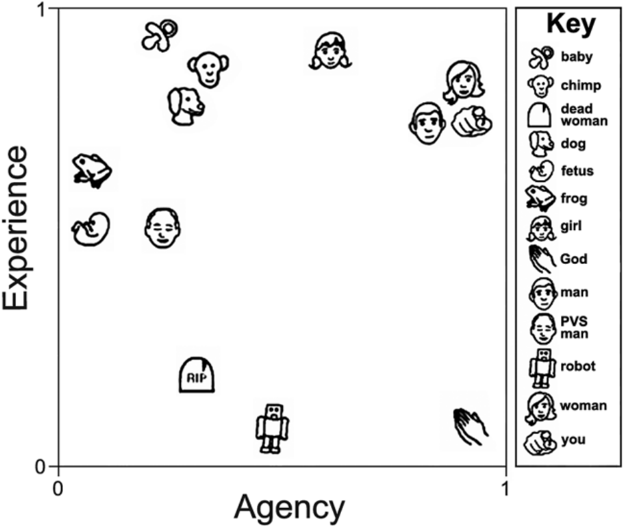
Participants compared the mental capacities of various human and nonhuman characters via online surveys. Factor analysis revealed two dimensions of mind perception, Experience (for example, capacity for hunger) and Agency (for example, capacity for self-control). The dimensions predicted different moral judgments but were both related to valuing of mind.
Overview
CoChat Summary
## TL;DR
This paper argues that mind perception is not a single continuum but instead has two dimensions: Experience and Agency. Using 2,399 completed web-based surveys, the authors found that these dimensions explain how people judge minds across 13 characters and are differentially related to moral judgments.
## Key findings
- A principal components factor analysis of correlations among 18 mental capacities yielded two factors with eigenvalues over 1.0: Experience (eigenvalue 15.85, explaining 88% of variance) and Agency (eigenvalue 1.46, explaining 8% of variance); the rotated solution explained 97% of rating variance.
- Experience loaded on 11 capacities: hunger, fear, pain, pleasure, rage, desire, personality, consciousness, pride, embarrassment, and joy; Agency loaded on 7 capacities: self-control, morality, memory, emotion recognition, planning, communication, and thought.
- Personal judgments tracked the dimensions differently: liking, saving from destruction, making happy, and perceiving a soul correlated with both dimensions, with r ranging from 0.38 to 0.72.
- Punishment judgments correlated more with Agency than Experience (r = 0.82 vs. r = 0.22, z = 2.86, P < 0.05), while avoidance of harm correlated more with Experience than Agency (r = 0.85 vs. r = 0.26, z = 2.10, P < 0.05).
## Methods
- Web-based Mind Survey design: respondents saw pairwise comparisons of 13 characters across 18 mental capacities or 6 personal judgments, using five-point scales for 78 comparisons per survey.
- Sample: about 3,400 survey launches, with 2,399 completed surveys analyzed; respondents ranged from 12 to 75 years old (mean 30.44, SD 12.27) and were 64% female.
- Main analysis: character means were computed, correlations across capacities were submitted to principal components factor analysis with varimax rotation, and factor scores were estimated via regression; additional analyses examined correlations with personal judgments and individual-difference variables using z-statistics.
## Limitations
- The paper states that the surveys were largely independent and that respondent data came from web recruitment through other psychology sites, which makes the sample a convenience sample rather than a random population sample.
- Evident from the text: the factor structure is based on self-selected web respondents and on pairwise judgments of preselected characters and capacities, so generalizability beyond the survey context is not directly tested.
- The paper notes that about 25% of launched surveys were not completed, indicating noncompletion/missing-data attrition.
Model-written summary. Check it against the paper before relying on it.
Integrity signals
Registry
Cites
Statistics
Figures
Verification
Claims the paper makes
0 Valid · 0 Not valid · 0 Not checked · 18 Own results and interpretations
A result the paper reports from its own data — it cites no other source for it, so there is none to check. The quote shows it is in the paper.
In the paper
“Characters ' factor scores on these dimensions (Fig. 1) reveal interesting features; for example, God was perceived as having much Agency but little Experience.”
- Also stated in: § Dimensions of Mind Perception · plain
“for example, God was perceived as having much Agency but little Experience.”
plain- Asserted: passes — The authors put it forward as true.
- Checkable: passes — It can be checked against evidence.
- Load-bearing: unclear — It is unclear whether the paper’s conclusions depend on it.
- Based: passes — The paper gives a reason why it holds.
- Also stated in: § Dimensions of Mind Perception · plain
A result the paper reports from its own data — it cites no other source for it, so there is none to check. The quote shows it is in the paper.
In the paper
“A factor we termed Experience (eigenvalue = 15.85) accounted for 88% of the variance and included 11 capacities (from highest loading): hunger, fear, pain, pleasure, rage, desire, personality, consciousness, pride, embarrassment, and joy.”
plain- Asserted: passes — The authors put it forward as true.
- Checkable: passes — It can be checked against evidence.
- Load-bearing: passes — The paper’s conclusions depend on it.
- Based: passes — The paper gives a reason why it holds.
A result the paper reports from its own data — it cites no other source for it, so there is none to check. The quote shows it is in the paper.
In the paper
“Of 234 z -statistics (13 characters × 9 individual difference variables × 2 factors), 23 were statistically significant.”
plain- Asserted: passes — The authors put it forward as true.
- Checkable: passes — It can be checked against evidence.
- Load-bearing: unclear — It is unclear whether the paper’s conclusions depend on it.
- Based: passes — The paper gives a reason why it holds.
A result the paper reports from its own data — it cites no other source for it, so there is none to check. The quote shows it is in the paper.
In the paper
“whereas desire to avoid harming ( ' If you were forced to harm one of these characters, which one would it be more painful for you to harm? ' ) correlated more with Experience ( r = 0.85) than Agency ( r = 0.26, z = 2.10, P < 0.05).”
plainstates an association- Asserted: passes — The authors put it forward as true.
- Checkable: passes — It can be checked against evidence.
- Load-bearing: passes — The paper’s conclusions depend on it.
- Based: passes — The paper gives a reason why it holds.
A result the paper reports from its own data — it cites no other source for it, so there is none to check. The quote shows it is in the paper.
In the paper
“The rotated solution accounted for all 18 capacities (extraction communalities ranged from 0.82 to 0.99), explained 97% of rating variance, and yielded two factors with eigenvalues over 1.0.”
plainstates an association- Asserted: passes — The authors put it forward as true.
- Checkable: passes — It can be checked against evidence.
- Load-bearing: passes — The paper’s conclusions depend on it.
- Based: passes — The paper gives a reason why it holds.
5 more claims
Create a free account to see all 18 claims and every source verdict.
- It may state two separate claims as one. 8
- Probably not a substantial claim. 1
Claims other papers make about this one
Each is checked against this paper’s own text: does it say what the citing paper says it does?
The source backs part of the claim, not all of it — or backs it for a different population, condition or comparison.
In the citing paper
“People also anthropomorphize a range of inanimate objects and animals (Kwan & Fiske, 2008; Gray, Gray, & Wegner, 2007).”
From Dehumanized Perception: A Psychological Means to Facilitate Atrocities, Torture, and Genocide? (2011) · cites this paper as Gray, Gray, & Wegner, 2007
Experimental — accuracy not yet measuredThe source backs part of the claim, not all of it — or backs it for a different population, condition or comparison.
In the citing paper
“work in social psychology has demonstrated that mental state attribution is not a unitary concept, but rather involves distinct and independent dimensions of ‘intelligence’ and ‘experience’.”
From The influence of mental state attributions on trust in large language models (2025) · cites this paper as [19]
Experimental — accuracy not yet measuredThe source backs part of the claim, not all of it — or backs it for a different population, condition or comparison.
In the citing paper
“Participants’ ratings for each of the 65 traits (Supplementary Fig. S1a) were reduced via a principal component analysis to two main dimensions, which together explained 58% of the variance (Supplementary Fig. S1b) and mapped onto previously identified dimensions of ‘experience’ (e.g. experiencing pleasure or feeling fearful) and ‘intelligence’ (e.g. knowing things or making choices; Gray et al. 2”
From Folk psychological attributions of consciousness to large language models (2024) · cites this paper as Gray et al. 2007
Experimental — accuracy not yet measuredThe cited source says what the claim attributes to it.
In the citing paper
“This dissociation is supported by factor analyses of ratings of a variety of mental states, which reveal two fundamental factors: agency, or the capacity for high-level reasoning and planning, and experience, or the capacity for sensations and emotions19”
From The influence of mental state attributions on trust in large language models (2025) · cites this paper as [19]
The cited source says what the claim attributes to it.
In the citing paper
“Other work has systematically explored the dimensions underlying mental state attributions to various agents, revealing a two-dimensional structure distinguishing between ‘Experience’ (i.e. the capacity to feel pain, fear, joy, or pride) and ‘Agency’ (i.e. the capacity to have self-control, morality, planning, or communication) that is reminiscent of the distinction between phenomenal and non-phen”
From Folk psychological attributions of consciousness to large language models (2024) · cites this paper as Gray et al. 2007
Statistics recomputed
Every reported test result, recomputed from its test statistic and degrees of freedom. A result shows as not adding up only once an independent check has confirmed it.
- Consistentz = 2.86reported p < .05 · recomputed p = .004
“z = 2.86, p < .05”
- Consistentz = 2.1reported p < .05 · recomputed p = .036
“z = 2.10, p < .05”
Self-check
Percentages, sums and reported differences re-computed from the paper’s own numbers.
Self-check results appear here once an independent check has confirmed them.
Citations
Cites
I.—COMPUTING MACHINERY AND INTELLIGENCE
TURING, A. M. (1950) · Mind · doi:10.1093/mind/lix.236.433 · Cited by 10,290
Does the chimpanzee have a theory of mind?
Premack, D., & Woodruff, G. (1978) · Behavioral and Brain Sciences · doi:10.1017/s0140525x00076512 · Cited by 8,743
Mindblindness: An Essay on Autism and Theory of Mind
Baron-Cohen, S. (1995) · doi:10.7551/mitpress/4635.001.0001 · Cited by 3,428
Dennett, D. C. (1996) · Medical Entomology and Zoology · Cited by 314
Research works printed but not linked: 1
- 1. A. Turing, Mind 59 , 433 (1950).
Cited by
Items 2,001–2,100 of 2,340
Reading the mind in infant eyes test: A measure of the recognition of infant emotion
Barnett, W., Garon‐Bissonnette, J., Carrow, C., Piersiak, H. A., Bailes, L. G., Ledgister, J., & Humphreys, K. L. (2025) · Development and Psychopathology · doi:10.1017/s0954579425000185 · Cited by 1
Ai Feedback vs. Human: Impact on Employee Behavior & PerformancePreprint
Houqe, M. N., Biswas, M. I., Talukder, M. S., Khan, A. R., & Kabir, M. N. (2025) · SSRN Electronic Journal · doi:10.2139/ssrn.5217569 · Cited by 1
Redefining Customer Behaviour with Service Robots: A Metaperception Lens via Bibliometric Analysis
Mukherjee, S., Das, M. K., Dass, S., & Chowdhury, M. (2025) · BENTHAM SCIENCE PUBLISHERS eBooks · doi:10.2174/9789815322071125010016
Shank, D. B. (2025) · Springer eBooks · doi:10.1007/978-3-031-86061-4_4
Shank, D. B. (2025) · Springer eBooks · doi:10.1007/978-3-031-86061-4_6
Xie, L., & Zhou, W. A. (2026) · Journal of Risk Research · doi:10.1080/13669877.2026.2722620 · Cited by 1
Beliefs About the Development of Mental Life
Weisman, K., King, L. S., & Humphreys, K. L. (2025) · Open Mind · doi:10.1162/opmi_a_00200 · Cited by 2
“By extension, the list included close variants on 14 of the 20 capacities evaluated in Gray et al.’s original study (Gray et al., 2007).”
InfluentialSöderlund, M. (2025) · Computers in Human Behavior Artificial Humans · doi:10.1016/j.chbah.2025.100163 · Cited by 1
Zhao, Z., Zou, X., & Xu, H. (2025) · International Theory and Practice in Humanities and Social Sciences · doi:10.70693/itphss.v2i5.21
Don’t be a saint: the influence of absent in-group favoritism or selflessness on perceived humanity
Yang, D., ouyang, T., & He, X. (2025) · Current Psychology · doi:10.1007/s12144-025-07909-6
“Prior research has primarily classified humanity perception along two dimensions—human nature and uniquely human (or experience and agency)—focusing on neutral or positive traits that differentiate humans from machines and animals (Gray et al., 2007, 2011; Haslam, 2006 ).”
Stigma Reduces AI Aversion: A Tradeoff between Judgment and Misinformation ConcernsPreprint
Bojd, B., Garimella, A., & Yin, H. (2025) · SSRN Electronic Journal · doi:10.2139/ssrn.5243372 · Cited by 2
The Human AffectomePreprint
Schiller, D., Yu, A. N. C., Alia‐Klein, N., Becker, S., Cromwell, H. C., Dolcos, F., Eslinger, P. J., Frewen, P., Kemp, A. H., Pace-Schott, E. F., et al. (2022) · PsyArXiv (OSF Preprints) · doi:10.31234/osf.io/9nu32_v1 · Cited by 5
Amici, F., Gomez-Melara, J. L., Majolo, B., Naranjo, R. A., Izar, P., Maulany, R. I., Ngakan, P. O., Sah, S. A. M., & Liebal, K. (2025) · iScience · doi:10.1016/j.isci.2025.112693 · Cited by 1
“21,57 Therefore, it is possible that individual anthropomorphic tendencies are modulated by the specific traits considered.”
Vicarious kin derogation—when and why people mock the innocent family members of political leaders
Tang, S., & Gray, K. J. (2025) · Journal of Experimental Social Psychology · doi:10.1016/j.jesp.2025.104781
Self-citationConsidering Fundamental Inequalities Offers a Path out of the Competitive Victimhood Trap
Shnabel, N. (2025) · Psychological Inquiry · doi:10.1080/1047840x.2025.2513810
“This worldview sees perpetrators as lacking moral patiency (i.e., eligibility for moral consideration; Gray et al., 2007), which might entitle to dismiss the grievances or even harm members of groups perceived to fall under the perpetrator category.”
Rheu, M., Peng, W., Molina, M. D., & Zhan, E. S. (2025) · SSRN Electronic Journal · doi:10.2139/ssrn.5340807
Heartless Rulez! Mechanical objectivity, empathic understanding, and the permissibility of AI
Schenk, P. (2025) · Frontiers in Sociology · doi:10.3389/fsoc.2025.1604709
“According to empirical research, respondents attribute less experiential mind to AI than humans (Gray et al., 2007; Shank and DeSanti, 2018).”
Decision strategy and perceived humanness: The roles of decision context and decision outcome
Zhang, H., Zhu, H., Wang, J., & Jin, Y. (2026) · Journal of Experimental Social Psychology · doi:10.1016/j.jesp.2026.104928
Robust Medusa Effect Across Facial ManipulationsPreprint
Han, J., Sasaki, K., Yonemitsu, F., et al. (2025) · SSRN Electronic Journal · doi:10.2139/ssrn.5352976
Re-Consider the Lobster: Animal Lives in Protein Supply ChainsPreprint
Ulrich, K. T. (2025) · SSRN Electronic Journal · doi:10.2139/ssrn.5374845
Kalimeris, J., Renz, S., Hofreiter, S., & Spörrle, M. (2025) · SSRN Electronic Journal · doi:10.2139/ssrn.5376824
When less is more: single selfhood-related cues elicit higher selfhood ratings than multiple cues
Pohl, J., Nikolovska, К., Maurelli, F., Kappas, A., & Hommel, B. (2026) · Frontiers in Cognition · doi:10.3389/fcogn.2026.1815906
Re-Consider the Lobster: Animal Lives in Protein Supply Chains
Ulrich, K. T. (2025) · Sustainability · doi:10.3390/su17157034
Xie, Z. (2025) · Psychology Health & Medicine · doi:10.1080/13548506.2025.2543906 · Cited by 1
“This theory delves into the cognitive mechanisms that enable individuals to interpret and predict the actions of others, be they human or non-human, based on the attribution of mind (H. M. Gray et al., 2007).”
Arnestad, M. N., Studzińska, A., Nordmo, M., & Matthiesen, S. B. (2025) · SN Business & Economics · doi:10.1007/s43546-025-00868-x · Cited by 5
“These roles are not seen as fluid but are rather psychologically rigid and mutually exclusive (Gray et al. 2007).”
Effect of Robot’s Active Behavior using Free Energy Principle on Perception of Agency*
Esaki, K., Kudo, Y., Matsumura, T., Kato, T., Owa, M., Miyakoshi, J., Asa, Y., Shao, Y., Mine, R., & Mizuno, H. (2025) · IEEE Workshop on Advanced Robotics and its Social Impacts (ARSO) · doi:10.1109/arso64737.2025.11124981
“Under the idea of intentionality based on human interpretation, most social robots have raised the perception of experience, which is one axis of Gray ’ s mind perception [6].”
Aktaş, A. (2025) · Journal of Turkish Studies · doi:10.7827/turkishstudies.80461
384385The Social Classification of Robots by Perceived Race and Gender
Barfield, J. K. (2025) · De Gruyter eBooks · doi:10.1515/9783111346632-018
Relationship with Feeling AI and Its Impact on Self-Disclosure: Use of AI in Travel Planning
Kotani, K. (2025) · Quarterly Journal of Marketing · doi:10.7222/marketing.2025.042
Fan, L., Li, S., Wang, C., & Zhang, X. (2025) · SSRN Electronic Journal · doi:10.2139/ssrn.5403350
Reappraising Intuitions About ConsciousnessPreprint
Kim, C., & Chong, S. C. (2025) · SSRN Electronic Journal · doi:10.2139/ssrn.5420626
Chen, Z., Liu, C., Ren, Y., et al. (2025) · SSRN Electronic Journal · doi:10.2139/ssrn.5434096
Framing Responsibility Human and AI Agent Effects on Apology Effectiveness in Service FailuresPreprint
Soh, J., & Kim, E. (2025) · SSRN Electronic Journal · doi:10.2139/ssrn.5492310
Awad, B. K. (2025) · Lecture notes in networks and systems · doi:10.1007/978-981-96-5013-2_19
Wei, S., Chen, D., Yu, S., Ren, Z., An, W., Liu, Z., & Pusetso, T. J. (2025) · SSRN Electronic Journal · doi:10.2139/ssrn.5551427
Kavuza, N. F., Goo, H. G., & Truong, K. P. (2025) · ACM International Conference on Intelligent Virtual Agents (IVA) · doi:10.1145/3717511.3749305
Moriguchi, Y., Watanabe, R., Hori, Y., & Reyes‐Jaquez, B. (2026) · Humanities and Social Sciences Communications · doi:10.1057/s41599-026-07511-6
“…investigations indicate that while the basic agent structure is similar across both Western (e.g. USA) and non-Western (e.g. Japan) populations (Gray et al., 2007; Takahashi et al., 2016), attitudes toward and anthropomorphic tendencies regarding AI can vary depending on cultural context…”
InfluentialDecoding Auditors’ Algorithm Aversion in Complex Estimate: A Multifaceted Understanding and SolutionPreprint
Yang, J., Marrone, M., & Amrollahi, A. (2025) · SSRN Electronic Journal · doi:10.2139/ssrn.5641717 · Cited by 1
Phelan, M. (2025) · Mind & Language · doi:10.1111/mila.70000
“These studies include: (cid:129) Gray et al. (2007) found that a robot and God were assessed as less capable of experiential states (e.g., feeling pain, experiencing pride) than a host of other, biologically embodied entities (e.g., a frog, an infant, an adult woman).”
InfluentialPolitics, Religion, and the Empiring of Languages in Brazil, Colombia, and Ukraine
Goodman, B. A., Ortega, Y., & Barros, S. R. (2025) · Oxford University Press eBooks · doi:10.1093/oxfordhb/9780192869203.013.36
The Representation of Minority People in Kazakhstan School Textbooks: The Invisible 130
Smagulova, J., & Narymbetova, K. (2025) · Oxford University Press eBooks · doi:10.1093/oxfordhb/9780192869203.013.40
Understanding Linguistic Prejudice through Linguistic Landscapes
Izadi, D. (2025) · Oxford University Press eBooks · doi:10.1093/oxfordhb/9780192869203.013.24
Sultana, S. (2025) · Oxford University Press eBooks · doi:10.1093/oxfordhb/9780192869203.013.26
The Symbolic Power of Written Language in the Andes
Godenzzi, J. C. (2025) · Oxford University Press eBooks · doi:10.1093/oxfordhb/9780192869203.013.31
Paterson, L. L. (2025) · Oxford University Press eBooks · doi:10.1093/oxfordhb/9780192869203.013.38
Culturally and Linguistically Diverse Language Learners in the Australian Education System
Steele, C., Oliver, R., & Holzberger, N. (2025) · Oxford University Press eBooks · doi:10.1093/oxfordhb/9780192869203.013.14 · Cited by 1
Language, (De)colonization, and the Curriculum
Bauler, C. V., & Cushing, I. R. (2025) · Oxford University Press eBooks · doi:10.1093/oxfordhb/9780192869203.013.30
Language Guidelines as the Frontier of Anti-Prejudicial Prescriptivism
Malory, B. (2025) · Oxford University Press eBooks · doi:10.1093/oxfordhb/9780192869203.013.39 · Cited by 2
Combatting Inequalities of Multilingualism Online
Tupas, R. (2025) · Oxford University Press eBooks · doi:10.1093/oxfordhb/9780192869203.013.32 · Cited by 1
Twitter as an Online Counter-Pedagogy to Linguistic Prejudice
Ramjattan, V. A. (2025) · Oxford University Press eBooks · doi:10.1093/oxfordhb/9780192869203.013.34 · Cited by 1
Social Status and Linguistic Prejudice in Brazil
Massini-Cagliari, G. (2025) · Oxford University Press eBooks · doi:10.1093/oxfordhb/9780192869203.013.20
Xu, Y., & Fang, F. (2025) · Oxford University Press eBooks · doi:10.1093/oxfordhb/9780192869203.013.29
Language Prejudice and Discrimination on Social Media Platforms in Southern Africa
Set, B., Mpofu, P., & Chari, T. J. (2025) · Oxford University Press eBooks · doi:10.1093/oxfordhb/9780192869203.013.22
Soler, J., & Morales‐Gálvez, S. (2025) · Oxford University Press eBooks · doi:10.1093/oxfordhb/9780192869203.013.35
Examining Discrimination and Prejudice as Emerging Constructs in Health Communication Scholarship
Dillon, P., Siegenthaler, B., & Basu, A. (2025) · Oxford University Press eBooks · doi:10.1093/oxfordhb/9780192869203.013.23
Sauntson, H. (2025) · Oxford University Press eBooks · doi:10.1093/oxfordhb/9780192869203.013.4
(2025) · Oxford University Press eBooks · doi:10.1093/oxfordhb/9780192869203.002.0006
Voice Quality, Pitch, and Gender Discrimination
Pearce, J., Setter, J. E., & Arvaniti, A. (2025) · Oxford University Press eBooks · doi:10.1093/oxfordhb/9780192869203.013.5
Incredible Language and Refugee Legal Processes: Challenging Asylum Credibility Assessments
Smith‐Khan, L. (2025) · Oxford University Press eBooks · doi:10.1093/oxfordhb/9780192869203.013.25
Samuelsson, C., Müller, N., & Hydén, L. (2025) · Oxford University Press eBooks · doi:10.1093/oxfordhb/9780192869203.013.9
Linguistic Prejudice and Discrimination against Autistic People
Aydos, V., Magnani, L. H., & Rückert, G. H. (2025) · Oxford University Press eBooks · doi:10.1093/oxfordhb/9780192869203.013.8
(De)Valuing Heritage Languages across Time and Space
Korne, H. D., Purkarthofer, J., & Obojska, M. A. (2025) · Oxford University Press eBooks · doi:10.1093/oxfordhb/9780192869203.013.12 · Cited by 1
Singh, J. N. (2025) · Oxford University Press eBooks · doi:10.1093/oxfordhb/9780192869203.013.2
Watt, D. J. L. (2025) · Oxford University Press eBooks · doi:10.1093/oxfordhb/9780192869203.013.17
(2025) · Oxford University Press eBooks · doi:10.1093/oxfordhb/9780192869203.002.0004
Milak, E., & Tankosić, A. (2025) · Oxford University Press eBooks · doi:10.1093/oxfordhb/9780192869203.013.11
Cultural Stigmatization and Linguistic Prejudice in Deaf Education in Ghana
Akanlig-Pare, G., & Edward, M. I. (2025) · Oxford University Press eBooks · doi:10.1093/oxfordhb/9780192869203.013.6
Language and Discursive Production of Blind Subjects: A Study of Gujarati Small Stories
Maheshwari, Z. (2025) · Oxford University Press eBooks · doi:10.1093/oxfordhb/9780192869203.013.7
Faloppa, F. (2025) · Oxford University Press eBooks · doi:10.1093/oxfordhb/9780192869203.013.15 · Cited by 1
Yu, T. (2025) · Oxford University Press eBooks · doi:10.1093/oxfordhb/9780192869203.013.1
The Oxford Handbook of Language and Prejudice
Ramjattan, V. A., Yu, T., Singh, J. N., Tudisco, J. J., Sauntson, H., Pearce, J., Setter, J., Arvaniti, A., Akanlig-Pare, G., (24095564), M. E., et al. (2025) · Oxford University Press eBooks · doi:10.1093/oxfordhb/9780192869203.001.0001 · Cited by 2
The Role of Metaphor and Indexicality in the Reinforcement of Social Meanings of Disability
Hermeston, R. (2025) · Oxford University Press eBooks · doi:10.1093/oxfordhb/9780192869203.013.10
Sayat, R. A., & Bozo, Ö. (2025) · BMC Psychology · doi:10.1186/s40359-025-03490-6 · Cited by 1
“…among meat-eaters, this study aims to translate and adapt the relevant measures, i.e., the 4Ns Scale and Motivations to Continue to Eat Meat Scale by Piazza et al. [42], and the Meat-Eating Justification Scale (MEJ) by Rothgerber [46], and the Mind Attribution Scale by Gray et al. [17] to Turkish.”
InfluentialObaidi, M., & Kunst, J. (2025) · Cambridge University Press eBooks · doi:10.1017/9781009407892.014
Buss, M., Metzger, M. J., & Kearney, E. (2025) · Journal of Applied Social Psychology · doi:10.1111/jasp.70028 · Cited by 2
Lees, J. M., Tang, S., & Sidanius, J. (2025) · Social Psychological and Personality Science · doi:10.1177/19485506251383988
“According to this model, mind perception is generally split along two dimensions (Gray et al., 2007)— agency (the capacity to do things like planning and communicating) and experience (the capacity to feel, such as emoting).”
傅, 翌. (2023) · Advances in Psychology · doi:10.12677/ap.2023.138423
Dong, Y., Wang, X., Ma, M. Z., & Poon, K. (2025) · Journal of Happiness Studies · doi:10.1007/s10902-025-00973-6
“In accordance, the Mind Attribution Theory (MAT; Gray et al., 2007) suggests that experience (e.g., emotionality, corresponding to human nature) and agency (e.g., self-control, corresponding to human uniqueness) are two key elements of mind perception.”
Ageism in media, entertainment, and culture
MacDonald, C., Boxley, E., Foreman, E., & McIntyre, M. (2025) · Elsevier eBooks · doi:10.1016/b978-0-443-33827-4.00011-0
Anchoring Anthropological Categories in Simple, Translatable Words: The Case of “Art” and “Religion”
Goddard, C., & Wierzbicka, A. (2025) · Current Anthropology · doi:10.1086/739001 · Cited by 1
Bevilacqua, M., Kormylo, C., & Pedraza‐Martinez, A. J. (2025) · SSRN Electronic Journal · doi:10.2139/ssrn.5931455
Developing Future Wearable Interfaces for Human-Drone Teams through a Virtual Drone Search GamePreprint
Zemedie, M., & Fraune, M. R. (2021) · OSF Preprints (OSF Preprints)
Understanding dehumanization: The role of agency and communionPreprint
Goldenberg, A., & Formanowicz, M. (2019) · OSF Preprints (OSF Preprints)
Thornton, M. A., & Tamir, D. (2022) · OSF Preprints (OSF Preprints)
The instability of sensitivity to false beliefs: How and why
Huang, Q., & Liu, X. (2025) · Developmental Review · doi:10.1016/j.dr.2025.101231
Hanson, R. (2016) · Oxford University Press eBooks · doi:10.1093/oso/9780198754626.002.0001
Hanson, R. (2016) · Oxford University Press eBooks · doi:10.1093/oso/9780198754626.002.0002
Understanding Consumer Engagement with AI Fashion Design
Lee, G., & Kim, H.-Y. (2025) · Springer eBooks · doi:10.1007/978-3-031-75316-9_40-1
Investigating the Similarity-Attraction Effect on Personality in Human-Robot Interactions
Nardelli, A., Corrao, F., Sgorbissa, A., & Recchiuto, C. T. (2025) · Lecture notes in computer science · doi:10.1007/978-981-95-2398-6_19
Robust Medusa effect across facial manipulations
Han, J., Sasaki, K., Yonemitsu, F., Takashima, K., & Yamada, Y. (2025) · Cognition · doi:10.1016/j.cognition.2025.106419
Sun, Y., Zhang, X., Wen, K., Yin, H., & Shi, C. (2025) · Computers in Human Behavior Reports · doi:10.1016/j.chbr.2025.100923
BEYDOĞAN, G. Ş. (2025) · Selçuk Üniversitesi Sosyal Bilimler Enstitüsü Dergisi · doi:10.52642/susbed.1623285 · Cited by 1
Yang, W., Zhang, J., Jiang, Y., & Guo, G. (2026) · International Journal of Human-Computer Interaction · doi:10.1080/10447318.2025.2610759
“The HRI literature has consistently shown that fundamental psychological processes, such as mind perception, are key determinants of human responses to robots (Gray et al., 2007; Waytz et al., 2014).”
Shalev, I., & Yaakobi, E. (2026) · Neuroethics · doi:10.1007/s12152-025-09630-4
“Scores on both experience and agency tend to differ, with people attributing high scores on both to themselves, low scores to the deceased, and high experience but low agency to infants [13].”
InfluentialEffects of Makeup on Dehumanization—The Mediating Effect of Facial Attractiveness
吴, 诺. (2026) · Advances in Psychology · doi:10.12677/ap.2026.161025
Fictional prototypes of AI–human coexistence and relationality
Hoshino, J. (2026) · AI & Society · doi:10.1007/s00146-025-02830-9
“Gray et al. (2007) conceptualize mind perception along two dimensions: agency (the capacity for autonomous action) and experience (the capacity for subjective feeling).”
Toward a predictive model of moral concern
Jaeger, B., Wilks, M., & Lissa, C. J. V. (2026) · Journal of Experimental Social Psychology · doi:10.1016/j.jesp.2026.104880
A world without violet: peculiar consequences of granting moral status to Artificial Intelligences
Topan, S. (2026) · AI & Society · doi:10.1007/s00146-025-02834-5 · Cited by 1
“Several studies have shown that humans tend to empathize with robots, intuitively granting them moral worth and reacting negatively to their mistreatment (Gray et al. 2007; Slater et al. 2006; Sommer et al. 2019; Suzuki et al. 2015).”
Plante, C. N., Piasecki, D., Moodley, J., Reysen, S., Roberts, S. E., & Gerbasi, K. C. (2026) · Anthrozoös · doi:10.1080/08927936.2026.2614162
“One reason is because anthropomorphized entities are granted greater moral concern and agency (Bandura, 1999; Gray et al., 2007).”
Status, identity, and territoriality: comparing human-human and human-AI encounters
Xin, B.-G., Ding, J., Peng, W., & Tan, H. (2026) · Current Psychology · doi:10.1007/s12144-025-08623-z
“(3) Perceived AI Anthropomorphism For participants in the AI conditions (Groups 3–6), we measured perceived anthropomorphism using five items adapted from scales assessing agency and experience perceptions (Jin et al., 2025; Gray et al., 2007).”
Metadata
- Authors
- Gray, H. M., Gray, K., & Wegner, D. M.
- Affiliations
- Harvard University (US)
- Corresponding author
- Gray, Heather M.
- Venue
- Science
- Published
- 2007-02-02
- Volume
- 315
- Issue
- 5812
- Pages
- 619-619
- ISSN
- 0036-8075 (ISSN-L)
- 1095-9203
- OpenAlex
- W2131227926
- Cited by
- 2,342
- References
- 4
- Citations by year
- 2026: 359 · 2025: 326 · 2024: 249 · 2023: 220 · 2022: 198 · 2021: 156 · 2020: 157 · 2019: 107 · 2018: 91 · 2017: 86 · 2016: 96 · 2015: 66 · 2014: 52 · 2013: 44 · 2012: 45
- FWCI
- 10.81
- Type
- journal article
- Language
- en
- Open access
- closed
- Locations
- Science (publishedVersion)
- PubMed (publishedVersion)
- Funders
- National Institutes of Health (1f31mh071053-01)
- National Institute of Mental Health (MH-71053, MH 49127, R01MH049127)
- Topics
- Life Sciences › Neuroscience › Cognitive Neuroscience › Psychology of Moral and Emotional Judgment
- Social Sciences › Psychology › Social Psychology › Social Robot Interaction and HRI
- Social Sciences › Sociology and Political Science › Social and Intergroup Psychology
- Keywords
- mind perception, moral judgment, agency, experience, non-human animals, personification, moral status of animals, self-control, hunger
- MeSH terms
- Adolescent, Adult, Aged, Child, Emotions, Female, Humans, Male, Mental Processes, Middle Aged, Morals, Perception, Personality, Principal Component Analysis
About these checks
Registry, retraction, Cites and statistics results are computed, not judged, with one exception: a printed reference that no index lists is read once by a model before it counts as a citation error. Claims are extracted by a model and kept only when their quote appears verbatim in the text; each cited source is then checked, with a model’s help, for whether it says what the claim relies on. Those verdicts can be wrong — read the claim’s quote and the cited source before relying on one.
A language model drew the claims from the paper on 2026-09-28, under version 3 of the claim definition (model deepseek-v4.1-flash, prompt extract-v3).
A second model labelled each claim on 2026-09-28 (model jev-1.13-20260917, definition revision gold-guideline-v0.2).
Statistics and arithmetic are recomputed, not judged.
Confidence bands are shown only for fields calibrated on our annotated test set. None is calibrated yet, so no band is shown.
What counts as a claim ›How we measure confidence ›How we check this ›
Are you an author, or do you see a problem with this page? Request a review
Data sources
Bibliographic data: Semantic Scholar, OpenAlex, Crossref.
Contains information from the Semantic Scholar Academic Graph Datasets, made available under the ODC Attribution License (ODC-BY 1.0).
Semantic Scholar’s data is described in: Kinney, R., et al. (2023). The Semantic Scholar Open Data Platform. arXiv:2301.10140.
