

Dimensions of Mind Perception
The DOI matches its Crossref record; 4 of the 4 references it cites were found in a registry or an index.
Abstract
Participants compared the mental capacities of various human and nonhuman characters via online surveys. Factor analysis revealed two dimensions of mind perception, Experience (for example, capacity for hunger) and Agency (for example, capacity for self-control). The dimensions predicted different moral judgments but were both related to valuing of mind.
Overview
CoChat Summary
## TL;DR
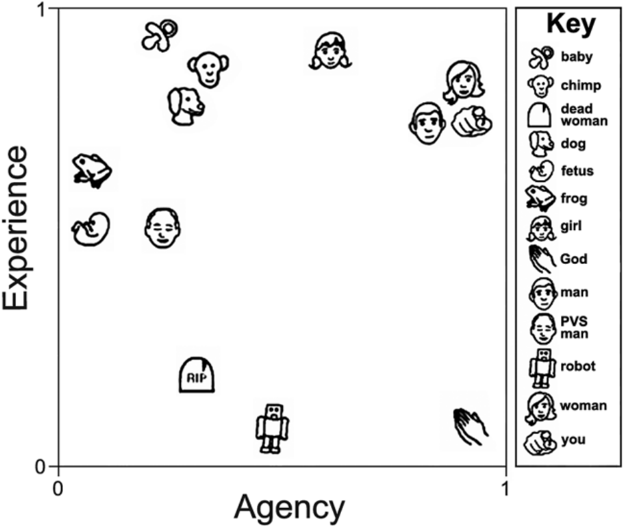
This paper argues that mind perception is not a single continuum but instead has two dimensions: Experience and Agency. Using 2,399 completed web-based surveys, the authors found that these dimensions explain how people judge minds across 13 characters and are differentially related to moral judgments.
## Key findings
- A principal components factor analysis of correlations among 18 mental capacities yielded two factors with eigenvalues over 1.0: Experience (eigenvalue 15.85, explaining 88% of variance) and Agency (eigenvalue 1.46, explaining 8% of variance); the rotated solution explained 97% of rating variance.
- Experience loaded on 11 capacities: hunger, fear, pain, pleasure, rage, desire, personality, consciousness, pride, embarrassment, and joy; Agency loaded on 7 capacities: self-control, morality, memory, emotion recognition, planning, communication, and thought.
- Personal judgments tracked the dimensions differently: liking, saving from destruction, making happy, and perceiving a soul correlated with both dimensions, with r ranging from 0.38 to 0.72.
- Punishment judgments correlated more with Agency than Experience (r = 0.82 vs. r = 0.22, z = 2.86, P < 0.05), while avoidance of harm correlated more with Experience than Agency (r = 0.85 vs. r = 0.26, z = 2.10, P < 0.05).
## Methods
- Web-based Mind Survey design: respondents saw pairwise comparisons of 13 characters across 18 mental capacities or 6 personal judgments, using five-point scales for 78 comparisons per survey.
- Sample: about 3,400 survey launches, with 2,399 completed surveys analyzed; respondents ranged from 12 to 75 years old (mean 30.44, SD 12.27) and were 64% female.
- Main analysis: character means were computed, correlations across capacities were submitted to principal components factor analysis with varimax rotation, and factor scores were estimated via regression; additional analyses examined correlations with personal judgments and individual-difference variables using z-statistics.
## Limitations
- The paper states that the surveys were largely independent and that respondent data came from web recruitment through other psychology sites, which makes the sample a convenience sample rather than a random population sample.
- Evident from the text: the factor structure is based on self-selected web respondents and on pairwise judgments of preselected characters and capacities, so generalizability beyond the survey context is not directly tested.
- The paper notes that about 25% of launched surveys were not completed, indicating noncompletion/missing-data attrition.
Model-written summary. Check it against the paper before relying on it.
Integrity signals
Registry
Cites
Statistics
Figures
Verification
Claims the paper makes
0 Valid · 0 Not valid · 0 Not checked · 18 Own results and interpretations
A result the paper reports from its own data — it cites no other source for it, so there is none to check. The quote shows it is in the paper.
In the paper
“Characters ' factor scores on these dimensions (Fig. 1) reveal interesting features; for example, God was perceived as having much Agency but little Experience.”
- Also stated in: § Dimensions of Mind Perception · plain
“for example, God was perceived as having much Agency but little Experience.”
plain- Asserted: passes — The authors put it forward as true.
- Checkable: passes — It can be checked against evidence.
- Load-bearing: unclear — It is unclear whether the paper’s conclusions depend on it.
- Based: passes — The paper gives a reason why it holds.
- Also stated in: § Dimensions of Mind Perception · plain
A result the paper reports from its own data — it cites no other source for it, so there is none to check. The quote shows it is in the paper.
In the paper
“A factor we termed Experience (eigenvalue = 15.85) accounted for 88% of the variance and included 11 capacities (from highest loading): hunger, fear, pain, pleasure, rage, desire, personality, consciousness, pride, embarrassment, and joy.”
plain- Asserted: passes — The authors put it forward as true.
- Checkable: passes — It can be checked against evidence.
- Load-bearing: passes — The paper’s conclusions depend on it.
- Based: passes — The paper gives a reason why it holds.
A result the paper reports from its own data — it cites no other source for it, so there is none to check. The quote shows it is in the paper.
In the paper
“Of 234 z -statistics (13 characters × 9 individual difference variables × 2 factors), 23 were statistically significant.”
plain- Asserted: passes — The authors put it forward as true.
- Checkable: passes — It can be checked against evidence.
- Load-bearing: unclear — It is unclear whether the paper’s conclusions depend on it.
- Based: passes — The paper gives a reason why it holds.
A result the paper reports from its own data — it cites no other source for it, so there is none to check. The quote shows it is in the paper.
In the paper
“whereas desire to avoid harming ( ' If you were forced to harm one of these characters, which one would it be more painful for you to harm? ' ) correlated more with Experience ( r = 0.85) than Agency ( r = 0.26, z = 2.10, P < 0.05).”
plainstates an association- Asserted: passes — The authors put it forward as true.
- Checkable: passes — It can be checked against evidence.
- Load-bearing: passes — The paper’s conclusions depend on it.
- Based: passes — The paper gives a reason why it holds.
A result the paper reports from its own data — it cites no other source for it, so there is none to check. The quote shows it is in the paper.
In the paper
“The rotated solution accounted for all 18 capacities (extraction communalities ranged from 0.82 to 0.99), explained 97% of rating variance, and yielded two factors with eigenvalues over 1.0.”
plainstates an association- Asserted: passes — The authors put it forward as true.
- Checkable: passes — It can be checked against evidence.
- Load-bearing: passes — The paper’s conclusions depend on it.
- Based: passes — The paper gives a reason why it holds.
5 more claims
Create a free account to see all 18 claims and every source verdict.
- It may state two separate claims as one. 8
- Probably not a substantial claim. 1
Claims other papers make about this one
Each is checked against this paper’s own text: does it say what the citing paper says it does?
The source backs part of the claim, not all of it — or backs it for a different population, condition or comparison.
In the citing paper
“People also anthropomorphize a range of inanimate objects and animals (Kwan & Fiske, 2008; Gray, Gray, & Wegner, 2007).”
From Dehumanized Perception: A Psychological Means to Facilitate Atrocities, Torture, and Genocide? (2011) · cites this paper as Gray, Gray, & Wegner, 2007
Experimental — accuracy not yet measuredThe source backs part of the claim, not all of it — or backs it for a different population, condition or comparison.
In the citing paper
“work in social psychology has demonstrated that mental state attribution is not a unitary concept, but rather involves distinct and independent dimensions of ‘intelligence’ and ‘experience’.”
From The influence of mental state attributions on trust in large language models (2025) · cites this paper as [19]
Experimental — accuracy not yet measuredThe source backs part of the claim, not all of it — or backs it for a different population, condition or comparison.
In the citing paper
“Participants’ ratings for each of the 65 traits (Supplementary Fig. S1a) were reduced via a principal component analysis to two main dimensions, which together explained 58% of the variance (Supplementary Fig. S1b) and mapped onto previously identified dimensions of ‘experience’ (e.g. experiencing pleasure or feeling fearful) and ‘intelligence’ (e.g. knowing things or making choices; Gray et al. 2”
From Folk psychological attributions of consciousness to large language models (2024) · cites this paper as Gray et al. 2007
Experimental — accuracy not yet measuredThe cited source says what the claim attributes to it.
In the citing paper
“This dissociation is supported by factor analyses of ratings of a variety of mental states, which reveal two fundamental factors: agency, or the capacity for high-level reasoning and planning, and experience, or the capacity for sensations and emotions19”
From The influence of mental state attributions on trust in large language models (2025) · cites this paper as [19]
The cited source says what the claim attributes to it.
In the citing paper
“Other work has systematically explored the dimensions underlying mental state attributions to various agents, revealing a two-dimensional structure distinguishing between ‘Experience’ (i.e. the capacity to feel pain, fear, joy, or pride) and ‘Agency’ (i.e. the capacity to have self-control, morality, planning, or communication) that is reminiscent of the distinction between phenomenal and non-phen”
From Folk psychological attributions of consciousness to large language models (2024) · cites this paper as Gray et al. 2007
Statistics recomputed
Every reported test result, recomputed from its test statistic and degrees of freedom. A result shows as not adding up only once an independent check has confirmed it.
- Consistentz = 2.86reported p < .05 · recomputed p = .004
“z = 2.86, p < .05”
- Consistentz = 2.1reported p < .05 · recomputed p = .036
“z = 2.10, p < .05”
Self-check
Percentages, sums and reported differences re-computed from the paper’s own numbers.
Self-check results appear here once an independent check has confirmed them.
Citations
Cites
I.—COMPUTING MACHINERY AND INTELLIGENCE
TURING, A. M. (1950) · Mind · doi:10.1093/mind/lix.236.433 · Cited by 10,290
Does the chimpanzee have a theory of mind?
Premack, D., & Woodruff, G. (1978) · Behavioral and Brain Sciences · doi:10.1017/s0140525x00076512 · Cited by 8,743
Mindblindness: An Essay on Autism and Theory of Mind
Baron-Cohen, S. (1995) · doi:10.7551/mitpress/4635.001.0001 · Cited by 3,428
Dennett, D. C. (1996) · Medical Entomology and Zoology · Cited by 314
Research works printed but not linked: 1
- A. Turing, Mind59, 433 (1950).
Cited by
Items 1,601–1,700 of 2,340
Khatry, P., Manokara, K., & Harris, L. T. (2020) · OSF Preprints (OSF Preprints) · doi:10.31219/osf.io/7th92 · Cited by 2
Embodied social robots trigger gaze following in real-timePreprint
Wiese, E., Weis, P. P., & Lofaro, D. M. (2018) · doi:10.31234/osf.io/8cx3s · Cited by 2
Exploring the relationship between anthropomorphism and Theory-of-Mind in brain and behaviourPreprint
Hortensius, R., Kent, M., Darda, K. M., Jastrzab, L. E., Koldewyn, K., Ramsey, R., & Cross, E. S. (2020) · PsyArXiv (OSF Preprints) · doi:10.31234/osf.io/3uj4g · Cited by 3
Virtually in Love: The Role of Anthropomorphism in Virtual Romantic RelationshipsPreprint
Koike, M., Loughnan, S., & Stanton, S. C. E. (2022) · doi:10.31234/osf.io/3vtcz · Cited by 2
Knowledge cues to human origins facilitate self-disclosure during interactions with chatbotsPreprint
Warren-Smith, G., Laban, G., Pacheco, E.-M., et al. (2023) · doi:10.31234/osf.io/7qsdn · Cited by 2
When Your Boss is an Algorithm: The Effect of Algorithmic Management on Worker PerformancePreprint
Margalit, Y., & Raviv, S. (2024) · Social Science Research Network · doi:10.2139/ssrn.4776355 · Cited by 5
Lin, S. (2024) · DR-NTU (Nanyang Technological University) · doi:10.32657/10356/181390 · Cited by 4
Au, R. H. Y., & Cheung, H. (2021) · Cognitive Development · doi:10.1016/j.cogdev.2021.101087 · Cited by 2
The second-order problem of other minds
Friedman, O., & Tasimi, A. (2023) · Behavioral and Brain Sciences · doi:10.1017/s0140525x22001443 · Cited by 1
Motivational Priorities Reflect Beliefs About God's Attributes
Nakkawita, E., & Heiphetz, L. (2023) · Social Cognition · doi:10.1521/soco.2023.41.3.239 · Cited by 1
Winkle, K., & Moradbakhti, L. (2023) · IEEE RO-MAN · doi:10.1109/ro-man57019.2023.10309488 · Cited by 2
“In this work, we investigate the impact of manipulating SAR agency , by which we generally mean the SAR’s capacity to autonomously “get on with things” (c.f. the capacity for self-control in Gray et al.’s definition of agency in the context of mind perception [9]).”
BackgroundAesthetic Motivation Impacts Judgments of Others’ Prosociality and Mental Life
Agrawal, T., & Schachner, A. (2023) · Open Mind · doi:10.1162/opmi_a_00113 · Cited by 3
“…participants were asked to make judgments not only about characters of interest (two characters who engaged in an activity, for aesthetic vs. non-aesthetic reasons), but also about a number of distractor characters (e.g., a sociable robot, a frog, a baby, etc., adapted from Gray et al., 2007).”
BackgroundMethodResultInfluentialHow Psychedelics Can Increase Moral Concern
Dillion, D., Puryear, C., & Gray, K. J. (2024) · Oxford University Press eBooks · doi:10.1093/oxfordhb/9780192844064.013.22 · Cited by 1
Self-citationGendered and Machine-like Features in Voices Affect Social Judgments
Neuenswander, K. L., Bryant, G. A., & Stroessner, S. J. (2024) · IEEE RO-MAN · doi:10.1109/ro-man60168.2024.10731140 · Cited by 2
Sunk cost predictions as theory of mind
Howard, A., Sehl, C. G., Denison, S., & Friedman, O. (2024) · Judgment and Decision Making · doi:10.1017/jdm.2024.25 · Cited by 1
“…the bias: In the first experiment, participants generally predicted that robots would show bias, despite strongly denying that robots could feel regret (a finding consistent with earlier work looking at beliefs about robots’ capacities to feel emotions; Gray et al., 2007; Weisman et al., 2017, 2021).”
Moral Categorization and Mind Perception
Robbins, P. (2025) · Cambridge University Press eBooks · doi:10.1017/9781108894357.012 · Cited by 1
The Double Standard of Ownership
Washington, Z., & Friedman, O. (2025) · Open Mind · doi:10.1162/opmi_a_00190 · Cited by 1
“Also, while people often withhold blame from agents that lack certain mental abilities (Gray et al., 2007), they may nonetheless be willing to praise these agents; as discussed above, people give less weight to intentionality and other mental states when evaluating morally good than bad acts…”
Liu, P., Li, S., Zhang, L., & Li, W. (2025) · Asia Pacific Journal of Marketing and Logistics · doi:10.1108/apjml-10-2024-1489 · Cited by 2
Being alive: how biology, agency and naturalness predict English speakers' understanding of life
Rissman, L. (2026) · Acta Psychologica · doi:10.1016/j.actpsy.2026.106891 · Cited by 1
Matching Effect of Algorithm Participation Form and Task Type on User Algorithm Appreciation
Chen, L.-H. (2025) · BDICN · doi:10.1145/3727353.3727470 · Cited by 1
“The mind perception theory proposed by Gray et al.[10] attributes human ”minds” to two dimensions: Agency (capacities such as reasoning and analysis) and Experience (capacities such as empathy and experiencing).”
A More Ordinary Ordinary View of the “What it is Like”-Talk
Wyrwa, M. (2025) · Philosophia · doi:10.1007/s11406-025-00865-2 · Cited by 1
Rasset, P., Fleury, M., Cabé, N., & Mange, J. (2025) · Journal of Applied Social Psychology · doi:10.1111/jasp.70008 · Cited by 1
Han, X., Liu, H., Li, S., & Zhang, M. (2025) · International Journal of Human-Computer Interaction · doi:10.1080/10447318.2025.2562957 · Cited by 1
“Based on this perception, consumers tend to rationally assume that machine-controlled VRs do not possess real experiential capabilities—regardless of the type of experience (Gray et al., 2007).”
Selfhood-attribution in a social context: further evidence for a Pars-Pro-Toto account
Pohl, J., Nikolovska, К., Maurelli, F., Kappas, A., & Hommel, B. (2025) · Frontiers in Psychology · doi:10.3389/fpsyg.2025.1528172 · Cited by 3
“While many theories of mind perception commonly either have a narrow focus [e.g., on agency and experience, Gray et al. (2007)] or are concerned with inferring specific mental states such as intentions (e.g., Theory of Mind, Frith and Frith, 2005; and Intentional Stance, Dennett, 1989) the…”
Textual or visual: consumer responses to compensation after AISA service failure
Xie, C., Zhao, M., Yang, C., & Chang, E.-C. (2025) · European Journal of Marketing · doi:10.1108/ejm-07-2023-0524 · Cited by 2
Chen, K. (2025) · Human Behavior and Emerging Technologies · doi:10.1155/hbe2/5581926 · Cited by 1
Drummond, R., & Ryan, S. J. (2025) · Oxford University Press eBooks · doi:10.1093/oxfordhb/9780192869203.013.33 · Cited by 3
Anti-Trans, Anti-Gender, and Transphobic Language
Tudisco, J. J. (2025) · Oxford University Press eBooks · doi:10.1093/oxfordhb/9780192869203.013.37 · Cited by 1
Age, Ageism, and Ageist Language
MacDonald, C., Peoples, C., Inker, J., & Gendron, T. L. (2025) · Oxford University Press eBooks · doi:10.1093/oxfordhb/9780192869203.013.19 · Cited by 1
Dryden, S., Wang, M., & Dovchin, S. (2025) · Oxford University Press eBooks · doi:10.1093/oxfordhb/9780192869203.013.16 · Cited by 2
Matras, Y. (2025) · Oxford University Press eBooks · doi:10.1093/oxfordhb/9780192869203.013.13 · Cited by 2
Söderlund, M. (2025) · Services Marketing Quarterly · doi:10.1080/15332969.2025.2579465 · Cited by 1
“Morality is the cognitive capacity to assign moral values (i.e., wrong vs. right) to actions (DeScioli & Kurzban, 2009) and to be able to distinguish between these two values (Gray et al., 2007).”
InfluentialBeyond the Responsibility Gap: Distributed Non-anthropocentric Responsibility in the AI Era
Noh, H. (2025) · Topoi · doi:10.1007/s11245-025-10302-4 · Cited by 6
Söderlund, M. (2025) · Journal of Retailing and Consumer Services · doi:10.1016/j.jretconser.2025.104638 · Cited by 2
Lee, G., Kim, J., Kim, K., Huh, J. Y., & Park, J. J. (2025) · Journal of Fashion Marketing and Management · doi:10.1108/jfmm-11-2024-0431 · Cited by 8
The Awareness Attribution Scale: Development, Validation, and Short-Form Reduction
Gou, M. S., Ciupińska, K., Wykowska, A., et al. (2025) · Lecture notes in computer science · doi:10.1007/978-3-032-07448-5_29 · Cited by 1
Mr. Oven or Mr. Pizza? How Cause‐Effect Anthropomorphism Influences Consumer Response
Huang, W. (2025) · Psychology and Marketing · doi:10.1002/mar.70087 · Cited by 1
“(Gray et al. 2007).”
InfluentialFujii, A., Ishi, C. T., Sakai, K., Funayama, T., Iwai, R., Takahashi, Y., Kumada, T., & Minato, T. (2025) · Frontiers in Robotics and AI · doi:10.3389/frobt.2025.1728647 · Cited by 6
“Agency and Experience are key dimensions of mind perception (Gray et al., 2007).”
InfluentialConversational AI Agents: The Effect of Process and Outcome Variation on Anthropomorphism and Trust
Saffarizadeh, K., & Keil, M. (2025) · Information Systems Journal · doi:10.1111/isj.70017 · Cited by 3
“…fall into two categories: capacity for agency (self-control, morality, memory, emotion recognition, planning, communication, and thought) and capacity for experience (hunger, fear, pain, pleasure, rage, desire, personality, consciousness, pride, embarrassment, and joy) (Gray et al. 2007).”
InfluentialHuman vs. Artificial Newscasters: Divergent Effects on Viewer Attention and Emotional Processing
Xu, X., & Wise, K. (2025) · International Journal of Human-Computer Interaction · doi:10.1080/10447318.2025.2578395 · Cited by 1
“Prior research suggests that people typically perceive machines as lacking emotional capacity (Gray et al., 2007; Gray & Wegner, 2012; Sytsma & Machery, 2010).”
Jeong, H. J., & Kim, M. (2026) · Young Consumers Insight and Ideas for Responsible Marketers · doi:10.1108/yc-05-2025-2553 · Cited by 1
Fan, L., Li, S., Wang, C., & Zhang, X. (2026) · Journal of theoretical and applied electronic commerce research · doi:10.3390/jtaer21010035 · Cited by 4
“In contrast, chatbots, which are often perceived as lacking minds and agency, are viewed merely as tools serving humans [58–60].”
Jaufenthaler, P., Schroll, R., & Kellermanns, F. W. (2026) · Entrepreneurship Theory and Practice · doi:10.1177/10422587251406322 · Cited by 3
“Consequently, family firms are expected not only to uphold ethical principles but also to exercise superior moral judgment (Epley et al., 2007; Gray et al., 2007).”
Hutzschenreuter, T., Kleindienst, I. R., & Perkhofer, F. (2026) · Managerial and Decision Economics · doi:10.1002/mde.70078 · Cited by 4
“Factors such as embodiment or language capabilities of contemporary AI may lead to anthropomorphizing AI, resulting in the perception of AI as having thinking, acting, or planning capabilities (Gray et al. 2007; Vanneste and Puranam 2025).”
Bhardwaj, H., & Sharma, D. (2026) · Journal of Interactive Advertising · doi:10.1080/15252019.2026.2614564 · Cited by 1
“Participants’ mind perception was assessed using a five-item scale adapted from Gray, Gray, and Wegner (2007) and Lee, Lee, and Sah (2020; α = 0.758), including items such as “I feel that EAI is able to think by itself.””
InfluentialHayter, C. S. (2026) · Journal of Business Venturing Insights · doi:10.1016/j.jbvi.2026.e00597 · Cited by 2
Wen-hao, W., Yang, J., Niu, T., & Jin, C. (2026) · International Journal of Social Robotics · doi:10.1007/s12369-026-01360-8 · Cited by 2
Amin, M. A., Elhoushy, S., Licsandru, T. C., & Lyngdoh, T. (2026) · Internet Research · doi:10.1108/intr-01-2025-0116 · Cited by 1
Giebeler, Y., Wahn, B., & Wiese, E. (2026) · Computers in Human Behavior Artificial Humans · doi:10.1016/j.chbah.2026.100271 · Cited by 1
Li, J., Han, M., & Yuan, Q. (2026) · Journal of Hospitality Marketing & Management · doi:10.1080/19368623.2026.2623405 · Cited by 5
“While PD theory emphasizes individuals’ perceived distance during social interactions, Mind Perception theory (MP theory) focuses on the ability to infer others’ internal states, including intentions, beliefs, and emotions (Gray et al., 2007).”
Zutshi, J., & Remedios, J. D. (2026) · Social and Personality Psychology Compass · doi:10.1111/spc3.70128 · Cited by 1
Brigaud, E., Carron, R., Anders, R., Shing, S. C. M., Madalina Croitoru, A., Ganesh, G., & Blanc, N. (2026) · Journal of Psychology and AI · doi:10.1080/29974100.2026.2628178 · Cited by 1
Huang, Y., & Jiao, J. (2026) · Journal of Hospitality Marketing & Management · doi:10.1080/19368623.2026.2642016 · Cited by 2
“Mind perception theory posits that perceptions of agency and experience are not formed solely based on external behaviors but also depend on internal attributions regarding the target’s mental states (Gray et al., 2007).”
InfluentialDishop, C. R. (2026) · Computers in Human Behavior · doi:10.1016/j.chb.2026.108994 · Cited by 2
Keck, S., Schumacher, C., Gupta, A., & Leavitt, K. (2026) · Academy of Management Journal · doi:10.5465/amj.2024.0457 · Cited by 2
The selling-oriented versus customer-oriented retail chatbot and effects on customer satisfaction
Söderlund, M., & Andersson, M. M. (2026) · Journal of Retailing and Consumer Services · doi:10.1016/j.jretconser.2026.104805 · Cited by 3
Dehumanization among children: Conceptualizations, measures and empirical findings
Khanjanian, M., Pouretemad, H., & Karimzadeh, O. (2026) · Cognitive Development · doi:10.1016/j.cogdev.2026.101692 · Cited by 2
Li, J., Qin, Q., & Cheng, B. (2026) · Journal of Business Research · doi:10.1016/j.jbusres.2026.116159 · Cited by 1
Fang, Z., Liu, Y., & Cao, X. (2026) · Aslib Journal of Information Management · doi:10.1108/ajim-04-2025-0175 · Cited by 1
How do AI agents influence customers’ moral choices? A social identity perspective
Wang, Y., Miao, H., Wang, Y., & Zhou, J. W. (2026) · International Journal of Contemporary Hospitality Management · doi:10.1108/ijchm-08-2025-1256 · Cited by 3
Beyond Anthropomorphism: a Spectrum of Interface Metaphors for LLMs
So, J., Cheng, C., & Murthy, S. K. (2026) · CHI Conference Extended Abstracts on Human Factors in Computing Systems (CHI EA) · doi:10.1145/3772363.3798591 · Cited by 7
Wang, Z., Song, R., Shen, C., Yin, S., Song, Z., Battu, B., Shi, L., Jia, D., Rahwan, T., & Hu, S. (2026) · National Science Review · doi:10.1093/nsr/nwag223 · Cited by 17
Guilty apology and trust repair in generative artificial intelligence: the role of mind perception
Xu, F., Yuan, Z., Jin, S., Niu, G., & Zhou, Z. (2026) · International Journal of Human-Computer Studies · doi:10.1016/j.ijhcs.2026.103813 · Cited by 2
The Impact of Psychological Pricing on Consumer Behavior: Literature Review
Alekri, R. M. H. A., Altamimi, A. M. S., Alansari, E. A. E. K., et al. (2026) · Studies in systems, decision and control · doi:10.1007/978-3-032-15820-8_111 · Cited by 1
Kang, W., Yang, G., & Shao, B. (2026) · Journal of Retailing and Consumer Services · doi:10.1016/j.jretconser.2026.104857 · Cited by 4
Alsaid, K. N., Hammami, S. M., Jedidi, H., Hakimi, M., & Almotairi, M. (2026) · Journal of Service Theory and Practice · doi:10.1108/jstp-04-2025-0124 · Cited by 4
Fang, S., Zhu, X., Zhu, T., Zhang, L., & Li, Y. (2026) · International Journal of Hospitality Management · doi:10.1016/j.ijhm.2026.104730 · Cited by 1
Who do children trust? AI vs. human recommendations and the role of anthropomorphic design
Lin, R., Chen, Y., & Guan, M. (2026) · Technological Forecasting and Social Change · doi:10.1016/j.techfore.2026.124707 · Cited by 2
Chai, S., Chang, Y., & Wang, H. (2026) · Journal of Business Research · doi:10.1016/j.jbusres.2026.116245 · Cited by 4
Attribution of consciousness to non-human animals: insights from AI and multidimensional frameworks
Chiarella, S. G., Laurenzi, M., D'Onofrio, M., Gallagher, S., & Raffone, A. (2026) · Frontiers in Psychology · doi:10.3389/fpsyg.2026.1716363 · Cited by 2
“The key epistemic advantage of multidimensional models lies in their capacity to reframe the study of attribution (Bayne et al., 2024; Birch et al., 2021; Gray et al., 2007).”
Liang, J., Zhu, Y., & Wu, J. (2026) · Journal of Business Research · doi:10.1016/j.jbusres.2026.116271 · Cited by 1
Carrilho, M., Pinto, D. C., Shuqair, S., Herter, M. M., & Mattila, A. S. (2026) · Psychology and Marketing · doi:10.1002/mar.70167 · Cited by 1
“…of embodied emotional presence lies at the heart of contemporary debates on AI and empathy (Huang and Rust 2024) and mind–body dualism perception (Gray et al. 2007), raising a central question of patients infer empathy based on which cues are perceived as diagnostic, given the embodiment of…”
Wu, Y., & Shen, F. (2026) · Journal of Computer-Mediated Communication · doi:10.1093/jcmc/zmag009 · Cited by 5
Johnson, K. A. (2026) · Cambridge University Press eBooks · doi:10.1017/9781009527842 · Cited by 1
PHILLIPS, E. K., & de Visser, E. J. (2026) · Frontiers in Cognition · doi:10.3389/fcogn.2026.1786256 · Cited by 3
“Definitions and naming practices are not neutral: perceiving a non-human entity as possessing human or uniquely human traits may invite expectations of moral standing, responsibility, or care (Gray et al., 2007, 2012; Kim et al., 2025).”
Kim, J., Ahn, J., & Sung, Y. (2026) · Online Information Review · doi:10.1108/oir-07-2025-0550 · Cited by 4
Deilen, M., De-Juan-Vigaray, M. D., Runia, P. M., & Meroño, M. C. P. (2026) · Journal of Global Scholars of Marketing Science · doi:10.1080/21639159.2026.2660934 · Cited by 2
“A compelling theoretical lens for understanding this dual necessity is provided by Theory of Mind (ToM), specifically the mind perception framework proposed by Gray et al. (2007).”
InfluentialHow Does the Mind Grow? Cross-Cultural Intuitive Theories of Mental Development
Meng, X., Oguni, R., Nishina, K., Murakami, T., Mizuno, Y., & Wang, J. J. (2026) · Psychological Science · doi:10.1177/09567976261453926 · Cited by 1
“The reflective–evaluative versus perceptual–experiential structure differed meaning-fully from existing models, such as Gray et al.’s (2007) experience-agency framework and Weisman et al.’s (2017) body–heart–mind model.”
InfluentialEmotion and Engagement Across the Idol Spectrum: Comparing Virtual and Human Idols
Kim, L., Chae, I., Kim, T., Heo, J., & Dwivedi, Y. K. (2026) · Psychology and Marketing · doi:10.1002/mar.70195 · Cited by 2
Liang, Q., & Ollier‐Malaterre, A. (2026) · International Journal of Human-Computer Interaction · doi:10.1080/10447318.2026.2676759 · Cited by 1
Vertogradov, G. L. (2026) · Психология и Психотехника · doi:10.7256/2454-0722.2026.2.80150 · Cited by 1
Thottathil, S. C., Dhal, M., & Verma, K. (2026) · Acta Psychologica · doi:10.1016/j.actpsy.2026.107498 · Cited by 1
Zhai, J., & Zhang, J. (2026) · International Journal of Human-Computer Interaction · doi:10.1080/10447318.2026.2707698 · Cited by 1
Human or Humane? Users’ Pluralist Perspectives on the Ethical Principles and Risks of Digital Humans
Willemsen, L. M., Withuis, I., Smit, S., & van Hooijdonk, C. M. J. (2026) · Lecture notes in computer science · doi:10.1007/978-3-032-26717-7_5 · Cited by 1
Bariach, B., Schoenegger, P., Bhaskar, M., & Suleyman, M. (2026) · AI and Ethics · doi:10.1007/s43681-026-01294-x · Cited by 6
Sentient AI in robots and agents: prolegomena for an evidence-based research program
Chella, A. (2026) · Frontiers in Psychology · doi:10.3389/fpsyg.2026.1903644 · Cited by 4
Analyzing Action for Agents with Varying Cognitive Capacities
Killingsworth, S. S., Saylor, M. M., & Levin, D. T. (2011) · Social Cognition · doi:10.1521/soco.2011.29.1.56 · Cited by 2
Psychological Inquiry: An International Journal for the Advancement of Psychological Theory
Gray, K. J., Waytz, A. G., & Young, L. (2012) · Cited by 1
Self-citationEnhancement and Identity: A Social Psychological Perspective
Wilson, S. G. (2014) · Advances in human and social aspects of technology book series · doi:10.4018/978-1-4666-6010-6.ch014 · Cited by 3
Chernyak, N., & Gary, H. E. (2014) · eScholarship (California Digital Library) · Cited by 1
Pyysiäinen, I. (2009) · Oxford University Press eBooks · doi:10.1093/acprof:oso/9780195380026.003.0004 · Cited by 1
Bruno, M. G., & Fritzman, J. M. (2020) · Social Epistemology · doi:10.1080/02691728.2020.1761479 · Cited by 2
How guilty is a robot who kills other robots?
Parlangeli, O., Guidi, S., Marchigiani, E., Palmitesta, P., Andreadis, A., & Roncato, S. (2020) · International Conference on Information, Intelligence, Systems & Applications (IISA) · doi:10.1109/iisa50023.2020.9284338 · Cited by 2
“The questions were structured taking into account what was put forward by [35] in reference to two dimensions that influence the perception of the mind, namely Agency and Experience.”
BackgroundWhat Is Human–Robot Interaction?
Bartneck, C., Belpaeme, T., Eyssel, F., Kanda, T., Keijsers, M., & Šabanović, S. (2020) · Cambridge University Press eBooks · doi:10.1017/9781108676649.002 · Cited by 5
The process motivation model of algorithmic decision-making approach and avoidance
Caifeng, X., Wu, J., Liying, X. U., Feng, Y., ZHAND, Y., & Yingying, X. I. E. (2022) · Advances in Psychological Science · doi:10.3724/sp.j.1042.2023.00060 · Cited by 2
How human are you? The humanness scale ( ¿Cuán humano eres tú? La escala de humanidad )
Morera, M. D., Delgado, N., Quiles, M. N., Martínez, R., & Medler, S. H. (2023) · International Journal of Social Psychology Revista de Psicología Social · doi:10.1080/02134748.2022.2139062 · Cited by 2
“Then we added 18 statements related to mental capacities (Gray et al., 2007) and 18 potentials proposed by Kofta et al. (2014).”
BackgroundInfluentialExploring space for robot mistakes in child robot interactions
Stower, R. E., Abdelghani, R., Tschopp, M. V., Evangelista, K. W. M., Chétouani, M., & Kappas, A. (2022) · Interaction Studies Social Behaviour and Communication in Biological and Artificial Systems · doi:10.1075/is.21034.sto · Cited by 2
Anthropomorphism and “Viralability”
Bichel, N., & Hart, A. G. (2023) · Springer eBooks · doi:10.1007/978-981-19-9976-5_7 · Cited by 1
A design of trip recommendation robot agents with opinions
Matsui, T., & Yamada, S. (2023) · Multimedia Tools and Applications · doi:10.1007/s11042-023-14747-w · Cited by 2
“These agents were chosen on the basis of Gray’s mind perception theory [11].”
MethodReview of Theories Applied in Artificial Intelligence Service
Zhang, H., Mai, S., Liu, Y., Zhu, T., & Huang, Z.-Y. (2023) · Journal of Artificial Intelligence Practice · doi:10.23977/jaip.2023.060306
Metadata
- Authors
- Gray, H. M., Gray, K., & Wegner, D. M.
- Affiliations
- Harvard University (US)
- Corresponding author
- Gray, Heather M.
- Venue
- Science
- Published
- 2007-02-02
- Volume
- 315
- Issue
- 5812
- Pages
- 619-619
- ISSN
- 0036-8075 (ISSN-L)
- 1095-9203
- OpenAlex
- W2131227926
- Cited by
- 2,342
- References
- 4
- Citations by year
- 2026: 359 · 2025: 326 · 2024: 249 · 2023: 220 · 2022: 198 · 2021: 156 · 2020: 157 · 2019: 107 · 2018: 91 · 2017: 86 · 2016: 96 · 2015: 66 · 2014: 52 · 2013: 44 · 2012: 45
- FWCI
- 10.81
- Type
- journal article
- Language
- en
- Open access
- closed
- Locations
- Science (publishedVersion)
- PubMed (publishedVersion)
- Funders
- National Institutes of Health (1f31mh071053-01)
- National Institute of Mental Health (MH-71053, MH 49127, R01MH049127)
- Topics
- Life Sciences › Neuroscience › Cognitive Neuroscience › Psychology of Moral and Emotional Judgment
- Social Sciences › Psychology › Social Psychology › Social Robot Interaction and HRI
- Social Sciences › Sociology and Political Science › Social and Intergroup Psychology
- Keywords
- mind perception, moral judgment, agency, experience, non-human animals, personification, moral status of animals, self-control, hunger
- MeSH terms
- Adolescent, Adult, Aged, Child, Emotions, Female, Humans, Male, Mental Processes, Middle Aged, Morals, Perception, Personality, Principal Component Analysis
About these checks
Registry, retraction, Cites and statistics results are computed, not judged, with one exception: a printed reference that no index lists is read once by a model before it counts as a citation error. Claims are extracted by a model and kept only when their quote appears verbatim in the text; each cited source is then checked, with a model’s help, for whether it says what the claim relies on. Those verdicts can be wrong — read the claim’s quote and the cited source before relying on one.
A language model drew the claims from the paper on 2026-09-28, under version 3 of the claim definition (model deepseek-v4.1-flash, prompt extract-v3).
A second model labelled each claim on 2026-09-28 (model jev-1.13-20260917, definition revision gold-guideline-v0.2).
Statistics and arithmetic are recomputed, not judged.
Confidence bands are shown only for fields calibrated on our annotated test set. None is calibrated yet, so no band is shown.
What counts as a claim ›How we measure confidence ›How we check this ›
Are you an author, or do you see a problem with this page? Request a review
Data sources
Bibliographic data: Semantic Scholar, OpenAlex, Crossref.
Contains information from the Semantic Scholar Academic Graph Datasets, made available under the ODC Attribution License (ODC-BY 1.0).
Semantic Scholar’s data is described in: Kinney, R., et al. (2023). The Semantic Scholar Open Data Platform. arXiv:2301.10140.
