

The DOI matches its Crossref record; 19 of the 19 references it cites were found in a registry or an index.
Ancient Ethiopian genome reveals extensive Eurasian admixture in Eastern Africa
Abstract
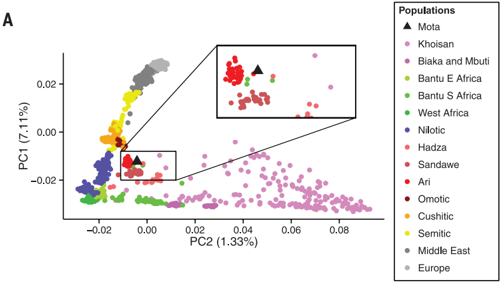
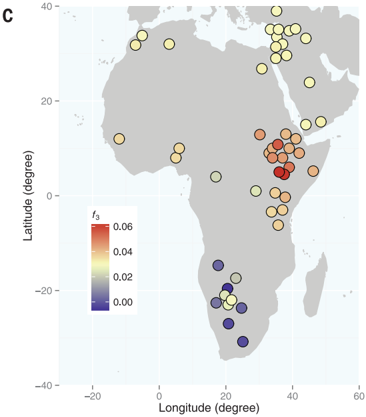
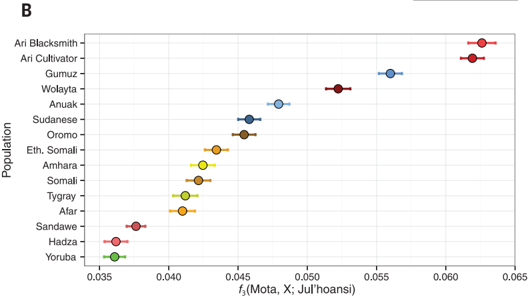
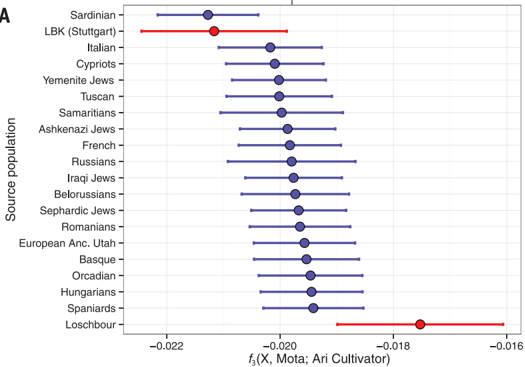
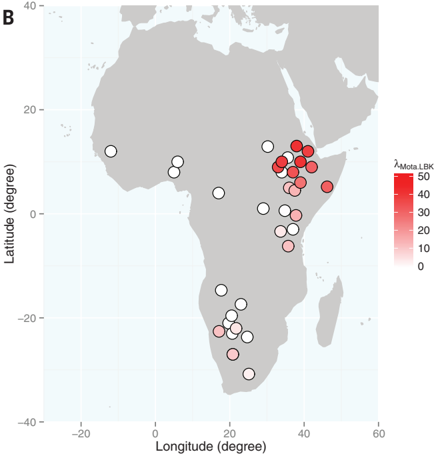
Ancient African helps to explain the present: Tracing the migrations of anatomically modern humans has been complicated by human movements both out of and into Africa, especially in relatively recent history. Gallego Llorente et al. sequenced an Ethiopian individual, “Mota,” who lived approximately 4500 years ago, predating one such wave of individuals into Africa from Eurasia. The genetic information from Mota suggests that present-day Sardinians were the likely source of the Eurasian backflow. Furthermore, 4 to 7% of most African genomes, including Yoruba and Mbuti Pygmies, originated from this Eurasian gene flow. Science , this issue p. 820
Overview
The claims and statistics of this paper haven’t been checked yet.
Run the check — free, no account needed. It reads the open-access text and checks the sources it cites.
Integrity signals
Registry
Cites
Statistics
Figures
Verification
Claims the paper makes
The claims and statistics of this paper haven’t been checked yet.
Run the check — free, no account needed. It reads the open-access text and checks the sources it cites.
Claims other papers make about this one
Each is checked against this paper’s own text: does it say what the citing paper says it does?
In the citing paper
“Genomes from ancient hunter gatherers in East Asia25, Neolithic farmers in Iran16,17, and ancient African hunter gatherers26,27, allow us to infer, through ancient–modern comparisons, that the genetic contribution from Neolithic populations to present-day farming or pastoralist Africans and South and East Asians is greater than that from hunter gatherers.”
From Cultural hitchhiking and competition between patrilineal kin groups explain the post-Neolithic Y-chromosome bottleneck (2018) · cites this paper as [26]
Self-check
Percentages, sums and reported differences re-computed from the paper’s own numbers.
The self-check needs the paper’s full text.
Citations
Cites
PLINK: a tool set for whole-genome association and population-based linkage analyses.
Purcell, S., Neale, B., Todd-Brown, K., Thomas, L., Ferreira, M. A. R., Bender, D., Maller, J., Sklar, P., de Bakker, P. I. W., Daly, M. J., et al. (2007) · The American Journal of Human Genetics · doi:10.1086/519795 · Cited by 34,089
BEDTools: a flexible suite of utilities for comparing genomic features
Quinlan, A. R., & Hall, I. M. (2010) · Bioinformatics · doi:10.1093/bioinformatics/btq033 · Cited by 27,437
Population Structure and Eigenanalysis
Patterson, N., Price, A. L., & Reich, D. (2006) · PLoS Genetics · doi:10.1371/journal.pgen.0020190 · Cited by 5,280
ANGSD: Analysis of Next Generation Sequencing Data
Korneliussen, T. S., Albrechtsen, A., & Nielsen, R. (2014) · BMC Bioinformatics · doi:10.1186/s12859-014-0356-4 · Cited by 2,982
Ancient Admixture in Human History
Patterson, N., Moorjani, P., Luo, Y., Mallick, S., Rohland, N., Zhan, Y., Genschoreck, T., Webster, T., & Reich, D. (2012) · Genetics · doi:10.1534/genetics.112.145037 · Cited by 2,848
The complete genome sequence of a Neanderthal from the Altai Mountains
Prüfer, K., Racimo, F., Patterson, N., Jay, F., Sankararaman, S., Sawyer, S., Heinze, A., Renaud, G., Sudmant, P. H., de Filippo, C., et al. (2014) · Nature · doi:10.1038/nature12886 · Cited by 2,254
A high-coverage genome sequence from an archaic denisovan individual
Meyer, M., Kircher, M., Gansauge, M.-T., Li, H., Racimo, F., Mallick, S., Schraiber, J. G., Jay, F., Prüfer, K., de Filippo, C., et al. (2012) · Science · doi:10.1126/science.1224344 · Cited by 1,967
mapDamage2.0: fast approximate Bayesian estimates of ancient DNA damage parameters
Jónsson, H., Ginolhac, A., Schubert, M., Johnson, P. L. F., & Orlando, L. (2013) · Bioinformatics · doi:10.1093/bioinformatics/btt193 · Cited by 1,669
Convergent adaptation of human lactase persistence in Africa and Europe
Tishkoff, S. A., Reed, F. A., Ranciaro, A., Voight, B. F., Babbitt, C. C., Silverman, J. S., Powell, K., Mortensen, H. M., Hirbo, J. B., Osman, M., et al. (2007) · Nature Genetics · doi:10.1038/ng1946 · Cited by 1,615
Ancient human genomes suggest three ancestral populations for present-day Europeans
Lazaridis, I., Patterson, N., Mittnik, A., Renaud, G., Mallick, S., Kirsanow, K., Sudmant, P. H., Schraiber, J. G., Castellano, S., Lipson, M., et al. (2014) · Nature · doi:10.1038/nature13673 · Cited by 1,357
The genomic landscape of Neanderthal ancestry in present-day humans
Sankararaman, S., Mallick, S., Dannemann, M., Prüfer, K., Kelso, J., Pääbo, S., Patterson, N., & Reich, D. (2014) · Nature · doi:10.1038/nature12961 · Cited by 1,107
Body mass and encephalization in Pleistocene Homo.
Ruff, C. B., Trinkaus, E., & Holliday, T. W. (1997) · Nature · doi:10.1038/387173a0 · Cited by 896
An early modern human from Romania with a recent Neanderthal ancestor
Fu, Q., Hajdinjak, M., Moldovan, O. T., Constantin, S., Mallick, S., Skoglund, P., Patterson, N., Rohland, N., Lazaridis, I., Nickel, B., et al. (2015) · Nature · doi:10.1038/nature14558 · Cited by 802
An aboriginal Australian genome reveals separate human dispersals into Asia
Rasmussen, M., Guo, X., Wang, Y., Lohmueller, K. E., Rasmussen, S., Albrechtsen, A., Skotte, L., Lindgreen, S., Metspalu, M., Jombart, T., et al. (2011) · Science · doi:10.1126/science.1211177 · Cited by 787
Self-citationGenome flux and stasis in a five millennium transect of European prehistory
Gamba, C., Jones, E. R., Teasdale, M. D., McLaughlin, R. L., Gonzalez-Fortes, G., Mattiangeli, V., Domboróczki, L., Kővári, I., Pap, I., Anders, A., et al. (2014) · Nature Communications · doi:10.1038/ncomms6257 · Cited by 667
Self-citationThe HIrisPlex system for simultaneous prediction of hair and eye colour from DNA
Walsh, S., Liu, F., Wollstein, A., Kovatsi, L., Ralf, A., Kosiniak-Kamysz, A., Branicki, W., & Kayser, M. (2013) · Forensic Science International Genetics · doi:10.1016/j.fsigen.2012.07.005 · Cited by 428
Ancient west Eurasian ancestry in southern and eastern Africa
Pickrell, J. K., Patterson, N., Loh, P.-R., Lipson, M., Berger, B., Stoneking, M., Pakendorf, B., & Reich, D. (2014) · Proceedings of the National Academy of Sciences · doi:10.1073/pnas.1313787111 · Cited by 300
Pagani, L., Kivisild, T., Tarekegn, A., Ekong, R., Plaster, C., Gallego Romero, I., Ayub, Q., Mehdi, S. Q., Thomas, M. G., Luiselli, D., et al. (2012) · The American Journal of Human Genetics · doi:10.1016/j.ajhg.2012.05.015 · Cited by 230
Raxter, M. H., Ruff, C. B., Azab, A., Erfan, M., Soliman, M., & El‐Sawaf, A. (2008) · American Journal of Physical Anthropology · doi:10.1002/ajpa.20790 · Cited by 113
Research works printed but not linked: 53
- 10.1002/bies.201400160 · DOI
- 10.1093/gbe/evu202 · DOI
- 10.1098/rspb.2014.1448 · DOI
- R. Blench in SemitoHamitic Festschrift for A.B. Dolgopolsky and H. Jungraithmayr G. Takacks Ed. (Dietich Reimer Verlag Berlin 2008) pp. 63–78.
- 10.1371/journal.pgen.1004353 · DOI
- 10.1126/science.1216304 · DOI · Paper page
- 10.1086/425161 · DOI
- M. C. Curtis in The Oxford Handbook of African Archaeology P. Mitchell P. J. Lane Eds. (Oxford Univ. Press 2013) pp. 571–584.
- 10.7183/0002-7316.75.3.452 · DOI
- 10.1073/pnas.1109300108 · DOI
- 10.1186/gb-2014-15-2-r36 · DOI
- 10.1093/molbev/mst089 · DOI
- 10.1371/journal.pgen.1003110 · DOI
- 10.1073/pnas.1209494109 · DOI
- 10.1073/pnas.1200567109 · DOI
- 10.1016/j.ajhg.2015.04.019 · DOI · Paper page
- 10.1371/journal.pgen.1004393 · DOI
- 10.1017/S0033822200045069 · DOI
- 10.1002/(SICI)1096-8644(199606)100:2<207::AID-AJPA4>3.0.CO;2-U · DOI
- 10.1371/journal.pone.0129102 · DOI · Paper page
- 10.1002/(SICI)1096-8644(199804)105:4<539::AID-AJPA10>3.0.CO;2-1 · DOI
- 10.1101/pdb.prot5448 · DOI
- 10.1093/nar/gku699 · DOI
- 10.1093/bioinformatics/btp324 · DOI · Paper page
- 10.1101/gr.107524.110 · DOI · Paper page
- 10.1093/bioinformatics/btp352 · DOI · Paper page
- 10.1073/pnas.0704665104 · DOI · Paper page
- 10.1093/nar/gkm588 · DOI
- 10.1126/science.1236573 · DOI · Paper page
- 10.1016/j.cub.2012.06.005 · DOI · Paper page
- 10.1002/humu.22356 · DOI
- 10.1016/j.jas.2013.07.004 · DOI · Paper page
- 10.1126/science.1253448 · DOI
- 10.1016/j.ajhg.2012.03.002 · DOI
- 10.1093/molbev/msr245 · DOI
- 10.1016/j.tig.2006.04.001 · DOI
- 10.1016/j.ajhg.2008.04.002 · DOI
- L. Jostins et al . YFitter: Maximum likelihood assignment of Y chromosome haplogroups from low-coverage sequence data. arXiv:1407.7988 [q-bio] (2014) (available at http://arxiv.org/abs/1407.7988). · arXiv
- 10.1086/386295 · DOI
- 10.1371/journal.pone.0016073 · DOI
- 10.1038/ejhg.2014.41 · DOI
- 10.1086/338306 · DOI
- 10.1038/ncomms2140 · DOI
- 10.1093/bioinformatics/btr330 · DOI
- 10.1371/journal.pgen.1005397 · DOI
- 10.1371/journal.pgen.1001373 · DOI
- 10.1371/journal.pone.0118625 · DOI
- 10.1126/science.1188021 · DOI · Paper page
- 10.1038/35006625 · DOI
- 10.3325/cmj.2013.54.248 · DOI
- 10.1007/s00439-011-0966-0 · DOI
- 10.1016/j.ajhg.2013.07.008 · DOI
- 10.1038/nature07963 · DOI
Cited by
Ancient DNA and the rewriting of human history: be sparing with Occam’s razor
Haber, M., Mezzavilla, M., Xue, Y., & Tyler-Smith, C. (2016) · Genome Biology · doi:10.1186/s13059-015-0866-z · Cited by 1,924
Genomic insights into the origin of farming in the ancient Near East
Lazaridis, I., Nadel, D., Rollefson, G., Merrett, D. C., Rohland, N., Mallick, S., Fernandes, D., Novak, M., Gamarra, B., Sirak, K., et al. (2016) · Nature · doi:10.1038/nature19310 · Cited by 955
Self-citationA high-coverage Neandertal genome from Vindija Cave in Croatia
Prüfer, K., de Filippo, C., Grote, S., Mafessoni, F., Korlević, P., Hajdinjak, M., Vernot, B., Skov, L., Hsieh, P., Peyrégne, S., et al. (2017) · Science · doi:10.1126/science.aao1887 · Cited by 719
Ancient gene flow from early modern humans into Eastern Neanderthals
Kuhlwilm, M., Gronau, I., Hubisz, M. J., de Filippo, C., Prado-Martinez, J., Kircher, M., Fu, Q., Burbano, H. A., Lalueza-Fox, C., de la Rasilla, M., et al. (2016) · Nature · doi:10.1038/nature16544 · Cited by 577
The genomic history of the Iberian Peninsula over the past 8000 years
Olalde, I., Mallick, S., Patterson, N., Rohland, N., Villalba-Mouco, V., Silva, M., Dulias, K., Edwards, C. J., Gandini, F., Pala, M., et al. (2019) · Science · doi:10.1126/science.aav4040 · Cited by 552
Self-citation
Metadata
- Authors
- Llorente, M. G., Jones, E. R., Eriksson, A., Siska, V., Arthur, K. W., Arthur, J. W., Curtis, M. C., Stock, J. T., Coltorti, M., Pieruccini, P., Stretton, S., Brock, F., Higham, T., Park, Y., Hofreiter, M., Bradley, D. G., Bhak, J., Pinhasi, R., & Manica, A.
- Venue
- Science
- Published
- 2015-11-13
- Volume
- 350
- Issue
- 6262
- Pages
- 820-822
- ISSN
- 0036-8075
- 1095-9203
- Cited by
- 295
- References
- 19
- Language
- en
- Funders
- NSF (1027607)
- European Research Council (ERC) (647787)
- ERC (263441, 310763, 617627)
- Biotechnology and Biological Sciences Research Council (BBSRC)
- UNIST (Ulsan National Institute of Science and Technology) (1.140113.01, 1.140064.01)
- Gates Cambridge Trust
About these checks
Registry, retraction, Cites and statistics results are computed, not judged, with one exception: a printed reference that no index lists is read once by a model before it counts as a citation error. Claims are extracted by a model and kept only when their quote appears verbatim in the text; each cited source is then checked, with a model’s help, for whether it says what the claim relies on. Those verdicts can be wrong — read the claim’s quote and the cited source before relying on one.
Statistics and arithmetic are recomputed, not judged.
Confidence bands are shown only for fields calibrated on our annotated test set. None is calibrated yet, so no band is shown.
What counts as a claim ›How we measure confidence ›How we check this ›
Are you an author, or do you see a problem with this page? Request a review
