

Examining the impacts of the COVID-19 pandemic on family mental health in Canada: findings from a national cross-sectional study
Open accessThe DOI matches its Crossref record; 49 of the 49 references it cites were found in a registry or an index.
Abstract
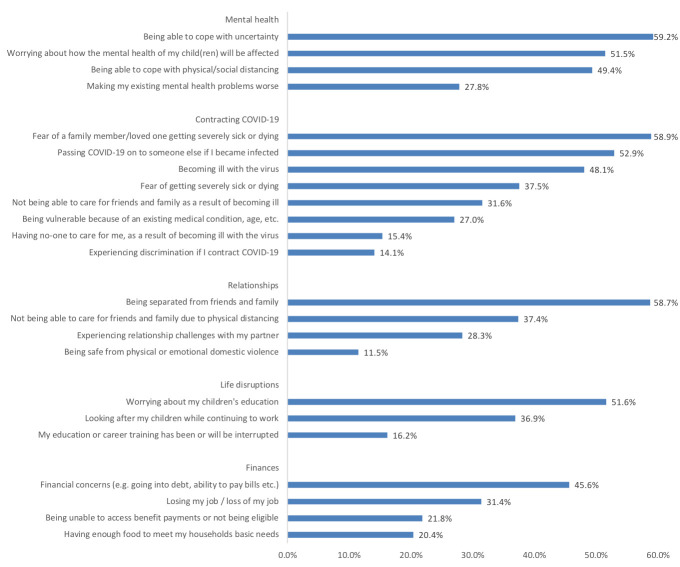
Objectives: In the first wave of the COVID-19 pandemic, social isolation, school/child care closures and employment instability have created unprecedented conditions for families raising children at home. This study describes the mental health impacts of the COVID-19 pandemic on families with children in Canada. Design, setting and participants: This descriptive study used a nationally representative, cross-sectional survey of adults living in Canada (n=3000) to examine the mental health impacts of the COVID-19 pandemic. Outcomes among parents with children <18 years old living at home (n=618) were compared with the rest of the sample. Data were collected via an online survey between 14 May to 29 May 2020. Outcome measures: Participants reported on changes to their mental health since the onset of the pandemic and sources of stress, emotional responses, substance use patterns and suicidality/self-harm. Additionally, parents identified changes in their interactions with their children, impacts on their children’s mental health and sources of support accessed. Results: 44.3% of parents with children <18 years living at home reported worse mental health as a result of the COVID-19 pandemic compared with 35.6% of respondents without children <18 living at home, χ 2 (1, n=3000)=16.2, p<0.001. More parents compared with the rest of the sample reported increased alcohol consumption (27.7% vs 16.1%, χ 2 (1, n=3000)=43.8, p<0.001), suicidal thoughts/feelings (8.3% vs 5.2%, χ 2 (1, n=3000)=8.0, p=0.005) and stress about being safe from physical/emotional domestic violence (11.5% vs 7.9%, χ 2 (1, n=3000)=8.1, p=0.005). 24.8% (95% CI 21.4 to 28.4) of parents reported their children’s mental health had worsened since the pandemic. Parents also reported more frequent negative as well as positive interactions with their children due to the pandemic (eg, more conflicts, 22.2% (95% CI 19.0 to 25.7); increased feelings of closeness, 49.7% (95% CI 45.7 to 53.7)). Conclusions: This study identifies that families with children <18 at home have experienced deteriorated mental health due to the pandemic. Population-level responses are required to adequately respond to families’ diverse needs and mitigate the potential for widening health and social inequities for parents and children.
Overview
The claims and statistics of this paper haven’t been checked yet.
Free: it reads the open-access text and checks the first 5 claims that cite a source we can check. Create a free account to check every claim.
Integrity signals
Registry
Cites
Statistics
Figures
Verification
Claims the paper makes
The claims and statistics of this paper haven’t been checked yet.
Free: it reads the open-access text and checks the first 5 claims that cite a source we can check. Create a free account to check every claim.
Claims other papers make about this one
Each is checked against this paper’s own text: does it say what the citing paper says it does?
The cited source doesn’t support the claim as written.
In the citing paper
“People without family are at a particularly high risk of health problems and deteriorated mental health due to COVID-19 [8,9].”
From Depression, anxiety, and stress in Korean general population during the COVID-19 pandemic. (2022) · cites this paper as [9]
Checked by a reasoning model — may be wrong.
Experimental — accuracy not yet measuredThe cited source says what the claim attributes to it.
In the citing paper
“Apart from the effects on the individual child or adolescent, the pandemic situation affected parents and whole family constructs [9], with a rise in parental stress, interparental and parent–child conflicts [10], child maltreatment [11, 12] and intimate partner violence [13].”
Self-check
Percentages, sums and reported differences re-computed from the paper’s own numbers.
The self-check needs the paper’s full text.
Citations
Cites
An interactive web-based dashboard to track COVID-19 in real time
Dong, E., Du, H., & Gardner, L. (2020) · The Lancet Infectious Diseases · doi:10.1016/s1473-3099(20)30120-1 · Cited by 10,048
Holmes, E. A., O'Connor, R. C., Perry, V. H., Tracey, I., Wessely, S., Arseneault, L., Ballard, C., Christensen, H., Cohen Silver, R., Everall, I., et al. (2020) · The Lancet Psychiatry · doi:10.1016/s2215-0366(20)30168-1 · Cited by 5,715
Impact of COVID-19 pandemic on mental health in the general population: a systematic review
Xiong, J., Lipsitz, O., Nasri, F., Lui, L. M. W., Gill, H., Phan, L., Chen-Li, D., Iacobucci, M., Ho, R., Majeed, A., et al. (2020) · Journal of Affective Disorders · doi:10.1016/j.jad.2020.08.001 · Cited by 5,204 · cited 1×
“Schools/child care, communities and government systems play an essential role in protecting and supporting parents and children, particularly for families without reliable access to the Internet or virtual technologies.”
BackgroundThe Lifelong Effects of Early Childhood Adversity and Toxic Stress
Shonkoff, J. P., Garner, A. S., THE COMMITTEE ON PSYCHOSOCIAL ASPECTS OF CHILD AND FAMILY HEALTH, C. O. E. C., Siegel, B. S., Dobbins, M. I., Earls, M. F., Garner, A. S., McGuinn, L., Pascoe, J., & Wood, D. L. (2012) · Pediatrics · doi:10.1542/peds.2011-2663 · Cited by 5,164
Mental health and the COVID-19 pandemic
Pfefferbaum, B., & North, C. S. (2020) · New England Journal of Medicine · doi:10.1056/nejmp2008017 · Cited by 4,378
Sick individuals and sick populations
Rose, G. (2001) · International Journal of Epidemiology · doi:10.1093/ije/30.3.427 · Cited by 3,736
The life course as developmental theory
Elder, G. H. (1998) · Child Development · doi:10.1111/j.1467-8624.1998.tb06128.x · Cited by 3,513
Sick individuals and sick populations
ROSE, G. (1985) · International Journal of Epidemiology · doi:10.1093/ije/14.1.32 · Cited by 2,701
Galea, S., Merchant, R. M., & Lurie, N. (2020) · JAMA Internal Medicine · doi:10.1001/jamainternmed.2020.1562 · Cited by 2,089
Manuscripts Accepted for Publication
(2005) · Child Development · doi:10.1111/j.1467-8624.2005.00876.x · Cited by 2,047
Research works printed but not linked: 2
- Vogel L . COVID-19: A timeline of Canada’s first-wave response, 2020; Canadian Medical Association Journal (CMAJ) News. Available: https://cmajnews.com/2020/06/12/coronavirus-1095847/
- Kousoulis A , McDaid S , Crepaz-Keay D , et al . Smaller boats in the COVID-19 storm: how different groups are coping with the coronavirus pandemic. London, UK: Mental Health Foundation; 2020: In press.
Cited by
Items 301–400 of 494
Zhou, Y.-W., Zheng, J.-Y., Shan, C.-Y., Yang, H.-S., Su, Y.-S., Wang, D. B., Ni, J.-X., Lan, L.-J., Lian, X.-Z., & Zhou, Z.-M. (2024) · Journal of Public Health · doi:10.1093/pubmed/fdae110 · Cited by 2
Beauregard, C., Miconi, D., Azparrent, A. C., Caron, M.-È., Lemieux, K., Papazian-Zohrabian, G., & Rousseau, C. (2024) · Canadian Journal of Art Therapy · doi:10.1080/26907240.2024.2408857 · Cited by 5
Cuadros, M. V. G. (2021) · Ágora Revista Científica · doi:10.21679/arc.v8i2.217 · Cited by 2
Torun, Y. T., Demirci, S. C., Gül, H., Demir, G., & İşeri, E. (2021) · Nordic Journal of Psychiatry · doi:10.1080/08039488.2021.1994647 · Cited by 1
“This may be related to increased parental stress and difficulties in parent-child relationships during the COVID-19 pandemic period [37].”
BackgroundHospital social workers and mental health: essential roles during the COVID-19 pandemic
Kourgiantakis, T., Craig, S. L., Sur, D., Muskat, B., & Kirkland, A. (2024) · Social Work in Mental Health · doi:10.1080/15332985.2024.2314474 · Cited by 2
“The pandemic has had a particularly deleterious impact on populations coping with employment and financial issues, increased health and mental health concerns, reduced access to services, discrimination, racism, loss, and trauma (Bardosh et al., 2022; Gadermann et al., 2021; Jenkins et al., 2021).”
BackgroundFlynn, S. (2024) · Child Care in Practice · doi:10.1080/13575279.2024.2353683 · Cited by 1
“There are already several existing studies on an international scale on the topic of mental health and the pandemic that adopt diverse methods from surveys (such as Gadermann et al., 2021) to narrative and systematic reviews (such as Fegert et al., 2020 and Imran et al., 2020).”
InfluentialSihvonen, E., Saarikallio-Torp, M., Merikukka, M., Hyvärinen, S., & Kouvonen, P. (2025) · Families Relationships and Societies · doi:10.1332/20467435y2025d000000056 · Cited by 1
Diep, T. T., Thao, H. P., Luận, T. C., Huong, N. T., & Lien, T. T. X. (2025) · Journal of Public Mental Health · doi:10.1108/jpmh-01-2025-0004 · Cited by 1
COVID-19 Pandemic Exposure and Toddler Behavioral Health in the ECHO Program
Akbaryan, A., Churchill, M. L., McGrath, M., Alshawabkeh, A. N., Enlow, M. B., Brennan, P. A., Vargas, J. C., Costello, L., D’Sa, V. A., Dunlop, A. L., et al. (2025) · JAMA Network Open · doi:10.1001/jamanetworkopen.2025.30346 · Cited by 1
Okyere, E., Marfoh, K., Kabukeinamala, D., Goundar, R., Makutu, L., Odrovakavula, L., & Vasukinatavea, S. (2025) · PLoS ONE · doi:10.1371/journal.pone.0331794 · Cited by 1
Exploring Parenting and Children’s Mental Health Pre and During the COVID-19 Pandemic
Withers, A., Lapshina, N., & Stewart, S. L. (2025) · Child Psychiatry & Human Development · doi:10.1007/s10578-025-01941-0 · Cited by 1
Impact de la crise de la COVID-19 sur les familles francophones dans les Prairies canadiennes
Leis, A., de Moissac, D., Proulx-Cullen, E., Gnidehou, S., Marchak, K. A., Keough, C., Chaput, M., & Turgeon, M. (2025) · Minorités linguistiques et société · doi:10.7202/1121531ar · Cited by 1
Ramesh, B., Freisthler, B., Ye, Y., Kieninger, K., Barboza-Salerno, G., & Thurston, H. (2026) · Spatial and Spatio-temporal Epidemiology · doi:10.1016/j.sste.2026.100782 · Cited by 1
Leikuma-Rimicāne, L., Ceballos, R. F., Baloran, E. T., & Medina, M. N. (2023) · Recoletos Multidisciplinary Research Journal · doi:10.32871/rmrj2311.01.05 · Cited by 1
Family violence during COVID-19 and its impact on mental health of children: A systematic review
Rajkumar, E., Mitra, J., Yadav, R., Hareesh, P. V., Gangadharan, A., Gopika, M. C., Christa, A. B., George, A. J., Gopi, A., Romate, J., et al. (2021) · Journal of Child and Adolescent Mental Health · doi:10.2989/17280583.2023.2261992 · Cited by 1
“Second, while they interact with families, parents, and youngsters, they should evaluate the likelihood of parental burnout, keeping in mind that the impacts of the recent pandemic may last longer than the”
BackgroundInfluentialAddressing unmet social needs of children with obesity: a pilot randomized controlled trial
Wahi, G., Marjerrison, S., Gill, S., Krasevich, K., Morrison, K. M., & Thabane, L. (2024) · Pilot and Feasibility Studies · doi:10.1186/s40814-024-01570-9 · Cited by 1
“…also been impacted by the intervals of COVID-19 lock-downs and restrictions where families with children had additional stresses and the burden of remote school scheduling and managing fluctuating workplace environments, perhaps leaving them less willing to participate in clinical research [30].”
Champion, A. R., Ryu, H., Oswald, F., Chai, A. M. M., Corrado, R. R., Frank, R. W., & Davies, G. J. (2024) · Journal of Family Violence · doi:10.1007/s10896-024-00787-9 · Cited by 1
Patte, K. A., Riazi, N. A., Goddard, J. A., & Michaelson, V. E. (2025) · Cogent Mental Health · doi:10.1080/28324765.2025.2515429 · Cited by 3
“Research on youths’ access to mental health services during the pandemic has often quantified this relationship (e.g (Gadermann et al., 2021; Muhajarine et al., 2022; Tromans et al., 2020), and/or examined parent perceptions of youths’ mental health support (Muhajarine et al., 2022).”
Adversity and Risk of Adolescent Mental Health Admission During COVID‐19
Auger, N., Youssef, M., Ayoub, A., Israël, M., Steiger, H., Low, N. C. P., & Côté‐Corriveau, G. (2025) · Stress and Health · doi:10.1002/smi.70071 · Cited by 1
Leigh, J. P., Moss, S. J., Mizen, S. J., Brown, H., Sriskandarajah, C., Stelfox, M., Halperin, B. A., Halperin, S. A., Ahmed, S. B., Lorenzetti, D., et al. (2025) · BMC Public Health · doi:10.1186/s12889-025-24244-4 · Cited by 2
Guo, H., Wang, X., & Jin, Z. (2025) · Journal of Affective Disorders Reports · doi:10.1016/j.jadr.2025.101004 · Cited by 2
Abdel-Baki, R., Frankiewicz, K., & Thomassin, K. (2026) · Research in Autism · doi:10.1016/j.reia.2026.202867 · Cited by 2
Changes in young children's behavior following COVID-19 pandemic onset: A tale of three cities
Martin, A., Wright, A., Mendelsohn, A. L., Gross, R. S., Miller, E. B., Morris‐Perez, P. A., Shaw, D. S., Pollak, S. D., Livas, G., & Johnson, A. D. (2026) · Child Development · doi:10.1093/chidev/aacag016 · Cited by 1
Gardziulevičienė, L., & Raišienė, A. G. (2021) · European Scientific Journal ESJ · doi:10.19044/esj.2021.v17n35p22 · Cited by 2
“Quarantine disrupted systems that allowed to maintain the mental health and emotional wellbeing of families (Gadermann et al., 2021).”
BackgroundBlais, A.-R., Hudon, È.-M. B., & Lymburner, M. (2022) · Promotion de la santé et prévention des maladies chroniques au Canada · doi:10.24095/hpcdp.42.8.03f · Cited by 1
Rankin, D. A., Yanis, A., Haddadin, Z., Talj, R., Fernandez, K. N., Bloos, S. M., Stahl, A. L., Gu, W., Nicotera, J., Howe, H. L., et al. (2022) · Health Science Reports · doi:10.1002/hsr2.658 · Cited by 1
“However, the risk and benefits of community closures should be taken into consideration given the potential negative effects associated with prolonged community closures.(15) At least early in the pandemic during stay‐at‐home/Phase I, we found that essential workers were at increased risk for testing positive for SARS…”
BackgroundImpact of COVID-19 School-Related Policies in Ontario on Parents’ School Lunch Packing Habits
Shwed, A., O’Rourke, B., Bruner, B., & Ferguson, K. (2022) · Canadian Journal of Dietetic Practice and Research · doi:10.3148/cjdpr-2022-022 · Cited by 2
Cesur, S., Topçu, M. T., & Kalcioglu, M. T. (2022) · American Journal of Audiology · doi:10.1044/2022_aja-22-00031 · Cited by 1
Życie z niepełnosprawnością w świecie VUCA
(2022) · Wydawnictwo Uniwersytetu Łódzkiego eBooks · doi:10.18778/8142-851-4 · Cited by 4
Percy‐Smith, B., Rizzo, S., Tay, C., Lorusso, E., Day, L., & Monchuk, L. (2022) · Children Youth and Environments · doi:10.1353/cye.2022.0028 · Cited by 2
Rodriguez, C., Feng, R. Y., & Vitoroulis, I. (2023) · University of Ottawa Journal of Medicine · doi:10.18192/uojm.v13i01.6413 · Cited by 1
Engelke, L., Winter, S., Renneberg, B., & Calvano, C. (2023) · Praxis der Kinderpsychologie und Kinderpsychiatrie · doi:10.13109/prkk.2023.72.4.287 · Cited by 2
Wang, C., Lu, H., Liang, J., Chen, D., & Chen, C.-C. (2023) · Pediatrics & Neonatology · doi:10.1016/j.pedneo.2023.02.007 · Cited by 1
“In response, parents and children had to adapt to new modes of remote learning.(33) The present results clearly show that parental mental health is negatively associated with having to deal with emergencies during home-schooling of a child.”
Tesfaye, Y., Alemu, B., Soboka, M., Girma, S., Reinhard, M. A., Rek, S., Adorjan, K., Zhelyazkova, A., Padberg, F., Jobst, A., et al. (2023) · European Archives of Psychiatry and Clinical Neuroscience · doi:10.1007/s00406-023-01674-y · Cited by 2
“A study from Canada showed parents faced burdens due to the pandemic’s effect on relationships and finance [76].”
Çollaku, P. J., Shala, M., Shahini, M., Këndusi, V., & Osmani, Q. (2023) · Journal of College Student Mental Health · doi:10.1080/87568225.2023.2269617 · Cited by 6
“In particular, new threats for families, such as social isolation, physical distancing, closure of childcare institutions and schools, financial and employment insecurities, housing instability, and changes in access to healthcare and social welfare, have been reported (Gadermann et al., 2021).”
Coping Mechanisms of Older Persons with Emigrant Children During the COVID-19 Pandemic in Nigeria
Ebimgbo, S. O., Abbah, O. I., Ifediba, E. C., Igwe, N. J., Chukwu, N. E., & Okoye, U. O. (2023) · Journal of Population Ageing · doi:10.1007/s12062-023-09435-4 · Cited by 4
“In countries like the US and Canada, the pandemic affected the emotional and psychological health in older adults (Patrick et al., 2020; Gadermann et al., 2021).”
Kikulwe, D., Ssewanyana, D., & Maiter, S. (2024) · Child Protection and Practice · doi:10.1016/j.chipro.2024.100004 · Cited by 2
“Corroborating with our fi ndings of the co-occurrence of mental health issues with other risk factors for child safety, emotional illness was linked to increased domestic con fl ict (Gadermann et al., 2021; Raina et al., 2021).”
BackgroundResultInfluentialTranscending: The journey and lived experiences of the educators who survived COVID-19
Corpuz-Reyes, J. N., & MONES, E. C. (2024) · World Journal of Advanced Research and Reviews · doi:10.30574/wjarr.2024.21.3.0740 · Cited by 1
Webber, C., Dover, K., Tanuseputro, P., Vigod, S. N., Moineddin, R., Clarke, A., Isenberg, S. R., Fiedorowicz, J. G., Jin, Y. H., Gandhi, J., et al. (2024) · Journal of Affective Disorders · doi:10.1016/j.jad.2024.08.125 · Cited by 2
Qiu, J., & Wang, J. (2025) · International Journal of Mental Health Promotion · doi:10.32604/ijmhp.2025.059951 · Cited by 3
“Secondly, university students increasingly seek help and support from peers and campus social networks [83], a trend that may lead to a relative weakening of the impact of FC in moderating depression and SI compared to broader social interactions.”
Ilie, A., Kim, A. J., DesRoches, D. I., Keys, E., Sherry, S., Stewart, S. H., Deacon, S. H., & Corkum, P. V. (2025) · Children · doi:10.3390/children12080962 · Cited by 1
“For example, Canadian parents with children reported higher rates of stress, alcohol consumption, suicidal ideation, and negative parent–child interactions during the pandemic [5].”
InfluentialViruses, Variants, and Vaccines: Overcoming Despair
el‐Guebaly, N. (2021) · The Canadian Journal of Addiction · doi:10.1097/cxa.0000000000000109 · Cited by 1
Aspects of schooling during lockdowns
Thorn, W., & Vincent‐Lancrin, S. (2021) · OECD eBooks · doi:10.1787/7f3ff6e8-en · Cited by 1
Fares‐Otero, N. E., & Trautmann, S. (2021) · Frontiers in Psychology · doi:10.3389/fpsyg.2021.764768 · Cited by 1
“The conditions created by the COVID-19 pandemic (Bridgland et al., 2021; Calvano et al., 2021; Gadermann et al., 2021) have heightened the likelihood for both life stressors (Brown et al.”
BackgroundLee, J., Allen, J., Lim, H., Choi, G., & Jung, J. (2022) · Frontiers in Psychiatry · doi:10.3389/fpsyt.2022.800385 · Cited by 3
Does the Familiarity of Online Teachers Matter During Covid Lockdowns?
Wang, S. C. (2022) · International Journal of Advanced Research in Education and Society · doi:10.55057/ijares.2022.4.2.10 · Cited by 1
Newlove‐Delgado, T., Mathews, F., Cross, L., Wooding, E. L., & Ford, T. J. (2022) · Elsevier eBooks · doi:10.1016/b978-0-323-91709-4.00007-x · Cited by 1
Cogenitorialità e funzionamento familiare nell'epoca del Covid-19
Santona, A. M. R., Tognasso, G., Porcedda, L., & Gorla, L. (2022) · TERAPIA FAMILIARE · doi:10.3280/tf2022-129008 · Cited by 1
Wahyuningrum, S. S., Riyanto, S., Hidayat, T., & Ashar, H. (2023) · Jurnal Berkala Epidemiologi · doi:10.20473/jbe.v11i12023.76-84 · Cited by 1
Descriptive Study of Optimizing Family Health Functions in Preventing COVID 19 Transmission
Luthfa, I., & Khasanah, N. N. (2021) · Majalah Keperawatan Unpad/Journal of Nursing Care · doi:10.24198/jnc.v4i2.30944 · Cited by 1
Insights in digital mental health: 2021
(2023) · Frontiers research topics · doi:10.3389/978-2-83251-673-7 · Cited by 2
Wray, A. J. D., Martin, G., Ferguson, K. N., Coen, S. E., Seabrook, J. A., & Gilliland, J. (2023) · Cities & Health · doi:10.1080/23748834.2023.2282850 · Cited by 1
“Youth living in poverty and non-white youth are considerably more likely to have worse mental health outcomes during the pandemic (Gadermann et al .”
BackgroundAsbrand, J., Hilbert, K., Langhammer, T., Ertle, A., Horváth, L., & Lueken, U. (2024) · Kindheit und Entwicklung · doi:10.1026/0942-5403/a000461 · Cited by 1
Blaine, J. (2022) · Psychology and Behavioral Sciences · doi:10.11648/j.pbs.20221101.13 · Cited by 1
Special Issue on the Challenges for family and child well‐being in the new era
Li, J., Rönkä, A. K., & Han, W. (2023) · International Journal of Social Welfare · doi:10.1111/ijsw.12620 · Cited by 1
Families, Disability, and Wellbeing in Canada [Issue brief]
Campbell, M. (2024) · doi:10.61959/i234316b · Cited by 1
It’s not all negative: The experiences of parents with a newborn during COVID-19 lockdown
Paradis, A., Todorov, E., & Godbout, N. (2021) · doi:10.64628/aam.636s5m6rf · Cited by 1
The Influence of Quarantine on Thai Highschool Students’ Productivity
Paisarntanawat, N. (2021) · International Journal of Current Science Research and Review · doi:10.47191/ijcsrr/v4-i6-06
González, A., Afifi, T. O., & Tonmyr, L. (2021) · Promotion de la santé et prévention des maladies chroniques au Canada · doi:10.24095/hpcdp.41.11.07f
Thorn, W., & Vincent‐Lancrin, S. (2021) · OECD eBooks · doi:10.1787/2ed0bf8c-en
School children’s psychological well-being and academic progress
Thorn, W., & Vincent‐Lancrin, S. (2021) · OECD eBooks · doi:10.1787/82228d86-en
Lockdown measures in selected countries: February-June 2020
Thorn, W., & Vincent‐Lancrin, S. (2021) · OECD eBooks · doi:10.1787/a6df8d7c-en
Susanti, L., & Tarigan, C. (2021) · Jurnal Jaffray · doi:10.25278/jj.v19i2.599 · Cited by 1
UTJECAJ PANDEMIJE COVID-19 NA NAČIN FUNKCIONISANJA PORODICE
Pekić, S., & Šatrović, A. (2021) · DRUŠTVENE DEVIJACIJE · doi:10.7251/zcmz0121295p
Thorn, W., & Vincent‐Lancrin, S. (2021) · OECD eBooks · doi:10.1787/80048fa8-en
Thorn, W., & Vincent‐Lancrin, S. (2021) · OECD eBooks · doi:10.1787/4889728b-en
Locked Out: Migrant Workers, Refugees and Stateless Citizens and the Homeless
Briggs, D., Telford, L., Lloyd, A., Ellis, A., & Kotzé, J. (2021) · Springer eBooks · doi:10.1007/978-3-030-88825-1_9
Kukurbra, K., Manafò, E., Malone, J. L., Drebit, E., Abba‐Aji, A., Oluboka, T., Grauwiler, D., & Petermann, L. (2021) · doi:10.2196/preprints.34160
Rodriguez, C., Feng, R. Y., & Vitoroulis, I. (2022) · University of Ottawa Journal of Medicine · doi:10.18192/uojm.v11i2.6065
Rodriguez, C., Feng, R. Y., Campbell, Z., Poitras, M., & Vitoroulis, I. (2022) · University of Ottawa Journal of Medicine · doi:10.18192/uojm.v11i2.5975
Risk factors for increased alcohol consumption among young adults during COVID-19
Rudenstine, S., Schulder, T., Bhatt, K. J., Ettman, C. K., & Galea, S. (2022) · Journal of American College Health · doi:10.1080/07448481.2022.2040518
West, C. (2022) · Carleton University's Institutional Repository (MacOdrum Library, Carleton University) · doi:10.22215/etd/2022-15081
Osoby z niepełnosprawnością w dobie pandemii – perspektywa kanadyjska
Skalska, K. E. (2022) · Wydawnictwo Uniwersytetu Łódzkiego eBooks · doi:10.18778/8142-851-4.05
Social support among persons with depressive disorders during COVID-19 pandemic
Dan, V. H., Ponnuchamy, L., Anand, N., & Bhaskarapillai, B. (2022) · Journal of Family Medicine and Primary Care · doi:10.4103/jfmpc.jfmpc_2462_21
“The multiplicity of roles performed by persons with mental illness as a parent, sibling, spouse, or offspring of the caregiver gives rise to complexities in relationships.[64,65] The quality of relationship between the spouses is subject to constructs such as cohesiveness, communication, trust, and support, which ulti…”
Backgroundالحليم, ا. ف. ا. ع. (2021) · Dirāsāt fi Al-Ṭufūlaẗ wa Al-Tarbiyyaẗ /Dirāsāt fi Al-Ṭufūlaẗ wa Al-Tarbiyyaẗ · doi:10.21608/dftt.2022.89119.1041
Yates, J., & Irwin, J. D. (2022) · The Family Journal · doi:10.1177/10664807221123550 · Cited by 1
“Worrying about their children’s education and heightened stress related to navigating child-minding and home-based/ online schooling while continuing to work themselves have been especially challenging for parents (Gadermann et al., 2021).”
BackgroundResultInfluentialCroxen, H., Jackson, M. I., Asirifi, M. A., & Symonds-Brown, H. (2022) · INYI Journal · doi:10.25071/1929-8471.98
Impact of Online Learning and Students’ Personal Factors on Students’ NWEA Scores
Sahin, A., & Matteson, S. M. (2022) · European Journal of Education and Pedagogy · doi:10.24018/ejedu.2022.3.5.461 · Cited by 1
Family experiences during illness outbreaks: A systematic reviewPreprint
Sheen, J. A., Chen, L., Lee, B., Aridas, A., & Reupert, A. (2022) · medRxiv · doi:10.1101/2022.11.16.22282428
Aprendizaje de Lectoescritura en la Pandemia Covid-19 y Métodos de Intervención
Osorio, O. R., & Polanco, J. G. C. (2023) · doi:10.37954/se.v8i1.393
COVID 19:Mental Health of the Patient and Family Members
Gopalan, R. T., & Fayed, G. A. K. (2021) · Al-Mağallah Al-ʿilmiyyaẗ Li Kulliyyaẗ Al-Tarbiyyaẗ Lil Ṭifūlaẗ Al-Mubakiraẗ - Ǧāmiʿaẗ Al-Manṣūraẗ · doi:10.21608/maml.2021.290363
Iriarte, E., Larson, M. E., & Behar‐Zusman, V. (2023) · Journal of Gerontological Nursing · doi:10.3928/00989134-20230310-02
Chen, J. (2023) · Journal of Education Humanities and Social Sciences · doi:10.54097/ehss.v10i.6888
“Parents of Canadian households with children reported with worse mental health and substance uses when compared to before the pandemic [3].”
BackgroundHohashi, N., Jaroensuk, P., Araki, S., & Taniguchi, M. (2023) · Journal of Rural Community Nursing Practice · doi:10.58545/jrcnp.v1i1.89
Resiliensi Mahasiswa Ilmu Kesehatan Tingkat Pertama pada Masa Pandemi Covid-19
Purnamasari, M. D., Swasti, K. G., Ramadani, R. I., & Swasti, K. G. (2023) · Journal of Bionursing · doi:10.20884/1.bion.2023.5.1.178
(2023) · Frontiers research topics · doi:10.3389/978-2-8325-2540-1
Varin, M., Venugopal, J., Li, L., MacEachern, K. H., Weeks, M., Baker, M. M., & Lowe, A. (2023) · Promotion de la santé et prévention des maladies chroniques au Canada · doi:10.24095/hpcdp.43.8.03f
Metadata
- Authors
- Gadermann, A. C., Thomson, K. C., Richardson, C. G., Gagné, M., McAuliffe, C., Hirani, S., & Jenkins, E.
- Affiliations
- University of British Columbia (CA)
- Corresponding author
- Gadermann, Anne C
- ORCID
- Venue
- BMJ Open
- Publisher
- BMJ
- Published
- 2021-01
- Volume
- 11
- Issue
- 1
- Pages
- e042871
- ISSN
- 2044-6055 (ISSN-L)
- PMC
- PMC7804831
- OpenAlex
- W3119253972
- Cited by
- 479
- References
- 48
- Citations by year
- 2026: 26 · 2025: 55 · 2024: 75 · 2023: 112 · 2022: 120 · 2021: 91
- FWCI
- 67.83
- Type
- journal article
- Language
- en
- Open access
- gold
- doi.org
- Licence
- Locations
- BMJ Open (publishedVersion, cc-by-nc)
- PubMed Central (publishedVersion, cc-by-nc)
- PubMed (publishedVersion)
- cIRcle (University of British Columbia) (submittedVersion, cc-by-nc)
- DOAJ (DOAJ: Directory of Open Access Journals) (submittedVersion, cc-by-sa)
- Open Collections
- Funders
- Michael Smith Health Research BC
- National Institute for Health and Care Research (NIHR201342)
- Canadian Mental Health Association
- Canadian Institutes of Health Research
- Topics
- Social Sciences › Psychology › Clinical Psychology › COVID-19 and Mental Health
- Health Sciences › Medicine › Public Health, Environmental and Occupational Health › Maternal Mental Health During Pregnancy and Postpartum
- Social Sciences › Psychology › Clinical Psychology › Child and Adolescent Psychosocial and Emotional Development
- Keywords
- COVID-19 pandemic, family mental health, parents of children, child mental health, social isolation, school closures, employment instability, alcohol consumption, suicidal ideation, self-harm, domestic violence, parent-child conflict, parent-child closeness, substance use, sources of support, Canada, lockdown
- MeSH terms
- COVID-19, SARS-CoV-2, Adolescent, Adult, Mental Disorders, Canada, Cross-Sectional Studies, Family Health, Female, Health Surveys, Humans, Longitudinal Studies, Male, Middle Aged, Quarantine, Social Isolation, Stress, Psychological, Young Adult
About these checks
Registry, retraction, Cites and statistics results are computed, not judged, with one exception: a printed reference that no index lists is read once by a model before it counts as a citation error. Claims are extracted by a model and kept only when their quote appears verbatim in the text; each cited source is then checked, with a model’s help, for whether it says what the claim relies on. Those verdicts can be wrong — read the claim’s quote and the cited source before relying on one.
Statistics and arithmetic are recomputed, not judged.
Confidence bands are shown only for fields calibrated on our annotated test set. None is calibrated yet, so no band is shown.
What counts as a claim ›How we measure confidence ›How we check this ›
Are you an author, or do you see a problem with this page? Request a review
Data sources
Bibliographic data: Semantic Scholar, OpenAlex, Crossref.
Contains information from the Semantic Scholar Academic Graph Datasets, made available under the ODC Attribution License (ODC-BY 1.0).
Semantic Scholar’s data is described in: Kinney, R., et al. (2023). The Semantic Scholar Open Data Platform. arXiv:2301.10140.
