

Model Cards for Model Reporting
Open accessThe DOI matches its Crossref record; 22 of the 22 references it cites were found in a registry or an index; 8 of the 34 sources its claims cite were checked for support.
Abstract
Trained machine learning models are increasingly used to perform high-impact tasks in areas such as law enforcement, medicine, education, and employment. In order to clarify the intended use cases of machine learning models and minimize their usage in contexts for which they are not well suited, we recommend that released models be accompanied by documentation detailing their performance characteristics. In this paper, we propose a framework that we call model cards, to encourage such transparent model reporting. Model cards are short documents accompanying trained machine learning models that provide benchmarked evaluation in a variety of conditions, such as across different cultural, demographic, or phenotypic groups (e.g., race, geographic location, sex, Fitzpatrick skin type [15]) and intersectional groups (e.g., age and race, or sex and Fitzpatrick skin type) that are relevant to the intended application domains. Model cards also disclose the context in which models are intended to be used, details of the performance evaluation procedures, and other relevant information. While we focus primarily on human-centered machine learning models in the application fields of computer vision and natural language processing, this framework can be used to document any trained machine learning model. To solidify the concept, we provide cards for two supervised models: One trained to detect smiling faces in images, and one trained to detect toxic comments in text. We propose model cards as a step towards the responsible democratization of machine learning and related artificial intelligence technology, increasing transparency into how well artificial intelligence technology works. We hope this work encourages those releasing trained machine learning models to accompany model releases with similar detailed evaluation numbers and other relevant documentation.
Overview
CoChat Summary
TL;DR
The paper proposes “model cards,” short documentation records accompanying trained machine learning models to report intended use, performance characteristics, and disaggregated evaluation across demographic, phenotypic, and intersectional groups. It illustrates the framework with worked examples for a smiling classifier and a toxicity classifier.
Key findings
- The authors argue there are no standardized documentation procedures for communicating trained ML model performance, especially for high-impact domains such as health care, employment, education, and law enforcement.
- They propose model card sections covering model details, intended use, factors, metrics, evaluation data, training data, quantitative analyses, ethical considerations, and caveats/recommendations.
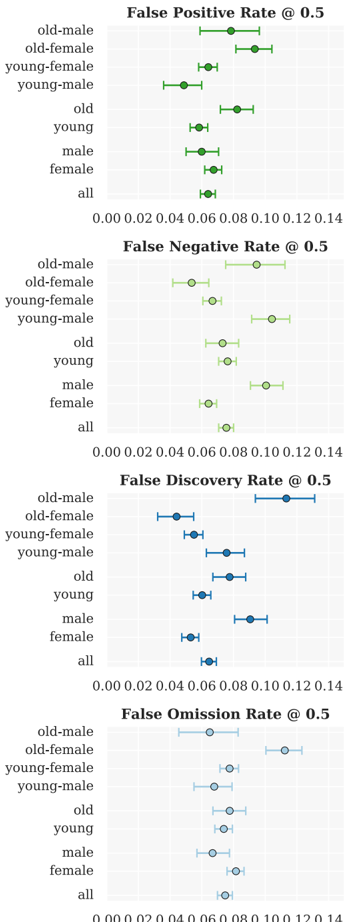
- In the smiling classifier example, all reported metrics at the .5 decision threshold have error types within the range 0.04–0.14, with 95% confidence intervals calculated by bootstrap resampling; the card notes older men have much higher false discovery rate, while men in aggregate have higher false negative rate.
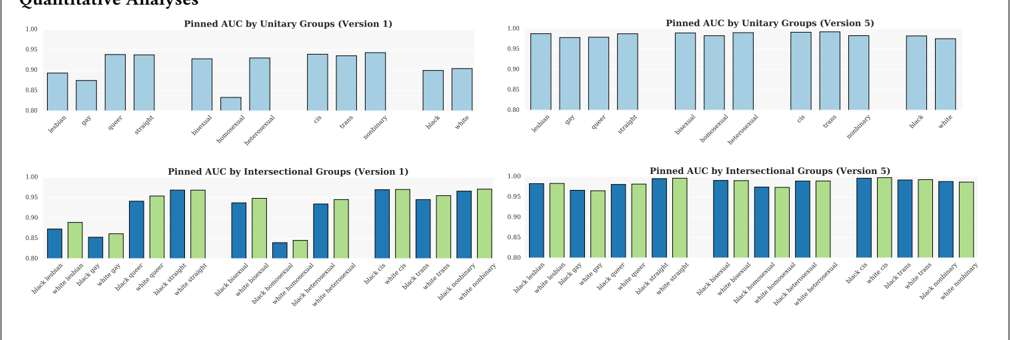
- In the toxicity example, TOXICITY v. 1 has low performance for several terms, especially “lesbian,” “gay,” and “homosexual,” while TOXICITY v. 5 shows more equitable performance after bias mitigation techniques.
Methods
- The paper is a framework/proposal paper, not an empirical study of a new model; it recommends model cards and details suggested sections and prompts.
- It provides two worked examples: a smiling classifier trained and evaluated on the CelebA dataset, using a convolutional neural net pretrained for face recognition and fine-tuned with cross-entropy loss for binary smiling classification.
- It also provides a model card for Perspective API’s TOXICITY classifier, a convolutional neural network developed by Jigsaw in 2017, evaluated on a synthetic Identity Phrase Templates test set; metrics include FPR, FNR, FDR, FOR for the smiling classifier and Pinned AUC for toxicity.
Limitations
- The paper states that model cards rely on the integrity of their creators and that it seems unlikely, at least in the near term, that they could be standardized or formalized enough to prevent misleading representations of model results.
- The paper states that evaluation datasets suitable for disaggregated evaluation are not yet common, and that the synthetic toxicity test data covers only a small set of very specific comments and is not comprehensive.
- The smiling classifier card states it does not capture race or skin type, uses binary gender classes (male/female), and that an ideal evaluation dataset would additionally include Fitzpatrick skin type, camera details, and environment details; the paper also states future work is needed to study how model information is interpreted and used by different stakeholders.
Model-written summary. Check it against the paper before relying on it.
Integrity signals
Registry
Cites
Statistics
Figures
Verification
Claims the paper makes
5 Valid · 1 Not valid · 18 Not checked · 30 Own results and interpretations
The cited sources support only part of this claim — read each source’s verdict below.
In the paper
“Synthetic data is valuable here because [11] shows that real data often has disproportionate amounts of toxicity directed at specific groups.”
What the sources say
- Partly supportedcites [11] [11] Lucas Dixon, John Li, Jeffrey Sorensen, Nithum Thain, and Lucy Vasserman. 2018. Measuring and Mitigating Unintended Bias in Text Classification. Proceedings of the AAAI/ACM Conference on AI, Ethics, and Society (2018). - sourceExperimental — accuracy not yet measured
The 'Quantifying bias in dataset' section (page unavailable) reports that certain identity terms appear disproportionately in toxic comments in the authors’ training data; for example, 'gay' appears in 3% of toxic comments but 0.5% of comments overall. It measures comments containing those terms, not whether toxicity is directed at the groups, and does not establish how often this pattern occurs across real datasets generally. (LLM, conf=0.85)
plainstates an association- Asserted: passes — The authors put it forward as true.
- Checkable: passes — It can be checked against evidence.
- Load-bearing: passes — The paper’s conclusions depend on it.
- Based: passes — The paper gives a reason why it holds.
- Partly supported
A result the paper reports from its own data — it cites no other source for it, so there is none to check. The quote shows it is in the paper.
In the paper
“For example, the false discovery rate on older men is much higher than that for other groups.”
plainstates an association- Asserted: passes — The authors put it forward as true.
- Checkable: passes — It can be checked against evidence.
- Load-bearing: passes — The paper’s conclusions depend on it.
- Based: passes — The paper gives a reason why it holds.
A result the paper reports from its own data — it cites no other source for it, so there is none to check. The quote shows it is in the paper.
In the paper
“TOXICITY v. 1 has low performance for several terms, especially 'lesbian', 'gay', and 'homosexual'.”
plain- Asserted: passes — The authors put it forward as true.
- Checkable: passes — It can be checked against evidence.
- Load-bearing: passes — The paper’s conclusions depend on it.
- Based: passes — The paper gives a reason why it holds.
None of the sources cited for this claim have been checked yet.
In the paper
“she collaborated with other researchers to demonstrate the disproportionate errors of computer vision systems on historically marginalized groups in the United States, such as darker-skinned women [5, 41].”
What the sources say
- Not checked yetcites [5] [5] Joy Buolamwini and Timnit Gebru. 2018. Gender Shades: Intersectional Accuracy Disparities in Commercial Gender Classification. In Proceedings of the 1st Conference on Fairness, Accountability and Transparency (Proceedings of Machine Learning Research) , Sorelle A. Friedler and Christo Wilson (Eds.), Vol. 81. PMLR, New York, NY, USA, 77-91. http://proceedings.mlr.press/v81/buolamwini18a.html -
- Not checked yetcites [41] [41] Inioluwa Raji. 2018. Black Panther Face Scorecard: Wakandans Under the Coded Gaze of AI. (2018). -
boostedstates an association- Asserted: passes — The authors put it forward as true.
- Checkable: passes — It can be checked against evidence.
- Load-bearing: passes — The paper’s conclusions depend on it.
- Based: passes — The paper gives a reason why it holds.
In the paper
“after MIT Media Lab graduate student Joy Buolamwini found that commercial face recognition systems failed to detect her face [4]”
What the sources say
- Not checked yetcites [4] [4] Joy Buolamwini. 2016. How I'm fighting Bias in Algorithms. (2016). https://www.ted.com/talks/joy\_buolamwini\_how\_i\_m\_fighting\_bias\_in\_ algorithms#t-63664 -
plainSingle case- Asserted: passes — The authors put it forward as true.
- Checkable: passes — It can be checked against evidence.
- Load-bearing: unclear — It is unclear whether the paper’s conclusions depend on it.
- Based: passes — The paper gives a reason why it holds.
13 more claims
Create a free account to see all 54 claims and to verify the 13 references still open.
- Probably not a substantial claim. 34
- It may state two separate claims as one. 8
Claims other papers make about this one
Each is checked against this paper’s own text: does it say what the citing paper says it does?
The source backs part of the claim, not all of it — or backs it for a different population, condition or comparison.
In the citing paper
“Model cards represent the field's standard for disclosing and documenting key facts about the architecture, training and evaluation of the model [14, 40].”
From Rethinking open source generative AI: open washing and the EU AI Act (2024) · cites this paper as [40]
Experimental — accuracy not yet measuredThe source backs part of the claim, not all of it — or backs it for a different population, condition or comparison.
In the citing paper
“Model cards (SMCs) [44] have been foundational in standardizing documentation for AI/ML model performance and characteristics, along with risks and unintended uses.”
From Interactive Model Cards: A Human-Centered Approach to Model Documentation (2022) · cites this paper as [44]
Experimental — accuracy not yet measuredThe source backs part of the claim, not all of it — or backs it for a different population, condition or comparison.
In the citing paper
“A second phase saw a more technical approach from the computer science community focusing on fairness, accountability and transparency as an engineering 'ethicalby-design' problem-solving exercise [20][21][22].”
From Putting AI ethics to work: are the tools fit for purpose? (2022) · cites this paper as [21]
Experimental — accuracy not yet measuredThe source backs part of the claim, not all of it — or backs it for a different population, condition or comparison.
In the citing paper
“These are either materials for use in design teams in workshop style events [76,77], tools for producing documentation of the design, build and test process [21,68], or technical tools for testing models, protecting privacy and security, testing for bias [69,93,94], or tracking provenance of data [95].”
From Putting AI ethics to work: are the tools fit for purpose? (2022) · cites this paper as [21]
Experimental — accuracy not yet measuredThe source backs part of the claim, not all of it — or backs it for a different population, condition or comparison.
In the citing paper
“There is some work on fairness relating to AI services, though this tends to focus on either exposing or 'auditing' certain AI services [22,38,126,133], or devising tools, methods and interventions relevant for those building (rather than using) such services [12,96,106,128].”
From Out of Context: Investigating the Bias and Fairness Concerns of “Artificial Intelligence as a Service” (2023) · cites this paper as [106]
Experimental — accuracy not yet measured
17 more claims about this paper
Create a free account to see every claim other papers make about this one.
Citations
Cites
BLEU: a method for automatic evaluation of machine translation
Papineni, K., Roukos, S., Ward, T., & Zhu, W.-J. (2001) · Proceedings of the 40th Annual Meeting on Association for Computational Linguistics - ACL '02 · doi:10.3115/1073083.1073135 · Cited by 21,344 · cited 1×
“translation system could compare BLEU scores [40] across demographic groups, and a model card for a speech recognition system could compare word-error rates.”
BackgroundCrenshaw, K. (2018) · Feminist Legal Theory · doi:10.4324/9780429500480-5 · Cited by 9,510
Deep Learning Face Attributes in the Wild
Liu, Z., Luo, P., Wang, X., & Tang, X. (2015) · 2015 IEEE International Conference on Computer Vision (ICCV) · doi:10.1109/iccv.2015.425 · Cited by 7,747 · cited 4×
“ms [5, 26] that report details of the datasets used to train and test machine learning models. We provide two example model cards in Section 5: A smiling detection model trained on the CelebA dataset [33] (Figure 2), and a public toxicity detection model, Perspective API [29] (Figure 3). Where Datasheets highlight cha…”
BackgroundMethodInfluentialThe validity and practicality of sun-reactive skin types I through VI
Fitzpatrick, T. B. (1988) · Archives of Dermatology · doi:10.1001/archderm.1988.01670060015008 · Cited by 4,339
Differential Privacy: A Survey of Results
Dwork, C. (2008) · Lecture Notes in Computer Science · doi:10.1007/978-3-540-79228-4_1 · Cited by 3,542 · cited 2×
“As such, collaboration with policy, privacy, and legal experts is necessary in order to ascertain which groups may be responsibly inferred, and how that information should be stored and accessed (for example, using differential privacy [12]).”
BackgroundCollins, G. S., Reitsma, J. B., Altman, D. G., & Moons, K. G. M. (2015) · Annals of Internal Medicine · doi:10.7326/m14-0697 · Cited by 3,267
Equality of Opportunity in Supervised Learning
Hardt, M., Price, E., & Srebro, N. (2016) · arXiv · doi:10.48550/arxiv.1610.02413 · Cited by 2,536 · cited 2×
“of Opportunity, and equal false negative and false positive rates across groups is equivalent to fulfilling Equality of Odds [26].”
BackgroundGebru, T., Morgenstern, J., Vecchione, B., Vaughan, J. W., Wallach, H., Daumé, H., & Crawford, K. (2018) · arXiv · doi:10.48550/arxiv.1803.09010 · Cited by 2,474
Self-citationA Probabilistic Interpretation of Precision, Recall and F-Score, with Implication for Evaluation
Goutte, C., & Gaussier, E. (2005) · Lecture Notes in Computer Science · doi:10.1007/978-3-540-31865-1_25 · Cited by 2,285 · cited 1×
“Confidence intervals for metrics derived from confusion matrices can be calculated by treating the matrices as probabilistic models of system performance [24].”
MethodFair prediction with disparate impact: a study of bias in recidivism prediction instruments
Chouldechova, A. (2017) · Big Data · doi:10.1089/big.2016.0047 · Cited by 2,159 · cited 1×
“or different errors that can be calculated from the confusion matrix for binary classification systems. • These also correspond to metrics in recent definitions of “fairness” in machine learning (cf. [8, 25]), where parity across subgroups for different metrics correspond to different fairness criteria. • 95% confiden…”
Background
Research works printed but not linked: 9
- [1] Avrio AI. 2018. Avrio AI: AI Talent Platform. (2018). https://www.goavrio.com/ -
- [5] Joy Buolamwini and Timnit Gebru. 2018. Gender Shades: Intersectional Accuracy Disparities in Commercial Gender Classification. In Proceedings of the 1st Conference on Fairness, Accountability and Transparency (Proceedings of Machine Learning Research) , Sorelle A. Friedler and Christo Wilson (Eds.), Vol. 81. PMLR, New York, NY, USA, 77-91. http://proceedings.mlr.press/v81/buolamwini18a.html -
- [13] Entelo. 2018. Recruitment Software | Entelo. (2018). https://www.entelo.com/ -
- [17] U.S. Food and Drug Administration. 2013. FDA Drug Safety Communication: Risk of next-morning impairment after use of insomnia drugs; FDA requires lower recommended doses for certain drugs containing zolpidem (Ambien, Ambien CR, Edluar, and Zolpimist). (2013). https://web.archive.org/web/20170428150213/ https://www.fda.gov/drugs/drugsafety/ucm352085.htm -
- [18] IIHS (Insurance Institute for Highway Safety: Highway Loss Data Institute). 2003. Special Issue: Side Impact Crashworthiness. Status Report 38, 7 (2003). -
- [19] Institute for the Future, Omidyar Network's Tech, and Society Solutions Lab. 2018. Ethical OS. (2018). https://ethicalos.org/ -
- [32] Jigsaw. 2017. Perspective API. (2017). https://www.perspectiveapi.com/ -
- [39] AI Now. 2018. Litigating Algorithms: Challenging Government Use Of Algorithmic Decision Systems. AI Now Institute. -
- [43] Mukund Sundararajan, Ankur Taly, and Qiqi Yan. 2017. In Proceedings of the 34th International Conference on Machine Learning , Vol. 70. PMLR, Sydney, Australia. -
Cited by
Items 1,201–1,300 of 2,235
Trustworthy and Responsible LLM
Ogbuokiri, B. (2025) · Springer eBooks · doi:10.1007/978-981-95-3658-0_51 · Cited by 4
Buhr, C. A., & Turevskiy, A. (2025) · Proceedings of the ... American Control Conference/Proceedings of the American Control Conference · doi:10.23919/acc63710.2025.11108010 · Cited by 2
“Another strategy to improve transparency in AI systems is the use of model cards[25].”
Walker, R., Dillard‐Wright, J., Karkar, R., Chung, J., Molony, J., & Gatrall, C. E. (2025) · Nursing Outlook · doi:10.1016/j.outlook.2025.102546 · Cited by 2
“…and colleagues’ proposal for AI “model cards,” which are a type of label designed to provide greater transparency about machine learning models by informing users about who created the model, for what purpose, and how it performs across intersectional identity groups (Mitchell et al., 2019).”
Khraishi, R., de Oliveira, C. I., Batra, D., Gostev, P., Pelosio, G., Okhrati, R., & Cowan, G. (2025) · neural information processing systems · doi:10.52202/085713-4179 · Cited by 5
“Provide concise “system cards” or technical briefs explaining how data are collected and how models tailor content in real time [139, 140] and maintain clear documentation to support audits of potentially addictive features [141, 142].”
Anik, A. I., & Bunt, A. (2026) · ACM International Conference on Intelligent User Interfaces (IUI) · doi:10.1145/3742413.3789087 · Cited by 3
“As they build upon the dataset documentation literature [53], they share common ground with artifacts such as Data Cards [102] and Model cards [36, 90].”
Darabipourshiraz, H., Smyslova, D., Xu, D., Jiang, S., & Long, D. (2026) · CHI Conference on Human Factors in Computing Systems · doi:10.1145/3772318.3791555 · Cited by 3
“Research on generative AI biases, particularly in large language models (LLMs), has focused on auditing and mitigating bias through strategies like diversifying training data and employing “red-teaming” approaches, in which a team tests a system to find unintended behaviors or risks [8, 15, 31, 33].”
Triedman, H., Sarathy, J., Nanayakkara, P., Cummings, R., Kaptchuk, G., Kross, S., & Redmiles, E. M. (2026) · CHI Conference on Human Factors in Computing Systems · doi:10.1145/3772318.3791573 · Cited by 1
“To ground our interviews in real-world analysis environments, we provide participants with dataset documentation, which is critical for enabling data users to responsibly work with data [37, 49, 52] and aligns with typical documentation practices for WMF data releases [7].”
"Computer Says No": Disabled Welfare Experiences and Envisioned Futures Under AI Governance
Curtis, H., Jenkins, A. D. G., Gentry, A., Zacharek, S., McVicker, S. J., Neate, T., & Birčanin, F. (2026) · CHI Conference on Human Factors in Computing Systems · doi:10.1145/3772318.3791025 · Cited by 4
“In AI research, model cards [78] have been proposed as a way to democratise AI by reporting intended applications and expected performance for expert and non-expert audiences, including disabled people.”
Human-Centered Explainable AI (XAI): From Algorithms to User Experiences
Liao, Q. V., & Varshney, K. R. (2026) · Cambridge University Press eBooks · doi:10.1017/9781108872225.011 · Cited by 487
Model Reports, a Supervision Tool for Machine Learning Engineers and Users
Saboni, A., Ouamane, M. R., Bennis, O., & Kratz, F. (2022) · International Journal of Education and Information Technologies · doi:10.46300/9109.2022.16.5 · Cited by 2
Practices for Engineering Trustworthy Machine Learning Applications
Serban, A., van der Blom, K., Hoos, H. H., & Visser, J. (2021) · IEEE/ACM International Conference on AI Engineering – Software Engineering for AI (CAIN) · doi:10.1109/wain52551.2021.00021 · Cited by 33
Training philosopher engineers for better AI
Ball, B., & Koliousis, A. (2022) · AI & Society · doi:10.1007/s00146-022-01535-7 · Cited by 3
“Model cards (Mitchell et al. 2019), for example, are a way to report on model design, how values of fairness have been benchmarked and evaluated, the intended use of the model and its limitations.”
BackgroundProML: A Decentralised Platform for Provenance Management of Machine Learning Software Systems
Tran, N. K., Sabir, B., Babar, M. A., Cui, N., Abolhasan, M., & Lipman, J. (2022) · Lecture notes in computer science · doi:10.1007/978-3-031-16697-6_4 · Cited by 6
Macaroni: Crawling and Enriching Metadata from Public Model Zoos
Li, Z., Kant, H., Hai, R., et al. (2023) · Lecture notes in computer science · doi:10.1007/978-3-031-34444-2_31 · Cited by 2
Datasheet for Subjective and Objective Quality Assessment Datasets
Barman, N., Reznik, Y. A., & Martini, M. G. (2023) · International Conference on Quality of Multimedia Experience (QoMEX) · doi:10.1109/qomex58391.2023.10178546 · Cited by 3
“Examples of such works include model cards [33] and datasheets [34], which allow the dataset creators to document various aspects of machine learning models and datasets.”
BackgroundMore Than Just a Policy: Day-to-Day Effects of Data Governance on the Data Scientist
Marivate, V. N. (2023) · Springer eBooks · doi:10.1007/978-3-031-24498-8_7 · Cited by 2
Applying Learning Systems Theory to Model Cognitive Unmanned Aerial Vehicles
Cody, T., & Beling, P. A. (2023) · doi:10.1109/ccaaw57883.2023.10219205 · Cited by 2
“The leading alternative approach for modeling learning systems is to use ‘data cards’ and ‘model cards’ [16].”
BackgroundMethodFactSheets for Hardware-Aware AI Models: A Case Study of Analog In Memory Computing AI Models
Dominique, B., Maghraoui, K. E., Piorkowski, D., & Herger, L. M. (2023) · IEEE International Conference on Software Services Engineering (SSE) · doi:10.1109/sse60056.2023.00029 · Cited by 5
“We found that the Analog AI Hardware domain shared many of the same documentation needs reported in prior work on AI documentation, such as details about the model’s architecture, details about training and test data, and model performance measures [12], [26], [9], [20].”
ResultExplainability for All: Care Ethics for Implementing Artificial Intelligence
Tracey, O., & Irish, R. K. (2023) · IEEE International Symposium on Technology and Society (ISTAS) · doi:10.1109/istas57930.2023.10306199 · Cited by 2
“Any of the methods of documentation requires a creator, or “intelligent agent” who understands the system thoroughly, to create the documentation and be able to explain it or assess the accuracy of an explanation [15] [18] [24] [25].”
BackgroundMethodSelf-configured Entity Resolution with pyJedAI
Efthymiou, V., Ioannou, E., Karvounis, M., et al. (2023) · IEEE International Conference on Big Data (BigData) · doi:10.1109/bigdata59044.2023.10386556 · Cited by 2
“To this end, pyJedAI will adapt the idea of model cards for machine learning models [24] to ER methods and pipelines: every implemented method will be associated with a reasonable set of values (e.g., q in q -grams blocking is usually defined in [2 , 6] with a step of 1), the appropriate metrics,…”
MethodThe Programmable World and Its Emerging Privacy Nightmare
Kotilainen, P., Mehraj, A., Mikkonen, T., et al. (2024) · Lecture notes in computer science · doi:10.1007/978-3-031-62362-2_18 · Cited by 2
Das, A., & Chowdhury, A. R. (2024) · Current directions in water scarcity research · doi:10.1016/b978-0-443-23631-0.00019-4 · Cited by 7
Khan, S. O., Morales, A., & Plale, B. (2024) · Lecture notes of the Institute for Computer Sciences, Social Informatics and Telecommunications Engineering · doi:10.1007/978-3-031-71304-0_3 · Cited by 2
Raghavan, M. (2023) · ACM eBooks · doi:10.1145/3603195.3603198 · Cited by 2
Algorithmic Monoculture and Social Welfare
Raghavan, M. (2023) · ACM eBooks · doi:10.1145/3603195.3603211 · Cited by 2
Patterns Count-Based Labels for Datasets
Moskovitch, Y., & Jagadish, H. V. (2021) · IEEE International Conference on Data Engineering (ICDE) · doi:10.1109/icde51399.2021.00184 · Cited by 2
“Other works [10], [16] have focused on model labeling.”
BackgroundUnderstanding Algorithm Aversion: When Do People Abandon AI After Seeing It Err?Preprint
Zhang, Y., & Gosline, R. R. (2022) · SSRN Electronic Journal · doi:10.2139/ssrn.4299576 · Cited by 3
The Role of AI Model Documentation in Translational Science: A Scoping ReviewPreprint
Brereton, T. A., Malik, M. M., Lifson, M. A., Greenwood, J. D., Peterson, K. J., & Overgaard, S. M. (2023) · medRxiv · doi:10.1101/2023.01.21.23284858 · Cited by 2
“, Google’s Model Card for model reporting [35], Model Facts Labels [36], DECIDE-AI [37], and AI Factsheets [38]).”
MethodRegulating MultifunctionalityPreprint
Coglianese, C., & Crum, C. R. (2024) · SSRN Electronic Journal · doi:10.2139/ssrn.5059426 · Cited by 2
Leashes, Not Guardrails: A Management-Based Approach to Artificial Intelligence Risk RegulationPreprint
Coglianese, C., & Crum, C. R. (2025) · SSRN Electronic Journal · doi:10.2139/ssrn.5137081 · Cited by 2
Bridging the Divide: A Systems Thinking Approach to Inclusivity in AI Development and EducationPreprint
Sarkar, A. (2025) · SSRN Electronic Journal · doi:10.2139/ssrn.5097669 · Cited by 5
Role of Blockchain Technology in e‐HRM in the Era of Artificial Intelligence
Singh, A., Lakhera, G., Ojha, M., & Mishra, A. K. (2025) · Wiley eBooks · doi:10.1002/9781394314409.ch13 · Cited by 4
Barua, S., Paller, C. J., Randhawa, N., & Rao, A. (2025) · Frontiers in Artificial Intelligence · doi:10.3389/frai.2025.1662971 · Cited by 2
Interdisciplinary narratives on artificial intelligence & personnel selection systems
Boyd, N. M., Hunter, J., Intindola, M. L., & Serra, T. (2025) · The International Journal of Human Resource Management · doi:10.1080/09585192.2025.2568782 · Cited by 4
“Indeed, Mitchell et al. (2019) advocate that the performance of machine learning models be documented beforehand across different cultural, demographic, or phenotypic groups.”
Is Your Model Risk ALARP? Evaluating Prospective Safety-Critical Applications of Complex ModelsPreprint
Francesco, D. D., Forrest, A., McGarry, F., et al. (2025) · SSRN Electronic Journal · doi:10.2139/ssrn.5575797 · Cited by 2
Chesterman, S. A., & Loy, H. C. (2026) · SSRN Electronic Journal · doi:10.2139/ssrn.6046274 · Cited by 6
Harnessing Design Thinking for Human-Centered Modelling
Pak, L. S. (2023) · ACM International Conference on Intelligent User Interfaces (IUI) · doi:10.1145/3581754.3584168 · Cited by 1
Designing Data Science Software for Social Care Organisations
Reinmund, T. (2023) · CHI Conference Extended Abstracts on Human Factors in Computing Systems (CHI EA) · doi:10.1145/3544549.3577062 · Cited by 1
“There has been a rush of work to develop tools and processes that mitigate concerns of algorithmic bias [13, 56, 59], devise algorithmic auditing frameworks [8, 78], and improve data set and model documentation practices [33, 61, 63].”
BackgroundHuman Factor on Artificial Intelligence: The Way to Ethical and Responsible Economic Growth
García‐Mieres, H., Pedrosa, I., & Pascual, J. (2024) · Business, management and economics · doi:10.5772/intechopen.111915 · Cited by 1
Difficulty Estimation with Action Scores for Computer Vision Tasks
Arriaga, O., Palacio, S., & Valdenegro-Toro, M. (2023) · IEEE/CVF Conference on Computer Vision and Pattern Recognition Workshops (CVPRW) · doi:10.1109/cvprw59228.2023.00030 · Cited by 4
FAIRifying STEM Data Ecosystem to Enhance Data Reuse
Namgay, P., Wangdi, P., Thinley, S., & Namgyel, T. (2023) · IEEE Frontiers in Education Conference (FIE) · doi:10.1109/fie58773.2023.10343320 · Cited by 2
“Nevertheless, it does not explicitly mention making FAIR research outputs and data sets as in the Horizon 2020 programme [18] and communicating data characteristics with a standardised format [7].”
BackgroundMethodClash of the Explainers: Argumentation for Context-Appropriate Explanations
Methnani, L., Dignum, V., & Theodorou, A. A. (2024) · Communications in computer and information science · doi:10.1007/978-3-031-50396-2_1 · Cited by 3
Digital Curation and AI: Opportunities and Risks for Cultural Heritage Institutions
Neudecker, C. (2023) · Edition Museum · doi:10.14361/9783839467107-013 · Cited by 9
Review and Critical Analysis of Ontologies for Artificial Intelligence Systems
Wasielewska-Michniewska, K., Ganzha, M., Paprzycki, M., & Pawłowski, W. (2024) · Lecture notes in electrical engineering · doi:10.1007/978-981-97-0855-0_70 · Cited by 1
Johnson, K., & Kühn, M. (2024) · Pharmaceutical Statistics · doi:10.1002/pst.2366 · Cited by 3
“Model Cards 45 offer a good template for getting started.”
Class Ratio and Its Implications for Reproducibility and Performance in Record Linkage
Foxcroft, J., Christen, P., & Antonie, L. (2024) · Lecture notes in computer science · doi:10.1007/978-981-97-2242-6_16 · Cited by 4
“Yet there is a lack of reporting on training data details in the literature [11,19,23,25], even though solutions have been proposed for data and model reporting [12,13,24].”
Tore, P. A. D., Schiavo, F., Domenico, M. D., & Mangione, G. R. (2024) · Integrated science · doi:10.1007/978-3-031-58363-6_17 · Cited by 9
Designing Tiny Robots: Engaging Stakeholders in Collaborative AI System Design
Raftopoulos, M. (2024) · International Academic Mindtrek Conference (Mindtrek) · doi:10.1145/3681716.3681722 · Cited by 1
“(5) We believe the methods outlined in this paper have the potential to supplement the development of AI Model Cards building on the works of Mitchell et al. (2019) and Crisian et al. (2022).”
Just War Theory and the Permissibility of Autonomous Weapons Systems
Taddeo, M. (2024) · Oxford University Press eBooks · doi:10.1093/oso/9780197745441.003.0008 · Cited by 1
Bustelo, J. L. (2024) · Revista Iberoamericana de Complejidad y Ciencias Económicas · doi:10.48168/ricce.v2n4p5 · Cited by 2
Talking About the Assumption in the Room
Mothilal, R. K., Lalani, F. M., Ahmed, S. I., Guha, S., & Sultana, S. (2025) · CHI Conference on Human Factors in Computing Systems · doi:10.1145/3706598.3713958 · Cited by 6
“There are also a significant number of these toolkits—some very popular such as model cards [87] or datasheets [37]—that do not include direct interrogative questions to invoke assumptions, but rather frame questions on various phases of an ML workflow intended to unearth hidden assumptions [29,…”
Introduction: AI and Diversity in a Datafied World of Work – Will the Future of Work be Inclusive?
Vassilopoulou, J., & Kyriakidou, O. (2025) · International perspectives on equality, diversity and inclusion · doi:10.1108/s2051-233320250000012002 · Cited by 1
Cousineau, C., Herger, N., & Dara, R. A. (2025) · AI and Ethics · doi:10.1007/s43681-025-00725-5 · Cited by 2
Culture machine: How MetaCLIP codifies culture
Munn, L., & Badri, A. (2025) · New Media & Society · doi:10.1177/14614448251336429 · Cited by 4
“Model cards provide insights into a model’s training data and social, cultural and intersectional context (Mitchell et al., 2019).”
Extending the scope of case-based reasoning through multiple case-based generalizations
Ghalem, Z., ZEGOUR, D. E., Bouabana‐Tebibel, T., & Rubin, S. H. (2025) · Knowledge and Information Systems · doi:10.1007/s10115-025-02472-9 · Cited by 1
“Providing them with current information and examples of new knowledge and cases presents difficulties and involves substantial expenses, which impede their capacity to adjust and progress [31].”
Günday, H. M., & Albayrak, E. (2025) · Psikiyatride Guncel Yaklasimlar - Current Approaches in Psychiatry · doi:10.18863/pgy.1620119 · Cited by 6
Porting an LLM based Application from ChatGPT to an On-Premise Environment
Paloniemi, T., Setälä, M., & Mikkonen, T. (2025) · International Conference on Software Reuse · doi:10.1109/icsr66718.2025.00014 · Cited by 4
“Transparency for model metadata has been advocated in studies like [22] and [23].”
Ethical Considerations and Challenges in Human-AI Collaboration
Minglani, D., Pal, M., Shanker, U., & Kumar, A. (2025) · Advances in computational intelligence and robotics book series · doi:10.4018/979-8-3693-8332-2.ch003 · Cited by 4
KPIs for AI Agents and Generative AI: A Rigorous Framework for Evaluation and Accountability
Sunkara, V. L. B. (2024) · International Journal of Scientific Research and Modern Technology. · doi:10.38124/ijsrmt.v3i4.572 · Cited by 3
Answering User Questions About Machine Learning Models Through Standardized Model Cards
Toma, T. R., Grewal, B., & Bezemer, C. (2025) · ACM/IEEE International Conference on Software Engineering: Companion Proceedings (ICSE-Companion) · doi:10.1109/icse55347.2025.00066 · Cited by 10
AI as a Co-Teacher: Designing Symbiotic Human-AI Classroom Partnerships
Shubhanshi (2025) · Advances in computational intelligence and robotics book series · doi:10.4018/979-8-3373-5951-9.ch009 · Cited by 1
Owen, N., & Senel, A. (2025) · Review of Education · doi:10.1002/rev3.70096 · Cited by 4
Cultural data markets: Interpreting the popularity of public datasets
Rojas, A. A., & Twyman, M. D. (2025) · New Media & Society · doi:10.1177/14614448251359631 · Cited by 2
“Nonetheless, documentation of datasets and models is one of many necessary techniques to foster more “responsible democratization” of data-based technologies and knowledge about their potential uses (Mitchell et al., 2019).”
Engineering U.S. Responsible AI Policy, A Survey, 2020-2025
Byrne, D. (2025) · ASEE Annual Conference & Exposition · doi:10.18260/1-2--55292 · Cited by 3
A Comprehensive Review of Real-Time Multi-View Multi-Person Markerless Motion Capture
Nagorny, P., Kevelham, B., Chagué, S., & Charbonnier, C. (2025) · ACM Computing Surveys · doi:10.1145/3757733 · Cited by 7
“The field is addressing this through transparency frameworks like model cards [99] and dataset datasheets [50].”
E-LENS: user requirement–oriented AI ethics assurance
Zhou, J. J., & Chen, F. (2025) · Human-Intelligent Systems Integration · doi:10.1007/s42454-025-00068-w · Cited by 4
“Model Cards (Mitchell et al. 2019) are short documents that provide benchmarked evaluations in a variety of conditions for trained machine learning models.”
InfluentialA Conceptual Framework of AI Transparency From Sociotechnical Perspective
Huang, C., Wang, Z., Wen, X., Wang, X., & Yao, X. (2025) · IEEE Transactions on Artificial Intelligence · doi:10.1109/tai.2025.3608735 · Cited by 3
“…but not limited to: acknowledgment of the known properties, function and limitations of AI model [29]; comprehensive model reporting and documentation [30]; publishing model evaluation results [31]; and posthoc explanation techniques such as LIME [32] or SHAP [33] that offer partial insights.”
Generate with CodeXHug: A Dataset to Enhance Model Cards with Code Usage Patterns
Palombo, S., Sipio, C. D., Rocco, J. D., & Ruscio, D. D. (2025) · Lecture notes in computer science · doi:10.1007/978-3-032-04207-1_22 · Cited by 3
“In addition, Hugging Face also provides dedicated capabilities that allow developers to upload their models, categorize them, and upload relevant information and meta-data using the model card [6].”
Resource-Aware Machine Learning
Morik, K. J. (2025) · Lecture notes in computer science · doi:10.1007/978-3-032-03028-3_7 · Cited by 1
Social and ethical solutions to defeat cyber attacks in edge computing
Joshua, R. G., Gbadega, P. A., & Tofade, S. O. (2025) · Elsevier eBooks · doi:10.1016/b978-0-443-34109-0.00003-6 · Cited by 1
Ciubotaru, B.-I. (2025) · International Conference on Control Systems and Computer Science · doi:10.1109/cscs66924.2025.00063 · Cited by 3
“Organizations deploying these technologies should implement robust evaluation frameworks, monitoring systems, and governance structures to ensure responsible use [64].”
Patra-RGCN: Missing Link Prediction in Model Card Graphs through Node Property Encodings
Priya, K., Withana, S., & Plale, B. (2025) · IEEE International Conference on eScience · doi:10.1109/escience65000.2025.00024 · Cited by 2
“Our design centers information/knowledge management in AI/ML Model Cards [7].”
Expanding ML-Documentation Standards For Better Security
Appel, C. E. (2025) · IEEE International Requirements Engineering Conference Workshops (REW) · doi:10.1109/rew66121.2025.00041 · Cited by 2
“But existing ML-documentation standards do not include security aspects and these standards often are not used by practitioners [7] [26].”
InfluentialBlinded by the Bot: Why AI Chatbots Cue Human Unethical Behavior in Negotiations
Weirup, A., Rees, M. R., Geiger, M. K., & Morse, L. (2025) · Journal of Business Ethics · doi:10.1007/s10551-025-06168-6 · Cited by 9
“These initiatives are operationalized through codified values, internal auditing tools like model cards (Mitchell et al., 2019), and interpretability toolkits like InterpretML, among others.”
Lei, J., Hu, L., Bu, Y., & Liu, J. (2025) · Journal of Data and Information Science · doi:10.2478/jdis-2025-0051 · Cited by 4
“Similar concerns have been increasingly discussed in the broader AI and HCI literature, such as Mitchell et al. (2019) on AI accountability.”
Nweke, L. O. (2025) · IntechOpen eBooks · doi:10.5772/intechopen.1012880 · Cited by 4
AI Enabling Design Thinking: Exploring the Impact of Generative AI on Creative Design
Georgiev, G. V., Mahmud, N., & Islam, M. R. U. (2025) · EAI/Springer Innovations in Communication and Computing · doi:10.1007/978-3-031-96518-0_1 · Cited by 5
Blockchain as a Governance Layer for AGI Ethics
Saxena, D. N. (2025) · Scientific Journal of Artificial Intelligence and Blockchain Technologies · doi:10.63345/sjaibt.v2.i1.110 · Cited by 2
Responsible Data Practices and Generative AI: Organizational, Legal, and Technical Perspectives
Chowdhury, R. (2025) · Oxford University Press eBooks · doi:10.1093/oxfordhb/9780198940272.013.0003 · Cited by 2
Muhammady, I. G. E., & Rizkika, H. L. (2025) · Jurnal Penelitian Ilmu Sosial dan Eksakta · doi:10.47134/trilogi.v5i1.1699 · Cited by 1
From rights to runtime: Privacy engineering for agentic AI
Navaie, K. (2025) · AI Magazine · doi:10.1002/aaai.70036 · Cited by 7
Archaeology of Self: Reflexivity in Data Activism to Address Systemic Injustices
Walker, R., Cruse, B., Cora, A., Rogers, K., D’Ignazio, C., Brion‐Meisels, G., & Breazeal, C. (2025) · ACM Conference on Equity and Access in Algorithms, Mechanisms, and Optimization (EAAMO) · doi:10.1145/3757887.3763020 · Cited by 3
Bowers, R., Agbeyibor, R., Kolb, J., & Feigh, K. M. (2025) · IEEE RO-MAN · doi:10.1109/ro-man63969.2025.11217692 · Cited by 1
“This document is inspired by the model cards commonly used to describe machine learning models [12].”
Failure as a Learning Opportunity in AI Literacy
Hilke, O., Pope, N., Kahila, J., Vartiainen, H., Roos, T., Parkki, T., & Tedre, M. (2025) · Koli Calling International Conference on Computing Education Research · doi:10.1145/3769994.3770062 · Cited by 3
A Generative Agentic AI Framework for Analysis and Debiasing of Datasets and Machine Learning Models
Gunaweera, J. N., Gunasekara, L., & Rajapakse, H. D. (2025) · Annual Conference of the IEEE Industrial Electronics Society (IECON) · doi:10.1109/iecon58223.2025.11221529 · Cited by 2
“Despite these advancements, real-world bias mitigation remains challenging due to dynamic ethical considerations and context-dependent fairness definitions [23].”
Stalnaker, T., Wintersgill, N., Chaparro, O., Heymann, L. A., Penta, M. D., Germán, D. M., & Poshyvanyk, D. (2025) · ACM Transactions on Software Engineering and Methodology · doi:10.1145/3776739 · Cited by 34
“Model cards [85] have become the standard method for sharing information about ML models hosted on Hugging Face [42], including intended uses, limitations, and datasets used in training [41].”
Engineering AI Ethics for Transparency
Ramachandran, M. (2025) · Springer eBooks · doi:10.1007/978-981-95-2909-4_15 · Cited by 1
Ramachandran, M. (2025) · Springer eBooks · doi:10.1007/978-981-95-2909-4_10 · Cited by 1
AI Ethics by Design with AI Reference Architecture: Embedding Ethics by Design in AI Architecture
Ramachandran, M. (2025) · Springer eBooks · doi:10.1007/978-981-95-2909-4_9 · Cited by 1
Digital collections explorer: An open-source, multimodal viewer for searching digital collections
Huang, Y., & Lee, B. C. G. (2025) · Computational Humanities Research · doi:10.1017/chr.2025.10017 · Cited by 6
The future of productivity: digital surrogacy
Aeon, B. (2025) · AI & Society · doi:10.1007/s00146-025-02791-z · Cited by 1
The Role of AI in Advancing Scientific Research from Hypothesis to Publication
Mohammad, A. F., Ahmed, W. K., Almekhlafi, A. G., Alzahmi, S., Al-Marzouqi, A. H., Alrabaee, S., & Zaneldin, E. K. (2025) · IEEE International Conference on Application of Information and Communication Technologies (AICT) · doi:10.1109/aict67988.2025.11268778 · Cited by 2
“Governance frameworks, such as AI usage cards [55] and model cards [56] provide mechanisms for accountability.”
A Hybrid Neuro-Symbolic Reasoning Framework for Automated Factual Verification in Conversational AI
Chin, W. H., Guo, Y., Loo, C. K., & Kubota, N. (2025) · International Conference on Machine Learning and Cybernetics · doi:10.1109/icmlc66258.2025.11280070 · Cited by 18
“Factual verification thus represents a fundamental frontier in ensuring that conversational AI systems remain reliable, trustworthy, and aligned with organizational and societal values [8].”
Empowering Special Education Through Generative AI With Opportunities, Challenges, and Case Studies
Bhaskaru, O., & Lalitha, K. (2025) · Advances in computational intelligence and robotics book series · doi:10.4018/979-8-3373-3745-6.ch007 · Cited by 1
A Dual-Definition Framework for Inclusivity and Other Aspirational Concepts
Togia, E., Liaperdos, J., Wallace, M., & Poulopoulos, V. (2025) · International Workshop on Semantic and Social Media Adaptation and Personalization (SMAP) · doi:10.1109/smap66932.2025.00021 · Cited by 1
“Projects like IBM’s AI Fairness 360 [37] and Google’s Model Cards [38] aim to identify and mitigate bias in machine learning systems.”
Nguyen, T. A., Le, T. H. M., & Babar, M. A. (2026) · ACM/IEEE International Conference on Software Engineering: Companion Proceedings (ICSE-Companion) · doi:10.1145/3744916.3787796 · Cited by 3
Embedding Governance into LLM Workflow Architectures for Enterprise-Wide Automation
Boddupally, H. L. (2024) · International Journal of Scientific Research in Computer Science Engineering and Information Technology · doi:10.32628/cseit24107450 · Cited by 6
From Innovation to Impact the Future Ethical Landscape and Governance of Large Language Models
Rehman, S. U. (2026) · IGI Global eBooks · doi:10.4018/979-8-3373-5017-2.ch014 · Cited by 1
García-Barceló, C., Morejón, A., Martínez, F. J., Tomás, D., & Mazón, J.-N. (2026) · Information · doi:10.3390/info17010079 · Cited by 1
Metadata
- Authors
- Mitchell, M., Wu, S., Zaldivar, A., Barnes, P., Vasserman, L., Hutchinson, B., Spitzer, E., Raji, I. D., & Gebru, T.
- Venue
- Proceedings of the Conference on Fairness, Accountability, and Transparency
- Publisher
- ACM
- Published
- 2019-01-29
- Pages
- 220-229
- OpenAlex
- W2897042519
- Semantic Scholar
- 7365f887c938ca21a6adbef08b5a520ebbd4638f
- Cited by
- 2,681
- References
- 12
- Citations by year
- 2026: 831 · 2025: 446 · 2024: 376 · 2023: 366 · 2022: 243 · 2021: 260 · 2020: 102 · 2019: 54
- FWCI
- 170.95
- Type
- conference paper
- Language
- en
- Open access
- green
- arxiv.org
- Locations
- ACM Conference on Fairness, Accountability, and Transparency (FAccT) (publishedVersion)
- arXiv (Cornell University) (submittedVersion)
- arXiv (Cornell University)
- Topics
- Physical Sciences › Computer Science › Artificial Intelligence › Ethics and Social Impacts of AI
- Physical Sciences › Computer Science › Artificial Intelligence › Explainable Artificial Intelligence (XAI)
- Physical Sciences › Computer Science › Computer Vision and Pattern Recognition › Face recognition and analysis
- Keywords
- model cards, model transparency, algorithmic fairness, demographic bias, responsible AI, democratization of AI, toxic comment detection, model documentation
About these checks
Registry, retraction, Cites and statistics results are computed, not judged, with one exception: a printed reference that no index lists is read once by a model before it counts as a citation error. Claims are extracted by a model and kept only when their quote appears verbatim in the text; each cited source is then checked, with a model’s help, for whether it says what the claim relies on. Those verdicts can be wrong — read the claim’s quote and the cited source before relying on one.
The claim verdicts this report counts are experimental: their accuracy is not yet measured.
A language model drew the claims from the paper on 2026-10-07, under version 3 of the claim definition (model deepseek-v4.1-flash, prompt extract-v3).
A second model labelled each claim on 2026-10-07 (model jev-1.13-20260917, definition revision gold-guideline-v0.2).
Cited sources are checked with a language model’s help (gpt-6-sol).
Statistics and arithmetic are recomputed, not judged.
Confidence bands are shown only for fields calibrated on our annotated test set. None is calibrated yet, so no band is shown.
What counts as a claim ›How we measure confidence ›How we check this ›
Are you an author, or do you see a problem with this page? Request a review
Data sources
Bibliographic data: Semantic Scholar, OpenAlex, Crossref.
Contains information from the Semantic Scholar Academic Graph Datasets, made available under the ODC Attribution License (ODC-BY 1.0).
Semantic Scholar’s data is described in: Kinney, R., et al. (2023). The Semantic Scholar Open Data Platform. arXiv:2301.10140.
