

Model Cards for Model Reporting
Open accessThe DOI matches its Crossref record; 22 of the 22 references it cites were found in a registry or an index; 8 of the 34 sources its claims cite were checked for support.
Abstract
Trained machine learning models are increasingly used to perform high-impact tasks in areas such as law enforcement, medicine, education, and employment. In order to clarify the intended use cases of machine learning models and minimize their usage in contexts for which they are not well suited, we recommend that released models be accompanied by documentation detailing their performance characteristics. In this paper, we propose a framework that we call model cards, to encourage such transparent model reporting. Model cards are short documents accompanying trained machine learning models that provide benchmarked evaluation in a variety of conditions, such as across different cultural, demographic, or phenotypic groups (e.g., race, geographic location, sex, Fitzpatrick skin type [15]) and intersectional groups (e.g., age and race, or sex and Fitzpatrick skin type) that are relevant to the intended application domains. Model cards also disclose the context in which models are intended to be used, details of the performance evaluation procedures, and other relevant information. While we focus primarily on human-centered machine learning models in the application fields of computer vision and natural language processing, this framework can be used to document any trained machine learning model. To solidify the concept, we provide cards for two supervised models: One trained to detect smiling faces in images, and one trained to detect toxic comments in text. We propose model cards as a step towards the responsible democratization of machine learning and related artificial intelligence technology, increasing transparency into how well artificial intelligence technology works. We hope this work encourages those releasing trained machine learning models to accompany model releases with similar detailed evaluation numbers and other relevant documentation.
Overview
CoChat Summary
TL;DR
The paper proposes “model cards,” short documentation records accompanying trained machine learning models to report intended use, performance characteristics, and disaggregated evaluation across demographic, phenotypic, and intersectional groups. It illustrates the framework with worked examples for a smiling classifier and a toxicity classifier.
Key findings
- The authors argue there are no standardized documentation procedures for communicating trained ML model performance, especially for high-impact domains such as health care, employment, education, and law enforcement.
- They propose model card sections covering model details, intended use, factors, metrics, evaluation data, training data, quantitative analyses, ethical considerations, and caveats/recommendations.
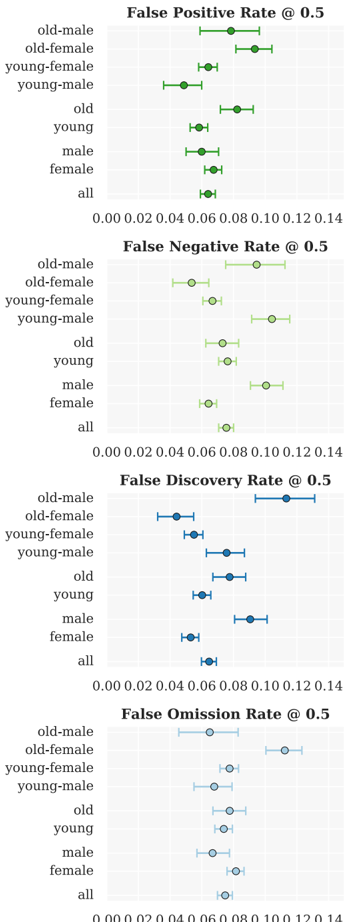
- In the smiling classifier example, all reported metrics at the .5 decision threshold have error types within the range 0.04–0.14, with 95% confidence intervals calculated by bootstrap resampling; the card notes older men have much higher false discovery rate, while men in aggregate have higher false negative rate.
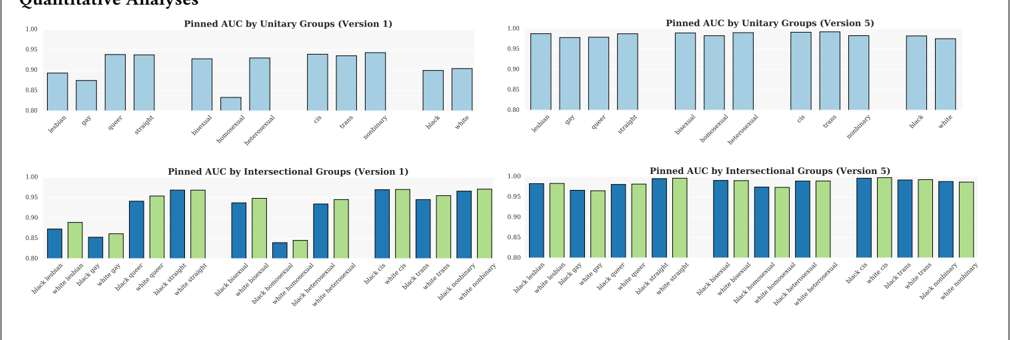
- In the toxicity example, TOXICITY v. 1 has low performance for several terms, especially “lesbian,” “gay,” and “homosexual,” while TOXICITY v. 5 shows more equitable performance after bias mitigation techniques.
Methods
- The paper is a framework/proposal paper, not an empirical study of a new model; it recommends model cards and details suggested sections and prompts.
- It provides two worked examples: a smiling classifier trained and evaluated on the CelebA dataset, using a convolutional neural net pretrained for face recognition and fine-tuned with cross-entropy loss for binary smiling classification.
- It also provides a model card for Perspective API’s TOXICITY classifier, a convolutional neural network developed by Jigsaw in 2017, evaluated on a synthetic Identity Phrase Templates test set; metrics include FPR, FNR, FDR, FOR for the smiling classifier and Pinned AUC for toxicity.
Limitations
- The paper states that model cards rely on the integrity of their creators and that it seems unlikely, at least in the near term, that they could be standardized or formalized enough to prevent misleading representations of model results.
- The paper states that evaluation datasets suitable for disaggregated evaluation are not yet common, and that the synthetic toxicity test data covers only a small set of very specific comments and is not comprehensive.
- The smiling classifier card states it does not capture race or skin type, uses binary gender classes (male/female), and that an ideal evaluation dataset would additionally include Fitzpatrick skin type, camera details, and environment details; the paper also states future work is needed to study how model information is interpreted and used by different stakeholders.
Model-written summary. Check it against the paper before relying on it.
Integrity signals
Registry
Cites
Statistics
Figures
Verification
Claims the paper makes
5 Valid · 1 Not valid · 18 Not checked · 30 Own results and interpretations
The cited sources support only part of this claim — read each source’s verdict below.
In the paper
“Synthetic data is valuable here because [11] shows that real data often has disproportionate amounts of toxicity directed at specific groups.”
What the sources say
- Partly supportedcites [11] [11] Lucas Dixon, John Li, Jeffrey Sorensen, Nithum Thain, and Lucy Vasserman. 2018. Measuring and Mitigating Unintended Bias in Text Classification. Proceedings of the AAAI/ACM Conference on AI, Ethics, and Society (2018). - sourceExperimental — accuracy not yet measured
The 'Quantifying bias in dataset' section (page unavailable) reports that certain identity terms appear disproportionately in toxic comments in the authors’ training data; for example, 'gay' appears in 3% of toxic comments but 0.5% of comments overall. It measures comments containing those terms, not whether toxicity is directed at the groups, and does not establish how often this pattern occurs across real datasets generally. (LLM, conf=0.85)
plainstates an association- Asserted: passes — The authors put it forward as true.
- Checkable: passes — It can be checked against evidence.
- Load-bearing: passes — The paper’s conclusions depend on it.
- Based: passes — The paper gives a reason why it holds.
- Partly supported
A result the paper reports from its own data — it cites no other source for it, so there is none to check. The quote shows it is in the paper.
In the paper
“For example, the false discovery rate on older men is much higher than that for other groups.”
plainstates an association- Asserted: passes — The authors put it forward as true.
- Checkable: passes — It can be checked against evidence.
- Load-bearing: passes — The paper’s conclusions depend on it.
- Based: passes — The paper gives a reason why it holds.
A result the paper reports from its own data — it cites no other source for it, so there is none to check. The quote shows it is in the paper.
In the paper
“TOXICITY v. 1 has low performance for several terms, especially 'lesbian', 'gay', and 'homosexual'.”
plain- Asserted: passes — The authors put it forward as true.
- Checkable: passes — It can be checked against evidence.
- Load-bearing: passes — The paper’s conclusions depend on it.
- Based: passes — The paper gives a reason why it holds.
None of the sources cited for this claim have been checked yet.
In the paper
“she collaborated with other researchers to demonstrate the disproportionate errors of computer vision systems on historically marginalized groups in the United States, such as darker-skinned women [5, 41].”
What the sources say
- Not checked yetcites [5] [5] Joy Buolamwini and Timnit Gebru. 2018. Gender Shades: Intersectional Accuracy Disparities in Commercial Gender Classification. In Proceedings of the 1st Conference on Fairness, Accountability and Transparency (Proceedings of Machine Learning Research) , Sorelle A. Friedler and Christo Wilson (Eds.), Vol. 81. PMLR, New York, NY, USA, 77-91. http://proceedings.mlr.press/v81/buolamwini18a.html -
- Not checked yetcites [41] [41] Inioluwa Raji. 2018. Black Panther Face Scorecard: Wakandans Under the Coded Gaze of AI. (2018). -
boostedstates an association- Asserted: passes — The authors put it forward as true.
- Checkable: passes — It can be checked against evidence.
- Load-bearing: passes — The paper’s conclusions depend on it.
- Based: passes — The paper gives a reason why it holds.
In the paper
“after MIT Media Lab graduate student Joy Buolamwini found that commercial face recognition systems failed to detect her face [4]”
What the sources say
- Not checked yetcites [4] [4] Joy Buolamwini. 2016. How I'm fighting Bias in Algorithms. (2016). https://www.ted.com/talks/joy\_buolamwini\_how\_i\_m\_fighting\_bias\_in\_ algorithms#t-63664 -
plainSingle case- Asserted: passes — The authors put it forward as true.
- Checkable: passes — It can be checked against evidence.
- Load-bearing: unclear — It is unclear whether the paper’s conclusions depend on it.
- Based: passes — The paper gives a reason why it holds.
13 more claims
Create a free account to see all 54 claims and to verify the 13 references still open.
- Probably not a substantial claim. 34
- It may state two separate claims as one. 8
Claims other papers make about this one
Each is checked against this paper’s own text: does it say what the citing paper says it does?
The source backs part of the claim, not all of it — or backs it for a different population, condition or comparison.
In the citing paper
“Model cards represent the field's standard for disclosing and documenting key facts about the architecture, training and evaluation of the model [14, 40].”
From Rethinking open source generative AI: open washing and the EU AI Act (2024) · cites this paper as [40]
Experimental — accuracy not yet measuredThe source backs part of the claim, not all of it — or backs it for a different population, condition or comparison.
In the citing paper
“Model cards (SMCs) [44] have been foundational in standardizing documentation for AI/ML model performance and characteristics, along with risks and unintended uses.”
From Interactive Model Cards: A Human-Centered Approach to Model Documentation (2022) · cites this paper as [44]
Experimental — accuracy not yet measuredThe source backs part of the claim, not all of it — or backs it for a different population, condition or comparison.
In the citing paper
“A second phase saw a more technical approach from the computer science community focusing on fairness, accountability and transparency as an engineering 'ethicalby-design' problem-solving exercise [20][21][22].”
From Putting AI ethics to work: are the tools fit for purpose? (2022) · cites this paper as [21]
Experimental — accuracy not yet measuredThe source backs part of the claim, not all of it — or backs it for a different population, condition or comparison.
In the citing paper
“These are either materials for use in design teams in workshop style events [76,77], tools for producing documentation of the design, build and test process [21,68], or technical tools for testing models, protecting privacy and security, testing for bias [69,93,94], or tracking provenance of data [95].”
From Putting AI ethics to work: are the tools fit for purpose? (2022) · cites this paper as [21]
Experimental — accuracy not yet measuredThe source backs part of the claim, not all of it — or backs it for a different population, condition or comparison.
In the citing paper
“There is some work on fairness relating to AI services, though this tends to focus on either exposing or 'auditing' certain AI services [22,38,126,133], or devising tools, methods and interventions relevant for those building (rather than using) such services [12,96,106,128].”
From Out of Context: Investigating the Bias and Fairness Concerns of “Artificial Intelligence as a Service” (2023) · cites this paper as [106]
Experimental — accuracy not yet measured
17 more claims about this paper
Create a free account to see every claim other papers make about this one.
Citations
Cites
BLEU: a method for automatic evaluation of machine translation
Papineni, K., Roukos, S., Ward, T., & Zhu, W.-J. (2001) · Proceedings of the 40th Annual Meeting on Association for Computational Linguistics - ACL '02 · doi:10.3115/1073083.1073135 · Cited by 21,344 · cited 1×
“translation system could compare BLEU scores [40] across demographic groups, and a model card for a speech recognition system could compare word-error rates.”
BackgroundCrenshaw, K. (2018) · Feminist Legal Theory · doi:10.4324/9780429500480-5 · Cited by 9,510
Deep Learning Face Attributes in the Wild
Liu, Z., Luo, P., Wang, X., & Tang, X. (2015) · 2015 IEEE International Conference on Computer Vision (ICCV) · doi:10.1109/iccv.2015.425 · Cited by 7,747 · cited 4×
“ms [5, 26] that report details of the datasets used to train and test machine learning models. We provide two example model cards in Section 5: A smiling detection model trained on the CelebA dataset [33] (Figure 2), and a public toxicity detection model, Perspective API [29] (Figure 3). Where Datasheets highlight cha…”
BackgroundMethodInfluentialThe validity and practicality of sun-reactive skin types I through VI
Fitzpatrick, T. B. (1988) · Archives of Dermatology · doi:10.1001/archderm.1988.01670060015008 · Cited by 4,339
Differential Privacy: A Survey of Results
Dwork, C. (2008) · Lecture Notes in Computer Science · doi:10.1007/978-3-540-79228-4_1 · Cited by 3,542 · cited 2×
“As such, collaboration with policy, privacy, and legal experts is necessary in order to ascertain which groups may be responsibly inferred, and how that information should be stored and accessed (for example, using differential privacy [12]).”
BackgroundCollins, G. S., Reitsma, J. B., Altman, D. G., & Moons, K. G. M. (2015) · Annals of Internal Medicine · doi:10.7326/m14-0697 · Cited by 3,267
Equality of Opportunity in Supervised Learning
Hardt, M., Price, E., & Srebro, N. (2016) · arXiv · doi:10.48550/arxiv.1610.02413 · Cited by 2,536 · cited 2×
“of Opportunity, and equal false negative and false positive rates across groups is equivalent to fulfilling Equality of Odds [26].”
BackgroundGebru, T., Morgenstern, J., Vecchione, B., Vaughan, J. W., Wallach, H., Daumé, H., & Crawford, K. (2018) · arXiv · doi:10.48550/arxiv.1803.09010 · Cited by 2,474
Self-citationA Probabilistic Interpretation of Precision, Recall and F-Score, with Implication for Evaluation
Goutte, C., & Gaussier, E. (2005) · Lecture Notes in Computer Science · doi:10.1007/978-3-540-31865-1_25 · Cited by 2,285 · cited 1×
“Confidence intervals for metrics derived from confusion matrices can be calculated by treating the matrices as probabilistic models of system performance [24].”
MethodFair prediction with disparate impact: a study of bias in recidivism prediction instruments
Chouldechova, A. (2017) · Big Data · doi:10.1089/big.2016.0047 · Cited by 2,159 · cited 1×
“or different errors that can be calculated from the confusion matrix for binary classification systems. • These also correspond to metrics in recent definitions of “fairness” in machine learning (cf. [8, 25]), where parity across subgroups for different metrics correspond to different fairness criteria. • 95% confiden…”
Background
Research works printed but not linked: 9
- [1] Avrio AI. 2018. Avrio AI: AI Talent Platform. (2018). https://www.goavrio.com/ -
- [5] Joy Buolamwini and Timnit Gebru. 2018. Gender Shades: Intersectional Accuracy Disparities in Commercial Gender Classification. In Proceedings of the 1st Conference on Fairness, Accountability and Transparency (Proceedings of Machine Learning Research) , Sorelle A. Friedler and Christo Wilson (Eds.), Vol. 81. PMLR, New York, NY, USA, 77-91. http://proceedings.mlr.press/v81/buolamwini18a.html -
- [13] Entelo. 2018. Recruitment Software | Entelo. (2018). https://www.entelo.com/ -
- [17] U.S. Food and Drug Administration. 2013. FDA Drug Safety Communication: Risk of next-morning impairment after use of insomnia drugs; FDA requires lower recommended doses for certain drugs containing zolpidem (Ambien, Ambien CR, Edluar, and Zolpimist). (2013). https://web.archive.org/web/20170428150213/ https://www.fda.gov/drugs/drugsafety/ucm352085.htm -
- [18] IIHS (Insurance Institute for Highway Safety: Highway Loss Data Institute). 2003. Special Issue: Side Impact Crashworthiness. Status Report 38, 7 (2003). -
- [19] Institute for the Future, Omidyar Network's Tech, and Society Solutions Lab. 2018. Ethical OS. (2018). https://ethicalos.org/ -
- [32] Jigsaw. 2017. Perspective API. (2017). https://www.perspectiveapi.com/ -
- [39] AI Now. 2018. Litigating Algorithms: Challenging Government Use Of Algorithmic Decision Systems. AI Now Institute. -
- [43] Mukund Sundararajan, Ankur Taly, and Qiqi Yan. 2017. In Proceedings of the 34th International Conference on Machine Learning , Vol. 70. PMLR, Sydney, Australia. -
Cited by
Items 901–1,000 of 2,236
Winslow, B. D., Garibay, Ö. Ö., Goyal, T., Koon, S., Margetis, G., Salvendy, G., Shneiderman, B., Tayebi, A., & Vardoulakis, L. (2026) · International Journal of Human-Computer Interaction · doi:10.1080/10447318.2026.2641703 · Cited by 17
Fairness, explainability, privacy, and robustness for trustworthy algorithmic decision-making
Majumdar, S. (2023) · Elsevier eBooks · doi:10.1016/b978-0-323-85713-0.00017-7 · Cited by 10
Artificial Intelligence, Machine Learning, and Natural Language Processing
Shoenbill, K. A., Kasthurirathne, S. N., & Mendonça, E. A. (2023) · Springer eBooks · doi:10.1007/978-3-031-29171-5_36 · Cited by 15
Training Future Machine Learning Engineers: A Project-Based Course on MLOps
Lanubile, F., Martínez‐Fernández, S., & Quaranta, L. (2023) · IEEE Software · doi:10.1109/ms.2023.3310768 · Cited by 11
Grigaliūnas, Š., Brūzgienė, R., & Venčkauskas, A. (2023) · IEEE Access · doi:10.1109/access.2023.3322162 · Cited by 15
“Even if a machine learning model performs well on its training data, it may perform inadequately when exposed to new data if it was not trained in a diverse environment or with context in mind [12], [13].”
BackgroundFrom Scarcity to Understanding: Transfer Learning for the Extremely Low Resource Irish Sign Language
Holmes, R., Rushe, E., Coster, M. D., Bonnaerens, M., Satoh, S., Sugimoto, A., & Ventresque, A. (2023) · IEEE International Conference on Computer Vision Workshops · doi:10.1109/iccvw60793.2023.00215 · Cited by 6
“Furthermore, pose estimation frameworks such as Google’s MediaPipe [22] publish accompanying details of the individuals it has been trained on [25], which suggests that these models have a greater level of robustness to human variation than could ever be achieved using a small SLR dataset with a…”
MethodXAI for Time-Series Classification Leveraging Image Highlight Methods
Makridis, G., Fatouros, G., Koukos, V., Kotios, D., Kyriazis, D., & Soldatos, J. K. (2024) · Communications in computer and information science · doi:10.1007/978-3-031-51643-6_28 · Cited by 12
Predicting small molecules solubility on endpoint devices using deep ensemble neural networks
Ramos, M. C., & White, A. D. (2024) · Digital Discovery · doi:10.1039/d3dd00217a · Cited by 12
“Details of the model performance, limitations, training data, ethical considerations, and caveats are available as a model card[78] at http://mol.dev/ .”
BackgroundRacial/Ethnic Categories in AI and Algorithmic Fairness: Why They Matter and What They Represent
Mickel, J. (2024) · ACM Conference on Fairness, Accountability, and Transparency (FAccT) · doi:10.1145/3630106.3659050 · Cited by 21
“Our work is motivated by previous scholarship on racial categories in algorithmic and AI fairness [1, 9, 25] as well as by existing documentation frameworks for datasets and models [8, 15, 17, 19, 24, 28, 30, 43, 56].”
MethodEmploying Hybrid AI Systems to Trace and Document Bias in ML Pipelines
Russo, M., Chudasama, Y., Purohit, D., Sawischa, S. F., & Vidal, M.-E. (2024) · IEEE Access · doi:10.1109/access.2024.3427388 · Cited by 11
Software Systems Compliance with the AI Act: Lessons Learned from an International Challenge
Scantamburlo, T., Falcarin, P., Veneri, A., Fabris, A., Gallese, C., Billa, V., Rotolo, F., & Marcuzzi, F. (2024) · doi:10.1145/3643691.3648589 · Cited by 14
The Role of Paradata in Algorithmic Accountability
Trace, C. B., & Hodges, J. A. (2024) · Knowledge management and organizational learning · doi:10.1007/978-3-031-53946-6_11 · Cited by 8
Galactica’s dis-assemblage: Meta’s beta and the omega of post-human science
Chartier-Edwards, N., Grenier, É., & Goujon, V. (2024) · AI & Society · doi:10.1007/s00146-024-02088-7 · Cited by 8
“…accompanying trained machine learning models that provide benchmarked evaluation in a variety of conditions, such as across different cultural, demographic, or phenotypic groups (…) and intersectional groups (…) that are relevant to the intended application domains" (Mitchell et al. 2019).”
Wachowiak, L., Tisnikar, P., Coles, A., Canal, G., & Çeliktutan, O. (2024) · INTERNATIONAL CONFERENCE ON MULTIMODAL INTERACTION · doi:10.1145/3678957.3688386 · Cited by 15
“Our MiniRocket model performing best on interaction rupture detection is summarized in the model card [26] in Figure 3.”
MHNfs: Prompting In-Context Bioactivity Predictions for Low-Data Drug Discovery
Schimunek, J., Luukkonen, S., & Klambauer, G. (2025) · Journal of Chemical Information and Modeling · doi:10.1021/acs.jcim.4c02373 · Cited by 11
A new methodological framework for hazard detection models in health information technology systems
Omitaomu, O. A., Klasky, H. B., Olama, M. M., Özmen, Ö., Pullum, L., Thakur, A. M., Kuruganti, T. P., Scott, J. M., Laurio, A., Drews, F. A., et al. (2021) · Journal of Biomedical Informatics · doi:10.1016/j.jbi.2021.103937 · Cited by 7
Boykin, C. M., Dasch, S. T., Rice, V., Lakshminarayanan, V. R., Togun, T. A., & Brown, S. M. (2021) · ACM Conference on Equity and Access in Algorithms, Mechanisms, and Optimization (EAAMO) · doi:10.1145/3465416.3483302 · Cited by 11
How Do People Rank Multiple Mutant Agents?
Dodge, J. E., Anderson, A. A., Olson, M., Dikkala, R., & Burnett, M. (2022) · ACM International Conference on Intelligent User Interfaces (IUI) · doi:10.1145/3490099.3511115 · Cited by 10
Network cards: concise, readable summaries of network data
Bagrow, J. P., & Ahn, Y. (2022) · Applied Network Science · doi:10.1007/s41109-022-00514-7 · Cited by 5
Revising human-systems engineering principles for embedded AI applications
Cummings, M. L. (2023) · Frontiers in Neuroergonomics · doi:10.3389/fnrgo.2023.1102165 · Cited by 8
“While there have been recent research efforts in developing processes to better contextualize the appropriateness of datasets (Gebru et al., 2018), as well as model performance with a given data set (Mitchell et al., 2019), there are no known organized auditing efforts across companies or agencies.”
BackgroundA Gradient Descent Multi-Algorithm Grid Search Optimization of Deep Learning for Sensor Fusion
Booth, T. M., & Ghosh, S. (2023) · IEEE International Systems Conference (SysCon) · doi:10.1109/syscon53073.2023.10131077 · Cited by 9
“When the criterion is satisfied, Prune_N_Tune will stop the refinement iterations and export the selected best performing model embedded with a Model Card [14] containing performance metrics and all information needed to reproduce it.”
MethodWhen Do Humans Heed AI Agents’ Advice? When Should They?
Dunning, R. E., Fischhoff, B., & Davis, A. L. (2023) · Human Factors The Journal of the Human Factors and Ergonomics Society · doi:10.1177/00187208231190459 · Cited by 17
“They have also raised concerns that these technologies may do more harm than good without appropriate human collaboration and supervision (e.g., Buolamwini & Gebru, 2018; Mitchell et al., 2019; Future of Life Institute, 2023).”
BackgroundDeveloping responsible AI practices at the Smithsonian Institution
Dikow, R. B., DiPietro, C., Trizna, M. G., BredenbeckCorp, H., Bursell, M. G., Ekwealor, J. T. B., Hodel, R. G. J., Lopez, N., Mattingly, W., Munro, J., et al. (2023) · Research Ideas and Outcomes · doi:10.3897/rio.9.e113334 · Cited by 11
“Data statements (Bender and Friedman 2018, McMillan-Major et al. 2023), model cards (Mitchell et al. 2019), and datasheets (Gebru et al. 2021) are all focused on better documentation of data and methods, making any work resulting from their use more transparent and reproducible.”
BackgroundDesigning Fiduciary Artificial Intelligence
Benthall, S., & Shekman, D. (2023) · ACM Conference on Equity and Access in Algorithms, Mechanisms, and Optimization (EAAMO) · doi:10.1145/3617694.3623230 · Cited by 25
“…and accountability for machine learning based on the data set they use for training [47], conformity with testing standards [12], use of the model only for its intended purposes and with testing for fairness on varying demographic groups [89], and for overall design of the reward system [50].”
Backgroundvon Struensee, S. (2021) · SSRN Electronic Journal · doi:10.2139/ssrn.3880779 · Cited by 11
A Primer on Artificial Intelligence and Machine Learning for the Financial Services IndustryPreprint
Osterrieder, J. R. (2023) · SSRN Electronic Journal · doi:10.2139/ssrn.4349078 · Cited by 8
Transformers Can Outperform Humans in Short Creative Writing TasksPreprint
Marco, G., Gonzalo, J. A., & Rello, L. (2023) · SSRN Electronic Journal · doi:10.2139/ssrn.4673692 · Cited by 9
Benchmarking Benchmark Leakage in Large Language Models
Xu, R., Wang, Z., Fan, R.-Z., & Liu, P. (2024) · arXiv · doi:10.48550/arxiv.2404.18824 · Cited by 210
“To this end, we introduce Benchmark Transparency Card (cf. Table 19), which serves as the supplement of the Data Card (Pushkarna et al., 2022; Gebru et al., 2021) and Model Card (Mitchell et al., 2019), aiming to document the utilization of benchmarks (such as whether any benchmark sets are used for training and wheth…”
Bridging the Gap: Decoding Abstract Concepts in Cultural Heritage Images
Pandiani, D. S. M. (2024) · Springer eBooks · doi:10.1007/978-3-031-57675-1_8 · Cited by 5
Uncertainties in outcome modelling in radiation oncology
Dünger, L., Mäusel, E., Zwanenburg, A., & Löck, S. (2025) · Physics and Imaging in Radiation Oncology · doi:10.1016/j.phro.2025.100774 · Cited by 14
“A data quality summary table [42] or a model card [13,153] can help to transparently report on data.”
Harmonizing creativity and ethics in AI systems
Baeyaert, J. (2025) · AI and Ethics · doi:10.1007/s43681-025-00766-w · Cited by 8
“Together, these practices render environmental responsibility a measurable and reproducible property of creative AI workflows, ensur - ing that ecological stewardship is embedded in both model architecture and user experience JSON-LD to every artefact [ 1, 46].”
InfluentialCroskey, P., Offert, F., Jacobs, J., & Thaler, K. M. (2025) · ACM Conference on Fairness, Accountability, and Transparency (FAccT) · doi:10.1145/3715275.3732058 · Cited by 12
“In response to calls and proposed solutions for increased transparency [52, 92, 115], some AI developers have released more (though still severely limited [144]) details about their training processes [104, 107].”
Huang, C., & Yao, X. (2025) · IEEE Computational Intelligence Magazine · doi:10.1109/mci.2025.3593452 · Cited by 7
“Documentation and transparency practices, such as maintaining model cards and detailed development process documentation, are crucial for accountability and auditability [35].”
Liu, Z., Kou, J., Zhang, W., Gu, C., Fang, X., Huang, Z., Hao, Y., Li, H., Lu, X., Yin, A., et al. (2024) · International Conference on Universal Village (UV) · doi:10.1109/uv63228.2024.11189137 · Cited by 12
Beyond Big Tech: Advocacy Technologists within Mission-Driven Civil Society Organizations
Chambers, L. M. (2025) · Proceedings of the ACM on Human-Computer Interaction · doi:10.1145/3757559 · Cited by 7
“Popular and innovative interventions such as datasheets for datasets [55], model cards for model reporting [92], or dataset nutritional labels [62] are generally intended for development contexts within tech companies.”
Towards a Responsible AI Organizational Maturity Model
Heger, A., Passi, S., Dhanorkar, S., Kahn, Z., Wang, R., & Vorvoreanu, M. (2025) · Proceedings of the ACM on Human-Computer Interaction · doi:10.1145/3757514 · Cited by 19
“Examples include Datasheets for Datasets [34], Error Analysis [65], Ethical OS [53], Consequence Scanning Kit [13], Fairlearn [10], Fairness Checklist [59], InterpretML [73], Model Cards [67], and Data Ethics Emergency Drill [40].”
Καρανικόλας, Ν., Kyriakidou, E., & Athanasouli, E. (2025) · Information · doi:10.3390/info16121049 · Cited by 13
Seuru, S., Grimm, V., Barton, M., Pérez, L., Gharakhanlou, N. M., Sengupta, R., & Dagnino, A. M. (2026) · Environmental Modelling & Software · doi:10.1016/j.envsoft.2026.106912 · Cited by 10
Trust in Artificial Intelligence: Clinicians Are Essential
Bhatt, U., & Shams, Z. (2021) · Health informatics · doi:10.1007/978-3-030-81030-6_10 · Cited by 5
cSmartML-Glassbox: Increasing Transparency and Controllability in Automated Clustering
Elshawi, R., & Sakr, S. (2022) · IEEE ... International Conference on Data Mining workshops · doi:10.1109/icdmw58026.2022.00015 · Cited by 11
“These proposals include reporting the process by which machine learning pipelines were created [18], [19] and visualizing the configurations explored by the AutoML [20]– [22].”
BackgroundGASTeN: Generative Adversarial Stress Test Networks
Cunha, L., Soares, C., Restivo, A., & Teixeira, L. F. (2023) · Lecture notes in computer science · doi:10.1007/978-3-031-30047-9_8 · Cited by 11
Harrison, G., Bryson, K., Bamba, A. E. B., Dovichi, L., Binion, A. H., Borem, A., & Ur, B. (2024) · CHI Conference on Human Factors in Computing Systems · doi:10.1145/3613904.3642755 · Cited by 11
“Researchers have proposed short summary information sheets describing relevant aspects of the model [44] or the data [22, 38] to support such processes.”
BackgroundInfluentialSchrödinger's Update: User Perceptions of Uncertainties in Proprietary Large Language Model Updates
Ma, Z., Mei, Y., Gajos, K. Z., & Arawjo, I. (2024) · CHI Conference Extended Abstracts on Human Factors in Computing Systems (CHI EA) · doi:10.1145/3613905.3651100 · Cited by 16
“Learning from software companies, LLM firms could adopt regular up-date schedules like monthly “Patch Tuesday” [63] [20, 42] and our participants to better predict how models might perform after updates.”
Natural Language Processing for HR Chatbots and Virtual Assistants
Singh, A. K., Lakhera, G., Ojha, M., Mishra, A. K., & Kaushik, S. (2024) · Advances in logistics, operations, and management science book series · doi:10.4018/979-8-3693-3318-1.ch020 · Cited by 6
Browsing and Searching Metadata of TREC
Breuer, T., Voorhees, E. M., & Soboroff, I. M. (2024) · International ACM SIGIR Conference on Research and Development in Information Retrieval (SIGIR) · doi:10.1145/3626772.3657873 · Cited by 6
Generative AI for Consumer Communications: Classification, Summarization, Response Generation
Correa, N., Correa, A., & Zadrozny, W. (2024) · IEEE ANDESCON · doi:10.1109/andescon61840.2024.10755794 · Cited by 8
Anglin, K., & Ventura, C. (2024) · Journal of Educational and Behavioral Statistics · doi:10.3102/10769986241279927 · Cited by 12
“Demonstrating sufficient performance among protected subgroups is one method of protection (Mitchell et al., 2019).”
Generative AI and Foundation Models
Narapareddy, V. S. R. (2025) · Universal Library of Innovative Research and Studies · doi:10.70315/uloap.ulirs.2025.0202002 · Cited by 12
Applying Data Feminism Principles to Assess Bias in English and Arabic NLP Research
Mayeda, C., Singh, A., Mahale, A., Sakr, L. S., & ElSherief, M. (2025) · ACM Conference on Fairness, Accountability, and Transparency (FAccT) · doi:10.1145/3715275.3732119 · Cited by 7
Pressing Matters: How AI Irons Out Epistemic Friction and Smooths Over Diversity
Ramsoomair, N. (2025) · Atlantis Critical Studies in Gender Culture & Social Justice · doi:10.7202/1119494ar · Cited by 9
Blockchain at the Shop Floor for Maintenance
Welte, D., Sikora, A., Schönle, D., Stodt, J., & Reich, C. (2020) · International Conference on Cyber-Enabled Distributed Computing and Knowledge Discovery (CyberC) · doi:10.1109/cyberc49757.2020.00013 · Cited by 7
“Using the example of the machine learning model, a unique property could be both the hash of the model and the identity of the model creator, as well as other properties as described by Mitchell et al. [29].”
MethodTrust Evaluation of Ontological Decision Support Systems for Avionics Analytics
Insaurralde, C. C., & Blasch, E. (2021) · Integrated Communications, Navigation and Surveillance Conference (ICNS) · doi:10.1109/icns52807.2021.9441570 · Cited by 7
“Key enhancements include datasheets [55], nutrition labels [56,57], model cards [58], and factsheets [59] on the AI/ML capability.”
BackgroundDigital Ethics as Translational Ethics
Danks, D. J. (2021) · Advances in human and social aspects of technology book series · doi:10.4018/978-1-7998-8467-5.ch001 · Cited by 6
“Datasheets (Gebru et al., 2018) and model cards (Mitchell et al., 2019) are two process innovations that aim to reduce or eliminate problems that can arise from this kind of distributed work.”
BackgroundAuditable Augmented/Mixed/Virtual Reality: The Practicalities of Mobile System Transparency
Cloete, R., Norval, C., & Singh, J. (2021) · Proceedings of the ACM on Interactive Mobile Wearable and Ubiquitous Technologies · doi:10.1145/3495001 · Cited by 7
“…in the context of transparency and accountability, is something of a nascent, yet growing topic for the technical disciplines, and has had some initial consideration in areas including cloud [72] and AI services [40, 41], the Internet of Things [53, 81], and machine learning [21, 25, 33, 52, 65].”
BackgroundSchedl, M., Gómez, E., & Lex, E. (2022) · International ACM SIGIR Conference on Research and Development in Information Retrieval (SIGIR) · doi:10.1145/3477495.3532683 · Cited by 10
Embedding Ethics and Trustworthiness for Sustainable AI in Earth Sciences: Where Do We Begin?
Dias, P. A., & Lunga, D. (2022) · IEEE International Geoscience and Remote Sensing Symposium (IGARSS) · doi:10.1109/igarss46834.2022.9883030 · Cited by 5
“The Model Cards framework is introduced in [11] for cataloging model characteristics such as performance metrics across multiple conditions, intended and non-intended use cases, assumptions, training/evaluation data, as well as any caveats and recommendations.”
MethodTrustworthy Algorithmic Ranking Systems
Schedl, M., Gómez, E., & Lex, E. (2023) · ACM International Conference on Web Search and Data Mining (WSDM) · doi:10.1145/3539597.3572723 · Cited by 5
Attitudinal Tensions in the Joint Pursuit of Explainable and Trusted AI
Narayanan, D., & Tan, Z. M. (2023) · Minds and Machines · doi:10.1007/s11023-023-09628-y · Cited by 11
“…et al., 2020), and there are a variety of informational cues – model parameters, intended use, evaluation data, training data, performance metrics, etc. – that a proactive ‘human in the loop’ would need to carefully scrutinize in their interactions with an AI-DST (cf. Mitchell et al., 2019).”
Background“I'm” Lost in Translation: Pronoun Missteps in Crowdsourced Data Sets
Seaborn, K., & Kim, Y. (2023) · CHI Conference Extended Abstracts on Human Factors in Computing Systems (CHI EA) · doi:10.1145/3544549.3585667 · Cited by 9
Verifiable Machine Learning Models in Industrial IoT via Blockchain
Stodt, J., Ghajar, F. G., Reich, C., & Clarke, N. (2023) · Communications in computer and information science · doi:10.1007/978-3-031-35644-5_6 · Cited by 5
The AI Act’s Research Exemption: A Mechanism for Regulatory Arbitrage?
Colonna, L., & Submitter, S. L. (2023) · YSEC yearbook of socio-economic constitutions · doi:10.1007/16495_2023_59 · Cited by 15
Rethinking Machine Learning Benchmarks in the Context of Professional Codes of Conduct
Henderson, P., Hu, J., Diab, M., & Pineau, J. (2024) · ACM Symposium on Computer Science and Law (CSLAW) · doi:10.1145/3614407.3643708 · Cited by 8
“Numerous interventions on responsible AI deployments, such as Model Cards [Mitchell et al. 2019], Datasheets [Gebru et al. 2021], Reward Reports [Gilbert et al. 2022], Holistic Assessments [Liang et al. 2022], Internal Audits [Raji et al. 2020], and others, have sought to improve transparency into…”
BackgroundReporting on artificial intelligence use in entrepreneurship research: Using a model card
Fox, J. D. (2024) · The International Journal of Entrepreneurship and Innovation · doi:10.1177/14657503241238691 · Cited by 9
Regulation of AI algorithms for clinical decision support: a personal opinion
Kandarpa, K. (2024) · International Journal of Computer Assisted Radiology and Surgery · doi:10.1007/s11548-024-03088-0 · Cited by 5
“…method developers may use during deployment is to provide data source ‘nutrition labels’ [like content labels on packaged food] specifying the geographic diversity, representation [gender, age, racial, ethnic, socioeconomic, etc.] and collection periods of data used for training and validation [5].”
Explainability as a Requirement for Hardware: Introducing Explainable Hardware (XHW)
Speith, T., Speith, J., Becker, S., Zou, Y., Biega, A. J., & Paar, C. (2024) · IEEE International Requirements Engineering Conference (RE) · doi:10.1109/re59067.2024.00042 · Cited by 12
“In line with the above idea of hardware labels, research on model cards [58] and datasheets for datasets [59] can already be found in the debates on XAI.”
BackgroundPatra ModelCards: AI/ML Accountability in the Edge-Cloud Continuum
Withana, S., & Plale, B. (2024) · IEEE International Conference on eScience · doi:10.1109/e-science62913.2024.10678710 · Cited by 6
“The seminal work of Mitchell et al. [25] introduces Model Cards as a standardized means for documenting AI/ML model creation and use.”
BackgroundMethodGPT-4 and Beyond : Advancements in AI Language Models
Jandhyala, V. S. V. (2024) · International Journal of Scientific Research in Computer Science Engineering and Information Technology · doi:10.32628/cseit241051019 · Cited by 12
Levine, M. (2025) · British Journal of Social Psychology · doi:10.1111/bjso.12896 · Cited by 6
“…away from just trying to make data bias and inequality transparent, to a more radical path of trying to tackle the underlying relations of power (see for example Bender and Friedman (2018), Buolamwini and Gebru (2018), Mitchell et al. (2019), Gebru (2020), Birhane (2021), Birhane et al. (2022)).”
Applying Algorithmic Accountability Frameworks with Domain-specific Codes of Ethics
Grasso, I., Russell, D., Matthews, A., Matthews, J. N., & Record, N. R. (2020) · ACM-IMS Foundations of Data Science Conference (FODS) · doi:10.1145/3412815.3416897 · Cited by 5
Deep Learning Systems: Algorithms, Compilers, and Processors for Large-Scale Production
Rodríguez, A. (2020) · Synthesis lectures on computer architecture · doi:10.2200/s01046ed1v01y202009cac053 · Cited by 8
Toward Multiconcern Software Development With Everything as Code
Stirbu, V., Raatikainen, M., Röntynen, J., Sokolov, V., Lehtonen, T., & Mikkonen, T. (2022) · IEEE Software · doi:10.1109/ms.2022.3167481 · Cited by 9
Measuring Bias and Fairness in Multiclass Classification
Blakeney, C., Atkinson, G., Huish, N., Yan, Y., Metsis, V., & Zong, Z. (2022) · IEEE International Conference on Networking, Architecture and Storage (NAS) · doi:10.1109/nas55553.2022.9925287 · Cited by 8
“Mitchell et al. explored how model cards can be used to provide details on model performance across cultural, racial, and inter-sectional groups and to inform when their usage is not well-suited [11].”
BackgroundCruz, B. G. S., Vega, C., & Hertel, F. (2022) · Lecture notes in computer science · doi:10.1007/978-3-031-20837-9_16 · Cited by 6
“Such errors include systematic biases against concrete populations [5] and limitations in model generalizability and transportability which are well-known issues in biomedical applications [6].”
BackgroundA System Framework for Personalized and Transparent Data-Driven Decisions
Oppold, S., & Herschel, M. (2020) · Lecture notes in computer science · doi:10.1007/978-3-030-49435-3_10 · Cited by 10
“To define and model the desired metadata, we can leverage existing work on responsible data set metadata [9,12] and machine learning model metadata [6, 19,28].”
MethodNegligent Algorithmic DiscriminationPreprint
Páez, A. (2021) · SSRN Electronic Journal · doi:10.2139/ssrn.3765778 · Cited by 17
Language Testing for Migrants: Co-Constructing Validation
O’Sullivan, B., & Chalhoub-Deville, M. B. (2021) · Language Assessment Quarterly · doi:10.1080/15434303.2021.1986513 · Cited by 8
Pushing Boundaries or Crossing Lines? The Complex Ethics of ChatGPT JailbreakingPreprint
Boxleitner, A. (2023) · SSRN Electronic Journal · doi:10.2139/ssrn.4604736 · Cited by 6
A Blueprint for Auditing Generative AIPreprint
Mökander, J., Curl, J., & Kshirsagar, M. (2024) · SSRN Electronic Journal · doi:10.2139/ssrn.4887768 · Cited by 7
Co-Producing AI: Toward an Augmented, Participatory Lifecycle
Mushkani, R., Berard, H., Ammar, T., Chatonnier, C., & Koseki, S. (2025) · Proceedings of the AAAI/ACM Conference on AI, Ethics, and Society · doi:10.1609/aies.v8i2.36674 · Cited by 5
On the State of Reporting in Crowdsourcing Experiments and a Checklist to Aid Current Practices
Ramírez, J., Sayin, B., Baez, M., Casati, F., Cernuzzi, L., Benatallah, B., & Demartini, G. (2021) · Proceedings of the ACM on Human-Computer Interaction · doi:10.1145/3479531 · Cited by 4
“…evidence-based medicine where systematic reviews follow a strict elaboration protocol [71], or, more recently, in the machine learning community where authors are encouraged to follow pre-established checklists or datasheets to communicate their models and datasets effectively [2, 6, 29, 49, 55].”
BackgroundSolyst, J., Wilcox, L. G., & Madaio, M. (2025) · CHI Conference on Human Factors in Computing Systems · doi:10.1145/3706598.3714144 · Cited by 9
“…and address the potential harms of AI, researchers, policymakers, and others have developed tools and other resources for development of responsible AI (RAI) [e.g., 64, 94]—including resources for dataset or model documentation [e.g., 32, 62] and tools for evaluating model fairness [e.g., 3, 84].”
A Comparative Survey Of Algorithmic Feed Recommendation System Designs
Edelson, L., Haugen, F., & McCoy, D. (2026) · ACM Transactions on Recommender Systems · doi:10.1145/3757327 · Cited by 9
Pyle, C., & Andalibi, N. (2025) · Proceedings of the ACM on Human-Computer Interaction · doi:10.1145/3757550 · Cited by 5
“…provide clear, accessible explanations for 1) the stage(s) in the application review process algorithmic admissions technologies are used, 2) if/how they are used in conjunction with human review, and 3) model inputs and outputs, using tools like Model Cards [114] and Datasheets for Datasets [68].”
Public Perceptions of Algorithmic Bias and Fairness in Cloud-Based Decision Systems
Alhosban, A., Gaire, R., & Al-Ababneh, H. A. (2025) · Standards · doi:10.3390/standards6010002 · Cited by 4
“Mandating standardized documentation for datasets (e.g., datasheets [22]) and models (e.g., model cards [23]).”
InfluentialEthical dilemmas in the use of artificial intelligence in transfusion medicine
Seheult, J. N., Malone, J. R., Jackson, B. R., Malik, M. M., & Yazer, M. H. (2026) · Vox Sanguinis · doi:10.1111/vox.70183 · Cited by 4
“Model cards and datasheets operationalize these expectations by summarizing data provenance, evaluation cohorts, subgroup results and caveats for implementation [67, 68].”
ROADMAP: An Ontology of Medical AI Models and Datasets
Suri, A., Takahashi, M. S., Retson, T., Gonzales, R. A., Park, S. H., & Kahn, C. E. (2026) · Radiology Artificial Intelligence · doi:10.1148/ryai.260069 · Cited by 7
AI in chemical engineering: From promise to practice
Chew, J. W., Andersson, R., Bierweiler, T., Ryttestal, P., & Wik, T. (2026) · AIChE Journal · doi:10.1002/aic.70358 · Cited by 11
On-Orbit Space AI: Federated, Multi-Agent, and Collaborative Algorithms for Satellite Constellations
Wang, Z. (2026) · Algorithms · doi:10.3390/a19040318 · Cited by 9
“Similarly, documentation frameworks such as datasheets and model cards are important because they make assumptions, limitations, and intended use explicit, which is especially valuable in safety-and mission-critical settings [169, 170].”
Niazi, S. K. (2026) · International Journal of Molecular Sciences · doi:10.3390/ijms27104349 · Cited by 8
“Har-monization through ICH working groups would promote the adoption of standardized templates for algorithmic transparency, uncertainty reporting, and benchmarking criteria, thereby minimizing the risk of inconsistent evaluation of equivalent evidence packages by different agencies [17,18,97].”
Exploring the Intersection of AI, Language, and Law: A Bibliometric Analysis
Lan, Z., & Zhang, X. (2026) · SAGE Open · doi:10.1177/21582440261431000 · Cited by 10
“…model cards with disaggregated performance reporting across jurisdictions and languages, and end-to-end internal algorithmic auditing that links design choices to harm hypotheses and remediation plans (Bender & Friedman, 2018; Gebru et al., 2021; Mitchell et al., 2019; Raji et al., 2020).”
Shrestha, H., Cachel, K., Alkhathlan, M., Rundensteiner, E. A., & Harrison, L. (2023) · ACM Conference on Fairness, Accountability, and Transparency (FAccT) · doi:10.1145/3593013.3594108 · Cited by 8
Cañas, P., Nieto, M., Otaegui, O., & Rodríguez, I. (2024) · SAE International Journal of Connected and Automated Vehicles · doi:10.4271/12-08-01-0010 · Cited by 4
Laminator: Verifiable ML Property Cards using Hardware-assisted Attestations
Duddu, V., Järvinen, O., Gunn, L. J., & Asokan, N. (2024) · ACM Conference on Data and Application Security and Privacy (CODASPY) · doi:10.1145/3714393.3726492 · Cited by 23
“TEEs [40] provide an environment in which security-critical code (trusted applications, or TAs) can run without outside interference from other TAs, or the rest of the system (the Rich Execution Environment, or REE, which contains the operating system and normal software).”
Responsible and Ethical AI in Natural Language Processing
Sangwan, S. R., & Kumar, A. (2025) · Springer eBooks · doi:10.1007/978-3-031-88988-2_10 · Cited by 5
Is the Next Winter Coming for AI? Elements of Making Secure and Robust AI
Harguess, J. D., & Ward, C. M. (2022) · IEEE Applied Imagery Pattern Recognition Workshop · doi:10.1109/aipr57179.2022.10092230 · Cited by 12
“While there have been some real developments towards resilience solutions, such as model cards [49] and data cards [50] that seek to standardize attributes for ML models and datasets, there are still many unknowns when it comes to testing and verifying AI systems.”
BackgroundMapping the Smart City: Participatory approaches to XAI
Gupta, S. (2023) · Designing Interactive Systems Conference · doi:10.1145/3563703.3593063 · Cited by 7
“Several methods and tools, such as model [44] and data documentation [4, 7, 22, 29] frameworks, have been designed to explain AI to experts [17].”
MethodEnhancing reproducibility of machine learning‐based studies in clinical journals through model cards
Dan, J., & Seeuws, N. (2023) · Developmental Medicine & Child Neurology · doi:10.1111/dmcn.15785 · Cited by 4
Kirov, B. (2023) · International Scientific Conference on Computer Science (COMSCI) · doi:10.1109/comsci59259.2023.10315821 · Cited by 7
“To maintain credibility and reliability in the final output, it's crucial to address and minimize bias present in AI-generated content [32].”
BackgroundFuture of Workplace Conversational AI-driven Personal Assistants: Promises and Perils
Saha, K., & Chandrasekharan, E. (2023) · Annual Meeting of the Forum for Information Retrieval Evaluation (FIRE) · doi:10.1145/3632754.3632939 · Cited by 5
Alfons, A., & Welz, M. (2024) · Social and Personality Psychology Compass · doi:10.1111/spc3.12941 · Cited by 14
Metadata
- Authors
- Mitchell, M., Wu, S., Zaldivar, A., Barnes, P., Vasserman, L., Hutchinson, B., Spitzer, E., Raji, I. D., & Gebru, T.
- Venue
- Proceedings of the Conference on Fairness, Accountability, and Transparency
- Publisher
- ACM
- Published
- 2019-01-29
- Pages
- 220-229
- OpenAlex
- W2897042519
- Semantic Scholar
- 7365f887c938ca21a6adbef08b5a520ebbd4638f
- Cited by
- 2,681
- References
- 12
- Citations by year
- 2026: 831 · 2025: 446 · 2024: 376 · 2023: 366 · 2022: 243 · 2021: 260 · 2020: 102 · 2019: 54
- FWCI
- 170.95
- Type
- conference paper
- Language
- en
- Open access
- green
- arxiv.org
- Locations
- ACM Conference on Fairness, Accountability, and Transparency (FAccT) (publishedVersion)
- arXiv (Cornell University) (submittedVersion)
- arXiv (Cornell University)
- Topics
- Physical Sciences › Computer Science › Artificial Intelligence › Ethics and Social Impacts of AI
- Physical Sciences › Computer Science › Artificial Intelligence › Explainable Artificial Intelligence (XAI)
- Physical Sciences › Computer Science › Computer Vision and Pattern Recognition › Face recognition and analysis
- Keywords
- model cards, model transparency, algorithmic fairness, demographic bias, responsible AI, democratization of AI, toxic comment detection, model documentation
About these checks
Registry, retraction, Cites and statistics results are computed, not judged, with one exception: a printed reference that no index lists is read once by a model before it counts as a citation error. Claims are extracted by a model and kept only when their quote appears verbatim in the text; each cited source is then checked, with a model’s help, for whether it says what the claim relies on. Those verdicts can be wrong — read the claim’s quote and the cited source before relying on one.
The claim verdicts this report counts are experimental: their accuracy is not yet measured.
A language model drew the claims from the paper on 2026-10-07, under version 3 of the claim definition (model deepseek-v4.1-flash, prompt extract-v3).
A second model labelled each claim on 2026-10-07 (model jev-1.13-20260917, definition revision gold-guideline-v0.2).
Cited sources are checked with a language model’s help (gpt-6-sol).
Statistics and arithmetic are recomputed, not judged.
Confidence bands are shown only for fields calibrated on our annotated test set. None is calibrated yet, so no band is shown.
What counts as a claim ›How we measure confidence ›How we check this ›
Are you an author, or do you see a problem with this page? Request a review
Data sources
Bibliographic data: Semantic Scholar, OpenAlex, Crossref.
Contains information from the Semantic Scholar Academic Graph Datasets, made available under the ODC Attribution License (ODC-BY 1.0).
Semantic Scholar’s data is described in: Kinney, R., et al. (2023). The Semantic Scholar Open Data Platform. arXiv:2301.10140.
