

The Regulation of Entry
Open accessThe DOI matches its Crossref record, with a small difference in title or year; 39 of the 39 references it cites were found in a registry or an index; none of the 13 sources its claims cite is checked for support yet.
Abstract
1%(5 :25.,1* 3$3(5 6(5,(6 7+( 5(*8/$7,21 2) (175< 6LPHRQ 'MDQNRY 5DIDHO /D 3RUWD )ORUHQ.LR /RSH]GH6LODQHV $QGUHL 6KOHLIHU :RUNLQJ 3DSHU KWWSZZZQEHURUJSDSHUVZ 1$7,21$/ %85($8 2) (&2120,& 5(6($5&+ 0DVVD.KXVHWWV $YHQXH &DPEULGJH 0$ 6HSWHPEHU :H WKDQN 2OJD ,RIIH 7DWLDQD 1HQRYD DQG (NDWHULQD 7UL]ORYD IRU DEOH UHVHDU.K DVVLVWDQ.H DQG +DPLG $ODYL ,ULQD $VWUDNKDQ $EKLMLW %DQHUMHH 5L.KDUG &DYHV -D.TXHOLQH &RROLGJH -DPHV (PHU\ 1LKDO (O0DJKDUEHO -HDQ 3DXO *DXWKLHU (G *ODHVHU 6LPRQ -RKQVRQ /DZUHQ.H .DW] 3HWHU .X.HUD 'DYLG /DLEVRQ ,UD /LHEHUPDQ 'DYLQ 0D.NLQ]LH 0DULH )UDQ.RLVH 0DULH1HOO\ 0DU.HOR 2ODUUHDJD *X\ 3IHIIHUPDQQ 6DQWLDJR 6HGD.D /HLOD :HEVWHU 3HWHU :ULJKW DQG VHPLQDU SDUWL.LSDQWV DW WKH 8QLYHUVLW\ RI 0DU\ODQG DW &ROOHJH 3DUN IRU KHOSIXO .RPPHQWV 7KH .ROOH.WLRQ RI GDWD IRU WKLV SDSHU ZDV RUJDQL]HG DQG ILQDQ.HG E\ WKH :RUOG %DQN $Q DSSHQGL[ GHV
Overview
CoChat Summary
TL;DR
This paper assembles a new cross-country dataset on business entry regulation in 75 countries and uses it to compare the helping-hand, capture, and tollbooth theories of regulation. The evidence is most consistent with the tollbooth view: heavier entry regulation is associated with more corruption, a larger unofficial economy, and less representative, more autocratic governments.
Key findings
- Across the 75-country sample, the number of entry procedures ranges from 2 in Canada to 20 in Bolivia, with a sample average of 10.17 procedures; the average official time is 63.05 business days and the average cost is 0.34 of GDP per capita.
- The number of procedures is strongly correlated with time and cost: the paper reports correlations of 0.75 with log time and 0.62 with log cost.
- The helping-hand tests do not support a beneficial-regulation story: in Table IV, more procedures are associated with lower ISO quality standards (e.g. coefficient -0.2646) and larger unofficial economy measures (e.g. coefficient 13.6277 for size of unofficial economy; 19.8763 for employment in the unofficial economy), while pollution and health outcomes do not improve.
- The tollbooth evidence is stronger: Table VI reports that more procedures are associated with worse corruption scores, with a coefficient of -3.2809 (and -1.7249 with GDP per capita controls) for the corruption regressions.
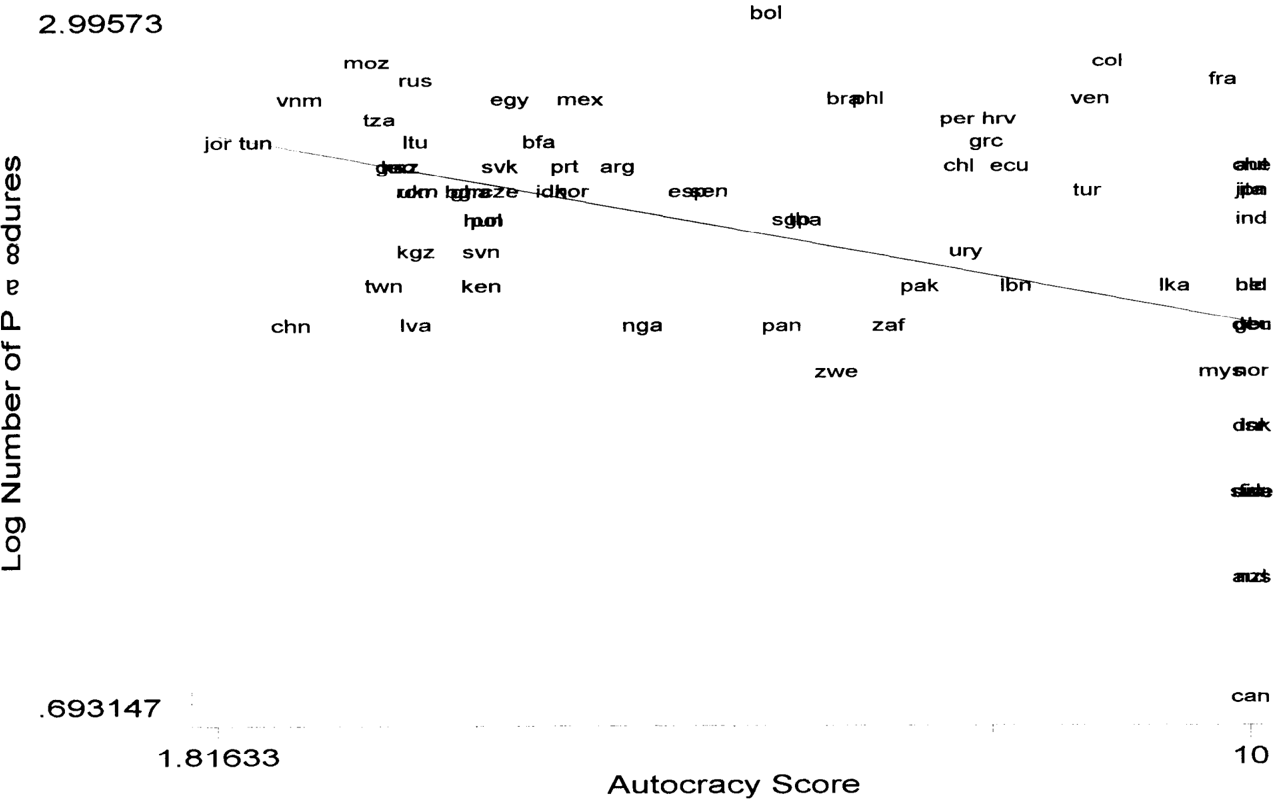
- In Table VIII, better government is associated with lighter regulation; the paper states that countries with more limited and representative governments have statistically significantly fewer procedures using 5 out of 6 measures of better government, and that more autocratic countries regulate more heavily.
Methods
- The paper builds a new database on entry regulation for 75 countries, focusing on the legal requirements, official time, and official cost for a standardized start-up firm.
- Data were gathered from written government sources, World Bank- and USAID-sponsored studies, government web pages, direct contacts with agencies, and independent double-checks in 73 countries via local consulting reports; the remaining 2 countries were double-checked through government contacts.
- The main analysis uses cross-country OLS regressions relating entry regulation measures to outcomes such as quality, pollution, unofficial economy, corruption, political institutions, legal origin, and GDP per capita; the paper also reports correlations and test-of-means comparisons across income quartiles.
Limitations
- The paper itself notes that the capture-theory tests are based on crude measures and that the data are probably least suited to test the capture hypothesis.
- The authors say the data almost surely underestimate the cost and complexity of entry because they focus on the capital city, omit industry-specific requirements and foreign-ownership steps, and ignore some informal delays and bribes.
- Evident from the text: the study is cross-sectional and based on official procedures/costs, so causal interpretation is limited and informal corruption/bureaucratic delays are not directly measured except indirectly through correlations.
Model-written summary. Check it against the paper before relying on it.
Integrity signals
Registry
Cites
Statistics
Figures
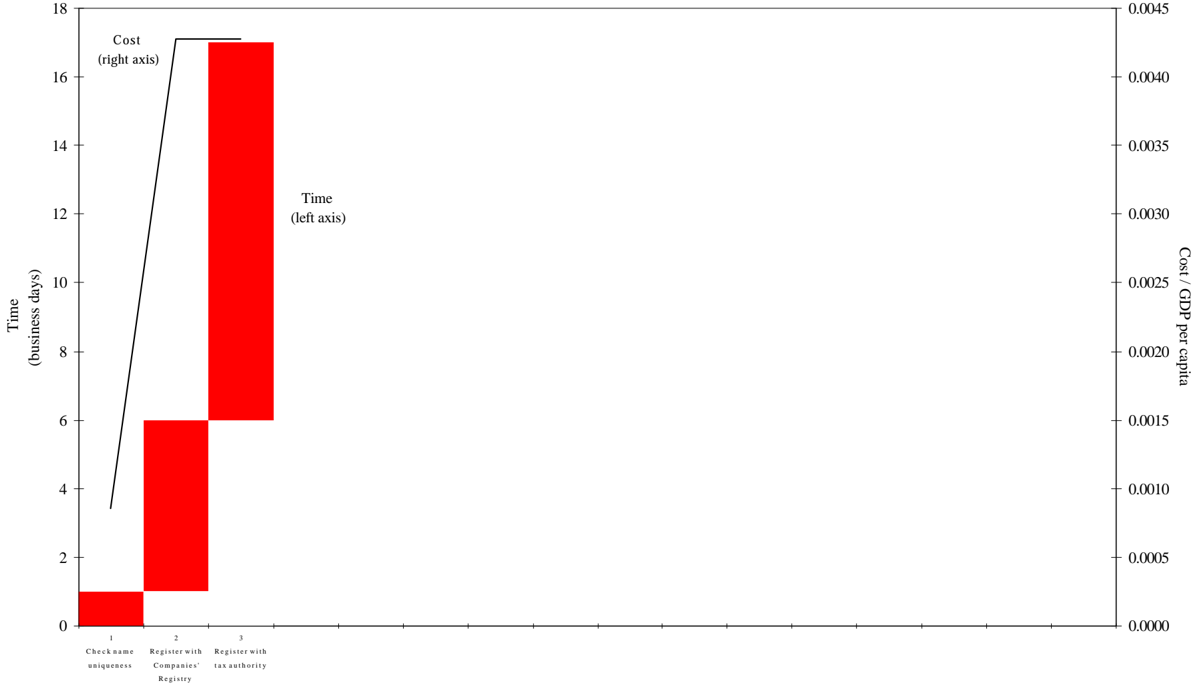
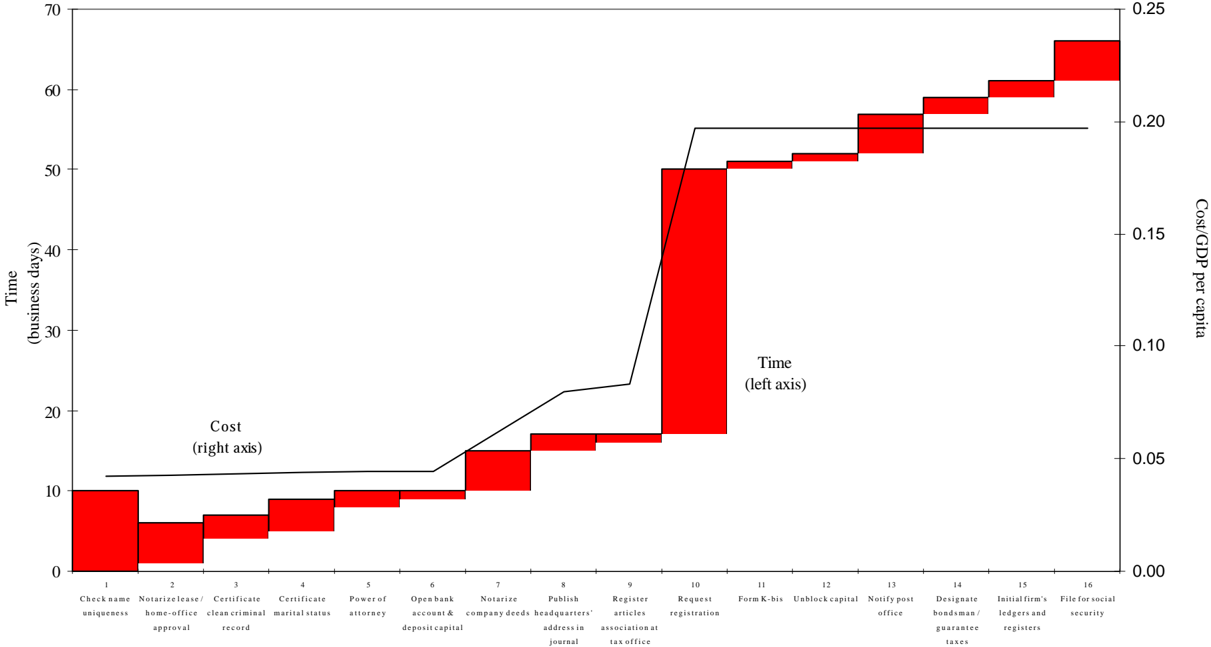
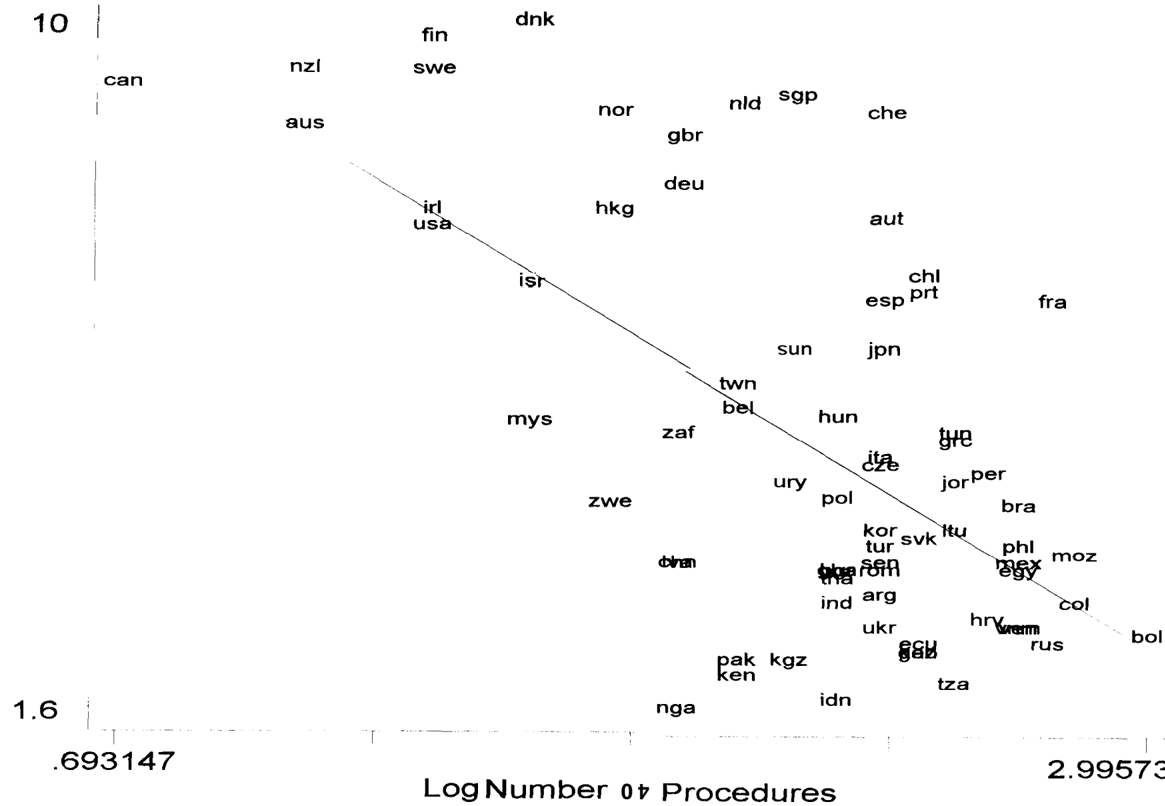
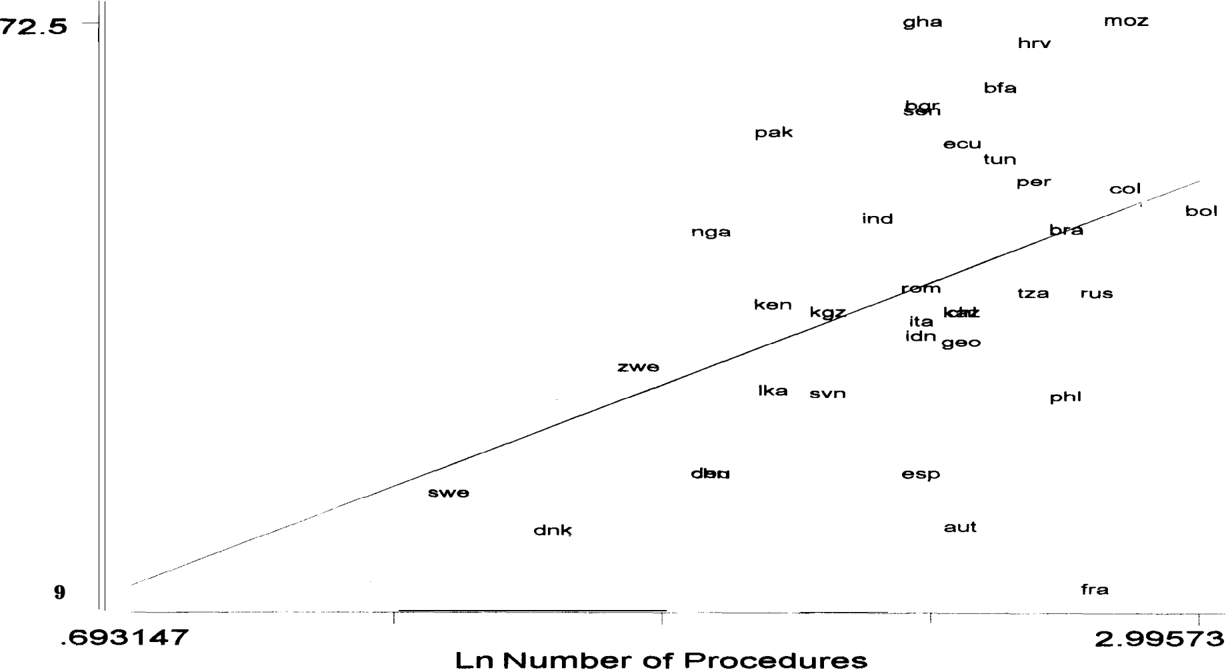
Verification
Claims the paper makes
0 Valid · 3 Not valid · 13 Not checked · 114 Own results and interpretations
A result the paper reports from its own data — it cites no other source for it, so there is none to check. The quote shows it is in the paper.
In the paper
“Very few entry regulations cover tax and labor issues.”
plain- Asserted: passes — The authors put it forward as true.
- Checkable: passes — It can be checked against evidence.
- Load-bearing: unclear — It is unclear whether the paper’s conclusions depend on it.
- Based: passes — The paper gives a reason why it holds.
In the paper
“The data show that the numbers of entry and of labor market regulations are positively correlated across countries, contrary to the substitutes hypothesis.”
What the sources say
- Not matchedcites Djankov et al., 2000
An author–year citation the paper’s reference list doesn’t settle. We don’t search these by name.
plainstates an association- Asserted: passes — The authors put it forward as true.
- Checkable: passes — It can be checked against evidence.
- Load-bearing: unclear — It is unclear whether the paper’s conclusions depend on it.
- Based: passes — The paper gives a reason why it holds.
- Not matched
A result the paper reports from its own data — it cites no other source for it, so there is none to check. The quote shows it is in the paper.
In the paper
“It often takes the form of screening procedures.”
- Also stated in: § III. Basic Results. · plain
“Instead, much of what governments do to regulate entry falls into the category of screening procedures.”
plain- Asserted: passes — The authors put it forward as true.
- Checkable: passes — It can be checked against evidence.
- Load-bearing: unclear — It is unclear whether the paper’s conclusions depend on it.
- Based: passes — The paper gives a reason why it holds.
- Also stated in: § III. Basic Results. · plain
A result the paper reports from its own data — it cites no other source for it, so there is none to check. The quote shows it is in the paper.
In the paper
“First, the cost-to-per-capita-GDP ratio decreases uniformly with GDP per capita.”
plainstates an association- Asserted: passes — The authors put it forward as true.
- Checkable: passes — It can be checked against evidence.
- Load-bearing: unclear — It is unclear whether the paper’s conclusions depend on it.
- Based: passes — The paper gives a reason why it holds.
A result the paper reports from its own data — it cites no other source for it, so there is none to check. The quote shows it is in the paper.
In the paper
“In contrast, countries in the other three quartiles of per capita income are not statistically different from each other in terms of the number of procedures and the time required to fulfill them.”
plain- Asserted: passes — The authors put it forward as true.
- Checkable: passes — It can be checked against evidence.
- Load-bearing: passes — The paper’s conclusions depend on it.
- Based: passes — The paper gives a reason why it holds.
49 more claims
Create a free account to see all 130 claims and every source verdict.
- Probably not a substantial claim. 21
- It may state two separate claims as one. 54
- The quote only partly states this claim. 26
Claims other papers make about this one
Each is checked against this paper’s own text: does it say what the citing paper says it does?
The source backs part of the claim, not all of it — or backs it for a different population, condition or comparison.
In the citing paper
“Our findings suggest an explanation for the low level of incorporation in Italy: the average direct cost associated with fulfilling the bureaucratic regulations for registering a new corporation in Italy is 20% of per capita GNP compared to 10% of per capita GNP on average for other G-7 European countries.”
From Entry regulation as a barrier to entrepreneurship (2006) · cites this paper as Djankov et al. (2002)
Experimental — accuracy not yet measuredThe cited source says what the claim attributes to it.
In the citing paper
“Given the explicit link made by Djankov et al . (2002) between the speed and ease with which businesses may be established in a country and its economic performance - and the enthusiasm with which this link has been grasped by European Union policy makers - our findings imply this link needs reconsidering.”
From The Effect of Business Regulations on Nascent and Young Business Entrepreneurship (2007) · cites this paper as Djankov et al . (2002)
Citations
Cites
La Porta, R., Lopez‐de‐Silanes, F., Shleifer, A., & Vishny, R. W. (1998) · Journal of Political Economy · doi:10.1086/250042 · Cited by 18,025
Self-citationThe Theory of Economic Regulation
Stigler, G. J. (1971) · The Bell Journal of Economics and Management Science · doi:10.2307/3003160 · Cited by 8,098
Journal of Economic Literature
(2019) · AEA Papers and Proceedings · doi:10.1257/pandp.109.633 · Cited by 7,468
The Quarterly Journal of Economics
Kuznets, S. (2024) · Business Cycle Theory, Part I Volume 4 · doi:10.4324/9781003549741-8 · Cited by 7,176
La Porta, R. (1999) · Journal of Law, Economics, and Organization · doi:10.1093/jleo/15.1.222 · Cited by 5,699 · cited 2×
“Legal origin has been viewed as a proxy for the government’s proclivity to intervene in the economy and the stance of the law toward the security of property rights in a country [La Porta et al. 1999].”
The Theory of Economic Regulation
Stigler, G. J. (2021) · The Political Economy · doi:10.4324/9781315495811-8 · Cited by 5,483
Pigou, A. C. (1933) · The Economic Journal · doi:10.2307/2224491 · Cited by 5,137
Toward a More General Theory of Regulation
Peltzman, S. (1976) · The Journal of Law and Economics · doi:10.1086/466865 · Cited by 4,729
Moffitt, R. A. (2009) · American Economic Review · doi:10.1257/aer.99.2.660 · Cited by 4,694
Shleifer, A., & Vishny, R. W. (1993) · The Quarterly Journal of Economics · doi:10.2307/2118402 · Cited by 3,778
Self-citation
Research works printed but not linked: 7
- McLiesh Caralee, 2001, NBER Working Paper No., 8288
- Kasnako lu, Zehra, and Münür Yayla, 'Unrecorded Economy in Turkey: A Monetary Approach', 1999. "Unrecorded Economy in Turkey (A Monetary Approach)" in Informal Sector in Turkey (I), Tuncer Bulutay (ed.), SIS, Ankara, forthcoming.
- Fred, 1987, Journal of Legal Studies, 101
- Olson, Mancur, 1991, 'Autocracy, Democracy, and Prosperity,' in Richard Zeckhauser, ed., Strategy of Choice, Cambridge, MA: MIT Press.
- 1967, Western Economic Journal, 232
- World Economic Forum (1999), The Global Competitiveness Report 1999 , Schwab, Klaus et al., eds., New York: Oxford University Press.
- World Economic Forum, The Global Competitiveness Report 2001, Klaus Schwab et al., eds. (New York, NY: Oxford University Press, 2001).
Cited by
Items 2,301–2,400 of 3,986
Gauthier, B., Goyette, J., & Kouame, W. A. K. (2020) · World Bank, Washington, DC eBooks · doi:10.1596/1813-9450-9441 · Cited by 7
“Djankov et al. (2002), for instance, find that stricter regulation of the entry of new firms in the market is associated with sharply higher levels of corruption and a greater relative size of the unofficial economy in a cross-section of countries (McChesney, 1987; De Soto, 1989; LaPorta et al., 1998).”
The Impact of Corruption on Firm Performance: Evidence from PakistanPreprint
Sohail, M. K., arsil, M., & Zaman, R. (2014) · SSRN Electronic Journal · doi:10.2139/ssrn.2515045 · Cited by 9
Institutional Causes of Macroeconomic VolatilityPreprint
Barseghyan, L., & DiCecio, R. (2008) · SSRN Electronic Journal · doi:10.2139/ssrn.1152358 · Cited by 6
An Innovation Policy Framework: Bridging the Gap between Industrial Dynamics and GrowthPreprint
Braunerhjelm, P., & Henrekson, M. (2018) · SSRN Electronic Journal · doi:10.2139/ssrn.2993108 · Cited by 6
Structural Reforms and the Potential Effects on the Italian EconomyPreprint
Annicchiarico, B., Dio, F. D., & Felici, F. (2012) · SSRN Electronic Journal · doi:10.2139/ssrn.2030811 · Cited by 6
Entry, Exit and Investment-Specific Technical ChangePreprint
Samaniego, R. M. (2008) · SSRN Electronic Journal · doi:10.2139/ssrn.1115945 · Cited by 8
The Falling Price of Cement in Africa
Leone, F., Macchiavello, R., & Reed, T. (2021) · World Bank, Washington, DC eBooks · doi:10.1596/1813-9450-9706 · Cited by 8
FDI in MENA: Impact of Political and Trade Liberalisation ProcessPreprint
Ghali, S., Baleix, J. M., Carril‐Caccia, F., Paniagua, J., & Zitouna, H. (2018) · SSRN Electronic Journal · doi:10.2139/ssrn.3284195 · Cited by 7
The Effectiveness of Entry Deregulation: Novel Evidence from Removing Minimum Capital RequirementsPreprint
Cheng, H., Ding, S., & Liu, Y. (2022) · SSRN Electronic Journal · doi:10.2139/ssrn.4182365 · Cited by 6
The Credit Crunch and Fall in Employment During the Great RecessionPreprint
Haltenhof, S., Lee, S. J., & Stebunovs, V. (2014) · SSRN Electronic Journal · doi:10.2139/ssrn.2422897 · Cited by 7
Self–Employment, Wealth and Start–up Costs: Evidence from a Financial Crisis
Elitcha, K., & Fonseca, R. (2018) · The B.E. Journal of Economic Analysis & Policy · doi:10.1515/bejeap-2017-0187 · Cited by 5
Bao, R., & Wei, L. (2024) · PLoS ONE · doi:10.1371/journal.pone.0299643 · Cited by 12
Impact of regulatory capital on bank interest margins: Moderating role of default risk
Begum, M., Rahman, M. M., & Faruq, M. O. (2024) · Heliyon · doi:10.1016/j.heliyon.2024.e30554 · Cited by 5
The role of culture as an informal institution in cross-border venture capital investments
Mahn, D., Poblete, C., Wang, C., & Heaton, C. (2024) · Journal of Institutional Economics · doi:10.1017/s1744137424000171 · Cited by 7
Khan, S., Tariq, M., & Azam, M. (2025) · Natural Resources Forum · doi:10.1111/1477-8947.70005 · Cited by 5
Ease of Doing Business and Enterprise Creation in Africa: A Cross-country Panel Analysis
Olubodun, I. E., Dada, J. T., Omodara, O. D., & Tabash, M. I. (2025) · The Journal of Entrepreneurship · doi:10.1177/09713557251318085 · Cited by 8
“Djankov et al. (2002) trigger more concerns that regions with high regulatory barriers to firm entry, high corruption and large unofficial economies tend to thrive.”
Key industrial policy, market competition and firms’ markup: Evidence from China
Chen, G., & Yuan, H. (2025) · Economic Modelling · doi:10.1016/j.econmod.2025.107245 · Cited by 9
He, G., Liu, Y., Ling, Y., & Zhou, Z. (2026) · The British Accounting Review · doi:10.1016/j.bar.2026.101874 · Cited by 7
Liberalizing Home-Based Business
Agarwal, S. D., Sing, T. F., Song, C., & Zhang, J. (2018) · Management Science · doi:10.1287/mnsc.2021.04232 · Cited by 8
“Djankov et al. (2002) and Klapper et al. (2006) exploit country-level variation in entry regulation to show the impact on the entry rates worldwide.”
Castellaneta, F., Conti, R., Kacperczyk, A. J., & Mamadehussene, S. (2024) · Organization Science · doi:10.1287/orsc.2022.16201 · Cited by 5
Ku, H., Tian, G. G., & Wu, Y. (2024) · Abacus · doi:10.1111/abac.12340 · Cited by 5
Hornstein, A. S. (2024) · Asia and the Global Economy · doi:10.1016/j.aglobe.2024.100093 · Cited by 10
Plata, G., Scott, S. A., & Aparicio, S. (2025) · Review of Managerial Science · doi:10.1007/s11846-025-00887-w · Cited by 10
“The rules of law vary across countries and development levels (Djankov et al. 2002 ).”
Misallocation in China: Evidence from China's business registration reform
Yang, X., Jiang, B., Bai, Y., Fu, L., & Liu, B. (2025) · China Economic Review · doi:10.1016/j.chieco.2025.102452 · Cited by 6
Regulatory Entry Barriers, Rent Shifting and the Home Market Effect
Tobal, M. (2016) · Review of International Economics · doi:10.1111/roie.12256 · Cited by 5
Multicriterial approach to estimation of economic efficiency based on regional innovative cluster
Rodionova, E. A., Trifonova, N. V., Epstein, M. Z., et al. (2017) · doi:10.1109/scm.2017.7970709 · Cited by 5
“In our opinion, for the task of ranking regions on the attractiveness of investments it is advisable to use the following system of indicators: 1) the volume of innovative goods / services produced (million dollars) / volume of direct investment (million dollars); 2) the level of the average salary in the region (aver…”
Taming cronyism!: the role of Public Private Dialogues
Sabry, M. I. (2017) · International Journal of Social Economics · doi:10.1108/ijse-01-2016-0030 · Cited by 5
Lanfranchi, A. G., Strehlau, S., Borini, F. M., & Melo, P. L. D. R. (2020) · Multinational Business Review · doi:10.1108/mbr-01-2020-0020 · Cited by 7
Blanc, F., & Ottimofiore, G. (2021) · Cambridge University Press eBooks · doi:10.1017/9781108759458.013 · Cited by 5
The Impact of Regulations upon the Startup of New Businesses
Trifu, A. E., Gîrneață, A., & Potcovaru, A. M. (2015) · RePEc: Research Papers in Economics · Cited by 5
Discretely innovating: The effect of limited market contestability on innovation and growth
Bond‐Smith, S. (2021) · Scottish Journal of Political Economy · doi:10.1111/sjpe.12306 · Cited by 5
Saldanha, J., & DeAngelo, G. J. (2022) · International Journal of Logistics Management · doi:10.1108/ijlm-07-2021-0367 · Cited by 4
State capacity, economic freedom, and classical liberalism
Murphy, R. (2022) · Constitutional Political Economy · doi:10.1007/s10602-022-09374-w · Cited by 7
The Effect of IFRS Adoption on the Business Climate: A Country Perspective
Penela, D., Estêvão, J., & Morais, A. I. (2022) · Journal of risk and financial management · doi:10.3390/jrfm15120604 · Cited by 7
Divergence in female entrepreneurial activity: an international comparison
Morales-Urrutia, X. (2023) · Estudos Econômicos (São Paulo) · doi:10.1590/1980-53575314xmu · Cited by 10
Does private share of public external debt support economic growth in developing countries?
Mijiyawa, A. G. (2024) · International Economics · doi:10.1016/j.inteco.2024.100499 · Cited by 5
Foreign business presence and local entrepreneurship development: evidence from China
Zhao, S. (2024) · Humanities and Social Sciences Communications · doi:10.1057/s41599-024-03732-9 · Cited by 5
Bureaucracy, Informality and Taxation : Essays in Development Economics and Public Finance
Fredriksson, A. (2009) · DiVA (Stockholm University) · Cited by 21
The Capital Flow from Institutional Investors to Entrepreneurs
Groh, A. P. (2012) · Oxford University Press eBooks · doi:10.1093/oxfordhb/9780195391596.013.0002 · Cited by 7
Supervisory approaches and financial market development: Some correlation-based evidence
Granlund, P. (2009) · Journal of Banking Regulation · doi:10.1057/jbr.2009.13 · Cited by 6
Challenges and opportunities for the Brazilian Public Private Partnerships Program
Edwards, P., Grilo, L., Melhado, S. B., Silva, S., Akintoye, A., & Hardcastle, C. (2005) · RMIT Research Repository (RMIT University Library) · Cited by 5
Corruption as a Deviant Social Attitude
Csapodi, P., Takács, I., & Takács‐György, K. (2011) · Corvinus Research Archive (Corvinus University of Budapest) · Cited by 5
Culture, Political Institutions and the Regulation of Entry
Baptista, R. (2009) · Springer eBooks · doi:10.1007/978-3-540-87910-7_4 · Cited by 8
What’s the Cost of e-Access to Legal Information? A composite indicator
Vallbé, J., & Mach, N. (2014) · UvA-DARE (University of Amsterdam) · Cited by 5
8 Deconstructing China's and India's Growth: The Role of Financial Policies
Aziz, J. (2010) · Oxford University Press eBooks · doi:10.1093/acprof:oso/9780199575077.003.0008 · Cited by 5
Kshetri, N., & Bebenroth, R. (2012) · Journal of Macromarketing · doi:10.1177/0276146712455335 · Cited by 6
“An explanation as to how corruption might affect retail spending is that corruption is positively related to the size of the informal economy (Djankov et al. 2002).”
Stability or restructuring? Macroeconomic dynamics under soft budget constraint problems
Toyofuku, K. (2013) · Economic Systems · doi:10.1016/j.ecosys.2013.07.004 · Cited by 5
Przychodzeń, J. (2013) · Central European Management Journal · doi:10.7206/mba.ce.2084-3356.62 · Cited by 5
Are There Too Many Entrepreneurs? A Model of Client-Based Entrepreneurship
Rauch, J. E., & Watson, J. (2003) · Law and Economics Workshop · Cited by 5
Orea, L. (2011) · Oxford Economic Papers · doi:10.1093/oep/gpr028 · Cited by 5
Samanni, M., Holmberg, S., & Rothstein, B. (2011) · Cited by 5
Hard or Easy? Difficulty of Entrepreneurial Startups in 107 Climato‐Economic Environments
de Vliert, E. V., Janssen, O., & van der Vegt, G. S. (2015) · Applied Psychology · doi:10.1111/apps.12057 · Cited by 5
Bank capital pressures, loan substitutability, and nonfinancial employment
Lee, S. J., & Stebunovs, V. (2015) · Journal of Economics and Business · doi:10.1016/j.jeconbus.2015.11.002 · Cited by 6
Kox, H. L. M., van Leeuwen, G., & van der Wiel, H. (2010) · Cited by 5
Studies in the macroeconomic implications of firm entry and exit
Vilmi, L. (2012) · Cited by 5
Informal Institutions: The Binding Constraint on Institutional Efficiency in Nigeria
Effiom, L., & Ubi, P. S. (2014) · British Journal of Economics Management & Trade · doi:10.9734/bjemt/2015/12243 · Cited by 5
Altenburg, T., Hampel-Milagrosa, A., & Loewe, M. (2016) · European Journal of Development Research · doi:10.1057/s41287-016-0010-2 · Cited by 5
“…Institutes (EADI) 0957-8811 The European Journal of Development Research Vol. 29, 2, 457–475 461 Duponchel, 2010; Stiglitz et al, 2006), regulation (Djankov et al, 2002), taxation (Weichenrieder, 2007), fair competition on markets (Singh, 2002; Laffont, 1998), corruption (Kaufmann, 2005),…”
Multifamily housing construction in Russia: supply elasticity and competition
Polidi, T. D. (2016) · Area Development and Policy · doi:10.1080/23792949.2016.1161492 · Cited by 5
Optimal fiscal policy in a model of firm entry and financial frictions
Cooke, D., & Damjanovic, T. (2019) · Review of Economic Dynamics · doi:10.1016/j.red.2019.05.001 · Cited by 4
Judicial Independence and US State Bond Ratings: An Empirical Investigation
Dove, J. A. (2017) · Public Budgeting & Finance · doi:10.1111/pbaf.12153 · Cited by 5
Vita, G. D., Vita, F. P. D., & Cafiso, G. (2017) · Journal of Institutional Economics · doi:10.1017/s1744137417000583 · Cited by 4
“…has been followed more recently by Alesina et al. (2003), Blanchard and Giavazzi (2003), Clemenz and Gugler (2000), Dawson and Seater (2013); Djankov et al. (2002); Djankov et al. (2006); Ginsburg (2000), Kaufman et al. (2003), Loayza et al. (2005); Nicoletti et al. (2001), Nicoletti and…”
Business regulation and business investment: evidence from US manufacturing 1970–2009
Pizzola, B. (2018) · Journal of Regulatory Economics · doi:10.1007/s11149-018-9356-z · Cited by 5
“An extensive review of the literature can be found in Djankov et al. (2002).”
Imperfect Enforcement of a Tax Threshold: The Consequences on Efficiency
Goyette, J. (2018) · Journal of African Economies · doi:10.1093/jae/ejy018 · Cited by 5
Institutional Context, Entrepreneurial Activity, and Social Progress
Urbano, D., Aparicio, S., & Audretsch, D. B. (2019) · International studies in entrepreneurship · doi:10.1007/978-3-030-13373-3_6 · Cited by 7
Trade, Inequality, and the Political Economy of Institutions
Levchenko, A. A., & Do, Q.-T. (2006) · IMF Working Paper · doi:10.5089/9781451863161.001 · Cited by 35
Entrepreneurship and Entrepreneurial Ecosystem
Schlattau, M. (2020) · Societies and political orders in transition · doi:10.1007/978-3-030-54909-1_2 · Cited by 6
12 Democracy, Technology, and Growth
Aghion, P., Alesina, A., & Trebbi, F. (2008) · Harvard University Press eBooks · doi:10.2307/j.ctv21hrgnz.16 · Cited by 79
The New Company Law: What Matters in An Innovative Economy
McCahery, J. A., Vermeulen, E. P. M., Hisatake, M., & Saito, J. (2010) · T.M.C. Asser Press eBooks · doi:10.1007/978-90-6704-477-6_5 · Cited by 7
Arab-German Trade and Institutions: The Effect of Good Governance on Arab Exports to Germany
Sabry, M. I. (2021) · European Journal of Development Research · doi:10.1057/s41287-021-00462-5 · Cited by 5
Corruption Networks: An Introduction
Granados, O. M. (2021) · Understanding complex systems · doi:10.1007/978-3-030-81484-7_1 · Cited by 5
Amin, M. (2009) · Economics Letters · doi:10.1016/j.econlet.2009.06.017 · Cited by 6
Political competition in dynamic economies
Solstad, S. U. (2023) · European Journal of Political Economy · doi:10.1016/j.ejpoleco.2023.102430 · Cited by 5
Förster, H., Greil, S., & Hilse, A. (2020) · International Transfer Pricing Journal · doi:10.59403/1srez66 · Cited by 5
Petrakis, P. E. (2024) · Statute Law Review · doi:10.1093/slr/hmae001 · Cited by 5
Do Country Differences Matter? Key Audit Matter Disclosure and the Role of Country Attributes
Federsel, F. P., & Hörner, S. (2025) · European Accounting Review · doi:10.1080/09638180.2025.2500442 · Cited by 13
“Cost of obtaining legal status to operate a firm as a share of GDP per capita (Djankov et al., 2002).”
Empirical Analysis of Effects of Country-level Governance to Strength of Investor Protection
Boţa‐Avram, C. (2013) · Procedia - Social and Behavioral Sciences · doi:10.1016/j.sbspro.2013.10.580 · Cited by 5
The future of FDI in south eastern European countries: Messages from new EU member states
Penev, S., & Rojec, M. (2014) · Economic Annals · doi:10.2298/eka1402043p · Cited by 5
“According to Busse and Groizard (2008) and Djankov et al. (2002), the legal and regulatory environment is one of the principal segments of the investment climate.”
Volchek, D., Saarenketo, S., & Jantunen, A. (2015) · Palgrave Macmillan UK eBooks · doi:10.1057/9781137446350_9 · Cited by 9
Courts and Firm Investments in Real Property
Troilo, M., & Collins, J. M. (2017) · RePEc: Research Papers in Economics · doi:10.1080/00213624.2017.1359041 · Cited by 5
Economic and Financial Crime: Theoretical and Methodological Approaches
Achim, M. V., & Borlea, S. N. (2020) · Studies of organized crime · doi:10.1007/978-3-030-51780-9_1 · Cited by 6
Jane, W., Chen, W.-P., & Hsu, Y.-L. (2015) · Eurasian economic review : · doi:10.1007/s40821-015-0025-1 · Cited by 4
Johansson, D., Elíasson, G., & Taymaz, E. (2024) · doi:10.34196/ijm.00299 · Cited by 5
Development Strategy, Viability and Economic Institutions: The Case of China
Lin, J. Y., Liu, M., Pan, S., et al. (2007) · Palgrave Macmillan UK eBooks · doi:10.1057/9780230801462_27 · Cited by 5
Corruption in Russia: What Do We Know and What Can We Do?
Guriev, S. M. (2007) · Voprosy Ekonomiki · doi:10.32609/0042-8736-2007-1-11-18 · Cited by 6
The Size Distribution of Manufacturing Plants and Development
Kothari, S. (2014) · IMF Working Paper · doi:10.2139/ssrn.2561281 · Cited by 6
Musacchio, A. G. G. Y. A. (2006) · Cited by 5
Are Autocratic Rulers Also Inside Traders? Cross-Country Evidence
Eckard, E. W. (2004) · Economic Inquiry · doi:10.1093/ei/cbi002 · Cited by 5
Union Disclosure in Canada and the United States
Palacios, M., Clemens, J., Godin, K., et al. (2006) · Cited by 5
PUBLIC POLICY AND BUSINESS CREATION IN THE UNITED STATES
Cumming, D. J., & Li, D. (2009) · Cited by 7
HIV/AIDS, Crime and Small Business in South Africa
Isaacs, E. B. H., & Friedrich, C. (2006) · International research in the business disciplines · doi:10.1016/s1074-7877(06)05009-4 · Cited by 5
Market liquidity, active investment, and markets for information
Lee, S. (2012) · Cited by 3
Housing Tenure Across Countries : The Effects of Regulations and Institutions
Englund, P., Kim, K.-H., Malpezzi, S. T., et al. (2005) · Cited by 5
Explaining Early Adoption on New Medicines: Regulation, Innovation and ScalePreprint
Varol, N., McGuire, A. J., & Costa‐Font, J. (2011) · RePEc: Research Papers in Economics · Cited by 5
Fogel, K., Mørck, R., & Yeung, B. Y. (2005) · SSRN Electronic Journal · doi:10.2139/ssrn.641803 · Cited by 6
Structural Policies for Shock-Prone Commodity Exporters
Collier, P., & Goderis, B. (2008) · Oxford University Research Archive (ORA) (University of Oxford) · Cited by 5
Cumming, D. J. (2010) · SSRN Electronic Journal · doi:10.2139/ssrn.1604516 · Cited by 4
Legal Institutions and Economic DevelopmentPreprint
Beck, T. (2010) · SSRN Electronic Journal · doi:10.2139/ssrn.1669100 · Cited by 12
Communication Technologies: Commercial Adoption and Institutional Environment
Andonova, V. (2004) · Repositori digital de la UPF (Universitat Pompeu Fabra) · Cited by 5
Determinants of high-growth firmsPreprint
de Wit, G., & Carrizosa, M. T. (2011) · RePEc: Research Papers in Economics · Cited by 5
Ruggunan, S. D. (2008) · ResearchSpace (University of KwaZulu-Natal) · Cited by 10
Metadata
- Authors
- Djankov, S., La Porta, R., Lopez-de-Silanes, F., & Shleifer, A.
- Affiliations
- World Bank (US)
- National Bureau of Economic Research (US)
- ORCID
- Djankov, S.
- Venue
- The Quarterly Journal of Economics
- Publisher
- Oxford University Press (OUP)
- Published
- 2002-02-01
- Volume
- 117
- Issue
- 1
- Pages
- 1-37
- ISSN
- 0033-5533
- 1531-4650
- OpenAlex
- W2139896179
- Cited by
- 3,956
- References
- 30
- Citations by year
- 2026: 223 · 2025: 185 · 2024: 157 · 2023: 120 · 2022: 140 · 2021: 150 · 2020: 151 · 2019: 161 · 2018: 157 · 2017: 162 · 2016: 166 · 2015: 193 · 2014: 200 · 2013: 183 · 2012: 193
- Type
- report
- Language
- en
- Open access
- green
- doi.org
- Licence
- other-oa
- Locations
- World Bank, Washington, DC eBooks (publishedVersion)
- The Quarterly Journal of Economics (publishedVersion)
- The World Bank Open Knowledge Repository (World Bank) (publishedVersion)
- National Bureau of Economic Research (publishedVersion, other-oa)
- RePEc: Research Papers in Economics (submittedVersion)
- Digital Access to Scholarship at Harvard (DASH) (Harvard University) (submittedVersion, cc-by)
- SSRN Electronic Journal (submittedVersion)
- OpenGrey (Institut de l'Information Scientifique et Technique) (submittedVersion)
- The World Bank Open Knowledge Repository (World Bank) (submittedVersion, cc-by)
- Topics
- Social Sciences › Sociology and Political Science › Corruption and Economic Development
- Social Sciences › Economics, Econometrics and Finance › Economics and Econometrics › Taxation and Compliance Studies
- Social Sciences › Business, Management and Accounting › Strategy and Management › Political Influence and Corporate Strategies
- Keywords
- start-up firms, bureaucratic procedures, corruption, informal economy, democracy, government size, public choice theory, public interest theory
About these checks
Registry, retraction, Cites and statistics results are computed, not judged, with one exception: a printed reference that no index lists is read once by a model before it counts as a citation error. Claims are extracted by a model and kept only when their quote appears verbatim in the text; each cited source is then checked, with a model’s help, for whether it says what the claim relies on. Those verdicts can be wrong — read the claim’s quote and the cited source before relying on one.
A language model drew the claims from the paper on 2026-10-01, under version 3 of the claim definition (model deepseek-v4.1-flash, prompt extract-v3).
A second model labelled each claim on 2026-10-01 (model jev-1.13-20260917, definition revision gold-guideline-v0.2).
Statistics and arithmetic are recomputed, not judged.
Confidence bands are shown only for fields calibrated on our annotated test set. None is calibrated yet, so no band is shown.
What counts as a claim ›How we measure confidence ›How we check this ›
Are you an author, or do you see a problem with this page? Request a review
Data sources
Bibliographic data: Semantic Scholar, OpenAlex, Crossref.
Contains information from the Semantic Scholar Academic Graph Datasets, made available under the ODC Attribution License (ODC-BY 1.0).
Semantic Scholar’s data is described in: Kinney, R., et al. (2023). The Semantic Scholar Open Data Platform. arXiv:2301.10140.
