

The Regulation of Entry
Open accessThe DOI matches its Crossref record, with a small difference in title or year; 39 of the 39 references it cites were found in a registry or an index; none of the 13 sources its claims cite is checked for support yet.
Abstract
1%(5 :25.,1* 3$3(5 6(5,(6 7+( 5(*8/$7,21 2) (175< 6LPHRQ 'MDQNRY 5DIDHO /D 3RUWD )ORUHQ.LR /RSH]GH6LODQHV $QGUHL 6KOHLIHU :RUNLQJ 3DSHU KWWSZZZQEHURUJSDSHUVZ 1$7,21$/ %85($8 2) (&2120,& 5(6($5&+ 0DVVD.KXVHWWV $YHQXH &DPEULGJH 0$ 6HSWHPEHU :H WKDQN 2OJD ,RIIH 7DWLDQD 1HQRYD DQG (NDWHULQD 7UL]ORYD IRU DEOH UHVHDU.K DVVLVWDQ.H DQG +DPLG $ODYL ,ULQD $VWUDNKDQ $EKLMLW %DQHUMHH 5L.KDUG &DYHV -D.TXHOLQH &RROLGJH -DPHV (PHU\ 1LKDO (O0DJKDUEHO -HDQ 3DXO *DXWKLHU (G *ODHVHU 6LPRQ -RKQVRQ /DZUHQ.H .DW] 3HWHU .X.HUD 'DYLG /DLEVRQ ,UD /LHEHUPDQ 'DYLQ 0D.NLQ]LH 0DULH )UDQ.RLVH 0DULH1HOO\ 0DU.HOR 2ODUUHDJD *X\ 3IHIIHUPDQQ 6DQWLDJR 6HGD.D /HLOD :HEVWHU 3HWHU :ULJKW DQG VHPLQDU SDUWL.LSDQWV DW WKH 8QLYHUVLW\ RI 0DU\ODQG DW &ROOHJH 3DUN IRU KHOSIXO .RPPHQWV 7KH .ROOH.WLRQ RI GDWD IRU WKLV SDSHU ZDV RUJDQL]HG DQG ILQDQ.HG E\ WKH :RUOG %DQN $Q DSSHQGL[ GHV
Overview
CoChat Summary
TL;DR
This paper assembles a new cross-country dataset on business entry regulation in 75 countries and uses it to compare the helping-hand, capture, and tollbooth theories of regulation. The evidence is most consistent with the tollbooth view: heavier entry regulation is associated with more corruption, a larger unofficial economy, and less representative, more autocratic governments.
Key findings
- Across the 75-country sample, the number of entry procedures ranges from 2 in Canada to 20 in Bolivia, with a sample average of 10.17 procedures; the average official time is 63.05 business days and the average cost is 0.34 of GDP per capita.
- The number of procedures is strongly correlated with time and cost: the paper reports correlations of 0.75 with log time and 0.62 with log cost.
- The helping-hand tests do not support a beneficial-regulation story: in Table IV, more procedures are associated with lower ISO quality standards (e.g. coefficient -0.2646) and larger unofficial economy measures (e.g. coefficient 13.6277 for size of unofficial economy; 19.8763 for employment in the unofficial economy), while pollution and health outcomes do not improve.
- The tollbooth evidence is stronger: Table VI reports that more procedures are associated with worse corruption scores, with a coefficient of -3.2809 (and -1.7249 with GDP per capita controls) for the corruption regressions.
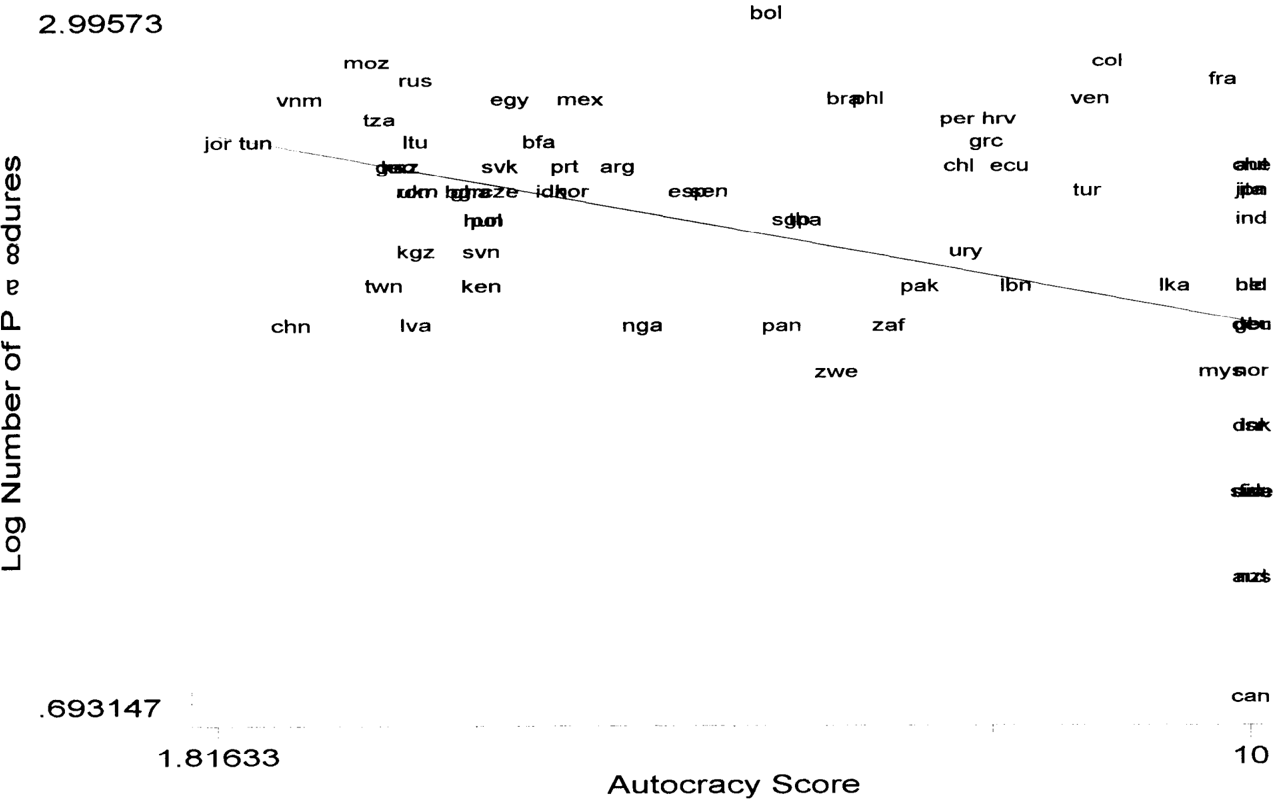
- In Table VIII, better government is associated with lighter regulation; the paper states that countries with more limited and representative governments have statistically significantly fewer procedures using 5 out of 6 measures of better government, and that more autocratic countries regulate more heavily.
Methods
- The paper builds a new database on entry regulation for 75 countries, focusing on the legal requirements, official time, and official cost for a standardized start-up firm.
- Data were gathered from written government sources, World Bank- and USAID-sponsored studies, government web pages, direct contacts with agencies, and independent double-checks in 73 countries via local consulting reports; the remaining 2 countries were double-checked through government contacts.
- The main analysis uses cross-country OLS regressions relating entry regulation measures to outcomes such as quality, pollution, unofficial economy, corruption, political institutions, legal origin, and GDP per capita; the paper also reports correlations and test-of-means comparisons across income quartiles.
Limitations
- The paper itself notes that the capture-theory tests are based on crude measures and that the data are probably least suited to test the capture hypothesis.
- The authors say the data almost surely underestimate the cost and complexity of entry because they focus on the capital city, omit industry-specific requirements and foreign-ownership steps, and ignore some informal delays and bribes.
- Evident from the text: the study is cross-sectional and based on official procedures/costs, so causal interpretation is limited and informal corruption/bureaucratic delays are not directly measured except indirectly through correlations.
Model-written summary. Check it against the paper before relying on it.
Integrity signals
Registry
Cites
Statistics
Figures
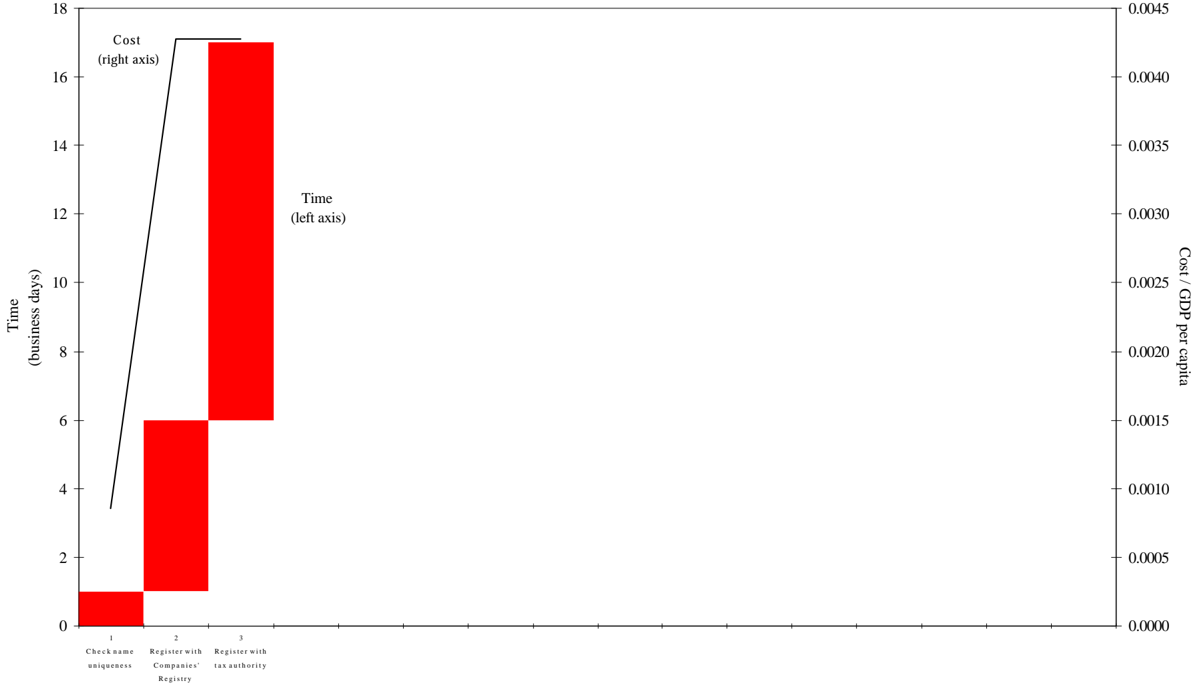
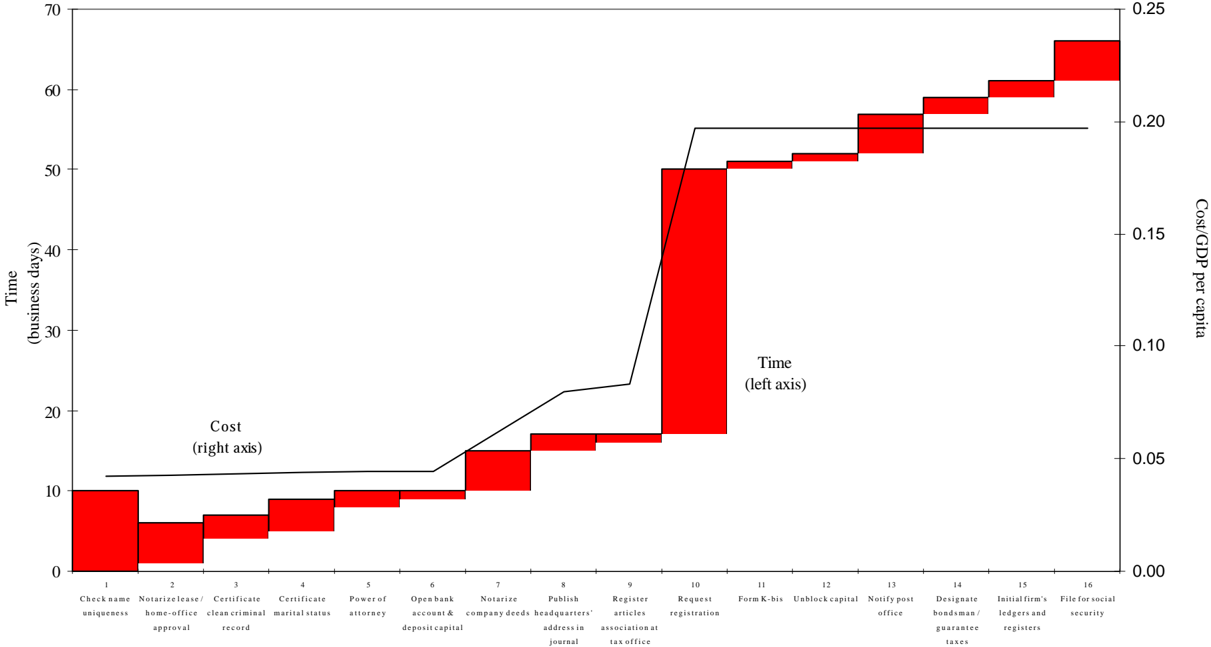
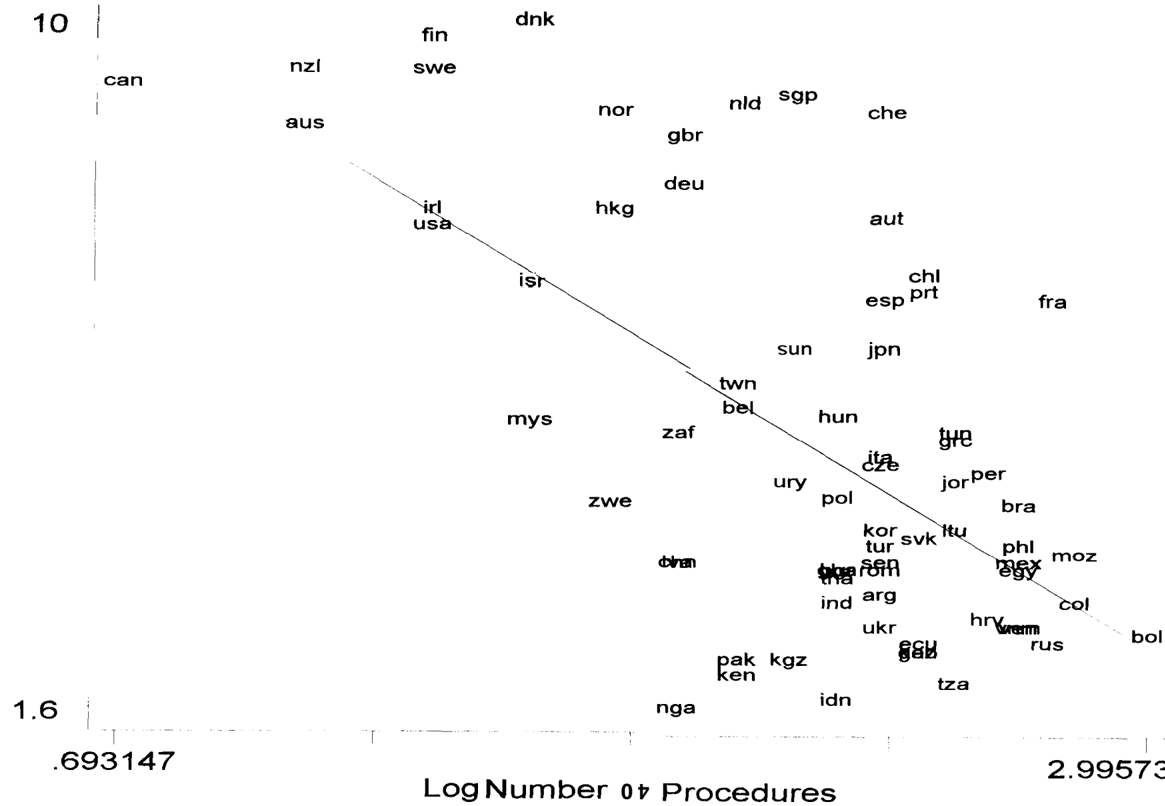
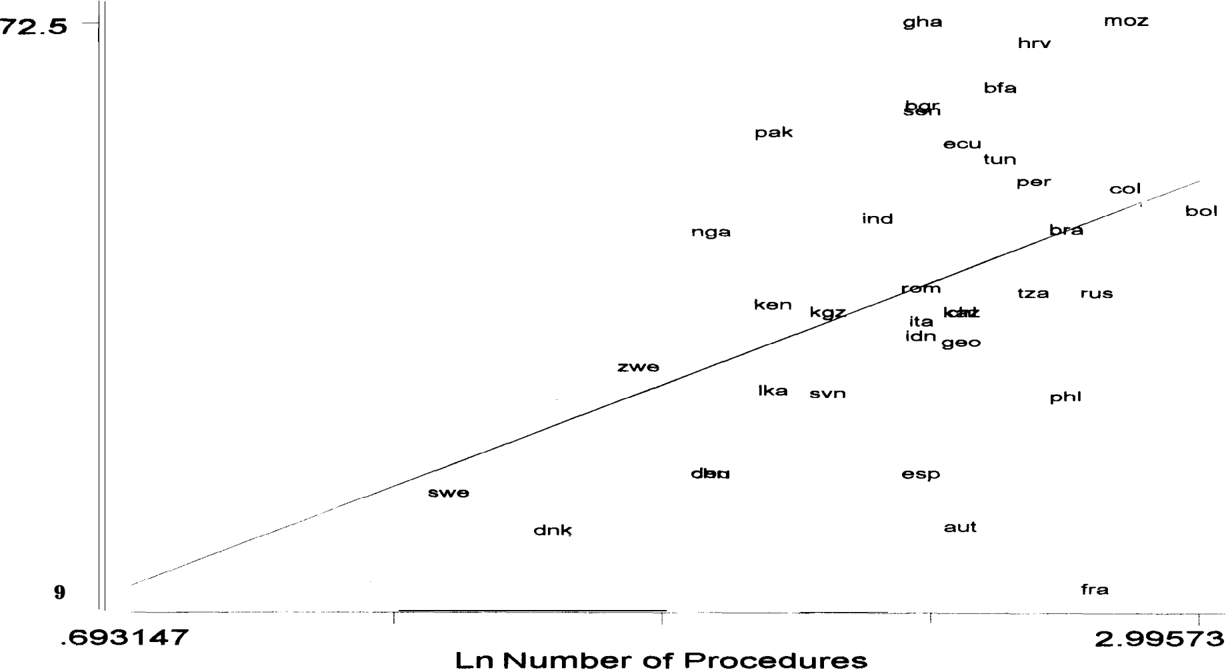
Verification
Claims the paper makes
0 Valid · 3 Not valid · 13 Not checked · 114 Own results and interpretations
A result the paper reports from its own data — it cites no other source for it, so there is none to check. The quote shows it is in the paper.
In the paper
“Very few entry regulations cover tax and labor issues.”
plain- Asserted: passes — The authors put it forward as true.
- Checkable: passes — It can be checked against evidence.
- Load-bearing: unclear — It is unclear whether the paper’s conclusions depend on it.
- Based: passes — The paper gives a reason why it holds.
In the paper
“The data show that the numbers of entry and of labor market regulations are positively correlated across countries, contrary to the substitutes hypothesis.”
What the sources say
- Not matchedcites Djankov et al., 2000
An author–year citation the paper’s reference list doesn’t settle. We don’t search these by name.
plainstates an association- Asserted: passes — The authors put it forward as true.
- Checkable: passes — It can be checked against evidence.
- Load-bearing: unclear — It is unclear whether the paper’s conclusions depend on it.
- Based: passes — The paper gives a reason why it holds.
- Not matched
A result the paper reports from its own data — it cites no other source for it, so there is none to check. The quote shows it is in the paper.
In the paper
“It often takes the form of screening procedures.”
- Also stated in: § III. Basic Results. · plain
“Instead, much of what governments do to regulate entry falls into the category of screening procedures.”
plain- Asserted: passes — The authors put it forward as true.
- Checkable: passes — It can be checked against evidence.
- Load-bearing: unclear — It is unclear whether the paper’s conclusions depend on it.
- Based: passes — The paper gives a reason why it holds.
- Also stated in: § III. Basic Results. · plain
A result the paper reports from its own data — it cites no other source for it, so there is none to check. The quote shows it is in the paper.
In the paper
“First, the cost-to-per-capita-GDP ratio decreases uniformly with GDP per capita.”
plainstates an association- Asserted: passes — The authors put it forward as true.
- Checkable: passes — It can be checked against evidence.
- Load-bearing: unclear — It is unclear whether the paper’s conclusions depend on it.
- Based: passes — The paper gives a reason why it holds.
A result the paper reports from its own data — it cites no other source for it, so there is none to check. The quote shows it is in the paper.
In the paper
“In contrast, countries in the other three quartiles of per capita income are not statistically different from each other in terms of the number of procedures and the time required to fulfill them.”
plain- Asserted: passes — The authors put it forward as true.
- Checkable: passes — It can be checked against evidence.
- Load-bearing: passes — The paper’s conclusions depend on it.
- Based: passes — The paper gives a reason why it holds.
49 more claims
Create a free account to see all 130 claims and every source verdict.
- Probably not a substantial claim. 21
- It may state two separate claims as one. 54
- The quote only partly states this claim. 26
Claims other papers make about this one
Each is checked against this paper’s own text: does it say what the citing paper says it does?
The source backs part of the claim, not all of it — or backs it for a different population, condition or comparison.
In the citing paper
“Our findings suggest an explanation for the low level of incorporation in Italy: the average direct cost associated with fulfilling the bureaucratic regulations for registering a new corporation in Italy is 20% of per capita GNP compared to 10% of per capita GNP on average for other G-7 European countries.”
From Entry regulation as a barrier to entrepreneurship (2006) · cites this paper as Djankov et al. (2002)
Experimental — accuracy not yet measuredThe cited source says what the claim attributes to it.
In the citing paper
“Given the explicit link made by Djankov et al . (2002) between the speed and ease with which businesses may be established in a country and its economic performance - and the enthusiasm with which this link has been grasped by European Union policy makers - our findings imply this link needs reconsidering.”
From The Effect of Business Regulations on Nascent and Young Business Entrepreneurship (2007) · cites this paper as Djankov et al . (2002)
Citations
Cites
La Porta, R., Lopez‐de‐Silanes, F., Shleifer, A., & Vishny, R. W. (1998) · Journal of Political Economy · doi:10.1086/250042 · Cited by 18,025
Self-citationThe Theory of Economic Regulation
Stigler, G. J. (1971) · The Bell Journal of Economics and Management Science · doi:10.2307/3003160 · Cited by 8,098
Journal of Economic Literature
(2019) · AEA Papers and Proceedings · doi:10.1257/pandp.109.633 · Cited by 7,468
The Quarterly Journal of Economics
Kuznets, S. (2024) · Business Cycle Theory, Part I Volume 4 · doi:10.4324/9781003549741-8 · Cited by 7,176
La Porta, R. (1999) · Journal of Law, Economics, and Organization · doi:10.1093/jleo/15.1.222 · Cited by 5,699 · cited 2×
“Legal origin has been viewed as a proxy for the government’s proclivity to intervene in the economy and the stance of the law toward the security of property rights in a country [La Porta et al. 1999].”
The Theory of Economic Regulation
Stigler, G. J. (2021) · The Political Economy · doi:10.4324/9781315495811-8 · Cited by 5,483
Pigou, A. C. (1933) · The Economic Journal · doi:10.2307/2224491 · Cited by 5,137
Toward a More General Theory of Regulation
Peltzman, S. (1976) · The Journal of Law and Economics · doi:10.1086/466865 · Cited by 4,729
Moffitt, R. A. (2009) · American Economic Review · doi:10.1257/aer.99.2.660 · Cited by 4,694
Shleifer, A., & Vishny, R. W. (1993) · The Quarterly Journal of Economics · doi:10.2307/2118402 · Cited by 3,778
Self-citation
Research works printed but not linked: 7
- McLiesh Caralee, 2001, NBER Working Paper No., 8288
- Kasnako lu, Zehra, and Münür Yayla, 'Unrecorded Economy in Turkey: A Monetary Approach', 1999. "Unrecorded Economy in Turkey (A Monetary Approach)" in Informal Sector in Turkey (I), Tuncer Bulutay (ed.), SIS, Ankara, forthcoming.
- Fred, 1987, Journal of Legal Studies, 101
- Olson, Mancur, 1991, 'Autocracy, Democracy, and Prosperity,' in Richard Zeckhauser, ed., Strategy of Choice, Cambridge, MA: MIT Press.
- 1967, Western Economic Journal, 232
- World Economic Forum (1999), The Global Competitiveness Report 1999 , Schwab, Klaus et al., eds., New York: Oxford University Press.
- World Economic Forum, The Global Competitiveness Report 2001, Klaus Schwab et al., eds. (New York, NY: Oxford University Press, 2001).
Cited by
Items 2,001–2,100 of 3,986
Leszczewska, K. (2007) · Economics and Organization of Enterprise · Cited by 9
Policy transfer in the Philippines: Can it pass the localisation test?
Gonzalez, E. T. (2007) · Cited by 9
Lobbying or Information Provision
Sukiassyan, G., & Nugent, J. B. (2011) · Eastern European Economics · doi:10.2753/eee0012-8775490202 · Cited by 9
Investment climate assessment : Improving enterprise performance and growth in Tanzania
Leechor, C. W., Ouattara, K., Clarke, G. R. G., et al. (2004) · Cited by 9
Monetary Policy and Banking Supervision: Still at Arm's Length? A comparative Analysis
Masciandaro, D. (2012) · RePEc: Research Papers in Economics · Cited by 13
A helping hand: examining the effect of foreign banks on the business environment
Hartwell, C. A., & Michael, B. (2015) · International Journal of Emerging Markets · doi:10.1108/ijoem-03-2014-0034 · Cited by 10
“• GDP per capita: one can assume that richer countries would have a better business environment than poorer countries (Djankov et al., 2002), and thus this is included to capture other country-specific effects that might not be encapsulated in the banks indicator.”
Preferences for social protection: Theory and empirics
Gioacchino, D. D., Sabani, L., & Tedeschi, S. (2013) · Economic Modelling · doi:10.1016/j.econmod.2013.09.055 · Cited by 9
The determinants of the size distribution of firms in Uganda
Goyette, J. (2014) · European Journal of Development Research · doi:10.1057/ejdr.2014.15 · Cited by 9
Industry Self-Regulation, Subversion of Justice, and Social Control of Torts
Grajzl, P., & Baniak, A. (2008) · International Review of Law and Economics · doi:10.1016/j.irle.2009.03.004 · Cited by 12
Stock Market Development and Cross-Country Differences in Relative Prices
Larraín, B. (2010) · The Review of Economics and Statistics · doi:10.1162/rest_a_00030 · Cited by 9
Structural unemployment and the costs of firm entry and exit
Janiak, A. (2013) · Labour Economics · doi:10.1016/j.labeco.2013.02.003 · Cited by 9
“Djankov et al. (2008) show that in some countries when firms face an unexpected downturn they may be forced to sell their capital equipment piecemeal, while in other economies the same firm continues operating as a going concern. Inappropriate regulation thus distorts incentives to invest in capital ex ante and thus f…”
InfluentialSulfur and plant ecology: a central role of sulfate transporters in responses to sulfur availability
Hawkesford, M. J. (2007) · Plant ecophysiology · doi:10.1007/978-1-4020-5887-5_1 · Cited by 11
Institutional Causes of Output Volatility
Barseghyan, L., & DiCecio, R. (2010) · doi:10.20955/r.92.205-224 · Cited by 10
“In our investigation, we use a measure of entry costs originally constructed by Djankov et al. (2002) and later expanded by the World Bank (2007).”
Regulation compliance in small Finnish companies
Sjögrén, H., & Syrjä, P. (2015) · International Journal of Law and Management · doi:10.1108/ijlma-03-2015-0010 · Cited by 9
Fitzsimons, V. G. (2007) · Palgrave Macmillan UK eBooks · doi:10.1057/9780230590625_3 · Cited by 10
An Empirical Study Regarding Entrepreneurship in Europe and Central Asia
Yolaç, S. (2015) · Procedia - Social and Behavioral Sciences · doi:10.1016/j.sbspro.2015.06.154 · Cited by 9
Corruption, Entrepreneurship, and Social Welfare
Chowdhury, F., Desai, S., & Audretsch, D. B. (2017) · SpringerBriefs in entrepreneurship and innovation · doi:10.1007/978-3-319-64916-0_6 · Cited by 9
Ding, S., Sun, P., & Jiang, W. (2019) · Scandinavian Journal of Economics · doi:10.1111/sjoe.12306 · Cited by 11
“For instance, based on a unique cross-section dataset of entry regulation of start-up companies in 85 countries, Djankov et al. (2002) find that heavier regulation of entry is generally associated with greater corruption and a larger size of the unofficial economy.”
Regulatory reform as risk management: Why governments redesign micro company legal obligations
Kitching, J. (2019) · International Small Business Journal Researching Entrepreneurship · doi:10.1177/0266242618823409 · Cited by 12
SEEKING RENT IN THE INFORMAL SECTOR
Kar, S., Mandal, B., Marjit, S., & Mukherjee, V. (2019) · Annals of Public and Cooperative Economics · doi:10.1111/apce.12253 · Cited by 9
“…in an economy is a consequence of governance failure, excessive regulations in the formal sector and corruption affecting the mainstream economy (Djankov et al. 2002, Marjit and Kar 2011).1 There are many economic dimensions associated with unbridled growth of the informal sector in developing…”
Shadow Economy in the Countryside of Russian Regions
Киреенко, А. П., & Nevzorova, E. N. (2019) · Regional Research of Russia · doi:10.1134/s2079970519010052 · Cited by 9
Manufacturing Firms in Africa: Some Stylized Facts about Wages and Productivity
Clarke, G. R. G. (2012) · World Bank, Washington, DC eBooks · doi:10.1596/9780821396322_ch03 · Cited by 18
The Power of Ranking: The Ease of Doing Business Indicator and Global Regulatory Behavior
Doshi, R., Kelley, J. G., & Simmons, B. A. (2020) · Cambridge University Press eBooks · doi:10.1017/9781108763493.003 · Cited by 15
Arruñada, B. (2014) · Man and the Economy · doi:10.1515/me-2014-0016 · Cited by 9
Strategic analysis of petty corruption: Entrepreneurs and bureaucrats
Lambert‐Mogiliansky, A., Majumdar, M., & Radner, R. (2006) · Journal of Development Economics · doi:10.1016/j.jdeveco.2006.06.002 · Cited by 9
Beck, T., Demirgiic-Kunt, A., & Levine, R. E. (2002) · Cited by 9
Economic Growth and Institutional Coherence
Czeglédi, P. (2006) · New Perspectives on Political Economy · doi:10.62374/xq4npa59 · Cited by 9
“Djankov et al. (2002) have also shown that the greater the number of procedures required to start a business, the more frequently occur various variables associated with negative social outcomes, such as water pollution, accidental death from poisoning and the unofficial economy.”
Nadzór bankowy i corporate governance a konkurencyjność sektora bankowego
Zalega, K. (2003) · Bank i Kredyt · Cited by 9
On the Sources of Entrepreneurial Talent in Italy: Tacit vs. Codified KnowledgePreprint
Federici, D., Ferrante, F., & Vistocco, D. (2007) · SSRN Electronic Journal · doi:10.2139/ssrn.1002864 · Cited by 8
What Determines Firms’ Decisions to Formalize?Preprint
McCulloch, N., Schulze, G. G., & Voss, J. (2010) · RePEc: Research Papers in Economics · Cited by 9
The Colonial Origins of Civil WarPreprint
Djankov, S., & Reynal‐Querol, M. (2007) · SSRN Electronic Journal · doi:10.2139/ssrn.1003337 · Cited by 14
Self-citationStructural Reform and Firm Profitability in Developing CountriesPreprint
Cuervo-Cazurra, Á., & Dau, L. A. (2008) · SSRN Electronic Journal · doi:10.2139/ssrn.1311928 · Cited by 9
“Additionally, the reform of regulations that protect investors reduces managerial misbehavior (Djankov et al., 2002; La Porta et al., 1998).”
Aidis, R. (2002) · SSRN Electronic Journal · doi:10.2139/ssrn.314201 · Cited by 10
Subsidizing Firm Entry in Open EconomiesPreprint
Pflüger, M., & Südekum, J. (2009) · SSRN Electronic Journal · doi:10.2139/ssrn.1489207 · Cited by 9
Labor Market Institutions, Firm-Specific Skills and Trade PatternsPreprint
Tang, H. (2011) · SSRN Electronic Journal · doi:10.2139/ssrn.1804963 · Cited by 9
The New Company Law - What Matters in an Innovative Economy?Preprint
McCahery, J. A., Vermeulen, E. P. M., Hisatake, M., & Saito, J. (2006) · SSRN Electronic Journal · doi:10.2139/ssrn.942993 · Cited by 12
Protection of Property Rights and Growth as Political EquilibriaPreprint
Asoni, A. (2008) · SSRN Electronic Journal · doi:10.2139/ssrn.1107509 · Cited by 9
Mobilizing resources in constrained environments: A study of technology social ventures
Desa, G. (2008) · ResearchWorks at the University of Washington (University of Washington) · Cited by 16
Optimal Monitoring of Long-Term Loan ContractsPreprint
Penalver, A. (2017) · SSRN Electronic Journal · doi:10.2139/ssrn.2893602 · Cited by 9
Guinea, Ó. F., & Erixon, F. (2019) · Econstor (Econstor) · Cited by 14
Bank Regulation, Supervision and Liquidity CreationPreprint
Kladakis, G., Chen, L., & Bellos, S. K. (2021) · SSRN Electronic Journal · doi:10.2139/ssrn.3719008 · Cited by 9
Imperfect Transmission of Tacit Knowledge and Other Barriers to EntrepreneurshipPreprint
Kanniainen, V., & Poutvaara, P. (2007) · RePEc: Research Papers in Economics · Cited by 26
Commodity Taxation and Regulatory CompetitionPreprint
Moriconi, S., Picard, P. M., & Zanaj, S. (2015) · SSRN Electronic Journal · doi:10.2139/ssrn.2680245 · Cited by 11
Institutional Polycentrism, Entrepreneurss Social Networks, and New Venture GrowthPreprint
Batjargal, B., Hitt, M. A., Tsui, A. S., Arrègle, J.-L., Webb, J. W., & Miller, T. L. (2013) · SSRN Electronic Journal · doi:10.2139/ssrn.2370597 · Cited by 11
Colonial Origins and Fertility: Can the Market Overcome History?Preprint
Canning, D., Mabeu, M. C., & Pongou, R. (2022) · SSRN Electronic Journal · doi:10.2139/ssrn.4070963 · Cited by 13
“…many empirical studies show that the common law system is associated with more secure property rights, higher quality of government, greater political freedom, and better financial development in the present-day (La Porta et al. (1998), Djankov et al. (2002), Glaeser and Shleifer (2002)).”
Destructive Digital EntrepreneurshipPreprint
Naudé, W. A. (2023) · SSRN Electronic Journal · doi:10.2139/ssrn.4587419 · Cited by 9
The Births, Lives and Deaths of Corporations in Late Imperial Russia
Gregg, A., & Nafziger, S. (2021) · The Economic Journal · doi:10.1093/ej/ueae011 · Cited by 19
Price of Regulations: Regulatory Costs and the Cross-section of Stock Returns
Ince, B., & Özsöylev, H. N. (2020) · The Review of Asset Pricing Studies · doi:10.1093/rapstu/raae001 · Cited by 10
Xiong, W., Wang, F., Christensen, T., & Casady, C. B. (2024) · Public Administration · doi:10.1111/padm.13003 · Cited by 29
Rethinking institutional arbitrage: De jure exposure and de facto enforcement
Xu, J. X. (2024) · Global Strategy Journal · doi:10.1002/gsj.1510 · Cited by 8
Time-to-build, regulation, and investment
Jeon, H. (2024) · European Journal of Operational Research · doi:10.1016/j.ejor.2024.07.037 · Cited by 8
THE IMPACT OF ENTREPRENEURIAL COMPETENCY ON EDUCATED YOUTHS: A PATHWAY TO SUSTAINABLE DEVELOPMENT
Sarkar, D., & Jena, S. K. (2024) · ShodhKosh Journal of Visual and Performing Arts · doi:10.29121/shodhkosh.v5.i5.2024.1617 · Cited by 12
Linking entrepreneurship and society: solutions for today and tomorrow
Audretsch, D. B., Aparicio, S., Hughes, M., & Urbano, D. (2024) · International Journal of Entrepreneurial Behaviour & Research · doi:10.1108/ijebr-08-2024-0864 · Cited by 21
Towards a comprehensive framework of the institutional dimensions in entrepreneurship research
Urbano, D., Álvarez, C., & Lopez, T. (2025) · Small Business Economics · doi:10.1007/s11187-025-01124-0 · Cited by 22
Duan, X.-P., Liu, X., Ren, X.-H., & Tao, M. (2026) · Journal of Environmental Management · doi:10.1016/j.jenvman.2026.128546 · Cited by 11
Friesen, J., & Wacker, K. M. (2019) · European Journal of Development Research · doi:10.1057/s41287-019-00204-8 · Cited by 8
Judicial efficiency and loan performance: micro evidence from Serbia
Božović, M. (2021) · European Journal of Law and Economics · doi:10.1007/s10657-021-09696-4 · Cited by 10
Wennberg, K., & Sandström, C. G. (2022) · International studies in entrepreneurship · doi:10.1007/978-3-030-94273-1_1 · Cited by 8
The Energy Company Business Model and the European Green Deal
Samborski, A. (2022) · Energies · doi:10.3390/en15114059 · Cited by 10
The Impact of Institutional Friction Cost on Economic Growth: Evidence from OECD Countries
Zhou, Q., Yu, D., Xu, F., & Sun, J. (2022) · Sustainability · doi:10.3390/su15010427 · Cited by 13
Kidokoro, Y., & Zhang, A.-M. (2023) · Economics of Transportation · doi:10.1016/j.ecotra.2022.100299 · Cited by 7
Trade liberalization and firms’ productivity in Vietnam: the role of local business environment
Le, Q. T., & Tomasi, C. (2023) · Regional Studies · doi:10.1080/00343404.2022.2155297 · Cited by 10
“…evidence supporting the claim that institutions are critical determinants of countries’ long-run productivity growth (Acemoglu et al., 2005; Djankov et al., 2002, 2003).8 More recently, the empirical literature has moved from a country to a subnational dimension, arguing that the business…”
Legal systems and stock market efficiency: an empirical analysis of stock indices around the world
Maganini, N. D., Rasheed, A. A., & Yaşar, M. (2023) · Journal of Institutional Economics · doi:10.1017/s174413742300005x · Cited by 9
Dejardin, M., & Laurent, H. (2023) · Small Business Economics · doi:10.1007/s11187-023-00802-1 · Cited by 9
“According to Djankov et al. (2002), regulation may be inopportune if guided by insiders’ interests.”
InfluentialKlenow, P. J., & Li, H. (2024) · Journal of Political Economy Macroeconomics · doi:10.1086/733979 · Cited by 8
Aguilera, R. V. (2008) · Springer eBooks · doi:10.1007/978-0-387-84833-4_17 · Cited by 20
The QoG Social Policy Dataset Codebook
Teorell, J., Kumlin, S., & Rothstein, B. (2010) · Cited by 9
Neumann, R., & Graeff, P. (2013) · Journal of Mathematical Sociology · doi:10.1080/0022250x.2011.597014 · Cited by 8
The Impact Of Poor Governance On Foreign Direct Investment: The Bangladesh Experience
Alam, Q., Emdad, M., Mian, U., et al. (2005) · Cited by 8
Granting preferential market access in services sequentially versus jointly with goods
Egger, P. H., & Shingal, A. (2017) · World Economy · doi:10.1111/twec.12523 · Cited by 9
Foreign banks and the business environment in transition: a cointegration approach
Hartwell, C. A. (2017) · Post-Communist Economies · doi:10.1080/14631377.2017.1361703 · Cited by 9
“Their article examined GDP per capita (following Djankov et al., 2002), population size, openness, inflation and government growth as possible determinants of specific traits of the business environment, outlining how each particular variable would affect the various facets of the business…”
Corruption, the shadow economy and innovation in Spanish regions
González-Fernández, M., Velasco, C. G., & Fanjul-Suárez, J.-L. (2018) · Panoeconomicus · doi:10.2298/pan170605003g · Cited by 10
Product regulations and persistence of profits: OECD evidence
Eklund, J. E., & Lappi, E. (2018) · Journal of Regulatory Economics · doi:10.1007/s11149-018-9365-y · Cited by 10
The co-evolution of institutions and stakeholders in creating new industries
Qi, J., Fu, X., Li, J., & Xie, J. (2019) · Asia Pacific Journal of Management · doi:10.1007/s10490-019-09650-8 · Cited by 10
China’s rule of law in New Era: the rise of regulation and formalism
An, J., Hou, W., & Zhang, Y. (2019) · Journal of Chinese Economic and Business Studies · doi:10.1080/14765284.2019.1672418 · Cited by 8
“Likewise, Djankov et al. (2002) show that heavier regulation of entry is associated with higher corruption but not better quality of public or private goods.”
The Impacts of Economic Freedom and Institutional Quality on Migration from African Countries
Gignarta, T. S., Guan, Z., & Borojo, D. G. (2020) · South African Journal of Economics · doi:10.1111/saje.12254 · Cited by 8
Entry Regulation and Persistence of Profits in Incumbent Firms
Desai, S., Eklund, J. E., & Lappi, E. (2020) · Review of Industrial Organization · doi:10.1007/s11151-020-09787-7 · Cited by 10
Egalitarianism, Cultural Distance, and FDI: A New Approach
Shalom, S., Licht, A. N., & Siegel, J. I. (2013) · Organization Science · Cited by 8
Regulation, entrepreneurship, and dynamism
Chambers, D., McLaughlin, P., & Sherouse, O. (2022) · Empirical Economics · doi:10.1007/s00181-022-02321-6 · Cited by 9
“Such regulations reduce startup activity, harm consumers, and generate economic rents (Djankov et al. 2002).”
İhracat Çeşitlendirmesinin Belirleyicileri: Seçilmiş Ülkeler İçin Dinamik Panel Veri Analizi
Yaşar, E. (2021) · Anemon Muş Alparslan Üniversitesi Sosyal Bilimler Dergisi · doi:10.18506/anemon.895060 · Cited by 19
Corporate ownership and political connections: Evidence from post-IPO long term performance in China
We, Z., Xiong, X., Wang, G., & Li, C. (2021) · Research in International Business and Finance · doi:10.1016/j.ribaf.2021.101561 · Cited by 15
Simple rules for the developing world
Rajagopalan, S., & Tabarrok, A. T. (2021) · European Journal of Law and Economics · doi:10.1007/s10657-021-09716-3 · Cited by 8
“But in practice weak states have as much or more regulation than strong states (Djankov et al., 2002) and try to enforce everything (Pritchett, 2009, Andrews et al., 2017).”
What factors hamper innovation amongst SMEs in Kenya?
Abbey, E., & Adu-Danso, E. (2022) · Innovation and Development · doi:10.1080/2157930x.2022.2030890 · Cited by 14
“It can also discourage the introduction of new or significantly improved products since the entry cost for informal firms may be lower, and they are less affected by regulatory requirements (Djankov et al. 2002; McKenzie and Seynabou Sakho 2010).”
The role of the university as a regional determinant of technological entrepreneurship
Huamaní, G. Z., López, S. F., & Andreassi, T. (2022) · Technology Analysis and Strategic Management · doi:10.1080/09537325.2022.2049740 · Cited by 10
“Finally, the variable Number of days to start a new business is used as a proxy for the administrative ease/di ffi culty of starting a business (Djankov et al. 2002; Baaziz 2019).”
Changes in government procurement: COVID-19 as an opportunity for corruption
Porporato, M., & Ruiz, J. I. (2023) · Journal of Accounting in Emerging Economies · doi:10.1108/jaee-10-2021-0325 · Cited by 13
Greil, S., & Wargowske, L. (2019) · Bulletin for international taxation · doi:10.59403/3w8whew · Cited by 8
Polishchuk, L., Shchetinin, O., & Михайлович, Ш. О. (2008) · Voprosy Ekonomiki · doi:10.32609/0042-8736-2008-3-106-123 · Cited by 8
Entry regulation, labor laws, and informality
Sharma, S. (2009) · Cited by 8
Mizuno, M., & Tabner, I. T. (2008) · Pacific Economic Review · doi:10.1111/j.1468-0106.2008.00419.x · Cited by 9
Differences in pollution levels among civil law countries: A possible interpretation
Vita, G. D. (2008) · Energy Policy · doi:10.1016/j.enpol.2008.07.001 · Cited by 9
The Prospectus Approval System
Schammo, P. (2006) · European Business Organization Law Review · doi:10.1017/s1566752906005015 · Cited by 8
Capital or knowhow: The role of foreign multinationals in Sino-foreign joint ventures
Bai, C., Lu, J., & Tao, Z. (2010) · China Economic Review · doi:10.1016/j.chieco.2010.06.007 · Cited by 14
Entry and barriers to entry in emerging markets
Estrin, S., & Campos, N. F. (2007) · Economic Systems · doi:10.1016/j.ecosys.2007.09.001 · Cited by 8
DOING BUSINESS: USING RATINGS TO DRIVE REFORM
Irwin, D. (2013) · Journal of International Development · doi:10.1002/jid.2906 · Cited by 8
El trabajo informal. Dos asuntos clave para los programas políticos
Kučera, D., & Roncolato, L. (2008) · Revista Internacional del Trabajo · doi:10.1111/j.1564-9148.2008.00039.x · Cited by 16
Episodes of unemployment reduction in rich, middle-income and transition economies
Freund, C. L., & Rijkers, B. (2014) · Journal of Comparative Economics · doi:10.1016/j.jce.2014.04.009 · Cited by 11
“The importance of averting corruption is not entirely unexpected either, since excessive regulation goes hand in hand with graft (Djankov et al 2002), taxing employers and making expansion more difficult, especially for firms lacking connections to government officials.”
The Effect of Systemic Banking Crises on Entrepreneurship
Paniagua, J., & Sapena, J. (2014) · Springer eBooks · doi:10.1007/978-3-319-08888-4_14 · Cited by 9
Contracting Institutions and Vertical Integration: Evidence from Chinas Manufacturing Firms
Dua, J., Lub, Y., & Taoc, Z. (2011) · Cited by 8
Democracy and dictatorship: The politics of innovation
(2008) · Studies in global competition · doi:10.4324/9780203929513.ch9 · Cited by 8
Remittance inflows and starting a business
Gautam, D. P. (2017) · Journal of Entrepreneurship and Public Policy · doi:10.1108/jepp-d-17-00002 · Cited by 8
Metadata
- Authors
- Djankov, S., La Porta, R., Lopez-de-Silanes, F., & Shleifer, A.
- Affiliations
- World Bank (US)
- National Bureau of Economic Research (US)
- ORCID
- Djankov, S.
- Venue
- The Quarterly Journal of Economics
- Publisher
- Oxford University Press (OUP)
- Published
- 2002-02-01
- Volume
- 117
- Issue
- 1
- Pages
- 1-37
- ISSN
- 0033-5533
- 1531-4650
- OpenAlex
- W2139896179
- Cited by
- 3,956
- References
- 30
- Citations by year
- 2026: 223 · 2025: 185 · 2024: 157 · 2023: 120 · 2022: 140 · 2021: 150 · 2020: 151 · 2019: 161 · 2018: 157 · 2017: 162 · 2016: 166 · 2015: 193 · 2014: 200 · 2013: 183 · 2012: 193
- Type
- report
- Language
- en
- Open access
- green
- doi.org
- Licence
- other-oa
- Locations
- World Bank, Washington, DC eBooks (publishedVersion)
- The Quarterly Journal of Economics (publishedVersion)
- The World Bank Open Knowledge Repository (World Bank) (publishedVersion)
- National Bureau of Economic Research (publishedVersion, other-oa)
- RePEc: Research Papers in Economics (submittedVersion)
- Digital Access to Scholarship at Harvard (DASH) (Harvard University) (submittedVersion, cc-by)
- SSRN Electronic Journal (submittedVersion)
- OpenGrey (Institut de l'Information Scientifique et Technique) (submittedVersion)
- The World Bank Open Knowledge Repository (World Bank) (submittedVersion, cc-by)
- Topics
- Social Sciences › Sociology and Political Science › Corruption and Economic Development
- Social Sciences › Economics, Econometrics and Finance › Economics and Econometrics › Taxation and Compliance Studies
- Social Sciences › Business, Management and Accounting › Strategy and Management › Political Influence and Corporate Strategies
- Keywords
- start-up firms, bureaucratic procedures, corruption, informal economy, democracy, government size, public choice theory, public interest theory
About these checks
Registry, retraction, Cites and statistics results are computed, not judged, with one exception: a printed reference that no index lists is read once by a model before it counts as a citation error. Claims are extracted by a model and kept only when their quote appears verbatim in the text; each cited source is then checked, with a model’s help, for whether it says what the claim relies on. Those verdicts can be wrong — read the claim’s quote and the cited source before relying on one.
A language model drew the claims from the paper on 2026-10-01, under version 3 of the claim definition (model deepseek-v4.1-flash, prompt extract-v3).
A second model labelled each claim on 2026-10-01 (model jev-1.13-20260917, definition revision gold-guideline-v0.2).
Statistics and arithmetic are recomputed, not judged.
Confidence bands are shown only for fields calibrated on our annotated test set. None is calibrated yet, so no band is shown.
What counts as a claim ›How we measure confidence ›How we check this ›
Are you an author, or do you see a problem with this page? Request a review
Data sources
Bibliographic data: Semantic Scholar, OpenAlex, Crossref.
Contains information from the Semantic Scholar Academic Graph Datasets, made available under the ODC Attribution License (ODC-BY 1.0).
Semantic Scholar’s data is described in: Kinney, R., et al. (2023). The Semantic Scholar Open Data Platform. arXiv:2301.10140.
