

The Regulation of Entry
Open accessThe DOI matches its Crossref record, with a small difference in title or year; 39 of the 39 references it cites were found in a registry or an index; none of the 13 sources its claims cite is checked for support yet.
Abstract
1%(5 :25.,1* 3$3(5 6(5,(6 7+( 5(*8/$7,21 2) (175< 6LPHRQ 'MDQNRY 5DIDHO /D 3RUWD )ORUHQ.LR /RSH]GH6LODQHV $QGUHL 6KOHLIHU :RUNLQJ 3DSHU KWWSZZZQEHURUJSDSHUVZ 1$7,21$/ %85($8 2) (&2120,& 5(6($5&+ 0DVVD.KXVHWWV $YHQXH &DPEULGJH 0$ 6HSWHPEHU :H WKDQN 2OJD ,RIIH 7DWLDQD 1HQRYD DQG (NDWHULQD 7UL]ORYD IRU DEOH UHVHDU.K DVVLVWDQ.H DQG +DPLG $ODYL ,ULQD $VWUDNKDQ $EKLMLW %DQHUMHH 5L.KDUG &DYHV -D.TXHOLQH &RROLGJH -DPHV (PHU\ 1LKDO (O0DJKDUEHO -HDQ 3DXO *DXWKLHU (G *ODHVHU 6LPRQ -RKQVRQ /DZUHQ.H .DW] 3HWHU .X.HUD 'DYLG /DLEVRQ ,UD /LHEHUPDQ 'DYLQ 0D.NLQ]LH 0DULH )UDQ.RLVH 0DULH1HOO\ 0DU.HOR 2ODUUHDJD *X\ 3IHIIHUPDQQ 6DQWLDJR 6HGD.D /HLOD :HEVWHU 3HWHU :ULJKW DQG VHPLQDU SDUWL.LSDQWV DW WKH 8QLYHUVLW\ RI 0DU\ODQG DW &ROOHJH 3DUN IRU KHOSIXO .RPPHQWV 7KH .ROOH.WLRQ RI GDWD IRU WKLV SDSHU ZDV RUJDQL]HG DQG ILQDQ.HG E\ WKH :RUOG %DQN $Q DSSHQGL[ GHV
Overview
CoChat Summary
TL;DR
This paper assembles a new cross-country dataset on business entry regulation in 75 countries and uses it to compare the helping-hand, capture, and tollbooth theories of regulation. The evidence is most consistent with the tollbooth view: heavier entry regulation is associated with more corruption, a larger unofficial economy, and less representative, more autocratic governments.
Key findings
- Across the 75-country sample, the number of entry procedures ranges from 2 in Canada to 20 in Bolivia, with a sample average of 10.17 procedures; the average official time is 63.05 business days and the average cost is 0.34 of GDP per capita.
- The number of procedures is strongly correlated with time and cost: the paper reports correlations of 0.75 with log time and 0.62 with log cost.
- The helping-hand tests do not support a beneficial-regulation story: in Table IV, more procedures are associated with lower ISO quality standards (e.g. coefficient -0.2646) and larger unofficial economy measures (e.g. coefficient 13.6277 for size of unofficial economy; 19.8763 for employment in the unofficial economy), while pollution and health outcomes do not improve.
- The tollbooth evidence is stronger: Table VI reports that more procedures are associated with worse corruption scores, with a coefficient of -3.2809 (and -1.7249 with GDP per capita controls) for the corruption regressions.
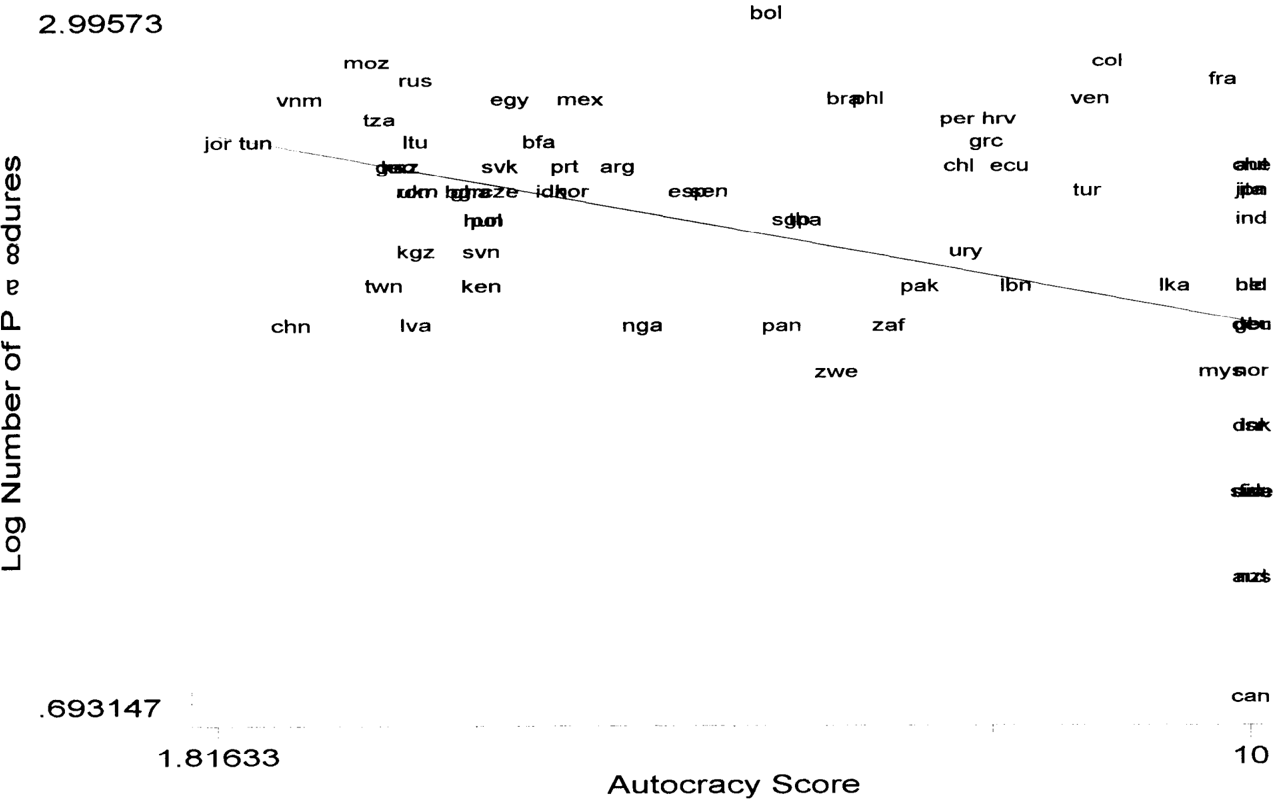
- In Table VIII, better government is associated with lighter regulation; the paper states that countries with more limited and representative governments have statistically significantly fewer procedures using 5 out of 6 measures of better government, and that more autocratic countries regulate more heavily.
Methods
- The paper builds a new database on entry regulation for 75 countries, focusing on the legal requirements, official time, and official cost for a standardized start-up firm.
- Data were gathered from written government sources, World Bank- and USAID-sponsored studies, government web pages, direct contacts with agencies, and independent double-checks in 73 countries via local consulting reports; the remaining 2 countries were double-checked through government contacts.
- The main analysis uses cross-country OLS regressions relating entry regulation measures to outcomes such as quality, pollution, unofficial economy, corruption, political institutions, legal origin, and GDP per capita; the paper also reports correlations and test-of-means comparisons across income quartiles.
Limitations
- The paper itself notes that the capture-theory tests are based on crude measures and that the data are probably least suited to test the capture hypothesis.
- The authors say the data almost surely underestimate the cost and complexity of entry because they focus on the capital city, omit industry-specific requirements and foreign-ownership steps, and ignore some informal delays and bribes.
- Evident from the text: the study is cross-sectional and based on official procedures/costs, so causal interpretation is limited and informal corruption/bureaucratic delays are not directly measured except indirectly through correlations.
Model-written summary. Check it against the paper before relying on it.
Integrity signals
Registry
Cites
Statistics
Figures
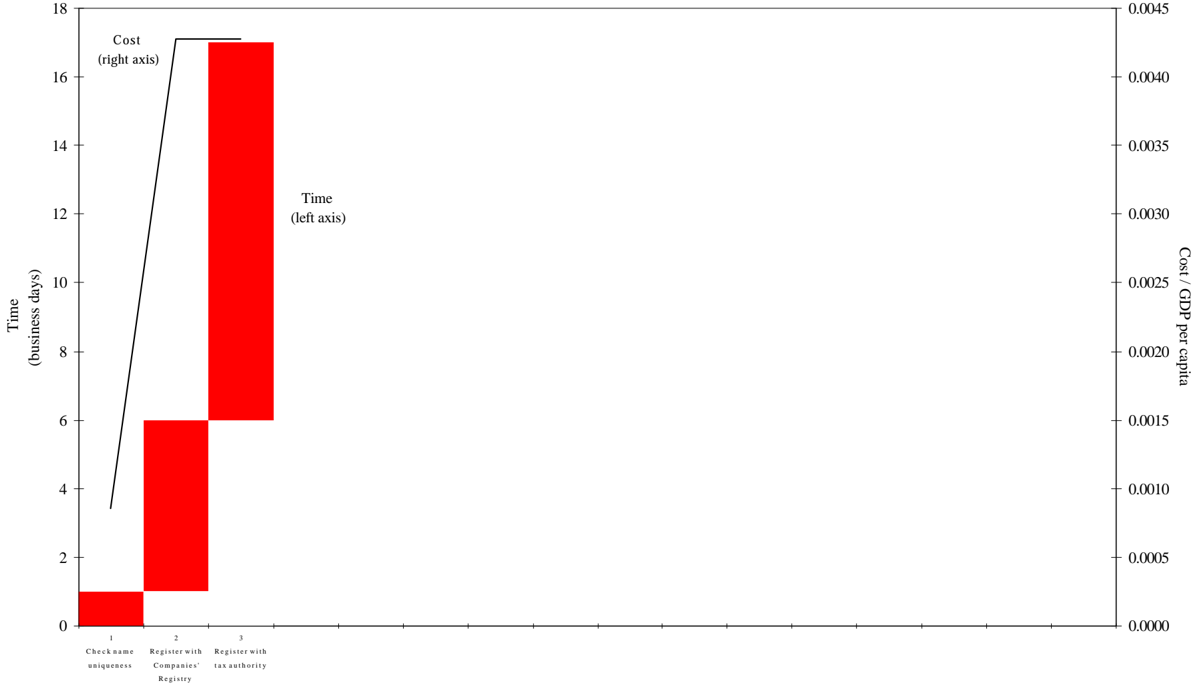
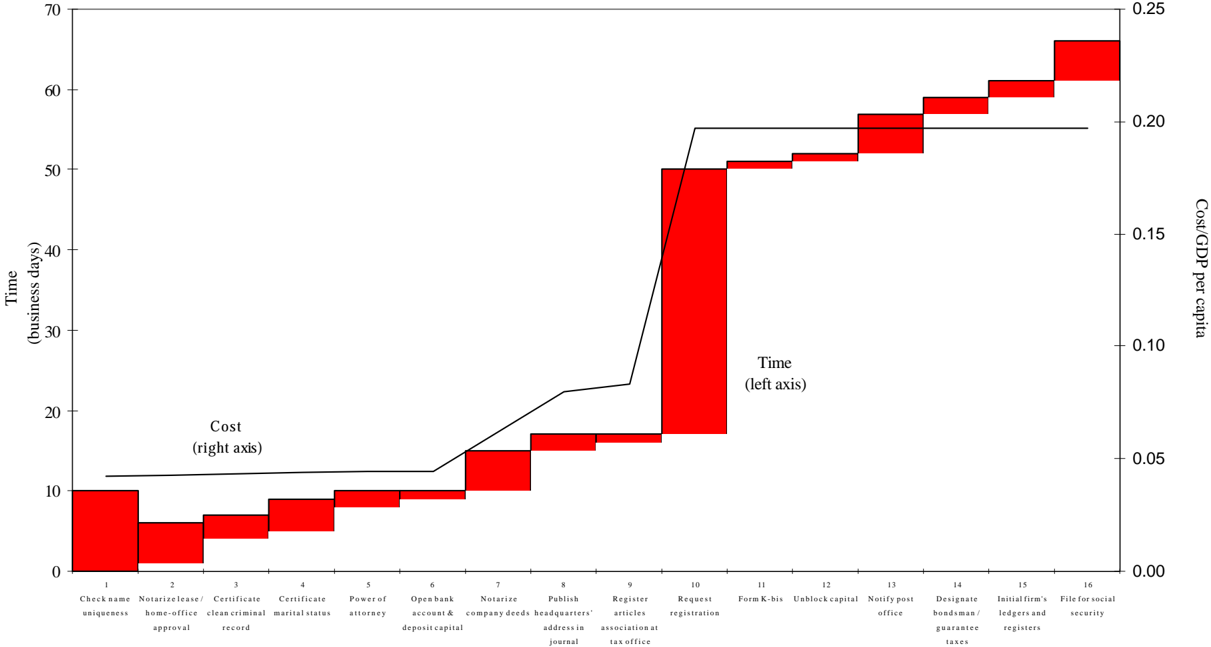
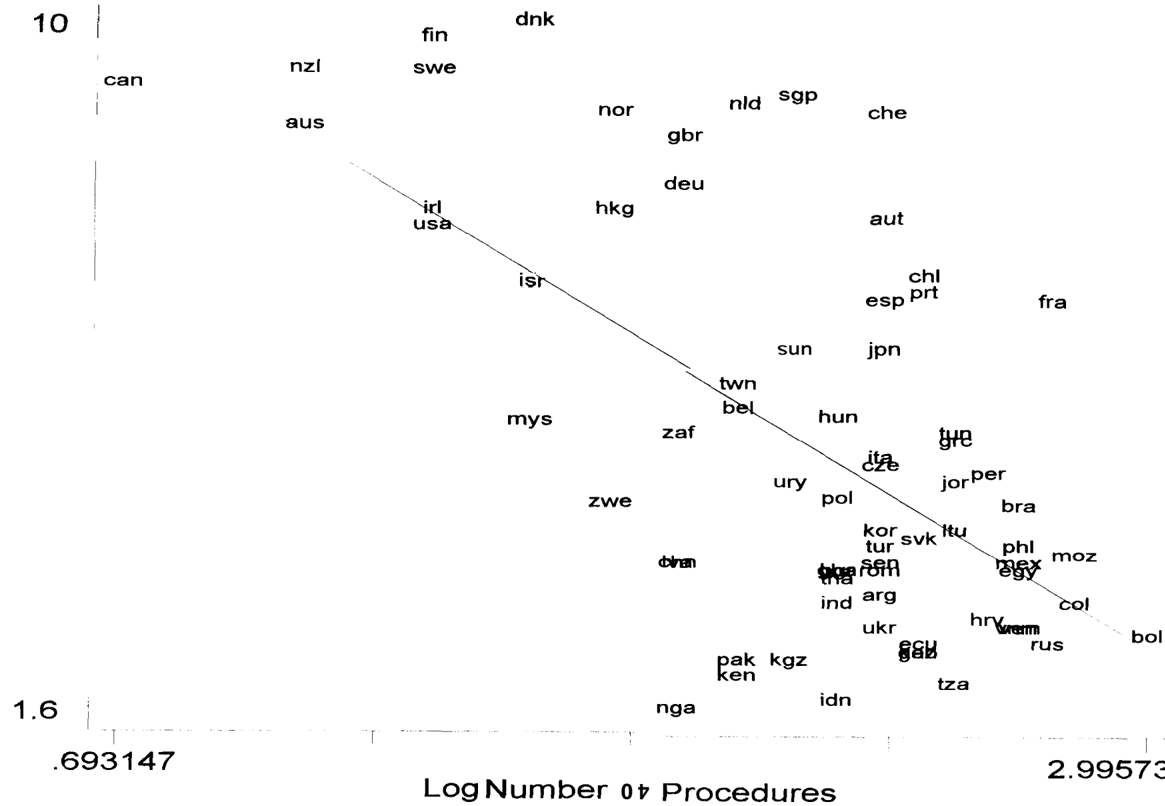
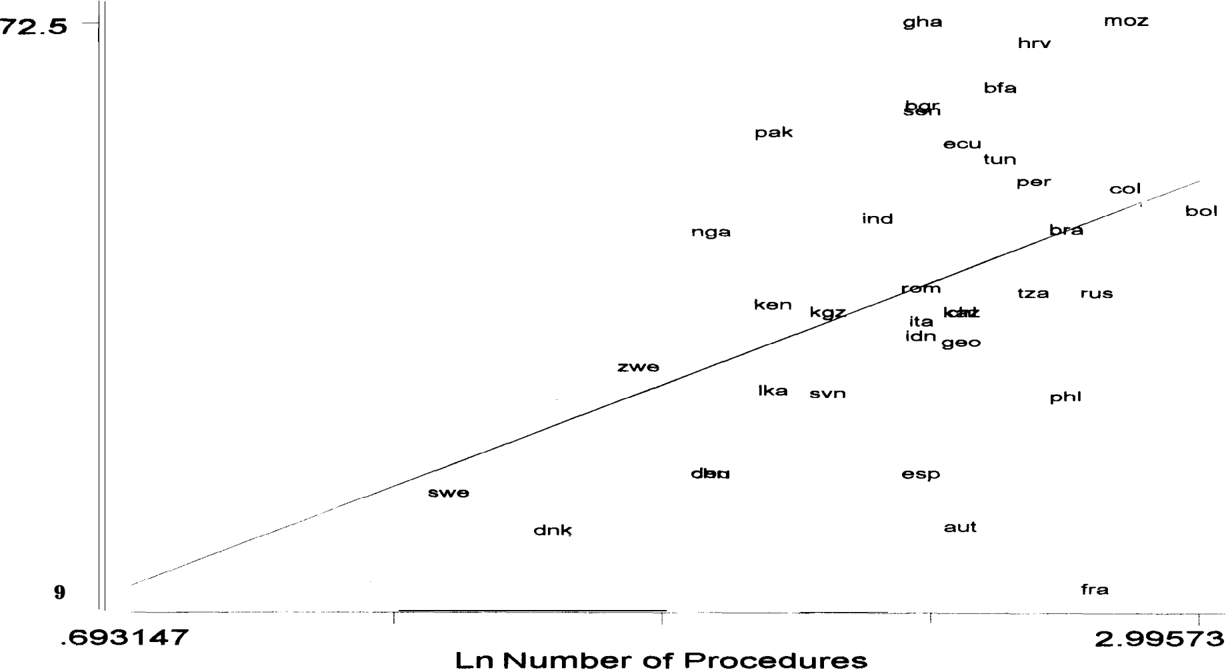
Verification
Claims the paper makes
0 Valid · 3 Not valid · 13 Not checked · 114 Own results and interpretations
A result the paper reports from its own data — it cites no other source for it, so there is none to check. The quote shows it is in the paper.
In the paper
“Very few entry regulations cover tax and labor issues.”
plain- Asserted: passes — The authors put it forward as true.
- Checkable: passes — It can be checked against evidence.
- Load-bearing: unclear — It is unclear whether the paper’s conclusions depend on it.
- Based: passes — The paper gives a reason why it holds.
In the paper
“The data show that the numbers of entry and of labor market regulations are positively correlated across countries, contrary to the substitutes hypothesis.”
What the sources say
- Not matchedcites Djankov et al., 2000
An author–year citation the paper’s reference list doesn’t settle. We don’t search these by name.
plainstates an association- Asserted: passes — The authors put it forward as true.
- Checkable: passes — It can be checked against evidence.
- Load-bearing: unclear — It is unclear whether the paper’s conclusions depend on it.
- Based: passes — The paper gives a reason why it holds.
- Not matched
A result the paper reports from its own data — it cites no other source for it, so there is none to check. The quote shows it is in the paper.
In the paper
“It often takes the form of screening procedures.”
- Also stated in: § III. Basic Results. · plain
“Instead, much of what governments do to regulate entry falls into the category of screening procedures.”
plain- Asserted: passes — The authors put it forward as true.
- Checkable: passes — It can be checked against evidence.
- Load-bearing: unclear — It is unclear whether the paper’s conclusions depend on it.
- Based: passes — The paper gives a reason why it holds.
- Also stated in: § III. Basic Results. · plain
A result the paper reports from its own data — it cites no other source for it, so there is none to check. The quote shows it is in the paper.
In the paper
“First, the cost-to-per-capita-GDP ratio decreases uniformly with GDP per capita.”
plainstates an association- Asserted: passes — The authors put it forward as true.
- Checkable: passes — It can be checked against evidence.
- Load-bearing: unclear — It is unclear whether the paper’s conclusions depend on it.
- Based: passes — The paper gives a reason why it holds.
A result the paper reports from its own data — it cites no other source for it, so there is none to check. The quote shows it is in the paper.
In the paper
“In contrast, countries in the other three quartiles of per capita income are not statistically different from each other in terms of the number of procedures and the time required to fulfill them.”
plain- Asserted: passes — The authors put it forward as true.
- Checkable: passes — It can be checked against evidence.
- Load-bearing: passes — The paper’s conclusions depend on it.
- Based: passes — The paper gives a reason why it holds.
49 more claims
Create a free account to see all 130 claims and every source verdict.
- Probably not a substantial claim. 21
- It may state two separate claims as one. 54
- The quote only partly states this claim. 26
Claims other papers make about this one
Each is checked against this paper’s own text: does it say what the citing paper says it does?
The source backs part of the claim, not all of it — or backs it for a different population, condition or comparison.
In the citing paper
“Our findings suggest an explanation for the low level of incorporation in Italy: the average direct cost associated with fulfilling the bureaucratic regulations for registering a new corporation in Italy is 20% of per capita GNP compared to 10% of per capita GNP on average for other G-7 European countries.”
From Entry regulation as a barrier to entrepreneurship (2006) · cites this paper as Djankov et al. (2002)
Experimental — accuracy not yet measuredThe cited source says what the claim attributes to it.
In the citing paper
“Given the explicit link made by Djankov et al . (2002) between the speed and ease with which businesses may be established in a country and its economic performance - and the enthusiasm with which this link has been grasped by European Union policy makers - our findings imply this link needs reconsidering.”
From The Effect of Business Regulations on Nascent and Young Business Entrepreneurship (2007) · cites this paper as Djankov et al . (2002)
Citations
Cites
La Porta, R., Lopez‐de‐Silanes, F., Shleifer, A., & Vishny, R. W. (1998) · Journal of Political Economy · doi:10.1086/250042 · Cited by 18,025
Self-citationThe Theory of Economic Regulation
Stigler, G. J. (1971) · The Bell Journal of Economics and Management Science · doi:10.2307/3003160 · Cited by 8,098
Journal of Economic Literature
(2019) · AEA Papers and Proceedings · doi:10.1257/pandp.109.633 · Cited by 7,468
The Quarterly Journal of Economics
Kuznets, S. (2024) · Business Cycle Theory, Part I Volume 4 · doi:10.4324/9781003549741-8 · Cited by 7,176
La Porta, R. (1999) · Journal of Law, Economics, and Organization · doi:10.1093/jleo/15.1.222 · Cited by 5,699 · cited 2×
“Legal origin has been viewed as a proxy for the government’s proclivity to intervene in the economy and the stance of the law toward the security of property rights in a country [La Porta et al. 1999].”
The Theory of Economic Regulation
Stigler, G. J. (2021) · The Political Economy · doi:10.4324/9781315495811-8 · Cited by 5,483
Pigou, A. C. (1933) · The Economic Journal · doi:10.2307/2224491 · Cited by 5,137
Toward a More General Theory of Regulation
Peltzman, S. (1976) · The Journal of Law and Economics · doi:10.1086/466865 · Cited by 4,729
Moffitt, R. A. (2009) · American Economic Review · doi:10.1257/aer.99.2.660 · Cited by 4,694
Shleifer, A., & Vishny, R. W. (1993) · The Quarterly Journal of Economics · doi:10.2307/2118402 · Cited by 3,778
Self-citation
Research works printed but not linked: 7
- McLiesh Caralee, 2001, NBER Working Paper No., 8288
- Kasnako lu, Zehra, and Münür Yayla, 'Unrecorded Economy in Turkey: A Monetary Approach', 1999. "Unrecorded Economy in Turkey (A Monetary Approach)" in Informal Sector in Turkey (I), Tuncer Bulutay (ed.), SIS, Ankara, forthcoming.
- Fred, 1987, Journal of Legal Studies, 101
- Olson, Mancur, 1991, 'Autocracy, Democracy, and Prosperity,' in Richard Zeckhauser, ed., Strategy of Choice, Cambridge, MA: MIT Press.
- 1967, Western Economic Journal, 232
- World Economic Forum (1999), The Global Competitiveness Report 1999 , Schwab, Klaus et al., eds., New York: Oxford University Press.
- World Economic Forum, The Global Competitiveness Report 2001, Klaus Schwab et al., eds. (New York, NY: Oxford University Press, 2001).
Cited by
Items 2,201–2,300 of 3,986
Lee, S., Yasuhiro Yamakawa, B., & Peng, M. W. (2007) · SSRN Electronic Journal · doi:10.2139/ssrn.1059661 · Cited by 7
Measuring Unmeasurable: How to Map Laws to Numbers Using LeximetricsPreprint
Kholodilin, K. A., & Pfeiffer, L. (2021) · SSRN Electronic Journal · doi:10.2139/ssrn.3810489 · Cited by 11
The Relationship Dilemma: Why Do Banks Differ in the Pace at Which They Adopt New Technology?
Mishra, P., Prabhala, N. R., & Rajan, R. G. (2019) · National Bureau of Economic Research · doi:10.3386/w25694 · Cited by 7
Acemoğlu, D. (2008) · The New Palgrave Dictionary of Economics · doi:10.1057/978-1-349-95121-5_2823-1 · Cited by 7
Potter, J., Qian, H., Fritsch, M. J., STOREY, D. J., & Fotopoulos, G. (2023) · OECD SME and entrepreneurship papers · doi:10.1787/bc031b11-en · Cited by 13
On the optimal number of representatives
Auriol, E., & Gary‐Bobo, R. (2011) · Public Choice · doi:10.1007/s11127-011-9801-3 · Cited by 72
Enhancing the Responsiveness of Bids in Public Procurement: The Case of Sri Lanka
Don, N. L. S. U., Hadiwattage, C., & Panuwatwanich, K. (2023) · Public Works Management & Policy · doi:10.1177/1087724x231191724 · Cited by 12
Pham, T. T. T., Cam, V. H. T., & Nguyen, D. P. K. (2024) · Entrepreneurial Business and Economics Review · doi:10.15678/eber.2024.120205 · Cited by 11
Amoroso, S., Herrmann, B., & Kritikos, A. S. (2024) · Regional Studies · doi:10.1080/00343404.2024.2366289 · Cited by 14
“Accordingly, there is considerable literature regarding the impact of regulations on entry (Ardagna & Lusardi, 2010; Ciccone & Papaioannou, 2007; Djankov et al., 2002).”
Mbama, P. C., & Mfelam, J. R. (2025) · Business Performance Review · doi:10.22495/bprv3i1p2 · Cited by 6
Peralta, A., & Young, S. L. (2025) · Journal of Business Venturing Insights · doi:10.1016/j.jbvi.2025.e00536 · Cited by 6
Mai, T. L., Trang, T. V., Phan, T. T., Nguyen, K. A., & Nguyen, Q. T. T. (2025) · Humanities and Social Sciences Communications · doi:10.1057/s41599-025-05034-0 · Cited by 20
“TCE further informs these relationships by suggesting that social structures in fl uence transaction costs, particularly in labor markets, where education levels and unemployment rates affect workforce ef fi ciency and business viability (Djankov et al., 2002).”
Yang, Z., Qin, Y., & Lyu, X. (2025) · Applied Economics · doi:10.1080/00036846.2025.2525555 · Cited by 14
“Previous literature indicates that cumbersome and costly procedures are hindrances to entrepreneurial dynamism (Djankov et al. 2002; Klapper, Laeven, and Rajan 2006; Prantl 2012).”
InfluentialHaruna, E. U., & Baek, Y. J. (2025) · International Economics and Economic Policy · doi:10.1007/s10368-025-00679-3 · Cited by 7
“In contrast, weak institutions result in corruption, policy ambiguity, and inefficiencies that impede economic activities and decrease productive capacities (Djankov et al. 2002).”
Sun, K., Zhong, X., Xiong, D., & Han, Z. (2026) · Journal of Asian Economics · doi:10.1016/j.asieco.2026.102131 · Cited by 7
Bank Capital Ratios and the Structure of Nonfinancial Industries
Lee, S. J., & Stebunovs, V. (2012) · Finance and Economics Discussion Series · doi:10.17016/feds.2012.53 · Cited by 8
Effet de l’inclusion financière sur la formalisation des Petites et Moyennes Entreprises au Cameroun
Ndouna, F. K., & Nanfosso, R. T. (2021) · Journal of Small Business & Entrepreneurship · doi:10.1080/08276331.2021.1980679 · Cited by 10
“3Suivant la th eorie de la production, les facteurs tels que le capital, le travail et l’innovation ou le progr es technologique sont consid er es comme etant primordiaux pour permettre aux entreprises d’am eliorer leurs performances. formalisation (Djankov et al. 2002; Ayyagari et al. 2017).”
Government and Cronyism: A Reply to Chalmers’s Comment
Klein, P. G., Holmes, R. M., Foss, N. J., Terjesen, S. A., & Pepe, J. (2023) · Academy of Management Perspectives · doi:10.5465/amp.2022.0166 · Cited by 6
The potential of Islamic financing in making financial development more entrepreneurship friendly
Sohail, H., & Arshed, N. (2024) · Journal of Islamic accounting and business research · doi:10.1108/jiabr-07-2023-0206 · Cited by 14
Laoute, C., Aarabe, M., Khizzou, N. B., Alla, L., Alj, B., & Benjelloun, A. S. (2024) · Advances in marketing, customer relationship management, and e-services book series · doi:10.4018/979-8-3693-9775-6.ch002 · Cited by 7
Wan, Q., Pan, H., & Huang, J. (2024) · Pacific-Basin Finance Journal · doi:10.1016/j.pacfin.2024.102575 · Cited by 6
Yang, Z., Zhang, F., Zeng, Z., Xu, H., & Li, M. (2025) · Energy Economics · doi:10.1016/j.eneco.2025.108486 · Cited by 9
Liu, Y., Ke, J., Chen, A., & Cai, X. (2025) · International Review of Economics & Finance · doi:10.1016/j.iref.2025.104331 · Cited by 14
Hanoteau, J., & Vial, V. (2015) · Journal of Indonesian Economy and Business · doi:10.22146/jieb.v29i1.6532 · Cited by 6
Environmental determinants of overweight and obesity : extended international literature review
Schmidhauser, S., Eichler, K., & Brügger, U. (2009) · Zürcher Hochschule für Angewandte Wissenschaften digital collection (Zurich University of Applied Sciences) · Cited by 10
Measuring Regulation: A Labor Task-Based Approach
Simkovic, M., & Zhang, M. B. (2019) · bepress Legal Repository · Cited by 6
Ngoc, T. B. (2017) · Journal of Economics and Development · doi:10.33301/2017.19.01.01 · Cited by 4
Business operations, contestability, bureaucratic holdup, and bribe solicitations
Goel, R. K., Mazhar, U., & Saunoris, J. W. (2020) · Review of Development Economics · doi:10.1111/rode.12687 · Cited by 7
Purcel, A.-A. (2020) · Virgil Madgearu Review of Economic Studies and Research · doi:10.24193/rvm.2020.13.54 · Cited by 7
Wired in? Genetic traits and entrepreneurship around the world
Krammer, S. M. S., & Gören, E. (2021) · Technological Forecasting and Social Change · doi:10.1016/j.techfore.2021.120788 · Cited by 9
Diversification of procedural and administrative costs and innovation: Some firm-level evidence
Kovač, M., & Spruk, R. (2021) · International Journal of Innovation Studies · doi:10.1016/j.ijis.2021.05.002 · Cited by 8
Donaubauer, J., Kannen, P., & Steglich, F. (2021) · The Journal of Development Studies · doi:10.1080/00220388.2021.1956471 · Cited by 11
Bribery and export intensity: the role of formal institutional constraint susceptibility
Eramudugoda, R., & Ramos, M. A. (2022) · Cross Cultural & Strategic Management · doi:10.1108/ccsm-08-2021-0150 · Cited by 10
Financing industrial corporations in a developing economy: panel evidence from Imperial Russia
Gregg, A., & Nafziger, S. (2023) · Financial History Review · doi:10.1017/s096856502200018x · Cited by 8
Krasniqi, B. A., Williams, N., Hashi, I., Reçica, F., Lubishtani, E., & Kryeziu, L. (2023) · Review of International Business and Strategy · doi:10.1108/ribs-11-2022-0104 · Cited by 6
Domínguez, B., Gómez, J., & Maícas, J. P. (2023) · Strategic Organization · doi:10.1177/14761270231195497 · Cited by 7
Sultana, N., Rahman, M. M., & Murad, S. M. W. (2023) · Structural Change and Economic Dynamics · doi:10.1016/j.strueco.2023.11.015 · Cited by 12
Institutional quality, shadow economy and entrepreneurship: international evidence
Pham, T. K. T. (2023) · International Journal of Sociology and Social Policy · doi:10.1108/ijssp-09-2023-0216 · Cited by 11
Quantifying the impact of red tape on investment: A survey data approach
Pellegrino, B., & Zheng, G. (2023) · Journal of Financial Economics · doi:10.1016/j.jfineco.2023.103763 · Cited by 6
The effects of informal competition on firms’ innovation in Greece
Vlachos, V. (2024) · International Journal of Development Issues · doi:10.1108/ijdi-08-2023-0192 · Cited by 6
ENTRY AND EXIT REGULATIONS - THE WORLD BANK'S DOING BUSINESS INDICATORS
Strobel, T. (2010) · RePEc: Research Papers in Economics · Cited by 6
Quantitative Assessment of Structural Reforms: Modelling the Lisboa Strategy
Grilo, I., Wobst, P., Arpaia, A., et al. (2007) · Economic papers · Cited by 6
1 What Can Be Learned about the Economies of China and India from Purchasing Power Comparisons?
HESTON, A. W. (2010) · Oxford University Press eBooks · doi:10.1093/acprof:oso/9780199575077.003.0001 · Cited by 6
The viability of the welfare state
Heckman, J. J. (2013) · Routledge eBooks · doi:10.4324/9780203870594-15 · Cited by 6
Searching for the EU Social Dialogue Model
Freeman, R. B. (2006) · Physica-Verlag eBooks · doi:10.1007/978-3-7908-1923-6_11 · Cited by 16
The politics of growth: Can lobbying raise growth and welfare?
Júlio, P. (2014) · Journal of Macroeconomics · doi:10.1016/j.jmacro.2014.08.007 · Cited by 8
Property rights institutions and bank performance across countries
ElKelish, W. W., & Tucker, J. (2015) · Managerial Finance · doi:10.1108/mf-10-2013-0288 · Cited by 10
Traditional and Innovative Approaches to Legal Reform: The ‘New Company Law’
McCahery, J. A., Vermeiden, E. P. M., Hisatake, M., & Saito, J. (2007) · European Business Organization Law Review · doi:10.1017/s1566752907000079 · Cited by 8
Productivity and Firms’ Sales Destination: C hinese Characteristics
Bao, Q., Huang, J., & Wang, Y. (2015) · Review of International Economics · doi:10.1111/roie.12181 · Cited by 6
The business landscape for MSMEs and large enterprises in Zambia
Munro, J., Pearson, R., Clarke, G. R. G., et al. (2010) · Cited by 6
Political Connections, Entrepreneurship, and Social Network Investment
Erkal, N., & Kali, R. (2010) · International Atlantic Economic Conference (IAEC) · Cited by 6
Multinationals and Corruption: Business as Usual?
Tekin‐Koru, A. (2017) · Springer eBooks · doi:10.1007/978-3-662-49502-5_7 · Cited by 6
Employment Protection and Misallocation of Resources Across Plants: International Evidence
Lashitew, A. A. (2015) · CESifo Economic Studies · doi:10.1093/cesifo/ifv023 · Cited by 6
Entrepreneurial Cognition and Learning
Cacciolatti, L. A., & Lee, S. H. (2015) · Palgrave Macmillan UK eBooks · doi:10.1057/9781137532589_4 · Cited by 14
ENTRY BARRIERS, COMPETITION, AND TECHNOLOGY ADOPTION
Fang, L. (2016) · Economic Inquiry · doi:10.1111/ecin.12391 · Cited by 12
Fonseca, R., & Utrero-González, N. (2016) · Applied Economics · doi:10.1080/00036846.2016.1243209 · Cited by 6
“For BE data, we have also tested robustness with Djankov et al. (2002) variables with similar results (available upon request).”
DIMINISHING RETURNS AND LABOR MARKET ADJUSTMENTS
Dao, H., & Delacroix, A. (2017) · Macroeconomic Dynamics · doi:10.1017/s1365100516001012 · Cited by 5
“That such costs are much larger than the policy costs estimated in Djankov et al. (2002) is consistent with what Felbermayr and Prat (2011) find with a similar framework.”
Political land corruption: evidence from Malta – the European Union’s smallest member state
Caruana‐Galizia, P., & Caruana-Galizia, M. (2017) · Journal of Public Policy · doi:10.1017/s0143814x17000174 · Cited by 6
Asset Growth and Stock Returns
Chen, S. K., Yao, T., Yu, T., & Zhang, T. (2008) · Cited by 6
If Development of Technologies can Win Shadow Economy
Nevzorova, E. N., Киреенко, А. П., & Leontyeva, Y. V. (2018) · International Scientific-Technical Conference on Actual Problems of Electronic Instrument Engineering (APEIE) · doi:10.1109/apeie.2018.8546303 · Cited by 6
Do Business Regulations Promote Growth in Low-income Countries?
Dima, B., & Dima, Ş. M. (2018) · Economic Analysis · doi:10.28934/ea.18.51.34.pp33-56 · Cited by 8
Good markets (really do) make good neighbors
Kominers, S. D. (2019) · ACM SIGecom Exchanges · doi:10.1145/3331041.3331044 · Cited by 6
“Fixing problems at the extensive margin often starts with ethnography: The designer must figure out where and how sources of friction impede participation, and must then assess the proper scale of response (for some strategies, see Duflo [2017]; see also Abebe [2018]).”
Phelan, C. (2002) · Quarterly Review · doi:10.21034/qr.2621 · Cited by 8
Le travail informel dans les pays en développement : une revue de la littérature
Albertini, J., Ismail, K., Poirier, A., & Terriau, A. (2020) · Revue française d économie · doi:10.3917/rfe.201.0139 · Cited by 13
Financial integration and the comparative advantage of exports
Liang, C. Y. C., & Lin, P. (2022) · Journal of International Trade & Economic Development · doi:10.1080/09638199.2022.2073603 · Cited by 6
“…(iii) entry regulations (entryk,t), measured either by the number of procedure for entry or the cost and time needed for entry, are taken from Djankov et al. (2002), (iv) labor regulations (labork,t), defined as the employment law index or the collective relation law index, from Botero et…”
The degree of commitment to regulator independence: measurement and impact
Trillas, F., & Montoya, M. Á. (2008) · RePEc: Research Papers in Economics · Cited by 6
Optimal Trade Policy, Equilibrium Unemployment and Labor Market Inefficiency
Suwanprasert, W. (2015) · Review of International Economics · doi:10.1111/roie.12492 · Cited by 8
“Hence, my model 2The informal sector in developing countries can be as large as 70% of all employment (Bosch & Esteban-Pretel, 2012; Djankov et al., 2002; Schneider, 2003).”
Does the Institutional Quality Affect Labor Productivity in Italian Vineyard Farms?
Raimondo, M., Nazzaro, C., Nifo, A., & Marotta, G. (2020) · Wine Economics and Policy · doi:10.36253/wep-7833 · Cited by 5
“As a consequence, several studies have been concerned with measuring the quality of political and administrative institutions (in terms, for example, of well-defined property rights, respect for regulations, degree of corruption, and barriers to entry on markets) both for cross-country [26, 27, 28, 29, 30, 31, 32, 33]…”
Ufere, N., & Gaskin, J. E. (2021) · PLoS ONE · doi:10.1371/journal.pone.0247012 · Cited by 12
“Similarly, countries with heavier regulation of entry have higher corruption and larger unofficial economies [54].”
Teaching Labor Laws: Evidence from a Randomized Control Trial in South Africa
Bertrand, M., & Crépon, B. (2021) · American Economic Journal Applied Economics · doi:10.1257/app.20190497 · Cited by 22
“…documented the regulation of business activity across many areas (such as in the World Bank’s Doing Business Reports following the seminal work of Djankov et al. (2002)) and measured how the stringency of this regulation affects economic outcomes, we hypothesize that, independently of…”
InfluentialCross‐country disparities in skill premium and skill acquisition
Banerjee, A. N., Basu, P., & Keller, E. (2022) · Economic Inquiry · doi:10.1111/ecin.13107 · Cited by 10
Choosing between the formal and informal economy: how do managers decide?
Aad, A. A., & Combs, J. G. (2021) · Cross Cultural & Strategic Management · doi:10.1108/ccsm-07-2020-0140 · Cited by 9
Doing Businessguidance, legal origins theory, and the politics of governance by knowledge
McHugh-Russell, L. (2021) · Canadian Journal of Development Studies/Revue canadienne d études du développement · doi:10.1080/02255189.2021.1971953 · Cited by 10
Credit market frictions and political failure
Aney, M. S., Ghatak, M., & Morelli, M. (2016) · Journal of Monetary Economics · doi:10.1016/j.jmoneco.2016.03.012 · Cited by 6
“On the other hand, if the government tried to propose the more general reforms aimed at improving property rights, these are always welfare enhancing because it makes wealth more effective 2This is most obvious when elites lobby for barriers to entry (Djankov et al. 2002).”
Analyzing the Effectiveness of State Regulatory Review
Sobel, R. S., & Dove, J. A. (2014) · Public Finance Review · doi:10.1177/1091142114557723 · Cited by 7
“If regulatory policy creates excess profits, or rents, for the industry or firms being regulated, regulators and politicians can extract some of those private rents through campaign contributions, votes, or even outright bribes (Djankov et al. 2002).”
A Review of Regulatory Theory and the U.S. Casino Industry
Calcagno, P. T., & Walker, D. M. (2016) · The Journal of Gambling Business and Economics · doi:10.5750/jgbe.v10i1.1059 · Cited by 8
Sial, M. S., Cherian, J. P., Otero, S. Á., Comite, U., Shabbir, M. S., Gunnlaugsson, S. B., & Tabash, M. I. (2021) · Journal of Sustainable Finance & Investment · doi:10.1080/20430795.2021.1990834 · Cited by 8
RetractedLevie, J., Kelley, D. J., Coduras, A., & Schøtt, T. (2014) · Strathprints: The University of Strathclyde institutional repository (University of Strathclyde) · Cited by 7
Entry barriers and markup ratios: evidence from OECD countries
Wu, H. (2008) · Applied Economics Letters · doi:10.1080/13504850601018122 · Cited by 9
Do Incumbents’ Mergers Influence Entrepreneurial Entry? An Evaluation
Majumdar, S. K., Moussawi, R., & Yaylacicegi, U. (2013) · Entrepreneurship Theory and Practice · doi:10.1111/etap.12015 · Cited by 6
de Jong, G., & Kloeze, R. (2013) · American Journal of Industrial and Business Management · doi:10.4236/ajibm.2013.36a001 · Cited by 6
Quantifying creative destruction: Entrepreneurship and productivity in New Zealand
McMillan, J. (2004) · New Zealand Economic Papers · doi:10.1080/00779950409544401 · Cited by 40
“New Zealand’s regulatory costs of starting a business are among the world’s lowest, according to Djankov et al. (2002), who describe the procedures for registering a firm as “streamlined.””
Market Reforms at the Zero Lower Bound
Cacciatore, M., Duval, R., Fiori, G., & Ghironi, F. P. (2017) · IMF Working Paper · doi:10.5089/9781484320679.001 · Cited by 8
Roeger, W., Varga, J., & Veld, J. I. ’. (2010) · RePEc: Research Papers in Economics · Cited by 6
The Economic Effects of Judicial Accountability - Some Preliminary InsightsPreprint
Voigt, S. (2005) · SSRN Electronic Journal · doi:10.2139/ssrn.732723 · Cited by 6
Balcerowicz, E., & Ustenko, O. (2006) · SSRN Electronic Journal · doi:10.2139/ssrn.1015802 · Cited by 6
Entrepreneurship Policies : Principles, Problems and OpportunitiesPreprint
Karlsson, C., & Andersson, M. (2009) · RePEc: Research Papers in Economics · Cited by 6
Barrell, R. J., & Kirby, S. (2007) · RePEc: Research Papers in Economics · Cited by 6
Does Law Matter? An IntroductionPreprint
Smits, J. M., & Faure, M. (2011) · SSRN Electronic Journal · doi:10.2139/ssrn.1950335 · Cited by 6
Public Policy, Entrepreneurship, and Venture Capital in the United StatesPreprint
Cumming, D. J., & Li, D. (2009) · SSRN Electronic Journal · doi:10.2139/ssrn.1443508 · Cited by 6
Salimath, M. S. (2006) · Research Exchange (Washington State University) · Cited by 9
Does Corruption Produce Unsafe Drivers?Preprint
Bertrand, M., Djankov, S., Hanna, R., & Mullainathan, S. (2006) · SSRN Electronic Journal · doi:10.2139/ssrn.902123 · Cited by 12
Self-citationLegal Origins and the Evolution of Institutions: Evidence from American State CourtsPreprint
Berkowitz, D., & Clay, K. B. (2007) · SSRN Electronic Journal · doi:10.2139/ssrn.993886 · Cited by 7
Do Regulatory Changes Affect Market Risk?Preprint
Grout, P. A., & Zalewska, A. (2004) · SSRN Electronic Journal · doi:10.2139/ssrn.567091 · Cited by 6
Labor Regulations and European Industrial Specialization: Evidence from Private Equity Investments
Bozkaya, A., & Kerr, W. R. (2007) · Cited by 4
The Impact of the Financial Crisis on New Firm CreationPreprint
Love, I., & Klapper, L. F. (2010) · SSRN Electronic Journal · doi:10.2139/ssrn.1641446 · Cited by 6
“The data show that dynamic business creation occurs in countries that provide entrepreneurs with a stable legal and regulatory regime, fast and inexpensive business registration process, more flexible employment regulations, and low corporate taxes.”
Existenzgründungen: Ein Weg zur Beschäftigungsförderung?Preprint
Pfeiffer, F. (2005) · RePEc: Research Papers in Economics · Cited by 6
The Impact of Policy Restrictions on Services TradePreprint
Gervais, A. (2015) · SSRN Electronic Journal · doi:10.2139/ssrn.2597220 · Cited by 6
“As noted by Eaton and Kortum (2002) and Feenstra (2004), it is possible to control for the unobserved MR terms using importer and exporter fixed effects.”
The Venture Capital Divide: Germany and the United States in the Post-War EraPreprint
Fohlin, C. (2016) · SSRN Electronic Journal · doi:10.2139/ssrn.2849237 · Cited by 10
Shen, G., & Philipsen, N. J. (2014) · SSRN Electronic Journal · doi:10.2139/ssrn.2535219 · Cited by 6
Metadata
- Authors
- Djankov, S., La Porta, R., Lopez-de-Silanes, F., & Shleifer, A.
- Affiliations
- World Bank (US)
- National Bureau of Economic Research (US)
- ORCID
- Djankov, S.
- Venue
- The Quarterly Journal of Economics
- Publisher
- Oxford University Press (OUP)
- Published
- 2002-02-01
- Volume
- 117
- Issue
- 1
- Pages
- 1-37
- ISSN
- 0033-5533
- 1531-4650
- OpenAlex
- W2139896179
- Cited by
- 3,956
- References
- 30
- Citations by year
- 2026: 223 · 2025: 185 · 2024: 157 · 2023: 120 · 2022: 140 · 2021: 150 · 2020: 151 · 2019: 161 · 2018: 157 · 2017: 162 · 2016: 166 · 2015: 193 · 2014: 200 · 2013: 183 · 2012: 193
- Type
- report
- Language
- en
- Open access
- green
- doi.org
- Licence
- other-oa
- Locations
- World Bank, Washington, DC eBooks (publishedVersion)
- The Quarterly Journal of Economics (publishedVersion)
- The World Bank Open Knowledge Repository (World Bank) (publishedVersion)
- National Bureau of Economic Research (publishedVersion, other-oa)
- RePEc: Research Papers in Economics (submittedVersion)
- Digital Access to Scholarship at Harvard (DASH) (Harvard University) (submittedVersion, cc-by)
- SSRN Electronic Journal (submittedVersion)
- OpenGrey (Institut de l'Information Scientifique et Technique) (submittedVersion)
- The World Bank Open Knowledge Repository (World Bank) (submittedVersion, cc-by)
- Topics
- Social Sciences › Sociology and Political Science › Corruption and Economic Development
- Social Sciences › Economics, Econometrics and Finance › Economics and Econometrics › Taxation and Compliance Studies
- Social Sciences › Business, Management and Accounting › Strategy and Management › Political Influence and Corporate Strategies
- Keywords
- start-up firms, bureaucratic procedures, corruption, informal economy, democracy, government size, public choice theory, public interest theory
About these checks
Registry, retraction, Cites and statistics results are computed, not judged, with one exception: a printed reference that no index lists is read once by a model before it counts as a citation error. Claims are extracted by a model and kept only when their quote appears verbatim in the text; each cited source is then checked, with a model’s help, for whether it says what the claim relies on. Those verdicts can be wrong — read the claim’s quote and the cited source before relying on one.
A language model drew the claims from the paper on 2026-10-01, under version 3 of the claim definition (model deepseek-v4.1-flash, prompt extract-v3).
A second model labelled each claim on 2026-10-01 (model jev-1.13-20260917, definition revision gold-guideline-v0.2).
Statistics and arithmetic are recomputed, not judged.
Confidence bands are shown only for fields calibrated on our annotated test set. None is calibrated yet, so no band is shown.
What counts as a claim ›How we measure confidence ›How we check this ›
Are you an author, or do you see a problem with this page? Request a review
Data sources
Bibliographic data: Semantic Scholar, OpenAlex, Crossref.
Contains information from the Semantic Scholar Academic Graph Datasets, made available under the ODC Attribution License (ODC-BY 1.0).
Semantic Scholar’s data is described in: Kinney, R., et al. (2023). The Semantic Scholar Open Data Platform. arXiv:2301.10140.
