

The Regulation of Entry
Open accessThe DOI matches its Crossref record, with a small difference in title or year; 39 of the 39 references it cites were found in a registry or an index; none of the 13 sources its claims cite is checked for support yet.
Abstract
1%(5 :25.,1* 3$3(5 6(5,(6 7+( 5(*8/$7,21 2) (175< 6LPHRQ 'MDQNRY 5DIDHO /D 3RUWD )ORUHQ.LR /RSH]GH6LODQHV $QGUHL 6KOHLIHU :RUNLQJ 3DSHU KWWSZZZQEHURUJSDSHUVZ 1$7,21$/ %85($8 2) (&2120,& 5(6($5&+ 0DVVD.KXVHWWV $YHQXH &DPEULGJH 0$ 6HSWHPEHU :H WKDQN 2OJD ,RIIH 7DWLDQD 1HQRYD DQG (NDWHULQD 7UL]ORYD IRU DEOH UHVHDU.K DVVLVWDQ.H DQG +DPLG $ODYL ,ULQD $VWUDNKDQ $EKLMLW %DQHUMHH 5L.KDUG &DYHV -D.TXHOLQH &RROLGJH -DPHV (PHU\ 1LKDO (O0DJKDUEHO -HDQ 3DXO *DXWKLHU (G *ODHVHU 6LPRQ -RKQVRQ /DZUHQ.H .DW] 3HWHU .X.HUD 'DYLG /DLEVRQ ,UD /LHEHUPDQ 'DYLQ 0D.NLQ]LH 0DULH )UDQ.RLVH 0DULH1HOO\ 0DU.HOR 2ODUUHDJD *X\ 3IHIIHUPDQQ 6DQWLDJR 6HGD.D /HLOD :HEVWHU 3HWHU :ULJKW DQG VHPLQDU SDUWL.LSDQWV DW WKH 8QLYHUVLW\ RI 0DU\ODQG DW &ROOHJH 3DUN IRU KHOSIXO .RPPHQWV 7KH .ROOH.WLRQ RI GDWD IRU WKLV SDSHU ZDV RUJDQL]HG DQG ILQDQ.HG E\ WKH :RUOG %DQN $Q DSSHQGL[ GHV
Overview
CoChat Summary
TL;DR
This paper assembles a new cross-country dataset on business entry regulation in 75 countries and uses it to compare the helping-hand, capture, and tollbooth theories of regulation. The evidence is most consistent with the tollbooth view: heavier entry regulation is associated with more corruption, a larger unofficial economy, and less representative, more autocratic governments.
Key findings
- Across the 75-country sample, the number of entry procedures ranges from 2 in Canada to 20 in Bolivia, with a sample average of 10.17 procedures; the average official time is 63.05 business days and the average cost is 0.34 of GDP per capita.
- The number of procedures is strongly correlated with time and cost: the paper reports correlations of 0.75 with log time and 0.62 with log cost.
- The helping-hand tests do not support a beneficial-regulation story: in Table IV, more procedures are associated with lower ISO quality standards (e.g. coefficient -0.2646) and larger unofficial economy measures (e.g. coefficient 13.6277 for size of unofficial economy; 19.8763 for employment in the unofficial economy), while pollution and health outcomes do not improve.
- The tollbooth evidence is stronger: Table VI reports that more procedures are associated with worse corruption scores, with a coefficient of -3.2809 (and -1.7249 with GDP per capita controls) for the corruption regressions.
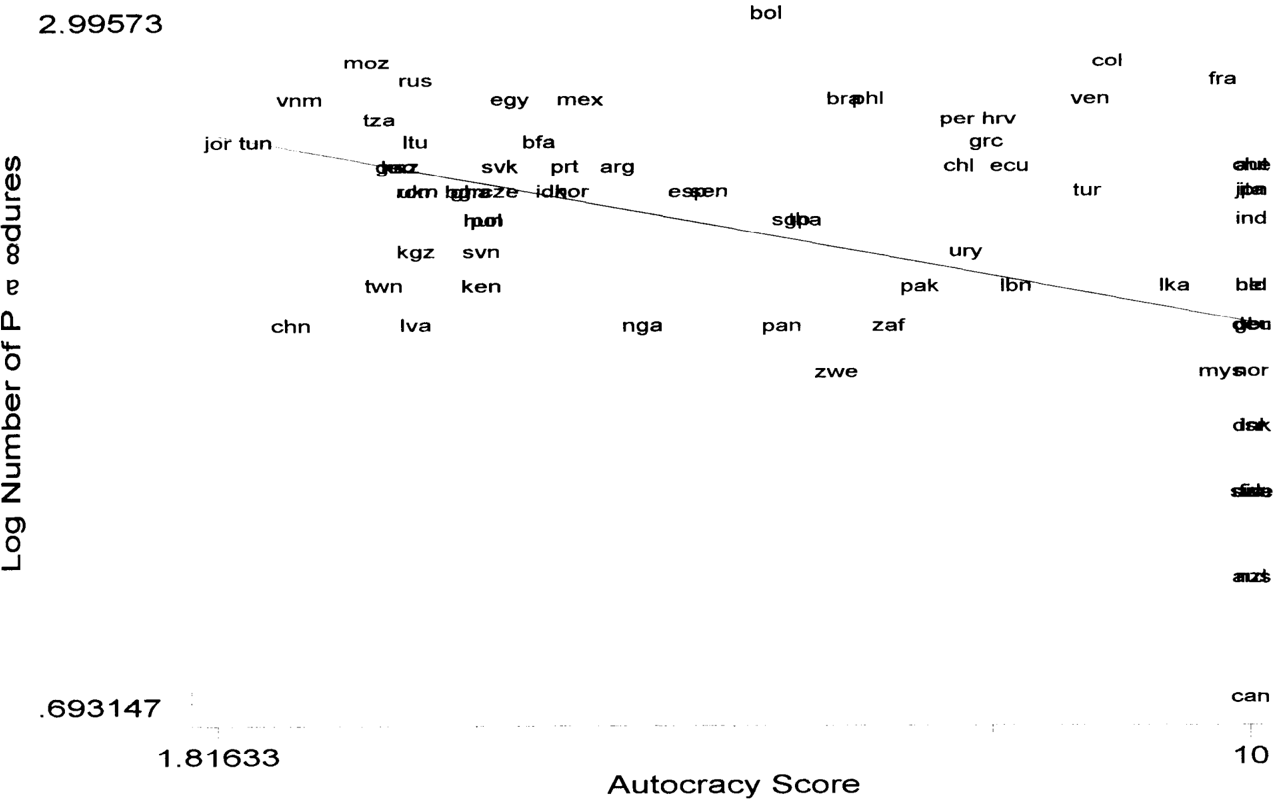
- In Table VIII, better government is associated with lighter regulation; the paper states that countries with more limited and representative governments have statistically significantly fewer procedures using 5 out of 6 measures of better government, and that more autocratic countries regulate more heavily.
Methods
- The paper builds a new database on entry regulation for 75 countries, focusing on the legal requirements, official time, and official cost for a standardized start-up firm.
- Data were gathered from written government sources, World Bank- and USAID-sponsored studies, government web pages, direct contacts with agencies, and independent double-checks in 73 countries via local consulting reports; the remaining 2 countries were double-checked through government contacts.
- The main analysis uses cross-country OLS regressions relating entry regulation measures to outcomes such as quality, pollution, unofficial economy, corruption, political institutions, legal origin, and GDP per capita; the paper also reports correlations and test-of-means comparisons across income quartiles.
Limitations
- The paper itself notes that the capture-theory tests are based on crude measures and that the data are probably least suited to test the capture hypothesis.
- The authors say the data almost surely underestimate the cost and complexity of entry because they focus on the capital city, omit industry-specific requirements and foreign-ownership steps, and ignore some informal delays and bribes.
- Evident from the text: the study is cross-sectional and based on official procedures/costs, so causal interpretation is limited and informal corruption/bureaucratic delays are not directly measured except indirectly through correlations.
Model-written summary. Check it against the paper before relying on it.
Integrity signals
Registry
Cites
Statistics
Figures
Verification
Claims the paper makes
0 Valid · 3 Not valid · 13 Not checked · 114 Own results and interpretations
A result the paper reports from its own data — it cites no other source for it, so there is none to check. The quote shows it is in the paper.
In the paper
“Very few entry regulations cover tax and labor issues.”
plain- Asserted: passes — The authors put it forward as true.
- Checkable: passes — It can be checked against evidence.
- Load-bearing: unclear — It is unclear whether the paper’s conclusions depend on it.
- Based: passes — The paper gives a reason why it holds.
In the paper
“The data show that the numbers of entry and of labor market regulations are positively correlated across countries, contrary to the substitutes hypothesis.”
What the sources say
- Not matchedcites Djankov et al., 2000
An author–year citation the paper’s reference list doesn’t settle. We don’t search these by name.
plainstates an association- Asserted: passes — The authors put it forward as true.
- Checkable: passes — It can be checked against evidence.
- Load-bearing: unclear — It is unclear whether the paper’s conclusions depend on it.
- Based: passes — The paper gives a reason why it holds.
- Not matched
A result the paper reports from its own data — it cites no other source for it, so there is none to check. The quote shows it is in the paper.
In the paper
“It often takes the form of screening procedures.”
- Also stated in: § III. Basic Results. · plain
“Instead, much of what governments do to regulate entry falls into the category of screening procedures.”
plain- Asserted: passes — The authors put it forward as true.
- Checkable: passes — It can be checked against evidence.
- Load-bearing: unclear — It is unclear whether the paper’s conclusions depend on it.
- Based: passes — The paper gives a reason why it holds.
- Also stated in: § III. Basic Results. · plain
A result the paper reports from its own data — it cites no other source for it, so there is none to check. The quote shows it is in the paper.
In the paper
“First, the cost-to-per-capita-GDP ratio decreases uniformly with GDP per capita.”
plainstates an association- Asserted: passes — The authors put it forward as true.
- Checkable: passes — It can be checked against evidence.
- Load-bearing: unclear — It is unclear whether the paper’s conclusions depend on it.
- Based: passes — The paper gives a reason why it holds.
A result the paper reports from its own data — it cites no other source for it, so there is none to check. The quote shows it is in the paper.
In the paper
“In contrast, countries in the other three quartiles of per capita income are not statistically different from each other in terms of the number of procedures and the time required to fulfill them.”
plain- Asserted: passes — The authors put it forward as true.
- Checkable: passes — It can be checked against evidence.
- Load-bearing: passes — The paper’s conclusions depend on it.
- Based: passes — The paper gives a reason why it holds.
49 more claims
Create a free account to see all 130 claims and every source verdict.
- Probably not a substantial claim. 21
- It may state two separate claims as one. 54
- The quote only partly states this claim. 26
Claims other papers make about this one
Each is checked against this paper’s own text: does it say what the citing paper says it does?
The source backs part of the claim, not all of it — or backs it for a different population, condition or comparison.
In the citing paper
“Our findings suggest an explanation for the low level of incorporation in Italy: the average direct cost associated with fulfilling the bureaucratic regulations for registering a new corporation in Italy is 20% of per capita GNP compared to 10% of per capita GNP on average for other G-7 European countries.”
From Entry regulation as a barrier to entrepreneurship (2006) · cites this paper as Djankov et al. (2002)
Experimental — accuracy not yet measuredThe cited source says what the claim attributes to it.
In the citing paper
“Given the explicit link made by Djankov et al . (2002) between the speed and ease with which businesses may be established in a country and its economic performance - and the enthusiasm with which this link has been grasped by European Union policy makers - our findings imply this link needs reconsidering.”
From The Effect of Business Regulations on Nascent and Young Business Entrepreneurship (2007) · cites this paper as Djankov et al . (2002)
Citations
Cites
La Porta, R., Lopez‐de‐Silanes, F., Shleifer, A., & Vishny, R. W. (1998) · Journal of Political Economy · doi:10.1086/250042 · Cited by 18,025
Self-citationThe Theory of Economic Regulation
Stigler, G. J. (1971) · The Bell Journal of Economics and Management Science · doi:10.2307/3003160 · Cited by 8,098
Journal of Economic Literature
(2019) · AEA Papers and Proceedings · doi:10.1257/pandp.109.633 · Cited by 7,468
The Quarterly Journal of Economics
Kuznets, S. (2024) · Business Cycle Theory, Part I Volume 4 · doi:10.4324/9781003549741-8 · Cited by 7,176
La Porta, R. (1999) · Journal of Law, Economics, and Organization · doi:10.1093/jleo/15.1.222 · Cited by 5,699 · cited 2×
“Legal origin has been viewed as a proxy for the government’s proclivity to intervene in the economy and the stance of the law toward the security of property rights in a country [La Porta et al. 1999].”
The Theory of Economic Regulation
Stigler, G. J. (2021) · The Political Economy · doi:10.4324/9781315495811-8 · Cited by 5,483
Pigou, A. C. (1933) · The Economic Journal · doi:10.2307/2224491 · Cited by 5,137
Toward a More General Theory of Regulation
Peltzman, S. (1976) · The Journal of Law and Economics · doi:10.1086/466865 · Cited by 4,729
Moffitt, R. A. (2009) · American Economic Review · doi:10.1257/aer.99.2.660 · Cited by 4,694
Shleifer, A., & Vishny, R. W. (1993) · The Quarterly Journal of Economics · doi:10.2307/2118402 · Cited by 3,778
Self-citation
Research works printed but not linked: 7
- McLiesh Caralee, 2001, NBER Working Paper No., 8288
- Kasnako lu, Zehra, and Münür Yayla, 'Unrecorded Economy in Turkey: A Monetary Approach', 1999. "Unrecorded Economy in Turkey (A Monetary Approach)" in Informal Sector in Turkey (I), Tuncer Bulutay (ed.), SIS, Ankara, forthcoming.
- Fred, 1987, Journal of Legal Studies, 101
- Olson, Mancur, 1991, 'Autocracy, Democracy, and Prosperity,' in Richard Zeckhauser, ed., Strategy of Choice, Cambridge, MA: MIT Press.
- 1967, Western Economic Journal, 232
- World Economic Forum (1999), The Global Competitiveness Report 1999 , Schwab, Klaus et al., eds., New York: Oxford University Press.
- World Economic Forum, The Global Competitiveness Report 2001, Klaus Schwab et al., eds. (New York, NY: Oxford University Press, 2001).
Cited by
Items 2,101–2,200 of 3,986
Economic Reforms in Serbia and Prospects for Economic Recovery and Growth
Bartlett, W. (2018) · Societies and political orders in transition · doi:10.1007/978-3-319-93665-9_11 · Cited by 8
Salinas, A., Muffatto, M., & Alvarado, R. (2018) · Padua Research Archive (University of Padova) · Cited by 10
Investigating critical resource determinants of start-ups: An empirical study of the MENA region
Alfalih, A. A. (2019) · Cogent Economics & Finance · doi:10.1080/23322039.2019.1628494 · Cited by 10
“These variables were used because they are considered able to influence start-up Page 10 of 19 propensity in each MENA country (Djankov et al., 2002).”
Effects of state aid to enterprises
Zemplínerová, A. (2006) · Politická ekonomie · doi:10.18267/j.polek.553 · Cited by 8
Institutional quality, conforming and evasive entrepreneurship
Hanoteau, J., & Vial, V. (2020) · Eurasian economic review : · doi:10.1007/s40821-020-00151-z · Cited by 13
ENTREPRENEURIAL SPAWNING IN THE INFORMAL ECONOMY
Alnahedh, M., & Alsanousi, S. (2020) · Journal of Developmental Entrepreneurship · doi:10.1142/s1084946720500089 · Cited by 5
Does more market competition lead to higher income and utility in the long run?
Stauvermann, P. J., & Kumar, R. R. (2021) · Bulletin of Economic Research · doi:10.1111/boer.12318 · Cited by 9
Gauthier, B., & Goyette, J. (2015) · Social Choice and Welfare · doi:10.1007/s00355-015-0903-6 · Cited by 9
“…Lawarree 1993; Laffont and Tirole 1992, 1993), public services provision (Banerjee 1997; Svensson 2003; Bertrand et al. 2007), licenses and permits (Djankov et al. 2002), as well as extortion by policemen, soldiers and weigh station employees (Olken and Barron 2007).7 We first model a situation…”
InfluentialService Deregulation, Competition, and the Performance of French and Italian Firms
Daveri, F., Lecat, R., & Parisi, M. L. (2015) · Scottish Journal of Political Economy · doi:10.1111/sjpe.12092 · Cited by 8
Institutions, Informal Labor Markets, and Business Cycle Volatility
Shapiro, A. F. (2015) · Economía · doi:10.31389/eco.72 · Cited by 22
Monetary transmission mechanism with firm turnover
Uusküla, L. (2016) · Journal of Macroeconomics · doi:10.1016/j.jmacro.2016.08.005 · Cited by 7
Legal origins and mortgage finance contradictions
Donkor-Hyiaman, K. A., & Ghartey, K. N. O. (2017) · International Journal of Housing Markets and Analysis · doi:10.1108/ijhma-03-2016-0019 · Cited by 10
Entrepreneurship and ICT: a comparative analysis between Germany and Portugal
Leitão, J. C. C., & Ferreira, J. J. (2009) · International Journal of Entrepreneurship and Small Business · doi:10.1504/ijesb.2009.023023 · Cited by 10
Comparing legal and alternative institutions in commerce
Allen, F. (2008) · Cadmus - EUI Research Repository (European University Institute) · Cited by 8
2004-3 For Sale: Barriers to Riches
Bridgman, B., Livshits, I., & MacGee, J. C. (2004) · Scholarship@Western (Western University) · Cited by 8
On the Politics of the Regulatory Reform: Econometric Evidence from the OECD CountriesPreprint
Duso, T. (2003) · SSRN Electronic Journal · doi:10.2139/ssrn.467302 · Cited by 8
The Climate for Business Development and Employment Growth in Puerto Rico
Davis, S. J., & Rivera-Batiz, L. A. (2005) · National Bureau of Economic Research · doi:10.3386/w11679 · Cited by 8
“More recently, Djankov et al. (2001) examine data for start-up firms in 85 countries.”
The Hidden Burden of the Income Tax: Compliance Costs of German IndividualsPreprint
Hundsdoerfer, J., Eichfelder, S., & Blaufus, K. (2011) · SSRN Electronic Journal · doi:10.2139/ssrn.1980211 · Cited by 8
“For example, Blumenthal and Slemrod (1992) observe considerably higher compliance costs for self-employed taxpayers that may negatively affect self-employment and impair economic growth (Djankov et al. 2002 and Grilo and Irigoyen 2006).”
Starting a Foreign Investment across Sectors
Soto, C. D. L. M., Ghossein, T., & Soto, C. D. L. M. (2013) · World Bank, Washington, DC eBooks · doi:10.1596/1813-9450-6707 · Cited by 8
“Research also shows that stricter regulation of entry is associated with higher levels of corruption, and a greater relative size of the unofficial economy (Djankov et al., 2002).”
Doing Business: A Review of Literature and Its Role in APEC 2015
Mendoza, R. U., Canare, T. A., & Ang, A. P. (2015) · doi:10.62986/dp2015.37 · Cited by 10
Product Market Regulation and Market Work: A Benchmark AnalysisPreprint
Fang, L., & Rogerson, R. D. (2009) · SSRN Electronic Journal · doi:10.2139/ssrn.1433125 · Cited by 8
Innovation and performance: A collection of microdata studies
van Leeuwen, G. (2009) · Research Repository (Delft University of Technology) · Cited by 17
López, R., & Islam, A. M. (2008) · RePEc: Research Papers in Economics · doi:10.22004/ag.econ.45875 · Cited by 11
Determinants of Entrepreneurship: Are Women Different?Preprint
Llussá, F. (2011) · SSRN Electronic Journal · doi:10.2139/ssrn.1799334 · Cited by 8
“X i j t is our variable of interest, the vector of individual characteristics, including age, gender, employment status, education, income, the role of social networks, business skills, and fear of failure.(24) This same vector appears the interacted with the gender indicator, Female i , which takes the value 1 when t…”
Corruption, Regulation, and Growth: An Empirical Study of the United StatesPreprint
Johnson, N. D., Ruger, W. P., Sorens, J., et al. (2013) · SSRN Electronic Journal · doi:10.2139/ssrn.2294938 · Cited by 8
Interacting Product and Labor Market Regulation and the Impact of Immigration on Native WagesPreprint
Prantl, S., & Spitz‐Oener, A. (2014) · SSRN Electronic Journal · doi:10.2139/ssrn.2381134 · Cited by 22
Capitalism and SocietyPreprint
Mørck, R., & Yeung, B. Y. (2010) · SSRN Electronic Journal · Cited by 10
Bank Lending Channels During the Great RecessionPreprint
Haltenhof, S., Lee, S. J., & Stebunovs, V. (2013) · SSRN Electronic Journal · doi:10.2139/ssrn.2346952 · Cited by 9
THE GLOBALISATION OF ANGEL INVESTMENTSPreprint
Lerner, J., Schoar, A., Sokolinski, S., & Wilson, K. (2015) · RePEc: Research Papers in Economics · Cited by 8
The Diversity of Entrepreneurial Regimes in EuropePreprint
Dilli, S., & Elert, N. (2016) · SSRN Electronic Journal · doi:10.2139/ssrn.2752966 · Cited by 10
“Stringent, inflexible labor institutions are an obstacle to entrepreneurial activity that may inhibit creative destruction (Djankov et al. 2002; Desai et al. 2003; Caballero and Hammour (2000) and lower firms’ innovative performance (Kaiser et al. 2011; Braunerhjelm et al. 2014; Scarpetta and…”
Political Allocation of FinancePreprint
Perotti, E. C., & Vorage, M. (2008) · SSRN Electronic Journal · doi:10.2139/ssrn.1098101 · Cited by 7
Aspects of Bureaucratic CorruptionPreprint
Bose, G. (2010) · SSRN Electronic Journal · doi:10.2139/ssrn.1679918 · Cited by 8
The Happiness Gap in Eastern EuropePreprint
Djankov, S., Nikolova, E., & Zilinsky, J. (2015) · SSRN Electronic Journal · doi:10.2139/ssrn.2658136 · Cited by 8
Self-citationDividend Taxes, Employment, and Firm ProductivityPreprint
Jacob, M. (2020) · SSRN Electronic Journal · doi:10.2139/ssrn.3564234 · Cited by 8
Financial reporting by small and medium enterprises in Thailand
Ploybut, S. (2012) · OpenGrey (Institut de l'Information Scientifique et Technique) · Cited by 15
Yang, Z., Ji, H., Chen, S., et al. (2024) · Technological and Economic Development of Economy · doi:10.3846/tede.2024.21869 · Cited by 7
Arbelo-Pérez, S., Ruiz-Rosa, I., & Taño, D. G. (2025) · Journal of global entrepreneurship research · doi:10.1007/s40497-025-00450-7 · Cited by 10
“The importance Page 4 of 12 of these formal institutions lies in their ability to foster more efficient market functioning by eliminating imperfections and restrictive administrative regulations, as pointed out by Djankov et al. (2002) and Cao and Shi (2021).”
Timely justice as a determinant of economic growth
Djankov, S., Melcarne, A., Ramello, G. B., & Spruk, R. (2025) · Journal of Economic Behavior & Organization · doi:10.1016/j.jebo.2025.107235 · Cited by 10
Self-citationPublic policy implications of entrepreneurship research
Aguinis, H., Jensen, S. H., Kraus, S., Poček, J., & Pinelli, M. (2025) · International Small Business Journal Researching Entrepreneurship · doi:10.1177/02662426251399898 · Cited by 11
“They can influence how easy it is to start or grow a business, gain access to funding and enforce contracts (Djankov et al., 2002; Williamson, 2000).”
Entrepreneurship and the Family Firm
Mehrotra, V., & Mørck, R. (2013) · Handbook of the economics of finance · doi:10.1016/b978-0-44-453594-8.00009-4 · Cited by 7
Venero, M. J. M. (2015) · Escritura pública · Cited by 8
Calvo, N., Gómez, I. N., & Lema, Y. A. (2023) · International Entrepreneurship and Management Journal · doi:10.1007/s11365-023-00905-x · Cited by 13
Business climate and global value chains: Insights from Africa
Ajide, F. M. (2023) · Transnational Corporation Review · doi:10.1016/j.tncr.2022.11.001 · Cited by 7
Dzingirai, C., & Dzingirai, M. (2024) · Heliyon · doi:10.1016/j.heliyon.2024.e31379 · Cited by 15
“Chortareas et al. [141] and Barth et al. [24,142] provide empirical evidence confirming views raised by Djankov et al. [143] that restrictions on banking activities are not only a bad regulation strategy that hinders banking sector performance and efficiency but exacerbates financial sector…”
Filtering or facilitating productive entrepreneurship?
Belitski, M., & Desai, S. (2024) · Technological Forecasting and Social Change · doi:10.1016/j.techfore.2024.123497 · Cited by 10
Ferreira, J. J. M., Fernandes, C., & Veiga, P. (2024) · International Journal of Entrepreneurial Behavior & Research · doi:10.1108/ijebr-05-2024-0511 · Cited by 9
Hou, G., Sun, C., & Lu, Z. (2025) · PLoS ONE · doi:10.1371/journal.pone.0302508 · Cited by 8
Labor Market Power, Self-Employment, and Development
Amodio, F., Medina, P., & Morlacco, M. (2022) · American Economic Review · doi:10.1257/aer.20230490 · Cited by 50
Fixed cost, number of firms, and skill premium: An alternative source for rising wage inequality
Kurokawa, Y. (2010) · Economics Letters · doi:10.1016/j.econlet.2010.04.049 · Cited by 7
“For example, see Djankov et al. (2002). rises if we assume variety-skill complementarity.”
DETECTING CORRUPTION AND EVALUATING PROGRAMS TO CONTROL IT: SOME LESSONS FOR MENA
Nugent, J. B. (2014) · WORLD SCIENTIFIC eBooks · doi:10.1142/9789814596015_0007 · Cited by 7
“…regulations can provide benefits such as protection from a variety of dangers (to health, accident and so on) but Broadman and Recanatini (1999) and Djankov et al. (2002) have provided evidence suggesting that rent-seeking effects (corruption, creation of barriers to competition) seem to vastly…”
Kok, L. J. D., Durenkamp, M., Yang, L., & Stulen, I. (2007) · Springer US · Cited by 7
Informal state–business connections, institutions, and economic growth
Sabry, M. I. (2017) · Economia Politica · doi:10.1007/s40888-017-0061-7 · Cited by 7
Harasym, R., Rodzinka, J., & Skica, T. (2017) · Journal of Entrepreneurship Management and Innovation · doi:10.7341/20171321 · Cited by 10
Fernández‐Torres, Y., Fernández, M. G., & Hernández, J. R. (2018) · Journal of Developmental Entrepreneurship · doi:10.1142/s1084946718500036 · Cited by 11
The Adverse Effects of Short‐term Contracts on Young Workers: Evidence From Italy
Tealdi, C. (2019) · Manchester School · doi:10.1111/manc.12265 · Cited by 10
Do checks on bureaucrats improve firm value? Evidence from a natural experiment
An, J., Armitage, S., Hou, W., & Liu, X. (2020) · Accounting and Finance · doi:10.1111/acfi.12705 · Cited by 10
Meet the Oligarchs: Business Legitimacy and Taxation at the Top
Tella, R. D., Dubra, J., & Lagomarsino, A. L. (2021) · The Journal of Law and Economics · doi:10.1086/714216 · Cited by 15
Impact of Regulations on Firm Value: Evidence from the 2016 U.S. Presidential Election
Kundu, S. (2018) · Journal of Financial and Quantitative Analysis · doi:10.1017/s0022109023000510 · Cited by 8
“For example, Djankov et al. (2002) show that countries with higher entry regulations have lower per-capita GDP than countries with lower entry regulations.”
Building networks: Investigating the quid pro quo between local politicians & developers
Tandel, V., Gandhi, S., & Tabarrok, A. T. (2023) · Journal of Development Economics · doi:10.1016/j.jdeveco.2023.103138 · Cited by 11
Tesón, F. R., & Klick, J. (2012) · Cambridge University Press eBooks · doi:10.1017/cbo9781139003957.012 · Cited by 27
Becker, S. O., & Hvide, H. K. (2013) · AgEcon Search (University of Minnesota, USA) · doi:10.22004/ag.econ.270547 · Cited by 11
Controls as a Sharable Knowledge Commodity: An Architecture for Open Exchange
Lee, R. M., Dutta, K., Henry, K., et al. (2007) · Group Decision and Negotiation · doi:10.1007/s10726-006-9060-8 · Cited by 7
Market selection and scale inefficiency – A new methodology applied to EU business services
Kox, H. L. M., & van Leeuwen, G. (2012) · Structural Change and Economic Dynamics · doi:10.1016/j.strueco.2012.02.006 · Cited by 7
Does corruption cause encumbered business regulations? An IV approach
Faria, H. J., Montesinos-Yufa, H. M., Morales, D. R., Aviles, G. B. C., & Brito-Bigott, O. (2011) · Applied Economics · doi:10.1080/00036846.2011.589814 · Cited by 10
“11 Similar findings are reported in Djankov et al. (2002).”
Corruption and the Private Sector: A review of issues
Forgues‐Puccio, G. F. (2013) · Cited by 7
The Political Economy of the Regulatory Process: An Empirical Approach
Fakultät, W. (2002) · Cited by 7
Indicating restaurant firms’ financial constraints: a new composite index
Mun, S. G., & Jang, S. S. (2019) · International Journal of Contemporary Hospitality Management · doi:10.1108/ijchm-06-2018-0466 · Cited by 8
Tax Policies and Informality in South Africa
Badaoui, E. E., & Magnani, R. (2015) · HAL (Le Centre pour la Communication Scientifique Directe) · Cited by 7
Does the eviction of street vendors affect food prices? Evidence from China's chengguan system
Sun, P., & Zhu, T. (2021) · Cities · doi:10.1016/j.cities.2021.103441 · Cited by 9
Chapter 1 Tax Evasion, Minimum Wage Noncompliance, and Informality
Basu, K., Chau, N. H., & Siddique, Z. (2012) · Research in labor economics · doi:10.1108/s0147-9121(2012)0000034004 · Cited by 7
“…perspective takes informality as a voluntary firm-level response to evade taxes and other costly regulations (De Soto 1989, Friedman et al. 2000, Djankov et al. 2002, Loayza, Serven, and Oviedo 2005, Schneider 2005, de Paula and Scheinkman 2010), when weak or non-existent enforcement of taxes…”
Regulation of Banks and Finance
Pelaez, C. M., & Peláez, C. A. (2009) · Palgrave Macmillan UK eBooks · doi:10.1057/9780230251250 · Cited by 13
“Some references in vast literature include: Djankov et al. (2002), Glaeser et al.”
Thomas, M. D., & Thomas, D. W. (2018) · The independent review · Cited by 7
Explaining regulatory autonomy in EU network sectors: Varieties of utility regulation?
Wassum, M., & Francesco, F. D. (2020) · Governance · doi:10.1111/gove.12437 · Cited by 11
Financial Development and Intersectoral Investment: New Estimates and Evidence
Ciccone, A., & Papaioannou, E. (2008) · Moneda y crédito · Cited by 8
Institutions and growth in limited access societies
Barseghyan, L., & Guerdjikova, A. (2010) · Journal of Economic Theory · doi:10.1016/j.jet.2010.08.010 · Cited by 8
13 Household Financial Assets in the Process of Development
Honohan, P. (2008) · Oxford University Press eBooks · doi:10.1093/acprof:oso/9780199548880.003.0013 · Cited by 10
Impact of corporate governance on productivity : Asian experience
Gonzalez, E. T. (2004) · Asian Productivity Organization eBooks · Cited by 13
Wpływ nadzoru bankowego na sektor bankowy w świetle najnowszych badań
Zalega, K. (2003) · Bank i Kredyt · Cited by 7
Productivity Dynamics and the Role of 'Big-Box' Entrants in RetailingPreprint
Maican, F. G., & Orth, M. (2012) · SSRN Electronic Journal · doi:10.2139/ssrn.2103166 · Cited by 7
Regional Institutional Environment and Swedish Regional New Firm FormationPreprint
Nyström, K. (2008) · RePEc: Research Papers in Economics · Cited by 7
FIRM ENTRY AND EXIT IN BRAZIL: CROSS-SECTORAL EVIDENCE FROM MANUFACTURING INDUSTRYPreprint
Campos, N. F., & Iootty, M. (2005) · RePEc: Research Papers in Economics · Cited by 7
The new comparative economics: a first look
Porta, R. L., López‐de‐Silanes, F., & Shleifer, A. (2002) · Cited by 7
Self-citationCross-Border Capital Flows into Real EstatePreprint
Baum, A. E., Fuerst, F., & Milcheva, S. (2013) · SSRN Electronic Journal · doi:10.2139/ssrn.2352073 · Cited by 9
Korruption und Schattenwirtschaft
Thum, M. (2010) · Duncker & Humblot eBooks · doi:10.2307/j.ctv1q69q48.7 · Cited by 8
Groh, A. P., Liechtenstein, H., & Lieser, K. (2008) · SSRN Electronic Journal · doi:10.2139/ssrn.960505 · Cited by 8
“Djankov et al. (2002) investigate the role of administrative and bureaucratic burdens for start-ups in different countries.”
Heterogeneous Firms and Informality: The Effects of Trade Liberalization on Labor MarketsPreprint
Becker, D. (2013) · SSRN Electronic Journal · doi:10.2139/ssrn.2366502 · Cited by 7
“The empirical literature classically states low government enforcement and high firm registration costs as main drivers of informal sector participation (Schneider and Enste, 2000; Djankov et al., 2002; Auriol and Warlters, 2005; Dabla-Norris and Inchauste, 2008).”
InfluentialPolitical Institutions and Incentives for Economic ReformsPreprint
Börner, K. (2005) · RePEc: Research Papers in Economics · doi:10.5282/edoc.3165 · Cited by 10
Decentralization, Corruption, and the Unofficial EconomyPreprint
Alexeev, M., & Habodaszova, L. (2007) · SSRN Electronic Journal · doi:10.2139/ssrn.990061 · Cited by 12
Product Market Competition and Economic Performance in New Zealand
Mourougane, A., & Wise, M. (2005) · OECD Economics Department working papers · doi:10.1787/838318004758 · Cited by 7
Skill-Biased Change in Entrepreneurial TechnologyPreprint
Poschke, M. (2010) · SSRN Electronic Journal · doi:10.2139/ssrn.1686493 · Cited by 9
“Murphy and Zabojnik 2004, Rajan and Wulf 2006, Frydman 2007).3 These skills are usually measured as the variety of someone’s experience of different industries, companies, functions within companies (e.g. production, marketing, finance), and thus technologies. The main reasons for this phenomenon suggested by that lit…”
Formality, Informality, and Social WelfarePreprint
Bennett, J. R., Jr. (2008) · SSRN Electronic Journal · doi:10.2139/ssrn.1145929 · Cited by 7
Instability and the Incentives for CorruptionPreprint
Campante, F. R., Chor, D., & Do, Q.-A. (2005) · SSRN Electronic Journal · doi:10.2139/ssrn.803105 · Cited by 7
"Big Business Owners and Politics: Investigating the Economic Incentives of Holding Top Office"Preprint
Bunkanwanicha, P., & Wiwattanakantang, Y. (2006) · RePEc: Research Papers in Economics · Cited by 7
Earnings Premiums and Penalties for Self-Employment and Informal Employees around the World
Mossaad, N., Gindling, T. H., & Newhouse, D. (2016) · World Bank, Washington, DC eBooks · doi:10.1596/1813-9450-7530 · Cited by 11
Evasive EntrepreneurshipPreprint
Elert, N., & Henrekson, M. (2014) · SSRN Electronic Journal · doi:10.2139/ssrn.2513475 · Cited by 7
“…al. 2006 As for competition policies, excessive rules and procedures risk discouraging potential entrepreneurs (Dana 1990; Gnyawali and Fogel 1994; Djankov et al. 2002; Begley et al. 2005) and hamper the process of creative destruction (La Porta et al. 1997, 2000; Caballero and Hammour 2000;…”
A study on the economic effects of the current VAT rates structure
Adam, S. (2015) · doi:10.1920/re.ifs.2024.0618 · Cited by 7
Governance and Economic Growth in Developing Economies: A Comparative Study
Lahouij, H. (2017) · The Keep (Eastern Illinois University) · Cited by 19
Entry Barriers, Idiosyncratic Distortions, and the Firm-Size Distribution
Jaef, R. N. F. (2019) · World Bank, Washington, DC eBooks · doi:10.1596/1813-9450-9027 · Cited by 7
Bank Financing for Small and Medium-sized Enterprises (SMEs) in Libya
Abdulsaleh, A. M. (2016) · Griffith Research Online · doi:10.25904/1912/2451 · Cited by 12
Preferences for Rigid Versus Individualized Wage Setting in Search Economies with FrictionsPreprint
Boeri, T., & Burda, M. C. (2004) · SSRN Electronic Journal · doi:10.2139/ssrn.545665 · Cited by 7
Metadata
- Authors
- Djankov, S., La Porta, R., Lopez-de-Silanes, F., & Shleifer, A.
- Affiliations
- World Bank (US)
- National Bureau of Economic Research (US)
- ORCID
- Djankov, S.
- Venue
- The Quarterly Journal of Economics
- Publisher
- Oxford University Press (OUP)
- Published
- 2002-02-01
- Volume
- 117
- Issue
- 1
- Pages
- 1-37
- ISSN
- 0033-5533
- 1531-4650
- OpenAlex
- W2139896179
- Cited by
- 3,956
- References
- 30
- Citations by year
- 2026: 223 · 2025: 185 · 2024: 157 · 2023: 120 · 2022: 140 · 2021: 150 · 2020: 151 · 2019: 161 · 2018: 157 · 2017: 162 · 2016: 166 · 2015: 193 · 2014: 200 · 2013: 183 · 2012: 193
- Type
- report
- Language
- en
- Open access
- green
- doi.org
- Licence
- other-oa
- Locations
- World Bank, Washington, DC eBooks (publishedVersion)
- The Quarterly Journal of Economics (publishedVersion)
- The World Bank Open Knowledge Repository (World Bank) (publishedVersion)
- National Bureau of Economic Research (publishedVersion, other-oa)
- RePEc: Research Papers in Economics (submittedVersion)
- Digital Access to Scholarship at Harvard (DASH) (Harvard University) (submittedVersion, cc-by)
- SSRN Electronic Journal (submittedVersion)
- OpenGrey (Institut de l'Information Scientifique et Technique) (submittedVersion)
- The World Bank Open Knowledge Repository (World Bank) (submittedVersion, cc-by)
- Topics
- Social Sciences › Sociology and Political Science › Corruption and Economic Development
- Social Sciences › Economics, Econometrics and Finance › Economics and Econometrics › Taxation and Compliance Studies
- Social Sciences › Business, Management and Accounting › Strategy and Management › Political Influence and Corporate Strategies
- Keywords
- start-up firms, bureaucratic procedures, corruption, informal economy, democracy, government size, public choice theory, public interest theory
About these checks
Registry, retraction, Cites and statistics results are computed, not judged, with one exception: a printed reference that no index lists is read once by a model before it counts as a citation error. Claims are extracted by a model and kept only when their quote appears verbatim in the text; each cited source is then checked, with a model’s help, for whether it says what the claim relies on. Those verdicts can be wrong — read the claim’s quote and the cited source before relying on one.
A language model drew the claims from the paper on 2026-10-01, under version 3 of the claim definition (model deepseek-v4.1-flash, prompt extract-v3).
A second model labelled each claim on 2026-10-01 (model jev-1.13-20260917, definition revision gold-guideline-v0.2).
Statistics and arithmetic are recomputed, not judged.
Confidence bands are shown only for fields calibrated on our annotated test set. None is calibrated yet, so no band is shown.
What counts as a claim ›How we measure confidence ›How we check this ›
Are you an author, or do you see a problem with this page? Request a review
Data sources
Bibliographic data: Semantic Scholar, OpenAlex, Crossref.
Contains information from the Semantic Scholar Academic Graph Datasets, made available under the ODC Attribution License (ODC-BY 1.0).
Semantic Scholar’s data is described in: Kinney, R., et al. (2023). The Semantic Scholar Open Data Platform. arXiv:2301.10140.
