

The Regulation of Entry
Open accessThe DOI matches its Crossref record, with a small difference in title or year; 39 of the 39 references it cites were found in a registry or an index; none of the 13 sources its claims cite is checked for support yet.
Abstract
1%(5 :25.,1* 3$3(5 6(5,(6 7+( 5(*8/$7,21 2) (175< 6LPHRQ 'MDQNRY 5DIDHO /D 3RUWD )ORUHQ.LR /RSH]GH6LODQHV $QGUHL 6KOHLIHU :RUNLQJ 3DSHU KWWSZZZQEHURUJSDSHUVZ 1$7,21$/ %85($8 2) (&2120,& 5(6($5&+ 0DVVD.KXVHWWV $YHQXH &DPEULGJH 0$ 6HSWHPEHU :H WKDQN 2OJD ,RIIH 7DWLDQD 1HQRYD DQG (NDWHULQD 7UL]ORYD IRU DEOH UHVHDU.K DVVLVWDQ.H DQG +DPLG $ODYL ,ULQD $VWUDNKDQ $EKLMLW %DQHUMHH 5L.KDUG &DYHV -D.TXHOLQH &RROLGJH -DPHV (PHU\ 1LKDO (O0DJKDUEHO -HDQ 3DXO *DXWKLHU (G *ODHVHU 6LPRQ -RKQVRQ /DZUHQ.H .DW] 3HWHU .X.HUD 'DYLG /DLEVRQ ,UD /LHEHUPDQ 'DYLQ 0D.NLQ]LH 0DULH )UDQ.RLVH 0DULH1HOO\ 0DU.HOR 2ODUUHDJD *X\ 3IHIIHUPDQQ 6DQWLDJR 6HGD.D /HLOD :HEVWHU 3HWHU :ULJKW DQG VHPLQDU SDUWL.LSDQWV DW WKH 8QLYHUVLW\ RI 0DU\ODQG DW &ROOHJH 3DUN IRU KHOSIXO .RPPHQWV 7KH .ROOH.WLRQ RI GDWD IRU WKLV SDSHU ZDV RUJDQL]HG DQG ILQDQ.HG E\ WKH :RUOG %DQN $Q DSSHQGL[ GHV
Overview
CoChat Summary
TL;DR
This paper assembles a new cross-country dataset on business entry regulation in 75 countries and uses it to compare the helping-hand, capture, and tollbooth theories of regulation. The evidence is most consistent with the tollbooth view: heavier entry regulation is associated with more corruption, a larger unofficial economy, and less representative, more autocratic governments.
Key findings
- Across the 75-country sample, the number of entry procedures ranges from 2 in Canada to 20 in Bolivia, with a sample average of 10.17 procedures; the average official time is 63.05 business days and the average cost is 0.34 of GDP per capita.
- The number of procedures is strongly correlated with time and cost: the paper reports correlations of 0.75 with log time and 0.62 with log cost.
- The helping-hand tests do not support a beneficial-regulation story: in Table IV, more procedures are associated with lower ISO quality standards (e.g. coefficient -0.2646) and larger unofficial economy measures (e.g. coefficient 13.6277 for size of unofficial economy; 19.8763 for employment in the unofficial economy), while pollution and health outcomes do not improve.
- The tollbooth evidence is stronger: Table VI reports that more procedures are associated with worse corruption scores, with a coefficient of -3.2809 (and -1.7249 with GDP per capita controls) for the corruption regressions.
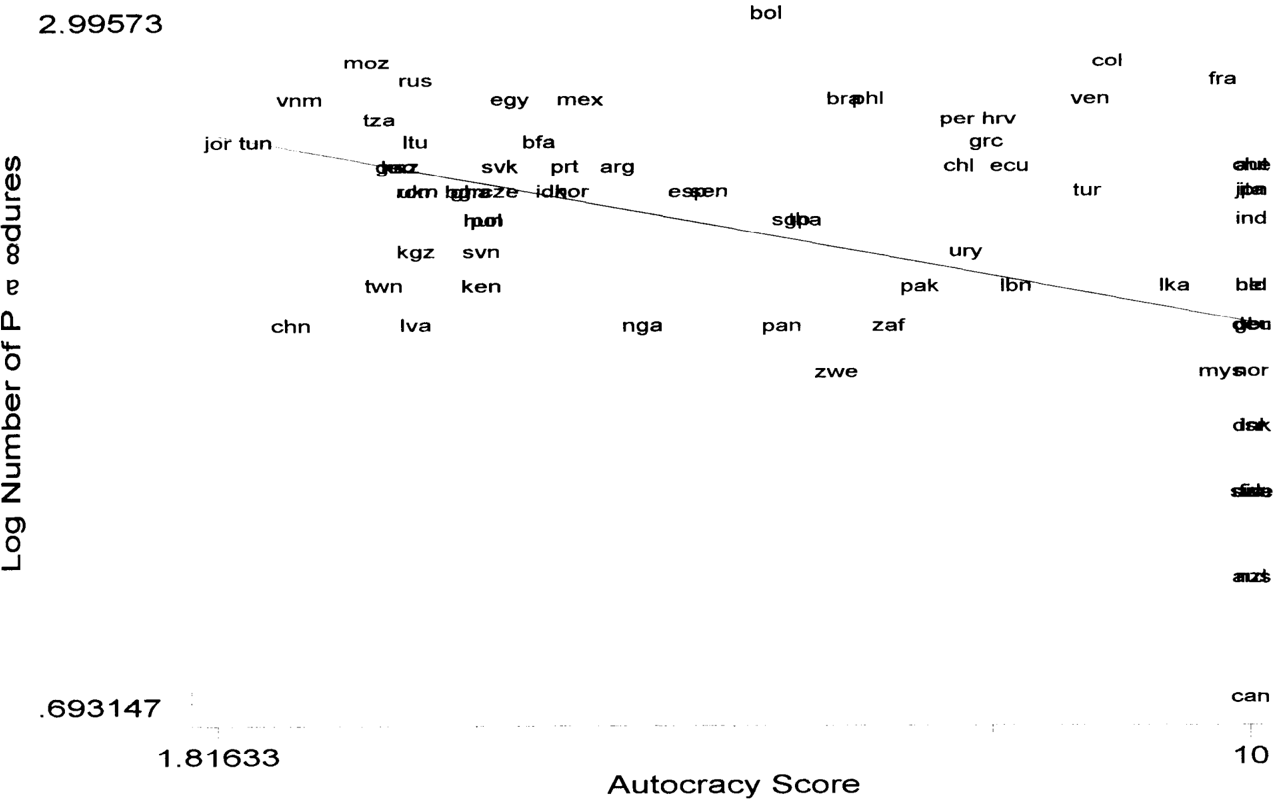
- In Table VIII, better government is associated with lighter regulation; the paper states that countries with more limited and representative governments have statistically significantly fewer procedures using 5 out of 6 measures of better government, and that more autocratic countries regulate more heavily.
Methods
- The paper builds a new database on entry regulation for 75 countries, focusing on the legal requirements, official time, and official cost for a standardized start-up firm.
- Data were gathered from written government sources, World Bank- and USAID-sponsored studies, government web pages, direct contacts with agencies, and independent double-checks in 73 countries via local consulting reports; the remaining 2 countries were double-checked through government contacts.
- The main analysis uses cross-country OLS regressions relating entry regulation measures to outcomes such as quality, pollution, unofficial economy, corruption, political institutions, legal origin, and GDP per capita; the paper also reports correlations and test-of-means comparisons across income quartiles.
Limitations
- The paper itself notes that the capture-theory tests are based on crude measures and that the data are probably least suited to test the capture hypothesis.
- The authors say the data almost surely underestimate the cost and complexity of entry because they focus on the capital city, omit industry-specific requirements and foreign-ownership steps, and ignore some informal delays and bribes.
- Evident from the text: the study is cross-sectional and based on official procedures/costs, so causal interpretation is limited and informal corruption/bureaucratic delays are not directly measured except indirectly through correlations.
Model-written summary. Check it against the paper before relying on it.
Integrity signals
Registry
Cites
Statistics
Figures
Verification
Claims the paper makes
0 Valid · 3 Not valid · 13 Not checked · 114 Own results and interpretations
A result the paper reports from its own data — it cites no other source for it, so there is none to check. The quote shows it is in the paper.
In the paper
“Very few entry regulations cover tax and labor issues.”
plain- Asserted: passes — The authors put it forward as true.
- Checkable: passes — It can be checked against evidence.
- Load-bearing: unclear — It is unclear whether the paper’s conclusions depend on it.
- Based: passes — The paper gives a reason why it holds.
In the paper
“The data show that the numbers of entry and of labor market regulations are positively correlated across countries, contrary to the substitutes hypothesis.”
What the sources say
- Not matchedcites Djankov et al., 2000
An author–year citation the paper’s reference list doesn’t settle. We don’t search these by name.
plainstates an association- Asserted: passes — The authors put it forward as true.
- Checkable: passes — It can be checked against evidence.
- Load-bearing: unclear — It is unclear whether the paper’s conclusions depend on it.
- Based: passes — The paper gives a reason why it holds.
- Not matched
A result the paper reports from its own data — it cites no other source for it, so there is none to check. The quote shows it is in the paper.
In the paper
“It often takes the form of screening procedures.”
- Also stated in: § III. Basic Results. · plain
“Instead, much of what governments do to regulate entry falls into the category of screening procedures.”
plain- Asserted: passes — The authors put it forward as true.
- Checkable: passes — It can be checked against evidence.
- Load-bearing: unclear — It is unclear whether the paper’s conclusions depend on it.
- Based: passes — The paper gives a reason why it holds.
- Also stated in: § III. Basic Results. · plain
A result the paper reports from its own data — it cites no other source for it, so there is none to check. The quote shows it is in the paper.
In the paper
“First, the cost-to-per-capita-GDP ratio decreases uniformly with GDP per capita.”
plainstates an association- Asserted: passes — The authors put it forward as true.
- Checkable: passes — It can be checked against evidence.
- Load-bearing: unclear — It is unclear whether the paper’s conclusions depend on it.
- Based: passes — The paper gives a reason why it holds.
A result the paper reports from its own data — it cites no other source for it, so there is none to check. The quote shows it is in the paper.
In the paper
“In contrast, countries in the other three quartiles of per capita income are not statistically different from each other in terms of the number of procedures and the time required to fulfill them.”
plain- Asserted: passes — The authors put it forward as true.
- Checkable: passes — It can be checked against evidence.
- Load-bearing: passes — The paper’s conclusions depend on it.
- Based: passes — The paper gives a reason why it holds.
49 more claims
Create a free account to see all 130 claims and every source verdict.
- Probably not a substantial claim. 21
- It may state two separate claims as one. 54
- The quote only partly states this claim. 26
Claims other papers make about this one
Each is checked against this paper’s own text: does it say what the citing paper says it does?
The source backs part of the claim, not all of it — or backs it for a different population, condition or comparison.
In the citing paper
“Our findings suggest an explanation for the low level of incorporation in Italy: the average direct cost associated with fulfilling the bureaucratic regulations for registering a new corporation in Italy is 20% of per capita GNP compared to 10% of per capita GNP on average for other G-7 European countries.”
From Entry regulation as a barrier to entrepreneurship (2006) · cites this paper as Djankov et al. (2002)
Experimental — accuracy not yet measuredThe cited source says what the claim attributes to it.
In the citing paper
“Given the explicit link made by Djankov et al . (2002) between the speed and ease with which businesses may be established in a country and its economic performance - and the enthusiasm with which this link has been grasped by European Union policy makers - our findings imply this link needs reconsidering.”
From The Effect of Business Regulations on Nascent and Young Business Entrepreneurship (2007) · cites this paper as Djankov et al . (2002)
Citations
Cites
La Porta, R., Lopez‐de‐Silanes, F., Shleifer, A., & Vishny, R. W. (1998) · Journal of Political Economy · doi:10.1086/250042 · Cited by 18,025
Self-citationThe Theory of Economic Regulation
Stigler, G. J. (1971) · The Bell Journal of Economics and Management Science · doi:10.2307/3003160 · Cited by 8,098
Journal of Economic Literature
(2019) · AEA Papers and Proceedings · doi:10.1257/pandp.109.633 · Cited by 7,468
The Quarterly Journal of Economics
Kuznets, S. (2024) · Business Cycle Theory, Part I Volume 4 · doi:10.4324/9781003549741-8 · Cited by 7,176
La Porta, R. (1999) · Journal of Law, Economics, and Organization · doi:10.1093/jleo/15.1.222 · Cited by 5,699 · cited 2×
“Legal origin has been viewed as a proxy for the government’s proclivity to intervene in the economy and the stance of the law toward the security of property rights in a country [La Porta et al. 1999].”
The Theory of Economic Regulation
Stigler, G. J. (2021) · The Political Economy · doi:10.4324/9781315495811-8 · Cited by 5,483
Pigou, A. C. (1933) · The Economic Journal · doi:10.2307/2224491 · Cited by 5,137
Toward a More General Theory of Regulation
Peltzman, S. (1976) · The Journal of Law and Economics · doi:10.1086/466865 · Cited by 4,729
Moffitt, R. A. (2009) · American Economic Review · doi:10.1257/aer.99.2.660 · Cited by 4,694
Shleifer, A., & Vishny, R. W. (1993) · The Quarterly Journal of Economics · doi:10.2307/2118402 · Cited by 3,778
Self-citation
Research works printed but not linked: 7
- McLiesh Caralee, 2001, NBER Working Paper No., 8288
- Kasnako lu, Zehra, and Münür Yayla, 'Unrecorded Economy in Turkey: A Monetary Approach', 1999. "Unrecorded Economy in Turkey (A Monetary Approach)" in Informal Sector in Turkey (I), Tuncer Bulutay (ed.), SIS, Ankara, forthcoming.
- Fred, 1987, Journal of Legal Studies, 101
- Olson, Mancur, 1991, 'Autocracy, Democracy, and Prosperity,' in Richard Zeckhauser, ed., Strategy of Choice, Cambridge, MA: MIT Press.
- 1967, Western Economic Journal, 232
- World Economic Forum (1999), The Global Competitiveness Report 1999 , Schwab, Klaus et al., eds., New York: Oxford University Press.
- World Economic Forum, The Global Competitiveness Report 2001, Klaus Schwab et al., eds. (New York, NY: Oxford University Press, 2001).
Cited by
Items 1,801–1,900 of 3,986
Business Regulations and Private Domestic Investment in Africa
Munemo, J. (2012) · Journal of African Business · doi:10.1080/15228916.2012.693447 · Cited by 15
Roeger, W., Varga, J., & Veld, J. I. ’. (2009) · Comparative Economic Studies · doi:10.1057/ces.2009.13 · Cited by 12
“02 Djankov et al. (2002) Final goods sector Mark-up (mup) 0.”
Decentralized Bribery and Market Participation
Popov, S. V. (2014) · Scandinavian Journal of Economics · doi:10.1111/sjoe.12081 · Cited by 13
“It includes the queue model of Lui (1985), where bribes are taken for advancing customers in a queue and actually improve allocations; Alesina and Angeletos (2005) models theft from government coffers, arguing that more redistribution does not necessarily bring more equality because of corruption; ? builds a model of…”
Market Institutions and Judicial Rulemaking
Arruñada, B., & Andonova, V. (2008) · Springer eBooks · doi:10.1007/978-3-540-69305-5_11 · Cited by 14
Patunru, A. A., McCulloch, N., & von Lübke, C. (2009) · IDS Working Papers · doi:10.1111/j.2040-0209.2009.00338_2.x · Cited by 18
Isomorphic effect and organizational bribery in transitional China
Gao, Y. (2011) · Asian Business & Management · doi:10.1057/abm.2011.6 · Cited by 13
Institutions and the Policy Process 2.0: Implications of the IAD Framework
Araral, E., & Amri, M. (2016) · Palgrave Macmillan UK eBooks · doi:10.1057/978-1-137-50494-4_5 · Cited by 23
The effects of bank regulation stringency on seasoned equity offering announcements
Liu, H., Liu, H., & Veld, C. H. (2018) · Journal of International Money and Finance · doi:10.1016/j.jimonfin.2018.11.001 · Cited by 12
Puzzling Tax Structures in Developing Countries: A Comparison of Two Alternative Explanations
Gordon, R., & Li, W. (2005) · National Bureau of Economic Research · doi:10.3386/w11661 · Cited by 12
Political Institutions, Policymaking Processes, and Policy Outcomes in MexicoPreprint
Lehoucq, F., Negretto, G. L., Aparicio, F. J., Nacif, B., & Benton, A. L. (2011) · SSRN Electronic Journal · doi:10.2139/ssrn.1815888 · Cited by 12
The Financial System Capacities in China and IndiaPreprint
Allen, F., Chakrabarti, R., De, S., Qian, J., & Qian, M. (2008) · SSRN Electronic Journal · doi:10.2139/ssrn.1260947 · Cited by 13
Expropriation Risk and Firm Growth: A Corporate Transparency ChannelPreprint
Durnev, A., & Guriev, S. M. (2011) · SSRN Electronic Journal · doi:10.2139/ssrn.1020476 · Cited by 18
Availability of Financing, Regulatory Business Costs and National Entrepreneurial PropensityPreprint
Ho, Y., & Wong, P. K. (2005) · SSRN Electronic Journal · doi:10.2139/ssrn.775485 · Cited by 10
The Quality of Law: Judicial Incentives, Legal Human Capital and the Evolution of LawPreprint
Hadfield, G. K. (2007) · SSRN Electronic Journal · doi:10.2139/ssrn.967494 · Cited by 35
“A recent exception is the legal origins literature (La Porta et al 1997, 1998, 2004, Mahoney 2001, Djankov et al 2002, 2003, Botero et al 2004), which identi es an empirical relationship between economic variables and legal families broadly identi ed as those rooted in civil law (French, German,…”
Raddatz, C. E., & Braun, M. (2009) · doi:10.1596/1813-9450-4902 · Cited by 12
Do Democracies Grow Faster? Revisiting the Institutions and Economic Performance DebatePreprint
Lim, J. J., & Decker, J. H. (2007) · RePEc: Research Papers in Economics · Cited by 12
Policy Reforms and Institutional Weaknesses: Closing the Gap
Llanto, G. M., & Gonzalez, E. T. (2007) · Econstor (Econstor) · Cited by 12
Systemic Risk, Bank Capital, and Deposit Insurance Around the WorldPreprint
Bostandzic, D., Pelster, M., & Weiß, G. N. F. (2014) · SSRN Electronic Journal · doi:10.2139/ssrn.2438693 · Cited by 12
Georgiou, M. N. (2010) · SSRN Electronic Journal · doi:10.2139/ssrn.1543976 · Cited by 12
Rei, D., & Bhattacharya, M. (2008) · RePEc: Research Papers in Economics · Cited by 32
Amin, M., & Soh, Y. C. (2020) · World Bank, Washington, DC eBooks · doi:10.1596/1813-9450-9149 · Cited by 13
“Introduction Business regulations often create opportunities for public officials to collect bribes (De Soto 1989; Shleifer and Vishny 1993; Djankov et al. 2002; Svensson 2005). If true, this simple insight provides a practical and powerful way for deregulation to combat corruption and its many harmful effects on the…”
Regulation and Technology-Driven Entry: Measurement and Micro-EvidencePreprint
Simkovic, M., & Zhang, M. B. (2018) · SSRN Electronic Journal · doi:10.2139/ssrn.3205589 · Cited by 12
Shareholder Democracy in Canada
Mørck, R. (2010) · National Bureau of Economic Research · doi:10.3386/w16558 · Cited by 12
Labour Reform in South Africa: Measuring Regulation and a Synthesis of Policy SuggestionsPreprint
Bhorat, H. I., & Cheadle, H. (2012) · SSRN Electronic Journal · doi:10.2139/ssrn.2184184 · Cited by 20
Expropriation Risk and Firm Growth: A Corporate Transparency ChannelPreprint
Durnev, A., & Guriev, S. M. (2008) · SSRN Electronic Journal · doi:10.2139/ssrn.1320966 · Cited by 12
Gate Fees: The Pervasive Effect of IPO Restrictions on Chinese Equity MarketsPreprint
Lee, C. M. C., Qu, Y., & Shen, T. (2021) · SSRN Electronic Journal · doi:10.2139/ssrn.3972870 · Cited by 12
Corruption, regulation, and investment incentives
Chiara, A. D., & Manna, E. (2022) · European Economic Review · doi:10.1016/j.euroecorev.2021.104009 · Cited by 18
Jalali, S. H. (2025) · Asia-Pacific Journal of Business Administration · doi:10.1108/apjba-11-2024-0621 · Cited by 20
Informal sector, productivity, and tax collection
Ordóñez, L., & Júlio, C. (2010) · Munich Personal RePEc Archive (Ludwig Maximilian University of Munich) · Cited by 10
The Effect of Business Regulations on Nascent and Young Business
van Stel, A. J., STOREY, D. J., & Thurik, R. (2007) · Cited by 11
A new theory of innovation and growth: the role of banking intermediation and corruption
Jalles, J. T. (2016) · Studies in Economics and Finance · doi:10.1108/sef-01-2016-0017 · Cited by 15
Productivity Dynamics and the Role of 'Big-Box' Entrants in Retailing
Maican, F. G., & Orth, M. (2012) · Journal of Industrial Economics · doi:10.1111/joie.12121 · Cited by 22
Culture and institutions. Part I
Alesina, A., & Giuliano, P. (2016) · Voprosy Ekonomiki · doi:10.32609/0042-8736-2016-10-82-111 · Cited by 17
How Institutional Development News Moves an Emerging Market
Guzmán, A., Mehrotra, V., Mørck, R., & Dávila, M. A. T. (2019) · Journal of Business Research · doi:10.1016/j.jbusres.2019.10.009 · Cited by 14
Contextualizing Technology Adoption and Self-Expression for Technology Entrepreneurial Innovation
Muralidharan, E. K., & Pathak, S. (2020) · International Journal of Innovation and Technology Management · doi:10.1142/s0219877020500261 · Cited by 13
Want more high-growth entrepreneurs? Then control corruption with less ineffective bureaucracy
Lecuna, A., Cohen, B. D., & Mandakovic, V. (2020) · Interdisciplinary Science Reviews · doi:10.1080/03080188.2020.1792128 · Cited by 18
“Contrary to van Stel, Storey, and Thurik’s (2007) findings, and consistent with Djankov et al. (2002), we posit that the number of procedures required for firm formation, which we have referred to as procedural bureaucracy, will in fact deter new firm formation.”
InfluentialCulture, democracy and regulation
Williamson, C. R. (2020) · Constitutional Political Economy · doi:10.1007/s10602-020-09319-1 · Cited by 8
Latent Exports: Almost Ideal Gravity and Zeros
Anderson, J. E., & Zhang, P. (2025) · The Review of Economics and Statistics · doi:10.1162/rest_a_01251 · Cited by 16
Do customs and other trade regulatory barriers lead firms to bribe? Evidence from Asia
Kumanayake, N. S. (2021) · Journal of International Trade & Economic Development · doi:10.1080/09638199.2021.1962391 · Cited by 11
“Corruption prones to tax the trade when there are low protectionist regulations and inversely, corruption shows trade enhancing effect when there are many regulations (Dutt and Traca 2010). Doan and Rosenow (2019) assert that during the period from 2015 to 2018, the total number of NTMs rose by approximately15% in mem…”
Why do Firms Operate Informally? Insights from a Systematic Literature Review
Pedroni, F. V., Pesce, G., & Briozzo, A. (2021) · Innovar · doi:10.15446/innovar.v32n83.99451 · Cited by 11
Political career concerns and bank lending in China
Tian, Y., Pan, X., Pang, B., & Wu, Y. (2023) · Emerging Markets Review · doi:10.1016/j.ememar.2023.101000 · Cited by 11
HTA Barriers for Conditional Approval Drugs
Mills, M. J. (2023) · PharmacoEconomics · doi:10.1007/s40273-023-01248-9 · Cited by 15
Corruption Propensity and Mitigation at Different Phases of Infrastructure Development
Ghahari, S., Queiroz, C., Labi, S., & McNeil, S. (2023) · Public Works Management & Policy · doi:10.1177/1087724x231162544 · Cited by 18
“On average, developed countries require 16 licenses, and developing countries require 20 (Djankov et al., 2002).”
Torriti, J., & Ikpe, E. (2014) · Review of World Economics · doi:10.1007/s10290-014-0200-y · Cited by 17
Business Conditions and Exit Risks Across Countries
Pflüger, M., & Russek, S. (2013) · Open Economies Review · doi:10.1007/s11079-013-9277-5 · Cited by 11
“…is more conducive to the starting and operation of a local firm; TOB time in days to open up a business and COB cost and time in % of GDP to open up a business (both provided by Djankov et al. 2002); CPI Corruption Perception Index (2009, Transparency International at www.transparency.org).”
Gouvernance du Mécanisme de supervision unique : quelques réflexions
Masciandaro, D., & Nieto, M. J. (2013) · Revue d économie financière · doi:10.3917/ecofi.112.0051 · Cited by 11
Determinants of the Informal Sector and their Effects on the Economy: The Case of Korea
Joo, D. (2011) · Global Economic Review · doi:10.1080/1226508x.2011.559326 · Cited by 10
“24%,24 the entry cost calculated by Djankov et al.[11].”
InfluentialCan capitalism restrain public perceived corruption? Some evidence
Faria, H. J., Morales, D. R., Pineda, N. M., & Montesinos-Yufa, H. M. (2012) · Journal of Institutional Economics · doi:10.1017/s1744137412000070 · Cited by 16
“Inflation volatility was used by Braun and Di Tella (2004) and entry regulations to open a new business were first used by Djankov et al. (2002).”
Do Entry Regulation and Taxes Hinder Firm Creation and Formalization? Evidence from Brazil
Rocha, R., & Ulyssea, G. (2014) · Cited by 11
Duvanova, D. (2016) · Studies in Comparative International Development · doi:10.1007/s12116-016-9224-8 · Cited by 12
Democracy’s comparative advantage: Evidence from aggregated trade data, 1962–2010
Yue, J., & Zhou, S. (2018) · World Development · doi:10.1016/j.worlddev.2018.06.018 · Cited by 13
Perceived corruption in business environment: exploring the underlying causes
Džunić, M., & Golubović, N. (2018) · E+M Ekonomie a Management · doi:10.15240/tul/001/2018-4-004 · Cited by 12
Registering for Growth: Tax and the Informal Sector in Developing Countries
Woodruff, C. (2013) · Cited by 12
The nexus of judicial efficiency, social burden and default risk: Cross-country evidence
Zhu, X., Peng, H., & Zhang, Z. (2020) · Journal of International Financial Markets Institutions and Money · doi:10.1016/j.intfin.2020.101243 · Cited by 11
International Dispersion and Profitability: An Institution-Based Approach
García-García, R., Canal, E. G., & Guillen, M. F. (2019) · Management International Review · doi:10.1007/s11575-019-00402-w · Cited by 11
What does “doing business” really measure? Evidence from trade times
Sharafeyeva, A., & Shepherd, B. (2020) · Economics Letters · doi:10.1016/j.econlet.2020.109215 · Cited by 15
The Challenges of Bankruptcy Reform
Cirmizi, E., Klapper, L. F., & Uttamchandani, M. (2010) · doi:10.1596/17113 · Cited by 11
Twentieth-Century Enterprise Forms: Japan in Comparative Perspective
Hannah, L., & Kasuya, M. (2015) · Enterprise & Society · doi:10.1017/eso.2015.51 · Cited by 11
Competition and Tax Evasion: A Cross Country Study
Wang, Y. (2012) · Economic Analysis and Policy · doi:10.1016/s0313-5926(12)50020-2 · Cited by 14
Local Laws and Venture Capital Contracting in Transition Economies: Evidence from Poland
Klonowski, D. J. (2006) · Post-Communist Economies · doi:10.1080/14631370600881929 · Cited by 11
“This is consistent with the academic literature (Djankov et al., 2002; La Porta et al., 1997, 1998) that stresses the importance of the nation’s legal system in determining the optimal deal structure and financial contracting.”
Growth Patterns and Inequality in the Presence of Costly Technology Adoption
Lahiri, R., & Ratnasiri, S. (2012) · Southern Economic Journal · doi:10.4284/0038-4038-79.1.203 · Cited by 13
To liberalize or not to liberalize: Political and economic determinants of financial liberalization
Kaya, I., Lyubimov, K., & Miletkov, M. K. (2011) · Emerging Markets Review · doi:10.1016/j.ememar.2011.10.002 · Cited by 18
Escribano, Á., Guasch, J. L., de Orte, M., et al. (2009) · The Singapore Economic Review · doi:10.1142/s0217590809003379 · Cited by 11
The ‘informal sector’ and the political economy of development
Tanaka, V. (2009) · Public Choice · doi:10.1007/s11127-009-9567-z · Cited by 14
“in support of the relevance of the political dimension that has been repeatedly brought to the fore over the years (e.g., Leys 1973; Moser 1978; de Soto 1986; Djankov et al. 2002; Auriol and Warlters 2005; and Chaudhuri et al. 2006).”
Small Businesses and the Shadow Economy
Nastav, B. (2008) · RePEc: Research Papers in Economics · Cited by 11
L'emploi informel: deux questions de politique controversées
Kučera, D., & Roncolato, L. (2008) · Revue internationale du Travail · doi:10.1111/j.1564-9121.2008.00039.x · Cited by 17
Business registration start-up : a concept note
De, L. (2005) · Cited by 11
Industrialization and the evolution of enforcement institutions
Mukoyama, T., & Popov, L. (2019) · Economic Theory · doi:10.1007/s00199-019-01183-x · Cited by 15
Liberalization and industrial performance: evidence from India and the UK
Aghion, P., & Burgess, R. (2014) · doi:10.4324/9780203946527-21 · Cited by 10
Transaction costs and economic growth under common legal system: State‐level evidence from Mexico
Spruk, R., & Kovač, M. (2019) · Economics and Politics · doi:10.1111/ecpo.12132 · Cited by 12
The effectiveness of banking supervision
Davis, E. P., & Obasi, U. (2009) · Brunel University Research Archive (BURA) (Brunel University London) · Cited by 16
What kind of ‘financial safety net’ for Russia? Russian Banking reform in comparative context
Tompson, W. J. (2004) · Post-Communist Economies · doi:10.1080/1463137042000223840 · Cited by 11
“However, Djankov et al. (2002) also conclude that countries with higher initial levels of government ownership of banks tend to experience slower growth and slower financial development.”
Enhancing Turkey's Growth Prospects by Improving Formal Sector Business Conditions
Gönenç, R., Leibfritz, W., & Yılmaz, G. (2007) · OECD Economics Department working papers · doi:10.1787/316551532607 · Cited by 11
“Djankov et al. (2002) found a strong statistical correlation between the complexity of product market regulations and the extent of corruption across countries.”
EXPLAINING THE PERFORMANCE OF FIRMS AND COUNTRIES: WHAT ROLE DOES THE BUSINESS ENVIRONMENT PLAY?Preprint
Commander, S. J., Švejnar, J., & Tinn, K. (2008) · RePEc: Research Papers in Economics · Cited by 11
Bankruptcy Reform Act of 2005 and Entrepreneurial ActivityPreprint
Paik, Y. (2010) · SSRN Electronic Journal · doi:10.2139/ssrn.1632716 · Cited by 11
Policy Compromises: Corruption and Regulation in a DemocracyPreprint
Aidt, T. S., & Dutta, J. (2005) · SSRN Electronic Journal · doi:10.2139/ssrn.774006 · Cited by 11
Popular Attitudes, Globalization, and RiskPreprint
Noland, M. (2004) · SSRN Electronic Journal · doi:10.2139/ssrn.581501 · Cited by 11
“Source: Djankov et al. (2000).”
Imports, Entry and Competition Law as Market DisciplinesPreprint
Hoekman, B. M., & Kee, H. L. (2003) · SSRN Electronic Journal · doi:10.1596/1813-9450-3031 · Cited by 11
Institutions and Development: What we (think we) know, what we would like to know *Preprint
HARE, P. G., & Davis, J. (2006) · RePEc: Research Papers in Economics · Cited by 11
Perspectives on Comparative Corporate GovernancePreprint
Aguilera, R. V., Desender, K. A., & de Castro, L. R. K. (2011) · SSRN Electronic Journal · doi:10.2139/ssrn.1797142 · Cited by 14
Finance and Society: On the Foundations of Corporate Social ResponsibilityPreprint
Hao, L., & Renneboog, L. (2014) · SSRN Electronic Journal · doi:10.2139/ssrn.2540024 · Cited by 14
“(ASDI) introduced by Djankov et al. (2008), (iv) the public enforcement index introduced by Djankov et al. (2008), and (v) the one-share one-vote index that was first introduced in LLSV (1998) and then”
Understanding multilevel interactions in economic development
Goedhuys, M., & Srholec, M. (2010) · ASEP · Cited by 13
Allocating Law-Making Powers: Self-Regulation vs. Government RegulationPreprint
Grajzl, P., & Murrell, P. (2005) · SSRN Electronic Journal · doi:10.2139/ssrn.870888 · Cited by 11
“Certainly, the transition countries have a justly deserved reputation for inefficient over-regulation (Djankov et al., 2002; Botero et al., 2004).”
Chari, A. V. (2009) · SSRN Electronic Journal · doi:10.2139/ssrn.1348231 · Cited by 11
Finding Success in Tragedy: Forced Entrepreneurs after Corporate BankruptcyPreprint
Hacamo, I., & Kleiner, K. (2016) · SSRN Electronic Journal · doi:10.2139/ssrn.2801637 · Cited by 10
Taxation and Dividend Policy: The Muting Effect of Agency Issues and Shareholder ConflictsPreprint
Jacob, M., & Michaely, R. (2014) · SSRN Electronic Journal · doi:10.2139/ssrn.2516927 · Cited by 11
The relationship between regulation and financial performance of rwanda Commercial Banks
Karemera, J. M. (2013) · Cited by 14
Environmental factors that affect the entrepreneurial intention
Sánchez, A. M. I. (2018) · Dipòsit Digital de Documents de la UAB (Universitat Autònoma de Barcelona) · Cited by 10
Dorobantu, S., Kaul, A., & Zelner, B. A. (2016) · SSRN Electronic Journal · doi:10.2139/ssrn.2798720 · Cited by 12
Gendered Laws, Informal Origins, and Subsequent Performance
Hyland, M., & Islam, A. M. (2021) · World Bank, Washington, DC eBooks · doi:10.1596/1813-9450-9766 · Cited by 12
“Similar to how firm entry can be restricted through burdensome regulations (Djankov et al., 2002), we hypothesize that burdensome and unequal regulations may restrict entry of women-owned businesses in the formal sector, pushing them into the informal economy.”
Amin, M., & Motta, V. (2021) · World Bank, Washington, DC eBooks · doi:10.1596/1813-9450-9812 · Cited by 15
Uncertainty, entrepreneurship, and the organization of corruption
Wang, Y. (2020) · Small Business Economics · doi:10.1007/s11187-020-00402-3 · Cited by 13
“Corruption increases the cost of doing business (e.g. Aghion et al. 2008; Djankov et al. 2002) and further increases the risk of businesses defaulting, since corruption tends to shift resources to bad project investment, which fosters bad loans (e.g. Beck et al. 2006).”
Regulation, competition, and the social control of business
Thomas, D. W., & Thomas, M. D. (2022) · Public Choice · doi:10.1007/s11127-022-00989-z · Cited by 11
The importance of project in underdeveloped countries
Adams, E. U. (2024) · Journal of African Studies and Development · doi:10.5897/jasd2023.0692 · Cited by 16
Business environment ecosystem and manufacturing upgrading: A configurational approach
Xue, B., Lin, Y., Ren, F., & Li, R. (2024) · Economic Analysis and Policy · doi:10.1016/j.eap.2024.05.011 · Cited by 10
The impact of climate vulnerability on new firm formation
Anton, S. G. (2024) · Business Strategy & Development · doi:10.1002/bsd2.406 · Cited by 11
Sometimes, Always, Never: Regulatory Clarity and the Development of Digital Financing
Ran, Z., Rau, P. R., & Ziegler, T. (2025) · Management Science · doi:10.1287/mnsc.2023.01538 · Cited by 14
Tax policy, corruption, and formal business entry: Cross-country evidence from emerging economies
Bilan, I., & Apostoaie, C.-M. (2025) · Economic Change and Restructuring · doi:10.1007/s10644-025-09865-4 · Cited by 16
Urbanization and land finance dependence: Insights from China
Chen, S., Tian, C., Dong, S., et al. (2025) · Economic Modelling · doi:10.1016/j.econmod.2025.107253 · Cited by 10
Startienė, G., & Remeikienė, R. (2013) · Technological and Economic Development of Economy · doi:10.3846/20294913.2012.763073 · Cited by 14
“Strict regulation of labour market Djankov 2009; Grubb, Wells 1993; Carrasco, ejrnæs 2003; Verheul et al.”
Metadata
- Authors
- Djankov, S., La Porta, R., Lopez-de-Silanes, F., & Shleifer, A.
- Affiliations
- World Bank (US)
- National Bureau of Economic Research (US)
- ORCID
- Djankov, S.
- Venue
- The Quarterly Journal of Economics
- Publisher
- Oxford University Press (OUP)
- Published
- 2002-02-01
- Volume
- 117
- Issue
- 1
- Pages
- 1-37
- ISSN
- 0033-5533
- 1531-4650
- OpenAlex
- W2139896179
- Cited by
- 3,956
- References
- 30
- Citations by year
- 2026: 223 · 2025: 185 · 2024: 157 · 2023: 120 · 2022: 140 · 2021: 150 · 2020: 151 · 2019: 161 · 2018: 157 · 2017: 162 · 2016: 166 · 2015: 193 · 2014: 200 · 2013: 183 · 2012: 193
- Type
- report
- Language
- en
- Open access
- green
- doi.org
- Licence
- other-oa
- Locations
- World Bank, Washington, DC eBooks (publishedVersion)
- The Quarterly Journal of Economics (publishedVersion)
- The World Bank Open Knowledge Repository (World Bank) (publishedVersion)
- National Bureau of Economic Research (publishedVersion, other-oa)
- RePEc: Research Papers in Economics (submittedVersion)
- Digital Access to Scholarship at Harvard (DASH) (Harvard University) (submittedVersion, cc-by)
- SSRN Electronic Journal (submittedVersion)
- OpenGrey (Institut de l'Information Scientifique et Technique) (submittedVersion)
- The World Bank Open Knowledge Repository (World Bank) (submittedVersion, cc-by)
- Topics
- Social Sciences › Sociology and Political Science › Corruption and Economic Development
- Social Sciences › Economics, Econometrics and Finance › Economics and Econometrics › Taxation and Compliance Studies
- Social Sciences › Business, Management and Accounting › Strategy and Management › Political Influence and Corporate Strategies
- Keywords
- start-up firms, bureaucratic procedures, corruption, informal economy, democracy, government size, public choice theory, public interest theory
About these checks
Registry, retraction, Cites and statistics results are computed, not judged, with one exception: a printed reference that no index lists is read once by a model before it counts as a citation error. Claims are extracted by a model and kept only when their quote appears verbatim in the text; each cited source is then checked, with a model’s help, for whether it says what the claim relies on. Those verdicts can be wrong — read the claim’s quote and the cited source before relying on one.
A language model drew the claims from the paper on 2026-10-01, under version 3 of the claim definition (model deepseek-v4.1-flash, prompt extract-v3).
A second model labelled each claim on 2026-10-01 (model jev-1.13-20260917, definition revision gold-guideline-v0.2).
Statistics and arithmetic are recomputed, not judged.
Confidence bands are shown only for fields calibrated on our annotated test set. None is calibrated yet, so no band is shown.
What counts as a claim ›How we measure confidence ›How we check this ›
Are you an author, or do you see a problem with this page? Request a review
Data sources
Bibliographic data: Semantic Scholar, OpenAlex, Crossref.
Contains information from the Semantic Scholar Academic Graph Datasets, made available under the ODC Attribution License (ODC-BY 1.0).
Semantic Scholar’s data is described in: Kinney, R., et al. (2023). The Semantic Scholar Open Data Platform. arXiv:2301.10140.
