

The Regulation of Entry
Open accessThe DOI matches its Crossref record, with a small difference in title or year; 39 of the 39 references it cites were found in a registry or an index; none of the 13 sources its claims cite is checked for support yet.
Abstract
1%(5 :25.,1* 3$3(5 6(5,(6 7+( 5(*8/$7,21 2) (175< 6LPHRQ 'MDQNRY 5DIDHO /D 3RUWD )ORUHQ.LR /RSH]GH6LODQHV $QGUHL 6KOHLIHU :RUNLQJ 3DSHU KWWSZZZQEHURUJSDSHUVZ 1$7,21$/ %85($8 2) (&2120,& 5(6($5&+ 0DVVD.KXVHWWV $YHQXH &DPEULGJH 0$ 6HSWHPEHU :H WKDQN 2OJD ,RIIH 7DWLDQD 1HQRYD DQG (NDWHULQD 7UL]ORYD IRU DEOH UHVHDU.K DVVLVWDQ.H DQG +DPLG $ODYL ,ULQD $VWUDNKDQ $EKLMLW %DQHUMHH 5L.KDUG &DYHV -D.TXHOLQH &RROLGJH -DPHV (PHU\ 1LKDO (O0DJKDUEHO -HDQ 3DXO *DXWKLHU (G *ODHVHU 6LPRQ -RKQVRQ /DZUHQ.H .DW] 3HWHU .X.HUD 'DYLG /DLEVRQ ,UD /LHEHUPDQ 'DYLQ 0D.NLQ]LH 0DULH )UDQ.RLVH 0DULH1HOO\ 0DU.HOR 2ODUUHDJD *X\ 3IHIIHUPDQQ 6DQWLDJR 6HGD.D /HLOD :HEVWHU 3HWHU :ULJKW DQG VHPLQDU SDUWL.LSDQWV DW WKH 8QLYHUVLW\ RI 0DU\ODQG DW &ROOHJH 3DUN IRU KHOSIXO .RPPHQWV 7KH .ROOH.WLRQ RI GDWD IRU WKLV SDSHU ZDV RUJDQL]HG DQG ILQDQ.HG E\ WKH :RUOG %DQN $Q DSSHQGL[ GHV
Overview
CoChat Summary
TL;DR
This paper assembles a new cross-country dataset on business entry regulation in 75 countries and uses it to compare the helping-hand, capture, and tollbooth theories of regulation. The evidence is most consistent with the tollbooth view: heavier entry regulation is associated with more corruption, a larger unofficial economy, and less representative, more autocratic governments.
Key findings
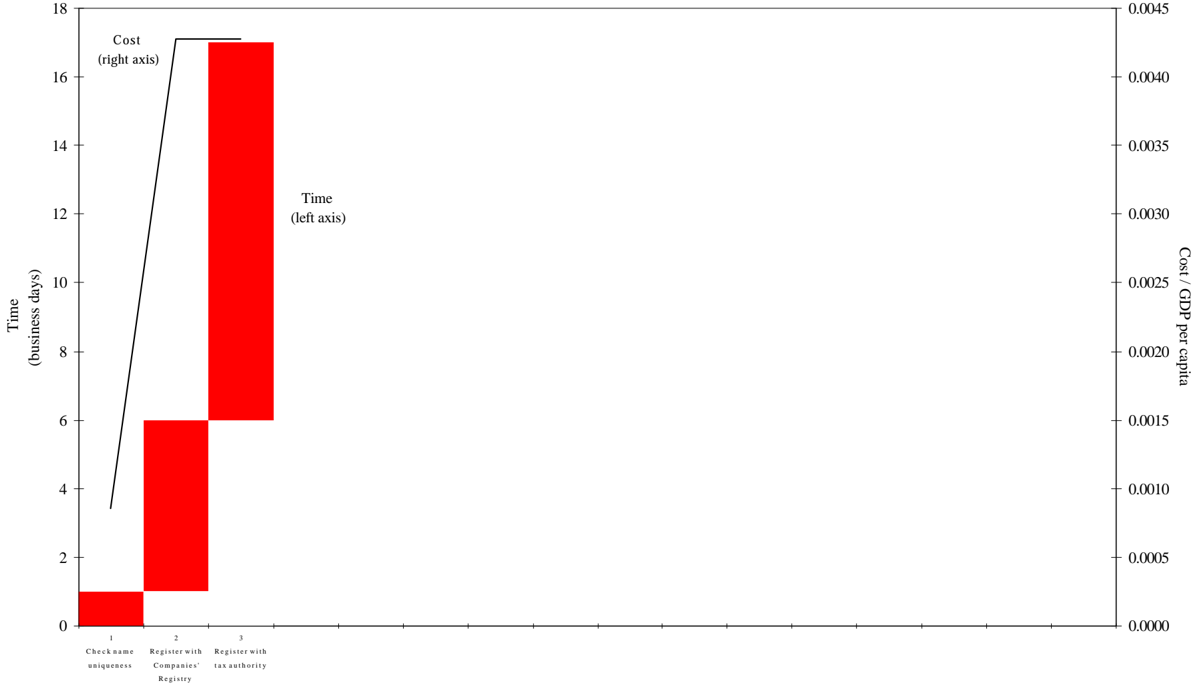
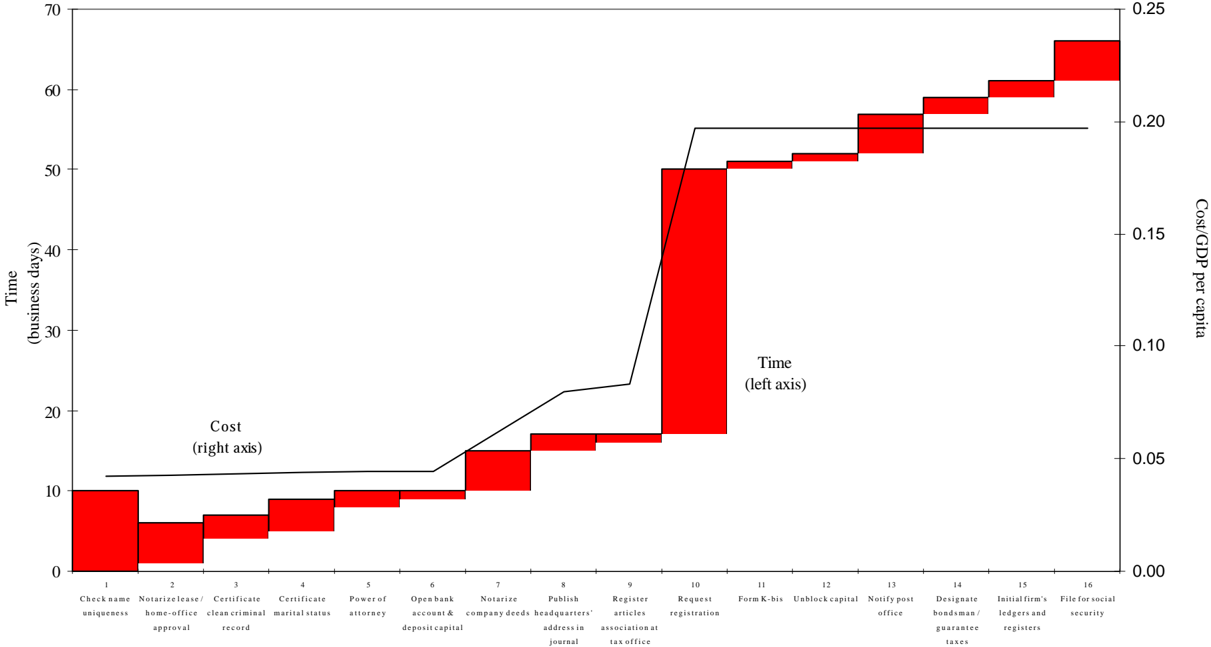
- Across the 75-country sample, the number of entry procedures ranges from 2 in Canada to 20 in Bolivia, with a sample average of 10.17 procedures; the average official time is 63.05 business days and the average cost is 0.34 of GDP per capita.
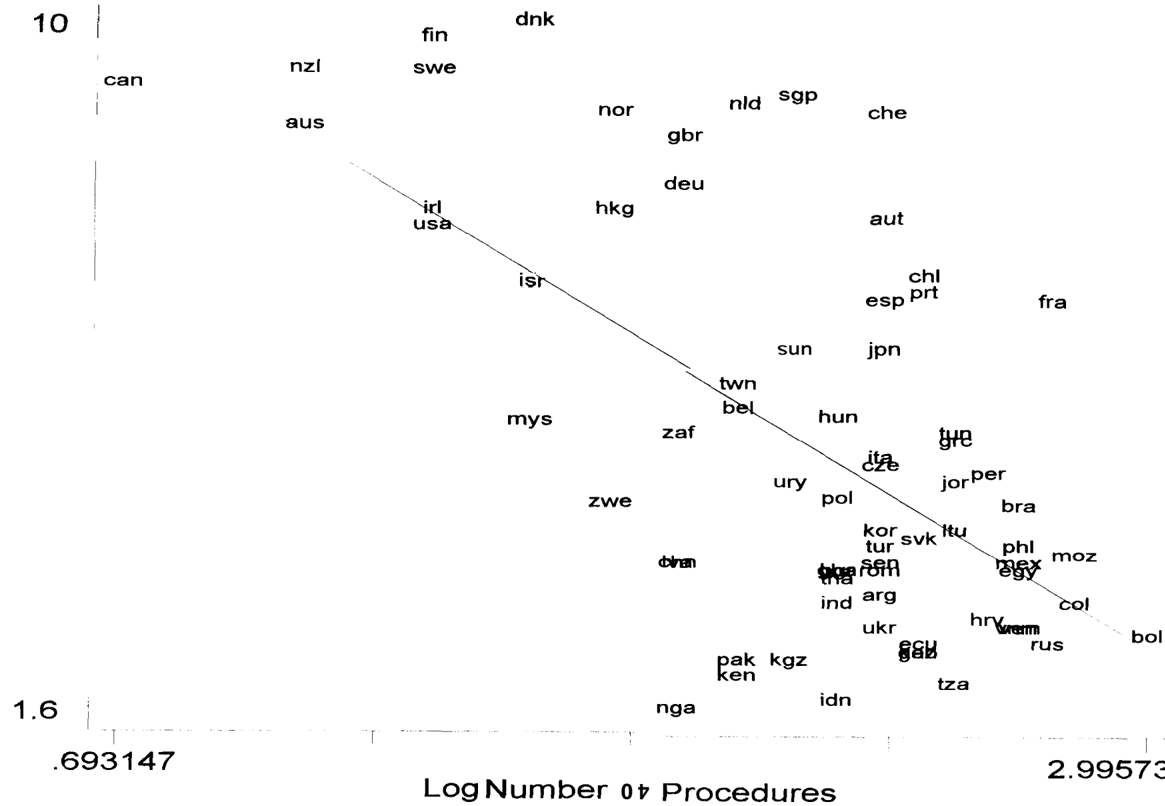
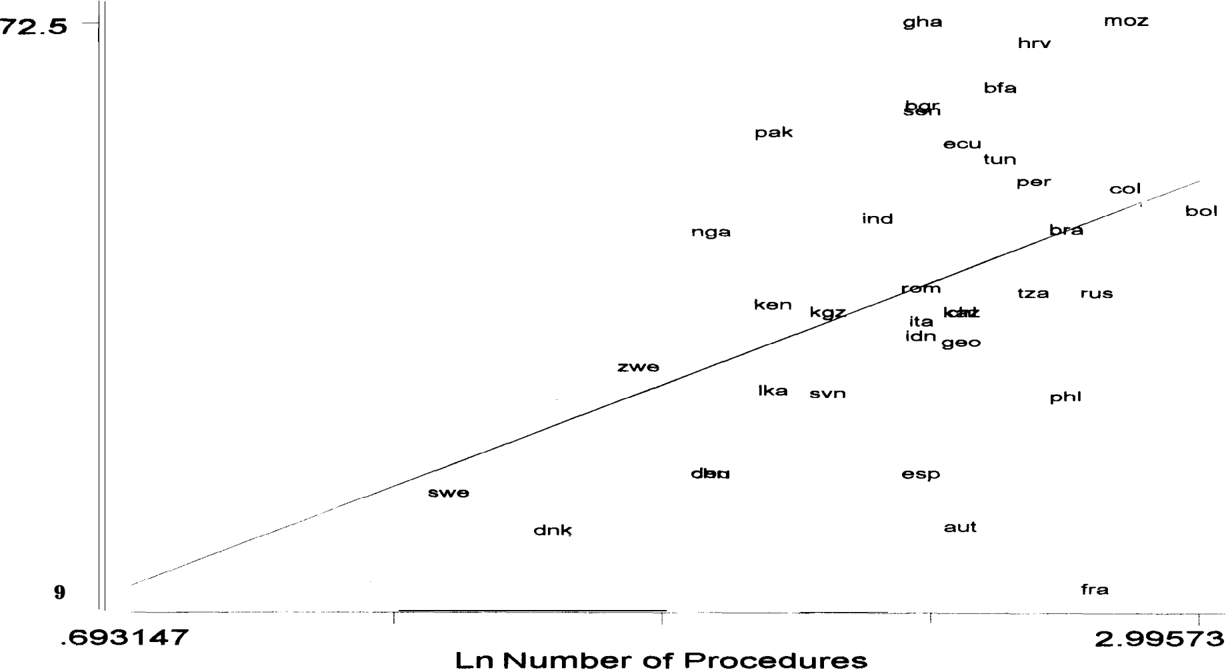
- The number of procedures is strongly correlated with time and cost: the paper reports correlations of 0.75 with log time and 0.62 with log cost.
- The helping-hand tests do not support a beneficial-regulation story: in Table IV, more procedures are associated with lower ISO quality standards (e.g. coefficient -0.2646) and larger unofficial economy measures (e.g. coefficient 13.6277 for size of unofficial economy; 19.8763 for employment in the unofficial economy), while pollution and health outcomes do not improve.
- The tollbooth evidence is stronger: Table VI reports that more procedures are associated with worse corruption scores, with a coefficient of -3.2809 (and -1.7249 with GDP per capita controls) for the corruption regressions.
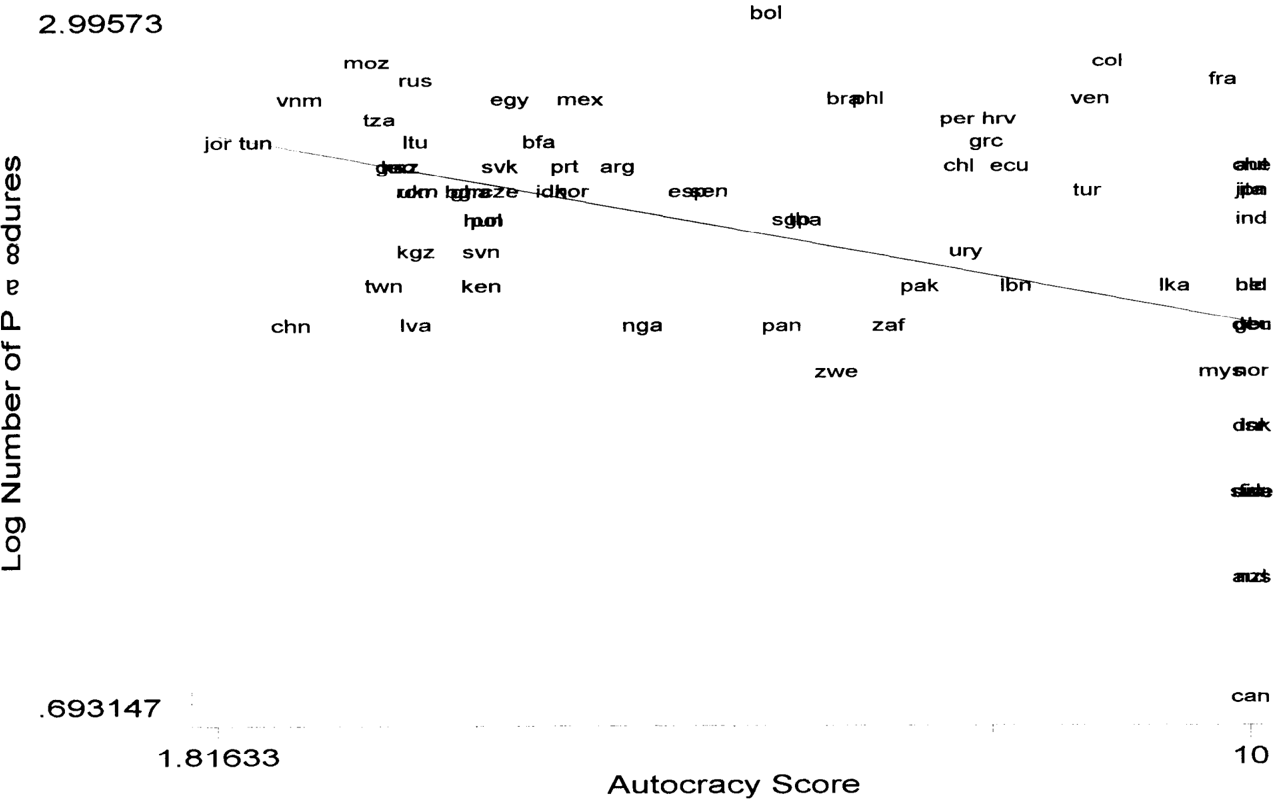
- In Table VIII, better government is associated with lighter regulation; the paper states that countries with more limited and representative governments have statistically significantly fewer procedures using 5 out of 6 measures of better government, and that more autocratic countries regulate more heavily.
Methods
- The paper builds a new database on entry regulation for 75 countries, focusing on the legal requirements, official time, and official cost for a standardized start-up firm.
- Data were gathered from written government sources, World Bank- and USAID-sponsored studies, government web pages, direct contacts with agencies, and independent double-checks in 73 countries via local consulting reports; the remaining 2 countries were double-checked through government contacts.
- The main analysis uses cross-country OLS regressions relating entry regulation measures to outcomes such as quality, pollution, unofficial economy, corruption, political institutions, legal origin, and GDP per capita; the paper also reports correlations and test-of-means comparisons across income quartiles.
Limitations
- The paper itself notes that the capture-theory tests are based on crude measures and that the data are probably least suited to test the capture hypothesis.
- The authors say the data almost surely underestimate the cost and complexity of entry because they focus on the capital city, omit industry-specific requirements and foreign-ownership steps, and ignore some informal delays and bribes.
- Evident from the text: the study is cross-sectional and based on official procedures/costs, so causal interpretation is limited and informal corruption/bureaucratic delays are not directly measured except indirectly through correlations.
Model-written summary. Check it against the paper before relying on it.
Integrity signals
Registry
Cites
Statistics
Figures
Verification
Claims the paper makes
0 Valid · 3 Not valid · 13 Not checked · 114 Own results and interpretations
A result the paper reports from its own data — it cites no other source for it, so there is none to check. The quote shows it is in the paper.
In the paper
“Very few entry regulations cover tax and labor issues.”
plain- Asserted: passes — The authors put it forward as true.
- Checkable: passes — It can be checked against evidence.
- Load-bearing: unclear — It is unclear whether the paper’s conclusions depend on it.
- Based: passes — The paper gives a reason why it holds.
In the paper
“The data show that the numbers of entry and of labor market regulations are positively correlated across countries, contrary to the substitutes hypothesis.”
What the sources say
- Not matchedcites Djankov et al., 2000
An author–year citation the paper’s reference list doesn’t settle. We don’t search these by name.
plainstates an association- Asserted: passes — The authors put it forward as true.
- Checkable: passes — It can be checked against evidence.
- Load-bearing: unclear — It is unclear whether the paper’s conclusions depend on it.
- Based: passes — The paper gives a reason why it holds.
- Not matched
A result the paper reports from its own data — it cites no other source for it, so there is none to check. The quote shows it is in the paper.
In the paper
“It often takes the form of screening procedures.”
- Also stated in: § III. Basic Results. · plain
“Instead, much of what governments do to regulate entry falls into the category of screening procedures.”
plain- Asserted: passes — The authors put it forward as true.
- Checkable: passes — It can be checked against evidence.
- Load-bearing: unclear — It is unclear whether the paper’s conclusions depend on it.
- Based: passes — The paper gives a reason why it holds.
- Also stated in: § III. Basic Results. · plain
A result the paper reports from its own data — it cites no other source for it, so there is none to check. The quote shows it is in the paper.
In the paper
“First, the cost-to-per-capita-GDP ratio decreases uniformly with GDP per capita.”
plainstates an association- Asserted: passes — The authors put it forward as true.
- Checkable: passes — It can be checked against evidence.
- Load-bearing: unclear — It is unclear whether the paper’s conclusions depend on it.
- Based: passes — The paper gives a reason why it holds.
A result the paper reports from its own data — it cites no other source for it, so there is none to check. The quote shows it is in the paper.
In the paper
“In contrast, countries in the other three quartiles of per capita income are not statistically different from each other in terms of the number of procedures and the time required to fulfill them.”
plain- Asserted: passes — The authors put it forward as true.
- Checkable: passes — It can be checked against evidence.
- Load-bearing: passes — The paper’s conclusions depend on it.
- Based: passes — The paper gives a reason why it holds.
49 more claims
Create a free account to see all 130 claims and every source verdict.
- Probably not a substantial claim. 21
- It may state two separate claims as one. 54
- The quote only partly states this claim. 26
Claims other papers make about this one
Each is checked against this paper’s own text: does it say what the citing paper says it does?
The source backs part of the claim, not all of it — or backs it for a different population, condition or comparison.
In the citing paper
“Our findings suggest an explanation for the low level of incorporation in Italy: the average direct cost associated with fulfilling the bureaucratic regulations for registering a new corporation in Italy is 20% of per capita GNP compared to 10% of per capita GNP on average for other G-7 European countries.”
From Entry regulation as a barrier to entrepreneurship (2006) · cites this paper as Djankov et al. (2002)
Experimental — accuracy not yet measuredThe cited source says what the claim attributes to it.
In the citing paper
“Given the explicit link made by Djankov et al . (2002) between the speed and ease with which businesses may be established in a country and its economic performance - and the enthusiasm with which this link has been grasped by European Union policy makers - our findings imply this link needs reconsidering.”
From The Effect of Business Regulations on Nascent and Young Business Entrepreneurship (2007) · cites this paper as Djankov et al . (2002)
Citations
Cites
La Porta, R., Lopez‐de‐Silanes, F., Shleifer, A., & Vishny, R. W. (1998) · Journal of Political Economy · doi:10.1086/250042 · Cited by 18,025
Self-citationThe Theory of Economic Regulation
Stigler, G. J. (1971) · The Bell Journal of Economics and Management Science · doi:10.2307/3003160 · Cited by 8,098
Journal of Economic Literature
(2019) · AEA Papers and Proceedings · doi:10.1257/pandp.109.633 · Cited by 7,468
The Quarterly Journal of Economics
Kuznets, S. (2024) · Business Cycle Theory, Part I Volume 4 · doi:10.4324/9781003549741-8 · Cited by 7,176
La Porta, R. (1999) · Journal of Law, Economics, and Organization · doi:10.1093/jleo/15.1.222 · Cited by 5,699 · cited 2×
“Legal origin has been viewed as a proxy for the government’s proclivity to intervene in the economy and the stance of the law toward the security of property rights in a country [La Porta et al. 1999].”
The Theory of Economic Regulation
Stigler, G. J. (2021) · The Political Economy · doi:10.4324/9781315495811-8 · Cited by 5,483
Pigou, A. C. (1933) · The Economic Journal · doi:10.2307/2224491 · Cited by 5,137
Toward a More General Theory of Regulation
Peltzman, S. (1976) · The Journal of Law and Economics · doi:10.1086/466865 · Cited by 4,729
Moffitt, R. A. (2009) · American Economic Review · doi:10.1257/aer.99.2.660 · Cited by 4,694
Shleifer, A., & Vishny, R. W. (1993) · The Quarterly Journal of Economics · doi:10.2307/2118402 · Cited by 3,778
Self-citation
Research works printed but not linked: 7
- McLiesh Caralee, 2001, NBER Working Paper No., 8288
- Kasnako lu, Zehra, and Münür Yayla, 'Unrecorded Economy in Turkey: A Monetary Approach', 1999. "Unrecorded Economy in Turkey (A Monetary Approach)" in Informal Sector in Turkey (I), Tuncer Bulutay (ed.), SIS, Ankara, forthcoming.
- Fred, 1987, Journal of Legal Studies, 101
- Olson, Mancur, 1991, 'Autocracy, Democracy, and Prosperity,' in Richard Zeckhauser, ed., Strategy of Choice, Cambridge, MA: MIT Press.
- 1967, Western Economic Journal, 232
- World Economic Forum (1999), The Global Competitiveness Report 1999 , Schwab, Klaus et al., eds., New York: Oxford University Press.
- World Economic Forum, The Global Competitiveness Report 2001, Klaus Schwab et al., eds. (New York, NY: Oxford University Press, 2001).
Cited by
Items 1,901–2,000 of 3,986
The Burden of Water Shortages on Informal Firms
Islam, A. M. (2019) · Land Economics · doi:10.3368/le.95.1.91 · Cited by 10
The War on Corruption: The Role of Electronic Government
Martins, J., Fernandes, B., Rohman, I. K., & Veiga, L. G. (2018) · Lecture notes in computer science · doi:10.1007/978-3-319-98690-6_9 · Cited by 15
Who Is Inclined to Hide the Truth: Evidence from Public Procurement
Yakovlev, A. A., Tkachenko, A., & Rodionova, Y. D. (2019) · International Journal of Public Administration · doi:10.1080/01900692.2019.1665683 · Cited by 10
“However, developing markets are characterized by excessive and contradictory regulation, pushing economic actors to the shadow sector on a mass scale (De Soto, 1989; Djankov, La Porta, Lopez-de-Silanes, & Shleifer, 2002).”
Nguyen, C. P., Schınckus, C., Su, T. D., & Chong, F. H. L. (2020) · International Journal of Finance & Economics · doi:10.1002/ijfe.2382 · Cited by 17
Ownership, Enforcement, and the Effects of Business Environment
Qiang, C. Z., Wang, H., & Xu, L. (2021) · Journal of Government and Economics · doi:10.1016/j.jge.2021.100007 · Cited by 14
Vacation rental market regulation and accommodation supply growth
Boto‐García, D., Baños-Pino, J. F., Tuero, E. A. D. V., & Sustacha, I. (2022) · Tourism Economics · doi:10.1177/13548166221110530 · Cited by 13
Corruption and the Burden of Regulation: National, Regional, and Firm-Level Evidence
Breen, M., & Gillanders, R. (2022) · Public Finance Review · doi:10.1177/10911421221114203 · Cited by 12
“…fi ndings lend support to previous work which argues that misgover-nance is partly responsible for low-quality regulation (Breen and Gillanders 2012; Djankov et al. 2002; Guriev 2004; ), as well as a large body of research that fi nds that corruption has a negative impact on many social and…”
InfluentialForeign direct investment and domestic entrepreneurship: insights from Asia
Luu, T. D. (2022) · International Journal of Development Issues · doi:10.1108/ijdi-07-2022-0142 · Cited by 11
Deregulation and green innovation: Does cultural reform pilot project matter
Zhu, C. W., Xia, Y., Liu, Q., & Hou, B. (2023) · Economic Analysis and Policy · doi:10.1016/j.eap.2023.02.003 · Cited by 10
Effects on the Economic and Sustainable Development and on the Poverty and Social Inequality
Remeikienė, R., & Gasparėnienė, L. (2023) · Contributions to finance and accounting · doi:10.1007/978-3-031-34082-6_9 · Cited by 23
Religiosity and financial development in Africa: evidence from panel quantile regression
Kwatia, B. O., Amewu, G., & Armah, M. (2024) · Cogent Business & Management · doi:10.1080/23311975.2024.2315313 · Cited by 13
“This is expected to facilitate financial sector development (Beck et al., 2007; Djankov et al., 2002; Fisman & Khanna, 2004).”
The Selective Enforcement of Government Regulation: Battleground States and the EPA
Gulen, H., & Myers, B. W. (2017) · The Journal of Law and Economics · doi:10.1086/728369 · Cited by 15
“…regulation can affect industry concentration, economic growth, and employment (see Gray 1987; Jayaratne and Strahan 1996; Bertrand and Kramarz 2002; Djankov et al. 2002; Botero et al. 2004; Atkeson, Hellwig, and Ordoñez 2015) and that regulation is more likely to be relaxed when potential…”
Quantifying uncertainty in ranking problems with composite indicators: a Bayesian approach
Zampetakis, L. A., & Moustakis, V. S. (2010) · Journal of Modelling in Management · doi:10.1108/17465661011026176 · Cited by 11
Do exchange rate regimes affect the role of central banks as banking supervisors?
Pellegrina, L. D., Masciandaro, D., & Pansini, R. V. (2012) · European Journal of Law and Economics · doi:10.1007/s10657-012-9317-4 · Cited by 9
Examining the effects of doing business on Iran and MENA countries’ economic growth
Fatemeh, M., Basirat, M., & Abdollahi, F. (2016) · International Journal of Islamic and Middle Eastern Finance and Management · doi:10.1108/imefm-07-2014-0066 · Cited by 10
Market Reforms at the Zero Lower Bound
Cacciatore, M., Duval, R., Fiori, G., & Ghironi, F. P. (2021) · Journal of money credit and banking · doi:10.1111/jmcb.12773 · Cited by 10
“We assume that Zt and Z∗ t follow a bivariate AR(1) process in logs, with Home (Foreign) productivity subject to innovations Zt ( Zt).”
InfluentialLes motivations et logiques de l’informalisation des entreprises formelles
Abaté, A. M. (2018) · Revue Congolaise de Gestion · doi:10.3917/rcg.025.0011 · Cited by 20
“Ainsi, les entrepreneurs du secteur informel ont recours à la corruption de l’administration publique pour échapper aux réglementations administratives (Djankov et al., 2002).”
Legal family, cultural dimensions, and FDI
Steigner, T., Riedy, M. K., & Bauman, A. (2019) · International Journal of Managerial Finance · doi:10.1108/ijmf-09-2017-0205 · Cited by 12
Regulation and corruption: claims, evidence and explanations
Dunlop, C. A., & Radaelli, C. M. (2019) · Edward Elgar Publishing eBooks · doi:10.4337/9781788117258.00012 · Cited by 14
“Djankov et al. (2002) help finesse the argument that some types of red tape are more detrimental than others.”
Urbano, D., Aparicio, S., & Audretsch, D. B. (2019) · International studies in entrepreneurship · doi:10.1007/978-3-030-13373-3_2 · Cited by 14
Choudhury, S. (2019) · European Journal of Political Economy · doi:10.1016/j.ejpoleco.2019.07.004 · Cited by 10
Tian, L., Yang, J. Y., & Li, J. (2019) · Asia Pacific Journal of Management · doi:10.1007/s10490-019-09673-1 · Cited by 13
Kaya, D., & Seebeck, A. (2019) · Journal of Accounting & Organizational Change · doi:10.1108/jaoc-03-2018-0023 · Cited by 11
Cronyism as an outcome of institutional settings: the case of pre-2011 Egypt
Sabry, M. I. (2020) · International Journal of Sociology and Social Policy · doi:10.1108/ijssp-08-2019-0153 · Cited by 10
Opting for Exit: Informalization, Social Policy Discontent, and Lack of Good Governance
Berens, S. (2020) · Latin American Politics and Society · doi:10.1017/lap.2019.58 · Cited by 28
“To reduce the informal sector, it is important to reform the rules and regulations that are certainly decisive barriers to the formal labor market (De Soto 1989; Loayza 1996; Johnson et al. 1998; Djankov et al. 2002).”
The doing business ranking and the design of public policies: the effect of regional dynamics
Estêvão, J., Lopes, J. D., & Penela, D. (2020) · Economic Research-Ekonomska Istraživanja · doi:10.1080/1331677x.2020.1831942 · Cited by 13
“Some examples of these works include (Djankov et al., 2002, 2008; Djankov et al., 2003; Djankov et al., 2007; Djankov et al., 2008; Djankov et al., 2010b; Djankov et al., 2010a).”
Mapping the (anti-)corruption field: key topics and changing trends, 1968–2020
Alvarez, J. P., & Sanz, I. P. (2021) · Journal of Computational Social Science · doi:10.1007/s42001-021-00110-2 · Cited by 22
Markatou, M. (2015) · Procedia - Social and Behavioral Sciences · doi:10.1016/j.sbspro.2015.06.157 · Cited by 10
Determinants of Employment Growth at MNEs: Evidence from Egypt, India, South Africa and Vietnam
Bhaumik, S. K., Estrin, S., & Meyer, K. E. (2007) · Comparative Economic Studies · doi:10.1057/palgrave.ces.8100161 · Cited by 15
Anti-Corruption in Regulation – A Safeguard for Infrastructure Reforms
Boehm, F. (2009) · Competition and Regulation in Network Industries · doi:10.1177/178359170901000103 · Cited by 11
“But if there is an informational advantage together with discretion on one side, this advantage can be abused and another path is followed by so-called tollbooth theories, e.g. shleifer and Vishny (1994), or Djankov et al (2002).”
Exclusive Goods and Formal-Sector Employment
Foellmi, R., & Zweimüller, J. (2011) · American Economic Journal Macroeconomics · doi:10.1257/mac.3.1.242 · Cited by 11
Capacity, not constraints: A theory of North-South regulatory cooperation
Marcoux, C., & Urpelainen, J. (2012) · The Review of International Organizations · doi:10.1007/s11558-012-9142-0 · Cited by 11
Niche firms, mass markets, and income across countries: Accounting for the impact of entry costs
Bento, P. (2014) · Journal of Economic Dynamics and Control · doi:10.1016/j.jedc.2014.09.009 · Cited by 12
“All firms (7)For example, Guner et al. (2008), Restuccia and Rogerson (2008), and Hsieh and Klenow (2009). (8)At the end of this section, I discuss the implications of allowing for both heterogeneous firms and fixed operating costs.”
Causes and Consequences of Firm Disclosures of Anticorruption Efforts
Healy, P. M., & Serafeim, G. (2012) · Cited by 14
Deconstructing Corruption: A Study of Cash for Favours in Rural India
Borooah, V. K. (2016) · Journal of South Asian Development · doi:10.1177/0973174115624773 · Cited by 11
Explaining changes in the US credit card market: Lenders are using more information
Davis, A., & Kim, J. (2016) · Economic Modelling · doi:10.1016/j.econmod.2016.11.025 · Cited by 11
Regulation and rent‐seeking: The role of the distribution of political and economic power
del Río, F., & Lores, F. (2017) · Journal of Public Economic Theory · doi:10.1111/jpet.12231 · Cited by 15
Regulation, competition, and economic growth: A resource-advantage theory perspective
Friske, W., & Zachary, M. A. (2017) · Journal of Research in Marketing and Entrepreneurship · doi:10.1108/jrme-04-2016-0010 · Cited by 13
Estimating the impact of country‐level policy restrictions on services trade
Gervais, A. (2017) · Review of International Economics · doi:10.1111/roie.12340 · Cited by 19
Drivers of Informal Sector Participation of Small and Medium Enterprise in Ghana
Mintah, S., & Darkwah, S. A. (2018) · Scientia Agriculturae Bohemica · doi:10.2478/sab-2018-0010 · Cited by 10
The role of institutions and immigrant networks in firms’ offshoring decisions
Moriconi, S., Peri, G., & Pozzoli, D. (2020) · Canadian Journal of Economics/Revue canadienne d économique · doi:10.1111/caje.12470 · Cited by 12
“The first is the Doing Business database compiled by the World Bank (see Djankov et al., 2002), which is a crosscountry database with information on regulations in over 160 countries for the 2006-2012 period.”
InfluentialBrexit and Corporate Citizenship
Armour, J. H., Fleischer, H., Knapp, V. J., et al. (2017) · European Business Organization Law Review · doi:10.1007/s40804-017-0072-4 · Cited by 10
Competition and labor productivity in India's retail stores
Amin, M. (2015) · Journal of Asian Economics · doi:10.1016/j.asieco.2015.10.003 · Cited by 11
“bread) and they also happen to be more competitive for extraneous reasons? We address this identification problem by showing that our main results hold with and without store-type fixed effects as controls.(13) The assumption here is that product lines carried by stores of a particular store-type (e.”
Institutional framing and entrepreneurship capital in Uganda
Ntayi, J. M., Mutebi, H., Byangwa, K., & Kamanyi, S. G. (2014) · World Journal of Entrepreneurship Management and Sustainable Development · doi:10.1108/wjemsd-07-2013-0037 · Cited by 12
The relationship between institutional quality and trade in Pacific Island countries
Gani, A., & Prasad, B. C. (2008) · Journal of International Trade Law and Policy · doi:10.1108/14770020810927327 · Cited by 26
Productivity and Economic Growth: The Case of Chile
Beyer, H. O., & Vergara, R. (2001) · Americanae (AECID Library) · Cited by 10
Licit and Illicit Responses to Regulation
Benham, L. (2005) · Springer eBooks · doi:10.1007/0-387-25092-1_24 · Cited by 10
On the Effect of the Costs of Operating Formally: New Experimental EvidencePreprint
Galiani, S., Meléndez, M., & Ahumada, C. N. (2015) · SSRN Electronic Journal · doi:10.2139/ssrn.2617874 · Cited by 10
Honda, K. (2012) · Institutional Repositories DataBase (IRDB) · doi:10.20561/00037828 · Cited by 10
Lee, S., Yasuhiro Yamakawa, B., & Peng, M. W. (2008) · RePEc: Research Papers in Economics · Cited by 8
Entrepreneurship in Emerging Markets: Which Institutions Matter?Preprint
Aidis, R., Estrin, S., & Mickiewicz, T. M. (2007) · RePEc: Research Papers in Economics · Cited by 10
Finance, Technology and Inequality in Economic DevelopmentPreprint
Horii, R., Ohdoi, R., & Yamamoto, K. (2005) · SSRN Electronic Journal · doi:10.2139/ssrn.702884 · Cited by 11
“Djankov et al. (2002) reports that the official cost of following the 33Note that the threshold level of λ, given by Λ(wt; I) in (25), gets larger when IA is smaller.”
The Wealth of Regions: Government Quality and Entrepreneurship in EuropePreprint
Charron, N., Lapuente, V., & Nistotskaya, M. (2012) · SSRN Electronic Journal · doi:10.2139/ssrn.2173256 · Cited by 12
Manufacturing Firms in Africa: Some Stylized Facts About Wages and ProductivityPreprint
Clarke, G. R. G. (2012) · SSRN Electronic Journal · doi:10.2139/ssrn.1989681 · Cited by 10
Rule of Law, Legal Development and Economic Growth: Perspectives for PakistanPreprint
Hasan, L. (2010) · SSRN Electronic Journal · doi:10.2139/ssrn.1685132 · Cited by 20
How Petty is Petty Corruption? Evidence from Firm Surveys in AfricaPreprint
Clarke, G. R. G. (2008) · SSRN Electronic Journal · doi:10.2139/ssrn.1117631 · Cited by 10
Microfinance and Female EmpowermentPreprint
Dessy, S., & Ewoudou, J. (2006) · SSRN Electronic Journal · doi:10.2139/ssrn.881766 · Cited by 10
“Djankov et al. (2002) also provide evidence that countries with heavier regulation of entry have larger informal sectors.”
Does employment protection inhibit technology diffusion
Samaniego, R. M. (2001) · Scholarly Commons (University of Pennsylvania) · Cited by 9
From nascent to actual entrepreneurship: the effect of entry barriersPreprint
van Stel, A. J., Thurik, R., Wennekers, S., & Storey, D. (2006) · RePEc: Research Papers in Economics · Cited by 12
The policy development process and the agenda for effective institutions in the Philippines
Llanto, G. M. (2009) · Econstor (Econstor) · doi:10.4324/9780203874004-14 · Cited by 10
Experimenting with Entrepreneurship: The Effect of Job-Protected LeavePreprint
Gottlieb, J. D., TOWNSEND, R. R., & Xu, T. (2016) · SSRN Electronic Journal · doi:10.2139/ssrn.2714577 · Cited by 10
State Ownership and Corporate Cash Holdings: Evidence from PrivatizationPreprint
Chen, R., Ghoul, S. E., Guedhami, O., & Nash, R. C. (2015) · SSRN Electronic Journal · Cited by 9
Sometimes, Always, Never: Regulatory Clarity and the Development of Digital FinancingPreprint
Ran, Z., Rau, P. R., & Ziegler, T. (2024) · SSRN Electronic Journal · doi:10.2139/ssrn.4863607 · Cited by 10
Entrepreneurship and TransitionPreprint
Chilosi, A. (2001) · SSRN Electronic Journal · doi:10.2139/ssrn.292616 · Cited by 10
Remittance flows and informal economies in post‐Soviet transition countries
Kakhkharov, J., & Rohde, N. (2023) · World Economy · doi:10.1111/twec.13375 · Cited by 9
Pradhan, R. P., Arvin, M. B., Nair, M. S., Bennett, S. E., & Brem, A. (2023) · International Journal of Innovation and Technology Management · doi:10.1142/s0219877024500111 · Cited by 15
Anton, S. G. (2024) · Journal of Business Economics and Management · doi:10.3846/jbem.2024.21113 · Cited by 12
“This finding is consistent with previous results reported by Djankov et al. (2002) and Cordier and Bade (2022).”
Drake, S., Lundberg, J., & Lundberg, S. (2024) · Journal of Environmental Management · doi:10.1016/j.jenvman.2024.121547 · Cited by 18
Haddad, C., & Verriest, A. (2024) · International Business Review · doi:10.1016/j.ibusrev.2024.102344 · Cited by 14
Flying safe: The impact of corporate governance on aviation safety
Khadivar, H., Fardnia, P., & Walker, T. (2025) · Journal of Air Transport Management · doi:10.1016/j.jairtraman.2025.102743 · Cited by 14
Peprah, A. A., Atarah, B. A., Adegbile, A., & Liedong, T. A. (2025) · International Small Business Journal Researching Entrepreneurship · doi:10.1177/02662426251338595 · Cited by 10
“…Armour and Cumming, 2006), rule of law (Richter, 2008; Webb et al., 2009) and high governance quality (Autio and Fu, 2015; Baumol, 1990; Estrin et al., 2013) for strengthening property rights (De Soto, 2000; Harper, 2013) and reducing transaction costs (Djankov et al., 2002; Puffer et al., 2010).”
Conceptual Analysis of Determinants of Entrepreneurship: A South African Perspective
Muhanna, E. (2007) · DOAJ (DOAJ: Directory of Open Access Journals) · Cited by 18
Political influence and banking performance: Evidence from the African countries
Damette, O., & Kouki, I. (2022) · The Quarterly Review of Economics and Finance · doi:10.1016/j.qref.2022.01.011 · Cited by 13
Does the economic freedom hinder the underground economy? Evidence from a cross-country analysis
D’Agostino, E., Benedetto, M. A. D., & Sobbrio, G. (2022) · Economia Politica · doi:10.1007/s40888-022-00288-2 · Cited by 9
“Accordingly, Djankov et al. (2002) find evidence that reducing the economic freedom, intended as a stricter entry regulation, increases both corruption and shadow economy.”
BackgroundHasayotin, K., Setthaji, R., Ratchatakulpat, T., Naburana, W., & Supanut, A. (2024) · Revista de Gestão Social e Ambiental · doi:10.24857/rgsa.v18n7-070 · Cited by 18
Financial system, R&D intensity and comparative advantage
Gür, N., & Avşar, V. (2015) · Journal of International Trade & Economic Development · doi:10.1080/09638199.2015.1045928 · Cited by 11
“As a measure for the regulation of entry, we use data from Djankov et al. (2002).”
Public Choice: A Critical Reassessment
Leight, J. (2009) · Cambridge University Press eBooks · doi:10.1017/cbo9780511657504.008 · Cited by 14
Associations versus registration as alternative strategies of small firms
Sukiassyan, G., & Nugent, J. B. (2008) · Small Business Economics · doi:10.1007/s11187-007-9085-7 · Cited by 9
“Djankov et al. (2003) examine the determinants of formality in judicial procedures and the effects thereof on contractual enforcement.”
InfluentialWho walks out? Entrepreneurship in a global economy
Couyoumdjian, J. R. (2011) · International Review of Law and Economics · doi:10.1016/j.irle.2011.12.001 · Cited by 13
Caucutt, E. M., & Kumar, K. B. (2008) · The B E Journal of Macroeconomics · doi:10.2202/1935-1690.1761 · Cited by 10
“3% in the prosperous Botswana even within sSA, could also be potentially identified with these fixed costs.(21) The huge costs seen for sSA imply that only the stagnation”
Economic Growth through the Development Process
Zilibotti, F. (2008) · CESifo Economic Studies · doi:10.1093/cesifo/ifn020 · Cited by 11
“[14] Djankov, Simeon, Rafael La Porta, Florencio Lopez-de-Silanes, and Andrei Shleifer (2002), “The Regulation of Entry,” Quarterly Journal of Economics, 117, 1-38.”
Public Finance and Economic Development: Reflections based on Experience in China
Gordon, R. (2010) · Journal of Globalization and Development · doi:10.2202/1948-1837.1024 · Cited by 16
Bypassing weak institutions in a large late-comer economy
Bessonova, E. V., & Romanovna, G. K. (2015) · Journal of Institutional Economics · doi:10.1017/s1744137415000041 · Cited by 14
What Do Managers Mean When They Say ‘Firms Like Theirs’ Pay Bribes?
Clarke, G. R. G. (2012) · International Journal of Economics and Finance · doi:10.5539/ijef.v4n10p161 · Cited by 10
Zhou, Y. (2007) · Cited by 9
Unreported Trade Flows and Gravity Equation Estimation
Baranga, T. (2009) · Cited by 9
A Note on Commodity Taxation and Economic Growth
Konishi, K. (2013) · RePEc: Research Papers in Economics · Cited by 9
Financial Sanctions: Consequencesfor Russia’s Economy and Economic Policy
Orlova, N. (2014) · Voprosy Ekonomiki · doi:10.32609/0042-8736-2014-12-54-66 · Cited by 9
Role of SMEs in Lebanese Economy
Farran, I., & Fawaz, M. (2018) · Journal of Economics and Management Sciences · doi:10.30560/jems.v1n2p78 · Cited by 11
Godlewska, M., & Pilewicz, T. (2018) · Comparative Economic Research Central and Eastern Europe · doi:10.2478/cer-2018-0028 · Cited by 9
Corruption and the Efficiency of Customs Clearance Process in Selected Countries
Onogwu, D. J. (2018) · Review of Public Administration and Management · doi:10.4172/2315-7844.1000257 · Cited by 9
The impact of regulation on private security industry dynamics
Scheerlinck, G., Buts, C., Cools, M., & Reniers, G. (2020) · European Journal of Law and Economics · doi:10.1007/s10657-020-09663-5 · Cited by 10
Evolution of Bilateral Capital Flows to Developing Countries at Intensive and Extensive Margins
Araujo, J., Lastauskas, P., & Papageorgiou, C. (2017) · Journal of money credit and banking · doi:10.1111/jmcb.12423 · Cited by 14
A Structural Model of Informality with Constrained Entrepreneurship
Nguimkeu, P. (2021) · Economic Development and Cultural Change · doi:10.1086/713934 · Cited by 15
Conversion and contagion in entrepreneurship: A cross‐country analysis
Bade, M. (2021) · Strategic Entrepreneurship Journal · doi:10.1002/sej.1412 · Cited by 19
Trust, regulation, and market efficiency
Cline, B. N., Williamson, C. R., & Xiong, H. (2022) · Public Choice · doi:10.1007/s11127-021-00945-3 · Cited by 11
“…by affecting the likelihood of market failure; however, the standard model assumes that economic actors’ main concerns are market failures even when they also are aware of the adverse effects imposed on them by business regulation (Djankov et al., 2002; Sylvester et al., 2009; Tullock, 1967).”
LAW AND PRACTICE OF MODERN ISLAMIC FINANCE IN AUSTRALIA
Ahmad, A. A. U. F. A. R. U. Q. (2007) · Cited by 9
Siems, M., & Yap, P. J. (2024) · Cambridge University Press eBooks · doi:10.1017/9781108914741.003 · Cited by 10
Metadata
- Authors
- Djankov, S., La Porta, R., Lopez-de-Silanes, F., & Shleifer, A.
- Affiliations
- World Bank (US)
- National Bureau of Economic Research (US)
- ORCID
- Djankov, S.
- Venue
- The Quarterly Journal of Economics
- Publisher
- Oxford University Press (OUP)
- Published
- 2002-02-01
- Volume
- 117
- Issue
- 1
- Pages
- 1-37
- ISSN
- 0033-5533
- 1531-4650
- OpenAlex
- W2139896179
- Cited by
- 3,956
- References
- 30
- Citations by year
- 2026: 223 · 2025: 185 · 2024: 157 · 2023: 120 · 2022: 140 · 2021: 150 · 2020: 151 · 2019: 161 · 2018: 157 · 2017: 162 · 2016: 166 · 2015: 193 · 2014: 200 · 2013: 183 · 2012: 193
- Type
- report
- Language
- en
- Open access
- green
- doi.org
- Licence
- other-oa
- Locations
- World Bank, Washington, DC eBooks (publishedVersion)
- The Quarterly Journal of Economics (publishedVersion)
- The World Bank Open Knowledge Repository (World Bank) (publishedVersion)
- National Bureau of Economic Research (publishedVersion, other-oa)
- RePEc: Research Papers in Economics (submittedVersion)
- Digital Access to Scholarship at Harvard (DASH) (Harvard University) (submittedVersion, cc-by)
- SSRN Electronic Journal (submittedVersion)
- OpenGrey (Institut de l'Information Scientifique et Technique) (submittedVersion)
- The World Bank Open Knowledge Repository (World Bank) (submittedVersion, cc-by)
- Topics
- Social Sciences › Sociology and Political Science › Corruption and Economic Development
- Social Sciences › Economics, Econometrics and Finance › Economics and Econometrics › Taxation and Compliance Studies
- Social Sciences › Business, Management and Accounting › Strategy and Management › Political Influence and Corporate Strategies
- Keywords
- start-up firms, bureaucratic procedures, corruption, informal economy, democracy, government size, public choice theory, public interest theory
About these checks
Registry, retraction, Cites and statistics results are computed, not judged, with one exception: a printed reference that no index lists is read once by a model before it counts as a citation error. Claims are extracted by a model and kept only when their quote appears verbatim in the text; each cited source is then checked, with a model’s help, for whether it says what the claim relies on. Those verdicts can be wrong — read the claim’s quote and the cited source before relying on one.
A language model drew the claims from the paper on 2026-10-01, under version 3 of the claim definition (model deepseek-v4.1-flash, prompt extract-v3).
A second model labelled each claim on 2026-10-01 (model jev-1.13-20260917, definition revision gold-guideline-v0.2).
Statistics and arithmetic are recomputed, not judged.
Confidence bands are shown only for fields calibrated on our annotated test set. None is calibrated yet, so no band is shown.
What counts as a claim ›How we measure confidence ›How we check this ›
Are you an author, or do you see a problem with this page? Request a review
Data sources
Bibliographic data: Semantic Scholar, OpenAlex, Crossref.
Contains information from the Semantic Scholar Academic Graph Datasets, made available under the ODC Attribution License (ODC-BY 1.0).
Semantic Scholar’s data is described in: Kinney, R., et al. (2023). The Semantic Scholar Open Data Platform. arXiv:2301.10140.
