

Impaired insulin-induced sympathetic neural activation and vasodilation in skeletal muscle in obese humans.
Open accessThe DOI matches its Crossref record; 31 of the 31 references it cites were found in a registry or an index; 12 of the 22 sources its claims cite were checked for support.
Abstract
The sympathetic nervous system is an important regulatory mechanism of both metabolic and cardiovascular function, and altered sympathetic activity may play a role in the etiology and/or complications of obesity. In lean subjects, insulin evokes sympathetic activation and vasodilation in skeletal muscle. In obese subjects such vasodilation is impaired and, in turn, may contribute to insulin resistance. To examine the relationship between sympathetic and vasodilatory responses in skeletal muscle to hyperinsulinemia, we simultaneously measured muscle sympathetic nerve activity (MSNA) and calf blood flow at basal and during a 2-h hyperinsulinemic (6 pmol/kg per min) euglycemic clamp in eight lean and eight obese subjects. The major findings of this study are twofold: obese subjects had a 2.2 times higher fasting rate of MSNA, and euglycemic hyperinsulinemia, which more than doubled MSNA and increased calf blood flow by roughly 30% in lean subjects, had only a minor vasodilatory and sympathoexcitatory effect in obese subjects. In contrast, two non-insulin-sympathetic stimuli evoked comparably large increases in MSNA in lean and obese subjects. We conclude that insulin resistance in obese subjects is associated with increased fasting MSNA and a specific impairment of sympathetic neural responsiveness to physiological hyperinsulinemia in skeletal muscle tissue.
Overview
CoChat Summary
TL;DR
In obese humans, fasting muscle sympathetic nerve activity (MSNA) was about 2.2-fold higher than in lean subjects, but hyperinsulinemia failed to normally increase MSNA or calf blood flow. This suggests obesity-related insulin resistance includes a specific impairment of insulin’s sympathoexcitatory and vasodilatory effects in skeletal muscle.
Key findings
- Obese subjects had higher basal MSNA than lean subjects (37±5 vs 17±3 bursts/min), and euglycemic hyperinsulinemia increased MSNA burst frequency by only 9±3% in obese subjects versus 94±10% in lean subjects (P < 0.05 vs lean).
- In lean subjects, the 2-h hyperinsulinemic euglycemic clamp increased calf blood flow by 29±5% and decreased calf vascular resistance by 20±3%; in obese subjects it had no detectable effect on calf blood flow or calf vascular resistance.
- Non-insulin sympathetic stimuli produced comparable MSNA increases in both groups: peak Valsalva responses were 71±8 bursts/min in obese vs 67±4 in lean, and cold pressor responses were 54±6 vs 45±3 bursts/min (P > 0.1).
- Across all 16 subjects, fasting insulinemia correlated directly with fasting MSNA burst frequency (r = 0.56, P < 0.03), and fasting MSNA was inversely related to glucose uptake during the last 30 min of insulin/glucose infusion (r = 0.68, P < 0.004).
Methods
- Eight obese subjects (BMI 33.8±1.6 kg/m², age 38±3 yr) and eight age- and sex-matched lean healthy subjects (BMI 22.2±0.7 kg/m², age 37±3 yr) were studied; all were normotensive, had normal glucose tolerance, took no medication, and had no evidence of metabolic or cardiovascular disease.
- Protocol 1 used a 2-h hyperinsulinemic euglycemic clamp at 1 mU/kg per min (6 pmol/kg per min), with simultaneous MSNA measured by microneurography of the peroneal nerve and calf blood flow measured by venous occlusion plethysmography; non-insulin sympathetic responses were tested with a Valsalva maneuver and cold pressor test.
- Protocol 2 studied five lean subjects with low-dose 2-h hyperinsulinemic euglycemic clamps at 0.5 and 0.15 mU/kg per min; analysis used ANOVA for repeated measures, paired t tests with Bonferroni adjustment, unpaired t tests, and least-squares correlations, with P < 0.05 considered significant.
Limitations
- Stated: the paper says its data “do not elucidate the underlying mechanism of insulin-induced sympathetic activation and vasodilation,” and it offers two possible interpretations for the attenuated sympathetic response in obese subjects—resistance to insulin’s sympathoexcitatory effects versus high basal MSNA already near the maximal insulin-induced response.
- Evident: the main comparison included only eight subjects per group, and the low-dose insulin dose-response studies included only five lean subjects.
- Evident: obese subjects had significantly higher plasma insulin concentrations during the clamp than lean subjects (643±47 vs 449±48 pmol/liter at 120 min), so the groups were not compared at matched insulinemia; the paper also has no formal limitations section.
Model-written summary. Check it against the paper before relying on it.
Integrity signals
Registry
Cites
Statistics
Figures
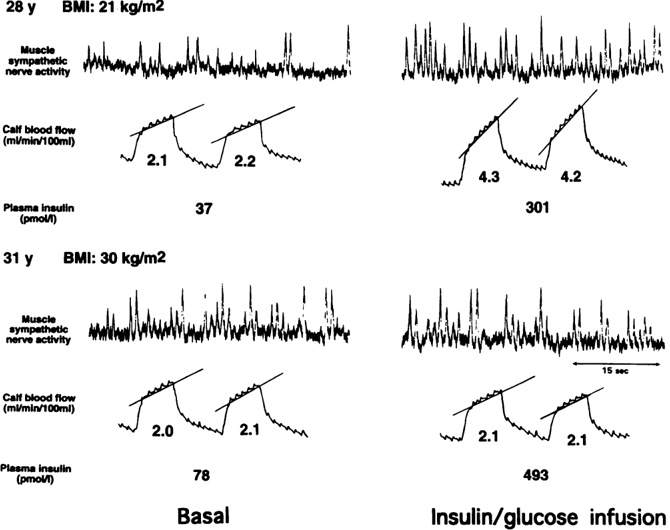
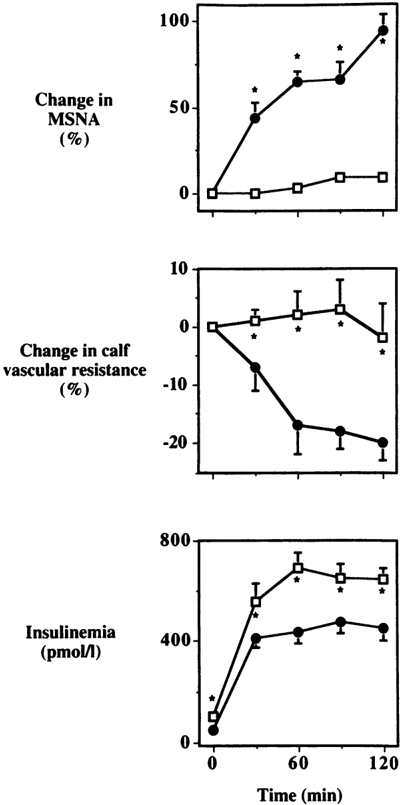
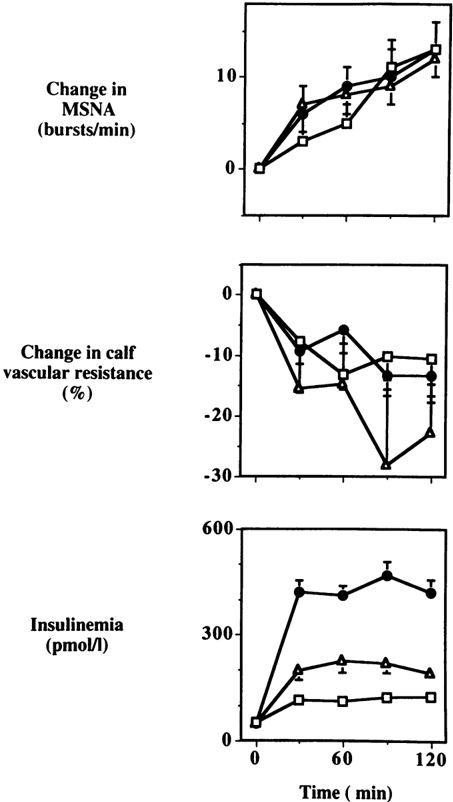
Verification
Claims the paper makes
8 Valid · 2 Not valid · 6 Not checked · 53 Own results and interpretations
The cited sources that could be checked couldn’t confirm or dispute this claim.
In the paper
“Data in experimental animals regarding effects of insulin resistance and obesity on insulin-induced sympathetic responses are conflicting.”
What the sources say
- Not matchedcites [16] 16. Morgan, D. A., T. W. Balon, and A. L. Mark. 1991. High fructose diet promotes exaggerated sympathetic and pressor responses to hyperinsulinemia in rats. FASEB (Fed. Am. Soc. Exp. Biol.) J. 5:A1497. (Abstr.)
We searched by its title and found no matching paper.
- Could not verifycites [17] 17. Holt, S., D. A. York, and J. T. R. Fitzsimons. 1983. The effect of corticosterone, cold exposure and overfeeding with sucrose on brown adipose tissue of obese Zucker rats (fa/fa). Biochem. J. 214:215–223. sourceExperimental — accuracy not yet measured
The Discussion reports age-dependent responses to cold and impaired autonomic stimulation of brown-adipose-tissue thermogenesis after sucrose overfeeding in obese rats. It does not address insulin-induced sympathetic responses or say that findings on insulin resistance and obesity are conflicting. Searches for those terms found no decisive passage in our copy; page numbers were unavailable. (LLM, conf=0.73)
plain- Asserted: passes — The authors put it forward as true.
- Checkable: passes — It can be checked against evidence.
- Load-bearing: passes — The paper’s conclusions depend on it.
- Based: passes — The paper gives a reason why it holds.
- Not matched
The cited sources support only part of this claim — read each source’s verdict below.
In the paper
“In lean subjects, sympathetic activation evoked by acute elevation of plasma insulin to high physiological concentrations does not raise blood pressure (12–14)”
What the sources say
- Partly supportedcites [12] 12. Anderson, E. A., R. P. Hoffman, T. W. Balon, C. A. Sinkey, and A. L. Mark. 1991. Hyperinsulinemia produces both sympathetic neural activation and vasodilation in normal humans. J. Clin. Invest. 87:2246–2252. sourceExperimental — accuracy not yet measured
The Abstract and Conclusion (pages not provided) report that acute insulin infusion increased sympathetic nerve activity without increasing arterial pressure in normal humans. The Subjects section describes 14 healthy males with BMIs ranging from 21 to 32; it does not establish the result specifically for lean subjects. (LLM, conf=0.84)
- Not checked — no full text of the sourcecites [13] 13. Scherrer, U., P. Vollenweider, D. Randin, E. Jéquier, P. Nicod, and L. Tappy. 1993. Suppression of insulin induced sympathetic activation and vasodilation by dexamethasone in humans. Circulation. 88:388–394. source
- Supportedcites [14] 14. Vollenweider, P., L. Tappy, D. Randin, P. Schneiter, E. Jéquier, P. Nicod, and U. Scherrer. 1993. Differential effects of hyperinsulinemia and carbohydrate metabolism on sympathetic nerve activity and muscle blood flow in humans. J. Clin. Invest. 92:147–154. source
The Discussion (p. 6) says that, in lean healthy subjects, acute hyperinsulinemia at high physiological concentrations does not raise arterial pressure. It also describes insulin’s sympathetic activation and vasodilation as opposing effects that may explain this result. (LLM, conf=0.94)
plain- Asserted: passes — The authors put it forward as true.
- Checkable: passes — It can be checked against evidence.
- Load-bearing: passes — The paper’s conclusions depend on it.
- Based: passes — The paper gives a reason why it holds.
- Partly supported
The cited sources support only part of this claim — read each source’s verdict below.
In the paper
“suggesting that body fat may be an important determinant of resting sympathetic nerve activity in humans (26, 27).”
What the sources say
- Partly supportedcites [26] 26. Spraul, M., E. Ravussin, A. M. Fontvieille, R. Rising, D. E. Larson, and E. A. Anderson. 1993. Reduced sympathetic nervous activity. A potential mechanism predisposing to body weight gain. J. Clin. Invest. 92:1730–1735. sourceExperimental — accuracy not yet measured
The Abstract and Discussion report that fasting muscle sympathetic nerve activity was positively related to body fat in Caucasian men, but not in Pima Indian men. This supports a possible relationship in one studied group, not the broader suggestion that body fat determines resting sympathetic nerve activity in humans generally; the study also measured an association rather than establishing direction of causation. Page numbers are unavailable in our copy. (LLM, conf=0.86)
- Not matchedcites [27] 27. Randin, D., P. Vollenweider, L. Tappy, E. Jéquier, P. Nicod, and U. Scherrer. 1993. Sustained sympathetic activation in skeletal muscle in overweight humans. Diabetes. 42:94A. (Abstr.)
We searched by its title and found no matching paper.
hedgedstates a possible cause- Asserted: passes — The authors put it forward as true.
- Checkable: passes — It can be checked against evidence.
- Load-bearing: passes — The paper’s conclusions depend on it.
- Based: passes — The paper gives a reason why it holds.
- Partly supported
The cited sources support only part of this claim — read each source’s verdict below.
In the paper
“In lean healthy subjects, insulin-induced stimulation of muscle blood flow consistently is accompanied by a marked stimulation of sympathetic neural outflow to the same vascular bed (12-14).”
What the sources say
- Partly supportedcites [12] 12. Anderson, E. A., R. P. Hoffman, T. W. Balon, C. A. Sinkey, and A. L. Mark. 1991. Hyperinsulinemia produces both sympathetic neural activation and vasodilation in normal humans. J. Clin. Invest. 87:2246–2252. sourceExperimental — accuracy not yet measured
The Discussion reports that insulin increased muscle sympathetic nerve activity while causing forearm vasodilation in healthy subjects. But it explicitly says blood flow was measured in the forearm and nerve activity in the leg, so the study does not establish both effects in the same vascular bed. The Subjects section also reports BMI values up to 32, rather than an exclusively lean group. (LLM, conf=0.90)
- Not checked — no full text of the sourcecites [13] 13. Scherrer, U., P. Vollenweider, D. Randin, E. Jéquier, P. Nicod, and L. Tappy. 1993. Suppression of insulin induced sympathetic activation and vasodilation by dexamethasone in humans. Circulation. 88:388–394. source
- Supportedcites [14] 14. Vollenweider, P., L. Tappy, D. Randin, P. Schneiter, E. Jéquier, P. Nicod, and U. Scherrer. 1993. Differential effects of hyperinsulinemia and carbohydrate metabolism on sympathetic nerve activity and muscle blood flow in humans. J. Clin. Invest. 92:147–154. source
The Abstract (p. 1) reports that, in six healthy lean subjects, insulin/glucose infusion increased both muscle sympathetic nerve activity and calf blood flow. The Discussion (p. 6) likewise says both increased markedly during infusion, supporting the claimed accompanying responses in skeletal muscle. (LLM, conf=0.91)
boostedstates an association- Asserted: passes — The authors put it forward as true.
- Checkable: passes — It can be checked against evidence.
- Load-bearing: passes — The paper’s conclusions depend on it.
- Based: passes — The paper gives a reason why it holds.
- Partly supported
Every source the paper cites for this claim was checked and supports it.
In the paper
“findings in humans, showing that local intraarterial insulin infusion, in contrast to systemic intravenous infusion, did not have any stimulatory effect on sympathetic activity in skeletal muscle (15).”
What the sources say
- Supportedcites [15] 15. Lembo, G., R. Napoli, B. Capaldo, V. Rendina, G. Iaccarino, M. Volpe, B. Trimarco, and L. Saccá. 1992. Abnormal sympathetic overactivity evoked by insulin in the skeletal muscle of patients with essential hypertension. J. Clin. Invest. 90:24–29. source
The local-insulinization results report that intraarterial insulin left forearm norepinephrine balance, uptake, and release unchanged in both normotensive and hypertensive subjects. The Discussion contrasts this with an effect on muscle norepinephrine metabolism during systemic insulinization. Page numbers are unavailable in our copy. (LLM, conf=0.93)
plain- Asserted: passes — The authors put it forward as true.
- Checkable: passes — It can be checked against evidence.
- Load-bearing: passes — The paper’s conclusions depend on it.
- Based: passes — The paper gives a reason why it holds.
- Supported
44 more claims · 1 with their cited sources checked
Create a free account to see all 69 claims and every source verdict.
- Probably not a substantial claim. 13
- It may state two separate claims as one. 7
- The quote only partly states this claim. 2
Citations
Cites
Role of Insulin Resistance in Human Disease
Reaven, G. M. (1988) · Diabetes · doi:10.2337/diab.37.12.1595 · Cited by 12,154
Glucose clamp technique: a method for quantifying insulin secretion and resistance.
DeFronzo, R. A., Tobin, J. D., & Andres, R. (1979) · American Journal of Physiology-Endocrinology and Metabolism · doi:10.1152/ajpendo.1979.237.3.e214 · Cited by 7,425
Coated Charcoal Immunoassay of Insulin
HERBERT, V., LAU, K.-S., GOTTLIEB, C. W., & BLEICHER, S. J. (1965) · The Journal of Clinical Endocrinology & Metabolism · doi:10.1210/jcem-25-10-1375 · Cited by 2,968
Somatosensory, proprioceptive, and sympathetic activity in human peripheral nerves
Vallbo, A. B., Hagbarth, K. E., Torebjork, H. E., & Wallin, B. G. (1979) · Physiological Reviews · doi:10.1152/physrev.1979.59.4.919 · Cited by 1,507
Hyperinsulinemia produces both sympathetic neural activation and vasodilation in normal humans.
Anderson, E. A., Hoffman, R. P., Balon, T. W., Sinkey, C. A., & Mark, A. L. (1991) · Journal of Clinical Investigation · doi:10.1172/jci115260 · Cited by 1,075
Laakso, M., Edelman, S. V., Brechtel, G., & Baron, A. D. (1990) · Journal of Clinical Investigation · doi:10.1172/jci114644 · Cited by 930
Parati, G., Casadei, R., Groppelli, A., Di Rienzo, M., & Mancia, G. (1989) · Hypertension · doi:10.1161/01.hyp.13.6.647 · Cited by 899
General Characteristics of Sympathetic Activity in Human Muscle Nerves
Delius, W., Hagbarth, K. ‐., Hongell, A., & Wallin, B. G. (1972) · Acta Physiologica Scandinavica · doi:10.1111/j.1748-1716.1972.tb05157.x · Cited by 831
Mechanisms of insulin resistance in human obesity: evidence for receptor and postreceptor defects.
Kolterman, O. G., Insel, J., Saekow, M., & Olefsky, J. M. (1980) · Journal of Clinical Investigation · doi:10.1172/jci109790 · Cited by 664
Effects of the cold pressor test on muscle sympathetic nerve activity in humans.
Victor, R. G., Leimbach, W. N., Seals, D. R., Wallin, B. G., & Mark, A. L. (1987) · Hypertension · doi:10.1161/01.hyp.9.5.429 · Cited by 519
Cited by
Cardiovascular Actions of Insulin
Muniyappa, R., Montagnani, M., Koh, K. K., & Quon, M. J. (2007) · Endocrine Reviews · doi:10.1210/er.2007-0006 · Cited by 872
Fatty Liver: A Novel Component of the Metabolic Syndrome
Kotronen, A., & Yki-Järvinen, H. (2008) · Arteriosclerosis, Thrombosis, and Vascular Biology · doi:10.1161/atvbaha.107.147538 · Cited by 797
Nitric oxide release accounts for insulin's vascular effects in humans.
Scherrer, U., Randin, D., Vollenweider, P., Vollenweider, L., & Nicod, P. (1994) · Journal of Clinical Investigation · doi:10.1172/jci117621 · Cited by 756
“sympathetic activation in skeletal muscle tissue (21).”
BackgroundSelf-citationThe Sympathetic Nervous System Alterations in Human Hypertension
Grassi, G., Mark, A., & Esler, M. (2015) · Circulation Research · doi:10.1161/circresaha.116.303604 · Cited by 616
“produced striking increases in muscle sympathetic nerve traffic and plasma norepinephrine in healthy lean subjects.(25,78,79)”
BackgroundSympathetic Activity in Obese Subjects With and Without Obstructive Sleep Apnea
Narkiewicz, K., van de Borne, P. J. H., Cooley, R. L., Dyken, M. E., & Somers, V. K. (1998) · Circulation · doi:10.1161/01.cir.98.8.772 · Cited by 523
From the metabolic syndrome to NAFLD or vice versa?
Vanni, E., Bugianesi, E., Kotronen, A., De Minicis, S., Yki-Järvinen, H., & Svegliati-Baroni, G. (2010) · Digestive and Liver Disease · doi:10.1016/j.dld.2010.01.016 · Cited by 497
Havel, P. J. (2001) · Experimental Biology and Medicine · doi:10.1177/153537020122601102 · Cited by 481
Leptin and Cardiovascular Disease: Response to Therapeutic Interventions
Koh, K. K., Park, S. M., & Quon, M. J. (2008) · Circulation · doi:10.1161/circulationaha.107.741645 · Cited by 479
Regional Sympathetic Nervous Activity and Oxygen Consumption in Obese Normotensive Human Subjects
Vaz, M., Jennings, G., Turner, A., Cox, H., Lambert, G., & Esler, M. (1997) · Circulation · doi:10.1161/01.cir.96.10.3423 · Cited by 404
Tissue–Specific Insulin Signaling, Metabolic Syndrome, and Cardiovascular Disease
Rask-Madsen, C., & Kahn, C. R. (2012) · Arteriosclerosis, Thrombosis, and Vascular Biology · doi:10.1161/atvbaha.111.241919 · Cited by 375
“In obese individuals, sympathetic nerve activity is increased under basal conditions but does not increase further during an euglycemic hyperinsulinemic clamp as seen in insulin sensitive control subjects.(33) Sympathetic overactivity in obesity can cause hypertension through vasoconstrictor effects mediated by sympat…”
BackgroundScherrer, U., & Sartori, C. (1997) · Circulation · doi:10.1161/01.cir.96.11.4104 · Cited by 371
Self-citationRole of Hyperinsulinemia and Insulin Resistance in Hypertension: Metabolic Syndrome Revisited
da Silva, A. A., do Carmo, J. M., Li, X., Wang, Z., Mouton, A. J., & Hall, J. E. (2020) · Canadian Journal of Cardiology · doi:10.1016/j.cjca.2020.02.066 · Cited by 368
Lambert, G. W., Straznicky, N. E., Lambert, E. A., Dixon, J. B., & Schlaich, M. P. (2010) · Pharmacology & Therapeutics · doi:10.1016/j.pharmthera.2010.02.002 · Cited by 347
Insulin Resistance, Hyperinsulinemia, and Blood Pressure: Role of Age and Obesity
Ferrannini, E., Natali, A., Capaldo, B., Lehtovirta, M., Jacob, S., & Yki-Järvinen for the European Group for the Study of Insuli, H. (1997) · Hypertension · doi:10.1161/01.hyp.30.5.1144 · Cited by 315
Janssen, J. A. M. J. L. (2021) · International Journal of Molecular Sciences · doi:10.3390/ijms22157797 · Cited by 294
Insulin resistance and risk for stroke
Kernan, W. N., Inzucchi, S. E., Viscoli, C. M., Brass, L. M., Bravata, D. M., & Horwitz, R. I. (2002) · Neurology · doi:10.1212/wnl.59.6.809 · Cited by 280
Insulin-induced vasodilatation: physiology or pharmacology?
Yki-Järvinen, H., & Utriainen, T. (1998) · Diabetologia · doi:10.1007/s001250050919 · Cited by 261
Sympathetic system activity in obesity and metabolic syndrome
TENTOLOURIS, N., LIATIS, S., & KATSILAMBROS, N. (2006) · Annals of the New York Academy of Sciences · doi:10.1196/annals.1367.010 · Cited by 260
Obesity and adipokines: effects on sympathetic overactivity
Smith, M. M., & Minson, C. T. (2012) · The Journal of Physiology · doi:10.1113/jphysiol.2011.221036 · Cited by 237
“In lean subjects, MSNA increased 94% in response to euglycaemic hyperinsulinaemia, much greater than the 9% increase observed in age-matched obese subjects (Vollenweider et al. 1994).”
BackgroundObesity and vascular dysfunction
Stapleton, P. A., James, M. E., Goodwill, A. G., & Frisbee, J. C. (2008) · Pathophysiology · doi:10.1016/j.pathophys.2008.04.007 · Cited by 218
Obesity-Related Metabolic Syndrome: Mechanisms of Sympathetic Overactivity
Canale, M. P., Manca di Villahermosa, S., Martino, G., Rovella, V., Noce, A., De Lorenzo, A., & Di Daniele, N. (2013) · International Journal of Endocrinology · doi:10.1155/2013/865965 · Cited by 218
Huggett, R. J., Burns, J., Mackintosh, A. F., & Mary, D. A. S. G. (2004) · Hypertension · doi:10.1161/01.hyp.0000147893.08533.d8 · Cited by 211
Dobrowolski, P., Prejbisz, A., Kuryłowicz, A., Baska, A., Burchardt, P., Chlebus, K., Dzida, G., Jankowski, P., Jaroszewicz, J., Jaworski, P., et al. (2022) · Archives of Medical Science · doi:10.5114/aoms/152921 · Cited by 201
“This is explained by the autonomic imbalance, that is, impaired central regulation of sympathetic and parasympathetic activity, where the former is hyperactive [84].”
BackgroundAssessment of Cardiac Autonomic Modulation during Adolescent Obesity
Rabbia, F., Silke, B., Conterno, A., Grosso, T., De Vito, B., Rabbone, I., Chiandussi, L., & Veglio, F. (2003) · Obesity Research · doi:10.1038/oby.2003.76 · Cited by 198
Insulin and Insulin-Like Growth Factor in Normal and Pathological Cardiovascular Physiology
Sowers, J. R. (1997) · Hypertension · doi:10.1161/01.hyp.29.3.691 · Cited by 186
Overweight, physical activity and high blood pressure in children: a review of the literature.
Torrance, B. D., McGuire, K. A., Lewanczuk, R. Z., & McGavock, J. (2007) · PubMed Central · Cited by 264
Karpe, F., Fielding, B. A., Ilic, V., Macdonald, I. A., Summers, L. K. M., & Frayn, K. N. (2002) · Diabetes · doi:10.2337/diabetes.51.8.2467 · Cited by 177
“, insulin-resistant subjects, have an increased muscle sympathetic activity in the fasting state and that the response to elevation of insulin in plasma gives a blunted response in terms of sympathetic activation (28).”
BackgroundTack, C. J. J., Ong, M. K. E., Lutterman, J. A., & Smits, P. (1998) · Diabetologia · doi:10.1007/s001250050948 · Cited by 177
“Several investigators have reported that insulin induces vasodilatation in skeletal muscle [2±4], an effect that is impaired under conditions of insulin resistance [3, 6, 7, 24].”
BackgroundBaron, A. D., Tarshoby, M., Hook, G., Lazaridis, E. N., Cronin, J., Johnson, A., & Steinberg, H. O. (2000) · Diabetes · doi:10.2337/diabetes.49.5.768 · Cited by 174
“Better understanding of the underlying mechanism is an important issue, because insulin’s effect to stimulate skeletal muscle perfusion is diminished in states of insulin resistance (8,9) and, thus, it is possible that diminished tissue perfusion could contribute to insulin resistance in these subjects.”
BackgroundA longitudinal study in youth of heart rate variability at rest and in response to stress
Li, Z., Snieder, H., Su, S., Ding, X., Thayer, J. F., Treiber, F. A., & Wang, X. (2009) · International Journal of Psychophysiology · doi:10.1016/j.ijpsycho.2009.03.002 · Cited by 172
“Themechanism underlying the relationshipbetweenvagallymediated cardiac autonomic regulation and obesity is not clear, although somehormonal signals, such as insulin (Vollenweider et al., 1994), free fatty acids (Grekin et al., 1997) and leptin (Haynes et al., 1997) have been postulated.”
Summers, L. K. M., Samra, J. S., Humphreys, S. M., Morris, R. J., & Frayn, K. N. (1996) · Clinical Science · doi:10.1042/cs0910679 · Cited by 167
The sympathetic nervous system in polycystic ovary syndrome: a novel therapeutic target?
Lansdown, A., & Rees, D. A. (2012) · Clinical Endocrinology · doi:10.1111/cen.12003 · Cited by 165
Sartori, C., Dessen, P., Mathieu, C., Monney, A., Bloch, J., Nicod, P., Scherrer, U., & Duplain, H. (2009) · Endocrinology · doi:10.1210/en.2009-0425 · Cited by 164
Self-citationWeight Gain–Induced Blood Pressure Elevation
Masuo, K., Mikami, H., Ogihara, T., & Tuck, M. L. (2000) · Hypertension · doi:10.1161/01.hyp.35.5.1135 · Cited by 155
Carroll, D., Phillips, A. C., & Der, G. (2008) · Psychosomatic Medicine · doi:10.1097/psy.0b013e31817b9382 · Cited by 155
“For example, muscle sympathetic nervous system activity shows a strong positive association with adiposity and obesity (62,63).”
BackgroundEffect of insulin on human aortic endothelial nitric oxide synthase
Aljada, A., & Dandona, P. (2000) · Metabolism · doi:10.1016/s0026-0495(00)91039-4 · Cited by 154
Bloomgarden, Z. T. (2003) · Diabetes Care · doi:10.2337/diacare.26.3.933 · Cited by 142
Autonomic and Hemodynamic Responses to Insulin in Lean and Obese Humans1
Muscelli, E., Emdin, M., Natali, A., Pratali, L., Camastra, S., Gastaldelli, A., Baldi, S., Carpeggiani, C., & Ferrannini, E. (1998) · The Journal of Clinical Endocrinology & Metabolism · doi:10.1210/jcem.83.6.4878 · Cited by 133
“doses of insulin (52), it has been hypothesized that the”
BackgroundInfluentialSympathetic Neural Overdrive in the Obese and Overweight State: Meta-Analysis of Published Studies
Grassi, G., Biffi, A., Seravalle, G., Trevano, F. Q., Dell’Oro, R., Corrao, G., & Mancia, G. (2019) · Hypertension · doi:10.1161/hypertensionaha.119.12885 · Cited by 133
“Gender information was not provided in 3 studies.(18,19,45) Articles that included normoweight subjects provided MSNA quantifica-”
BackgroundMediators of sympathetic activation in metabolic syndrome obesity
Straznicky, N. E., Eikelis, N., Lambert, É., & Esler, M. (2008) · Current Hypertension Reports · doi:10.1007/s11906-008-0083-1 · Cited by 140
Impaired insulin sensitivity among nondiabetic patients with a recent TIA or ischemic stroke
Kernan, W. N., Inzucchi, S. E., Viscoli, C. M., Brass, L. M., Bravata, D. M., Shulman, G. I., McVeety, J. C., & Horwitz, R. I. (2003) · Neurology · doi:10.1212/01.wnl.0000063318.66140.a3 · Cited by 126
“Lacunar etiology 12/17 (76) 23/55 (42) 1.”
Scherrer, U., & Sartori, C. (2000) · European Journal of Endocrinology · doi:10.1530/eje.0.1420315 · Cited by 118
Self-citationMuscle metaboreflex control is diminished in normotensive obese women
Negrão, C. E., Trombetta, I. C., Batalha, L. T., Ribeiro, M. M., Rondon, M. U. P. B., Tinucci, T., Forjaz, C. L. M., Barretto, A. C. P., Halpern, A., & Villares, S. M. F. (2001) · American Journal of Physiology-Heart and Circulatory Physiology · doi:10.1152/ajpheart.2001.281.2.h469 · Cited by 116
“The vasodilatory responses during euglycemic-hyperinsulinemic condition decreased in obese individuals (23).”
BackgroundNeuroadrenergic Dysfunction Along the Diabetes Continuum
Straznicky, N. E., Grima, M. T., Sari, C. I., Eikelis, N., Lambert, E. A., Nestel, P. J., Esler, M. D., Dixon, J. B., Chopra, R., Tilbrook, A. J., et al. (2012) · Diabetes · doi:10.2337/db12-0138 · Cited by 114
“, the notion of a ceiling effect) (21).”
BackgroundThe peripheral sympathetic nervous system in human obesity
Baak, M. A. V. (2001) · Obesity Reviews · doi:10.1046/j.1467-789x.2001.00010.x · Cited by 114
“There is some evidence that the response of the sympathetic nervous system to various physiological stimuli (underfeeding, hyperinsulinaemia; cold exposure) is blunted in those who are obese (9,33,39).”
BackgroundStraznicky, N. E., Lambert, G. W., Masuo, K., Dawood, T., Eikelis, N., Nestel, P. J., McGrane, M. T., Mariani, J. A., Socratous, F., Chopra, R., et al. (2008) · American Journal of Clinical Nutrition · doi:10.3945/ajcn.2008.26299 · Cited by 123
“Vollenweider et al (8) showed, in lean young subjects, that MSNA increased by 94% in response to euglycemic hyperinsulinemia, whereas in age-matched obese subjects the increase was only 9%.”
BackgroundInfluentialPerturbed Autonomic Nervous System Function in Metabolic Syndrome
Tentolouris, N., Argyrakopoulou, G., & Katsilambros, N. L. (2008) · NeuroMolecular Medicine · doi:10.1007/s12017-008-8022-5 · Cited by 145
“In humans, acute physiological and pharmacological euglycemic hyperinsulinemia (DeFronzo et al. 1979) increases SNS activity as determined by measurements of plasma catecholamine concentration (Rowe et al. 1981; O’Hare et al. 1989; Berne et al. 1992; Scherrer et al. 1993; Vollenweider et al. 1994 ), plasma norepinephr…”
BackgroundOverweight and Sympathetic Overactivity in Black Americans
Abate, N. I., Mansour, Y. H., Tuncel, M., Arbique, D., Chavoshan, B., Kizilbash, A., Howell-Stampley, T., Vongpatanasin, W., & Victor, R. G. (2001) · Hypertension · doi:10.1161/01.hyp.38.3.379 · Cited by 111
Leptin and the Cardiovascular System
Rahmouni, K. (2004) · Recent Progress in Hormone Research · doi:10.1210/rp.59.1.225 · Cited by 110
“Using direct measurement with microneurography, several groups have shown increased SNA to skeletal muscle in obese subjects, as compared to lean individuals (Vollenweider et al., 1994; Grassi et al., 1995).”
BackgroundOBESITY AND AUTONOMIC FUNCTION IN ADOLESCENCE
Riva, P., Martini, G., Rabbia, F., Milan, A., Paglieri, C., Chiandussi, L., & Veglio, F. (2001) · Clinical and Experimental Hypertension · doi:10.1081/ceh-100001197 · Cited by 107
“This finding is only barely detectable in obese subjects, in spite of high sympathetic nerve firing in the fasting state (50).”
BackgroundSartori, C. S., Lepori, M., & Scherrer, U. (2005) · Pharmacology & Therapeutics · doi:10.1016/j.pharmthera.2004.11.009 · Cited by 108
Self-citationPIKKUJAMSA, S. (1998) · American Journal of Hypertension · doi:10.1016/s0895-7061(98)00035-1 · Cited by 106
Fu, J., Yu, M. G., Li, Q., Park, K., & King, G. L. (2021) · Molecular Metabolism · doi:10.1016/j.molmet.2021.101236 · Cited by 294
“Furthermore, in obese individuals, insulin has been reported to increase sympathetic nerve activity under basal conditions, but not during a euglycemic hyperinsulinemic clamp as seen in insulin-sensitive controls [62].”
BackgroundTentolouris, N., Tsigos, C., Perea, D., Koukou, E., Kyriaki, D., Kitsou, E., Daskas, S., Daifotis, Z., Makrilakis, K., Raptis, S., et al. (2003) · Metabolism · doi:10.1016/s0026-0495(03)00322-6 · Cited by 109
INSULIN AS A VASCULAR HORMONE: IMPLICATIONS FOR THE PATHOPHYSIOLOGY OF CARDIOVASCULAR DISEASE
Cleland, S. J., Petrie, J. R., Ueda, S., Elliott, H. L., & Connell, J. M. (1998) · Clinical and Experimental Pharmacology and Physiology · doi:10.1111/j.1440-1681.1998.t01-15-.x · Cited by 102
Rask-Madsen, C., Ihlemann, N., Krarup, T., Christiansen, E., Kober, L., Nervil Kistorp, C., & Torp-Pedersen, C. (2001) · Diabetes · doi:10.2337/diabetes.50.11.2611 · Cited by 99
“However, vasoconstrictor effects of insulin-stimulated sympathetic activation may not be comparable in insulin-sensitive and insulin-resistant individuals, as sympathetic responses to insulin are altered in obese subjects (32).”
BackgroundClonidine Prevents Insulin Resistance and Hypertension in Obese Dogs
Rocchini, A. P., Mao, H. Z., Babu, K., Marker, P., & Rocchini, A. J. (1999) · Hypertension · doi:10.1161/01.hyp.33.1.548 · Cited by 98
Heart rate in relation to insulin sensitivity and insulin secretion in nondiabetic subjects.
Festa, A., D'Agostino, R., Hales, C. N., Mykkänen, L., & Haffner, S. M. (2000) · Diabetes Care · doi:10.2337/diacare.23.5.624 · Cited by 95
Ortlepp, Kluge, Giesen, Plum, Radke, Hanrath, & Joost, H. (2000) · European Journal of Clinical Investigation · doi:10.1046/j.1365-2362.2000.00611.x · Cited by 107
Rittig, K., Staib, K., Machann, J., Bøttcher, M., Peter, A., Schick, F., Claussen, C. D., Stefan, N., Fritsche, A., Häring, H., et al. (2008) · Diabetologia · doi:10.1007/s00125-008-1128-3 · Cited by 90
“In previous studies, muscle perfusion has been shown to modulate insulinmediated glucose uptake [20–22], which is reduced in the insulin-resistant state [23, 24 ].”
BackgroundCarotid body, insulin, and metabolic diseases: unraveling the links
Conde, S. V., Sacramento, J. F., Guarino, M. P., Gonzalez, C., Obeso, A., Diogo, L. N., Monteiro, E. C., & Ribeiro, M. J. (2014) · Frontiers in Physiology · doi:10.3389/fphys.2014.00418 · Cited by 87
“…sympathetic nerve activity is dose-dependent (Anderson et al., 1991; Berne et al., 1992), others have shown that this relationship is not apparent (Vollenweider et al., 1993, 1994) attributing this effect to a saturation of the receptors needed for insulin to cross the blood brain barrier (Banks…”
BackgroundHemodynamic and Renal Responses to Chronic Hyperinsulinemia in Obese, Insulin-Resistant Dogs
Hall, J. E., Brands, M. W., Zappe, D. H., Dixon, W. N., Mizelle, H. L., Reinhart, G. A., & Hildebrandt, D. A. (1995) · Hypertension · doi:10.1161/01.hyp.25.5.994 · Cited by 84
Influence of insulin and of insulin resistance on platelet and vascular smooth muscle cell function
Trovati, M., & Anfossi, G. (2002) · Journal of Diabetes and its Complications · doi:10.1016/s1056-8727(01)00196-9 · Cited by 81
“In those years, it was already known that the vasodilating effects of insulin were impaired in obesity and in Type 2 diabetes mellitus (Laasko, Edelman, Brechtel & Baron, 1992; Vollenweider et al., 1994), inducing to suppose that human vessels are a site of insulin resistance and providing a possible explanation for t…”
BackgroundThe obese gene product, leptin: possible role in obesity-related hypertension in adolescents
Hirose, H., Saito, I., Tsujioka, M., Mori, M., Kawabe, H., & Saruta, T. (1998) · Journal of Hypertension · doi:10.1097/00004872-199816121-00023 · Cited by 80
Jarczok, M. N., Li, J., Mauss, D., Fischer, J. E., & Thayer, J. F. (2013) · International Journal of Cardiology · doi:10.1016/j.ijcard.2012.02.002 · Cited by 79
“However several hormones such as insulin, free fatty acids, and leptin as well as inflammation have been implicated [24–27].”
BackgroundNitric oxide and its role in lipid peroxidation
Violi, F., Marino, R., Milite, M. T., & Loffredo, L. (1999) · Diabetes/Metabolism Research and Reviews · doi:10.1002/(sici)1520-7560(199907/08)15:4<283::aid-dmrr42>3.0.co;2-u · Cited by 126
Koskinen, J., Magnussen, C. G., Taittonen, L., Räsänen, L., Mikkilä, V., Laitinen, T., Rönnemaa, T., Kähönen, M., Viikari, J. S. A., Raitakari, O. T., et al. (2010) · Circulation · doi:10.1161/circulationaha.109.894584 · Cited by 76
Dose-Dependent Vasodilating Effects of Insulin on Adenosine-Stimulated Myocardial Blood Flow
Sundell, J., Nuutila, P., Laine, H. K., Luotolahti, M., Kalliokoski, K. K., Raitakari, O. T., & Knuuti, J. M. (2002) · Diabetes · doi:10.2337/diabetes.51.4.1125 · Cited by 70
“Insulin induces a dose-dependent vasodilation in the peripheral arteries (9–11) that is blunted in insulin-resistant states (10,12,13).”
BackgroundSeravalle, G., Lonati, L. M., Buzzi, S., Cairo, M., Trevano, F. Q., Dell’Oro, R., Facchetti, R., Mancia, G., & Grassi, G. M. (2015) · Journal of Hypertension · doi:10.1097/hjh.0000000000000567 · Cited by 73
“As a hyperinsulinemic state may exert central sympathoexcitatory effects [26,27], there exists a possibility that the highnormal BP-related sympathetic activation depends on this metabolic alteration.”
BackgroundOlver, T. D., & Laughlin, M. H. (2016) · American Journal of Physiology-Heart and Circulatory Physiology · doi:10.1152/ajpheart.00440.2015 · Cited by 67
Contrasting Autonomic and Hemodynamic Effects of Insulin in Healthy Elderly Versus Young Subjects
Hausberg, M., Hoffman, R. P., Somers, V. K., Sinkey, C. A., Mark, A. L., & Anderson, E. A. (1997) · Hypertension · doi:10.1161/01.hyp.29.3.700 · Cited by 73
Sartori, C. S., & Scherrer, U. (1999) · Journal of Hypertension · doi:10.1097/00004872-199917110-00003 · Cited by 74
Self-citationCuesta‐Sancho, S., Kireev, R. A., García, C., Rancán, L., Vara, E., & Tresguerres, J. A. F. (2012) · AGE · doi:10.1007/s11357-012-9397-7 · Cited by 75
“Insulin-resistant states are characterized by the inability of insulin to promote glucose uptake in the tissues (Duplain et al. 2001; Vollenweider et al. 1994).”
Sympathetic Nerve Activity and Insulin in Obese Normotensive and Hypertensive Men
Gudbjörnsdóttir, S., Lönnroth, P., Sverrisdóttir, Y. B., Wallin, B. G., & Elam, M. (1996) · Hypertension · doi:10.1161/01.hyp.27.2.276 · Cited by 67
Higashi, Y., Oshima, T., Sasaki, N., Ishioka, N., Nakano, Y., Ozono, R., Yoshimura, M., Ishibashi, K., Matsuura, H., & Kajiyama, G. (1997) · Hypertension · doi:10.1161/01.hyp.29.1.280 · Cited by 76
Protogerou, A. D., Blacher, J., Aslangul, E., Jeunne, C. L., Lekakis, J. P., Mavrikakis, M., & Safar, M. E. (2006) · Atherosclerosis · doi:10.1016/j.atherosclerosis.2006.05.046 · Cited by 72
Sympathetic Activity and Body Mass Index Contribute to Blood Pressure Levels.
Masuo, K., Mikami, H., Mikiko, I. T. O. H., Ogihara, T., & Tuck, M. L. (2000) · Hypertension Research · doi:10.1291/hypres.23.303 · Cited by 71
Insulin and myocardial blood flow
Sundell, J. (2003) · Cardiovascular Research · doi:10.1016/s0008-6363(02)00718-6 · Cited by 65
Effects of weight loss on insulin sensitivity and arterial stiffness in overweight adults
Dengel, D. R., Kelly, A. S., Olson, T. P., Kaiser, D. R., Dengel, J. L., & Bank, A. J. (2006) · Metabolism · doi:10.1016/j.metabol.2006.02.018 · Cited by 66
Glucose ingestion affects cardiac ANS in healthy subjects with different amounts of body fat.
Paolisso, G., Manzella, D., Ferrara, N., Gambardella, A., Abete, P., Tagliamonte, M. R., De Lucia, D., Furgi, G., Picone, C., Gentile, S., et al. (1997) · American Journal of Physiology-Endocrinology and Metabolism · doi:10.1152/ajpendo.1997.273.3.e471 · Cited by 61
Antiepileptic drugs influences on body weight in people with epilepsy
Hamed, S. A. (2015) · Expert Review of Clinical Pharmacology · doi:10.1586/17512433.2015.991716 · Cited by 61
Obesity-induced increases in sympathetic nerve activity: Sex matters
Brooks, V. L., Shi, Z., Holwerda, S. W., & Fadel, P. J. (2014) · Autonomic Neuroscience · doi:10.1016/j.autneu.2014.11.006 · Cited by 64
“…situation in humans, previous studies demonstrated that a nearly 10-fold dose range of iv insulin produced similar increases in MSNA in lean subjects (Berne et al., 1992; Vollenweider et al., 1994); in rats, a doubling of the iv insulin dose does not double the LSNA response (Morgan et al., 1993).”
InfluentialSCOTT, E. M., Greenwood, J. P., Vacca, G., Stoker, J. B., Gilbey, S. G., & Mary, D. (2002) · Clinical Science · doi:10.1042/cs1020523 · Cited by 67
Time course of insulin resistance associated with feeding dogs a high-fat diet
Rocchini, A. P., Marker, P. H., & Cervenka, T. (1997) · American Journal of Physiology-Endocrinology and Metabolism · doi:10.1152/ajpendo.1997.272.1.e147 · Cited by 72
Goulopoulou, S., Baynard, T., Franklin, R. M., Fernhall, B., Carhart, R. L., Weinstock, R. S., & Kanaley, J. A. (2009) · Metabolism · doi:10.1016/j.metabol.2009.10.011 · Cited by 58
“In response to a glucose challenge, obese subjects fail to increase muscle and whole-body sympathetic activity [1,3].”
BackgroundInfluentialBisquolo, V. A. F., Cardoso, C. G., Ortega, K. C., Gusmão, J. L., Tinucci, T., Negrão, C. E., Wajchenberg, B. L., Mion, D., & Forjaz, C. L. M. (2005) · Journal of Applied Physiology · doi:10.1152/japplphysiol.00251.2004 · Cited by 54
“Also, some studies (25, 26, 28, 38) have reported that neural and hemodynamic responses to hyperinsulinemia depend on insulin sensitivity status.”
BackgroundInfluentialSartori, C. S., Trueb, L., NICOD, P. H., & Scherrer, U. (1999) · Hypertension · doi:10.1161/01.hyp.34.4.586 · Cited by 54
Self-citationAltered hemodynamic regulation and reflex control during exercise and recovery in obese boys
Δίπλα, Κ., Zafeiridis, A., Koidou, E., Geladas, N. D., & Vrabas, I. S. (2010) · American Journal of Physiology-Heart and Circulatory Physiology · doi:10.1152/ajpheart.00087.2010 · Cited by 54
Pathophysiological Links Between Diabetes and Blood Pressure
Libianto, R., Batu, D., MacIsaac, R. J., Cooper, M. E., & Ekinci, E. I. (2018) · Canadian Journal of Cardiology · doi:10.1016/j.cjca.2018.01.010 · Cited by 71
Muscle sympathetic nerve activity and hemodynamic alterations in middle-aged obese women
Ribeiro, M. M., Trombetta, I. C., Batalha, L. T., Rondon, M. U. P. B., Forjaz, C. L. M., Barretto, A. C. P., Villares, S. M. F., & Negrão, C. E. (2001) · Brazilian Journal of Medical and Biological Research · doi:10.1590/s0100-879x2001000400006 · Cited by 54
“In addition, the increased muscle sympathetic nerve activity may explain the lower forearm blood flow (9) and the reduced vasodilatory response during mental stress in obese individuals (10).”
BackgroundMetabolic syndrome — a new definition and management guidelines
Dobrowolski, P., Prejbisz, A., Kuryłowicz, A., Baska, A., Burchardt, P., Chlebus, K., Dzida, G. J., Jankowski, P., Jaroszewicz, J., Jaworski, P., et al. (2022) · Arterial Hypertension · doi:10.5603/ah.a2022.0012 · Cited by 79
Obesity and Endothelial Dysfunction
Shankar, S. S., & Steinberg, H. O. (2005) · Seminars in Vascular Medicine · doi:10.1055/s-2005-871742 · Cited by 59
“also showed impaired blood flow increments in response to insulin in obese subjects.(33) In contrast to our observation, Yki-Jarvinen was unable to demonstrate insulin-mediated increments in forearm blood flow, even at pharmacologic doses using plethysmography.”
ResultKatsiki, N., Mikhailidis, D. P., Gotzamani‐Psarrakou, A., Yovos, J. G., & Karamitsos, D. T. (2011) · Expert Opinion on Therapeutic Targets · doi:10.1517/14728222.2011.553609 · Cited by 53
“1 Effect of insulin monotherapy Under physiological conditions, insulin suppresses food intake, increases energy expenditure and activates the sympathetic nervous system [15,109,110].”
BackgroundStraznicky, N. E., Lambert, G. W., McGrane, M. T., Masuo, K., Dawood, T., Nestel, P. J., Eikelis, N., Schlaich, M. P., Esler, M., Socratous, F., et al. (2009) · Diabetes · doi:10.2337/db08-1595 · Cited by 56
“(8) showed that in lean young subjects MSNA increased by 94% in response to euglycemic hyperinsulinemia, whereas in age-matched obese subjects the increase was only 9%.”
BackgroundResultVasodilator Response to Systemic But Not to Local Hyperinsulinemia in the Human Forearm
Cardillo, C., Kilcoyne, C. M., Nambi, S., Cannon, R. O., Quon, M. J., & Panza, J. A. (1998) · Hypertension · doi:10.1161/01.hyp.32.4.740 · Cited by 51
Insulin treatment and cardiovascular disease; friend or foe? A point of view
Muis, M. J., Bots, M. L., Grobbee, D. E., & Stolk, R. P. (2004) · Diabetic Medicine · doi:10.1111/j.1464-5491.2004.01416.x · Cited by 54
Lindgren, K., Hagelin, E., Hansén, N., & Lind, L. (2005) · Journal of Hypertension · doi:10.1097/01.hjh.0000198024.91976.c2 · Cited by 52
“Other methods have shown the sympathetic nerve activity to increase with insulin resistance, obesity and metabolic syndrome [ 40 ,41], and it could therefore be that a part of the reduction in BRS and other secondary variables shown in the present study could also be an effect of the increased sympathetic nerve activi…”
MethodLeptin and insulin homeostasis in epilepsy: Relation to weight adverse conditions
Hamed, S. A. (2007) · Epilepsy Research · doi:10.1016/j.eplepsyres.2007.04.001 · Cited by 51
High Serum Leptin Is Associated with Attenuated Coronary Vasoreactivity
Sundell, J., Huupponen, R., Raitakari, O. T., Nuutila, P., & Knuuti, J. M. (2003) · Obesity Research · doi:10.1038/oby.2003.108 · Cited by 49
Update on adipose tissue blood flow regulation
Sotorník, R., Brassard, P., Martin, E., Yale, P., Carpentier, A. C., & Ardilouze, J. (2012) · American Journal of Physiology-Endocrinology and Metabolism · doi:10.1152/ajpendo.00351.2011 · Cited by 60
Metadata
- Authors
- Vollenweider, P., Randin, D., Tappy, L., Jéquier, E., Nicod, P., & Scherrer, U.
- Affiliations
- Centre Hospitalier Universitaire Vaudois (CH)
- Venue
- Journal of Clinical Investigation
- Published
- 1994-06-01
- Volume
- 93
- Issue
- 6
- Pages
- 2365-2371
- ISSN
- 0021-9738 (ISSN-L)
- PMC
- PMC294442
- OpenAlex
- W2063637050
- Cited by
- 285
- References
- 30
- Citations by year
- 2026: 2 · 2025: 1 · 2023: 8 · 2022: 4 · 2021: 5 · 2020: 8 · 2019: 9 · 2018: 6 · 2017: 5 · 2016: 11 · 2015: 10 · 2014: 5 · 2013: 3 · 2012: 14
- FWCI
- 7.91
- Type
- journal article
- Language
- en
- Open access
- bronze
- doi.org
- Locations
- Journal of Clinical Investigation (publishedVersion)
- PubMed Central (publishedVersion)
- PubMed (publishedVersion)
- IRIS (submittedVersion)
- SERVAL (Université de Lausanne) (submittedVersion)
- Funders
- National Science Foundation
- Schweizerischer Nationalfonds zur Förderung der Wissenschaftlichen Forschung (36280, 28668)
- Nestec
- Topics
- Health Sciences › Medicine › Endocrinology, Diabetes and Metabolism › Diabetes, Cardiovascular Risks, and Lipoproteins
- Health Sciences › Medicine › Physiology (medical) › Cardiovascular and exercise physiology
- Health Sciences › Medicine › Endocrinology, Diabetes and Metabolism › Adipokines, Inflammation, and Metabolic Diseases
- Keywords
- obesity, insulin resistance, muscle sympathetic nerve activity, skeletal muscle vasodilation, hyperinsulinemic-euglycemic clamp, calf blood flow, sympathetic nervous system, insulin signaling
- MeSH terms
- Adult, Blood Glucose, Female, Humans, Insulin, Male, Muscles, Obesity, Regional Blood Flow, Sympathetic Nervous System, Vascular Resistance, Vasodilation
About these checks
Registry, retraction, Cites and statistics results are computed, not judged, with one exception: a printed reference that no index lists is read once by a model before it counts as a citation error. Claims are extracted by a model and kept only when their quote appears verbatim in the text; each cited source is then checked, with a model’s help, for whether it says what the claim relies on. Those verdicts can be wrong — read the claim’s quote and the cited source before relying on one.
The claim verdicts this report counts are experimental: their accuracy is not yet measured.
A language model drew the claims from the paper on 2026-10-10, under version 3 of the claim definition (model deepseek-v4.1-flash, prompt extract-v3).
A second model labelled each claim on 2026-10-10 (model jev-1.13-20260917, definition revision gold-guideline-v0.2).
Cited sources are checked with a language model’s help (gpt-6-sol).
Statistics and arithmetic are recomputed, not judged.
Confidence bands are shown only for fields calibrated on our annotated test set. None is calibrated yet, so no band is shown.
What counts as a claim ›How we measure confidence ›How we check this ›
Are you an author, or do you see a problem with this page? Request a review
Data sources
Bibliographic data: Semantic Scholar, OpenAlex, Crossref.
Contains information from the Semantic Scholar Academic Graph Datasets, made available under the ODC Attribution License (ODC-BY 1.0).
Semantic Scholar’s data is described in: Kinney, R., et al. (2023). The Semantic Scholar Open Data Platform. arXiv:2301.10140.
