

Driving Brand Engagement Through Online Social Influencers: An Empirical Investigation of Sponsored Blogging Campaigns
Open accessThe DOI matches its Crossref record; 88 of the 88 references it cites were found in a registry or an index; 1 of the 26 sources its claims cite were checked for support.
Abstract
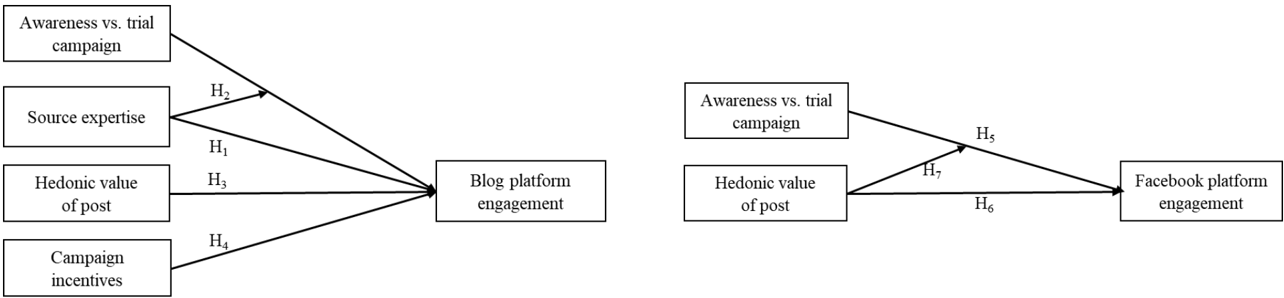
Influencer marketing is prevalent in firm strategies, yet little is known about the factors that drive success of online brand engagement at different stages of the consumer purchase funnel. The findings suggest that sponsored blogging affects online engagement (e.g., posting comments, liking a brand) differently depending on blogger characteristics and blog post content, which are further moderated by social media platform type and campaign advertising intent. When a sponsored post occurs on a blog, high blogger expertise is more effective when the advertising intent is to raise awareness versus increase trial. However, source expertise fails to drive engagement when the sponsored post occurs on Facebook. When a sponsored post occurs on Facebook, posts high in hedonic content are more effective when the advertising intent is to increase trial versus raise awareness. The effectiveness of campaign incentives depends on the platform type, such that they can increase (decrease) engagement on blogs (Facebook). The empirical evidence for these findings comes from real in-market customer response data and is supplemented with data from an experiment. Taken together, the findings highlight the critical interplay of platform type, campaign intent, source, campaign incentives, and content factors in driving engagement.
Overview
CoChat Summary
TL;DR
This paper examines how sponsored blogging campaigns drive online engagement across blogs and Facebook, using field data from 1,830 sponsored posts and a follow-up experiment. It finds engagement depends on platform, campaign intent, blogger expertise, hedonic content, and incentives, with expertise helping awareness campaigns on blogs but not Facebook.
Key findings
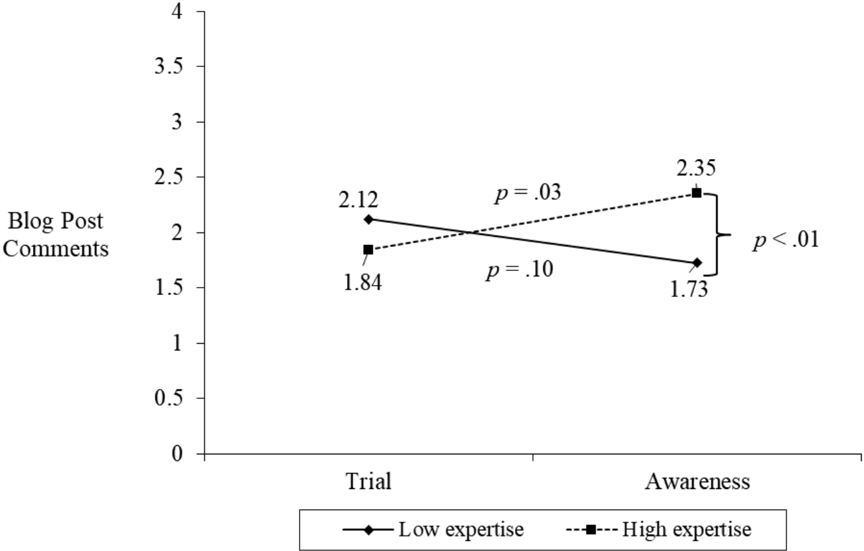
- In the blog-comment model (N = 1,237), blogger expertise had no significant main effect (b = −.1228, n.s.), but campaign intent × expertise was positive (b = .7283, p = .01): high-expertise bloggers performed better in awareness than trial campaigns (simple slope p < .05); low-expertise bloggers did not differ by intent (p = .10), so H2b was not supported.
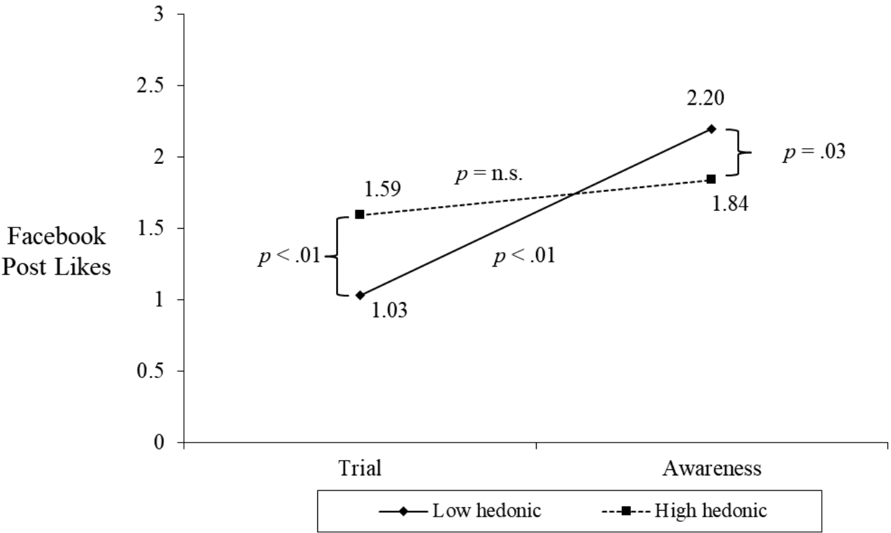
- Hedonic value of post increased blog comments (b = .2616, p < .01), and campaign giveaways increased blog comments (b = .4526, p = .01). On Facebook, awareness intent increased likes (b = .7416, p < .01), hedonic value increased likes (b = .2215, p = .03), and giveaways decreased likes (b = −.7840, p < .01).
- On Facebook, awareness × hedonic value was negative (b = −.4824, p < .01), implying hedonic content is positive for trial campaigns and negative for awareness campaigns; blogger expertise was not significantly related to Facebook likes (b = .0253, n.s.).
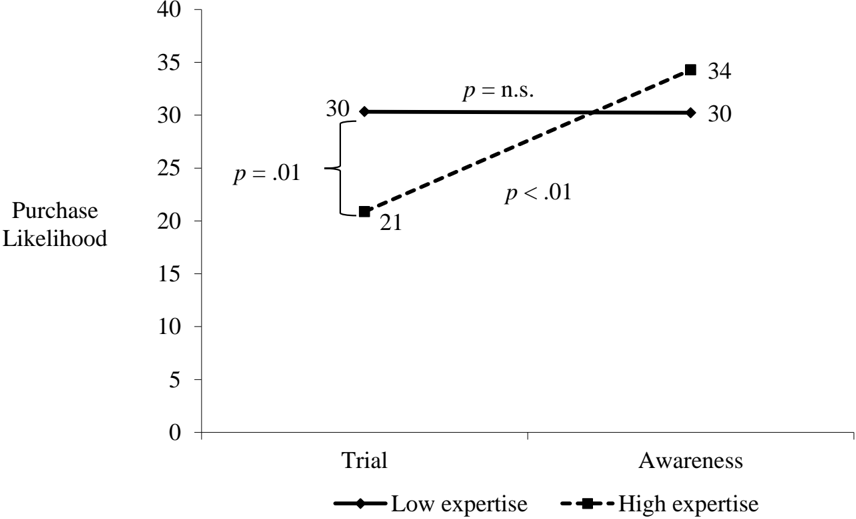
- Study 2 (N = 395 mothers) replicated the expertise × campaign intent interaction on purchase likelihood (F(1, 387) = 8.88, p < .01): with high expertise, awareness > trial (M = 34.10 vs. 20.66, p < .01); with low expertise, no difference (M = 30.24 vs. 30.29, p = .7106).
Methods
- Study 1 used real in-market data from The Motherhood agency: 1,830 sponsored posts by 595 bloggers across 57 campaigns (September 2012–December 2016); final analysis N = 1,237 due missing data. Dependent variables were number of blog post comments and Facebook post likes; negative binomial models with Heckman selection.
- Independent variables included campaign intent (awareness vs. trial), blogger expertise (sum of educational affiliation and blogger credentials, 0–2), hedonic and functional post value from coder factor analysis, campaign giveaways, follower counts, and controls.
- Study 2 was a 2 (expertise: high/low) × 2 (campaign: awareness/trial) between-subjects experiment with a Qualtrics panel of mothers (N = 395), using an educational paid app (Water Bears); the dependent variable was purchase likelihood.
Limitations
- Stated: the paper did not directly test ROI or sales, used post hoc coder ratings for sentiment, did not include a field experiment on blogger choice, and used bloggers’ network size at the time of posts without past performance/longevity; it also notes platforms evolve and ethical debates around sponsorship disclosure.
- Evident from text: Study 1 relies on one blogging agency and “mommy” bloggers, with missing data reducing the sample from 1,830 to 1,237; coder reliability for sentiment was modest (average α = .51, median = .56), and the field data are observational, limiting causal claims.
Model-written summary. Check it against the paper before relying on it.
Integrity signals
Registry
Cites
Statistics
Figures
Verification
Claims the paper makes
1 Valid · 0 Not valid · 18 Not checked · 125 Own results and interpretations
The sources with a verdict support this claim; the rest weren’t checked yet, have no full text we could read, or their verdicts aren’t rated yet.
In the paper
“we used the methodology Shrout and Fleiss (1979) describe and computed the Shrout-Fleiss single ICC score agreement of .998, which is considered quite high (Koo and Li 2016).”
What the sources say
- Not checked — no full text of the sourcecites Shrout and Fleiss (1979) matched to “Intraclass correlations: Uses in assessing rater reliability.” (1979) source
- Supportedcites Koo and Li 2016 matched to “A guideline of selecting and reporting intraclass correlation coefficients for reliability research” (2016) source
The ICC Interpretation passage (Introduction) classifies ICC values greater than 0.90 as indicating excellent reliability, supporting the description of .998 as quite high. The cited paper does not establish the citing authors’ computed score; the citation is attached to its interpretation. (LLM, conf=0.93)
plain- Asserted: passes — The authors put it forward as true.
- Checkable: passes — It can be checked against evidence.
- Load-bearing: unclear — It is unclear whether the paper’s conclusions depend on it.
- Based: passes — The paper gives a reason why it holds.
A result the paper reports from its own data — it cites no other source for it, so there is none to check. The quote shows it is in the paper.
In the paper
“When a sponsored post occurs on Facebook, posts high in hedonic content are more effective when the advertising intent is to increase trial versus raise awareness.”
plainstates a cause- Asserted: passes — The authors put it forward as true.
- Checkable: passes — It can be checked against evidence.
- Load-bearing: passes — The paper’s conclusions depend on it.
- Based: passes — The paper gives a reason why it holds.
A result the paper reports from its own data — it cites no other source for it, so there is none to check. The quote shows it is in the paper.
In the paper
“When a sponsored post occurs on a blog, high blogger expertise is more effective when the advertising intent is to raise awareness versus increase trial.”
- Also stated in: § Statement of Intended Contribution · p. 5 · plain
“In addition, blogger expertise exerts a greater impact in awareness (vs. trial) campaigns.”
plainstates a cause- Asserted: passes — The authors put it forward as true.
- Checkable: passes — It can be checked against evidence.
- Load-bearing: passes — The paper’s conclusions depend on it.
- Based: passes — The paper gives a reason why it holds.
- Also stated in: § Statement of Intended Contribution · p. 5 · plain
A result the paper reports from its own data — it cites no other source for it, so there is none to check. The quote shows it is in the paper.
In the paper
“However, source expertise fails to drive engagement when the sponsored post occurs on Facebook.”
plain- Asserted: passes — The authors put it forward as true.
- Checkable: passes — It can be checked against evidence.
- Load-bearing: passes — The paper’s conclusions depend on it.
- Based: passes — The paper gives a reason why it holds.
A result the paper reports from its own data — it cites no other source for it, so there is none to check. The quote shows it is in the paper.
In the paper
“We find that hedonic value has a significant effect on both blog and Facebook platforms.”
plainstates a cause- Asserted: passes — The authors put it forward as true.
- Checkable: passes — It can be checked against evidence.
- Load-bearing: passes — The paper’s conclusions depend on it.
- Based: passes — The paper gives a reason why it holds.
60 more claims
Create a free account to see all 144 claims and to verify the 2 references still open.
- It may state two separate claims as one. 43
- Probably not a substantial claim. 39
- The quote only partly states this claim. 10
Claims other papers make about this one
Each is checked against this paper’s own text: does it say what the citing paper says it does?
The cited source doesn’t support the claim as written.
In the citing paper
“Hughes, Swaminathan, and Brooks (2019) found that Facebook influencer campaigns that included incentives significantly increased the number of post comments.”
From Influencer Marketing on Instagram: Empirical Research on Social Media Engagement with Sponsored Posts (2022) · cites this paper as Hughes, Swaminathan, and Brooks (2019)
Checked by a reasoning model — may be wrong.
Experimental — accuracy not yet measuredThe source backs part of the claim, not all of it — or backs it for a different population, condition or comparison.
In the citing paper
“Social media platforms represent low-involvement, high-distraction, and hedonic environments (Hughes, Swaminathan, and Brooks 2019; Schulze, Sch€ oler, and Skiera 2014).”
From Influencer Marketing on Instagram: Empirical Research on Social Media Engagement with Sponsored Posts (2022) · cites this paper as Hughes, Swaminathan, and Brooks 2019
Experimental — accuracy not yet measuredThe cited source says what the claim attributes to it.
In the citing paper
“social media engagement is an important key performance indicator (KPI) to measure the success of sponsored posts on social media (Hughes, Swaminathan, and Brooks 2019;Lammenett 2019).”
From Influencer Marketing on Instagram: Empirical Research on Social Media Engagement with Sponsored Posts (2022) · cites this paper as Hughes, Swaminathan, and Brooks 2019
The cited source says what the claim attributes to it.
In the citing paper
“Previous research suggest that hedonic value can have an impact on post interaction and popularity (De Vries, Gensler, and Leeflang 2012;Hughes, Swaminathan, and Brooks 2019;Sabate et al. 2014).”
From Influencer Marketing on Instagram: Empirical Research on Social Media Engagement with Sponsored Posts (2022) · cites this paper as Hughes, Swaminathan, and Brooks 2019
The cited source says what the claim attributes to it.
In the citing paper
“Likes and comments are KPIs in influencer marketing (Hughes, Swaminathan, and Brooks 2019).”
From Influencer Marketing on Instagram: Empirical Research on Social Media Engagement with Sponsored Posts (2022) · cites this paper as Hughes, Swaminathan, and Brooks 2019
2 more claims about this paper
Create a free account to see every claim other papers make about this one.
Statistics that don’t add up
Each reported p-value recomputed from its test statistic and degrees of freedom, each partial η² from its F, and each ratio, mean difference or B printed with a p checked against its own confidence interval.
Rated minor: it would not touch a result — a value no result rests on, a p-value that stays on the same side of the significance level, or a conflict that is clerical, resolved elsewhere in the paper, or outside its own findings.
In the paper
“F(3, 260) = 3.61, p < .01”
Reported p < .01 · recomputed p = .014
Statistics recomputed
Every reported test result, recomputed from its test statistic and degrees of freedom. A result shows as not adding up only once an independent check has confirmed it.
- Doesn’t add upF(3, 260) = 3.61reported p < .01 · recomputed p = .014
“F(3, 260) = 3.61, p < .01”
- Not confirmedz = -0.06reported p = .95 · recomputed p = .952
“(z = -.060, p = .950”
- ConsistentF(3, 260) = 7.22reported p < .01 · recomputed p < .001
“F(3, 260) = 7.22, p < .01”
- Consistentz = 1.22reported p = .223 · recomputed p = .222
“(z = 1.22, p = .223”
- ConsistentF(3, 93) = 20.13reported p < .01 · recomputed p < .001
“F(3, 93) = 20.13, p < .01”
8 more recomputed tests
Create a free account to see every test the Stats check recomputed.
Self-check
Percentages, sums and reported differences re-computed from the paper’s own numbers.
Each contradiction between two passages listed here was confirmed by an independent check.
Rated minor: it would not touch a result — a value no result rests on, a p-value that stays on the same side of the significance level, or a conflict that is clerical, resolved elsewhere in the paper, or outside its own findings.
In the paper
§ Discussion · p. 29
“However, the results in Study 1 are driven by high expertise, while the results in Study 2 are driven by differences due to low expertise.”
§ Method and Results · p. 29
“Next, examining purchase likelihood under low blogger expertise, we found no significant difference between awareness and trial campaigns (Mawareness = 30.24, Mtrial = 30.29; F(1, 387) = .14, p = .7106)”
Citations
Cites
A guideline of selecting and reporting intraclass correlation coefficients for reliability research
Koo, T. K., & Li, M. Y. (2016) · Journal of Chiropractic Medicine · doi:10.1016/j.jcm.2016.02.012 · Cited by 31,709
Sample Selection Bias as a Specification Error
Heckman, J. J. (1979) · Econometrica · doi:10.2307/1912352 · Cited by 28,779
Intraclass correlations: Uses in assessing rater reliability.
Shrout, P. E., & Fleiss, J. L. (1979) · Psychological Bulletin · doi:10.1037/0033-2909.86.2.420 · Cited by 24,532
The Elaboration Likelihood Model of Persuasion
Petty, R. E., & Cacioppo, J. T. (1986) · Advances in Experimental Social Psychology · doi:10.1016/s0065-2601(08)60214-2 · Cited by 8,822 · cited 3×
“Our theoretical basis for predictions derives from the literature on the elaboration likelihood model (ELM) (Petty and Cacioppo 1986).”
BackgroundMethodHennig-Thurau, T., Gwinner, K. P., Walsh, G., & Gremler, D. D. (2004) · Journal of Interactive Marketing · doi:10.1002/dir.10073 · Cited by 5,916
A study of normative and informational social influences upon individual judgment.
Deutsch, M., & Gerard, H. B. (1955) · The Journal of Abnormal and Social Psychology · doi:10.1037/h0046408 · Cited by 4,819 · cited 1×
“This can derive from informational power, in which the expert has knowledge that others do not have (Deutsch and Gerard 1955).”
BackgroundDimensions of Consumer Expertise
Alba, J. W., & Hutchinson, J. W. (1987) · Journal of Consumer Research · doi:10.1086/209080 · Cited by 4,375
Ohanian, R. (1990) · Journal of Advertising · doi:10.1080/00913367.1990.10673191 · Cited by 4,043
The Influence of Source Credibility on Communication Effectiveness
Hovland, C. I., & Weiss, W. (1951) · Public Opinion Quarterly · doi:10.1086/266350 · Cited by 3,543 · cited 1×
“Source expertise affects attitude change (Hovland and Weiss 1951; McCracken 1989; Ohanian 1991), level of confidence and positivity (Tormala, Briñol, and Petty 2007), and behavioral changes (Crisci and Kassinove 1973) and leads to higher levels of persuasion (Petty and Wegener 1998).”
BackgroundThe Elaboration Likelihood Model of Persuasion
Petty, R. E., & Cacioppo, J. T. (1986) · Communication and Persuasion · doi:10.1007/978-1-4612-4964-1_1 · Cited by 3,202
Research works printed but not linked: 3
- Association of National Advertisers (2018), 'Advertisers Love Influencer Marketing: ANA Study,' press release, https://www.ana.net/content/show/id/48437.
- French, John and Bertram Raven (1959), 'The Bases of Social Power,' in Studies in Social Power , Dorwin Cartwright, ed. Ann Arbor: University of Michigan, 150-67.
- Zhu, June and Bernard Tan (2007), 'Effectiveness of Blog Advertising: Impact of Communicator Expertise, Campaign intent, and Product Involvement,' in ICIS 2007 Proceedings - Twenty Eighth International Conference on Information Systems . Atlanta: Association for Information Systems, paper 121.
Cited by
Items 101–200 of 779
Internet Celebrities’ Impact on Luxury Fashion Impulse Buying
Chen, M., Xie, Z., Zhang, J., & Li, Y. (2021) · Journal of Theoretical and Applied Electronic Commerce Research · doi:10.3390/jtaer16060136 · Cited by 56
“, [9,12,26]), expertise exerts impact on platform engagement [24,27], and trustworthiness contributes to brand awareness and buying intention [25,28].”
BackgroundTafesse, W., & Dayan, M. (2023) · Journal of Retailing and Consumer Services · doi:10.1016/j.jretconser.2023.103357 · Cited by 108
Tafesse, W., & Wood, B. P. (2022) · Journal of Product & Brand Management · doi:10.1108/jpbm-02-2022-3851 · Cited by 85
The Power of Influencers: How Does Influencer Marketing Shape Consumers’ Purchase Intentions?
Chen, Y., Qin, Z., Yan, Y., & Yi, H. (2024) · Sustainability · doi:10.3390/su16135471 · Cited by 199
“This is consistent with the findings of Hughes et al. (2019), who, through empirical research on social media influencers, discovered that bloggers’ expertise and blog content significantly affect online brand engagement and purchase intentions [57].”
Kanuri, V. K., Hughes, C., & Hodges, B. T. (2023) · International Journal of Research in Marketing · doi:10.1016/j.ijresmar.2023.08.007 · Cited by 76
Self-citationHow does entrepreneurial orientation and SDG orientation of CEOs evolve before and during a pandemic
Yadav, H., Kar, A. K., & Kashiramka, S. (2021) · Journal of Enterprise Information Management · doi:10.1108/jeim-03-2021-0149 · Cited by 68
How being envied shapes tourists’ relationships with luxury brands: A dual-mediation model
Feng, W., Yu, I. Y., Yang, M. X., & Yi, M. (2021) · Tourism Management · doi:10.1016/j.tourman.2021.104344 · Cited by 51
Cheng, Y., Hung‐Baesecke, C. F., & Chen, Y.-R. R. (2021) · International Journal of Business Communication · doi:10.1177/23294884211035112 · Cited by 79
“…consumers engage in the promoted CSR initiative through behavioral and/or communicative actions (i.e., CSR communication engagement), not only following the SMI’s advice but also strengthening their (para-social) relationships with the SMI (Hughes et al., 2019; Ki & Kim, 2019; Shan et al., 2020).”
BackgroundMagatef, S. G., Al‐Okaily, M., Ashour, L. M., & Abuhussein, T. (2023) · Journal of Open Innovation Technology Market and Complexity · doi:10.1016/j.joitmc.2023.100149 · Cited by 133
“Hughes et al. (2019) show the positive impact of customisation on customer perceptions and its reflection on the quality of electronic The square-root of the average variance extracted (AVE) is printed in bold on the diagonal. services, creating loyalty.”
BackgroundMethodLeveraging online selling through social media influencers
Shuqair, S., Filieri, R., Viglia, G., Mattila, A. S., & Pinto, D. C. (2023) · Journal of Business Research · doi:10.1016/j.jbusres.2023.114391 · Cited by 65
Influencer-Generated Reference Groups
Lee, J. K., & de Fortuny, E. J. (2021) · Journal of Consumer Research · doi:10.1093/jcr/ucab056 · Cited by 61
Rutter, R. N., Barnes, S. J., Roper, S., Nadeau, J. P., & Lettice, F. (2021) · Industrial Management & Data Systems · doi:10.1108/imds-02-2021-0093 · Cited by 72
Tweets We Like Aren’t Alike: Time of Day Affects Engagement with Vice and Virtue Tweets
Zor, O., Kim, K. H., & Monga, A. (2021) · Journal of Consumer Research · doi:10.1093/jcr/ucab072 · Cited by 51
Huang, W., Wang, X., Zhang, Q., Zhang, R., & Zhang, R. (2024) · Journal of Retailing and Consumer Services · doi:10.1016/j.jretconser.2024.104199 · Cited by 99
Park, S., Strover, S., Choi, J. R., & Schnell, M. (2021) · New Media & Society · doi:10.1177/14614448211014355 · Cited by 66
“It thus should come as no surprise that Hughes et al. (2019) characterize Facebook as a low-involvement platform that rewards hedonic posts with more engagement, echoing Bakir and McStay’s (2018) points.”
BackgroundSundermann, G., & Munnukka, J. (2022) · Journal of Interactive Marketing · doi:10.1177/10949968221087256 · Cited by 70
“commercialism as well as user groups and their respective usage motives, differ across social network platforms (e.g., Hudders et al., 2020; Hughes et al., 2019; Kozinets et al., 2010), future studies should test the constructed model in the context of other social media platforms (e.”
BackgroundZhang, X., Zhao, Z., & Wang, K. (2023) · Journal of Research in Interactive Marketing · doi:10.1108/jrim-02-2023-0069 · Cited by 62
Jiang, K., Qin, M., Deng, D., & Zhou, D. (2024) · Journal of Consumer Behaviour · doi:10.1002/cb.2451 · Cited by 58
The Risk of Programmatic Advertising: Effects of Website Quality on Advertising Effectiveness
Shehu, E., Nabout, N. A., & Clément, M. (2020) · International Journal of Research in Marketing · doi:10.1016/j.ijresmar.2020.10.004 · Cited by 67
Social comparison orientation and frequency: A study on international travel bloggers
Mariani, M. M., Styvén, M. E., & Nataraajan, R. (2020) · Journal of Business Research · doi:10.1016/j.jbusres.2020.09.070 · Cited by 49
Effect of personal branding stereotypes on user engagement on short-video platforms
Wei, Z., Zhang, M., & Qiao, T. (2022) · Journal of Retailing and Consumer Services · doi:10.1016/j.jretconser.2022.103121 · Cited by 60
Saeed, R., Khan, H., Lee, R., Lockshin, L., Bellman, S., Cohen, E., & Yang, S. H. (2024) · Journal of Business Research · doi:10.1016/j.jbusres.2024.114870 · Cited by 57
Hochstein, R. E., Harmeling, C. M., & Perko, T. (2025) · Journal of the Academy of Marketing Science · doi:10.1007/s11747-023-00982-y · Cited by 45
“…i on s I n t e r n a ti on a l F e s ti v a l o f C r ea ti v it y We expect our proposed necessary conditions for consumer digital trust also have implications for social media influencers wo blur the line between economic interest and appearing like peers (Chen et al., 2023; Hughes et al., 2019).”
Digital consumer engagement in a social network: A literature review applying TCCM framework
Saikia, W., & Bhattacharjee, A. (2023) · International Journal of Consumer Studies · doi:10.1111/ijcs.12981 · Cited by 70
Sheng, J., Lee, Y., & Lan, H. (2023) · Internet Research · doi:10.1108/intr-12-2021-0903 · Cited by 61
Reputation Burning: Analyzing the Impact of Brand Sponsorship on Social Influencers
Cheng, M. (., & Zhang, S. (2025) · Management Science · doi:10.1287/mnsc.2023.00193 · Cited by 55
High on Bitcoin: Evidence of emotional contagion in the YouTube crypto influencer space
Meyer, E. A., Sandner, P., Cloutier, B., & Welpe, I. M. (2023) · Journal of Business Research · doi:10.1016/j.jbusres.2023.113850 · Cited by 58
Gurrieri, L., Drenten, J. M., & Abidin, C. (2023) · Journal of Marketing Management · doi:10.1080/0267257x.2023.2255053 · Cited by 56
“practical aspects of influencer marketing: how brands can profit from influencers (Hughes et al., 2019; Ki & Kim, 2019; Leung et al., 2022; Lou & Yuan, 2019; Martínez-López et al., 2020; Reinikainen et al., 2020), the functional components of influencer marketing (Brooks et al.”
BackgroundVirtual idol marketing: Benefits, risks, and an integrated framework of the emerging marketing field
Yu, Y., Kwong, S. C., & Bannasilp, A. (2023) · Heliyon · doi:10.1016/j.heliyon.2023.e22164 · Cited by 66
“The hedonic value of content refers to the enjoyment, emotions, and entertainment that audiences experience from the content [47].”
Alnoor, A., Abbas, S., Khaw, K. W., Muhsen, Y. R., & Chew, X. (2024) · Journal of Retailing and Consumer Services · doi:10.1016/j.jretconser.2024.104057 · Cited by 59
E-Commerce Influencers in China: Dual-Route Model on Likes, Shares, and Sales
Hung, K. H., Tse, D. K., & Chan, T. H. (2021) · Journal of Advertising · doi:10.1080/00913367.2021.1990811 · Cited by 54
“While it began as short videos posted on social media platforms, these genuine and person-to-person instances of sharing fun, entertaining product usage tips among friends have become a salient force in the advertising industry (Hughes, Swaminathan, and Brooks 2019).”
BackgroundLiao, J., & Chen, J. (2024) · Journal of Business Research · doi:10.1016/j.jbusres.2024.114937 · Cited by 86
Kay, S., Mulcahy, R. F., Sutherland, K. E., & Lawley, M. (2022) · Journal of Marketing Management · doi:10.1080/0267257x.2022.2118815 · Cited by 59
“…influencers as more credible than brands brings new insight to the literature, which may explain why previous studies have predominately focused solely on measuring the influencer’s source credibility (Lou & Yuan, 2019; Reinikainen et al., 2020) and how this drives engagement (Hughes et al., 2019).”
BackgroundResultSponsorship Disclosure on social media: literature review and future research agenda
Jhawar, A., Varshney, S., & Kumar, P. (2023) · Management Review Quarterly · doi:10.1007/s11301-023-00342-8 · Cited by 53
“The discussion on sponsorship disclosure originates from brand-sponsored word-of-mouth (WOM) promotions (i.e., posts/advertisements) on social media by influencing agents such as influencers, celebrities, YouTubers, and bloggers (Lou 2022; Hughes et al. 2019).”
Dinh, T. C. T., Wang, M., & Lee, Y. (2023) · SAGE Open · doi:10.1177/21582440231197259 · Cited by 110
“For example, perceived expertise increases followers’ engagement (Hughes et al., 2019) and buying intention (Uribe et al., 2016) because influencers are perceived as experts in their specific fields (Hudders et al., 2021).”
BackgroundWalsh, D., Kliamenakis, A., Laroche, M., & Jabado, S. (2024) · Psychology and Marketing · doi:10.1002/mar.22075 · Cited by 84
Effects of air quality and weather conditions on Chinese tourists’ emotional experience
Wang, Y. W., Yang, Y., Huang, S. S., Huang, L., & Sun, W. (2021) · Journal of Hospitality and Tourism Management · doi:10.1016/j.jhtm.2021.05.012 · Cited by 44
Does your style engage? Linguistic styles of influencers and digital consumer engagement on YouTube
Munaro, A. C., Barcelos, R. H., Maffezzolli, E. C. F., Rodrigues, J. P. S., & Paraíso, E. C. (2024) · Computers in Human Behavior · doi:10.1016/j.chb.2024.108217 · Cited by 66
How can live streamers enhance viewer engagement in eCommerce streaming?
Liu, G. H. W., Mengdi, S., & Lee, N. C.-A. (2021) · Hawaii International Conference on System Sciences (HICSS) · doi:10.24251/hicss.2021.375 · Cited by 63
“It typically reflects in three subdimensions: behavioral engagement, affective engagement and cognitive engagement [25, 27-31].”
BackgroundHult, G. T. M., Morgeson, F. V., Sharma, U., & Fornell, C. (2022) · Journal of International Business Studies · doi:10.1057/s41267-022-00546-2 · Cited by 69
Social media influencers: literature review, trends and research agenda
Tanwar, A. S., Chaudhry, H., & Srivastava, M. K. (2023) · Journal of Advances in Management Research · doi:10.1108/jamr-10-2022-0218 · Cited by 64
Duong, N. T., Lin, H., Wu, T. C., & Wang, Y. (2024) · International Journal of Human-Computer Interaction · doi:10.1080/10447318.2024.2423332 · Cited by 91
The effect of green influencer message characteristics: Framing, construal, and timing
König, S., & Maier, E. (2024) · Psychology and Marketing · doi:10.1002/mar.22021 · Cited by 51
Standing out or fitting in? How perceived autonomy affects virtual influencer marketing outcomes
Zheng, X., Miao, M., Zhang, L., & Huang, L. Y. (2024) · Journal of Business Research · doi:10.1016/j.jbusres.2024.114917 · Cited by 46
Suri, A., Huang, B., & Sénécal, S. (2023) · International Journal of Electronic Commerce · doi:10.1080/10864415.2023.2226898 · Cited by 47
“have ultimate control over the advertised message [32].”
BackgroundThe creator’s dilemma: Resolving tensions between authenticity and monetization in social media
Hofstetter, R., & Gollnhofer, J. (2024) · International Journal of Research in Marketing · doi:10.1016/j.ijresmar.2024.07.001 · Cited by 51
Building Brands for the Emerging Bicultural Market: The Appeal of Paradox Brands
Rodas, M. A., John, D. R., & Torelli, C. J. (2021) · Journal of Consumer Research · doi:10.1093/jcr/ucab037 · Cited by 41
Singh, K. (2021) · European Integration Studies · doi:10.5755/j01.eis.1.15.28803 · Cited by 86
“These activities are called engagement and are a variable that determines how effective an influencer is for marketing purposes (Hughes et al., 2019).”
BackgroundEntrepreneurial influencers and influential entrepreneurs: two sides of the same coin
Guiñez-Cabrera, N. A., & Aqueveque, C. (2021) · International Journal of Entrepreneurial Behaviour & Research · doi:10.1108/ijebr-08-2020-0563 · Cited by 53
Wear in or wear out: how consumers respond to repetitive influencer marketing
Geng, R., Chen, X., & Wang, S. (2024) · Internet Research · doi:10.1108/intr-01-2022-0075 · Cited by 39
Framing the customer journey: touch point categories and decision-making process stages
Towers, A., & Towers, N. (2021) · International Journal of Retail & Distribution Management · doi:10.1108/ijrdm-08-2020-0296 · Cited by 88
Environmental factors to maximize social media engagement: A comprehensive framework
Reimer, T. (2023) · Journal of Retailing and Consumer Services · doi:10.1016/j.jretconser.2023.103458 · Cited by 56
Benito, S. M., Illera, A. E., & Fernández, E. O. (2020) · Communication & Society · doi:10.15581/003.33.3.149-166 · Cited by 45
Zhao, X. Q., Xu, Z., Ding, F., & Li, Z. (2024) · SAGE Open · doi:10.1177/21582440241250122 · Cited by 100
“Prior research has shown that influencers can be more effective at recommending products or brands than traditional advertising formats, due in part to their perceived credibility (Audrezet et al., 2020; Hughes et al., 2019).”
Neuhaus, T., Millemann, J. A., & Nijssen, E. (2022) · Industrial Marketing Management · doi:10.1016/j.indmarman.2022.08.006 · Cited by 59
How to Make Influencer Advertising Engaging on Instagram: Emotional Storytelling in Sponsored Posts
Gross, J., Cui, Z., & von Wangenheim, F. (2023) · Journal of Interactive Advertising · doi:10.1080/15252019.2023.2211579 · Cited by 64
“We provide two important contributions that help build influencer marketing as a unique literature stream by exploring its efficiency from a dual perspective (Hughes et al. 2019; Oh, Keller, and Neslin 2020; Voorveld 2019).”
BackgroundResultInfluentialPourazad, N., Stocchi, L., & Narsey, S. (2023) · Journal of Advertising Research · doi:10.2501/jar-2023-008 · Cited by 55
Aboelenien, A., Baudet, A., & Chow, A. M. (2023) · Journal of Marketing Management · doi:10.1080/0267257x.2023.2218853 · Cited by 44
Ozuem, W., Willis, M., Ranfagni, S., Howell, K. E., & Rovai, S. (2023) · Information Technology and People · doi:10.1108/itp-05-2022-0371 · Cited by 47
Liu, Q., Yu, S. K., & Yang, Y. (2023) · Computers in Human Behavior · doi:10.1016/j.chb.2023.107969 · Cited by 46
Rahman, W. N. A., Mutum, D. S., & Ghazali, E. M. (2022) · International Journal of E-Services and Mobile Applications · doi:10.4018/ijesma.295960 · Cited by 107
“Companies have invested in influencers for their social media marketing because influencers are critical for a stronger brand presence and greater outreach, as well as having considerable control of the pre- and post-purchase elements of the customer journey (Hughes et al. 2019; Erz, Marder, & Osadchaya, 2018; Schivin…”
BackgroundHow do consumers interact with social media influencers in extraordinary times?
Saldanha, N., Mulye, R., & Japutra, A. (2023) · Journal of Research in Interactive Marketing · doi:10.1108/jrim-02-2023-0062 · Cited by 44
Rungruangjit, W., & Charoenpornpanichkul, K. (2022) · Sustainability · doi:10.3390/su142315770 · Cited by 59
Liu, Y., Liu, X., Wang, M., & Wen, D. (2021) · Frontiers in Psychology · doi:10.3389/fpsyg.2021.800766 · Cited by 81
“Weekend post has a significant impact on enterprise content strategy, and we use it to capture weekend and weekday seasonality (Hughes et al., 2019).”
MethodVideo Influencers: Unboxing the MystiquePreprint
Rajaram, P., & Manchanda, P. (2020) · SSRN Electronic Journal · doi:10.2139/ssrn.3752107 · Cited by 32
“Influencer marketing literature that analyzes textual data has found that high influencer expertise on sponsored blog posts is more effective in increasing comments below the blog if the advertising intent is to raise awareness versus increasing trial (Hughes et al., 2019).”
InfluentialManaging the tensions in marketer-influencer relationships
McMullan, K., Laurell, C., & PITT, L. F. (2021) · Business Horizons · doi:10.1016/j.bushor.2021.09.003 · Cited by 45
Social Media Influencers as Mediators of Commercial Messages
Vanninen, H., Mero, J., & Kantamaa, E. (2022) · Journal of Internet Commerce · doi:10.1080/15332861.2022.2096399 · Cited by 49
“Consequently, it has become crucial for academics and practitioners to understand how to strategically employ influencers as part of the marketing mix (Appel et al. 2020; Dwivedi et al. 2021; Haenlein et al. 2020; Hughes, Swaminathan, and Brooks 2019).”
BackgroundHow to convert Millennial consumers to brand evangelists through social media micro-influencers
Pornsrimate, K., & Khamwon, A. (2021) · Innovative Marketing · doi:10.21511/im.17(2).2021.03 · Cited by 45
“…attachment (Tang, 2016), brand image (Dreifaldt & Drennan, 2019), brand trust (Bijen, 2017; Kolarova, 2018), brand engagement (Hollebeek & Macky, 2019; Hughes et al., 2019; Pornsrimate & Khamwon, 2020; Rooderkerk & Pauwels, 2016), brand love, and brand evangelism (Pornsrimate & Khamwon, 2020).”
InfluentialWalter, N., Föhl, U., & Zagermann, L. (2024) · Journal of Current Issues & Research in Advertising · doi:10.1080/10641734.2024.2366198 · Cited by 44
“Other studies focusing on expertise have found that this factor impacts success: Hughes, Swaminathan, and Brooks (2019) show that blogger expertise (measured by the presence of the indivdual’s educational affiliation and blogger credentials in his or her profile) positively impacts blog engagement.”
Supriani, I., Ninglasari, S. Y., & Iswati, S. (2024) · Journal of Islamic marketing · doi:10.1108/jima-02-2024-0085 · Cited by 81
Nabivi, E. (2025) · Sustainability · doi:10.3390/su17051965 · Cited by 82
“Among these digital platforms, social media stand out as effective channels for green marketing [3–5].”
Zhou, F., Su, Q., & Mou, J. (2021) · Technology in Society · doi:10.1016/j.techsoc.2021.101571 · Cited by 34
Presentation of celebrities’ private life through visual social media
Klostermann, J., Meißner, M., Max, A., & Decker, R. (2022) · Journal of Business Research · doi:10.1016/j.jbusres.2022.113524 · Cited by 39
Influencers and the attention economy: the meaning and management of attention on Instagram
Kubler, K. (2023) · Journal of Marketing Management · doi:10.1080/0267257x.2022.2157864 · Cited by 49
Pawsitively powerful: Why and when pet influencers boost social media effectiveness
Cioccio, M. D., Pozharliev, R., & Angelis, M. D. (2024) · Psychology and Marketing · doi:10.1002/mar.22000 · Cited by 42
“Hughes et al. (2019), for instance, showed that source credibility increases online engagement.”
The impact of social media influencers on the financial market performance of firms
Keasey, K., Lambrinoudakis, C., Mascia, D. V., & Zhang, Z. (2024) · European Financial Management · doi:10.1111/eufm.12513 · Cited by 55
The invisible leash: when human brands hijack corporate brands' consumer relationships
Giertz, J. N., Hollebeek, L. D., Weiger, W. H., & Hammerschmidt, M. (2022) · Journal of service management · doi:10.1108/josm-06-2021-0211 · Cited by 38
Xu, S., & Xiong, Y. (2020) · Public Relations Review · doi:10.1016/j.pubrev.2020.101959 · Cited by 36
Buying Future Endorsements from Prospective Influencers on User-Generated Content Platforms
Lanz, A., Goldenberg, J., Shapira, D., & Stahl, F. (2023) · Journal of Marketing Research · doi:10.1177/00222437231207323 · Cited by 30
“We assume that there are observable proxies of fi nancial success — such as network status (e.g., followers) or content-consumption level — which are positively correlated with revenues, a common assumption in the seeding literature (e.g., Hughes, Swaminathan, and Brooks 2019).”
ResultDO DIGITAL INFLUENCERS SUCCESSFULLY CONTRIBUTE TO REDUCING THE GAP BETWEEN CUSTOMERS AND COMPANIES?
Moreira, I., Stenzel, P., Lopes, J. M., & Oliveira, J. (2021) · Brazilian Business Review · doi:10.15728/bbr.2021.18.6.4 · Cited by 62
“However, there is little information about the factors that drive successful online brand engagement (Hughes, Swaminathan, & Brooks, 2019).”
BackgroundSocial Media Influencer Promoted Sustainable Fashion: Effects of Sponsorship and Benefit Association
Kapoor, P. S., Tagore, A., & Dua, S. (2022) · Journal of Promotion Management · doi:10.1080/10496491.2022.2163034 · Cited by 40
“Therefore, SMI-generated posts combine paid and earned media aspects, according to Hughes et al. (2019).”
BackgroundKumar, A., Rayne, D., Salo, J., & Yiu, C. S. (2024) · Australasian Marketing Journal (AMJ) · doi:10.1177/14413582241247391 · Cited by 62
“Likewise, Hughes et al. (2019) found that sponsored blogging affects customer engagement (e.g. via comments and likes).”
Influential'Meat' the Influencers: Crafting Authentic Endorsements that Drive Willingness to Buy Cultured Meat.
Leite, F. P., Septianto, F., & Pontes, N. (2024) · Appetite · doi:10.1016/j.appet.2024.107401 · Cited by 24
“…landscape, social media influencers have progressively become opinion leaders by disseminating product information through online platforms (Hughes et al., 2019) and have emerged as a vital source of influence throughout the customer ’ s F.P. Leite et al. decision journey (Hamilton et al.,…”
BackgroundInfluentialA review of strategic decision-making in marketing through big data and analytics
Nnaji, U. O., Benjamin, L. B., Eyo-Udo, N. L., & Etukudoh, E. A. (2024) · Magna Scientia Advanced Research and Reviews · doi:10.30574/msarr.2024.11.1.0077 · Cited by 66
“Additionally, data-driven insights help in allocating resources more efficiently, ensuring that marketing budgets are invested in strategies that yield the highest return on investment (Chaffey & Smith, 2022; Hughes, Swaminathan, & Brooks, 2019).”
BackgroundWe match! Building online brand engagement behaviours through emotional and rational processes
Ballester, E., Ruiz, C., Rubio, N., & Veloutsou, C. A. (2024) · Journal of Retailing and Consumer Services · doi:10.1016/j.jretconser.2024.104146 · Cited by 45
“…relationships with followers to stimulate engagement (Ye et al., 2021; Cheung et al., 2022), leaving the link between the two uncertain in contexts that users extensively follow digital influencers by consuming their content, posting comments, and seeking information (Hughes et al., 2019).”
Shin, H., & Perdue, R. R. (2022) · Journal of Travel Research · doi:10.1177/00472875211073618 · Cited by 35
“Due to the continuing growth of online platforms and social media, customers have more and more opportunities to interact with brands (de Oliveira Santini et al. 2020; Hughes, Swaminathan, and Brooks 2019).”
BackgroundPost-Story: Influence of Introducing Story Feature on Social Media Posts
Alibakhshi, R., & Srivastava, S. C. (2022) · Journal of Management Information Systems · doi:10.1080/07421222.2022.2063550 · Cited by 38
“Additionally, literature suggests that creation of SM posts by profile owners assists in establishing their influence within the follower community [25, 46, 55].”
BackgroundInfluentialSeeing is Believing: Does Live Streaming E-commerce Make Brands More Shoppable?Preprint
Zhang, L., SETHI, S. P., & Zhang, Y. (2022) · SSRN Electronic Journal · doi:10.2139/ssrn.3992063 · Cited by 33
Perera, C. H., Nguyen, L. T. V., & Nayak, R. (2023) · International Journal of Educational Management · doi:10.1108/ijem-05-2023-0260 · Cited by 67
Cao, N., Isa, N. M., Perumal, S., & Chen, C. (2025) · Journal of theoretical and applied electronic commerce research · doi:10.3390/jtaer20020150 · Cited by 85
Kihal, S. E., & Shehu, E. (2022) · Journal of Retailing · doi:10.1016/j.jretai.2022.01.002 · Cited by 36
Akram, M. S., Malhotra, N., Goraya, M. A. S., Shareef, M. A., Malik, A., & Lal, B. (2022) · Technological Forecasting and Social Change · doi:10.1016/j.techfore.2022.121771 · Cited by 37
Cheng, Z. “., Plangger, K. A., Cai, F., Campbell, C. L., & PITT, L. F. (2022) · European Journal of Marketing · doi:10.1108/ejm-11-2021-0922 · Cited by 45
The impact of influencer-sourced brand endorsement on online consumer brand engagement
Gupta, S., Mahajan, R., & Dash, S. B. (2023) · Journal of Strategic Marketing · doi:10.1080/0965254x.2023.2200389 · Cited by 36
“Various aspects related to SMIs’ branded content, like visual aesthetics, informativeness (C. W. C. Ki et al., 2020; C. W. Ki & Kim, 2019), interactive content (C. W. Ki & Kim, 2019), hedonic value (Hughes et al., 2019), uniqueness, etc., have been explored.”
Feng, W., Chang, D., & Sun, H. (2023) · Frontiers in Psychology · doi:10.3389/fpsyg.2022.1113655 · Cited by 47
Semiz, B. B., & Paylan, M. A. (2023) · Asia Pacific Journal of Marketing and Logistics · doi:10.1108/apjml-08-2022-0702 · Cited by 37
Dialectical Emotional Labour in Digital Person-branding: The case of digital influencers
Christensen, A.-B. H., Gyrd-Jones, R. I., & Beverland, M. B. (2023) · Organization Studies · doi:10.1177/01708406231208370 · Cited by 32
“At the heart of influencer marketing, influencers work as person-brands (Fournier & Eckhardt, 2019), using their private narratives to engage their audience (Hughes, Swaminathan, & Brooks, 2019).”
BackgroundUnrequited love? A mixed-methods study of parasocial engagement with social media influencers
Tyrväinen, O., & Karjaluoto, H. (2024) · International Journal of Information Management · doi:10.1016/j.ijinfomgt.2024.102845 · Cited by 35
Yoo, J. J., Kim, H., & Choi, S. (2024) · Journal of Innovation & Knowledge · doi:10.1016/j.jik.2024.100616 · Cited by 22
The grey side of influencer marketing: Content, contexts, and consequences
Jhawar, A., Varshney, S., & Kumar, P. (2024) · Journal of Consumer Behaviour · doi:10.1002/cb.2349 · Cited by 34
Metadata
- Authors
- Hughes, C., Swaminathan, V., & Brooks, G.
- Affiliations
- University of Mendoza (AR)
- University of Notre Dame (US)
- University of Oxford (GB)
- Corresponding author
- Hughes, Christian
- Venue
- Journal of Marketing
- Publisher
- SAGE Publications
- Published
- 2019-06-04
- Volume
- 83
- Issue
- 5
- Pages
- 78-96
- ISSN
- 0022-2429 (ISSN-L)
- 1547-7185
- OpenAlex
- W2946816985
- Cited by
- 789
- References
- 88
- Citations by year
- 2026: 118 · 2025: 150 · 2024: 150 · 2023: 132 · 2022: 99 · 2021: 81 · 2020: 48 · 2019: 9
- FWCI
- 119.02
- Type
- journal article
- Language
- en
- Open access
- green
- kclpure.kcl.ac.uk
- Licence
- other-oa
- journals.sagepub.com/page/policies/text-and-data-mining-license (tdm)
- Locations
- Journal of Marketing (publishedVersion)
- Research Portal (King's College London) (submittedVersion, other-oa)
- Funders
- Marketing Science Institute (#4-1927)
- Topics
- Social Sciences › Business, Management and Accounting › Marketing › Digital Marketing and Social Media
- Social Sciences › Business, Management and Accounting › Marketing › Marketing and Advertising Strategies
- Social Sciences › Business, Management and Accounting › Marketing › Consumer Behavior in Brand Consumption and Identification
- Keywords
- influencer marketing, brand engagement, social media influencers, purchase funnel, source expertise, Facebook, blog posts, consumer purchase behavior
About these checks
Registry, retraction, Cites and statistics results are computed, not judged, with one exception: a printed reference that no index lists is read once by a model before it counts as a citation error. Claims are extracted by a model and kept only when their quote appears verbatim in the text; each cited source is then checked, with a model’s help, for whether it says what the claim relies on. Those verdicts can be wrong — read the claim’s quote and the cited source before relying on one.
A language model drew the claims from the paper on 2026-10-10, under version 3 of the claim definition (model deepseek-v4.1-flash, prompt extract-v3).
A second model labelled each claim on 2026-10-10 (model jev-1.13-20260917, definition revision gold-guideline-v0.2).
Cited sources are checked with a language model’s help (gpt-6-sol).
Statistics and arithmetic are recomputed, not judged.
Confidence bands are shown only for fields calibrated on our annotated test set. None is calibrated yet, so no band is shown.
What counts as a claim ›How we measure confidence ›How we check this ›
Are you an author, or do you see a problem with this page? Request a review
Data sources
Bibliographic data: Semantic Scholar, OpenAlex, Crossref.
Contains information from the Semantic Scholar Academic Graph Datasets, made available under the ODC Attribution License (ODC-BY 1.0).
Semantic Scholar’s data is described in: Kinney, R., et al. (2023). The Semantic Scholar Open Data Platform. arXiv:2301.10140.
