

Driving Brand Engagement Through Online Social Influencers: An Empirical Investigation of Sponsored Blogging Campaigns
Open accessThe DOI matches its Crossref record; 88 of the 88 references it cites were found in a registry or an index; 1 of the 26 sources its claims cite were checked for support.
Abstract
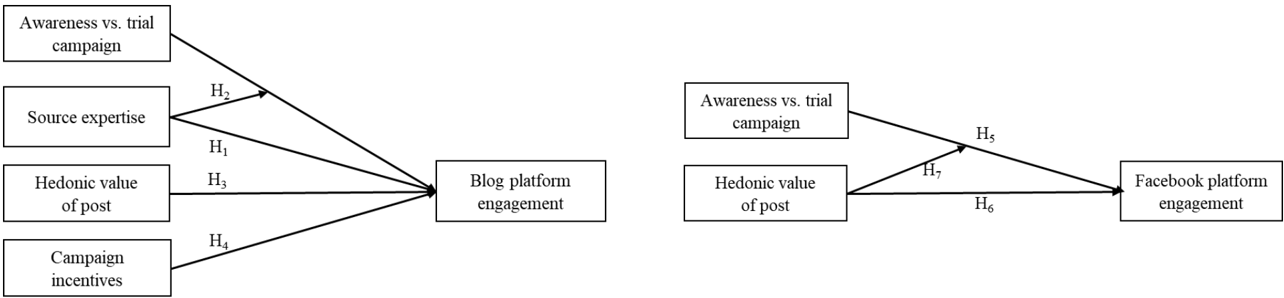
Influencer marketing is prevalent in firm strategies, yet little is known about the factors that drive success of online brand engagement at different stages of the consumer purchase funnel. The findings suggest that sponsored blogging affects online engagement (e.g., posting comments, liking a brand) differently depending on blogger characteristics and blog post content, which are further moderated by social media platform type and campaign advertising intent. When a sponsored post occurs on a blog, high blogger expertise is more effective when the advertising intent is to raise awareness versus increase trial. However, source expertise fails to drive engagement when the sponsored post occurs on Facebook. When a sponsored post occurs on Facebook, posts high in hedonic content are more effective when the advertising intent is to increase trial versus raise awareness. The effectiveness of campaign incentives depends on the platform type, such that they can increase (decrease) engagement on blogs (Facebook). The empirical evidence for these findings comes from real in-market customer response data and is supplemented with data from an experiment. Taken together, the findings highlight the critical interplay of platform type, campaign intent, source, campaign incentives, and content factors in driving engagement.
Overview
CoChat Summary
TL;DR
This paper examines how sponsored blogging campaigns drive online engagement across blogs and Facebook, using field data from 1,830 sponsored posts and a follow-up experiment. It finds engagement depends on platform, campaign intent, blogger expertise, hedonic content, and incentives, with expertise helping awareness campaigns on blogs but not Facebook.
Key findings
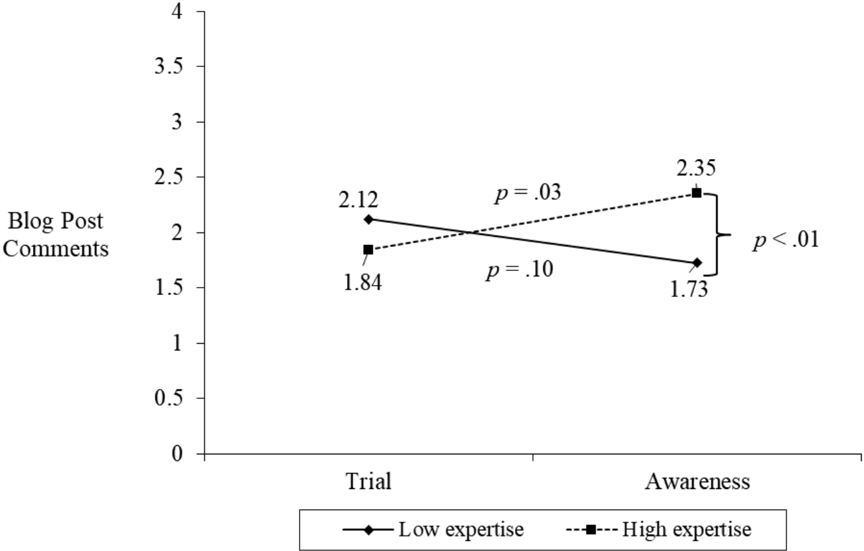
- In the blog-comment model (N = 1,237), blogger expertise had no significant main effect (b = −.1228, n.s.), but campaign intent × expertise was positive (b = .7283, p = .01): high-expertise bloggers performed better in awareness than trial campaigns (simple slope p < .05); low-expertise bloggers did not differ by intent (p = .10), so H2b was not supported.
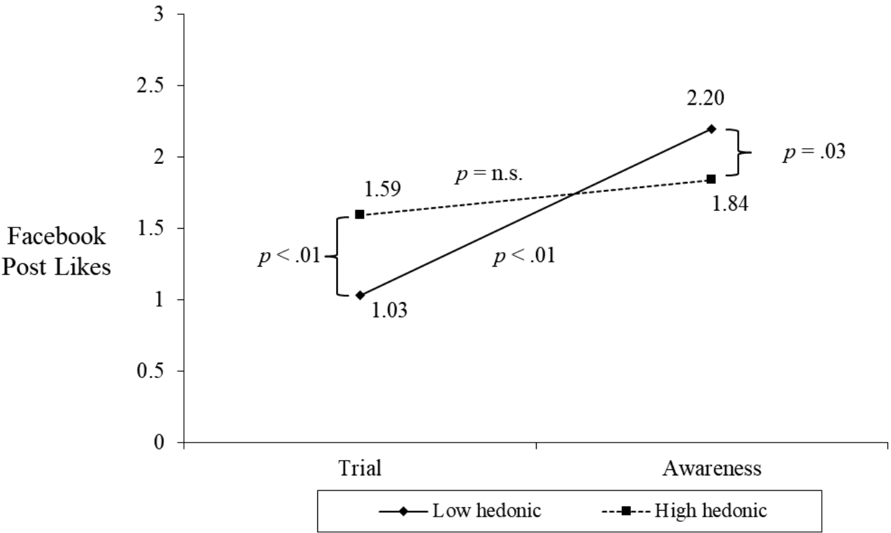
- Hedonic value of post increased blog comments (b = .2616, p < .01), and campaign giveaways increased blog comments (b = .4526, p = .01). On Facebook, awareness intent increased likes (b = .7416, p < .01), hedonic value increased likes (b = .2215, p = .03), and giveaways decreased likes (b = −.7840, p < .01).
- On Facebook, awareness × hedonic value was negative (b = −.4824, p < .01), implying hedonic content is positive for trial campaigns and negative for awareness campaigns; blogger expertise was not significantly related to Facebook likes (b = .0253, n.s.).
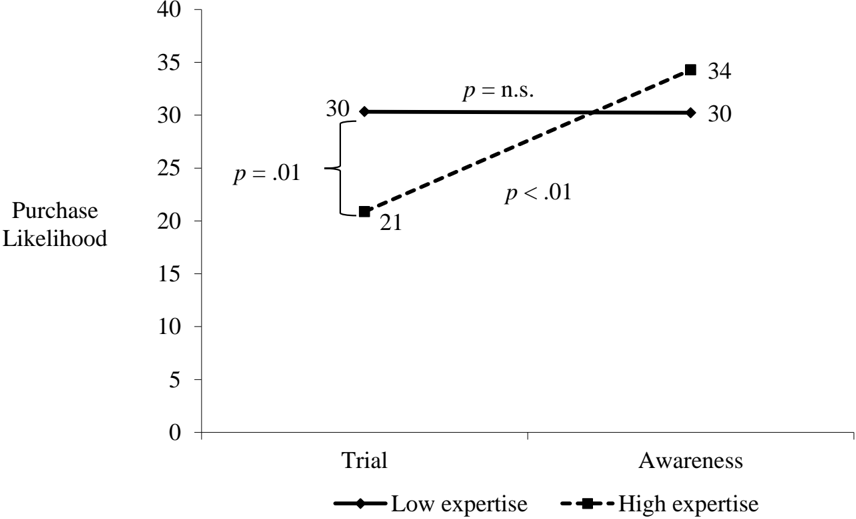
- Study 2 (N = 395 mothers) replicated the expertise × campaign intent interaction on purchase likelihood (F(1, 387) = 8.88, p < .01): with high expertise, awareness > trial (M = 34.10 vs. 20.66, p < .01); with low expertise, no difference (M = 30.24 vs. 30.29, p = .7106).
Methods
- Study 1 used real in-market data from The Motherhood agency: 1,830 sponsored posts by 595 bloggers across 57 campaigns (September 2012–December 2016); final analysis N = 1,237 due missing data. Dependent variables were number of blog post comments and Facebook post likes; negative binomial models with Heckman selection.
- Independent variables included campaign intent (awareness vs. trial), blogger expertise (sum of educational affiliation and blogger credentials, 0–2), hedonic and functional post value from coder factor analysis, campaign giveaways, follower counts, and controls.
- Study 2 was a 2 (expertise: high/low) × 2 (campaign: awareness/trial) between-subjects experiment with a Qualtrics panel of mothers (N = 395), using an educational paid app (Water Bears); the dependent variable was purchase likelihood.
Limitations
- Stated: the paper did not directly test ROI or sales, used post hoc coder ratings for sentiment, did not include a field experiment on blogger choice, and used bloggers’ network size at the time of posts without past performance/longevity; it also notes platforms evolve and ethical debates around sponsorship disclosure.
- Evident from text: Study 1 relies on one blogging agency and “mommy” bloggers, with missing data reducing the sample from 1,830 to 1,237; coder reliability for sentiment was modest (average α = .51, median = .56), and the field data are observational, limiting causal claims.
Model-written summary. Check it against the paper before relying on it.
Integrity signals
Registry
Cites
Statistics
Figures
Verification
Claims the paper makes
1 Valid · 0 Not valid · 18 Not checked · 125 Own results and interpretations
The sources with a verdict support this claim; the rest weren’t checked yet, have no full text we could read, or their verdicts aren’t rated yet.
In the paper
“we used the methodology Shrout and Fleiss (1979) describe and computed the Shrout-Fleiss single ICC score agreement of .998, which is considered quite high (Koo and Li 2016).”
What the sources say
- Not checked — no full text of the sourcecites Shrout and Fleiss (1979) matched to “Intraclass correlations: Uses in assessing rater reliability.” (1979) source
- Supportedcites Koo and Li 2016 matched to “A guideline of selecting and reporting intraclass correlation coefficients for reliability research” (2016) source
The ICC Interpretation passage (Introduction) classifies ICC values greater than 0.90 as indicating excellent reliability, supporting the description of .998 as quite high. The cited paper does not establish the citing authors’ computed score; the citation is attached to its interpretation. (LLM, conf=0.93)
plain- Asserted: passes — The authors put it forward as true.
- Checkable: passes — It can be checked against evidence.
- Load-bearing: unclear — It is unclear whether the paper’s conclusions depend on it.
- Based: passes — The paper gives a reason why it holds.
A result the paper reports from its own data — it cites no other source for it, so there is none to check. The quote shows it is in the paper.
In the paper
“When a sponsored post occurs on Facebook, posts high in hedonic content are more effective when the advertising intent is to increase trial versus raise awareness.”
plainstates a cause- Asserted: passes — The authors put it forward as true.
- Checkable: passes — It can be checked against evidence.
- Load-bearing: passes — The paper’s conclusions depend on it.
- Based: passes — The paper gives a reason why it holds.
A result the paper reports from its own data — it cites no other source for it, so there is none to check. The quote shows it is in the paper.
In the paper
“When a sponsored post occurs on a blog, high blogger expertise is more effective when the advertising intent is to raise awareness versus increase trial.”
- Also stated in: § Statement of Intended Contribution · p. 5 · plain
“In addition, blogger expertise exerts a greater impact in awareness (vs. trial) campaigns.”
plainstates a cause- Asserted: passes — The authors put it forward as true.
- Checkable: passes — It can be checked against evidence.
- Load-bearing: passes — The paper’s conclusions depend on it.
- Based: passes — The paper gives a reason why it holds.
- Also stated in: § Statement of Intended Contribution · p. 5 · plain
A result the paper reports from its own data — it cites no other source for it, so there is none to check. The quote shows it is in the paper.
In the paper
“However, source expertise fails to drive engagement when the sponsored post occurs on Facebook.”
plain- Asserted: passes — The authors put it forward as true.
- Checkable: passes — It can be checked against evidence.
- Load-bearing: passes — The paper’s conclusions depend on it.
- Based: passes — The paper gives a reason why it holds.
A result the paper reports from its own data — it cites no other source for it, so there is none to check. The quote shows it is in the paper.
In the paper
“We find that hedonic value has a significant effect on both blog and Facebook platforms.”
plainstates a cause- Asserted: passes — The authors put it forward as true.
- Checkable: passes — It can be checked against evidence.
- Load-bearing: passes — The paper’s conclusions depend on it.
- Based: passes — The paper gives a reason why it holds.
60 more claims
Create a free account to see all 144 claims and to verify the 2 references still open.
- It may state two separate claims as one. 43
- Probably not a substantial claim. 39
- The quote only partly states this claim. 10
Claims other papers make about this one
Each is checked against this paper’s own text: does it say what the citing paper says it does?
The cited source doesn’t support the claim as written.
In the citing paper
“Hughes, Swaminathan, and Brooks (2019) found that Facebook influencer campaigns that included incentives significantly increased the number of post comments.”
From Influencer Marketing on Instagram: Empirical Research on Social Media Engagement with Sponsored Posts (2022) · cites this paper as Hughes, Swaminathan, and Brooks (2019)
Checked by a reasoning model — may be wrong.
Experimental — accuracy not yet measuredThe source backs part of the claim, not all of it — or backs it for a different population, condition or comparison.
In the citing paper
“Social media platforms represent low-involvement, high-distraction, and hedonic environments (Hughes, Swaminathan, and Brooks 2019; Schulze, Sch€ oler, and Skiera 2014).”
From Influencer Marketing on Instagram: Empirical Research on Social Media Engagement with Sponsored Posts (2022) · cites this paper as Hughes, Swaminathan, and Brooks 2019
Experimental — accuracy not yet measuredThe cited source says what the claim attributes to it.
In the citing paper
“social media engagement is an important key performance indicator (KPI) to measure the success of sponsored posts on social media (Hughes, Swaminathan, and Brooks 2019;Lammenett 2019).”
From Influencer Marketing on Instagram: Empirical Research on Social Media Engagement with Sponsored Posts (2022) · cites this paper as Hughes, Swaminathan, and Brooks 2019
The cited source says what the claim attributes to it.
In the citing paper
“Previous research suggest that hedonic value can have an impact on post interaction and popularity (De Vries, Gensler, and Leeflang 2012;Hughes, Swaminathan, and Brooks 2019;Sabate et al. 2014).”
From Influencer Marketing on Instagram: Empirical Research on Social Media Engagement with Sponsored Posts (2022) · cites this paper as Hughes, Swaminathan, and Brooks 2019
The cited source says what the claim attributes to it.
In the citing paper
“Likes and comments are KPIs in influencer marketing (Hughes, Swaminathan, and Brooks 2019).”
From Influencer Marketing on Instagram: Empirical Research on Social Media Engagement with Sponsored Posts (2022) · cites this paper as Hughes, Swaminathan, and Brooks 2019
2 more claims about this paper
Create a free account to see every claim other papers make about this one.
Statistics that don’t add up
Each reported p-value recomputed from its test statistic and degrees of freedom, each partial η² from its F, and each ratio, mean difference or B printed with a p checked against its own confidence interval.
Rated minor: it would not touch a result — a value no result rests on, a p-value that stays on the same side of the significance level, or a conflict that is clerical, resolved elsewhere in the paper, or outside its own findings.
In the paper
“F(3, 260) = 3.61, p < .01”
Reported p < .01 · recomputed p = .014
Statistics recomputed
Every reported test result, recomputed from its test statistic and degrees of freedom. A result shows as not adding up only once an independent check has confirmed it.
- Doesn’t add upF(3, 260) = 3.61reported p < .01 · recomputed p = .014
“F(3, 260) = 3.61, p < .01”
- Not confirmedz = -0.06reported p = .95 · recomputed p = .952
“(z = -.060, p = .950”
- ConsistentF(3, 260) = 7.22reported p < .01 · recomputed p < .001
“F(3, 260) = 7.22, p < .01”
- Consistentz = 1.22reported p = .223 · recomputed p = .222
“(z = 1.22, p = .223”
- ConsistentF(3, 93) = 20.13reported p < .01 · recomputed p < .001
“F(3, 93) = 20.13, p < .01”
8 more recomputed tests
Create a free account to see every test the Stats check recomputed.
Self-check
Percentages, sums and reported differences re-computed from the paper’s own numbers.
Each contradiction between two passages listed here was confirmed by an independent check.
Rated minor: it would not touch a result — a value no result rests on, a p-value that stays on the same side of the significance level, or a conflict that is clerical, resolved elsewhere in the paper, or outside its own findings.
In the paper
§ Discussion · p. 29
“However, the results in Study 1 are driven by high expertise, while the results in Study 2 are driven by differences due to low expertise.”
§ Method and Results · p. 29
“Next, examining purchase likelihood under low blogger expertise, we found no significant difference between awareness and trial campaigns (Mawareness = 30.24, Mtrial = 30.29; F(1, 387) = .14, p = .7106)”
Citations
Cites
A guideline of selecting and reporting intraclass correlation coefficients for reliability research
Koo, T. K., & Li, M. Y. (2016) · Journal of Chiropractic Medicine · doi:10.1016/j.jcm.2016.02.012 · Cited by 31,709
Sample Selection Bias as a Specification Error
Heckman, J. J. (1979) · Econometrica · doi:10.2307/1912352 · Cited by 28,779
Intraclass correlations: Uses in assessing rater reliability.
Shrout, P. E., & Fleiss, J. L. (1979) · Psychological Bulletin · doi:10.1037/0033-2909.86.2.420 · Cited by 24,532
The Elaboration Likelihood Model of Persuasion
Petty, R. E., & Cacioppo, J. T. (1986) · Advances in Experimental Social Psychology · doi:10.1016/s0065-2601(08)60214-2 · Cited by 8,822 · cited 3×
“Our theoretical basis for predictions derives from the literature on the elaboration likelihood model (ELM) (Petty and Cacioppo 1986).”
BackgroundMethodHennig-Thurau, T., Gwinner, K. P., Walsh, G., & Gremler, D. D. (2004) · Journal of Interactive Marketing · doi:10.1002/dir.10073 · Cited by 5,916
A study of normative and informational social influences upon individual judgment.
Deutsch, M., & Gerard, H. B. (1955) · The Journal of Abnormal and Social Psychology · doi:10.1037/h0046408 · Cited by 4,819 · cited 1×
“This can derive from informational power, in which the expert has knowledge that others do not have (Deutsch and Gerard 1955).”
BackgroundDimensions of Consumer Expertise
Alba, J. W., & Hutchinson, J. W. (1987) · Journal of Consumer Research · doi:10.1086/209080 · Cited by 4,375
Ohanian, R. (1990) · Journal of Advertising · doi:10.1080/00913367.1990.10673191 · Cited by 4,043
The Influence of Source Credibility on Communication Effectiveness
Hovland, C. I., & Weiss, W. (1951) · Public Opinion Quarterly · doi:10.1086/266350 · Cited by 3,543 · cited 1×
“Source expertise affects attitude change (Hovland and Weiss 1951; McCracken 1989; Ohanian 1991), level of confidence and positivity (Tormala, Briñol, and Petty 2007), and behavioral changes (Crisci and Kassinove 1973) and leads to higher levels of persuasion (Petty and Wegener 1998).”
BackgroundThe Elaboration Likelihood Model of Persuasion
Petty, R. E., & Cacioppo, J. T. (1986) · Communication and Persuasion · doi:10.1007/978-1-4612-4964-1_1 · Cited by 3,202
Research works printed but not linked: 3
- Association of National Advertisers (2018), 'Advertisers Love Influencer Marketing: ANA Study,' press release, https://www.ana.net/content/show/id/48437.
- French, John and Bertram Raven (1959), 'The Bases of Social Power,' in Studies in Social Power , Dorwin Cartwright, ed. Ann Arbor: University of Michigan, 150-67.
- Zhu, June and Bernard Tan (2007), 'Effectiveness of Blog Advertising: Impact of Communicator Expertise, Campaign intent, and Product Involvement,' in ICIS 2007 Proceedings - Twenty Eighth International Conference on Information Systems . Atlanta: Association for Information Systems, paper 121.
Cited by
Items 401–500 of 779
Li, P., Shao, J., & Wu, H. (2023) · Aslib Journal of Information Management · doi:10.1108/ajim-02-2023-0055 · Cited by 6
The Impact of Digital Marketing on Brand Awareness in the Multinational FMCG SectorPreprint
Nipa, M. N., & Chowdhury, M. S. A. (2024) · Preprints.org · doi:10.20944/preprints202407.0550.v1 · Cited by 15
Influencer Marketing Unlocked: Understanding the Value Chains Driving the Creator EconomyPreprint
Libai, B., Rosario, A. B., Beichert, M., et al. (2024) · SSRN Electronic Journal · doi:10.2139/ssrn.4972530 · Cited by 5
Climbing the Influence Tiers on TikTok: A Multimodal Study
Tricomi, P. P., Kumar, S., Conti, M., & Subrahmanian, V. S. (2024) · Proceedings of the International AAAI Conference on Web and Social Media · doi:10.1609/icwsm.v18i1.31405 · Cited by 8
“…models on how influencers should behave have been developed for Twitter (Lahuerta-Otero and Cordero-Guti´errez 2016), Facebook (Arora et al. 2019; Hughes, Swaminathan, and Brooks 2019), YouTube (Sokolova and Kefi 2020), and Instagram (Tafesse and Wood 2021; Casal´o, Flavi´an, and…”
BackgroundGao, J., Liang, S., Sun, S., & Wang, S. (2025) · Journal of Travel Research · doi:10.1177/00472875251341304 · Cited by 7
“Interactions (i.e., likes, comments, favorites, reposts) can be regarded as tourists’ behavioral responses driven by the videos (Hughes et al., 2019).”
Breaking the mold: how visual atypicality shapes brand-generated image virality
Adam, Z., & Yang, Z. (2025) · International Journal of Research in Marketing · doi:10.1016/j.ijresmar.2025.07.005 · Cited by 7
Voices that captivate: The impact of AI-generated voiceover on video Ad engagement
Bai, Y. L., Xue, Z., Zhang, M., Tan, Q., & Li, Y. (2025) · International Journal of Information Management · doi:10.1016/j.ijinfomgt.2025.102962 · Cited by 10
Li, W., Ong, C. H., Su, C., & Zhou, Y. (2025) · Journal of Promotion Management · doi:10.1080/10496491.2025.2546354 · Cited by 8
“The effect of influencer marketing on brand engagement and purchasing behavior (Hughes et al., 2019).”
Chen, L., Chen, Y., Pan, Y., & Smith, A. N. (2025) · International Journal of Electronic Commerce · doi:10.1080/10864415.2025.2515725 · Cited by 7
“However, prior research has tended to focus on text and image-based sponsored influencer content [13, 49, 55, 56], and how managers can optimize their influencer video marketing campaigns to maximize engagement is not well informed by current research.”
Let me deinfluence you! The impacts of deinfluencing content
Penttinen, V., Ciuchita, R., & Pedersen, S. (2026) · Journal of the Academy of Marketing Science · doi:10.1007/s11747-026-01141-9 · Cited by 14
“As influencer marketing has matured, to become a normative feature of online content, some con - sumers even prefer that their favorite content creators to engage in brand collaborations (Chen et al., 2023; Hughes et al., 2019).”
Huang, L. (2023) · Journal of Applied Marketing Theory · doi:10.20429/jamt.2023.100207 · Cited by 12
Kallevig, A. (2024) · Springer eBooks · doi:10.1007/978-3-031-35589-9_12 · Cited by 7
Vive la résistance: a boomerang effect of resisting incentivized eWOM on consumer trust
Gvili, Y., & Levy, S. (2024) · International Journal of Advertising · doi:10.1080/02650487.2024.2426428 · Cited by 6
“To encourage positive eWOM related to their brands, some marketers proactively incentivize consumers to share product recommendations and positive feedback (Hughes, Swaminathan, and Brooks 2019).”
Sim, H.-J., Kim, A., & Kim, S. S. (2024) · Journal of theoretical and applied electronic commerce research · doi:10.3390/jtaer19040155 · Cited by 6
“Hughes et al. [16] describe the informational type of social influence as the impact of information obtained from others, which is accepted as evidence for one’s reality.”
The Effect of Company Size on Aggregate Word-of-Mouth Valence
Klostermann, J., Flaswinkel, A. M., Hydock, C., & Decker, R. (2025) · Journal of Marketing · doi:10.1177/00222429251320603 · Cited by 6
Secinaro, S. F., Lanzalonga, F., Chmet, F., & Poliak, M. (2025) · Journal of Engineering and Technology Management · doi:10.1016/j.jengtecman.2025.101897 · Cited by 8
“On the other hand, it appears necessary to align the informational purposes and construction of an entire advertising campaign to the target platform (Hughes et al., 2019).”
How Influencers Grow: An Empirical Study and Future Research Agenda
Campbell, C., Girard, J. M., McDuff, D., & Rosengren, S. (2025) · Journal of Interactive Marketing · doi:10.1177/10949968251360683 · Cited by 5
“Interaction effects may exist between different speci fi c content factors (Hughes, Swaminathan, and Brooks 2019).”
InfluentialAn Investigation on the Influence of Blogs on Consumer Engagement Behaviour
Erem, B., & Kuşçu, A. (2021) · Yönetim ve Ekonomi Dergisi · doi:10.18657/yonveek.745426 · Cited by 8
Waseem, M. A., Waqas, M., Irfan, I., Abdullah, M. I., & Wajid, N. (2022) · INQUIRY The Journal of Health Care Organization Provision and Financing · doi:10.1177/00469580221126304 · Cited by 10
L’engagement du consommateur envers la marque : perspective socio-culturelle et voies de recherche
Scarano, M. C., Regany, F., & Özçağlar–Toulouse, N. (2023) · Recherche et Applications en Marketing (French Edition) · doi:10.1177/07673701231180409 · Cited by 6
“…dimensions (Hollebeek, 2011 ; Obilo et al., 2021) ; elle s’appuie sur des conceptualisations académiques ou sur des perspectives managériales ; elle le restreint à ses conséquences comme des commentaires en ligne ou des likes (Hughes et al. 2019 Meire et al., 2019 ; Villarroel et al., 2019).”
BackgroundAdversity as Authenticity: How Influencers Use Personal Struggles to Build their Brands
Foos, A. E. (2021) · The BRC Academy Journal of Business · doi:10.15239/j.brcacadjb.2021.11.01.ja05 · Cited by 7
Fu, X., & Ren, X. (2023) · Nankai Business Review International · doi:10.1108/nbri-04-2022-0037 · Cited by 5
Kihal, S. E., & Shehu, E. (2022) · SSRN Electronic Journal · doi:10.2139/ssrn.4192277 · Cited by 4
I feel like it’s expensive! Role of influencer type on price perception
Jha, S. (2025) · Marketing Intelligence & Planning · doi:10.1108/mip-04-2024-0222 · Cited by 8
Luxury versus masstige brands: the role of social media influencers and generational cohorts
Chowdhury, T. G., Murshed, F., DesRoberts, N., & Brooks, C. (2025) · The Journal of Marketing Theory and Practice · doi:10.1080/10696679.2025.2586745 · Cited by 6
Paused to feel: Rediscovering the Power of static posts in influencer-driven charity
Phan, T. A., Nguyễn, H. K., & Huynh, M. K. (2026) · Journal of Marketing Communications · doi:10.1080/13527266.2025.2612544 · Cited by 4
Mahn, L., Hegner, S. M., Piehler, R., Schade, M., & Burmann, C. (2026) · International Journal of Advertising · doi:10.1080/02650487.2026.2616979 · Cited by 5
“Informational content helps viewers make confident purchasing decisions and denotes the informativeness of a post, assisting consumers in understanding a product, thereby facilitating decision-making (Hughes, Swaminathan, and Brooks 2019; Pan et al. 2025).”
Decoding urban adoption of AI‑driven cabs: a mixed‑method investigation in China
Mustafa, S., Wang, Q., Jamil, K., & Jie, F. (2026) · Transportation Research Part A Policy and Practice · doi:10.1016/j.tra.2026.104890 · Cited by 6
Amplifying (or buffering) the blow: How influencer signals shape brand cancellation outcomes
Demsar, V., Saldanha, N., Sands, S., & Ferraro, C. (2026) · European Journal of Marketing · doi:10.1108/ejm-04-2025-0283 · Cited by 5
Manyanga, W., & Pillay, P. (2026) · Strategic Business Research · doi:10.1016/j.sbr.2026.100116 · Cited by 4
Customer engagement in tourism and hospitality research
Rather, R. A., Ramkissoon, H. R., Hollebeek, L. D., & Loureiro, S. M. C. (2023) · Edward Elgar Publishing eBooks · doi:10.4337/9781802203943.00010 · Cited by 14
Gómez, Y. A. C., Triana, G. J. C., & Caviedes-Caviedes, S. P. (2024) · Revista Latina de Comunicación Social · doi:10.4185/rlcs-2025-2363 · Cited by 9
Aggarwal, A., Arora, N., Manchanda, P., Kaur, J., & Afzal, M. (2025) · The Journal of Marketing Theory and Practice · doi:10.1080/10696679.2025.2493811 · Cited by 7
“Additionally, customers are motivated to explore and read brand-related content on social media influencer channels, such as trends, news, and developments concerning brands, as they tend to rely on influencer suggestions in their decision-making processes (Hughes et al., 2019).”
A life cycle framework of social media influencers and the influencer’ dilemma
Spörl-Wang, K., Krause, F., & Henkel, S. (2025) · Journal of Business Research · doi:10.1016/j.jbusres.2025.115459 · Cited by 7
Yang, J., & Chuenterawong, P. (2025) · International Journal of Strategic Communication · doi:10.1080/1553118x.2025.2524181 · Cited by 9
“…effect of trustworthiness was slightly higher than that of expertise is also consistent with other studies exploring credibility-related outcomes (Hughes et al., 2019; Reichelt et al., 2014) and SMIs’ effectiveness on message credibility and brand attitude (D. Y. Kim & Kim, 2021; Xiao et al.,…”
Ekinci, Y., Can, A. S., Javed, A., & Viglia, G. (2025) · Internet Research · doi:10.1108/intr-09-2024-1463 · Cited by 6
How Social Media Changes Today’s Marketing Strategies
Murshed, N. A. (2020) · International Journal of Innovative Science and Research Technology (IJISRT) · doi:10.38124/ijisrt20sep218 · Cited by 5
EMERGING INFLUENCERS PROMOTING TRAVEL: THE CASE OF LOCAL TOURISM IN LATVIA
Berjozkina, G., & Garanti, Z. (2020) · Journal of Regional Economic and Social Development · doi:10.17770/jresd2020vol1.12.5402 · Cited by 6
Mosa, R. A. (2022) · International journal of business economics & management · doi:10.21744/ijbem.v5n1.1871 · Cited by 13
Wold, R. (2022) · Journal of Business and Technical Communication · doi:10.1177/10506519221143107 · Cited by 4
Brand Placement in Social Media: Characteristics, Typology and Effectiveness
Bouyahia, S. B., & Miled-Cherif, H. B. (2022) · Décisions Marketing · doi:10.3917/dm.105.0055 · Cited by 4
Ramadhan, N. T., Daulay, M. Y. I., & Semayang, R. (2023) · Frontiers in Business and Economics · doi:10.56225/finbe.v2i1.191 · Cited by 4
Influencer recommendation system: choosing the right influencer using a network analysis approach
Jha, A. K., & Ray, S. (2023) · Marketing Intelligence & Planning · doi:10.1108/mip-04-2023-0149 · Cited by 9
Nouira, O., & Boukamcha, F. (2023) · Journal of Human Behavior in the Social Environment · doi:10.1080/10911359.2023.2267091 · Cited by 8
“A substantial amount of research considers the influencers’ expertise as the extent to which influencers are competent, knowledgeable and have the ability to defend and discuss accurately a particular subject (Hughes et al., 2019).”
Exploratory factor analysis in social media by Kaiser-Meyer-Olkin statistical approach
Sood, V., & Mehendale, S. (2023) · AIP conference proceedings · doi:10.1063/5.0168188 · Cited by 5
Consumer brand engagement: Socio-cultural perspective and research avenues
Scarano, M. C., Regany, F., & Özçağlar–Toulouse, N. (2023) · Recherche et Applications en Marketing (English Edition) · doi:10.1177/20515707231204721 · Cited by 8
“…measures it on a single or several dimensions (Hollebeek, 2011; Obilo et al., 2021); it draws on academic conceptualisations or managerial perspectives; it restricts it to its consequences such as online comments or likes (Hughes et al., 2019; Meire et al., 2019; Villarroel Ordenes et al., 2019).”
BackgroundDewanthi, D. S. (2024) · Business Economic Communication and Social Sciences (BECOSS) Journal · doi:10.21512/becossjournal.v6i1.10483 · Cited by 3
Cunha, Â., & Casais, B. (2024) · Emerald Group Publishing Limited eBooks · doi:10.1108/978-1-83753-686-320241012 · Cited by 5
Source Model: Pengukuran Kredibilitas Celebrity Endorser
Yunita, D. (2021) · JURNAL MANAJEMEN DAN BISNIS SRIWIJAYA · doi:10.29259/jmbs.v19i2.15160 · Cited by 10
Oh, T. T., & Kim, J. (2022) · SSRN Electronic Journal · doi:10.2139/ssrn.4011595 · Cited by 3
The Impact of Mobile-Based Digital Transformation on Tax StickinessPreprint
Zhou, P., Zhou, S., & Ji, H. (2022) · SSRN Electronic Journal · doi:10.2139/ssrn.4074705 · Cited by 3
Does Your Style Engage? Linguistic Styles of Influencers and User Engagement on YoutubePreprint
Munaro, A. C., Barcelos, R. H., Maffezzolli, E. C. F., Rodrigues, J. P. S., & Paraíso, E. C. (2023) · SSRN Electronic Journal · doi:10.2139/ssrn.4680101 · Cited by 3
Abdullah, M. F., Khan, N. R. M., Ibrahim, M. A., & Putit, L. (2023) · International Journal of Academic Research in Business and Social Sciences · doi:10.6007/ijarbss/v13-i11/19605 · Cited by 9
“Social media influencer is prevalent in firm strategies, yet little is known about the factors that drive success of online brand engagement at different stages of the consumer purchase behavior (Hughes et al., 2019).”
BackgroundFASHION IN THE DIGITAL AGE: SOCIAL MEDIA MARKETING’S INFLUENCE ON THE APPAREL MARKET
Bhonsle, P., Soni, N., & Mohan, C. (2024) · ShodhKosh Journal of Visual and Performing Arts · doi:10.29121/shodhkosh.v5.i6.2024.2113 · Cited by 2
Consumer responses to weakness revelation of human brands: The role of authenticity
Liu, M. W., Huang, J., Zhu, Q., & Zheng, X. (2024) · International Journal of Research in Marketing · doi:10.1016/j.ijresmar.2024.09.005 · Cited by 7
Advertising and keyword selection strategies on Baidu: an empirical analysis
He, C., Ren, J., & Huang, H. (2025) · Industrial Management & Data Systems · doi:10.1108/imds-10-2023-0750 · Cited by 5
Supply chain channel selection and discount strategy under influencer marketing
Xia, Y., Xie, J., & Zhang, T. (2025) · Annals of Operations Research · doi:10.1007/s10479-025-06523-w · Cited by 3
“Most influencer marketing studies have adopted case studies or empirical methods to understand the value of new business models (Reinikainen et al., 2020; Hughes et al., 2019).”
How Do Image Captions Drive Consumer Engagement on Social Media?
Adam, Z. (2025) · Journal of Interactive Marketing · doi:10.1177/10949968251352408 · Cited by 3
“Given these distributional properties, a negative binomial regression model was employed, following the approach of prior studies (see Hartmann et al. 2021; Hughes, Swaminathan, and Brooks 2019; Ordenes et al. 2019; Overgoor et al. 2022).”
Ji, L., Chen, X., Jiang, L., & Huang, J. T. (2025) · Information & Management · doi:10.1016/j.im.2025.104202 · Cited by 6
Gonzalez, A. J., Akgün, I. I., & Vandenbosch, L. (2025) · Social Media + Society · doi:10.1177/20563051251339035 · Cited by 3
Hooking Customers with Facebook: An Empirical Analysis of Grocery Stores’ Online Engagement
Numan, N. N., Wielheesen, T. J. P., Sloot, L. M., Bijmolt, T. H. A., & van Nierop, E. (2025) · Journal of Interactive Marketing · doi:10.1177/10949968251337700 · Cited by 5
“…the disengagement of followers when confronted with commercial posts (Liadeli, Sotgiu, and Verlegh 2023; Quesenberry and Coolsen 2018; Swani, Milne, and Brown 2013), as well as the use of incentive posts to steer engagement (Hughes, Swaminathan, and Brooks 2019; Verhoef, Reinartz, and Krafft 2010).”
Reasoning by truth or touching with heart, how does recommendation type affect consumer reaction?
Liu, L., Xu, Y., & Liu, H. (2025) · Asia Pacific Journal of Marketing and Logistics · doi:10.1108/apjml-12-2024-1987 · Cited by 5
Dzreke, S. S., & Dzreke, S. E. (2025) · Frontiers in Research · doi:10.71350/30624533111 · Cited by 10
Deng, B., Shi, C., & Wong, I. A. (2025) · Journal Of Vacation Marketing · doi:10.1177/13567667251386467 · Cited by 4
Leveraging Rational Addiction Theory to Reduce Mobile Usage
Somasundaram, J., Zimmermann, L., & Pham, Q. D. (2025) · Journal of Marketing · doi:10.1177/00222429251405841 · Cited by 6
Uncovering the negative impact of flash sales on instant order cancellations in live streaming
Zhang, X., Wang, F., Cao, X., & Zan, A. (2025) · Journal of Business Research · doi:10.1016/j.jbusres.2025.115882 · Cited by 4
Shetu, S. N. (2025) · SN Business & Economics · doi:10.1007/s43546-025-01017-0 · Cited by 4
“In a study, Hughes et al. ( 2019) state that social media influencers (SMIs)-generated posts incorporate ele - ments of earned and paid media.”
Zhang, X., Ji, X., Cao, P., & Xiao, Q. (2026) · Journal of Business Research · doi:10.1016/j.jbusres.2026.116003 · Cited by 8
Beyond the post: Crafting influencer marketing strategies across the funnel
Peggiani, G., & Lamberti, L. (2026) · Journal of Business Research · doi:10.1016/j.jbusres.2026.116037 · Cited by 6
Singh, V. (2026) · Marketing Intelligence & Planning · doi:10.1108/mip-07-2025-0557 · Cited by 3
Efecto del boca-oreja electrónico en la intención de compra
Sánchez-Jaime, R. A., Flores, J. I. A., & Velásquez-Arboleda, Ó. H. (2022) · Paradigma Económico · doi:10.36677/paradigmaeconomico.v14i2.17501 · Cited by 7
“…similar en el bocaoreja cuando los mensajes se transmiten a través de patrocinios con un influencer en una red social específica; al respecto, Hughes et al. (2019) exponen que el boca-oreja positivo a través de una persona reconocida en las redes sociales, tiene un efecto positivo en la AHM,…”
BackgroundXu, R., Kim, E., & Lee, J. H. (2022) · Fashion & Textile Research Journal · doi:10.5805/sfti.2022.24.6.719 · Cited by 3
Vania, P. A., & Aruan, D. T. H. (2023) · Jurnal Aplikasi Manajemen · doi:10.21776/ub.jam.2023.021.02.10 · Cited by 14
Mewengkang, J. D., & Hidayah, R. T. (2023) · JMBI UNSRAT (Jurnal Ilmiah Manajemen Bisnis dan Inovasi Universitas Sam Ratulangi) · doi:10.35794/jmbi.v10i2.49552 · Cited by 16
“Dengan demikian, mereka menyimpulkan bahwa efektivitas kampanye insentif terutama bergantung pada jenis platform (Hughes et al., 2019).”
Influencer Marketing for Hedonic and Utilitarian Products: Counterintuitive Tourism Findings
von Mettenheim, W., & Wiedmann, K. (2023) · Tourism Culture & Communication · doi:10.3727/109830423x16950766924951 · Cited by 2
Influencer Marketing: A New Frontier for Brand Awareness in the Digital Era
Pandey, K. M., Kumar, H., Dahikar, C., & Rajyalaskhmi, N. C. (2023) · International Journal for Research in Applied Science and Engineering Technology · doi:10.22214/ijraset.2023.56239 · Cited by 8
SOCIAL MEDIA INFLUENCERS’ ATTRIBUTES ON FOLLOWERS’ PURCHASE INTENTION IN MALAYSIA
Tamsir, F., Zain, N. N. M., Poniran, H., Basar, S. A., Rahman, A. R. A., Mohan, N. M. M., & Ibrahim, N. A. (2023) · Quantum Journal of Social Sciences and Humanities · doi:10.55197/qjssh.v4i6.283 · Cited by 6
“For example, the study of Hughes et al. (2019) investigated the same topic of the purchase intention and the influencers‟ credibility in the UK context, and their results argued that for any sponsored post posted on the blog, the blogger with better expertise would be the more effective one to…”
BackgroundSAĞINDIK, D., & Yükselen, C. (2023) · Güncel Pazarlama Yaklaşımları ve Araştırmaları Dergisi · doi:10.54439/gupayad.1386555 · Cited by 5
BUILDING CONSUMER ENGAGEMENT IN SOCIAL MEDIA: A SYSTEMATIC LITERATURE REVIEW
Mardhatilah, D., Omar, A., & Septiari, E. D. (2024) · Journal of Business Management and Accounting · doi:10.32890/jbma2024.14.1.1 · Cited by 13
Singh, H., & Singh, S. K. (2024) · Advances in marketing, customer relationship management, and e-services book series · doi:10.4018/979-8-3693-4195-7.ch014 · Cited by 3
Fajar, F., & Otok, B. W. (2024) · Jurnal Ilmiah Manajemen Kesatuan · doi:10.37641/jimkes.v12i4.2741 · Cited by 18
“This is in line with Lou and Yuan's research which found that consumers are more likely to engage with fellow users who have expertise or can present brands and/or products (Hughes et al., 2019).”
ResultSharma, L., & Bagdi, H. (2024) · Journal of Applied Research in Higher Education · doi:10.1108/jarhe-07-2024-0332 · Cited by 2
Influencers and prosocial luxury dynamics
Cenizo, C. (2024) · Corporate Social Responsibility and Environmental Management · doi:10.1002/csr.3035 · Cited by 4
He, Y., You, Y., & Mao, H. (2024) · Marketing Letters · doi:10.1007/s11002-024-09759-x · Cited by 3
“Since the number of likes and comments are count variables, a negative binomial model was used for data analysis (Hughes et al., 2019).”
Lu, H., Luo, X. R., Ma, S., & Chen, R. (2025) · Information & Management · doi:10.1016/j.im.2025.104205 · Cited by 4
Deng, M., Li, J., Deng, X., & Sun, B. (2025) · Electronic Commerce Research · doi:10.1007/s10660-025-10078-0 · Cited by 5
Developing a Digital Artifact for the Sustainable Presentation of Marketing Research Results
Shen, Z., & de la Garza, A. (2019) · Sustainability · doi:10.3390/su11236554 · Cited by 5
“argue that “influencer marketing is prevalent in firm strategies, yet little is known about the factors that drive the success of online brand engagement at different stages of the consumer purchase funnel” [12].”
BackgroundInfluencer Marketing – Status Quo, Einsatzmöglichkeiten und Entwicklungsperspektiven
Ceyp, M. (2021) · Springer eBooks · doi:10.1007/978-3-658-28959-1_33 · Cited by 2
Pick, M., & Sarstedt, M. (2022) · Management for professionals · doi:10.1007/978-3-030-90657-3_17 · Cited by 2
Ranking Micro-Influencers: A Multimedia Framework with Multi-Task and Interpretable Architectures
Elwood, A., Gasparin, A., & Rozza, A. (2022) · International Journal of Semantic Computing · doi:10.1142/s1793351x22400098 · Cited by 2
Barbosa, M. D. O., Ferreira, F. L., & Christino, J. M. M. (2022) · Revista Alcance · doi:10.14210/alcance.v29n2(mai/ago).p208-240 · Cited by 26
Is She Real? Leveraging Real-Life and Virtual Influencer Marketing in Brand Communications
Penttinen, V., Mouritzen, S. L. T., & Pedersen, S. (2024) · Developments in marketing science: proceedings of the Academy of Marketing Science · doi:10.1007/978-3-031-49039-2_4 · Cited by 7
COMPARISON OF THE EFFECTS OF MEGA AND MICRO-INFLUENCERS ON CONSUMER PURCHASING BEHAVIOUR
Furtana, T. E., & Öğüt, N. (2024) · Bilgi Ekonomisi ve Yönetimi Dergisi · doi:10.54860/beyder.1332542 · Cited by 9
Leveraging Rational Addiction Theory to Reduce Mobile UsagePreprint
Somasundaram, J., Zimmermann, L., & Duc, P. Q. (2020) · SSRN Electronic Journal · doi:10.2139/ssrn.3719413 · Cited by 2
Rohde, P. (2020) · PsyArXiv (OSF Preprints) · doi:10.31234/osf.io/9cfw3 · Cited by 2
Streaming Consumers in Livestreaming E-commerce: Identifying Lifts from Sales PitchesPreprint
Li, X., & Han, R. (2024) · SSRN Electronic Journal · doi:10.2139/ssrn.4847854 · Cited by 3
Zhang, P., Cheng, Y. F., Sun, Y., Lei, D., & Shen, Z. M. (2025) · SSRN Electronic Journal · doi:10.2139/ssrn.5050147 · Cited by 2
إعلانات المؤثرین عبر وسائل التواصل الاجتماعی وعلاقتها بالسلوک الشرائی لدى الشباب الجامعی السعودی:
سلامة, م. و. (2020) · المجلة العلمیة لبحوث العلاقات العامة و الإعلان · doi:10.21608/sjocs.2020.155417 · Cited by 1
Barcelos, R. H., & Munaro, A. C. (2022) · Springer proceedings in business and economics · doi:10.1007/978-3-031-05728-1_15 · Cited by 2
تحليل خطاب المؤثرين عبر مواقع التواصل الاجتماعي في بحوث ودراسات الإعلام الجديد
عثمان, أ. أ. (2022) · Al-Maǧallah Al-Miṣriyyaẗ Li-Buḥūṯ Al-Iʿlām · doi:10.21608/ejsc.2022.253932 · Cited by 1
Metadata
- Authors
- Hughes, C., Swaminathan, V., & Brooks, G.
- Affiliations
- University of Mendoza (AR)
- University of Notre Dame (US)
- University of Oxford (GB)
- Corresponding author
- Hughes, Christian
- Venue
- Journal of Marketing
- Publisher
- SAGE Publications
- Published
- 2019-06-04
- Volume
- 83
- Issue
- 5
- Pages
- 78-96
- ISSN
- 0022-2429 (ISSN-L)
- 1547-7185
- OpenAlex
- W2946816985
- Cited by
- 789
- References
- 88
- Citations by year
- 2026: 118 · 2025: 150 · 2024: 150 · 2023: 132 · 2022: 99 · 2021: 81 · 2020: 48 · 2019: 9
- FWCI
- 119.02
- Type
- journal article
- Language
- en
- Open access
- green
- kclpure.kcl.ac.uk
- Licence
- other-oa
- journals.sagepub.com/page/policies/text-and-data-mining-license (tdm)
- Locations
- Journal of Marketing (publishedVersion)
- Research Portal (King's College London) (submittedVersion, other-oa)
- Funders
- Marketing Science Institute (#4-1927)
- Topics
- Social Sciences › Business, Management and Accounting › Marketing › Digital Marketing and Social Media
- Social Sciences › Business, Management and Accounting › Marketing › Marketing and Advertising Strategies
- Social Sciences › Business, Management and Accounting › Marketing › Consumer Behavior in Brand Consumption and Identification
- Keywords
- influencer marketing, brand engagement, social media influencers, purchase funnel, source expertise, Facebook, blog posts, consumer purchase behavior
About these checks
Registry, retraction, Cites and statistics results are computed, not judged, with one exception: a printed reference that no index lists is read once by a model before it counts as a citation error. Claims are extracted by a model and kept only when their quote appears verbatim in the text; each cited source is then checked, with a model’s help, for whether it says what the claim relies on. Those verdicts can be wrong — read the claim’s quote and the cited source before relying on one.
A language model drew the claims from the paper on 2026-10-10, under version 3 of the claim definition (model deepseek-v4.1-flash, prompt extract-v3).
A second model labelled each claim on 2026-10-10 (model jev-1.13-20260917, definition revision gold-guideline-v0.2).
Cited sources are checked with a language model’s help (gpt-6-sol).
Statistics and arithmetic are recomputed, not judged.
Confidence bands are shown only for fields calibrated on our annotated test set. None is calibrated yet, so no band is shown.
What counts as a claim ›How we measure confidence ›How we check this ›
Are you an author, or do you see a problem with this page? Request a review
Data sources
Bibliographic data: Semantic Scholar, OpenAlex, Crossref.
Contains information from the Semantic Scholar Academic Graph Datasets, made available under the ODC Attribution License (ODC-BY 1.0).
Semantic Scholar’s data is described in: Kinney, R., et al. (2023). The Semantic Scholar Open Data Platform. arXiv:2301.10140.
