

Driving Brand Engagement Through Online Social Influencers: An Empirical Investigation of Sponsored Blogging Campaigns
Open accessThe DOI matches its Crossref record; 88 of the 88 references it cites were found in a registry or an index; 1 of the 26 sources its claims cite were checked for support.
Abstract
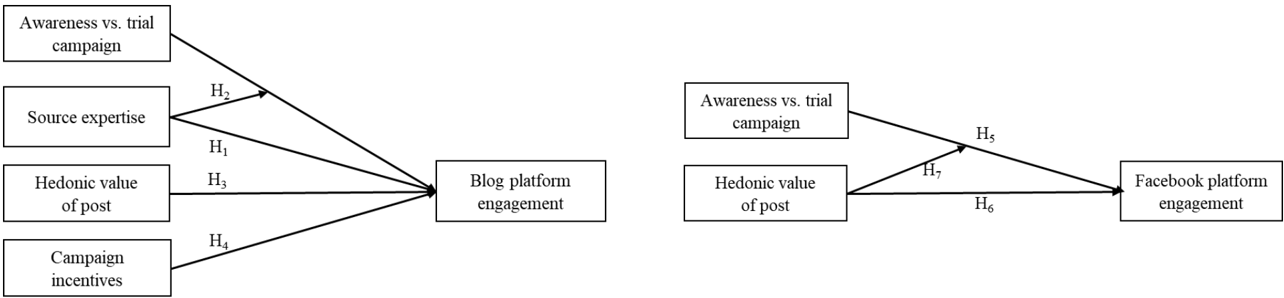
Influencer marketing is prevalent in firm strategies, yet little is known about the factors that drive success of online brand engagement at different stages of the consumer purchase funnel. The findings suggest that sponsored blogging affects online engagement (e.g., posting comments, liking a brand) differently depending on blogger characteristics and blog post content, which are further moderated by social media platform type and campaign advertising intent. When a sponsored post occurs on a blog, high blogger expertise is more effective when the advertising intent is to raise awareness versus increase trial. However, source expertise fails to drive engagement when the sponsored post occurs on Facebook. When a sponsored post occurs on Facebook, posts high in hedonic content are more effective when the advertising intent is to increase trial versus raise awareness. The effectiveness of campaign incentives depends on the platform type, such that they can increase (decrease) engagement on blogs (Facebook). The empirical evidence for these findings comes from real in-market customer response data and is supplemented with data from an experiment. Taken together, the findings highlight the critical interplay of platform type, campaign intent, source, campaign incentives, and content factors in driving engagement.
Overview
CoChat Summary
TL;DR
This paper examines how sponsored blogging campaigns drive online engagement across blogs and Facebook, using field data from 1,830 sponsored posts and a follow-up experiment. It finds engagement depends on platform, campaign intent, blogger expertise, hedonic content, and incentives, with expertise helping awareness campaigns on blogs but not Facebook.
Key findings
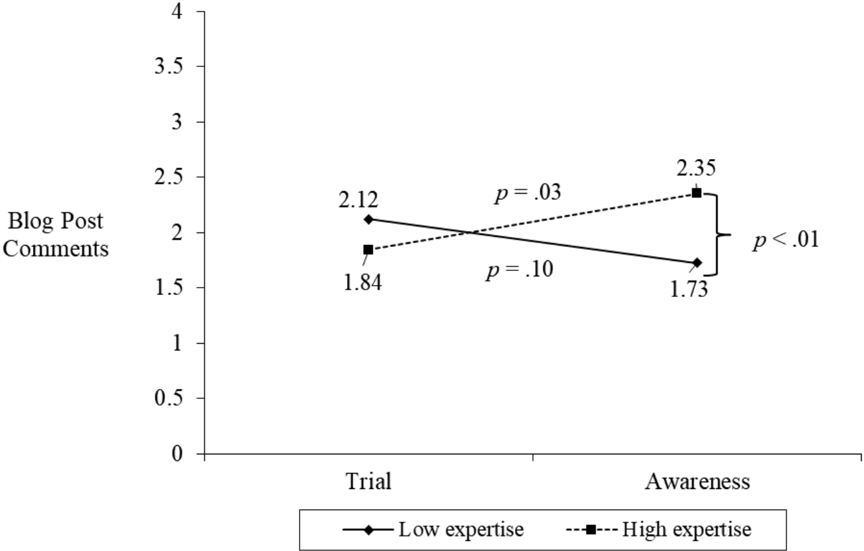
- In the blog-comment model (N = 1,237), blogger expertise had no significant main effect (b = −.1228, n.s.), but campaign intent × expertise was positive (b = .7283, p = .01): high-expertise bloggers performed better in awareness than trial campaigns (simple slope p < .05); low-expertise bloggers did not differ by intent (p = .10), so H2b was not supported.
- Hedonic value of post increased blog comments (b = .2616, p < .01), and campaign giveaways increased blog comments (b = .4526, p = .01). On Facebook, awareness intent increased likes (b = .7416, p < .01), hedonic value increased likes (b = .2215, p = .03), and giveaways decreased likes (b = −.7840, p < .01).
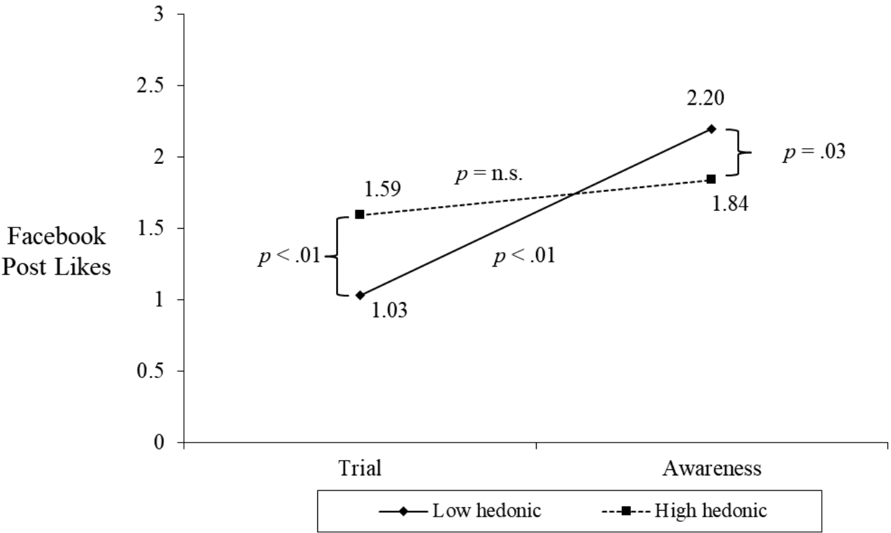
- On Facebook, awareness × hedonic value was negative (b = −.4824, p < .01), implying hedonic content is positive for trial campaigns and negative for awareness campaigns; blogger expertise was not significantly related to Facebook likes (b = .0253, n.s.).
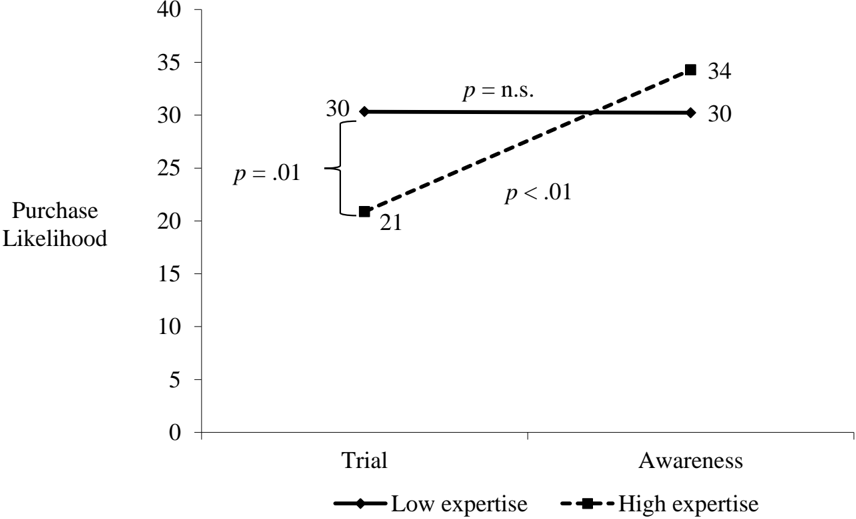
- Study 2 (N = 395 mothers) replicated the expertise × campaign intent interaction on purchase likelihood (F(1, 387) = 8.88, p < .01): with high expertise, awareness > trial (M = 34.10 vs. 20.66, p < .01); with low expertise, no difference (M = 30.24 vs. 30.29, p = .7106).
Methods
- Study 1 used real in-market data from The Motherhood agency: 1,830 sponsored posts by 595 bloggers across 57 campaigns (September 2012–December 2016); final analysis N = 1,237 due missing data. Dependent variables were number of blog post comments and Facebook post likes; negative binomial models with Heckman selection.
- Independent variables included campaign intent (awareness vs. trial), blogger expertise (sum of educational affiliation and blogger credentials, 0–2), hedonic and functional post value from coder factor analysis, campaign giveaways, follower counts, and controls.
- Study 2 was a 2 (expertise: high/low) × 2 (campaign: awareness/trial) between-subjects experiment with a Qualtrics panel of mothers (N = 395), using an educational paid app (Water Bears); the dependent variable was purchase likelihood.
Limitations
- Stated: the paper did not directly test ROI or sales, used post hoc coder ratings for sentiment, did not include a field experiment on blogger choice, and used bloggers’ network size at the time of posts without past performance/longevity; it also notes platforms evolve and ethical debates around sponsorship disclosure.
- Evident from text: Study 1 relies on one blogging agency and “mommy” bloggers, with missing data reducing the sample from 1,830 to 1,237; coder reliability for sentiment was modest (average α = .51, median = .56), and the field data are observational, limiting causal claims.
Model-written summary. Check it against the paper before relying on it.
Integrity signals
Registry
Cites
Statistics
Figures
Verification
Claims the paper makes
1 Valid · 0 Not valid · 18 Not checked · 125 Own results and interpretations
The sources with a verdict support this claim; the rest weren’t checked yet, have no full text we could read, or their verdicts aren’t rated yet.
In the paper
“we used the methodology Shrout and Fleiss (1979) describe and computed the Shrout-Fleiss single ICC score agreement of .998, which is considered quite high (Koo and Li 2016).”
What the sources say
- Not checked — no full text of the sourcecites Shrout and Fleiss (1979) matched to “Intraclass correlations: Uses in assessing rater reliability.” (1979) source
- Supportedcites Koo and Li 2016 matched to “A guideline of selecting and reporting intraclass correlation coefficients for reliability research” (2016) source
The ICC Interpretation passage (Introduction) classifies ICC values greater than 0.90 as indicating excellent reliability, supporting the description of .998 as quite high. The cited paper does not establish the citing authors’ computed score; the citation is attached to its interpretation. (LLM, conf=0.93)
plain- Asserted: passes — The authors put it forward as true.
- Checkable: passes — It can be checked against evidence.
- Load-bearing: unclear — It is unclear whether the paper’s conclusions depend on it.
- Based: passes — The paper gives a reason why it holds.
A result the paper reports from its own data — it cites no other source for it, so there is none to check. The quote shows it is in the paper.
In the paper
“When a sponsored post occurs on Facebook, posts high in hedonic content are more effective when the advertising intent is to increase trial versus raise awareness.”
plainstates a cause- Asserted: passes — The authors put it forward as true.
- Checkable: passes — It can be checked against evidence.
- Load-bearing: passes — The paper’s conclusions depend on it.
- Based: passes — The paper gives a reason why it holds.
A result the paper reports from its own data — it cites no other source for it, so there is none to check. The quote shows it is in the paper.
In the paper
“When a sponsored post occurs on a blog, high blogger expertise is more effective when the advertising intent is to raise awareness versus increase trial.”
- Also stated in: § Statement of Intended Contribution · p. 5 · plain
“In addition, blogger expertise exerts a greater impact in awareness (vs. trial) campaigns.”
plainstates a cause- Asserted: passes — The authors put it forward as true.
- Checkable: passes — It can be checked against evidence.
- Load-bearing: passes — The paper’s conclusions depend on it.
- Based: passes — The paper gives a reason why it holds.
- Also stated in: § Statement of Intended Contribution · p. 5 · plain
A result the paper reports from its own data — it cites no other source for it, so there is none to check. The quote shows it is in the paper.
In the paper
“However, source expertise fails to drive engagement when the sponsored post occurs on Facebook.”
plain- Asserted: passes — The authors put it forward as true.
- Checkable: passes — It can be checked against evidence.
- Load-bearing: passes — The paper’s conclusions depend on it.
- Based: passes — The paper gives a reason why it holds.
A result the paper reports from its own data — it cites no other source for it, so there is none to check. The quote shows it is in the paper.
In the paper
“We find that hedonic value has a significant effect on both blog and Facebook platforms.”
plainstates a cause- Asserted: passes — The authors put it forward as true.
- Checkable: passes — It can be checked against evidence.
- Load-bearing: passes — The paper’s conclusions depend on it.
- Based: passes — The paper gives a reason why it holds.
60 more claims
Create a free account to see all 144 claims and to verify the 2 references still open.
- It may state two separate claims as one. 43
- Probably not a substantial claim. 39
- The quote only partly states this claim. 10
Claims other papers make about this one
Each is checked against this paper’s own text: does it say what the citing paper says it does?
The cited source doesn’t support the claim as written.
In the citing paper
“Hughes, Swaminathan, and Brooks (2019) found that Facebook influencer campaigns that included incentives significantly increased the number of post comments.”
From Influencer Marketing on Instagram: Empirical Research on Social Media Engagement with Sponsored Posts (2022) · cites this paper as Hughes, Swaminathan, and Brooks (2019)
Checked by a reasoning model — may be wrong.
Experimental — accuracy not yet measuredThe source backs part of the claim, not all of it — or backs it for a different population, condition or comparison.
In the citing paper
“Social media platforms represent low-involvement, high-distraction, and hedonic environments (Hughes, Swaminathan, and Brooks 2019; Schulze, Sch€ oler, and Skiera 2014).”
From Influencer Marketing on Instagram: Empirical Research on Social Media Engagement with Sponsored Posts (2022) · cites this paper as Hughes, Swaminathan, and Brooks 2019
Experimental — accuracy not yet measuredThe cited source says what the claim attributes to it.
In the citing paper
“social media engagement is an important key performance indicator (KPI) to measure the success of sponsored posts on social media (Hughes, Swaminathan, and Brooks 2019;Lammenett 2019).”
From Influencer Marketing on Instagram: Empirical Research on Social Media Engagement with Sponsored Posts (2022) · cites this paper as Hughes, Swaminathan, and Brooks 2019
The cited source says what the claim attributes to it.
In the citing paper
“Previous research suggest that hedonic value can have an impact on post interaction and popularity (De Vries, Gensler, and Leeflang 2012;Hughes, Swaminathan, and Brooks 2019;Sabate et al. 2014).”
From Influencer Marketing on Instagram: Empirical Research on Social Media Engagement with Sponsored Posts (2022) · cites this paper as Hughes, Swaminathan, and Brooks 2019
The cited source says what the claim attributes to it.
In the citing paper
“Likes and comments are KPIs in influencer marketing (Hughes, Swaminathan, and Brooks 2019).”
From Influencer Marketing on Instagram: Empirical Research on Social Media Engagement with Sponsored Posts (2022) · cites this paper as Hughes, Swaminathan, and Brooks 2019
2 more claims about this paper
Create a free account to see every claim other papers make about this one.
Statistics that don’t add up
Each reported p-value recomputed from its test statistic and degrees of freedom, each partial η² from its F, and each ratio, mean difference or B printed with a p checked against its own confidence interval.
Rated minor: it would not touch a result — a value no result rests on, a p-value that stays on the same side of the significance level, or a conflict that is clerical, resolved elsewhere in the paper, or outside its own findings.
In the paper
“F(3, 260) = 3.61, p < .01”
Reported p < .01 · recomputed p = .014
Statistics recomputed
Every reported test result, recomputed from its test statistic and degrees of freedom. A result shows as not adding up only once an independent check has confirmed it.
- Doesn’t add upF(3, 260) = 3.61reported p < .01 · recomputed p = .014
“F(3, 260) = 3.61, p < .01”
- Not confirmedz = -0.06reported p = .95 · recomputed p = .952
“(z = -.060, p = .950”
- ConsistentF(3, 260) = 7.22reported p < .01 · recomputed p < .001
“F(3, 260) = 7.22, p < .01”
- Consistentz = 1.22reported p = .223 · recomputed p = .222
“(z = 1.22, p = .223”
- ConsistentF(3, 93) = 20.13reported p < .01 · recomputed p < .001
“F(3, 93) = 20.13, p < .01”
8 more recomputed tests
Create a free account to see every test the Stats check recomputed.
Self-check
Percentages, sums and reported differences re-computed from the paper’s own numbers.
Each contradiction between two passages listed here was confirmed by an independent check.
Rated minor: it would not touch a result — a value no result rests on, a p-value that stays on the same side of the significance level, or a conflict that is clerical, resolved elsewhere in the paper, or outside its own findings.
In the paper
§ Discussion · p. 29
“However, the results in Study 1 are driven by high expertise, while the results in Study 2 are driven by differences due to low expertise.”
§ Method and Results · p. 29
“Next, examining purchase likelihood under low blogger expertise, we found no significant difference between awareness and trial campaigns (Mawareness = 30.24, Mtrial = 30.29; F(1, 387) = .14, p = .7106)”
Citations
Cites
A guideline of selecting and reporting intraclass correlation coefficients for reliability research
Koo, T. K., & Li, M. Y. (2016) · Journal of Chiropractic Medicine · doi:10.1016/j.jcm.2016.02.012 · Cited by 31,709
Sample Selection Bias as a Specification Error
Heckman, J. J. (1979) · Econometrica · doi:10.2307/1912352 · Cited by 28,779
Intraclass correlations: Uses in assessing rater reliability.
Shrout, P. E., & Fleiss, J. L. (1979) · Psychological Bulletin · doi:10.1037/0033-2909.86.2.420 · Cited by 24,532
The Elaboration Likelihood Model of Persuasion
Petty, R. E., & Cacioppo, J. T. (1986) · Advances in Experimental Social Psychology · doi:10.1016/s0065-2601(08)60214-2 · Cited by 8,822 · cited 3×
“Our theoretical basis for predictions derives from the literature on the elaboration likelihood model (ELM) (Petty and Cacioppo 1986).”
BackgroundMethodHennig-Thurau, T., Gwinner, K. P., Walsh, G., & Gremler, D. D. (2004) · Journal of Interactive Marketing · doi:10.1002/dir.10073 · Cited by 5,916
A study of normative and informational social influences upon individual judgment.
Deutsch, M., & Gerard, H. B. (1955) · The Journal of Abnormal and Social Psychology · doi:10.1037/h0046408 · Cited by 4,819 · cited 1×
“This can derive from informational power, in which the expert has knowledge that others do not have (Deutsch and Gerard 1955).”
BackgroundDimensions of Consumer Expertise
Alba, J. W., & Hutchinson, J. W. (1987) · Journal of Consumer Research · doi:10.1086/209080 · Cited by 4,375
Ohanian, R. (1990) · Journal of Advertising · doi:10.1080/00913367.1990.10673191 · Cited by 4,043
The Influence of Source Credibility on Communication Effectiveness
Hovland, C. I., & Weiss, W. (1951) · Public Opinion Quarterly · doi:10.1086/266350 · Cited by 3,543 · cited 1×
“Source expertise affects attitude change (Hovland and Weiss 1951; McCracken 1989; Ohanian 1991), level of confidence and positivity (Tormala, Briñol, and Petty 2007), and behavioral changes (Crisci and Kassinove 1973) and leads to higher levels of persuasion (Petty and Wegener 1998).”
BackgroundThe Elaboration Likelihood Model of Persuasion
Petty, R. E., & Cacioppo, J. T. (1986) · Communication and Persuasion · doi:10.1007/978-1-4612-4964-1_1 · Cited by 3,202
Research works printed but not linked: 3
- Association of National Advertisers (2018), 'Advertisers Love Influencer Marketing: ANA Study,' press release, https://www.ana.net/content/show/id/48437.
- French, John and Bertram Raven (1959), 'The Bases of Social Power,' in Studies in Social Power , Dorwin Cartwright, ed. Ann Arbor: University of Michigan, 150-67.
- Zhu, June and Bernard Tan (2007), 'Effectiveness of Blog Advertising: Impact of Communicator Expertise, Campaign intent, and Product Involvement,' in ICIS 2007 Proceedings - Twenty Eighth International Conference on Information Systems . Atlanta: Association for Information Systems, paper 121.
Cited by
Vrontis, D., Makrides, A., Christofi, M., & Thrassou, A. (2021) · International Journal of Consumer Studies · doi:10.1111/ijcs.12647 · Cited by 1,178
Transforming the Customer Experience through New Technologies
Hoyer, W. D., Kroschke, M., Schmitt, B., Kraume, K., & Shankar, V. (2020) · Journal of Interactive Marketing · doi:10.1016/j.intmar.2020.04.001 · Cited by 1,049
Belanche, D., Casaló, L. V., Flavián, M., & Ibáñez-Sánchez, S. (2021) · Journal of Business Research · doi:10.1016/j.jbusres.2021.03.067 · Cited by 659
Leung, F. F., Gu, F. F., & Palmatier, R. W. (2022) · Journal of the Academy of Marketing Science · doi:10.1007/s11747-021-00829-4 · Cited by 580
Yuan, S., & Lou, C. (2020) · Journal of Interactive Advertising · doi:10.1080/15252019.2020.1769514 · Cited by 543
Perceived authenticity of social media influencers: scale development and validation
Lee, J. A., & Eastin, M. S. (2021) · Journal of Research in Interactive Marketing · doi:10.1108/jrim-12-2020-0253 · Cited by 521
When less is more: the impact of macro and micro social media influencers’ disclosure
Kay, S., Mulcahy, R., & Parkinson, J. (2020) · Journal of Marketing Management · doi:10.1080/0267257x.2020.1718740 · Cited by 508
“For example, Hughes et al.’s (2019) review suggests that consumers’ perceptions of the traits of influencers (or bloggers), such as their source credibility, is one of the most commonly investigated factors. Other such studies include Schouten et al. (2019) and Lou and Yuan (2019), which both investigate the source cr…”
BackgroundInfluencer Marketing Effectiveness
Leung, F. F., Gu, F. F., Li, Y., Zhang, J. Z., & Palmatier, R. W. (2022) · Journal of Marketing · doi:10.1177/00222429221102889 · Cited by 476
De Keyser, A., Verleye, K., Lemon, K. N., Keiningham, T. L., & Klaus, P. (2020) · Journal of Service Research · doi:10.1177/1094670520928390 · Cited by 457
“Early research on touchpoint nature largely concentrates on human and physical touchpoints (e.g., Arnould and Price 1993; Hui and Bateson 1991; Schouten, McAlexander, and Koenig 2007; human: 41.96%, physical: 40.56%).”
BackgroundInfluentialBranding in a Hyperconnected World: Refocusing Theories and Rethinking Boundaries
Swaminathan, V., Sorescu, A., Steenkamp, J.-B. E. M., O’Guinn, T. C. G., & Schmitt, B. (2020) · Journal of Marketing · doi:10.1177/0022242919899905 · Cited by 456
“The ability to create and promote a person brand online has led to the rise of influencers, a category of individuals who appear to have high potential as brand promoters and whose impact on brands and their meaning is the focus of recent scholarly research (Hughes, Swaminathan, and Brooks 2019).”
BackgroundSelf-citationThe Value of Influencer Marketing for Business: A Bibliometric Analysis and Managerial Implications
Ye, G., Hudders, L., De Jans, S., & De Veirman, M. (2021) · Journal of Advertising · doi:10.1080/00913367.2020.1857888 · Cited by 389
“Apart from these, additional factors such as cultural characteristics (Hong and Minor 2014) and platform characteristics (Hughes, Swaminathan, and Brooks 2019) have also been investigated in the previous influencer marketing research.”
BackgroundInfluencer marketing on TikTok: The effectiveness of humor and followers’ hedonic experience
Barta, S., Belanche, D., Fernández, A., & Flavián, M. (2023) · Journal of Retailing and Consumer Services · doi:10.1016/j.jretconser.2022.103149 · Cited by 369
The digital marketing capabilities gap
Herhausen, D., Miočević, D., Morgan, R. E., & Kleijnen, M. H. P. (2020) · Industrial Marketing Management · doi:10.1016/j.indmarman.2020.07.022 · Cited by 327
Finding goldilocks influencers: How follower count drives social media engagement
Wies, S., Bleier, A., & Edeling, A. (2023) · Journal of Marketing · doi:10.1177/00222429221125131 · Cited by 326
AlFarraj, O., Alalwan, A. A., Obeidat, Z. M., Baabdullah, A., Aldmour, R., & Al-Haddad, S. (2021) · Review of International Business and Strategy · doi:10.1108/ribs-07-2020-0089 · Cited by 311
Social media influencer marketing: foundations, trends, and ways forward
Joshi, Y., Lim, W. M., Jagani, K., & Kumar, S. (2025) · Electronic Commerce Research · doi:10.1007/s10660-023-09719-z · Cited by 306
Traveling with Companions: The Social Customer Journey
Hamilton, R., Ferraro, R., Haws, K. L., & Mukhopadhyay, A. (2021) · Journal of Marketing · doi:10.1177/0022242920908227 · Cited by 296
Influencer marketing: Homophily, customer value co-creation behaviour and purchase intention
Bu, Y., Parkinson, J., & Thaichon, P. (2022) · Journal of Retailing and Consumer Services · doi:10.1016/j.jretconser.2021.102904 · Cited by 271
Cheung, M. L., Leung, W. K. S., Aw, E. C.-X., & Koay, K. Y. (2022) · Journal of Retailing and Consumer Services · doi:10.1016/j.jretconser.2022.102940 · Cited by 269
Understanding followers’ stickiness to digital influencers: The effect of psychological responses
Hu, L., Min, Q., Han, S., & Liu, Z. (2020) · International Journal of Information Management · doi:10.1016/j.ijinfomgt.2020.102169 · Cited by 260
Making Sense? The Sensory-Specific Nature of Virtual Influencer Effectiveness
Zhou, X., Yan, X., & Jiang, Y. (2024) · Journal of Marketing · doi:10.1177/00222429231203699 · Cited by 249
“…on prior literature on sensory marketing, anthropo-morphism and humanization, and in fl uencer marketing (e.g., Biswas et al. 2014; Crolic et al. 2022; Hughes, Swaminathan, and Brooks 2019; Kwak, Puzakova, and Rocereto 2015; Leung et al. 2022), we propose and show that virtual in fl uencers are…”
BackgroundSánchez-Fernández, R., & Jiménez-Castillo, D. (2021) · Journal of Marketing Management · doi:10.1080/0267257x.2020.1866648 · Cited by 231
“…credibility factors (i.e. expertise, trustworthiness, and attractiveness) do not predict this outcome (Hughes et al., 2019; Lim et al., 2017; Lou & Yuan, 2019; Van Esch et al., 2018) or are not significantly related to engagement (Hughes et al., 2019) or advertising effectiveness (Gong & Li, 2017).”
BackgroundResultInfluentialInfluencer marketing effectiveness: A meta-analytic review
Pan, M., Blut, M., Ghiassaleh, A., & Lee, Z. W. Y. (2025) · Journal of the Academy of Marketing Science · doi:10.1007/s11747-024-01052-7 · Cited by 210
“This increases the likelihood of reaching broader audiences, thereby effectively influencing behavioral engagement (Hughes et al., 2019), purchasing behavior (Hashem, 2021), and sales (Gu et al., 2024).”
InfluentialA Meta-Analysis of When and How Advertising Creativity Works
Rosengren, S., Eisend, M., Koslow, S., & Dahlen, M. (2020) · Journal of Marketing · doi:10.1177/0022242920929288 · Cited by 204
“…of studies on the effects of advertising creativity on sales (for an exception, see Reinartz and Saffert [2013]) and the effects of advertising creativity in digital contexts, such as the effects of advertising creativity on social media influencer engagement (Hughes, Swaminathan, and Brooks 2019).”
BackgroundHow, why, and when disclosure type matters for influencer marketing
Karagür, Z., Becker, J.-M., Klein, K., & Edeling, A. (2022) · International Journal of Research in Marketing · doi:10.1016/j.ijresmar.2021.09.006 · Cited by 205
Vander Schee, B. A., Peltier, J., & Dahl, A. J. (2020) · Journal of Research in Interactive Marketing · doi:10.1108/jrim-01-2020-0010 · Cited by 190
Effectiveness of Travel Social Media Influencers: A Case of Eco-Friendly Hotels
Kapoor, P. S., Balaji, M. S., Jiang, Y., & Jebarajakirthy, C. (2022) · Journal of Travel Research · doi:10.1177/00472875211019469 · Cited by 185
“Furthermore, previous research has shown several factors to influence sponsorship disclosure (Hughes, Swaminathan, and Brooks 2019).”
BackgroundHartmann, J., Heitmann, M., Schamp, C., & Netzer, O. (2021) · Journal of Marketing Research · doi:10.1177/00222437211037258 · Cited by 184
“We therefore estimate negative binomial regressions (e.g., Akpinar and Berger 2017; Hughes, Swaminathan, and Brooks 2019; Ordenes et al. 2019), which result in better model fits than Poisson regressions.”
MethodA conceptual framework of contemporary luxury consumption
Wang, Y. (2022) · International Journal of Research in Marketing · doi:10.1016/j.ijresmar.2021.10.010 · Cited by 183
Munaro, A. C., Hübner Barcelos, R., Francisco Maffezzolli, E. C., Santos Rodrigues, J. P., & Cabrera Paraiso, E. (2021) · Journal of Consumer Behaviour · doi:10.1002/cb.1939 · Cited by 171
Nafees, L., Cook, C. M., Nikolov, A. N., & Stoddard, J. E. (2021) · Digital Business · doi:10.1016/j.digbus.2021.100008 · Cited by 170
Path to Purpose? How Online Customer Journeys Differ for Hedonic Versus Utilitarian Purchases
Li, J., Abbasi, A., Cheema, A., & Abraham, L. B. (2020) · Journal of Marketing · doi:10.1177/0022242920911628 · Cited by 162
“Previous studies show that consumers find fun- and entertainmentoriented social media to be a more suitable information source for hedonic purchases (Hughes, Swaminathan, and Brooks 2019; Liu et al. 2019; Park et al. 2018; Schulze, Schöler, and Skiera 2014).”
BackgroundResultInfluencer Mix Strategies in Livestream Commerce: Impact on Product Sales
Gu, X., Zhang, X., & Kannan, P. K. (2024) · Journal of Marketing · doi:10.1177/00222429231213581 · Cited by 160
How Sensory Language Shapes Influencer’s Impact
Rizzo, G. L. C., Berger, J. A., Angelis, M. D., & Pozharliev, R. (2023) · Journal of Consumer Research · doi:10.1093/jcr/ucad017 · Cited by 203
Chen, L., Yan, Y., & Smith, A. N. (2022) · Journal of the Academy of Marketing Science · doi:10.1007/s11747-022-00887-2 · Cited by 217
“Prior research on sponsorship disclosure has mostly focused on written or pictorial, versus video, content (e.g., Breves et al., 2019; Hughes et al., 2019; Kim & Kim, 2021).”
BackgroundRevenue Generation Through Influencer Marketing
Beichert, M., Bayerl, A., Goldenberg, J., & Lanz, A. (2024) · Journal of Marketing · doi:10.1177/00222429231217471 · Cited by 150
“The fi ndings from Table 2 provide new supportive evidence that low-followership targeting outperforms high-followership targeting in terms of ROI.”
BackgroundMethodInfluentialSocial media influencers and consumer engagement: A review and future research agenda
Pradhan, B., Kishore, K., & Gokhale, N. (2023) · International Journal of Consumer Studies · doi:10.1111/ijcs.12901 · Cited by 151
Jin, S. V., Ryu, E., & Muqaddam, A. (2021) · Journal of Fashion Marketing and Management: An International Journal · doi:10.1108/jfmm-04-2020-0059 · Cited by 146
How High-Arousal Language Shapes Micro- Versus Macro-Influencers’ Impact
Rizzo, G. L. C., Ordenes, F. J. V., Pozharliev, R., Angelis, M. D., & Costabile, M. (2024) · Journal of Marketing · doi:10.1177/00222429231207636 · Cited by 187
“To explain such mixed results, we propose that the language that micro-and macro-in fl uencers use is relevant, a notion that resonates with Cascio Rizzo et al. ’ s (2023) recommendation that macro-in fl uencers should use sensory language to increase engagement.”
BackgroundMethodInfluentialSocial media influencer marketing: the moderating role of materialism
Koay, K. Y., Cheung, M. L., Soh, P. C.-H., & Teoh, C. W. (2022) · European Business Review · doi:10.1108/ebr-02-2021-0032 · Cited by 139
The impact of digital influencers’ characteristics on purchase intention of fashion products
Gomes, M. A., Marques, S. H., & Dias, Á. (2022) · Journal of Global Fashion Marketing · doi:10.1080/20932685.2022.2039263 · Cited by 241
“Sponsored blogging is a relevant category of influencer marketing, as bloggers can help create WOM about a brand through their sponsored posts (Hughes, Swaminathan, and Brooks, 2019). highlighted that the hedonic value of a sponsored post’s content, which refers to the pleasure, emotions, and…”
BackgroundFollowers’ reactions to influencers’ Instagram posts
Belanche, D., Flavián, M., & Ibáñez‐Sánchez, S. (2020) · Spanish Journal of Marketing - ESIC · doi:10.1108/sjme-11-2019-0100 · Cited by 207
So, K. K. F., Li, X. R., & Kim, H. (2019) · Journal of Hospitality & Tourism Research · doi:10.1177/1096348019895562 · Cited by 156
“Accordingly, another intriguing avenue for investigation is whether channel/platform differences exist in terms of CE and the specific characteristics likely to generate such differences (Hughes et al., 2019).”
BackgroundInfluencer Marketing and Authenticity in Content Creation
Kapitan, S., van Esch, P., Soma, V., & Kietzmann, J. (2021) · Australasian Marketing Journal (AMJ) · doi:10.1177/18393349211011171 · Cited by 240
“Influencers who post self-directed content and constantly discuss personal opinions, experiences, and judgments about endorsed goods likewise encourage and reinforce consumer inferences of their self-driven, intrinsic motivation for endorsements (Hughes et al., 2019).”
BackgroundGiertz, J. N., Weiger, W. H., Törhönen, M., & Hamari, J. (2021) · Journal of service management · doi:10.1108/josm-12-2020-0439 · Cited by 183
Characteristics and roles of streamers in e-commerce live streaming
Zhang, S., Huang, C., Li, X., & Ren, A. (2022) · The Service Industries Journal · doi:10.1080/02642069.2022.2068530 · Cited by 130
“In fl uen-cers have also been recognized as marketing tools in some studies (De Jans et al., 2018; Hughes et al., 2019; Torres et al., 2019).”
BackgroundVirtual influencers and pro-environmental causes: The roles of message warmth and trust in experts
Gerrath, M. H. E. E., Olya, H., Shah, Z., & Li, H. (2024) · Journal of Business Research · doi:10.1016/j.jbusres.2024.114520 · Cited by 170
Making and breaking relationships on social media: the impacts of brand and influencer betrayals
Reinikainen, H., Tan, T. M., Luoma‐aho, V., & Salo, J. (2021) · Technological Forecasting and Social Change · doi:10.1016/j.techfore.2021.120990 · Cited by 199
The role of influencers in the consumer decision-making process
Zak, S., & Hasprova, M. (2020) · SHS Web of Conferences · doi:10.1051/shsconf/20207403014 · Cited by 120
“Influencer marketing is prevalent in firm strategies, yet little is known about the factors that drive success of online brand engagement at different stages of the consumer purchase funnel [10].”
BackgroundHow do social media influencers induce the urge to buy impulsively? Social commerce context
Shamim, K., Azam, M., & Islam, T. (2023) · Journal of Retailing and Consumer Services · doi:10.1016/j.jretconser.2023.103621 · Cited by 191
Wu, Y., Nambisan, S., Xiao, J., & Xie, K. (2022) · Journal of the Academy of Marketing Science · doi:10.1007/s11747-022-00837-y · Cited by 186
“Firms are acutely aware of this change and are spending an increasing proportion of their budgets on influencer marketing (Hughes et al., 2019).”
BackgroundAshraf, A., Hameed, I., & Saeed, S. A. (2023) · International Journal of Consumer Studies · doi:10.1111/ijcs.12917 · Cited by 190
Followers' problematic engagement with influencers on social media: An attachment theory perspective
Farivar, S., Wang, F., & Turel, O. (2022) · Computers in Human Behavior · doi:10.1016/j.chb.2022.107288 · Cited by 160
Ge, J., Sui, Y., Zhou, X., & Li, G. (2021) · International Journal of Advertising · doi:10.1080/02650487.2020.1848986 · Cited by 116
“Hughes, Swaminathan, and Brooks (2019) argued that social media platform users can build relationships with bloggers by subscribing to their channels or blogs and keeping an eye on their posts on social media.”
BackgroundRen, S., Karimi, S., Velázquez, A. B., & Cai, J. (2022) · Journal of Business Research · doi:10.1016/j.jbusres.2022.113476 · Cited by 153
He, Z., Deng, N., Li, X. R., & Gu, H. (2021) · Journal of Travel Research · doi:10.1177/0047287521995134 · Cited by 128
“These behavioral aspects of social media engagement have been exemplified through website metrics such as “likes” and comments (Gummerus et al. 2012; Hughes, Swaminathan, and Brooks 2019).”
BackgroundMapping the influence of influencer marketing: a bibliometric analysis
Abhishek, & Srivastava, M. (2021) · Marketing Intelligence & Planning · doi:10.1108/mip-03-2021-0085 · Cited by 154
Kim, E. A., Duffy, M. E., & Thorson, E. (2021) · Journal of Advertising · doi:10.1080/00913367.2020.1868026 · Cited by 163
Influencer Marketing: Role of Influencer Credibility and Congruence on Brand Attitude and eWOM
Dhun, & Dangi, H. K. (2023) · Journal of Internet Commerce · doi:10.1080/15332861.2022.2125220 · Cited by 108
“In addition, Hughes et al. (2019) recognized that the factors influencing sponsored blogging campaign engagement vary between platforms such as Blogs and Facebook.”
BackgroundInfluentialYıldırım, S. (2021) · Ecofeminism and Climate Change · doi:10.1108/efcc-02-2021-0003 · Cited by 163
Payal, R., Sharma, N., & Dwivedi, Y. K. (2024) · Electronic Commerce Research and Applications · doi:10.1016/j.elerap.2024.101381 · Cited by 151
Borchers, N. S., & Enke, N. (2021) · Public Relations Review · doi:10.1016/j.pubrev.2021.102041 · Cited by 184
Manis, K. T., & Madhavaram, S. (2023) · Journal of Business Research · doi:10.1016/j.jbusres.2022.113485 · Cited by 138
Mega or Micro? Influencer Selection Using Follower Elasticity
Tian, Z., Dew, R., & Iyengar, R. (2022) · Journal of Marketing Research · doi:10.1177/00222437231210267 · Cited by 129
“A few recent studies have found a positive relationship between in-degree and engagement with content on social networks (e.g., Hughes, Swaminathan, and Brooks 2019; Valsesia, Proserpio, and Nunes 2020).”
BackgroundHsieh, J. (2023) · Journal of Retailing and Consumer Services · doi:10.1016/j.jretconser.2023.103397 · Cited by 111
Multifaceted Influencers: Toward a New Typology for Influencer Roles in Advertising
Ksenia, R., & Colliander, J. (2021) · Journal of Advertising · doi:10.1080/00913367.2021.1980471 · Cited by 147
Gross, J., & von Wangenheim, F. (2022) · Journal of Interactive Advertising · doi:10.1080/15252019.2022.2123724 · Cited by 153
“The hedonic value of a post refers to the enjoyment, vividness, and entertainment a user experiences from reading the post (Hughes, Swaminathan, and Brooks 2019).”
BackgroundResultInfluentialGerrath, M. H. E. E., & Usrey, B. (2021) · International Journal of Research in Marketing · doi:10.1016/j.ijresmar.2020.09.010 · Cited by 89
“Finally, we build on the emerging body of influencer marketing literature (Audrezet et al., 2020; Eisend et al., 2020; Hughes et al., 2019; Stubb et al., 2019) by testing the effects of incentivization acceptance motives and perceived incentivization commonness in two influencer contexts—product…”
InfluentialSocial Media Engagement for Global Influencers
Bentley, K., Chu, C. K., Nistor, C., Pehlivan, E., & Yalcin, T. (2021) · Journal of Global Marketing · doi:10.1080/08911762.2021.1895403 · Cited by 120
“Social media influencers have been studied by researchers in various disciplines ranging from computer science to anthropology in the last twenty years (Chang et al., 2020; Ge & Gretzel, 2018; Hughes et al., 2019).”
Exploring the nexus of social media influencers and consumer brand engagement
Cheung, M. L., Leung, W. K. S., Yang, M. X., Koay, K. Y., & Chang, M. K. (2022) · Asia Pacific Journal of Marketing and Logistics · doi:10.1108/apjml-07-2021-0522 · Cited by 135
Understanding digital consumer: A review, synthesis, and future research agenda
Güngör, A. S., & Çadırcı, T. O. (2022) · International Journal of Consumer Studies · doi:10.1111/ijcs.12809 · Cited by 122
Eliciting brand-related social media engagement: A conditional inference tree framework
Schivinski, B. (2019) · Journal of Business Research · doi:10.1016/j.jbusres.2019.08.045 · Cited by 102
Virtual Influencer as a Brand Avatar in Interactive Marketing
Audrezet, A., & Köles, B. (2023) · Springer eBooks · doi:10.1007/978-3-031-14961-0_16 · Cited by 128
Rohde, P., & Mau, G. (2021) · European Journal of Marketing · doi:10.1108/ejm-06-2019-0530 · Cited by 111
“This influence can be achieved in various ways, and marketing scholars have started to embrace a broader notion of people with strong social influence (Hughes et al., 2019; Jiménez-Castillo and Sánchez-Fernández, 2019).”
BackgroundVollrath, M. D., & Villegas, S. G. (2021) · Journal of Marketing Analytics · doi:10.1057/s41270-020-00098-0 · Cited by 150
Myers, S. K., Sen, S. S., Syrdal, H. A., & Woodroof, P. J. (2022) · The Journal of Marketing Theory and Practice · doi:10.1080/10696679.2022.2093224 · Cited by 113
“…engagement and influence are context-dependent (Bochenek, 2019; Brodie et al., 2011; Calder et al., 2009; Dolan et al., 2019; Gummerus et al., 2012; Hughes et al., 2019), making it difficult to apply assumptions based on prior research to understanding what factors impact follower interactions…”
BackgroundRelationship between Advertising Disclosure, Influencer Credibility and Purchase Intention
Sesar, V., Martinčević, I., & Boguszewicz-Kreft, M. (2022) · Journal of risk and financial management · doi:10.3390/jrfm15070276 · Cited by 205
“These include influencer marketing success factors (Hughes et al. 2019; Lou and Yuan 2019; Renchen 2020), because, despite the explosion of social influencers, their effectiveness is still low (Hughes et al. 2019).”
BackgroundXue, J., & Liu, M. T. (2022) · Asia Pacific Journal of Marketing and Logistics · doi:10.1108/apjml-11-2021-0822 · Cited by 97
Past, present, and future scene of influencer marketing in hospitality and tourism management
Polat, E., Çelik, F., Ibrahim, B., & Gursoy, D. (2024) · Journal of Travel & Tourism Marketing · doi:10.1080/10548408.2024.2317741 · Cited by 73
“Subsequently, examining a range of firm financial performance outcomes of IM efforts will be interesting, including return on investment and sales (Hughes et al., 2019).”
Background#dadtribe: Performing Sharenting Labour to Commercialise Involved Fatherhood
Campaña, M., den Bossche, A. V., & Miller, B. (2020) · Journal of Macromarketing · doi:10.1177/0276146720933334 · Cited by 91
“…the case of mother influencers finding empowering enclaves in social media by laying bare the challenges of motherhood, while also generating income through these platforms (e.g., Blum-Ross and Livingstone 2017; Brady and Guerin 2010; Campana and Doern 2018; Hughes, Swaminathan, and Brooks 2019).”
BackgroundPark, S. (., Wei, X., & Lee, H. (2024) · Journal of Consumer Behaviour · doi:10.1002/cb.2290 · Cited by 78
Duffek, B., Eisingerich, A. B., Merlo, O., & Lee, G. (2025) · Journal of Marketing · doi:10.1177/00222429251319786 · Cited by 145
“…” by Nunes, Ordanini, and Giambastiani (2021) and expand the work of Beichert et al. (2024), Leung et al. (2022), Gu, Zhang, and Kannan (2024), Hughes, Swaminathan, and Brooks (2019), and Wies, Bleier, and Edeling (2022) on engagement; the work by Cascio Rizzo et al. (2024) on in fl…”
Syrdal, H. A., Myers, S. K., Sen, S. S., Woodroof, P. J., & McDowell, W. C. (2023) · Journal of Business Research · doi:10.1016/j.jbusres.2023.113875 · Cited by 119
Spörl-Wang, K., Krause, F., & Henkel, S. (2024) · Journal of Business Research · doi:10.1016/j.jbusres.2024.114991 · Cited by 135
Farrell, J. R., Campbell, C., & Sands, S. (2021) · Journal of Advertising Research · doi:10.2501/jar-2021-017 · Cited by 104
Steils, N., Martin-Salerno, A., & Toti, J.-F. (2022) · Journal of Advertising Research · doi:10.2501/jar-2022-008 · Cited by 97
Digital customer engagement: A systematic literature review and research agenda
Srivastava, R., Gupta, P., Kumar, H., & Tuli, N. (2023) · Australian Journal of Management · doi:10.1177/03128962231177096 · Cited by 139
“…their social networks, resulting in higher brand engagement (Leckie et al., 2022); how social influencers impact consumer engagement at different stages of consumer purchase; and how the type of social media platform moderates the impact of antecedents of consumer engagement (Hughes et al., 2019).”
On the role of social media platforms in the creator economy
Bleier, A., Fossen, B. L., & Shapira, M. (2024) · International Journal of Research in Marketing · doi:10.1016/j.ijresmar.2024.06.006 · Cited by 123
Disability in influencer marketing: a complex model of disability representation
Södergren, J., & Vallström, N. (2023) · Journal of Marketing Management · doi:10.1080/0267257x.2022.2144418 · Cited by 65
B2B eWOM on Alibaba: Signaling through online reviews in platform-based social exchange
Tóth, Z., Mrad, M., Itani, O. S., Luo, J., & Liu, M. J. (2022) · Industrial Marketing Management · doi:10.1016/j.indmarman.2022.04.019 · Cited by 80
Influencer Marketing and Consumer Behaviour: A Systematic Literature Review
Kanaveedu, A., & Kalapurackal, J. J. (2022) · Vision The Journal of Business Perspective · doi:10.1177/09722629221114607 · Cited by 121
“Moreover, the hedonic value and informative value of the post increase blog and Facebook platform engagement, and reinforce the trust in posts among followers (Hughes et al., 2019; Lou & Yuan, 2019).”
Wang, B., Han, Y., Kandampully, J. A., & Lu, X. (2024) · Journal of Retailing and Consumer Services · doi:10.1016/j.jretconser.2024.104106 · Cited by 76
A meta-analysis of the effectiveness of social media influencers: Mechanisms and moderation
Barari, M. M., Eisend, M., & Jain, S. P. (2025) · Journal of the Academy of Marketing Science · doi:10.1007/s11747-025-01107-3 · Cited by 167
Customers Online Engagement with Social Media Influencers’ Content Related to COVID 19
Khasawneh, M. H. A., Abuhashesh, M., Ahmad, A. M. K., Masa’deh, R. M. T., & Alshurideh, M. T. (2021) · Studies in systems, decision and control · doi:10.1007/978-3-030-67151-8_22 · Cited by 80
Mainolfi, G., & Vergura, D. T. (2021) · Journal of Fashion Marketing and Management · doi:10.1108/jfmm-03-2020-0050 · Cited by 101
How to motivate opinion leaders to spread e-WoM on social media: monetary vs non-monetary incentives
López, M., Piñero, M. S., & Verlegh, P. W. J. (2021) · Journal of Research in Interactive Marketing · doi:10.1108/jrim-03-2020-0059 · Cited by 72
Jung, N., & Im, S. (2021) · International Journal of Advertising · doi:10.1080/02650487.2021.1991107 · Cited by 60
“Many firms have been keen to include influencer marketing in their focal digital marketing strategy (Hughes, Swaminathan, and Brooks 2019).”
BackgroundInfluentialWang, K., Ashraf, A. R., Thongpapanl, N., & Nguyen, O. T. K. (2023) · Journal of Business Research · doi:10.1016/j.jbusres.2023.114092 · Cited by 74
Influencer marketing unlocked: Understanding the value chains driving the creator economy
Libai, B., Rosario, A. B., Beichert, M., Donkers, B., Haenlein, M., Hofstetter, R., Kannan, P. K., van der Lans, R., Lanz, A., Li, H. A., et al. (2025) · Journal of the Academy of Marketing Science · doi:10.1007/s11747-024-01073-2 · Cited by 134
“Academic investigations mirror this complexity, with recent studies just beginning to explore a direct sales impact while many still focus on intermediary metrics such as impressions and engagement (Beichert et al., 2024; Hughes et al., 2019; Leung et al., 2022a).”
Sardar, S., Tata, S. V., & Sarkar, S. (2024) · Journal of Retailing and Consumer Services · doi:10.1016/j.jretconser.2024.103888 · Cited by 98
Metadata
- Authors
- Hughes, C., Swaminathan, V., & Brooks, G.
- Affiliations
- University of Mendoza (AR)
- University of Notre Dame (US)
- University of Oxford (GB)
- Corresponding author
- Hughes, Christian
- Venue
- Journal of Marketing
- Publisher
- SAGE Publications
- Published
- 2019-06-04
- Volume
- 83
- Issue
- 5
- Pages
- 78-96
- ISSN
- 0022-2429 (ISSN-L)
- 1547-7185
- OpenAlex
- W2946816985
- Cited by
- 789
- References
- 88
- Citations by year
- 2026: 118 · 2025: 150 · 2024: 150 · 2023: 132 · 2022: 99 · 2021: 81 · 2020: 48 · 2019: 9
- FWCI
- 119.02
- Type
- journal article
- Language
- en
- Open access
- green
- kclpure.kcl.ac.uk
- Licence
- other-oa
- journals.sagepub.com/page/policies/text-and-data-mining-license (tdm)
- Locations
- Journal of Marketing (publishedVersion)
- Research Portal (King's College London) (submittedVersion, other-oa)
- Funders
- Marketing Science Institute (#4-1927)
- Topics
- Social Sciences › Business, Management and Accounting › Marketing › Digital Marketing and Social Media
- Social Sciences › Business, Management and Accounting › Marketing › Marketing and Advertising Strategies
- Social Sciences › Business, Management and Accounting › Marketing › Consumer Behavior in Brand Consumption and Identification
- Keywords
- influencer marketing, brand engagement, social media influencers, purchase funnel, source expertise, Facebook, blog posts, consumer purchase behavior
About these checks
Registry, retraction, Cites and statistics results are computed, not judged, with one exception: a printed reference that no index lists is read once by a model before it counts as a citation error. Claims are extracted by a model and kept only when their quote appears verbatim in the text; each cited source is then checked, with a model’s help, for whether it says what the claim relies on. Those verdicts can be wrong — read the claim’s quote and the cited source before relying on one.
A language model drew the claims from the paper on 2026-10-10, under version 3 of the claim definition (model deepseek-v4.1-flash, prompt extract-v3).
A second model labelled each claim on 2026-10-10 (model jev-1.13-20260917, definition revision gold-guideline-v0.2).
Cited sources are checked with a language model’s help (gpt-6-sol).
Statistics and arithmetic are recomputed, not judged.
Confidence bands are shown only for fields calibrated on our annotated test set. None is calibrated yet, so no band is shown.
What counts as a claim ›How we measure confidence ›How we check this ›
Are you an author, or do you see a problem with this page? Request a review
Data sources
Bibliographic data: Semantic Scholar, OpenAlex, Crossref.
Contains information from the Semantic Scholar Academic Graph Datasets, made available under the ODC Attribution License (ODC-BY 1.0).
Semantic Scholar’s data is described in: Kinney, R., et al. (2023). The Semantic Scholar Open Data Platform. arXiv:2301.10140.
