

Driving Brand Engagement Through Online Social Influencers: An Empirical Investigation of Sponsored Blogging Campaigns
Open accessThe DOI matches its Crossref record; 88 of the 88 references it cites were found in a registry or an index; 1 of the 26 sources its claims cite were checked for support.
Abstract
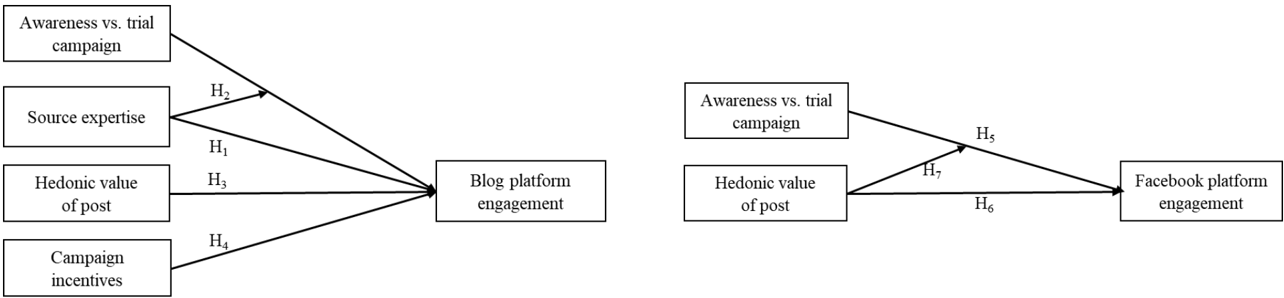
Influencer marketing is prevalent in firm strategies, yet little is known about the factors that drive success of online brand engagement at different stages of the consumer purchase funnel. The findings suggest that sponsored blogging affects online engagement (e.g., posting comments, liking a brand) differently depending on blogger characteristics and blog post content, which are further moderated by social media platform type and campaign advertising intent. When a sponsored post occurs on a blog, high blogger expertise is more effective when the advertising intent is to raise awareness versus increase trial. However, source expertise fails to drive engagement when the sponsored post occurs on Facebook. When a sponsored post occurs on Facebook, posts high in hedonic content are more effective when the advertising intent is to increase trial versus raise awareness. The effectiveness of campaign incentives depends on the platform type, such that they can increase (decrease) engagement on blogs (Facebook). The empirical evidence for these findings comes from real in-market customer response data and is supplemented with data from an experiment. Taken together, the findings highlight the critical interplay of platform type, campaign intent, source, campaign incentives, and content factors in driving engagement.
Overview
CoChat Summary
TL;DR
This paper examines how sponsored blogging campaigns drive online engagement across blogs and Facebook, using field data from 1,830 sponsored posts and a follow-up experiment. It finds engagement depends on platform, campaign intent, blogger expertise, hedonic content, and incentives, with expertise helping awareness campaigns on blogs but not Facebook.
Key findings
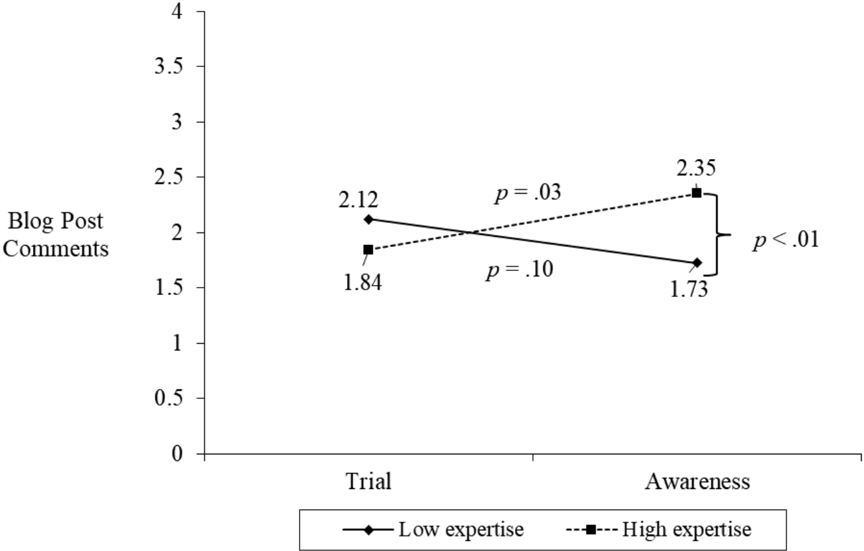
- In the blog-comment model (N = 1,237), blogger expertise had no significant main effect (b = −.1228, n.s.), but campaign intent × expertise was positive (b = .7283, p = .01): high-expertise bloggers performed better in awareness than trial campaigns (simple slope p < .05); low-expertise bloggers did not differ by intent (p = .10), so H2b was not supported.
- Hedonic value of post increased blog comments (b = .2616, p < .01), and campaign giveaways increased blog comments (b = .4526, p = .01). On Facebook, awareness intent increased likes (b = .7416, p < .01), hedonic value increased likes (b = .2215, p = .03), and giveaways decreased likes (b = −.7840, p < .01).
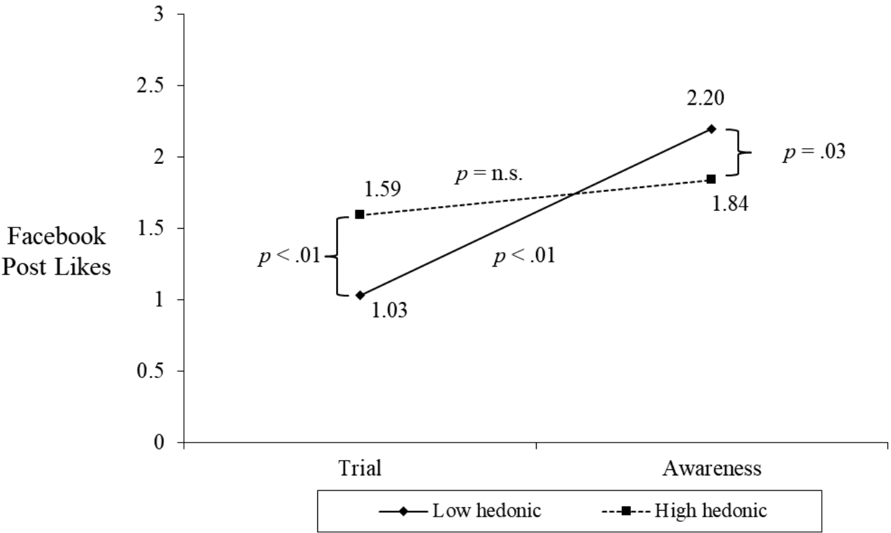
- On Facebook, awareness × hedonic value was negative (b = −.4824, p < .01), implying hedonic content is positive for trial campaigns and negative for awareness campaigns; blogger expertise was not significantly related to Facebook likes (b = .0253, n.s.).
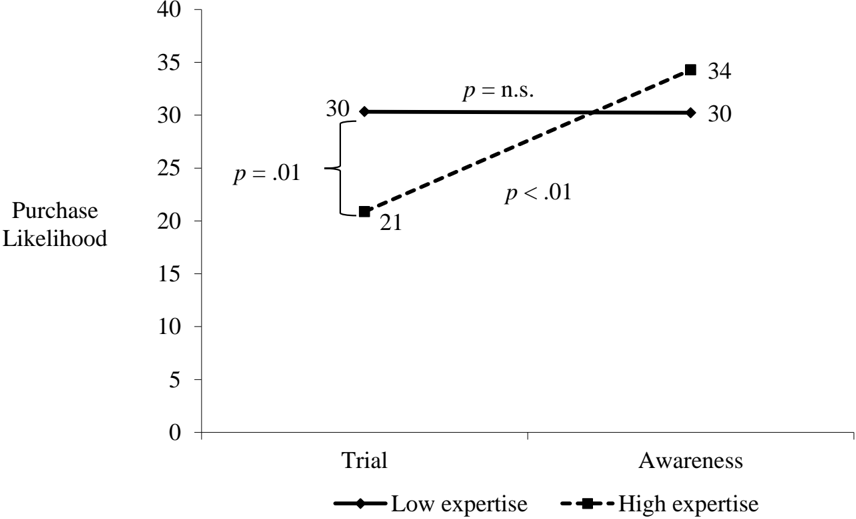
- Study 2 (N = 395 mothers) replicated the expertise × campaign intent interaction on purchase likelihood (F(1, 387) = 8.88, p < .01): with high expertise, awareness > trial (M = 34.10 vs. 20.66, p < .01); with low expertise, no difference (M = 30.24 vs. 30.29, p = .7106).
Methods
- Study 1 used real in-market data from The Motherhood agency: 1,830 sponsored posts by 595 bloggers across 57 campaigns (September 2012–December 2016); final analysis N = 1,237 due missing data. Dependent variables were number of blog post comments and Facebook post likes; negative binomial models with Heckman selection.
- Independent variables included campaign intent (awareness vs. trial), blogger expertise (sum of educational affiliation and blogger credentials, 0–2), hedonic and functional post value from coder factor analysis, campaign giveaways, follower counts, and controls.
- Study 2 was a 2 (expertise: high/low) × 2 (campaign: awareness/trial) between-subjects experiment with a Qualtrics panel of mothers (N = 395), using an educational paid app (Water Bears); the dependent variable was purchase likelihood.
Limitations
- Stated: the paper did not directly test ROI or sales, used post hoc coder ratings for sentiment, did not include a field experiment on blogger choice, and used bloggers’ network size at the time of posts without past performance/longevity; it also notes platforms evolve and ethical debates around sponsorship disclosure.
- Evident from text: Study 1 relies on one blogging agency and “mommy” bloggers, with missing data reducing the sample from 1,830 to 1,237; coder reliability for sentiment was modest (average α = .51, median = .56), and the field data are observational, limiting causal claims.
Model-written summary. Check it against the paper before relying on it.
Integrity signals
Registry
Cites
Statistics
Figures
Verification
Claims the paper makes
1 Valid · 0 Not valid · 18 Not checked · 125 Own results and interpretations
The sources with a verdict support this claim; the rest weren’t checked yet, have no full text we could read, or their verdicts aren’t rated yet.
In the paper
“we used the methodology Shrout and Fleiss (1979) describe and computed the Shrout-Fleiss single ICC score agreement of .998, which is considered quite high (Koo and Li 2016).”
What the sources say
- Not checked — no full text of the sourcecites Shrout and Fleiss (1979) matched to “Intraclass correlations: Uses in assessing rater reliability.” (1979) source
- Supportedcites Koo and Li 2016 matched to “A guideline of selecting and reporting intraclass correlation coefficients for reliability research” (2016) source
The ICC Interpretation passage (Introduction) classifies ICC values greater than 0.90 as indicating excellent reliability, supporting the description of .998 as quite high. The cited paper does not establish the citing authors’ computed score; the citation is attached to its interpretation. (LLM, conf=0.93)
plain- Asserted: passes — The authors put it forward as true.
- Checkable: passes — It can be checked against evidence.
- Load-bearing: unclear — It is unclear whether the paper’s conclusions depend on it.
- Based: passes — The paper gives a reason why it holds.
A result the paper reports from its own data — it cites no other source for it, so there is none to check. The quote shows it is in the paper.
In the paper
“When a sponsored post occurs on Facebook, posts high in hedonic content are more effective when the advertising intent is to increase trial versus raise awareness.”
plainstates a cause- Asserted: passes — The authors put it forward as true.
- Checkable: passes — It can be checked against evidence.
- Load-bearing: passes — The paper’s conclusions depend on it.
- Based: passes — The paper gives a reason why it holds.
A result the paper reports from its own data — it cites no other source for it, so there is none to check. The quote shows it is in the paper.
In the paper
“When a sponsored post occurs on a blog, high blogger expertise is more effective when the advertising intent is to raise awareness versus increase trial.”
- Also stated in: § Statement of Intended Contribution · p. 5 · plain
“In addition, blogger expertise exerts a greater impact in awareness (vs. trial) campaigns.”
plainstates a cause- Asserted: passes — The authors put it forward as true.
- Checkable: passes — It can be checked against evidence.
- Load-bearing: passes — The paper’s conclusions depend on it.
- Based: passes — The paper gives a reason why it holds.
- Also stated in: § Statement of Intended Contribution · p. 5 · plain
A result the paper reports from its own data — it cites no other source for it, so there is none to check. The quote shows it is in the paper.
In the paper
“However, source expertise fails to drive engagement when the sponsored post occurs on Facebook.”
plain- Asserted: passes — The authors put it forward as true.
- Checkable: passes — It can be checked against evidence.
- Load-bearing: passes — The paper’s conclusions depend on it.
- Based: passes — The paper gives a reason why it holds.
A result the paper reports from its own data — it cites no other source for it, so there is none to check. The quote shows it is in the paper.
In the paper
“We find that hedonic value has a significant effect on both blog and Facebook platforms.”
plainstates a cause- Asserted: passes — The authors put it forward as true.
- Checkable: passes — It can be checked against evidence.
- Load-bearing: passes — The paper’s conclusions depend on it.
- Based: passes — The paper gives a reason why it holds.
60 more claims
Create a free account to see all 144 claims and to verify the 2 references still open.
- It may state two separate claims as one. 43
- Probably not a substantial claim. 39
- The quote only partly states this claim. 10
Claims other papers make about this one
Each is checked against this paper’s own text: does it say what the citing paper says it does?
The cited source doesn’t support the claim as written.
In the citing paper
“Hughes, Swaminathan, and Brooks (2019) found that Facebook influencer campaigns that included incentives significantly increased the number of post comments.”
From Influencer Marketing on Instagram: Empirical Research on Social Media Engagement with Sponsored Posts (2022) · cites this paper as Hughes, Swaminathan, and Brooks (2019)
Checked by a reasoning model — may be wrong.
Experimental — accuracy not yet measuredThe source backs part of the claim, not all of it — or backs it for a different population, condition or comparison.
In the citing paper
“Social media platforms represent low-involvement, high-distraction, and hedonic environments (Hughes, Swaminathan, and Brooks 2019; Schulze, Sch€ oler, and Skiera 2014).”
From Influencer Marketing on Instagram: Empirical Research on Social Media Engagement with Sponsored Posts (2022) · cites this paper as Hughes, Swaminathan, and Brooks 2019
Experimental — accuracy not yet measuredThe cited source says what the claim attributes to it.
In the citing paper
“social media engagement is an important key performance indicator (KPI) to measure the success of sponsored posts on social media (Hughes, Swaminathan, and Brooks 2019;Lammenett 2019).”
From Influencer Marketing on Instagram: Empirical Research on Social Media Engagement with Sponsored Posts (2022) · cites this paper as Hughes, Swaminathan, and Brooks 2019
The cited source says what the claim attributes to it.
In the citing paper
“Previous research suggest that hedonic value can have an impact on post interaction and popularity (De Vries, Gensler, and Leeflang 2012;Hughes, Swaminathan, and Brooks 2019;Sabate et al. 2014).”
From Influencer Marketing on Instagram: Empirical Research on Social Media Engagement with Sponsored Posts (2022) · cites this paper as Hughes, Swaminathan, and Brooks 2019
The cited source says what the claim attributes to it.
In the citing paper
“Likes and comments are KPIs in influencer marketing (Hughes, Swaminathan, and Brooks 2019).”
From Influencer Marketing on Instagram: Empirical Research on Social Media Engagement with Sponsored Posts (2022) · cites this paper as Hughes, Swaminathan, and Brooks 2019
2 more claims about this paper
Create a free account to see every claim other papers make about this one.
Statistics that don’t add up
Each reported p-value recomputed from its test statistic and degrees of freedom, each partial η² from its F, and each ratio, mean difference or B printed with a p checked against its own confidence interval.
Rated minor: it would not touch a result — a value no result rests on, a p-value that stays on the same side of the significance level, or a conflict that is clerical, resolved elsewhere in the paper, or outside its own findings.
In the paper
“F(3, 260) = 3.61, p < .01”
Reported p < .01 · recomputed p = .014
Statistics recomputed
Every reported test result, recomputed from its test statistic and degrees of freedom. A result shows as not adding up only once an independent check has confirmed it.
- Doesn’t add upF(3, 260) = 3.61reported p < .01 · recomputed p = .014
“F(3, 260) = 3.61, p < .01”
- Not confirmedz = -0.06reported p = .95 · recomputed p = .952
“(z = -.060, p = .950”
- ConsistentF(3, 260) = 7.22reported p < .01 · recomputed p < .001
“F(3, 260) = 7.22, p < .01”
- Consistentz = 1.22reported p = .223 · recomputed p = .222
“(z = 1.22, p = .223”
- ConsistentF(3, 93) = 20.13reported p < .01 · recomputed p < .001
“F(3, 93) = 20.13, p < .01”
8 more recomputed tests
Create a free account to see every test the Stats check recomputed.
Self-check
Percentages, sums and reported differences re-computed from the paper’s own numbers.
Each contradiction between two passages listed here was confirmed by an independent check.
Rated minor: it would not touch a result — a value no result rests on, a p-value that stays on the same side of the significance level, or a conflict that is clerical, resolved elsewhere in the paper, or outside its own findings.
In the paper
§ Discussion · p. 29
“However, the results in Study 1 are driven by high expertise, while the results in Study 2 are driven by differences due to low expertise.”
§ Method and Results · p. 29
“Next, examining purchase likelihood under low blogger expertise, we found no significant difference between awareness and trial campaigns (Mawareness = 30.24, Mtrial = 30.29; F(1, 387) = .14, p = .7106)”
Citations
Cites
A guideline of selecting and reporting intraclass correlation coefficients for reliability research
Koo, T. K., & Li, M. Y. (2016) · Journal of Chiropractic Medicine · doi:10.1016/j.jcm.2016.02.012 · Cited by 31,709
Sample Selection Bias as a Specification Error
Heckman, J. J. (1979) · Econometrica · doi:10.2307/1912352 · Cited by 28,779
Intraclass correlations: Uses in assessing rater reliability.
Shrout, P. E., & Fleiss, J. L. (1979) · Psychological Bulletin · doi:10.1037/0033-2909.86.2.420 · Cited by 24,532
The Elaboration Likelihood Model of Persuasion
Petty, R. E., & Cacioppo, J. T. (1986) · Advances in Experimental Social Psychology · doi:10.1016/s0065-2601(08)60214-2 · Cited by 8,822 · cited 3×
“Our theoretical basis for predictions derives from the literature on the elaboration likelihood model (ELM) (Petty and Cacioppo 1986).”
BackgroundMethodHennig-Thurau, T., Gwinner, K. P., Walsh, G., & Gremler, D. D. (2004) · Journal of Interactive Marketing · doi:10.1002/dir.10073 · Cited by 5,916
A study of normative and informational social influences upon individual judgment.
Deutsch, M., & Gerard, H. B. (1955) · The Journal of Abnormal and Social Psychology · doi:10.1037/h0046408 · Cited by 4,819 · cited 1×
“This can derive from informational power, in which the expert has knowledge that others do not have (Deutsch and Gerard 1955).”
BackgroundDimensions of Consumer Expertise
Alba, J. W., & Hutchinson, J. W. (1987) · Journal of Consumer Research · doi:10.1086/209080 · Cited by 4,375
Ohanian, R. (1990) · Journal of Advertising · doi:10.1080/00913367.1990.10673191 · Cited by 4,043
The Influence of Source Credibility on Communication Effectiveness
Hovland, C. I., & Weiss, W. (1951) · Public Opinion Quarterly · doi:10.1086/266350 · Cited by 3,543 · cited 1×
“Source expertise affects attitude change (Hovland and Weiss 1951; McCracken 1989; Ohanian 1991), level of confidence and positivity (Tormala, Briñol, and Petty 2007), and behavioral changes (Crisci and Kassinove 1973) and leads to higher levels of persuasion (Petty and Wegener 1998).”
BackgroundThe Elaboration Likelihood Model of Persuasion
Petty, R. E., & Cacioppo, J. T. (1986) · Communication and Persuasion · doi:10.1007/978-1-4612-4964-1_1 · Cited by 3,202
Research works printed but not linked: 3
- Association of National Advertisers (2018), 'Advertisers Love Influencer Marketing: ANA Study,' press release, https://www.ana.net/content/show/id/48437.
- French, John and Bertram Raven (1959), 'The Bases of Social Power,' in Studies in Social Power , Dorwin Cartwright, ed. Ann Arbor: University of Michigan, 150-67.
- Zhu, June and Bernard Tan (2007), 'Effectiveness of Blog Advertising: Impact of Communicator Expertise, Campaign intent, and Product Involvement,' in ICIS 2007 Proceedings - Twenty Eighth International Conference on Information Systems . Atlanta: Association for Information Systems, paper 121.
Cited by
Items 201–300 of 779
Pelet, J., & Ettis, S. A. (2022) · International Journal of Technology and Human Interaction · doi:10.4018/ijthi.2022010106 · Cited by 41
Choi, Y. S., Wu, Q., & Lee, J. Y. (2024) · Journal of Business Research · doi:10.1016/j.jbusres.2024.115094 · Cited by 30
Lourenço, C. E., Ferreira, J. C., & dos Santos, V. M. (2024) · Journal of Marketing Communications · doi:10.1080/13527266.2024.2439841 · Cited by 34
Piñero, M. S., & López, M. (2023) · Springer eBooks · doi:10.1007/978-3-031-14961-0_26 · Cited by 31
The role of influencers and social comparison in shaping travel intentions
Wahba, S., El‐Deeb, S., & Habil, S. G. M. (2024) · Journal of Hospitality and Tourism Insights · doi:10.1108/jhti-01-2024-0042 · Cited by 40
Zhang, H., & Gong, X. (2020) · European Journal of Marketing · doi:10.1108/ejm-06-2019-0491 · Cited by 23
Garavan, T. N., Koukpaki, S., Darcy, C., O’Brien, F., Oyedijo, A., & Adams, K. (2022) · Tourism Management · doi:10.1016/j.tourman.2022.104558 · Cited by 26
Cárdaba, M. Á. M., Fernández, A. E. S., Martínez, L. M., & Cambra, U. C. (2022) · Journal of Global Fashion Marketing · doi:10.1080/20932685.2022.2085607 · Cited by 20
“Brands are aware of this influence and, especially within the fashion category, are including these new digital leaders as an increasingly relevant part of their marketing and communication strategies (Hughes et al., 2019; Noris et al., 2021).”
BackgroundDoes polarizing personality matter in influencer marketing? Evidence from Instagram
Beheshti, M. K., Gopinath, M., Ashouri, S., & Zal, S. (2023) · Journal of Business Research · doi:10.1016/j.jbusres.2023.113804 · Cited by 28
Can residents engage potential tourists as ‘micro’ and ‘nano’ influencers?
Wei, H., & Zhang, T. (2023) · Current Issues in Tourism · doi:10.1080/13683500.2023.2260062 · Cited by 28
“…social media in fl uencers can positively impact purchase intentions (Ekinci & Hosany, 2006; Lou & Yuan, 2019), recommendations (Jiménez-Castillo & Sánchez-Fernández, 2019), brand awareness (Lou & Yuan, 2019), attitudes (Jin et al., 2019), and engagement (Chmait et al., 2020; Hughes et al., 2019).”
Bahar, V. S., & Hasan, M. (2024) · Information Technology and People · doi:10.1108/itp-05-2023-0421 · Cited by 36
The Power of Brand Selfies in Consumer-Generated Brand Images
Hartmann, J., Heitmann, M., Schamp, C., & Netzer, O. (2019) · SSRN Electronic Journal · doi:10.2139/ssrn.3354415 · Cited by 19
Pourazad, N., Stocchi, L., & Simmonds, L. (2025) · Information Technology & Tourism · doi:10.1007/s40558-025-00330-6 · Cited by 22
“Replacing traditional opinion leaders and market mavens, TSMIs disseminate product information through various platforms (Hughes et al. 2019).”
Influencer Activism: Insights for Effective Partnership With Brands and Organizations
D’Arco, M., Branca, G., Marino, V., & Resciniti, R. (2024) · Psychology and Marketing · doi:10.1002/mar.22149 · Cited by 23
Benevento, E., Aloini, D., Roma, P., & Bellino, D. (2024) · Journal of Business Research · doi:10.1016/j.jbusres.2024.115123 · Cited by 91
Saternus, Z., Mihale-Wilson, C., & Hinz, O. F. (2024) · Electronic Markets · doi:10.1007/s12525-024-00743-x · Cited by 50
“However, to truly capture the real-world dynamics of spon-sorship disclosure, it is crucial that such studies be conducted using authentic influencers on actual social media platforms rather than relying solely on reported behavior or fictitious scenarios (Cao & Belo 2024, Hughes et al. 2019).”
Aldlimi, T., Priporas, C., & Chang, S.-W. (2025) · Journal of Consumer Behaviour · doi:10.1002/cb.2485 · Cited by 44
The effects of advertisement disclosure on heavy and light Instagram users
Saternus, Z., Weber, P., & Hinz, O. F. (2022) · Electronic Markets · doi:10.1007/s12525-022-00546-y · Cited by 30
“, 2013; Carr & Hayes, 2014; Hwang & Jeong, 2016), Facebook posts (Boerman et al., 2017; Hughes et al., 2019), tweets on Twitter (Hayes et al.”
BackgroundInfluencer relations: Establishing the concept and process for public relations
Smith, B. G., Golan, G. J., & Freberg, K. (2023) · Public Relations Review · doi:10.1016/j.pubrev.2023.102305 · Cited by 39
Live Influence: Redefining Credibility and Attractiveness in Healthcare Livestreaming
Phan, T. A., Le, T. M. T., & Pham, B. T. T. (2024) · Howard Journal of Communications · doi:10.1080/10646175.2024.2429454 · Cited by 21
“In contrast, individuals with less online experience rely more heavily on information obtained through online searches, influencers, or social groups (Hughes et al., 2019).”
Influencers as a segment of digital marketing communication: Generation Y attitudes
Vukmirović, V., Kostić-Stanković, M., & Domazet, I. (2020) · Marketing · doi:10.5937/markt2002098v · Cited by 19
Zhang, H. (2024) · Asia Pacific Journal of Marketing and Logistics · doi:10.1108/apjml-07-2023-0618 · Cited by 34
How influencers can enhance consumer responses by value co-creation
Zhang, J., Cai, L., & Zheng, X. (2024) · European Journal of Marketing · doi:10.1108/ejm-05-2023-0362 · Cited by 28
Arsel, Z., Zanette, M. C., & Melo, C. D. R. (2025) · Journal of Marketing · doi:10.1177/00222429241296459 · Cited by 25
“…of sponsored content, the object ’ s market value is contingent on the creator ’ s ability to capture an audience with content that is informative, intimate, socializing, entertaining, and engaging (Hughes, Swaminathan, and Brooks 2019; Leung et al. 2022; Scholz 2021; Tian, Dew, and Iyengar 2023).”
InfluentialJhawar, A., Varshney, S., & Kumar, P. (2024) · Journal of Consumer Marketing · doi:10.1108/jcm-11-2023-6426 · Cited by 24
Goldenberg, J., Lanz, A., Shapira, D., & Stahl, F. (2024) · Journal of Marketing · doi:10.1177/00222429231223420 · Cited by 27
Customer engagement strategies within family businesses in emerging economies: A multi-method study
Pereira, V. E., Laker, B., Bamel, U. K., Sharma, G. D., & Paul, H. (2024) · Journal of Business Research · doi:10.1016/j.jbusres.2024.114508 · Cited by 29
Zhang, H., & Gong, X. (2021) · Asia Pacific Journal of Marketing and Logistics · doi:10.1108/apjml-03-2020-0126 · Cited by 19
Autores, V. (2019) · adComunica revista científica de estrategias tendencias e innovación en comunicación · doi:10.6035/2174-0992.2019.18 · Cited by 17
Brand evangelism in the digital era: The impact of data-driven influencer marketing
Rabby, F., Murthy, Y. S., & Bansal, R. (2025) · Journal of Open Innovation Technology Market and Complexity · doi:10.1016/j.joitmc.2025.100552 · Cited by 35
Chen, H., & Ren, J. (2022) · Lecture notes in computer science · doi:10.1007/978-3-031-05014-5_18 · Cited by 31
Ouyang, P., Liu, J., & Zhang, X. (2023) · Aslib Journal of Information Management · doi:10.1108/ajim-09-2022-0410 · Cited by 19
Unveiling the effect of benign and malicious envy toward social media influencers on brand choice
Wang, T., Thai, T. D.-H., Yeh, R. K.-J., & Tamariz, C. (2023) · Journal of Research in Interactive Marketing · doi:10.1108/jrim-11-2022-0335 · Cited by 25
Deposit AI as the “invisible hand” to make the resale easier: A moderated mediation model
Peng, L., Luo, M., & Guo, Y. (2023) · Journal of Retailing and Consumer Services · doi:10.1016/j.jretconser.2023.103480 · Cited by 21
Dam, L., Borsai, A. M., & Burroughs, B. E. (2023) · Journal of Promotion Management · doi:10.1080/10496491.2023.2253244 · Cited by 17
“Hughes et al. (2019) found online engagement in influencer marketing is impacted by both the characteristics of the blogger and the posted content in the context of blogs targeting mothers (“mommy” blog-ging).”
BackgroundLi, X., Yuan, Y., & Zhang, J. (2024) · International Journal of Tourism Research · doi:10.1002/jtr.2630 · Cited by 29
Rodrigues, M. A., Carvalho, M. A. M., de Oliveira, L. G., & Barbosa, A. (2024) · Tourism & Management Studies · doi:10.18089/tms.20240203 · Cited by 54
Weiger, W. H., Giertz, J. N., Hammerschmidt, M., & Hollebeek, L. D. (2025) · Journal of Business Research · doi:10.1016/j.jbusres.2025.115280 · Cited by 26
The effects of self‐awareness on consumer evaluation of experiential creation
Min, B., & Wakslak, C. J. (2022) · International Journal of Consumer Studies · doi:10.1111/ijcs.12789 · Cited by 34
Harrison, E. N. B., & Kwon, W. (2023) · Journal of Product & Brand Management · doi:10.1108/jpbm-10-2022-4180 · Cited by 24
Effects of streamer effort and popularity on livestream retailing performance: a mixed-method study
Lu, B., Li, G., & Ge, J. (2023) · Electronic Commerce Research · doi:10.1007/s10660-023-09757-7 · Cited by 26
“…of livestream for every hour after 7 p.m., whether the livestream retailing takes place on weekends or weekdays ( Weekend ) (M = 0.282, SD = 0.450) [23], whether the livestream retailing covers golden week ( Goldenweek ) (M = 0.020, SD = 0.140) [41], streamer gender ( Gender ) (M = 0.481, SD =…”
InfluentialThematic analysis in social media influencers: who are they following and why?
de Castro, C. A. (2023) · Frontiers in Communication · doi:10.3389/fcomm.2023.1217684 · Cited by 35
Macro-influencers or meso-influencers, how do companies choose?
Lv, J., Yang, R., Yu, J., Yao, W., & Wang, Y. (2023) · Industrial Management & Data Systems · doi:10.1108/imds-05-2022-0310 · Cited by 29
Chen, L., Chen, Y., & Pan, Y. (2024) · European Journal of Marketing · doi:10.1108/ejm-03-2022-0172 · Cited by 20
Pham, A. D., Dao, T. T. T., Pham, P. M., Pham, Y. H., Nguyen, H. T. T., & Pham, L. N. (2024) · Journal of Internet Commerce · doi:10.1080/15332861.2024.2338699 · Cited by 28
“Consequently, global brands are allocating budgets to SMI marketing, expecting spending to reach USD 373 million by 2027 (Hughes, Swaminathan, and Brooks 2019; Ki et al. 2020).”
BackgroundWhat makes UGC more popular on social media platforms? Insights from information adoption theory
Zhuang, W., Zeng, Q., Zhang, Y., Lin, D., & Fan, W. (2024) · Behaviour and Information Technology · doi:10.1080/0144929x.2024.2361835 · Cited by 23
“By contrast, sponsored UGC is guided and paid for by marketers for commercial purposes (Hughes, Swaminathan, and Brooks 2019; Kim and Song 2018; Pei and Mayzlin 2022).”
Navigating livestream commerce: A dual-lens framework of influencers’ impact on product sales
Zhang, S. K., Tang, T., & Krallman, A. (2024) · Journal of Business Research · doi:10.1016/j.jbusres.2024.114919 · Cited by 25
Enhancing social media engagement: Speech act strategies across influencer types
Fang, X., Shin, S. K., & Huang, X. (2025) · Journal of Retailing and Consumer Services · doi:10.1016/j.jretconser.2025.104258 · Cited by 35
A checklist for managers to enhance influencer partnerships and avoid potential pitfalls
McMullan, K. (2022) · Business Horizons · doi:10.1016/j.bushor.2022.09.003 · Cited by 28
Typology and impact of follower responses to social media influencer “promotional crisis”
Rynarzewska, A. I., Nafees, L., & Nikolov, A. N. (2024) · Psychology and Marketing · doi:10.1002/mar.22133 · Cited by 19
Lou, C., Zhou, X., Huang, X., Qiu, C., & Yuan, M. (2022) · International Journal of Advertising · doi:10.1080/02650487.2022.2111830 · Cited by 21
“…on the behavioral dimension of consumer engagement (e.g., liking and commenting) and operationalized engagement as metrics that gauge the magnitude of consumer responses and interactions such as likes and comments (e.g., Barger, Peltier, and schultz 2016; Hughes, swaminathan, and Brooks 2019).”
BackgroundInfluentialUsing representational and abstract imagery to create regulatory fit effects
Naletelich, K., Ketron, S. C., Spears, N. E., & Gelves, J. A. (2022) · Psychology and Marketing · doi:10.1002/mar.21736 · Cited by 16
Chen, Y., Chen, L., & Pan, Y. (2024) · Journal of Marketing Management · doi:10.1080/0267257x.2024.2305748 · Cited by 26
“However, there has been limited research on these factors in relation to influencer marketing effectiveness, with only two studies focusing on text-based cam-paigns (Hughes et al., 2019; Leung, Gu, Li, et al., 2022).”
InfluentialBusiness-to-Investor Marketing: The Interplay of Costly and Costless Signals
Nyilasy, G., Yi, S., Herhausen, D., Ludwig, S., & Dahl, D. W. (2024) · Journal of Marketing · doi:10.1177/00222429241288464 · Cited by 21
“…to fi nd instruments that correlate with the costly and costless signals, but not with the unobserved determinants of the outcome (that form part of the error term); that is, we must fi nd instruments that meet the relevance and exclusion restrictions (e.g., Hughes, Swaminathan, and Brooks 2019).”
Araujo, S. V. I. D., Kamath, G. B., Pai, R. R., & Dhaigude, A. S. (2024) · Cogent Business & Management · doi:10.1080/23311975.2024.2432539 · Cited by 27
“…to the imitation of consuming habits, has become a significant area of research in the intersection of consumer well-being and influencer marketing (hughes et al., 2019). this practice is driven by consumers adopting other people’s consuming habits, which can potentially change their preferences…”
Park, S. (., Chu, Y. (., & Chung, J.-H. (2025) · Journal of Advertising Research · doi:10.1080/00218499.2025.2497615 · Cited by 22
Zahran, I., & Aljuhmani, H. Y. (2025) · Sustainability · doi:10.3390/su17177888 · Cited by 34
Sukma, N., & Leelasantitham, A. (2022) · PLoS ONE · doi:10.1371/journal.pone.0270137 · Cited by 21
“In addition, the social network has improved social contributions by building numerous online communities to assist one another, allowing individuals to share their experiences and information, and in particular, by forming an online community of experts [3].”
BackgroundOzuem, W., & Willis, M. (2022) · Springer eBooks · doi:10.1007/978-3-030-94444-5_10 · Cited by 34
Influential and Worthy: A Video-centric Exploration of Travel Influencers’ Value Chain Logic
Guo, S., Deng, N., & He, Z. (2024) · Journal of Travel Research · doi:10.1177/00472875241249428 · Cited by 23
“Pertinent elements include source characteristics like an influencer’s expertise (Hughes et al., 2019), number of fol-lowers (Tafesse & Wood, 2021), and perceived autonomy (Valsesia et al., 2020).”
InfluentialLikes on image posts in social networking services: Impact of travel episode
Tamaki, S. (2021) · Journal of Destination Marketing & Management · doi:10.1016/j.jdmm.2021.100615 · Cited by 20
Delight my brain and my eyes: Credibility and aesthetic judgments of endorsers
Volkmer, S. A., & Meißner, M. (2025) · Journal of Retailing and Consumer Services · doi:10.1016/j.jretconser.2024.104217 · Cited by 27
Smart mirror fashion technology for better customer brand engagement
Wang, M., Marsden, J., & Thomas, M. A. (2023) · International Journal of Fashion Design Technology and Education · doi:10.1080/17543266.2023.2243485 · Cited by 19
Malodia, S., Filieri, R., Otterbring, T., & Dhir, A. (2024) · British Journal of Management · doi:10.1111/1467-8551.12823 · Cited by 34
The bad-influencer effect: Indulgence undermines social connection
Gamlin, J., & Touré‐Tillery, M. (2024) · Journal of the Academy of Marketing Science · doi:10.1007/s11747-024-01024-x · Cited by 21
“Extensive research has explored whose recommendations consumers follow and why (Berger, 2014; Hughes et al., 2019; Leung et al., 2022; Moore & Lafreniere, 2020).”
Chavda, K., & Chauhan, R. (2024) · Journal of Advances in Accounting Economics and Management · doi:10.47134/aaem.v1i3.180 · Cited by 52
Game On: Enhancing Customer Engagement Through Influencers’ Gamified Messages
Kapoor, P. S., Balaji, M. S., & Maity, M. (2024) · Journal of Travel Research · doi:10.1177/00472875241289565 · Cited by 25
“Existing research has highlighted the critical role of message content in increasing customer engagement (Hughes et al., 2019; Xie-Carson et al., 2023).”
The Effect of Using Instagram Influencers in Building Conseva’s Brand Awareness
Tjandrawibawa, P. (2020) · The Winners · doi:10.21512/tw.v21i1.6497 · Cited by 28
“This interaction can be measured by the number of likes and comments that influencers get from followers when making paid posts from a brand to market the brand’s products or services on Instagram (Hughes et al., 2019).”
BackgroundYu, J., Liang, M., & Jin, C. (2023) · Sustainability · doi:10.3390/su15086937 · Cited by 36
Reputation Burning: Analyzing the Impact of Brand Sponsorship on Social InfluencersPreprint
Cheng, M., & Zhang, S. (2022) · SSRN Electronic Journal · doi:10.2139/ssrn.4071188 · Cited by 13
Designing E-Commerce Livestreams: How Quicker Product Promotion Affects Sales?
Xie, S., Sharma, S., & Mehra, A. (2022) · Production and Operations Management · doi:10.1177/10591478251314455 · Cited by 16
“…like the extent of affiliation a brand should seek with influencers (Pei and Mayzlin, 2022), how to select influencers and schedule their posts (Han et al., 2023; Mallipeddi et al., 2022) and how influencers’ characteristics and the nature of content affect consumer engagement (Hughes et al., 2019).”
Micro influencers, mega impact: How TikTok influencers shape sustainable travel choices
Aragones, B. B., Theben, A., & von Schuckmann, J. (2025) · Journal of Marketing Communications · doi:10.1080/13527266.2025.2469283 · Cited by 23
Javed, A., Vardarsuyu, M., Can, A. S., & Ekinci, Y. (2025) · Anatolia · doi:10.1080/13032917.2025.2531563 · Cited by 39
“While bloggers create information-rich, paid or unpaid content on their platforms (Hughes et al., 2019), SMIs integrate product promotions seamlessly into their lifestyle (Cheung et al., 2022).”
Impact of Influencers on Consumer Behaviour: empirical study
Govindan, P. G. P., & Alotaibi, I. S. (2021) · International Conference on Computation, Automation and Knowledge Management (ICCAKM) · doi:10.1109/iccakm50778.2021.9357713 · Cited by 19
Klostermann, J., Hinze, T. K., Völckner, F., Kupfer, A.-K., & Schwerdtfeger, R. (2023) · Journal of the Academy of Marketing Science · doi:10.1007/s11747-023-00957-z · Cited by 17
“Similar to Hughes et al. (2019), we use the selection of a constituent brand’s most similar constituent brand and its most similar antagonist brand (i.e., the villain characters selected for the comic; see Web Appendix B for a screenshot of characters appearing in a comic issue) as explanatory…”
Bentley, K., Rajagopal, P., & Kulow, K. (2024) · Journal of Consumer Psychology · doi:10.1002/jcpy.1432 · Cited by 26
Kapoor, P. S., Maggon, M., & Gangwani, K. K. (2024) · International Journal of Consumer Studies · doi:10.1111/ijcs.70005 · Cited by 16
Perfect imperfection: Vulnerability in influencer communications on social media
Penttinen, V. (2025) · Journal of Marketing Management · doi:10.1080/0267257x.2025.2495330 · Cited by 23
“Marketing literature has traditionally viewed influencers as solely promotional entities (Hughes et al., 2019; Ren et al., 2023), neglecting the growing trend of sharing negative recommendations.”
#foodporn: examining Instagram food influencers through the systems model of creativity
Drew, Z., Fulton, J., & McIntyre, P. (2022) · Communication Research and Practice · doi:10.1080/22041451.2022.2137248 · Cited by 15
R.A.S.D.Rathnayake, & Lakshika, V. G. P. (2023) · Asian Journal of Marketing Management · doi:10.31357/ajmm.v2i01.6254 · Cited by 46
“The study of Hughes et al. (2019) investigated the purchase intention and credibility in the UK context, and the results showcased that for any sponsored post posted on the blog, the blogger with better expertise would be the more effective one to raise the awareness versus others, and this is…”
BackgroundParadigms for Progress: An Anomaly-First Framework for Paradigm Development
Swaminathan, V., Lamberton, C. P., Sridhar, S., & Marinova, D. (2023) · Journal of Marketing · doi:10.1177/00222429231201959 · Cited by 17
Self-citationKhurana, T., Pannu, S., Dalal, G., Vyas, P., & Rani, P. (2025) · NMIMS Management Review · doi:10.1177/09711023251352318 · Cited by 12
“Hughes et al. (2019) highlighted the important role that SMIs’ credibility plays in elucidating customers’ propensity to engage, as evidenced by the frequent occurrence of likes and comments on Facebook pages.”
Health-Related Advertising: Leveraging Virtual and Human Influencers to Encourage Health Behaviors
Meng, L. M., Wu, Q., Wang, Y., & Duan, S. (2025) · Journal of Advertising · doi:10.1080/00913367.2024.2439958 · Cited by 13
“The numerous advantages of virtual influ-encers, such as their high flexibility and permanent work status, have made them key visible sources on social media (Byun and Ahn 2023; Hughes, Swaminathan, and Brooks 2019; Sands et al. 2022; Thomas and Fowler 2021).”
Awareness of network security and customer value – The company and customer perspective
Krawczyk-Sokołowska, I., & Caputa, W. (2023) · Technological Forecasting and Social Change · doi:10.1016/j.techfore.2023.122430 · Cited by 28
“The process still focuses on building real customer loyalty, by creating a state of customer satisfaction, developing customer relationships, building trust and finally customer engagement (Brodie et al., 2011; Hughes et al., 2019) (Fig.”
BackgroundInfluentialGarg, M., & Bakshi, A. (2024) · Humanities and Social Sciences Communications · doi:10.1057/s41599-024-03133-y · Cited by 29
“Nevertheless, there have been concerns about the ef fi cacy of vlogger-driven marketing (Sánchez-Fernández and Jiménez-Castillo, 2021; Hughes et al., 2019), prompting a necessity to improve understanding of the factors that contribute to its success.”
Song, M., Hong, Z., Wang, Y., & Duan, Y. (2024) · Journal Of Vacation Marketing · doi:10.1177/13567667241286528 · Cited by 13
“Given the strong motivation and accessibility of social media in fl uencers, their travel-experience sharing and emotional expressions such as well-being can signi fi cantly affect people ’ s emotions and subsequent behaviours (Hughes et al., 2019).”
The Effects of Advertising Disclosure Regulations on Social Media: Evidence From Instagram
Ershov, D., & Mitchell, M. F. (2025) · The RAND Journal of Economics · doi:10.1111/1756-2171.12493 · Cited by 11
Not easy to “like”: How does cognitive load influence user engagement in online reviews?
Wang, Y., & Li, K. (2025) · Decision Support Systems · doi:10.1016/j.dss.2025.114436 · Cited by 16
The Virtuous Cycle: Social Media Influencers’ Potential for Kindness Contagion
Bradley, T., Anderson, K. C., & Hass, A. (2023) · Journal of Macromarketing · doi:10.1177/02761467231163754 · Cited by 17
“In hopes of driving word-of-mouth (WOM) marketing (Kozinets et al. 2010), firms have recognized SMIs as novel actors to drive awareness (Hughes, Swaminathan, and Brooks 2019).”
BackgroundMethodInfluentialJuhaidi, A., Fuady, M. N., Ramadan, W., & Ma’ruf, H. (2024) · NURTURE · doi:10.55951/nurture.v18i2.642 · Cited by 19
“Social media engagement can be seen from following, commenting, liking, tagging and mentioning friends about products or services as well as other positive activities on the company's social media account pages (Hughes, Swaminathan, & Brooks, 2019; Pentina, Guilloux, & Micu, 2018).”
BackgroundBrands as personal narratives: learning from user–YouTube–brand interactions
Sashittal, H. C., & Jassawalla, A. R. (2021) · Journal of Brand Management · doi:10.1057/s41262-021-00248-4 · Cited by 13
Virtual Reality, Real Responsibility: The Regulatory Landscape for Virtual InfluencersPreprint
Mertens, F., & Goetghebuer, J. (2024) · SSRN Electronic Journal · doi:10.2139/ssrn.4718820 · Cited by 16
Zhang, P., Hasan, N., Aljaroodi, H. M., Chao, C., & Chiong, R. (2025) · Asia Pacific Journal of Marketing and Logistics · doi:10.1108/apjml-05-2023-0404 · Cited by 22
Güven, E., & KÖKEN, M. M. (2022) · Alanya Akademik Bakış · doi:10.29023/alanyaakademik.1113058 · Cited by 18
Influencer Marketing in the Digital Ecosystem
Rosário, A. T., Lopes, P., & Rosário, F. S. (2023) · Advances in marketing, customer relationship management, and e-services book series · doi:10.4018/978-1-6684-8898-0.ch009 · Cited by 17
Gen Z buying patterns: comparing the influence of professional advising and social media engagement
Stoica, M., & Hickman, T. M. (2024) · Young Consumers Insight and Ideas for Responsible Marketers · doi:10.1108/yc-09-2023-1871 · Cited by 11
Continued engagement intention with social media influencers: the role of experience
Pandit, A., McLeay, F., Zaveri, M. M., Mursalin, J. A., & Rosenberger, P. J. (2024) · Internet Research · doi:10.1108/intr-12-2023-1105 · Cited by 25
Lavertu, L., Kulow, K., Cowan, K. L., & Marder, B. L. (2025) · Journal of Advertising Research · doi:10.1080/00218499.2025.2463707 · Cited by 20
Tang, Y. M., Wong, J. K. N., & Ho, G. T. S. (2025) · Journal of theoretical and applied electronic commerce research · doi:10.3390/jtaer20030159 · Cited by 22
“Current approaches leverage digital platforms, social media, and influencer marketing to build brand awareness and foster engagement [3].”
From tourist motivations to buying decisions: A multilevel engagement perspective
Nusair, K., Okumuş, F., Karatepe, O. M., Alfarhan, U. F., & de Larrea, G. L. (2023) · Tourism Management Perspectives · doi:10.1016/j.tmp.2023.101148 · Cited by 14
Metadata
- Authors
- Hughes, C., Swaminathan, V., & Brooks, G.
- Affiliations
- University of Mendoza (AR)
- University of Notre Dame (US)
- University of Oxford (GB)
- Corresponding author
- Hughes, Christian
- Venue
- Journal of Marketing
- Publisher
- SAGE Publications
- Published
- 2019-06-04
- Volume
- 83
- Issue
- 5
- Pages
- 78-96
- ISSN
- 0022-2429 (ISSN-L)
- 1547-7185
- OpenAlex
- W2946816985
- Cited by
- 789
- References
- 88
- Citations by year
- 2026: 118 · 2025: 150 · 2024: 150 · 2023: 132 · 2022: 99 · 2021: 81 · 2020: 48 · 2019: 9
- FWCI
- 119.02
- Type
- journal article
- Language
- en
- Open access
- green
- kclpure.kcl.ac.uk
- Licence
- other-oa
- journals.sagepub.com/page/policies/text-and-data-mining-license (tdm)
- Locations
- Journal of Marketing (publishedVersion)
- Research Portal (King's College London) (submittedVersion, other-oa)
- Funders
- Marketing Science Institute (#4-1927)
- Topics
- Social Sciences › Business, Management and Accounting › Marketing › Digital Marketing and Social Media
- Social Sciences › Business, Management and Accounting › Marketing › Marketing and Advertising Strategies
- Social Sciences › Business, Management and Accounting › Marketing › Consumer Behavior in Brand Consumption and Identification
- Keywords
- influencer marketing, brand engagement, social media influencers, purchase funnel, source expertise, Facebook, blog posts, consumer purchase behavior
About these checks
Registry, retraction, Cites and statistics results are computed, not judged, with one exception: a printed reference that no index lists is read once by a model before it counts as a citation error. Claims are extracted by a model and kept only when their quote appears verbatim in the text; each cited source is then checked, with a model’s help, for whether it says what the claim relies on. Those verdicts can be wrong — read the claim’s quote and the cited source before relying on one.
A language model drew the claims from the paper on 2026-10-10, under version 3 of the claim definition (model deepseek-v4.1-flash, prompt extract-v3).
A second model labelled each claim on 2026-10-10 (model jev-1.13-20260917, definition revision gold-guideline-v0.2).
Cited sources are checked with a language model’s help (gpt-6-sol).
Statistics and arithmetic are recomputed, not judged.
Confidence bands are shown only for fields calibrated on our annotated test set. None is calibrated yet, so no band is shown.
What counts as a claim ›How we measure confidence ›How we check this ›
Are you an author, or do you see a problem with this page? Request a review
Data sources
Bibliographic data: Semantic Scholar, OpenAlex, Crossref.
Contains information from the Semantic Scholar Academic Graph Datasets, made available under the ODC Attribution License (ODC-BY 1.0).
Semantic Scholar’s data is described in: Kinney, R., et al. (2023). The Semantic Scholar Open Data Platform. arXiv:2301.10140.
