

Driving Brand Engagement Through Online Social Influencers: An Empirical Investigation of Sponsored Blogging Campaigns
Open accessThe DOI matches its Crossref record; 88 of the 88 references it cites were found in a registry or an index; 1 of the 26 sources its claims cite were checked for support.
Abstract
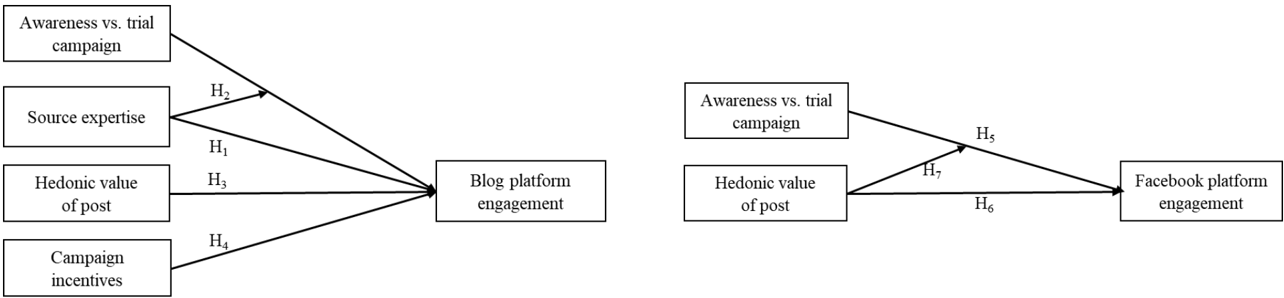
Influencer marketing is prevalent in firm strategies, yet little is known about the factors that drive success of online brand engagement at different stages of the consumer purchase funnel. The findings suggest that sponsored blogging affects online engagement (e.g., posting comments, liking a brand) differently depending on blogger characteristics and blog post content, which are further moderated by social media platform type and campaign advertising intent. When a sponsored post occurs on a blog, high blogger expertise is more effective when the advertising intent is to raise awareness versus increase trial. However, source expertise fails to drive engagement when the sponsored post occurs on Facebook. When a sponsored post occurs on Facebook, posts high in hedonic content are more effective when the advertising intent is to increase trial versus raise awareness. The effectiveness of campaign incentives depends on the platform type, such that they can increase (decrease) engagement on blogs (Facebook). The empirical evidence for these findings comes from real in-market customer response data and is supplemented with data from an experiment. Taken together, the findings highlight the critical interplay of platform type, campaign intent, source, campaign incentives, and content factors in driving engagement.
Overview
CoChat Summary
TL;DR
This paper examines how sponsored blogging campaigns drive online engagement across blogs and Facebook, using field data from 1,830 sponsored posts and a follow-up experiment. It finds engagement depends on platform, campaign intent, blogger expertise, hedonic content, and incentives, with expertise helping awareness campaigns on blogs but not Facebook.
Key findings
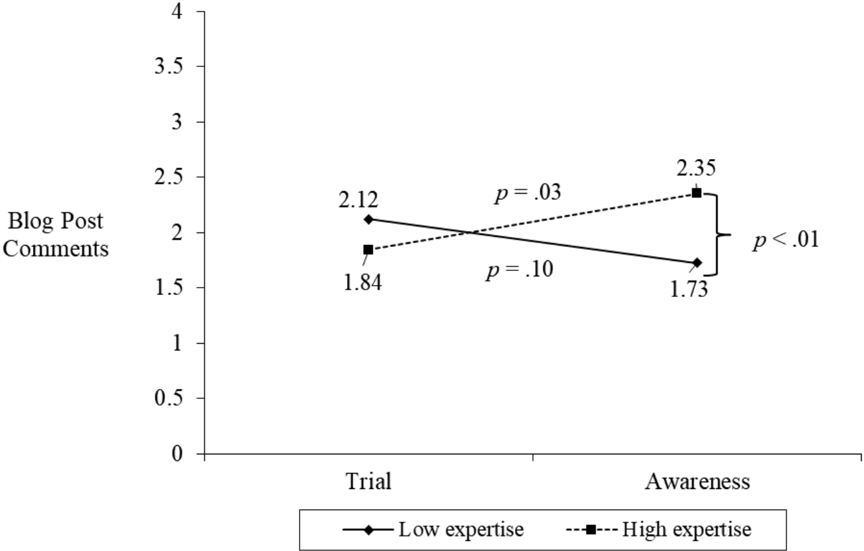
- In the blog-comment model (N = 1,237), blogger expertise had no significant main effect (b = −.1228, n.s.), but campaign intent × expertise was positive (b = .7283, p = .01): high-expertise bloggers performed better in awareness than trial campaigns (simple slope p < .05); low-expertise bloggers did not differ by intent (p = .10), so H2b was not supported.
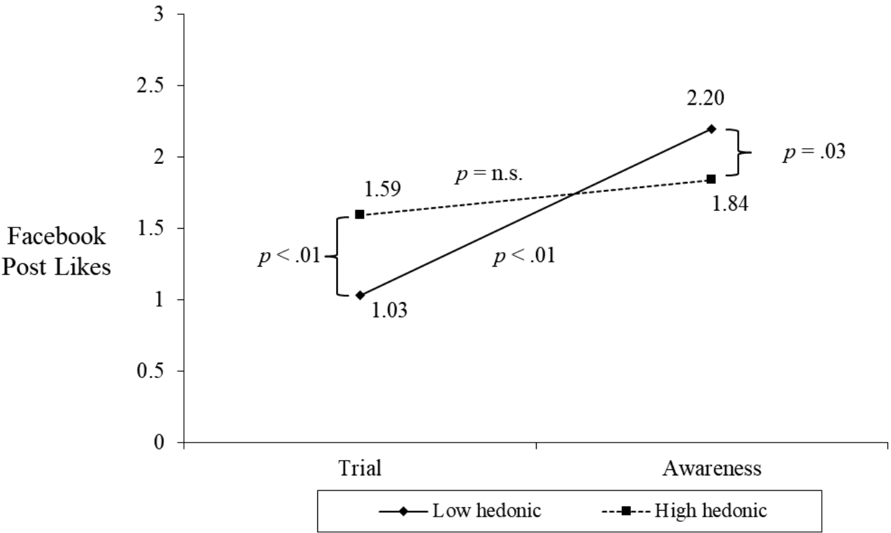
- Hedonic value of post increased blog comments (b = .2616, p < .01), and campaign giveaways increased blog comments (b = .4526, p = .01). On Facebook, awareness intent increased likes (b = .7416, p < .01), hedonic value increased likes (b = .2215, p = .03), and giveaways decreased likes (b = −.7840, p < .01).
- On Facebook, awareness × hedonic value was negative (b = −.4824, p < .01), implying hedonic content is positive for trial campaigns and negative for awareness campaigns; blogger expertise was not significantly related to Facebook likes (b = .0253, n.s.).
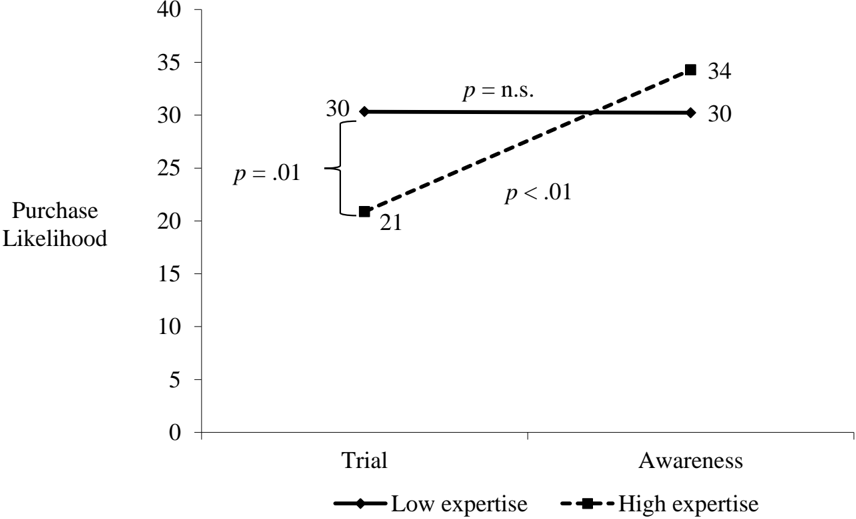
- Study 2 (N = 395 mothers) replicated the expertise × campaign intent interaction on purchase likelihood (F(1, 387) = 8.88, p < .01): with high expertise, awareness > trial (M = 34.10 vs. 20.66, p < .01); with low expertise, no difference (M = 30.24 vs. 30.29, p = .7106).
Methods
- Study 1 used real in-market data from The Motherhood agency: 1,830 sponsored posts by 595 bloggers across 57 campaigns (September 2012–December 2016); final analysis N = 1,237 due missing data. Dependent variables were number of blog post comments and Facebook post likes; negative binomial models with Heckman selection.
- Independent variables included campaign intent (awareness vs. trial), blogger expertise (sum of educational affiliation and blogger credentials, 0–2), hedonic and functional post value from coder factor analysis, campaign giveaways, follower counts, and controls.
- Study 2 was a 2 (expertise: high/low) × 2 (campaign: awareness/trial) between-subjects experiment with a Qualtrics panel of mothers (N = 395), using an educational paid app (Water Bears); the dependent variable was purchase likelihood.
Limitations
- Stated: the paper did not directly test ROI or sales, used post hoc coder ratings for sentiment, did not include a field experiment on blogger choice, and used bloggers’ network size at the time of posts without past performance/longevity; it also notes platforms evolve and ethical debates around sponsorship disclosure.
- Evident from text: Study 1 relies on one blogging agency and “mommy” bloggers, with missing data reducing the sample from 1,830 to 1,237; coder reliability for sentiment was modest (average α = .51, median = .56), and the field data are observational, limiting causal claims.
Model-written summary. Check it against the paper before relying on it.
Integrity signals
Registry
Cites
Statistics
Figures
Verification
Claims the paper makes
1 Valid · 0 Not valid · 18 Not checked · 125 Own results and interpretations
The sources with a verdict support this claim; the rest weren’t checked yet, have no full text we could read, or their verdicts aren’t rated yet.
In the paper
“we used the methodology Shrout and Fleiss (1979) describe and computed the Shrout-Fleiss single ICC score agreement of .998, which is considered quite high (Koo and Li 2016).”
What the sources say
- Not checked — no full text of the sourcecites Shrout and Fleiss (1979) matched to “Intraclass correlations: Uses in assessing rater reliability.” (1979) source
- Supportedcites Koo and Li 2016 matched to “A guideline of selecting and reporting intraclass correlation coefficients for reliability research” (2016) source
The ICC Interpretation passage (Introduction) classifies ICC values greater than 0.90 as indicating excellent reliability, supporting the description of .998 as quite high. The cited paper does not establish the citing authors’ computed score; the citation is attached to its interpretation. (LLM, conf=0.93)
plain- Asserted: passes — The authors put it forward as true.
- Checkable: passes — It can be checked against evidence.
- Load-bearing: unclear — It is unclear whether the paper’s conclusions depend on it.
- Based: passes — The paper gives a reason why it holds.
A result the paper reports from its own data — it cites no other source for it, so there is none to check. The quote shows it is in the paper.
In the paper
“When a sponsored post occurs on Facebook, posts high in hedonic content are more effective when the advertising intent is to increase trial versus raise awareness.”
plainstates a cause- Asserted: passes — The authors put it forward as true.
- Checkable: passes — It can be checked against evidence.
- Load-bearing: passes — The paper’s conclusions depend on it.
- Based: passes — The paper gives a reason why it holds.
A result the paper reports from its own data — it cites no other source for it, so there is none to check. The quote shows it is in the paper.
In the paper
“When a sponsored post occurs on a blog, high blogger expertise is more effective when the advertising intent is to raise awareness versus increase trial.”
- Also stated in: § Statement of Intended Contribution · p. 5 · plain
“In addition, blogger expertise exerts a greater impact in awareness (vs. trial) campaigns.”
plainstates a cause- Asserted: passes — The authors put it forward as true.
- Checkable: passes — It can be checked against evidence.
- Load-bearing: passes — The paper’s conclusions depend on it.
- Based: passes — The paper gives a reason why it holds.
- Also stated in: § Statement of Intended Contribution · p. 5 · plain
A result the paper reports from its own data — it cites no other source for it, so there is none to check. The quote shows it is in the paper.
In the paper
“However, source expertise fails to drive engagement when the sponsored post occurs on Facebook.”
plain- Asserted: passes — The authors put it forward as true.
- Checkable: passes — It can be checked against evidence.
- Load-bearing: passes — The paper’s conclusions depend on it.
- Based: passes — The paper gives a reason why it holds.
A result the paper reports from its own data — it cites no other source for it, so there is none to check. The quote shows it is in the paper.
In the paper
“We find that hedonic value has a significant effect on both blog and Facebook platforms.”
plainstates a cause- Asserted: passes — The authors put it forward as true.
- Checkable: passes — It can be checked against evidence.
- Load-bearing: passes — The paper’s conclusions depend on it.
- Based: passes — The paper gives a reason why it holds.
60 more claims
Create a free account to see all 144 claims and to verify the 2 references still open.
- It may state two separate claims as one. 43
- Probably not a substantial claim. 39
- The quote only partly states this claim. 10
Claims other papers make about this one
Each is checked against this paper’s own text: does it say what the citing paper says it does?
The cited source doesn’t support the claim as written.
In the citing paper
“Hughes, Swaminathan, and Brooks (2019) found that Facebook influencer campaigns that included incentives significantly increased the number of post comments.”
From Influencer Marketing on Instagram: Empirical Research on Social Media Engagement with Sponsored Posts (2022) · cites this paper as Hughes, Swaminathan, and Brooks (2019)
Checked by a reasoning model — may be wrong.
Experimental — accuracy not yet measuredThe source backs part of the claim, not all of it — or backs it for a different population, condition or comparison.
In the citing paper
“Social media platforms represent low-involvement, high-distraction, and hedonic environments (Hughes, Swaminathan, and Brooks 2019; Schulze, Sch€ oler, and Skiera 2014).”
From Influencer Marketing on Instagram: Empirical Research on Social Media Engagement with Sponsored Posts (2022) · cites this paper as Hughes, Swaminathan, and Brooks 2019
Experimental — accuracy not yet measuredThe cited source says what the claim attributes to it.
In the citing paper
“social media engagement is an important key performance indicator (KPI) to measure the success of sponsored posts on social media (Hughes, Swaminathan, and Brooks 2019;Lammenett 2019).”
From Influencer Marketing on Instagram: Empirical Research on Social Media Engagement with Sponsored Posts (2022) · cites this paper as Hughes, Swaminathan, and Brooks 2019
The cited source says what the claim attributes to it.
In the citing paper
“Previous research suggest that hedonic value can have an impact on post interaction and popularity (De Vries, Gensler, and Leeflang 2012;Hughes, Swaminathan, and Brooks 2019;Sabate et al. 2014).”
From Influencer Marketing on Instagram: Empirical Research on Social Media Engagement with Sponsored Posts (2022) · cites this paper as Hughes, Swaminathan, and Brooks 2019
The cited source says what the claim attributes to it.
In the citing paper
“Likes and comments are KPIs in influencer marketing (Hughes, Swaminathan, and Brooks 2019).”
From Influencer Marketing on Instagram: Empirical Research on Social Media Engagement with Sponsored Posts (2022) · cites this paper as Hughes, Swaminathan, and Brooks 2019
2 more claims about this paper
Create a free account to see every claim other papers make about this one.
Statistics that don’t add up
Each reported p-value recomputed from its test statistic and degrees of freedom, each partial η² from its F, and each ratio, mean difference or B printed with a p checked against its own confidence interval.
Rated minor: it would not touch a result — a value no result rests on, a p-value that stays on the same side of the significance level, or a conflict that is clerical, resolved elsewhere in the paper, or outside its own findings.
In the paper
“F(3, 260) = 3.61, p < .01”
Reported p < .01 · recomputed p = .014
Statistics recomputed
Every reported test result, recomputed from its test statistic and degrees of freedom. A result shows as not adding up only once an independent check has confirmed it.
- Doesn’t add upF(3, 260) = 3.61reported p < .01 · recomputed p = .014
“F(3, 260) = 3.61, p < .01”
- Not confirmedz = -0.06reported p = .95 · recomputed p = .952
“(z = -.060, p = .950”
- ConsistentF(3, 260) = 7.22reported p < .01 · recomputed p < .001
“F(3, 260) = 7.22, p < .01”
- Consistentz = 1.22reported p = .223 · recomputed p = .222
“(z = 1.22, p = .223”
- ConsistentF(3, 93) = 20.13reported p < .01 · recomputed p < .001
“F(3, 93) = 20.13, p < .01”
8 more recomputed tests
Create a free account to see every test the Stats check recomputed.
Self-check
Percentages, sums and reported differences re-computed from the paper’s own numbers.
Each contradiction between two passages listed here was confirmed by an independent check.
Rated minor: it would not touch a result — a value no result rests on, a p-value that stays on the same side of the significance level, or a conflict that is clerical, resolved elsewhere in the paper, or outside its own findings.
In the paper
§ Discussion · p. 29
“However, the results in Study 1 are driven by high expertise, while the results in Study 2 are driven by differences due to low expertise.”
§ Method and Results · p. 29
“Next, examining purchase likelihood under low blogger expertise, we found no significant difference between awareness and trial campaigns (Mawareness = 30.24, Mtrial = 30.29; F(1, 387) = .14, p = .7106)”
Citations
Cites
A guideline of selecting and reporting intraclass correlation coefficients for reliability research
Koo, T. K., & Li, M. Y. (2016) · Journal of Chiropractic Medicine · doi:10.1016/j.jcm.2016.02.012 · Cited by 31,709
Sample Selection Bias as a Specification Error
Heckman, J. J. (1979) · Econometrica · doi:10.2307/1912352 · Cited by 28,779
Intraclass correlations: Uses in assessing rater reliability.
Shrout, P. E., & Fleiss, J. L. (1979) · Psychological Bulletin · doi:10.1037/0033-2909.86.2.420 · Cited by 24,532
The Elaboration Likelihood Model of Persuasion
Petty, R. E., & Cacioppo, J. T. (1986) · Advances in Experimental Social Psychology · doi:10.1016/s0065-2601(08)60214-2 · Cited by 8,822 · cited 3×
“Our theoretical basis for predictions derives from the literature on the elaboration likelihood model (ELM) (Petty and Cacioppo 1986).”
BackgroundMethodHennig-Thurau, T., Gwinner, K. P., Walsh, G., & Gremler, D. D. (2004) · Journal of Interactive Marketing · doi:10.1002/dir.10073 · Cited by 5,916
A study of normative and informational social influences upon individual judgment.
Deutsch, M., & Gerard, H. B. (1955) · The Journal of Abnormal and Social Psychology · doi:10.1037/h0046408 · Cited by 4,819 · cited 1×
“This can derive from informational power, in which the expert has knowledge that others do not have (Deutsch and Gerard 1955).”
BackgroundDimensions of Consumer Expertise
Alba, J. W., & Hutchinson, J. W. (1987) · Journal of Consumer Research · doi:10.1086/209080 · Cited by 4,375
Ohanian, R. (1990) · Journal of Advertising · doi:10.1080/00913367.1990.10673191 · Cited by 4,043
The Influence of Source Credibility on Communication Effectiveness
Hovland, C. I., & Weiss, W. (1951) · Public Opinion Quarterly · doi:10.1086/266350 · Cited by 3,543 · cited 1×
“Source expertise affects attitude change (Hovland and Weiss 1951; McCracken 1989; Ohanian 1991), level of confidence and positivity (Tormala, Briñol, and Petty 2007), and behavioral changes (Crisci and Kassinove 1973) and leads to higher levels of persuasion (Petty and Wegener 1998).”
BackgroundThe Elaboration Likelihood Model of Persuasion
Petty, R. E., & Cacioppo, J. T. (1986) · Communication and Persuasion · doi:10.1007/978-1-4612-4964-1_1 · Cited by 3,202
Research works printed but not linked: 3
- Association of National Advertisers (2018), 'Advertisers Love Influencer Marketing: ANA Study,' press release, https://www.ana.net/content/show/id/48437.
- French, John and Bertram Raven (1959), 'The Bases of Social Power,' in Studies in Social Power , Dorwin Cartwright, ed. Ann Arbor: University of Michigan, 150-67.
- Zhu, June and Bernard Tan (2007), 'Effectiveness of Blog Advertising: Impact of Communicator Expertise, Campaign intent, and Product Involvement,' in ICIS 2007 Proceedings - Twenty Eighth International Conference on Information Systems . Atlanta: Association for Information Systems, paper 121.
Cited by
Items 501–600 of 779
Natália, N. (2023) · El-Mal Jurnal Kajian Ekonomi & Bisnis Islam · doi:10.47467/elmal.v5i1.3547 · Cited by 2
“Terlepas dari pertumbuhan belanja baru-baru ini yang signifikan dengan media sosial influencer, keraguan tentang efektivitas mereka juga di pertanyakan Hughes et al. (2019) Influencer memiliki peran di media sosial sebagai alat promosi dalam proses pengambilan keputusan konsumen .”
BackgroundTapping into the Popularity of Social Media Stars: A Management Model for Influencer Marketing
Vapiwala, F., Dixit, M., & Pandita, D. (2023) · International Conference on Decision Aid Sciences and Applications (DASA) · doi:10.1109/dasa59624.2023.10286705 · Cited by 3
“Lastly, on the basis of the findings, the authors also aim to propose a decision model that enables marketers to effectively select the appropriate influencer for their influencer marketing campaigns and ensure its successful implementation.”
BackgroundCorporate Influencing im Business-To-Business-Vertrieb
Nestler, L., & Hoffmann, C. (2024) · HMD Praxis der Wirtschaftsinformatik · doi:10.1365/s40702-024-01082-3 · Cited by 1
Influencer Marketing – Funktionsweise, Anwendung und Erfolgsfaktoren
Greve, G., & Hopf, G. (2024) · Springer eBooks · doi:10.1007/978-3-658-42282-0_19-1 · Cited by 1
Customer Engagement Drivers with Brands on Social Media: Article Review
Issam, A., & Said, O. F. M. (2024) · International Journal of Academic Research in Economics and Management Sciences · doi:10.6007/ijarems/v13-i2/21553 · Cited by 4
Ding, X., & Han, M. (2024) · Asian Communication Research · doi:10.20879/acr.2024.21.021 · Cited by 2
Influencer Marketing – Funktionsweise, Anwendung und Erfolgsfaktoren
Greve, G., & Hopf, G. (2024) · Springer eBooks · doi:10.1007/978-3-658-45784-6_19 · Cited by 3
Ayari, S., Nouira, O., & Oueslati, K. (2024) · Journal of Decision System · doi:10.1080/12460125.2024.2415152 · Cited by 2
Emebo, A. (2025) · European Conference on Social Media · doi:10.34190/ecsm.12.1.3360 · Cited by 1
“Despite extensive research in influencer marketing on factors like influencer credibility and emotional connections (De Jans et al., 2018; Hughes et al., 2019), gaps remain in understanding how parasocial relationships impact influencers' well-being.”
Impact of Social Media Marketing on Brand Awareness in Nepal
Bajracharya, S., & Sah, P. (2024) · Nepalese Journal of Business. · doi:10.3126/njb.v11i4.79734 · Cited by 3
“Additionally, Hughes et al. (2019) explained that interaction can be measured by the number of likes and comments that influencers get from followers when making paid posts from a brand to market the brand’s products or services on Instagram.”
Fadli, F., Nasution, M. D. T. P., Qamariah, I., & Zulkarnain, S. H. (2025) · Jurnal Ilmiah Manajemen Kesatuan · doi:10.37641/jimkes.v13i5.3785 · Cited by 13
Abdulla, A., & Saberi, M. (2025) · Journal of Business and Socio-economic Development · doi:10.1108/jbsed-03-2025-0069 · Cited by 12
Unravelling consumer decision-making under the realm of digital influencer: a review and agenda
Kumar, N., Agrawal, A. K., Cúg, J., Chatterjee, S., & Troise, C. (2025) · Measuring Business Excellence · doi:10.1108/mbe-06-2025-0135 · Cited by 2
Including Subjective Language or Not? How Product Recommendation Language Shapes Influencers' Impact
Xie, K., Zhang, M., Cai, S., & Wang, Y. (2026) · Journal of Interactive Marketing · doi:10.1177/10949968251393224 · Cited by 1
“Previous in fl uencer marketing literature has primarily focused on the impact of in fl uencers ’ network characteristics (e.g., follower size) or content characteristics (e.g., sponsorship disclosure, content customization) on customer engagement (Chen, Yan, and Smith 2023; Chung, Ding, and Kalra 2023; Hughes, Swaminat…”
Influencer Marketing: A Comprehensive Review and Future Research Direction
Gupta, P., & Verma, S. (2025) · South Asian Journal of Business and Management Cases · doi:10.1177/22779779251393408 · Cited by 9
Online influencer marketing on user-generated content platforms
Gao, W., Zhong, F., Yu, H., Liu, X., & Zhou, Z. (2025) · International Journal of Production Research · doi:10.1080/00207543.2025.2598447 · Cited by 3
Jhawar, A. (2025) · Current Issues in Tourism · doi:10.1080/13683500.2025.2608263 · Cited by 1
Don't You Know That You're Toxic? How Influencer‐Driven Misinformation Fuels Online Toxicity
Domenico, G. D., Mangiò, F., & Dineva, D. (2026) · Psychology and Marketing · doi:10.1002/mar.70106 · Cited by 2
Endorsement Rate in Influencer Marketing
Li, Y., Gao, A. Y., Gu, F. F., & Leung, F. F. (2026) · Journal of Marketing · doi:10.1177/00222429261422744 · Cited by 3
Fostering consumer engagement with expressive certainty in entrepreneur-generated content
Yang, Q., Shen, M., Huo, J., & Meng, L. M. (2026) · European Journal of Marketing · doi:10.1108/ejm-10-2022-0764 · Cited by 1
Decoding Visual Brand Identity Through Computer Vision
Emon, M. M. H., & Khan, T. (2026) · Advances in computational intelligence and robotics book series · doi:10.4018/979-8-3373-4506-2.ch002 · Cited by 1
Virtual Social Influencer Scale Development and Validation: An Algorithmic Approach
van Esch, P., Cui, Y. G., Arli, D. I., & Eskridge, B. (2026) · Australasian Marketing Journal (AMJ) · doi:10.1177/14413582261423028 · Cited by 2
“On one hand, VSIs offer novel avenues for brand storytelling, creative expression, and audience engagement (Hughes et al., 2019).”
Beyond youth: The optimal age for influencer credibility and marketing success
Galle, C., Lau, V., & Dost, F. (2026) · Journal of the Academy of Marketing Science · doi:10.1007/s11747-025-01134-0 · Cited by 4
“Hence older influencers may benefit from heightened perceptions of competence, depending on the product and platform con - text (Hughes et al., 2019).”
Begum, M., & Xue, F. (2026) · Journal of Marketing Communications · doi:10.1080/13527266.2026.2640419 · Cited by 1
Promoting sustainable foods on Instagram: impact of message source and appeals
Lemmens, F., Brengman, M., & Willems, K. (2026) · Journal of Consumer Marketing · doi:10.1108/jcm-06-2024-6994 · Cited by 5
Affiliate marketing: a systematic synthesis of literature and a framework development
Rishi, B., Jebarajakirthy, C., Agrawal, A., Maseeh, H. I., & Saha, R. (2026) · Marketing Intelligence & Planning · doi:10.1108/mip-08-2024-0554 · Cited by 1
Jin, S. U. N., Wang, H., & Yang, J. (2026) · Journal of Advertising Research · doi:10.1080/00218499.2026.2616850 · Cited by 2
Wan, D., Shen, P., & Kang, H. (2026) · The Journal of Marketing Theory and Practice · doi:10.1080/10696679.2026.2646199 · Cited by 1
Rethinking social media strategy: Crafting digital sensory appeals to maximize customer engagement
Lee, N. Y., Edelblum, A. B., Park, K., & Zablah, A. R. (2026) · Journal of the Academy of Marketing Science · doi:10.1007/s11747-026-01145-5 · Cited by 2
Navigating the Influencer Marketplace: Long-Tail Effects and Content Strategies
Shi, L., He, S., & Ba, S. (2026) · Information Systems Research · doi:10.1287/isre.2023.0581 · Cited by 3
Patil, R. K., & Rice, D. H. (2026) · Journal of Business Research · doi:10.1016/j.jbusres.2026.116354 · Cited by 7
Koronios, K., Ntasis, L., Dimitropoulos, P. E., & Dekoulou, P. (2026) · Competitiveness Review An International Business Journal incorporating Journal of Global Competitiveness · doi:10.1108/cr-02-2026-0100 · Cited by 1
The impact of help-seeking cues in video posts on user engagement
Ma, K., Jiang, Z., & Sun, W. (2026) · Journal of Retailing and Consumer Services · doi:10.1016/j.jretconser.2026.105061 · Cited by 1
Alikılıç, Ö., & Özer, A. (2021) · Ankara Üniversitesi ilef dergisi/Ankara üniversitesi ilef dergisi · doi:10.24955/ilef.1037992 · Cited by 1
"Oi, Meu Nome É…" x "Me Poupe": Influenciadores Digitais e a Reação dos Consumidores
Andreoli, T. P., & Vieira, B. A. (2022) · Revista Gestão & Conexões · doi:10.47456/regec.2317-5087.2022.11.1.35933.39-60 · Cited by 1
Ren, W., Liu, B., Liang, L., Li, X., & Li, H. (2022) · Applied economics and policy studies · doi:10.1007/978-981-19-5727-7_62 · Cited by 3
Influencer’s Trustworthiness for Car Purchase
Hartawidjaja, G. F., & Agus, A. A. (2023) · Quantitative Economics and Management Studies · doi:10.35877/454ri.qems1446 · Cited by 6
Digital Marketing and Digital Marketing Mix
Kucuk, S. U. (2023) · Palgrave studies in marketing, organizations and society · doi:10.1007/978-3-031-18215-0_8 · Cited by 3
US Cross-Border E-Commerce Marketing Analysis and Future Plans
Chen, E. (2023) · Journal of Education Humanities and Social Sciences · doi:10.54097/ehss.v16i.9600 · Cited by 1
“In return, these bloggers need to put an ad about the products in their account [8].”
BackgroundAntara, P. M., Ibrahim, N. A., & Musa, R. (2023) · Springer eBooks · doi:10.1007/978-981-99-2337-3_43 · Cited by 1
Altenscheidt, J., Ernst, S.-C., & Schmitz, C. (2023) · Journal of Personal Selling and Sales Management · doi:10.1080/08853134.2023.2266144 · Cited by 4
“To assess if non-response bias is an issue in our dataset, we followed the approach suggested by Armstrong and Overton (1977) which has frequently been adopted in the marketing literature (e.g. Bhagwat et al. 2020; Hughes, Swaminathan, and Brooks 2019; Hulland, Baumgartner, and Smith 2018).”
Rosa del Olmo Prize: Introductory Essay
Goyes, D. R., South, N., Scott, J., & Creagh, T. (2023) · International Journal for Crime Justice and Social Democracy · doi:10.5204/ijcjsd.3223 · Cited by 2
Facebook’s Influence on the Effectiveness of Digital Advertising among Malaysian Youth
Lin, T., Veerappan, V., Warraich, M. A., Sulistyo, P. B., & Putra, A. R. (2024) · Journal of Communication Language and Culture · doi:10.33093/jclc.2024.4.1.4 · Cited by 5
AI Assistant in Online Pharmacy
Shen, T., Liang, C., Peng, J., Guan, M., & Li, J. (2023) · Hawaii International Conference on System Sciences (HICSS) · doi:10.24251/hicss.2023.461 · Cited by 2
“According to the prior literature, whether new designs or campaigns in online platforms could lead to more purchases largely depends on their effectiveness in enhancing users’ platform engagement (Chaudhuri et al. 2021, Hughes et al. 2019).”
Digital Disruption—How Medical Doctors Employ Influencer Marketing Strategies
Kanzler, A. (2024) · Springer proceedings in business and economics · doi:10.1007/978-3-031-47888-8_8 · Cited by 2
Dam, L. (2024) · Advances in marketing, customer relationship management, and e-services book series · doi:10.4018/979-8-3693-0912-4.ch008 · Cited by 2
Li, H., & Tay, K. (2024) · Media Konservasi · doi:10.29244/medkon.29.3.349 · Cited by 10
“Comment count represents the extent of audience participation and discussion, indicating their engagement level with specific content [47].”
BackgroundAdvantages and Disadvantages for Brands of Using Social Media Influencers
Cattaneo, E., & Sun, Y. (2024) · Springer eBooks · doi:10.1007/978-3-031-63516-8_5 · Cited by 2
Consumer Engagement in Social Media: A Systematic Literature Review of Surveys and Experiments
Salam, M. (2024) · doi:10.32920/26883382 · Cited by 4
The Impact of Social Media Influencers on Consumer-Brand Relationship in Tourism
Baycur, G. (2024) · Tourism, hospitality & event management · doi:10.1007/978-3-031-59535-6_9 · Cited by 3
Dijital Ebeveynlik: Sharenting Bağlamında Ünlü Futbolcuların Dramaturjik Paylaşımları
Duman, Ö. D. (2024) · Akdeniz Üniversitesi İletişim Fakültesi Dergisi · doi:10.31123/akil.1556293 · Cited by 4
Netnography and AI influencers
Dutta, A., & Sharma, A. (2025) · Business Information Review · doi:10.1177/02663821241310374 · Cited by 4
The Effect of Visual Influencer Marketing on Social Commerce Engagement: A Multi-Variable Approach
Balraj, B., & Haripriya, T. (2025) · INTERANTIONAL JOURNAL OF SCIENTIFIC RESEARCH IN ENGINEERING AND MANAGEMENT · doi:10.55041/ijsrem43951 · Cited by 1
Thakur, R., & John, J. (2025) · Internet Research · doi:10.1108/intr-04-2024-0556 · Cited by 1
Sales representative vs. firm commitment: The moderating role of national distance
Wang, M., Gu, F. F., Zhao, D., & He, D. (2025) · Industrial Marketing Management · doi:10.1016/j.indmarman.2025.04.006 · Cited by 1
Herrera-Enríquez, G., & Yépez, R. F. U. (2024) · Revista Científica Ciencia y Método · doi:10.55813/gaea/rcym/v2/n2/43 · Cited by 12
Pan, L.-Y., Huang, H., & Ko, C.-H. (2020) · Behaviour and Information Technology · doi:10.1080/0144929x.2020.1766115 · Cited by 2
“Similar to ‘sponsored bloggers’ who become key contributors in influencer marketing, these incentive-driven bloggers are reimbursed for generating eWOM in social media in favour of specific brand owners or organisations (Hughes, Swaminathan, and Brooks 2019).”
BackgroundExploitation of Health on Instagram
Blight, M. G. (2021) · IGI Global eBooks · doi:10.4018/978-1-6684-2414-8.ch024 · Cited by 2
Endorsement as a Marketing Strategy Trend in Islamic Perspective
Sopian, A. A. (2020) · Journal of Economicate Studies · doi:10.32506/joes.v4i2.650 · Cited by 1
Rungtrakulchai, R. (2021) · International Conference on Business and Industrial Research (ICBIR) · doi:10.1109/icbir52339.2021.9465863 · Cited by 2
Studying the Drivers of Consumer Behavioural Engagement With Social Media Brand-Related Content
Ebrahim, R. S. (2021) · International Journal of Customer Relationship Marketing and Management · doi:10.4018/ijcrmm.2022010106 · Cited by 6
Kucuk, S. U. (2020) · Springer eBooks · doi:10.1007/978-3-030-53983-2_5 · Cited by 1
Ge, J., & Guo, J. (2022) · Lecture notes in computer science · doi:10.1007/978-3-031-05014-5_20 · Cited by 2
Influencer marketing for growing sports clothing brands in Ireland
O'Leary, S. (2020) · eSource (Dublin Business School) · Cited by 1
Giertz, J. N. (2022) · eDiss (Georg-August-Universität Göttingen) · doi:10.53846/goediss-9352 · Cited by 2
Goldenberg, J., Lanz, A., Shapira, D., & Stahl, F. (2024) · SSRN Electronic Journal · doi:10.2139/ssrn.4662992 · Cited by 1
Shaping the Influencers: The Role of Multi-Channel NetworksPreprint
Hao, Y., & Li, X. (2024) · SSRN Electronic Journal · doi:10.2139/ssrn.4720070 · Cited by 4
Krishnamoorthy, A., Sanaei, F., & Subramanian, T. (2025) · SSRN Electronic Journal · doi:10.2139/ssrn.5336880 · Cited by 1
From Coalescence to Bureaucratization: Veganuary’s Use of Rhetorical Strategies on Social Media
Carr, S. A. (2020) · TopSCHOLAR (Western Kentucky University)
محمد, م. ص. (2020) · مجلة البحوث الإعلامیة · doi:10.21608/jsb.2020.109040
YouTube airline review vloggers' impact on their followers'purchase intent
Wojciechowicz, J. K. (2020) · NORMA · Cited by 2
El marketing de influencers en universitarios del norte de México
Estrada, I. C., & Zavala, A. M. M. (2021) · RECAI Revista de Estudios en Contaduría Administración e Informática · doi:10.36677/recai.v10i28.15514
Greenalgh, D. (2020) · eSource (Dublin Business School)
Kang, Y., & Yang, K. C. C. (2021) · Advances in public policy and administration (APPA) book series · doi:10.4018/978-1-7998-8057-8.ch012
العوامل المؤثرة في متابعة الجمهور العربي لحسابات المؤثرين على انستجرام:
سلامة, ح. ع. (2021) · Al-Maǧallah Al-Miṣriyyaẗ Li-Buḥūṯ Al-Iʿlām · doi:10.21608/ejsc.2021.211342
Kim, W.-H., Shim, J.-W., & Choi, H.-L. (2022) · Journal of Digital Contents Society · doi:10.9728/dcs.2022.23.3.559 · Cited by 1
إبراهیم, ص. م. (2022) · المجلة العربية لبحوث الاعلام والاتصال · doi:10.21608/jkom.2022.232572
Kaskela, T., Zhu, B., & Dhamapurkar, S. (2022) · Lecture notes in business information processing · doi:10.1007/978-3-031-04126-6_8
Verhallen, P. (2021) · Research Publications (Maastricht University) · doi:10.26481/dis.20210628pv
Influencer Marketing – Status Quo, Einsatzmöglichkeiten und Entwicklungsperspektiven
Ceyp, M. (2020) · Springer eBooks · doi:10.1007/978-3-658-28973-7_33-1
(2021) · Publisher House of the Far East University eBooks · doi:10.24866/7444-5125-7
Exploitation of Health on Instagram
Blight, M. G. (2020) · Advances in information security, privacy, and ethics book series · doi:10.4018/978-1-7998-3487-8.ch007
Gestão estratégica de marcas no contexto do consumo responsável: proposta de um modelo teórico
Bedendo, M. H. (2020) · Digital Library of Theses and Dissertations (Universidade de São Paulo) · doi:10.11606/t.12.2020.tde-23062020-220700 · Cited by 1
Defining and Measuring the Perceived Quality of a Virtual Community
Othmani, L., Bouslama, N., & Sfaxi, J. (2022) · Advances in marketing, customer relationship management, and e-services book series · doi:10.4018/978-1-7998-9553-4.ch007
Social Media Advertising and Consumer Purchase: A Literature Review
Gao, T. (2022) · Lecture notes in computer science · doi:10.1007/978-3-031-05014-5_19 · Cited by 2
Designing E-Commerce Livestreams: How Quicker Product Promotion Affects Sales?Preprint
Xie, S., Mehra, A., & Sharma, S. (2022) · SSRN Electronic Journal · doi:10.2139/ssrn.4114942
Finding the Right Influencers on Instagram for Endorsement Product Using Text Mining
Pamungkas, H., Yudhianto, R. H., Sembiring, B. J., & Budi, I. D. (2022) · International Journal on Advanced Science Engineering and Information Technology · doi:10.18517/ijaseit.12.4.17228
da Silva, M. B. (2022) · Digital Library of Theses and Dissertations (Universidade de São Paulo) · doi:10.11606/t.96.2022.tde-07102022-095123
Turismo en época de pandemia: impacto del mensaje publicitario en el comportamiento turístico
Castillo-Altamirano, M., & Ballesteros-López, L. (2023) · 593 Digital Publisher CEIT · doi:10.33386/593dp.2023.1-1.1203
Valcárce, D. P., Arias, S. M., & Muñoz, S. M. (2023) · Research Square · doi:10.21203/rs.3.rs-2529587/v1
The Influences of Ad-Targeting on Teen Purchasing Decision Autonomy
Bradley, M. (2023) · Journal of Student Research · doi:10.47611/jsrhs.v11i1.2252 · Cited by 1
Zhang, J., Lee, S., & Tan, Y. (2023) · SSRN Electronic Journal · doi:10.2139/ssrn.4383852
Socuaji, A. M. B., Note, K. A. R., Remetio, E. G. G., Tolete, R. J. V., Vallan, C. A., & Lapuz, M. C. M. (2022) · International Conference in Information and Computing Research (iCORE) · doi:10.1109/icore58172.2022.00064 · Cited by 2
“When a promotion appears on a vlog, a well-known content creator's ability is impactful when the offer quality brings awareness and informs the public rather than increasing the revenues and trials only [2].”
BackgroundInfluentialIs this Endorsement Authentic? The Role of Message Sequence in Influencer Marketing
Yang, J., Kennedy-Foglio, L., Jiang, M., & Joo, E. (2023) · European Advertising Academy · doi:10.1007/978-3-658-40429-1_21 · Cited by 1
Nair, A. S., & Marciniak, R. (2023) · Emerald Group Publishing Limited eBooks · doi:10.1108/978-1-80382-345-420231022 · Cited by 1
Dampak Karakteristik Influencer Digital terhadap Niat Beli Produk Fashion
Simanjuntak, R., Yani, A., & Sumarsid, S. (2023) · Labs Jurnal Bisnis dan Manajemen · doi:10.57134/labs.v28i2.43 · Cited by 4
Ahrholdt, D. C., Greve, G., & Hopf, G. (2023) · Springer eBooks · doi:10.1007/978-3-658-40599-1_12
QuanQuan, L., Yu, S. K., & YaTing, Y. (2023) · SSRN Electronic Journal · doi:10.2139/ssrn.4461075
Metadata
- Authors
- Hughes, C., Swaminathan, V., & Brooks, G.
- Affiliations
- University of Mendoza (AR)
- University of Notre Dame (US)
- University of Oxford (GB)
- Corresponding author
- Hughes, Christian
- Venue
- Journal of Marketing
- Publisher
- SAGE Publications
- Published
- 2019-06-04
- Volume
- 83
- Issue
- 5
- Pages
- 78-96
- ISSN
- 0022-2429 (ISSN-L)
- 1547-7185
- OpenAlex
- W2946816985
- Cited by
- 789
- References
- 88
- Citations by year
- 2026: 118 · 2025: 150 · 2024: 150 · 2023: 132 · 2022: 99 · 2021: 81 · 2020: 48 · 2019: 9
- FWCI
- 119.02
- Type
- journal article
- Language
- en
- Open access
- green
- kclpure.kcl.ac.uk
- Licence
- other-oa
- journals.sagepub.com/page/policies/text-and-data-mining-license (tdm)
- Locations
- Journal of Marketing (publishedVersion)
- Research Portal (King's College London) (submittedVersion, other-oa)
- Funders
- Marketing Science Institute (#4-1927)
- Topics
- Social Sciences › Business, Management and Accounting › Marketing › Digital Marketing and Social Media
- Social Sciences › Business, Management and Accounting › Marketing › Marketing and Advertising Strategies
- Social Sciences › Business, Management and Accounting › Marketing › Consumer Behavior in Brand Consumption and Identification
- Keywords
- influencer marketing, brand engagement, social media influencers, purchase funnel, source expertise, Facebook, blog posts, consumer purchase behavior
About these checks
Registry, retraction, Cites and statistics results are computed, not judged, with one exception: a printed reference that no index lists is read once by a model before it counts as a citation error. Claims are extracted by a model and kept only when their quote appears verbatim in the text; each cited source is then checked, with a model’s help, for whether it says what the claim relies on. Those verdicts can be wrong — read the claim’s quote and the cited source before relying on one.
A language model drew the claims from the paper on 2026-10-10, under version 3 of the claim definition (model deepseek-v4.1-flash, prompt extract-v3).
A second model labelled each claim on 2026-10-10 (model jev-1.13-20260917, definition revision gold-guideline-v0.2).
Cited sources are checked with a language model’s help (gpt-6-sol).
Statistics and arithmetic are recomputed, not judged.
Confidence bands are shown only for fields calibrated on our annotated test set. None is calibrated yet, so no band is shown.
What counts as a claim ›How we measure confidence ›How we check this ›
Are you an author, or do you see a problem with this page? Request a review
Data sources
Bibliographic data: Semantic Scholar, OpenAlex, Crossref.
Contains information from the Semantic Scholar Academic Graph Datasets, made available under the ODC Attribution License (ODC-BY 1.0).
Semantic Scholar’s data is described in: Kinney, R., et al. (2023). The Semantic Scholar Open Data Platform. arXiv:2301.10140.
