

Driving Brand Engagement Through Online Social Influencers: An Empirical Investigation of Sponsored Blogging Campaigns
Open accessThe DOI matches its Crossref record; 88 of the 88 references it cites were found in a registry or an index; 1 of the 26 sources its claims cite were checked for support.
Abstract
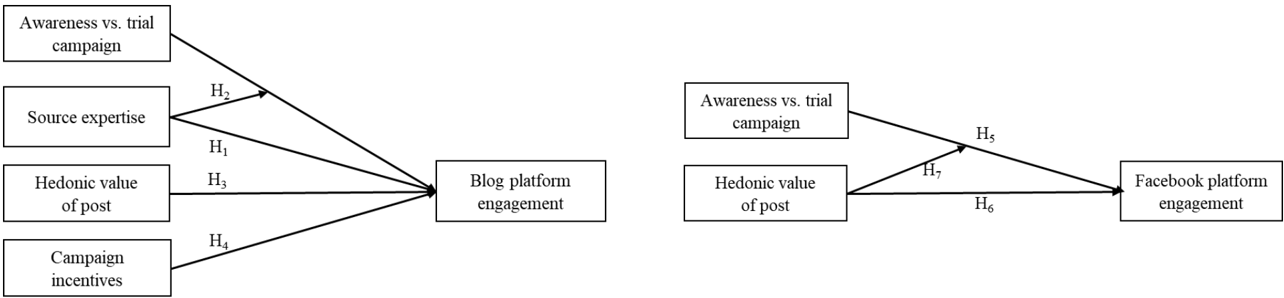
Influencer marketing is prevalent in firm strategies, yet little is known about the factors that drive success of online brand engagement at different stages of the consumer purchase funnel. The findings suggest that sponsored blogging affects online engagement (e.g., posting comments, liking a brand) differently depending on blogger characteristics and blog post content, which are further moderated by social media platform type and campaign advertising intent. When a sponsored post occurs on a blog, high blogger expertise is more effective when the advertising intent is to raise awareness versus increase trial. However, source expertise fails to drive engagement when the sponsored post occurs on Facebook. When a sponsored post occurs on Facebook, posts high in hedonic content are more effective when the advertising intent is to increase trial versus raise awareness. The effectiveness of campaign incentives depends on the platform type, such that they can increase (decrease) engagement on blogs (Facebook). The empirical evidence for these findings comes from real in-market customer response data and is supplemented with data from an experiment. Taken together, the findings highlight the critical interplay of platform type, campaign intent, source, campaign incentives, and content factors in driving engagement.
Overview
CoChat Summary
TL;DR
This paper examines how sponsored blogging campaigns drive online engagement across blogs and Facebook, using field data from 1,830 sponsored posts and a follow-up experiment. It finds engagement depends on platform, campaign intent, blogger expertise, hedonic content, and incentives, with expertise helping awareness campaigns on blogs but not Facebook.
Key findings
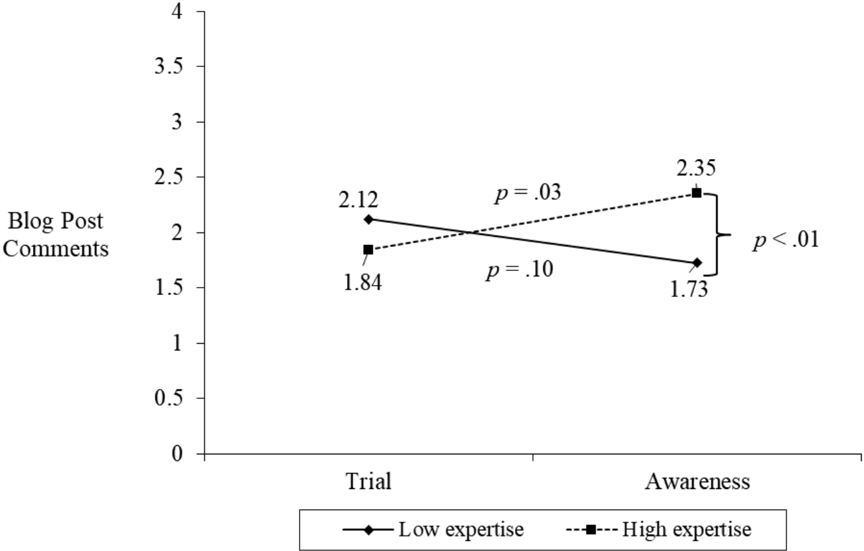
- In the blog-comment model (N = 1,237), blogger expertise had no significant main effect (b = −.1228, n.s.), but campaign intent × expertise was positive (b = .7283, p = .01): high-expertise bloggers performed better in awareness than trial campaigns (simple slope p < .05); low-expertise bloggers did not differ by intent (p = .10), so H2b was not supported.
- Hedonic value of post increased blog comments (b = .2616, p < .01), and campaign giveaways increased blog comments (b = .4526, p = .01). On Facebook, awareness intent increased likes (b = .7416, p < .01), hedonic value increased likes (b = .2215, p = .03), and giveaways decreased likes (b = −.7840, p < .01).
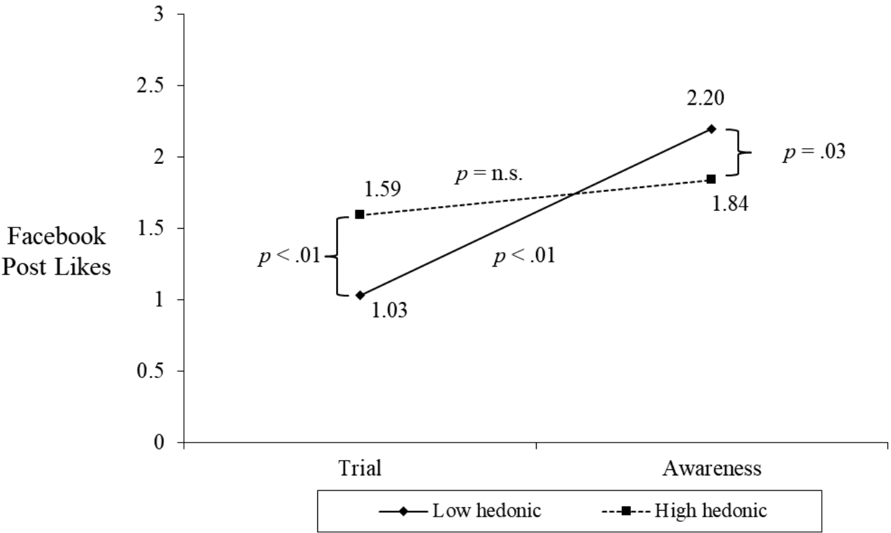
- On Facebook, awareness × hedonic value was negative (b = −.4824, p < .01), implying hedonic content is positive for trial campaigns and negative for awareness campaigns; blogger expertise was not significantly related to Facebook likes (b = .0253, n.s.).
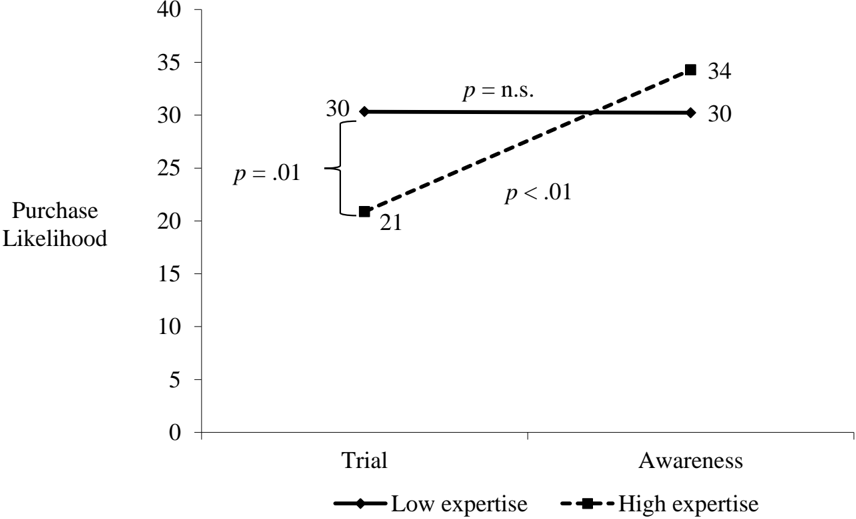
- Study 2 (N = 395 mothers) replicated the expertise × campaign intent interaction on purchase likelihood (F(1, 387) = 8.88, p < .01): with high expertise, awareness > trial (M = 34.10 vs. 20.66, p < .01); with low expertise, no difference (M = 30.24 vs. 30.29, p = .7106).
Methods
- Study 1 used real in-market data from The Motherhood agency: 1,830 sponsored posts by 595 bloggers across 57 campaigns (September 2012–December 2016); final analysis N = 1,237 due missing data. Dependent variables were number of blog post comments and Facebook post likes; negative binomial models with Heckman selection.
- Independent variables included campaign intent (awareness vs. trial), blogger expertise (sum of educational affiliation and blogger credentials, 0–2), hedonic and functional post value from coder factor analysis, campaign giveaways, follower counts, and controls.
- Study 2 was a 2 (expertise: high/low) × 2 (campaign: awareness/trial) between-subjects experiment with a Qualtrics panel of mothers (N = 395), using an educational paid app (Water Bears); the dependent variable was purchase likelihood.
Limitations
- Stated: the paper did not directly test ROI or sales, used post hoc coder ratings for sentiment, did not include a field experiment on blogger choice, and used bloggers’ network size at the time of posts without past performance/longevity; it also notes platforms evolve and ethical debates around sponsorship disclosure.
- Evident from text: Study 1 relies on one blogging agency and “mommy” bloggers, with missing data reducing the sample from 1,830 to 1,237; coder reliability for sentiment was modest (average α = .51, median = .56), and the field data are observational, limiting causal claims.
Model-written summary. Check it against the paper before relying on it.
Integrity signals
Registry
Cites
Statistics
Figures
Verification
Claims the paper makes
1 Valid · 0 Not valid · 18 Not checked · 125 Own results and interpretations
The sources with a verdict support this claim; the rest weren’t checked yet, have no full text we could read, or their verdicts aren’t rated yet.
In the paper
“we used the methodology Shrout and Fleiss (1979) describe and computed the Shrout-Fleiss single ICC score agreement of .998, which is considered quite high (Koo and Li 2016).”
What the sources say
- Not checked — no full text of the sourcecites Shrout and Fleiss (1979) matched to “Intraclass correlations: Uses in assessing rater reliability.” (1979) source
- Supportedcites Koo and Li 2016 matched to “A guideline of selecting and reporting intraclass correlation coefficients for reliability research” (2016) source
The ICC Interpretation passage (Introduction) classifies ICC values greater than 0.90 as indicating excellent reliability, supporting the description of .998 as quite high. The cited paper does not establish the citing authors’ computed score; the citation is attached to its interpretation. (LLM, conf=0.93)
plain- Asserted: passes — The authors put it forward as true.
- Checkable: passes — It can be checked against evidence.
- Load-bearing: unclear — It is unclear whether the paper’s conclusions depend on it.
- Based: passes — The paper gives a reason why it holds.
A result the paper reports from its own data — it cites no other source for it, so there is none to check. The quote shows it is in the paper.
In the paper
“When a sponsored post occurs on Facebook, posts high in hedonic content are more effective when the advertising intent is to increase trial versus raise awareness.”
plainstates a cause- Asserted: passes — The authors put it forward as true.
- Checkable: passes — It can be checked against evidence.
- Load-bearing: passes — The paper’s conclusions depend on it.
- Based: passes — The paper gives a reason why it holds.
A result the paper reports from its own data — it cites no other source for it, so there is none to check. The quote shows it is in the paper.
In the paper
“When a sponsored post occurs on a blog, high blogger expertise is more effective when the advertising intent is to raise awareness versus increase trial.”
- Also stated in: § Statement of Intended Contribution · p. 5 · plain
“In addition, blogger expertise exerts a greater impact in awareness (vs. trial) campaigns.”
plainstates a cause- Asserted: passes — The authors put it forward as true.
- Checkable: passes — It can be checked against evidence.
- Load-bearing: passes — The paper’s conclusions depend on it.
- Based: passes — The paper gives a reason why it holds.
- Also stated in: § Statement of Intended Contribution · p. 5 · plain
A result the paper reports from its own data — it cites no other source for it, so there is none to check. The quote shows it is in the paper.
In the paper
“However, source expertise fails to drive engagement when the sponsored post occurs on Facebook.”
plain- Asserted: passes — The authors put it forward as true.
- Checkable: passes — It can be checked against evidence.
- Load-bearing: passes — The paper’s conclusions depend on it.
- Based: passes — The paper gives a reason why it holds.
A result the paper reports from its own data — it cites no other source for it, so there is none to check. The quote shows it is in the paper.
In the paper
“We find that hedonic value has a significant effect on both blog and Facebook platforms.”
plainstates a cause- Asserted: passes — The authors put it forward as true.
- Checkable: passes — It can be checked against evidence.
- Load-bearing: passes — The paper’s conclusions depend on it.
- Based: passes — The paper gives a reason why it holds.
60 more claims
Create a free account to see all 144 claims and to verify the 2 references still open.
- It may state two separate claims as one. 43
- Probably not a substantial claim. 39
- The quote only partly states this claim. 10
Claims other papers make about this one
Each is checked against this paper’s own text: does it say what the citing paper says it does?
The cited source doesn’t support the claim as written.
In the citing paper
“Hughes, Swaminathan, and Brooks (2019) found that Facebook influencer campaigns that included incentives significantly increased the number of post comments.”
From Influencer Marketing on Instagram: Empirical Research on Social Media Engagement with Sponsored Posts (2022) · cites this paper as Hughes, Swaminathan, and Brooks (2019)
Checked by a reasoning model — may be wrong.
Experimental — accuracy not yet measuredThe source backs part of the claim, not all of it — or backs it for a different population, condition or comparison.
In the citing paper
“Social media platforms represent low-involvement, high-distraction, and hedonic environments (Hughes, Swaminathan, and Brooks 2019; Schulze, Sch€ oler, and Skiera 2014).”
From Influencer Marketing on Instagram: Empirical Research on Social Media Engagement with Sponsored Posts (2022) · cites this paper as Hughes, Swaminathan, and Brooks 2019
Experimental — accuracy not yet measuredThe cited source says what the claim attributes to it.
In the citing paper
“social media engagement is an important key performance indicator (KPI) to measure the success of sponsored posts on social media (Hughes, Swaminathan, and Brooks 2019;Lammenett 2019).”
From Influencer Marketing on Instagram: Empirical Research on Social Media Engagement with Sponsored Posts (2022) · cites this paper as Hughes, Swaminathan, and Brooks 2019
The cited source says what the claim attributes to it.
In the citing paper
“Previous research suggest that hedonic value can have an impact on post interaction and popularity (De Vries, Gensler, and Leeflang 2012;Hughes, Swaminathan, and Brooks 2019;Sabate et al. 2014).”
From Influencer Marketing on Instagram: Empirical Research on Social Media Engagement with Sponsored Posts (2022) · cites this paper as Hughes, Swaminathan, and Brooks 2019
The cited source says what the claim attributes to it.
In the citing paper
“Likes and comments are KPIs in influencer marketing (Hughes, Swaminathan, and Brooks 2019).”
From Influencer Marketing on Instagram: Empirical Research on Social Media Engagement with Sponsored Posts (2022) · cites this paper as Hughes, Swaminathan, and Brooks 2019
2 more claims about this paper
Create a free account to see every claim other papers make about this one.
Statistics that don’t add up
Each reported p-value recomputed from its test statistic and degrees of freedom, each partial η² from its F, and each ratio, mean difference or B printed with a p checked against its own confidence interval.
Rated minor: it would not touch a result — a value no result rests on, a p-value that stays on the same side of the significance level, or a conflict that is clerical, resolved elsewhere in the paper, or outside its own findings.
In the paper
“F(3, 260) = 3.61, p < .01”
Reported p < .01 · recomputed p = .014
Statistics recomputed
Every reported test result, recomputed from its test statistic and degrees of freedom. A result shows as not adding up only once an independent check has confirmed it.
- Doesn’t add upF(3, 260) = 3.61reported p < .01 · recomputed p = .014
“F(3, 260) = 3.61, p < .01”
- Not confirmedz = -0.06reported p = .95 · recomputed p = .952
“(z = -.060, p = .950”
- ConsistentF(3, 260) = 7.22reported p < .01 · recomputed p < .001
“F(3, 260) = 7.22, p < .01”
- Consistentz = 1.22reported p = .223 · recomputed p = .222
“(z = 1.22, p = .223”
- ConsistentF(3, 93) = 20.13reported p < .01 · recomputed p < .001
“F(3, 93) = 20.13, p < .01”
8 more recomputed tests
Create a free account to see every test the Stats check recomputed.
Self-check
Percentages, sums and reported differences re-computed from the paper’s own numbers.
Each contradiction between two passages listed here was confirmed by an independent check.
Rated minor: it would not touch a result — a value no result rests on, a p-value that stays on the same side of the significance level, or a conflict that is clerical, resolved elsewhere in the paper, or outside its own findings.
In the paper
§ Discussion · p. 29
“However, the results in Study 1 are driven by high expertise, while the results in Study 2 are driven by differences due to low expertise.”
§ Method and Results · p. 29
“Next, examining purchase likelihood under low blogger expertise, we found no significant difference between awareness and trial campaigns (Mawareness = 30.24, Mtrial = 30.29; F(1, 387) = .14, p = .7106)”
Citations
Cites
A guideline of selecting and reporting intraclass correlation coefficients for reliability research
Koo, T. K., & Li, M. Y. (2016) · Journal of Chiropractic Medicine · doi:10.1016/j.jcm.2016.02.012 · Cited by 31,709
Sample Selection Bias as a Specification Error
Heckman, J. J. (1979) · Econometrica · doi:10.2307/1912352 · Cited by 28,779
Intraclass correlations: Uses in assessing rater reliability.
Shrout, P. E., & Fleiss, J. L. (1979) · Psychological Bulletin · doi:10.1037/0033-2909.86.2.420 · Cited by 24,532
The Elaboration Likelihood Model of Persuasion
Petty, R. E., & Cacioppo, J. T. (1986) · Advances in Experimental Social Psychology · doi:10.1016/s0065-2601(08)60214-2 · Cited by 8,822 · cited 3×
“Our theoretical basis for predictions derives from the literature on the elaboration likelihood model (ELM) (Petty and Cacioppo 1986).”
BackgroundMethodHennig-Thurau, T., Gwinner, K. P., Walsh, G., & Gremler, D. D. (2004) · Journal of Interactive Marketing · doi:10.1002/dir.10073 · Cited by 5,916
A study of normative and informational social influences upon individual judgment.
Deutsch, M., & Gerard, H. B. (1955) · The Journal of Abnormal and Social Psychology · doi:10.1037/h0046408 · Cited by 4,819 · cited 1×
“This can derive from informational power, in which the expert has knowledge that others do not have (Deutsch and Gerard 1955).”
BackgroundDimensions of Consumer Expertise
Alba, J. W., & Hutchinson, J. W. (1987) · Journal of Consumer Research · doi:10.1086/209080 · Cited by 4,375
Ohanian, R. (1990) · Journal of Advertising · doi:10.1080/00913367.1990.10673191 · Cited by 4,043
The Influence of Source Credibility on Communication Effectiveness
Hovland, C. I., & Weiss, W. (1951) · Public Opinion Quarterly · doi:10.1086/266350 · Cited by 3,543 · cited 1×
“Source expertise affects attitude change (Hovland and Weiss 1951; McCracken 1989; Ohanian 1991), level of confidence and positivity (Tormala, Briñol, and Petty 2007), and behavioral changes (Crisci and Kassinove 1973) and leads to higher levels of persuasion (Petty and Wegener 1998).”
BackgroundThe Elaboration Likelihood Model of Persuasion
Petty, R. E., & Cacioppo, J. T. (1986) · Communication and Persuasion · doi:10.1007/978-1-4612-4964-1_1 · Cited by 3,202
Research works printed but not linked: 3
- Association of National Advertisers (2018), 'Advertisers Love Influencer Marketing: ANA Study,' press release, https://www.ana.net/content/show/id/48437.
- French, John and Bertram Raven (1959), 'The Bases of Social Power,' in Studies in Social Power , Dorwin Cartwright, ed. Ann Arbor: University of Michigan, 150-67.
- Zhu, June and Bernard Tan (2007), 'Effectiveness of Blog Advertising: Impact of Communicator Expertise, Campaign intent, and Product Involvement,' in ICIS 2007 Proceedings - Twenty Eighth International Conference on Information Systems . Atlanta: Association for Information Systems, paper 121.
Cited by
Items 301–400 of 779
Suseno, B. D., & Basrowi, B. (2023) · HighTech and Innovation Journal · doi:10.28991/hij-2023-04-02-02 · Cited by 31
“The important interplay between internet platform types and content factors driving engagement has also been studied [25].”
Antecedents and consequences of conceptualizing online hyperconnected brand selection
Majeed, S., & Kim, W. G. (2024) · Journal of Consumer Marketing · doi:10.1108/jcm-08-2023-6193 · Cited by 13
Yousef, A. M. F., Salah, R., & Makram, E. M. (2020) · International Conference on Computer Supported Education · doi:10.5220/0009425601180129 · Cited by 18
Pessanha, G. R. G., & Soares, E. A. (2021) · ReMark - Revista Brasileira de Marketing · doi:10.5585/remark.v20i4.17914 · Cited by 33
La aparición de menores en contenidos comerciales y su efecto negativo en la audiencia:
Illera, A. E., Benito, S. M., & Fernández, E. O. (2022) · Revista ICONO14 · doi:10.7195/ri14.v20i1.1752 · Cited by 13
Mega or Micro? Influencer Selection Using Follower ElasticityPreprint
Tian, Z., Dew, R., & Iyengar, R. (2022) · SSRN Electronic Journal · doi:10.2139/ssrn.4173421 · Cited by 10
Broadbridge, V., Mangiò, F., & Domenico, G. D. (2023) · Journal of Advertising Research · doi:10.2501/jar-2023-026 · Cited by 10
Cheung, M. L., Pires, G. D., Rosenberger, P. J., Leung, W. K. S., & Attia, S. T. (2024) · Journal of Strategic Marketing · doi:10.1080/0965254x.2024.2404841 · Cited by 19
“Accordingly, more than 80% of brands invest over 19% of their marketing resources to develop and deploy social-media content to engage with consumers, seeking to encourage consumer participation on social-media brand pages (Hughes et al., 2019).”
Dong, X., Wang, B., Liu, Y., Xi, N., & Zhu, D. (2024) · Asia Pacific Journal of Marketing and Logistics · doi:10.1108/apjml-11-2023-1113 · Cited by 17
Szántó, P., Papp-Váry, Á., & Radácsi, L. (2025) · Administrative Sciences · doi:10.3390/admsci15040148 · Cited by 11
“Applied to PB, these principles highlight the roles of differentiation and emotional connection in career success (Hughes et al., 2019).”
Chaudhury, S. R., Nafees, L., & Perera, B. Y. (2020) · Journal of Macromarketing · doi:10.1177/0276146720956380 · Cited by 12
Mavens at Work: Brand Commitment and the Moderating Role of Market Mavens on Social Media Engagement
Goldring, D., Gong, B., & Gironda, J. T. (2021) · Journal of Promotion Management · doi:10.1080/10496491.2021.1989536 · Cited by 11
“In addition, other factors such as the type of social media platform and type of organization may also impact the relationships investigated in our study (Hughes et al., 2019).”
BackgroundWhat Makes Brand Social Media Posts Engaging? An Integrative Framework and Future Research Agenda
Deng, Q., Hine, M. J., Ji, S., & Wang, Y. (2021) · Journal of Internet Commerce · doi:10.1080/15332861.2021.2011599 · Cited by 11
“Context, i.e., social media platform, was only examined in 4 papers of our sample (see Devereux, Grimmer, and Grimmer 2020; Edney et al. 2018; Hughes, Swaminathan, and Brooks 2019; Menon et al. 2019).”
BackgroundInfluencer Marketing Factors Affecting Brand Awareness and Brand Image of Start-up Businesses
Bonus, A. K., Raghani, J., Visitacion, J. K., & Castaño, M. C. (2022) · Journal of business and management studies · doi:10.32996/jbms.2022.4.1.22 · Cited by 16
“However, it is important to take note that the effectiveness of influencer marketing differs on different platforms (Hughes et al., 2019).”
BackgroundSocial Media Influencer Marketing: Building a Deeper Understanding through Bibliometric Analysis
Khurana, T., Pannu, S., & Dalal, G. (2024) · Vision The Journal of Business Perspective · doi:10.1177/09722629231225567 · Cited by 12
Motherhood and consumption: A systematic review and directions for future research
Freitas, T. M. L., Leite, R. S., & Pinto, M. D. R. (2024) · International Journal of Consumer Studies · doi:10.1111/ijcs.13071 · Cited by 14
How platformisation shapes sports betting consumption practices and implications for harm
Cahill, H., Gordon, R., Gurrieri, L., & Harada, T. (2024) · Marketing Theory · doi:10.1177/14705931241270853 · Cited by 12
“…perspectives on these interactions highlight how platformisation connects internet architectures and online networks into a platform ecosystem (Van Dijck, 2021), while facilitating a convergence of consumers, producers, advertisers, and practices (Hartmann et al., 2018; Hughes et al., 2019).”
VIRTUAL INFLUENCERS AND DIGITAL ENGAGEMENT: KEY INSIGHTS FROM INDONESIA'S YOUNGER CONSUMERS
Kembau, A. S., Kolondam, A., & Mandey, N. H. J. (2024) · Jurnal Manajemen Pemasaran · doi:10.9744/pemasaran.18.2.123-136 · Cited by 30
“Hughes et al., 2019; Schouten et al., 2020”
BackgroundResultInfluentialFacebook and Consumer Research: A Review, AI ‐Driven Thematic Visualisation, and Research Agenda
Zaveri, M. M., & Wilk, V. (2024) · International Journal of Consumer Studies · doi:10.1111/ijcs.13104 · Cited by 13
Micro or Meso: Do influencers influence veganism?
Chhabra, S., Wani, T. A., & Kaushal, V. (2025) · Journal of Marketing Communications · doi:10.1080/13527266.2025.2470982 · Cited by 13
From social feeds to market fields: How influencer stories drive market innovation
Cayla, J., Bhatnagar, K., Nanarpuzha, R., & Dey, S. (2025) · International Journal of Research in Marketing · doi:10.1016/j.ijresmar.2025.03.001 · Cited by 10
Empirical Analysis of Social Media Influencers’ Effect on Consumer Purchase Intentions and Behavior
Adaba, G. B., Mwainyekule, L., & Frimpong, F. K. S. (2025) · Platforms · doi:10.3390/platforms3030011 · Cited by 35
Yao, Q., Liu, Y., Hu, B. X., & Jin, J. K. (2025) · Computers in Human Behavior · doi:10.1016/j.chb.2025.108754 · Cited by 12
Hu, K., Kim, C., & Kang, E. Y. (2025) · Journal of Current Issues & Research in Advertising · doi:10.1080/10641734.2025.2529006 · Cited by 11
“Over the past two decades, the influencer marketing industry has experienced substantial growth, establishing itself as a significant global force transforming the creation, marketing, and dissemination of information and culture (Hughes, Swaminathan, and Brooks 2019).”
Ndasi, W. N., & Cheung, M. L. (2025) · International Journal of Hospitality Management · doi:10.1016/j.ijhm.2025.104401 · Cited by 16
Li, D., Liao, J., Filieri, R., & Du, P. (2025) · European Journal of Marketing · doi:10.1108/ejm-09-2023-0720 · Cited by 13
Yang, K. C. C., & Kang, Y. (2021) · Asiascape Digital Asia · doi:10.1163/22142312-12340133 · Cited by 15
The influential paradox: Brand and deal content sharing by influencers in friendship networks
Wang, F., Zhang, X., Chen, M., Zeng, W., & Cao, R. (2022) · Journal of Business Research · doi:10.1016/j.jbusres.2022.06.020 · Cited by 12
Real men don’t share (online): perceived neediness and the frequent-posting femininity stereotype
Edelblum, A. B., & Warren, N. B. (2023) · European Journal of Marketing · doi:10.1108/ejm-12-2022-0883 · Cited by 15
Myers, S. K., Sen, S. S., Syrdal, H. A., Woodroof, P. J., & Stafford, M. R. (2025) · Journal of Interactive Marketing · doi:10.1177/10949968251317204 · Cited by 10
“For larger in fl uencers, maintaining authenticity becomes challenging, often leading to skepticism and reduced engagement as followers perceive endorsements as transactional (Hughes, Swaminathan, and Brooks 2019).”
When we are alike: homophily in livestream commerce
Cao, Y., Oc, Y., Wang, F., & Pei, Y.-L. (2025) · Journal of Consumer Marketing · doi:10.1108/jcm-03-2024-6668 · Cited by 10
Understanding the what and how of successful social live streaming.
Giertz, J. N., Weiger, W. H., Törhönen, M., & Hamari, J. (2020) · Tampere University Institutional Repository (Tampere University) · Cited by 18
Influencer Marketing: A Bibliometric Analysis of 10 Years of Scopus-Indexed Research
Boateng, S. L. (2022) · Advances in theory and practice of emerging markets · doi:10.1007/978-3-030-77987-0_7 · Cited by 13
Engaging social media influencers credibility on purchase behaviour through lens of brand engagement
Sharma, M., Sahai, P., & Singh, V. K. (2022) · International Journal of Health Sciences · doi:10.53730/ijhs.v6ns2.8030 · Cited by 16
Caruelle, D. (2023) · Springer eBooks · doi:10.1007/978-3-031-14961-0_27 · Cited by 19
The Drivers of Video Popularity on YouTube: An Empirical Investigation
Munaro, A. C., Barcelos, R. H., Maffezzolli, E. C. F., Rodrigues, J. P. S., & Paraíso, E. C. (2020) · Springer proceedings in business and economics · doi:10.1007/978-3-030-47595-6_10 · Cited by 8
Handling Hysteresis in a Referral Marketing Campaign with Self-Information. Hints from Epidemics
Lacitignola, D. (2021) · Mathematics · doi:10.3390/math9060680 · Cited by 8
Gross, J., & Lunardo, R. (2023) · Marketing Letters · doi:10.1007/s11002-023-09707-1 · Cited by 10
“We followed Hughes et al. (2019) and measured low and high engagements through the number of likes and comments, respectively.”
Chiu, Y., Hong, L.-S., Song, S.-R., & Cheng, Y.-C. (2024) · Mathematics · doi:10.3390/math12070981 · Cited by 12
How Streamers Enhance Consumer Engagement and Brand Equity in Live Commerce
Jiao, Y., Sarigöllü, E., Lou, L., & Jo, M. (2024) · Journal of Global Information Management · doi:10.4018/jgim.352039 · Cited by 21
Role of Influencer Marketing in the Indian Retail Business Sector: A Qualitative Study
Singh, M., Syed, S. M., Saheb, S. S., Yadav, P. S., & Kiran, P. B. N. (2025) · Advances in marketing, customer relationship management, and e-services book series · doi:10.4018/979-8-3693-8542-5.ch005 · Cited by 7
Wee, C., Wang, L. Y. K., & Ong, H. F. (2025) · ACM Transactions on Computing Education · doi:10.1145/3717838 · Cited by 10
“Hughes et al. [60] claim that connective mediums encourage students to create content and reciprocate discussions with a wide range of similarly keen learners.”
Singh, M., Michael, R. A., Saheb, S. S., Yadav, P. S., Kiran, P. B. N., & Malhi, A. S. (2025) · Advances in logistics, operations, and management science book series · doi:10.4018/979-8-3693-8492-3.ch001 · Cited by 8
Social Virtual Influencer Effectiveness: Environmental Factor and Source Trust
Chen, H., Lou, C., Wang, Y., & Lee, Y. (2025) · Social Marketing Quarterly · doi:10.1177/15245004251342800 · Cited by 15
“Hughes et al. (2019) explored how in fl uencers in social media campaigns enhance message credibility and audience engagement, making them ideal for initiatives targeting youth and marginalized groups.”
Elsharnouby, T. H., Shaalan, A., Elsharnouby, M. H., & Elbedweihy, A. M. (2025) · Journal of Marketing Communications · doi:10.1080/13527266.2025.2522996 · Cited by 19
How sentiment volatility of influencer product recommendation posts affects customer engagement
Zhang, M., Xie, K., Cai, S., & Wang, Y. (2025) · Journal of Business Research · doi:10.1016/j.jbusres.2025.115597 · Cited by 9
#Gifted: the impact of influencer gifting strategy in influencer marketing
Wang, R., Kim, E., & Li, X. (2025) · International Journal of Advertising · doi:10.1080/02650487.2025.2548645 · Cited by 12
“Both marketers (Association of National Advertisers 2014) and scholars (Chen, Yan, and Smith 2023; Hughes, Swaminathan, and Brooks 2019; Valsesia, Proserpio, and Nunes 2020; Kim, Cunningham, and Aribarg 2022; Wies, Bleier, and Edeling 2022) analyze various indicators of social media engagement…”
Social free sampling: engaging consumer through product trial reports
Liao, J., Chen, J., & Jin, F. (2022) · Information Technology and People · doi:10.1108/itp-11-2021-0867 · Cited by 9
When Brand Narratives Are Written in Metaphoric Terms, Can They Weaken Self-Brand Connections?
Fomas, S., Reimann, M., López, A., et al. (2023) · Journal of the Association for Consumer Research · doi:10.1086/727831 · Cited by 7
“Our intention was to simulate the context of brand in fl uencers, who are sometimes tasked to cocreate brand messages (Hughes, Swaminathan, and Brooks 2019; Leung et al. 2022).”
MethodVargas, V. C., Vieira, V. A., Moura, L. R. C., & Filho, C. G. (2023) · The Journal of Marketing Theory and Practice · doi:10.1080/10696679.2023.2273560 · Cited by 10
“Therefore, the rationality of earned social media happens by indicating firms and brands, it does a free marketing communication in an online social network (Hughes et al., 2019), using a WOM advocacy strategy (Batra & Keller, 2016).”
The Prosocial Ambassador Effect: Adopting an Ambassador Role Increases Sustainable Behavior
Hassler, C. M. K., Mende, M., Scott, M. L., & Bolton, L. E. (2024) · Journal of Marketing · doi:10.1177/00222429241265000 · Cited by 15
“Consumers can work with fi rms in a variety of promotional roles in which the consumer is expected to adopt a brand ’ s product and promote it to other consumers (e.g., Hughes, Swaminathan, and Brooks 2019; Garnefeld et al. 2013).”
Teaching Generation Z Social Media Marketing: A Micro-Influencer Project.
Foos, A. E. (2020) · Journal of instructional pedagogies · Cited by 7
Antecedents and Consequences of Credibility and Parasocial Interaction on Food Shopping Intentions
Farahdiba, D. (2022) · Jurnal Manajemen Teori dan Terapan | Journal of Theory and Applied Management · doi:10.20473/jmtt.v15i1.32513 · Cited by 15
“Hughes et al. (2019) inspected the mediation role of the attitude over the relationship between credibility perceived and the UK customers’ penchant to buy service brands.”
BackgroundDeterminants and Consequences of YouTube Advertising Value
Moutinho, M., Rodrigues, M., & Ribeiro, A. (2022) · International Journal of Marketing Communication and New Media · doi:10.54663/2182-9306.2022.v10.n18.50-70 · Cited by 8
Characteristics of Gen-Z YouTube Viewers as Potential Consumers for Influencer Marketing
Hermawan, F., Karjo, C. H., Wijayanti, S. H., & Napitupulu, B. E. (2023) · European Journal of Business Management and Research · doi:10.24018/ejbmr.2023.8.3.1941 · Cited by 15
Effective Digital Advertising: The Influence of Customised Ads, Self-esteem and Product Attributes
Linardi, E. K., Lin, H.-F., & Yeo, B. (2023) · Journal of Creative Communications · doi:10.1177/09732586231195241 · Cited by 16
“The hedonic function has entertainment value (Hughes et al., 2019) and relates to emotional experiences, such as increasing perceptions of success (Apaolaza-Ibantilde et al., 2011).”
BackgroundImpact of Customer’s Social Value on Optimizing Referral Reward Programs
Jiang, F., Mei, S., & Zhong, W. (2020) · Journal of Organizational Computing and Electronic Commerce · doi:10.1080/10919392.2020.1761750 · Cited by 14
“As the recent results (Hu, Chen, and Davison 2019; Hughes, Swaminathan, and Brooks 2019; Martensen, Brockenhuus-Schack, and Zahid 2018) point out, the sender’s social influence which is closely related to expertise and trustworthiness significantly affects the adoption of referrals.”
ResultRomero, J. R., & Barón-Dulce, G. (2019) · adComunica revista científica de estrategias tendencias e innovación en comunicación · doi:10.6035/2174-0992.2019.18.4 · Cited by 7
Made with AI: Consumer Engagement with Social Media Containing AI DisclosuresPreprint
Carney, S., Riveros, I., & Tully, S. M. (2024) · SSRN Electronic Journal · doi:10.2139/ssrn.4988760 · Cited by 7
Instagram Influencers Credibility Dimensions and Purchase Intention of Followers: Empirical Evidence
Kumar, K. L., Venugopal, P., Devi, S. A., Aswinipriya, S., & Rao, C. V. (2023) · Studies in Media and Communication · doi:10.11114/smc.v11i1.5705 · Cited by 19
“This result is stable across other studies like Rebelo (2017), Hughes et al. (2019), Weismueller et al. (2020), and Chetioui et al. (2020) where the authors indicated that if the endorsers are found to be expert and trustworthy while suggesting the products to customers, it will create a positive…”
ResultA co-creation involving peripheral cues: When and how engagement size generates persuasiveness
Li, P., & Sun, Y. (2025) · Journal of Retailing and Consumer Services · doi:10.1016/j.jretconser.2025.104311 · Cited by 6
Consumer reactions to the use of sex appeals in influencer vs brand social media marketing
Hosen, N., Demsar, V., Ferraro, C., & Wheeler, M. A. (2025) · Journal of Business Research · doi:10.1016/j.jbusres.2025.115511 · Cited by 12
Gui, Y., & Huang, L. (2025) · Young Consumers Insight and Ideas for Responsible Marketers · doi:10.1108/yc-01-2025-2385 · Cited by 11
Yang, R., Zhou, Z., & Zhang, Y. (2025) · Geoforum · doi:10.1016/j.geoforum.2025.104502 · Cited by 8
Gao, X., Li, W., & Zhao, Y. (2026) · Frontiers in Psychology · doi:10.3389/fpsyg.2025.1701085 · Cited by 14
“…media content marketing, functional value reflects the consumers’ awareness of the practicality and informative nature of the social media posts, whereas hedonic value reflects the emotional experience of pleasure and enjoyment that consumers experience when reading the posts (Hughes et al., 2019).”
Paid, Owned and Earned Media Research: A Mixed Review, Reflections and Agendas for Future Research
Vasan, S., Rao, A. A., Priya, S. S., & Gupta, N. (2024) · FIIB Business Review · doi:10.1177/23197145241283866 · Cited by 8
Star wars: customer loyalty for YouTube stars through service innovation and value co-creation
Saurabh, J., & Dinesh, J. (2025) · Service Business · doi:10.1007/s11628-025-00582-6 · Cited by 7
“An increase in social media participation may be expected from a post that includes high-value content (Hughes et al. 2019), promoting customer engagement behavior.”
InfluentialFrom fame and followers to fortune: How person-brands capture value in the creator economy
Dolbec, P.-Y., & Smith, A. N. (2025) · International Journal of Research in Marketing · doi:10.1016/j.ijresmar.2025.03.004 · Cited by 12
Influencer marketing: service supplier selection
Sorooshian, S. (2025) · Management Decision · doi:10.1108/md-12-2023-2366 · Cited by 17
Shoppers’ digital deal seeking: Charting new territory
Gillison, S. T., Beatty, S. E., & Northington, W. M. (2021) · The Journal of Marketing Theory and Practice · doi:10.1080/10696679.2021.1931890 · Cited by 6
“These findings are consistent with prior studies on social influence, which suggest that consumers are increasingly reliant on social media opinion leaders termed “micro-influencers” (Appel et al. 2020; Hughes et al., 2019).”
ResultSalient knowledge that others are also evaluating reduces judgment extremity
Tsai, C. I., Zhao, M., & Soman, D. (2021) · Journal of the Academy of Marketing Science · doi:10.1007/s11747-021-00807-w · Cited by 7
El marketing de influencers en universitarios del norte de México
Estrada, I. C., & Zavala, A. M. M. (2021) · Redalyc (Universidad Autónoma del Estado de México) · Cited by 6
Digital Media Influencers: A Systematic Literature Review
Lima, F. A., & Brandão, A. (2022) · International Journal of Marketing Communication and New Media · doi:10.54663/2182-9306.2022.v10.n19.162-183 · Cited by 11
“Conversely, Facebook posts with high self-indulgent content are more beneficial when combined with test campaigns, and campaign giveaways have a negative impact due to the potential destructive effect one platform can have on another (Hughes et al., 2019).”
BackgroundDigital Influencer's choice of product endorsement: A perspective of congruence
Feng, N., Zhao, W., Feng, H., Li, M., & Xian, L. (2023) · Journal of Management Science and Engineering · doi:10.1016/j.jmse.2023.01.001 · Cited by 8
Influencer Kaynak Güvenilirliği ve Marka Tutumunun Satın Alma Niyeti Üzerindeki Etkisi
SARIOĞLU, C. İ. (2023) · İnsan ve Toplum Bilimleri Araştırmaları Dergisi · doi:10.15869/itobiad.1248404 · Cited by 15
Lee, J.-S., & Lee, H. K. (2024) · Fashion and Textiles · doi:10.1186/s40691-024-00385-9 · Cited by 12
“Hughes et al. (2019) found that online engagement with sponsored blogs, including such actions as commenting and liking a brand, varies based on blogger characteristics and blog content.”
BackgroundCheng, T. C. E., Lam, H. K. S., Lyons, A. C., & Yeung, A. C. L. (2020) · International Journal of Operations & Production Management · doi:10.1108/ijopm-05-2020-829 · Cited by 6
Phan, T. A., Nguyen, P. N. Q., Le, T. M. T., & Pham, B. T. T. (2025) · Howard Journal of Communications · doi:10.1080/10646175.2025.2458014 · Cited by 6
“Those with less online experience rely more on information obtained from online searches, influencers, or social groups (Hughes et al., 2019).”
Multichannel Effects of Mobile In-Feed Advertising
Li, Y., Zhuang, M., & Fang, E. (. (2025) · Journal of Marketing · doi:10.1177/00222429251322447 · Cited by 8
Lo, F., Haq, M. D., & Shen, Y.-Y. (2025) · Marketing Intelligence & Planning · doi:10.1108/mip-06-2024-0433 · Cited by 8
Jhawar, A. (2025) · Journal Of Vacation Marketing · doi:10.1177/13567667251382467 · Cited by 7
An integrated marketing communications framework for social media influencers
Zheng, J. C., & Speece, M. W. (2025) · Journal of Marketing Management · doi:10.1080/0267257x.2025.2570733 · Cited by 7
“Existing partial conceptual frameworks can provide a foundation, although they need some adaptation because SMIs can differ significantly regarding their follower base, engagement rates, talents, and platform (Hughes et al., 2019).”
Made With AI: Consumer Engagement With Social Media Containing AI Disclosures
Carney, S., Riveros, I., & Tully, S. M. (2026) · Journal of Consumer Research · doi:10.1093/jcr/ucag013 · Cited by 29
Watkins, B. A. (2022) · Emerald Group Publishing Limited eBooks · doi:10.1108/978-1-80071-597-420221017 · Cited by 7
Halkla İlişkiler ve Reklam Perspektifinden Yaratıcılığın Geleceği
Öztürk, G., KIYAT, G. B. D., & ALTUNTAŞ, E. Y. (2024) · Türkiye İletişim Araştırmaları Dergisi · doi:10.17829/turcom.1360999 · Cited by 5
Aldlimi, T., Priporas, C., & Chang, S.-W. (2025) · Qualitative Market Research An International Journal · doi:10.1108/qmr-08-2024-0159 · Cited by 9
Munaro, A. C., Barcelos, R. H., Maffezzolli, E. C. F., Rodrigues, J. P. S., & Paraíso, E. C. (2025) · Journal of Marketing Management · doi:10.1080/0267257x.2025.2500571 · Cited by 9
“This is operatio-nalised through four behaviours along a continuum of engagement levels: viewing, liking, disliking, and commenting (Dessart et al., 2016; Gavilanes et al., 2018; Hughes et al., 2019; Khan, 2017; Labrecque et al., 2020).”
Ip, C. Y., & Wu, C.-N. (2025) · Journal of Dairy Science · doi:10.3168/jds.2025-26597 · Cited by 16
Creative or on-set? Matching mechanism with product type on consumers’ responses of livestreaming
Zhou, L., & Zhang, J. (2025) · Industrial Management & Data Systems · doi:10.1108/imds-06-2023-0384 · Cited by 5
Using Big Data and AI to Examine Product Engagement in Social Media Influencer Posts
Barnes, S. J., & Rutter, R. N. (2019) · International Conference on Information Technology, Information Systems and Electrical Engineering (ICITISEE) · doi:10.1109/icitisee48480.2019.9003991 · Cited by 9
“Thus, to maximise engagement and return on investment (ROI), brands must ensure a close fit between “platform type, campaign intent, source, campaign incentives, and content factors in driving engagement” such as selecting the correct influencer within native marketing [7].”
BackgroundAngraini, N. (2023) · International Journal of Economic Research and Financial Accounting (IJERFA) · doi:10.55227/ijerfa.v1i4.42 · Cited by 15
“…marketers are already moving to hiring influencers on social media as their mix of online communication and considering performance relationships with them for the long term (Campbell & Farrell, 2020) as an important component of digital marketing strategies within companies (Hughes et al., 2019).”
BackgroundColladon, A. F., Matarazzo, M., Petruzzellis, L., & Visentin, M. (2024) · International Journal of Advertising · doi:10.1080/02650487.2024.2367316 · Cited by 7
“In line with previous literature in marketing (e.g. Chen, Yan, and Smith 2023; Hughes, Swaminathan, and Brooks 2019; Leung, Gu, and Palmatier 2022), the behavioral responses (i.e. intention to buy) are more prevalent when the video is made by an influencer, which confirms the importance of the…”
Influential3Rs of Sustainable Activism on Social Media: Relatability, Reliability and Redress
Luzak, J. (2024) · Journal of Consumer Policy · doi:10.1007/s10603-024-09574-x · Cited by 8
“Some also found that the mitigating effect of a sponsored-ad disclosure on the communication’s persuasiveness depended on the platform used — being stronger on social media platforms than on blogs (Hughes et al., 2019) — and could weaken with time (Audrezet & Charry, 2019).”
Thomas, V. L., & Liu–Thompkins, Y. (2024) · Journal of Advertising · doi:10.1080/00913367.2024.2408002 · Cited by 6
“…for more information (see Goldfarb, Tucker, and Wang 2022; Li 2013; Papies, Ebbes, and Van Heerde 2017) as well as existing articles that employ these methods to analyze computational advertising data (see Ahmadi, Waltenrath, and Janze 2023; Hughes, Swaminathan, and Brooks 2019; Yoon et al. 2018).”
Using Influencer Marketing to Strengthen Brand Evangelism: A Pathway to Sustainable Marketing
Garg, Y., & Gopal, K. (2024) · Advances in marketing, customer relationship management, and e-services book series · doi:10.4018/979-8-3693-7773-4.ch005 · Cited by 9
Prasetyo, S. D. K., & Sobari, N. (2024) · Jurnal Manajemen Teori dan Terapan | Journal of Theory and Applied Management · doi:10.20473/jmtt.v17i3.58532 · Cited by 43
“Expertise is measured by the influencer's professional background, content quality, and ability to provide trustworthy advice (Hughes et al., 2019).”
An Analysis of Consumers’ Opinion on Fashion Influencer using Big Data
Han, K.-H. (2019) · Journal of Digital Contents Society · doi:10.9728/dcs.2019.20.11.2283 · Cited by 5
How highly creative product descriptions lead to attitude change: a dual-process model
Yao, F., & Shao, J. (2021) · Journal of Cognitive Psychology · doi:10.1080/20445911.2021.1876713 · Cited by 7
“Word-ofmouth marketing is widely available in the online market (Kozinets et al., 2010) and bloggers’ recommendations are popular promotional channels (Hughes et al., 2019; Kang & Namkung, 2019).”
BackgroundRanking Micro-Influencers: a Novel Multi-Task Learning and Interpretable Framework
Elwood, A., Gasparin, A., & Rozza, A. (2021) · IEEE International Symposium on Multimedia (ISM) · doi:10.1109/ism52913.2021.00030 · Cited by 11
“As influencer marketing has grown in popularity, there has been significant interest from the traditional marketing research community [14]–[18].”
BackgroundREKLAMLARDAKİ ÜNLÜLERDEN SOSYAL MEDYADAKİ FENOMENLERE: INFLUENCER PAZARLAMASINA BÜTÜNCÜL BİR BAKIŞ
Baycur, G., & Karaca, H. S. (2022) · Pazarlama ve Pazarlama Araştırmaları Dergisi · doi:10.15659/ppad.15.1.994788 · Cited by 23
Metadata
- Authors
- Hughes, C., Swaminathan, V., & Brooks, G.
- Affiliations
- University of Mendoza (AR)
- University of Notre Dame (US)
- University of Oxford (GB)
- Corresponding author
- Hughes, Christian
- Venue
- Journal of Marketing
- Publisher
- SAGE Publications
- Published
- 2019-06-04
- Volume
- 83
- Issue
- 5
- Pages
- 78-96
- ISSN
- 0022-2429 (ISSN-L)
- 1547-7185
- OpenAlex
- W2946816985
- Cited by
- 789
- References
- 88
- Citations by year
- 2026: 118 · 2025: 150 · 2024: 150 · 2023: 132 · 2022: 99 · 2021: 81 · 2020: 48 · 2019: 9
- FWCI
- 119.02
- Type
- journal article
- Language
- en
- Open access
- green
- kclpure.kcl.ac.uk
- Licence
- other-oa
- journals.sagepub.com/page/policies/text-and-data-mining-license (tdm)
- Locations
- Journal of Marketing (publishedVersion)
- Research Portal (King's College London) (submittedVersion, other-oa)
- Funders
- Marketing Science Institute (#4-1927)
- Topics
- Social Sciences › Business, Management and Accounting › Marketing › Digital Marketing and Social Media
- Social Sciences › Business, Management and Accounting › Marketing › Marketing and Advertising Strategies
- Social Sciences › Business, Management and Accounting › Marketing › Consumer Behavior in Brand Consumption and Identification
- Keywords
- influencer marketing, brand engagement, social media influencers, purchase funnel, source expertise, Facebook, blog posts, consumer purchase behavior
About these checks
Registry, retraction, Cites and statistics results are computed, not judged, with one exception: a printed reference that no index lists is read once by a model before it counts as a citation error. Claims are extracted by a model and kept only when their quote appears verbatim in the text; each cited source is then checked, with a model’s help, for whether it says what the claim relies on. Those verdicts can be wrong — read the claim’s quote and the cited source before relying on one.
A language model drew the claims from the paper on 2026-10-10, under version 3 of the claim definition (model deepseek-v4.1-flash, prompt extract-v3).
A second model labelled each claim on 2026-10-10 (model jev-1.13-20260917, definition revision gold-guideline-v0.2).
Cited sources are checked with a language model’s help (gpt-6-sol).
Statistics and arithmetic are recomputed, not judged.
Confidence bands are shown only for fields calibrated on our annotated test set. None is calibrated yet, so no band is shown.
What counts as a claim ›How we measure confidence ›How we check this ›
Are you an author, or do you see a problem with this page? Request a review
Data sources
Bibliographic data: Semantic Scholar, OpenAlex, Crossref.
Contains information from the Semantic Scholar Academic Graph Datasets, made available under the ODC Attribution License (ODC-BY 1.0).
Semantic Scholar’s data is described in: Kinney, R., et al. (2023). The Semantic Scholar Open Data Platform. arXiv:2301.10140.
