

Driving Brand Engagement Through Online Social Influencers: An Empirical Investigation of Sponsored Blogging Campaigns
Open accessThe DOI matches its Crossref record; 88 of the 88 references it cites were found in a registry or an index; 1 of the 26 sources its claims cite were checked for support.
Abstract
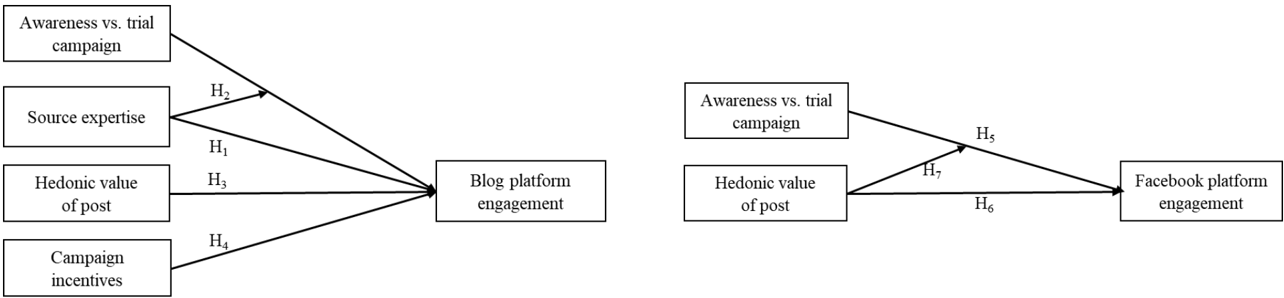
Influencer marketing is prevalent in firm strategies, yet little is known about the factors that drive success of online brand engagement at different stages of the consumer purchase funnel. The findings suggest that sponsored blogging affects online engagement (e.g., posting comments, liking a brand) differently depending on blogger characteristics and blog post content, which are further moderated by social media platform type and campaign advertising intent. When a sponsored post occurs on a blog, high blogger expertise is more effective when the advertising intent is to raise awareness versus increase trial. However, source expertise fails to drive engagement when the sponsored post occurs on Facebook. When a sponsored post occurs on Facebook, posts high in hedonic content are more effective when the advertising intent is to increase trial versus raise awareness. The effectiveness of campaign incentives depends on the platform type, such that they can increase (decrease) engagement on blogs (Facebook). The empirical evidence for these findings comes from real in-market customer response data and is supplemented with data from an experiment. Taken together, the findings highlight the critical interplay of platform type, campaign intent, source, campaign incentives, and content factors in driving engagement.
Overview
CoChat Summary
TL;DR
This paper examines how sponsored blogging campaigns drive online engagement across blogs and Facebook, using field data from 1,830 sponsored posts and a follow-up experiment. It finds engagement depends on platform, campaign intent, blogger expertise, hedonic content, and incentives, with expertise helping awareness campaigns on blogs but not Facebook.
Key findings
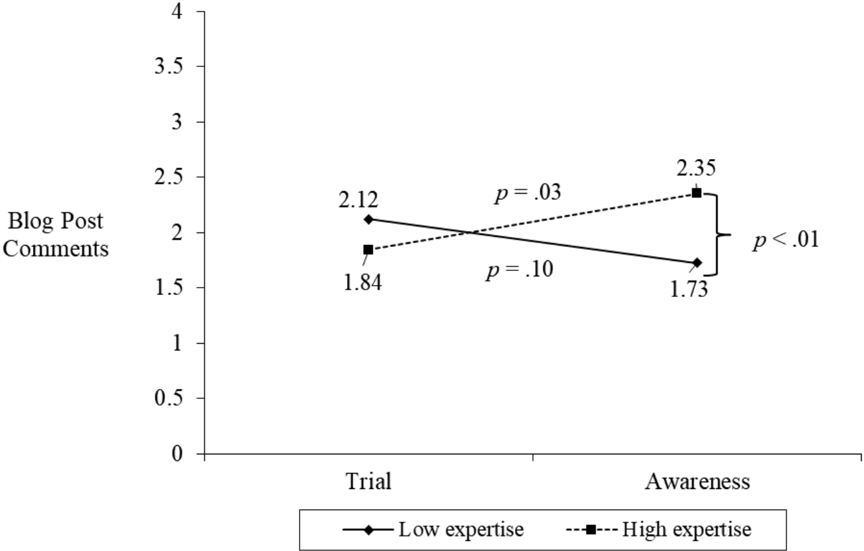
- In the blog-comment model (N = 1,237), blogger expertise had no significant main effect (b = −.1228, n.s.), but campaign intent × expertise was positive (b = .7283, p = .01): high-expertise bloggers performed better in awareness than trial campaigns (simple slope p < .05); low-expertise bloggers did not differ by intent (p = .10), so H2b was not supported.
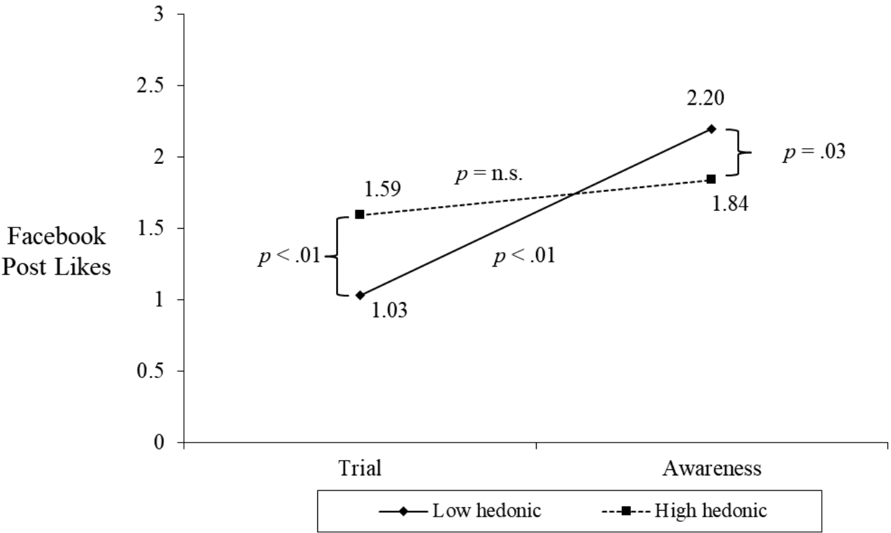
- Hedonic value of post increased blog comments (b = .2616, p < .01), and campaign giveaways increased blog comments (b = .4526, p = .01). On Facebook, awareness intent increased likes (b = .7416, p < .01), hedonic value increased likes (b = .2215, p = .03), and giveaways decreased likes (b = −.7840, p < .01).
- On Facebook, awareness × hedonic value was negative (b = −.4824, p < .01), implying hedonic content is positive for trial campaigns and negative for awareness campaigns; blogger expertise was not significantly related to Facebook likes (b = .0253, n.s.).
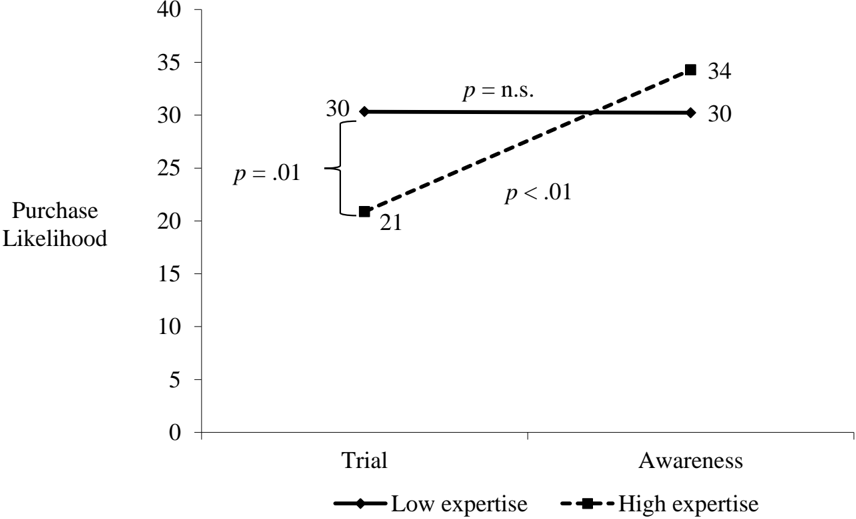
- Study 2 (N = 395 mothers) replicated the expertise × campaign intent interaction on purchase likelihood (F(1, 387) = 8.88, p < .01): with high expertise, awareness > trial (M = 34.10 vs. 20.66, p < .01); with low expertise, no difference (M = 30.24 vs. 30.29, p = .7106).
Methods
- Study 1 used real in-market data from The Motherhood agency: 1,830 sponsored posts by 595 bloggers across 57 campaigns (September 2012–December 2016); final analysis N = 1,237 due missing data. Dependent variables were number of blog post comments and Facebook post likes; negative binomial models with Heckman selection.
- Independent variables included campaign intent (awareness vs. trial), blogger expertise (sum of educational affiliation and blogger credentials, 0–2), hedonic and functional post value from coder factor analysis, campaign giveaways, follower counts, and controls.
- Study 2 was a 2 (expertise: high/low) × 2 (campaign: awareness/trial) between-subjects experiment with a Qualtrics panel of mothers (N = 395), using an educational paid app (Water Bears); the dependent variable was purchase likelihood.
Limitations
- Stated: the paper did not directly test ROI or sales, used post hoc coder ratings for sentiment, did not include a field experiment on blogger choice, and used bloggers’ network size at the time of posts without past performance/longevity; it also notes platforms evolve and ethical debates around sponsorship disclosure.
- Evident from text: Study 1 relies on one blogging agency and “mommy” bloggers, with missing data reducing the sample from 1,830 to 1,237; coder reliability for sentiment was modest (average α = .51, median = .56), and the field data are observational, limiting causal claims.
Model-written summary. Check it against the paper before relying on it.
Integrity signals
Registry
Cites
Statistics
Figures
Verification
Claims the paper makes
1 Valid · 0 Not valid · 18 Not checked · 125 Own results and interpretations
The sources with a verdict support this claim; the rest weren’t checked yet, have no full text we could read, or their verdicts aren’t rated yet.
In the paper
“we used the methodology Shrout and Fleiss (1979) describe and computed the Shrout-Fleiss single ICC score agreement of .998, which is considered quite high (Koo and Li 2016).”
What the sources say
- Not checked — no full text of the sourcecites Shrout and Fleiss (1979) matched to “Intraclass correlations: Uses in assessing rater reliability.” (1979) source
- Supportedcites Koo and Li 2016 matched to “A guideline of selecting and reporting intraclass correlation coefficients for reliability research” (2016) source
The ICC Interpretation passage (Introduction) classifies ICC values greater than 0.90 as indicating excellent reliability, supporting the description of .998 as quite high. The cited paper does not establish the citing authors’ computed score; the citation is attached to its interpretation. (LLM, conf=0.93)
plain- Asserted: passes — The authors put it forward as true.
- Checkable: passes — It can be checked against evidence.
- Load-bearing: unclear — It is unclear whether the paper’s conclusions depend on it.
- Based: passes — The paper gives a reason why it holds.
A result the paper reports from its own data — it cites no other source for it, so there is none to check. The quote shows it is in the paper.
In the paper
“When a sponsored post occurs on Facebook, posts high in hedonic content are more effective when the advertising intent is to increase trial versus raise awareness.”
plainstates a cause- Asserted: passes — The authors put it forward as true.
- Checkable: passes — It can be checked against evidence.
- Load-bearing: passes — The paper’s conclusions depend on it.
- Based: passes — The paper gives a reason why it holds.
A result the paper reports from its own data — it cites no other source for it, so there is none to check. The quote shows it is in the paper.
In the paper
“When a sponsored post occurs on a blog, high blogger expertise is more effective when the advertising intent is to raise awareness versus increase trial.”
- Also stated in: § Statement of Intended Contribution · p. 5 · plain
“In addition, blogger expertise exerts a greater impact in awareness (vs. trial) campaigns.”
plainstates a cause- Asserted: passes — The authors put it forward as true.
- Checkable: passes — It can be checked against evidence.
- Load-bearing: passes — The paper’s conclusions depend on it.
- Based: passes — The paper gives a reason why it holds.
- Also stated in: § Statement of Intended Contribution · p. 5 · plain
A result the paper reports from its own data — it cites no other source for it, so there is none to check. The quote shows it is in the paper.
In the paper
“However, source expertise fails to drive engagement when the sponsored post occurs on Facebook.”
plain- Asserted: passes — The authors put it forward as true.
- Checkable: passes — It can be checked against evidence.
- Load-bearing: passes — The paper’s conclusions depend on it.
- Based: passes — The paper gives a reason why it holds.
A result the paper reports from its own data — it cites no other source for it, so there is none to check. The quote shows it is in the paper.
In the paper
“We find that hedonic value has a significant effect on both blog and Facebook platforms.”
plainstates a cause- Asserted: passes — The authors put it forward as true.
- Checkable: passes — It can be checked against evidence.
- Load-bearing: passes — The paper’s conclusions depend on it.
- Based: passes — The paper gives a reason why it holds.
60 more claims
Create a free account to see all 144 claims and to verify the 2 references still open.
- It may state two separate claims as one. 43
- Probably not a substantial claim. 39
- The quote only partly states this claim. 10
Claims other papers make about this one
Each is checked against this paper’s own text: does it say what the citing paper says it does?
The cited source doesn’t support the claim as written.
In the citing paper
“Hughes, Swaminathan, and Brooks (2019) found that Facebook influencer campaigns that included incentives significantly increased the number of post comments.”
From Influencer Marketing on Instagram: Empirical Research on Social Media Engagement with Sponsored Posts (2022) · cites this paper as Hughes, Swaminathan, and Brooks (2019)
Checked by a reasoning model — may be wrong.
Experimental — accuracy not yet measuredThe source backs part of the claim, not all of it — or backs it for a different population, condition or comparison.
In the citing paper
“Social media platforms represent low-involvement, high-distraction, and hedonic environments (Hughes, Swaminathan, and Brooks 2019; Schulze, Sch€ oler, and Skiera 2014).”
From Influencer Marketing on Instagram: Empirical Research on Social Media Engagement with Sponsored Posts (2022) · cites this paper as Hughes, Swaminathan, and Brooks 2019
Experimental — accuracy not yet measuredThe cited source says what the claim attributes to it.
In the citing paper
“social media engagement is an important key performance indicator (KPI) to measure the success of sponsored posts on social media (Hughes, Swaminathan, and Brooks 2019;Lammenett 2019).”
From Influencer Marketing on Instagram: Empirical Research on Social Media Engagement with Sponsored Posts (2022) · cites this paper as Hughes, Swaminathan, and Brooks 2019
The cited source says what the claim attributes to it.
In the citing paper
“Previous research suggest that hedonic value can have an impact on post interaction and popularity (De Vries, Gensler, and Leeflang 2012;Hughes, Swaminathan, and Brooks 2019;Sabate et al. 2014).”
From Influencer Marketing on Instagram: Empirical Research on Social Media Engagement with Sponsored Posts (2022) · cites this paper as Hughes, Swaminathan, and Brooks 2019
The cited source says what the claim attributes to it.
In the citing paper
“Likes and comments are KPIs in influencer marketing (Hughes, Swaminathan, and Brooks 2019).”
From Influencer Marketing on Instagram: Empirical Research on Social Media Engagement with Sponsored Posts (2022) · cites this paper as Hughes, Swaminathan, and Brooks 2019
2 more claims about this paper
Create a free account to see every claim other papers make about this one.
Statistics that don’t add up
Each reported p-value recomputed from its test statistic and degrees of freedom, each partial η² from its F, and each ratio, mean difference or B printed with a p checked against its own confidence interval.
Rated minor: it would not touch a result — a value no result rests on, a p-value that stays on the same side of the significance level, or a conflict that is clerical, resolved elsewhere in the paper, or outside its own findings.
In the paper
“F(3, 260) = 3.61, p < .01”
Reported p < .01 · recomputed p = .014
Statistics recomputed
Every reported test result, recomputed from its test statistic and degrees of freedom. A result shows as not adding up only once an independent check has confirmed it.
- Doesn’t add upF(3, 260) = 3.61reported p < .01 · recomputed p = .014
“F(3, 260) = 3.61, p < .01”
- Not confirmedz = -0.06reported p = .95 · recomputed p = .952
“(z = -.060, p = .950”
- ConsistentF(3, 260) = 7.22reported p < .01 · recomputed p < .001
“F(3, 260) = 7.22, p < .01”
- Consistentz = 1.22reported p = .223 · recomputed p = .222
“(z = 1.22, p = .223”
- ConsistentF(3, 93) = 20.13reported p < .01 · recomputed p < .001
“F(3, 93) = 20.13, p < .01”
8 more recomputed tests
Create a free account to see every test the Stats check recomputed.
Self-check
Percentages, sums and reported differences re-computed from the paper’s own numbers.
Each contradiction between two passages listed here was confirmed by an independent check.
Rated minor: it would not touch a result — a value no result rests on, a p-value that stays on the same side of the significance level, or a conflict that is clerical, resolved elsewhere in the paper, or outside its own findings.
In the paper
§ Discussion · p. 29
“However, the results in Study 1 are driven by high expertise, while the results in Study 2 are driven by differences due to low expertise.”
§ Method and Results · p. 29
“Next, examining purchase likelihood under low blogger expertise, we found no significant difference between awareness and trial campaigns (Mawareness = 30.24, Mtrial = 30.29; F(1, 387) = .14, p = .7106)”
Citations
Cites
A guideline of selecting and reporting intraclass correlation coefficients for reliability research
Koo, T. K., & Li, M. Y. (2016) · Journal of Chiropractic Medicine · doi:10.1016/j.jcm.2016.02.012 · Cited by 31,709
Sample Selection Bias as a Specification Error
Heckman, J. J. (1979) · Econometrica · doi:10.2307/1912352 · Cited by 28,779
Intraclass correlations: Uses in assessing rater reliability.
Shrout, P. E., & Fleiss, J. L. (1979) · Psychological Bulletin · doi:10.1037/0033-2909.86.2.420 · Cited by 24,532
The Elaboration Likelihood Model of Persuasion
Petty, R. E., & Cacioppo, J. T. (1986) · Advances in Experimental Social Psychology · doi:10.1016/s0065-2601(08)60214-2 · Cited by 8,822 · cited 3×
“Our theoretical basis for predictions derives from the literature on the elaboration likelihood model (ELM) (Petty and Cacioppo 1986).”
BackgroundMethodHennig-Thurau, T., Gwinner, K. P., Walsh, G., & Gremler, D. D. (2004) · Journal of Interactive Marketing · doi:10.1002/dir.10073 · Cited by 5,916
A study of normative and informational social influences upon individual judgment.
Deutsch, M., & Gerard, H. B. (1955) · The Journal of Abnormal and Social Psychology · doi:10.1037/h0046408 · Cited by 4,819 · cited 1×
“This can derive from informational power, in which the expert has knowledge that others do not have (Deutsch and Gerard 1955).”
BackgroundDimensions of Consumer Expertise
Alba, J. W., & Hutchinson, J. W. (1987) · Journal of Consumer Research · doi:10.1086/209080 · Cited by 4,375
Ohanian, R. (1990) · Journal of Advertising · doi:10.1080/00913367.1990.10673191 · Cited by 4,043
The Influence of Source Credibility on Communication Effectiveness
Hovland, C. I., & Weiss, W. (1951) · Public Opinion Quarterly · doi:10.1086/266350 · Cited by 3,543 · cited 1×
“Source expertise affects attitude change (Hovland and Weiss 1951; McCracken 1989; Ohanian 1991), level of confidence and positivity (Tormala, Briñol, and Petty 2007), and behavioral changes (Crisci and Kassinove 1973) and leads to higher levels of persuasion (Petty and Wegener 1998).”
BackgroundThe Elaboration Likelihood Model of Persuasion
Petty, R. E., & Cacioppo, J. T. (1986) · Communication and Persuasion · doi:10.1007/978-1-4612-4964-1_1 · Cited by 3,202
Who is the Celebrity Endorser? Cultural Foundations of the Endorsement Process
McCracken, G. (1989) · Journal of Consumer Research · doi:10.1086/209217 · Cited by 3,196 · cited 1×
“Source expertise affects attitude change (Hovland and Weiss 1951; McCracken 1989; Ohanian 1991), level of confidence and positivity (Tormala, Briñol, and Petty 2007), and behavioral changes (Crisci and Kassinove 1973) and leads to higher levels of persuasion (Petty and Wegener 1998).”
BackgroundWhat Makes Online Content Viral?
Berger, J., & Milkman, K. L. (2012) · Journal of Marketing Research · doi:10.1509/jmr.10.0353 · Cited by 3,178 · cited 4×
“We extend the findings of Berger and Milkman (2012), who argue that hedonic content increases social transmission and virality of online messages.”
BackgroundInfluentialLou, C., & Yuan, S. (2019) · Journal of Interactive Advertising · doi:10.1080/15252019.2018.1533501 · Cited by 2,795 · cited 1×
“Lou and Yuan (2019) demonstrate the importance of message content, source credibility, and homophily in influencer marketing.”
BackgroundCustomer engagement: the construct, antecedents, and consequences
Pansari, A., & Kumar, V. (2017) · Journal of the Academy of Marketing Science · doi:10.1007/s11747-016-0485-6 · Cited by 1,758
Brand trust in the context of consumer loyalty
Delgado‐Ballester, E., & Luis Munuera‐Alemán, J. (2001) · European Journal of Marketing · doi:10.1108/eum0000000006475 · Cited by 1,334
Exploring customer brand engagement: definition and themes
Hollebeek, L. (2011) · Journal of Strategic Marketing · doi:10.1080/0965254x.2011.599493 · Cited by 1,331
The Impact of Celebrity Spokespersons’ Perceived Image on Consumers’ Intention to Purchase
Ohanian, R. (1991) · Journal of Advertising Research · doi:10.1080/00218499.1991.12466759 · Cited by 1,266
Competitive Advantage through Engagement
Kumar, V., & Pansari, A. (2016) · Journal of Marketing Research · doi:10.1509/jmr.15.0044 · Cited by 1,182
Customer Engagement as a New Perspective in Customer Management
Verhoef, P. C., Reinartz, W. J., & Krafft, M. (2010) · Journal of Service Research · doi:10.1177/1094670510375461 · Cited by 1,033
Toward a theory of customer engagement marketing
Harmeling, C. M., Moffett, J. W., Arnold, M. J., & Carlson, B. D. (2017) · Journal of the Academy of Marketing Science · doi:10.1007/s11747-016-0509-2 · Cited by 1,033
MacInnis, D. J., Moorman, C., & Jaworski, B. J. (1991) · Journal of Marketing · doi:10.2307/1251955 · Cited by 984
Hollebeek, L. D., & Macky, K. (2019) · Journal of Interactive Marketing · doi:10.1016/j.intmar.2018.07.003 · Cited by 978
Maheswaran, D., & Chaiken, S. (1991) · Journal of Personality and Social Psychology · doi:10.1037//0022-3514.61.1.13 · Cited by 831
Atmospheric Affect as a Tool for Creating Value and Gaining Share of Customer
Babin, B. J., & Attaway, J. S. (2000) · Journal of Business Research · doi:10.1016/s0148-2963(99)00011-9 · Cited by 823
Dimensions for Evaluating the Acceptability of Message Sources
Berlo, D. K., Lemert, J. B., & Mertz, R. J. (1969) · Public Opinion Quarterly · doi:10.1086/267745 · Cited by 752
What Drives Immediate and Ongoing Word of Mouth?
Berger, J., & Schwartz, E. M. (2011) · Journal of Marketing Research · doi:10.1509/jmkr.48.5.869 · Cited by 663 · cited 2×
“Evidence suggests that hedonic content can have an impact on attitudes and WOM (Berger and Schwartz 2011; Kim, Ratneshwar, and Thorson 2017).”
BackgroundResultBoerman, S. C., Willemsen, L. M., & Van Der Aa, E. P. (2017) · Journal of Interactive Marketing · doi:10.1016/j.intmar.2016.12.002 · Cited by 581
Why pass on viral messages? Because they connect emotionally
Dobele, A., Lindgreen, A., Beverland, M., Vanhamme, J., & van Wijk, R. (2007) · Business Horizons · doi:10.1016/j.bushor.2007.01.004 · Cited by 502
For fun and profit: Hedonic value from image interactivity and responses toward an online store
Fiore, A. M., Jin, H., & Kim, J. (2005) · Psychology & Marketing · doi:10.1002/mar.20079 · Cited by 488
Hinkin, T. R., & Schriesheim, C. A. (1989) · Journal of Applied Psychology · doi:10.1037//0021-9010.74.4.561 · Cited by 457
Maclnnis, D. J., Moorman, C., & Jaworski, B. J. (1991) · Journal of Marketing · doi:10.1177/002224299105500403 · Cited by 454
The Effects of Advertiser Reputation and Extremity of Advertising Claim on Advertising Effectiveness
Goldberg, M. E., & Hartwick, J. (1990) · Journal of Consumer Research · doi:10.1086/208547 · Cited by 444 · cited 1×
“Prior research suggests that in the presence of an extreme advertising claim, the positive impact of source expertise diminishes (Goldberg and Hartwick 1990).”
BackgroundLu, L.-C., Chang, W.-P., & Chang, H.-H. (2014) · Computers in Human Behavior · doi:10.1016/j.chb.2014.02.007 · Cited by 424
Highly Credible Sources: Persuasive Facilitators or Persuasive Liabilities?
Dholakia, R. R., & Sternthal, B. (1977) · Journal of Consumer Research · doi:10.1086/208671 · Cited by 378
Colicev, A., Malshe, A., Pauwels, K., & O'Connor, P. (2018) · Journal of Marketing · doi:10.1509/jm.16.0055 · Cited by 370
Turkish Journal of Computer and Mathematics Education
(2023) · doi:10.48047/turcomat · Cited by 369
Connected marketing : the viral, buzz and word of mouth revolution
Kirby, J., & Marsden, P. (2006) · Cited by 367
Hewett, K., Rand, W., Rust, R. T., & van Heerde, H. J. (2016) · Journal of Marketing · doi:10.1509/jm.15.0033 · Cited by 366
Motivated Heuristic and Systematic Processing
Chen, S., Duckworth, K., & Chaiken, S. (1999) · Psychological Inquiry · doi:10.1207/s15327965pli1001_6 · Cited by 356
Matching Versus Mismatching Attitude Functions: Implications for Scrutiny of Persuasive Messages
Petty, R. E., & Wegener, D. T. (1998) · Personality and Social Psychology Bulletin · doi:10.1177/0146167298243001 · Cited by 349
Detecting, Preventing, and Mitigating Online Firestorms in Brand Communities
Herhausen, D., Ludwig, S., Grewal, D., Wulf, J., & Schoegel, M. (2019) · Journal of Marketing · doi:10.1177/0022242918822300 · Cited by 335
Strategic Responses to New Technologies and Their Impact on Firm Performance
Lee, R. P., & Grewal, R. (2004) · Journal of Marketing · doi:10.1509/jmkg.68.4.157.42730 · Cited by 334
Villarroel Ordenes, F., Grewal, D., Ludwig, S., Ruyter, K. D., Mahr, D., & Wetzels, M. (2019) · Journal of Consumer Research · doi:10.1093/jcr/ucy032 · Cited by 330
How Advertising Works on the WWW: Modified Elaboration Likelihood Model
Cho, C.-H. (1999) · Journal of Current Issues & Research in Advertising · doi:10.1080/10641734.1999.10505087 · Cited by 281 · cited 1×
“Under low involvement, Cho (1999) finds that attention-getting online advertising appeals were more effective.”
BackgroundWang, Z., Walther, J. B., Pingree, S., & Hawkins, R. P. (2008) · Health Communication · doi:10.1080/10410230802229738 · Cited by 275
de Vries, L., Gensler, S., & Leeflang, P. S. H. (2017) · Journal of Marketing · doi:10.1509/jm.15.0178 · Cited by 260
Kumar, V., Bhaskaran, V., Mirchandani, R., & Shah, M. (2013) · Marketing Science · doi:10.1287/mksc.1120.0768 · Cited by 257
Hwang, Y., & Jeong, S.-H. (2016) · Computers in Human Behavior · doi:10.1016/j.chb.2016.04.026 · Cited by 251
Driving Profitability by Encouraging Customer Referrals: Who, When, and How
Kumar, V., Petersen, J. A., & Leone, R. P. (2010) · Journal of Marketing · doi:10.1509/jmkg.74.5.001 · Cited by 240
van Reijmersdal, E. A., Fransen, M. L., van Noort, G., Opree, S. J., Vandeberg, L., Reusch, S., van Lieshout, F., & Boerman, S. C. (2016) · American Behavioral Scientist · doi:10.1177/0002764216660141 · Cited by 223
The Determinants of Email Receivers’ Disseminating Behaviors on the Internet
Chiu, H.-C., Hsieh, Y.-C., Kao, Y.-H., & Lee, M. (2007) · Journal of Advertising Research · doi:10.2501/s0021849907070547 · Cited by 210
Homer, P. M., & Kahle, L. R. (1990) · Journal of Advertising · doi:10.1080/00913367.1990.10673178 · Cited by 202
Why Narrative Ads Work: An Integrated Process Explanation
Kim, E. (., Ratneshwar, S., & Thorson, E. (2017) · Journal of Advertising · doi:10.1080/00913367.2016.1268984 · Cited by 202
Kiecker, P., & Cowles, D. (2002) · Journal of Euromarketing · doi:10.1300/j037v11n02_04 · Cited by 192
Danaher, P. J., & Dagger, T. S. (2013) · Journal of Marketing Research · doi:10.1509/jmr.12.0241 · Cited by 184
Do display ads influence search? Attribution and dynamics in online advertising
Kireyev, P., Pauwels, K., & Gupta, S. (2016) · International Journal of Research in Marketing · doi:10.1016/j.ijresmar.2015.09.007 · Cited by 173
Lovett, M. J., & Staelin, R. (2016) · Marketing Science · doi:10.1287/mksc.2015.0961 · Cited by 169
Ahluwalia, R., & Burnkrant, R. E. (2004) · Journal of Consumer Research · doi:10.1086/383421 · Cited by 161 · cited 1×
“We measured persuasion knowledge using scale items from Ahluwalia and Burnkrant (2004).”
MethodMultiple Roles for Source Credibility Under High Elaboration: It's all in the Timing
Tormala, Z. L., Briñol, P., & Petty, R. E. (2007) · Social Cognition · doi:10.1521/soco.2007.25.4.536 · Cited by 160
Selective Use of Heunrstic and Systematic Processing Under Defense Motivation
Giner-Sorolila, R., & Chaiken, S. (1997) · Personality and Social Psychology Bulletin · doi:10.1177/0146167297231009 · Cited by 159
Return on Engagement Initiatives: A Study of a Business-to-Business Mobile App
Gill, M., Sridhar, S., & Grewal, R. (2017) · Journal of Marketing · doi:10.1509/jm.16.0149 · Cited by 158
Comparative versus Noncomparative Advertising: A Meta-Analysis
Grewal, D., Kavanoor, S., Fern, E. F., Costley, C., & Barnes, J. (1997) · Journal of Marketing · doi:10.1177/002224299706100401 · Cited by 146
Social Dollars in Online Communities: The Effect of Product, User, and Network Characteristics
Park, E., Rishika, R., Janakiraman, R., Houston, M. B., & Yoo, B. (2018) · Journal of Marketing · doi:10.1509/jm.16.0271 · Cited by 139
(2017) · Springer eBooks · doi:10.1007/978-3-319-61985-9 · Cited by 131
Engaging with consumers using social media: a case study of music festivals
Hudson, S., & Hudson, R. (2013) · International Journal of Event and Festival Management · doi:10.1108/ijefm-06-2013-0012 · Cited by 128
Relating Online, Regional, and National Advertising to Firm Value
Sridhar, S., Germann, F., Kang, C., & Grewal, R. (2016) · Journal of Marketing · doi:10.1509/jm.14.0231 · Cited by 124
Wu, M., Huang, Y., Li, R., Bortree, D. S., Yang, F., Xiao, A., & Wang, R. (2016) · American Behavioral Scientist · doi:10.1177/0002764216660139 · Cited by 123
Teixeira, T., Picard, R., & el Kaliouby, R. (2014) · Marketing Science · doi:10.1287/mksc.2014.0854 · Cited by 114
How Customer Referral Programs Turn Social Capital into Economic Capital
Van Den Bulte, C., Bayer, E., Skiera, B., & Schmitt, P. (2018) · Journal of Marketing Research · doi:10.1509/jmr.14.0653 · Cited by 110 · cited 1×
“These types of actions contribute to a firm’s revenue, as referred customers are typically more profitable than those not referred (Palmatier, Kumar, and Harmeling 2017; Van den Bulte et al. 2018).”
BackgroundSidedness, commercial intent and expertise in blog advertising
Uribe, R., Buzeta, C., & Velásquez, M. (2016) · Journal of Business Research · doi:10.1016/j.jbusres.2016.04.102 · Cited by 109 · cited 4×
“In an influencer marketing context, expertise increases behavioral intention toward products (Uribe, Buzeta, and Velásquez 2016).”
BackgroundMethodInfluentialColliander, J., & Erlandsson, S. (2015) · Journal of Marketing Communications · doi:10.1080/13527266.2012.730543 · Cited by 108
Under the influence of a blogger: The role of information‐seeking goals and issue involvement
Balabanis, G., & Chatzopoulou, E. (2019) · Psychology & Marketing · doi:10.1002/mar.21182 · Cited by 100
The Reach and Persuasiveness of Viral Video Ads
Tucker, C. E. (2015) · Marketing Science · doi:10.1287/mksc.2014.0874 · Cited by 97
The Effects of Expert and Consumer Endorsements on Audience Response
Wang, A. (2005) · Journal of Advertising Research · doi:10.1017/s0021849905050452 · Cited by 93
Effect of Perceived Expertise, Strength of Advice, and Environmental Setting on Parental Compliance
Crisci, R., & Kassinove, H. (1973) · The Journal of Social Psychology · doi:10.1080/00224545.1973.9922597 · Cited by 90
Pansari, A., & Kumar, V. (2017) · Springer eBooks · doi:10.1007/978-3-319-61985-9_1 · Cited by 89
Ballantine, P. W., & Au Yeung, C. (2015) · Marketing Intelligence & Planning · doi:10.1108/mip-03-2014-0044 · Cited by 76
What makes online content viral?
Berger, J. (2012) · Strategic Direction · doi:10.1108/sd.2012.05628haa.014 · Cited by 76
The implications of company‐sponsored messages disguised as word‐of‐mouth
Magnini, V. P. (2011) · Journal of Services Marketing · doi:10.1108/08876041111143078 · Cited by 72
No Comment?! The Drivers of Reactions to Online Posts in Professional Groups
Rooderkerk, R. P., & Pauwels, K. H. (2016) · Journal of Interactive Marketing · doi:10.1016/j.intmar.2015.12.003 · Cited by 69
Wang, P., Xiong, G., & Yang, J. Y. (2018) · Journal of Marketing · doi:10.1177/0022242918817549 · Cited by 64
Trial/awareness advertising decisions
Muller, E. (1983) · Journal of Economic Dynamics and Control · doi:10.1016/0165-1889(83)90058-1 · Cited by 43
(2012) · Cited by 32
Cognition or Affect? - Exploring Information Processing on Facebook
Koroleva, K., Krasnova, H., & Günther, O. (2011) · Lecture notes in computer science · doi:10.1007/978-3-642-24704-0_22 · Cited by 13
Why, When, and How Much to Entertain Consumers in Advertisements?
Teixeira, T. S., Picard, R. W., & el Kaliouby, R. (2014) · Cited by 9
University Students’ Aims of Use of Social Network Sites Scale: Development and Validation
Karal, H., & Kokoç, M. (2010) · Turkish Journal of Computer and Mathematics Education (TURCOMAT) · doi:10.17762/turcomat.v1i3.17 · Cited by 9
Advertising Strategy of Coca-Cola at Coca-Cola Beverages Pvt.Ltd
Department of Management Studies S.V. University, T. 5., Yuvaraju, D. D., Subramanyam, D. D., & Rao, P. S. D. (2014) · IOSR Journal of Business and Management · doi:10.9790/487x-1662122131 · Cited by 2
Three Essays on Retransmission of Brand Messages in Social Media
Jalali, N. Y. (2015) · Cited by 1
Research works printed but not linked: 3
- Association of National Advertisers (2018), 'Advertisers Love Influencer Marketing: ANA Study,' press release, https://www.ana.net/content/show/id/48437.
- French, John and Bertram Raven (1959), 'The Bases of Social Power,' in Studies in Social Power , Dorwin Cartwright, ed. Ann Arbor: University of Michigan, 150-67.
- Zhu, June and Bernard Tan (2007), 'Effectiveness of Blog Advertising: Impact of Communicator Expertise, Campaign intent, and Product Involvement,' in ICIS 2007 Proceedings - Twenty Eighth International Conference on Information Systems . Atlanta: Association for Information Systems, paper 121.
Cited by
Vrontis, D., Makrides, A., Christofi, M., & Thrassou, A. (2021) · International Journal of Consumer Studies · doi:10.1111/ijcs.12647 · Cited by 1,178
Transforming the Customer Experience through New Technologies
Hoyer, W. D., Kroschke, M., Schmitt, B., Kraume, K., & Shankar, V. (2020) · Journal of Interactive Marketing · doi:10.1016/j.intmar.2020.04.001 · Cited by 1,049
Belanche, D., Casaló, L. V., Flavián, M., & Ibáñez-Sánchez, S. (2021) · Journal of Business Research · doi:10.1016/j.jbusres.2021.03.067 · Cited by 659
Leung, F. F., Gu, F. F., & Palmatier, R. W. (2022) · Journal of the Academy of Marketing Science · doi:10.1007/s11747-021-00829-4 · Cited by 580
Yuan, S., & Lou, C. (2020) · Journal of Interactive Advertising · doi:10.1080/15252019.2020.1769514 · Cited by 543
Metadata
- Authors
- Hughes, C., Swaminathan, V., & Brooks, G.
- Affiliations
- University of Mendoza (AR)
- University of Notre Dame (US)
- University of Oxford (GB)
- Corresponding author
- Hughes, Christian
- Venue
- Journal of Marketing
- Publisher
- SAGE Publications
- Published
- 2019-06-04
- Volume
- 83
- Issue
- 5
- Pages
- 78-96
- ISSN
- 0022-2429 (ISSN-L)
- 1547-7185
- OpenAlex
- W2946816985
- Cited by
- 789
- References
- 88
- Citations by year
- 2026: 118 · 2025: 150 · 2024: 150 · 2023: 132 · 2022: 99 · 2021: 81 · 2020: 48 · 2019: 9
- FWCI
- 119.02
- Type
- journal article
- Language
- en
- Open access
- green
- kclpure.kcl.ac.uk
- Licence
- other-oa
- journals.sagepub.com/page/policies/text-and-data-mining-license (tdm)
- Locations
- Journal of Marketing (publishedVersion)
- Research Portal (King's College London) (submittedVersion, other-oa)
- Funders
- Marketing Science Institute (#4-1927)
- Topics
- Social Sciences › Business, Management and Accounting › Marketing › Digital Marketing and Social Media
- Social Sciences › Business, Management and Accounting › Marketing › Marketing and Advertising Strategies
- Social Sciences › Business, Management and Accounting › Marketing › Consumer Behavior in Brand Consumption and Identification
- Keywords
- influencer marketing, brand engagement, social media influencers, purchase funnel, source expertise, Facebook, blog posts, consumer purchase behavior
About these checks
Registry, retraction, Cites and statistics results are computed, not judged, with one exception: a printed reference that no index lists is read once by a model before it counts as a citation error. Claims are extracted by a model and kept only when their quote appears verbatim in the text; each cited source is then checked, with a model’s help, for whether it says what the claim relies on. Those verdicts can be wrong — read the claim’s quote and the cited source before relying on one.
A language model drew the claims from the paper on 2026-10-10, under version 3 of the claim definition (model deepseek-v4.1-flash, prompt extract-v3).
A second model labelled each claim on 2026-10-10 (model jev-1.13-20260917, definition revision gold-guideline-v0.2).
Cited sources are checked with a language model’s help (gpt-6-sol).
Statistics and arithmetic are recomputed, not judged.
Confidence bands are shown only for fields calibrated on our annotated test set. None is calibrated yet, so no band is shown.
What counts as a claim ›How we measure confidence ›How we check this ›
Are you an author, or do you see a problem with this page? Request a review
Data sources
Bibliographic data: Semantic Scholar, OpenAlex, Crossref.
Contains information from the Semantic Scholar Academic Graph Datasets, made available under the ODC Attribution License (ODC-BY 1.0).
Semantic Scholar’s data is described in: Kinney, R., et al. (2023). The Semantic Scholar Open Data Platform. arXiv:2301.10140.
