

Driving Brand Engagement Through Online Social Influencers: An Empirical Investigation of Sponsored Blogging Campaigns
Open accessThe DOI matches its Crossref record; 88 of the 88 references it cites were found in a registry or an index; 1 of the 26 sources its claims cite were checked for support.
Abstract
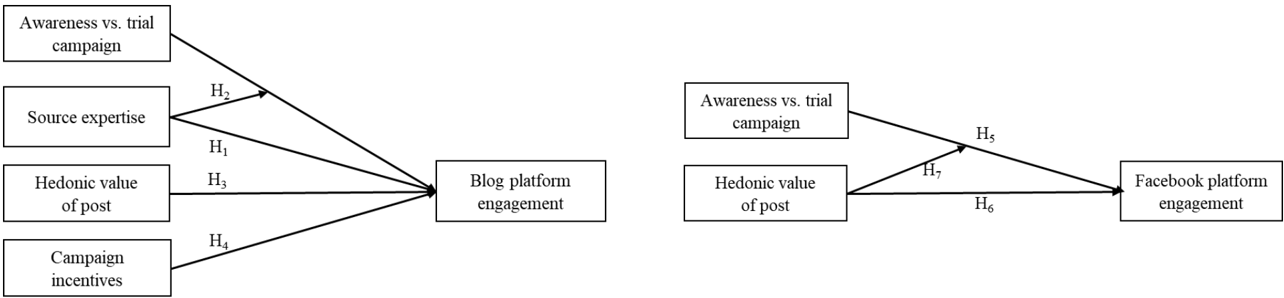
Influencer marketing is prevalent in firm strategies, yet little is known about the factors that drive success of online brand engagement at different stages of the consumer purchase funnel. The findings suggest that sponsored blogging affects online engagement (e.g., posting comments, liking a brand) differently depending on blogger characteristics and blog post content, which are further moderated by social media platform type and campaign advertising intent. When a sponsored post occurs on a blog, high blogger expertise is more effective when the advertising intent is to raise awareness versus increase trial. However, source expertise fails to drive engagement when the sponsored post occurs on Facebook. When a sponsored post occurs on Facebook, posts high in hedonic content are more effective when the advertising intent is to increase trial versus raise awareness. The effectiveness of campaign incentives depends on the platform type, such that they can increase (decrease) engagement on blogs (Facebook). The empirical evidence for these findings comes from real in-market customer response data and is supplemented with data from an experiment. Taken together, the findings highlight the critical interplay of platform type, campaign intent, source, campaign incentives, and content factors in driving engagement.
Overview
CoChat Summary
TL;DR
This paper examines how sponsored blogging campaigns drive online engagement across blogs and Facebook, using field data from 1,830 sponsored posts and a follow-up experiment. It finds engagement depends on platform, campaign intent, blogger expertise, hedonic content, and incentives, with expertise helping awareness campaigns on blogs but not Facebook.
Key findings
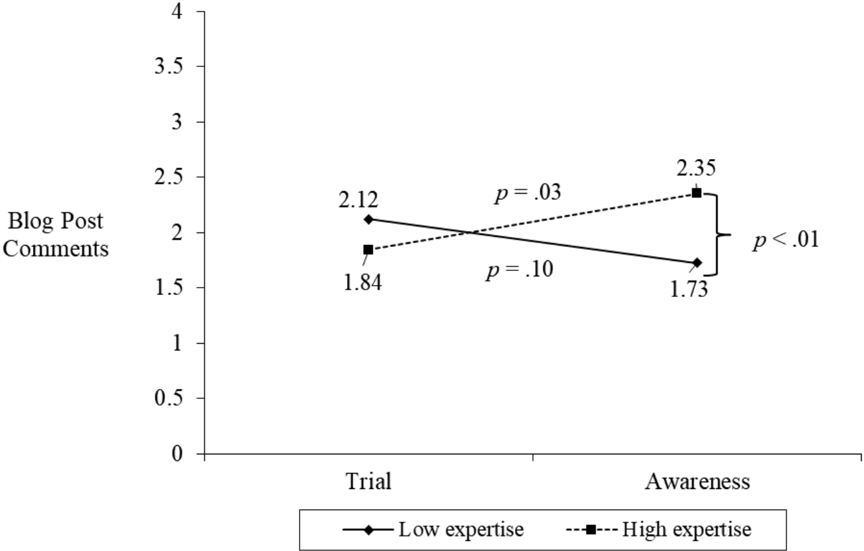
- In the blog-comment model (N = 1,237), blogger expertise had no significant main effect (b = −.1228, n.s.), but campaign intent × expertise was positive (b = .7283, p = .01): high-expertise bloggers performed better in awareness than trial campaigns (simple slope p < .05); low-expertise bloggers did not differ by intent (p = .10), so H2b was not supported.
- Hedonic value of post increased blog comments (b = .2616, p < .01), and campaign giveaways increased blog comments (b = .4526, p = .01). On Facebook, awareness intent increased likes (b = .7416, p < .01), hedonic value increased likes (b = .2215, p = .03), and giveaways decreased likes (b = −.7840, p < .01).
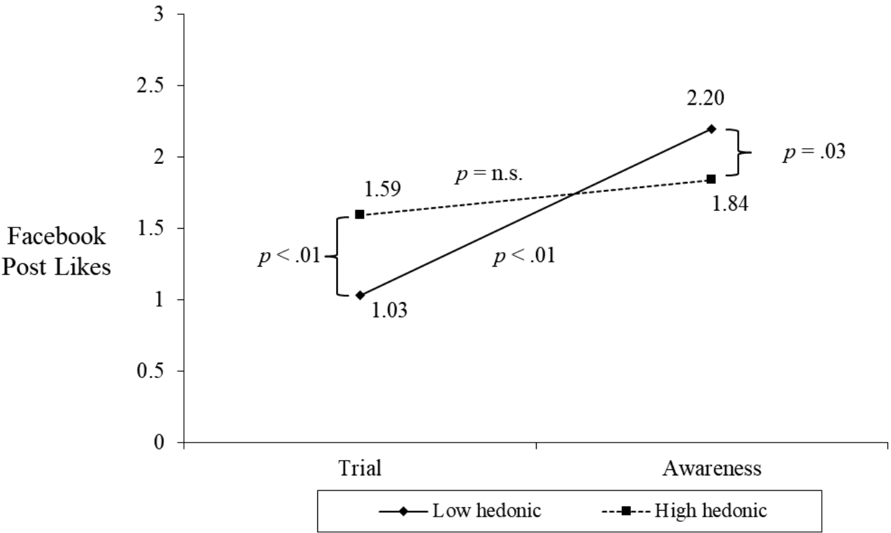
- On Facebook, awareness × hedonic value was negative (b = −.4824, p < .01), implying hedonic content is positive for trial campaigns and negative for awareness campaigns; blogger expertise was not significantly related to Facebook likes (b = .0253, n.s.).
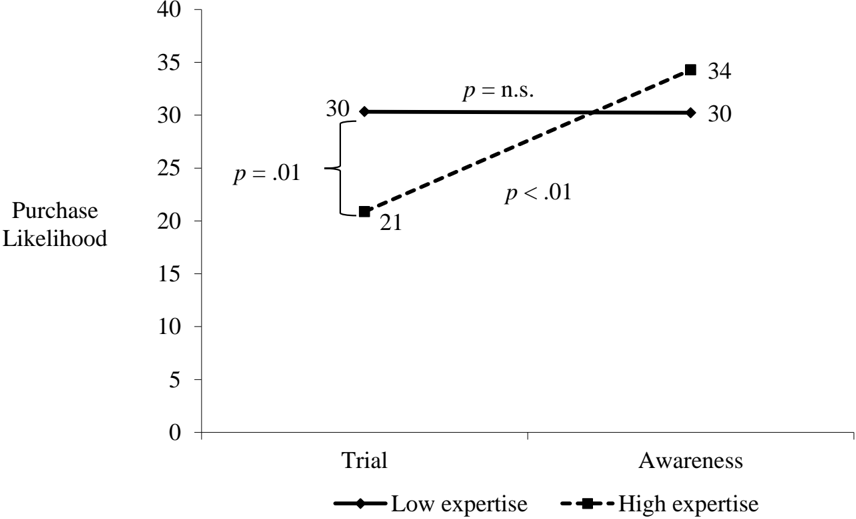
- Study 2 (N = 395 mothers) replicated the expertise × campaign intent interaction on purchase likelihood (F(1, 387) = 8.88, p < .01): with high expertise, awareness > trial (M = 34.10 vs. 20.66, p < .01); with low expertise, no difference (M = 30.24 vs. 30.29, p = .7106).
Methods
- Study 1 used real in-market data from The Motherhood agency: 1,830 sponsored posts by 595 bloggers across 57 campaigns (September 2012–December 2016); final analysis N = 1,237 due missing data. Dependent variables were number of blog post comments and Facebook post likes; negative binomial models with Heckman selection.
- Independent variables included campaign intent (awareness vs. trial), blogger expertise (sum of educational affiliation and blogger credentials, 0–2), hedonic and functional post value from coder factor analysis, campaign giveaways, follower counts, and controls.
- Study 2 was a 2 (expertise: high/low) × 2 (campaign: awareness/trial) between-subjects experiment with a Qualtrics panel of mothers (N = 395), using an educational paid app (Water Bears); the dependent variable was purchase likelihood.
Limitations
- Stated: the paper did not directly test ROI or sales, used post hoc coder ratings for sentiment, did not include a field experiment on blogger choice, and used bloggers’ network size at the time of posts without past performance/longevity; it also notes platforms evolve and ethical debates around sponsorship disclosure.
- Evident from text: Study 1 relies on one blogging agency and “mommy” bloggers, with missing data reducing the sample from 1,830 to 1,237; coder reliability for sentiment was modest (average α = .51, median = .56), and the field data are observational, limiting causal claims.
Model-written summary. Check it against the paper before relying on it.
Integrity signals
Registry
Cites
Statistics
Figures
Verification
Claims the paper makes
1 Valid · 0 Not valid · 18 Not checked · 125 Own results and interpretations
The sources with a verdict support this claim; the rest weren’t checked yet, have no full text we could read, or their verdicts aren’t rated yet.
In the paper
“we used the methodology Shrout and Fleiss (1979) describe and computed the Shrout-Fleiss single ICC score agreement of .998, which is considered quite high (Koo and Li 2016).”
What the sources say
- Not checked — no full text of the sourcecites Shrout and Fleiss (1979) matched to “Intraclass correlations: Uses in assessing rater reliability.” (1979) source
- Supportedcites Koo and Li 2016 matched to “A guideline of selecting and reporting intraclass correlation coefficients for reliability research” (2016) source
The ICC Interpretation passage (Introduction) classifies ICC values greater than 0.90 as indicating excellent reliability, supporting the description of .998 as quite high. The cited paper does not establish the citing authors’ computed score; the citation is attached to its interpretation. (LLM, conf=0.93)
plain- Asserted: passes — The authors put it forward as true.
- Checkable: passes — It can be checked against evidence.
- Load-bearing: unclear — It is unclear whether the paper’s conclusions depend on it.
- Based: passes — The paper gives a reason why it holds.
A result the paper reports from its own data — it cites no other source for it, so there is none to check. The quote shows it is in the paper.
In the paper
“When a sponsored post occurs on Facebook, posts high in hedonic content are more effective when the advertising intent is to increase trial versus raise awareness.”
plainstates a cause- Asserted: passes — The authors put it forward as true.
- Checkable: passes — It can be checked against evidence.
- Load-bearing: passes — The paper’s conclusions depend on it.
- Based: passes — The paper gives a reason why it holds.
A result the paper reports from its own data — it cites no other source for it, so there is none to check. The quote shows it is in the paper.
In the paper
“When a sponsored post occurs on a blog, high blogger expertise is more effective when the advertising intent is to raise awareness versus increase trial.”
- Also stated in: § Statement of Intended Contribution · p. 5 · plain
“In addition, blogger expertise exerts a greater impact in awareness (vs. trial) campaigns.”
plainstates a cause- Asserted: passes — The authors put it forward as true.
- Checkable: passes — It can be checked against evidence.
- Load-bearing: passes — The paper’s conclusions depend on it.
- Based: passes — The paper gives a reason why it holds.
- Also stated in: § Statement of Intended Contribution · p. 5 · plain
A result the paper reports from its own data — it cites no other source for it, so there is none to check. The quote shows it is in the paper.
In the paper
“However, source expertise fails to drive engagement when the sponsored post occurs on Facebook.”
plain- Asserted: passes — The authors put it forward as true.
- Checkable: passes — It can be checked against evidence.
- Load-bearing: passes — The paper’s conclusions depend on it.
- Based: passes — The paper gives a reason why it holds.
A result the paper reports from its own data — it cites no other source for it, so there is none to check. The quote shows it is in the paper.
In the paper
“We find that hedonic value has a significant effect on both blog and Facebook platforms.”
plainstates a cause- Asserted: passes — The authors put it forward as true.
- Checkable: passes — It can be checked against evidence.
- Load-bearing: passes — The paper’s conclusions depend on it.
- Based: passes — The paper gives a reason why it holds.
60 more claims
Create a free account to see all 144 claims and to verify the 2 references still open.
- It may state two separate claims as one. 43
- Probably not a substantial claim. 39
- The quote only partly states this claim. 10
Claims other papers make about this one
Each is checked against this paper’s own text: does it say what the citing paper says it does?
The cited source doesn’t support the claim as written.
In the citing paper
“Hughes, Swaminathan, and Brooks (2019) found that Facebook influencer campaigns that included incentives significantly increased the number of post comments.”
From Influencer Marketing on Instagram: Empirical Research on Social Media Engagement with Sponsored Posts (2022) · cites this paper as Hughes, Swaminathan, and Brooks (2019)
Checked by a reasoning model — may be wrong.
Experimental — accuracy not yet measuredThe source backs part of the claim, not all of it — or backs it for a different population, condition or comparison.
In the citing paper
“Social media platforms represent low-involvement, high-distraction, and hedonic environments (Hughes, Swaminathan, and Brooks 2019; Schulze, Sch€ oler, and Skiera 2014).”
From Influencer Marketing on Instagram: Empirical Research on Social Media Engagement with Sponsored Posts (2022) · cites this paper as Hughes, Swaminathan, and Brooks 2019
Experimental — accuracy not yet measuredThe cited source says what the claim attributes to it.
In the citing paper
“social media engagement is an important key performance indicator (KPI) to measure the success of sponsored posts on social media (Hughes, Swaminathan, and Brooks 2019;Lammenett 2019).”
From Influencer Marketing on Instagram: Empirical Research on Social Media Engagement with Sponsored Posts (2022) · cites this paper as Hughes, Swaminathan, and Brooks 2019
The cited source says what the claim attributes to it.
In the citing paper
“Previous research suggest that hedonic value can have an impact on post interaction and popularity (De Vries, Gensler, and Leeflang 2012;Hughes, Swaminathan, and Brooks 2019;Sabate et al. 2014).”
From Influencer Marketing on Instagram: Empirical Research on Social Media Engagement with Sponsored Posts (2022) · cites this paper as Hughes, Swaminathan, and Brooks 2019
The cited source says what the claim attributes to it.
In the citing paper
“Likes and comments are KPIs in influencer marketing (Hughes, Swaminathan, and Brooks 2019).”
From Influencer Marketing on Instagram: Empirical Research on Social Media Engagement with Sponsored Posts (2022) · cites this paper as Hughes, Swaminathan, and Brooks 2019
2 more claims about this paper
Create a free account to see every claim other papers make about this one.
Statistics that don’t add up
Each reported p-value recomputed from its test statistic and degrees of freedom, each partial η² from its F, and each ratio, mean difference or B printed with a p checked against its own confidence interval.
Rated minor: it would not touch a result — a value no result rests on, a p-value that stays on the same side of the significance level, or a conflict that is clerical, resolved elsewhere in the paper, or outside its own findings.
In the paper
“F(3, 260) = 3.61, p < .01”
Reported p < .01 · recomputed p = .014
Statistics recomputed
Every reported test result, recomputed from its test statistic and degrees of freedom. A result shows as not adding up only once an independent check has confirmed it.
- Doesn’t add upF(3, 260) = 3.61reported p < .01 · recomputed p = .014
“F(3, 260) = 3.61, p < .01”
- Not confirmedz = -0.06reported p = .95 · recomputed p = .952
“(z = -.060, p = .950”
- ConsistentF(3, 260) = 7.22reported p < .01 · recomputed p < .001
“F(3, 260) = 7.22, p < .01”
- Consistentz = 1.22reported p = .223 · recomputed p = .222
“(z = 1.22, p = .223”
- ConsistentF(3, 93) = 20.13reported p < .01 · recomputed p < .001
“F(3, 93) = 20.13, p < .01”
8 more recomputed tests
Create a free account to see every test the Stats check recomputed.
Self-check
Percentages, sums and reported differences re-computed from the paper’s own numbers.
Each contradiction between two passages listed here was confirmed by an independent check.
Rated minor: it would not touch a result — a value no result rests on, a p-value that stays on the same side of the significance level, or a conflict that is clerical, resolved elsewhere in the paper, or outside its own findings.
In the paper
§ Discussion · p. 29
“However, the results in Study 1 are driven by high expertise, while the results in Study 2 are driven by differences due to low expertise.”
§ Method and Results · p. 29
“Next, examining purchase likelihood under low blogger expertise, we found no significant difference between awareness and trial campaigns (Mawareness = 30.24, Mtrial = 30.29; F(1, 387) = .14, p = .7106)”
Citations
Cites
A guideline of selecting and reporting intraclass correlation coefficients for reliability research
Koo, T. K., & Li, M. Y. (2016) · Journal of Chiropractic Medicine · doi:10.1016/j.jcm.2016.02.012 · Cited by 31,709
Sample Selection Bias as a Specification Error
Heckman, J. J. (1979) · Econometrica · doi:10.2307/1912352 · Cited by 28,779
Intraclass correlations: Uses in assessing rater reliability.
Shrout, P. E., & Fleiss, J. L. (1979) · Psychological Bulletin · doi:10.1037/0033-2909.86.2.420 · Cited by 24,532
The Elaboration Likelihood Model of Persuasion
Petty, R. E., & Cacioppo, J. T. (1986) · Advances in Experimental Social Psychology · doi:10.1016/s0065-2601(08)60214-2 · Cited by 8,822 · cited 3×
“Our theoretical basis for predictions derives from the literature on the elaboration likelihood model (ELM) (Petty and Cacioppo 1986).”
BackgroundMethodHennig-Thurau, T., Gwinner, K. P., Walsh, G., & Gremler, D. D. (2004) · Journal of Interactive Marketing · doi:10.1002/dir.10073 · Cited by 5,916
A study of normative and informational social influences upon individual judgment.
Deutsch, M., & Gerard, H. B. (1955) · The Journal of Abnormal and Social Psychology · doi:10.1037/h0046408 · Cited by 4,819 · cited 1×
“This can derive from informational power, in which the expert has knowledge that others do not have (Deutsch and Gerard 1955).”
BackgroundDimensions of Consumer Expertise
Alba, J. W., & Hutchinson, J. W. (1987) · Journal of Consumer Research · doi:10.1086/209080 · Cited by 4,375
Ohanian, R. (1990) · Journal of Advertising · doi:10.1080/00913367.1990.10673191 · Cited by 4,043
The Influence of Source Credibility on Communication Effectiveness
Hovland, C. I., & Weiss, W. (1951) · Public Opinion Quarterly · doi:10.1086/266350 · Cited by 3,543 · cited 1×
“Source expertise affects attitude change (Hovland and Weiss 1951; McCracken 1989; Ohanian 1991), level of confidence and positivity (Tormala, Briñol, and Petty 2007), and behavioral changes (Crisci and Kassinove 1973) and leads to higher levels of persuasion (Petty and Wegener 1998).”
BackgroundThe Elaboration Likelihood Model of Persuasion
Petty, R. E., & Cacioppo, J. T. (1986) · Communication and Persuasion · doi:10.1007/978-1-4612-4964-1_1 · Cited by 3,202
Research works printed but not linked: 3
- Association of National Advertisers (2018), 'Advertisers Love Influencer Marketing: ANA Study,' press release, https://www.ana.net/content/show/id/48437.
- French, John and Bertram Raven (1959), 'The Bases of Social Power,' in Studies in Social Power , Dorwin Cartwright, ed. Ann Arbor: University of Michigan, 150-67.
- Zhu, June and Bernard Tan (2007), 'Effectiveness of Blog Advertising: Impact of Communicator Expertise, Campaign intent, and Product Involvement,' in ICIS 2007 Proceedings - Twenty Eighth International Conference on Information Systems . Atlanta: Association for Information Systems, paper 121.
Cited by
Items 601–700 of 779
Hiển, N. Đ., Huy, N. T., Di, T. T. L., et al. (2022) · TẠP CHÍ KHOA HỌC TRƯỜNG ĐẠI HỌC QUỐC TẾ HỒNG BÀNG · doi:10.59294/hiujs.vol..2022.453
Secinaro, S. F., Lanzalonga, F., Chmet, F., & Poliak, M. (2023) · SSRN Electronic Journal · doi:10.2139/ssrn.4520539
Influencer Marketing. Potencjał cyfrowych twórców w kształtowaniu relacji konsumentów z markami
Łaszkiewicz, A. (2022) · Wydawnictwo Uniwersytetu Łódzkiego eBooks · doi:10.18778/8331-087-9
Will Specific Consumer Traits Affect Shopping Behavior, under the Condition of Influencer Marketing?
Liu, Y., Yin, M., Li, H., Liu, Z., & Wang, K. (2023) · Advances in Economics Management and Political Sciences · doi:10.54254/2754-1169/10/20230436
Journal of Entrepreneurial Innovations
Shambare, R. (2022) · Journal of Entrepreneurial Innovations · doi:10.14426/jei.v1i2.712
Park, C.-H., Lee, S.-B., & Kim, D.-E. (2023) · International Journal of Membrane Science and Technology · doi:10.15379/ijmst.v10i4.1873 · Cited by 1
“The theoretical background of influencer attributes dates back to social influence theory, which assumes that individuals are influenced by the beliefs and actions of those around them [8].”
BackgroundInfluentialDeeudomwongsa, N., & Chongkolrattanaporn, T. (2021) · Chula Digiverse · doi:10.58837/chula.is.2021.118 · Cited by 1
The relationship between Starbucks brand’s image, trust, and online engagement
Chen, W.-C., & Chaihanchanchai, P. (2021) · Chula Digiverse · doi:10.58837/chula.is.2021.120 · Cited by 1
อิทธิพลของผู้นำทางความคิดด้านความงามบนอินสตาแกรม ต่อทัศนคติและพฤติกรรมของผู้บริโภค
ศรีเทวฤทธิ์, อ., & ตันติเวชกุล, น. (2022) · Chula Digiverse · doi:10.58837/chula.the.2022.635
Tincknell, L. (2023) · Queensland University of Technology · doi:10.5204/thesis.eprints.243267
Economic Implications of Celebrity Endorsements for Online ShoppingPreprint
Sheng, D.-L., Han, K., & Khern-am-nuai, W. (2023) · Social Science Research Network · doi:10.2139/ssrn.4568304
The Effect of Social Media Influencers (SMIs) on Consumers’ Purchase Intention
Lee, P. X., Yeap, J. A. L., Ooi, S. K., & Li, C. (2023) · International Journal of Business and Technology Management · doi:10.55057/ijbtm.2023.5.3.36 · Cited by 2
Unravelling the Dynamics of Influencer Marketing on Social Commerce
(2023) · Journal of International Business and Management · doi:10.37227/jibm-2023-08-6267
Navigating the Influencer Marketplace: Long-tail Effects and Content StrategiesPreprint
Shi, L., He, S., & Ba, S. (2023) · SSRN Electronic Journal · doi:10.2139/ssrn.4583835
THE ASYMMETRIC EFFECTS OF INFLUENCER FOLLOWER COUNT ACROSS THE PURCHASE FUNNELPreprint
Choi, A. A., Son, Y., Ho, Y., & Tan, Y. (2023) · SSRN Electronic Journal · doi:10.2139/ssrn.4095895
The Role of Social Media Influencers in Saudis' Domestic Destination Choice
Alamer, M. (2023) · University of North Texas Digital Library (University of North Texas) · doi:10.12794/metadc2179293 · Cited by 1
Murteira, C., & Antunes, A. C. (2023) · Advances in marketing, customer relationship management, and e-services book series · doi:10.4018/979-8-3693-0551-5.ch004 · Cited by 1
Signals that sharing economy service providers should send out: The case of codementor
Cheng, K., Hsu, J. S., Yepuru, P., & Wang, S.-J. (2023) · Asia Pacific Management Review · doi:10.1016/j.apmrv.2023.12.002 · Cited by 3
(2000) · Time to knit · doi:10.3917/dm.105.0177
Lazányi, K. R. (2023) · IEEE International Symposium on Computational Intelligence and Informatics (CINTI) · doi:10.1109/cinti59972.2023.10381993
“Online advertising also enables businesses awareness and recall among their target audience [7].”
Background"Na początku to jest fajna zabawa". Blogowanie kulturalne – pomiędzy późnym kapitalizmem a nie-pracą
Kosińska, O. (2023) · Zarządzanie w Kulturze · doi:10.4467/20843976zk.23.011.18656
“Gdyby patrzeć na ich działania jedynie przez pryzmat wartości instrumentalnych, w tym zasobów materialnych, wiele z tego typu działań nie osiągało i nie osiąga poziomu, który byłby satysfakcjonujący.”
Islam, M. A., Kaium, M. A., Zahan, I., & Rahman, M. S. (2024) · Asian Management and Business Review · doi:10.20885/ambr.vol4.iss1.art7 · Cited by 13
“Bloggers are sponsored by organizations to share their recommendations on their blogs and get benefits from supporting marketing (Hughes et al., 2019).”
BackgroundResearch on the Influencing Factors of CBA Spectators' Behavioral Intention to Watch the Game
Li, L. (2024) · Frontiers in Sport Research · doi:10.25236/fsr.2024.060117
“[6] At the level of purchase behavior, Sokolova K (2019) noted that influencer credibility and quasi-social interactions significantly enhance consumers' purchase intentions; [7] Youssef C (2020) examined the influence of fashion influencers on consumers' purchase intentions using the fashion…”
BackgroundSelf-Promotion Strategies on Instagram
Pinto, M. O., Teixeira, S., & de Oliveira, Z. M. (2024) · Advances in marketing, customer relationship management, and e-services book series · doi:10.4018/979-8-3693-4195-7.ch013
Distilling Brand Alliance Opportunities from Information NetworksPreprint
Malhotra, P., Ringel, D. M., Zhao, K., et al. (2024) · SSRN Electronic Journal · doi:10.2139/ssrn.4822029
Influencer Marketing in International Business
Azhar, K. A., Wel, C. A. C., & Hamid, S. N. A. (2024) · Elsevier eBooks · doi:10.1016/b978-0-443-13701-3.00151-1 · Cited by 3
Lee, Y. H., & Lee, J. J. (2024) · Media Asia · doi:10.1080/01296612.2024.2352949 · Cited by 1
“As the utilization and impact of YouTube influencers have risen in recent years, there is an increasing demand for and interest in research examining the efficacy of influencer advertising (Hughes et al., 2019; Taylor, 2020).”
Liu., S., & Ni, X. (2024) · Finance & Economics · doi:10.61173/42yvhf20
When Should a Live-Stream E-Seller Offer Return-Freight Insurance?Preprint
Zhang, T. C., Xie, J., & Xia, Y. (2024) · SSRN Electronic Journal · doi:10.2139/ssrn.4867055
Attention Monetization via e-Commerce: Why Do People Buy Groceries on an Education App?Preprint
Cao, J., Chaimanowong, W., Hu, M. M., & Ke, T. T. (2024) · SSRN Electronic Journal · doi:10.2139/ssrn.4863882
Sharuddin, R. S. I. R., & Baharom, S. N. (2024) · Idealogy Journal · doi:10.24191/idealogy.v9i1.529 · Cited by 4
Sitorus, B. A., Ambad, S. N. A., & Dawayan, C. R. (2024) · Advances in business strategy and competitive advantage book series · doi:10.4018/979-8-3693-3518-5.ch005 · Cited by 1
Social media influencers as a marketing channel: A taxonomy
Vu, V. C. (2024) · Queensland University of Technology · doi:10.5204/thesis.eprints.250819 · Cited by 1
A strategic blueprint for integrating artificial intelligence in marketing
Singhal, K., Singh, J., Sharma, V., & Kumar, S. (2024) · AIP conference proceedings · doi:10.1063/5.0221513 · Cited by 2
Virtual World, Fear of Missing Out and Its Impact on Impulsive Buying
Tabari, S., & Ding, Q. S. (2024) · Springer eBooks · doi:10.1007/978-3-031-63516-8_8 · Cited by 2
HR's Role in Developing Incentive Programs for Micro Influencers in Social Media Marketing
Mansyur, N. A. (2024) · Journal of Social Commerce · doi:10.56209/jommerce.v4i2.113 · Cited by 1
“…these incentives created relates with the brand marketing initiatives in order to ensure the influencers working for the brand is inspired to create posts that not just capture the audience’s attention but also feature the main brand messages and goals (Hughes et al., 2019; Argyris et al., 2020).”
BackgroundZhang, Y. (2024) · Research Square · doi:10.21203/rs.3.rs-4865619/v1 · Cited by 1
Journalistic Actors in a Gamified Media Context
Valcárce, D. P., & Gómez‐García, S. (2024) · Springer eBooks · doi:10.1007/978-3-031-63153-5_17 · Cited by 1
Mulheres no Conselho de Administração e a divulgação de gênero à luz da Teoria do Tokenismo
Silva, L. K. S., Oliveira, M. C., Júnior, M. S. R., & Lozano, M. B. (2024) · Estudios Gerenciales · doi:10.18046/j.estger.2024.171.6497 · Cited by 1
Gabelaia, I. (2024) · Advances in marketing, customer relationship management, and e-services book series · doi:10.4018/979-8-3693-3924-4.ch008
Arasawa, K., Matsukawa, S., Sugio, N., et al. (2024) · Transactions of Japan Society of Kansei Engineering · doi:10.5057/jjske.tjske-d-24-00018
Grace, M., Purmono, B. B., Afifah, N., & Setiawan, H. (2024) · Ilomata International Journal of Management · doi:10.61194/ijjm.v6i1.1503 · Cited by 1
Online controversial events: leveraging consumer engagement with users’ positive buzz
Li, X., Fan, T., Yu, H., & Yang, P. (2024) · Journal of Research in Interactive Marketing · doi:10.1108/jrim-05-2024-0249 · Cited by 3
Cerezo, A., & Hilgert, H. (2024) · Springer eBooks · doi:10.1007/978-3-658-46109-6_4 · Cited by 1
Maximizing Social Media Values to Enhance Customer Commitment in Pakistan's Retail Sector
Siddiqui, D. A., Alam, F., & Ali, S. M. (2025) · The Critical Review of Social Sciences Studies · doi:10.59075/3rhcjh80 · Cited by 1
TikTok Made Me Buy It! Consumer Motivations and Purchasing Behavior during COVID-19
Sifford, K. (2022) · University of North Texas Digital Library (University of North Texas) · doi:10.12794/metadc2048688
The Slang Paradox: Connecting or Disconnecting with Consumers?
Pyrah, B., Wang, J., Li, Y., & Xie, Y. (2025) · Journal of Marketing Research · doi:10.1177/00222437251322453
“Following the empirical literature on social media engagement (Hughes, Swaminathan, and Brooks 2019; Li and Xie 2020; Valsesia, Proserpio, and Nunes 2020), we use negative binomial regression to estimate the effect of slang usage on user engagement for two reasons.”
The Influence Of Digital Marketing On Brand Awareness In The Multinational FMCG SectorPreprint
Nipa, M. N., Nath, A., & Chowdhury, S. A. (2025) · SSRN Electronic Journal · doi:10.2139/ssrn.5086500 · Cited by 1
El influencer desde la perspectiva de las relaciones públicas y su relevancia en el sector ecuestre
Alabart-Algueró, J., Cuenca-Fontbona, J., & Gutiérrez-Aragón, Ó. (2025) · Palabra Clave · doi:10.5294/pacla.2025.28.s1.8 · Cited by 7
Instagram Analysis: Country Comparison on Purchase Intention
Bingol, T., & Karakaya, F. (2025) · Journal of Marketing Development and Competitiveness · doi:10.33423/jmdc.v19i1.7547 · Cited by 2
“Hughes, et al., (2019) acknowledged that network, blogger characteristics and content characteristics impact sponsored blogger engagement.”
Gen Z's Code: Cracking the Authenticity Formula in Influencer-Driven Social Media Advertising
Venes, A., & Duarte, A. (2025) · IGI Global eBooks · doi:10.4018/979-8-3693-6675-2.ch014 · Cited by 2
The Rise of Digital Influencers: Shaping the Future of MarketingPreprint
Ibrahim, R. (2025) · SSRN Electronic Journal · doi:10.2139/ssrn.5124291
Analyzing Chagee’s Marketing Strategies from A Digital Marketing Perspective
Wang, Z. (2025) · Highlights in Business Economics and Management · doi:10.54097/h0dck432
Yin, T., Chu, T., & Fu, X. (2025) · Nankai Business Review International · doi:10.1108/nbri-11-2024-0110
gfm Forschungsreihe: Influencer Marketing EffectivenessPreprint
Lanz, A. (2025) · SSRN Electronic Journal · doi:10.2139/ssrn.5196869
The Two-Step Flow Theory in the Digital Age (2005–2025): An Analytical Literature ReviewPreprint
Almakaty, S. S. (2025) · Preprints.org · doi:10.20944/preprints202505.0192.v1 · Cited by 1
Li, M. Y. (2025) · SSRN Electronic Journal · doi:10.2139/ssrn.5247878
Sentiment Classification of Product Influencers
Freixo, B., & Belo, O. (2025) · Lecture notes in business information processing · doi:10.1007/978-3-031-90863-7_8
Frohnert, K. (2025) · Springer eBooks · doi:10.1007/978-3-658-47793-6_3 · Cited by 1
How Video’s Color Hue Style Affects Influencers with Different Follower Size
Hong, K., Yuen, S. S.-M., Ma, Y., & Liu, M. T. (2025) · Smart innovation, systems and technologies · doi:10.1007/978-981-96-3081-3_36 · Cited by 1
Application for Influencer Marketing
Mizuno, M. (2025) · Evolutionary economics and social complexity science · doi:10.1007/978-4-431-54874-4_4
Mukherjee, T., & Mukherjee, A. (2025) · International Journal of Advanced Research in Science Communication and Technology · doi:10.48175/ijarsct-28189
Analyzing the Role of Influencer Marketing on Brand Perception
Singh, M. (2025) · International Journal for Research in Applied Science and Engineering Technology · doi:10.22214/ijraset.2025.72697 · Cited by 1
Do influencers pay? Evidence from the Internet celebrity economy in China
Chen, X., Choi, P. M. S., Kim, S., Lee, J., & Kim, S. (2025) · The Quarterly Review of Economics and Finance · doi:10.1016/j.qref.2025.102030 · Cited by 2
IMPACT OF INFLUENCER MARKETING IN CONTEXT OF INDIA
Bishnoi, R., & Anand, M. (2025) · International Journal of Research In Commerce and Management Studies · doi:10.38193/ijrcms.2025.7348
Guo, X., Zheng, W., & Lin, Z. (2025) · Journal of Hospitality & Tourism Research · doi:10.1177/10963480251361951 · Cited by 2
“…of tourism social media influencers, such as their distinguishing features (Leung et al., 2025; Li et al., 2023), the mechanisms of their influence (Kapoor et al., 2022; Pop et al., 2022; Szymkowiak et al., 2021), and the outcomes of their activities (Hughes et al., 2019; Lee & Eastin, 2020).”
The impact of relationship strategy on customer engagement in paid membership programs
Ren, X., Fu, X., Luan, R., & Bai, L. (2025) · Journal of Retailing and Consumer Services · doi:10.1016/j.jretconser.2025.104440
R, D. P., & NARASIMHAMURTY, C. A. (2025) · INTERANTIONAL JOURNAL OF SCIENTIFIC RESEARCH IN ENGINEERING AND MANAGEMENT · doi:10.55041/ijsrem51633
Moura, B. M., Leão, A. L. M. D. S., Santos, C. F. F., & da Silva, E. P. (2025) · ReMark - Revista Brasileira de Marketing · doi:10.5585/2025.24394
Moura, B. M., Leão, A. L. M. D. S., Santos, C. F. F., & da Silva, E. P. (2025) · ReMark - Revista Brasileira de Marketing · doi:10.5585/2025.29508
Understanding dating intentions on linkedin through perceived trustworthiness and user engagement
Arbia, M. B., Ertz, M., Horrich, A., & Bouzaabia, R. (2025) · Scientific Reports · doi:10.1038/s41598-025-19328-5 · Cited by 1
Gross, E.-C., & Stancea, A. (2025) · Humanities and Social Sciences Communications · doi:10.1057/s41599-025-05961-y · Cited by 1
“This aligns with the fi ndings of Hughes et al. (2019), who noted that the perceived utility of content is a signi fi cant driver of audience reactions.”
Vazquez, E. E., Patel, C., & Siliceo, L. (2025) · Recherche et Applications en Marketing (English Edition) · doi:10.1177/20515707251342480
“…of enhancing influencer marketing effectiveness variables like consumer engagement with the brand being marketed by the influencer (Brennan, 2019; Hughes et al., 2019; Leung et al., 2022; Valsesia et al., 2020), consumer attitude toward that brand (De Veirman and Hudders, 2020), influencer…”
A novel data-driven approach to detect and predict customer transitions in the marketing funnel
Crowe, C., Haas, C. S., & Hall, M. (2025) · Social Network Analysis and Mining · doi:10.1007/s13278-025-01533-9 · Cited by 2
“Some brands provide a higher rate of keeping users surfing on their site, which has been referred to as the platform’s rate of distraction, which impacts the influence of social media on consumers (Hughes et al. 2019).”
InfluentialBeyond the Hype: Social Media Marketing and Purchase Intention in the Indian Cosmetic Industry
Peter, L., Mathew, J., & Joseph, C. G. M. (2025) · Journal of Digital Marketing and Communication · doi:10.53623/jdmc.v5i2.834
“Prior studies indicate that scepticism may function as a mediator between marketing stimuli and consumer behaviour [37].”
Academic research on Facebook: a bibliometric review
Khorshidi, M. S., Merigó, J. M., & Beydoun, G. (2025) · Social Network Analysis and Mining · doi:10.1007/s13278-025-01526-8 · Cited by 2
“The personalization of content feeds, driven by machine learning algorithms, shapes the information that users encounter (Van Dijck 2013; Hughes et al. 2019 ).”
InfluentialVazquez, E. E., Patel, C. R., & Siliceo, L. (2025) · Recherche et Applications en Marketing (French Edition) · doi:10.1177/07673701251381014
“…d'efficacité du marketing d'influence, telles que l'engagement du consommateur envers la marque commercialisée par l'influenceur (Brennan, 2019 ; Hughes et al., 2019 ; Leung et al., 2022 ; Valsesia et al, 2020), l'attitude des consommateurs à l'égard de cette marque (De Veirman et Hudders…”
When does endorsement work? The moderating role of endorser and message characteristics
Zhang, Y., Chuang, C.-H., & Lin, Y. (2025) · Industrial Management & Data Systems · doi:10.1108/imds-01-2025-0094 · Cited by 2
Chaturvedi, A. (2025) · Information Discovery and Delivery · doi:10.1108/idd-12-2024-0213 · Cited by 2
Zhang, J., Lee, S., & Tan, Y. (2023) · Information Systems Research · doi:10.1287/isre.2023.0158 · Cited by 4
Frese, F., Hollstein, A. S., Fink, T., Schade, M., & Burmann, C. (2025) · Springer eBooks · doi:10.1007/978-3-658-46399-1_68-1
When should a live-stream e-seller offer return-freight insurance?
Zhang, T., Xie, J., Xie, J., & Yu, X. (2025) · Journal of Management Science and Engineering · doi:10.1016/j.jmse.2025.11.003
Gastronomic exploration, recipes, and culinary applications
Aribi, M. M., Merouane, F., & Berkani, M. (2025) · Elsevier eBooks · doi:10.1016/b978-0-443-33345-3.00036-5
Dahake, P. S., Dahake, P. P., Mohare, R. V., & Shukla, J. (2025) · IGI Global eBooks · doi:10.4018/979-8-3373-2367-1.ch004
Prakash, V., Agrawal, A., & Kesh, R. (2025) · Emerald Group Publishing Limited eBooks · doi:10.1108/978-1-83662-666-420261012
Sustainability in Influencer Marketing – A Bibliometric and Content Analysis
Bartošová, S. (2025) · Media & Marketing Identity · doi:10.34135/mmidentity-2025-02 · Cited by 1
Liu, W., Chen, H., Zhang, M., Tong, L., & Fan, W. (2025) · Information Technology and Management · doi:10.1007/s10799-025-00479-w
Stratégie d’influence et réputation de marque : les défis de l’expansion internationale pour Courbet
Ruaud, S., Lejealle, C., & Delecolle, T. (2025) · Recherche et Cas en Sciences de Gestion · doi:10.3917/rcsg.027.0026
Manyanga, W., Redda, E. H., & Nyagadza, B. (2026) · Palgrave studies of marketing in emerging economies · doi:10.1007/978-3-032-02365-0_6
The mixed impact of word-of-mouth on technological adoption and promotional length optimization
Chanchal, Aggrawal, D., & Anand, A. (2026) · Journal of Advances in Management Research · doi:10.1108/jamr-11-2024-0415 · Cited by 1
Nguyen, H. D. T. (2025) · International Conference on E-business, Management and Economics (ICEME) · doi:10.1145/3760557.3760619 · Cited by 3
“Ducoffe’s (1996) Web Advertising Model, grounded in Uses and Gratifications Theory, evaluates ad value through informativeness, credibility [13], entertainment [14], and irritation [12]; later research adds incentives [15].”
Multi-route to influencer marketing effectiveness: a cross-cultural study of TikTok
Thakur, R., Coker, K. K., & AlSaleh, D. (2026) · International Marketing Review · doi:10.1108/imr-06-2025-0285 · Cited by 4
Vui, N. T. N. (2025) · Tạp chí Công nghiệp Kinh tế và Quản lý · doi:10.62831/202518018
Effective Influencer Marketing Strategies for Brand Evangelism: A Systematic Review
Musasa, T., Kanyepe, J., Madondo, E., & Tlapana, T. (2026) · IGI Global eBooks · doi:10.4018/979-8-3373-5916-8.ch004
Merz, Y., Föhl, U., & Regelmann, S. (2026) · Springer eBooks · doi:10.1007/978-3-658-46399-1_69-1
Li, M. (2026) · Literature Language and Cultural Studies · doi:10.63313/llcs.9130
“Social media has strong social attributes, and promoters enhance their influence on social media by posting posts that are liked, commented on, and forwarded (Hughes et al., 2019).”
Cai, S., Zhang, M., Wang, Y., & Xie, K. (2026) · Asia Pacific Journal of Marketing and Logistics · doi:10.1108/apjml-09-2025-1944
Digital engagement: Current insights and future directions from a bibliometric-content analysis
Srivastava, A. K. (2026) · Multidisciplinary Reviews · doi:10.31893/multirev.2026367
“Hughes et al. (2019) found that blogger expertise influences engagement outcomes, depending on the platform and advertising goal.”
The “sponsored content residue” in influencer marketing
Zhang, H., & Zhao, J. (2026) · International Journal of Research in Marketing · doi:10.1016/j.ijresmar.2026.02.001 · Cited by 2
Metadata
- Authors
- Hughes, C., Swaminathan, V., & Brooks, G.
- Affiliations
- University of Mendoza (AR)
- University of Notre Dame (US)
- University of Oxford (GB)
- Corresponding author
- Hughes, Christian
- Venue
- Journal of Marketing
- Publisher
- SAGE Publications
- Published
- 2019-06-04
- Volume
- 83
- Issue
- 5
- Pages
- 78-96
- ISSN
- 0022-2429 (ISSN-L)
- 1547-7185
- OpenAlex
- W2946816985
- Cited by
- 789
- References
- 88
- Citations by year
- 2026: 118 · 2025: 150 · 2024: 150 · 2023: 132 · 2022: 99 · 2021: 81 · 2020: 48 · 2019: 9
- FWCI
- 119.02
- Type
- journal article
- Language
- en
- Open access
- green
- kclpure.kcl.ac.uk
- Licence
- other-oa
- journals.sagepub.com/page/policies/text-and-data-mining-license (tdm)
- Locations
- Journal of Marketing (publishedVersion)
- Research Portal (King's College London) (submittedVersion, other-oa)
- Funders
- Marketing Science Institute (#4-1927)
- Topics
- Social Sciences › Business, Management and Accounting › Marketing › Digital Marketing and Social Media
- Social Sciences › Business, Management and Accounting › Marketing › Marketing and Advertising Strategies
- Social Sciences › Business, Management and Accounting › Marketing › Consumer Behavior in Brand Consumption and Identification
- Keywords
- influencer marketing, brand engagement, social media influencers, purchase funnel, source expertise, Facebook, blog posts, consumer purchase behavior
About these checks
Registry, retraction, Cites and statistics results are computed, not judged, with one exception: a printed reference that no index lists is read once by a model before it counts as a citation error. Claims are extracted by a model and kept only when their quote appears verbatim in the text; each cited source is then checked, with a model’s help, for whether it says what the claim relies on. Those verdicts can be wrong — read the claim’s quote and the cited source before relying on one.
A language model drew the claims from the paper on 2026-10-10, under version 3 of the claim definition (model deepseek-v4.1-flash, prompt extract-v3).
A second model labelled each claim on 2026-10-10 (model jev-1.13-20260917, definition revision gold-guideline-v0.2).
Cited sources are checked with a language model’s help (gpt-6-sol).
Statistics and arithmetic are recomputed, not judged.
Confidence bands are shown only for fields calibrated on our annotated test set. None is calibrated yet, so no band is shown.
What counts as a claim ›How we measure confidence ›How we check this ›
Are you an author, or do you see a problem with this page? Request a review
Data sources
Bibliographic data: Semantic Scholar, OpenAlex, Crossref.
Contains information from the Semantic Scholar Academic Graph Datasets, made available under the ODC Attribution License (ODC-BY 1.0).
Semantic Scholar’s data is described in: Kinney, R., et al. (2023). The Semantic Scholar Open Data Platform. arXiv:2301.10140.
