

Driving Brand Engagement Through Online Social Influencers: An Empirical Investigation of Sponsored Blogging Campaigns
Open accessThe DOI matches its Crossref record; 88 of the 88 references it cites were found in a registry or an index; 1 of the 26 sources its claims cite were checked for support.
Abstract
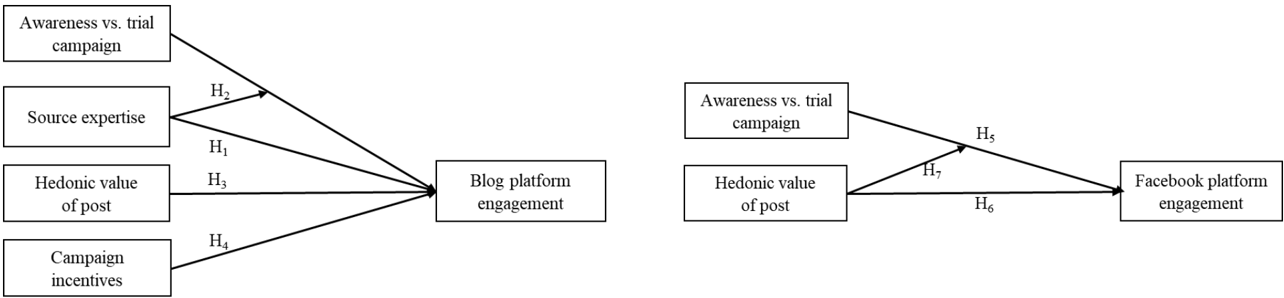
Influencer marketing is prevalent in firm strategies, yet little is known about the factors that drive success of online brand engagement at different stages of the consumer purchase funnel. The findings suggest that sponsored blogging affects online engagement (e.g., posting comments, liking a brand) differently depending on blogger characteristics and blog post content, which are further moderated by social media platform type and campaign advertising intent. When a sponsored post occurs on a blog, high blogger expertise is more effective when the advertising intent is to raise awareness versus increase trial. However, source expertise fails to drive engagement when the sponsored post occurs on Facebook. When a sponsored post occurs on Facebook, posts high in hedonic content are more effective when the advertising intent is to increase trial versus raise awareness. The effectiveness of campaign incentives depends on the platform type, such that they can increase (decrease) engagement on blogs (Facebook). The empirical evidence for these findings comes from real in-market customer response data and is supplemented with data from an experiment. Taken together, the findings highlight the critical interplay of platform type, campaign intent, source, campaign incentives, and content factors in driving engagement.
Overview
CoChat Summary
TL;DR
This paper examines how sponsored blogging campaigns drive online engagement across blogs and Facebook, using field data from 1,830 sponsored posts and a follow-up experiment. It finds engagement depends on platform, campaign intent, blogger expertise, hedonic content, and incentives, with expertise helping awareness campaigns on blogs but not Facebook.
Key findings
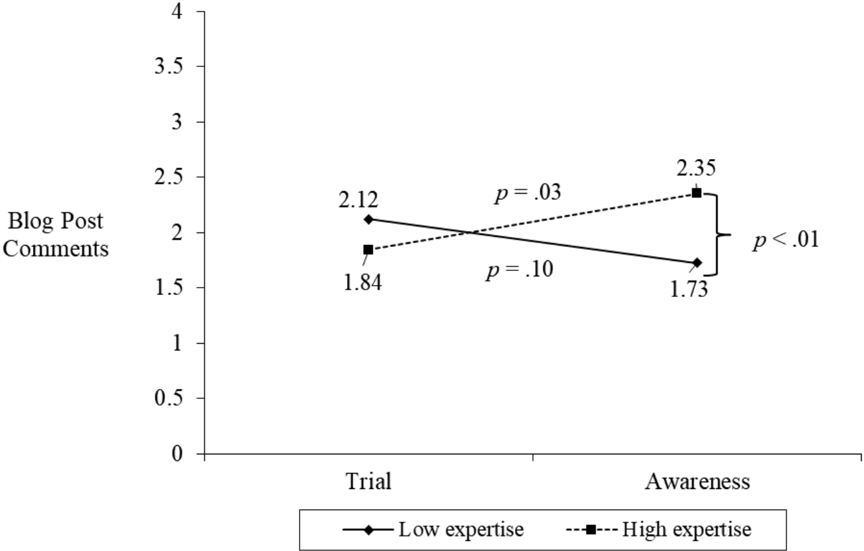
- In the blog-comment model (N = 1,237), blogger expertise had no significant main effect (b = −.1228, n.s.), but campaign intent × expertise was positive (b = .7283, p = .01): high-expertise bloggers performed better in awareness than trial campaigns (simple slope p < .05); low-expertise bloggers did not differ by intent (p = .10), so H2b was not supported.
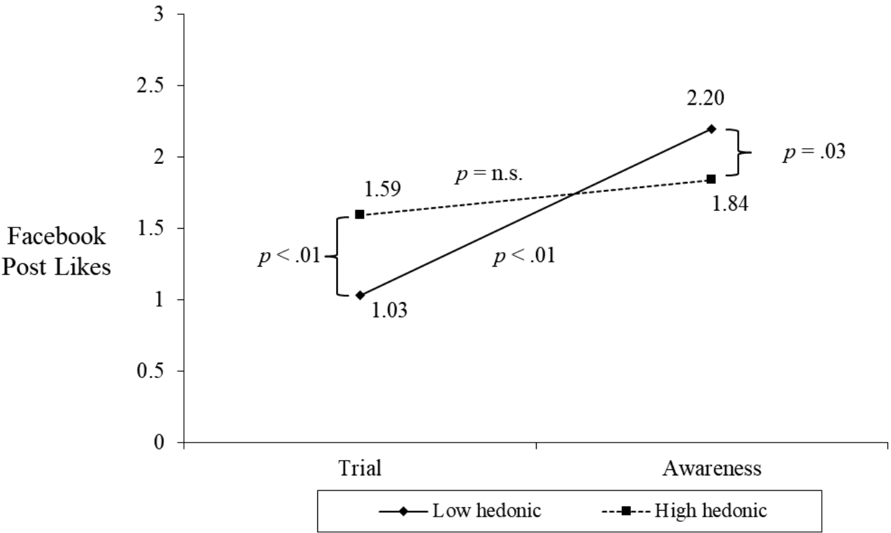
- Hedonic value of post increased blog comments (b = .2616, p < .01), and campaign giveaways increased blog comments (b = .4526, p = .01). On Facebook, awareness intent increased likes (b = .7416, p < .01), hedonic value increased likes (b = .2215, p = .03), and giveaways decreased likes (b = −.7840, p < .01).
- On Facebook, awareness × hedonic value was negative (b = −.4824, p < .01), implying hedonic content is positive for trial campaigns and negative for awareness campaigns; blogger expertise was not significantly related to Facebook likes (b = .0253, n.s.).
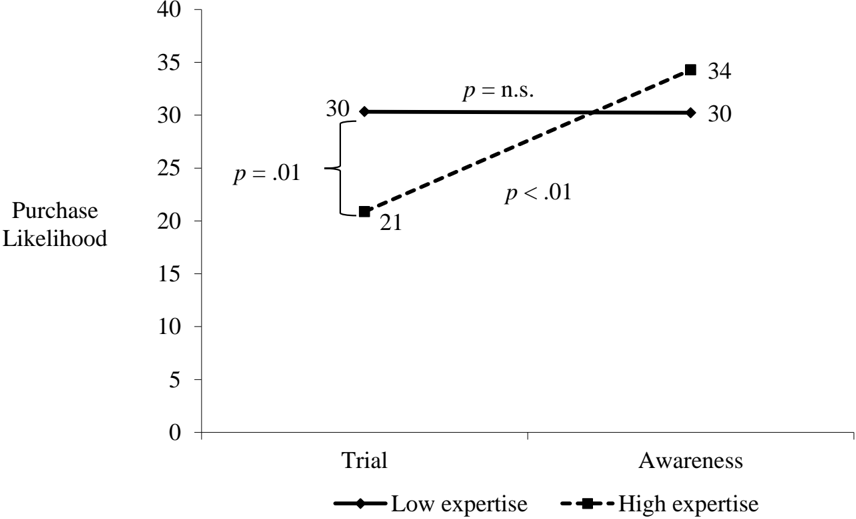
- Study 2 (N = 395 mothers) replicated the expertise × campaign intent interaction on purchase likelihood (F(1, 387) = 8.88, p < .01): with high expertise, awareness > trial (M = 34.10 vs. 20.66, p < .01); with low expertise, no difference (M = 30.24 vs. 30.29, p = .7106).
Methods
- Study 1 used real in-market data from The Motherhood agency: 1,830 sponsored posts by 595 bloggers across 57 campaigns (September 2012–December 2016); final analysis N = 1,237 due missing data. Dependent variables were number of blog post comments and Facebook post likes; negative binomial models with Heckman selection.
- Independent variables included campaign intent (awareness vs. trial), blogger expertise (sum of educational affiliation and blogger credentials, 0–2), hedonic and functional post value from coder factor analysis, campaign giveaways, follower counts, and controls.
- Study 2 was a 2 (expertise: high/low) × 2 (campaign: awareness/trial) between-subjects experiment with a Qualtrics panel of mothers (N = 395), using an educational paid app (Water Bears); the dependent variable was purchase likelihood.
Limitations
- Stated: the paper did not directly test ROI or sales, used post hoc coder ratings for sentiment, did not include a field experiment on blogger choice, and used bloggers’ network size at the time of posts without past performance/longevity; it also notes platforms evolve and ethical debates around sponsorship disclosure.
- Evident from text: Study 1 relies on one blogging agency and “mommy” bloggers, with missing data reducing the sample from 1,830 to 1,237; coder reliability for sentiment was modest (average α = .51, median = .56), and the field data are observational, limiting causal claims.
Model-written summary. Check it against the paper before relying on it.
Integrity signals
Registry
Cites
Statistics
Figures
Verification
Claims the paper makes
1 Valid · 0 Not valid · 18 Not checked · 125 Own results and interpretations
The sources with a verdict support this claim; the rest weren’t checked yet, have no full text we could read, or their verdicts aren’t rated yet.
In the paper
“we used the methodology Shrout and Fleiss (1979) describe and computed the Shrout-Fleiss single ICC score agreement of .998, which is considered quite high (Koo and Li 2016).”
What the sources say
- Not checked — no full text of the sourcecites Shrout and Fleiss (1979) matched to “Intraclass correlations: Uses in assessing rater reliability.” (1979) source
- Supportedcites Koo and Li 2016 matched to “A guideline of selecting and reporting intraclass correlation coefficients for reliability research” (2016) source
The ICC Interpretation passage (Introduction) classifies ICC values greater than 0.90 as indicating excellent reliability, supporting the description of .998 as quite high. The cited paper does not establish the citing authors’ computed score; the citation is attached to its interpretation. (LLM, conf=0.93)
plain- Asserted: passes — The authors put it forward as true.
- Checkable: passes — It can be checked against evidence.
- Load-bearing: unclear — It is unclear whether the paper’s conclusions depend on it.
- Based: passes — The paper gives a reason why it holds.
A result the paper reports from its own data — it cites no other source for it, so there is none to check. The quote shows it is in the paper.
In the paper
“When a sponsored post occurs on Facebook, posts high in hedonic content are more effective when the advertising intent is to increase trial versus raise awareness.”
plainstates a cause- Asserted: passes — The authors put it forward as true.
- Checkable: passes — It can be checked against evidence.
- Load-bearing: passes — The paper’s conclusions depend on it.
- Based: passes — The paper gives a reason why it holds.
A result the paper reports from its own data — it cites no other source for it, so there is none to check. The quote shows it is in the paper.
In the paper
“When a sponsored post occurs on a blog, high blogger expertise is more effective when the advertising intent is to raise awareness versus increase trial.”
- Also stated in: § Statement of Intended Contribution · p. 5 · plain
“In addition, blogger expertise exerts a greater impact in awareness (vs. trial) campaigns.”
plainstates a cause- Asserted: passes — The authors put it forward as true.
- Checkable: passes — It can be checked against evidence.
- Load-bearing: passes — The paper’s conclusions depend on it.
- Based: passes — The paper gives a reason why it holds.
- Also stated in: § Statement of Intended Contribution · p. 5 · plain
A result the paper reports from its own data — it cites no other source for it, so there is none to check. The quote shows it is in the paper.
In the paper
“However, source expertise fails to drive engagement when the sponsored post occurs on Facebook.”
plain- Asserted: passes — The authors put it forward as true.
- Checkable: passes — It can be checked against evidence.
- Load-bearing: passes — The paper’s conclusions depend on it.
- Based: passes — The paper gives a reason why it holds.
A result the paper reports from its own data — it cites no other source for it, so there is none to check. The quote shows it is in the paper.
In the paper
“We find that hedonic value has a significant effect on both blog and Facebook platforms.”
plainstates a cause- Asserted: passes — The authors put it forward as true.
- Checkable: passes — It can be checked against evidence.
- Load-bearing: passes — The paper’s conclusions depend on it.
- Based: passes — The paper gives a reason why it holds.
60 more claims
Create a free account to see all 144 claims and to verify the 2 references still open.
- It may state two separate claims as one. 43
- Probably not a substantial claim. 39
- The quote only partly states this claim. 10
Claims other papers make about this one
Each is checked against this paper’s own text: does it say what the citing paper says it does?
The cited source doesn’t support the claim as written.
In the citing paper
“Hughes, Swaminathan, and Brooks (2019) found that Facebook influencer campaigns that included incentives significantly increased the number of post comments.”
From Influencer Marketing on Instagram: Empirical Research on Social Media Engagement with Sponsored Posts (2022) · cites this paper as Hughes, Swaminathan, and Brooks (2019)
Checked by a reasoning model — may be wrong.
Experimental — accuracy not yet measuredThe source backs part of the claim, not all of it — or backs it for a different population, condition or comparison.
In the citing paper
“Social media platforms represent low-involvement, high-distraction, and hedonic environments (Hughes, Swaminathan, and Brooks 2019; Schulze, Sch€ oler, and Skiera 2014).”
From Influencer Marketing on Instagram: Empirical Research on Social Media Engagement with Sponsored Posts (2022) · cites this paper as Hughes, Swaminathan, and Brooks 2019
Experimental — accuracy not yet measuredThe cited source says what the claim attributes to it.
In the citing paper
“social media engagement is an important key performance indicator (KPI) to measure the success of sponsored posts on social media (Hughes, Swaminathan, and Brooks 2019;Lammenett 2019).”
From Influencer Marketing on Instagram: Empirical Research on Social Media Engagement with Sponsored Posts (2022) · cites this paper as Hughes, Swaminathan, and Brooks 2019
The cited source says what the claim attributes to it.
In the citing paper
“Previous research suggest that hedonic value can have an impact on post interaction and popularity (De Vries, Gensler, and Leeflang 2012;Hughes, Swaminathan, and Brooks 2019;Sabate et al. 2014).”
From Influencer Marketing on Instagram: Empirical Research on Social Media Engagement with Sponsored Posts (2022) · cites this paper as Hughes, Swaminathan, and Brooks 2019
The cited source says what the claim attributes to it.
In the citing paper
“Likes and comments are KPIs in influencer marketing (Hughes, Swaminathan, and Brooks 2019).”
From Influencer Marketing on Instagram: Empirical Research on Social Media Engagement with Sponsored Posts (2022) · cites this paper as Hughes, Swaminathan, and Brooks 2019
2 more claims about this paper
Create a free account to see every claim other papers make about this one.
Statistics that don’t add up
Each reported p-value recomputed from its test statistic and degrees of freedom, each partial η² from its F, and each ratio, mean difference or B printed with a p checked against its own confidence interval.
Rated minor: it would not touch a result — a value no result rests on, a p-value that stays on the same side of the significance level, or a conflict that is clerical, resolved elsewhere in the paper, or outside its own findings.
In the paper
“F(3, 260) = 3.61, p < .01”
Reported p < .01 · recomputed p = .014
Statistics recomputed
Every reported test result, recomputed from its test statistic and degrees of freedom. A result shows as not adding up only once an independent check has confirmed it.
- Doesn’t add upF(3, 260) = 3.61reported p < .01 · recomputed p = .014
“F(3, 260) = 3.61, p < .01”
- Not confirmedz = -0.06reported p = .95 · recomputed p = .952
“(z = -.060, p = .950”
- ConsistentF(3, 260) = 7.22reported p < .01 · recomputed p < .001
“F(3, 260) = 7.22, p < .01”
- Consistentz = 1.22reported p = .223 · recomputed p = .222
“(z = 1.22, p = .223”
- ConsistentF(3, 93) = 20.13reported p < .01 · recomputed p < .001
“F(3, 93) = 20.13, p < .01”
8 more recomputed tests
Create a free account to see every test the Stats check recomputed.
Self-check
Percentages, sums and reported differences re-computed from the paper’s own numbers.
Each contradiction between two passages listed here was confirmed by an independent check.
Rated minor: it would not touch a result — a value no result rests on, a p-value that stays on the same side of the significance level, or a conflict that is clerical, resolved elsewhere in the paper, or outside its own findings.
In the paper
§ Discussion · p. 29
“However, the results in Study 1 are driven by high expertise, while the results in Study 2 are driven by differences due to low expertise.”
§ Method and Results · p. 29
“Next, examining purchase likelihood under low blogger expertise, we found no significant difference between awareness and trial campaigns (Mawareness = 30.24, Mtrial = 30.29; F(1, 387) = .14, p = .7106)”
Citations
Cites
A guideline of selecting and reporting intraclass correlation coefficients for reliability research
Koo, T. K., & Li, M. Y. (2016) · Journal of Chiropractic Medicine · doi:10.1016/j.jcm.2016.02.012 · Cited by 31,709
Sample Selection Bias as a Specification Error
Heckman, J. J. (1979) · Econometrica · doi:10.2307/1912352 · Cited by 28,779
Intraclass correlations: Uses in assessing rater reliability.
Shrout, P. E., & Fleiss, J. L. (1979) · Psychological Bulletin · doi:10.1037/0033-2909.86.2.420 · Cited by 24,532
The Elaboration Likelihood Model of Persuasion
Petty, R. E., & Cacioppo, J. T. (1986) · Advances in Experimental Social Psychology · doi:10.1016/s0065-2601(08)60214-2 · Cited by 8,822 · cited 3×
“Our theoretical basis for predictions derives from the literature on the elaboration likelihood model (ELM) (Petty and Cacioppo 1986).”
BackgroundMethodHennig-Thurau, T., Gwinner, K. P., Walsh, G., & Gremler, D. D. (2004) · Journal of Interactive Marketing · doi:10.1002/dir.10073 · Cited by 5,916
A study of normative and informational social influences upon individual judgment.
Deutsch, M., & Gerard, H. B. (1955) · The Journal of Abnormal and Social Psychology · doi:10.1037/h0046408 · Cited by 4,819 · cited 1×
“This can derive from informational power, in which the expert has knowledge that others do not have (Deutsch and Gerard 1955).”
BackgroundDimensions of Consumer Expertise
Alba, J. W., & Hutchinson, J. W. (1987) · Journal of Consumer Research · doi:10.1086/209080 · Cited by 4,375
Ohanian, R. (1990) · Journal of Advertising · doi:10.1080/00913367.1990.10673191 · Cited by 4,043
The Influence of Source Credibility on Communication Effectiveness
Hovland, C. I., & Weiss, W. (1951) · Public Opinion Quarterly · doi:10.1086/266350 · Cited by 3,543 · cited 1×
“Source expertise affects attitude change (Hovland and Weiss 1951; McCracken 1989; Ohanian 1991), level of confidence and positivity (Tormala, Briñol, and Petty 2007), and behavioral changes (Crisci and Kassinove 1973) and leads to higher levels of persuasion (Petty and Wegener 1998).”
BackgroundThe Elaboration Likelihood Model of Persuasion
Petty, R. E., & Cacioppo, J. T. (1986) · Communication and Persuasion · doi:10.1007/978-1-4612-4964-1_1 · Cited by 3,202
Research works printed but not linked: 3
- Association of National Advertisers (2018), 'Advertisers Love Influencer Marketing: ANA Study,' press release, https://www.ana.net/content/show/id/48437.
- French, John and Bertram Raven (1959), 'The Bases of Social Power,' in Studies in Social Power , Dorwin Cartwright, ed. Ann Arbor: University of Michigan, 150-67.
- Zhu, June and Bernard Tan (2007), 'Effectiveness of Blog Advertising: Impact of Communicator Expertise, Campaign intent, and Product Involvement,' in ICIS 2007 Proceedings - Twenty Eighth International Conference on Information Systems . Atlanta: Association for Information Systems, paper 121.
Cited by
Items 701–779 of 779
Usage of Social Media on Planned Behavior to Use Crypto Asset Trading Platform
Handoko, B. L., & Ayuanda, N. (2025) · International Conference on ICT for Smart Society (ICISS) · doi:10.1109/iciss66954.2025.11389467
“Additionally, Hughes et al. [10] highlighted that influencers' endorsements on social media can create social pressure and build trust, which aligns with the subjective norms and attitude components of the TPB.”
Shankar, R., & Srivastava, S. (2026) · Emerald Group Publishing Limited eBooks · doi:10.1108/978-1-83608-602-420261014
Emerging Trends and Influences in Tourism
(2026) · Emerald Group Publishing Limited eBooks · doi:10.1108/978-1-83608-602-420261019
Hong, A., Ziyu, F. E. N. G., & Wang, Y. (2026) · Advances in Psychological Science · doi:10.3724/sp.j.1042.2026.0836 · Cited by 1
Government Officials as Social Media Influencers: Appeal and Effects on Destination eWOMPreprint
Sun, P., Ji, X., Jin, H., et al. (2026) · SSRN Electronic Journal · doi:10.2139/ssrn.6496750
Influencer Marketing on TikTok: Role of Content and Reviewer-Related Signals
Nguyen, T., & Paliszkiewicz, J. O. (2026) · Journal of Computer Information Systems · doi:10.1080/08874417.2026.2632082
The Personalization-Privacy Paradox in the Attention Economy
Cloarec, J. (2019) · theses.fr (ABES) · doi:10.70675/3fbb380bz8c98z4ab5z8c08z6d70e5703e1e · Cited by 3
Krishna Kumar, T. P., Nair, D., Agarwal, S., Hanumanthu, K. D., Reddy, R. R., & Anitha, G. (2026) · ShodhKosh Journal of Visual and Performing Arts · doi:10.29121/shodhkosh.v7.i3s.2026.7352
Vongmahasetha, T., & Wittayakom, S. (2026) · Multidisciplinary Reviews · doi:10.31893/multirev.2026478
“…outcomes — such as enhanced brand recall, increased attention allocation, increased engagement intentions and reduced avoidance — research remains fragmented across platforms, mechanisms and theoretical models (Hughes et al., 2019; Islam & Rahman, 2017; Mou et al., 2025; Vander Schee et al., 2020).”
An investigation of marketing communication facilitated by social media platforms
Niu, J. (2023) · theses.fr (ABES) · doi:10.70675/ce4ce92dzf6efz40f4za2caz9f61aa17649f
Zhong, X., Wu, F., Sun, Q. M., & Chen, J. (2026) · Journal of Interactive Marketing · doi:10.1177/10949968261447298
Product salience in influencer endorsement posts
Klostermann, J., Meißner, M., Musalem, A., & Decker, R. (2026) · Journal of the Academy of Marketing Science · doi:10.1007/s11747-026-01143-7 · Cited by 1
“For example, Hughes et al. (2019) and Karagür et al. (2022) count the number of likes of social media posts on different platforms, while Leung et al. ( 2022) also consider reposts on Twitter and Weibo.”
InfluentialChen, Y.-C., Hsu, C., & Lin, H.-Y. (2026) · Telematics and Informatics · doi:10.1016/j.tele.2026.102414 · Cited by 1
Merz, Y., Föhl, U., & Regelmann, S. (2026) · Springer eBooks · doi:10.1007/978-3-658-49614-2_69
Anti-consumption toward untrustworthy influencers promoting charity campaigns
Phan, T. A., Huynh, M. K., & Nguyễn, H. K. (2026) · Elsevier eBooks · doi:10.1016/b978-0-443-29863-9.00168-9 · Cited by 1
Ghosh, M., & Islam, A. S. (2026) · South Asian Journal of Marketing · doi:10.1108/sajm-08-2025-0041
Cognitive View of New Entry Threats in Mobile App Markets
Soh, F., & Grover, V. (2026) · Journal of Management Information Systems · doi:10.1080/07421222.2026.2647467
“…[44, 45], UGC, and customers’ opinions and assessments of the firm [19, 52, 103, 115], UGC, investors & donors’ opinions and evaluation of the firm [47, 72], third-party-generated content, and consumer perceptions [53, 71], third-party-generated content and investors & donors contributions [3, 87].”
Ismael, A. S., & Balogh, P. (2026) · Sustainable landscape planning and natural resources management · doi:10.1007/978-3-032-17498-7_22
Fota, A., Rollin, R., & Schramm‐Klein, H. (2026) · Springer eBooks · doi:10.1007/978-3-658-49371-4_30
Dong, X., Xie, J., Xi, N., Liao, J., & Xie, S. (2026) · International Journal of Advertising · doi:10.1080/02650487.2026.2670858 · Cited by 1
Cioccio, M. D., Pozharliev, R., & Angelis, M. D. (2026) · Journal of Retailing and Consumer Services · doi:10.1016/j.jretconser.2026.104895
Li, F., Li, R., & Li, S. (2026) · Information Processing & Management · doi:10.1016/j.ipm.2026.104929
A multi-method examination of influencer attribute effects across the marketing funnel
Wang, C. C., Chang, S.-C., & Lin, Y.-F. (2026) · Asia Pacific Journal of Marketing and Logistics · doi:10.1108/apjml-12-2025-2634
Xiang, G., Ou, W., & 欧缤忆 (2026) · Journal Of Vacation Marketing · doi:10.1177/13567667261454754
Government officials as social media influencers: Appeal and effects on destination eWOM
Sun, P., Ji, X., Jin, H., & Li, X. (2026) · Journal of Digital Economy · doi:10.1016/j.jdec.2026.05.003
Shin, H., Kim, S., Yang, H.-D., & Kim, Y.-Y. (2026) · Journal of theoretical and applied electronic commerce research · doi:10.3390/jtaer21060188
Sales effects of a product’s endorsements by traditional celebrities and internet celebrities
Sheng, D., & Astvansh, V. (2026) · Cogent Business & Management · doi:10.1080/23311975.2026.2687837 · Cited by 1
Market diversity and cultural product performance: Evidence from the global movie industry
Kutlubay, O. C., Yayla, S., Kim, D., Çiçek, M., & Jean, R. “. (2026) · International Business Review · doi:10.1016/j.ibusrev.2026.102628
Paylan, M. A., & Semiz, B. B. (2026) · Journal of Applied and Theoretical Social Sciences · doi:10.37241/jatss.2026.154
“The literature on consumer engagement emphasizes a number of potential factors that can impact consumer engagement (Hughes et al., 2019).”
Martin, K. D., & Barrett, K. (2026) · Oxford University Press eBooks · doi:10.1093/9780197859063.003.0036
Lanz, A. (2026) · doi:10.1093/9780197859063.003.0001
Influencer marketing and consumer motivations through the lens of the Means-End Chain theory
Halwani, L., & Moulard, J. G. (2026) · Journal of Marketing Communications · doi:10.1080/13527266.2026.2697270
Garcia, Â., António, N., & Rita, P. (2026) · Developments in marketing science: proceedings of the Academy of Marketing Science · doi:10.1007/978-3-032-20132-4_19
Farrell, J. R., Sands, S., & Ferraro, C. (2026) · Journal of Advertising Research · doi:10.1080/00218499.2026.2667595 · Cited by 1
Yang, B., & Wang, X. (2026) · Journal of theoretical and applied electronic commerce research · doi:10.3390/jtaer21070212
The foundations, evolution and promise of customer-based brand equity
Keller, K. L. (2026) · Journal of the Academy of Marketing Science · doi:10.1007/s11747-026-01168-y · Cited by 1
Ahmed, A. G., & Gaber, H. R. (2026) · Cogent Business & Management · doi:10.1080/23311975.2026.2697148
Araujo, S. V. I. D., Dhaigude, A. S., Kamath, G. B., Pai, R. R., Nayak, S., & Prabhu, V. (2026) · Acta Psychologica · doi:10.1016/j.actpsy.2026.107422 · Cited by 1
Liu, R., Osman, S., Sabri, M. F., & Jaafar, N. A. A. (2026) · Journal of theoretical and applied electronic commerce research · doi:10.3390/jtaer21070226 · Cited by 2
“Consumers’ reactions to influencer-generated communications represent an extension of COBRA’s constructs of consumption, contribution to, and creation of content based on influencer messaging [46,47].”
The Antecedents and Consequences of Social‐Media Engagement With A Sustainability‐Advertisement
Nuery, N., Yannopoulou, N., Manika, D., & Alamanos, E. (2026) · International Journal of Consumer Studies · doi:10.1111/ijcs.70230
To swear or not to swear: Exploring the role of profanity in influencer marketing
Moghadam, M. N., & Mahajan, V. (2026) · Journal of the Academy of Marketing Science · doi:10.1007/s11747-026-01183-z
“This financial motivation is a central pillar of influencer marketing (Hughes et al., 2019), yet it can also shape how consumers interpret an influencer’s language choices.”
Luo, Y., Lei, X., Zhang, W., Zheng, H., Xu, X., & Xu, J. H. (2026) · Information Processing & Management · doi:10.1016/j.ipm.2026.105068 · Cited by 4
Deng, Q., Pergelova, A., & Hachey, A. (2026) · Journal of Consumer Affairs · doi:10.1111/joca.70067 · Cited by 2
Virtual influencer marketing: A meta-analytic review
Barari, M. M., Eisend, M., & Kulczynski, A. (2026) · Journal of the Academy of Marketing Science · doi:10.1007/s11747-026-01186-w · Cited by 7
Birds of a feather: How influencer-brand fit drives product sales in livestream commerce
Zhang, S. K., Shi, Y., Liang, H., & Xue, Y. L. (2026) · Journal of the Academy of Marketing Science · doi:10.1007/s11747-026-01187-9
“…fit as a distinct dimension of influencer-brand fit alongside image-based fit and extend the fit literature into livestream commerce, where immediate sales replace the accumulated brand engagement that anchors asynchronous contexts (Beichert et al. 2024; Hughes et al. 2019; Leung et al. 2022b ).”
InfluentialNazmul, M. D. S. B., Azad, M. S., & Mahdy, M. R. C. (2026) · Computers in Human Behavior Reports · doi:10.1016/j.chbr.2026.101237
Visual strategies in influencer marketing campaigns: The role of consistency
Boluki, A., Shehu, E., & Bijmolt, T. H. A. (2026) · Journal of the Academy of Marketing Science · doi:10.1007/s11747-026-01188-8 · Cited by 1
“Some studies analyze text (Cas-cio Rizzo et al. 2023, 2024; Hughes et al. 2019; Leung et al. 2022a, b ; Valsesia et al. 2020), but insights on the role of visuals in influencer marketing are scarce.”
Singh, P., Jayawardena, N. S., & Thaichon, P. (2026) · Journal of Consumer Behaviour · doi:10.1002/cb.70196 · Cited by 1
“Trust me, I’m virtual”: understanding consumer engagement with influencers and travel intentions
Nie, Y., Barnes, S. J., So, K. K. F., Shin, H., Yoon, J.-H., & Kim, M. J. (2026) · Asia Pacific Journal of Tourism Research · doi:10.1080/10941665.2026.2714235
Taheran, F., Mortazavi, A., & Thomas, V. L. (2026) · European Journal of Marketing · doi:10.1108/ejm-02-2025-0156 · Cited by 2
Islam, M., Sheikh, S. A., Pathak, A., & Mukherjee, D. (2026) · Journal of theoretical and applied electronic commerce research · doi:10.3390/jtaer21080271
“Earlier findings [24–26] demonstrate that consumers view entertainment-oriented digital media as especially relevant sources of information when making hedonic purchase decisions on e-commerce platforms.”
Influencers' characteristics and communication strategies in purchase intention at festivals
Marmelo, J., Teixeira, S., de Oliveira, Z. M., & Teixeira, S. (2026) · International Journal of Event and Festival Management · doi:10.1108/ijefm-01-2026-0001
Günay, K. (2026) · Journal of Political Marketing · doi:10.1080/15377857.2026.2708723
Filieri, R., Rasty, F., Bazi, S., & Zheng, L. (2026) · Journal of Marketing Management · doi:10.1080/0267257x.2026.2712510
How Does Social Media Influencer Marketing Affect Consumer Purchase Behaviour?
Daryal, A. (2025) · RESEARCH HUB International Multidisciplinary Research Journal · doi:10.31305/rhimrj.2025.v12n10.013
Zhang, H., Gong, X.-S., & Guan, Y.-X. (2026) · Journal of business research · doi:10.1016/j.jbusres.2026.116498
Wen, X., Xian, T., Liao, C., & Huang, Z. (2026) · Journal of Retailing · doi:10.1016/j.jretai.2026.08.005
Srivastava, E., & Narayanan, P. (2026) · International Marketing Review · doi:10.1108/imr-04-2025-0175
Nie, J., Gao, F., Liu, Y., et al. (2026) · Journal of Retailing and Consumer Services · doi:10.1016/j.jretconser.2026.105054
What Really Works: The Drivers and Mediators of Success in Influencer Marketing
Pan, M., Blut, M., Ghiassaleh, A., & Lee, Z. W. Y. (2026) · Management and business review. · doi:10.1177/2694104x261479131
Hero products and the value of position in live streaming commerce evidence from Douyin
Hu, J. (2026) · Journal of Retailing and Consumer Services · doi:10.1016/j.jretconser.2026.105072
Yasin, M. M., Porcu, L., Liébana-Cabanillas, F. J., & Zarco, C. P. (2026) · Journal of Islamic marketing · doi:10.1108/jima-01-2023-0003
Korzyński, P., Protsiuk, O., Wang, F., Krzaczek, I., & Sands, S. (2026) · Review of Managerial Science · doi:10.1007/s11846-026-01061-6
Bakri, M., Harris, P., & Dillon, S. M. (2026) · Journal of Retailing and Consumer Services · doi:10.1016/j.jretconser.2026.105094
Calibrating Linguistic Surprise for Audience Engagement in Influencer MarketingPreprint
Baozhen, Z. H. A. N., Feng, G., Li, J., & Gao, A. Y. (2026) · SSRN Electronic Journal · doi:10.2139/ssrn.7438616
Ammetller, G., Rodríguez‐Ardura, I., Meseguer‐Artola, A., & Williams, S. D. (2026) · Competitiveness Review An International Business Journal incorporating Journal of Global Competitiveness · doi:10.1108/cr-02-2026-0121
Tran, K., NGUYEN, C. Q., & Dat, D. (2026) · Strategic Business Research · doi:10.1016/j.sbr.2026.100301
Ali, M., Haq, M. Z. U., Farhad, S., & Zia, M. S. (2026) · journal of social sciences review · doi:10.62843/jssr.v6i3.755
Ali, M., Haq, M. Z. U., Farhad, S., et al. (2026) · journal of social sciences review · doi:10.62843/jssr.v6i4.755
Digital brand engagement: harnessing brandfests designed for brand publics
Preiksaitis, K. M., & Mitchell, A. I. (2026) · International Journal of Research in Marketing · doi:10.1016/j.ijresmar.2026.09.005
The Age‐Fit Hypothesis: Celebrity Age, Content Type, and Consumer Engagement on Social Media
Zhang, X., Zhang, Q., Wan, F., Zhang, N., & Filieri, R. (2026) · Psychology and Marketing · doi:10.1002/mar.70268
Li, N., Yuan, L., & Xie, L. (2026) · Muallim Journal of Social Science and Humanities · doi:10.33306/mjssh/448
Watson, J. M. (2026) · Oxford University Press eBooks · doi:10.1093/9780197859063.003.0069
Rasul, T., Santini, F. D. O., Lim, W. M., Ladeira, W. J., Cheah, I., Japutra, A., & Shaheen, M. (2026) · Journal of Consumer Behaviour · doi:10.1002/cb.70246
Building sustainable influencer partnerships within the creator economy
Pahari, S., Mortimer, G., Troise, C., & Bresciani, S. (2026) · Journal of Retailing and Consumer Services · doi:10.1016/j.jretconser.2026.105116
Castillo, D. J., & Sánchez‐Fernández, R. (2026) · Journal of Product & Brand Management · doi:10.1108/jpbm-01-2026-6723
Rita, P., Santos, Z., & Zhou, R. (2026) · Computers in Human Behavior Reports · doi:10.1016/j.chbr.2026.101372
Not alone: How group photos enhance audience responses to virtual influencers
Fang, J., & Pan, Y. (2026) · Journal of Retailing and Consumer Services · doi:10.1016/j.jretconser.2026.105135
Metadata
- Authors
- Hughes, C., Swaminathan, V., & Brooks, G.
- Affiliations
- University of Mendoza (AR)
- University of Notre Dame (US)
- University of Oxford (GB)
- Corresponding author
- Hughes, Christian
- Venue
- Journal of Marketing
- Publisher
- SAGE Publications
- Published
- 2019-06-04
- Volume
- 83
- Issue
- 5
- Pages
- 78-96
- ISSN
- 0022-2429 (ISSN-L)
- 1547-7185
- OpenAlex
- W2946816985
- Cited by
- 789
- References
- 88
- Citations by year
- 2026: 118 · 2025: 150 · 2024: 150 · 2023: 132 · 2022: 99 · 2021: 81 · 2020: 48 · 2019: 9
- FWCI
- 119.02
- Type
- journal article
- Language
- en
- Open access
- green
- kclpure.kcl.ac.uk
- Licence
- other-oa
- journals.sagepub.com/page/policies/text-and-data-mining-license (tdm)
- Locations
- Journal of Marketing (publishedVersion)
- Research Portal (King's College London) (submittedVersion, other-oa)
- Funders
- Marketing Science Institute (#4-1927)
- Topics
- Social Sciences › Business, Management and Accounting › Marketing › Digital Marketing and Social Media
- Social Sciences › Business, Management and Accounting › Marketing › Marketing and Advertising Strategies
- Social Sciences › Business, Management and Accounting › Marketing › Consumer Behavior in Brand Consumption and Identification
- Keywords
- influencer marketing, brand engagement, social media influencers, purchase funnel, source expertise, Facebook, blog posts, consumer purchase behavior
About these checks
Registry, retraction, Cites and statistics results are computed, not judged, with one exception: a printed reference that no index lists is read once by a model before it counts as a citation error. Claims are extracted by a model and kept only when their quote appears verbatim in the text; each cited source is then checked, with a model’s help, for whether it says what the claim relies on. Those verdicts can be wrong — read the claim’s quote and the cited source before relying on one.
A language model drew the claims from the paper on 2026-10-10, under version 3 of the claim definition (model deepseek-v4.1-flash, prompt extract-v3).
A second model labelled each claim on 2026-10-10 (model jev-1.13-20260917, definition revision gold-guideline-v0.2).
Cited sources are checked with a language model’s help (gpt-6-sol).
Statistics and arithmetic are recomputed, not judged.
Confidence bands are shown only for fields calibrated on our annotated test set. None is calibrated yet, so no band is shown.
What counts as a claim ›How we measure confidence ›How we check this ›
Are you an author, or do you see a problem with this page? Request a review
Data sources
Bibliographic data: Semantic Scholar, OpenAlex, Crossref.
Contains information from the Semantic Scholar Academic Graph Datasets, made available under the ODC Attribution License (ODC-BY 1.0).
Semantic Scholar’s data is described in: Kinney, R., et al. (2023). The Semantic Scholar Open Data Platform. arXiv:2301.10140.
