

Toward an Entrepreneurial Ecosystem Research Program
Open accessThe DOI matches its Crossref record; 252 of the 252 references it cites were found in a registry or an index; 36 of the 199 sources its claims cite were checked for support.
Abstract
Entrepreneurial ecosystems have become a prominent concept, yet in its current state, the concept itself represents a paradox. While it draws on a rich intellectual history and provides an opportunity to synthesize different strands of research, it is also under-theorized and the mechanisms that govern ecosystem evolution are not well understood. This paper takes stock of recent advancements in ecosystem scholarship and synthesizes the empirical reality of the causal mechanisms. We use these dynamics to position ecosystems in a broader context, within and beyond the domain of entrepreneurship research, and propose a transdisciplinary research program for ecosystem research and practice.
Overview
CoChat Summary
TL;DR
This paper reviews entrepreneurial ecosystem scholarship and argues the concept remains under-theorized, with the mechanisms governing ecosystem evolution not well understood. It synthesizes empirical causal mechanisms and proposes a transdisciplinary research program organized around context, structure, microfoundations, and complex systems.
Key findings
- The systematic review’s final sample contains 62 empirical articles; the initial search yielded 724 articles, reduced to an intermediate sample of 183, with 44 papers studying ecosystems at the city or regional level and 18 at the national level.
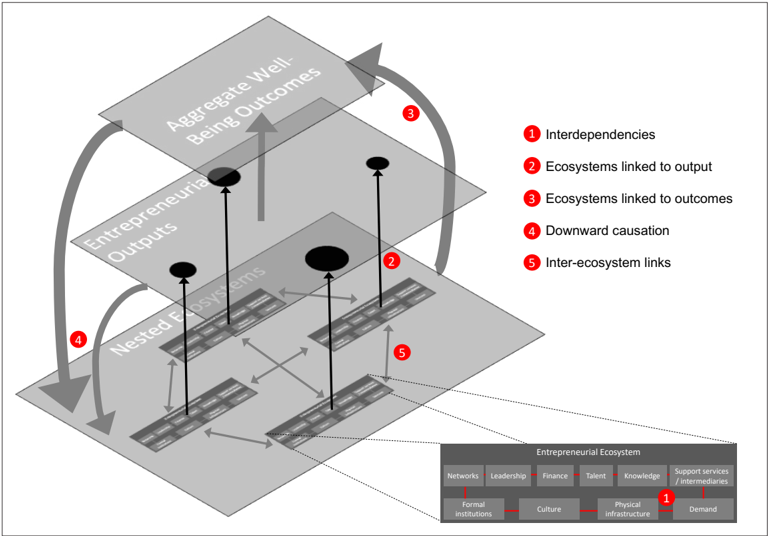
- The review identifies causal mechanisms linking ecosystem elements to outputs and outcomes: intra-layer interdependence among elements, upward causation from elements to outputs/outcomes, downward causation and path dependency/feedback, and inter-ecosystem links.
- Country-level studies link entrepreneurial ecosystems to economic growth and find mature ecosystems enable knowledge spillovers and more efficient resource allocation; regional evidence on whether ecosystems moderate the entrepreneurship–economic growth relationship is mixed, with Bruns et al. (2017) finding no moderating effect and Szerb et al. (2019) finding a positive moderating effect.
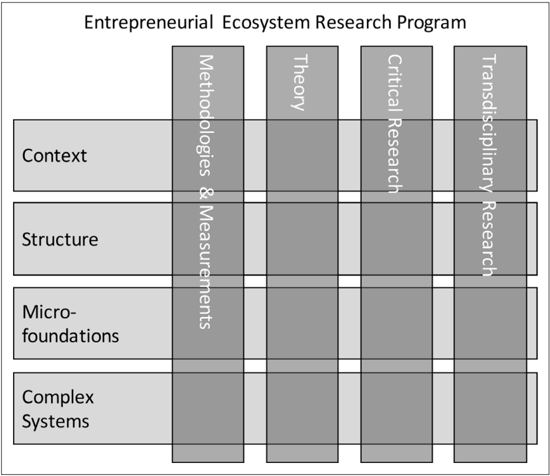
- The paper proposes a transdisciplinary entrepreneurial ecosystem research program with four research streams (context, structure, microfoundations, complex systems) and four cross-sectional themes (methodologies and measurements, theory, critical research, transdisciplinary research).
Methods
- Systematic literature review using Web of Science and Scopus, with topic searches for terms such as “entrep* ecosys*,” “startup ecosys*,” and “sys* of entrep*,” yielding an initial 724 articles.
- The review restricted sources to the top 25% Scimago-ranked journals in relevant business, management, economics, geography, and urban studies subareas, producing an intermediate sample of 183 articles; after in-depth reading and exclusions, 62 empirical articles remained.
- Analysis was guided by the Stam (2015) and Stam and Van de Ven (2019) framework to identify causal mechanisms: intra-layer causation, upward causation, downward causation/feedback, and inter-ecosystem links.
Limitations
- The paper states that ecosystem research is fragmented and heterogeneous, under-theorized, and that mechanisms governing ecosystem evolution are not well understood; much literature uses the ecosystem concept metaphorically without taking interdependence seriously.
- The paper states there is a lack of empirical evidence on path dependency and ecosystem boundaries, and that research is dominated by observational and case-study methods, making causality difficult to infer; it also warns of the ecological fallacy and notes that non-Gaussian distributions are often ignored.
- Evident from the methods: the review is limited to journal articles in top 25% journals, excluding book chapters, conference papers, and non-empirical work, and the final sample of 62 articles may narrow the evidence base.
Model-written summary of a shortened version of the paper’s full text (it is longer than we read). Check it against the paper before relying on it.
Integrity signals
Registry
Cites
Statistics
Figures
Verification
Claims the paper makes
31 Valid · 16 Not valid · 116 Not checked · 37 Own results and interpretations
The cited sources support only part of this claim — read each source’s verdict below.
In the paper
“There is also a subset of studies that focus on a singular innovation project within in a spatial setting, not looking at the aggregate preva -lence of entrepreneurship, nor at the interdependencies in the ecosystem at large (e.g., DiVito & Ingen- Housz, 2019).”
What the sources say
- Partly supportedcites DiVito & Ingen-Housz, 2019 matched to “From individual sustainability orientations to collective sustainability innovation and sustainable entrepreneurial ecosystems” (2021) sourceExperimental — accuracy not yet measured
The Methods section describes a single collaborative innovation project in Amsterdam and says the study does not aim to reveal relationships between variables, supporting the project-level and spatial characterization. But it names the broader ecosystem as a unit of analysis, and the Introduction explicitly says the study examines interdependencies among ecosystem actors. The claim that it does not look at those interdependencies is therefore unsupported. Page numbers are not available in our copy. (LLM, conf=0.88)
plain- Asserted: passes — The authors put it forward as true.
- Checkable: passes — It can be checked against evidence.
- Load-bearing: unclear — It is unclear whether the paper’s conclusions depend on it.
- Based: passes — The paper gives a reason why it holds.
- Partly supported
The cited sources support only part of this claim — read each source’s verdict below.
In the paper
“which are responsible for the bulk of new job creation in devel -oped economies, making it a crucial target for economic development policy ( Brown & Mason, 2017).”
What the sources say
- Partly supportedcites Brown & Mason, 2017 matched to “Looking inside the spiky bits: a critical review and conceptualisation of entrepreneurial ecosystems” (2017) sourceExperimental — accuracy not yet measured
Section 4.1.2, “Blockbuster entrepreneurship” (page unavailable), says that a tiny number of UK firms contribute disproportionately to job creation by high-growth firms. That supports their importance as job creators, but it does not establish that high-growth firms account for the bulk of all new jobs across developed economies. (LLM, conf=0.85)
plainstates a cause- Asserted: passes — The authors put it forward as true.
- Checkable: passes — It can be checked against evidence.
- Load-bearing: unclear — It is unclear whether the paper’s conclusions depend on it.
- Based: passes — The paper gives a reason why it holds.
- Rests on an assumption not shown here.
- Partly supported
Every source the paper cites for this claim was checked and supports it.
In the paper
“An example is the investment in physical infrastructure without supporting the underlying cultural and social support, which turned planned innovation hotspots into empty real estate (Pugh et al., 2018).”
What the sources say
- Supportedcites Pugh et al., 2018 matched to “From ‘Techniums’ to ‘emptiums’: the failure of a flagship innovation policy in Wales” (2018) source
The Discussion and Conclusion says Technium buildings had low occupancy and that firms received little on-site support beyond physical space. The passage labelled Table 4 about here describes a lack of softer support and local networks, with empty space ultimately leased out as the government became a landlord. Together, these support the citing sentence’s paraphrase. (LLM, conf=0.89)
plainstates a cause- Asserted: passes — The authors put it forward as true.
- Checkable: passes — It can be checked against evidence.
- Load-bearing: passes — The paper’s conclusions depend on it.
- Based: passes — The paper gives a reason why it holds.
- Supported
The cited sources support only part of this claim — read each source’s verdict below.
In the paper
“These co- evolutionary dynamics are the result of the interactions of individuals within eco -systems ( Johnson et al., 2019 ; Thompson et al., 2018).”
What the sources say
- Partly supportedcites Johnson et al., 2019 matched to “Entrepreneurial dynamism and the built environment in the evolution of university entrepreneurial ecosystems” (2019) sourceExperimental — accuracy not yet measured
Section 5.1 links the evolution of university-centered entrepreneurial ecosystems to agents’ behavior and their interconnected responses. The Conclusion adds that evolution depends on both those responses and the built environment; the claim broadens this finding to ecosystems generally and leaves out that additional factor. Page numbers are unavailable in our copy. (LLM, conf=0.83)
- Supportedcites Thompson et al., 2018 matched to “How entrepreneurial ecosystems take form: Evidence from social impact initiatives in Seattle” (2018) source
The Discussion (p. 27) states that a field-theory approach considers 'how individuals doing things together contributes to the particular features and dynamics of an ecosystem,' and the Introduction (p. 4) credits endogenous, bottom-up, time-patterned processes driven by micro social interaction, with interactions and shared meanings becoming 'common and mutually reinforcing' across the phase transition (pp. 4, 26). Our copy does not use the term 'co-evolutionary' (searches for it returned only semantic matches), but it substantively treats ecosystem dynamics as the product of actor interactions within the ecosystem, so the paraphrase is carried. The one narrowing worth noting is that the paper bounds this to the early moments of ecosystem formation in its Seattle social-impact setting and pairs interactions with shared meanings rather than interactions alone. (LLM, conf=0.82)
plainstates a cause- Asserted: passes — The authors put it forward as true.
- Checkable: passes — It can be checked against evidence.
- Load-bearing: unclear — It is unclear whether the paper’s conclusions depend on it.
- Based: passes — The paper gives a reason why it holds.
- Partly supported
Every source the paper cites for this claim was checked and supports it.
In the paper
“Ecosystem configurations can vary significantly and new policies/investments should develop support among underlying social and cultural attributes [53] Spigel (2017)”
What the sources say
- Supportedcites Spigel (2017) matched to “The Relational Organization of Entrepreneurial Ecosystems” (2017) source
Section 2.4 states that entrepreneurial ecosystems can have multiple possible configurations. Section 3.1 likewise describes different configurations and relationships among ecosystem attributes, supporting the claim that configurations vary. (LLM, conf=0.92)
plain- Asserted: passes — The authors put it forward as true.
- Checkable: passes — It can be checked against evidence.
- Load-bearing: unclear — It is unclear whether the paper’s conclusions depend on it.
- Based: passes — The paper gives a reason why it holds.
- Supported
81 more claims · 12 with their cited sources checked
Create a free account to see all 200 claims and to verify the 44 references still open.
- Probably not a substantial claim. 82
- It may state two separate claims as one. 52
Self-check
Percentages, sums and reported differences re-computed from the paper’s own numbers.
Each contradiction between two passages listed here was confirmed by an independent check.
Rated minor: it would not touch a result — a value no result rests on, a p-value that stays on the same side of the significance level, or a conflict that is clerical, resolved elsewhere in the paper, or outside its own findings.
In the paper
§ Microfoundations · p. 24
“We must be aware of the ecological fallacy (Robinson, 2009 )”
§ References · p. 47
“- Robinson, W. S. (1950). Ecological correlations and the behavior of individuals.”
Citations
Cites
The Theory of Economic Development
Schumpeter, J., & Backhaus, U. (2006) · The European Heritage in Economics and the Social Sciences · doi:10.1007/0-306-48082-4_3 · Cited by 22,506
Introductory Econometrics: A Modern Approach
Wooldridge, J. M. (1999) · Cited by 14,466
(1993) · Journal of the American Dietetic Association · doi:10.1016/0002-8223(93)92196-5 · Cited by 11,976
Teece, D. J. (1986) · Research Policy · doi:10.1016/0048-7333(86)90027-2 · Cited by 7,842 · cited 1×
“Untraded interdependencies include the complementarities between actors and resources, and information flows which do not entirely correspond to the flows of commodities (Richardson, 1972 ; Teece, 1986 , 1998; Tripsas, 1997).”
Competing Technologies, Increasing Returns, and Lock-In by Historical Events
Arthur, W. B. (1989) · The Economic Journal · doi:10.2307/2234208 · Cited by 7,489 · cited 1×
“The concept of path dependency goes back to the work by David (1988) and Arthur (1989) and “can be used to offer an understanding of why some optional developments are followed, or intention - ally chosen, over others […] path dependence conditions, but does not determine, a specific outcome”…”
Analyzing the Past to Prepare for the Future: Writing a Literature Review
Webster, J., & Watson, R. T. (2002) · MIS Quarterly · doi:10.2307/4132319 · Cited by 7,449 · cited 2×
“In the initial stage, we searched all databases from Web of Science and Scopus for a comprehensive overview of the literature (Frank & Hatak, 2014 ; Martín-Martín et al., 2018 ; Webster & Watson, 2002).”
Teece, D. (1993) · Research Policy · doi:10.1016/0048-7333(93)90063-n · Cited by 7,242
Clusters and the new economics of competition.
Porter, M. E. (1998) · PubMed · Cited by 5,679
Clusters and the New Economics of Competition
Milošević, D. (2014) · Harvard business review · Cited by 4,854
Beyond Markets and States: Polycentric Governance of Complex Economic Systems
Ostrom, E. (2010) · American Economic Review · doi:10.1257/aer.100.3.641 · Cited by 4,529 · cited 2×
“In combination with insights from polynuclear governance (Ostrom, 2010) and multilevel governance (Bache et al.”
Research works printed but not linked: 5
- David, P. A. (1988). Path- dependence: Putting the past into the future of economics . Institute for Mathematical Studies in the Social Sciences Technical Report No. 533: Stanford University Press.
- World Economic Forum. (2014). Entrepreneurial ecosystems around the globe and early- stage company growth dynamics . World Economic Forum.
- Krugman, P. (1991). Geography and trade . MIT Press.
- Marshall, A. (1920). Principles of Economics . (Rev ed.). Macmillan.
- Startup Genome. (2020). The Global Startup Ecosystem Report GSER 2020: The New Normal for the Global Startup Economy and the Impact of COVID-19 . Startup Genome.
Cited by
Items 101–200 of 780
Towards Social Innovation Strategy: An Analysis of UK Social Enterprises
João-Roland, I. D. S., & Granados, M. L. (2022) · Technological Forecasting and Social Change · doi:10.1016/j.techfore.2022.122189 · Cited by 43
Enablers of explorative and exploitative intellectual capital in entrepreneurial ecosystems
Grande, S., Bertello, A., Bernardi, P. D., & Ricciardi, F. (2022) · Journal of Intellectual Capital · doi:10.1108/jic-07-2021-0197 · Cited by 35
Harris, J. L., & Menzel, M.-P. (2023) · Progress in Human Geography · doi:10.1177/03091325231205091 · Cited by 34
Dissecting the ecosystems’ determinants of entrepreneurial re-entry after a business failure
Benavides, J. R. E., Guerrero, M., & Díaz, D. (2021) · European Business Review · doi:10.1108/ebr-09-2020-0222 · Cited by 30
Benevolent Sexism and the Gender Gap in Startup Evaluation
Nguyen, N., Hideg, I., Engel, Y., & Godart, F. C. (2023) · Entrepreneurship Theory and Practice · doi:10.1177/10422587231178865 · Cited by 32
“…training for investor groups (e.g., angel investors, venture capitalists, and bank loan officers), entrepreneurial support organizations (e.g., incubators, accelerators, and science parks), and other stake-holder groups in the startup ecosystem (Bergman & McMullen, 2022; Wurth et al., 2022).”
BackgroundBusiness model design for Electric Commercial Vehicles (ECVs): An ecosystemic perspective
Dehkordi, R., Ahokangas, P., Evers, N., & Sorvisto, M. (2024) · Energy Policy · doi:10.1016/j.enpol.2023.113971 · Cited by 32
Entrepreneurial ecosystems and actor legitimacy
Lechner, C., Delanoë‐Gueguen, S., & Gueguen, G. (2022) · International Journal of Entrepreneurial Behaviour & Research · doi:10.1108/ijebr-03-2020-0165 · Cited by 32
DIVERSIFIKASI SEBAGAI STRATEGI KEBERLANJUTAN PROGRAM KEWIRAUSAHAAN BERBASIS DIGITAL
Hamid, R. S., Anwar, S. M., Ukkas, I., & Goso, G. (2023) · Jurnal Fokus Manajemen Bisnis · doi:10.12928/fokus.v13i1.7303 · Cited by 28
“Konsep ekosistem wirausaha telah muncul dan semakin mendapatkan momentum di kalangan praktisi, pembuat kebijakan, dan akademisi (Wurth et al ., 2022).”
BackgroundRoundy, P. T., & Im, S. (2024) · Asia Pacific Journal of Management · doi:10.1007/s10490-024-09951-7 · Cited by 29
“Entrepreneurial ecosystems are the interdependent communities of local actors, forces, and places that support entrepreneurship (Stam, 2015; Wurth et al., 2022).”
How do environmental factors shape entrepreneurial intention? A review and future research
Tetteh, C., Tasavori, M., Bhattarai, C. R., Zaefarian, R., & Rajwani, T. S. (2024) · International Entrepreneurship and Management Journal · doi:10.1007/s11365-024-01002-3 · Cited by 45
“The creation of new ventures requires the presence of skilled individuals, the availability of suppliers and customers, and the accessibility of high-quality universities (Begley et al., 2005; Schillo et al., 2016; Stenholm et al., 2013; Wurth et al., 2022).”
Entrepreneurial finance and regional ecosystem emergence
Clayton, P. A., Feldman, M. P., & Montmartin, B. (2023) · Small Business Economics · doi:10.1007/s11187-023-00827-6 · Cited by 29
“Thus, we answer a recent call for longitudinal studies of ecosystems with new measures and innovative data sources (Wurth et al., 2022).”
InfluentialPita, M., Costa, J., & Moreira, A. C. (2021) · Education Sciences · doi:10.3390/educsci11120762 · Cited by 32
“Although other studies sought to measure entrepreneurial ecosystems [19], the purpose of this four-quadrant taxonomic approach is to categorize EEs: Die-Hard (low EEQ; low EI), Go-Getter (low EEQ; high EI), Sugar-Coated (high EEQ; low EI) and Front-Runners (high EEQ; high EI).”
Backgroundvan Dijk, J., Leendertse, J., Stam, E., & van Rijnsoever, F. J. (2024) · Research Policy · doi:10.1016/j.respol.2024.105154 · Cited by 28
Self-citationLeger, M., Arsenijevic, J., & Bosma, N. S. (2024) · Entrepreneurship and Regional Development · doi:10.1080/08985626.2024.2348046 · Cited by 41
Coad, A., Domnick, C., Santoleri, P., & Srhoj, S. (2025) · Regional Studies · doi:10.1080/00343404.2024.2433498 · Cited by 26
“This would speak to possible path-dependency in regional HGFs according to EE theory (Wurth et al., 2022).”
Gebhardt, L., & Bachmann, N. (2023) · Journal of Cleaner Production · doi:10.1016/j.jclepro.2023.138255 · Cited by 23
Reis, G. G., Villar, E. G., Gimenez, F. A. P., Molento, C. F. M., & Ferri, P. (2022) · Technology in Society · doi:10.1016/j.techsoc.2022.102116 · Cited by 26
Exploring the effect of institutions on entrepreneurial ecosystems: A meta–analysis
Goletsis, Y., Christogeorgou, K., & Mylonidis, N. (2024) · Journal of Small Business Management · doi:10.1080/00472778.2024.2363845 · Cited by 32
Kromidha, E., Altınay, L., & Arıcı, H. E. (2024) · Entrepreneurship and Regional Development · doi:10.1080/08985626.2024.2327050 · Cited by 25
Scuotto, V., Crammond, R. J., Murray, A., & Giudice, M. D. (2023) · Journal of International Management · doi:10.1016/j.intman.2023.101095 · Cited by 35
Advancing gender inclusivity: moving entrepreneurial ecosystems onto new paths
de Bruin, A., & Swail, J. M. (2024) · International Journal of Gender and Entrepreneurship · doi:10.1108/ijge-02-2024-0070 · Cited by 29
Büyükbalcı, P., & Dülger, M. (2022) · Journal of Entrepreneurship in Emerging Economies · doi:10.1108/jeee-08-2021-0339 · Cited by 26
Messeghem, K., Theodoraki, C., & Carayannis, E. G. (2023) · Management international · doi:10.59876/a-f3jv-f7y8 · Cited by 30
Mapping entrepreneurship support organisations: An examination of the ‘cluttered landscape’ critique
Hruskova, M., Mason, C. M., & Herzog, S. (2022) · Local Economy The Journal of the Local Economy Policy Unit · doi:10.1177/02690942231173655 · Cited by 30
“There is now a recognition that entrepreneurial ecosystems are heterogeneous with fundamentally different configurations (Brown and Mason, 2017; Wurth et al., 2022).”
BackgroundVital entrepreneurial ecosystems: The case of ICT in Yaba, Nigeria
Gómez, G. M., Manya, V., & Fransen, J. (2023) · Cities · doi:10.1016/j.cities.2023.104289 · Cited by 32
Avnimelech, G., & Amit, A. (2024) · Research Policy · doi:10.1016/j.respol.2024.105079 · Cited by 27
Fostering rural entrepreneurship: An ex-post analysis for Spanish municipalities
Alemany, A. P. F., Herrera, L., & Doyague, M. F. M. (2023) · Technological Forecasting and Social Change · doi:10.1016/j.techfore.2023.122915 · Cited by 28
Henn, R., Terzidis, O., Kuschel, K., Leiva, J. C., & Alsua, C. J. (2022) · Small Enterprise Research · doi:10.1080/13215906.2022.2134191 · Cited by 25
“This procedure leads to ineffective support programmes, negatively affecting the entrepreneurial outcome (Wurth et al., 2022).”
BackgroundInnovation and Entrepreneurial Ecosystems
Ianioglo, A. (2022) · IntechOpen eBooks · doi:10.5772/intechopen.102344 · Cited by 39
Beyond words: How visual imagery shapes collaborative sensemaking in entrepreneurial ecosystems
Wurth, B., & Mawson, S. (2024) · Journal of Business Venturing Insights · doi:10.1016/j.jbvi.2024.e00458 · Cited by 23
Self-citationTransport endowment, knowledge spillovers and firm performance in emerging economies
Bergantino, A. S., Capozza, C., & Spiru, A. (2023) · Small Business Economics · doi:10.1007/s11187-023-00739-5 · Cited by 31
“…infrastructures play a key role in economic processes, but, to the best of our knowledge, there is a lack of studies that place attention on transport infrastructures as a crucial element in the entrepreneurial eco-system (see Wurth et al., 2022), with a few exceptions (Audretsch et al., 2015).”
An ADAM-based approach to unveiling entrepreneurial ecosystems in selected European countries
Popović, G., Fedajev, A., Mitić, P., & Meidutė‐Kavaliauskienė, I. (2024) · Management Decision · doi:10.1108/md-12-2023-2420 · Cited by 19
Marchesani, F., Masciarelli, F., & Bikfalvi, A. (2024) · Entrepreneurship and Regional Development · doi:10.1080/08985626.2024.2358969 · Cited by 26
Knowledge-Related Resourcefulness for Growth in Weak Entrepreneurial Ecosystems
Rawhouser, H. N., Sutter, C. J., Holzaepfel, N., Conger, M., & Newbert, S. L. (2024) · Entrepreneurship Theory and Practice · doi:10.1177/10422587241259393 · Cited by 26
“…specifically on weak entrepreneurial ecosystems, where entrepreneurs with growth aspirations are rare and face significant challenges (Welter et al., 2018; Wurth et al., 2021), we are able to gain novel insight about the resourceful behaviors that enable access to knowledge in such contexts.”
Sticky ties: Quest for structural inter-organizational configurations in entrepreneurial ecosystems
Guéneau, G., Chabaud, D., & Chalus-Sauvannet, M.-C. (2023) · Technological Forecasting and Social Change · doi:10.1016/j.techfore.2023.122416 · Cited by 19
Sustainable entrepreneurial ecosystems: what are the main schools of thought and topical trends?
Thuy, N. T. T., & Hue, T. T. (2025) · Discover Sustainability · doi:10.1007/s43621-025-00931-5 · Cited by 28
“Some exemplary studies that have a significant influence on this cluster include [9, 11, 15, 19, 50, 56, 61].”
Entrepreneurial Ecosystem and Value Creation: A Systematic Literature Review
Kehinde, W. O., Ogunsade, A. I., Obembe, D., & Mafimisebi, O. P. (2022) · Review of management literature · doi:10.1108/s2754-586520220000001012 · Cited by 19
Fischer, B. B., Guerrero, M., Mayer, H., Meissner, D., Schäfer, S., & Theodoraki, C. (2025) · Small Business Economics · doi:10.1007/s11187-025-01020-7 · Cited by 44
Alterskye, A., Fuller, T., & Caputo, A. (2023) · Journal of Business Venturing Insights · doi:10.1016/j.jbvi.2023.e00431 · Cited by 20
Measuring entrepreneurial ecosystems across levels: a district approach
Hess, S., Wahl, A., & Johnson, A. R. (2025) · Small Business Economics · doi:10.1007/s11187-025-01041-2 · Cited by 22
Decoding value exchange in entrepreneurial ecosystems through a service-dominant lens
Donaldson, C., Newbery, R., Berbegal‐Mirabent, J., & Kallmuenzer, A. (2024) · Small Business Economics · doi:10.1007/s11187-024-00935-x · Cited by 23
“A multiple-actor approach signals that EEs are as much a social phenomenon as they are an economic one and that their multi-layered social structures warrant attention (Fraiberg, 2017; Neumeyer & Santos, 2018; Wurth et al., 2022).”
Mapping the entrepreneurship ecosystem scholarship: current state and future directions
Muldoon, J. E., Lee, Y., Liguori, E. W., Sahoo, S., & Kumar, S. (2024) · International Entrepreneurship and Management Journal · doi:10.1007/s11365-024-00975-5 · Cited by 19
“…interest in social stakeholders to achieve the success of new ventures (von Bloh et al., 2020; Tiba et al., 2020), to the various regulations put in place to encourage more collaboration between these entities in order to achieve innovation and business growth (Spigel, 2017; Wurth et al., 2022).”
Institutional environments for circular start-ups: Insights from an entrepreneurial European region
Maaßen, C., & Urbano, D. (2024) · International Small Business Journal Researching Entrepreneurship · doi:10.1177/02662426231222562 · Cited by 19
“The entrepreneurial ecosystem view focuses on local conditions conducive to entre-preneurship, especially the agency of entrepreneurial actors to transform local contexts (Wurth et al., 2022).”
Steigertahl, L., & Mauer, R. (2021) · The International Journal of Entrepreneurship and Innovation · doi:10.1177/14657503211051217 · Cited by 21
“Furthermore, by investigating neighboring ecosystems, we hope to add to the identified empirical gap for transnational entrepreneurial ecosystem research and multiscale studies (Alvedalen and Boschma, 2017; Velt et al., 2020; Wurth et al., 2021).”
BackgroundEntrepreneurial ecosystems and interregional flows of entrepreneurial talent
Mazzoni, L., Riccaboni, M., & Stam, E. (2025) · Small Business Economics · doi:10.1007/s11187-025-01022-5 · Cited by 28
Self-citationA shock to the system: entrepreneurial ecosystem resilience and adaptation in a global pandemic
Cannice, M. V., Park, S., & Lee, J. Y. (2022) · Journal of Small Business and Enterprise Development · doi:10.1108/jsbed-04-2022-0197 · Cited by 18
Towards a systemic entrepreneurship activity model
Dahle, Y., Reuther, K., Steinert, M., & Supphellen, M. (2023) · International Entrepreneurship and Management Journal · doi:10.1007/s11365-023-00874-1 · Cited by 20
“However, the field is still undertheorized and neither the governing mechanisms, nor typologies for entrepreneurial ecosystems, the composition of particular ecosystem elements, or its influencing factors are well understood yet (Cao & Shi, 2021; Theodoraki et al., 2022; Wurth et al., 2021).”
BackgroundEmami, A., Yoruk, E., & Jones, P. K. (2023) · Journal of Business Research · doi:10.1016/j.jbusres.2023.113882 · Cited by 22
Deconstructing self-organisation in microentrepreneurship: A social embeddedness perspective
Simba, A., Wang, Y., & García, F. D. O. (2023) · Journal of Business Research · doi:10.1016/j.jbusres.2023.113916 · Cited by 15
Sethar, W. A., Pitafi, A., Bhutto, A., Nassani, A. A., Haffar, M., & Kamran, S. M. (2022) · Sustainability · doi:10.3390/su14095532 · Cited by 19
Financial Entrepreneurial Ecosystems: An Analysis of Urban and Rural Regions of Norway
Frimanslund, T. (2022) · International Journal of Global Business and Competitiveness · doi:10.1007/s42943-022-00050-2 · Cited by 22
Close but not nearby? Rethinking proximity in the digital era of entrepreneurial ecosystems
Lamotte, O. (2025) · Journal of Business Venturing Insights · doi:10.1016/j.jbvi.2025.e00521 · Cited by 21
Komlosi, E. S., Dejardin, M., Szerb, L., & Páger, B. (2024) · The Journal of Technology Transfer · doi:10.1007/s10961-024-10149-8 · Cited by 31
“Wurth et al. (2022) highlighted the importance of examining EEs through a complex systems perspective, which recognizes the interdependencies and feedback mechanisms among various EE elements and emphasize the need for a comprehensive understanding of how these interactions produce high-performance…”
The Entrepreneurial State Cannot Deliver Without an Entrepreneurial Society
Sanders, M. W. J. L., Stam, E., & Thurik, R. (2024) · International studies in entrepreneurship · doi:10.1007/978-3-031-49196-2_14 · Cited by 15
Self-citationDonaldson, C., Villagrasa, J., & Neck, H. M. (2023) · Venture Capital · doi:10.1080/13691066.2023.2221392 · Cited by 22
“…its foundations in regional development and strategy (Acs et al. 2017), the EE and its facilitation of a bounded infrastructure for enterprising and innovative behaviors connects a wide range of stakeholders, talent, and resources that may otherwise remain isolated (Wurth, Stam, and Spigel 2022).”
Co-creating value in entrepreneurship: an exploratory study of Lebanese women
Farquhar, J. D., Lichy, J., Althalathini, D., Kachour, M., & Michels, N. (2024) · Entrepreneurship and Regional Development · doi:10.1080/08985626.2024.2311319 · Cited by 16
Jones, P., Maas, G., Johnston, A., & Yörük, E. (2022) · International Journal of Technological Learning Innovation and Development · doi:10.1504/ijtlid.2022.121476 · Cited by 22
Accelerator-mediated access to investors among early-stage start-ups
Dalle, J., den Besten, M., & Morfin, J. (2023) · Annals of Operations Research · doi:10.1007/s10479-023-05583-0 · Cited by 24
“Wurth et al. (2022) point out that, among researchers and policy makers, there are two distinct approaches to entrepreneurial ecosystems.”
InfluentialIncubation - An evolutionary process
Lindelöf, P., & Hellberg, R. (2023) · Technovation · doi:10.1016/j.technovation.2023.102755 · Cited by 23
The role of large corporations in entrepreneurial ecosystems – a case study of Munich
Herzog, S., Mason, C. M., & Hruskova, M. (2024) · European Planning Studies · doi:10.1080/09654313.2023.2301295 · Cited by 22
Marinelli, L., Bartoloni, S., Costa, A., & Pascucci, F. (2023) · European Journal of Innovation Management · doi:10.1108/ejim-02-2023-0119 · Cited by 27
Not seeing the forest for the trees? A systems approach to the entrepreneurial university
Wurth, B., MacKenzie, N., & Howick, S. (2024) · Small Business Economics · doi:10.1007/s11187-023-00864-1 · Cited by 24
Self-citation‘Take my advice’: Entrepreneurial consumers and the ecosystemic logics of digital platforms
da Fonseca, A. L. A., Chimenti, P. C. P. D. S., & Campos, R. D. (2023) · Technological Forecasting and Social Change · doi:10.1016/j.techfore.2023.122601 · Cited by 26
The emergence of entrepreneurship education programs in Indonesian higher education institutions
Maritz, A., Li, A., Utami, W., & Sumaji, Y. M. P. (2022) · Entrepreneurship Education · doi:10.1007/s41959-022-00080-0 · Cited by 47
Exploring the Strategic Intent and Practices of University Accelerators: A Case of Australia
Maritz, A., Nguyen, Q. A., & Hsieh, H.-M. (2021) · Sustainability · doi:10.3390/su131910769 · Cited by 22
“Entrepreneurial ecosystems have become very prominent over the last decade, and the current thinking can be seen as a result of developments in several related literatures and practices, such as context, high-growth entrepreneurship, clusters, regional innovation systems, entrepreneurial environments, business ecosyst…”
BackgroundWhy startups fail in emerging entrepreneurial ecosystems?
D’Andrea, F. A. M. C., dos Santos, D. A. G., Costa, C. V. P., & Zen, A. C. (2023) · REGEPE Entrepreneurship and Small Business Journal · doi:10.14211/regepe.esbj.e2055 · Cited by 30
Exports during the pandemic: enhanced by digitalization
Tolba, A. H., Karadeniz, E., Boutaleb, F., Bouhaddioui, C., Menipaz, E., Laverde, F. P., Hernández, Y. B., Alsaeed, M., & Schøtt, T. (2022) · Small Enterprise Research · doi:10.1080/13215906.2022.2141846 · Cited by 17
“The relevance of the study is to assess this empirical evidence and to understand where to look for recovery as COVID-19 lessons emerge on long-term business performance and resilience (Wurth et al, 2021).”
BackgroundMeyer, C. D. (2022) · Social Sciences · doi:10.3390/socsci11040150 · Cited by 37
Harrison, R. (2025) · The Journal of Technology Transfer · doi:10.1007/s10961-025-10206-w · Cited by 34
“…to ‘national systems of innovation’, ‘learning regions’, the ‘triple helix’, ‘regional clusters’, regional innovation systems’, ‘business ecosystem’, ‘entrepre-neurship and innovation network’ ‘entrepreneurship system’, and finishing up with ‘entre - preneurial ecosystem’ (Wurth et al., 2022).”
University as an opportunity space enabler in a regional entrepreneurial ecosystem
Rinkinen, S., Konsti‐Laakso, S., & Lahikainen, K. (2023) · European Planning Studies · doi:10.1080/09654313.2023.2246522 · Cited by 26
David, A., Terstriep, J., & Freiling, J. (2025) · International Small Business Journal Researching Entrepreneurship · doi:10.1177/02662426251322080 · Cited by 30
Identifying necessary conditions to deep-tech entrepreneurship
Dionísio, E. A., Júnior, E. I., Morini, C., & Quadros, R. (2023) · RAUSP Management Journal · doi:10.1108/rausp-09-2022-0203 · Cited by 23
Turning the tables towards gender inclusivity in entrepreneurial ecosystems
Isakova, E., & Stroila, I. (2025) · Journal of Business Research · doi:10.1016/j.jbusres.2025.115620 · Cited by 22
Different strokes for different folks: a configurational analysis of entrepreneurial ecosystems
Bennett, D., Vedula, S., & ARAKI, M. E. (2025) · Small Business Economics · doi:10.1007/s11187-025-01038-x · Cited by 27
“…the desired outcome of a well-functioning ecosystem, the prevailing focus has been somewhat narrow, often equating productive entrepreneurship solely with high-growth, venture-capital backed start-ups (Leendertse et al., 2022; Spigel, 2017; Stam, 2015; Stam & Van de Ven, 2021; Wurth et al., 2022).”
InfluentialCordero, A. M., & Lewis, A. (2023) · Entrepreneurship Theory and Practice · doi:10.1177/10422587231198450 · Cited by 19
“…entre-preneurship and innovation that emphasize the role of information exchange, such as the knowledge spillover theory of entrepreneurship (Audretsch & Lehmann, 2005), entrepreneurial ecosystem theories (Wurth et al., 2022), and regional theories of absorptive capacity (Migue´lez & Moreno, 2015).”
BackgroundDeepening Insights Into Social Entrepreneurship by Leveraging Service-Dominant Logic
Baker, J. J., & Weerakoon, C. (2024) · Journal of Social Entrepreneurship · doi:10.1080/19420676.2024.2316801 · Cited by 27
Scaling technology ventures in Africa: new opportunities for research
Weiss, T., Perkmann, M., & Phillips, N. (2021) · Innovation · doi:10.1080/14479338.2021.1999249 · Cited by 22
“…effect of nascent ecosystems on scaling Implicit in existing understandings of scaling is that to rapidly scale firms need a highly differentiated and mature entrepreneurial ecosystem to allow firms to specialise and outsource all non-core activities (Autio & Rannikko, 2016; Wurth et al., 2021).”
BackgroundHuang, Q., Su, Z., & Yu, J. (2025) · Journal of Environmental Management · doi:10.1016/j.jenvman.2025.125247 · Cited by 15
Negri, G., Ciambotti, G., Theodoraki, C., & Littlewood, D. C. (2025) · Small Business Economics · doi:10.1007/s11187-025-01042-1 · Cited by 19
Teacher entrepreneurial ecosystems: How local communities support teacher entrepreneurs
Roundy, P. T. (2022) · Entrepreneurship Education and Pedagogy · doi:10.1177/25151274211069032 · Cited by 41
“Thus, TEEs present scholars with the opportunity to understand how entrepreneurial ecosystems influence intrapreneurship, a topic that, to date, has not received significant attention in EE research (Wurth et al., 2021).”
BackgroundInfluentialGreening pastures: Ecosystems for sustainable entrepreneurship
Leendertse, J., & van Rijnsoever, F. J. (2025) · Small Business Economics · doi:10.1007/s11187-025-01040-3 · Cited by 25
Ceci, G., Ancona, A., Iovanella, A., & Veglianti, E. (2026) · Journal of Innovation & Knowledge · doi:10.1016/j.jik.2026.100973 · Cited by 17
Conditions that make ventures thrive: from individual entrepreneur to innovation impact
CHUNG, B., Franses, P. H., & Pennings, E. (2023) · Small Business Economics · doi:10.1007/s11187-023-00800-3 · Cited by 18
“For instance, governments have created entrepreneurial programs that serve to gain relevant knowledge (Wurth et al., 2022).”
InfluentialSulistyowati, R., Djatmika, E. T., Hermawan, A., & Rahayu, W. P. (2022) · Journal of Higher Education Theory and Practice · doi:10.33423/jhetp.v22i14.5532 · Cited by 29
Crammond, R. J. (2024) · Journal of Intellectual Capital · doi:10.1108/jic-05-2024-0148 · Cited by 23
Microfoundations and dynamics of do-it-yourself ecosystems
Qiu, Y., Bouncken, R. B., Arndt, F. F., & Ng, W. (2023) · Technological Forecasting and Social Change · doi:10.1016/j.techfore.2023.122611 · Cited by 15
University Innovation and the Emergence of Four California Entrepreneurial Ecosystems
Casper, S., & West, J. (2024) · Academy of Management Perspectives · doi:10.5465/amp.2023.0058 · Cited by 14
Entrepreneurial ecosystem typologies for entrepreneurial dynamism: a configurational theorizing
Roshan, R., Balodi, K. C., & Theodoraki, C. (2025) · Entrepreneurship and Regional Development · doi:10.1080/08985626.2025.2475898 · Cited by 15
Smart working as an organisational process or as a social change? An Italian pandemic experience
Morea, D., Basile, G., Bonacci, I., & Mazzitelli, A. (2023) · Employee Relations · doi:10.1108/er-03-2022-0152 · Cited by 12
Harrison, D., Munksgaard, K. B., & Prenkert, F. (2022) · British Journal of Management · doi:10.1111/1467-8551.12650 · Cited by 14
Huggins, R., Munday, M., Thompson, P., & Xu, C. (2023) · Local Economy The Journal of the Local Economy Policy Unit · doi:10.1177/02690942241237779 · Cited by 15
“…perspective, it can be argued that adopting an agency-based approach to analysing such emergence highlights the importance of key human actors in this process alongside the role of particular resources, capital and institutions (Stam and Van de Ven, 2021; Korber et al., 2022; Wurth et al., 2022).”
BackgroundBusiness in the backwaters: how ‘distance from the core’ impacts entrepreneurs’ lived experiences
Giazitzoglu, A., Voléry, T., Cunningham, J. A., Musu, A., & Bianchi, C. (2024) · Entrepreneurship and Regional Development · doi:10.1080/08985626.2024.2313560 · Cited by 13
Tekic, A., Žerjav, V., & Tekić, Ž. (2022) · International Journal of Project Management · doi:10.1016/j.ijproman.2022.05.002 · Cited by 15
Tabas, A. M., Kansheba, J. M., & Theodoraki, C. (2024) · Journal of Knowledge Management · doi:10.1108/jkm-08-2023-0685 · Cited by 15
Entrepreneurial ecosystems governance: critical perspectives and steps forward
Nave, E., Torres, P., Querido, A. R., Ferreira, J. J., & Fernandes, G. (2024) · The Journal of Technology Transfer · doi:10.1007/s10961-024-10172-9 · Cited by 19
Mazzoni, L., Naudé, W. A., & Innocenti, N. (2024) · Journal of Business Venturing Insights · doi:10.1016/j.jbvi.2024.e00512 · Cited by 13
Public Spaces, Equality, Diversity and Inclusion: Connecting Disabled Entrepreneurs to Urban Spaces
Smith, H. L. (2023) · Land · doi:10.3390/land12040873 · Cited by 15
Gregori, P., Schwarz, E. J., & Holzmann, P. (2025) · Small Business Economics · doi:10.1007/s11187-025-01071-w · Cited by 18
Oliveira, A. Y., Mendes, J. A. J., Zanon, L. G., Gerólamo, M. C., & Zuin, V. G. (2025) · Business Strategy & Development · doi:10.1002/bsd2.70083 · Cited by 14
Ali, J., & Jabeen, Z. (2024) · Managerial and Decision Economics · doi:10.1002/mde.4233 · Cited by 14
Metadata
- Authors
- Wurth, B., Stam, E., & Spigel, B.
- Affiliations
- University of Strathclyde (GB)
- Utrecht University (NL)
- University of Edinburgh (GB)
- Corresponding author
- Wurth, Bernd
- Venue
- Entrepreneurship Theory and Practice
- Publisher
- SAGE Publications
- Published
- 2021-03-22
- Volume
- 46
- Issue
- 3
- Pages
- 729-778
- ISSN
- 1042-2587 (ISSN-L)
- 1540-6520
- OpenAlex
- W3128170268
- Cited by
- 789
- References
- 238
- Citations by year
- 2026: 181 · 2025: 190 · 2024: 159 · 2023: 132 · 2022: 92 · 2021: 35
- FWCI
- 89.59
- Type
- journal article
- Language
- en
- Open access
- hybrid
- doi.org
- Locations
- Entrepreneurship Theory and Practice (publishedVersion, cc-by)
- ENLIGHTEN (Jurnal Bimbingan dan Konseling Islam) (acceptedVersion, cc-by-sa)
- Strathprints: The University of Strathclyde institutional repository (University of Strathclyde) (submittedVersion)
- RePEc: Research Papers in Economics (submittedVersion)
- Utrecht University Repository (Utrecht University) (submittedVersion, other-oa)
- Edinburgh Research Explorer (University of Edinburgh) (submittedVersion, cc-by)
- Funders
- Universiteit Utrecht
- Topics
- Social Sciences › Business, Management and Accounting › Management of Technology and Innovation › Entrepreneurship Studies and Influences
- Social Sciences › Business, Management and Accounting › Management of Technology and Innovation › University-Industry-Government Innovation Models
- Social Sciences › Business, Management and Accounting › Strategy and Management › Innovation and Knowledge Management
- Keywords
- entrepreneurial ecosystems, ecosystem evolution, causal mechanisms, transdisciplinary research, entrepreneurship research agenda, ecosystem theory
About these checks
Registry, retraction, Cites and statistics results are computed, not judged, with one exception: a printed reference that no index lists is read once by a model before it counts as a citation error. Claims are extracted by a model and kept only when their quote appears verbatim in the text; each cited source is then checked, with a model’s help, for whether it says what the claim relies on. Those verdicts can be wrong — read the claim’s quote and the cited source before relying on one.
The claim verdicts this report counts are experimental: their accuracy is not yet measured.
A language model drew the claims from the paper on 2026-10-29, under version 3 of the claim definition (model deepseek-v4.1-flash, prompt extract-v3).
A second model labelled each claim on 2026-10-29 (model jev-1.13-20260917, definition revision gold-guideline-v0.2).
Cited sources are checked with a language model’s help (gpt-6-sol and qwen3.8-omni-flash).
Statistics and arithmetic are recomputed, not judged.
Confidence bands are shown only for fields calibrated on our annotated test set. None is calibrated yet, so no band is shown.
What counts as a claim ›How we measure confidence ›How we check this ›
Are you an author, or do you see a problem with this page? Request a review
Data sources
Bibliographic data: Semantic Scholar, OpenAlex, Crossref.
Contains information from the Semantic Scholar Academic Graph Datasets, made available under the ODC Attribution License (ODC-BY 1.0).
Semantic Scholar’s data is described in: Kinney, R., et al. (2023). The Semantic Scholar Open Data Platform. arXiv:2301.10140.
