

Toward an Entrepreneurial Ecosystem Research Program
Open accessThe DOI matches its Crossref record; 252 of the 252 references it cites were found in a registry or an index; 36 of the 199 sources its claims cite were checked for support.
Abstract
Entrepreneurial ecosystems have become a prominent concept, yet in its current state, the concept itself represents a paradox. While it draws on a rich intellectual history and provides an opportunity to synthesize different strands of research, it is also under-theorized and the mechanisms that govern ecosystem evolution are not well understood. This paper takes stock of recent advancements in ecosystem scholarship and synthesizes the empirical reality of the causal mechanisms. We use these dynamics to position ecosystems in a broader context, within and beyond the domain of entrepreneurship research, and propose a transdisciplinary research program for ecosystem research and practice.
Overview
CoChat Summary
TL;DR
This paper reviews entrepreneurial ecosystem scholarship and argues the concept remains under-theorized, with the mechanisms governing ecosystem evolution not well understood. It synthesizes empirical causal mechanisms and proposes a transdisciplinary research program organized around context, structure, microfoundations, and complex systems.
Key findings
- The systematic review’s final sample contains 62 empirical articles; the initial search yielded 724 articles, reduced to an intermediate sample of 183, with 44 papers studying ecosystems at the city or regional level and 18 at the national level.
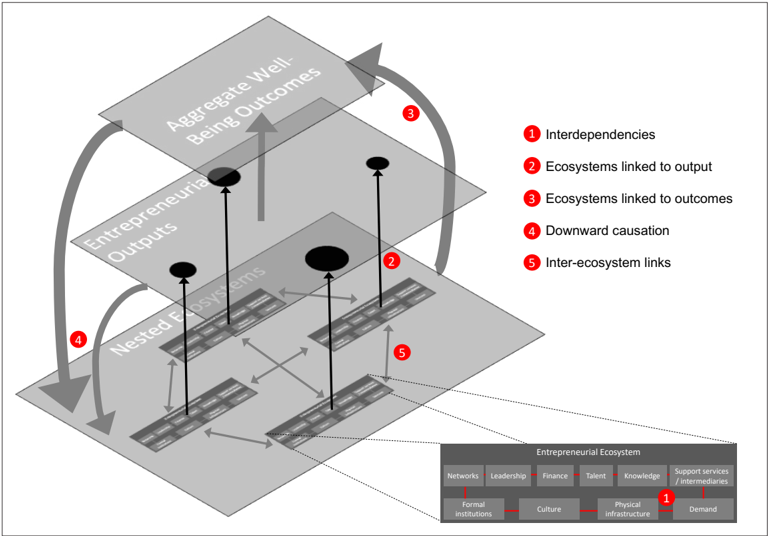
- The review identifies causal mechanisms linking ecosystem elements to outputs and outcomes: intra-layer interdependence among elements, upward causation from elements to outputs/outcomes, downward causation and path dependency/feedback, and inter-ecosystem links.
- Country-level studies link entrepreneurial ecosystems to economic growth and find mature ecosystems enable knowledge spillovers and more efficient resource allocation; regional evidence on whether ecosystems moderate the entrepreneurship–economic growth relationship is mixed, with Bruns et al. (2017) finding no moderating effect and Szerb et al. (2019) finding a positive moderating effect.
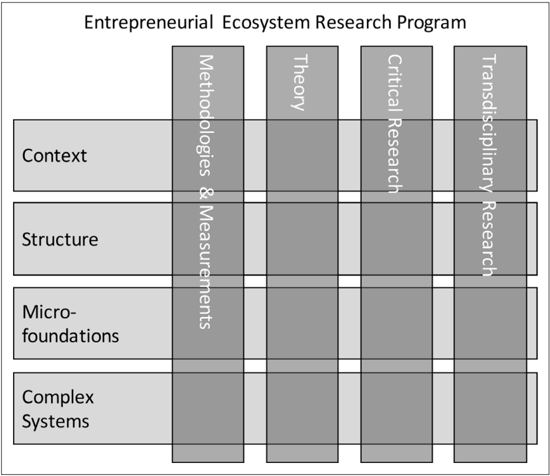
- The paper proposes a transdisciplinary entrepreneurial ecosystem research program with four research streams (context, structure, microfoundations, complex systems) and four cross-sectional themes (methodologies and measurements, theory, critical research, transdisciplinary research).
Methods
- Systematic literature review using Web of Science and Scopus, with topic searches for terms such as “entrep* ecosys*,” “startup ecosys*,” and “sys* of entrep*,” yielding an initial 724 articles.
- The review restricted sources to the top 25% Scimago-ranked journals in relevant business, management, economics, geography, and urban studies subareas, producing an intermediate sample of 183 articles; after in-depth reading and exclusions, 62 empirical articles remained.
- Analysis was guided by the Stam (2015) and Stam and Van de Ven (2019) framework to identify causal mechanisms: intra-layer causation, upward causation, downward causation/feedback, and inter-ecosystem links.
Limitations
- The paper states that ecosystem research is fragmented and heterogeneous, under-theorized, and that mechanisms governing ecosystem evolution are not well understood; much literature uses the ecosystem concept metaphorically without taking interdependence seriously.
- The paper states there is a lack of empirical evidence on path dependency and ecosystem boundaries, and that research is dominated by observational and case-study methods, making causality difficult to infer; it also warns of the ecological fallacy and notes that non-Gaussian distributions are often ignored.
- Evident from the methods: the review is limited to journal articles in top 25% journals, excluding book chapters, conference papers, and non-empirical work, and the final sample of 62 articles may narrow the evidence base.
Model-written summary of a shortened version of the paper’s full text (it is longer than we read). Check it against the paper before relying on it.
Integrity signals
Registry
Cites
Statistics
Figures
Verification
Claims the paper makes
31 Valid · 16 Not valid · 116 Not checked · 37 Own results and interpretations
The cited sources support only part of this claim — read each source’s verdict below.
In the paper
“There is also a subset of studies that focus on a singular innovation project within in a spatial setting, not looking at the aggregate preva -lence of entrepreneurship, nor at the interdependencies in the ecosystem at large (e.g., DiVito & Ingen- Housz, 2019).”
What the sources say
- Partly supportedcites DiVito & Ingen-Housz, 2019 matched to “From individual sustainability orientations to collective sustainability innovation and sustainable entrepreneurial ecosystems” (2021) sourceExperimental — accuracy not yet measured
The Methods section describes a single collaborative innovation project in Amsterdam and says the study does not aim to reveal relationships between variables, supporting the project-level and spatial characterization. But it names the broader ecosystem as a unit of analysis, and the Introduction explicitly says the study examines interdependencies among ecosystem actors. The claim that it does not look at those interdependencies is therefore unsupported. Page numbers are not available in our copy. (LLM, conf=0.88)
plain- Asserted: passes — The authors put it forward as true.
- Checkable: passes — It can be checked against evidence.
- Load-bearing: unclear — It is unclear whether the paper’s conclusions depend on it.
- Based: passes — The paper gives a reason why it holds.
- Partly supported
The cited sources support only part of this claim — read each source’s verdict below.
In the paper
“which are responsible for the bulk of new job creation in devel -oped economies, making it a crucial target for economic development policy ( Brown & Mason, 2017).”
What the sources say
- Partly supportedcites Brown & Mason, 2017 matched to “Looking inside the spiky bits: a critical review and conceptualisation of entrepreneurial ecosystems” (2017) sourceExperimental — accuracy not yet measured
Section 4.1.2, “Blockbuster entrepreneurship” (page unavailable), says that a tiny number of UK firms contribute disproportionately to job creation by high-growth firms. That supports their importance as job creators, but it does not establish that high-growth firms account for the bulk of all new jobs across developed economies. (LLM, conf=0.85)
plainstates a cause- Asserted: passes — The authors put it forward as true.
- Checkable: passes — It can be checked against evidence.
- Load-bearing: unclear — It is unclear whether the paper’s conclusions depend on it.
- Based: passes — The paper gives a reason why it holds.
- Rests on an assumption not shown here.
- Partly supported
Every source the paper cites for this claim was checked and supports it.
In the paper
“An example is the investment in physical infrastructure without supporting the underlying cultural and social support, which turned planned innovation hotspots into empty real estate (Pugh et al., 2018).”
What the sources say
- Supportedcites Pugh et al., 2018 matched to “From ‘Techniums’ to ‘emptiums’: the failure of a flagship innovation policy in Wales” (2018) source
The Discussion and Conclusion says Technium buildings had low occupancy and that firms received little on-site support beyond physical space. The passage labelled Table 4 about here describes a lack of softer support and local networks, with empty space ultimately leased out as the government became a landlord. Together, these support the citing sentence’s paraphrase. (LLM, conf=0.89)
plainstates a cause- Asserted: passes — The authors put it forward as true.
- Checkable: passes — It can be checked against evidence.
- Load-bearing: passes — The paper’s conclusions depend on it.
- Based: passes — The paper gives a reason why it holds.
- Supported
The cited sources support only part of this claim — read each source’s verdict below.
In the paper
“These co- evolutionary dynamics are the result of the interactions of individuals within eco -systems ( Johnson et al., 2019 ; Thompson et al., 2018).”
What the sources say
- Partly supportedcites Johnson et al., 2019 matched to “Entrepreneurial dynamism and the built environment in the evolution of university entrepreneurial ecosystems” (2019) sourceExperimental — accuracy not yet measured
Section 5.1 links the evolution of university-centered entrepreneurial ecosystems to agents’ behavior and their interconnected responses. The Conclusion adds that evolution depends on both those responses and the built environment; the claim broadens this finding to ecosystems generally and leaves out that additional factor. Page numbers are unavailable in our copy. (LLM, conf=0.83)
- Supportedcites Thompson et al., 2018 matched to “How entrepreneurial ecosystems take form: Evidence from social impact initiatives in Seattle” (2018) source
The Discussion (p. 27) states that a field-theory approach considers 'how individuals doing things together contributes to the particular features and dynamics of an ecosystem,' and the Introduction (p. 4) credits endogenous, bottom-up, time-patterned processes driven by micro social interaction, with interactions and shared meanings becoming 'common and mutually reinforcing' across the phase transition (pp. 4, 26). Our copy does not use the term 'co-evolutionary' (searches for it returned only semantic matches), but it substantively treats ecosystem dynamics as the product of actor interactions within the ecosystem, so the paraphrase is carried. The one narrowing worth noting is that the paper bounds this to the early moments of ecosystem formation in its Seattle social-impact setting and pairs interactions with shared meanings rather than interactions alone. (LLM, conf=0.82)
plainstates a cause- Asserted: passes — The authors put it forward as true.
- Checkable: passes — It can be checked against evidence.
- Load-bearing: unclear — It is unclear whether the paper’s conclusions depend on it.
- Based: passes — The paper gives a reason why it holds.
- Partly supported
Every source the paper cites for this claim was checked and supports it.
In the paper
“Ecosystem configurations can vary significantly and new policies/investments should develop support among underlying social and cultural attributes [53] Spigel (2017)”
What the sources say
- Supportedcites Spigel (2017) matched to “The Relational Organization of Entrepreneurial Ecosystems” (2017) source
Section 2.4 states that entrepreneurial ecosystems can have multiple possible configurations. Section 3.1 likewise describes different configurations and relationships among ecosystem attributes, supporting the claim that configurations vary. (LLM, conf=0.92)
plain- Asserted: passes — The authors put it forward as true.
- Checkable: passes — It can be checked against evidence.
- Load-bearing: unclear — It is unclear whether the paper’s conclusions depend on it.
- Based: passes — The paper gives a reason why it holds.
- Supported
81 more claims · 12 with their cited sources checked
Create a free account to see all 200 claims and to verify the 44 references still open.
- Probably not a substantial claim. 82
- It may state two separate claims as one. 52
Self-check
Percentages, sums and reported differences re-computed from the paper’s own numbers.
Each contradiction between two passages listed here was confirmed by an independent check.
Rated minor: it would not touch a result — a value no result rests on, a p-value that stays on the same side of the significance level, or a conflict that is clerical, resolved elsewhere in the paper, or outside its own findings.
In the paper
§ Microfoundations · p. 24
“We must be aware of the ecological fallacy (Robinson, 2009 )”
§ References · p. 47
“- Robinson, W. S. (1950). Ecological correlations and the behavior of individuals.”
Citations
Cites
The Theory of Economic Development
Schumpeter, J., & Backhaus, U. (2006) · The European Heritage in Economics and the Social Sciences · doi:10.1007/0-306-48082-4_3 · Cited by 22,506
Introductory Econometrics: A Modern Approach
Wooldridge, J. M. (1999) · Cited by 14,466
(1993) · Journal of the American Dietetic Association · doi:10.1016/0002-8223(93)92196-5 · Cited by 11,976
Teece, D. J. (1986) · Research Policy · doi:10.1016/0048-7333(86)90027-2 · Cited by 7,842 · cited 1×
“Untraded interdependencies include the complementarities between actors and resources, and information flows which do not entirely correspond to the flows of commodities (Richardson, 1972 ; Teece, 1986 , 1998; Tripsas, 1997).”
Competing Technologies, Increasing Returns, and Lock-In by Historical Events
Arthur, W. B. (1989) · The Economic Journal · doi:10.2307/2234208 · Cited by 7,489 · cited 1×
“The concept of path dependency goes back to the work by David (1988) and Arthur (1989) and “can be used to offer an understanding of why some optional developments are followed, or intention - ally chosen, over others […] path dependence conditions, but does not determine, a specific outcome”…”
Analyzing the Past to Prepare for the Future: Writing a Literature Review
Webster, J., & Watson, R. T. (2002) · MIS Quarterly · doi:10.2307/4132319 · Cited by 7,449 · cited 2×
“In the initial stage, we searched all databases from Web of Science and Scopus for a comprehensive overview of the literature (Frank & Hatak, 2014 ; Martín-Martín et al., 2018 ; Webster & Watson, 2002).”
Teece, D. (1993) · Research Policy · doi:10.1016/0048-7333(93)90063-n · Cited by 7,242
Clusters and the new economics of competition.
Porter, M. E. (1998) · PubMed · Cited by 5,679
Clusters and the New Economics of Competition
Milošević, D. (2014) · Harvard business review · Cited by 4,854
Beyond Markets and States: Polycentric Governance of Complex Economic Systems
Ostrom, E. (2010) · American Economic Review · doi:10.1257/aer.100.3.641 · Cited by 4,529 · cited 2×
“In combination with insights from polynuclear governance (Ostrom, 2010) and multilevel governance (Bache et al.”
Research works printed but not linked: 5
- David, P. A. (1988). Path- dependence: Putting the past into the future of economics . Institute for Mathematical Studies in the Social Sciences Technical Report No. 533: Stanford University Press.
- World Economic Forum. (2014). Entrepreneurial ecosystems around the globe and early- stage company growth dynamics . World Economic Forum.
- Krugman, P. (1991). Geography and trade . MIT Press.
- Marshall, A. (1920). Principles of Economics . (Rev ed.). Macmillan.
- Startup Genome. (2020). The Global Startup Ecosystem Report GSER 2020: The New Normal for the Global Startup Economy and the Impact of COVID-19 . Startup Genome.
Cited by
Items 601–700 of 780
Mukherjee, K., Majumdar, M., & Chattopadhyay, A. (2026) · Journal of economic and administrative sciences. · doi:10.1108/jeas-10-2025-0750
Roundy, P. T., & Akiode, M. (2026) · Revista de Administração de Empresas · doi:10.1108/rae-02-2026-0010 · Cited by 1
Gil, A., Reis, G. G., Gil, E. D. C., & Borini, F. M. (2026) · SSRN Electronic Journal · doi:10.2139/ssrn.6283798
Structuring the Social Entrepreneurship Ecosystem in Colombia
Ramirez, A. R., Fernández, A. M. M. A. A. M., & Fernández, A. M. (2026) · Business, management and economics · doi:10.5772/intechopen.1015386
Do religiosity and financial inclusion influence entrepreneurship development across countries?
Ali, J. (2026) · Quality & Quantity · doi:10.1007/s11135-026-02744-8
“Entrepreneurial ecosystems help create a conducive environment for business formation and can positively impact attitudes towards entrepreneurship, making individuals more likely to consider entrepreneurship a profitable and rewarding career option (Fritsch and Storey 2014; Wurth et al. 2022 ).”
Binuyo, A. O., Nwankwere, I. A., Okoronkwo, G., & Bamidele, A. G. (2023) · Journal of Economics Finance and Management Studies · doi:10.47191/jefms/v6-i6-08
Kashino, T. (2024) · SSRN Electronic Journal · doi:10.2139/ssrn.4883562
Trinidad, J. E. (2026) · American Sociological Review · doi:10.1177/00031224261465023
“…firms— highlight how social networks and entrepreneurial ecosystems provide resources for new ventures (Botelho et al. 2024; Sheares 2025; Wurth et al. 2022), this article demonstrates that the interplay of capital, field, and habitus provides a more profound account of how organizations…”
Grow fast, fail slowly: Un trepreneurial ecosystems and the fast failure paradox
Herzog, S., van Merriënboer, M., Mason, C. M., & Chalmers, D. M. (2026) · International Small Business Journal Researching Entrepreneurship · doi:10.1177/02662426261449741
Management of Innovation Ecosystems Development: Conceptual Aspect
Карсанова, Е. С. (2025) · Humanities and Social Sciences Bulletin of the Financial University · doi:10.26794/2226-7867-2025-15-5-89-97
Connecting Entrepreneurship Education and Entrepreneurship ResearchPreprint
Wiklund, J., Rasmussen, E., Fini, R., & Aaboen, L. (2025) · SSRN Electronic Journal · doi:10.2139/ssrn.5108597
Matt, L. B. M., Fonseca, M. V. D. A., & Fontainha, T. C. (2026) · doi:10.5151/4gkd2026-1101
Human Factors in the Creation and Growth of Entrepreneurship Ecosystems
Vargas-Hernández, J. G., González, F. J. G., Vargas-González, O. C., Castañeda-Burciaga, S., & Guirette-Barbosa, O. A. (2025) · IGI Global eBooks · doi:10.4018/979-8-3693-8171-7.ch003
Fuentes, J. N., Schmutzler, J., & Vázquez, G. C. (2026) · Entrepreneurship Theory and Practice · doi:10.1177/10422587261462834 · Cited by 1
Identifying robust ecosystem identities through scenario-based wind tunneling
Hernández, C. G., & Bas, E. (2026) · Foresight-Russia · doi:10.17323/fstig.2026.32225
Philip, D. (2025) · Emerald Group Publishing Limited eBooks · doi:10.1108/978-1-83608-124-120261003
Balodi, K. C., Kattuman, P. A., Theodoraki, C., & Roshan, R. (2026) · Industrial and Corporate Change · doi:10.1093/icc/dtag014 · Cited by 1
Raharti, R., Andika, A., & Anisah, T. N. (2026) · Economics and Culture · doi:10.2478/jec-2026-0002
“…these foundational perspectives, demonstrating how government intervention and institutional support shape opportunity structures, venture-related perceptions, and individuals’ consideration of entrepreneurial opportunities within local and regional systems (Bamfo et al., 2023; Wurth et al., 2022).”
Schiller, V. (2023) · New Business Models Conference (NBM) · doi:10.26481/mup.2302.06 · Cited by 1
Thomas, E., Faccin, K., Bittencourt, B. A., & Coussi, O. (2024) · De Gruyter eBooks · doi:10.1515/9783111101385-001
An outline of the interplay between female entrepreneurship and entrepreneurial ecosystems
Ungerer, C., Rintsch, H., & Henn, R. (2023) · IEEE International Conference on Engineering, Technology and Innovation (ICE/ITMC) · doi:10.1109/ice/itmc58018.2023.10332285 · Cited by 1
“However, the field is still undertheorized and neither the structure, nor the composition of elements, factors influencing them, or governing mechanisms are understood well yet [1–3].”
BackgroundSilva, J. P. M., Guimarães, L. D. O., Júnior, E. I., & de Carvalho, R. B. (2025) · Cadernos EBAPE BR · doi:10.1590/1679-395120240018 · Cited by 1
Baig, P., Martinez, E. M., Belitski, M., Theodoraki, C., & Godley, A. (2025) · Contributions to management science · doi:10.1007/978-3-031-96169-4_1
Gender and age structure of the Czech entrepreneurial activity: any trend changes?
Dvouletý, O., Bocková, N., & Svobodova, I. (2026) · Journal of Research in Marketing and Entrepreneurship · doi:10.1108/jrme-02-2025-0022
Intenza, M. (2025) · Emerald Group Publishing Limited eBooks · doi:10.1108/978-1-83662-612-120251002
National and Regional Economic Growth and Development Fostered by Entrepreneurship Ecosystems
Vargas-Hernández, J. G. (2024) · Advances in psychology, mental health, and behavioral studies (APMHBS) book series · doi:10.4018/979-8-3693-3673-1.ch015
The Building of Innovative Place: The Start-Ups Center in Wadi Makkah
Albarqawi, W. A. (2024) · Springer eBooks · doi:10.1007/978-3-031-49903-6_34
Hähnlein, J., & Küster, A. (2023) · HMD Praxis der Wirtschaftsinformatik · doi:10.1365/s40702-023-00972-2
“Sie werden in der Forschung und Wissenschaft noch immer viel diskutiert und sind noch nicht abschließend untersucht (Wurth et al. 2021).”
BackgroundVargas-Hernández, J. G., González-Ávila, F. J., & Vargas-González, O. C. (2024) · Advances in human resources management and organizational development book series · doi:10.4018/979-8-3693-7046-9.ch010
Entrepreneurship as a Causal and Mediating Role in Entrepreneurial Ecosystems
Vargas-Hernández, J. G., González-Ávila, F. J., Vargas-González, O. C., & Rodríguez-Maillard, C. A. (2025) · IGI Global eBooks · doi:10.4018/979-8-3693-8694-1.ch013
Terzibaş, A. (2026) · Turkuaz Uluslararası Türk Dünyası Bilimsel Araştırmalar Dergisi · doi:10.54970/turkuaz.1947628
ECOSYSTEM RESEARCH PROGRAM FOCUSING ON QUANTUM TECHNOLOGIES
Shevchuk, D. (2023) · Экономика и предпринимательство · doi:10.34925/eip.2022.149.12.188
Belbouli, A., Touhami, F., Elmoukhtar, M., Mouhtat, I., El-Bir, A., & Ketatni, H. (2026) · Multidisciplinary Science Journal · doi:10.31893/multiscience.2026694
“In particular, the role of structured interaction between SMEs and institutional actors — through which territorial information becomes entrepreneurial opportunities and measurable regional outcomes — requires clearer modeling and stronger empirical validation (Wurth et al., 2022, 2023).”
Dvouletý, O. (2025) · Palgrave studies in entrepreneurship and society. · doi:10.1007/978-3-031-72190-8_9
Handler, N., & Brachert, M. (2026) · Small Business Economics · doi:10.1007/s11187-026-01278-5
Accelerators and acceleration policy in entrepreneurial ecosystems
Khalid, F., & Spigel, B. (2023) · Revue de l’Entrepreneuriat · doi:10.3917/e.entre.hs4.0047 · Cited by 9
Self-citationSaidkulova, F., Narzieva, D., Қахрамановна, Ч. Н., Achilova, F., Jonibekovich, J. J., & Rajabova, M. A. R. M. A. (2026) · Frontiers in Sociology · doi:10.3389/fsoc.2026.1926726
Qi, J., Zhang, W., & White, S. C. (2026) · Research Policy · doi:10.1016/j.respol.2026.105452 · Cited by 2
Alaoui, M. A., Cascant, E., & Dominguez, N. (2026) · Recherches en Sciences de Gestion · doi:10.3917/resg.169.0077
Aoun, C., Bourdin, S., & Retsin, C. (2026) · Revista Internacional del Trabajo · doi:10.16995/ilrs.23814
Phiri, B., Mubanga, M., & Chipeta, E. M. (2026) · Open Journal of Business and Management · doi:10.4236/ojbm.2026.145129
- Retracted
Marra, M., & Celentano, R. M. (2025) · Contributions to economics · doi:10.1007/978-3-031-85814-7_7
Roundy, P. T., & Evans, R. (2025) · Contributions to management science · doi:10.1007/978-3-031-96169-4_13 · Cited by 1
Amoa‐Gyarteng, K. (2026) · Research Square · doi:10.21203/rs.3.rs-10100479/v1
National and Regional Economic Growth and Development Fostered by Entrepreneurship Ecosystems
Vargas-Hernández, J. G., García-Camacho, M. A., González-Ávila, F. J., & Vargas-González, O. C. (2024) · Advances in human resources management and organizational development book series · doi:10.4018/979-8-3693-3530-7.ch008
Beyond Proximity: Multidimensional Analysis of Ecosystem Architecture in the Knowledge Economy
Ito, H., Kitahara, Y., Denscombe, N., & Ando, M. (2026) · Journal of the Knowledge Economy · doi:10.1007/s13132-026-03264-4
“The path from localized learning to global collaboration is mediated by a region’s absorptive capac - ity, governance capabilities, and access to enabling institutions such as universities and public research organizations (Asheim et al., 2011 ; Wurth et al., 2022 ).”
Reflection on Student Entrepreneurs’ Intention-Action Gap from Embeddedness Perspective
Harima, A. (2023) · Revue de l’Entrepreneuriat · doi:10.3917/entre.221.0024 · Cited by 3
Vedana, D., & Andreassi, T. (2025) · Revista de Administração de Empresas · doi:10.1590/s0034-759020250302x · Cited by 2
Podjetništvo med potencialom in razvojnimi ambicijami: GEM Slovenija 2025
Širec, K., Tominc, P., Hojnik, B. B., Rus, M., & Crnogaj, K. (2026) · doi:10.18690/um.epf.4.2026 · Cited by 5
Unravelling the Dynamics of Performance Orientation: Literature Review and Conceptual Refinement
Procházková, L., Lašáková, A., & Anand, A. (2025) · Emerald Group Publishing Limited eBooks · doi:10.1108/s2754-58652025000004a003
Peningkatan Partisipasi Guru Pada Pendidikan Dasar Melalui Sertifikasi Guru
Judijanto, L., Reza, H. K., & Susanti, M. (2024) · Journal on Education · doi:10.31004/joe.v6i4.5742
“Program ini penting untuk mengakreditasi pendidik agar diakui profesionalismenya oleh negara dan memberikan tambahan dana untuk memenuhi kebutuhan keluarga yang menunjang profesi guru (kesejahteraan ekonomi) (Wurth et al., 2022; Pramono, 2020).”
BackgroundRoles for City Governments in Entrepreneurial Ecosystems: An Initial Exploration
Harper-Anderson, E. L., O'Hollaren, K., & Gates, S. M. (2023) · RAND Corporation eBooks · doi:10.7249/rra1141-1 · Cited by 4
Equity-Centered Innovation Ecosystems
Brown, S. (2026) · IGI Global eBooks · doi:10.4018/979-8-3373-6355-4.ch001
Narcos, Inc.: drug cartels and the architecture of entrepreneurial ecosystems
Moeller, A., & Hunter, S. (2026) · Trends in Organized Crime · doi:10.1007/s12117-026-09591-x
Process research in entrepreneurial ecosystems: Reviewing the past and preparing the futurePreprint
Toepler, F., Theodoraki, C., & Velamuri, V. K. (2026) · SSRN Electronic Journal · doi:10.2139/ssrn.6467492
Stuetzer, M., Wyrwich, M., Brodeur, A., Obschonka, M., Audretsch, D. B., Rentfrow, P. J., Potter, J., & Gosling, S. D. (2026) · Journal of Business Venturing · doi:10.1016/j.jbusvent.2026.106626
Heinze, W., & Ormiston, J. (2026) · International Journal of Management Reviews · doi:10.1111/ijmr.70031 · Cited by 2
Yu, X., 林仁芳, Ma, X., Wang, D., Chen, K., & Ren, Z. (2026) · Asian Journal of Technology Innovation · doi:10.1080/19761597.2026.2687077
A structural and processual approach to entrepreneurial ecosystems : the case of Lyon area
Chalus-Sauvannet, M.-C., & Guéneau, G. (2025) · Management & Prospective · doi:10.3917/e.g2000.411.0035
Entrepreneurship and Productivity Growth: Role of Corporations in Entrepreneurial EcosystemsPreprint
Moon, S. (2024) · SSRN Electronic Journal · doi:10.2139/ssrn.4751296
Business Model Innovation and Business Ecosystem Innovation for the Sustainable Energy Transition
Dehkordi, R., Ahokangas, P., Sorvisto, M., & Mohammadian, M. (2026) · Springer eBooks · doi:10.1007/978-3-032-14717-2_3
Entrepreneurial ecosystems in cider production: stakeholder composition and relationships
Leirdal, E. K. N., & Kwiatkowski, G. (2026) · European Business Review · doi:10.1108/ebr-02-2026-0047
Ecosystem simulation: the software to platform leap
Liu, Z. H., Cui, Y., Zhang, Y., Li, Z., Liu, X., & Wang, S. (2026) · Scientific Reports · doi:10.1038/s41598-026-54641-7
“Contemporary definitions emphasize the collaboration among interconnected actors to enhance efficiency, create shared value, and shape the ecosystem’s trajectory 36,38,39 .”
Brunner, P., & Schaeffer, V. (2026) · Entrepreneurship and Regional Development · doi:10.1080/08985626.2026.2716115
Sarfo, C. A., Owusu, J., Caputo, A., & Kan, K. A. S. (2026) · Entrepreneurship and Regional Development · doi:10.1080/08985626.2026.2737183
Prokop, D. (2025) · Contributions to management science · doi:10.1007/978-3-031-96169-4_2 · Cited by 1
Learning to grow in entrepreneurial ecosystems
Spigel, B. (2026) · Small Business Economics · doi:10.1007/s11187-026-01252-1 · Cited by 1
Self-citationDeng, P., Tan, R. S.-E., Jiang, J., Wan, P. M., Ng, M., Arokiasamy, A. R. A., & Gao, D. (2026) · Discover Sustainability · doi:10.1007/s43621-026-02885-8 · Cited by 1
Unicorns: From Silicon Valley to a Global Phenomenon?
Vogelaar, J. J., & Stam, E. (2025) · Cambridge University Press eBooks · doi:10.1017/9781009469210.003 · Cited by 3
Self-citationShin, H., Yoon, H., & Park, J. (2026) · Asia Pacific Journal of Tourism Research · doi:10.1080/10941665.2026.2718384
139Rural Everyday Entrepreneurial Ecosystems and Higher Education
Jacobson, D. D. (2025) · De Gruyter eBooks · doi:10.1515/9783110791396-008
Ideas in communities: a micro-perspective on entrepreneurial ecosystems.
Muhammad, M. (2022) · ThinkIR: The University of Louisville's Institutional Repository (University of Louisville) · doi:10.18297/etd/4000
Yoruk, E., Paramba, J. N., Jones, P. K., & Salamzadeh, A. (2026) · Journal of Small Business Management · doi:10.1080/00472778.2026.2645919 · Cited by 4
ТРАНСФОРМАЦІЯ СТАРТАП-ЕКОСИСТЕМИ УКРАЇНИ В УМОВАХ ВІЙНИ: ВИКЛИКИ, ТЕНДЕНЦІЇ ТА ПЕРСПЕКТИВИ РОЗВИТКУ
Кубатко, О., Вороненко, В., Чорток, Ю., Півень, В., & Барсук, В. (2026) · Mechanism of an economic regulation · doi:10.32782/mer.2026.109.5
Intellectual structure of entrepreneurial ecosystem research: a bibliometric and thematic review
Pul, R., Kurmi, O., Mog, R. K., & Gayan, M. A. (2026) · Global Knowledge, Memory and Communication · doi:10.1108/gkmc-10-2025-0785
How to Measure the Performance of Entrepreneurial Ecosystems: A Systematic Literature Review
Chaves-Ladino, R., & Hernández, C. N. J. (2025) · F1000Research · doi:10.12688/f1000research.172389.1
Banc, C. (2022) · theses.fr (ABES) · doi:10.70675/0237b2c9zf958z46abza03fz0213c11e4f26 · Cited by 2
From spillovers to recursive coupling: The development of rural entrepreneurial ecosystems over time
Frimanslund, T. (2026) · Journal of Rural Studies · doi:10.1016/j.jrurstud.2026.104422 · Cited by 1
Towards a Theory of Ecosystem Catalyst
Savaget, P., & Pitsis, T. S. (2022) · Academy of Management Proceedings · doi:10.5465/ambpp.2022.11146abstract
Dual-sided evolution: the Seoul ICT entrepreneurial ecosystem case
Cho, D. S., Bae, J., & Pickernell, D. G. (2026) · Entrepreneurship and Regional Development · doi:10.1080/08985626.2026.2698646
Mise en place: rural entrepreneurship and the role of the community
Boudreaux, C. J., & Mazzoni, J. F. R. (2026) · Small Business Economics · doi:10.1007/s11187-025-01172-6
“The Silicon Valley Model (SVM) emphasizes growth and innovation through technology, funding, and new ideas, which are key elements of a successful entrepreneurial environment (Spigel, 2017; Audretsch, 2021; Wurth et al., 2022).”
Collaborative Work Spaces, Diversity, and Regional Entrepreneurship Growth: A Conceptual Review
Waters-Lynch, J., & Tavassoli, S. (2025) · Oxford University Press eBooks · doi:10.1093/oxfordhb/9780198866190.013.0015
Conceptual and Theoretical Foundations of Technology Entrepreneurship
Kumar, D., Bhaskar, R. A., & Sekhar, C. (2026) · Springer eBooks · doi:10.1007/978-981-95-7441-4_1
Buarque, B., Câmara, S. F., Oukes, T., & Júnior, E. P. L. (2025) · Revista de Administração de Empresas · doi:10.1590/s0034-759020250309x · Cited by 4
Entrepreneurship Ecosystem Decision: Policy Making and Strategic Framework
Vargas-Hernández, J. G., González-Ávila, F. J., & Vargas-González, O. C. (2024) · Advances in business strategy and competitive advantage book series · doi:10.4018/979-8-3693-7903-5.ch010
Oteng, R., & Armah, A. (2026) · International Journal of Latest Technology in Engineering Management & Applied Science · doi:10.51583/ijltemas.2026.150600151
73Chapter 6 Clusters of Innovation (COI) in Emerging Markets: Overview and Brazilian Cases
Feferman, F. (2026) · De Gruyter eBooks · doi:10.1515/9783111630120-006
Passavanti, C., Primario, S., & Rippa, P. (2026) · Lecture notes in networks and systems · doi:10.1007/978-3-032-23684-5_16
Transitional Everyday Entrepreneurs and their Enabling and Constraining Entrepreneurial Ecosystems
Jacobson, D. D. (2025) · Contributions to management science · doi:10.1007/978-3-031-96169-4_12 · Cited by 1
Brunner, P. (2021) · theses.fr (ABES) · doi:10.70675/d5ac5f40z7ee6z4d2bz820czc8e98e2e120c · Cited by 4
(2024) · Review of International Comparative Management · doi:10.24818/rmci.2024.2.372
Khan, S., & Raj, S. J. (2026) · SSRN Electronic Journal · doi:10.2139/ssrn.7071891
The role of entrepreneurial support organisations in ecosystem sustainable transitions
Cloitre, A., Paulino, V. D. S., & Theodoraki, C. (2026) · Industry and Innovation · doi:10.1080/13662716.2026.2683378 · Cited by 1
Frugal AI and entrepreneurial decision-making in India
Chanda, R. S., Paliwal, M., Pund, R., & Agarwal, A. (2026) · Discover Sustainability · doi:10.1007/s43621-026-03904-4
“Understanding the institutional, social, and geographic factors affecting innovation [90, 91] and entrepreneurship in general [92] has advanced.”
Power Plays: Surfacing the Hidden Currents In Entrepreneurial EcosystemsPreprint
Terstriep, J., David, A., Zaghow, L. R., et al. (2025) · SSRN Electronic Journal · doi:10.2139/ssrn.5401095
Belitski, M., & Grigore, A.-M. (2025) · Springer eBooks · doi:10.1007/978-981-96-0112-7_10
Poli, S., Villani, E., & Grimaldi, R. (2026) · SSRN Electronic Journal · doi:10.2139/ssrn.6504755
Metadata
- Authors
- Wurth, B., Stam, E., & Spigel, B.
- Affiliations
- University of Strathclyde (GB)
- Utrecht University (NL)
- University of Edinburgh (GB)
- Corresponding author
- Wurth, Bernd
- Venue
- Entrepreneurship Theory and Practice
- Publisher
- SAGE Publications
- Published
- 2021-03-22
- Volume
- 46
- Issue
- 3
- Pages
- 729-778
- ISSN
- 1042-2587 (ISSN-L)
- 1540-6520
- OpenAlex
- W3128170268
- Cited by
- 789
- References
- 238
- Citations by year
- 2026: 181 · 2025: 190 · 2024: 159 · 2023: 132 · 2022: 92 · 2021: 35
- FWCI
- 89.59
- Type
- journal article
- Language
- en
- Open access
- hybrid
- doi.org
- Locations
- Entrepreneurship Theory and Practice (publishedVersion, cc-by)
- ENLIGHTEN (Jurnal Bimbingan dan Konseling Islam) (acceptedVersion, cc-by-sa)
- Strathprints: The University of Strathclyde institutional repository (University of Strathclyde) (submittedVersion)
- RePEc: Research Papers in Economics (submittedVersion)
- Utrecht University Repository (Utrecht University) (submittedVersion, other-oa)
- Edinburgh Research Explorer (University of Edinburgh) (submittedVersion, cc-by)
- Funders
- Universiteit Utrecht
- Topics
- Social Sciences › Business, Management and Accounting › Management of Technology and Innovation › Entrepreneurship Studies and Influences
- Social Sciences › Business, Management and Accounting › Management of Technology and Innovation › University-Industry-Government Innovation Models
- Social Sciences › Business, Management and Accounting › Strategy and Management › Innovation and Knowledge Management
- Keywords
- entrepreneurial ecosystems, ecosystem evolution, causal mechanisms, transdisciplinary research, entrepreneurship research agenda, ecosystem theory
About these checks
Registry, retraction, Cites and statistics results are computed, not judged, with one exception: a printed reference that no index lists is read once by a model before it counts as a citation error. Claims are extracted by a model and kept only when their quote appears verbatim in the text; each cited source is then checked, with a model’s help, for whether it says what the claim relies on. Those verdicts can be wrong — read the claim’s quote and the cited source before relying on one.
The claim verdicts this report counts are experimental: their accuracy is not yet measured.
A language model drew the claims from the paper on 2026-10-29, under version 3 of the claim definition (model deepseek-v4.1-flash, prompt extract-v3).
A second model labelled each claim on 2026-10-29 (model jev-1.13-20260917, definition revision gold-guideline-v0.2).
Cited sources are checked with a language model’s help (gpt-6-sol and qwen3.8-omni-flash).
Statistics and arithmetic are recomputed, not judged.
Confidence bands are shown only for fields calibrated on our annotated test set. None is calibrated yet, so no band is shown.
What counts as a claim ›How we measure confidence ›How we check this ›
Are you an author, or do you see a problem with this page? Request a review
Data sources
Bibliographic data: Semantic Scholar, OpenAlex, Crossref.
Contains information from the Semantic Scholar Academic Graph Datasets, made available under the ODC Attribution License (ODC-BY 1.0).
Semantic Scholar’s data is described in: Kinney, R., et al. (2023). The Semantic Scholar Open Data Platform. arXiv:2301.10140.
