

Toward an Entrepreneurial Ecosystem Research Program
Open accessThe DOI matches its Crossref record; 252 of the 252 references it cites were found in a registry or an index; 36 of the 199 sources its claims cite were checked for support.
Abstract
Entrepreneurial ecosystems have become a prominent concept, yet in its current state, the concept itself represents a paradox. While it draws on a rich intellectual history and provides an opportunity to synthesize different strands of research, it is also under-theorized and the mechanisms that govern ecosystem evolution are not well understood. This paper takes stock of recent advancements in ecosystem scholarship and synthesizes the empirical reality of the causal mechanisms. We use these dynamics to position ecosystems in a broader context, within and beyond the domain of entrepreneurship research, and propose a transdisciplinary research program for ecosystem research and practice.
Overview
CoChat Summary
TL;DR
This paper reviews entrepreneurial ecosystem scholarship and argues the concept remains under-theorized, with the mechanisms governing ecosystem evolution not well understood. It synthesizes empirical causal mechanisms and proposes a transdisciplinary research program organized around context, structure, microfoundations, and complex systems.
Key findings
- The systematic review’s final sample contains 62 empirical articles; the initial search yielded 724 articles, reduced to an intermediate sample of 183, with 44 papers studying ecosystems at the city or regional level and 18 at the national level.
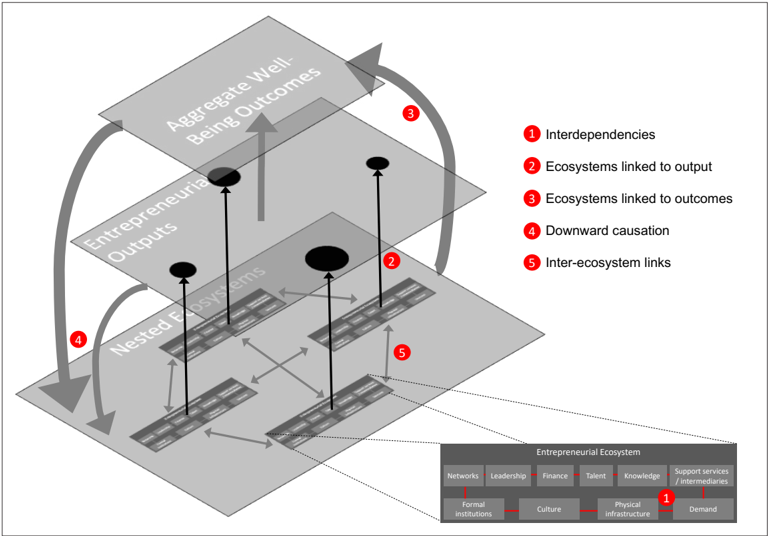
- The review identifies causal mechanisms linking ecosystem elements to outputs and outcomes: intra-layer interdependence among elements, upward causation from elements to outputs/outcomes, downward causation and path dependency/feedback, and inter-ecosystem links.
- Country-level studies link entrepreneurial ecosystems to economic growth and find mature ecosystems enable knowledge spillovers and more efficient resource allocation; regional evidence on whether ecosystems moderate the entrepreneurship–economic growth relationship is mixed, with Bruns et al. (2017) finding no moderating effect and Szerb et al. (2019) finding a positive moderating effect.
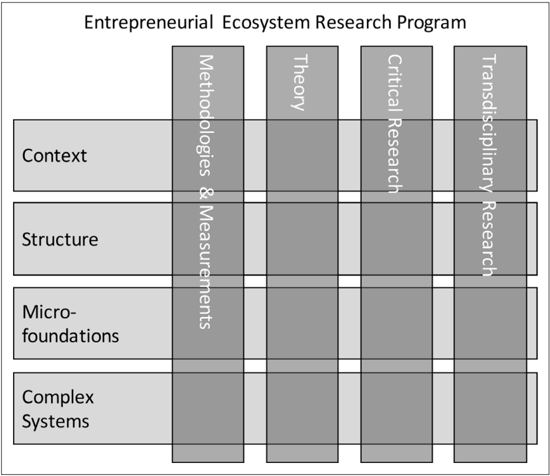
- The paper proposes a transdisciplinary entrepreneurial ecosystem research program with four research streams (context, structure, microfoundations, complex systems) and four cross-sectional themes (methodologies and measurements, theory, critical research, transdisciplinary research).
Methods
- Systematic literature review using Web of Science and Scopus, with topic searches for terms such as “entrep* ecosys*,” “startup ecosys*,” and “sys* of entrep*,” yielding an initial 724 articles.
- The review restricted sources to the top 25% Scimago-ranked journals in relevant business, management, economics, geography, and urban studies subareas, producing an intermediate sample of 183 articles; after in-depth reading and exclusions, 62 empirical articles remained.
- Analysis was guided by the Stam (2015) and Stam and Van de Ven (2019) framework to identify causal mechanisms: intra-layer causation, upward causation, downward causation/feedback, and inter-ecosystem links.
Limitations
- The paper states that ecosystem research is fragmented and heterogeneous, under-theorized, and that mechanisms governing ecosystem evolution are not well understood; much literature uses the ecosystem concept metaphorically without taking interdependence seriously.
- The paper states there is a lack of empirical evidence on path dependency and ecosystem boundaries, and that research is dominated by observational and case-study methods, making causality difficult to infer; it also warns of the ecological fallacy and notes that non-Gaussian distributions are often ignored.
- Evident from the methods: the review is limited to journal articles in top 25% journals, excluding book chapters, conference papers, and non-empirical work, and the final sample of 62 articles may narrow the evidence base.
Model-written summary of a shortened version of the paper’s full text (it is longer than we read). Check it against the paper before relying on it.
Integrity signals
Registry
Cites
Statistics
Figures
Verification
Claims the paper makes
31 Valid · 16 Not valid · 116 Not checked · 37 Own results and interpretations
The cited sources support only part of this claim — read each source’s verdict below.
In the paper
“There is also a subset of studies that focus on a singular innovation project within in a spatial setting, not looking at the aggregate preva -lence of entrepreneurship, nor at the interdependencies in the ecosystem at large (e.g., DiVito & Ingen- Housz, 2019).”
What the sources say
- Partly supportedcites DiVito & Ingen-Housz, 2019 matched to “From individual sustainability orientations to collective sustainability innovation and sustainable entrepreneurial ecosystems” (2021) sourceExperimental — accuracy not yet measured
The Methods section describes a single collaborative innovation project in Amsterdam and says the study does not aim to reveal relationships between variables, supporting the project-level and spatial characterization. But it names the broader ecosystem as a unit of analysis, and the Introduction explicitly says the study examines interdependencies among ecosystem actors. The claim that it does not look at those interdependencies is therefore unsupported. Page numbers are not available in our copy. (LLM, conf=0.88)
plain- Asserted: passes — The authors put it forward as true.
- Checkable: passes — It can be checked against evidence.
- Load-bearing: unclear — It is unclear whether the paper’s conclusions depend on it.
- Based: passes — The paper gives a reason why it holds.
- Partly supported
The cited sources support only part of this claim — read each source’s verdict below.
In the paper
“which are responsible for the bulk of new job creation in devel -oped economies, making it a crucial target for economic development policy ( Brown & Mason, 2017).”
What the sources say
- Partly supportedcites Brown & Mason, 2017 matched to “Looking inside the spiky bits: a critical review and conceptualisation of entrepreneurial ecosystems” (2017) sourceExperimental — accuracy not yet measured
Section 4.1.2, “Blockbuster entrepreneurship” (page unavailable), says that a tiny number of UK firms contribute disproportionately to job creation by high-growth firms. That supports their importance as job creators, but it does not establish that high-growth firms account for the bulk of all new jobs across developed economies. (LLM, conf=0.85)
plainstates a cause- Asserted: passes — The authors put it forward as true.
- Checkable: passes — It can be checked against evidence.
- Load-bearing: unclear — It is unclear whether the paper’s conclusions depend on it.
- Based: passes — The paper gives a reason why it holds.
- Rests on an assumption not shown here.
- Partly supported
Every source the paper cites for this claim was checked and supports it.
In the paper
“An example is the investment in physical infrastructure without supporting the underlying cultural and social support, which turned planned innovation hotspots into empty real estate (Pugh et al., 2018).”
What the sources say
- Supportedcites Pugh et al., 2018 matched to “From ‘Techniums’ to ‘emptiums’: the failure of a flagship innovation policy in Wales” (2018) source
The Discussion and Conclusion says Technium buildings had low occupancy and that firms received little on-site support beyond physical space. The passage labelled Table 4 about here describes a lack of softer support and local networks, with empty space ultimately leased out as the government became a landlord. Together, these support the citing sentence’s paraphrase. (LLM, conf=0.89)
plainstates a cause- Asserted: passes — The authors put it forward as true.
- Checkable: passes — It can be checked against evidence.
- Load-bearing: passes — The paper’s conclusions depend on it.
- Based: passes — The paper gives a reason why it holds.
- Supported
The cited sources support only part of this claim — read each source’s verdict below.
In the paper
“These co- evolutionary dynamics are the result of the interactions of individuals within eco -systems ( Johnson et al., 2019 ; Thompson et al., 2018).”
What the sources say
- Partly supportedcites Johnson et al., 2019 matched to “Entrepreneurial dynamism and the built environment in the evolution of university entrepreneurial ecosystems” (2019) sourceExperimental — accuracy not yet measured
Section 5.1 links the evolution of university-centered entrepreneurial ecosystems to agents’ behavior and their interconnected responses. The Conclusion adds that evolution depends on both those responses and the built environment; the claim broadens this finding to ecosystems generally and leaves out that additional factor. Page numbers are unavailable in our copy. (LLM, conf=0.83)
- Supportedcites Thompson et al., 2018 matched to “How entrepreneurial ecosystems take form: Evidence from social impact initiatives in Seattle” (2018) source
The Discussion (p. 27) states that a field-theory approach considers 'how individuals doing things together contributes to the particular features and dynamics of an ecosystem,' and the Introduction (p. 4) credits endogenous, bottom-up, time-patterned processes driven by micro social interaction, with interactions and shared meanings becoming 'common and mutually reinforcing' across the phase transition (pp. 4, 26). Our copy does not use the term 'co-evolutionary' (searches for it returned only semantic matches), but it substantively treats ecosystem dynamics as the product of actor interactions within the ecosystem, so the paraphrase is carried. The one narrowing worth noting is that the paper bounds this to the early moments of ecosystem formation in its Seattle social-impact setting and pairs interactions with shared meanings rather than interactions alone. (LLM, conf=0.82)
plainstates a cause- Asserted: passes — The authors put it forward as true.
- Checkable: passes — It can be checked against evidence.
- Load-bearing: unclear — It is unclear whether the paper’s conclusions depend on it.
- Based: passes — The paper gives a reason why it holds.
- Partly supported
Every source the paper cites for this claim was checked and supports it.
In the paper
“Ecosystem configurations can vary significantly and new policies/investments should develop support among underlying social and cultural attributes [53] Spigel (2017)”
What the sources say
- Supportedcites Spigel (2017) matched to “The Relational Organization of Entrepreneurial Ecosystems” (2017) source
Section 2.4 states that entrepreneurial ecosystems can have multiple possible configurations. Section 3.1 likewise describes different configurations and relationships among ecosystem attributes, supporting the claim that configurations vary. (LLM, conf=0.92)
plain- Asserted: passes — The authors put it forward as true.
- Checkable: passes — It can be checked against evidence.
- Load-bearing: unclear — It is unclear whether the paper’s conclusions depend on it.
- Based: passes — The paper gives a reason why it holds.
- Supported
81 more claims · 12 with their cited sources checked
Create a free account to see all 200 claims and to verify the 44 references still open.
- Probably not a substantial claim. 82
- It may state two separate claims as one. 52
Self-check
Percentages, sums and reported differences re-computed from the paper’s own numbers.
Each contradiction between two passages listed here was confirmed by an independent check.
Rated minor: it would not touch a result — a value no result rests on, a p-value that stays on the same side of the significance level, or a conflict that is clerical, resolved elsewhere in the paper, or outside its own findings.
In the paper
§ Microfoundations · p. 24
“We must be aware of the ecological fallacy (Robinson, 2009 )”
§ References · p. 47
“- Robinson, W. S. (1950). Ecological correlations and the behavior of individuals.”
Citations
Cites
The Theory of Economic Development
Schumpeter, J., & Backhaus, U. (2006) · The European Heritage in Economics and the Social Sciences · doi:10.1007/0-306-48082-4_3 · Cited by 22,506
Introductory Econometrics: A Modern Approach
Wooldridge, J. M. (1999) · Cited by 14,466
(1993) · Journal of the American Dietetic Association · doi:10.1016/0002-8223(93)92196-5 · Cited by 11,976
Teece, D. J. (1986) · Research Policy · doi:10.1016/0048-7333(86)90027-2 · Cited by 7,842 · cited 1×
“Untraded interdependencies include the complementarities between actors and resources, and information flows which do not entirely correspond to the flows of commodities (Richardson, 1972 ; Teece, 1986 , 1998; Tripsas, 1997).”
Competing Technologies, Increasing Returns, and Lock-In by Historical Events
Arthur, W. B. (1989) · The Economic Journal · doi:10.2307/2234208 · Cited by 7,489 · cited 1×
“The concept of path dependency goes back to the work by David (1988) and Arthur (1989) and “can be used to offer an understanding of why some optional developments are followed, or intention - ally chosen, over others […] path dependence conditions, but does not determine, a specific outcome”…”
Analyzing the Past to Prepare for the Future: Writing a Literature Review
Webster, J., & Watson, R. T. (2002) · MIS Quarterly · doi:10.2307/4132319 · Cited by 7,449 · cited 2×
“In the initial stage, we searched all databases from Web of Science and Scopus for a comprehensive overview of the literature (Frank & Hatak, 2014 ; Martín-Martín et al., 2018 ; Webster & Watson, 2002).”
Teece, D. (1993) · Research Policy · doi:10.1016/0048-7333(93)90063-n · Cited by 7,242
Clusters and the new economics of competition.
Porter, M. E. (1998) · PubMed · Cited by 5,679
Clusters and the New Economics of Competition
Milošević, D. (2014) · Harvard business review · Cited by 4,854
Beyond Markets and States: Polycentric Governance of Complex Economic Systems
Ostrom, E. (2010) · American Economic Review · doi:10.1257/aer.100.3.641 · Cited by 4,529 · cited 2×
“In combination with insights from polynuclear governance (Ostrom, 2010) and multilevel governance (Bache et al.”
Research works printed but not linked: 5
- David, P. A. (1988). Path- dependence: Putting the past into the future of economics . Institute for Mathematical Studies in the Social Sciences Technical Report No. 533: Stanford University Press.
- World Economic Forum. (2014). Entrepreneurial ecosystems around the globe and early- stage company growth dynamics . World Economic Forum.
- Krugman, P. (1991). Geography and trade . MIT Press.
- Marshall, A. (1920). Principles of Economics . (Rev ed.). Macmillan.
- Startup Genome. (2020). The Global Startup Ecosystem Report GSER 2020: The New Normal for the Global Startup Economy and the Impact of COVID-19 . Startup Genome.
Cited by
Items 701–780 of 780
Into the Wild: Advancing Ecocentric Entrepreneurship Through Natural Non-Human Actors
Yang, M., & Johnson, M. (2026) · Entrepreneurship Theory and Practice · doi:10.1177/10422587261447791 · Cited by 1
“It emphasizes the interdependence of human actors in fostering entrepreneurship in a geographical territory (Wurth et al., 2022).”
Boas, M. C. D. S. V., Guimarães, Í. J. B., Ouro‐Salim, O., Nacife, J. M., de Freitas, T. M., & Silva, J. S. (2026) · Administrative Sciences · doi:10.3390/admsci16080354
“However, recent ecosystem studies have questioned the assumption that collaboration automatically produces stronger or more distributed innovation outcomes (Autio et al., 2014; Stam & Van de Ven, 2021; Wurth et al., 2022).”
Stroila, I., Tornow, H. I., & Tzanakou, C. (2026) · Entrepreneurship and Regional Development · doi:10.1080/08985626.2026.2690051 · Cited by 1
Koch, L. L., Pletsch, A. L. B., Tonial, G., Begnini, S., & Julkovski, D. J. (2026) · Asia Pacific Journal of Innovation and Entrepreneurship · doi:10.1108/apjie-09-2024-0193
Configuration of factors influencing the formation of rural entrepreneurship ecosystems in Iran
Karimi, A., Hosseini, S., & Dehyouri, S. (2026) · The Journal of Agricultural Education and Extension · doi:10.1080/1389224x.2026.2629391
Startups in entrepreneurial ecosystems – a case study of the metropolitan area of Porto
Matos, M. E. O., Gomes, F., & Almeida, F. (2026) · European Planning Studies · doi:10.1080/09654313.2026.2674049
Mancuso, I., Petruzzelli, A. M., Panniello, U., & Giudice, M. D. (2026) · Creativity and Innovation Management · doi:10.1111/caim.70063
Brown, A. R., Wood, M. S., Williams, D. W., & Cuervo, E. (2026) · Journal of Business Research · doi:10.1016/j.jbusres.2026.116378
Contingent Governance and Sustainability in Medellín’s Entrepreneurship and Innovation Ecosystem
Mesa, J. P. R., Vargas, F. J. A., Escalante, J. C., & Betancur, J. E. H. (2026) · Revista Venezolana de Gerencia · doi:10.52080/rvgluz.31.115.9
What Can Participant Observations Tell Us About Rural Entrepreneurship?
Giazitzoglu, A., & Bosworth, G. (2025) · Emerald Group Publishing Limited eBooks · doi:10.1108/s2040-724620250000020002
Honig, B. (2024) · Human Resource Management Journal · doi:10.1111/1748-8583.12576
Roundy, P. T. (2025) · Team Performance Management · doi:10.1108/tpm-01-2025-0004
The entrepreneurship triangle: a novel approach to explain national differences in entrepreneurship
Buckley, P. J., Dau, L. A., & Munjal, S. (2025) · Journal of International Business Policy · doi:10.1057/s42214-025-00222-w · Cited by 1
ECONOMIC MODELING OF ENTREPRENEURSHIP ECOSYSTEM DEVELOPMENT IN TERRITORIAL COMMUNITIES
Жидик, Я. О. (2025) · Економіка та суспільство · doi:10.32782/2524-0072/2025-82-89 · Cited by 1
Tetteh, E. N. A. (2023) · Advances in information quality and management · doi:10.4018/978-1-6684-7366-5.ch071 · Cited by 2
Martínez, M. S. C., Picazo, M. T. M., & Martín, M. Á. G. (2026) · Future Business Journal · doi:10.1186/s43093-026-01008-z
Hariharan, R., & Selvakumar, K. (2026) · SHS Web of Conferences · doi:10.1051/shsconf/202623703002
“The field has over the years shifted to become a central area of study as opposed to being a niche domain due to the increase in its relevance when dealing with matters related to poverty, inequality and environmental degradation(Wurth et al., 2021).”
Do entrepreneurship ecosystems help senior new ventures?
Amorós, J. E., Leporati, M., Marín, A. J. T., & Roses, S. (2026) · Cogent Business & Management · doi:10.1080/23311975.2026.2723572
Critical Realism as a Framework for Engaged Entrepreneurial Ecosystem Research
Johnson, S. (2023) · Emerald Group Publishing Limited eBooks · doi:10.1108/s2040-724620230000017004
Structural, Configurational, Relational, and Instrumental Dimensions of Entrepreneurship Ecosystems
Vargas-Hernández, J. G., González-Ávila, F. J., & Vargas-González, O. C. (2025) · IGI Global eBooks · doi:10.4018/979-8-3693-7515-0.ch014
Essays on the Political Economy of Innovative Startups
Seng, J. Y. (2023) · OpenArchive@CBS (Copenhagen Business School) · doi:10.22439/phd.42.2023
Cantoni, R., Alterskye, A., Hernández-Vivanco, A., Xifré, R., & Calero, M. (2025) · Energy Research & Social Science · doi:10.1016/j.erss.2025.104479
Bejjani-Cazaré, M., Göcke, L., & Menter, M. (2025) · Journal of Intellectual Capital · doi:10.1108/jic-11-2024-0368
"KNOWLEDGE-RELATED RESOURCEFULNESS FOR GROWTH IN WEAK ENTREPRENEURIALPreprint
Rawhouser, H., Sutter, C., Holzaepfel, N., Conger, M., & Newbert, S. (2024) · Social Science Research Network · doi:10.2139/ssrn.4878664
From personal to organisational addressability: swift trust in early-stage Romanian ICT ventures
Clipa, A. M., Brezovec, E., Danileț, M., & Clipa, C.-I. (2026) · Kybernetes · doi:10.1108/k-05-2026-1374
Micol, F., Leendertse, J., & van Rijnsoever, F. J. (2026) · The Journal of Technology Transfer · doi:10.1007/s10961-026-10327-w · Cited by 5
Zhu, Z. (2026) · Journal of Business Venturing Insights · doi:10.2139/ssrn.6845713
A structural and processual approach to entrepreneurial ecosystems : the case of Lyon area
Sauvannet, M.-C. C., & Gueneau, G. (2025) · Management & Prospective · doi:10.3917/g2000.411.0013 · Cited by 1
Do entrepreneurial ecosystems improve social progress beyond economic development?
Belfanti, F., Riva, M., & Alberti, F. G. (2026) · Competitiveness Review An International Business Journal incorporating Journal of Global Competitiveness · doi:10.1108/cr-01-2026-0067
The Microfoundations of Resilience in Entrepreneurial Ecosystems A Complex Adaptive Systems ApproachPreprint
Napoli, P. H., Fischer, B. B., de Morais, G. H. S. M., & Roundy, P. T. (2026) · SSRN Electronic Journal · doi:10.2139/ssrn.6278348
Of mice, cats, and underdogs: a soft power-based view of the entrepreneurial firm
Audretsch, D. B., & Fiedler, A. (2026) · Journal of Business Research · doi:10.1016/j.jbusres.2026.116415
Evaluating the Palm Oil Industry in Nigeria
Onojieruo, F. I. (2024) · International Journal of Entrepreneurship and Business Innovation · doi:10.52589/ijebi-jv1vrm3t
Sarker, A. E., Tipu, S. A. A., Zervopoulos, P. D., Khalifa, A. S., Jamali, D., Athmay, A. A. A. R. A. A., & Sultan, R. A. (2023) · Studies in systems, decision and control · doi:10.1007/978-3-031-42085-6_28
From funding to competitiveness: the innovation effects of public support in European Union SMEs
Lewandowska, M. S., Weresa, M. A., & Kubecka, A. (2026) · Competitiveness Review An International Business Journal incorporating Journal of Global Competitiveness · doi:10.1108/cr-01-2026-0072
Werle, M., & Giones, F. (2025) · International Journal of Entrepreneurial Behaviour & Research · doi:10.1108/ijebr-02-2024-0158 · Cited by 3
Introducing Central Questions in Entrepreneurial Ecosystems Across Cultures and Regions
Pechlaner, H., Thees, H., & Manske-Wang, W. (2022) · FGF studies in small business and entrepreneurship · doi:10.1007/978-3-030-97050-5_1 · Cited by 1
A Mixed Research Analysis: From Industrial Districts to Entrepreneurial Ecosystems
Intenza, M. (2025) · Emerald Group Publishing Limited eBooks · doi:10.1108/978-1-83662-612-120251004 · Cited by 1
Framing entrepreneurial ecosystem complexity: beyond the myth
Ancona, A., Ferraro, G., & Iovanella, A. (2026) · Entrepreneurship and Regional Development · doi:10.1080/08985626.2026.2730571
Analytical Model of the Firm’s Ecosystem: Comparison of Large Industrial Enterprises in Russia
Попов, Е. В. (2022) · Journal of Applied Economic Research · doi:10.15826/vestnik.2022.21.4.027 · Cited by 3
Rajagopal, N. A., & Rajagopal, A. (2024) · Palgrave studies of entrepreneurship and social challenges in developing economies · doi:10.1007/978-3-031-63653-0_4
Hameed, K., Ahmad, Z., Breaz, T. O., & Mohammad, R. A. (2026) · Journal of Industrial and Management Optimization · doi:10.3934/jimo.2026099
Strategic Integration of Resilience in Innovation EcosystemsPreprint
Lee, P.-C. (2024) · SSRN Electronic Journal · doi:10.2139/ssrn.4818960 · Cited by 1
Kileo, A. A. (2026) · Research Square · doi:10.21203/rs.3.rs-11034035/v1
Haqqani, N., Herrebosch, N., Jackson, J., Juma, I., & Kanaan, F. (2023) · University College London · doi:10.14324/000.wp.10183625
Resilience Is the New Competitive
Sanders, M. W. J. L. (2022) · International studies in entrepreneurship · doi:10.1007/978-3-031-04655-1_2
Yáñez-Valdés, C., & Tautiva, J. A. D. (2024) · Advances in logistics, operations, and management science book series · doi:10.4018/979-8-3693-7442-9.ch010
Rajagopal, N. A., & Rajagopal, A. (2024) · Palgrave studies of entrepreneurship and social challenges in developing economies · doi:10.1007/978-3-031-63653-0_1
Xie, L., & Lu, X. (2022) · Springer eBooks · doi:10.1007/978-981-19-5813-7_4
Navigating Uncertainty: The Evolution of Entrepreneurial Support Networks During the COVID-19 Crisis
Schösser, F., Reuther, K., Dahle, Y., & Stahl, M. (2025) · IEEE International Conference on Engineering, Technology and Innovation (ICE/ITMC) · doi:10.1109/ice/itmc65658.2025.11106666
The Interplay of FinTech, Alternative Funding, and Behavioral Economics in Startup Growth
Tanvir, K., Gomes, D. J., Dey, N., Amit, A. P., Nazera, F., Haq, M. K., & Raju, V. (2026) · IGI Global eBooks · doi:10.4018/979-8-3373-9574-6.ch002
Lefèbvre, V., & Fonrouge, C. (2022) · Revue de l’Entrepreneuriat · doi:10.3917/e.entre.pr.0055
Toward a City with “Democratization of Entrepreneurship”:
Ninomiya, M., Ota, Y., & Mitsui, Y. (2024) · Quarterly Journal of Marketing · doi:10.7222/marketing.2024.016
Elam, L. I. D., Begalli, D., & Capitello, R. (2026) · Journal of Small Business and Enterprise Development · doi:10.1108/jsbed-11-2024-0577 · Cited by 4
The promise of entrepreneurial ecosystems for sustainability transitions
Fischer, B., Stam, E., Roundy, P. T., Demirel, P., de Moraes, G. H. S. M., & Brown, R. (2026) · Industry and Innovation · doi:10.1080/13662716.2026.2683385 · Cited by 2
Self-citationStructural, Configurational, Relational, and Instrumental Dimensions of Entrepreneurship Ecosystems
Vargas-Hernández, J. G., González-Ávila, F. J., Vargas-González, O. C., Castañeda-Burciaga, S., & Guirette-Barbosa, O. A. (2024) · Advances in finance, accounting, and economics book series · doi:10.4018/979-8-3693-5508-4.ch021
The Mediating Effect of Managerial Awareness on Mis and Entrepreneurial Ecosystems in Jordan
(2023) · Journal of Logistics Informatics and Service Science · doi:10.33168/jliss.2024.0117
Tavanti, M. (2025) · Springer eBooks · doi:10.1007/978-3-031-93467-4_6
Entrepreneurial Ecosystems, Resilience, and Sustainable Business Growth: An Empirical Analysis
Uthamaputhran, S. A. L., Rasool, S., & Cerchione, R. (2026) · Sustainable Development · doi:10.1002/sd.70956 · Cited by 5
Grigore, A.-M., & Popa, I. (2025) · Studies in Business and Economics · doi:10.2478/sbe-2025-0050
“The political landscape plays a critical role in shaping the functioning of organizations and the governance of nations (Wurth, et al., 2022; Kromidha et al., 2024).”
Equal Participation, Unequal Safety: Sexual Harassment in Entrepreneurial NetworkingPreprint
Kashino, T. (2026) · SSRN Electronic Journal · doi:10.2139/ssrn.7082201
Poblete, C., Apablaza, M., & Mandakovic, V. (2026) · Journal of Small Business Management · doi:10.1080/00472778.2026.2697504 · Cited by 1
Smith, H. L. (2023) · Edward Elgar Publishing eBooks · doi:10.4337/9780857937056.00016
Jiao, H., & Wang, L. (2026) · Technovation · doi:10.1016/j.technovation.2026.103652
Mitigating Local Bottlenecks in Rural Entrepreneurial Ecosystems through Trans-Local Linkages
Almeida, J. R., & Daniel, A. D. (2025) · Contributions to management science · doi:10.1007/978-3-031-96169-4_6
KILIÇ, S. N. (2023) · Journal of Gastronomy Hospitality and Travel (joghat) · doi:10.33083/joghat.2023.304
Employabilité: un écosystème territorial pour en surmonter la complexité
Aoun, C., Bourdin, S., & Retsin, C. (2026) · International Labour Review · doi:10.16995/ilrf.23814
Beyond additivity: a Configurational Theory of university-ecosystem alignment for founder creation
Lee, J. (2025) · Entrepreneurship and Regional Development · doi:10.1080/08985626.2025.2603462
Sarto, N. D., & Audretsch, D. B. (2026) · SSRN Electronic Journal · doi:10.2139/ssrn.7230770
Navigating Ecosystem Virtuality
Rose, R., Maul, V., Hölzle, K., & Bauer, W. (2023) · doi:10.30844/wgab_2023_8
Іляш, О., & Губарєва, І. (2025) · Ekonomìka ta suspìlʹstvo · doi:10.32782/2524-0072/2025-82-80
Sotnyk, V. V., & Holik, V. (2026) · Економіка та суспільство · doi:10.32782/2524-0072/d2026-86-167
Women in Saudi Arabia's Evolving Entrepreneurial Ecosystem: Sociocultural and Institutional Dynamics
Ashkanani, N. H. (2025) · Emerald Group Publishing Limited eBooks · doi:10.1108/978-1-83608-208-820251005
Hassen, T. B., Chatti, C. B., Villegas-Mateos, A., & Abdulwahed, M. S. (2025) · Emerald Group Publishing Limited eBooks · doi:10.1108/978-1-83608-208-820251015
Aray, Y. N., Verkhovskaya, O. R., Bogatyreva, K., Moonesar, I. A., & Stephens, M. (2025) · Emerald Group Publishing Limited eBooks · doi:10.1108/978-1-83608-208-820251014
Institutional Theory: The Underlying Structure of Innovation-Driven Entrepreneurship
Dai, S. (2025) · Springer eBooks · doi:10.1007/978-981-96-3133-9_6
Intellectual architecture of sustainable entrepreneurial ecosystems - a bibliometric review
Raghav, P., Singla, A., Tanwar, N., & Saini, P. (2026) · Competitiveness Review An International Business Journal incorporating Journal of Global Competitiveness · doi:10.1108/cr-01-2026-0033
Wang, X., Xue, C., & 赵晓 (2026) · Technology Analysis and Strategic Management · doi:10.1080/09537325.2026.2736236
Living labs as entrepreneurial ecosystem architectures evidence from Horizon 2020 and Horizon Europe
Sica, G., Spiniello, C., Palazzo, M., Micozzi, A., & Lusini, G. (2026) · International Entrepreneurship and Management Journal · doi:10.1007/s11365-026-01258-x
“…paper responds to calls for closer attention to ecosystem governance, actor heterogeneity, policy design, and the mechanisms connecting ecosystem structure to entrepreneurial outcomes (Alvedalen & Boschma, 2017 ; Brown & Mason, 2017; Cavallo et al., 2019; Spigel et al., 2020; Wurth et al., 2022).”
Metadata
- Authors
- Wurth, B., Stam, E., & Spigel, B.
- Affiliations
- University of Strathclyde (GB)
- Utrecht University (NL)
- University of Edinburgh (GB)
- Corresponding author
- Wurth, Bernd
- Venue
- Entrepreneurship Theory and Practice
- Publisher
- SAGE Publications
- Published
- 2021-03-22
- Volume
- 46
- Issue
- 3
- Pages
- 729-778
- ISSN
- 1042-2587 (ISSN-L)
- 1540-6520
- OpenAlex
- W3128170268
- Cited by
- 789
- References
- 238
- Citations by year
- 2026: 181 · 2025: 190 · 2024: 159 · 2023: 132 · 2022: 92 · 2021: 35
- FWCI
- 89.59
- Type
- journal article
- Language
- en
- Open access
- hybrid
- doi.org
- Locations
- Entrepreneurship Theory and Practice (publishedVersion, cc-by)
- ENLIGHTEN (Jurnal Bimbingan dan Konseling Islam) (acceptedVersion, cc-by-sa)
- Strathprints: The University of Strathclyde institutional repository (University of Strathclyde) (submittedVersion)
- RePEc: Research Papers in Economics (submittedVersion)
- Utrecht University Repository (Utrecht University) (submittedVersion, other-oa)
- Edinburgh Research Explorer (University of Edinburgh) (submittedVersion, cc-by)
- Funders
- Universiteit Utrecht
- Topics
- Social Sciences › Business, Management and Accounting › Management of Technology and Innovation › Entrepreneurship Studies and Influences
- Social Sciences › Business, Management and Accounting › Management of Technology and Innovation › University-Industry-Government Innovation Models
- Social Sciences › Business, Management and Accounting › Strategy and Management › Innovation and Knowledge Management
- Keywords
- entrepreneurial ecosystems, ecosystem evolution, causal mechanisms, transdisciplinary research, entrepreneurship research agenda, ecosystem theory
About these checks
Registry, retraction, Cites and statistics results are computed, not judged, with one exception: a printed reference that no index lists is read once by a model before it counts as a citation error. Claims are extracted by a model and kept only when their quote appears verbatim in the text; each cited source is then checked, with a model’s help, for whether it says what the claim relies on. Those verdicts can be wrong — read the claim’s quote and the cited source before relying on one.
The claim verdicts this report counts are experimental: their accuracy is not yet measured.
A language model drew the claims from the paper on 2026-10-29, under version 3 of the claim definition (model deepseek-v4.1-flash, prompt extract-v3).
A second model labelled each claim on 2026-10-29 (model jev-1.13-20260917, definition revision gold-guideline-v0.2).
Cited sources are checked with a language model’s help (gpt-6-sol and qwen3.8-omni-flash).
Statistics and arithmetic are recomputed, not judged.
Confidence bands are shown only for fields calibrated on our annotated test set. None is calibrated yet, so no band is shown.
What counts as a claim ›How we measure confidence ›How we check this ›
Are you an author, or do you see a problem with this page? Request a review
Data sources
Bibliographic data: Semantic Scholar, OpenAlex, Crossref.
Contains information from the Semantic Scholar Academic Graph Datasets, made available under the ODC Attribution License (ODC-BY 1.0).
Semantic Scholar’s data is described in: Kinney, R., et al. (2023). The Semantic Scholar Open Data Platform. arXiv:2301.10140.
