

Toward an Entrepreneurial Ecosystem Research Program
Open accessThe DOI matches its Crossref record; 252 of the 252 references it cites were found in a registry or an index; 36 of the 199 sources its claims cite were checked for support.
Abstract
Entrepreneurial ecosystems have become a prominent concept, yet in its current state, the concept itself represents a paradox. While it draws on a rich intellectual history and provides an opportunity to synthesize different strands of research, it is also under-theorized and the mechanisms that govern ecosystem evolution are not well understood. This paper takes stock of recent advancements in ecosystem scholarship and synthesizes the empirical reality of the causal mechanisms. We use these dynamics to position ecosystems in a broader context, within and beyond the domain of entrepreneurship research, and propose a transdisciplinary research program for ecosystem research and practice.
Overview
CoChat Summary
TL;DR
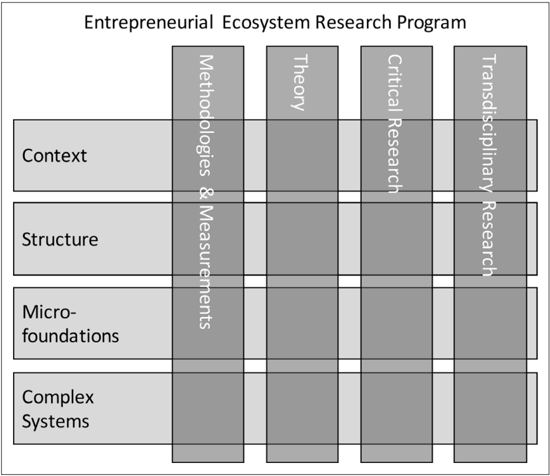
This paper reviews entrepreneurial ecosystem scholarship and argues the concept remains under-theorized, with the mechanisms governing ecosystem evolution not well understood. It synthesizes empirical causal mechanisms and proposes a transdisciplinary research program organized around context, structure, microfoundations, and complex systems.
Key findings
- The systematic review’s final sample contains 62 empirical articles; the initial search yielded 724 articles, reduced to an intermediate sample of 183, with 44 papers studying ecosystems at the city or regional level and 18 at the national level.
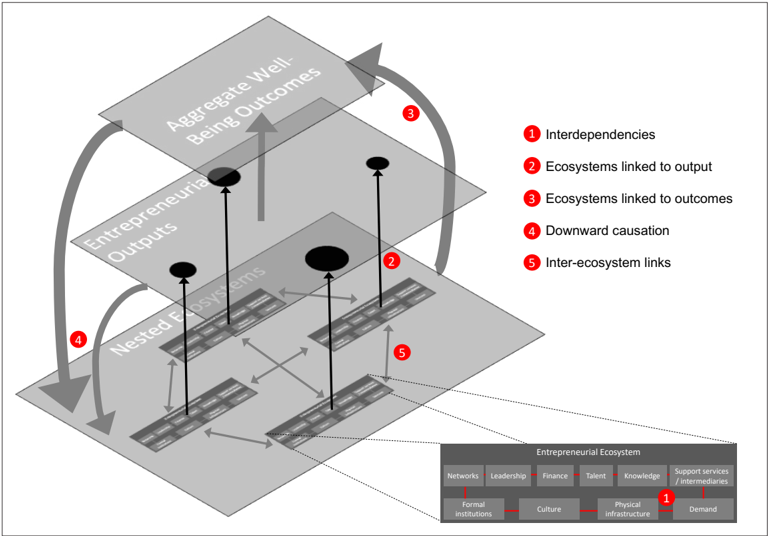
- The review identifies causal mechanisms linking ecosystem elements to outputs and outcomes: intra-layer interdependence among elements, upward causation from elements to outputs/outcomes, downward causation and path dependency/feedback, and inter-ecosystem links.
- Country-level studies link entrepreneurial ecosystems to economic growth and find mature ecosystems enable knowledge spillovers and more efficient resource allocation; regional evidence on whether ecosystems moderate the entrepreneurship–economic growth relationship is mixed, with Bruns et al. (2017) finding no moderating effect and Szerb et al. (2019) finding a positive moderating effect.
- The paper proposes a transdisciplinary entrepreneurial ecosystem research program with four research streams (context, structure, microfoundations, complex systems) and four cross-sectional themes (methodologies and measurements, theory, critical research, transdisciplinary research).
Methods
- Systematic literature review using Web of Science and Scopus, with topic searches for terms such as “entrep* ecosys*,” “startup ecosys*,” and “sys* of entrep*,” yielding an initial 724 articles.
- The review restricted sources to the top 25% Scimago-ranked journals in relevant business, management, economics, geography, and urban studies subareas, producing an intermediate sample of 183 articles; after in-depth reading and exclusions, 62 empirical articles remained.
- Analysis was guided by the Stam (2015) and Stam and Van de Ven (2019) framework to identify causal mechanisms: intra-layer causation, upward causation, downward causation/feedback, and inter-ecosystem links.
Limitations
- The paper states that ecosystem research is fragmented and heterogeneous, under-theorized, and that mechanisms governing ecosystem evolution are not well understood; much literature uses the ecosystem concept metaphorically without taking interdependence seriously.
- The paper states there is a lack of empirical evidence on path dependency and ecosystem boundaries, and that research is dominated by observational and case-study methods, making causality difficult to infer; it also warns of the ecological fallacy and notes that non-Gaussian distributions are often ignored.
- Evident from the methods: the review is limited to journal articles in top 25% journals, excluding book chapters, conference papers, and non-empirical work, and the final sample of 62 articles may narrow the evidence base.
Model-written summary of a shortened version of the paper’s full text (it is longer than we read). Check it against the paper before relying on it.
Integrity signals
Registry
Cites
Statistics
Figures
Verification
Claims the paper makes
31 Valid · 16 Not valid · 116 Not checked · 37 Own results and interpretations
The cited sources support only part of this claim — read each source’s verdict below.
In the paper
“There is also a subset of studies that focus on a singular innovation project within in a spatial setting, not looking at the aggregate preva -lence of entrepreneurship, nor at the interdependencies in the ecosystem at large (e.g., DiVito & Ingen- Housz, 2019).”
What the sources say
- Partly supportedcites DiVito & Ingen-Housz, 2019 matched to “From individual sustainability orientations to collective sustainability innovation and sustainable entrepreneurial ecosystems” (2021) sourceExperimental — accuracy not yet measured
The Methods section describes a single collaborative innovation project in Amsterdam and says the study does not aim to reveal relationships between variables, supporting the project-level and spatial characterization. But it names the broader ecosystem as a unit of analysis, and the Introduction explicitly says the study examines interdependencies among ecosystem actors. The claim that it does not look at those interdependencies is therefore unsupported. Page numbers are not available in our copy. (LLM, conf=0.88)
plain- Asserted: passes — The authors put it forward as true.
- Checkable: passes — It can be checked against evidence.
- Load-bearing: unclear — It is unclear whether the paper’s conclusions depend on it.
- Based: passes — The paper gives a reason why it holds.
- Partly supported
The cited sources support only part of this claim — read each source’s verdict below.
In the paper
“which are responsible for the bulk of new job creation in devel -oped economies, making it a crucial target for economic development policy ( Brown & Mason, 2017).”
What the sources say
- Partly supportedcites Brown & Mason, 2017 matched to “Looking inside the spiky bits: a critical review and conceptualisation of entrepreneurial ecosystems” (2017) sourceExperimental — accuracy not yet measured
Section 4.1.2, “Blockbuster entrepreneurship” (page unavailable), says that a tiny number of UK firms contribute disproportionately to job creation by high-growth firms. That supports their importance as job creators, but it does not establish that high-growth firms account for the bulk of all new jobs across developed economies. (LLM, conf=0.85)
plainstates a cause- Asserted: passes — The authors put it forward as true.
- Checkable: passes — It can be checked against evidence.
- Load-bearing: unclear — It is unclear whether the paper’s conclusions depend on it.
- Based: passes — The paper gives a reason why it holds.
- Rests on an assumption not shown here.
- Partly supported
Every source the paper cites for this claim was checked and supports it.
In the paper
“An example is the investment in physical infrastructure without supporting the underlying cultural and social support, which turned planned innovation hotspots into empty real estate (Pugh et al., 2018).”
What the sources say
- Supportedcites Pugh et al., 2018 matched to “From ‘Techniums’ to ‘emptiums’: the failure of a flagship innovation policy in Wales” (2018) source
The Discussion and Conclusion says Technium buildings had low occupancy and that firms received little on-site support beyond physical space. The passage labelled Table 4 about here describes a lack of softer support and local networks, with empty space ultimately leased out as the government became a landlord. Together, these support the citing sentence’s paraphrase. (LLM, conf=0.89)
plainstates a cause- Asserted: passes — The authors put it forward as true.
- Checkable: passes — It can be checked against evidence.
- Load-bearing: passes — The paper’s conclusions depend on it.
- Based: passes — The paper gives a reason why it holds.
- Supported
The cited sources support only part of this claim — read each source’s verdict below.
In the paper
“These co- evolutionary dynamics are the result of the interactions of individuals within eco -systems ( Johnson et al., 2019 ; Thompson et al., 2018).”
What the sources say
- Partly supportedcites Johnson et al., 2019 matched to “Entrepreneurial dynamism and the built environment in the evolution of university entrepreneurial ecosystems” (2019) sourceExperimental — accuracy not yet measured
Section 5.1 links the evolution of university-centered entrepreneurial ecosystems to agents’ behavior and their interconnected responses. The Conclusion adds that evolution depends on both those responses and the built environment; the claim broadens this finding to ecosystems generally and leaves out that additional factor. Page numbers are unavailable in our copy. (LLM, conf=0.83)
- Supportedcites Thompson et al., 2018 matched to “How entrepreneurial ecosystems take form: Evidence from social impact initiatives in Seattle” (2018) source
The Discussion (p. 27) states that a field-theory approach considers 'how individuals doing things together contributes to the particular features and dynamics of an ecosystem,' and the Introduction (p. 4) credits endogenous, bottom-up, time-patterned processes driven by micro social interaction, with interactions and shared meanings becoming 'common and mutually reinforcing' across the phase transition (pp. 4, 26). Our copy does not use the term 'co-evolutionary' (searches for it returned only semantic matches), but it substantively treats ecosystem dynamics as the product of actor interactions within the ecosystem, so the paraphrase is carried. The one narrowing worth noting is that the paper bounds this to the early moments of ecosystem formation in its Seattle social-impact setting and pairs interactions with shared meanings rather than interactions alone. (LLM, conf=0.82)
plainstates a cause- Asserted: passes — The authors put it forward as true.
- Checkable: passes — It can be checked against evidence.
- Load-bearing: unclear — It is unclear whether the paper’s conclusions depend on it.
- Based: passes — The paper gives a reason why it holds.
- Partly supported
Every source the paper cites for this claim was checked and supports it.
In the paper
“Ecosystem configurations can vary significantly and new policies/investments should develop support among underlying social and cultural attributes [53] Spigel (2017)”
What the sources say
- Supportedcites Spigel (2017) matched to “The Relational Organization of Entrepreneurial Ecosystems” (2017) source
Section 2.4 states that entrepreneurial ecosystems can have multiple possible configurations. Section 3.1 likewise describes different configurations and relationships among ecosystem attributes, supporting the claim that configurations vary. (LLM, conf=0.92)
plain- Asserted: passes — The authors put it forward as true.
- Checkable: passes — It can be checked against evidence.
- Load-bearing: unclear — It is unclear whether the paper’s conclusions depend on it.
- Based: passes — The paper gives a reason why it holds.
- Supported
81 more claims · 12 with their cited sources checked
Create a free account to see all 200 claims and to verify the 44 references still open.
- Probably not a substantial claim. 82
- It may state two separate claims as one. 52
Self-check
Percentages, sums and reported differences re-computed from the paper’s own numbers.
Each contradiction between two passages listed here was confirmed by an independent check.
Rated minor: it would not touch a result — a value no result rests on, a p-value that stays on the same side of the significance level, or a conflict that is clerical, resolved elsewhere in the paper, or outside its own findings.
In the paper
§ Microfoundations · p. 24
“We must be aware of the ecological fallacy (Robinson, 2009 )”
§ References · p. 47
“- Robinson, W. S. (1950). Ecological correlations and the behavior of individuals.”
Citations
Cites
The Theory of Economic Development
Schumpeter, J., & Backhaus, U. (2006) · The European Heritage in Economics and the Social Sciences · doi:10.1007/0-306-48082-4_3 · Cited by 22,506
Introductory Econometrics: A Modern Approach
Wooldridge, J. M. (1999) · Cited by 14,466
(1993) · Journal of the American Dietetic Association · doi:10.1016/0002-8223(93)92196-5 · Cited by 11,976
Teece, D. J. (1986) · Research Policy · doi:10.1016/0048-7333(86)90027-2 · Cited by 7,842 · cited 1×
“Untraded interdependencies include the complementarities between actors and resources, and information flows which do not entirely correspond to the flows of commodities (Richardson, 1972 ; Teece, 1986 , 1998; Tripsas, 1997).”
Competing Technologies, Increasing Returns, and Lock-In by Historical Events
Arthur, W. B. (1989) · The Economic Journal · doi:10.2307/2234208 · Cited by 7,489 · cited 1×
“The concept of path dependency goes back to the work by David (1988) and Arthur (1989) and “can be used to offer an understanding of why some optional developments are followed, or intention - ally chosen, over others […] path dependence conditions, but does not determine, a specific outcome”…”
Analyzing the Past to Prepare for the Future: Writing a Literature Review
Webster, J., & Watson, R. T. (2002) · MIS Quarterly · doi:10.2307/4132319 · Cited by 7,449 · cited 2×
“In the initial stage, we searched all databases from Web of Science and Scopus for a comprehensive overview of the literature (Frank & Hatak, 2014 ; Martín-Martín et al., 2018 ; Webster & Watson, 2002).”
Teece, D. (1993) · Research Policy · doi:10.1016/0048-7333(93)90063-n · Cited by 7,242
Clusters and the new economics of competition.
Porter, M. E. (1998) · PubMed · Cited by 5,679
Clusters and the New Economics of Competition
Milošević, D. (2014) · Harvard business review · Cited by 4,854
Beyond Markets and States: Polycentric Governance of Complex Economic Systems
Ostrom, E. (2010) · American Economic Review · doi:10.1257/aer.100.3.641 · Cited by 4,529 · cited 2×
“In combination with insights from polynuclear governance (Ostrom, 2010) and multilevel governance (Bache et al.”
Research works printed but not linked: 5
- David, P. A. (1988). Path- dependence: Putting the past into the future of economics . Institute for Mathematical Studies in the Social Sciences Technical Report No. 533: Stanford University Press.
- World Economic Forum. (2014). Entrepreneurial ecosystems around the globe and early- stage company growth dynamics . World Economic Forum.
- Krugman, P. (1991). Geography and trade . MIT Press.
- Marshall, A. (1920). Principles of Economics . (Rev ed.). Macmillan.
- Startup Genome. (2020). The Global Startup Ecosystem Report GSER 2020: The New Normal for the Global Startup Economy and the Impact of COVID-19 . Startup Genome.
Cited by
Items 501–600 of 780
Relationship between entrepreneurship and economic growth in Nigeria
Abakpa, A., & Dvouletý, O. (2026) · Journal of global entrepreneurship research · doi:10.1007/s40497-025-00485-w · Cited by 2
“This has been reflected in the current scholarly and policy discussions on the role of the so-called entrepreneurial eco-system concept in representing entrepreneurs’ broader institutional, cultural, and socio-economic surroundings (Wurth et al., 2022; Theodoraki et al., 2023).”
Family Business Entrepreneurial Ecosystem: An Explorative Approach
Méndez, Ó. J. M., Carvalho, L. C., & Martinez, A. M. (2022) · Emerald Group Publishing Limited eBooks · doi:10.1108/978-1-80117-666-820221007 · Cited by 2
The Evolutionary Mosaic: A Geographical Sequence Analysis of the Berlin Entrepreneurial Ecosystem
Kuebart, A. (2026) · The Professional Geographer · doi:10.1080/00330124.2026.2667386 · Cited by 1
Katono, I. W. (2024) · Advances in finance, accounting, and economics book series · doi:10.4018/979-8-3693-0477-8.ch013 · Cited by 2
Lin, X., Hui, E. C. M., Cong, Z., et al. (2024) · SSRN Electronic Journal · doi:10.2139/ssrn.4837572 · Cited by 1
Determinanten der Gründungsentscheidung im gesamtwirtschaftlichen, sektoralen und regionalen Kontext
Fritsch, M. J., & Wyrwich, M. (2021) · Springer eBooks · doi:10.1007/978-3-658-34637-9_8 · Cited by 1
Reflections on high growth firms
Motoyama, Y., Henderson, C., Clevenger, M. R., Desai, S., Oh, S., & van Maasakkers, T. (2023) · Local Economy The Journal of the Local Economy Policy Unit · doi:10.1177/02690942241246725 · Cited by 2
Pushing boundaries: market intelligence elevating SMEs export intensity through vibrant ecosystem
Alam, M. N., Hasan, S. S., Haider, S. S., Nabi, M. N. U., Masroor, I., & Bably, S. M. (2025) · Review of International Business and Strategy · doi:10.1108/ribs-11-2024-0135 · Cited by 2
Johnson, D., Hughes, J., & Huang, Y. (2026) · International Journal of Entrepreneurial Behaviour & Research · doi:10.1108/ijebr-06-2025-0758 · Cited by 3
Xie, L., & Lu, X. (2021) · Springer eBooks · doi:10.1007/978-981-16-6757-2_4 · Cited by 1
Intellectual framework for knowledge-intensive innovative entrepreneurship
de Paiva, E. M., & da Costa, P. R. (2024) · Journal of International Entrepreneurship · doi:10.1007/s10843-024-00351-y · Cited by 1
“However, the literature on entrepreneurial ecosystems is relatively new (Ács et al. 2014; Autio et al. 2014; Alvedalen and Boschma 2017), and it has recently grown in popularity (Audretsch et al. 2019; Wurth et al. 2022).”
Shaping mentoring for entrepreneurs
Rosado-Cubero, A., Hernández, A., Jiménez, F. J. B., & Freire-Rubio, T. (2026) · International Entrepreneurship and Management Journal · doi:10.1007/s11365-026-01183-z · Cited by 1
“The entrepreneurial ecosystem concept has gained significant attention in recent years as a way to understand the broader context that supports entrepreneurship (Cantner et al., 2021; Stam & van de Ven, 2021; Bouncken & Kraus, 2022; Wurth et al., 2022; Malecki, 2018).”
Chabaud, D. (2025) · RIMHE Revue Interdisciplinaire Management Homme(s) & Entreprise · doi:10.3917/rimhe.059.0084 · Cited by 1
Knowledge Map Analysis for Entrepreneurial Ecosystem Research
(2022) · Journal of Social Science and Humanities · doi:10.53469/jssh.2022.4(11).06 · Cited by 1
The Ecology of Innovation: The Evolution of a Research Paradigm
Root, H. L. (2023) · Springer eBooks · doi:10.1007/978-3-031-25931-9_12 · Cited by 3
Alberti, F. G., Belfanti, F., & Riva, M. (2026) · Humanism in business series · doi:10.1007/978-3-032-04917-9_10 · Cited by 3
Beyond coping: A process model of entrepreneurial ecosystem resilience under polycrisis
Stroila, I., & Shi, H. (2026) · Journal of Small Business Management · doi:10.1080/00472778.2026.2688290 · Cited by 2
The Entrepreneurial Ecosystem in Poland: A Panacea for Growth?
Angowski, M., & Sagan, M. (2023) · Emerald Group Publishing Limited eBooks · doi:10.1108/978-1-83753-654-220231026 · Cited by 3
Buarque, B., Câmara, S. F., Pinto, J. G. P., & Filho, J. I. B. D. M. (2023) · International Journal of Innovation · doi:10.5585/2023.22989 · Cited by 4
Mattes, V., SCHEY, J., Schulz, A., Schallmo, D. R. A., & Schieder, C. (2025) · International Journal of Innovation Management · doi:10.1142/s1363919625400213 · Cited by 1
Universities within the Entrepreneurial Ecosystem: Exploring the Process of Co-evolution
Johnston, A. (2024) · Oxford University Press eBooks · doi:10.1093/oso/9780192866264.003.0019 · Cited by 2
Esposito, G., Amitrano, C. C., Troise, C., & Yahiaoui, D. (2026) · International Entrepreneurship and Management Journal · doi:10.1007/s11365-025-01153-x · Cited by 7
“…offers a valuable meso-level view of entrepreneurship as embedded within territorial and institutional networks (Brown & Mason, 2017 ; Stam & van de Ven, 2021 ; Wurth et al., 2022 ), the NeCyM extends this by integrating governance and innovation as co-evolving forces alongside entrepreneurship.”
InfluentialPerformance of Entrepreneurship Ecosystem Activities
Vargas-Hernández, J. G., González-Ávila, F. J., Rodríguez-Maillard, C. A., Luján, J. M. B., & Vargas-González, O. C. (2024) · Advances in business strategy and competitive advantage book series · doi:10.4018/979-8-3693-7903-5.ch012 · Cited by 1
Behavioral determinants of HEIs researcher´s intention to collaborate with firms
Puerta‐Sierra, L., Puente‐Díaz, R., & Montalvo, C. (2023) · Cogent Business & Management · doi:10.1080/23311975.2023.2270809 · Cited by 1
“In the last years, it has been recognized that an essential element for ecosystem development is the actors’ connections (Wurth et al., 2021).”
BackgroundLA GESTIÓN DE LA COMPLEJIDAD EN EL ECOSISTEMA EMPRENDEDOR
Segura, C. M. L., Artiga, J. S. C., & Sifontes, M. G. A. (2024) · Actas del Congreso de Investigación, Desarrollo e Innovación IDI-UNICyT · doi:10.47300/actasidi-unicyt-2023-44 · Cited by 1
“Esto equivale a un ecosistema emprendedor que enfatiza la dimensión del entorno y de su interrelación con diversas estructuras económicas y sociales (Wurth et al., 2021).”
BackgroundOxygenating Innovation? The Not-So-Brave New World of COVID-19?
Krueger, N. F. (2022) · International studies in entrepreneurship · doi:10.1007/978-3-031-04655-1_4 · Cited by 1
Barbosa, I., & de Oliveira, E. R. (2026) · Journal of Management Development · doi:10.1108/jmd-08-2025-0468 · Cited by 1
Dai, Z., Zhao, X., Luo, R., & Liu, Y. (2025) · International Regional Science Review · doi:10.1177/01600176251377398 · Cited by 2
Entrepreneurial ecosystems, evolutionary growth and global expansion
Anwar, S. T. (2025) · Journal of International Entrepreneurship · doi:10.1007/s10843-025-00389-6 · Cited by 1
Verkhovod, I., Бондаренко, С., & Polishchuk, A. (2026) · Social and Labour Relations Theory and Practice · doi:10.21511/slrtp.15(2).2025.05 · Cited by 1
As eurorrexións en perspectiva: vellos problemas e novos retos para a cooperación
Marzábal, Ó. R., Sánchez-Carreira, M. D. C., Mourão, P. R., et al. (2022) · Revista Galega de Economía · doi:10.15304/rge.31.2.8624 · Cited by 1
“Estas empresas de gobernanza adóitañse captar como conceptos de ecosistemas empresariais, ecosistemas empresariais sociais e ecosistemas fiñañceirós territoriais (Wurth et al., 2021; Gancarczyk e Konopa, 2021; Thompson, 2018; Łasak, 2022).”
BackgroundVillegas-Mateos, A., Sreih, J. F., Tok, E., & Labbaf, H. (2025) · Emerald Group Publishing Limited eBooks · doi:10.1108/978-1-83608-208-820251002 · Cited by 2
The Entrepreneurial Ecosystem of the Kurdistan Region of Iraq
Al-Silefanee, R., Uctu, R., & Stam, E. (2025) · Emerald Group Publishing Limited eBooks · doi:10.1108/978-1-83608-208-820251009 · Cited by 1
Self-citationDynamics of platform-driven industry emergence: the case of the Dutch game industry
Heslinga, A., & Loots, E. (2025) · Geoforum · doi:10.1016/j.geoforum.2025.104432 · Cited by 1
Wahyudi, S. E., Baihaqi, I., & Arvitrida, N. I. (2026) · Cogent Business & Management · doi:10.1080/23311975.2026.2697628
Fintech as a Mechanism for Entrepreneurship Ecosystem Development in Emerging Economies
Randa, I. O. (2023) · Advances in business strategy and competitive advantage book series · doi:10.4018/979-8-3693-0527-0.ch005 · Cited by 2
IS MANAGING LOCAL GOVERNMENT THROUGH AN ENTREPRENEURIAL ECOSYSTEM A NEW APPROACH?
Tross, U., Raudsaar, M., & Hirv, T. (2026) · Trames-journal of The Humanities and Social Sciences · doi:10.3176/tr.2026.1.02
Retrieval-Augmented Generative AI for Analyzing Entrepreneurship in AfricaPreprint
Esibe, R. N., Aliyu, M., Thornburg, J., Stam, E., & Barros, J. (2026) · SSRN Electronic Journal · doi:10.2139/ssrn.6668914
Self-citationScheu, M., & Kuckertz, A. (2026) · SSRN Electronic Journal · doi:10.2139/ssrn.6210580
Governance Structures in Digital Entrepreneurial Ecosystems: The Impact on Strategic Choices
Bongiorno, A., Szopik‐Depczyńska, K., D’Alessandro, C., & Cinici, M. C. (2026) · Springer proceedings in complexity · doi:10.1007/978-3-032-09062-1_14 · Cited by 1
Molope, G. E., Seeletse, S. M., & Ladzani, W. (2024) · International Journal of Applied Research in Business and Management · doi:10.51137/wrp.ijarbm.2024.gmre.45649 · Cited by 1
Powe, N. A., & Oswell, D. (2026) · Social enterprise journal · doi:10.1108/sej-04-2025-0074
Population effect in Lagos’ entrepreneurial ecosystems: a blessing or a curse?
Oladele, S., Adigun, O. H., Laosebikan, J. O., Oladele, F., & Akinsola, O. A. (2025) · Journal of Entrepreneurship in Emerging Economies · doi:10.1108/jeee-04-2025-0170 · Cited by 4
Don’t stand so close to me: foreign and domestic incumbents and new business births
Danakol, S. H., Mickiewicz, T. M., & Skica, T. (2026) · Journal of Economic Geography · doi:10.1093/jeg/lbag010
Rincón, A. G., & Avolio, B. E. (2026) · Competitiveness Review An International Business Journal incorporating Journal of Global Competitiveness · doi:10.1108/cr-07-2025-0220
Avnimelech, G., & Amit, A. (2023) · SSRN Electronic Journal · doi:10.2139/ssrn.4447536
Unveiling the entrepreneurial ecosystems black box: An interpretable machine learning approach
Longo, L., Mazzoni, L., & Riccaboni, M. (2026) · Journal of the International Council for Small Business · doi:10.1080/26437015.2026.2712250
Challenges and Opportunities: Resource Flows and Digitalization in Entrepreneurial Ecosystems
Bejjani, M. (2025) · Contributions to management science · doi:10.1007/978-3-031-96169-4_11
ENGENDERING SUSTAINABLE DEVELOPMENT THROUGH DIGITAL ENTREPRENEURSHIP IN NIGERIA
Akurega, M. I., & Okocha, D. O. (2023) · Caleb International Journal of Development Studies · doi:10.26772/cijds-2023-06-02-01 · Cited by 2
Conclusion: Entrepreneurship Education for an Undergraduate Audience—A Review and Future Directions
Larios-Hernández, G. J., Walmsley, A., & Castro, V. I. L. (2022) · Springer eBooks · doi:10.1007/978-3-030-87865-8_19
Bridging the entrepreneur–advisor chasm: cognitive distance, trust and network ties
Sörensson, A., Ghannad, N., & Kask, J. (2026) · Journal of Small Business and Enterprise Development · doi:10.1108/jsbed-08-2025-0559 · Cited by 1
Lyu, Z., & Murtaza, N. (2026) · PLoS ONE · doi:10.1371/journal.pone.0340966
“Cultural, psychological, political, and economic factors all work together in EEs to affect the emergence and development of new businesses [42].”
Butkevičienė, J., & Kozma, M. (2026) · Emerald Group Publishing Limited eBooks · doi:10.1108/s1745-88622026000020b004 · Cited by 2
Harris, S., Clarke, M., & Brattström, A. (2026) · Entrepreneurship Theory and Practice · doi:10.1177/10422587261472141
del Sinú, U., & Vázquez, M. A. P. (2024) · doi:10.59899/ref-post-2-c18
You, Y., Huang, X., & Li, R. (2026) · Technological Forecasting and Social Change · doi:10.1016/j.techfore.2026.124811
Persais, É., & Cuénoud, T. (2025) · Management & Prospective · doi:10.3917/g2000.412.0100
Franchise’s locational concentration in Brazil: a contextual perspective
Bitti, E. J. S., Dermonde, M., & Fischer, B. B. (2025) · Revista de Gestão · doi:10.1108/rege-12-2024-0174
Institutional Space-Making for Equity in Entrepreneurial Ecosystems: Evidence from U.S. Cities
Wang, Q., Kim, S., & Taylor, S. (2026) · Entrepreneurship Theory and Practice · doi:10.1177/10422587261450579 · Cited by 1
Парасій-Вергуненко, І. М., Безверхий, К. В., Дерій, В. А., Гарнага, О., & Khodzytska, V. (2026) · Financial and credit activity problems of theory and practice · doi:10.55643/fcaptp.4.69.2026.5280
Rovere, R. L. L. (2022) · Revista Brasileira de Inovação · doi:10.20396/rbi.v21i00.8666305 · Cited by 1
Kant, S., & Degefa, T. T. (2025) · IGI Global eBooks · doi:10.4018/979-8-3693-9836-4.ch004
Long-term effects of regional shocks on new opportunity and necessity entrepreneurship
Congregado, E., Fossen, F. M., Rubino, N., & Ponce, D. (2026) · Regional Studies · doi:10.1080/00343404.2026.2726959 · Cited by 1
Conclusions and Future Research
Martinez, E. M., Baig, P., Belitski, M., Theodoraki, C., & Godley, A. (2025) · Contributions to management science · doi:10.1007/978-3-031-96169-4_14
Financial market discipline and new business formation
Dewally, M., Liu, P., & Shao, Y. (2026) · Small Business Economics · doi:10.1007/s11187-026-01262-z
Banc, C., & Messeghem, K. (2026) · Revue de l’Entrepreneuriat · doi:10.3917/e.entre.hs5.0065 · Cited by 1
Digital Entrepreneurship Ecosystem : An ExplorationPreprint
Yadav, S. S. K., & Mishra, G. (2025) · SSRN Electronic Journal · doi:10.2139/ssrn.5343166
Padrón-Vivas, R. (2026) · SSRN Electronic Journal · doi:10.2139/ssrn.7366918
Hojnik, B. B. (2026) · Systems · doi:10.3390/systems14101193 · Cited by 1
López, E. D. D. L., & Rodriguez, R. P. (2026) · Systems · doi:10.3390/systems14070814
Sundram, M., & Fourie, A. (2025) · International Social Science Journal · doi:10.1111/issj.70001
Quand les logiques s’hybrident : trajectoire d’un écosystème entrepreneurial culturel et créatif
Prigent, G., & Kübler, B. (2026) · RIMHE Revue Interdisciplinaire Management Homme(s) & Entreprise · doi:10.3917/rimhe.063.0005
Safa, S. H., Boustani, N. M., & Mawlawi, H. (2026) · Ethnic and Indigenous Business Studies. · doi:10.1007/978-3-032-33088-8_2
From Personal to Collective Powers: Towards Gender Inclusivity in Entrepreneurial Ecosystems
Stroila, I., Isakova, E., & Neergaard, H. (2026) · Entrepreneurship Theory and Practice · doi:10.1177/10422587261450569
THE ENTREPRENEURIAL ECOSYSTEM CONCEPT: IN SEARCH OF THE COMMON DEFINITION
(2022) · ASERC Journal of Socio-Economic Studies · doi:10.30546/2663-7251.2022.5.1.121
Lee, T. (2025) · SSRN Electronic Journal · doi:10.2139/ssrn.5358408
Organizing (in) innovation ecosystems: a definition, new theoretical lenses and a research agenda
Cochis, C., & Ungureanu, P. (2026) · European Journal of Innovation Management · doi:10.1108/ejim-03-2026-0270
Ribeiro, O. C. D. R., Bueno, A. M., ALVES, E. B., & Tessaro, N. T. (2023) · Revista Pensamento Contemporâneo em Administração · doi:10.12712/rpca.v17i4.60597 · Cited by 1
“These external elements are present in certain regions and corroborate to the competitive advantage in the organization level (Spigel & Harrison, 2018; Wurth et al ., 2021).”
BackgroundInfluentialChen, X., Batjargal, B., & Chen, J. (2026) · Strategic Organization · doi:10.1177/14761270261433465
Anton, A. S., & Mansingh, J. P. (2026) · Frontiers in Sustainable Food Systems · doi:10.3389/fsufs.2026.1814235
Beyond Elites: Inclusive Entrepreneurship in the Era of AI
Eftekhar, N. (2026) · Advances in Science, Technology & Innovation/Advances in science, technology & innovation · doi:10.1007/978-3-032-22039-4_17
Towards an Ecosystem Approach to Corporate Entrepreneurship and Startup–Incumbent Relationships
Law, F., Chebbi, H., Cheffou, A. I., Blondel, F., & Hermans, J. (2026) · Revue de l’Entrepreneuriat · doi:10.3917/e.entre.hs5.0009
Frazão, C. D. N. F., dos Santos, I. C., & Farina, M. C. (2023) · Revista Brasileira de Gestão e Desenvolvimento Regional · doi:10.54399/rbgdr.v19i3.7007 · Cited by 1
Governance of core and periphery ecosystems: The role of entrepreneurial support organizations
Renzy, R., Clayton, P. A., & Liu, C. Y. (2026) · Local Economy The Journal of the Local Economy Policy Unit · doi:10.1177/02690942261461271
“Nearby ecosystems that have achieved greater success are likely to become examples which other lagging regions attempt to replicate a “cargo cult” of copy-and-paste policies across regions that may not be effective (Wurth et al., 2022).”
Entrepreneurship Ecosystems, Performance, Policy Formulation
Vargas-Hernández, J. G., Vargas-González, O. C., Castañeda-Burciaga, S., & González-Ávila, F. J. (2024) · Advances in business strategy and competitive advantage book series · doi:10.4018/979-8-3693-5426-1.ch014
Entrepreneuriat des personnes en situation de pauvreté dans les pays développés
Douaihy, C. (2023) · theses.fr (ABES) · doi:10.70675/14bb85a3z651az4e8bz8b2cz592d71b9d25f
Ecosystem Embeddedness by Female Refugee Social Entrepreneurs in France
Cascant, E. (2025) · Revue de l’Entrepreneuriat · doi:10.3917/e.entre.233.0091 · Cited by 1
Beyond the Individual: Neurodiversity and the Multi-Level Ecology of Entrepreneurial Ecosystems
Tucker, R. (2026) · Entrepreneurship: Theory & Practice · doi:10.1177/10422587261462857
O’Shea, G., Luoto, S., Bor, S., & Hakala, H. (2026) · Review of Managerial Science · doi:10.1007/s11846-026-01047-4
Human Factors in the Creation and Growth of Entrepreneurship Ecosystems
Vargas-Hernández, J. G., González-Ávila, F. J., & Vargas-González, O. C. (2024) · Advances in business strategy and competitive advantage book series · doi:10.4018/979-8-3693-9486-1.ch007
Mostafiz, M. I., & Simeonova, B. (2026) · Entrepreneurship and Regional Development · doi:10.1080/08985626.2026.2698653
Lu, S., Wu, C., Chen, B., Bi, D., & Du, X. (2025) · Journal of Organizational and End User Computing · doi:10.4018/joeuc.371411
Cherbib, J., Rhattat, R., & Messeghem, K. (2026) · Revue internationale P M E Économie et gestion de la petite et moyenne entreprise · doi:10.7202/1124423ar
Rangsorok: vakfoltok a startupökoszisztéma-kutatásban
Makai, A. L. (2023) · Statisztikai Szemle · doi:10.20311/stat2023.03.hu0203 · Cited by 1
Sarfo, C. A., Mamabolo, A., Owusu, J., Sarpong, D., Karimi, W., & Nwanguma, B. (2026) · The Journal of Technology Transfer · doi:10.1007/s10961-026-10395-y
Robles-Avila, S. E., & Corrales-Estrada, M. (2026) · The International Trade Journal · doi:10.1080/08853908.2026.2724844
Unlocking Digital Entrepreneurial Behavior: The Role of Ecosystem Support, Intention, and Innovation
Chavadi, C. A., Pandian, P., Ravindran, K., & Sirothiya, M. (2026) · IIMS Journal of Management Science · doi:10.1177/0976030x251379200 · Cited by 2
“Most previous research has focused on either ecosystem inputs or individual motivations, leaving largely unaddressed the question of how ecosystems influence behavior in an integrative way (Guerrero et al., 2020; Wurth et al., 2021).”
Semenova, V. (2024) · CUB Ph.D. Dissertations (Corvinus University of Budapest) · doi:10.14267/phd.2024056
Metadata
- Authors
- Wurth, B., Stam, E., & Spigel, B.
- Affiliations
- University of Strathclyde (GB)
- Utrecht University (NL)
- University of Edinburgh (GB)
- Corresponding author
- Wurth, Bernd
- Venue
- Entrepreneurship Theory and Practice
- Publisher
- SAGE Publications
- Published
- 2021-03-22
- Volume
- 46
- Issue
- 3
- Pages
- 729-778
- ISSN
- 1042-2587 (ISSN-L)
- 1540-6520
- OpenAlex
- W3128170268
- Cited by
- 789
- References
- 238
- Citations by year
- 2026: 181 · 2025: 190 · 2024: 159 · 2023: 132 · 2022: 92 · 2021: 35
- FWCI
- 89.59
- Type
- journal article
- Language
- en
- Open access
- hybrid
- doi.org
- Locations
- Entrepreneurship Theory and Practice (publishedVersion, cc-by)
- ENLIGHTEN (Jurnal Bimbingan dan Konseling Islam) (acceptedVersion, cc-by-sa)
- Strathprints: The University of Strathclyde institutional repository (University of Strathclyde) (submittedVersion)
- RePEc: Research Papers in Economics (submittedVersion)
- Utrecht University Repository (Utrecht University) (submittedVersion, other-oa)
- Edinburgh Research Explorer (University of Edinburgh) (submittedVersion, cc-by)
- Funders
- Universiteit Utrecht
- Topics
- Social Sciences › Business, Management and Accounting › Management of Technology and Innovation › Entrepreneurship Studies and Influences
- Social Sciences › Business, Management and Accounting › Management of Technology and Innovation › University-Industry-Government Innovation Models
- Social Sciences › Business, Management and Accounting › Strategy and Management › Innovation and Knowledge Management
- Keywords
- entrepreneurial ecosystems, ecosystem evolution, causal mechanisms, transdisciplinary research, entrepreneurship research agenda, ecosystem theory
About these checks
Registry, retraction, Cites and statistics results are computed, not judged, with one exception: a printed reference that no index lists is read once by a model before it counts as a citation error. Claims are extracted by a model and kept only when their quote appears verbatim in the text; each cited source is then checked, with a model’s help, for whether it says what the claim relies on. Those verdicts can be wrong — read the claim’s quote and the cited source before relying on one.
The claim verdicts this report counts are experimental: their accuracy is not yet measured.
A language model drew the claims from the paper on 2026-10-29, under version 3 of the claim definition (model deepseek-v4.1-flash, prompt extract-v3).
A second model labelled each claim on 2026-10-29 (model jev-1.13-20260917, definition revision gold-guideline-v0.2).
Cited sources are checked with a language model’s help (gpt-6-sol and qwen3.8-omni-flash).
Statistics and arithmetic are recomputed, not judged.
Confidence bands are shown only for fields calibrated on our annotated test set. None is calibrated yet, so no band is shown.
What counts as a claim ›How we measure confidence ›How we check this ›
Are you an author, or do you see a problem with this page? Request a review
Data sources
Bibliographic data: Semantic Scholar, OpenAlex, Crossref.
Contains information from the Semantic Scholar Academic Graph Datasets, made available under the ODC Attribution License (ODC-BY 1.0).
Semantic Scholar’s data is described in: Kinney, R., et al. (2023). The Semantic Scholar Open Data Platform. arXiv:2301.10140.
