

A Step-by-Step Process of Thematic Analysis to Develop a Conceptual Model in Qualitative Research
Open accessThe DOI matches its Crossref record; 77 of the 78 references it cites were found in a registry or an index, and 1 are not checked yet; 2 of the 57 sources its claims cite were checked for support.
Abstract
Thematic analysis is a highly popular technique among qualitative researchers for analyzing qualitative data, which usually comprises thick descriptive data. However, the application and use of thematic analysis has also involved complications due to confusion regarding the final outcome’s presentation as a conceptual model. This paper develops a systematic thematic analysis process for creating a conceptual model from qualitative research findings. It explores the adaptability of the proposed process across various research methodologies, including constructivist methodologies, positivist methodologies, grounded theory, and interpretive phenomenology, and justifies their application. The paper distinguishes between inductive and deductive coding approaches and emphasizes the merits of each. It suggests that the derived systematic thematic analysis model is valuable across multiple disciplines, particularly in grounded theory, ethnographic approaches, and narrative approaches, while also being adaptable to more descriptive, positivist-based methodologies. By providing a methodological roadmap, this study enhances the rigor and replicability of thematic analysis and offers a comprehensive strategy for theoretical conceptualization in qualitative research. The contribution of this paper is a systematic six-step thematic analysis process that leads to the development of a conceptual model; each step is described in detail and examples are given.
Verified 2026-11-22 · 1 reference not checked yet
Overview
CoChat Summary
TL;DR
This methodological paper presents a six-step systematic thematic analysis process for developing a conceptual model from qualitative data, illustrated with Naeem and Ozuem’s (2022a) panic-buying study. It introduces 6Rs for keyword selection, 6Rs for coding, and 4Rs for theming to enhance rigor and trustworthiness.
Key findings
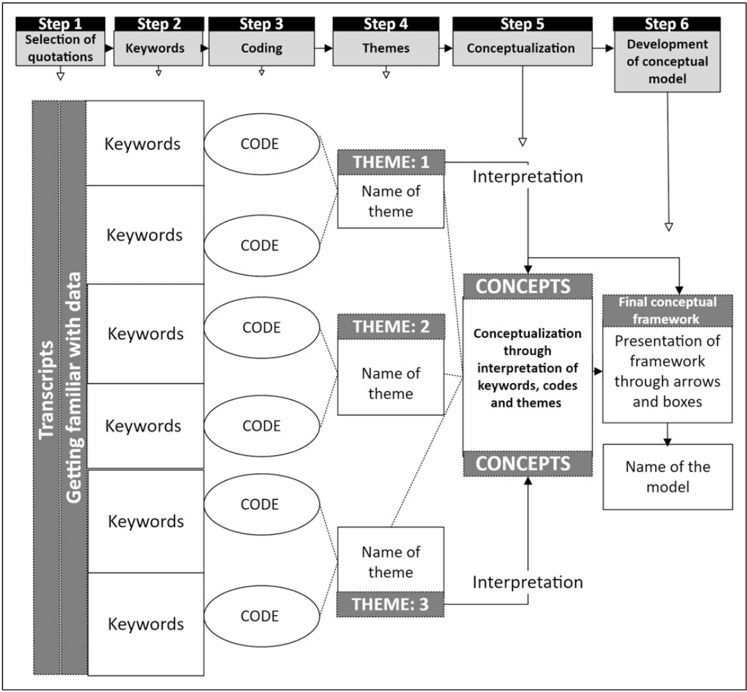
- The paper proposes six steps: transcription/familiarization and quotation selection; keyword selection; coding; theme development; conceptualization through interpretation of keywords, codes, and themes; and development of a conceptual model.
- It introduces 6Rs for keyword selection (realness, richness, repetition, rationale, repartee, regal), 6Rs for coding (robust, reflective, resplendent, relevant, radical, righteous), and 4Rs for theming (reciprocal, recognizable, responsive, resourceful).
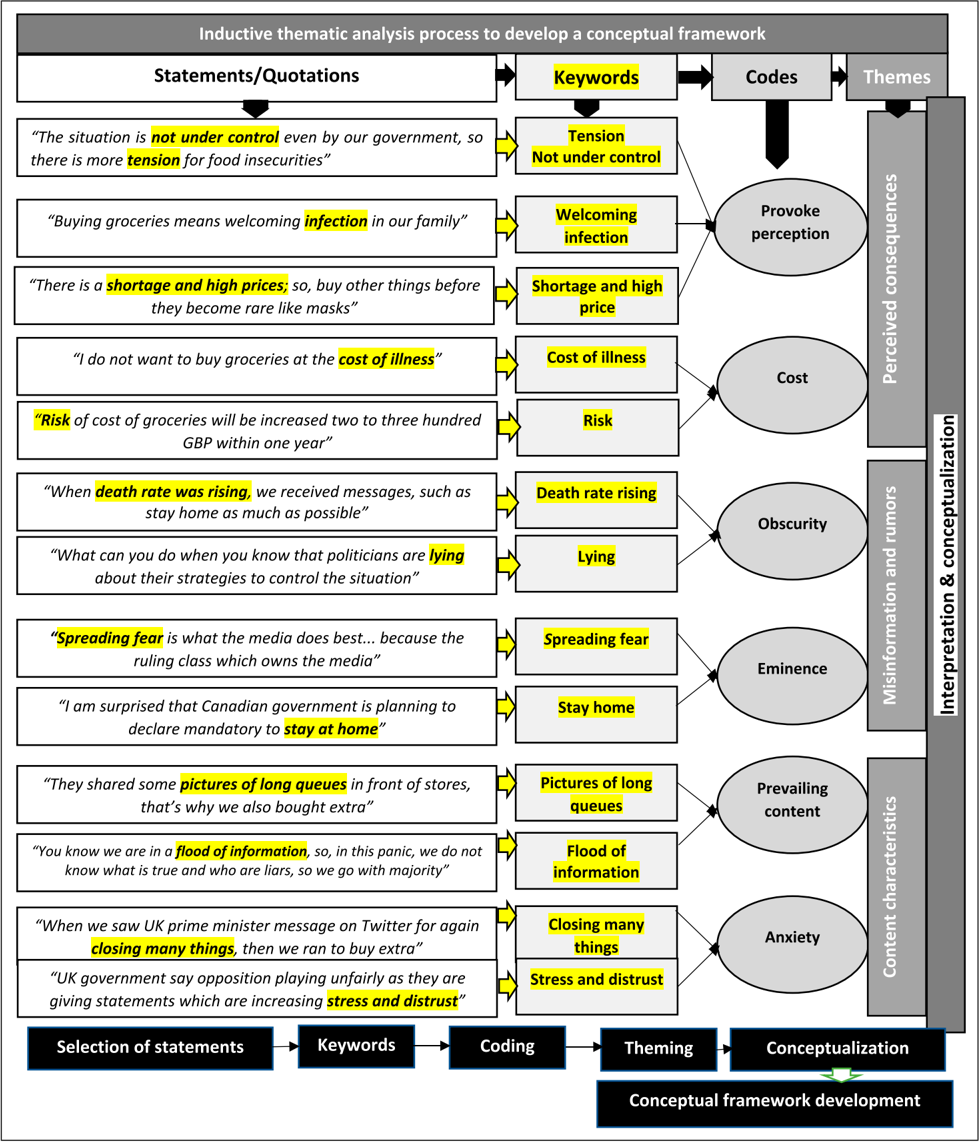
- In the exemplar study, three main themes emerged: “Perceived consequences” from codes “Provoke perception” and “Cost”; “Misinformation and rumors” from codes “Obscurity” and “Eminence”; and “Content Characteristics” from codes “Prevailing content” and “Anxiety.”
- The exemplar’s final model, “Panic buying as social practice,” was based on Protection Motivation Theory (PMT) and the Theory of Rumor Transmission (TORT).
Methods
- Design: a methodological/conceptual paper that presents a comprehensive systematic model for thematic analysis culminating in a conceptual model, using Naeem and Ozuem (2022a) as an exemplar.
- Exemplar data: qualitative data gathered from Twitter, YouTube, and interviews; the exemplar used a six-stage thematic analysis and a social constructionist perspective with PMT and TORT as theoretical foundations.
- Main analysis: the paper describes each of the six steps in detail, provides practical examples from the exemplar, and compares the proposed process with Braun and Clarke’s (2006) six steps of thematic analysis.
Limitations
- The paper states that the potential of the process to address other research contexts or quantitative methods may require further exploration, and that the efficiency of the method compared with other model-building approaches has not been empirically tested.
- Evident from the text: the proposed six-step process and the 6Rs/4Rs are illustrated through a single exemplar study and are not independently validated or empirically compared with alternative thematic analysis approaches.
Model-written summary. Check it against the paper before relying on it.
Integrity signals
Registry
Cites
Statistics
Figures

Verification
Claims the paper makes
0 Valid · 4 Not valid · 56 Not checked · 89 Own results and interpretations
The cited sources that could be checked couldn’t confirm or dispute this claim.
In the paper
“For narrative approaches, conceptual model development focuses on personal experiences, emotions, and life histories (Eldh et al., 2020).”
§ A Step-by-Step Process of Thematic Analysis to Develop a Conceptual Model in Qualitative Research > Step 6: Development of Conceptual Model.
What the sources say
- Could not verifycites Eldh et al., 2020 matched to “Quotations in Qualitative Studies: Reflections on Constituents, Custom, and Purpose” (2020) sourceExperimental — accuracy not yet measured
The Discussion and Conclusions (page numbers unavailable) address how quotations can illustrate qualitative analysis and findings. A search for narrative approaches, conceptual model development, emotions, and life histories found no passage addressing the attributed claim. (LLM, conf=0.72)
plainstates an association- Asserted: passes — The authors put it forward as true.
- Checkable: passes — It can be checked against evidence.
- Load-bearing: unclear — It is unclear whether the paper’s conclusions depend on it.
- Based: passes — The paper gives a reason why it holds.
- Could not verify
In the paper
“The analytical process balances between descriptive analysis, which outlines patterns or trends, and interpretive analysis, which offers subjective perspectives (Miles & Huberman, 1994, p. 56).”
§ A Step-by-Step Process of Thematic Analysis to Develop a Conceptual Model in Qualitative Research > Step 2: Selection of Keywords.
What the sources say
- Not matchedcites Miles & Huberman, 1994, p. 56
An author–year citation the paper’s reference list doesn’t settle. We don’t search these by name.
plain- Asserted: passes — The authors put it forward as true.
- Checkable: passes — It can be checked against evidence.
- Load-bearing: passes — The paper’s conclusions depend on it.
- Based: passes — The paper gives a reason why it holds.
- Not matched
In the paper
“However, the thematic analysis approach could also fit a post-positivist paradigm (Howell, 2012, p. 30).”
§ A Step-by-Step Process of Thematic Analysis to Develop a Conceptual Model in Qualitative Research > Step 2: Selection of Keywords.
What the sources say
- Not matchedcites Howell, 2012, p. 30
An author–year citation the paper’s reference list doesn’t settle. We don’t search these by name.
hedgedstates an association- Asserted: passes — The authors put it forward as true.
- Checkable: passes — It can be checked against evidence.
- Load-bearing: unclear — It is unclear whether the paper’s conclusions depend on it.
- Based: passes — The paper gives a reason why it holds.
- Not matched
In the paper
“Hence, quotation selection is not simply a mechanical task but is influenced by the researcher's philosophical and theoretical approach (Jackson & Mazzei, 2012).”
§ A Step-by-Step Process of Thematic Analysis to Develop a Conceptual Model in Qualitative Research > Step 1: Transcription, Familiarization With the Data, and Selection of Quotations.
What the sources say
- Not matchedcites Jackson & Mazzei, 2012
An author–year citation the paper’s reference list doesn’t settle. We don’t search these by name.
plainstates a cause- Asserted: passes — The authors put it forward as true.
- Checkable: passes — It can be checked against evidence.
- Load-bearing: passes — The paper’s conclusions depend on it.
- Based: passes — The paper gives a reason why it holds.
- Not matched
A conclusion the paper draws from its own results — it cites no other source for it, so there is none to check. The quote shows it is in the paper.
In the paper
“Thus, keywords serve as a critical bridge between data and themes in different methodologies.”
§ A Step-by-Step Process of Thematic Analysis to Develop a Conceptual Model in Qualitative Research > Step 4: Theme Development.
boostedstates an association- Asserted: passes — The authors put it forward as true.
- Checkable: passes — It can be checked against evidence.
- Load-bearing: unclear — It is unclear whether the paper’s conclusions depend on it.
- Based: passes — The paper gives a reason why it holds.
10 more claims
Create a free account to see all 149 claims and every source verdict.
- It may state two separate claims as one. 54
- Probably not a substantial claim. 128
Claims other papers make about this one
Each is checked against this paper’s own text: does it say what the citing paper says it does?
The source backs part of the claim, not all of it — or backs it for a different population, condition or comparison.
In the citing paper
“With the identified keywords, initial coding was further informed by and cross-referenced to the literature on AI ethics and governance, particularly addressing public concerns in government AI, alongside the author team's collective expertise in AI-driven digital transformation in public administration.”
From Accountability in Government Use of AI : Citizen Concerns and Preferences (2025) · cites this paper as Naeem et al. 2023
Experimental — accuracy not yet measuredThe source backs part of the claim, not all of it — or backs it for a different population, condition or comparison.
In the citing paper
“Thematic analysis is a highly popular technique among qualitative researchers for analyzing qualitative data, which usually comprises thick descriptive data (Naeem et al., 2023).”
From The Psycho-Emotive Effects of AI-Generated Fake News on Social Media Users (2026) · cites this paper as Naeem et al., 2023
Experimental — accuracy not yet measuredThe cited source says what the claim attributes to it.
In the citing paper
“The selection of keywords was guided by the 6Rs framework-Realness, Richness, Repetition, Rationale, Repartee, and Regal-to ensure they accurately represented the essence of the data (Naeem et al. 2023).”
From Accountability in Government Use of AI : Citizen Concerns and Preferences (2025) · cites this paper as Naeem et al. 2023
The cited source says what the claim attributes to it.
In the citing paper
“The data were analyzed through Naeem et al.'s (2023) six-step thematic analysis process to develop a conceptual framework (Naeem & Ozuem, 2022).”
From “It’s Not Just About Competition – It’s Ceremony”: Introducing the Embedded Indigeneity Framework for Understanding Identity, Mission, and Practice in TCU and NASNTI Athletics (2026) · cites this paper as Naeem et al. (2023)
The cited source says what the claim attributes to it.
In the citing paper
“The selected methodology was implemented due to the end results that 1) presented a novel conceptual framework and 2) serves as a contextually specific extension of existing theory/theories (Naeem et al., 2023).”
From “It’s Not Just About Competition – It’s Ceremony”: Introducing the Embedded Indigeneity Framework for Understanding Identity, Mission, and Practice in TCU and NASNTI Athletics (2026) · cites this paper as Naeem et al., 2023
Self-check
Percentages, sums and reported differences re-computed from the paper’s own numbers.
Each contradiction between two passages listed here was confirmed by an independent check.
Rated minor: it would not touch a result — a value no result rests on, a p-value that stays on the same side of the significance level, or a conflict that is clerical, resolved elsewhere in the paper, or outside its own findings.
In the paper
§ A Step-by-Step Process of Thematic Analysis to Develop a Conceptual Model in Qualitative Research > Step 6: Development of Conceptual Model.
“Positivism, which favours inductive methods, builds its model on top of previously established theories and conducts its experiments in an unbiased manner.”
§ A Step-by-Step Process of Thematic Analysis to Develop a Conceptual Model in Qualitative Research > Step 6: Development of Conceptual Model.
“An inductive approach is primarily data-driven, whereby themes are derived from the data itself without the influence of pre-existing theories (Braun & Clarke, 2006).”
Citations
Cites
Using thematic analysis in psychology
Braun, V., & Clarke, V. (2006) · Qualitative Research in Psychology · doi:10.1191/1478088706qp063oa · Cited by 194,414
Qualitative Data Analysis: An Expanded Sourcebook
(1994) · Journal of Environmental Psychology · doi:10.1016/s0272-4944(05)80231-2 · Cited by 48,420 · cited 2×
“In the coding process, consideration of keywords helps in multiple ways: The analytical process balances between descriptive analysis, which outlines patterns or trends, and interpretive analysis, which offers subjective perspectives (Miles & Huberman, 1994, p. 56).”
Lincoln, Y. S., Guba, E. G., & Pilotta, J. J. (1985) · International Journal of Intercultural Relations · doi:10.1016/0147-1767(85)90062-8 · Cited by 45,787 · cited 1×
“…degrees of subjectivity and objectivity has underscored the fl exibility intrinsic to research methodologies and highlighted that these tools of analysis are intimately intertwined with, and, indeed, emerge from the distinctive nature of speci fi c disciplines and perspectives (Lincoln & Guba, 1985).”
BackgroundThe Discovery of Grounded Theory: Strategies for Qualitative Research
Glaser, B. G., & Strauss, A. L. (2017) · Aldine (Routledge reprint) · doi:10.4324/9780203793206 · Cited by 25,789
The qualitative content analysis process
Elo, S., & Kyngäs, H. (2008) · Journal of Advanced Nursing · doi:10.1111/j.1365-2648.2007.04569.x · Cited by 22,617 · cited 1×
“Deductive coding, linked with descriptive analysis, is a top-down approach where pre-existing theories, models, or codes guide the data analysis (Elo & Kyng¨as, 2008).”
Method(2009) · Cited by 21,330
Reflecting on reflexive thematic analysis
Braun, V., & Clarke, V. (2019) · Qualitative Research in Sport, Exercise and Health · doi:10.1080/2159676x.2019.1628806 · Cited by 19,677
(1998) · Medical Entomology and Zoology · Cited by 18,397
(2014) · Cited by 15,747
S., N. L. (2017) · doi:10.1177/1609406917733847 · Cited by 14,051 · cited 3×
“· Robust: Coding should convey the true essence of data in a theoretical manner (Nowell et al., 2017).”
Background
Research works printed but not linked: 9
- 1. Arar, K. (2017). The what's and why's of the how to of qualitative research. Qualitative Report, 22(11), 2956-2958.
- 16. Creswell, J. W. (2012). Educational research. Pearson.
- 19. Denzin, N. K., & Salvo, J. (2020). New directions in theorizing qualitative research: Theory as resistance. Myers Education Press.
- 62. Oliver, P. (2021). Using qualitative methods to answer your research question (First). Open University Press.
- 63. Patton, M. Q. (2015). Qualitative research & evaluation methods: Integrating theory and practice (fourth). Sage Publications, Inc. Qualitative research (pp. 273-290). Sage.
- 67. Saldana, J. (2021). The coding manual for qualitative researchers (Fourth). Sage.
- 68. Saldana, J. M. (2016). The coding manual for qualitative researchers (4rd ed.). Sage Publications.
- 74. Seale, C. (2013). Qualitative research practice. In C. Seale, G. Gobo, J. Gubrium, & D. Silverman (Eds.), Concise paperback. Sage.
- 80. Tracy, S. J. (2019). Qualitative research methods: Collecting evi- dence, crafting analysis, communicating impact (2nd ed.). Wiley Blackwell.
Cited by
Items 1,801–1,900 of 2,204
A qualitative exploration of a memory from youth that shaped women’s current relationship with food
Tessier, A., St-Cyr, J., Dumas, A., Philippe, F. L., & Carbonneau, N. (2026) · Women s Health · doi:10.1177/17455057261475924
“To address the study aim, participants’ childhood and adolescence memories were analyzed using an inductive systematic thematic analysis 43 conducted with NVivo qualitative data analysis software (QSR International Pty Ltd. Version 15.1.0).”
InfluentialEducation at the end of the world
Ellison, S., Lange, W., & Iqtadar, S. (2025) · The Review of Education Pedagogy & Cultural Studies · doi:10.1080/10714413.2025.2451569
“…recognizable “based on their strong alignment with the original data,” responsive based on “their responsiveness to the research objectives,” and resourceful based on their ability to “provide useful insights to answer the research question(s)” (Naeem, Ozeum, Howell, & Ranfagni, 2023, p. 11-12).”
Yende, S. J., & Nkumane, K. G. (2025) · Southern African Journal for Folklore Studies · doi:10.25159/2663-6697/20119
Custodio Kimberly, D., Jaboli Niña Nimfa, A., Bartolome Paul Vincent, A., & Lazaro Bryan Louis, G. (2024) · International Journal of Advanced Multidisciplinary Research and Studies · doi:10.62225/2583049x.2024.4.3.2804
“Data coding, topic or theme searching, theme improvement, and presenting the findings are the basic principles of thematic analysis, and they also apply to other qualitative techniques (Naeem et al ., 2023) [36] .”
MethodThe Open Lab. Empowering Community Engagement and Knowledge in Conservation and Treatment Methods
Andrianopoulou, P., Papathoma, E., Kouis, D., et al. (2024) · International Symposium on the Conservation of Monuments in the Mediterranean Basin · doi:10.12681/monubasin.8334
Addressing stakeholder dynamics in megaprojects: a framework for governance
Uğural, M. N., & Aghili, S. (2026) · Engineering Construction & Architectural Management · doi:10.1108/ecam-07-2025-1219 · Cited by 2
Fiastro, A. E., Der, A. D., Mena‐Meléndez, L., Brown, E. M., Fredman, S., Norman, W. V., Godfrey, E. M., & Munro, S. B. (2026) · SSM - Qualitative Research in Health · doi:10.1016/j.ssmqr.2026.100868
Bhat, K., Das, S., Kalra, J., Mahajan, N., & Shah, K. (2026) · Indian Journal of Medical Biochemistry · doi:10.5005/jp-journals-10054-0338
FloraMotion: A Toolkit for Animating PlantsPreprint
Onosato, N., Min, T., Yamamoto, T., et al. (2026) · SSRN Electronic Journal · doi:10.2139/ssrn.7434605
The experience of fear of recurrence in Mexican breast cancer survivors: a qualitative study
Bazan-Muñoz, J., Lebel, S., Monroy-López, A., Riveros-Rosas, A., Caballero-Suárez, N. P., Bermúdez-Pavón, M., & Gálvez‐Hernández, C. L. (2025) · Journal of Psychosocial Oncology Research and Practice · doi:10.1097/or9.0000000000000182 · Cited by 1
Unimaginable policies: from savage market orthodoxy to free HE in Chile
Figueroa, F. Z., & Santori, D. (2025) · Journal of Education Policy · doi:10.1080/02680939.2025.2554596 · Cited by 1
“We complemented this with descriptive content analysis to visualise frequency distributions and highlight the volume of topics and codes (Naeem et al. 2023; Cunningham et al. 2004; see Figures 1–3; Krippendorff 2018).”
Female poverty in rural Türkiye: a case study of Ayvacık district
Yazıcı, M., & Alkan, H. I. (2025) · SN Social Sciences · doi:10.1007/s43545-025-01250-2
“Thematic analysis is a highly popular analytical technique frequently used to analyze qualitative data consisting of thick descriptive data (Naeem et al. 2023 ).”
Farmer, M. L., Hoffman, J., Gomez, J., Imes, C. C., & Bell, T. R. (2026) · Journal of Perinatology · doi:10.1038/s41372-026-02736-4 · Cited by 1
Rethinking loose parts design for urban outdoor spaces through children’s participation
POLAT, S., & Şahin, B. E. (2026) · Children s Geographies · doi:10.1080/14733285.2026.2720928 · Cited by 1
Rendrayani, F., Alfian, S. D., Nguyen, T. N., & Puspitasari, I. M. (2026) · BMC Medical Education · doi:10.1186/s12909-026-09722-6
“The data analysis followed a thematic analysis approach, in which the final set of codes was organized into categories, subthemes, and overarching themes [36].”
From Conflict Transformation to Peace-Centered Development: Finding Meaningful Pathways
Okpara, U. T., & Yunus, S. (2026) · Journal of Peacebuilding & Development · doi:10.1177/15423166261447467 · Cited by 1
Modeling the Spruce Budworm Population: A Numerical Approach Using Heun and Runge-Kutta Methods
Al-Moders, A. H., Pantino, F., & Anda, A. M. (2025) · Interval Indonesian Journal of Mathematical Education · doi:10.37251/ijome.v3i1.1583
“From a theoretical perspective, this study contributes to advancing numerical modeling in ecology by showcasing how the choice of method influences the accuracy and reliability of results [41], [42].”
Challenges For Chinese Film Directors In Contemporary Film Industry
Jiangyue, L., Abdullah, M. H. T., & Zainodin, W. H. W. (2025) · INTERNATIONAL JOURNAL OF ART AND DESIGN · doi:10.24191/ijad.v9i1/si.5405 · Cited by 1
Exploring critical incidents and post-traumatic stress among UK prison officers
Wright, L., & Lewis, M. (2026) · Psychiatry Psychology and Law · doi:10.1080/13218719.2026.2663436
Semahegn, A., Belete, M., Tiruneh, G. T., Mulu, S., Shiferaw, B. B., Siraneh, Y., Teferi, M., Girma, A., Muluneh, M. D., Getnet, A., et al. (2026) · Discover Public Health · doi:10.1186/s12982-026-02857-3
“Thematic analysis [35] was applied to organise and manage the qualitative data from different sources.”
Prado, J., & Sepúlveda, L. (2026) · Journal of Vocational Education and Training · doi:10.1080/13636820.2026.2620062
“We used a thematic analysis approach (Naeem et al. 2023) to inductively identify the different life goals and strategies identified by students.”
Developed in conversation: a duoethnographic evaluation of a participatory action research project
Goss, A. C., & Blanco, J. P. (2024) · Educational Action Research · doi:10.1080/09650792.2024.2418488
“Our data analysis started inductively because we wanted to reflect upon and discuss our data with as few preconceptions as possible before making final decisions on an analytic approach (Naeem et al. 2023).”
A systematic review of geographical information systems for the conservation of historic settlements
Mukhopadhyay, N., Bharule, S. P., & Sen, J. (2026) · Discover Sustainability · doi:10.1007/s43621-026-03664-1 · Cited by 1
“To address the second research question, a mixed-methods thematic analysis was undertaken using VOSviewer, following a four-step thematic analysis process [39, 40] (Fig.”
Adaptasi Teknologi Pembelajaran Daring dalam Meningkatkan Keterlibatan Siswa Pasca Pandemi Covid-19
Firmansyah, R. (2025) · ARSEN Jurnal Penelitian Pendididikan · doi:10.30822/arsen.v2i2.3996
“Sebagai bagian dari evaluasi literatur, penelitian ini juga akan menggunakan teknik analisis konten untuk mengevaluasi kualitas dari setiap artikel yang dikaji (Naeem et al., 2023).”
Constraints and Challenges of Conducting Discourse Analysis in Qualitative Research
Chakabwata, W. (2025) · IGI Global eBooks · doi:10.4018/979-8-3373-4432-4.ch007
Mapping Misinformation:A Network Analysis of Fake News in India and Bangladesh on X (Twitter)Preprint
Roy, M., & DeRoche, M. (2024) · SSRN Electronic Journal · doi:10.2139/ssrn.5003668
Educating character across differences: a cross-case synthesis of virtue ethics in higher education
Colclough, T. M., & Pritchard, D. (2026) · Journal of Character Education · doi:10.1108/jced-01-2026-0003 · Cited by 1
A Question of Identity: Young Māori Connections to Marae—Do They Matter?
Kawharu, M., McTaggart, S., Tapsell, P., & Watene, K. (2026) · Kōtuitui New Zealand Journal of Social Sciences Online · doi:10.1002/kot2.70026
Student performance as a catalyst for teacher identity formation: evidence from Tanzania
Lawrent, G. (2026) · Cogent Education · doi:10.1080/2331186x.2026.2658232
Mathebula, L., Mathevula, R. F., & Ramalepa, T. N. (2026) · Curationis · doi:10.4102/curationis.v49i1.2816
“Thematic analysis was conducted through a multistep process: data immersion via transcript readings, coding of significant features, theme identification and refinement, and theme definition and naming (Naeem et al. 2023).”
Dimitriadou, E. A., & Lanitis, A. (2026) · Lecture notes in educational technology · doi:10.1007/978-981-95-2521-8_13 · Cited by 1
Uncovering Online Collaborative Learning in Teaching English for Specific Purposes
Butarbutar, R. (2025) · LatIA · doi:10.62486/latia2025334 · Cited by 3
The Impact of E-Commerce on Fresh Food Supply Chains and Quality in Gauteng, South Africa
Momanyi, R. M., & Dunga, H. M. (2026) · Springer eBooks · doi:10.1007/978-981-95-9489-4_8
Needham, C., Fraser, P., Vargas, C., Alston, L. V., & Allender, S. E. (2025) · Public Health Nutrition · doi:10.1017/s1368980025100852
“Word frequency analysis was undertaken by one researcher (CN) to deductively identify, analyse and report themes within data captured (35) .”
Głos, A., Corredor, L. M., Vargas, I., Monreal, V., & Sarrazin, A. V. (2025) · Frontiers in Psychology · doi:10.3389/fpsyg.2025.1607643
Mathe, L. R. (2026) · Sustainable development goals series · doi:10.1007/978-3-032-09881-8_23
Vargas, M. F., Connolly, R., Bates, E., et al. (2025) · doi:10.1109/is264627.2025.11284625
“The analysis focused on the explicit content of the interviews, rather than underlying assumptions, and was therefore conducted from a semantic and largely inductive standpoint [43].”
Mulder, F., CARDOSO, M. L., Romer, A., et al. (2026) · Exploratory Research in Clinical and Social Pharmacy · doi:10.1016/j.rcsop.2026.100842
“Three investigators (MC, AR, FM) conducted the step-by-step process of thematic analysis by Naeem et al., 18 using an inductive approach with themes derived from the data.”
Thomas, S., Anand, S. R., Sam, S. A., Pradhaban, M. V., Grace Mano, R., Shabeer, M., Kumar, M., Mathew, J. E., Pricilla, R. A., & Rahman, S. P. M. F. (2026) · International Journal of Community Medicine and Public Health · doi:10.18203/2394-6040.ijcmph20262694
Sidik, S. M., Kuek, J. H. L., & Sani, R. M. M. (2026) · Cogent Psychology · doi:10.1080/23311908.2026.2623274 · Cited by 1
GRAHAM, G., & Altenberger, I. (2026) · The British Journal of Social Work · doi:10.1093/bjsw/bcaf301 · Cited by 1
Powaga, L., GROOT, E. D., Hartman, E. A. R., Platteel, T. N., Venekamp, R. P., Hertogh, C. M. P. M., Bleijenberg, N., Zwart, D. L. M., & van de Pol, A. C. (2026) · BMC Family Practice · doi:10.1186/s12875-026-03233-5
“Data analysis was done using thematic analysis [15].”
Peng, L., Wei, L., & Chen, Q. (2026) · New Media & Society · doi:10.1177/14614448261431228
Leisure, hustle and career: Informal skills acquisition in accordion repairing
Marcolin, A., Saatçi, B., Toraldo, M. L., & Land, C. (2025) · Management Learning · doi:10.1177/13505076251392834
Tiwari, A., Singh, S. K., Manar, M. K., et al. (2024) · Research Square · doi:10.21203/rs.3.rs-4167593/v1
Rousson, D. O., Zielinski, S., & Batista, C. M. (2025) · Journal of Homosexuality · doi:10.1080/00918369.2025.2546887
“The analysis followed a five-step framework by Naeem et al. (2023 This structured approach enabled systematic analysis of the interview content.”
Mirhosseini, S. F., Jelodar, M. B., & Wilkinson, S. J. (2026) · Journal of Infrastructure Preservation and Resilience · doi:10.1186/s43065-025-00166-8 · Cited by 2
Erol, M., & BOSTANCI, M. (2026) · İstanbul Üniversitesi Sosyoloji Dergisi / İstanbul University Journal of Sociology · doi:10.26650/sj.2026.46.1.1147
Introduction—Navigating the Evolving IT&C Landscape
Ivana, D., Pitic, D., Irimiaș, T., et al. (2025) · Springer eBooks · doi:10.1007/978-3-032-01874-8_1
Embedding resilience in B2B networks: insights from a Swedish recycling firm
Eriksson, H., Örnbratt, I., Rydback, M., & Chowdhury, E. H. (2026) · Journal of Business and Industrial Marketing · doi:10.1108/jbim-03-2025-0261 · Cited by 1
Reedy, A., & Reedy, D. (2025) · Education 3-13 · doi:10.1080/03004279.2025.2597401 · Cited by 2
HIV/AIDS narratives: representing Indonesian women in the online information landscape
Firliani, A. (2024) · Jurnal Studi Komunikasi (Indonesian Journal of Communications Studies) · doi:10.25139/jsk.v8i3.8303
“Keywords are essential for creating codes that accurately reflect the underlying meaning of the data (Naeem et al., 2023).”
Formativní diagnostikování a zpětná vazba: jak učitelé sledují a podporují pokrok žáků
Kratochvílová, J., & Jurčík, M. (2025) · Studia paedagogica · doi:10.5817/sp2025-1-6
Interstitial placemaking: unpacking the domains of relational urbanism of Belfast’s alleyways
Silva, C. (2026) · Journal of Urban Design · doi:10.1080/13574809.2026.2716751
Exploring Mediation by an Embodied Virtual Agent in Immersive Triadic Collaborative Decision-Making
Han, B., Dong, Z., Zhang, J., Wen, R., Hirai, T., Clark, A., & Piumsomboon, T. (2026) · IEEE Transactions on Visualization and Computer Graphics · doi:10.1109/tvcg.2026.3679103 · Cited by 3
“We analysed qualitative data from three sources: an open-ended post-study questionnaire, post-study interviews and user–agent dialogue, using the step-by-step thematic analysis procedure of Naeem et al. [47].”
Khorsandi, N., Blevins, A., & Khanafshar, E. (2025) · Journal of the American Society of Cytopathology · doi:10.1016/j.jasc.2025.04.004
Visual Attunement: A Longitudinal Study of Comics-Based Education in a US Medical School
Moretti, V., Rewey, S. J., & Green, M. J. (2026) · Teaching and Learning in Medicine · doi:10.1080/10401334.2026.2686673
Chachu, K. H., & Maboe, K. A. (2025) · Current HIV Research · doi:10.2174/011570162x354534250414010350
Hořáková, M., & Vnoučková, L. (2026) · Danube · doi:10.2478/danb-2026-0010
“…using semi-structured interviews and thematic analysis have proven well suited to examining these subjective,identity-laden processes across a range of professional domains, and several recent contributions provide methodological parallels for the present design (Byrne, 2022; Naeem et al., 2023).”
Novisto, V., & Darmayanti, D. (2026) · Lecture notes in electrical engineering · doi:10.1007/978-3-032-12170-7_10
Carrapiço, E., Correia, A. R. S., & Monteiro, B. R. (2025) · Ciência & Saúde Coletiva · doi:10.1590/1413-81232025307.21562024 · Cited by 3
Sustainable digitalization in education: perspectives of Latvian educational professionals
Briede, L., Samuilik, I., & Kozlovska, O. (2026) · Frontiers in Education · doi:10.3389/feduc.2026.1898042
Colthup, R. A., Johnson, G. N., Jenkins, R. J., & Runacres, J. (2025) · BMJ Open · doi:10.1136/bmjopen-2025-101052 · Cited by 2
Rehmatulla, N., Iyer, P., & Nameghi, F. H. (2026) · Sustainability · doi:10.3390/su18031526
Bennie, S., Coetzee, L., & Booyens, K. (2026) · Acta criminologica · doi:10.66034/crim.2026.39.1.1
Mulaudzi, L. V. (2026) · SN Social Sciences · doi:10.1007/s43545-026-01732-x
“It is widely used for its flexibility and accessibility across various epistemological frameworks, allow - ing researchers to systematically interpret complex qualitative data (Kammeringer et al. 2023; Naeem et al. 2023).”
Yauk, J., Dobbs, D., Peterson, L. J., & Meng, H. (2026) · American Journal of Hospice and Palliative Medicine® · doi:10.1177/10499091261444002
Helping the helpers: mental wellbeing of the funeral professional
Monroe, P., Wu, D., Glassford, R., Fuss, L., Kant, J., & Kohlbeck, S. A. (2025) · Frontiers in Public Health · doi:10.3389/fpubh.2025.1721802
“Thematic analysis is a flexible method of identifying patterns within data that builds on iterative levels of data organization (18).”
Lim, R. E., Kim, S., & Cooley, S. C. (2026) · Journal of Media Ethics · doi:10.1080/23736992.2026.2728647
Moreau, A., & Dryhurst, S. (2025) · International Journal of Disaster Risk Reduction · doi:10.1016/j.ijdrr.2025.105766 · Cited by 1
Malayan Tapir Roadkill: Assessment Towards Road User and Mitigation Strategies
SHABUDDIN, N. H. M., Kasmuri, N. H., JALAL, A. S. A., Nayono, S. E., & Ahmad, R. (2025) · International Journal of Conservation Science · doi:10.36868/ijcs.2025.01.22
“Conducting thematic analysis, which is mostly a common form, follows a six-step process: familiarization, coding, generating themes, reviewing themes, defining and naming themes and writing them up [13].”
Ncube, T., & Murray, Ú. (2025) · SSRN Electronic Journal · doi:10.2139/ssrn.5375431
All the bedroom's a stage: Reconceptualizing sex as “performance” to sex as “rehearsal”
Harmon, T. (2025) · Feminist Anthropology · doi:10.1002/fea2.70027
Amien, N. N., Hadikusumo, R. A., & Syavardie, Y. (2025) · Ilomata International Journal of Management · doi:10.61194/ijjm.v6i4.1768
Vivas, P. L., & Gratacós, G. (2026) · Education Sciences · doi:10.3390/educsci16091484
Mizell, N., & Ozelie, R. (2026) · Student Journal of Occupational Therapy · doi:10.46409/001.kcsx5115
Zhang, H., Zhang, Z., Liu, S., & Li, C. (2026) · Journal of Hospitality and Tourism Technology · doi:10.1108/jhtt-05-2025-0438 · Cited by 4
Zanaye, T., Mazenda, A., & Huni, C. (2026) · SN Business & Economics · doi:10.1007/s43546-026-01334-y
“The analysis followed the six-step framework proposed by Naeem et al. (2023).”
InfluentialSanders, C., Haggarty, D., Friesen, M., McKellar, T., Clyne, C., Schiller, C. J., Agoston, I., & Roots, A. (2026) · Canadian Journal of Nursing Research · doi:10.1177/08445621261454191
Abortion care pathways in Addis Ababa healthcare facilities: a qualitative descriptive study
Wakgari, N., Tessema, G. A., Watson, S., et al. (2026) · Reproductive Health · doi:10.1186/s12978-026-02333-w
“Unlike deductive analysis, which begins with predefined themes based on a theoretical framework or prior research, inductive thematic analysis starts with the data, identifying emergent themes within the text [48].”
Factors influencing academic achievement of girls in Zimbabwean rural secondary schools
George, D., & Gwirayi, P. (2025) · International Review of Social Sciences Research · doi:10.53378/irssr.353182
Umeh, K. F., Adaji, S., Sacks, M., Eleje, G. U., Umeh, E. O., Ushie, S. N., Okafor, C. G., Oguejiofor, C. B., Bawa, U., Bature, S., et al. (2024) · Research Square · doi:10.21203/rs.3.rs-3951807/v1
Self-Compassion pada Orang Tua yang Memiliki Anak dengan Down Syndrome
Pratiwi, A., Abidin, Z., & Hanami, Y. (2024) · Psyche 165 Journal · doi:10.35134/jpsy165.v17i2.337 · Cited by 4
“Thematic analysis adalah metode yang digunakan dengan mengidentifikasi tema dalam suatu kumpulan data [24].”
MethodMaity, J. (2026) · Journal of Graphic Novels & Comics · doi:10.1080/21504857.2026.2729501
Wu, W., Song, X., Pachankis, J. E., Yi, M., Li, M. L., Pan, S., He, Y., Li, F., Xiong, Y., & Li, X. (2026) · Journal of Medical Internet Research · doi:10.2196/98541
“Two researchers (WW and XL) independently reviewed and coded the transcripts following the six-step approach proposed by Braun and Clarke [33].”
Asante, K., & Alshehhi, K. (2026) · Advances in computational intelligence and robotics book series · doi:10.4018/979-8-2600-0328-2.ch007
Kumar, A., Banerjee, S., & Dutta, P. (2025) · Journal of Radio & Audio Media · doi:10.1080/19376529.2025.2530719
Reconstructing home – the shifting identities of contemporary Malaysian Chinese migrants in Taiwan
Du, Y. (2025) · Development in Practice · doi:10.1080/09614524.2025.2573982
Beyond Automotive: E-Kanban Adaptation in Indonesian Manufacturing
Ricky, C., Tanaka, K., Sawaguchi, M., & Minato, N. (2025) · International Journal of Japan Association for Management Systems · doi:10.14790/ijams.17.1_16 · Cited by 2
Noureddine, R., Hardouin, J.-B., & Arsandaux, J. (2026) · Discover Public Health · doi:10.1186/s12982-026-02147-y
“We used Qualitative Thematic Analysis to systematically explore the textual data in depth [16, 19].”
Connecting communities across the globe: Atlas protocol
Newell, R., Correa‐Morales, J. E., Tripodoro, V., Vanderstichelen, S., Aggarwal, G., Aoun, S. M., Das, E., Demachkieh, F., Downar, J., Flores, S. L., et al. (2025) · Palliative Care and Social Practice · doi:10.1177/26323524251396994 · Cited by 2
Sunandar, A., Abd-Karim, S. B., & Zulkifly, U. K. Z. (2026) · Journal of Islamic accounting and business research · doi:10.1108/jiabr-08-2025-0542
Martinez, J. B. (2025) · Indonesian Journal of Education Research (IJoER) · doi:10.37251/ijoer.v6i3.1739
Samara, M. N., Harry, K. D., Weissman, B., & Dopp, K. V. (2026) · PLoS ONE · doi:10.1371/journal.pone.0353395
“Open-ended responses underwent systematic thematic analysis [28].”
Dias-Barbosa, C., Taylor, N., Chan, K., York, J. P., Puelles, J., & Chavda, R. (2025) · Patient · doi:10.1007/s40271-025-00789-9
“A mixed methods approach was used in this study, which involved integrating quantitative data from the LEAP trial to describe the study sample and contextualize findings from the qualitative study [21, 22].”
Fathalla, A. M., Chang, S., Chiang, C. Y., Audehm, R. G., Gorelik, A., Yates, C. J., Snow, S., Barmanray, R., Price, S., Collins, L., et al. (2026) · JMIR Formative Research · doi:10.2196/78472
“However, we aimed to mitigate this limitation by using a rigorous, peer-reviewed analysis protocol recognized for its reliability and validity [42,43].”
Metadata
- Authors
- Naeem, M., Ozuem, W., Howell, K., & Ranfagni, S.
- Affiliations
- University of Gloucestershire (GB)
- University of Cumbria (GB)
- Northumbria University (GB)
- University of Florence (IT)
- Corresponding author
- Naeem, Muhammad
- Venue
- International Journal of Qualitative Methods
- Publisher
- SAGE Publications
- Published
- 2023-10
- Volume
- 22
- ISSN
- 1609-4069 (ISSN-L)
- OpenAlex
- W4388503650
- Cited by
- 2,243
- References
- 71
- Citations by year
- 2026: 1000 · 2025: 981 · 2024: 258 · 2023: 4
- FWCI
- 1654.78
- Type
- journal article
- Language
- en
- Open access
- gold
- doi.org
- Licence
- Locations
- International Journal of Qualitative Methods (publishedVersion, cc-by-nc)
- Insight (University of Cumbria) (acceptedVersion)
- DOAJ (DOAJ: Directory of Open Access Journals) (submittedVersion, cc-by-sa)
- Florence Research (University of Florence) (submittedVersion)
- Topics
- Social Sciences › Education › Qualitative Research Methods and Applications
- Social Sciences › Sociology and Political Science › Qualitative Research Methods and Ethics
- Social Sciences › General Social Sciences › Computational and Text Analysis Methods
- Keywords
- thematic analysis, conceptual modeling, qualitative data analysis, inductive coding, deductive coding, grounded theory, interpretive phenomenology, constructivist research, positivist research, theoretical conceptualization, replicability
About these checks
Registry, retraction, Cites and statistics results are computed, not judged, with one exception: a printed reference that no index lists is read once by a model before it counts as a citation error. Claims are extracted by a model and kept only when their quote appears verbatim in the text; each cited source is then checked, with a model’s help, for whether it says what the claim relies on. Those verdicts can be wrong — read the claim’s quote and the cited source before relying on one.
The claim verdicts this report counts are experimental: their accuracy is not yet measured.
A language model drew the claims from the paper on 2026-10-10, under version 3 of the claim definition (model deepseek-v4.1-flash, prompt extract-v3).
A second model labelled each claim on 2026-10-10 (model jev-1.13-20260917, definition revision gold-guideline-v0.2).
Cited sources are checked with a language model’s help (gpt-6-sol).
Statistics and arithmetic are recomputed, not judged.
Confidence bands are shown only for fields calibrated on our annotated test set. None is calibrated yet, so no band is shown.
What counts as a claim ›How we measure confidence ›How we check this ›
Are you an author, or do you see a problem with this page? Request a review
Data sources
Bibliographic data: Semantic Scholar, OpenAlex, Crossref.
Contains information from the Semantic Scholar Academic Graph Datasets, made available under the ODC Attribution License (ODC-BY 1.0).
Semantic Scholar’s data is described in: Kinney, R., et al. (2023). The Semantic Scholar Open Data Platform. arXiv:2301.10140.
