

A Step-by-Step Process of Thematic Analysis to Develop a Conceptual Model in Qualitative Research
Open accessThe DOI matches its Crossref record; 77 of the 78 references it cites were found in a registry or an index, and 1 are not checked yet; 2 of the 57 sources its claims cite were checked for support.
Abstract
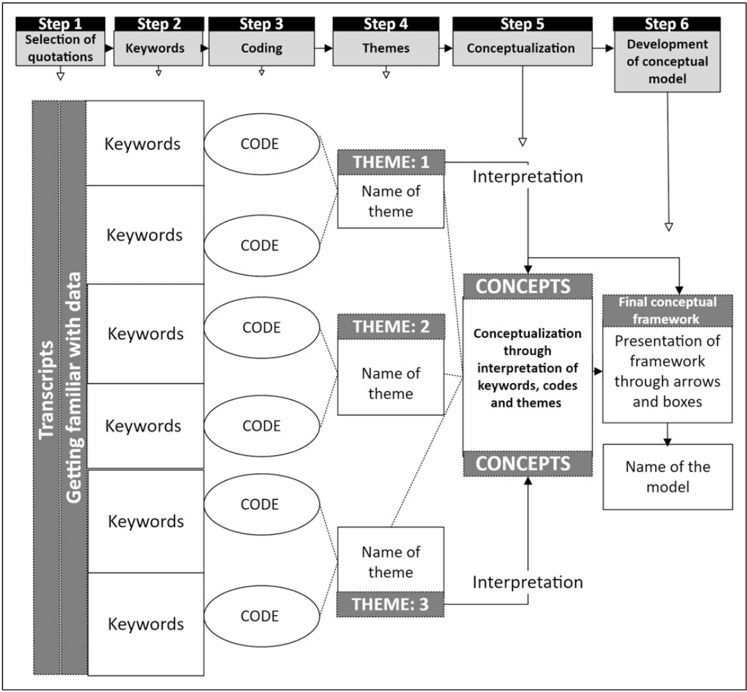
Thematic analysis is a highly popular technique among qualitative researchers for analyzing qualitative data, which usually comprises thick descriptive data. However, the application and use of thematic analysis has also involved complications due to confusion regarding the final outcome’s presentation as a conceptual model. This paper develops a systematic thematic analysis process for creating a conceptual model from qualitative research findings. It explores the adaptability of the proposed process across various research methodologies, including constructivist methodologies, positivist methodologies, grounded theory, and interpretive phenomenology, and justifies their application. The paper distinguishes between inductive and deductive coding approaches and emphasizes the merits of each. It suggests that the derived systematic thematic analysis model is valuable across multiple disciplines, particularly in grounded theory, ethnographic approaches, and narrative approaches, while also being adaptable to more descriptive, positivist-based methodologies. By providing a methodological roadmap, this study enhances the rigor and replicability of thematic analysis and offers a comprehensive strategy for theoretical conceptualization in qualitative research. The contribution of this paper is a systematic six-step thematic analysis process that leads to the development of a conceptual model; each step is described in detail and examples are given.
Verified 2026-11-22 · 1 reference not checked yet
Overview
CoChat Summary
TL;DR
This methodological paper presents a six-step systematic thematic analysis process for developing a conceptual model from qualitative data, illustrated with Naeem and Ozuem’s (2022a) panic-buying study. It introduces 6Rs for keyword selection, 6Rs for coding, and 4Rs for theming to enhance rigor and trustworthiness.
Key findings
- The paper proposes six steps: transcription/familiarization and quotation selection; keyword selection; coding; theme development; conceptualization through interpretation of keywords, codes, and themes; and development of a conceptual model.
- It introduces 6Rs for keyword selection (realness, richness, repetition, rationale, repartee, regal), 6Rs for coding (robust, reflective, resplendent, relevant, radical, righteous), and 4Rs for theming (reciprocal, recognizable, responsive, resourceful).
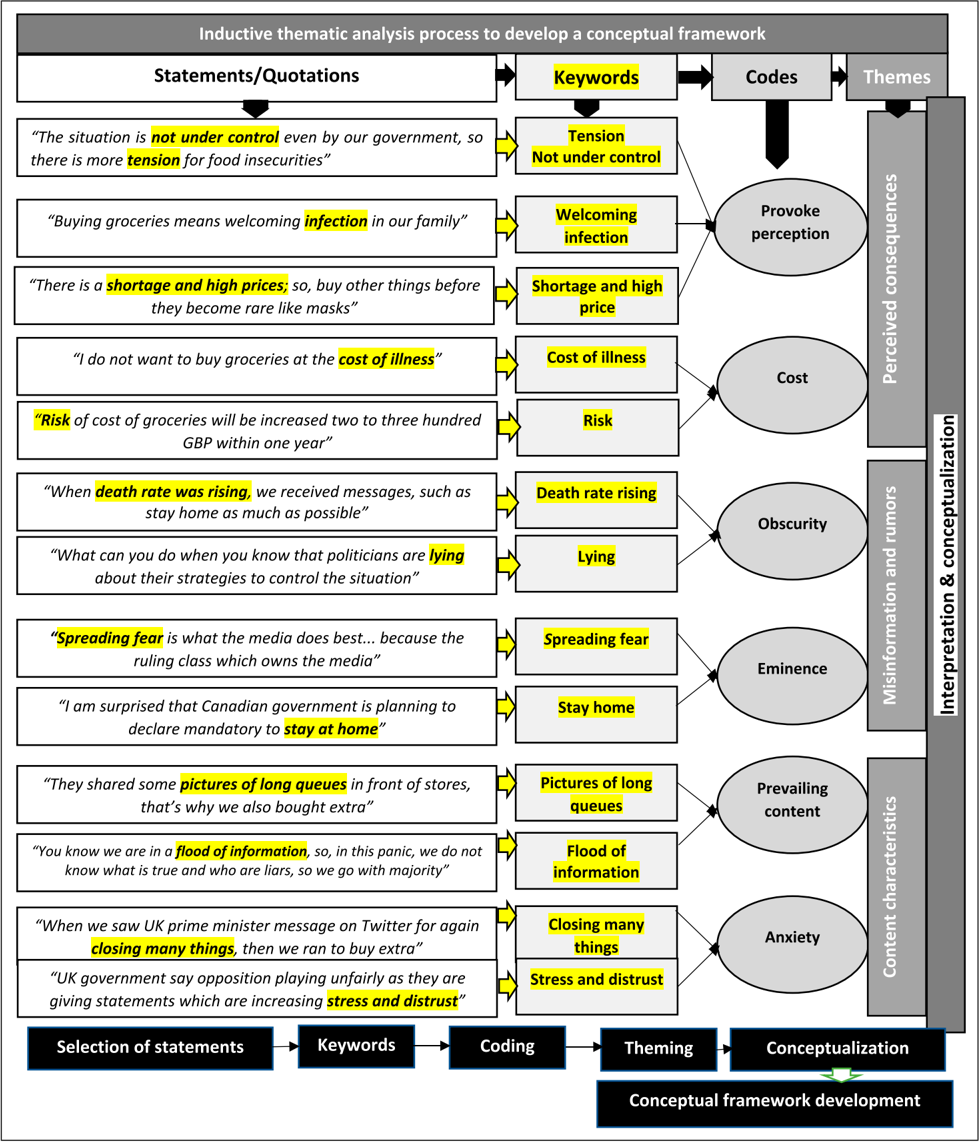
- In the exemplar study, three main themes emerged: “Perceived consequences” from codes “Provoke perception” and “Cost”; “Misinformation and rumors” from codes “Obscurity” and “Eminence”; and “Content Characteristics” from codes “Prevailing content” and “Anxiety.”
- The exemplar’s final model, “Panic buying as social practice,” was based on Protection Motivation Theory (PMT) and the Theory of Rumor Transmission (TORT).
Methods
- Design: a methodological/conceptual paper that presents a comprehensive systematic model for thematic analysis culminating in a conceptual model, using Naeem and Ozuem (2022a) as an exemplar.
- Exemplar data: qualitative data gathered from Twitter, YouTube, and interviews; the exemplar used a six-stage thematic analysis and a social constructionist perspective with PMT and TORT as theoretical foundations.
- Main analysis: the paper describes each of the six steps in detail, provides practical examples from the exemplar, and compares the proposed process with Braun and Clarke’s (2006) six steps of thematic analysis.
Limitations
- The paper states that the potential of the process to address other research contexts or quantitative methods may require further exploration, and that the efficiency of the method compared with other model-building approaches has not been empirically tested.
- Evident from the text: the proposed six-step process and the 6Rs/4Rs are illustrated through a single exemplar study and are not independently validated or empirically compared with alternative thematic analysis approaches.
Model-written summary. Check it against the paper before relying on it.
Integrity signals
Registry
Cites
Statistics
Figures

Verification
Claims the paper makes
0 Valid · 4 Not valid · 56 Not checked · 89 Own results and interpretations
The cited sources that could be checked couldn’t confirm or dispute this claim.
In the paper
“For narrative approaches, conceptual model development focuses on personal experiences, emotions, and life histories (Eldh et al., 2020).”
§ A Step-by-Step Process of Thematic Analysis to Develop a Conceptual Model in Qualitative Research > Step 6: Development of Conceptual Model.
What the sources say
- Could not verifycites Eldh et al., 2020 matched to “Quotations in Qualitative Studies: Reflections on Constituents, Custom, and Purpose” (2020) sourceExperimental — accuracy not yet measured
The Discussion and Conclusions (page numbers unavailable) address how quotations can illustrate qualitative analysis and findings. A search for narrative approaches, conceptual model development, emotions, and life histories found no passage addressing the attributed claim. (LLM, conf=0.72)
plainstates an association- Asserted: passes — The authors put it forward as true.
- Checkable: passes — It can be checked against evidence.
- Load-bearing: unclear — It is unclear whether the paper’s conclusions depend on it.
- Based: passes — The paper gives a reason why it holds.
- Could not verify
In the paper
“The analytical process balances between descriptive analysis, which outlines patterns or trends, and interpretive analysis, which offers subjective perspectives (Miles & Huberman, 1994, p. 56).”
§ A Step-by-Step Process of Thematic Analysis to Develop a Conceptual Model in Qualitative Research > Step 2: Selection of Keywords.
What the sources say
- Not matchedcites Miles & Huberman, 1994, p. 56
An author–year citation the paper’s reference list doesn’t settle. We don’t search these by name.
plain- Asserted: passes — The authors put it forward as true.
- Checkable: passes — It can be checked against evidence.
- Load-bearing: passes — The paper’s conclusions depend on it.
- Based: passes — The paper gives a reason why it holds.
- Not matched
In the paper
“However, the thematic analysis approach could also fit a post-positivist paradigm (Howell, 2012, p. 30).”
§ A Step-by-Step Process of Thematic Analysis to Develop a Conceptual Model in Qualitative Research > Step 2: Selection of Keywords.
What the sources say
- Not matchedcites Howell, 2012, p. 30
An author–year citation the paper’s reference list doesn’t settle. We don’t search these by name.
hedgedstates an association- Asserted: passes — The authors put it forward as true.
- Checkable: passes — It can be checked against evidence.
- Load-bearing: unclear — It is unclear whether the paper’s conclusions depend on it.
- Based: passes — The paper gives a reason why it holds.
- Not matched
In the paper
“Hence, quotation selection is not simply a mechanical task but is influenced by the researcher's philosophical and theoretical approach (Jackson & Mazzei, 2012).”
§ A Step-by-Step Process of Thematic Analysis to Develop a Conceptual Model in Qualitative Research > Step 1: Transcription, Familiarization With the Data, and Selection of Quotations.
What the sources say
- Not matchedcites Jackson & Mazzei, 2012
An author–year citation the paper’s reference list doesn’t settle. We don’t search these by name.
plainstates a cause- Asserted: passes — The authors put it forward as true.
- Checkable: passes — It can be checked against evidence.
- Load-bearing: passes — The paper’s conclusions depend on it.
- Based: passes — The paper gives a reason why it holds.
- Not matched
A conclusion the paper draws from its own results — it cites no other source for it, so there is none to check. The quote shows it is in the paper.
In the paper
“Thus, keywords serve as a critical bridge between data and themes in different methodologies.”
§ A Step-by-Step Process of Thematic Analysis to Develop a Conceptual Model in Qualitative Research > Step 4: Theme Development.
boostedstates an association- Asserted: passes — The authors put it forward as true.
- Checkable: passes — It can be checked against evidence.
- Load-bearing: unclear — It is unclear whether the paper’s conclusions depend on it.
- Based: passes — The paper gives a reason why it holds.
10 more claims
Create a free account to see all 149 claims and every source verdict.
- It may state two separate claims as one. 54
- Probably not a substantial claim. 128
Claims other papers make about this one
Each is checked against this paper’s own text: does it say what the citing paper says it does?
The source backs part of the claim, not all of it — or backs it for a different population, condition or comparison.
In the citing paper
“With the identified keywords, initial coding was further informed by and cross-referenced to the literature on AI ethics and governance, particularly addressing public concerns in government AI, alongside the author team's collective expertise in AI-driven digital transformation in public administration.”
From Accountability in Government Use of AI : Citizen Concerns and Preferences (2025) · cites this paper as Naeem et al. 2023
Experimental — accuracy not yet measuredThe source backs part of the claim, not all of it — or backs it for a different population, condition or comparison.
In the citing paper
“Thematic analysis is a highly popular technique among qualitative researchers for analyzing qualitative data, which usually comprises thick descriptive data (Naeem et al., 2023).”
From The Psycho-Emotive Effects of AI-Generated Fake News on Social Media Users (2026) · cites this paper as Naeem et al., 2023
Experimental — accuracy not yet measuredThe cited source says what the claim attributes to it.
In the citing paper
“The selection of keywords was guided by the 6Rs framework-Realness, Richness, Repetition, Rationale, Repartee, and Regal-to ensure they accurately represented the essence of the data (Naeem et al. 2023).”
From Accountability in Government Use of AI : Citizen Concerns and Preferences (2025) · cites this paper as Naeem et al. 2023
The cited source says what the claim attributes to it.
In the citing paper
“The data were analyzed through Naeem et al.'s (2023) six-step thematic analysis process to develop a conceptual framework (Naeem & Ozuem, 2022).”
From “It’s Not Just About Competition – It’s Ceremony”: Introducing the Embedded Indigeneity Framework for Understanding Identity, Mission, and Practice in TCU and NASNTI Athletics (2026) · cites this paper as Naeem et al. (2023)
The cited source says what the claim attributes to it.
In the citing paper
“The selected methodology was implemented due to the end results that 1) presented a novel conceptual framework and 2) serves as a contextually specific extension of existing theory/theories (Naeem et al., 2023).”
From “It’s Not Just About Competition – It’s Ceremony”: Introducing the Embedded Indigeneity Framework for Understanding Identity, Mission, and Practice in TCU and NASNTI Athletics (2026) · cites this paper as Naeem et al., 2023
Self-check
Percentages, sums and reported differences re-computed from the paper’s own numbers.
Each contradiction between two passages listed here was confirmed by an independent check.
Rated minor: it would not touch a result — a value no result rests on, a p-value that stays on the same side of the significance level, or a conflict that is clerical, resolved elsewhere in the paper, or outside its own findings.
In the paper
§ A Step-by-Step Process of Thematic Analysis to Develop a Conceptual Model in Qualitative Research > Step 6: Development of Conceptual Model.
“Positivism, which favours inductive methods, builds its model on top of previously established theories and conducts its experiments in an unbiased manner.”
§ A Step-by-Step Process of Thematic Analysis to Develop a Conceptual Model in Qualitative Research > Step 6: Development of Conceptual Model.
“An inductive approach is primarily data-driven, whereby themes are derived from the data itself without the influence of pre-existing theories (Braun & Clarke, 2006).”
Citations
Cites
Using thematic analysis in psychology
Braun, V., & Clarke, V. (2006) · Qualitative Research in Psychology · doi:10.1191/1478088706qp063oa · Cited by 194,414
Qualitative Data Analysis: An Expanded Sourcebook
(1994) · Journal of Environmental Psychology · doi:10.1016/s0272-4944(05)80231-2 · Cited by 48,420 · cited 2×
“In the coding process, consideration of keywords helps in multiple ways: The analytical process balances between descriptive analysis, which outlines patterns or trends, and interpretive analysis, which offers subjective perspectives (Miles & Huberman, 1994, p. 56).”
Lincoln, Y. S., Guba, E. G., & Pilotta, J. J. (1985) · International Journal of Intercultural Relations · doi:10.1016/0147-1767(85)90062-8 · Cited by 45,787 · cited 1×
“…degrees of subjectivity and objectivity has underscored the fl exibility intrinsic to research methodologies and highlighted that these tools of analysis are intimately intertwined with, and, indeed, emerge from the distinctive nature of speci fi c disciplines and perspectives (Lincoln & Guba, 1985).”
BackgroundThe Discovery of Grounded Theory: Strategies for Qualitative Research
Glaser, B. G., & Strauss, A. L. (2017) · Aldine (Routledge reprint) · doi:10.4324/9780203793206 · Cited by 25,789
The qualitative content analysis process
Elo, S., & Kyngäs, H. (2008) · Journal of Advanced Nursing · doi:10.1111/j.1365-2648.2007.04569.x · Cited by 22,617 · cited 1×
“Deductive coding, linked with descriptive analysis, is a top-down approach where pre-existing theories, models, or codes guide the data analysis (Elo & Kyng¨as, 2008).”
Method(2009) · Cited by 21,330
Reflecting on reflexive thematic analysis
Braun, V., & Clarke, V. (2019) · Qualitative Research in Sport, Exercise and Health · doi:10.1080/2159676x.2019.1628806 · Cited by 19,677
(1998) · Medical Entomology and Zoology · Cited by 18,397
(2014) · Cited by 15,747
S., N. L. (2017) · doi:10.1177/1609406917733847 · Cited by 14,051 · cited 3×
“· Robust: Coding should convey the true essence of data in a theoretical manner (Nowell et al., 2017).”
Background
Research works printed but not linked: 9
- 1. Arar, K. (2017). The what's and why's of the how to of qualitative research. Qualitative Report, 22(11), 2956-2958.
- 16. Creswell, J. W. (2012). Educational research. Pearson.
- 19. Denzin, N. K., & Salvo, J. (2020). New directions in theorizing qualitative research: Theory as resistance. Myers Education Press.
- 62. Oliver, P. (2021). Using qualitative methods to answer your research question (First). Open University Press.
- 63. Patton, M. Q. (2015). Qualitative research & evaluation methods: Integrating theory and practice (fourth). Sage Publications, Inc. Qualitative research (pp. 273-290). Sage.
- 67. Saldana, J. (2021). The coding manual for qualitative researchers (Fourth). Sage.
- 68. Saldana, J. M. (2016). The coding manual for qualitative researchers (4rd ed.). Sage Publications.
- 74. Seale, C. (2013). Qualitative research practice. In C. Seale, G. Gobo, J. Gubrium, & D. Silverman (Eds.), Concise paperback. Sage.
- 80. Tracy, S. J. (2019). Qualitative research methods: Collecting evi- dence, crafting analysis, communicating impact (2nd ed.). Wiley Blackwell.
Cited by
Items 1,701–1,800 of 2,204
Mohamed, H., Salsberg, J., Alanzi, T. M., Mohamed, M., & Kelly, D. (2026) · Supportive Care in Cancer · doi:10.1007/s00520-026-11236-2 · Cited by 1
“The Framework method deductively utilised a semi-structured interview format with predetermined questions, serving as an agreed analytic framework, while also allowing for inductive discovery of unexpected aspects of the participants’ experiences of the phenomena [25].”
InfluentialRabenu, E., & Shertzer, Y. (2025) · Journal of Nursing Management · doi:10.1155/jonm/5525447 · Cited by 2
“Tis approach ensured that the analysis remained grounded in the data while systematically progressing from initial codes to higher-level thematic insights [33, 34].”
McLaughlin, J., Coleman-Fountain, E., Cullingworth, J. B., Pearson, C., Shildrick, T., & Watson, N. (2026) · The Sociological Review · doi:10.1177/00380261261460810
Nungo, M. A., Abubakar, R., & Makokha, C. J. (2026) · Wiley eBooks · doi:10.1002/9781394282470.ch20
Perceptions and knowledge of diabetes in poor urban communities in Accra, Ghana
Awuah, R. B., Antwi, P., Sanuade, O. A., Kushitor, S. B., Marphatia, A. A., Kretchy, I. A., Amon, S., BLANDFORD, A. E., Vaughan, M., Baatiema, L., et al. (2025) · Global Public Health · doi:10.1080/17441692.2025.2516700
“Two members of the project team (RBA and HMJ) conducted the analysis using the thematic analysis approach (Lochmiller, 2021; Naeem et al., 2023).”
CIRCULAR ECONOMY IN AIRPORT CATERING OPERATIONS
Yıldız, Ö. E. (2026) · Doğuş Üniversitesi Dergisi · doi:10.31671/doujournal.1652953
Understanding Phenomenological Qualitative Inquiry in Information Science and Informatics Research
Mukungu, I., & Lyaka, M. (2026) · IGI Global eBooks · doi:10.4018/979-8-3693-4018-9.ch008
Essman, M., Parnham, J. C., Chang, K., Etkind, M. P., Shah, P., Smith, D., Vasiljevic, M., Boyland, E. J., Cummins, S., Vamos, E. P., et al. (2025) · medRxiv · doi:10.1101/2025.08.18.25332943
Exploring Safe Place: Insights from Thai Children At-Risk
Jaroenkajornkij, N., Girish, M., Binson, B., & Lev‐Wiesel, R. (2025) · Child Indicators Research · doi:10.1007/s12187-025-10279-x
“Thematic analysis was selected for its flexibility in identifying meaningful patterns across heterogeneous qualitative data (Naeem et al., 2023).”
Hussain, A. (2026) · EDPACS · doi:10.1080/07366981.2026.2681070 · Cited by 1
Shroff, D. D., Govindan, S., D'Souza, A., et al. (2026) · International Journal of Qualitative Studies on Health and Well-Being · doi:10.1080/17482631.2026.2654071
Grichko, V., Driver, J., Mulder, S., & Hall, S. M. (2026) · Review of Education · doi:10.1002/rev3.70167 · Cited by 2
Routhier, F., Lettre, J., Longchamps, F., et al. (2026) · Children & Society · doi:10.1111/chso.70029
Human–AI interaction data governance and personal health management: Analysis of the literature
Liu, X., & Shankar, K. (2026) · Data & Policy · doi:10.1017/dap.2026.10080
“The thematic analysis followed the six-step approach proposed by Naeem et al. (2023).”
Njakoi, C. K., Owajege, C. N., & Wirsiy, F. S. (2026) · Discover Public Health · doi:10.21203/rs.3.rs-9455647/v1
The dynamics of ethnic violence and the role of social media in contemporary Ethiopia
Tekalegn, S. H. (2025) · International Journal of History · doi:10.22271/27069109.2025.v7.i5c.416
“The following table illustrates the major themes and their frequency during a six-step thematic content analysis that was followed by reflexive thematic analysis (Braun & Clarke, 2012; Naeem et al. , 2023) [8, 29] .”
A socioecological system approach to analyzing the impact of rangeland enclosures in Somaliland
Ibrahim, K. J. (2025) · Sustainable Environment · doi:10.1080/27658511.2025.2602972
Armijo, C., Villagomez, A., Knecht-Sabres, L. J., et al. (2025) · Journal of Rehabilitation Practices and Research · doi:10.33790/jrpr1100183
A contextualised analysis of elite sport policies in South Africa
Mthombeni, S., Coopoo, Y., & Noorbhai, H. (2026) · International Journal of Sport Policy and Politics · doi:10.1080/19406940.2026.2727431
Oneka, G., & Birn, A. (2026) · Nursing Inquiry · doi:10.1111/nin.70100
“After coding the data, G.O. identified and refined the themes employing a process described by Naeem et al. (2023).”
Digital benevolence: What drives TikTok users to donate to online beggars?Preprint
Kurniawan, R. (2025) · SSRN Electronic Journal · doi:10.2139/ssrn.5086050
Roberts, J., López, S. A., & Macdonald, S. D. (2026) · Emerald Group Publishing Limited eBooks · doi:10.1108/978-1-80686-467-620261011
Jemiluyi, O., & Afolabi, A. A. (2026) · Journal of Black Psychology · doi:10.1177/00957984261490179
Choo, S. Y., Low, M. P., & Har, W. M. (2026) · Contributions to environmental sciences & innovative business technology · doi:10.1007/978-981-92-1780-9_7
Turnbull, D., & Chugh, R. (2026) · Quality & Quantity · doi:10.1007/s11135-026-02652-x · Cited by 1
“Recent methodological work emphasises the value of a structured, step-by-step approach to thematic analysis in supporting the development of conceptual models (Naeem et al. 2023 ).”
Beyond recognition: gendered violence and the critique of political economy in Croatia
Kujundžić, J. (2025) · Frontiers in Sociology · doi:10.3389/fsoc.2025.1656897 · Cited by 2
Barriers to Utilization of Urban Health Post Services in Taybad, Iran: A Qualitative Study
soufi, A., Zynali, R., Mirzakhani, K., et al. (2026) · Journal of Health Research and Development · doi:10.66224/jhrd.4.1.43
Daukere, B. E., & paul, I. I. (2025) · SSRN Electronic Journal · doi:10.2139/ssrn.5239653
Yusoph, R. A. (2026) · World sustainability series · doi:10.1007/978-981-95-2310-8_15
Lowry, S., & Toner, P. (2026) · Advances in Medical Education and Practice · doi:10.2147/amep.s575726 · Cited by 1
Hassen, N., Mohamed, A., Rajeswaran, K., Reibeling, W., Hashie, C., Talreja, A., Yuyitung, L., Slonimerov, E., Golam, M. S., Sammy, J., et al. (2025) · Urban forestry & urban greening · doi:10.1016/j.ufug.2025.129258
Smith, C., & Wallin, I. (2026) · Forestry An International Journal of Forest Research · doi:10.1093/forestry/cpag036
Career anchors and early career self-management
Gerhardt, T. (2026) · Higher Education Skills and Work-based Learning · doi:10.1108/heswbl-11-2025-0510 · Cited by 1
The Stabilizing Effect of Multimedia on ESL Spelling Retention: A Mixed-Methods Study
Pandayan, R. P. (2025) · Journal of Education and Learning Reviews · doi:10.60027/jelr.2025.1624 · Cited by 2
Armed conflict and cholera outbreaks: a narrative review of epidemiology, challenges, and responses
Quadri, S. A. Q. (2026) · Academia Medicine and Health · doi:10.20935/acadmedhealth8124
Jahanbakhsh, E. (2025) · SSRN Electronic Journal · doi:10.2139/ssrn.5371602 · Cited by 3
Daniel, E. I., Nwankwo, N., Adah, C. A., Oshodi, O. S., Emuze, F. A., Chinyio, E., & Umeokafor, N. I. (2025) · Journal of Engineering Design and Technology · doi:10.1108/jedt-02-2025-0095 · Cited by 2
Forrester‐Bowling, T., Bennetts, S. L., McLure, J., Peeters, A., Scott, D. A., Berk, M., Moylan, S., Carolin, R., & Lucas, J. J. (2025) · International Journal of Mental Health Nursing · doi:10.1111/inm.70176
From borrowing to localization: Implementing the pyramid model in a Canadian early childhood context
Li, L., & de Sanchez, G. A. (2026) · Journal of Childhood Education & Society · doi:10.37291/jces.828
“Transcripts were analyzed thematically following an iterative process of open coding, categorization, and theme development (Naeem et al., 2023).”
Goodday, S., Karlin, E., Sorensen, M., Yang, R., Gordon, P., Opoku, C., Vuong, D., Wilson, J., McKenzie, D., Piccotti, J., et al. (2026) · JMIR mhealth and uhealth · doi:10.2196/85425 · Cited by 1
“A thematic analysis [25,26] of qualitative data captured during these interactions was conducted to identify themes for app improvement.”
Muhyie, J. H., Ayal, D. Y., & Teshome, T. T. (2026) · Progress in Disaster Science · doi:10.1016/j.pdisas.2026.100708
Heritage language revival: digital media’s role in grandparent-grandchild interactions
Romanowski, P. (2026) · Innovation in Language Learning and Teaching · doi:10.1080/17501229.2026.2614753 · Cited by 2
Gray, S., Curley, L. J., & Sime, P. J. (2026) · Psychiatry Psychology and Law · doi:10.1080/13218719.2025.2599134
Olson, P. S., Nathisuwan, S., Katz, M. D., et al. (2025) · Journal of Pharmaceutical Policy and Practice · doi:10.1080/20523211.2025.2593123
“Thematic analysis was undertaken following a six-step process: (1) familiarisation with the data, (2) generation of initial codes, (3) identification of themes, (4) review of themes, (5) definition and naming of themes, and (6) production of the report (Naeem et al., 2023).”
Karanikas, N., & Hasan, S. M. T. (2026) · Safety Science · doi:10.1016/j.ssci.2026.107337
Malik, U. A. O., Ali, S., & Yasmeen, R. (2025) · Research Square · doi:10.21203/rs.3.rs-5537207/v1
A qualitative study of system justification among Italian LGB activists
Bonetti, C., Bassi, S., Caricati, L., Giuffré, M., & Rossi, F. (2025) · Psychology and Sexuality · doi:10.1080/19419899.2025.2487450
“In this sense, themes were the outcome reassuming patterns of meanings that arose from the data that informed research questions (Braun & Clarke, 2006; Naeem et al., 2023).”
The Impact of STEM Enrichment on Problem-Solving Skills Among Gifted Learners
Cheikhmous, A. A., & Mohamed, A. H. H. (2025) · Gifted Education International · doi:10.1177/02614294251380959
When the Number Falls Short: Nurses, Postoperative Pain Discordance, and Opioid Stewardship
Ramadan, O. M. E., Ibrahim, S. R. S., Alshammari, M. S. S., Elmezayn, A. E. M., Elsayed, G. E. A., Mohamed, S. A., Alasqah, I., & Eldesoky, H. A. M. (2026) · Pain Management Nursing · doi:10.1016/j.pmn.2026.08.014
Collaço, N., Kennington, A., Greenberg, N., Imber, T., Warne, D., & Sodergren, S. C. (2026) · Current Oncology · doi:10.3390/curroncol33070422
“Survey responses and co-design workshop data were analysed by NC and SS using a deductive, descriptive thematic approach guided by Naeem et al.’s [19] systematic process for developing conceptual models in qualitative research.”
Navigating identities: between belonging and understanding
Mahmud, C. R. (2026) · Language and Intercultural Communication · doi:10.1080/14708477.2025.2612164
Misaligned: Exploring Undergraduates’ Career Values and Perceptions of Teaching
Bowsher, A., Rice, J. K., & Bill, K. (2026) · American Journal of Education · doi:10.1086/743002
Yang, Y. (2026) · Journal of Communication Management · doi:10.1108/jcom-12-2025-0331
Good death and end-of-life care preferences: perspectives from older Singaporeans
Lee, H. J., Jung, I., Chen, S., Park, M. S.-A., & Luk, S. C. Y. (2026) · BMC Palliative Care · doi:10.1186/s12904-026-02162-5 · Cited by 1
“The specific procedure [24] was as follows: three coders (HL, IJ, SC) independently read the transcripts and performed open coding, allowing them to interpret, analyse, and identify thematic patterns within the semantics of participants’ expressions.”
Beyond the checklist: structuring risk perception in high-altitude adventure cycling
Xie, T., Wu, X., Huang, R., Guo, W., & Shi, S. (2026) · Tourism Recreation Research · doi:10.1080/02508281.2026.2637465
Ghimire, R., Sharma, S., Bhusal, R., et al. (2026) · Discover Public Health · doi:10.1186/s12982-026-02916-9
Citizenship formation and resilience among Ukrainian female migrants: case studies from Norway
Tokovská, M., Domogalla, S. A., Bell-Mizori, A. R., & Ferreira, V. N. (2026) · Frontiers in Psychology · doi:10.3389/fpsyg.2025.1720857
“The analysis followed a systematic approach combining elements of narrative analysis (Allen, 2017) and thematic analysis (Naeem et al., 2023).”
Communication Infrastructures and Platform Dynamics in Shaping Entrepreneurial Success
Komodromos, M., Harkiolakis, T., Papalexandris, S., et al. (2026) · IGI Global eBooks · doi:10.4018/979-8-3373-4566-6.ch009
Mahala, A., Jayalakshmi, A. V., Chauhan, B., Bauddh, M., & Mahakur, B. K. (2026) · Discover Education · doi:10.1007/s44217-026-01789-z
“Transcripts were analyzed thematically using Braun and Clarke’s six-phase approach [58], supplemented by the Framework Method to ensure analytic congruence with quantitative results.”
Wise, J. M., Byun, J. Y., Benning, L., Ott, C., Pruitt, Z. C., Krier, S. E., López, D. J., Turan, J. M., Weiser, S. D., Wingood, G. M., et al. (2025) · BMC Health Services Research · doi:10.1186/s12913-025-13690-w
“Thematic analysis techniques were utilized to identify, analyze, and report themes emerging from the qualitative data [4, 23].”
The attendance paradox: schools as ambivalent spaces of adolescent substance use
Abinaya, A., & Vijayalakshmi, V. (2026) · Frontiers in Public Health · doi:10.3389/fpubh.2026.1920425
“The fourth pass moved from themes to conceptualization, following the six-step process of Naeem et al. (26): selection of representative quotations; identification of keywords within quotations; coding; theme development; conceptualization; and development of a conceptual model.”
InfluentialKetwa, Z., Seleke, Z., & Bantwini, B. D. (2026) · Journal of Education and Learning Technology · doi:10.38159/jelt.2026782
Perera, C. R., Hewege, C., & Hassan, S. (2025) · Emerald Group Publishing Limited eBooks · doi:10.1108/978-1-83708-844-720251013
Okhifun, I. G. (2026) · Cureus · doi:10.7759/cureus.101511 · Cited by 1
“Data were extracted and analysed using the Thematic Content Analysis approach, as described by Naeem et al. [37], including: 1.”
Cybersécurité, Gouvernance & Innovation
Salehi, A., & Motaghi, H. (2026) · doi:10.3917/emi.benta.2026.01.0168
First Year CS Students Exploring Implications of Social Media Recommendation Algorithms
Apiola, M. (2025) · International Convention on Information and Communication Technology, Electronics and Microelectronics · doi:10.1109/mipro65660.2025.11131972
“As part of their final set of assignments, students were given a learning task that invited them to reflect on the current technological landscape and their The data were thematically analyzed in ATLAS.ti [ 34].”
Cyprien, L., Fekete, S., Leech, S. M., Fung, B. A. S., Hervieux, A., Wagner, C., & Gould, K. (2026) · People and Nature · doi:10.1002/pan3.70295
“The Stewardship Plan covers the Richardson, Red Earth, ESAR and WSAR ranges. analysis of the transcripts (Naeem et al., 2023 ).”
Women’s Experiences of Helplessness and Powerlessness During the Perinatal PeriodPreprint
Hanson, S. (2026) · Research Square · doi:10.21203/rs.3.rs-9595534/v1
Ji, W., Zhao, Y., Kang, Y., He, Z., Xu, L., Shukar, S., Aikepaier, A., Chen, X., He, Q., Zeng, M., et al. (2026) · Journal of Patient-Reported Outcomes · doi:10.1186/s41687-026-01026-z
Zhuwakinyu, M. (2026) · Journal of Communication Management · doi:10.1108/jcom-12-2025-0336
Yi, H., Xian, L., Zhang, Y., Zeng, J., & Zhang, Z. (2026) · ACM Conference on Fairness, Accountability, and Transparency (FAccT) · doi:10.1145/3805689.3812239 · Cited by 1
Radmard, H., Foroutan, A., & Adib, D. (2026) · The American journal of family therapy · doi:10.1080/01926187.2025.2610774
“Data were analyzed using the systematic six-step thematic analysis process outlined by Naeem et al. (2023).”
InfluentialKile, S. (2025) · Chapman University Digital Commons (Chapman University) · doi:10.36837/chapman.000683
Breen, A. K., Lai, T. C., Robinson, K. H., Feldman, D., Elder, C. V., Cooper, C., McBurney, D., McDougall, R. J., Karp, C. A., Pang, K. C., et al. (2026) · International Journal of Transgender Health · doi:10.1080/26895269.2026.2729543
Beg, M. J. (2025) · Indian Journal of Psychological Medicine · doi:10.1177/02537176251317159
Brunton, J., & Lawn, S. (2026) · Journal of Health Organization and Management · doi:10.1108/jhom-12-2025-0895 · Cited by 2
Williams, B. J., Hill, N., Cole, D., Gomersall, S. R., Tweedy, S. M., Cairney, J., & Hill, J. R. (2026) · JSAMS Plus · doi:10.1016/j.jsampl.2026.100139
“Additionally, a deductive thematic approach was used to analyse data related to recommendations provided to people with epilepsy against the two research questions [20].”
Kunisaki, L., & Kane, K. M. (2026) · AERA Open · doi:10.1177/23328584261419818
Lopes, W. A. C., Rusteiko, A. C., Mendes, C. R., Honório, N. V. C., & Okano, M. T. (2025) · IFIP advances in information and communication technology · doi:10.1007/978-3-032-03515-8_32
A thematic analysis of A-level physics examiner reports on gravity
McInerney, C. (2026) · Physics Education · doi:10.1088/1361-6552/ae806d
Agich, A., & Dóczi, T. (2025) · Sprint, sports research international · doi:10.1556/1020.2025.00016 · Cited by 1
Manaliyo, J. C. (2026) · African Journal of Hospitality Tourism and Leisure · doi:10.46222/ajhtl.19770720.775
Alruwaili, M. M., Munir, F., Carrillo, P. M., & Soetanto, R. (2025) · Safety · doi:10.3390/safety11030090
“Codes were continually refined and synthesized into themes through constant comparison, supported by iterative reading and team-based discussions [30,31].”
Botero, K., Rendón, C., García, A. B., et al. (2025) · Palliative Medicine Reports · doi:10.1177/10966218251366067
Fall, L., & Little, H. (2026) · European Journal of Education · doi:10.1111/ejed.70692
Webster, C. A., Moon, J., Kern, B. D., Reed, J. A., Becerra, V., Erwin, H. E., McLoughlin, G. M., Craig, D. W., Tejeda-Delgado, C., & Dauenhauer, B. D. (2026) · European Physical Education Review · doi:10.1177/1356336x261464361
Transitioning from Printed to Digitized Self-Learning Modules: Challenges Encountered by Teachers
Fortaleza, R., & BANTULO, J. S. (2025) · Psychology and Education A Multidisciplinary Journal · doi:10.70838/pemj.440603
Travel influencers as online co-creators of experience: a tourist-centred perspective
Ghanavati, H., Espelt, N. G., & De-Juan-Vigaray, M. D. (2026) · Tourism Recreation Research · doi:10.1080/02508281.2026.2705472
Climatic Risks in South American Coastal Ecosystems: A Mixed-Methods Review
Nagy, G. J., Muñoz, N. S., Olivares, I., & Soto, I. L. (2026) · Advances in Environmental and Engineering Research · doi:10.21926/aeer.2603019
Leading Digital Change in Cambodian Teacher Education
Bou, D., Lang, B., Loem, S., et al. (2026) · IGI Global eBooks · doi:10.4018/979-8-2600-1142-3.ch005
van Haeringen, S. L., Vandenbroucke, A. R. E., Swaab, H., & Jansen, L. M. C. (2026) · Frontiers in Psychology · doi:10.3389/fpsyg.2026.1809135 · Cited by 4
SARIKOÇ, G., & Belen, H. M. (2026) · International Journal of Environmental Research and Public Health · doi:10.3390/ijerph23091097
Clinicians’ Perspective on Counseling Clients With Reproductive Trauma: A Phenomenological Study
Kent, V., & Overfelt, C. (2025) · Journal of Mental Health Counseling · doi:10.17744/mehc.47.4.02 · Cited by 2
Fanani, A. Z., Syarif, A. M., Laksana, D. A. W., et al. (2025) · Techno Com · doi:10.62411/tc.v24i2.12723
“Thematic analysis that investigates qualitative data that provides broad answers to the research questions and objectives of the study [18], has complicated challenges in presenting the results as a conceptual model [19].”
Kartika, A., Rozak, H. A., Sugiarti, S., Rahmadhani, S., & Kusumawardani, A. (2026) · Journal of Governance and Regulation · doi:10.22495/jgrv15i2siart3 · Cited by 1
Right-Wing Populism and the Culture Industry: Russell Brand and Conspiratorial Discourse
Isaacs, R. (2026) · Palgrave Studies in European Political Sociology · doi:10.1007/978-3-032-13933-7_11
Metadata
- Authors
- Naeem, M., Ozuem, W., Howell, K., & Ranfagni, S.
- Affiliations
- University of Gloucestershire (GB)
- University of Cumbria (GB)
- Northumbria University (GB)
- University of Florence (IT)
- Corresponding author
- Naeem, Muhammad
- Venue
- International Journal of Qualitative Methods
- Publisher
- SAGE Publications
- Published
- 2023-10
- Volume
- 22
- ISSN
- 1609-4069 (ISSN-L)
- OpenAlex
- W4388503650
- Cited by
- 2,243
- References
- 71
- Citations by year
- 2026: 1000 · 2025: 981 · 2024: 258 · 2023: 4
- FWCI
- 1654.78
- Type
- journal article
- Language
- en
- Open access
- gold
- doi.org
- Licence
- Locations
- International Journal of Qualitative Methods (publishedVersion, cc-by-nc)
- Insight (University of Cumbria) (acceptedVersion)
- DOAJ (DOAJ: Directory of Open Access Journals) (submittedVersion, cc-by-sa)
- Florence Research (University of Florence) (submittedVersion)
- Topics
- Social Sciences › Education › Qualitative Research Methods and Applications
- Social Sciences › Sociology and Political Science › Qualitative Research Methods and Ethics
- Social Sciences › General Social Sciences › Computational and Text Analysis Methods
- Keywords
- thematic analysis, conceptual modeling, qualitative data analysis, inductive coding, deductive coding, grounded theory, interpretive phenomenology, constructivist research, positivist research, theoretical conceptualization, replicability
About these checks
Registry, retraction, Cites and statistics results are computed, not judged, with one exception: a printed reference that no index lists is read once by a model before it counts as a citation error. Claims are extracted by a model and kept only when their quote appears verbatim in the text; each cited source is then checked, with a model’s help, for whether it says what the claim relies on. Those verdicts can be wrong — read the claim’s quote and the cited source before relying on one.
The claim verdicts this report counts are experimental: their accuracy is not yet measured.
A language model drew the claims from the paper on 2026-10-10, under version 3 of the claim definition (model deepseek-v4.1-flash, prompt extract-v3).
A second model labelled each claim on 2026-10-10 (model jev-1.13-20260917, definition revision gold-guideline-v0.2).
Cited sources are checked with a language model’s help (gpt-6-sol).
Statistics and arithmetic are recomputed, not judged.
Confidence bands are shown only for fields calibrated on our annotated test set. None is calibrated yet, so no band is shown.
What counts as a claim ›How we measure confidence ›How we check this ›
Are you an author, or do you see a problem with this page? Request a review
Data sources
Bibliographic data: Semantic Scholar, OpenAlex, Crossref.
Contains information from the Semantic Scholar Academic Graph Datasets, made available under the ODC Attribution License (ODC-BY 1.0).
Semantic Scholar’s data is described in: Kinney, R., et al. (2023). The Semantic Scholar Open Data Platform. arXiv:2301.10140.
