

A Step-by-Step Process of Thematic Analysis to Develop a Conceptual Model in Qualitative Research
Open accessThe DOI matches its Crossref record; 77 of the 78 references it cites were found in a registry or an index, and 1 are not checked yet; 2 of the 57 sources its claims cite were checked for support.
Abstract
Thematic analysis is a highly popular technique among qualitative researchers for analyzing qualitative data, which usually comprises thick descriptive data. However, the application and use of thematic analysis has also involved complications due to confusion regarding the final outcome’s presentation as a conceptual model. This paper develops a systematic thematic analysis process for creating a conceptual model from qualitative research findings. It explores the adaptability of the proposed process across various research methodologies, including constructivist methodologies, positivist methodologies, grounded theory, and interpretive phenomenology, and justifies their application. The paper distinguishes between inductive and deductive coding approaches and emphasizes the merits of each. It suggests that the derived systematic thematic analysis model is valuable across multiple disciplines, particularly in grounded theory, ethnographic approaches, and narrative approaches, while also being adaptable to more descriptive, positivist-based methodologies. By providing a methodological roadmap, this study enhances the rigor and replicability of thematic analysis and offers a comprehensive strategy for theoretical conceptualization in qualitative research. The contribution of this paper is a systematic six-step thematic analysis process that leads to the development of a conceptual model; each step is described in detail and examples are given.
Verified 2026-11-22 · 1 reference not checked yet
Overview
CoChat Summary
TL;DR
This methodological paper presents a six-step systematic thematic analysis process for developing a conceptual model from qualitative data, illustrated with Naeem and Ozuem’s (2022a) panic-buying study. It introduces 6Rs for keyword selection, 6Rs for coding, and 4Rs for theming to enhance rigor and trustworthiness.
Key findings
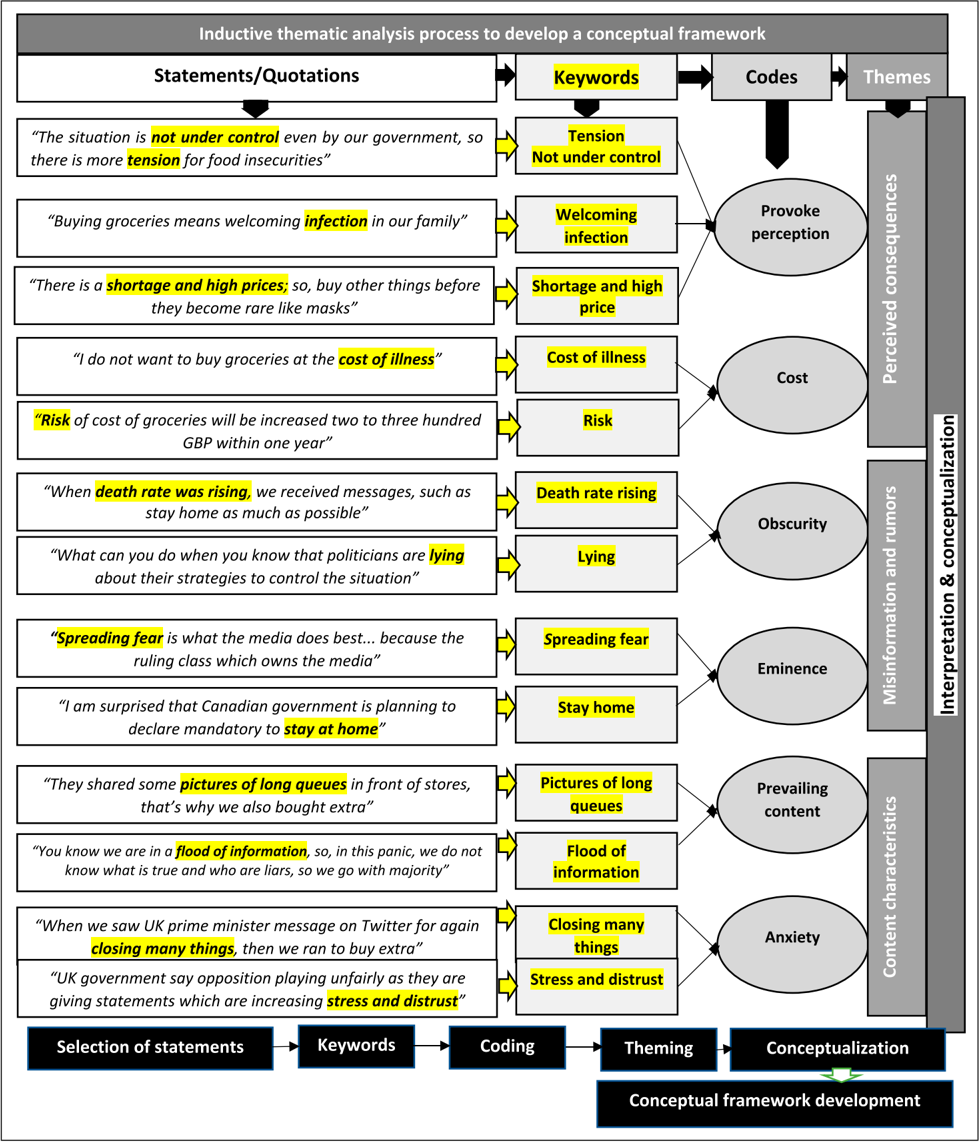
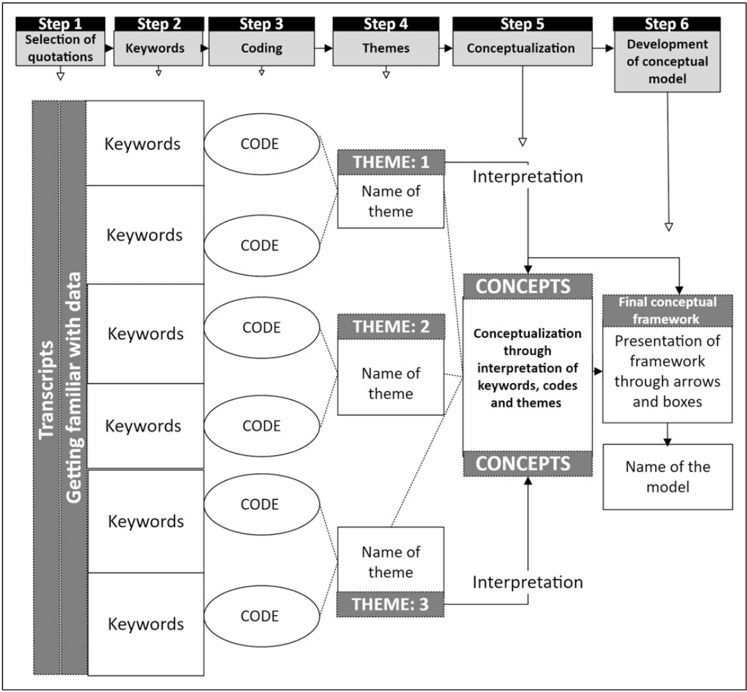
- The paper proposes six steps: transcription/familiarization and quotation selection; keyword selection; coding; theme development; conceptualization through interpretation of keywords, codes, and themes; and development of a conceptual model.
- It introduces 6Rs for keyword selection (realness, richness, repetition, rationale, repartee, regal), 6Rs for coding (robust, reflective, resplendent, relevant, radical, righteous), and 4Rs for theming (reciprocal, recognizable, responsive, resourceful).
- In the exemplar study, three main themes emerged: “Perceived consequences” from codes “Provoke perception” and “Cost”; “Misinformation and rumors” from codes “Obscurity” and “Eminence”; and “Content Characteristics” from codes “Prevailing content” and “Anxiety.”
- The exemplar’s final model, “Panic buying as social practice,” was based on Protection Motivation Theory (PMT) and the Theory of Rumor Transmission (TORT).
Methods
- Design: a methodological/conceptual paper that presents a comprehensive systematic model for thematic analysis culminating in a conceptual model, using Naeem and Ozuem (2022a) as an exemplar.
- Exemplar data: qualitative data gathered from Twitter, YouTube, and interviews; the exemplar used a six-stage thematic analysis and a social constructionist perspective with PMT and TORT as theoretical foundations.
- Main analysis: the paper describes each of the six steps in detail, provides practical examples from the exemplar, and compares the proposed process with Braun and Clarke’s (2006) six steps of thematic analysis.
Limitations
- The paper states that the potential of the process to address other research contexts or quantitative methods may require further exploration, and that the efficiency of the method compared with other model-building approaches has not been empirically tested.
- Evident from the text: the proposed six-step process and the 6Rs/4Rs are illustrated through a single exemplar study and are not independently validated or empirically compared with alternative thematic analysis approaches.
Model-written summary. Check it against the paper before relying on it.
Integrity signals
Registry
Cites
Statistics
Figures

Verification
Claims the paper makes
0 Valid · 4 Not valid · 56 Not checked · 89 Own results and interpretations
The cited sources that could be checked couldn’t confirm or dispute this claim.
In the paper
“For narrative approaches, conceptual model development focuses on personal experiences, emotions, and life histories (Eldh et al., 2020).”
§ A Step-by-Step Process of Thematic Analysis to Develop a Conceptual Model in Qualitative Research > Step 6: Development of Conceptual Model.
What the sources say
- Could not verifycites Eldh et al., 2020 matched to “Quotations in Qualitative Studies: Reflections on Constituents, Custom, and Purpose” (2020) sourceExperimental — accuracy not yet measured
The Discussion and Conclusions (page numbers unavailable) address how quotations can illustrate qualitative analysis and findings. A search for narrative approaches, conceptual model development, emotions, and life histories found no passage addressing the attributed claim. (LLM, conf=0.72)
plainstates an association- Asserted: passes — The authors put it forward as true.
- Checkable: passes — It can be checked against evidence.
- Load-bearing: unclear — It is unclear whether the paper’s conclusions depend on it.
- Based: passes — The paper gives a reason why it holds.
- Could not verify
In the paper
“The analytical process balances between descriptive analysis, which outlines patterns or trends, and interpretive analysis, which offers subjective perspectives (Miles & Huberman, 1994, p. 56).”
§ A Step-by-Step Process of Thematic Analysis to Develop a Conceptual Model in Qualitative Research > Step 2: Selection of Keywords.
What the sources say
- Not matchedcites Miles & Huberman, 1994, p. 56
An author–year citation the paper’s reference list doesn’t settle. We don’t search these by name.
plain- Asserted: passes — The authors put it forward as true.
- Checkable: passes — It can be checked against evidence.
- Load-bearing: passes — The paper’s conclusions depend on it.
- Based: passes — The paper gives a reason why it holds.
- Not matched
In the paper
“However, the thematic analysis approach could also fit a post-positivist paradigm (Howell, 2012, p. 30).”
§ A Step-by-Step Process of Thematic Analysis to Develop a Conceptual Model in Qualitative Research > Step 2: Selection of Keywords.
What the sources say
- Not matchedcites Howell, 2012, p. 30
An author–year citation the paper’s reference list doesn’t settle. We don’t search these by name.
hedgedstates an association- Asserted: passes — The authors put it forward as true.
- Checkable: passes — It can be checked against evidence.
- Load-bearing: unclear — It is unclear whether the paper’s conclusions depend on it.
- Based: passes — The paper gives a reason why it holds.
- Not matched
In the paper
“Hence, quotation selection is not simply a mechanical task but is influenced by the researcher's philosophical and theoretical approach (Jackson & Mazzei, 2012).”
§ A Step-by-Step Process of Thematic Analysis to Develop a Conceptual Model in Qualitative Research > Step 1: Transcription, Familiarization With the Data, and Selection of Quotations.
What the sources say
- Not matchedcites Jackson & Mazzei, 2012
An author–year citation the paper’s reference list doesn’t settle. We don’t search these by name.
plainstates a cause- Asserted: passes — The authors put it forward as true.
- Checkable: passes — It can be checked against evidence.
- Load-bearing: passes — The paper’s conclusions depend on it.
- Based: passes — The paper gives a reason why it holds.
- Not matched
A conclusion the paper draws from its own results — it cites no other source for it, so there is none to check. The quote shows it is in the paper.
In the paper
“Thus, keywords serve as a critical bridge between data and themes in different methodologies.”
§ A Step-by-Step Process of Thematic Analysis to Develop a Conceptual Model in Qualitative Research > Step 4: Theme Development.
boostedstates an association- Asserted: passes — The authors put it forward as true.
- Checkable: passes — It can be checked against evidence.
- Load-bearing: unclear — It is unclear whether the paper’s conclusions depend on it.
- Based: passes — The paper gives a reason why it holds.
10 more claims
Create a free account to see all 149 claims and every source verdict.
- It may state two separate claims as one. 54
- Probably not a substantial claim. 128
Claims other papers make about this one
Each is checked against this paper’s own text: does it say what the citing paper says it does?
The source backs part of the claim, not all of it — or backs it for a different population, condition or comparison.
In the citing paper
“With the identified keywords, initial coding was further informed by and cross-referenced to the literature on AI ethics and governance, particularly addressing public concerns in government AI, alongside the author team's collective expertise in AI-driven digital transformation in public administration.”
From Accountability in Government Use of AI : Citizen Concerns and Preferences (2025) · cites this paper as Naeem et al. 2023
Experimental — accuracy not yet measuredThe source backs part of the claim, not all of it — or backs it for a different population, condition or comparison.
In the citing paper
“Thematic analysis is a highly popular technique among qualitative researchers for analyzing qualitative data, which usually comprises thick descriptive data (Naeem et al., 2023).”
From The Psycho-Emotive Effects of AI-Generated Fake News on Social Media Users (2026) · cites this paper as Naeem et al., 2023
Experimental — accuracy not yet measuredThe cited source says what the claim attributes to it.
In the citing paper
“The selection of keywords was guided by the 6Rs framework-Realness, Richness, Repetition, Rationale, Repartee, and Regal-to ensure they accurately represented the essence of the data (Naeem et al. 2023).”
From Accountability in Government Use of AI : Citizen Concerns and Preferences (2025) · cites this paper as Naeem et al. 2023
The cited source says what the claim attributes to it.
In the citing paper
“The data were analyzed through Naeem et al.'s (2023) six-step thematic analysis process to develop a conceptual framework (Naeem & Ozuem, 2022).”
From “It’s Not Just About Competition – It’s Ceremony”: Introducing the Embedded Indigeneity Framework for Understanding Identity, Mission, and Practice in TCU and NASNTI Athletics (2026) · cites this paper as Naeem et al. (2023)
The cited source says what the claim attributes to it.
In the citing paper
“The selected methodology was implemented due to the end results that 1) presented a novel conceptual framework and 2) serves as a contextually specific extension of existing theory/theories (Naeem et al., 2023).”
From “It’s Not Just About Competition – It’s Ceremony”: Introducing the Embedded Indigeneity Framework for Understanding Identity, Mission, and Practice in TCU and NASNTI Athletics (2026) · cites this paper as Naeem et al., 2023
Self-check
Percentages, sums and reported differences re-computed from the paper’s own numbers.
Each contradiction between two passages listed here was confirmed by an independent check.
Rated minor: it would not touch a result — a value no result rests on, a p-value that stays on the same side of the significance level, or a conflict that is clerical, resolved elsewhere in the paper, or outside its own findings.
In the paper
§ A Step-by-Step Process of Thematic Analysis to Develop a Conceptual Model in Qualitative Research > Step 6: Development of Conceptual Model.
“Positivism, which favours inductive methods, builds its model on top of previously established theories and conducts its experiments in an unbiased manner.”
§ A Step-by-Step Process of Thematic Analysis to Develop a Conceptual Model in Qualitative Research > Step 6: Development of Conceptual Model.
“An inductive approach is primarily data-driven, whereby themes are derived from the data itself without the influence of pre-existing theories (Braun & Clarke, 2006).”
Citations
Cites
Using thematic analysis in psychology
Braun, V., & Clarke, V. (2006) · Qualitative Research in Psychology · doi:10.1191/1478088706qp063oa · Cited by 194,414
Qualitative Data Analysis: An Expanded Sourcebook
(1994) · Journal of Environmental Psychology · doi:10.1016/s0272-4944(05)80231-2 · Cited by 48,420 · cited 2×
“In the coding process, consideration of keywords helps in multiple ways: The analytical process balances between descriptive analysis, which outlines patterns or trends, and interpretive analysis, which offers subjective perspectives (Miles & Huberman, 1994, p. 56).”
Lincoln, Y. S., Guba, E. G., & Pilotta, J. J. (1985) · International Journal of Intercultural Relations · doi:10.1016/0147-1767(85)90062-8 · Cited by 45,787 · cited 1×
“…degrees of subjectivity and objectivity has underscored the fl exibility intrinsic to research methodologies and highlighted that these tools of analysis are intimately intertwined with, and, indeed, emerge from the distinctive nature of speci fi c disciplines and perspectives (Lincoln & Guba, 1985).”
BackgroundThe Discovery of Grounded Theory: Strategies for Qualitative Research
Glaser, B. G., & Strauss, A. L. (2017) · Aldine (Routledge reprint) · doi:10.4324/9780203793206 · Cited by 25,789
The qualitative content analysis process
Elo, S., & Kyngäs, H. (2008) · Journal of Advanced Nursing · doi:10.1111/j.1365-2648.2007.04569.x · Cited by 22,617 · cited 1×
“Deductive coding, linked with descriptive analysis, is a top-down approach where pre-existing theories, models, or codes guide the data analysis (Elo & Kyng¨as, 2008).”
Method(2009) · Cited by 21,330
Reflecting on reflexive thematic analysis
Braun, V., & Clarke, V. (2019) · Qualitative Research in Sport, Exercise and Health · doi:10.1080/2159676x.2019.1628806 · Cited by 19,677
(1998) · Medical Entomology and Zoology · Cited by 18,397
(2014) · Cited by 15,747
S., N. L. (2017) · doi:10.1177/1609406917733847 · Cited by 14,051 · cited 3×
“· Robust: Coding should convey the true essence of data in a theoretical manner (Nowell et al., 2017).”
Background
Research works printed but not linked: 9
- 1. Arar, K. (2017). The what's and why's of the how to of qualitative research. Qualitative Report, 22(11), 2956-2958.
- 16. Creswell, J. W. (2012). Educational research. Pearson.
- 19. Denzin, N. K., & Salvo, J. (2020). New directions in theorizing qualitative research: Theory as resistance. Myers Education Press.
- 62. Oliver, P. (2021). Using qualitative methods to answer your research question (First). Open University Press.
- 63. Patton, M. Q. (2015). Qualitative research & evaluation methods: Integrating theory and practice (fourth). Sage Publications, Inc. Qualitative research (pp. 273-290). Sage.
- 67. Saldana, J. (2021). The coding manual for qualitative researchers (Fourth). Sage.
- 68. Saldana, J. M. (2016). The coding manual for qualitative researchers (4rd ed.). Sage Publications.
- 74. Seale, C. (2013). Qualitative research practice. In C. Seale, G. Gobo, J. Gubrium, & D. Silverman (Eds.), Concise paperback. Sage.
- 80. Tracy, S. J. (2019). Qualitative research methods: Collecting evi- dence, crafting analysis, communicating impact (2nd ed.). Wiley Blackwell.
Cited by
Items 2,001–2,100 of 2,204
Phan, T. T. H., Phan, N. H. S., & Trang, L. T. (2026) · Discover Education · doi:10.1007/s44217-026-02167-5 · Cited by 1
“Representatives of the coding procedure and theme development are presented in Appendix A. RQ3, on the other hand, was responded using inductive thematic analysis guided by Naeem et al. [54].”
Naladala, R. (2025) · JOURNAL OF ADVANCE AND FUTURE RESEARCH · doi:10.56975/jaafr.v3i6.500500
Black, J., Manger, S., & Carlisle, K. (2026) · American Journal of Lifestyle Medicine · doi:10.1177/15598276261484859
“This process was adapted from Naeem et al 20 for short survey responses rather than full interview transcripts.”
From pilgrimage to policy: actionable strategies for sustainable religious tourism in India
Singh, V., & Bhuyan, A. (2025) · International Hospitality Review · doi:10.1108/ihr-03-2025-0030
Aftab, M., Abbasi, M. H., & Arif, M. (2026) · Springer eBooks · doi:10.1007/978-3-032-27041-2_5
Social construction of nature in tourism
Hosen, N., Hamzah, A., Majid, M. R., et al. (2025) · Annals of Tourism Research · doi:10.1016/j.annals.2025.103947
Acharya, S. M., Das, M., A., S. P., Shinde, B., Nikam, S., Patil, V., Choubisa, J., Sharma, A., Malkani, R. H., & Setia, M. S. (2026) · Cureus · doi:10.7759/cureus.108703
Moussa, R., Tantawy, F., Magdy, N., Sokkar, A., Khaled, R., & Bassem, M. (2026) · Energies · doi:10.3390/en19153619
Too Bold, Black, and Brilliant: Navigating the Leadership Tightrope of Assimilation vs. Authenticity
Reddick, D. (2024) · Advances in educational marketing, administration, and leadership book series · doi:10.4018/979-8-3693-0698-7.ch001
Maghfiroh, M. F. N., Barwani, F. A., Balushi, F. A., & Rahbi, A. A. (2026) · Springer eBooks · doi:10.1007/978-981-95-9276-0_19
The role of football in reducing greenhouse gas emissions
Ardali, A. A., Keshkar, S., & Heydarinejad, S. (2025) · International Journal of Environmental Studies · doi:10.1080/00207233.2025.2575584 · Cited by 1
Munyangane, O. L. (2026) · F1000Research · doi:10.12688/f1000research.189672.1
Muscat, C. C., Marshall, S. A., Irvin, A., Hickling, A., Simić, T., Broad, K., & Scratch, S. E. (2026) · Child Care Health and Development · doi:10.1111/cch.70349
“Multiple readings of transcripts supported data familiarization across all coders (Naeem et al. 2023; Nowell et al. 2017).”
Bridging Ethical Gaps in Real Estate Agency Practices: Insights from agents and consumers
Kanniyapan, G., Hwa, T. K., Keat, T. S., Aun, C. W., Yeow, T. B., & Newell, G. (2025) · Environment-Behaviour Proceedings Journal · doi:10.21834/e-bpj.v10i31.6284 · Cited by 1
Brown, C. (2026) · Computer Assisted Language Learning · doi:10.1080/09588221.2026.2737120
The little smart squirrel or the push for artificial intelligence in Lithuanian book publishing
Grigas, V., & Gudinavičius, A. (2025) · Septentrio Conference Series · doi:10.7557/5.8264
Carrapiço, E., Correia, A. R. S., & Monteiro, B. R. (2025) · Ciência & Saúde Coletiva · doi:10.1590/1413-81232025307.21562024en · Cited by 1
Pahenra, Rohmiati, Amaludin, R., Hermanto, Usman, Said, H., & Ndibo, Y. L. (2026) · Journal of Early Childhood Teacher Education · doi:10.1080/10901027.2026.2702962
Legitimate providers? An exploration of social enterprise in Norwegian welfare
Hunt, S. (2025) · Social enterprise journal · doi:10.1108/sej-11-2024-0188
Sophasath, M., Tremblay, M., Hogue, C., Brisset, A., Tandon, P., Huard, G., Rose, C. F., & Bémeur, C. (2025) · Clinics and Research in Hepatology and Gastroenterology · doi:10.1016/j.clinre.2025.102672 · Cited by 1
Paat, Y., Dorado, A. V., Tovar, D. G., Myers, N. W., Ruiz, S. L., Perez, D. A., Vara, B. L. R., Camacho, E., Núñez‐Mchiri, G. G., Zamora, H., et al. (2025) · Sustainability · doi:10.3390/su17167507 · Cited by 1
Borderland Security: State Police Perspectives on Crime and Insecurity in Mexico
Williamson, S. L., Forrai, K., del Mercado, G. V., Schafer, J. A., Telep, C. W., & Chamberlain, A. W. (2026) · International Journal of Offender Therapy and Comparative Criminology · doi:10.1177/0306624x261439098
“Interview transcripts were translated from Spanish into English and then coded using a thematic analysis approach (Braun & Clarke, 2006; Naeem et al., 2023) to identify common challenges and barriers faced by state police.”
Muene, A., Matjie, M. A., & Mabasa, F. D. (2025) · International Journal of Applied Research in Business and Management · doi:10.51137/wrp.ijarbm.422
Sustainability and Nursing: Intersecting Paths: A Bibliometric and Thematic Analysis Study
Bulut, M. (2026) · Sustainable Development · doi:10.1002/sd.70746
Ghanayem, A., & Hallak, H. (2026) · BMC Health Services Research · doi:10.1186/s12913-026-14247-1 · Cited by 1
“This may result in increased patient adherence to treatment protocols, increased satisfaction levels, and improved health results [18, 19].”
Ethical leadership and sustainable development in South Africa: pathways to a resilient future
Cheteni, P., & Umejesi, I. (2025) · Development in Practice · doi:10.1080/09614524.2025.2534152
Santosa, A., Juniarti, N., Pahria, T., & Susanti, R. D. (2026) · The Open Nursing Journal · doi:10.2174/0118744346452378260129064143
Zainol, M. Z., & Hashim, A. (2025) · Al-Makrifah Journal of Knowledge and Learning in Islamic Tradition and Culture · doi:10.37134/almakrifah.vol3.2.11a.2025
Pritts, N. (2026) · International Journal of Innovative Teaching and Learning in Higher Education · doi:10.4018/ijitlhe.413093
Bistis, M. (2025) · Hitik International Journal of Catechists and Religious Educators · doi:10.63130/hijcre.v2i2.219
“Interview transcripts, observational notes, and documentary materials were coded thematically following Naeem et al. (2023).”
Gizaw, A. T., & Abayneh, M. (2024) · Frontiers in Public Health · doi:10.3389/fpubh.2024.1273448
“After listening to the audio-recorded material, verbatim transcription was performed by the researcher simultaneously to ensure data saturation (16).”
MethodReassessing the restorative features of Japan’s kōban policing system
Héra, G. (2026) · Contemporary Justice Review · doi:10.1080/10282580.2026.2638264
“…analysing the qualitative data, I followed the approach of the qualitative deductive thematic analysis (Braun & Clarke, 2006; Moira & Brid, 2017; Naeem et al., 2023) in which the researcher identifies and organizes themes within textual data based on pre-existing theories, conceptual…”
Guracho, Y. D., Thomas, S. J., & Win, K. T. (2026) · Discover Mental Health · doi:10.1007/s44192-026-00443-2
“1 Braun and Clarke’s six-step framework for doing thematic analysis [40] • Theme 4 , Suggested mobile mental health app content for patients with depression and anxiety”
InfluentialContentious population policy-making and its consequences: a health policy analysis
Joulaei, H., Morshed-Behbahani, B., Ghadimi, P., Parashkouhi, S. N., & Mansoori, Y. (2025) · International Journal for Equity in Health · doi:10.1186/s12939-025-02469-4 · Cited by 3
“…the reliability and validity of our study, we adhered to Schwandt et al.’s (2007) [22] criteria credibility, confirmability, transferability, and dependability while conducting data analysis concurrently with data collection using Braun & Clarke’s six-step thematic analysis framework (2006) [23].”
Salcedo, A. (2025) · PREO Journal of Business and Management · doi:10.67730/ejqy1b88
Petkus, J. M. (2025) · Children s Health Care · doi:10.1080/02739615.2025.2600316
Mniwasa, E. E. (2025) · Qualitative Research in Financial Markets · doi:10.1108/qrfm-10-2024-0309 · Cited by 2
Mulry, A. L., Hincher, C. G., & Qaqish, O. (2025) · ASEE Annual Conference & Exposition · doi:10.18260/1-2--56574
Helie, N., Bae, N., & Doyon-Poulin, P. (2026) · Lecture notes in computer science · doi:10.1007/978-3-032-30798-9_18
Nasution, S. N., Marlina, M., & Batubara, H. J. (2026) · Priviet Social Sciences Journal · doi:10.55942/pssj.v6i1.1425
“Data collection was carried out through field observation, in-depth interviews, literature review, and visual documentation (Naeem et al., 2023).”
Gao, C., Liu, R., Cao, G., & Tan, J. (2026) · Early Childhood Education Journal · doi:10.1007/s10643-026-02156-1
“It has gained significant popularity among researchers in the field due to its effectiveness in qualitative data analysis (Naeem et al., 2023).”
Transformative paradigms: Advancing problem-solving methodologies in Social Sciences and Humanities
Motadi, M. S., & Sikhwari, T. T. (2026) · E-Journal of Humanities Arts and Social Sciences · doi:10.38159/ehass.20267311
Empowering young writers: perspectives from the classroom on interactive digital tools for writing
Dunn, J., Mehigan, G., & Ballentine, M. (2026) · International Journal of Early Years Education · doi:10.1080/09669760.2026.2721581
Loewenstein, A., Asper, A., & Feingold, D. (2025) · Journal of Psychoactive Drugs · doi:10.1080/02791072.2025.2479100
“Transcribed interviews were analyzed using the content analysis procedure (Vaismoradi et al. 2016), initially coding semantic segments and subsequently extracting themes and meta-themes emerging from the codes (Miles and Huberman 1984) and developing a conceptual model (Naeem et al. 2023).”
Betkus, M. H., Banner, D., Currie, L. M., Jackson, P. J., & Freeman, S. (2026) · Canadian Journal of Nursing Research · doi:10.1177/08445621261463882
Qualitative Method Design and Data Analysis
Zumitzavan, V. (2025) · Springer eBooks · doi:10.1007/978-981-95-4318-2_9
Febintatias, E. N., Syaifuddin, M., & Zukhrufurrohmah (2025) · Journal of Education Research and Evaluation · doi:10.23887/jere.v9i4.101466 · Cited by 1
Guo, M., He, M., Wang, C., Liu, Q., Ma, S., & Li, Y. (2026) · Applied Sciences · doi:10.3390/app16168086
Mennen, S. W. M., Fontanesi, C., Dokter, D., & Stubbe, J. H. (2026) · American Journal of Dance Therapy · doi:10.1007/s10465-026-09433-x
Theisen-Homer, V., Manzone, J. A., & Weaver, T. J. (2025) · Journal of Teacher Education · doi:10.1177/00224871251363949
“We then employed a systematic thematic analysis using precoding generated from key words and phrases found throughout the interviews (Naeem et al., 2023).”
Whyte-Phillips, K., & Burchell, J. (2025) · Business Management Research and Applications A Cross-Disciplinary Journal · doi:10.54093/bmra.v4i2.10020 · Cited by 2
Green, R. (2025) · The Research Repository @ WVU (West Virginia University) · doi:10.33915/etd.12747
Rafiee, M., al-Thabhawee, A. R. H., Mahdi, M. I. M., Al-Asadi, S. H. M. M., & Abbasian‐Naghneh, S. (2025) · Digital Scholarship in the Humanities · doi:10.1093/llc/fqaf132
Bohler, R. M., Lofaro, R. J., Smith, K. D., Johnson, J. A., Shehaj, B., Kite, B., & Mase, W. A. (2025) · The Journal of Rural Health · doi:10.1111/jrh.70084
When the teachers are the students: ECEC teachers becoming nontraditional college students
Shany, Y. (2025) · Journal of Early Childhood Teacher Education · doi:10.1080/10901027.2025.2593383
Hermanu, A. I., Suhartoyo, H., Munawaroh, M., Firmansyah, D., Rahmawati, F., Setyowati, E., Yuliana, M., & Siringoringo, H. (2026) · Journal of Science and Technology Policy Management · doi:10.1108/jstpm-02-2025-0036
Homelessness in Early Childhood Education & Care Pedagogy: Insights of ECEC Professionals
Bonnett, T. H., Sullivan, J., & Terry, R. (2025) · Child Care in Practice · doi:10.1080/13575279.2025.2566362
“As these steps were followed each of the researchers independently populated a coding frame (Guest et al., 2012; Naeem et al., 2023).”
Justice, C., McWilliams, J., Brown, R. B., Fowkes, V., Kamimoto, J. D., Price, I., Gomez, I., Poplau, S., & Linzer, M. (2026) · Healthcare · doi:10.3390/healthcare14172735
“The system was prompted to conduct a qualitative analysis using inductive thematic analysis (transcription, selection of key-words, coding, theme development, conceptualization, and development of a conceptual model) [24,25].”
Health Governance Review Volume 31, Issue 1
Ibragimova, I. (2026) · International Journal of Health Governance · doi:10.1108/ijhg-03-2026-177
Symposia influencing LIS curriculum and society
Aguiñaga, J., Azof, N., Friedland, M., & Chow, A. (2025) · Proceedings of the ALISE Annual Conference · doi:10.21900/j.alise.2025.1952
Accelerating Bioinformatics in Global South: A Preliminary Perspective-Driven Empirical StudyPreprint
Agu, P. C., Sharma, H., Anil Kumar, S., Khan, A., Katam, R., & Suravajhala, P. (2026) · Research Square · doi:10.21203/rs.3.rs-8549203/v1
Das, A., & Sen, A. (2026) · ShodhKosh Journal of Visual and Performing Arts · doi:10.29121/shodhkosh.v7.i12s.2026.7226
“For analysis, the author applied thematic analysis (Naeem et al., 2023) to used for observation notes.”
Saleh, R. (2026) · Frontiers in Communication · doi:10.3389/fcomm.2026.1665793
SALIHU, G. A., Gabi, D., Suru, H. U., & Garba, M. (2026) · British Journal of Contemporary Research · doi:10.67693/bjcr-vuuiq3yc
Johnson, G. U., Donkor, F., Noor, M. S., O’Leary, J., Sivalingam, V., Umeh, K., Fernandez-Mills, K., Horton, R., O'Hara, M., & Pearson-Jenkins, J. (2026) · Nurse Education Today · doi:10.1016/j.nedt.2026.107195
Edmunds, M., Patroni, J., & Olorunnisola, T. S. (2025) · Trauma Violence & Abuse · doi:10.1177/15248380251343188 · Cited by 1
“An inductive approach involves generating codes from data that allows for the creation themes and patterns (Naeem et al., 2023).”
A Measurement Method for Quantifying Application Landscape Complexity with Enterprise Architecture
Luiz, R. M. J., Stoica, E., Piest, J. P. S., Bukhsh, F. A., & Levelt, W. (2026) · Lecture notes in computer science · doi:10.1007/978-3-032-28110-4_2
Baha, P., & Kihwele, J. E. (2026) · Quality Assurance in Education · doi:10.1108/qae-09-2025-0268 · Cited by 1
Detecting User Stances on AI-Generated YouTube Content
Gunti, R. R., & Dilinika, J. M. S. (2026) · doi:10.1109/scse70081.2026.11499872
“Even-tually, as the pattern became clearer, code categories were grouped into thirty-three themes that accurately interpreted the underlying meanings (see section VI) [23].”
Experience design in virtual events: extending the digital experience economy
Jung, S., Shin, H. W., Yang, S., & Kim, S. (2026) · Journal of Hospitality and Tourism Technology · doi:10.1108/jhtt-10-2025-0963
The Use of Large Language Models for Qualitative Research: DECOTAPreprint
Player, L., Hughes, R., Mitev, K., et al. (2024) · doi:10.31234/osf.io/t5gbv
Motha, S. G., Naidoo, N., & Mostert, K. (2026) · Health Promotion & Physical Activity · doi:10.55225/hppa.735
Community pharmacy resiliency during Covid-19 pandemic in Iran: A qualitative study
Zomorodi, Z., Sharif, F. V., Moradi, N., & Sharif, Z. (2025) · Exploratory Research in Clinical and Social Pharmacy · doi:10.1016/j.rcsop.2025.100670 · Cited by 1
Evaluating Consumer Credit Forbearance Regulation: Evidence from an Estonian Policy Change
Pulk, K., & Kalamees, P. (2026) · Journal of Consumer Policy · doi:10.1007/s10603-026-09621-9 · Cited by 1
“Although there is always some ambiguity in theme development, we developed themes with the principles of reciprocity, recognition, responsiveness, and resourcefulness in mind (Naeem et al. 2023).”
Rahman, M. H. (2025) · Qualitative Research in Financial Markets · doi:10.1108/qrfm-06-2025-0163
Collaborative Unit Design Professional Development: Harnessing the Potential of Partnership
Wilson, R. E., & Bradbury, L. U. (2026) · School Science and Mathematics · doi:10.1111/ssm.70066
Soriano, W. C. (2024) · International Journal of Research Studies in Education · doi:10.5861/ijrse.2024.24841
Depremlerin Rizikoları ve Sosyal Etkileri: 6 Şubat Depremlerinin Kitlesel Travması
Tanrıverdi, A. B. (2025) · Afet ve Risk Dergisi · doi:10.35341/afet.1611776 · Cited by 1
Hsiao, C.-H., Lin, K.-J., Lee, Y.-T., Lin, S. T., & Chen, L. (2025) · Systems · doi:10.3390/systems13110952
Expectations and opinions on digital manuscript systems: A survey of expert users
Sapa, R., Żymełka‐Pietrzak, A., & Kita‐Huber, J. (2026) · The Journal of Academic Librarianship · doi:10.1016/j.acalib.2026.103257
Johnson, M. C., Rose, B., Pamphile, S., Landrum, D., Ferguson, A. L., Charette, R. J., & Haywood, D. (2025) · The Family Journal · doi:10.1177/10664807251343897
Mapping the Crowdsourcing Workforce in Latin America and the Caribbean
Williams, G., Santos, M. D. L., To, A., & Savage, S. (2024) · Avances en Interacción Humano-Computadora · doi:10.47756/aihc.y9i1.160
O brincar nas práticas assistenciais de técnicos de enfermagem junto à criança hospitalizada
Petruccelli, G., Wernet, M., Silveira, A. O., & Maia, E. B. S. (2025) · Revista gaúcha de enfermagem · doi:10.1590/1983-1447.2025.20240348.pt · Cited by 6
Partnering With Lived Experience Experts: A Toolkit for Inclusive Consumer Research
Carlini, J., Milne, E., & Muir, R. (2025) · International Journal of Market Research · doi:10.1177/14707853251381411 · Cited by 1
“Initial content analysis was conducted using an inductive approach, adhering to the guidelines of Naeem et al. (2023).”
Jiang, Y., & Lin, Y. (2025) · Communication Theory · doi:10.1093/ct/qtaf023
Wise blindness: reinterpreting false information engagement through a thematic analysis
Ding, W., & Ge, Y. H. (2025) · Social Influence · doi:10.1080/15534510.2025.2469704 · Cited by 1
“The analysis process began by identifying significant quotes and keywords as anchor points for coding, which was in line with best practices in thematic analysis (e.g., Naeem et al., 2023).”
Ricks, T., Jacob, E. R., & Lam, L. (2025) · Collegian Journal of the Royal College of Nursing Australia · doi:10.1016/j.colegn.2025.11.004
Problems and Opportunities in Agritourism among Micro Entrepreneurs in Kapangan, Benguet
Mating, K. M. (2025) · Cognizance Journal of Multidisciplinary Studies · doi:10.47760/cognizance.2025.v05i05.013
Clifford, D., Wall, A., Kurdi, A. B., & Bennie, M. (2026) · International Journal of Clinical Pharmacy · doi:10.1007/s11096-026-02180-6
Ebubedike, M., Addae-Kyeremeh, E., Kwaah, C. Y., Agyei, C., & Cullen, J. (2026) · Educational Action Research · doi:10.1080/09650792.2026.2682814
Peterson, H. (2025) · Palgrave studies in gender and education · doi:10.1007/978-3-031-98941-4_2
Analysing the Impact of Survivorship Bias on Border Security Effectiveness
KANTEMİR, Ö., Birdal, E. O., & Özkil, A. (2026) · CONTEMPORARY MILITARY CHALLENGES · doi:10.2478/cmc-2026-0008
Sufi values on TikTok: Social media usage and its implications for the digital spread of Sufism
Wajdi, F., Fatimah, A. N., Effendi, M. R., & Amaliyah (2026) · Heliyon · doi:10.1016/j.heliyon.2026.e45518 · Cited by 1
Knox, A. W., & Brownell, G. (2025) · Journal of Social Work and Social Welfare Policy · doi:10.33790/jswwp1100154
Faculty Upskilling for Digital Transformation: A Model for Higher Education Institutions
Charles, T., & Fares, N. (2026) · IGI Global eBooks · doi:10.4018/979-8-3373-8959-2.ch009
Begum, R., Chamaa, A. E., Parikh, P., Walton, D. M., & Rushton, A. (2026) · BMJ Open · doi:10.1136/bmjopen-2026-120001
“70 It will begin with participants’ accounts, from which initial codes will be generated inductively.”
Jong, A., & Jong, S. (2026) · The social science · doi:10.3390/socsci15060375
Lin, L. S. F. (2025) · Springer eBooks · doi:10.1007/978-3-031-87817-6_9
Metadata
- Authors
- Naeem, M., Ozuem, W., Howell, K., & Ranfagni, S.
- Affiliations
- University of Gloucestershire (GB)
- University of Cumbria (GB)
- Northumbria University (GB)
- University of Florence (IT)
- Corresponding author
- Naeem, Muhammad
- Venue
- International Journal of Qualitative Methods
- Publisher
- SAGE Publications
- Published
- 2023-10
- Volume
- 22
- ISSN
- 1609-4069 (ISSN-L)
- OpenAlex
- W4388503650
- Cited by
- 2,243
- References
- 71
- Citations by year
- 2026: 1000 · 2025: 981 · 2024: 258 · 2023: 4
- FWCI
- 1654.78
- Type
- journal article
- Language
- en
- Open access
- gold
- doi.org
- Licence
- Locations
- International Journal of Qualitative Methods (publishedVersion, cc-by-nc)
- Insight (University of Cumbria) (acceptedVersion)
- DOAJ (DOAJ: Directory of Open Access Journals) (submittedVersion, cc-by-sa)
- Florence Research (University of Florence) (submittedVersion)
- Topics
- Social Sciences › Education › Qualitative Research Methods and Applications
- Social Sciences › Sociology and Political Science › Qualitative Research Methods and Ethics
- Social Sciences › General Social Sciences › Computational and Text Analysis Methods
- Keywords
- thematic analysis, conceptual modeling, qualitative data analysis, inductive coding, deductive coding, grounded theory, interpretive phenomenology, constructivist research, positivist research, theoretical conceptualization, replicability
About these checks
Registry, retraction, Cites and statistics results are computed, not judged, with one exception: a printed reference that no index lists is read once by a model before it counts as a citation error. Claims are extracted by a model and kept only when their quote appears verbatim in the text; each cited source is then checked, with a model’s help, for whether it says what the claim relies on. Those verdicts can be wrong — read the claim’s quote and the cited source before relying on one.
The claim verdicts this report counts are experimental: their accuracy is not yet measured.
A language model drew the claims from the paper on 2026-10-10, under version 3 of the claim definition (model deepseek-v4.1-flash, prompt extract-v3).
A second model labelled each claim on 2026-10-10 (model jev-1.13-20260917, definition revision gold-guideline-v0.2).
Cited sources are checked with a language model’s help (gpt-6-sol).
Statistics and arithmetic are recomputed, not judged.
Confidence bands are shown only for fields calibrated on our annotated test set. None is calibrated yet, so no band is shown.
What counts as a claim ›How we measure confidence ›How we check this ›
Are you an author, or do you see a problem with this page? Request a review
Data sources
Bibliographic data: Semantic Scholar, OpenAlex, Crossref.
Contains information from the Semantic Scholar Academic Graph Datasets, made available under the ODC Attribution License (ODC-BY 1.0).
Semantic Scholar’s data is described in: Kinney, R., et al. (2023). The Semantic Scholar Open Data Platform. arXiv:2301.10140.
