

A Step-by-Step Process of Thematic Analysis to Develop a Conceptual Model in Qualitative Research
Open accessThe DOI matches its Crossref record; 77 of the 78 references it cites were found in a registry or an index, and 1 are not checked yet; 2 of the 57 sources its claims cite were checked for support.
Abstract
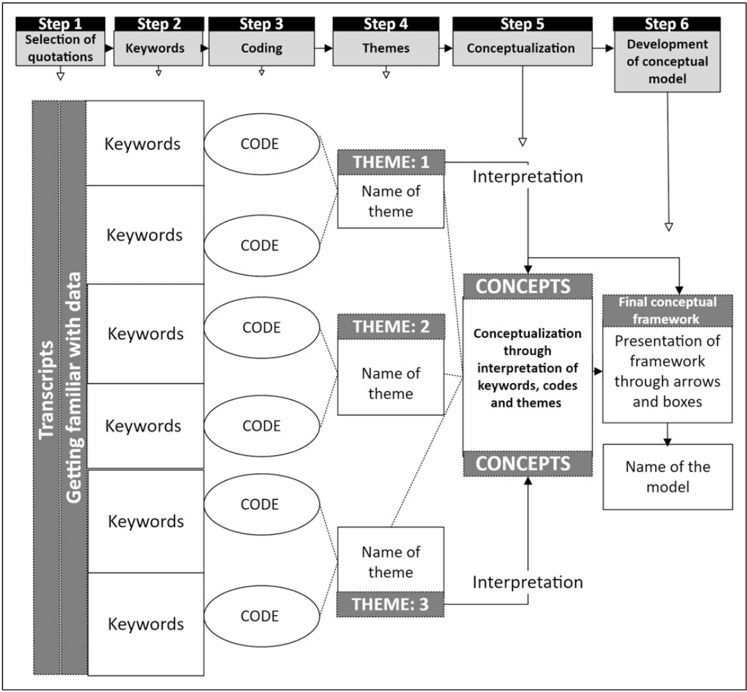
Thematic analysis is a highly popular technique among qualitative researchers for analyzing qualitative data, which usually comprises thick descriptive data. However, the application and use of thematic analysis has also involved complications due to confusion regarding the final outcome’s presentation as a conceptual model. This paper develops a systematic thematic analysis process for creating a conceptual model from qualitative research findings. It explores the adaptability of the proposed process across various research methodologies, including constructivist methodologies, positivist methodologies, grounded theory, and interpretive phenomenology, and justifies their application. The paper distinguishes between inductive and deductive coding approaches and emphasizes the merits of each. It suggests that the derived systematic thematic analysis model is valuable across multiple disciplines, particularly in grounded theory, ethnographic approaches, and narrative approaches, while also being adaptable to more descriptive, positivist-based methodologies. By providing a methodological roadmap, this study enhances the rigor and replicability of thematic analysis and offers a comprehensive strategy for theoretical conceptualization in qualitative research. The contribution of this paper is a systematic six-step thematic analysis process that leads to the development of a conceptual model; each step is described in detail and examples are given.
Verified 2026-11-22 · 1 reference not checked yet
Overview
CoChat Summary
TL;DR
This methodological paper presents a six-step systematic thematic analysis process for developing a conceptual model from qualitative data, illustrated with Naeem and Ozuem’s (2022a) panic-buying study. It introduces 6Rs for keyword selection, 6Rs for coding, and 4Rs for theming to enhance rigor and trustworthiness.
Key findings
- The paper proposes six steps: transcription/familiarization and quotation selection; keyword selection; coding; theme development; conceptualization through interpretation of keywords, codes, and themes; and development of a conceptual model.
- It introduces 6Rs for keyword selection (realness, richness, repetition, rationale, repartee, regal), 6Rs for coding (robust, reflective, resplendent, relevant, radical, righteous), and 4Rs for theming (reciprocal, recognizable, responsive, resourceful).
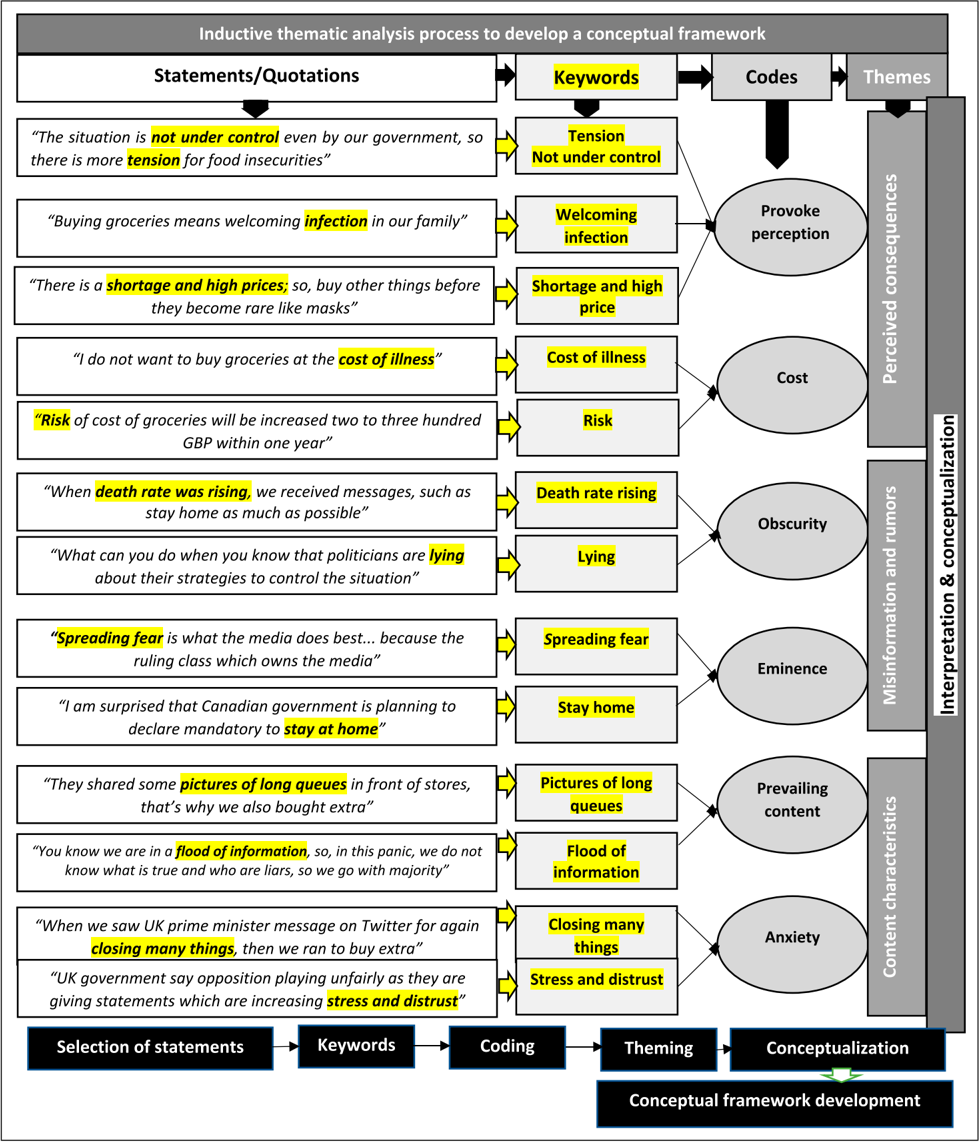
- In the exemplar study, three main themes emerged: “Perceived consequences” from codes “Provoke perception” and “Cost”; “Misinformation and rumors” from codes “Obscurity” and “Eminence”; and “Content Characteristics” from codes “Prevailing content” and “Anxiety.”
- The exemplar’s final model, “Panic buying as social practice,” was based on Protection Motivation Theory (PMT) and the Theory of Rumor Transmission (TORT).
Methods
- Design: a methodological/conceptual paper that presents a comprehensive systematic model for thematic analysis culminating in a conceptual model, using Naeem and Ozuem (2022a) as an exemplar.
- Exemplar data: qualitative data gathered from Twitter, YouTube, and interviews; the exemplar used a six-stage thematic analysis and a social constructionist perspective with PMT and TORT as theoretical foundations.
- Main analysis: the paper describes each of the six steps in detail, provides practical examples from the exemplar, and compares the proposed process with Braun and Clarke’s (2006) six steps of thematic analysis.
Limitations
- The paper states that the potential of the process to address other research contexts or quantitative methods may require further exploration, and that the efficiency of the method compared with other model-building approaches has not been empirically tested.
- Evident from the text: the proposed six-step process and the 6Rs/4Rs are illustrated through a single exemplar study and are not independently validated or empirically compared with alternative thematic analysis approaches.
Model-written summary. Check it against the paper before relying on it.
Integrity signals
Registry
Cites
Statistics
Figures

Verification
Claims the paper makes
0 Valid · 4 Not valid · 56 Not checked · 89 Own results and interpretations
The cited sources that could be checked couldn’t confirm or dispute this claim.
In the paper
“For narrative approaches, conceptual model development focuses on personal experiences, emotions, and life histories (Eldh et al., 2020).”
§ A Step-by-Step Process of Thematic Analysis to Develop a Conceptual Model in Qualitative Research > Step 6: Development of Conceptual Model.
What the sources say
- Could not verifycites Eldh et al., 2020 matched to “Quotations in Qualitative Studies: Reflections on Constituents, Custom, and Purpose” (2020) sourceExperimental — accuracy not yet measured
The Discussion and Conclusions (page numbers unavailable) address how quotations can illustrate qualitative analysis and findings. A search for narrative approaches, conceptual model development, emotions, and life histories found no passage addressing the attributed claim. (LLM, conf=0.72)
plainstates an association- Asserted: passes — The authors put it forward as true.
- Checkable: passes — It can be checked against evidence.
- Load-bearing: unclear — It is unclear whether the paper’s conclusions depend on it.
- Based: passes — The paper gives a reason why it holds.
- Could not verify
In the paper
“The analytical process balances between descriptive analysis, which outlines patterns or trends, and interpretive analysis, which offers subjective perspectives (Miles & Huberman, 1994, p. 56).”
§ A Step-by-Step Process of Thematic Analysis to Develop a Conceptual Model in Qualitative Research > Step 2: Selection of Keywords.
What the sources say
- Not matchedcites Miles & Huberman, 1994, p. 56
An author–year citation the paper’s reference list doesn’t settle. We don’t search these by name.
plain- Asserted: passes — The authors put it forward as true.
- Checkable: passes — It can be checked against evidence.
- Load-bearing: passes — The paper’s conclusions depend on it.
- Based: passes — The paper gives a reason why it holds.
- Not matched
In the paper
“However, the thematic analysis approach could also fit a post-positivist paradigm (Howell, 2012, p. 30).”
§ A Step-by-Step Process of Thematic Analysis to Develop a Conceptual Model in Qualitative Research > Step 2: Selection of Keywords.
What the sources say
- Not matchedcites Howell, 2012, p. 30
An author–year citation the paper’s reference list doesn’t settle. We don’t search these by name.
hedgedstates an association- Asserted: passes — The authors put it forward as true.
- Checkable: passes — It can be checked against evidence.
- Load-bearing: unclear — It is unclear whether the paper’s conclusions depend on it.
- Based: passes — The paper gives a reason why it holds.
- Not matched
In the paper
“Hence, quotation selection is not simply a mechanical task but is influenced by the researcher's philosophical and theoretical approach (Jackson & Mazzei, 2012).”
§ A Step-by-Step Process of Thematic Analysis to Develop a Conceptual Model in Qualitative Research > Step 1: Transcription, Familiarization With the Data, and Selection of Quotations.
What the sources say
- Not matchedcites Jackson & Mazzei, 2012
An author–year citation the paper’s reference list doesn’t settle. We don’t search these by name.
plainstates a cause- Asserted: passes — The authors put it forward as true.
- Checkable: passes — It can be checked against evidence.
- Load-bearing: passes — The paper’s conclusions depend on it.
- Based: passes — The paper gives a reason why it holds.
- Not matched
A conclusion the paper draws from its own results — it cites no other source for it, so there is none to check. The quote shows it is in the paper.
In the paper
“Thus, keywords serve as a critical bridge between data and themes in different methodologies.”
§ A Step-by-Step Process of Thematic Analysis to Develop a Conceptual Model in Qualitative Research > Step 4: Theme Development.
boostedstates an association- Asserted: passes — The authors put it forward as true.
- Checkable: passes — It can be checked against evidence.
- Load-bearing: unclear — It is unclear whether the paper’s conclusions depend on it.
- Based: passes — The paper gives a reason why it holds.
10 more claims
Create a free account to see all 149 claims and every source verdict.
- It may state two separate claims as one. 54
- Probably not a substantial claim. 128
Claims other papers make about this one
Each is checked against this paper’s own text: does it say what the citing paper says it does?
The source backs part of the claim, not all of it — or backs it for a different population, condition or comparison.
In the citing paper
“With the identified keywords, initial coding was further informed by and cross-referenced to the literature on AI ethics and governance, particularly addressing public concerns in government AI, alongside the author team's collective expertise in AI-driven digital transformation in public administration.”
From Accountability in Government Use of AI : Citizen Concerns and Preferences (2025) · cites this paper as Naeem et al. 2023
Experimental — accuracy not yet measuredThe source backs part of the claim, not all of it — or backs it for a different population, condition or comparison.
In the citing paper
“Thematic analysis is a highly popular technique among qualitative researchers for analyzing qualitative data, which usually comprises thick descriptive data (Naeem et al., 2023).”
From The Psycho-Emotive Effects of AI-Generated Fake News on Social Media Users (2026) · cites this paper as Naeem et al., 2023
Experimental — accuracy not yet measuredThe cited source says what the claim attributes to it.
In the citing paper
“The selection of keywords was guided by the 6Rs framework-Realness, Richness, Repetition, Rationale, Repartee, and Regal-to ensure they accurately represented the essence of the data (Naeem et al. 2023).”
From Accountability in Government Use of AI : Citizen Concerns and Preferences (2025) · cites this paper as Naeem et al. 2023
The cited source says what the claim attributes to it.
In the citing paper
“The data were analyzed through Naeem et al.'s (2023) six-step thematic analysis process to develop a conceptual framework (Naeem & Ozuem, 2022).”
From “It’s Not Just About Competition – It’s Ceremony”: Introducing the Embedded Indigeneity Framework for Understanding Identity, Mission, and Practice in TCU and NASNTI Athletics (2026) · cites this paper as Naeem et al. (2023)
The cited source says what the claim attributes to it.
In the citing paper
“The selected methodology was implemented due to the end results that 1) presented a novel conceptual framework and 2) serves as a contextually specific extension of existing theory/theories (Naeem et al., 2023).”
From “It’s Not Just About Competition – It’s Ceremony”: Introducing the Embedded Indigeneity Framework for Understanding Identity, Mission, and Practice in TCU and NASNTI Athletics (2026) · cites this paper as Naeem et al., 2023
Self-check
Percentages, sums and reported differences re-computed from the paper’s own numbers.
Each contradiction between two passages listed here was confirmed by an independent check.
Rated minor: it would not touch a result — a value no result rests on, a p-value that stays on the same side of the significance level, or a conflict that is clerical, resolved elsewhere in the paper, or outside its own findings.
In the paper
§ A Step-by-Step Process of Thematic Analysis to Develop a Conceptual Model in Qualitative Research > Step 6: Development of Conceptual Model.
“Positivism, which favours inductive methods, builds its model on top of previously established theories and conducts its experiments in an unbiased manner.”
§ A Step-by-Step Process of Thematic Analysis to Develop a Conceptual Model in Qualitative Research > Step 6: Development of Conceptual Model.
“An inductive approach is primarily data-driven, whereby themes are derived from the data itself without the influence of pre-existing theories (Braun & Clarke, 2006).”
Citations
Cites
Using thematic analysis in psychology
Braun, V., & Clarke, V. (2006) · Qualitative Research in Psychology · doi:10.1191/1478088706qp063oa · Cited by 194,414
Qualitative Data Analysis: An Expanded Sourcebook
(1994) · Journal of Environmental Psychology · doi:10.1016/s0272-4944(05)80231-2 · Cited by 48,420 · cited 2×
“In the coding process, consideration of keywords helps in multiple ways: The analytical process balances between descriptive analysis, which outlines patterns or trends, and interpretive analysis, which offers subjective perspectives (Miles & Huberman, 1994, p. 56).”
Lincoln, Y. S., Guba, E. G., & Pilotta, J. J. (1985) · International Journal of Intercultural Relations · doi:10.1016/0147-1767(85)90062-8 · Cited by 45,787 · cited 1×
“…degrees of subjectivity and objectivity has underscored the fl exibility intrinsic to research methodologies and highlighted that these tools of analysis are intimately intertwined with, and, indeed, emerge from the distinctive nature of speci fi c disciplines and perspectives (Lincoln & Guba, 1985).”
BackgroundThe Discovery of Grounded Theory: Strategies for Qualitative Research
Glaser, B. G., & Strauss, A. L. (2017) · Aldine (Routledge reprint) · doi:10.4324/9780203793206 · Cited by 25,789
The qualitative content analysis process
Elo, S., & Kyngäs, H. (2008) · Journal of Advanced Nursing · doi:10.1111/j.1365-2648.2007.04569.x · Cited by 22,617 · cited 1×
“Deductive coding, linked with descriptive analysis, is a top-down approach where pre-existing theories, models, or codes guide the data analysis (Elo & Kyng¨as, 2008).”
Method(2009) · Cited by 21,330
Reflecting on reflexive thematic analysis
Braun, V., & Clarke, V. (2019) · Qualitative Research in Sport, Exercise and Health · doi:10.1080/2159676x.2019.1628806 · Cited by 19,677
(1998) · Medical Entomology and Zoology · Cited by 18,397
(2014) · Cited by 15,747
S., N. L. (2017) · doi:10.1177/1609406917733847 · Cited by 14,051 · cited 3×
“· Robust: Coding should convey the true essence of data in a theoretical manner (Nowell et al., 2017).”
Background
Research works printed but not linked: 9
- 1. Arar, K. (2017). The what's and why's of the how to of qualitative research. Qualitative Report, 22(11), 2956-2958.
- 16. Creswell, J. W. (2012). Educational research. Pearson.
- 19. Denzin, N. K., & Salvo, J. (2020). New directions in theorizing qualitative research: Theory as resistance. Myers Education Press.
- 62. Oliver, P. (2021). Using qualitative methods to answer your research question (First). Open University Press.
- 63. Patton, M. Q. (2015). Qualitative research & evaluation methods: Integrating theory and practice (fourth). Sage Publications, Inc. Qualitative research (pp. 273-290). Sage.
- 67. Saldana, J. (2021). The coding manual for qualitative researchers (Fourth). Sage.
- 68. Saldana, J. M. (2016). The coding manual for qualitative researchers (4rd ed.). Sage Publications.
- 74. Seale, C. (2013). Qualitative research practice. In C. Seale, G. Gobo, J. Gubrium, & D. Silverman (Eds.), Concise paperback. Sage.
- 80. Tracy, S. J. (2019). Qualitative research methods: Collecting evi- dence, crafting analysis, communicating impact (2nd ed.). Wiley Blackwell.
Cited by
Items 1,301–1,400 of 2,204
Performance Strategies for Latin American Dancesport: A Convergent Mixed-Method Design
Cordova, A. J., & Villaganas, E. J. (2026) · Psychology and Education A Multidisciplinary Journal · doi:10.70838/pemj.600509
Lecturers’ perceptions on student midwives’ competence in symphysis fundal height measurement
Cele, W. D., Mbeje, P., & Mhlongo, E. M. (2025) · Health SA Gesondheid · doi:10.4102/hsag.v30i0.3054
“The researcher chose thematic analysis because it is flexible and it comprises strict descriptive data (Naeem et al. 2023).”
Distribution of students in university academic fields: underlying myths, locality and influences
Kawonga, G. A., Fussy, D. S., & Mlyahilu, J. N. (2026) · International Journal of Adolescence and Youth · doi:10.1080/02673843.2026.2703093
Can local farms sustain Thai school lunches? A qualitative exploration of challenges and solutionsPreprint
Praditsorn, P., Beuchelt, T., Borgemeister, C., Nöthlings, U., Srisangwan, N., Keeratichamroen, A., & Sranacharoenpong, K. (2025) · medRxiv · doi:10.1101/2025.10.14.25338034
Muchaku, S., Zhou, L., Slayi, M., et al. (2026) · Frontiers in Human Dynamics · doi:10.3389/fhumd.2026.1858768
Okunrobo, H. O., Inegbedion, N. A., & Ugiagbe, E. O. (2026) · Children and Youth Services Review · doi:10.1016/j.childyouth.2026.108930
The Transformative Impact of AI-based (Smart-care) Technology on Ensuring 3Es:Preprint
Gupta, A. D., Sharma, K., & Tripathi, S. S. (2026) · Research Square · doi:10.21203/rs.3.rs-4838690/v1
Challenges in Adoption of AI-Driven Collaborative Innovation
Mubarak, M. F., Evans, R., Nazir, S., Shahzad, K., & Jucevičius, G. (2026) · Future of business and finance · doi:10.1007/978-3-032-06604-6_8
An Exploration into the Perspective of Health Care Leaders Regarding Retention and Satisfaction
Scott, D. A., Siceloff, B., & Roh, B. E. (2025) · doi:10.38124/ijisrt/25aug1322
Crafting resilience: reframing firm growth for artisan food entrepreneurs at farmers’ markets
Connolly, R., Repar, L. A., & Bogue, J. (2026) · Entrepreneurship and Regional Development · doi:10.1080/08985626.2026.2622327 · Cited by 1
Harris, C., & Skuthan, A. (2026) · Journal of Occupational Therapy Schools & Early Intervention · doi:10.1080/19411243.2026.2712898
Thinking Intersectionally about State Power and Resistance in the Breddon Women’s Center in England
Padmanabhan, K. (2025) · Social Politics International Studies in Gender State & Society · doi:10.1093/sp/jxaf061
Brew, C. A., & Buertey, A. A. (2026) · International Journal of Africa Nursing Sciences · doi:10.1016/j.ijans.2026.101108
García, A. L. A., & González, R. S. R. (2026) · DIALÉCTICA · doi:10.56219/dialctica.v1i27.5182
Subramanyam, N., & Meyer, D. (2025) · Environmental Research Infrastructure and Sustainability · doi:10.1088/2634-4505/ae152f · Cited by 2
“Instead, the authors took detailed notes and photographs of relevant records and documents when permitted (e.g. figure 4) which were expanded into typed transcripts and reflections (Naeem et al 2023).”
Tiro, R. S., Dube, M., & Mohlatlole, N. E. (2026) · Social Sciences · doi:10.3390/socsci15020065 · Cited by 3
Avatar Identity and Immersive Gameplay: Influences on Symbolic Fashion Brand ConsumptionPreprint
Ozuem, W., Shahaj, E. R., Willis, M., Ranfagni, S., & Howell, K. E. (2025) · SSRN Electronic Journal · doi:10.2139/ssrn.5381612
Self-citationMiah, M. S., Mia, C., Zakaria, A. F. M., et al. (2025) · Journal of Tourism and Cultural Change · doi:10.1080/14766825.2025.2553692
“Audio-recorded interviews were transcribed verbatim, and researchers MSM, CM, and NMRAC familiarized themselves with the transcripts by reading selected ones repeatedly (Naeem et al., 2023).”
Zilvar, M., & Mareš, M. (2026) · Deviant Behavior · doi:10.1080/01639625.2026.2717600
Ajayi, E. J., & Mavuru, L. (2026) · South African Journal of Education · doi:10.15700/saje.v46n3a2620
Zhou, F., & Wang, C. (2026) · Land Degradation and Development · doi:10.1002/ldr.70695
Early activation in cochlear implantation: the patient’s perspective
Biever, A., Bishop, G. A., Adkins, W. J., et al. (2025) · Cochlear Implants International · doi:10.1080/14670100.2025.2502703
“Responses to questions 5 and 6 were coded based on principles of Thematic Analysis as detailed by Naeem et al. (2023).”
Feng, S., Yang, D.-Y. D., Zhang, K., Yuan, G., Tang, H., Findlay, D., Thomas, A., MacKinnon, L., Kuang, M., Xiao, H., et al. (2025) · Advances in Medical Education and Practice · doi:10.2147/amep.s532673
“14 The qualitative reflection data from individual interviews were subjected to the steps of semantic analysis, 15 including transcript review and data coding by two independent research co-authors, and interpretation of the coded data with the development of emerging themes by the main author.”
Digital Risks as Experienced by Social Care Workers in Assisted Living
Silvennoinen, P. (2026) · Journal of Technology in Human Services · doi:10.1080/15228835.2026.2733012
Beekman, A. M., Schreuder, A., de Ru, J. C. R., van Stel, H. F., & Staal, I. I. E. (2026) · The Journal of Pediatrics Clinical Practice · doi:10.1016/j.jpedcp.2026.200201
Navigating equity tensions and enacting agency in Chinese TESOL practicums
Yan, E., Yao, N.-Y., Song, J.-J., & Zhuo, J.-L. (2026) · Teaching and Teacher Education : An International Journal of Research and Studies · doi:10.1016/j.tate.2026.105847
Contextualising mixed-use development in cities in Sub-Saharan Africa: A systematic review
Afful, D. S., Poku‐Boansi, M., Doe, B., & Asibey, M. O. (2026) · Land Use Policy · doi:10.1016/j.landusepol.2026.108345
Why do perioperative nurses resign?: A qualitative study
Mayes, C. G., & Cochran, K. (2026) · Excellence and Credentialing in Health Care · doi:10.1097/echc.0000000000000006
Pearson, H., & Dubé, A. K. (2026) · SSRN Electronic Journal · doi:10.2139/ssrn.7292191 · Cited by 1
Ramadhan, D. G. (2025) · Journal of Literacy Education · doi:10.64780/jole.v1i1.34
“Data were analyzed using thematic analysis (Lochmiller 2021; and Naeem et al 2023), guided by the three dimensions of Brennan and Resnick’s computational thinking framework: concepts, practices, and perspectives.”
Tucci, V., Lu, M., Parakh, N. D., Pazmino‐Canizares, J., Nayar, R., Thomas, Z., Mattina, G. F., Witiw, C. D., Wilson, J., Ladha, K. S., et al. (2026) · Canadian Journal of Pain · doi:10.1080/24740527.2026.2717112
Mohamed, H., Alanzi, T. M., Salsberg, J., Mohamed, M., & Kelly, D. (2026) · JMIR Cancer · doi:10.2196/77738 · Cited by 3
“We used a hybrid deduc-tive-inductive approach to data analysis [38], starting with a priori themes and allowing emergent themes to develop as the analysis progressed.”
Jaamour, D., Asthana, S., Zuniga, Y., Goel, M., Barnard, C., Post, L. A., Xu, D., & Pollack, T. (2026) · BMJ Public Health · doi:10.1136/bmjph-2025-003646
Global ocean leadership: The origin of the Ocean Panel
Sullivan, A., Pecl, G. T., Layton, C., & Ogier, E. M. (2026) · Environmental Science & Policy · doi:10.1016/j.envsci.2026.104482
The CoughRetrain Program: Restoring Control Through a Non-pharmacological Intervention
Oliveira, A., Quach, S., Newman, A. N. L., Mancopes, R., Wahab, M., Kum, E., Smith, K., Brooks, D., & Satia, I. (2026) · Lung · doi:10.1007/s00408-026-00899-7
Developing Science Teachers' Vision of Coherence Through Vertical Professional Learning Communities
Pimentel, D. R., Moriarty, T., & Carlson, J. (2025) · School Science and Mathematics · doi:10.1111/ssm.18382
Ramatea, M. A. (2025) · British Journal of Special Education · doi:10.1111/1467-8578.70064 · Cited by 6
Partnership approach success in excellences vocational high school
Jabar, C. S. A., Komariah, K., Awaludin, D. P., et al. (2025) · AIP conference proceedings · doi:10.1063/5.0292244
Wan, S. W., & Leung, S. K. Y. (2024) · Educational Management Administration & Leadership · doi:10.1177/17411432241269391
“The analysis involved an inductive process in which themes were derived from the raw data without predetermined classi fi cations (Naeem et al., 2023).”
Olayiwola-Adedoja, T. O., & Naidoo, S. (2026) · Education Sciences · doi:10.3390/educsci16071004 · Cited by 4
Zinnah, F., Minichiello, A., & Asghar, M. (2025) · ASEE Annual Conference & Exposition · doi:10.18260/1-2--57497
Maghbouli, N., Azizi, F., Behkam, S., & Pourhassan, S. (2025) · BMC Medical Education · doi:10.1186/s12909-025-08161-z
“The recorded data were transcribed, and themes were extracted, categorized, and analysed using the inductive thematic analysis (ITA) method [22].”
Shih, H.-J., Achuff, B.-J., Hollis, K. F., et al. (2026) · doi:10.2196/preprints.113194
Mazziotti, J., Tolento, C. J., & Ondusko, D. S. (2026) · Journal of Perinatology · doi:10.1038/s41372-026-02731-9
“Free-text responses underwent thematic analysis [28, 29].”
Malapela, R. G., Risenga, P. R., & Matakanye, H. (2026) · Sexes · doi:10.3390/sexes7030041
“Data were analysed using the Naeem, Ozuem, Howell, and Ranfagni data analysis method [24], following six steps: (1) Familiarisation with data: The recorded transcripts in English were read and reread by the researchers.”
Experiences of social work students at faith-based institutions
Abney, K., Williams, P. L., Ozughen, J., & Grady, M. D. (2025) · Journal of Religion & Spirituality in Social Work Social Thought · doi:10.1080/15426432.2025.2521020
“Thematic analytic methods are used to identify and present major constructs and themes that are present across the various participants’ descriptions of the phenomenon being studied (Naeem et al., 2023, Saunders et al., 2023).”
Mamba, W. M., Fourie, W. J., Botma, Y., & Heyns, T. (2026) · International Journal of Africa Nursing Sciences · doi:10.1016/j.ijans.2026.101029
Yakubu, M. O., & Esan, D. T. (2026) · Frontiers in Digital Health · doi:10.3389/fdgth.2026.1891831
“To enhance analytical rigour, coding and theme development were reviewed through peer debriefing among members of the research team (21).”
Tiong, S. P., Yang, X., Touzet, A. Y., Millward, C. P., Zipser, C. M., Tetreault, L., Gharooni, A., & Davies, B. M. (2026) · PLoS ONE · doi:10.1371/journal.pone.0333864
“Thematic analysis (TA) is a qualitative research method for identifying and analysing patterns or themes within a data-set through process such as data familiarisation and coding [11].”
Bonesso, S., Cortellazzo, L., & Afeltra, G. (2026) · Human Resource Management Journal · doi:10.1111/1748-8583.70040 · Cited by 7
Mbunda, S., Mawi, N. E., & Iseselo, M. K. (2025) · PLoS ONE · doi:10.1371/journal.pone.0325501 · Cited by 3
“A thematic analysis method was used to analyze data as stipulated by Naeem et al. [33].”
Enhancing Undergraduate Literacy in STEM Contexts: A Systematic Literature Review of Interventions
Wiggins, L. F., Wright, K. L., & Plumlee, D. G. (2026) · Innovative Higher Education · doi:10.1007/s10755-026-09958-6
Connell-Variy, T., Nanayakkara, K., West, L., & Wilkinson, S. (2026) · Urban Planning · doi:10.17645/up.11535 · Cited by 1
“This research adopted a qualitative method through thematic analysis, which looks at identifying patterns in a data set (Naeem et al., 2023).”
Ayaz-Shah, A. A., Neal, R. D., Haider, Z. F., Lloyd, K. E., Green, S. M. C., Nasir, N., Thompson, M. J., & Smith, S. G. (2025) · Frontiers in Cancer Control and Society · doi:10.3389/fcacs.2025.1568916 · Cited by 3
“Data saturation was determined as the lack of emergence of new codes from the data (24).”
Ecosystem (dis)services matter for conservation policies: Insights from Nepal
Subedi, D. R., Liu, Q., Bhuju, D. R., et al. (2025) · Earth System Governance · doi:10.1016/j.esg.2025.100303
Osman, S. G., Adom, D., Donkor, E. K., & Adu-Agyem, J. (2026) · Art Time · doi:10.62425/at.1858837
Delgado, K., & Ebardo, R. A. (2025) · Lecture notes in computer science · doi:10.1007/978-981-96-0692-4_11
Local Perceptions and Discourses on Pesticide Health Risks in a Rural Community in Paysandú, Uruguay
Rodríguez, N., Trotta, A., Herkovits, D., & Peres, F. (2026) · NEW SOLUTIONS A Journal of Environmental and Occupational Health Policy · doi:10.1177/10482911261450052 · Cited by 2
“41 In turn, the discourses that emerged from the content analysis were explored.”
青少年发展的数字赋能:一项关于身体活动、睡眠与学业表现的跨模态循证研究及政策启示
苏占国, & 苏倚平 (2025) · 教育学刊 · doi:10.62836/jer.v3n4.0390
Zhuwakinyu, M. (2025) · International Journal of Research in Business and Social Science (2147-4478) · doi:10.20525/ijrbs.v14i7.4514 · Cited by 2
“The semi-structured interview data were analysed by the researcher using the sequential six-phase thematic approach developed by Naeem et al. (2023), ensuring a systematic, comprehensive examination.”
The Ethno-Sexual Hyphen: Communicating Gay-Mizrahi Subjectivity in Israeli Workplaces
Hajaj, M., & Ben‐Lulu, E. (2026) · Behavioral Sciences · doi:10.3390/bs16081449
“The analysis was conducted using reflexive thematic analysis (Braun & Clarke, 2022), supported by a systematic approach to conceptual model development in qualitative research (Naeem et al., 2023).”
Parallag, L. T. (2025) · Journal of Economics Finance and Management Studies · doi:10.47191/jefms/v8-i8-03
Gantt‐Howrey, A., Rocha, J., & Lin, M. (2026) · Journal of Counseling & Development · doi:10.1002/jcad.70045
Inclusive Pathways: Professors’ Voices on Fostering Equity at a Mexican University
Cruz-Martínez, C., Mejía, E. J. B. Z., & Berdón, E. M. G. (2026) · GiST Education and Learning Research Journal · doi:10.26817/16925777.2140
“In this way, those data segments were organized and classified into relevant themes or categories based on their shared characteristics to facilitate pattern recognition (Naeem et al., 2023).”
Kebenei, E. K., Cheruiyot, D., Bukusi, E. A., Zeegers, M. P., & Gopalakrishna, G. (2026) · BMC Medical Ethics · doi:10.1186/s12910-026-01499-z
Prasetia, I., Sugesti, T., Nurmadiah, N., Syahputra, B. P., Rahman, A. A., Suprayetno, E., & Lesmana, G. (2026) · F1000Research · doi:10.12688/f1000research.179643.1
What makes Innovative Air Mobility visually pollutant?
Aniceto, F. R., Almeida, H. F., Lopes, M., & Kalakou, S. (2026) · Transport Policy · doi:10.1016/j.tranpol.2026.104385 · Cited by 1
Placentophagy: self-trust and embodied entanglements in Czech society
Karlová, J., & Jaterková, M. (2026) · Medical Humanities · doi:10.1136/medhum-2025-013718 · Cited by 1
MEDYADA PATRİYARKAL NORMLARIN TEMSİLİ VE KARŞI ÇIKIŞIN İZLERİ: BAHAR DİZİSİ ÖRNEĞİ
Yolçu, N., & SAYGILI, Ş. Y. (2026) · Çukurova Üniversitesi Sosyal Bilimler Enstitüsü Dergisi · doi:10.35379/cusosbil.1641502
Engström, Å. H., Wiell, K., Hägglund, H., et al. (2026) · International Journal of Circumpolar Health · doi:10.1080/22423982.2026.2710003
“The effect size was calculated by dividing the z-value by the square root of n over two time points [16], with the criteria as follows: 0.10 = small effect size, 0.20 = medium effect size, and 0.30 = large effect size [17].”
InfluentialImmigrant Young Adults of Color’s Racial Dialogues in Family: A Qualitative Exploration
Park, S., Garrison, Y. L., & Kim, D. H. (2025) · The Counseling Psychologist · doi:10.1177/00110000251411480 · Cited by 1
Saroj, & Oyebode, O. O. (2026) · Journal of Nutrition Education and Behavior · doi:10.1016/j.jneb.2026.07.013
Su, X., & Ong, S. C. (2026) · Corporate and Business Strategy Review · doi:10.22495/cbsrv7i3art24
Arista, A., Niqotaini, Z., Theresiawati, Seta, H. B., Astriratma, R., & Cholil, W. (2025) · International Conference on Informatics, Multimedia, Cyber and Information System (ICIMCIS) · doi:10.1109/icimcis68501.2025.11327336 · Cited by 1
“A thematic analysis [30] is being conducted to facilitate the translation from questions to a conceptual framework, as illustrated in Fig.”
Du, Y., Globa, A., Brambilla, A., et al. (2026) · SSRN Electronic Journal · doi:10.2139/ssrn.7309198
Defining task conflict in the construction industry: a contextual exploration
Indikatiya, I. H. P. R., & Liyanage, M. L. D. C. J. (2026) · Proceedings of the Institution of Civil Engineers - Management Procurement and Law · doi:10.1680/jmapl.26.00022
Campo, F. C. C. D., Cruz, J. R., Cruz, K., Pangan, E. J., & Fronda, R. J. D. (2025) · World Symposium on Software Engineering (WSSE) · doi:10.1145/3779657.3779659 · Cited by 1
“Thematic content analysis, a “descriptive presentation of qualitative data,” [8] is the most appropriate data analysis tool for this research as it helps determine relationships between concepts and data [9].”
Understanding South Korean Immigrant Adolescents' Experiences of Staying Home Alone
Park, S., & Ruiz‐Casares, M. (2025) · Child & Family Social Work · doi:10.1111/cfs.70083
Exploring Domestic Lighting Practices in Adulthood and Early Ageing
Øien, T. B., Mathiasen, N., Frandsen, A. K., & Ruohonen, S. M. (2026) · Applied Sciences · doi:10.3390/app16083671
Moreno, A. F., Ribeiro, P. R., Batista, P., Pintado, M., & Oliveira-Silva, P. (2026) · Sustainability · doi:10.3390/su18199887
Kozan, A., Siddaiah, A., & Dasgupta, S. (2026) · Frontiers in Communication · doi:10.3389/fcomm.2026.1848819 · Cited by 1
Posts, Privacy, and Plight – Investigating Ethical Boundaries of Consumer Data Usage for AI Training
Jagani, K., & Vikram, S. (2026) · Springer eBooks · doi:10.1007/978-981-95-6509-2_12
Structuring the Research Report
Almusaed, A., Almssad, A., & Yitmen, İ. (2025) · Springer eBooks · doi:10.1007/978-3-031-97393-2_22
Thompson, H. (2024) · MOspace Institutional Repository (University of Missouri) · doi:10.32469/10355/105935
Mangan, E. L., & O’Donoghue, C. R. (2025) · Perspectives of the ASHA Special Interest Groups · doi:10.1044/2025_persp-24-00117
Inman, R. A., Santos, C. M., Fernandes, T., & Mendes, S. A. (2026) · Frontiers in Education · doi:10.3389/feduc.2026.1916143
Alaboson, J., Coffey, L., & Maguire, R. (2026) · Journal of Health Psychology · doi:10.1177/13591053251405034
“…responses explaining barriers to participation in peer support and reasons for non-engagement in both in-person and online peer support were coded with an inductive approach, and analysed through content analysis (Braun and Clarke, 2006; Erlingsson and Brysiewicz, 2017; Naeem et al., 2023).”
What to wear to a contemporary UK funeral: The impact of cultural diversity on mourning dress
Almond, K., & Simpson, J. (2024) · Clothing Cultures · doi:10.1386/cc_00086_1
Imperial, R. M. A., & Artiola, A. S. (2026) · Psychology and Education A Multidisciplinary Journal · doi:10.70838/pemj.610409
Artpradid, V., Hayward-Smith, L., Johnson, P., Petts, L., & Wood, K. (2026) · Cogent Arts and Humanities · doi:10.1080/23311983.2025.2609253
Comparative analysis of climate change impact assessment frameworks for SMEs
Almeida, F. L., & de Morais, J. C. P. (2026) · Impact Assessment and Project Appraisal · doi:10.1080/14615517.2026.2741447
Potter, C., Grégoire, V., Nagar, A., et al. (2025) · Journal of Public Health Management and Practice · doi:10.1097/phh.0000000000002245
Reconfiguring Intimacy With AI Companions: A Qualitative Study of Chinese Gen Z
Wenxi, W. (2026) · Advances in computational intelligence and robotics book series · doi:10.4018/979-8-3373-6623-4.ch003
Li, Y., Zhang, X., Qi, B., Gao, J., Pang, X., & Zhang, C. (2026) · BMC Medical Ethics · doi:10.1186/s12910-026-01412-8
“The analysis consisted of three main steps: [23]”
Ibok, O., Akpan, E., Ekanem, J., Antia-Obong, E., Etuk, U., Okon, I., Ekong, B., & Okon, E. (2026) · SSRN Electronic Journal · doi:10.2139/ssrn.6115122
Exploring Environmental Design in VR for Autistic Children: Towards Expert and Parent Insights
Zhang, Y., Keighrey, C., Brennan, S., & Murray, N. (2026) · ACM International Conference on Interactive Media Experiences · doi:10.1145/3788851.3815995
Improving the experiences of young adults with the Australian healthcare system
Keller, K., Mintzes, B. J., & McEwin, E. J. (2025) · Australian Journal of Primary Health · doi:10.1071/py25046
Llorente, C. D. M., van der Velde, M., Scheffers, I., Veenhof, C., & Valkenet, K. (2025) · Clinical Rehabilitation · doi:10.1177/02692155251393557
“27 Inductive analysis was chosen because this study explored an under-researched area, allowing themes to emerge directly from the data rather than from prede fi ned categories.”
March, S., Mangoyana, C., Lalloo, R., et al. (2026) · European Journal Of Dental Education · doi:10.1111/eje.70168
Swipe, Like, Vote: How Slovak Politics Talks to Generation Z
Mikušová, S., & Javořík, D. (2025) · Media & Marketing Identity · doi:10.34135/mmidentity-2025-46
Metadata
- Authors
- Naeem, M., Ozuem, W., Howell, K., & Ranfagni, S.
- Affiliations
- University of Gloucestershire (GB)
- University of Cumbria (GB)
- Northumbria University (GB)
- University of Florence (IT)
- Corresponding author
- Naeem, Muhammad
- Venue
- International Journal of Qualitative Methods
- Publisher
- SAGE Publications
- Published
- 2023-10
- Volume
- 22
- ISSN
- 1609-4069 (ISSN-L)
- OpenAlex
- W4388503650
- Cited by
- 2,243
- References
- 71
- Citations by year
- 2026: 1000 · 2025: 981 · 2024: 258 · 2023: 4
- FWCI
- 1654.78
- Type
- journal article
- Language
- en
- Open access
- gold
- doi.org
- Licence
- Locations
- International Journal of Qualitative Methods (publishedVersion, cc-by-nc)
- Insight (University of Cumbria) (acceptedVersion)
- DOAJ (DOAJ: Directory of Open Access Journals) (submittedVersion, cc-by-sa)
- Florence Research (University of Florence) (submittedVersion)
- Topics
- Social Sciences › Education › Qualitative Research Methods and Applications
- Social Sciences › Sociology and Political Science › Qualitative Research Methods and Ethics
- Social Sciences › General Social Sciences › Computational and Text Analysis Methods
- Keywords
- thematic analysis, conceptual modeling, qualitative data analysis, inductive coding, deductive coding, grounded theory, interpretive phenomenology, constructivist research, positivist research, theoretical conceptualization, replicability
About these checks
Registry, retraction, Cites and statistics results are computed, not judged, with one exception: a printed reference that no index lists is read once by a model before it counts as a citation error. Claims are extracted by a model and kept only when their quote appears verbatim in the text; each cited source is then checked, with a model’s help, for whether it says what the claim relies on. Those verdicts can be wrong — read the claim’s quote and the cited source before relying on one.
The claim verdicts this report counts are experimental: their accuracy is not yet measured.
A language model drew the claims from the paper on 2026-10-10, under version 3 of the claim definition (model deepseek-v4.1-flash, prompt extract-v3).
A second model labelled each claim on 2026-10-10 (model jev-1.13-20260917, definition revision gold-guideline-v0.2).
Cited sources are checked with a language model’s help (gpt-6-sol).
Statistics and arithmetic are recomputed, not judged.
Confidence bands are shown only for fields calibrated on our annotated test set. None is calibrated yet, so no band is shown.
What counts as a claim ›How we measure confidence ›How we check this ›
Are you an author, or do you see a problem with this page? Request a review
Data sources
Bibliographic data: Semantic Scholar, OpenAlex, Crossref.
Contains information from the Semantic Scholar Academic Graph Datasets, made available under the ODC Attribution License (ODC-BY 1.0).
Semantic Scholar’s data is described in: Kinney, R., et al. (2023). The Semantic Scholar Open Data Platform. arXiv:2301.10140.
