

A Step-by-Step Process of Thematic Analysis to Develop a Conceptual Model in Qualitative Research
Open accessThe DOI matches its Crossref record; 77 of the 78 references it cites were found in a registry or an index, and 1 are not checked yet; 2 of the 57 sources its claims cite were checked for support.
Abstract
Thematic analysis is a highly popular technique among qualitative researchers for analyzing qualitative data, which usually comprises thick descriptive data. However, the application and use of thematic analysis has also involved complications due to confusion regarding the final outcome’s presentation as a conceptual model. This paper develops a systematic thematic analysis process for creating a conceptual model from qualitative research findings. It explores the adaptability of the proposed process across various research methodologies, including constructivist methodologies, positivist methodologies, grounded theory, and interpretive phenomenology, and justifies their application. The paper distinguishes between inductive and deductive coding approaches and emphasizes the merits of each. It suggests that the derived systematic thematic analysis model is valuable across multiple disciplines, particularly in grounded theory, ethnographic approaches, and narrative approaches, while also being adaptable to more descriptive, positivist-based methodologies. By providing a methodological roadmap, this study enhances the rigor and replicability of thematic analysis and offers a comprehensive strategy for theoretical conceptualization in qualitative research. The contribution of this paper is a systematic six-step thematic analysis process that leads to the development of a conceptual model; each step is described in detail and examples are given.
Verified 2026-11-22 · 1 reference not checked yet
Overview
CoChat Summary
TL;DR
This methodological paper presents a six-step systematic thematic analysis process for developing a conceptual model from qualitative data, illustrated with Naeem and Ozuem’s (2022a) panic-buying study. It introduces 6Rs for keyword selection, 6Rs for coding, and 4Rs for theming to enhance rigor and trustworthiness.
Key findings
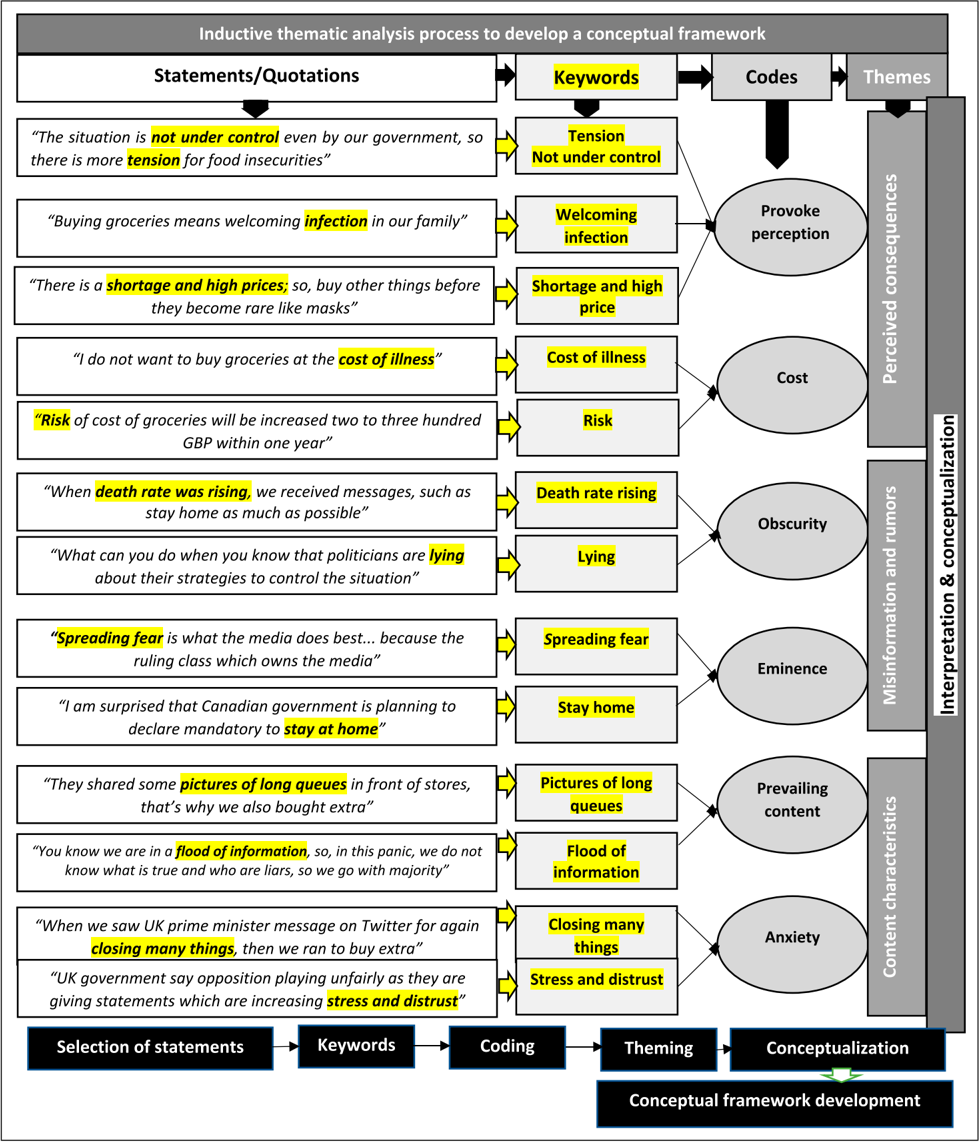
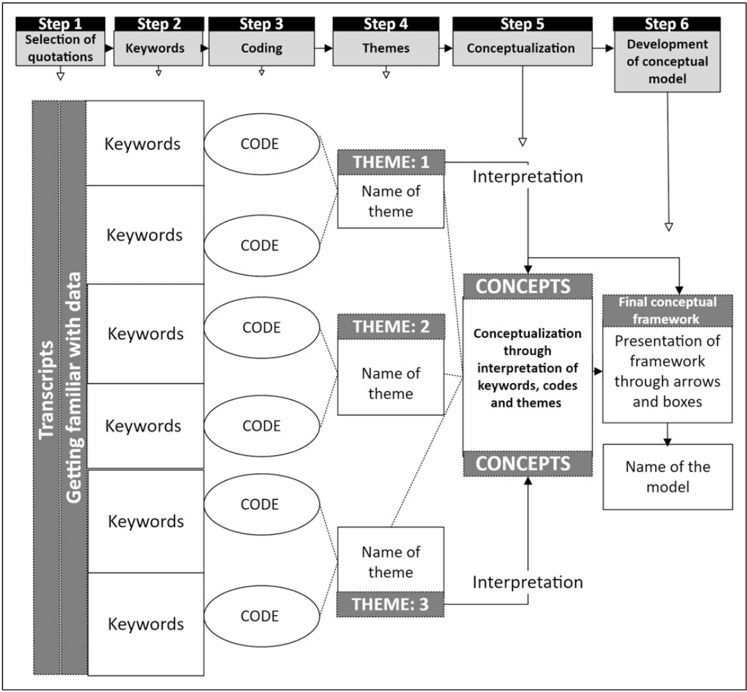
- The paper proposes six steps: transcription/familiarization and quotation selection; keyword selection; coding; theme development; conceptualization through interpretation of keywords, codes, and themes; and development of a conceptual model.
- It introduces 6Rs for keyword selection (realness, richness, repetition, rationale, repartee, regal), 6Rs for coding (robust, reflective, resplendent, relevant, radical, righteous), and 4Rs for theming (reciprocal, recognizable, responsive, resourceful).
- In the exemplar study, three main themes emerged: “Perceived consequences” from codes “Provoke perception” and “Cost”; “Misinformation and rumors” from codes “Obscurity” and “Eminence”; and “Content Characteristics” from codes “Prevailing content” and “Anxiety.”
- The exemplar’s final model, “Panic buying as social practice,” was based on Protection Motivation Theory (PMT) and the Theory of Rumor Transmission (TORT).
Methods
- Design: a methodological/conceptual paper that presents a comprehensive systematic model for thematic analysis culminating in a conceptual model, using Naeem and Ozuem (2022a) as an exemplar.
- Exemplar data: qualitative data gathered from Twitter, YouTube, and interviews; the exemplar used a six-stage thematic analysis and a social constructionist perspective with PMT and TORT as theoretical foundations.
- Main analysis: the paper describes each of the six steps in detail, provides practical examples from the exemplar, and compares the proposed process with Braun and Clarke’s (2006) six steps of thematic analysis.
Limitations
- The paper states that the potential of the process to address other research contexts or quantitative methods may require further exploration, and that the efficiency of the method compared with other model-building approaches has not been empirically tested.
- Evident from the text: the proposed six-step process and the 6Rs/4Rs are illustrated through a single exemplar study and are not independently validated or empirically compared with alternative thematic analysis approaches.
Model-written summary. Check it against the paper before relying on it.
Integrity signals
Registry
Cites
Statistics
Figures

Verification
Claims the paper makes
0 Valid · 4 Not valid · 56 Not checked · 89 Own results and interpretations
The cited sources that could be checked couldn’t confirm or dispute this claim.
In the paper
“For narrative approaches, conceptual model development focuses on personal experiences, emotions, and life histories (Eldh et al., 2020).”
§ A Step-by-Step Process of Thematic Analysis to Develop a Conceptual Model in Qualitative Research > Step 6: Development of Conceptual Model.
What the sources say
- Could not verifycites Eldh et al., 2020 matched to “Quotations in Qualitative Studies: Reflections on Constituents, Custom, and Purpose” (2020) sourceExperimental — accuracy not yet measured
The Discussion and Conclusions (page numbers unavailable) address how quotations can illustrate qualitative analysis and findings. A search for narrative approaches, conceptual model development, emotions, and life histories found no passage addressing the attributed claim. (LLM, conf=0.72)
plainstates an association- Asserted: passes — The authors put it forward as true.
- Checkable: passes — It can be checked against evidence.
- Load-bearing: unclear — It is unclear whether the paper’s conclusions depend on it.
- Based: passes — The paper gives a reason why it holds.
- Could not verify
In the paper
“The analytical process balances between descriptive analysis, which outlines patterns or trends, and interpretive analysis, which offers subjective perspectives (Miles & Huberman, 1994, p. 56).”
§ A Step-by-Step Process of Thematic Analysis to Develop a Conceptual Model in Qualitative Research > Step 2: Selection of Keywords.
What the sources say
- Not matchedcites Miles & Huberman, 1994, p. 56
An author–year citation the paper’s reference list doesn’t settle. We don’t search these by name.
plain- Asserted: passes — The authors put it forward as true.
- Checkable: passes — It can be checked against evidence.
- Load-bearing: passes — The paper’s conclusions depend on it.
- Based: passes — The paper gives a reason why it holds.
- Not matched
In the paper
“However, the thematic analysis approach could also fit a post-positivist paradigm (Howell, 2012, p. 30).”
§ A Step-by-Step Process of Thematic Analysis to Develop a Conceptual Model in Qualitative Research > Step 2: Selection of Keywords.
What the sources say
- Not matchedcites Howell, 2012, p. 30
An author–year citation the paper’s reference list doesn’t settle. We don’t search these by name.
hedgedstates an association- Asserted: passes — The authors put it forward as true.
- Checkable: passes — It can be checked against evidence.
- Load-bearing: unclear — It is unclear whether the paper’s conclusions depend on it.
- Based: passes — The paper gives a reason why it holds.
- Not matched
In the paper
“Hence, quotation selection is not simply a mechanical task but is influenced by the researcher's philosophical and theoretical approach (Jackson & Mazzei, 2012).”
§ A Step-by-Step Process of Thematic Analysis to Develop a Conceptual Model in Qualitative Research > Step 1: Transcription, Familiarization With the Data, and Selection of Quotations.
What the sources say
- Not matchedcites Jackson & Mazzei, 2012
An author–year citation the paper’s reference list doesn’t settle. We don’t search these by name.
plainstates a cause- Asserted: passes — The authors put it forward as true.
- Checkable: passes — It can be checked against evidence.
- Load-bearing: passes — The paper’s conclusions depend on it.
- Based: passes — The paper gives a reason why it holds.
- Not matched
A conclusion the paper draws from its own results — it cites no other source for it, so there is none to check. The quote shows it is in the paper.
In the paper
“Thus, keywords serve as a critical bridge between data and themes in different methodologies.”
§ A Step-by-Step Process of Thematic Analysis to Develop a Conceptual Model in Qualitative Research > Step 4: Theme Development.
boostedstates an association- Asserted: passes — The authors put it forward as true.
- Checkable: passes — It can be checked against evidence.
- Load-bearing: unclear — It is unclear whether the paper’s conclusions depend on it.
- Based: passes — The paper gives a reason why it holds.
10 more claims
Create a free account to see all 149 claims and every source verdict.
- It may state two separate claims as one. 54
- Probably not a substantial claim. 128
Claims other papers make about this one
Each is checked against this paper’s own text: does it say what the citing paper says it does?
The source backs part of the claim, not all of it — or backs it for a different population, condition or comparison.
In the citing paper
“With the identified keywords, initial coding was further informed by and cross-referenced to the literature on AI ethics and governance, particularly addressing public concerns in government AI, alongside the author team's collective expertise in AI-driven digital transformation in public administration.”
From Accountability in Government Use of AI : Citizen Concerns and Preferences (2025) · cites this paper as Naeem et al. 2023
Experimental — accuracy not yet measuredThe source backs part of the claim, not all of it — or backs it for a different population, condition or comparison.
In the citing paper
“Thematic analysis is a highly popular technique among qualitative researchers for analyzing qualitative data, which usually comprises thick descriptive data (Naeem et al., 2023).”
From The Psycho-Emotive Effects of AI-Generated Fake News on Social Media Users (2026) · cites this paper as Naeem et al., 2023
Experimental — accuracy not yet measuredThe cited source says what the claim attributes to it.
In the citing paper
“The selection of keywords was guided by the 6Rs framework-Realness, Richness, Repetition, Rationale, Repartee, and Regal-to ensure they accurately represented the essence of the data (Naeem et al. 2023).”
From Accountability in Government Use of AI : Citizen Concerns and Preferences (2025) · cites this paper as Naeem et al. 2023
The cited source says what the claim attributes to it.
In the citing paper
“The data were analyzed through Naeem et al.'s (2023) six-step thematic analysis process to develop a conceptual framework (Naeem & Ozuem, 2022).”
From “It’s Not Just About Competition – It’s Ceremony”: Introducing the Embedded Indigeneity Framework for Understanding Identity, Mission, and Practice in TCU and NASNTI Athletics (2026) · cites this paper as Naeem et al. (2023)
The cited source says what the claim attributes to it.
In the citing paper
“The selected methodology was implemented due to the end results that 1) presented a novel conceptual framework and 2) serves as a contextually specific extension of existing theory/theories (Naeem et al., 2023).”
From “It’s Not Just About Competition – It’s Ceremony”: Introducing the Embedded Indigeneity Framework for Understanding Identity, Mission, and Practice in TCU and NASNTI Athletics (2026) · cites this paper as Naeem et al., 2023
Self-check
Percentages, sums and reported differences re-computed from the paper’s own numbers.
Each contradiction between two passages listed here was confirmed by an independent check.
Rated minor: it would not touch a result — a value no result rests on, a p-value that stays on the same side of the significance level, or a conflict that is clerical, resolved elsewhere in the paper, or outside its own findings.
In the paper
§ A Step-by-Step Process of Thematic Analysis to Develop a Conceptual Model in Qualitative Research > Step 6: Development of Conceptual Model.
“Positivism, which favours inductive methods, builds its model on top of previously established theories and conducts its experiments in an unbiased manner.”
§ A Step-by-Step Process of Thematic Analysis to Develop a Conceptual Model in Qualitative Research > Step 6: Development of Conceptual Model.
“An inductive approach is primarily data-driven, whereby themes are derived from the data itself without the influence of pre-existing theories (Braun & Clarke, 2006).”
Citations
Cites
Using thematic analysis in psychology
Braun, V., & Clarke, V. (2006) · Qualitative Research in Psychology · doi:10.1191/1478088706qp063oa · Cited by 194,414
Qualitative Data Analysis: An Expanded Sourcebook
(1994) · Journal of Environmental Psychology · doi:10.1016/s0272-4944(05)80231-2 · Cited by 48,420 · cited 2×
“In the coding process, consideration of keywords helps in multiple ways: The analytical process balances between descriptive analysis, which outlines patterns or trends, and interpretive analysis, which offers subjective perspectives (Miles & Huberman, 1994, p. 56).”
Lincoln, Y. S., Guba, E. G., & Pilotta, J. J. (1985) · International Journal of Intercultural Relations · doi:10.1016/0147-1767(85)90062-8 · Cited by 45,787 · cited 1×
“…degrees of subjectivity and objectivity has underscored the fl exibility intrinsic to research methodologies and highlighted that these tools of analysis are intimately intertwined with, and, indeed, emerge from the distinctive nature of speci fi c disciplines and perspectives (Lincoln & Guba, 1985).”
BackgroundThe Discovery of Grounded Theory: Strategies for Qualitative Research
Glaser, B. G., & Strauss, A. L. (2017) · Aldine (Routledge reprint) · doi:10.4324/9780203793206 · Cited by 25,789
The qualitative content analysis process
Elo, S., & Kyngäs, H. (2008) · Journal of Advanced Nursing · doi:10.1111/j.1365-2648.2007.04569.x · Cited by 22,617 · cited 1×
“Deductive coding, linked with descriptive analysis, is a top-down approach where pre-existing theories, models, or codes guide the data analysis (Elo & Kyng¨as, 2008).”
Method(2009) · Cited by 21,330
Reflecting on reflexive thematic analysis
Braun, V., & Clarke, V. (2019) · Qualitative Research in Sport, Exercise and Health · doi:10.1080/2159676x.2019.1628806 · Cited by 19,677
(1998) · Medical Entomology and Zoology · Cited by 18,397
(2014) · Cited by 15,747
S., N. L. (2017) · doi:10.1177/1609406917733847 · Cited by 14,051 · cited 3×
“· Robust: Coding should convey the true essence of data in a theoretical manner (Nowell et al., 2017).”
Background
Research works printed but not linked: 9
- 1. Arar, K. (2017). The what's and why's of the how to of qualitative research. Qualitative Report, 22(11), 2956-2958.
- 16. Creswell, J. W. (2012). Educational research. Pearson.
- 19. Denzin, N. K., & Salvo, J. (2020). New directions in theorizing qualitative research: Theory as resistance. Myers Education Press.
- 62. Oliver, P. (2021). Using qualitative methods to answer your research question (First). Open University Press.
- 63. Patton, M. Q. (2015). Qualitative research & evaluation methods: Integrating theory and practice (fourth). Sage Publications, Inc. Qualitative research (pp. 273-290). Sage.
- 67. Saldana, J. (2021). The coding manual for qualitative researchers (Fourth). Sage.
- 68. Saldana, J. M. (2016). The coding manual for qualitative researchers (4rd ed.). Sage Publications.
- 74. Seale, C. (2013). Qualitative research practice. In C. Seale, G. Gobo, J. Gubrium, & D. Silverman (Eds.), Concise paperback. Sage.
- 80. Tracy, S. J. (2019). Qualitative research methods: Collecting evi- dence, crafting analysis, communicating impact (2nd ed.). Wiley Blackwell.
Cited by
Items 2,101–2,200 of 2,204
Bloodworth, R. F., Hemphill, R. C., Forsythe, L. P., Mohan, C., Nolton, E. C., Abadi, P., Stewart, L. J., & Woodward, K. P. (2026) · Research Integrity and Peer Review · doi:10.1186/s41073-026-00198-y
“Thematic analysis [17] was conducted to identify trends in open-ended reviewer survey responses about the virtual panel discussions (Aim 3).”
Qiao, C., Pamirzad, Q. H., & Susyall, G. A. (2026) · Annals of the International Communication Association · doi:10.1093/anncom/wlag026
Stroud, B., Brent, T., Driver‐Woods, M., & Wu, T. (2025) · Infant Mental Health Journal · doi:10.1002/imhj.70042
Nissinen, J., Penttilä, N., Stevanovic, M., & Pirinen, V. (2025) · Journal of Fluency Disorders · doi:10.1016/j.jfludis.2025.106175 · Cited by 3
Yoshinaga, R., Diaz, K., Prefontaine, B., Rice, M. M., & Price, E. (2026) · International Journal of STEM Education · doi:10.1186/s40594-026-00605-2 · Cited by 1
Introduction: Refugees and Asylum Seekers in the Context of Sustainable Urban Development
Saral, A. T., & Pavlova, M. (2025) · Education in the Asia-Pacific region · doi:10.1007/978-981-95-1680-3_1
Tholchah, M., & Aprisyah, R. (2026) · Journal of Childhood Education & Society · doi:10.37291/2717638x.202671665
Barbenheimer: Una estrategia disruptiva de promoción cinematográfica
Mondragon-Márquez, L., & Gallardo-Echenique, E. E. (2026) · Área Abierta · doi:10.5209/arab.103257
“El procesamiento de las respuestas se realizó a través del análisis temático, que permitió identificar, organizar y examinar categorías significativas en los datos (Naeem et al., 2023).”
Johnson, G. U., Towell‐Barnard, A., McLean, C., Ewens, B. A., & Robert, G. (2024) · SSRN Electronic Journal · doi:10.2139/ssrn.4880567
Rister, A., Hoban, I., & Adkins, M. (2025) · Journal of Human Trafficking · doi:10.1080/23322705.2025.2594949 · Cited by 1
Greco, A., Frederix, G., Hooft, L., & ten Ham, R. M. T. (2026) · Value in Health · doi:10.1016/j.jval.2026.04.008 · Cited by 1
Silang, K., Mbuzi, V., Graham, C. J., & East, L. (2025) · Journal of Advanced Nursing · doi:10.1111/jan.70208 · Cited by 1
“Thematic analysis was adopted to identify and summarise key findings from the studies (Naeem et al. 2023).”
Wellness-enhanced contingency management for stimulant use: A formative qualitative study
Deshais, M. A., Norton, L., Tkac, V., Digioia-laird, V., & Swarbrick, M. A. (2026) · Digital Health · doi:10.1177/20552076261426320
Alidadi, M., Gruyter, C. D., Jafari, A., & Foster, S. A. (2026) · Transportation Research Interdisciplinary Perspectives · doi:10.1016/j.trip.2026.102290
Afriana, J., Permanasari, A., Setyaningsih, S., Sidik, I. M., Ismail, I., Juita, D. N., & Iryance, I. (2026) · Research Square · doi:10.21203/rs.3.rs-8215088/v1
Kalmus, H., Vochоzka, M., & Gulyás, J. (2025) · Logi · doi:10.2478/logi-2025-0009
“To answer RQ1, a theme analysis with Conceptual Outputs was used [20], which included highly cited Web of Science articles from 2014 to 2024.”
Permana, A. T. L., Apriliya, S., & Respati, R. (2026) · Journal of Literacy Education · doi:10.64780/jole.v2i1.200
“The analysis followed iterative stages, including data familiarization, coding, theme development, and interpretation, consistent with thematic analysis procedures outlined (Naeem et al., 2023).”
Youth–Adult Intergenerational Friendships: Sociality across Difference at the Skatepark
Hunter, D. (2026) · Cambridge University Press eBooks · doi:10.1017/9781009772822.004
Julius, M. K., -, B. S. R., & Yiga, A. P. (2024) · International Journal For Multidisciplinary Research · doi:10.36948/ijfmr.2024.v06i03.20542
SUÇ KORKUSU VE ZENOFOBİNİN REKREASYON ÜZERİNDEKİ ETKİLERİ
DEMİRBAŞ, M., & Çağlayan, M. N. (2026) · Dicle Üniversitesi Sosyal Bilimler Enstitüsü Dergisi · doi:10.15182/diclesosbed.1599024
Nepali Women at Work: Menstruation in Informal and Formal Workplaces
Karki, S., & Mix, T. L. (2026) · Gender Work and Organization · doi:10.1111/gwao.70144
Analogies and Metaphors for Agentic AI: How Industry Practitioners Explain Emerging AI Systems
Stundzig, F., Heimburg, V., & Wiesche, M. (2026) · Mensch und Computer (MuC) · doi:10.1145/3820253.3820283
Art Therapy in Palliative Gynaecological Oncology: Clinical Value in Acute Care
Lee, P. P., Mun, S., Nair, T., et al. (2026) · Art Therapy · doi:10.1080/07421656.2026.2700057
Kavaklı, N., Öztürk, N., & Vinte, J. V. (2026) · Uluslararası Eğitim Araştırmacıları Dergisi · doi:10.52134/ueader.1902732
Student radiographers’ knowledge and experience of lateral hip X-ray positioning: A survey
Clarke, L., & Lockwood, P. (2024) · Radiography · doi:10.1016/j.radi.2024.08.011
Generative Artificial Intelligence in Venture Creation Learning: A New Pedagogy of PartnershipPreprint
Ripollés, M., & Blesa, A. (2025) · SSRN Electronic Journal · doi:10.2139/ssrn.5403388
Tibane, C. C., & Mafa-Theledi, O. N. (2026) · Journal of Education and Learning Technology · doi:10.38159/jelt.2026764
“34 The analysis was informed by Deliverology and Implementation Science.”
Mentoring as Professional Support for Beginning Teachers in KyrgyzstanPreprint
Kabylov, T. B., Abdykadyrova, S., Sagyndykova, R., Pazylova, S., Ypyshova, N. U., Namatova, N. A., & Bekmuratova, R. (2026) · Research Square · doi:10.21203/rs.3.rs-8451993/v1 · Cited by 2
Global governance complex for climate change: a bibliometric analysis
Li, Z., & Yaakop, M. R. (2025) · Discover Sustainability · doi:10.1007/s43621-025-02089-6 · Cited by 4
“Author keywords can be instrumental in better capturing the thematic content of an article, as these terms reflect authors’ own framing and conceptualization of their research [46].”
Santillan, M., Nieto, O., Segura-Bermudez, J. R., et al. (2026) · Culture Health & Sexuality · doi:10.1080/13691058.2025.2609878
Doubell, M. T. B. (2024) · Cronfa (Swansea University) · doi:10.23889/suthesis.67349
Gouda, S., Abba, E., & Roy, A. (2026) · Research Square · doi:10.21203/rs.3.rs-9117477/v1
Understanding students' mathematical dispositions through metaphorical representations
Wei, Z., Zuo, H., Wijaya, T. T., & Wang, Y. (2026) · Asian Education and Development Studies · doi:10.1108/aeds-08-2025-0395
The human factors in production and logistics systems of organ and tissue transplantation
Pauli, J., Ruffatto, J., & Latifi, M. (2025) · International Journal of Pharmaceutical and Healthcare Marketing · doi:10.1108/ijphm-02-2025-0016
Alqadri, A., Beaton, F., & Moshfeghi, Y. (2026) · JMIR Aging · doi:10.2196/preprints.94726
Wu, W., Song, X., Pachankis, J. E., Yi, M., Li, M. L., Pan, S., He, Y., Li, F., Xiong, Y., & Li, X. (2026) · doi:10.2196/preprints.98541
MacDonald, P., Frank, H., & Stack, R. J. (2026) · Obesity Science & Practice · doi:10.1002/osp4.70182
“Data were analysed using an inductive reflexive thematic analysis, following the Braun and Clarke reflexive thematic analysis approach [20] and the practical guidance described by Naeem et al. [22].”
Andrlić, B., Oniku, A. C., & Arebi, I. B. (2024) · Journal of Infrastructure Policy and Development · doi:10.24294/jipd10115
“The keywords identified possessed realness, richness, repetition, rationale and regal (Naeem et al., 2023) qualities essential and imperative for thematic analysis.”
Reuben, S., Bobat, S., & van Niekerk, T. (2026) · Administrative Sciences · doi:10.3390/admsci16020099 · Cited by 1
“The interview transcripts were analysed using reflexive thematic analysis, drawing on contemporary methodological guidance that emphasises flexibility, reflexivity, and transparency in qualitative inquiry (Braun & Clarke, 2006; Naeem et al., 2023; Pearson et al., 2025).”
Engelman, S. P., & Ibarra, F. P. (2025) · American Journal of Management · doi:10.33423/ajm.v25i3.7767
Lalani, N. S., Katare, B., Osei, E. A., Yang, S. S., Wagle, S., Gallegos, J. L., & Ajuwon, A. M. (2026) · Frontiers in Public Health · doi:10.3389/fpubh.2025.1751524 · Cited by 1
“The team conducted a thematic analysis, guided explicitly by the Socio-Ecological Resilience Theory and Social Role Theory as sensitizing frameworks (34).”
Leading with self-awareness: The antecedent to relational leadership
Driver, A. (2025) · Journal of Educational Leadership Policy and Practice · doi:10.2478/jelpp-2025-0002
“Following the data collection period, a reflexive thematic analysis (Braun & Clarke, 2006; 2019) and inductive coding process (Naeem et al., 2023) were used to identify initial themes perceived as important to the research question.”
Vigh, E., Attwood, A. S., & Roudaut, A. (2024) · Australian Conference on Human-Computer Interaction (OzCHI) · doi:10.1145/3726986.3727903 · Cited by 1
“Reflexive thematic analysis was used to determine keywords of interest which were then coded [29, 36, 103, 127].”
How Industry 4.0 is shaping the future of a disadvantaged region: the case of Calabria
Cosma, A. M. I., Silvestri, L., Coloca, A., & Filice, L. (2025) · Procedia Computer Science · doi:10.1016/j.procs.2025.02.034 · Cited by 1
Addo, R. A., & Ansah-Mensah, K. (2026) · Urban Forum · doi:10.1007/s12132-026-09565-w
“…inductive thematic coding style (Table S1) was applied, generating themes including awareness through smell, awareness through visual indicators, identification of air pollution sources, knowledge from school, inter - generational knowledge, and personal observation as per (Naeem et al., 2023).”
Enhancing STEM Workforce Development via Non-Degree Credentialing: A Systematic Literature Review
Zinnah, F., Minichiello, A., & Asghar, M. (2025) · Community College Journal of Research and Practice · doi:10.1080/10668926.2025.2582707 · Cited by 1
Parent and Caregiver Perspectives: The Lived Experience of Raising a Child with Misophonia
Molthrop, K. A., Gates, E. C., Guzick, A. G., Siepsiak, M., & Rosenthal, M. Z. (2026) · Child Psychiatry & Human Development · doi:10.1007/s10578-026-02013-7 · Cited by 1
Advanced Computational Methods for Air Pollution Modeling and Simulation
Hashim, M., Tabassum, B., Arif, H., Khan, T., Khan, M., Hasan, A., & Khan, N. (2026) · Springer eBooks · doi:10.1007/978-3-032-13953-5_2
Legislation, Policies, and Industry Standards Aiming toward Net Zero in the Built Environment
Goh, C. S., & Maddox, A. (2025) · Journal of Legal Affairs and Dispute Resolution in Engineering and Construction · doi:10.1061/jladah.ladr-1384
Senito: Exploring How Agency of Shared Objects Can Be Leveraged to Foster Community Sharing Cultures
Wu, H., Nissen, B., & Lechelt, S. (2026) · Designing Interactive Systems Conference · doi:10.1145/3800645.3812873
Singh, M., Nanga, R., & Jaffer, S. (2026) · Millah Journal of Religious Studies · doi:10.20885/millah.vol25.iss1.art12 · Cited by 2
“This benefits the reader in comprehending the study's argument (Naeem et al., 2023).”
Mešl, N., & Kodele, T. (2025) · Social Sciences · doi:10.3390/socsci14060372
“We conducted a thematic analysis (Vaismoradi et al. 2013; Naeem et al. 2023).”
Preservice teachers’ experiences of using ICT in English education programmes at Nepali universities
Kandel, R. K., & Bist, R. B. (2026) · Cogent Education · doi:10.1080/2331186x.2026.2731678 · Cited by 4
Nguyen, D. M. H., Hoang, L. H., Ho, S. S. H., & Rocca, L. (2026) · SSRN Electronic Journal · doi:10.2139/ssrn.7387990
Kemigisha, E. (2026) · Research Square · doi:10.21203/rs.3.rs-9171816/v1
Garcia, L. E. (2025) · The Research Repository @ WVU (West Virginia University) · doi:10.33915/etd.12798
Agdere, S., Albers, E. A. C., Kreuk, E., Horstkötter, D., Paauw, D., Rirash, A. F., Smets, E. M. A., & Visser, L. N. C. (2026) · Research Square · doi:10.21203/rs.3.rs-9940093/v1
Relationally focused school improvement planning: a multi-case study of sensemaking and design
Steenis, E. J. V., Sox, D. M., Radabaugh, S. A., Scales, P. C., & Widman, S. (2026) · Journal of Educational Change · doi:10.1007/s10833-026-09566-3
Maeko, M. S. A. (2025) · African Journal of Teacher Education · doi:10.21083/ajote.v14i1.8334 · Cited by 2
The rationales behind family business digitalization
Tirdasari, N. L., Dhewanto, W., & Arief, N. N. (2026) · RAUSP Management Journal · doi:10.1108/rausp-12-2024-0249 · Cited by 1
Leveraging Collective Impact Principles for Identity-Inclusive Computing Education through AiiCE
Garcia, L. Y., Daily, S. B., & Washington, A. N. (2026) · ACM Technical Symposium on Computer Science Education (SIGCSE) · doi:10.1145/3770762.3772647
Financial Stability Success Strategies for Nursing Homes
Garrison, J. H., & Critchlow, K. A. (2026) · Open Journal of Business and Management · doi:10.4236/ojbm.2026.143075
A conceptual model and supporting approach for EU taxonomy alignment with green BPM
Klessascheck, F., Bogatinovska, I., Andree, K., & Pufahl, L. (2026) · Software & Systems Modeling · doi:10.1007/s10270-026-01422-5 · Cited by 2
Kiconco, A., Quinn, K. G., Krechel, S., Kostelac, C. A., Ohlrich, J., & Dickson‐Gómez, J. (2026) · Substance Use & Misuse · doi:10.1080/10826084.2026.2634254
“Based on the primary codes, latent thematic analysis was applied to identify patterns (Braun & Clarke, 2019; Naeem et al., 2023) that aligned with the three CFIR domains (intervention, individuals, and inner setting).”
Ampatzidou, C., de Waal, M., & Vlassenrood, L. (2026) · Participatory Design Conference · doi:10.1145/3789492.3796404
Espinoza-Marín, C., & Bonilla, R. (2026) · Revista de Biología Tropical · doi:10.15517/am22z874
Salehi-Amiri, F., & Hashemi, M. R. (2026) · Classroom Discourse · doi:10.1080/19463014.2025.2598211
Youth engagement in the Kenyan potato value chain: implications for food systems transformation
Ngigi, M. W., & Moran, D. (2026) · Journal of Rural Studies · doi:10.1016/j.jrurstud.2026.104355
Media, police shootings and mental illness: Is stigma a problem?
Waugh, C., Han, H., & Heffernan, E. (2026) · Australian & New Zealand Journal of Psychiatry · doi:10.1177/00048674261475603 · Cited by 1
van der Kleij, R., Spinnler, O., Broderick-Hale, J., Hendriks, K., Drenth, A., & van Wijgerden, J. (2026) · Computers in Human Behavior · doi:10.1016/j.chb.2026.109127
Alwa, F. A. P., Maulana, K. K., Bahriya, S., et al. (2025) · Priviet Social Sciences Journal · doi:10.55942/pssj.v5i11.885
“This step provides credible and relevant data to comprehensively describe the use of Canva in project-based learning implementations (Naeem et al., 2023)”
From emotional safety to agentic engagement: implementing Mentimeter in undergraduate TESOL courses
Yan, E., Liu, X., & Lu, C. (2026) · Interactive Technology and Smart Education · doi:10.1108/itse-11-2025-0352
Quantum: Resilient Security Frameworks for Aviation and Aerospace
Burton, S. L. (2026) · IGI Global eBooks · doi:10.4018/979-8-2600-1026-6.ch014
How Do EFL Teachers Navigate Problem-Based Learning in Indonesian Classrooms?
Azzahra, N. R., & Nurkamto, J. (2024) · Voices of English Language Education Society · doi:10.29408/veles.v8i3.27956 · Cited by 9
“Furthermore, thematic analysis was employed by Naeem et al. (2023) to systematically interpret the collected data.”
Levická, J., & Strculová, Z. (2024) · Revue of Social Sevices / Revue sociálnych služieb · doi:10.34135/rss.240204
Hands-On Mastery in Physiological Signal Processing: A Challenge-Based Learning Approach
Barquero‐Pérez, Ó., Cámara-Vázquez, M. Á., & Goya–Esteban, R. (2025) · Biomedical Engineering Education · doi:10.1007/s43683-025-00169-7
“This iterative and flexible approach allows themes to emerge organically from the data without being confined to pre-existing categories, making it especially valuable for exploratory research [36, 37].”
User Experience Design for People with Substance Use Disorder: A Proposed Research Framework
Tutkaluk, A. (2025) · Communications in computer and information science · doi:10.1007/978-3-031-94156-6_22
Jounou, I. P., Caballero, R. T., & Cruz-Piqueras, M. (2024) · Figshare · doi:10.6084/m9.figshare.26733891
Sinha, T., Bhoi, S., Sharma, D., Chauhan, S., Magan, R., Sahu, A. K., Bhargava, S., Nayar, P. D., Kannan, V., Lodha, R., et al. (2024) · Figshare · doi:10.6084/m9.figshare.26974401
Huang, X. (2025) · SSRN Electronic Journal · doi:10.2139/ssrn.5521335
Lambert, A., Marceau, M.-O., Hammock, M., et al. (2025) · FACETS · doi:10.1139/facets-2024-0273
Novikasari, I., & Santosa, C. A. (2025) · IGI Global eBooks · doi:10.4018/979-8-3373-7245-7.ch008 · Cited by 1
New Business Models and Entrepreneurship for Sustainable Tourism
Zhan, L. J., Soeiro, J. D., & Francis, R. S. (2025) · Emerald Group Publishing Limited eBooks · doi:10.1108/978-1-83708-058-820251008
Human‐ AI Interaction Data Governance in Personal Health Management: Literature and Cases Analysis
Liu, X., & Shankar, K. (2025) · Proceedings of the Association for Information Science and Technology · doi:10.1002/pra2.1469
“Thematic analysis includes the selection of quotations, keywords, coding, themes, conceptualisation, and conceptual model development (Naeem et al., 2023).”
Qi, Z., Pearce, M., & Rowe, T. (2026) · Violence and Victims · doi:10.1891/vv-2025-0079
Moeini, S., Teymourlouy, A. A., Gorji, H. A., & Kabir, M. J. (2026) · BMC Health Services Research · doi:10.1186/s12913-026-15189-4 · Cited by 1
Isunju, J. B., Tamás, P. A., Mugambe, R. K., Wafula, S. T., Akello, T., Galiwango, J., Nalugya, A., Tamale, B. N., Nansubuga, R., Anguzu, G., et al. (2026) · Scientific Reports · doi:10.1038/s41598-026-67033-8
Lello, D. S., Kansheba, J. M., & Bhat, M. A. (2026) · Engineering Construction & Architectural Management · doi:10.1108/ecam-11-2025-1852
Naghshineh, B., Silva, G. M., & Henriques, S. (2026) · Global Journal of Flexible Systems Management · doi:10.1007/s40171-026-00511-0
Wang, M., & 杨永忠 (2026) · Technovation · doi:10.1016/j.technovation.2026.103738
Mohammadi, F., Samarein, Z. A., Rezaeisharif, A., Ghamarigivi, H., & Tanha, R. R. (2026) · Quarterly Journal of Child Mental Health · doi:10.66224/jcmh.13.2.3
Carter, B. T., Croom, D. B., Sandlin, M. R., et al. (2026) · Journal of Agricultural Education · doi:10.5032/jae.v67i4.3450
“…partnerships helped explain variation in We also checked the analytic process against the six-step systematic thematic analysis process described by Naeem et al. (2023): transcription and familiarization with the data and selection of quotations; selection of keywords; coding; theme development;…”
Gonçalves, E., Mulaji, S. M., & Kabanda, S. K. (2026) · IFIP advances in information and communication technology · doi:10.1007/978-3-032-30942-6_35
Parasitic generative AI: how technologies feed on PR professionals' vulnerabilities
Dong, C., & van den Berg, M. (2026) · Journal of Communication Management · doi:10.1108/jcom-01-2026-0063
Hendrickx, M., Kerckhaert, L.-A., Willems, S. J. T., Crutzen, R., Verbestel, V., & Vanthomme, K. (2026) · PLoS ONE · doi:10.1371/journal.pone.0359860
S.I.D.E. Ways: horizontal peer mentorship for blackwomen doctoral students’ sustainment
Harris, D. M., Marshall, B. L., & Wright, J. R. (2026) · International Journal of Qualitative Studies in Education · doi:10.1080/09518398.2026.2739347
Piccoli, A. (2026) · Action Research · doi:10.1177/14767503261490029
Hashaka, G., Zaake, D., Tumwine, G., Musana, O., Byaruhanga, R., & Kayiira, A. (2026) · JCO Global Oncology · doi:10.1200/go-25-00441
Metadata
- Authors
- Naeem, M., Ozuem, W., Howell, K., & Ranfagni, S.
- Affiliations
- University of Gloucestershire (GB)
- University of Cumbria (GB)
- Northumbria University (GB)
- University of Florence (IT)
- Corresponding author
- Naeem, Muhammad
- Venue
- International Journal of Qualitative Methods
- Publisher
- SAGE Publications
- Published
- 2023-10
- Volume
- 22
- ISSN
- 1609-4069 (ISSN-L)
- OpenAlex
- W4388503650
- Cited by
- 2,243
- References
- 71
- Citations by year
- 2026: 1000 · 2025: 981 · 2024: 258 · 2023: 4
- FWCI
- 1654.78
- Type
- journal article
- Language
- en
- Open access
- gold
- doi.org
- Licence
- Locations
- International Journal of Qualitative Methods (publishedVersion, cc-by-nc)
- Insight (University of Cumbria) (acceptedVersion)
- DOAJ (DOAJ: Directory of Open Access Journals) (submittedVersion, cc-by-sa)
- Florence Research (University of Florence) (submittedVersion)
- Topics
- Social Sciences › Education › Qualitative Research Methods and Applications
- Social Sciences › Sociology and Political Science › Qualitative Research Methods and Ethics
- Social Sciences › General Social Sciences › Computational and Text Analysis Methods
- Keywords
- thematic analysis, conceptual modeling, qualitative data analysis, inductive coding, deductive coding, grounded theory, interpretive phenomenology, constructivist research, positivist research, theoretical conceptualization, replicability
About these checks
Registry, retraction, Cites and statistics results are computed, not judged, with one exception: a printed reference that no index lists is read once by a model before it counts as a citation error. Claims are extracted by a model and kept only when their quote appears verbatim in the text; each cited source is then checked, with a model’s help, for whether it says what the claim relies on. Those verdicts can be wrong — read the claim’s quote and the cited source before relying on one.
The claim verdicts this report counts are experimental: their accuracy is not yet measured.
A language model drew the claims from the paper on 2026-10-10, under version 3 of the claim definition (model deepseek-v4.1-flash, prompt extract-v3).
A second model labelled each claim on 2026-10-10 (model jev-1.13-20260917, definition revision gold-guideline-v0.2).
Cited sources are checked with a language model’s help (gpt-6-sol).
Statistics and arithmetic are recomputed, not judged.
Confidence bands are shown only for fields calibrated on our annotated test set. None is calibrated yet, so no band is shown.
What counts as a claim ›How we measure confidence ›How we check this ›
Are you an author, or do you see a problem with this page? Request a review
Data sources
Bibliographic data: Semantic Scholar, OpenAlex, Crossref.
Contains information from the Semantic Scholar Academic Graph Datasets, made available under the ODC Attribution License (ODC-BY 1.0).
Semantic Scholar’s data is described in: Kinney, R., et al. (2023). The Semantic Scholar Open Data Platform. arXiv:2301.10140.
