

A Step-by-Step Process of Thematic Analysis to Develop a Conceptual Model in Qualitative Research
Open accessThe DOI matches its Crossref record; 77 of the 78 references it cites were found in a registry or an index, and 1 are not checked yet; 2 of the 57 sources its claims cite were checked for support.
Abstract
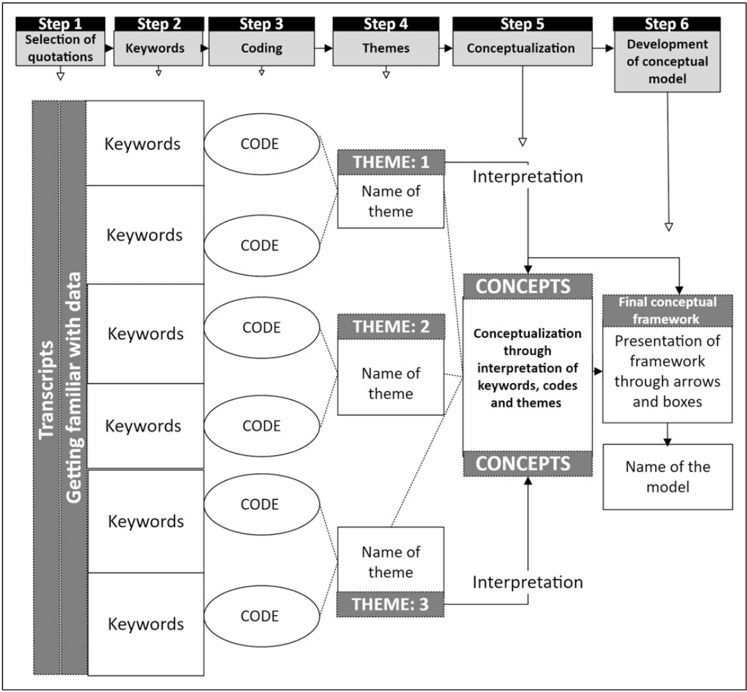
Thematic analysis is a highly popular technique among qualitative researchers for analyzing qualitative data, which usually comprises thick descriptive data. However, the application and use of thematic analysis has also involved complications due to confusion regarding the final outcome’s presentation as a conceptual model. This paper develops a systematic thematic analysis process for creating a conceptual model from qualitative research findings. It explores the adaptability of the proposed process across various research methodologies, including constructivist methodologies, positivist methodologies, grounded theory, and interpretive phenomenology, and justifies their application. The paper distinguishes between inductive and deductive coding approaches and emphasizes the merits of each. It suggests that the derived systematic thematic analysis model is valuable across multiple disciplines, particularly in grounded theory, ethnographic approaches, and narrative approaches, while also being adaptable to more descriptive, positivist-based methodologies. By providing a methodological roadmap, this study enhances the rigor and replicability of thematic analysis and offers a comprehensive strategy for theoretical conceptualization in qualitative research. The contribution of this paper is a systematic six-step thematic analysis process that leads to the development of a conceptual model; each step is described in detail and examples are given.
Verified 2026-11-22 · 1 reference not checked yet
Overview
CoChat Summary
TL;DR
This methodological paper presents a six-step systematic thematic analysis process for developing a conceptual model from qualitative data, illustrated with Naeem and Ozuem’s (2022a) panic-buying study. It introduces 6Rs for keyword selection, 6Rs for coding, and 4Rs for theming to enhance rigor and trustworthiness.
Key findings
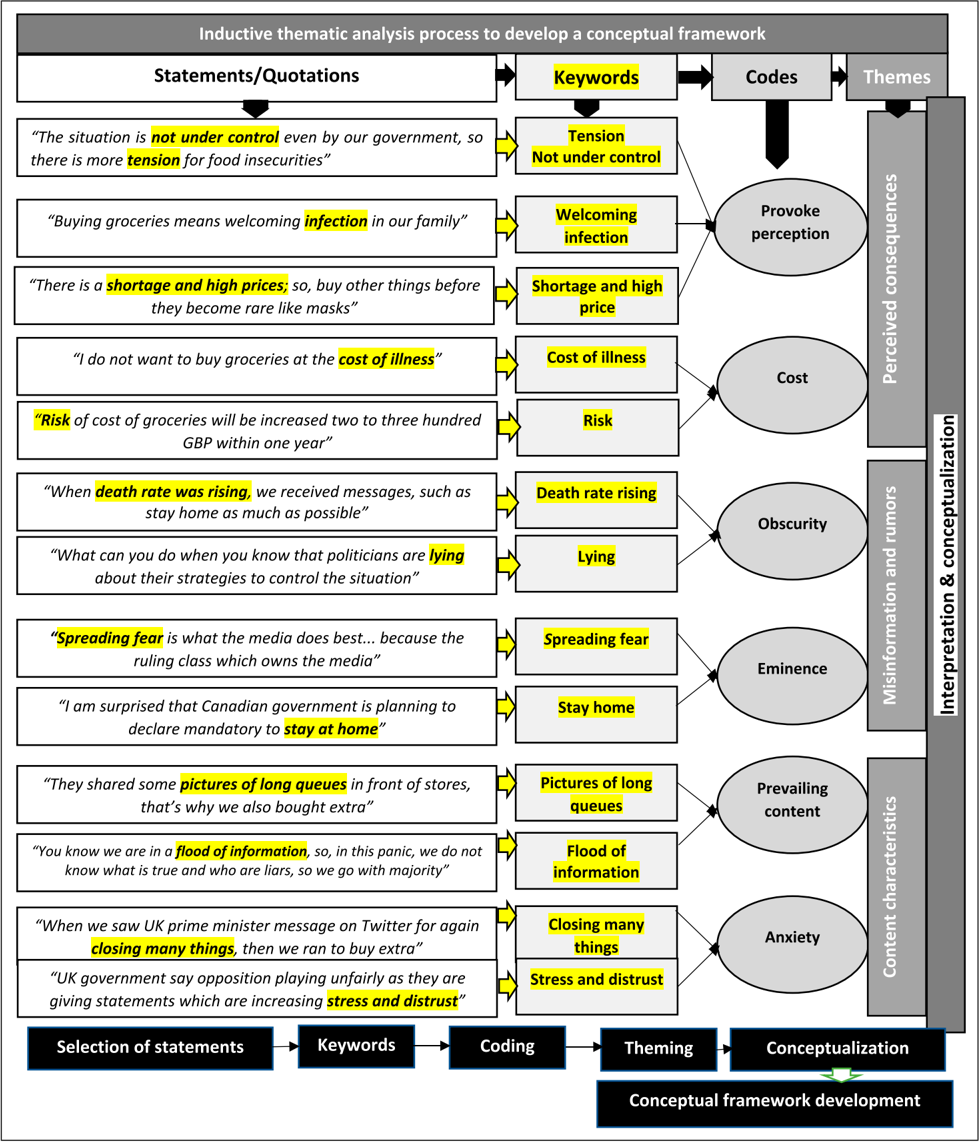
- The paper proposes six steps: transcription/familiarization and quotation selection; keyword selection; coding; theme development; conceptualization through interpretation of keywords, codes, and themes; and development of a conceptual model.
- It introduces 6Rs for keyword selection (realness, richness, repetition, rationale, repartee, regal), 6Rs for coding (robust, reflective, resplendent, relevant, radical, righteous), and 4Rs for theming (reciprocal, recognizable, responsive, resourceful).
- In the exemplar study, three main themes emerged: “Perceived consequences” from codes “Provoke perception” and “Cost”; “Misinformation and rumors” from codes “Obscurity” and “Eminence”; and “Content Characteristics” from codes “Prevailing content” and “Anxiety.”
- The exemplar’s final model, “Panic buying as social practice,” was based on Protection Motivation Theory (PMT) and the Theory of Rumor Transmission (TORT).
Methods
- Design: a methodological/conceptual paper that presents a comprehensive systematic model for thematic analysis culminating in a conceptual model, using Naeem and Ozuem (2022a) as an exemplar.
- Exemplar data: qualitative data gathered from Twitter, YouTube, and interviews; the exemplar used a six-stage thematic analysis and a social constructionist perspective with PMT and TORT as theoretical foundations.
- Main analysis: the paper describes each of the six steps in detail, provides practical examples from the exemplar, and compares the proposed process with Braun and Clarke’s (2006) six steps of thematic analysis.
Limitations
- The paper states that the potential of the process to address other research contexts or quantitative methods may require further exploration, and that the efficiency of the method compared with other model-building approaches has not been empirically tested.
- Evident from the text: the proposed six-step process and the 6Rs/4Rs are illustrated through a single exemplar study and are not independently validated or empirically compared with alternative thematic analysis approaches.
Model-written summary. Check it against the paper before relying on it.
Integrity signals
Registry
Cites
Statistics
Figures

Verification
Claims the paper makes
0 Valid · 4 Not valid · 56 Not checked · 89 Own results and interpretations
The cited sources that could be checked couldn’t confirm or dispute this claim.
In the paper
“For narrative approaches, conceptual model development focuses on personal experiences, emotions, and life histories (Eldh et al., 2020).”
§ A Step-by-Step Process of Thematic Analysis to Develop a Conceptual Model in Qualitative Research > Step 6: Development of Conceptual Model.
What the sources say
- Could not verifycites Eldh et al., 2020 matched to “Quotations in Qualitative Studies: Reflections on Constituents, Custom, and Purpose” (2020) sourceExperimental — accuracy not yet measured
The Discussion and Conclusions (page numbers unavailable) address how quotations can illustrate qualitative analysis and findings. A search for narrative approaches, conceptual model development, emotions, and life histories found no passage addressing the attributed claim. (LLM, conf=0.72)
plainstates an association- Asserted: passes — The authors put it forward as true.
- Checkable: passes — It can be checked against evidence.
- Load-bearing: unclear — It is unclear whether the paper’s conclusions depend on it.
- Based: passes — The paper gives a reason why it holds.
- Could not verify
In the paper
“The analytical process balances between descriptive analysis, which outlines patterns or trends, and interpretive analysis, which offers subjective perspectives (Miles & Huberman, 1994, p. 56).”
§ A Step-by-Step Process of Thematic Analysis to Develop a Conceptual Model in Qualitative Research > Step 2: Selection of Keywords.
What the sources say
- Not matchedcites Miles & Huberman, 1994, p. 56
An author–year citation the paper’s reference list doesn’t settle. We don’t search these by name.
plain- Asserted: passes — The authors put it forward as true.
- Checkable: passes — It can be checked against evidence.
- Load-bearing: passes — The paper’s conclusions depend on it.
- Based: passes — The paper gives a reason why it holds.
- Not matched
In the paper
“However, the thematic analysis approach could also fit a post-positivist paradigm (Howell, 2012, p. 30).”
§ A Step-by-Step Process of Thematic Analysis to Develop a Conceptual Model in Qualitative Research > Step 2: Selection of Keywords.
What the sources say
- Not matchedcites Howell, 2012, p. 30
An author–year citation the paper’s reference list doesn’t settle. We don’t search these by name.
hedgedstates an association- Asserted: passes — The authors put it forward as true.
- Checkable: passes — It can be checked against evidence.
- Load-bearing: unclear — It is unclear whether the paper’s conclusions depend on it.
- Based: passes — The paper gives a reason why it holds.
- Not matched
In the paper
“Hence, quotation selection is not simply a mechanical task but is influenced by the researcher's philosophical and theoretical approach (Jackson & Mazzei, 2012).”
§ A Step-by-Step Process of Thematic Analysis to Develop a Conceptual Model in Qualitative Research > Step 1: Transcription, Familiarization With the Data, and Selection of Quotations.
What the sources say
- Not matchedcites Jackson & Mazzei, 2012
An author–year citation the paper’s reference list doesn’t settle. We don’t search these by name.
plainstates a cause- Asserted: passes — The authors put it forward as true.
- Checkable: passes — It can be checked against evidence.
- Load-bearing: passes — The paper’s conclusions depend on it.
- Based: passes — The paper gives a reason why it holds.
- Not matched
A conclusion the paper draws from its own results — it cites no other source for it, so there is none to check. The quote shows it is in the paper.
In the paper
“Thus, keywords serve as a critical bridge between data and themes in different methodologies.”
§ A Step-by-Step Process of Thematic Analysis to Develop a Conceptual Model in Qualitative Research > Step 4: Theme Development.
boostedstates an association- Asserted: passes — The authors put it forward as true.
- Checkable: passes — It can be checked against evidence.
- Load-bearing: unclear — It is unclear whether the paper’s conclusions depend on it.
- Based: passes — The paper gives a reason why it holds.
10 more claims
Create a free account to see all 149 claims and every source verdict.
- It may state two separate claims as one. 54
- Probably not a substantial claim. 128
Claims other papers make about this one
Each is checked against this paper’s own text: does it say what the citing paper says it does?
The source backs part of the claim, not all of it — or backs it for a different population, condition or comparison.
In the citing paper
“With the identified keywords, initial coding was further informed by and cross-referenced to the literature on AI ethics and governance, particularly addressing public concerns in government AI, alongside the author team's collective expertise in AI-driven digital transformation in public administration.”
From Accountability in Government Use of AI : Citizen Concerns and Preferences (2025) · cites this paper as Naeem et al. 2023
Experimental — accuracy not yet measuredThe source backs part of the claim, not all of it — or backs it for a different population, condition or comparison.
In the citing paper
“Thematic analysis is a highly popular technique among qualitative researchers for analyzing qualitative data, which usually comprises thick descriptive data (Naeem et al., 2023).”
From The Psycho-Emotive Effects of AI-Generated Fake News on Social Media Users (2026) · cites this paper as Naeem et al., 2023
Experimental — accuracy not yet measuredThe cited source says what the claim attributes to it.
In the citing paper
“The selection of keywords was guided by the 6Rs framework-Realness, Richness, Repetition, Rationale, Repartee, and Regal-to ensure they accurately represented the essence of the data (Naeem et al. 2023).”
From Accountability in Government Use of AI : Citizen Concerns and Preferences (2025) · cites this paper as Naeem et al. 2023
The cited source says what the claim attributes to it.
In the citing paper
“The data were analyzed through Naeem et al.'s (2023) six-step thematic analysis process to develop a conceptual framework (Naeem & Ozuem, 2022).”
From “It’s Not Just About Competition – It’s Ceremony”: Introducing the Embedded Indigeneity Framework for Understanding Identity, Mission, and Practice in TCU and NASNTI Athletics (2026) · cites this paper as Naeem et al. (2023)
The cited source says what the claim attributes to it.
In the citing paper
“The selected methodology was implemented due to the end results that 1) presented a novel conceptual framework and 2) serves as a contextually specific extension of existing theory/theories (Naeem et al., 2023).”
From “It’s Not Just About Competition – It’s Ceremony”: Introducing the Embedded Indigeneity Framework for Understanding Identity, Mission, and Practice in TCU and NASNTI Athletics (2026) · cites this paper as Naeem et al., 2023
Self-check
Percentages, sums and reported differences re-computed from the paper’s own numbers.
Each contradiction between two passages listed here was confirmed by an independent check.
Rated minor: it would not touch a result — a value no result rests on, a p-value that stays on the same side of the significance level, or a conflict that is clerical, resolved elsewhere in the paper, or outside its own findings.
In the paper
§ A Step-by-Step Process of Thematic Analysis to Develop a Conceptual Model in Qualitative Research > Step 6: Development of Conceptual Model.
“Positivism, which favours inductive methods, builds its model on top of previously established theories and conducts its experiments in an unbiased manner.”
§ A Step-by-Step Process of Thematic Analysis to Develop a Conceptual Model in Qualitative Research > Step 6: Development of Conceptual Model.
“An inductive approach is primarily data-driven, whereby themes are derived from the data itself without the influence of pre-existing theories (Braun & Clarke, 2006).”
Citations
Cites
Using thematic analysis in psychology
Braun, V., & Clarke, V. (2006) · Qualitative Research in Psychology · doi:10.1191/1478088706qp063oa · Cited by 194,414
Qualitative Data Analysis: An Expanded Sourcebook
(1994) · Journal of Environmental Psychology · doi:10.1016/s0272-4944(05)80231-2 · Cited by 48,420 · cited 2×
“In the coding process, consideration of keywords helps in multiple ways: The analytical process balances between descriptive analysis, which outlines patterns or trends, and interpretive analysis, which offers subjective perspectives (Miles & Huberman, 1994, p. 56).”
Lincoln, Y. S., Guba, E. G., & Pilotta, J. J. (1985) · International Journal of Intercultural Relations · doi:10.1016/0147-1767(85)90062-8 · Cited by 45,787 · cited 1×
“…degrees of subjectivity and objectivity has underscored the fl exibility intrinsic to research methodologies and highlighted that these tools of analysis are intimately intertwined with, and, indeed, emerge from the distinctive nature of speci fi c disciplines and perspectives (Lincoln & Guba, 1985).”
BackgroundThe Discovery of Grounded Theory: Strategies for Qualitative Research
Glaser, B. G., & Strauss, A. L. (2017) · Aldine (Routledge reprint) · doi:10.4324/9780203793206 · Cited by 25,789
The qualitative content analysis process
Elo, S., & Kyngäs, H. (2008) · Journal of Advanced Nursing · doi:10.1111/j.1365-2648.2007.04569.x · Cited by 22,617 · cited 1×
“Deductive coding, linked with descriptive analysis, is a top-down approach where pre-existing theories, models, or codes guide the data analysis (Elo & Kyng¨as, 2008).”
Method(2009) · Cited by 21,330
Reflecting on reflexive thematic analysis
Braun, V., & Clarke, V. (2019) · Qualitative Research in Sport, Exercise and Health · doi:10.1080/2159676x.2019.1628806 · Cited by 19,677
(1998) · Medical Entomology and Zoology · Cited by 18,397
(2014) · Cited by 15,747
S., N. L. (2017) · doi:10.1177/1609406917733847 · Cited by 14,051 · cited 3×
“· Robust: Coding should convey the true essence of data in a theoretical manner (Nowell et al., 2017).”
Background
Research works printed but not linked: 9
- 1. Arar, K. (2017). The what's and why's of the how to of qualitative research. Qualitative Report, 22(11), 2956-2958.
- 16. Creswell, J. W. (2012). Educational research. Pearson.
- 19. Denzin, N. K., & Salvo, J. (2020). New directions in theorizing qualitative research: Theory as resistance. Myers Education Press.
- 62. Oliver, P. (2021). Using qualitative methods to answer your research question (First). Open University Press.
- 63. Patton, M. Q. (2015). Qualitative research & evaluation methods: Integrating theory and practice (fourth). Sage Publications, Inc. Qualitative research (pp. 273-290). Sage.
- 67. Saldana, J. (2021). The coding manual for qualitative researchers (Fourth). Sage.
- 68. Saldana, J. M. (2016). The coding manual for qualitative researchers (4rd ed.). Sage Publications.
- 74. Seale, C. (2013). Qualitative research practice. In C. Seale, G. Gobo, J. Gubrium, & D. Silverman (Eds.), Concise paperback. Sage.
- 80. Tracy, S. J. (2019). Qualitative research methods: Collecting evi- dence, crafting analysis, communicating impact (2nd ed.). Wiley Blackwell.
Cited by
Items 1,401–1,500 of 2,204
Qu, H., Sahrani, S., Fauzi, F., Song, X., & Zhao, Y. (2026) · Information · doi:10.3390/info17050479
Thulemark, M., & Thulemark, M. (2026) · Journal of Heritage Tourism · doi:10.1080/1743873x.2026.2683187
“Following TA steps (Naeem et al., 2023), the researchers first became familiar with the data through reading the interview transcription, which included extended descriptions of facial expressions, tone, movements, timed silences, apparent reflection or hesitations.”
Boas, A. S. D. C. V., Wernet, M., Ruiz, M. T., Silveira, A. O., Charepe, Z. B., Linares, A. M., & da Silva, J. A. (2026) · Revista da Escola de Enfermagem da USP · doi:10.1590/1980-220x-reeusp-2025-0394pt
Young adult building artisans' involvement in illicit substances: the implications for SDGs 3 and 8.
Ebekozien, A., Ebekozien, O., Ebekozien, E. O., Hafez, M., Aigbavboa, C., Nwaole, A., Samsurijan, M., Eremiokhale, J. I., Aigbe, R. O., & Ghazali, N. (2026) · International Journal of Health Care Quality Assurance · doi:10.1108/ijhcqa-10-2025-0173
Li, L. C., Hou, T. C., Singh, D. K. A., et al. (2026) · Journal of Bodywork and Movement Therapies · doi:10.1016/j.jbmt.2026.06.028
Peng, F., Neville, S., Maher, C. A., Du, T., Windsor, T. D., & Eckert, M. C. (2025) · Journal of Intergenerational Relationships · doi:10.1080/15350770.2025.2584530
Kholiya, D., Mehta, P., Akhilesh, et al. (2025) · International Journal of Research and Review · doi:10.52403/ijrr.20251203
Kang, Y., & Yang, K. C. C. (2025) · IGI Global eBooks · doi:10.4018/979-8-3373-3685-5.ch011
Lin, T. F. (2026) · Learning Disability Quarterly · doi:10.1177/07319487261449487
“…calculated for each participant across the six steps of thematic analysis: (a) extracting quotations; (b) selecting keywords; (c) coding; (d) developing themes; (e) concep-tualizing through interpretation of keywords, codes, and themes; and (f) constructing a conceptual model (Naeem et al., 2023).”
Thomson, C., Ross, L., & Davies, J. E. (2025) · Drugs & Therapy Perspectives · doi:10.1007/s40267-025-01159-z
Wrench, E., Kaur, J., Rankin, S. M., Williams, R. A., & Machin, L. (2026) · Adoption Quarterly · doi:10.1080/10926755.2026.2714154
Imagination and the creative process: a systematic review
Lamb, K. N., & Puryear, J. S. (2026) · Frontiers in Psychology · doi:10.3389/fpsyg.2026.1686856
“Thematic analysis is a flexible approach and lends itself to inductive and deductive coding approaches (Braun and Clarke, 2006; Miles and Huberman, 1994; Naeem et al., 2023).”
Cheng, Z. (2025) · Media Watch · doi:10.1177/09760911251368965
“Both deductive and inductive codes were applied to capture both expected and unexpected results (Naeem et al., 2023).”
Reasons of Social Exclusion of Elderly Persons
Čepienė, A., & Grigienė, N. (2025) · SOCIAL WELFARE INTERDISCIPLINARY APPROACH · doi:10.15388/sw.2025.15.11
Huang, W. (2025) · Journal of Continuing Education in the Health Professions · doi:10.1097/ceh.0000000000000625
Choirunisa’, N., Zubaidah, S., & Susanto, H. (2025) · Salud Ciencia y Tecnología · doi:10.56294/saludcyt20251882
Kamarudin, N. H. (2026) · EDUCATUM Journal of Social Sciences · doi:10.37134/ejoss.vol12.sp2.17.2026 · Cited by 1
Chen, Z., Zainuddin, Z. A., Xu, M., Zhou, N., Yan, Y., & Dong, J. (2025) · BMC Public Health · doi:10.1186/s12889-025-22805-1
“This method can be divided into six key steps: transcription, selection of keywords, coding, theme development, conceptualisation through interpretation of keywords/ codes/themes, and the development of a conceptual model [33].”
Mbuva, J. M. (2025) · Journal of Higher Education Theory and Practice · doi:10.33423/jhetp.v25i3.7794
du Plessis, M., & Rabie, C. (2025) · South African Journal of Economic and Management Sciences · doi:10.4102/sajems.v28i1.6428 · Cited by 7
“Adhering to a structured six-step framework (Naeem et al. 2023), the analysis proceeded through the following steps: (1) thorough data familiarisation; (2) initial keyword identification; (3) the systematic selection and application of relevant codes; (4) the development of overarching themes from…”
Manion, K., Tabora, J., & O'Neill, D. (2026) · ASEE Annual Conference & Exposition · doi:10.18260/1-2--58975
Tiong, S. P., Yang, X., Touzet, A. Y., Millward, C. P., Zipser, C. M., Tetreault, L. A., Gharooni, A., & Davies, B. M. (2025) · doi:10.2196/preprints.76448
Bukirwa, N. C., Ngigi, M. W., & Gitau, R. (2026) · Agricultural Sciences · doi:10.4236/as.2026.178045
Caregivers' views on paediatric burn injury prevention materials in the United Kingdom.
Salt, C., Shepherd, L., Taylor, J., Burton, A., & Hurst, G. (2026) · Burns · doi:10.1016/j.burns.2026.108026
Experiences and Coping Strategies of Chinese International Students in Pakistan: A Qualitative Study
Khan, N., Fatima, I., & Tariq, O. (2026) · Culture & Psychology · doi:10.1177/1354067x261452187
Exploring shared experiences as citizen sport diplomats: a collaborative self-ethnography
Griffiths, R. J., Tingle, J. K., & Breidenstein, A. (2026) · European Sport Management Quarterly · doi:10.1080/16184742.2025.2611729
“…of analysis used more of a top-down approach, i.e. the use of a pre-existing model to guide the data analysis, we employed deductive thematic analysis (Naeem et al., 2023) to review our initial transcripts and code additional recorded discussions that took place after returning from the conference.”
Sukasih, S., Wulandari, D., Tyas, D. N., & Andrijati, N. (2024) · Salud Ciencia y Tecnología · doi:10.56294/saludcyt2024.1352
Siripukdeekan, C., Seeherunwong, A., Vongsirimas, N., Lekdamrongkul, P., & Pithukpakorn, M. (2026) · Research Square · doi:10.21203/rs.3.rs-10616988/v1
Beyond the algorithm: academic developers as digital mediators in Global South higher education
Sithole, M. P. (2026) · The International Journal for Academic Development · doi:10.1080/1360144x.2026.2726310
Collaborative Learning through Digital Writing: Peer Editing and Feedback in EFL ContextsPreprint
Ismail, I. (2025) · SSRN Electronic Journal · doi:10.2139/ssrn.5232307
Beyond the pitch: migration, communication, culture, and chastity in Nigerian women's football
Onwumechili, C., & Akpan, U. S. (2025) · Soccer and Society · doi:10.1080/14660970.2025.2603766
Booker, S. Q., & Herr, K. (2026) · Research on Aging · doi:10.1177/01640275261467445
Sources cited analysis: balancing safety and transparency with confidential interview evidence
Sharp, T. (2025) · International Journal of Social Research Methodology · doi:10.1080/13645579.2025.2544344
“I identified these patterns of shared meaning by performing reflexive thematic analysis (Braun & Clarke, 2019, Naeem et al., 2023).”
Assessing Surgical Capacity in Guam: Current Strengths and Future Goals
Benavente, R. V., Biala, E., Lopez, B. A., et al. (2026) · International Journal of Environmental Research and Public Health · doi:10.3390/ijerph23030353
“Thematic analysis was utilized [8].”
Entry to Perioperative Nursing: An Explanatory Mixed Methods Study
Gore, A., Karacsony, S., & Saghafi, F. (2025) · Nursing Inquiry · doi:10.1111/nin.70057
“This process supported the development of internally coherent and analytically rich themes (Naeem et al. 2023).”
Rethinking agrotourism: Integrating conceptual insight from existing scholarship
Wibowo, J. M. (2026) · Local Economy The Journal of the Local Economy Policy Unit · doi:10.1177/02690942261442587 · Cited by 2
Experiences of children during violent conflicts in Northern Ghana
Bukari, K. N., Imoro, R. J., Appiah-Boateng, S., & Bukari, S. (2026) · Global Change Peace & Security · doi:10.1080/14781158.2026.2710851
Managing Diversity and Inclusion in UAE Family Organizations
Iyer, S. S., & Malhotra, S. (2025) · Advances in business strategy and competitive advantage book series · doi:10.4018/979-8-3693-9261-4.ch015
Sharpe, T. L., Aqil, N., Richardson, M.-A., et al. (2026) · International Review of Victimology · doi:10.1177/02697580261456765
“This approach includes analyzing the text for keywords, assigning codes to segments of data, and developing themes by identifying relationships and patterns among codes (Naeem et al, 2023).”
Bridging Theory and Practice: Case Studies as Tools for Applied Linguistics in University Settings
Asrifan, A., Sadaruddin, S., Mardyawati, M., Rika Kurnia, R., Syamsuardi, S., & Kumar, L. S. (2024) · Advances in educational technologies and instructional design book series · doi:10.4018/979-8-3693-5738-5.ch003
Kaplonyi, J., Loi, S. M., Stout, J. C., Philip, J. A. M., Gebert, R., & Goh, A. (2026) · Journal of Nursing Scholarship · doi:10.1111/jnu.70130
“This flexibility allowed for capture of the nuances of the data set (Naeem et al. 2023; Saunders et al. 2023; Williams and Moser 2019).”
Simard, M., Lemieux, K., Pomerleau, J., & Beauregard, C. (2026) · The Arts in Psychotherapy · doi:10.1016/j.aip.2026.102556
Can yield warranties promote farmer practice adoption? Evidence from a two-region pilot study
Houser, M. K., Fisher, K., Sainato, K., Peterson, L., Frautschy, P., & Fife, A. (2025) · Journal of Soil and Water Conservation · doi:10.1080/00224561.2025.2456433
Understanding Community Involvement Behaviors in Waste Bank Programs: A Qualitative Study
Hidayat, S., Rauf, B., & Mandra, M. A. S. (2025) · Pubmedia Social Sciences and Humanities · doi:10.47134/pssh.v3i2.497
Omayo, F. M., & Mbatha, B. (2025) · Science Research · doi:10.11648/j.sr.20251306.12
Krisnamurthi, B., Utami, A. D., Abdullah, I., & Aulia, M. R. (2026) · SSRN Electronic Journal · doi:10.2139/ssrn.6437512 · Cited by 1
Duncan, E., Osei, E. O., & Arthur-Nyarko, E. (2025) · Research Square · doi:10.21203/rs.3.rs-8182290/v1
Mwijuka, M. (2025) · International Journal For Multidisciplinary Research · doi:10.36948/ijfmr.2025.v07i03.46751
Shaikh, D., Bhalerao, H., & Simon, A. (2025) · Journal of Lifestyle and SDGs Review · doi:10.47172/2965-730x.sdgsreview.v5.n03.pe05414
Pacheco, A. L., & Puerto, E. (2025) · Latin American Computer Conference (CLEI) · doi:10.1109/clei67442.2025.11420823 · Cited by 1
Game-changing the way to teach professional maintenance in company-specific production systems
Pérez, S. N. G., Papadopoulou, P., Leal, A., Bokrantz, J., & Skoogh, A. (2026) · Journal of Quality in Maintenance Engineering · doi:10.1108/jqme-03-2025-0015 · Cited by 1
Mobile Phone Rewards to Improve Qur’anic Memorization at Ma’had Aly IHBS
Adzima, F., Hadi, S., Marina, S., et al. (2025) · Journal of Islamic Civilization · doi:10.33086/jic.v7i1.7739
“This interpretation was essential for comprehensively understanding the extent to which mobile phone rewards could enhance student motivation and improve their Qur’anic memorization achievements (Naeem et al., 2023).”
Tibane, C. C., & Mafa-Theledi, O. N. (2025) · Journal of Education and Learning Technology · doi:10.38159/jelt.20256115
Mkra, Z. P., & Agboola, C. (2025) · Turkish Academic Research Review - Türk Akademik Araştırmalar Dergisi [TARR] · doi:10.30622/tarr.1657750
Development of digital twin framework to support sustainability of urban farming community
Maharani, N. Z., & Eitiveni, I. (2026) · Journal of Information Technology Case and Application Research · doi:10.1080/15228053.2026.2709991
Ajayi, O. G., & Atiku, S. O. (2026) · Cogent Education · doi:10.1080/2331186x.2026.2704326
Tiong, S. P., Yang, X., Touzet, A. Y., Millward, C. P., Zipser, C. M., Tetreault, L. A., Gharooni, A., & Davies, B. M. (2025) · medRxiv · doi:10.1101/2025.09.22.25336392
The innovation in Indonesian language for foreign speaker teaching: A systematic literature review
Faizin, Isnaini, M., & Khoiriyah (2025) · Multidisciplinary Reviews · doi:10.31893/multirev.2026331
“It can be achieved since the thematic analysis requires researchers to familiarise themselves with the data, reviewing themes, searching for themes and producing the report based on the theme (Naeem et al., 2023).”
Unpacking accessible tourism: motivators, barriers, and emotions of mobility-impaired travellers
Burhan, B. B., Hanafiah, M. H., Rahman, N. A. F. W. A., & Zahri, W. A. W. A. (2026) · Leisure/Loisir · doi:10.1080/14927713.2026.2651695
Tang, V. F. Y., Jiang, D., Kwok, J. Y. Y., Ho, H. C. Y., Jian, I. Y., Choi, N. G., Cruwys, T., You, J., Warner, L. M., Seewer, N., et al. (2026) · Frontiers in Public Health · doi:10.3389/fpubh.2026.1741422
Hidayat, N., Ibrahim, S. A., Pramukti, A. R. D., Arifani, Y., & Wijayatiningsih, T. D. (2026) · Human Behavior and Emerging Technologies · doi:10.1155/hbe2/1167530 · Cited by 2
Bhamani, S. S., Arthur, D., Dawood, M., Hanif, S., Ali, F. R., & Letourneau, N. L. (2026) · Midwifery · doi:10.1016/j.midw.2026.104950
12131 LESLLA students’ views of their use of French in their everyday life in Quebec (Canada)
Fortier, V., Amireault, V., Beaulieu, S., et al. (2025) · De Gruyter eBooks · doi:10.1515/9783111403878-002
Shields, M. (2024) · MOspace Institutional Repository (University of Missouri) · doi:10.32469/10355/105924
Occupational hazards: Perceptions of nurse managers at Intermediate Hospital Onandjokwe
Nakatana, K., Amukugo, H. J., & Salomo, S. (2025) · Health SA Gesondheid · doi:10.4102/hsag.v30i0.2904
“Data analyses were done by thematic approach analysis, and six steps of the coding process were followed (Naeem et al. 2023).”
Pediatric Death in the Emergency Department: Qualitative Insights From Physicians’ Experiences
Lee, J. Y., Pattee, J., Aspiotes, C. R., Lunoe, M. M., Kazmerski, T. M., Harvey, D. S., Zuckerbraun, N. S., & Noorbakhsh, K. A. (2026) · Pediatric Emergency Care · doi:10.1097/pec.0000000000003707
Kunanusorn, A., Darmawijaya, I. G., & Kunanusorn, P. (2026) · Journal of Policy Research in Tourism Leisure and Events · doi:10.1080/19407963.2026.2705458
McMullin, D., Mapaling, C., & Tsabedze, W. F. (2025) · E-Journal of Humanities Arts and Social Sciences · doi:10.38159/ehass.20256821 · Cited by 1
ALWAYS ON, ALWAYS UNDER PRESSURE: A BIBLIOMETRIC REVIEW OF WORKPLACE TELEPRESSURE RESEARCH
Karaçay, G. T. (2026) · Anadolu Üniversitesi İktisadi ve İdari Bilimler Fakültesi Dergisi · doi:10.53443/anadoluibfd.1930593
Identifying Intercultural Competencies Among Faculty Members: A Metasynthesis StudyPreprint
Hajianvari, L., Ramezani, A., & Bakhtiari, F. (2025) · Research Square · doi:10.21203/rs.3.rs-5443797/v1
Iranian women's perception of marital dissatisfaction formation: an explanatory qualitative studyPreprint
Hajimirzaie, S. S., Bahri, N., Parsajam, T., et al. (2025) · Research Square · doi:10.21203/rs.3.rs-6295417/v1
Nieminen, L., Leivo, J., Luukkaala, T. H., & Kankaanpää, M. (2026) · Topics in Spinal Cord Injury Rehabilitation · doi:10.46292/sci25-00018
van Wyk, H., & Nel, J. A. (2026) · South African Journal of Psychology · doi:10.1177/00812463261474384
“A systematic six-step thematic analysis process was employed as proposed by Naeem et al. (2023), proceeding through phases of familiarisation, keyword selection, open coding, theme development, interpretation, and conceptual modelling.”
A Thematic Analysis of VR Learning Frameworks in Higher Education: The VRISE Model
Abdullah, N. H. I., Phon, D. N. E., & Zulkifli, N. S. A. (2025) · doi:10.1109/icitce65255.2025.11210763
“This study adopts a structured thematic analysis method informed by the six-step process outlined by [26], to synthesize the findings from ten selected VR learning frameworks.”
Differentiated Learning to Facilitate Interest in Mathematics Learning in Elementary School
Siregar, P. S., Santosa, F., Lestari, S., & Hatika, R. G. (2026) · MIMBAR PGSD Undiksha · doi:10.23887/jjpgsd.v14i1.102399 · Cited by 1
Chisosa, T. A., Saruchera, M., Jaricha, H., & Charirwe, E. (2026) · Journal of Public Child Welfare · doi:10.1080/15548732.2026.2726260
Ishaka, M., & Hidayat, R. (2025) · Jurnal Ranah Publik Indonesia Kontemporer (Rapik) · doi:10.47134/rapik.v5i2.119 · Cited by 1
Vähämäki, J., Hilgert, A., Wolf, K., & Bruder, M. (2026) · World Development · doi:10.1016/j.worlddev.2026.107451 · Cited by 2
Motha, S. G., Naidoo, N., & Mostert, K. (2026) · South African Journal of Physiotherapy · doi:10.4102/sajp.v82i1.2348
“This process was used to understand the participants’ experiences by transforming the text into meaningful units, codes, categories, and themes (Naeem et al. 2023; Saldaña 2016).”
Eniego, A. A., Jesus, A. B. D., & Magat, M. E. R. (2025) · Springer eBooks · doi:10.1007/978-981-96-5154-2_8 · Cited by 1
Hikmah as a Solution to the Crisis of Adab in Buya Hamka’s Thought
Islam, M. T., Nasution, A., Baqi, S. A., Novitasari, D., Ikmah, A. D., Azmi, M. U., & Oktaviani, I. N. (2025) · RELIGIA · doi:10.28918/religia.v28i1.8062 · Cited by 14
Nurses’ perspectives of conscientious objection and ethical challenges in abortion care
Dill, M., & Dunne, D. (2026) · Nursing Ethics · doi:10.1177/09697330261465872
Kazmierczak-Murray, S., & Carey, A. (2026) · Global Implementation Research and Applications · doi:10.1007/s43477-025-00205-2
Pueschel, J., Borraz, S., & Gurzki, H. (2026) · Journal of Advertising Research · doi:10.1080/00218499.2026.2693330
Pérez, M. J. R., Sánchez‐Heras, A. B., Alonso, C. M., García, Y. G., Oliver, N. A., Marcos, R., Renau, R. R., Marsiñach, C. S., Bosque, S. B., & Varela, M. Q. (2026) · BMJ Open · doi:10.1136/bmjopen-2025-107391 · Cited by 2
“…shape the research questions to ensure they reflected patient priorities, experiences and preferences, (b) the creation of the interview guides—providing valuable feedback to ensure that topics were relevant and questions were appropriate and sensitive and (c) revision of the final manuscript.”
Pieri, M. (2026) · Frontiers in Public Health · doi:10.3389/fpubh.2026.1903749
“In the first phase, the author identified relevant quotes that showed interesting patterns and vivid depictions of the lived experiences (43).”
Osman, S. G., Adom, D., Donkor, E. K., et al. (2026) · Research Square · doi:10.21203/rs.3.rs-8616859/v1
A Comprehensive Bibliometric Evaluation of Medical Tourism Using Biblioshiny and VOSviewer
Kesavan, V., Polisetty, A., Khattar, R., et al. (2026) · IGI Global eBooks · doi:10.4018/979-8-3373-6881-8.ch004
Constraints and creativity. Social ties in monetary transfers to the poor
Bertoluzza, G. (2026) · International Journal of Sociology and Social Policy · doi:10.1108/ijssp-11-2025-0783
Kipsoi, M. J., Wachira, S. W., & Esho, T. C. (2025) · Primary Health Care Practice Journal · doi:10.11604/phcp.2025.2.6.48053
Mahlangu, G., Phahlane, M. M., & Mbohwa, C. (2025) · doi:10.2196/preprints.86347
Perceptions of Assisted Dying Among Scottish Medical Students: Insights from a National Survey
Geddes, D., Knox, J., Obree, D., & Harden, J. (2023) · Asian Journal of Ethics in Health and Medicine · doi:10.51847/a6mjlbv3qh
Event security: interdisciplinary risk communication
Nguyen, T., & Kearns, E. (2026) · International Journal of Event and Festival Management · doi:10.1108/ijefm-08-2025-0124
Philosophical Foundations of Research
Almusaed, A., Almssad, A., & Yitmen, İ. (2025) · Springer eBooks · doi:10.1007/978-3-031-97393-2_6 · Cited by 4
Mealings, K. T., Hughes, S., Halvorsen, L., Nash, K., Coe, L.-J., Macqueen, D., Ward, K., & McMahon, C. M. (2026) · BMJ Open · doi:10.1136/bmjopen-2025-111701
“Yarning circle recordings will be transcribed verbatim professionally and will be analysed qualitatively using culturally adapted thematic analysis 33 34 to identify concepts of value of school screening programmes.”
Holland, N. S., & Illemann, N. M. (2026) · Journal of Radiology Nursing · doi:10.1016/j.jradnu.2026.101436
Metadata
- Authors
- Naeem, M., Ozuem, W., Howell, K., & Ranfagni, S.
- Affiliations
- University of Gloucestershire (GB)
- University of Cumbria (GB)
- Northumbria University (GB)
- University of Florence (IT)
- Corresponding author
- Naeem, Muhammad
- Venue
- International Journal of Qualitative Methods
- Publisher
- SAGE Publications
- Published
- 2023-10
- Volume
- 22
- ISSN
- 1609-4069 (ISSN-L)
- OpenAlex
- W4388503650
- Cited by
- 2,243
- References
- 71
- Citations by year
- 2026: 1000 · 2025: 981 · 2024: 258 · 2023: 4
- FWCI
- 1654.78
- Type
- journal article
- Language
- en
- Open access
- gold
- doi.org
- Licence
- Locations
- International Journal of Qualitative Methods (publishedVersion, cc-by-nc)
- Insight (University of Cumbria) (acceptedVersion)
- DOAJ (DOAJ: Directory of Open Access Journals) (submittedVersion, cc-by-sa)
- Florence Research (University of Florence) (submittedVersion)
- Topics
- Social Sciences › Education › Qualitative Research Methods and Applications
- Social Sciences › Sociology and Political Science › Qualitative Research Methods and Ethics
- Social Sciences › General Social Sciences › Computational and Text Analysis Methods
- Keywords
- thematic analysis, conceptual modeling, qualitative data analysis, inductive coding, deductive coding, grounded theory, interpretive phenomenology, constructivist research, positivist research, theoretical conceptualization, replicability
About these checks
Registry, retraction, Cites and statistics results are computed, not judged, with one exception: a printed reference that no index lists is read once by a model before it counts as a citation error. Claims are extracted by a model and kept only when their quote appears verbatim in the text; each cited source is then checked, with a model’s help, for whether it says what the claim relies on. Those verdicts can be wrong — read the claim’s quote and the cited source before relying on one.
The claim verdicts this report counts are experimental: their accuracy is not yet measured.
A language model drew the claims from the paper on 2026-10-10, under version 3 of the claim definition (model deepseek-v4.1-flash, prompt extract-v3).
A second model labelled each claim on 2026-10-10 (model jev-1.13-20260917, definition revision gold-guideline-v0.2).
Cited sources are checked with a language model’s help (gpt-6-sol).
Statistics and arithmetic are recomputed, not judged.
Confidence bands are shown only for fields calibrated on our annotated test set. None is calibrated yet, so no band is shown.
What counts as a claim ›How we measure confidence ›How we check this ›
Are you an author, or do you see a problem with this page? Request a review
Data sources
Bibliographic data: Semantic Scholar, OpenAlex, Crossref.
Contains information from the Semantic Scholar Academic Graph Datasets, made available under the ODC Attribution License (ODC-BY 1.0).
Semantic Scholar’s data is described in: Kinney, R., et al. (2023). The Semantic Scholar Open Data Platform. arXiv:2301.10140.
