

A Step-by-Step Process of Thematic Analysis to Develop a Conceptual Model in Qualitative Research
Open accessThe DOI matches its Crossref record; 77 of the 78 references it cites were found in a registry or an index, and 1 are not checked yet; 2 of the 57 sources its claims cite were checked for support.
Abstract
Thematic analysis is a highly popular technique among qualitative researchers for analyzing qualitative data, which usually comprises thick descriptive data. However, the application and use of thematic analysis has also involved complications due to confusion regarding the final outcome’s presentation as a conceptual model. This paper develops a systematic thematic analysis process for creating a conceptual model from qualitative research findings. It explores the adaptability of the proposed process across various research methodologies, including constructivist methodologies, positivist methodologies, grounded theory, and interpretive phenomenology, and justifies their application. The paper distinguishes between inductive and deductive coding approaches and emphasizes the merits of each. It suggests that the derived systematic thematic analysis model is valuable across multiple disciplines, particularly in grounded theory, ethnographic approaches, and narrative approaches, while also being adaptable to more descriptive, positivist-based methodologies. By providing a methodological roadmap, this study enhances the rigor and replicability of thematic analysis and offers a comprehensive strategy for theoretical conceptualization in qualitative research. The contribution of this paper is a systematic six-step thematic analysis process that leads to the development of a conceptual model; each step is described in detail and examples are given.
Verified 2026-11-22 · 1 reference not checked yet
Overview
CoChat Summary
TL;DR
This methodological paper presents a six-step systematic thematic analysis process for developing a conceptual model from qualitative data, illustrated with Naeem and Ozuem’s (2022a) panic-buying study. It introduces 6Rs for keyword selection, 6Rs for coding, and 4Rs for theming to enhance rigor and trustworthiness.
Key findings
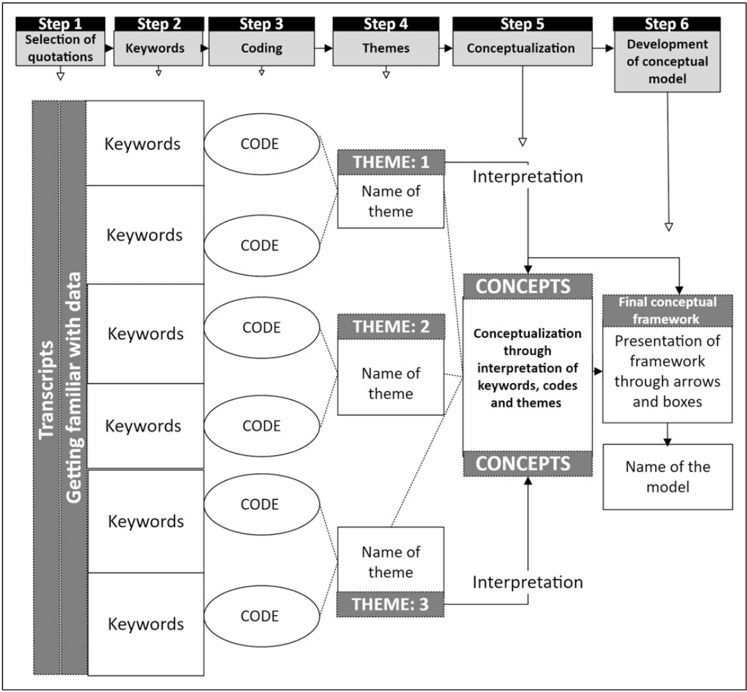
- The paper proposes six steps: transcription/familiarization and quotation selection; keyword selection; coding; theme development; conceptualization through interpretation of keywords, codes, and themes; and development of a conceptual model.
- It introduces 6Rs for keyword selection (realness, richness, repetition, rationale, repartee, regal), 6Rs for coding (robust, reflective, resplendent, relevant, radical, righteous), and 4Rs for theming (reciprocal, recognizable, responsive, resourceful).
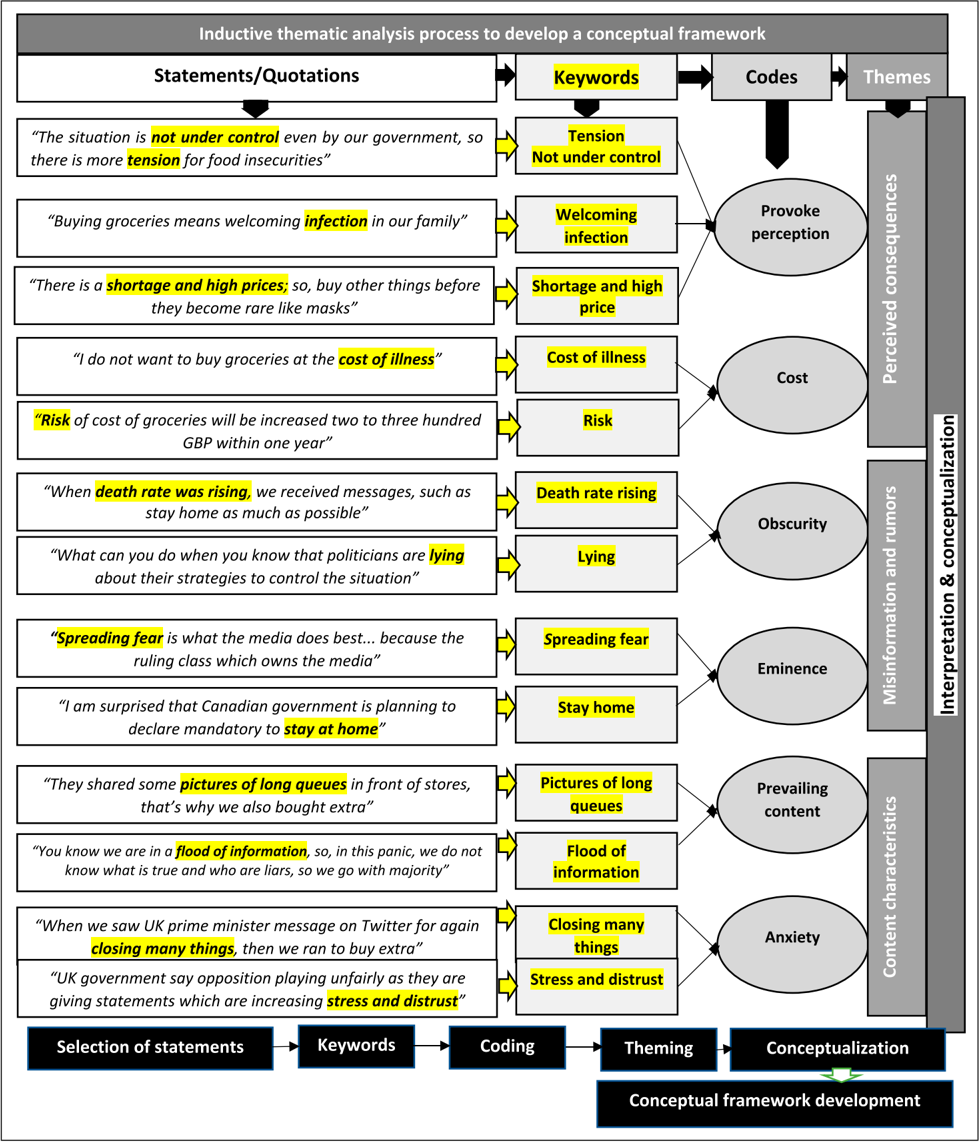
- In the exemplar study, three main themes emerged: “Perceived consequences” from codes “Provoke perception” and “Cost”; “Misinformation and rumors” from codes “Obscurity” and “Eminence”; and “Content Characteristics” from codes “Prevailing content” and “Anxiety.”
- The exemplar’s final model, “Panic buying as social practice,” was based on Protection Motivation Theory (PMT) and the Theory of Rumor Transmission (TORT).
Methods
- Design: a methodological/conceptual paper that presents a comprehensive systematic model for thematic analysis culminating in a conceptual model, using Naeem and Ozuem (2022a) as an exemplar.
- Exemplar data: qualitative data gathered from Twitter, YouTube, and interviews; the exemplar used a six-stage thematic analysis and a social constructionist perspective with PMT and TORT as theoretical foundations.
- Main analysis: the paper describes each of the six steps in detail, provides practical examples from the exemplar, and compares the proposed process with Braun and Clarke’s (2006) six steps of thematic analysis.
Limitations
- The paper states that the potential of the process to address other research contexts or quantitative methods may require further exploration, and that the efficiency of the method compared with other model-building approaches has not been empirically tested.
- Evident from the text: the proposed six-step process and the 6Rs/4Rs are illustrated through a single exemplar study and are not independently validated or empirically compared with alternative thematic analysis approaches.
Model-written summary. Check it against the paper before relying on it.
Integrity signals
Registry
Cites
Statistics
Figures

Verification
Claims the paper makes
0 Valid · 4 Not valid · 56 Not checked · 89 Own results and interpretations
The cited sources that could be checked couldn’t confirm or dispute this claim.
In the paper
“For narrative approaches, conceptual model development focuses on personal experiences, emotions, and life histories (Eldh et al., 2020).”
§ A Step-by-Step Process of Thematic Analysis to Develop a Conceptual Model in Qualitative Research > Step 6: Development of Conceptual Model.
What the sources say
- Could not verifycites Eldh et al., 2020 matched to “Quotations in Qualitative Studies: Reflections on Constituents, Custom, and Purpose” (2020) sourceExperimental — accuracy not yet measured
The Discussion and Conclusions (page numbers unavailable) address how quotations can illustrate qualitative analysis and findings. A search for narrative approaches, conceptual model development, emotions, and life histories found no passage addressing the attributed claim. (LLM, conf=0.72)
plainstates an association- Asserted: passes — The authors put it forward as true.
- Checkable: passes — It can be checked against evidence.
- Load-bearing: unclear — It is unclear whether the paper’s conclusions depend on it.
- Based: passes — The paper gives a reason why it holds.
- Could not verify
In the paper
“The analytical process balances between descriptive analysis, which outlines patterns or trends, and interpretive analysis, which offers subjective perspectives (Miles & Huberman, 1994, p. 56).”
§ A Step-by-Step Process of Thematic Analysis to Develop a Conceptual Model in Qualitative Research > Step 2: Selection of Keywords.
What the sources say
- Not matchedcites Miles & Huberman, 1994, p. 56
An author–year citation the paper’s reference list doesn’t settle. We don’t search these by name.
plain- Asserted: passes — The authors put it forward as true.
- Checkable: passes — It can be checked against evidence.
- Load-bearing: passes — The paper’s conclusions depend on it.
- Based: passes — The paper gives a reason why it holds.
- Not matched
In the paper
“However, the thematic analysis approach could also fit a post-positivist paradigm (Howell, 2012, p. 30).”
§ A Step-by-Step Process of Thematic Analysis to Develop a Conceptual Model in Qualitative Research > Step 2: Selection of Keywords.
What the sources say
- Not matchedcites Howell, 2012, p. 30
An author–year citation the paper’s reference list doesn’t settle. We don’t search these by name.
hedgedstates an association- Asserted: passes — The authors put it forward as true.
- Checkable: passes — It can be checked against evidence.
- Load-bearing: unclear — It is unclear whether the paper’s conclusions depend on it.
- Based: passes — The paper gives a reason why it holds.
- Not matched
In the paper
“Hence, quotation selection is not simply a mechanical task but is influenced by the researcher's philosophical and theoretical approach (Jackson & Mazzei, 2012).”
§ A Step-by-Step Process of Thematic Analysis to Develop a Conceptual Model in Qualitative Research > Step 1: Transcription, Familiarization With the Data, and Selection of Quotations.
What the sources say
- Not matchedcites Jackson & Mazzei, 2012
An author–year citation the paper’s reference list doesn’t settle. We don’t search these by name.
plainstates a cause- Asserted: passes — The authors put it forward as true.
- Checkable: passes — It can be checked against evidence.
- Load-bearing: passes — The paper’s conclusions depend on it.
- Based: passes — The paper gives a reason why it holds.
- Not matched
A conclusion the paper draws from its own results — it cites no other source for it, so there is none to check. The quote shows it is in the paper.
In the paper
“Thus, keywords serve as a critical bridge between data and themes in different methodologies.”
§ A Step-by-Step Process of Thematic Analysis to Develop a Conceptual Model in Qualitative Research > Step 4: Theme Development.
boostedstates an association- Asserted: passes — The authors put it forward as true.
- Checkable: passes — It can be checked against evidence.
- Load-bearing: unclear — It is unclear whether the paper’s conclusions depend on it.
- Based: passes — The paper gives a reason why it holds.
10 more claims
Create a free account to see all 149 claims and every source verdict.
- It may state two separate claims as one. 54
- Probably not a substantial claim. 128
Claims other papers make about this one
Each is checked against this paper’s own text: does it say what the citing paper says it does?
The source backs part of the claim, not all of it — or backs it for a different population, condition or comparison.
In the citing paper
“With the identified keywords, initial coding was further informed by and cross-referenced to the literature on AI ethics and governance, particularly addressing public concerns in government AI, alongside the author team's collective expertise in AI-driven digital transformation in public administration.”
From Accountability in Government Use of AI : Citizen Concerns and Preferences (2025) · cites this paper as Naeem et al. 2023
Experimental — accuracy not yet measuredThe source backs part of the claim, not all of it — or backs it for a different population, condition or comparison.
In the citing paper
“Thematic analysis is a highly popular technique among qualitative researchers for analyzing qualitative data, which usually comprises thick descriptive data (Naeem et al., 2023).”
From The Psycho-Emotive Effects of AI-Generated Fake News on Social Media Users (2026) · cites this paper as Naeem et al., 2023
Experimental — accuracy not yet measuredThe cited source says what the claim attributes to it.
In the citing paper
“The selection of keywords was guided by the 6Rs framework-Realness, Richness, Repetition, Rationale, Repartee, and Regal-to ensure they accurately represented the essence of the data (Naeem et al. 2023).”
From Accountability in Government Use of AI : Citizen Concerns and Preferences (2025) · cites this paper as Naeem et al. 2023
The cited source says what the claim attributes to it.
In the citing paper
“The data were analyzed through Naeem et al.'s (2023) six-step thematic analysis process to develop a conceptual framework (Naeem & Ozuem, 2022).”
From “It’s Not Just About Competition – It’s Ceremony”: Introducing the Embedded Indigeneity Framework for Understanding Identity, Mission, and Practice in TCU and NASNTI Athletics (2026) · cites this paper as Naeem et al. (2023)
The cited source says what the claim attributes to it.
In the citing paper
“The selected methodology was implemented due to the end results that 1) presented a novel conceptual framework and 2) serves as a contextually specific extension of existing theory/theories (Naeem et al., 2023).”
From “It’s Not Just About Competition – It’s Ceremony”: Introducing the Embedded Indigeneity Framework for Understanding Identity, Mission, and Practice in TCU and NASNTI Athletics (2026) · cites this paper as Naeem et al., 2023
Self-check
Percentages, sums and reported differences re-computed from the paper’s own numbers.
Each contradiction between two passages listed here was confirmed by an independent check.
Rated minor: it would not touch a result — a value no result rests on, a p-value that stays on the same side of the significance level, or a conflict that is clerical, resolved elsewhere in the paper, or outside its own findings.
In the paper
§ A Step-by-Step Process of Thematic Analysis to Develop a Conceptual Model in Qualitative Research > Step 6: Development of Conceptual Model.
“Positivism, which favours inductive methods, builds its model on top of previously established theories and conducts its experiments in an unbiased manner.”
§ A Step-by-Step Process of Thematic Analysis to Develop a Conceptual Model in Qualitative Research > Step 6: Development of Conceptual Model.
“An inductive approach is primarily data-driven, whereby themes are derived from the data itself without the influence of pre-existing theories (Braun & Clarke, 2006).”
Citations
Cites
Using thematic analysis in psychology
Braun, V., & Clarke, V. (2006) · Qualitative Research in Psychology · doi:10.1191/1478088706qp063oa · Cited by 194,414
Qualitative Data Analysis: An Expanded Sourcebook
(1994) · Journal of Environmental Psychology · doi:10.1016/s0272-4944(05)80231-2 · Cited by 48,420 · cited 2×
“In the coding process, consideration of keywords helps in multiple ways: The analytical process balances between descriptive analysis, which outlines patterns or trends, and interpretive analysis, which offers subjective perspectives (Miles & Huberman, 1994, p. 56).”
Lincoln, Y. S., Guba, E. G., & Pilotta, J. J. (1985) · International Journal of Intercultural Relations · doi:10.1016/0147-1767(85)90062-8 · Cited by 45,787 · cited 1×
“…degrees of subjectivity and objectivity has underscored the fl exibility intrinsic to research methodologies and highlighted that these tools of analysis are intimately intertwined with, and, indeed, emerge from the distinctive nature of speci fi c disciplines and perspectives (Lincoln & Guba, 1985).”
BackgroundThe Discovery of Grounded Theory: Strategies for Qualitative Research
Glaser, B. G., & Strauss, A. L. (2017) · Aldine (Routledge reprint) · doi:10.4324/9780203793206 · Cited by 25,789
The qualitative content analysis process
Elo, S., & Kyngäs, H. (2008) · Journal of Advanced Nursing · doi:10.1111/j.1365-2648.2007.04569.x · Cited by 22,617 · cited 1×
“Deductive coding, linked with descriptive analysis, is a top-down approach where pre-existing theories, models, or codes guide the data analysis (Elo & Kyng¨as, 2008).”
Method(2009) · Cited by 21,330
Reflecting on reflexive thematic analysis
Braun, V., & Clarke, V. (2019) · Qualitative Research in Sport, Exercise and Health · doi:10.1080/2159676x.2019.1628806 · Cited by 19,677
(1998) · Medical Entomology and Zoology · Cited by 18,397
(2014) · Cited by 15,747
S., N. L. (2017) · doi:10.1177/1609406917733847 · Cited by 14,051 · cited 3×
“· Robust: Coding should convey the true essence of data in a theoretical manner (Nowell et al., 2017).”
Background
Research works printed but not linked: 9
- 1. Arar, K. (2017). The what's and why's of the how to of qualitative research. Qualitative Report, 22(11), 2956-2958.
- 16. Creswell, J. W. (2012). Educational research. Pearson.
- 19. Denzin, N. K., & Salvo, J. (2020). New directions in theorizing qualitative research: Theory as resistance. Myers Education Press.
- 62. Oliver, P. (2021). Using qualitative methods to answer your research question (First). Open University Press.
- 63. Patton, M. Q. (2015). Qualitative research & evaluation methods: Integrating theory and practice (fourth). Sage Publications, Inc. Qualitative research (pp. 273-290). Sage.
- 67. Saldana, J. (2021). The coding manual for qualitative researchers (Fourth). Sage.
- 68. Saldana, J. M. (2016). The coding manual for qualitative researchers (4rd ed.). Sage Publications.
- 74. Seale, C. (2013). Qualitative research practice. In C. Seale, G. Gobo, J. Gubrium, & D. Silverman (Eds.), Concise paperback. Sage.
- 80. Tracy, S. J. (2019). Qualitative research methods: Collecting evi- dence, crafting analysis, communicating impact (2nd ed.). Wiley Blackwell.
Cited by
Items 1,601–1,700 of 2,204
Multilingual Approaches to Specialized Language Pedagogy and Research: A Journal’s Perspective
Fuentes, A. B. C. (2024) · Creative Education · doi:10.4236/ce.2024.156059
Moreau, A., & Dryhurst, S. (2025) · SSRN Electronic Journal · doi:10.2139/ssrn.5145355
The Impact of Ineffective Leaders on Organizational Performance
Schall, D. J. (2025) · Open Journal of Business and Management · doi:10.4236/ojbm.2025.133108
The ‘roots/routes to fruit’ model: developing a ‘fruitful’ collaborative network across universities
Beauchamp, G., Chapman, S., Atherton, S., Ayres, J., Young, N., Crick, T., Davies, O., Horder, S., Hughes, C. J., Jones, M., et al. (2025) · Cogent Education · doi:10.1080/2331186x.2025.2559153
“The IAT used Nowell et al. (2017) process of team thematic analysis, beginning with reading and re-reading to ensure familiarity (familiarising) with the data (Naeem et al., 2023).”
Integrating family planning with reproductive health services: A multi-case study protocol
Gul, F., Lassi, Z. S., Tessema, G. A., & Mahmood, M. A. (2025) · Sexual & Reproductive Healthcare · doi:10.1016/j.srhc.2025.101090 · Cited by 1
Ewuoso, C. O., & Chiwarawara, K. (2026) · BMJ Global Health · doi:10.1136/bmjgh-2025-019194 · Cited by 1
Iroanyah, N. F., Waldron, I. R. G., Kapiriri, L., Miguel, M. B., Murad‐Kassam, S., Ferrow, L., & Oyinlola, O. (2025) · Dementia · doi:10.1177/14713012251398970
Modification of Social Roles Performance in People with Long COVID: A Qualitative Study
León-Herrera, S., Samper-Pardo, M., Oliván‐Blázquez, B., Landesa, S. A., & Sánchez-Arizcuren, R. (2025) · Verhaltenstherapie · doi:10.1159/000546333 · Cited by 1
“An inductive thematic analysis was conducted to identify emerging themes and subthemes related to the participants ’ experiences with social role modi fi cations due to long COVID [Naeem et al., 2023].”
Eco-Innovation to Build a Competitive Advantage of Export Products: A Case Study in Indonesian SMEs
Irawan, D. A., & Michael, M. (2025) · IOP Conference Series Earth and Environmental Science · doi:10.1088/1755-1315/1489/1/012002
“Interpreting participant-used keywords is the basis for identifying patterns in the data set [17].”
Sysko-Romańczuk, S., Kluj, G., Rokicki, Ł., Robak, S., & Tomczyk, P. (2026) · Energies · doi:10.3390/en19153547
Jabar, M., Tarroja, M. C., Collado, Z. C., Brennan, M., & Byrnes, E. (2026) · Journal of Human Behavior in The Social Environment · doi:10.1080/10911359.2026.2695065
Sangil, M. J., Barajas, J. R., Orpiada, E. K. N., et al. (2026) · Systems and Information Engineering Design Symposium · doi:10.1109/sieds69358.2026.11540324
“This study employed a systematic thematic analysis following the six-step framework of Naeem et al. [25] to examine sustainability integration across Philippine SUC engineering curricula.”
Káplár-Kodácsy, K., Fillingim, R. B., & Dorner, H. (2025) · International Journal of Mentoring and Coaching in Education · doi:10.1108/ijmce-05-2025-0049 · Cited by 1
Hemminger, K. (2026) · Digital Commons - DU (University of Denver) · doi:10.56902/etdcrp.2026.154
Haryadi, D., Yensy, N. A., Wahyuni, S. T., Nurhidayati, E., & Danim, S. (2026) · Learning in Context · doi:10.1016/j.lecon.2026.100029
Comunicación y disidencia en movimiento: Narrativas migratorias LGTBIQ+ en Ecuador
Campoverde, E. C. L., & Robles, E. (2025) · European Public & Social Innovation Review · doi:10.31637/epsir-2026-2134 · Cited by 1
Madwe, M. C., & Mthembu, I. N. (2025) · International Journal of Applied Research in Business and Management · doi:10.51137/wrp.ijarbm.2025.mmbt.45713
Görgülü, D. (2026) · Education science and sports. · doi:10.70053/esas.1855990
Kasujja, I., Asiimwe, J. K., Melgar-Quinonez, H., Lund, C., & Salisbury, T. T. (2025) · Research Square · doi:10.21203/rs.3.rs-8106943/v2
PERAN ADAT DALAM PENGASUHAN BALITA SEBAGAI UPAYA PENCEGAHAN STUNTING DI DESA PEDAWA, BALI
Ardianti, N., & Triratnawati, A. (2024) · Jurnal Ilmu Keluarga dan Konsumen · doi:10.24156/jikk.2024.17.3.291
“Analisis tematik digunakan untuk menganalisis klasifikasi dan menyajikan tema (pola) yang berhubungan dengan data (Naeem et al., 2023).”
The Effectiveness of Legal Protection for Sustainable Tourism in Ujung Kulon National Park
Maulana, M. F., & Jinhui, K. (2026) · Journal of Law and Resilient Future · doi:10.62503/jlrf.1.1.18-38
State-controlled Professionalisation of Accounting in Thailand through IFRS ConvergencePreprint
Petcharat, N., Sittipatna, P., & Mula, J. M. (2025) · SSRN Electronic Journal · doi:10.2139/ssrn.5818033
Salleh, N. H., Ismail, M., & Nawi, N. H. M. (2026) · Muallim Journal of Social Science and Humanities · doi:10.33306/mjssh/413
Ngenge, R. T., Rofiah, K., Ainin, I. K., & Giyoh, J. C. (2026) · Teaching and Teacher Education · doi:10.1016/j.tate.2026.105734
Comparing Titration Practices in Educational Institutions with Varied Accreditation Levels
Orden, C. B. (2025) · Indonesian Journal of Education Research (IJoER) · doi:10.37251/ijoer.v6i3.1581
“The responses were categorized according to the steps: coding of data, searching for themes, refining the themes, and reporting the findings [28].”
Wang, L., Gu, L., Wan, X., & Zhang, K. (2026) · BMC Family Practice · doi:10.1186/s12875-026-03320-7
“Data analysis followed Braun and Clarke’s six-phase reflexive thematic analysis [31].”
Kamaruddin, A., Arifin, S. R. B. M., Azahari, N. A., Muhammad, N. A., Pratiwi, C. S., Astuti, A. W., Suryaningsih, E. K., Pien, L. S., Hamid, S. H. A., Mamat, W. H. W., et al. (2026) · INTERNATIONAL JOURNAL OF CARE SCHOLARS · doi:10.31436/ijcs.v9i2.565
“Thematic analysis is a research technique that was used to identify , analyze , describe , and report themes or patterns in a set of data that leads to new insights and understanding (3).”
Melby, L. M. H., Anthun, K. S., & Toussaint, P. J. (2025) · Health Informatics Journal · doi:10.1177/14604582251344839
Skopečková, E., & Poesová, K. (2026) · Journal of Education for Teaching International Research and Pedagogy · doi:10.1080/02607476.2026.2671869
What Are the Real Challenges of Being a Freelancer?
Halim, N. N., & Putra, O. P. B. (2026) · Lecture notes in networks and systems · doi:10.1007/978-3-032-13003-7_21
Ngongi, L. I., Akiba, C. F., Kilonzo, M. N., Minja, A., Komba, C., Mbaga, M., Msafiri, A., Kajula, L. J., Kaaya, S., Pence, B. W., et al. (2025) · PLoS ONE · doi:10.1371/journal.pone.0323502
“Naeem and colleagues (2023) describe thematic analysis as a process guiding researchers’ selection of keywords and quotations, coding, identification of themes, interpretation, and the development of a conceptual model [11].”
Luxury Meets Affordability: The Strategic Co-Branding of Swatch with Omega and Blancpain
Drašković, N. (2025) · Palgrave studies in cross-disciplinary business research, in association with EuroMed Academy of Business · doi:10.1007/978-3-031-96676-7_5
Gagaramusu, Y., Zulnuraini, Z., Kaharu, S. N., Purbarani, D. A., Khairunnisa, K., & Nur, A. H. B. (2025) · IJORER International Journal of Recent Educational Research · doi:10.46245/ijorer.v6i6.1069 · Cited by 1
“This was followed by a thematic analysis to identify patterns, themes, and relationships across categories (Naeem et al., 2023), culminating in the preparation of the research report as the final stage.”
Yang, C., Shi, S., Runeson, G., & Lu, D. (2026) · Urban Policy and Research · doi:10.1080/08111146.2026.2628639
“The interview data were analysed using thematic analysis, a widely used method for identifying, interpreting, and reporting patterns within qualitative data (Braun and Clarke 2006, Naeem et al. 2023).”
Mashumba, L., & Ntwayapelo, B. (2026) · Journal of Economic Criminology · doi:10.1016/j.jeconc.2026.100243
Bauana, A. E., & Inna, F. T. (2026) · Indonesian Journal of Innovation Multidisipliner Research · doi:10.69693/ijim.v4i2.661
Munala, L., Allen, E. M., Frederick, A. J., & Ngunjiri, A. S. W. (2026) · Discover Public Health · doi:10.1186/s12982-026-02721-4
“We utilized thematic analysis for its ability to systematically identify, analyze, and interpret patterns and themes within qualitative data [24].”
Pham, C. (2025) · SSRN Electronic Journal · doi:10.2139/ssrn.5389361
Schutz, K., Wolff, L., Pandey, S., Bruns, H. A., Condry, D. L. J., Justement, L. B., Kleinschmit, A. J., Lal, A., Sletten, S., Sparks-Thissen, R. L., et al. (2026) · Frontiers in Education · doi:10.3389/feduc.2025.1639366
Digital fashion and the metaverse: perspectives from the emerging fashion designers in Zimbabwe
Chipambwa, W., & Hahlani, O. S. (2025) · Fashion and Textiles Review. · doi:10.35738/ftr.v6.2025.06
Orr, C. J., Acosta, A., Acosta, L., Palmquist, A. E. L., Price, C., Guterriez-Wu, J., Gaona, A. R., & Fisher, E. B. (2025) · Nutrients · doi:10.3390/nu17243941
“After collection and transcription of data, transcripts were reviewed for the emergence of novel themes that were not included in the a priori codes [29].”
Khoza, S., Haque, M. M.-U., & Mandal, S. (2026) · Progress in Disaster Science · doi:10.1016/j.pdisas.2026.100604
Liu, J., & Ruanggoon, J. (2025) · European Public & Social Innovation Review · doi:10.31637/epsir-2026-2035 · Cited by 1
“Qualitative research, thematic analysis was employed to identify recurring themes, patterns, and concepts emerging from the in-depth interviews (Naeem et al., 2023).”
Graegin, A., & Gardner, M. (2025) · Excelsior Leadership in Teaching and Learning · doi:10.14305/jn.19440413.2024.17.2.01
Collaço, N., Sodergren, S. C., Way, K. M., Košir, U., Cairns, C., van der Graaf, W. T. A., Husson, O., & Darlington, A. (2026) · Supportive Care in Cancer · doi:10.1007/s00520-026-11170-3
“Audio recordings were analysed using thematic analysis [23, 24], combining inductive and deductive approaches.”
Tiwari, M. K., & S, L. P. (2026) · Knowledge and Process Management · doi:10.1002/kpm.70157
Casanova-Villalba, C. I., Herrera-Sánchez, M. J., & Casanova-Villalba, L. A. (2026) · Revista Científica Enfoques del Conocimiento · doi:10.55813/gaea/revistacec/v3/n3/53
The end of EU–Russia energy cooperation: A geopolitical discursive perspective
Tichý, L., & Dubský, Z. (2026) · Energy Research & Social Science · doi:10.1016/j.erss.2026.104957
Atan, A., Aksu, N., Yıldız, R., & Orun, E. (2026) · Sinop Üniversitesi Eğitim Fakültesi Dergisi · doi:10.71340/suefd.1800643
Pasanen, A., & Innes, P. (2025) · Journal of Multilingual and Multicultural Development · doi:10.1080/01434632.2025.2509796
LEXICO-DISCURSIVE MARKERS OF AUTHORITY IN INTERNATIONAL LEGAL ACADEMIC WRITING
Pavlov, V. O. (2025) · Scientific Journal of National Pedagogical Dragomanov University Series 9 Current Trends in Language Development · doi:10.31392/udu-nc.series9.2025.30.06 · Cited by 1
Early intervention e apprendimento della letto-scrittura: un'indagine sulle percezioni dei docenti
Monteverde, M., Bullegas, D., & Mura, A. (2025) · EDUCATIONAL REFLECTIVE PRACTICES · doi:10.3280/erp2-2024oa18713
AI as a Catalyst for Sustainable Supply Chains: From Carbon Reduction to Territorial Competitiveness
Meziane, B., Alla, L., & Bentalha, B. (2025) · IGI Global eBooks · doi:10.4018/979-8-3373-3012-9.ch001
Gupta, D., Krishnamoorthy, B., & Wali, O. P. (2024) · International Journal of Innovative Technology and Exploring Engineering · doi:10.35940/ijitee.d1770.14011224
Joshi, R., & Sharda, P. (2026) · Journal of Science and Technology Policy Management · doi:10.1108/jstpm-02-2025-0039
The Digital Dignity Divide: Work, Technology, and Well-Being Outcomes Among U.S. Employees
Dalessandro, C., & Lovell, A. (2025) · Social Currents · doi:10.1177/23294965251356407 · Cited by 2
“In coding our interviews, we took an approach that closely follows the process of “thematic analysis” as outlined by Braun and Clarke (2006) and Naeem et al. (2023).”
Penders, S., Stijnen, M., Kremers, S., & Gubbels, J. S. (2025) · Social Sciences & Humanities Open · doi:10.1016/j.ssaho.2025.101937 · Cited by 2
Legg, L., Forrester, S., Roberts, J., Shepherd, J., & Mears, A. C. (2026) · International Journal of Sports Science & Coaching · doi:10.1177/17479541261452450
Ramos, M. A. G., Marquez, R. J. A., Natarte, G. I. A., & Villanueva, M. A. L. P. (2026) · AIDS Care · doi:10.1080/09540121.2026.2684011
Emery, C., Sandford, R. A., & Cope, E. (2026) · Physical Education and Sport Pedagogy · doi:10.1080/17408989.2026.2660940
Optimizing EFL Learning: Digital Native Leverage Mobile-Assisted Language Learning (MALL)
Saridah, S., Sulaeman, D., Faturohmah, P. S., & Ruminda, R. (2024) · Jo-ELT (Journal of English Language Teaching) Fakultas Pendidikan Bahasa & Seni Prodi Pendidikan Bahasa Inggris IKIP · doi:10.33394/jo-elt.v11i1.11342 · Cited by 4
“It took at least six steps such as transcript creation, data identification, code selection, theme development, keyword interpretations, and reconceptualization model development (Naeem et al., 2023).”
BackgroundMcCulloch, M., & Colley, D. (2026) · Journal of Marketing Education · doi:10.1177/02734753261468182
Governing the evidence base: An empirical framework of AI archetypes for policy analysis
Turobov, A., & Coyle, D. (2026) · Data & Policy · doi:10.1017/dap.2026.10100
“The script used PyMuPDF to extract text from PDF documents and followed steps mirroring traditional thematic analysis (Naeem et al., 2023): data familiarisation, code generation with quotations, theme development, and summarising the analysis in a comprehensive table.”
Democracy under Algorithmic Power: Governmentality and Control in The Digital Public Sphere
Amalia, I., Sutrisna, A. C., & Sulistyowati, T. (2026) · Indonesian Journal of Innovation Multidisipliner Research · doi:10.69693/ijim.v4i3.2107
“The analysis was carried out using the thematic analysis , which is a systematic approach to identifying, exploring, and interpreting patterns in data (Clarke & Braun, 2017; Naeem et al., 2023).”
Welsen, S. (2026) · Lecture notes in networks and systems · doi:10.1007/978-3-032-18888-5_56
Muslimin, A. I., & Khan, A. (2024) · Journal on English as a Foreign Language · doi:10.23971/jefl.v14i1.7286 · Cited by 6
“…the interview result, professional creating code of the data seen in the transcription, and then grouping the code into themes (the attitude and the factors affecting the participant's attitudes including how they perceive the DC benefits, and possible challenges and supports) (Naeem et al., 2023).”
BackgroundSaeed, A. J., Li, M., Wu, Q., & Yan, X. (2025) · Humanities and Social Sciences Communications · doi:10.1057/s41599-025-05889-3 · Cited by 3
“Through a qualitative thematic analysis of Net fl ix ’ s docuseries Queen Cleopatra (2023), our research examines visual and narrative patterns to identify, analyse, and report themes related to racial representation and historical revisionism (Braun and Clarke, 2006; Naeem et al., 2023).”
Sandaruwan, K. P. G. L., Sumanasekara, S. L., Nathan, R. J., & Fekete‐Farkas, M. (2026) · Business Strategy and the Environment · doi:10.1002/bse.70867 · Cited by 1
Albaqami, S., Nekovee, M., & Khan, I. (2025) · International Conference on Computational Intelligence, Security, and Artificial Intelligence (IntelliSecAI) · doi:10.1109/intellisecai66368.2025.11473244
“Below, we describe the requirement, research design, participants, data collection, and in-depth analysis phases [34].”
Individual and Collaborative Work on Learner Autonomy in L2 Academic Writing
Wang, Z., Chen, Q., & Hong, W. C. H. (2026) · Lecture notes in educational technology · doi:10.1007/978-981-95-9418-4_12
Hill, C. R., Via, J. D., Blekkenhorst, L. C., Dupuy, M., Freak‐Poli, R., Zhong, L., Hodgson, J. M., Sim, M., Stanley, M. J., Devine, A., et al. (2026) · Disability and Rehabilitation · doi:10.1080/09638288.2026.2710823
Powell, Z., Allen, A., Davis, C., Gisnarian, A., Jellesma, F., Ramos‐Cejudo, J., Salguero, J. M., Balcombe, L., Vorobev, A., Ivanova, E., et al. (2026) · Behaviour and Information Technology · doi:10.1080/0144929x.2026.2706675 · Cited by 1
Jamieson, H., Beba, H., Kaval, A., et al. (2025) · International Journal of Pharmacy Practice · doi:10.1093/ijpp/riaf119
Villanueva, E. R. (2025) · SSRN Electronic Journal · doi:10.2139/ssrn.5367507
Shenouda, M., Huang, B., Schultz, E. C., Estai, M., Ranjitkar, S., Louie, J. P., & Pungchanchaikul, P. (2026) · Online Journal of Public Health Informatics · doi:10.2196/81163 · Cited by 1
Mussa, I., & Dagada, R. (2026) · Digital Health · doi:10.1177/20552076261427507 · Cited by 1
“21 This dual analytic strategy ensured a robust synthesis across different methodological designs.”
Navigating AI Adoption: In-House Development vs. Outsourcing for Industry 5.0
Dehkordi, B. B., Torkkeli, M., Tariq, A., & Dabić, M. (2026) · Future of business and finance · doi:10.1007/978-3-032-06604-6_4 · Cited by 1
Anorico, H. C. (2025) · Journal of Beliefs and Values · doi:10.1080/13617672.2025.2550945 · Cited by 2
Khamkhom, N., Visuttipun, P., Niyomphol, W., Yakoh, K., & Cheasuwantavee, T. (2026) · VOLUNTAS International Journal of Voluntary and Nonprofit Organizations · doi:10.1017/s0957876526000586
Aritonang, O. T., Silalahi, W. P., Saragih, O., & Situmeang, D. M. (2026) · F1000Research · doi:10.12688/f1000research.169661.1
Exploring English Major Students' Perspectives on Blended Learning: A Multiple Case Study
Escandallo, J. C., & Escandallo, L. E. (2024) · International Journal of Asian Education · doi:10.46966/ijae.v5i2.375 · Cited by 10
Using Forum Theatre as a Pedagogical Tool to Embody the Teaching of Consent
Bird, T., & Higdon, R. D. (2026) · Emerald Group Publishing Limited eBooks · doi:10.1108/978-1-83662-022-820261010
Takriti, R. A., AlAmirah, I., Rabbani, L. M., Ioannidou, O., Schofield, L. M., Tairab, H. H., Elhoweris, H., Alhosani, N. M., & Erduran, S. (2025) · Early Childhood Education Journal · doi:10.1007/s10643-025-01953-4
Bain, L. E., Sangong, S., Adewunmi, O. A., & Njei, B. M. (2026) · PLOS Global Public Health · doi:10.1371/journal.pgph.0006484
“We employed Braun and Clarke’s Six-Phase Thematic Analysis [14].”
The relevance of entrepreneurial team stability for the development of entrepreneurial identity
Kurteshi, R., & Almeida, F. L. (2026) · International Journal of Organization Theory and Behavior · doi:10.1108/ijotb-12-2025-0374
Rethinking student experience through temporal positioning
Zhao, X. (2026) · Language and Intercultural Communication · doi:10.1080/14708477.2026.2692985
Estrada-Jaramillo, A., Michael, M., & Farrimond, H. R. (2026) · BMC Infectious Diseases · doi:10.1186/s12879-026-12652-9 · Cited by 1
“…processes and interactions during the initial document analysis and familiarised ourselves with the data, a set of themes and categories for each type of participant was identified from the interviews, diaries, documents and OAFGs, following the principles of thematic analysis [45, 46] (Fig.”
Recollections and experiences of menstrual communication among women in KwaZulu-Natal, South Africa
Nomsenge, S. O. (2025) · Culture Health & Sexuality · doi:10.1080/13691058.2025.2490109 · Cited by 1
“According to Naeem et al. (2023), this approach entails systematically processing and interpreting common patterns and themes emerging from a data set.”
Boas, A. S. D. C. V., Wernet, M., Ruiz, M. T., Silveira, A. O., Charepe, Z. B., Linares, A. M., & da Silva, J. A. (2026) · Revista da Escola de Enfermagem da USP · doi:10.1590/1980-220x-reeusp-2025-0394en
“Thematic analysis (19) was adopted as the methodological framework and was conducted by the first author under the supervision of the last author.”
Content and technological components of a model for teaching critical thinking in English classes
Evdokimova, A. E. (2026) · Vestnik of Samara State Technical University Psychological and Pedagogical Sciences · doi:10.17673/vsgtu-pps.2026.2.4
“…методы, ориентированные на ди-алог и аналитическую работу с содержанием, включая дискуссию, беседу, работу с проблемными заданиями и текстами, поскольку они побуждают обучающихся проверять предположения, аргументировать позицию и осуществлять рефлек-сию над ходом рассуждения [14, 19, 24].”
Unpacking care in social policy: A feminist analysis of Argentina’s Universal Child Allowance
Pita, Y. (2026) · sozialpolitik ch · doi:10.18753/2297-8224-8052
“Conducted in the Buenos Aires Metropolitan Area (AMBA), the research combines qualitative interviews, analysis of policy documents and a literature review, all grounded in feminist research principles committed to reflexive, collaborative, and non-hierarchical practices (Wilson 2023).”
Why Not Me? A Photovoice Study of Belonging and Identity Formation Among Gender Minorities in STEM
Harcharik, D., Davishahl, J., & Stuart, L. S. L. (2026) · ASEE Annual Conference & Exposition · doi:10.18260/1-2--60781
How Do Imams Describe Mental Health and Well-Being? A Qualitative Study
Eagle, D. E., & Sohail, M. M. (2026) · Pastoral Psychology · doi:10.1007/s11089-026-01307-w
Lussier, S., Jones, C., Thornhill, S., Neto, A. S., & Jones, D. (2025) · Anaesthesia and Intensive Care · doi:10.1177/0310057x251379092
“Thematic analysis was conducted as per Naeem et al 11 and was performed by two of the study authors (SL and ST), initially independently, before gaining final consensus on the themes.”
Ramly, L. M., Alimom, N. B., Rashid, I. D. A. A., & Raman, T. N. A. B. A. (2024) · International Journal of Academic Research in Business and Social Sciences · doi:10.6007/ijarbss/v14-i7/22183 · Cited by 3
“Several themes were discovered, identified, and derived from the feedback of the informants involved in this study (Naeem et al., 2023).”
Araya, N., Mehari, A., & Girma, B. (2026) · Cities · doi:10.1016/j.cities.2026.107158 · Cited by 1
Social farming in prison: Institutions as morphogenetic agents of reconstructive society
Genova, A. (2025) · WELFARE E ERGONOMIA · doi:10.3280/we2024-002013
Merina, B., Suhud, U., Sihotang, D. S., et al. (2026) · International Journal of Latest Technology in Engineering Management & Applied Science · doi:10.51583/ijltemas.2026.150500015
Metadata
- Authors
- Naeem, M., Ozuem, W., Howell, K., & Ranfagni, S.
- Affiliations
- University of Gloucestershire (GB)
- University of Cumbria (GB)
- Northumbria University (GB)
- University of Florence (IT)
- Corresponding author
- Naeem, Muhammad
- Venue
- International Journal of Qualitative Methods
- Publisher
- SAGE Publications
- Published
- 2023-10
- Volume
- 22
- ISSN
- 1609-4069 (ISSN-L)
- OpenAlex
- W4388503650
- Cited by
- 2,243
- References
- 71
- Citations by year
- 2026: 1000 · 2025: 981 · 2024: 258 · 2023: 4
- FWCI
- 1654.78
- Type
- journal article
- Language
- en
- Open access
- gold
- doi.org
- Licence
- Locations
- International Journal of Qualitative Methods (publishedVersion, cc-by-nc)
- Insight (University of Cumbria) (acceptedVersion)
- DOAJ (DOAJ: Directory of Open Access Journals) (submittedVersion, cc-by-sa)
- Florence Research (University of Florence) (submittedVersion)
- Topics
- Social Sciences › Education › Qualitative Research Methods and Applications
- Social Sciences › Sociology and Political Science › Qualitative Research Methods and Ethics
- Social Sciences › General Social Sciences › Computational and Text Analysis Methods
- Keywords
- thematic analysis, conceptual modeling, qualitative data analysis, inductive coding, deductive coding, grounded theory, interpretive phenomenology, constructivist research, positivist research, theoretical conceptualization, replicability
About these checks
Registry, retraction, Cites and statistics results are computed, not judged, with one exception: a printed reference that no index lists is read once by a model before it counts as a citation error. Claims are extracted by a model and kept only when their quote appears verbatim in the text; each cited source is then checked, with a model’s help, for whether it says what the claim relies on. Those verdicts can be wrong — read the claim’s quote and the cited source before relying on one.
The claim verdicts this report counts are experimental: their accuracy is not yet measured.
A language model drew the claims from the paper on 2026-10-10, under version 3 of the claim definition (model deepseek-v4.1-flash, prompt extract-v3).
A second model labelled each claim on 2026-10-10 (model jev-1.13-20260917, definition revision gold-guideline-v0.2).
Cited sources are checked with a language model’s help (gpt-6-sol).
Statistics and arithmetic are recomputed, not judged.
Confidence bands are shown only for fields calibrated on our annotated test set. None is calibrated yet, so no band is shown.
What counts as a claim ›How we measure confidence ›How we check this ›
Are you an author, or do you see a problem with this page? Request a review
Data sources
Bibliographic data: Semantic Scholar, OpenAlex, Crossref.
Contains information from the Semantic Scholar Academic Graph Datasets, made available under the ODC Attribution License (ODC-BY 1.0).
Semantic Scholar’s data is described in: Kinney, R., et al. (2023). The Semantic Scholar Open Data Platform. arXiv:2301.10140.
