

A Step-by-Step Process of Thematic Analysis to Develop a Conceptual Model in Qualitative Research
Open accessThe DOI matches its Crossref record; 77 of the 78 references it cites were found in a registry or an index, and 1 are not checked yet; 2 of the 57 sources its claims cite were checked for support.
Abstract
Thematic analysis is a highly popular technique among qualitative researchers for analyzing qualitative data, which usually comprises thick descriptive data. However, the application and use of thematic analysis has also involved complications due to confusion regarding the final outcome’s presentation as a conceptual model. This paper develops a systematic thematic analysis process for creating a conceptual model from qualitative research findings. It explores the adaptability of the proposed process across various research methodologies, including constructivist methodologies, positivist methodologies, grounded theory, and interpretive phenomenology, and justifies their application. The paper distinguishes between inductive and deductive coding approaches and emphasizes the merits of each. It suggests that the derived systematic thematic analysis model is valuable across multiple disciplines, particularly in grounded theory, ethnographic approaches, and narrative approaches, while also being adaptable to more descriptive, positivist-based methodologies. By providing a methodological roadmap, this study enhances the rigor and replicability of thematic analysis and offers a comprehensive strategy for theoretical conceptualization in qualitative research. The contribution of this paper is a systematic six-step thematic analysis process that leads to the development of a conceptual model; each step is described in detail and examples are given.
Verified 2026-11-22 · 1 reference not checked yet
Overview
CoChat Summary
TL;DR
This methodological paper presents a six-step systematic thematic analysis process for developing a conceptual model from qualitative data, illustrated with Naeem and Ozuem’s (2022a) panic-buying study. It introduces 6Rs for keyword selection, 6Rs for coding, and 4Rs for theming to enhance rigor and trustworthiness.
Key findings
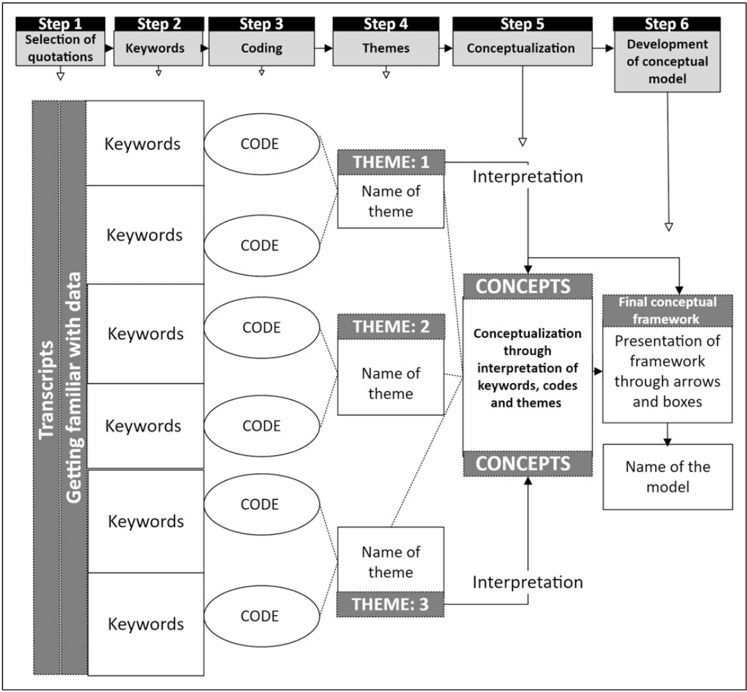
- The paper proposes six steps: transcription/familiarization and quotation selection; keyword selection; coding; theme development; conceptualization through interpretation of keywords, codes, and themes; and development of a conceptual model.
- It introduces 6Rs for keyword selection (realness, richness, repetition, rationale, repartee, regal), 6Rs for coding (robust, reflective, resplendent, relevant, radical, righteous), and 4Rs for theming (reciprocal, recognizable, responsive, resourceful).
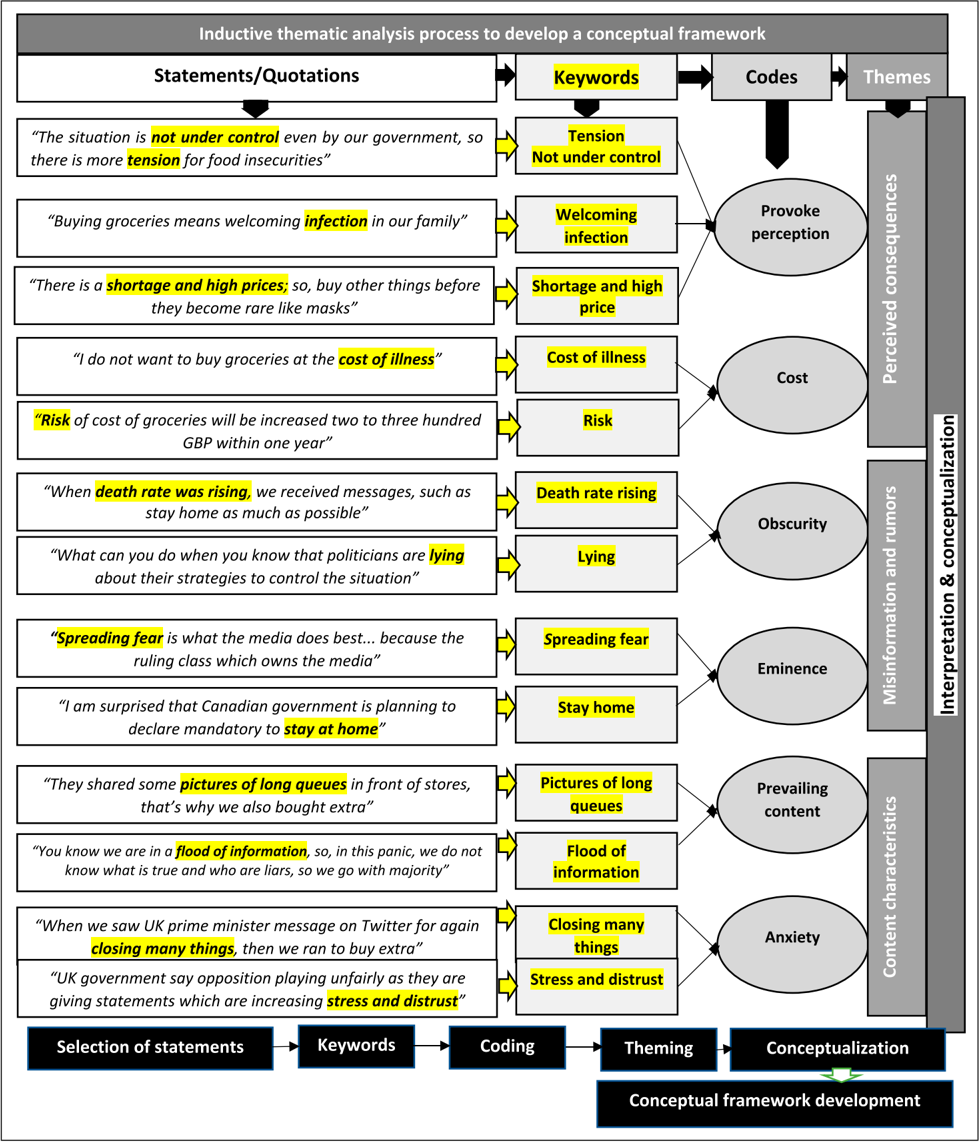
- In the exemplar study, three main themes emerged: “Perceived consequences” from codes “Provoke perception” and “Cost”; “Misinformation and rumors” from codes “Obscurity” and “Eminence”; and “Content Characteristics” from codes “Prevailing content” and “Anxiety.”
- The exemplar’s final model, “Panic buying as social practice,” was based on Protection Motivation Theory (PMT) and the Theory of Rumor Transmission (TORT).
Methods
- Design: a methodological/conceptual paper that presents a comprehensive systematic model for thematic analysis culminating in a conceptual model, using Naeem and Ozuem (2022a) as an exemplar.
- Exemplar data: qualitative data gathered from Twitter, YouTube, and interviews; the exemplar used a six-stage thematic analysis and a social constructionist perspective with PMT and TORT as theoretical foundations.
- Main analysis: the paper describes each of the six steps in detail, provides practical examples from the exemplar, and compares the proposed process with Braun and Clarke’s (2006) six steps of thematic analysis.
Limitations
- The paper states that the potential of the process to address other research contexts or quantitative methods may require further exploration, and that the efficiency of the method compared with other model-building approaches has not been empirically tested.
- Evident from the text: the proposed six-step process and the 6Rs/4Rs are illustrated through a single exemplar study and are not independently validated or empirically compared with alternative thematic analysis approaches.
Model-written summary. Check it against the paper before relying on it.
Integrity signals
Registry
Cites
Statistics
Figures

Verification
Claims the paper makes
0 Valid · 4 Not valid · 56 Not checked · 89 Own results and interpretations
The cited sources that could be checked couldn’t confirm or dispute this claim.
In the paper
“For narrative approaches, conceptual model development focuses on personal experiences, emotions, and life histories (Eldh et al., 2020).”
§ A Step-by-Step Process of Thematic Analysis to Develop a Conceptual Model in Qualitative Research > Step 6: Development of Conceptual Model.
What the sources say
- Could not verifycites Eldh et al., 2020 matched to “Quotations in Qualitative Studies: Reflections on Constituents, Custom, and Purpose” (2020) sourceExperimental — accuracy not yet measured
The Discussion and Conclusions (page numbers unavailable) address how quotations can illustrate qualitative analysis and findings. A search for narrative approaches, conceptual model development, emotions, and life histories found no passage addressing the attributed claim. (LLM, conf=0.72)
plainstates an association- Asserted: passes — The authors put it forward as true.
- Checkable: passes — It can be checked against evidence.
- Load-bearing: unclear — It is unclear whether the paper’s conclusions depend on it.
- Based: passes — The paper gives a reason why it holds.
- Could not verify
In the paper
“The analytical process balances between descriptive analysis, which outlines patterns or trends, and interpretive analysis, which offers subjective perspectives (Miles & Huberman, 1994, p. 56).”
§ A Step-by-Step Process of Thematic Analysis to Develop a Conceptual Model in Qualitative Research > Step 2: Selection of Keywords.
What the sources say
- Not matchedcites Miles & Huberman, 1994, p. 56
An author–year citation the paper’s reference list doesn’t settle. We don’t search these by name.
plain- Asserted: passes — The authors put it forward as true.
- Checkable: passes — It can be checked against evidence.
- Load-bearing: passes — The paper’s conclusions depend on it.
- Based: passes — The paper gives a reason why it holds.
- Not matched
In the paper
“However, the thematic analysis approach could also fit a post-positivist paradigm (Howell, 2012, p. 30).”
§ A Step-by-Step Process of Thematic Analysis to Develop a Conceptual Model in Qualitative Research > Step 2: Selection of Keywords.
What the sources say
- Not matchedcites Howell, 2012, p. 30
An author–year citation the paper’s reference list doesn’t settle. We don’t search these by name.
hedgedstates an association- Asserted: passes — The authors put it forward as true.
- Checkable: passes — It can be checked against evidence.
- Load-bearing: unclear — It is unclear whether the paper’s conclusions depend on it.
- Based: passes — The paper gives a reason why it holds.
- Not matched
In the paper
“Hence, quotation selection is not simply a mechanical task but is influenced by the researcher's philosophical and theoretical approach (Jackson & Mazzei, 2012).”
§ A Step-by-Step Process of Thematic Analysis to Develop a Conceptual Model in Qualitative Research > Step 1: Transcription, Familiarization With the Data, and Selection of Quotations.
What the sources say
- Not matchedcites Jackson & Mazzei, 2012
An author–year citation the paper’s reference list doesn’t settle. We don’t search these by name.
plainstates a cause- Asserted: passes — The authors put it forward as true.
- Checkable: passes — It can be checked against evidence.
- Load-bearing: passes — The paper’s conclusions depend on it.
- Based: passes — The paper gives a reason why it holds.
- Not matched
A conclusion the paper draws from its own results — it cites no other source for it, so there is none to check. The quote shows it is in the paper.
In the paper
“Thus, keywords serve as a critical bridge between data and themes in different methodologies.”
§ A Step-by-Step Process of Thematic Analysis to Develop a Conceptual Model in Qualitative Research > Step 4: Theme Development.
boostedstates an association- Asserted: passes — The authors put it forward as true.
- Checkable: passes — It can be checked against evidence.
- Load-bearing: unclear — It is unclear whether the paper’s conclusions depend on it.
- Based: passes — The paper gives a reason why it holds.
10 more claims
Create a free account to see all 149 claims and every source verdict.
- It may state two separate claims as one. 54
- Probably not a substantial claim. 128
Claims other papers make about this one
Each is checked against this paper’s own text: does it say what the citing paper says it does?
The source backs part of the claim, not all of it — or backs it for a different population, condition or comparison.
In the citing paper
“With the identified keywords, initial coding was further informed by and cross-referenced to the literature on AI ethics and governance, particularly addressing public concerns in government AI, alongside the author team's collective expertise in AI-driven digital transformation in public administration.”
From Accountability in Government Use of AI : Citizen Concerns and Preferences (2025) · cites this paper as Naeem et al. 2023
Experimental — accuracy not yet measuredThe source backs part of the claim, not all of it — or backs it for a different population, condition or comparison.
In the citing paper
“Thematic analysis is a highly popular technique among qualitative researchers for analyzing qualitative data, which usually comprises thick descriptive data (Naeem et al., 2023).”
From The Psycho-Emotive Effects of AI-Generated Fake News on Social Media Users (2026) · cites this paper as Naeem et al., 2023
Experimental — accuracy not yet measuredThe cited source says what the claim attributes to it.
In the citing paper
“The selection of keywords was guided by the 6Rs framework-Realness, Richness, Repetition, Rationale, Repartee, and Regal-to ensure they accurately represented the essence of the data (Naeem et al. 2023).”
From Accountability in Government Use of AI : Citizen Concerns and Preferences (2025) · cites this paper as Naeem et al. 2023
The cited source says what the claim attributes to it.
In the citing paper
“The data were analyzed through Naeem et al.'s (2023) six-step thematic analysis process to develop a conceptual framework (Naeem & Ozuem, 2022).”
From “It’s Not Just About Competition – It’s Ceremony”: Introducing the Embedded Indigeneity Framework for Understanding Identity, Mission, and Practice in TCU and NASNTI Athletics (2026) · cites this paper as Naeem et al. (2023)
The cited source says what the claim attributes to it.
In the citing paper
“The selected methodology was implemented due to the end results that 1) presented a novel conceptual framework and 2) serves as a contextually specific extension of existing theory/theories (Naeem et al., 2023).”
From “It’s Not Just About Competition – It’s Ceremony”: Introducing the Embedded Indigeneity Framework for Understanding Identity, Mission, and Practice in TCU and NASNTI Athletics (2026) · cites this paper as Naeem et al., 2023
Self-check
Percentages, sums and reported differences re-computed from the paper’s own numbers.
Each contradiction between two passages listed here was confirmed by an independent check.
Rated minor: it would not touch a result — a value no result rests on, a p-value that stays on the same side of the significance level, or a conflict that is clerical, resolved elsewhere in the paper, or outside its own findings.
In the paper
§ A Step-by-Step Process of Thematic Analysis to Develop a Conceptual Model in Qualitative Research > Step 6: Development of Conceptual Model.
“Positivism, which favours inductive methods, builds its model on top of previously established theories and conducts its experiments in an unbiased manner.”
§ A Step-by-Step Process of Thematic Analysis to Develop a Conceptual Model in Qualitative Research > Step 6: Development of Conceptual Model.
“An inductive approach is primarily data-driven, whereby themes are derived from the data itself without the influence of pre-existing theories (Braun & Clarke, 2006).”
Citations
Cites
Using thematic analysis in psychology
Braun, V., & Clarke, V. (2006) · Qualitative Research in Psychology · doi:10.1191/1478088706qp063oa · Cited by 194,414
Qualitative Data Analysis: An Expanded Sourcebook
(1994) · Journal of Environmental Psychology · doi:10.1016/s0272-4944(05)80231-2 · Cited by 48,420 · cited 2×
“In the coding process, consideration of keywords helps in multiple ways: The analytical process balances between descriptive analysis, which outlines patterns or trends, and interpretive analysis, which offers subjective perspectives (Miles & Huberman, 1994, p. 56).”
Lincoln, Y. S., Guba, E. G., & Pilotta, J. J. (1985) · International Journal of Intercultural Relations · doi:10.1016/0147-1767(85)90062-8 · Cited by 45,787 · cited 1×
“…degrees of subjectivity and objectivity has underscored the fl exibility intrinsic to research methodologies and highlighted that these tools of analysis are intimately intertwined with, and, indeed, emerge from the distinctive nature of speci fi c disciplines and perspectives (Lincoln & Guba, 1985).”
BackgroundThe Discovery of Grounded Theory: Strategies for Qualitative Research
Glaser, B. G., & Strauss, A. L. (2017) · Aldine (Routledge reprint) · doi:10.4324/9780203793206 · Cited by 25,789
The qualitative content analysis process
Elo, S., & Kyngäs, H. (2008) · Journal of Advanced Nursing · doi:10.1111/j.1365-2648.2007.04569.x · Cited by 22,617 · cited 1×
“Deductive coding, linked with descriptive analysis, is a top-down approach where pre-existing theories, models, or codes guide the data analysis (Elo & Kyng¨as, 2008).”
Method(2009) · Cited by 21,330
Reflecting on reflexive thematic analysis
Braun, V., & Clarke, V. (2019) · Qualitative Research in Sport, Exercise and Health · doi:10.1080/2159676x.2019.1628806 · Cited by 19,677
(1998) · Medical Entomology and Zoology · Cited by 18,397
(2014) · Cited by 15,747
S., N. L. (2017) · doi:10.1177/1609406917733847 · Cited by 14,051 · cited 3×
“· Robust: Coding should convey the true essence of data in a theoretical manner (Nowell et al., 2017).”
Background
Research works printed but not linked: 9
- 1. Arar, K. (2017). The what's and why's of the how to of qualitative research. Qualitative Report, 22(11), 2956-2958.
- 16. Creswell, J. W. (2012). Educational research. Pearson.
- 19. Denzin, N. K., & Salvo, J. (2020). New directions in theorizing qualitative research: Theory as resistance. Myers Education Press.
- 62. Oliver, P. (2021). Using qualitative methods to answer your research question (First). Open University Press.
- 63. Patton, M. Q. (2015). Qualitative research & evaluation methods: Integrating theory and practice (fourth). Sage Publications, Inc. Qualitative research (pp. 273-290). Sage.
- 67. Saldana, J. (2021). The coding manual for qualitative researchers (Fourth). Sage.
- 68. Saldana, J. M. (2016). The coding manual for qualitative researchers (4rd ed.). Sage Publications.
- 74. Seale, C. (2013). Qualitative research practice. In C. Seale, G. Gobo, J. Gubrium, & D. Silverman (Eds.), Concise paperback. Sage.
- 80. Tracy, S. J. (2019). Qualitative research methods: Collecting evi- dence, crafting analysis, communicating impact (2nd ed.). Wiley Blackwell.
Cited by
Items 1,501–1,600 of 2,204
A SOCIAL-COGNITIVE MODEL OF TEACHING PEDAGOGIES TO PROMOTE INCLUSIVITY IN ZIMBABWE
Mathe, S., Thuketana, N. S., & Malatji, M. J. (2026) · Education Innovation Diversity · doi:10.17770/eid2025.2.88
Fernandez, K., Chisholm, K., & Ruzycki, N. (2025) · ASEE Annual Conference & Exposition · doi:10.18260/1-2--56182
Evaluation of recruitment methods and promotional strategies for sexual health services and research
Gonzalez, P. R., Black, E., Trenaman, S. C., & Wilby, K. J. (2025) · Journal of the American Pharmacists Association · doi:10.1016/j.japh.2025.102949
Wernet, M., Charepe, Z. B., Festas, C., Silveira, A. O., & Nakao, P. A. (2026) · Revista da Escola de Enfermagem da USP · doi:10.1590/1980-220x-reeusp-2025-0118es
Ha, S., & Min, Y. (2026) · Convergence The International Journal of Research into New Media Technologies · doi:10.1177/13548565261468610
Donato, L. (2025) · Cogent Social Sciences · doi:10.1080/23311886.2025.2473649 · Cited by 10
“once the transcription process is completed, the researcher used the thematic analysis model presented in the study of Naeem et al. (2023), which outlines the six steps of systematic thematic analysis. the first step pertains to transcribing the data, familiarizing oneself with it, and selecting…”
Black Male Veterans’ Mental Health: Exploring Their Lived Experiences
Robinson, T. D. (2024) · Social Work in Public Health · doi:10.1080/19371918.2024.2357084 · Cited by 2
“This methodical and organized approach guarantees comprehensiveness and minimizes potential bias (Crowe, Inder, & Porter, 2015; Naeem, Ozuem, Howell, & Ranfagni, 2023).”
Mojeed-Sanni, B. A., Akanji, B. O., Mordi, C., Ajonbadi, H. A., Mordi, T., & Adeoti, A. (2026) · Employee Relations · doi:10.1108/er-07-2025-0611
Towards Inclusive Education: A Critical Analysis of Inclusive Education Practices in Pakistan
Nosheen, K., & Gaad, E. (2025) · Lecture notes in civil engineering · doi:10.1007/978-3-031-84371-6_39
Sari, D. N., Hilmanto, D., Sunjaya, D. K., & Sari, P. (2026) · Research Square · doi:10.21203/rs.3.rs-8363565/v1 · Cited by 3
Rahmah, N., Supriyatman, Agni, R., Rahmita, & Pahriadi (2025) · Jurnal Penelitian Pendidikan IPA · doi:10.29303/jppipa.v11i12.12918
“The data were analyzed using thematic analysis (Naeem et al., 2023).”
López-Gastélum, E., Reyes-Castro, P. A., Arellano-Gálvez, M. D. C., & Ferrer, C. P. (2026) · Cities & Health · doi:10.1080/23748834.2026.2616561
Ge, Y., Li, Z., Sreen, N., Alghafes, R. A., & Nguyen, M. (2026) · Business Strategy and the Environment · doi:10.1002/bse.71148
Dinçer, S. (2026) · Safety Science · doi:10.1016/j.ssci.2026.107307
Critical Intimacies, Differences, and Ruptures
Eramian, L., & Mallory, P. (2026) · Cambridge University Press eBooks · doi:10.1017/9781009772822.002
Hearing Through the Patient’s Ears: Hearing Simulation for Counseling and Education
Kingsbury, H. A., Kingsbury, S. E., Cevette, M. J., Stepánek, J., Habr, E., Itawi, H., & Pradhan, G. N. (2026) · Audiology Research · doi:10.3390/audiolres16030077
“A semantic, inductive approach was used to analyze text responses from the questionnaires using thematic analysis [31,32].”
Nagogo, A. A. K. U., Nass, N. S., Muhammad, A., et al. (2026) · doi:10.12688/verixiv.1191.3
How curriculum frameworks cultivate democratic and historical consciousness
Sharp, H., Alvén, F., Ammert, N., Edling, S., Löfström, J., & Nally, D. (2026) · Citizenship Social and Economics Education · doi:10.1177/14788047261443214 · Cited by 2
Yaisikana, M. (2026) · Ageing and Society · doi:10.1017/s0144686x26100841
“These themes became the foundation for synthesizing and organizing the data of the AFC sites’ operation (Brailas et al. 2023; Naeem et al. 2023).”
More than just location: how engineering undergraduate students choose their schools and programs
Wang, X., Dai, M., Mathis, R. S., Zhao, T., & Morgan, N. (2025) · Frontiers in Education · doi:10.3389/feduc.2025.1718475 · Cited by 1
Toffanin, A. M., & Busi, B. (2024) · Sociológia - Slovak Sociological Review · doi:10.31577/sociologia.2024.56.4.14
Digital resilience in delivering public services. A conceptual model
Sienkiewicz-Małyjurek, K. (2026) · Government Information Quarterly · doi:10.1016/j.giq.2026.102172 · Cited by 1
Climbing the not-for-profit leadership ladder in Australia: Equity, diversity, and inclusion
Loo, C. Y., Peter, S., Moore, I., Grove, M. J., & Baldassar, L. V. (2025) · The British Journal of Social Work · doi:10.1093/bjsw/bcaf121
Exploring Self-Study as Professional Development: Early Childhood Directors’ Learning Experiences
Dewhirst, C. B. (2026) · Early Childhood Education Journal · doi:10.1007/s10643-026-02129-4
“Analyses employed two complementary approaches: the - matic analysis (Naeem et al., 2023) to identify patterns within and across data sources, and thematic trajectory anal - ysis (Spencer et al., 2021 ) to track how individual directors’ thinking evolved over time.”
Understanding the hesitation of Indonesian consumers toward battery electric vehicle adoption
Yotapditya, I., Prabawani, B., & Dewi, R. S. (2026) · Discover Sustainability · doi:10.1007/s43621-026-03591-1 · Cited by 2
“The pattern of meaning that emerges shows consistency across cases and considered adequate to support interpretation [2, 33, 65].”
Sustainable E-Waste Disposal Methods: The Case of Discarded Mobile Phones in Zimbabwe
Mukucha, P. (2026) · IGI Global eBooks · doi:10.4018/979-8-2600-1960-3.ch009
Malloy, C., Arthur, M. M., Alwine, J. S., et al. (2025) · Clinical Nurse Specialist · doi:10.1097/nur.0000000000000932
Domesticating Social Commerce: How Douyin Becomes Embedded in Everyday Consumer Practices in China
Dou, W. (2026) · Advances in Applied Sociology · doi:10.4236/aasoci.2026.162010
Coaching as a Catalyst to Facilitate Spiritual Leadership
Mkabela, N. P., & Hewitt, L. M. (2026) · International journal of evidence based coaching and mentoring · doi:10.1177/17418305261475888
‘Control is up to me’: youth narratives on the problematic use of ICTs
Ramírez, J. P., García, J. R., & Pedregal, A. M. N. (2025) · Frontiers in Human Dynamics · doi:10.3389/fhumd.2025.1713744
Implementing AI in SCM: Pros, Cons, Needs and Challenges from the Managers’ Perspective
Hijazi, R., & Daabes, A. A. (2025) · Lecture notes in networks and systems · doi:10.1007/978-3-031-96622-4_22
Innovation in Education: Technology to Improve Gender Equality in Palangka Raya City Schools
Sentosa, A., Karya, B., Arianti, S., Susilowati, E., & Norsandi, D. (2026) · KnE Social Sciences · doi:10.18502/kss.v11i1.20632
Institut Agama Islam Bani Fattah Jombang, I., Saifullah, A., Siswopranoto, M. F., & Sekolah Tinggi Ilmu Tarbiyah Al Urwatul Wutsqo Jombang, I. (2024) · International Journal of Social Science and Human Research · doi:10.47191/ijsshr/v7-i03-43
Ismiyati, Suminah, Sukamto, I. S., & Demartoto, A. (2026) · Social Sciences & Humanities Open · doi:10.1016/j.ssaho.2026.102887 · Cited by 1
Wu, C., Hao, Y., Wang, Z., & 霍茜瑜 (2026) · Asian-Pacific Journal of Second and Foreign Language Education · doi:10.1186/s40862-026-00463-z
“Accordingly, this study followed the systematic six-step thematic analysis process outlined by Naeem et al. (2023), adopting a hybrid deductive– inductive strategy.”
Strategies for Restoration of Livelihoods in Communities Displaced and Resettled by Mining Companies
Sekgala, M. M., & Mkwanazi, S. (2026) · Sustainability · doi:10.3390/su18168143 · Cited by 2
Alhelbawy, S. L. (2026) · Millah Journal of Religious Studies · doi:10.20885/millah.vol25.iss1.art6
“Each source was read attentively and critically, considering its historical, doctrinal, and cultural context, to extract the ethical norms regarding the protection of non-combatants (Naeem et al., 2023).”
Sprajcer, M., Shriane, A. E., Ferguson, S. A., Gupta, C. C., Smith, R. G., Kim, J. J., Baum, C. L., Kolbe-Alexander, T. L., Stanton, R., Thomas, M. J. W., et al. (2025) · Health Promotion International · doi:10.1093/heapro/daaf175 · Cited by 1
“2022, Proudfoot and Proudfoot 2022, Naeem et al .”
InfluentialImproving early childhood nutrition practices through parents’ evening forums in rural Rwanda
Nsanzabera, F., Irakoze, E., Manishimwe, A., Nsengiyumva, J. B., Mwiseneza, A., Ntakirutimana, E., & Nkurikiyimana, F. (2025) · Public Health Nutrition · doi:10.1017/s1368980025100803
“The study adhered to principles of phenomenological inquiry, focusing on participants ’ lived experiences and perceptions regarding malnutrition and nutrition education (21) .”
Buraiki, A. A., Abdullah, S. I. S. S., & Khambari, M. N. M. (2025) · Pertanika Journal of Vocational Science and Technology Education · doi:10.47836/pjvste.1.1.05
Lived Experiences of Teachers in Assisting Marginalized Parents in the Education of their Children
Padrones, M. A. G. (2026) · International Journal of Sustainable and Integrated Studies · doi:10.65339/ijsis.v1.i1.38
“The data were analyzed using Thematic Analysis following the step-by-step process proposed by Naeem et al. (2023).”
Pour, M. J., Emami, S. A., & Esmaeli, M. (2025) · Journal of strategy and management · doi:10.1108/jsma-08-2025-0334 · Cited by 4
Aji, H. M., & Fadhilla, H. N. (2026) · Journal of Political Marketing · doi:10.1080/15377857.2026.2648546
Pakaya, R., Datau, S., Tumaloto, E. H., et al. (2025) · JOURNAL SPORT AREA · doi:10.25299/sportarea.2025.vol10(3).22110
Wulandari, A., Nugroho, C., Wulan, R. R., Fitriawan, R. A., & Qathrunnada, Z. (2026) · Cogent Social Sciences · doi:10.1080/23311886.2026.2717796 · Cited by 1
A two-stage concept mapping for emerging concepts: an analysis of the Smart Healthy City
Kim, J., Son, S., Chung, H., Ryu, K., Lee, D., & Paeng, H. (2025) · Humanities and Social Sciences Communications · doi:10.1057/s41599-025-06222-8 · Cited by 2
“Concept mapping offers advantages for understanding complex topics by systematically structuring inputs and visualizing relationships between concepts, combining qualitative analysis with quantitative veri fi cation (Naeem et al., 2023).”
When religious narratives become policy-relevant: Iraq, Jerusalem, and US Middle East policy
Ali, M., & Almohammed, A. (2026) · Frontiers in Political Science · doi:10.3389/fpos.2026.1910153
Selanon, P., & Sapsangthong, A. (2026) · Architecture · doi:10.3390/architecture6030145 · Cited by 1
“Thematic analysis is a flexible qualitative method that enables researchers to systematically identify, organize, and interpret patterns of meaning within a dataset while supporting conceptual development and theory building [30,33,34].”
Teachers as designers of gamified pedagogical infrastructure: ClassPoint use in language classrooms
Alramamneh, Y., Ali, N., Kasasbeh, N., Hussien, A. M., Almajdoub, Z., & Alamoush, I. M. A. (2026) · Frontiers in Education · doi:10.3389/feduc.2026.1861576 · Cited by 4
Parent‐child mediation in family law: Feasible in South Australia or just a French affair
Erlings, E. I. J. (2026) · Family Court Review · doi:10.1111/fcre.70083
Cox, C., Majors, M., Tufon, D., et al. (2026) · Public Health Reports · doi:10.1177/00333549261468273
When the river disappears: emotional attachments and heritage-making in a changing landscape
Strzelecka, M., Strzelecka, C., Holtorf, C. J., & Tusznio, J. (2025) · Ecosystems and People · doi:10.1080/26395916.2025.2602251 · Cited by 1
Bwalya, N., Phahlamohlaka, N. M., & Friedrich-Nel, H. (2026) · Health SA Gesondheid · doi:10.4102/hsag.v31i0.3363
“The theme and subthemes were developed based on the categories of codes in ATLAS.ti (Braun & Clarke 2021; Naeem et al. 2023; Williams & Moser 2019).”
Making sense of sustainability: A decade of research and emerging directions for the future
Monkge, T. A., Roux, C. L., & Letsholo, R. (2026) · Acta Commercii · doi:10.4102/ac.v26i1.1468
Gugulethu, B. P. Z. (2025) · Science of law. · doi:10.55284/h18a0934
Co-Design of a Wearable AAC for Children with Special Needs
Karan, A., Venkatesh, K., & Acharaya, S. (2026) · Procedia CIRP · doi:10.1016/j.procir.2026.05.353
Social Enterprise Improvisation of Services to the Community Using Mobile Technology
Olivier, W. H., & Iyamu, T. (2025) · European Conference on Research Methodology for Business and Management Studies · doi:10.34190/ecrm.24.1.3651
Developing trust in the collaborative hospital construction projects
Tulokas, M., Tampio, K.-P., & Haapasalo, H. J. O. (2026) · International Journal of Managing Projects in Business · doi:10.1108/ijmpb-05-2025-0175
After death experiences in patients with Parkinson’s disease
Applewhite, C., Potheegadoo, J., Bernasconi, F., & Blanke, O. (2026) · Phenomenology and the Cognitive Sciences · doi:10.1007/s11097-026-10173-z · Cited by 1
Ibrahim, A. A., Githinji, F. W., Ndagire, R., Namwanje, A., Ssenyondo, A., Agwang, A., Nampiima, C., & Atim, F. (2026) · BMC Pregnancy and Childbirth · doi:10.1186/s12884-026-08875-y · Cited by 1
“Data analysis employed inductive thematic content analysis, a systematic approach that involves identifying patterns and themes within data without imposing pre-existing theoretical frameworks [21, 22].”
Taylor, W. (2025) · Social Sciences · doi:10.11648/j.ss.20251406.15 · Cited by 2
Fan, Y., Soon, W. M. A., & Kah Loon, N. G. (2026) · Journal of Statistics and Data Science Education · doi:10.1080/26939169.2026.2685694
Jiang, X. (2026) · Frontiers in Psychology · doi:10.3389/fpsyg.2026.1927045
“Iterative movement among transcripts, memos, codes, negative cases, and candidate themes supported conceptual model building (Naeem et al., 2023).”
Nakasato, K., Isono, M., & Kato, K. (2025) · Journal of Community Genetics · doi:10.1007/s12687-025-00833-z
“This study employed thematic analysis (Naeem et al. 2023).”
McCullough, E., Zulaika, G., Osire, E. A., Akinyi, C., Otieno, F., Phillips‐Howard, P. A., Mehta, S. D., & Mason, L. (2026) · Women s Health · doi:10.1177/17455057261465644
What constitutes the authenticity of a gastronomic destination?
Ye, Y., & Cheng, D. (2026) · International Journal of Gastronomy and Food Science · doi:10.1016/j.ijgfs.2026.101598
Bhuiya, S., Liza, Z. A., Islam, M. A., Miah, M. S., & Infectious Diseases Division (icddr, B. (2024) · Journal of Population and Social Studies · doi:10.25133/jpssv332025.012
Girela, F. J. G., Rivas-Valenzuela, J., Moreno-Doña, A., García, E. R., & Norambuena, S. P. (2025) · Sport in Society · doi:10.1080/17430437.2025.2539825 · Cited by 2
“The data collection technique has been carried out based on the analysis of the personal narrative of the students through the realization of critical incidents experienced during the process (Naeem et al. 2023).”
Owili, J., Maat, H., & van Mierlo, B. (2026) · Veterinary and Animal Science · doi:10.1016/j.vas.2026.100765
“Initial coding captured participants' statements regarding veterinary support on farms, movement decisions, health permit regulations, feeding patterns, and treatment withdrawals (Naeem et al., 2023).”
Anderson, B. J., Taylor, S. E., Travaglia, J., et al. (2025) · Journal of Pharmacy Practice and Research · doi:10.1002/jppr.1958
Optimizing Large Language Models for Hospital Discharge Prediction
Spagnoli, J., Guzman, N. M., Desai, K., Chang, T. H. W., Bell, A. L., Gilbert, V. L., Lehn, S., Parekh, V. I., Sjoding, M. W., & Wong, A. H. (2026) · Journal of General Internal Medicine · doi:10.1007/s11606-026-10792-x
Ruiz, A. M., Hammett, J. F., Baca-Atlas, S. N., Moore, K. M., Weitzel, J., Kirwan, M., Mkandawire‐Valhmu, L., & Gondwe, K. W. (2026) · Healthcare · doi:10.3390/healthcare14142111
“This inductive process provided the basis for developing codes and initial descriptive themes based on recurring keywords in the extracted textual data [50–52].”
InfluentialPeña, A. D., Clariza, J., & Aballiar-Vista, M. A. (2026) · Journal of interdisciplinary perspectives · doi:10.69569/jip.2026.050
Mokhtar, D., Wang, H. D., Garland, E. C., Shakya, D., Occhino-Moede, L., Liu, E., & Frank, A. C. (2026) · Journal of Participatory Medicine · doi:10.2196/98822 · Cited by 2
“Guided by the 4R’s framework described by Naeem et al [24], researchers examined how codes combined to reflect broader patterns in participants’ perspectives on AI in health care.”
Barriers in Implementing Multisectoral Action for Noncommunicable Diseases in Uttar Pradesh, India
Tiwari, A., Singh, S. K., Manar, M. K., Singh, A. B., Pandey, K., & Kaur, M. (2025) · Indian Journal of Public Health · doi:10.4103/ijph.ijph_1366_24
Responding to harmful sexual behaviour in schools: the role of educational psychologists
Harland, D., & Miller, E. (2026) · Educational Psychology in Practice · doi:10.1080/02667363.2026.2635369
“The process of theme development and refinement was iterative and ongoing up to the point where a conceptual model was developed, which Naeem et al. (2023) suggest is the final stage in thematic analysis.”
6 Şubat Depremlerinde Sosyal Yardımlara Yönelik Kriz İletişimi Araştırması: Kahramanmaraş İli Örneği
Tanrıverdi, A. B. (2025) · Süleyman Demirel Üniversitesi Vizyoner Dergisi · doi:10.21076/vizyoner.1652687
Understanding educators’ curriculum narratives through the lens of powerful curriculum practice
Kalsoom, Q., & McLennan, C. (2026) · Journal of Curriculum Studies · doi:10.1080/00220272.2026.2731561
Lyons, G., de Vasconcellos, C. A. M., Silva, T. S. E., et al. (2026) · Journal of Laparoendoscopic & Advanced Surgical Techniques · doi:10.1177/10926429261490774
Nomlala, L., & Baidoo, J. (2025) · African Journal of Inter/Multidisciplinary Studies · doi:10.51415/ajims.v7i2.1330
Negotiating time and energy: How work patterns and social class shape energy flexibility in Norway
Matthiasen, E. H. (2025) · Energy Research & Social Science · doi:10.1016/j.erss.2025.104447 · Cited by 1
Improving Food Security through Climate-Smart Farming and Readiness for Disasters
Silaswara, D., Chandra, Y., Mardiana, H., & Gini, P. L. (2024) · ULIL ALBAB Jurnal Ilmiah Multidisiplin · doi:10.56799/jim.v3i9.4808
“In analyzing the qualitative data, we categorized the responses into three distinct groups based on the participants' levels of knowledge: lowest knowledge, moderate knowledge, and highest knowledge (Morgan, 2022; Naeem, Ozuem, Howell, & Ranfagni, 2023).”
Art making on the nervous system: A mixed methods study
Andrus, M., Harmon-Walker, G., & Feddersen, K. (2026) · The Arts in Psychotherapy · doi:10.1016/j.aip.2026.102497
Breaking the Hustle: How Institutional Culture Impacts Academic Resource Engagement in Engineering
Kim, G., & Lescott, C. J. (2025) · ASEE Annual Conference & Exposition · doi:10.18260/1-2--56005
Alkan, B., Alkan, H. I., & Danayiyen, S. S. (2026) · Discover Global Society · doi:10.1007/s44282-026-00549-6
“Thematic analysis is a widely used method for analyzing dense, explanatory qualitative data [42].”
Samiun, Z., Syafar, M., Citrakesumasari, C., Thamrin, Y., Moedjiono, A. I., Erika, K. A., & Salam, A. (2025) · Journal of Qualitative Research in Health Sciences · doi:10.34172/jqr.1587
Hodkowski, N. M., White, L. P., & McMahon, L. (2026) · Mathematics Education Research Journal · doi:10.1007/s13394-026-00595-y
Shelton, N., Munro, N., Starling, J., Tieu, L., Sutherland, R., & Keep, M. (2026) · Child Language Teaching and Therapy · doi:10.1177/02656590261432879 · Cited by 1
Badr, N. G., & El-Eid, J. S. (2026) · Communications in computer and information science · doi:10.1007/978-3-032-34459-5_3
Maier, K., Haworth-Brockman, M. J., Villacis-Alvarez, E., MacKenzie, L. J., Ireland, L., Kasper, K., Keynan, Y., & Rueda, Z. V. (2025) · Frontiers in Public Health · doi:10.3389/fpubh.2025.1585604 · Cited by 1
“Thematic analysis is a method whereby researchers code qualitative data, develop themes, and interpret patterns and concepts, which are then reported using a conceptual framework or model (54).”
Salinas, S. C., & Vidal, C. (2026) · Revista de Estudios Sociales · doi:10.7440/res.12142
Phelps, J., Nimmo, J., Bainazarov, T., Abukar, Z., Dar, J., Stratton, M., Locke, L. A., & Xu, T. (2026) · International Journal of Qualitative Studies in Education · doi:10.1080/09518398.2026.2647226
Miranda-Lozano, D., Gómez, R. S., Sierra-Díaz, M. J., & Fernández‐Río, J. (2026) · Quest · doi:10.1080/00336297.2026.2664514
Multidimensional Analysis of HBIM Segmentation: A Roadmap Towards Standardization
Galanakis, D., Maravelakis, E., Vidakis, N., et al. (2026) · Heritage · doi:10.3390/heritage9060232
Leite, A. L., Duxbury, L. E., Lemos, D. D. C., & Moraes, M. C. B. (2025) · Community Work & Family · doi:10.1080/13668803.2025.2564253 · Cited by 2
State of darkness protection in strategic lighting documents of 10 European cities
Vuorenmaa, R., Pihlajaniemi, H., & Parhankangas, O. (2026) · Photochemical & Photobiological Sciences · doi:10.1007/s43630-026-00924-x
“In the following chapters, each category is presented with citations from the documents to bring the data to life [26 ].”
Sharma, P., & Tiwari, G. N. (2026) · Environmental and Sustainability Indicators · doi:10.1016/j.indic.2026.101539
Limungi, G. M., Kiptulon, E. K., Muriuki, F. M., Makhoka, S. N., & Máté, O. (2025) · International Journal of Africa Nursing Sciences · doi:10.1016/j.ijans.2025.100877
Giving men a voice: understanding male parenting experience and parental burnout
de Santis, L., Noronha, A. P. P., & Brianda, M. E. (2025) · Journal of Family Studies · doi:10.1080/13229400.2025.2587856
Metadata
- Authors
- Naeem, M., Ozuem, W., Howell, K., & Ranfagni, S.
- Affiliations
- University of Gloucestershire (GB)
- University of Cumbria (GB)
- Northumbria University (GB)
- University of Florence (IT)
- Corresponding author
- Naeem, Muhammad
- Venue
- International Journal of Qualitative Methods
- Publisher
- SAGE Publications
- Published
- 2023-10
- Volume
- 22
- ISSN
- 1609-4069 (ISSN-L)
- OpenAlex
- W4388503650
- Cited by
- 2,243
- References
- 71
- Citations by year
- 2026: 1000 · 2025: 981 · 2024: 258 · 2023: 4
- FWCI
- 1654.78
- Type
- journal article
- Language
- en
- Open access
- gold
- doi.org
- Licence
- Locations
- International Journal of Qualitative Methods (publishedVersion, cc-by-nc)
- Insight (University of Cumbria) (acceptedVersion)
- DOAJ (DOAJ: Directory of Open Access Journals) (submittedVersion, cc-by-sa)
- Florence Research (University of Florence) (submittedVersion)
- Topics
- Social Sciences › Education › Qualitative Research Methods and Applications
- Social Sciences › Sociology and Political Science › Qualitative Research Methods and Ethics
- Social Sciences › General Social Sciences › Computational and Text Analysis Methods
- Keywords
- thematic analysis, conceptual modeling, qualitative data analysis, inductive coding, deductive coding, grounded theory, interpretive phenomenology, constructivist research, positivist research, theoretical conceptualization, replicability
About these checks
Registry, retraction, Cites and statistics results are computed, not judged, with one exception: a printed reference that no index lists is read once by a model before it counts as a citation error. Claims are extracted by a model and kept only when their quote appears verbatim in the text; each cited source is then checked, with a model’s help, for whether it says what the claim relies on. Those verdicts can be wrong — read the claim’s quote and the cited source before relying on one.
The claim verdicts this report counts are experimental: their accuracy is not yet measured.
A language model drew the claims from the paper on 2026-10-10, under version 3 of the claim definition (model deepseek-v4.1-flash, prompt extract-v3).
A second model labelled each claim on 2026-10-10 (model jev-1.13-20260917, definition revision gold-guideline-v0.2).
Cited sources are checked with a language model’s help (gpt-6-sol).
Statistics and arithmetic are recomputed, not judged.
Confidence bands are shown only for fields calibrated on our annotated test set. None is calibrated yet, so no band is shown.
What counts as a claim ›How we measure confidence ›How we check this ›
Are you an author, or do you see a problem with this page? Request a review
Data sources
Bibliographic data: Semantic Scholar, OpenAlex, Crossref.
Contains information from the Semantic Scholar Academic Graph Datasets, made available under the ODC Attribution License (ODC-BY 1.0).
Semantic Scholar’s data is described in: Kinney, R., et al. (2023). The Semantic Scholar Open Data Platform. arXiv:2301.10140.
