

A Step-by-Step Process of Thematic Analysis to Develop a Conceptual Model in Qualitative Research
Open accessThe DOI matches its Crossref record; 77 of the 78 references it cites were found in a registry or an index, and 1 are not checked yet; 2 of the 57 sources its claims cite were checked for support.
Abstract
Thematic analysis is a highly popular technique among qualitative researchers for analyzing qualitative data, which usually comprises thick descriptive data. However, the application and use of thematic analysis has also involved complications due to confusion regarding the final outcome’s presentation as a conceptual model. This paper develops a systematic thematic analysis process for creating a conceptual model from qualitative research findings. It explores the adaptability of the proposed process across various research methodologies, including constructivist methodologies, positivist methodologies, grounded theory, and interpretive phenomenology, and justifies their application. The paper distinguishes between inductive and deductive coding approaches and emphasizes the merits of each. It suggests that the derived systematic thematic analysis model is valuable across multiple disciplines, particularly in grounded theory, ethnographic approaches, and narrative approaches, while also being adaptable to more descriptive, positivist-based methodologies. By providing a methodological roadmap, this study enhances the rigor and replicability of thematic analysis and offers a comprehensive strategy for theoretical conceptualization in qualitative research. The contribution of this paper is a systematic six-step thematic analysis process that leads to the development of a conceptual model; each step is described in detail and examples are given.
Verified 2026-11-22 · 1 reference not checked yet
Overview
CoChat Summary
TL;DR
This methodological paper presents a six-step systematic thematic analysis process for developing a conceptual model from qualitative data, illustrated with Naeem and Ozuem’s (2022a) panic-buying study. It introduces 6Rs for keyword selection, 6Rs for coding, and 4Rs for theming to enhance rigor and trustworthiness.
Key findings
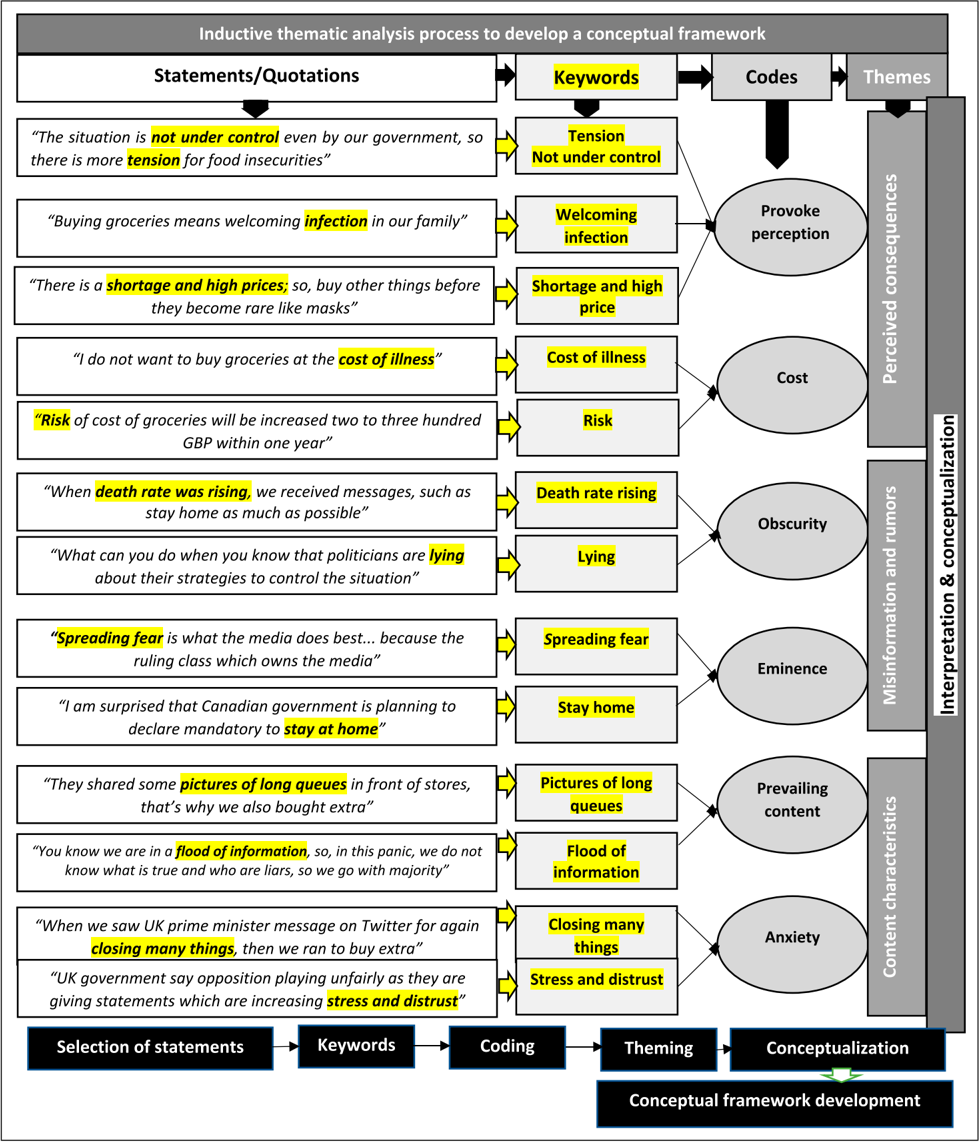
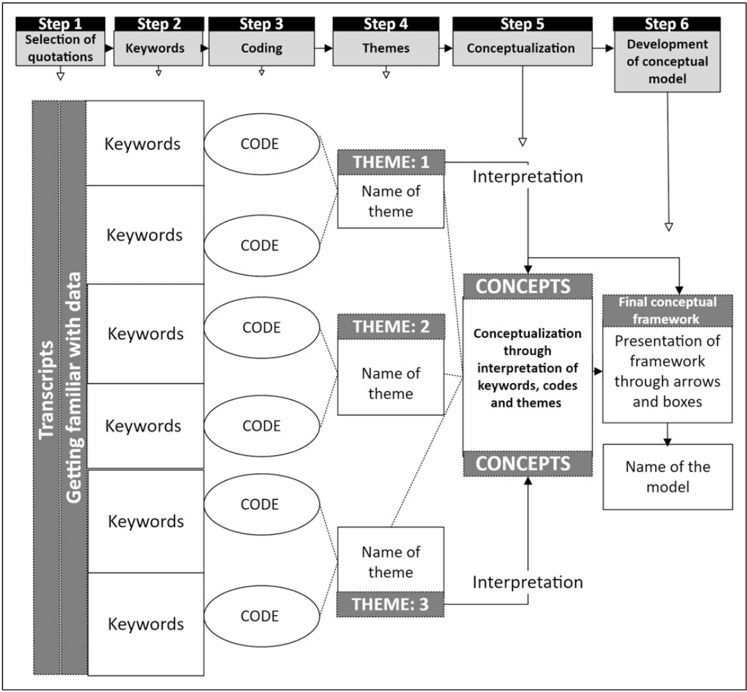
- The paper proposes six steps: transcription/familiarization and quotation selection; keyword selection; coding; theme development; conceptualization through interpretation of keywords, codes, and themes; and development of a conceptual model.
- It introduces 6Rs for keyword selection (realness, richness, repetition, rationale, repartee, regal), 6Rs for coding (robust, reflective, resplendent, relevant, radical, righteous), and 4Rs for theming (reciprocal, recognizable, responsive, resourceful).
- In the exemplar study, three main themes emerged: “Perceived consequences” from codes “Provoke perception” and “Cost”; “Misinformation and rumors” from codes “Obscurity” and “Eminence”; and “Content Characteristics” from codes “Prevailing content” and “Anxiety.”
- The exemplar’s final model, “Panic buying as social practice,” was based on Protection Motivation Theory (PMT) and the Theory of Rumor Transmission (TORT).
Methods
- Design: a methodological/conceptual paper that presents a comprehensive systematic model for thematic analysis culminating in a conceptual model, using Naeem and Ozuem (2022a) as an exemplar.
- Exemplar data: qualitative data gathered from Twitter, YouTube, and interviews; the exemplar used a six-stage thematic analysis and a social constructionist perspective with PMT and TORT as theoretical foundations.
- Main analysis: the paper describes each of the six steps in detail, provides practical examples from the exemplar, and compares the proposed process with Braun and Clarke’s (2006) six steps of thematic analysis.
Limitations
- The paper states that the potential of the process to address other research contexts or quantitative methods may require further exploration, and that the efficiency of the method compared with other model-building approaches has not been empirically tested.
- Evident from the text: the proposed six-step process and the 6Rs/4Rs are illustrated through a single exemplar study and are not independently validated or empirically compared with alternative thematic analysis approaches.
Model-written summary. Check it against the paper before relying on it.
Integrity signals
Registry
Cites
Statistics
Figures

Verification
Claims the paper makes
0 Valid · 4 Not valid · 56 Not checked · 89 Own results and interpretations
The cited sources that could be checked couldn’t confirm or dispute this claim.
In the paper
“For narrative approaches, conceptual model development focuses on personal experiences, emotions, and life histories (Eldh et al., 2020).”
§ A Step-by-Step Process of Thematic Analysis to Develop a Conceptual Model in Qualitative Research > Step 6: Development of Conceptual Model.
What the sources say
- Could not verifycites Eldh et al., 2020 matched to “Quotations in Qualitative Studies: Reflections on Constituents, Custom, and Purpose” (2020) sourceExperimental — accuracy not yet measured
The Discussion and Conclusions (page numbers unavailable) address how quotations can illustrate qualitative analysis and findings. A search for narrative approaches, conceptual model development, emotions, and life histories found no passage addressing the attributed claim. (LLM, conf=0.72)
plainstates an association- Asserted: passes — The authors put it forward as true.
- Checkable: passes — It can be checked against evidence.
- Load-bearing: unclear — It is unclear whether the paper’s conclusions depend on it.
- Based: passes — The paper gives a reason why it holds.
- Could not verify
In the paper
“The analytical process balances between descriptive analysis, which outlines patterns or trends, and interpretive analysis, which offers subjective perspectives (Miles & Huberman, 1994, p. 56).”
§ A Step-by-Step Process of Thematic Analysis to Develop a Conceptual Model in Qualitative Research > Step 2: Selection of Keywords.
What the sources say
- Not matchedcites Miles & Huberman, 1994, p. 56
An author–year citation the paper’s reference list doesn’t settle. We don’t search these by name.
plain- Asserted: passes — The authors put it forward as true.
- Checkable: passes — It can be checked against evidence.
- Load-bearing: passes — The paper’s conclusions depend on it.
- Based: passes — The paper gives a reason why it holds.
- Not matched
In the paper
“However, the thematic analysis approach could also fit a post-positivist paradigm (Howell, 2012, p. 30).”
§ A Step-by-Step Process of Thematic Analysis to Develop a Conceptual Model in Qualitative Research > Step 2: Selection of Keywords.
What the sources say
- Not matchedcites Howell, 2012, p. 30
An author–year citation the paper’s reference list doesn’t settle. We don’t search these by name.
hedgedstates an association- Asserted: passes — The authors put it forward as true.
- Checkable: passes — It can be checked against evidence.
- Load-bearing: unclear — It is unclear whether the paper’s conclusions depend on it.
- Based: passes — The paper gives a reason why it holds.
- Not matched
In the paper
“Hence, quotation selection is not simply a mechanical task but is influenced by the researcher's philosophical and theoretical approach (Jackson & Mazzei, 2012).”
§ A Step-by-Step Process of Thematic Analysis to Develop a Conceptual Model in Qualitative Research > Step 1: Transcription, Familiarization With the Data, and Selection of Quotations.
What the sources say
- Not matchedcites Jackson & Mazzei, 2012
An author–year citation the paper’s reference list doesn’t settle. We don’t search these by name.
plainstates a cause- Asserted: passes — The authors put it forward as true.
- Checkable: passes — It can be checked against evidence.
- Load-bearing: passes — The paper’s conclusions depend on it.
- Based: passes — The paper gives a reason why it holds.
- Not matched
A conclusion the paper draws from its own results — it cites no other source for it, so there is none to check. The quote shows it is in the paper.
In the paper
“Thus, keywords serve as a critical bridge between data and themes in different methodologies.”
§ A Step-by-Step Process of Thematic Analysis to Develop a Conceptual Model in Qualitative Research > Step 4: Theme Development.
boostedstates an association- Asserted: passes — The authors put it forward as true.
- Checkable: passes — It can be checked against evidence.
- Load-bearing: unclear — It is unclear whether the paper’s conclusions depend on it.
- Based: passes — The paper gives a reason why it holds.
10 more claims
Create a free account to see all 149 claims and every source verdict.
- It may state two separate claims as one. 54
- Probably not a substantial claim. 128
Claims other papers make about this one
Each is checked against this paper’s own text: does it say what the citing paper says it does?
The source backs part of the claim, not all of it — or backs it for a different population, condition or comparison.
In the citing paper
“With the identified keywords, initial coding was further informed by and cross-referenced to the literature on AI ethics and governance, particularly addressing public concerns in government AI, alongside the author team's collective expertise in AI-driven digital transformation in public administration.”
From Accountability in Government Use of AI : Citizen Concerns and Preferences (2025) · cites this paper as Naeem et al. 2023
Experimental — accuracy not yet measuredThe source backs part of the claim, not all of it — or backs it for a different population, condition or comparison.
In the citing paper
“Thematic analysis is a highly popular technique among qualitative researchers for analyzing qualitative data, which usually comprises thick descriptive data (Naeem et al., 2023).”
From The Psycho-Emotive Effects of AI-Generated Fake News on Social Media Users (2026) · cites this paper as Naeem et al., 2023
Experimental — accuracy not yet measuredThe cited source says what the claim attributes to it.
In the citing paper
“The selection of keywords was guided by the 6Rs framework-Realness, Richness, Repetition, Rationale, Repartee, and Regal-to ensure they accurately represented the essence of the data (Naeem et al. 2023).”
From Accountability in Government Use of AI : Citizen Concerns and Preferences (2025) · cites this paper as Naeem et al. 2023
The cited source says what the claim attributes to it.
In the citing paper
“The data were analyzed through Naeem et al.'s (2023) six-step thematic analysis process to develop a conceptual framework (Naeem & Ozuem, 2022).”
From “It’s Not Just About Competition – It’s Ceremony”: Introducing the Embedded Indigeneity Framework for Understanding Identity, Mission, and Practice in TCU and NASNTI Athletics (2026) · cites this paper as Naeem et al. (2023)
The cited source says what the claim attributes to it.
In the citing paper
“The selected methodology was implemented due to the end results that 1) presented a novel conceptual framework and 2) serves as a contextually specific extension of existing theory/theories (Naeem et al., 2023).”
From “It’s Not Just About Competition – It’s Ceremony”: Introducing the Embedded Indigeneity Framework for Understanding Identity, Mission, and Practice in TCU and NASNTI Athletics (2026) · cites this paper as Naeem et al., 2023
Self-check
Percentages, sums and reported differences re-computed from the paper’s own numbers.
Each contradiction between two passages listed here was confirmed by an independent check.
Rated minor: it would not touch a result — a value no result rests on, a p-value that stays on the same side of the significance level, or a conflict that is clerical, resolved elsewhere in the paper, or outside its own findings.
In the paper
§ A Step-by-Step Process of Thematic Analysis to Develop a Conceptual Model in Qualitative Research > Step 6: Development of Conceptual Model.
“Positivism, which favours inductive methods, builds its model on top of previously established theories and conducts its experiments in an unbiased manner.”
§ A Step-by-Step Process of Thematic Analysis to Develop a Conceptual Model in Qualitative Research > Step 6: Development of Conceptual Model.
“An inductive approach is primarily data-driven, whereby themes are derived from the data itself without the influence of pre-existing theories (Braun & Clarke, 2006).”
Citations
Cites
Using thematic analysis in psychology
Braun, V., & Clarke, V. (2006) · Qualitative Research in Psychology · doi:10.1191/1478088706qp063oa · Cited by 194,414
Qualitative Data Analysis: An Expanded Sourcebook
(1994) · Journal of Environmental Psychology · doi:10.1016/s0272-4944(05)80231-2 · Cited by 48,420 · cited 2×
“In the coding process, consideration of keywords helps in multiple ways: The analytical process balances between descriptive analysis, which outlines patterns or trends, and interpretive analysis, which offers subjective perspectives (Miles & Huberman, 1994, p. 56).”
Lincoln, Y. S., Guba, E. G., & Pilotta, J. J. (1985) · International Journal of Intercultural Relations · doi:10.1016/0147-1767(85)90062-8 · Cited by 45,787 · cited 1×
“…degrees of subjectivity and objectivity has underscored the fl exibility intrinsic to research methodologies and highlighted that these tools of analysis are intimately intertwined with, and, indeed, emerge from the distinctive nature of speci fi c disciplines and perspectives (Lincoln & Guba, 1985).”
BackgroundThe Discovery of Grounded Theory: Strategies for Qualitative Research
Glaser, B. G., & Strauss, A. L. (2017) · Aldine (Routledge reprint) · doi:10.4324/9780203793206 · Cited by 25,789
The qualitative content analysis process
Elo, S., & Kyngäs, H. (2008) · Journal of Advanced Nursing · doi:10.1111/j.1365-2648.2007.04569.x · Cited by 22,617 · cited 1×
“Deductive coding, linked with descriptive analysis, is a top-down approach where pre-existing theories, models, or codes guide the data analysis (Elo & Kyng¨as, 2008).”
Method(2009) · Cited by 21,330
Reflecting on reflexive thematic analysis
Braun, V., & Clarke, V. (2019) · Qualitative Research in Sport, Exercise and Health · doi:10.1080/2159676x.2019.1628806 · Cited by 19,677
(1998) · Medical Entomology and Zoology · Cited by 18,397
(2014) · Cited by 15,747
S., N. L. (2017) · doi:10.1177/1609406917733847 · Cited by 14,051 · cited 3×
“· Robust: Coding should convey the true essence of data in a theoretical manner (Nowell et al., 2017).”
Background
Research works printed but not linked: 9
- 1. Arar, K. (2017). The what's and why's of the how to of qualitative research. Qualitative Report, 22(11), 2956-2958.
- 16. Creswell, J. W. (2012). Educational research. Pearson.
- 19. Denzin, N. K., & Salvo, J. (2020). New directions in theorizing qualitative research: Theory as resistance. Myers Education Press.
- 62. Oliver, P. (2021). Using qualitative methods to answer your research question (First). Open University Press.
- 63. Patton, M. Q. (2015). Qualitative research & evaluation methods: Integrating theory and practice (fourth). Sage Publications, Inc. Qualitative research (pp. 273-290). Sage.
- 67. Saldana, J. (2021). The coding manual for qualitative researchers (Fourth). Sage.
- 68. Saldana, J. M. (2016). The coding manual for qualitative researchers (4rd ed.). Sage Publications.
- 74. Seale, C. (2013). Qualitative research practice. In C. Seale, G. Gobo, J. Gubrium, & D. Silverman (Eds.), Concise paperback. Sage.
- 80. Tracy, S. J. (2019). Qualitative research methods: Collecting evi- dence, crafting analysis, communicating impact (2nd ed.). Wiley Blackwell.
Cited by
Items 1,901–2,000 of 2,204
Rivaldi, M., Baa, S., Ali, P. R., Bakri, N., & Mariana, R. (2026) · Indonesian Journal of Multidisciplinary on Social and Technology · doi:10.69693/ijmst.v4i3.14071
Mukucha, P. (2025) · Journal of Marketing and Consumer Behaviour in Emerging Markets · doi:10.7172/2449-6634.jmcbem.2025.2.1
Embedded entrepreneurship for local product valorisation: the BUFET D’ORÍS potato market
Noguer-Juncà, E., Crespi‐Vallbona, M., & Fusté‐Forné, F. (2026) · Rural Society · doi:10.1080/10371656.2026.2737888
Wulandari, A., Fajriansyah, S., & Tjalla, M. (2026) · J-LELC Journal of Language Education Linguistics and Culture · doi:10.25299/j-lelc.2026.30332 · Cited by 1
The Vaper's Perspective: A Qualitative Study of E-Cigarette Users and Smokers in Slovenia
Pavlič, D. R., Maksuti, A., Guček, N. K., Albaradi, I., & Stepanović, A. (2024) · Slovenian Journal of Public Health · doi:10.2478/sjph-2024-0026
“This study used inductive content analysis, which includes coding, creating categories and abstraction: framing a general description of the research topic through generating categories (23 ‒ 25).”
BackgroundMethodDosanjh, G. (2025) · Cureus · doi:10.7759/cureus.82127 · Cited by 1
“This is a widely accepted method for analysing qualitative data [32].”
Manoshi, D., Ashok, H. S., & War, R. J. (2026) · Journal of Psychosexual Health · doi:10.1177/26318318261474612
Sanadi, R., Elangovan, A. R., Kuppusamy, C., Arasappa, R., & Chandra, P. S. (2026) · Archives of Women s Mental Health · doi:10.1007/s00737-025-01669-9 · Cited by 1
Beauregard, C. (2026) · Children & Society · doi:10.1111/chso.70023 · Cited by 1
Mabweazara, G. M. (2026) · Community Health Equity Research & Policy · doi:10.1177/2752535x261483611
Okçu, G. D., Ghasemzadeh, B., Toofan, S., Neog, R., Rahimi, L., & Rahnamayiezekavat, P. (2026) · Habitat International · doi:10.1016/j.habitatint.2026.103916 · Cited by 2
Rethinking Micro-Hubs for Active Mobility in Peri-Urban Areas
Velo, L., Munarin, S., & Ramezani, M. (2026) · Sustainability · doi:10.3390/su18115265
Gray, A. M., & Bartlett, J. (2025) · IGI Global eBooks · doi:10.4018/979-8-3373-5322-7.ch002
Consumer Communities and Second-Hand Clothing Swaps as Drivers of Circularity in Fashion Industry
Győri, Z., Szegedi, K., & Oravecz, T. (2026) · doi:10.18690/um.epf.7.2026.43
Empowering Blind Internet Users: Addressing Communication Self-Efficacy and Digital Barriers
Khanganba, S. P., & Sharma, R. (2025) · IEEE International Conference on Electronics, Computing and Communication Technologies (CONECCT) · doi:10.1109/conecct65861.2025.11306789
“Pre-determined codes were developed by identifying key themes and findings (See Table I) from the existing literature [13].”
Analysis of Diversity, Equity, and Inclusion Initiatives in Environmental Education in Wisconsin
Bauer, J., Hougham, R. J., & Burgess, S. (2025) · Mid-western educational researcher · doi:10.25035/mwer.37.01.07
“Qualitative data was analyzed thematically, following the methodology of Naeem et al. (2023), to identify and conceptualize patterns and themes that evolved within and across open-response questions.”
Guimarães, J. S., Pritchard, M., Sabir, S., et al. (2025) · BMC Public Health · doi:10.1186/s12889-025-24281-z
“Thematic analysis was used to code and analyze the data, which provides a systematic approach to interpreting the data by focusing on recurring ideas, meanings, and perceptions articulated by participants [49, 50].”
Turn-Key Protocols for Food Safety Culture Improvement: A Narrative on Theory and Best Practice
Lues, R. J. F., Jonker, J., Visser, M., & Skweyiya, N. (2026) · Foods · doi:10.3390/foods15142540 · Cited by 2
Experiência de mulheres jovens com sífilis gestacional sob a ótica conceitual da esperança
Wernet, M., Charepe, Z. B., Festas, C., Silveira, A. O., & Nakao, P. A. (2026) · Revista da Escola de Enfermagem da USP · doi:10.1590/1980-220x-reeusp-2025-0118pt
From Place to Space: The Lived Experiences of Relocated Women Due to Resettlement Program
Garcia, P. G. (2025) · Psychology and Education A Multidisciplinary Journal · doi:10.70838/pemj.500706
Redefining Talent Pipelines in Bahrain’s Industry Through Blended Learning and Tech Integration
Alhalwachi, L., Alkhater, N. S., Mureed, Z., et al. (2025) · International Conference on Computer and Applications (ICCA) · doi:10.1109/icca66035.2025.11431043
Jumat, S., & Saibeh, B. B. (2026) · International Journal of Modern Education · doi:10.35631/ijmoe.830028
Ahmad, A. F., Shan, A., Chih, H., Tee, L. B. G., & Dhar, A. (2026) · Learning Environments Research · doi:10.1007/s10984-026-09597-w
Baulch, E. (2026) · Media International Australia · doi:10.1177/1329878x261426675
Iqbal, S., Niazi, M., Aruj, M., Ain, N. U., Hanif, F., & Sabqat, M. (2026) · Journal of Dental Education · doi:10.1002/jdd.70354
Dewilde, E., Coglan, L., Mitchell, E., Tucker, D., & Rowlings, D. W. (2026) · Cleaner Food Systems · doi:10.1016/j.clfs.2026.100038
Assessment of the Academic Leadership Fellows Program on the First 20 Cohorts
Maine, L. L., Chase, P. A., Shrader, S. P., et al. (2025) · American Journal of Pharmaceutical Education · doi:10.1016/j.ajpe.2025.101902
Through the Looking Glass: Uncovering the EU's Gendered Foreign Policy to Afghanistan
Matos, L. (2026) · Contemporary European Politics · doi:10.1002/cep4.70047 · Cited by 1
Sumaktoyo, N. G., & Soedirgo, J. (2026) · Political Psychology · doi:10.1111/pops.70159
“We conducted a thematic analysis of our interview transcripts to identify common patterns and themes in the data (Naeem et al., 2023).”
Nxumalo, T., Seroto, J., & Matlabe, S. M. (2026) · Children and Youth Services Review · doi:10.1016/j.childyouth.2026.109235
Social and emotional skills of students at Child Protection and Welfare Bureau Gujranwala, Pakistan
Nayab, S., Sarwar, M., Hisham-Ul-Hassan, K., Mehmood-ul-Hassan, & Aziz, A. A. (2026) · Psicologia Reflexão e Crítica · doi:10.1186/s41155-026-00401-5 · Cited by 1
“Qualitative Analysis (Phase I): Qualitative data was analysed using thematic analysis following Braun and Clarke’s six-step approach (Braun & Clarke, 2006; Cernasev & Axon, 2023; Kiger & Varpio, 2020; Naeem et al., 2023; Sandhiya & Bhuvaneswari, 2025).”
Shurety, E., Kelly, F. J., & Varaden, D. (2026) · Social Science & Medicine · doi:10.1016/j.socscimed.2026.119342
Younes, R. S., Ibrahim, C. D., Moukarzel, C., & Mzawak, M. A. (2026) · Social Sciences · doi:10.3390/socsci15050300 · Cited by 2
Building understanding: a review of European farmers’ perceptions of agrobiodiversity
Malka, T., Birge, T., Herzon, I., et al. (2026) · Journal for Nature Conservation · doi:10.1016/j.jnc.2026.127427
Interlinkage between mountaineering and risk: understanding climbing Sherpas’ lifeworld
Gulati, M. (2025) · Annals of Leisure Research · doi:10.1080/11745398.2025.2560833
“They were constructed based on interrelationship between different codes (Naeem et al. 2023).”
Scandurra, C., Mezzalira, S., Rea, D., Geremicca, A., Cruciani, G., Carone, N., & Bochicchio, V. (2026) · Culture Health & Sexuality · doi:10.1080/13691058.2026.2720106
Felsen, C. B., Licherdell, E., Gaitan, M. A., et al. (2026) · Antimicrobial Stewardship & Healthcare Epidemiology · doi:10.1017/ash.2026.10791
Larsson, O., Márquez, C. K., & Bokrantz, J. (2025) · IFIP advances in information and communication technology · doi:10.1007/978-3-032-03534-9_29
Candidate withdrawal in the French 2024 national legislative elections
Mișcoiu, S. S., & Gherghina, S. (2024) · French Politics · doi:10.1057/s41253-024-00272-1
“The process of collecting, grouping, and analyzing the data followed the six-steps outlined in the literature (Naeem et al. 2023): data/answers transcription and familiarization, keyword identification, code selection, theme development, conceptualization through the interpretation of keywords,…”
Keen, D. L. (2025) · Global Qualitative Nursing Research · doi:10.1177/23333936251342017 · Cited by 5
“Naeem et al. (2023) described the sixth phase in thematic analysis as theoretical conceptualization.”
Kumru, F. B. A. (2026) · Journal of Research in Childhood Education · doi:10.1080/02568543.2026.2640990
Destination Image of Lake Salda in the Lens of Tourists and Locals
GABERLİ, Y. C., GÜVENOL, B., & GÜLER, M. E. (2024) · Journal of Tourism and Gastronomy Studies · doi:10.21325/jotags.2024.1527
The experience of young women with gestational syphilis from the conceptual perspective of hope
Wernet, M., Charepe, Z. B., Festas, C., Silveira, A. O., & Nakao, P. A. (2026) · Revista da Escola de Enfermagem da USP · doi:10.1590/1980-220x-reeusp-2025-0118en
“The analytical process was conducted using thematic analysis (15) , structured in six stages.”
Maulida, T., Jayadinata, A. K., & Ardiyanti, D. (2026) · Jurnal Pembelajaran Bimbingan dan Pengelolaan Pendidikan · doi:10.17977/um065.v7.i1.2027.13
Margaretha, S. E. P. M., Purwaningsih, I., & Widiastuti, Z. (2026) · Journal of Applied Nursing and Health · doi:10.55018/janh.v8i2.692
Cook, V., Garcia, A. R., Eubank, K., Cozart, D., Pérez‐Figueroa, R., & Damron, J. (2026) · Families in Society The Journal of Contemporary Social Services · doi:10.1177/10443894261423058
“Data were analyzed by the first and second authors through a thematic analysis of content related to hybridity (Braun & Clarke, 2006; Naeem et al., 2023).”
Karki, S., & Mix, T. L. (2025) · Gender and Education · doi:10.1080/09540253.2025.2568413
“The authors decided to use thematic analysis as it allows for identifying and analyzing themes emerging from the dataset (Naeem et al. 2023).”
Marwaha, R. K., & Shukla, Y. (2026) · Indian Journal of Rheumatology · doi:10.1177/09733698261447048
An Integrative Model for Analysing Approaches to Employment Relations in Southern Africa
Abram, T., Lessing, K. F., & Swarts, I. (2026) · African Journal of Employee Relations · doi:10.25159/2664-3731/21558
Naidoo, L., Sawasawa, C., & Desai, N. (2025) · South African Journal of Communication Disorders · doi:10.4102/sajcd.v72i2.1110
“This approach allowed for themes to emerge directly from the data, rather than being shaped by preconceived categories, thereby ensuring that the analysis remained grounded in the participants’ own words and perspectives (Naeem et al., 2023).”
Registered Nurses’ Response to Pain
Rojaye, J. O. (2024) · Nursing and Health Sciences Journal (NHSJ) · doi:10.53713/nhsj.v4i2.304
Zuhri, Z., Nasution, N., Nasyikhudin, A., & Mashabi, R. (2026) · JURNAL IQRA · doi:10.25217/ji.v11i2.6599
Nguyen, C. A., Nguyen, N. H., Hoang, T. A., Nguyen, H. N. Q., Nguyen, T. H. H., Paz, S. D. L., Liamputtong, P., Nguyen, T. H. H., Tran, D. H. N., & Le, V. P. (2026) · Research Square · doi:10.21203/rs.3.rs-8111766/v1
Investigating the Implementation of Generative Artificial Intelligence in Sustainable Tourism
Pasipanodya, S. K. M. (2026) · Advances in computational intelligence and robotics book series · doi:10.4018/979-8-2600-3800-0.ch007
A Review of Everyday Urban Adaptations: What They are and How They Advance Progress in AdaptationPreprint
Alda‐Vidal, C., & Olazabal, M. (2025) · SSRN Electronic Journal · doi:10.2139/ssrn.5220045
Hickman, E. T., Williams, M. E., DeBiasi, R. L., et al. (2026) · Pathogens · doi:10.3390/pathogens15040419
“The codes were re-examined and redefined as needed for accuracy, as each interview was coded and memos were utilized to link overarching themes as they emerged using an inductive thematic analysis framework [27].”
Developing A Culturally Situated Conceptual Play Model for Chinese Kindergartens
Liu, Q., & Demetriou, H. (2026) · Early Childhood Education Journal · doi:10.1007/s10643-026-02175-y
“Based on this conceptualization, this article turns to the final stage of the data analysis process: the development of a conceptual model (Naeem et al., 2023).”
The landscape of complexity in fire safety design of buildings
Mohan, A. T., Seligmann, B. J., Coile, R. V., & Lange, D. (2026) · Fire Safety Journal · doi:10.1016/j.firesaf.2026.104715
Pit Senyor! non-social emotions in Sinulog festival vlogs’ comment culture
Fabro, N., Ledesma, A., Tioyao, B. L., Tiamson, Z. L., Mesana, J. C. B., & de Guzman, A. B. (2026) · Anatolia · doi:10.1080/13032917.2026.2692055
“These were then shaped into higher-tier themes and the final conceptual model (Mesana et al., 2025; Naeem et al., 2023).”
Riyaz, U., Khalid, R., & Zaki, S. (2026) · Springer eBooks · doi:10.1007/978-3-032-19906-5_5
Alotaibi, A. M., AlJahlan, A. A., Alharbi, G., & Alghizzi, T. M. (2025) · Ampersand · doi:10.1016/j.amper.2025.100240 · Cited by 5
Walker, N., Bell, N., & Woodlock, D. (2024) · Child Abuse & Neglect · doi:10.1016/j.chiabu.2024.106995 · Cited by 2
The impact of parental separation on offspring romantic relationships
Yaktine, N., & Mansour, C. (2025) · Discover Psychology · doi:10.1007/s44202-025-00518-1
“Codes are therefore the building blocks for identifying patterns and developing themes and subthemes [9, 10, 35].”
Wendi, C., Li, H., Tang, Q.-K., Fauzi, N. F. M., & Ludin, A. F. M. (2026) · Frontiers in Public Health · doi:10.3389/fpubh.2026.1754702
“This approached is supported (22) where they found that saturation was achieved between 5 to 24 interviews.”
Ncube, T., & Murray, Ú. (2026) · Climate Risk Management · doi:10.1016/j.crm.2026.100855
Challenges of the modern teacher: interoperability between preparation and curricula
Jurgilė, V., & Lunina, S. (2025) · Journal of Early Childhood Teacher Education · doi:10.1080/10901027.2025.2586638
Perceptions of Equity, Challenges, and Identity-Based Differences Among U.S. EntomologistsPreprint
Bustos, S. B., Abramson, C. I., & Chicas‐Mosier, A. M. (2026) · bioRxiv (Cold Spring Harbor Laboratory) · doi:10.64898/2026.08.18.745652
Alqadri, A., Moshfeghi, Y., & Beaton, F. (2025) · doi:10.2196/preprints.85428
Nurwahidah, R. R., & Wahyuni, Y. (2026) · JPI (Jurnal Pendidikan Indonesia) · doi:10.23887/jpi-undiksha.v15i2.107064
Khan, I., Iqbal, H., & Ajmal, A. W. (2026) · Contemporary South Asia · doi:10.1080/09584935.2026.2639303
“The study adopted an inductive thematic analysis, allowing the generation of themes from the data through iteration between the themes and data (Braun and Clarke 2013; Naeem et al. 2023).”
HanaARrange: Designing an Augmented Reality Support System for Daily Ikebana Practice and Well-being
Wang, X., Altintop, Z. E., Kirschbaum, D., Cheng, M., Kitamura, Y., & Tseng, C. (2026) · Designing Interactive Systems Conference · doi:10.1145/3800645.3812940
Lee, J., Bae, S. Y., Khereid, N., et al. (2026) · Mobilities · doi:10.1080/17450101.2026.2646588
Firmansyah, E. A., Harsanto, B., Sarasi, V., Ramadhan, R., & Kasumaningrum, Y. (2026) · Cogent Food & Agriculture · doi:10.1080/23311932.2026.2725348
Cover crops, chemicals, and emissions in Pottawatomie County, Kansas, USA
Miller-Klugesherz, J. A. (2026) · Journal of Agriculture Food Systems and Community Development · doi:10.5304/jafscd.2026.152.002 · Cited by 1
Australian pharmacists’ experiences with assisted-dying: a qualitative study
Vujanic, S., Hughes, S., Isaac, S., Moore, I., Pace, J., & Chaar, B. B. (2026) · International Journal of Pharmacy Practice · doi:10.1093/ijpp/riag137
Anti-racist school leadership in Wales: from theory to practice
Clarke, R. N., & Haughton, C. (2025) · Equity in Education & Society · doi:10.1177/27526461251335030
Ruttley, M., Hasan, S., Mahamed, W., Murphy, C., Nosheen, Q., & Williams, N. (2025) · Therapeutic Communities The International Journal of Therapeutic Communities · doi:10.1108/tc-01-2023-0002
Idris, N. D. M. (2026) · Journal of Hunan University Natural Sciences · doi:10.55463/issn.1674-2974.53.8.8
A relationship-based approach to tackling unemployment in disadvantaged communities
Hodgkins, A., & Solvason, C. (2026) · International Journal of Social Pedagogy · doi:10.14324/111.444.ijsp.2026.v15.x.003
Subrata, S. A., Masithoh, R. F., & Sasongko, D. (2024) · Pacific Rim International Journal of Nursing Research · doi:10.60099/prijnr.2025.271172 · Cited by 1
“Rigor and trustworthiness: The rigor and trustworthiness of this study were ensured by considering several key criteria 24 as follows: First, credibility and dependability were utilized to establish trustworthiness and confirm the quality of the study, with credibility assessed through researchers…”
Cariño Competence in STEM: Women of Color Leadership as Cultural Intuition Praxis
Rocha, J., Arellano, L., Rodriguez, M. A., & Murillo, J. C. (2026) · Education Sciences · doi:10.3390/educsci16060930
Challenges Faced by Female Secondary School Principals in Three Geographical Regions in Lesotho
Sepiriti, S., Morena, M. C., & Tlali, T. V. (2024) · Journal of Educational Studies · doi:10.59915/jes.2024.23.2.2
Bandelli, D. (2025) · Frontiers in Sociology · doi:10.3389/fsoc.2025.1671596
“By integrating both inductive and deductive strategies for qualitative coding, the following three overarching questions were progressively refined into sub-questions that informed the coding categories (Naeem et al., 2023).”
Tan, P. Y., Yiga, P., Bao, Y., Gong, Y. Y., Ma, R., Ensaff, H., Yang, M., Chen, J., Huang, J., Yang, Z., et al. (2026) · BMJ Public Health · doi:10.1136/bmjph-2025-004433 · Cited by 1
Akidah, I., & Muhajir (2026) · Journal for Lesson and Learning Studies · doi:10.23887/jlls.v9i1.105033
Ndlovu, B. P., Khoza, H. C., & Sanjigadu, S. (2026) · E-Journal of Humanities Arts and Social Sciences · doi:10.38159/ehass.20267127
Chilala, O., Boateng, P. A., & Arthur, S. (2024) · International Journal of Applied Research in Business and Management · doi:10.51137/wrp.ijarbm.2024.coet.45642
Spirou, A., Serrada, I., Smedley, K., Sartoretto, J., & Hordacre, B. G. (2026) · Frontiers in Rehabilitation Sciences · doi:10.3389/fresc.2026.1809550
Acevedo-De-los-Ríos, A., Dyson, A., Claeys, D., & Cárdenas‐Mamani, Ú. (2026) · Ecological Modelling · doi:10.1016/j.ecolmodel.2026.111632 · Cited by 2
Balais, J. A. D., Bangao, Z. J. P., Berbano, J. R. L., De Castillo, C. A., Silvestre, J. N., Villamor, C. S. C. E. G., & Prudente, R. S. (2025) · doi:10.38124/ijisrt/25may694 · Cited by 1
Hammed, S. G., & Jacob, E. (2026) · BMC Women s Health · doi:10.1186/s12905-026-04483-2
“The next step involved coding the data and systematically labelling related ideas and patterns [56, 84].”
Realist triadic interviews: enhancing narrative co-construction in educational research
Macleod, G. (2026) · International Journal of Research & Method in Education · doi:10.1080/1743727x.2026.2643871 · Cited by 1
Pardini, S., Martínez, O. N., & Mayora, O. (2025) · JMIR Pediatrics and Parenting · doi:10.2196/83621 · Cited by 1
“Throughout the analysis, we used an inductive, data-driven approach, allowing the themes to emerge organically from the data without reliance on preexisting theoretical models [50].”
Motivating Purchases Through ASMR Storytelling on Social Media
Gamarra-Ponce, K., Solari-Martin, D., & Gallardo-Echenique, E. E. (2026) · Smart innovation, systems and technologies · doi:10.1007/978-3-032-16288-5_42
Reconceptualising technological value in architectural heritage
Kaptan, M. A., & Ünlü, A. (2026) · Built Heritage · doi:10.1186/s43238-026-00274-8
“Guided by thematic analysis (e.g., Braun and Clarke 2006; Naeem et al. 2023), the study systematically identifies, analyses, and interprets patterns of meaning across the selected sources.”
Ethical AI use is contextual: focus group insights on students’ decision-making in academic work
Chong, S. L., Balajee, V., & Lee, E. H. (2026) · AI & Society · doi:10.1007/s00146-026-03237-w
Megasari, D. S., Sari, S. F. M., Usodoningtyas, S., et al. (2025) · E3S Web of Conferences · doi:10.1051/e3sconf/202567302009
Metadata
- Authors
- Naeem, M., Ozuem, W., Howell, K., & Ranfagni, S.
- Affiliations
- University of Gloucestershire (GB)
- University of Cumbria (GB)
- Northumbria University (GB)
- University of Florence (IT)
- Corresponding author
- Naeem, Muhammad
- Venue
- International Journal of Qualitative Methods
- Publisher
- SAGE Publications
- Published
- 2023-10
- Volume
- 22
- ISSN
- 1609-4069 (ISSN-L)
- OpenAlex
- W4388503650
- Cited by
- 2,243
- References
- 71
- Citations by year
- 2026: 1000 · 2025: 981 · 2024: 258 · 2023: 4
- FWCI
- 1654.78
- Type
- journal article
- Language
- en
- Open access
- gold
- doi.org
- Licence
- Locations
- International Journal of Qualitative Methods (publishedVersion, cc-by-nc)
- Insight (University of Cumbria) (acceptedVersion)
- DOAJ (DOAJ: Directory of Open Access Journals) (submittedVersion, cc-by-sa)
- Florence Research (University of Florence) (submittedVersion)
- Topics
- Social Sciences › Education › Qualitative Research Methods and Applications
- Social Sciences › Sociology and Political Science › Qualitative Research Methods and Ethics
- Social Sciences › General Social Sciences › Computational and Text Analysis Methods
- Keywords
- thematic analysis, conceptual modeling, qualitative data analysis, inductive coding, deductive coding, grounded theory, interpretive phenomenology, constructivist research, positivist research, theoretical conceptualization, replicability
About these checks
Registry, retraction, Cites and statistics results are computed, not judged, with one exception: a printed reference that no index lists is read once by a model before it counts as a citation error. Claims are extracted by a model and kept only when their quote appears verbatim in the text; each cited source is then checked, with a model’s help, for whether it says what the claim relies on. Those verdicts can be wrong — read the claim’s quote and the cited source before relying on one.
The claim verdicts this report counts are experimental: their accuracy is not yet measured.
A language model drew the claims from the paper on 2026-10-10, under version 3 of the claim definition (model deepseek-v4.1-flash, prompt extract-v3).
A second model labelled each claim on 2026-10-10 (model jev-1.13-20260917, definition revision gold-guideline-v0.2).
Cited sources are checked with a language model’s help (gpt-6-sol).
Statistics and arithmetic are recomputed, not judged.
Confidence bands are shown only for fields calibrated on our annotated test set. None is calibrated yet, so no band is shown.
What counts as a claim ›How we measure confidence ›How we check this ›
Are you an author, or do you see a problem with this page? Request a review
Data sources
Bibliographic data: Semantic Scholar, OpenAlex, Crossref.
Contains information from the Semantic Scholar Academic Graph Datasets, made available under the ODC Attribution License (ODC-BY 1.0).
Semantic Scholar’s data is described in: Kinney, R., et al. (2023). The Semantic Scholar Open Data Platform. arXiv:2301.10140.
