

A Step-by-Step Process of Thematic Analysis to Develop a Conceptual Model in Qualitative Research
Open accessThe DOI matches its Crossref record; 77 of the 78 references it cites were found in a registry or an index, and 1 are not checked yet; 2 of the 57 sources its claims cite were checked for support.
Abstract
Thematic analysis is a highly popular technique among qualitative researchers for analyzing qualitative data, which usually comprises thick descriptive data. However, the application and use of thematic analysis has also involved complications due to confusion regarding the final outcome’s presentation as a conceptual model. This paper develops a systematic thematic analysis process for creating a conceptual model from qualitative research findings. It explores the adaptability of the proposed process across various research methodologies, including constructivist methodologies, positivist methodologies, grounded theory, and interpretive phenomenology, and justifies their application. The paper distinguishes between inductive and deductive coding approaches and emphasizes the merits of each. It suggests that the derived systematic thematic analysis model is valuable across multiple disciplines, particularly in grounded theory, ethnographic approaches, and narrative approaches, while also being adaptable to more descriptive, positivist-based methodologies. By providing a methodological roadmap, this study enhances the rigor and replicability of thematic analysis and offers a comprehensive strategy for theoretical conceptualization in qualitative research. The contribution of this paper is a systematic six-step thematic analysis process that leads to the development of a conceptual model; each step is described in detail and examples are given.
Verified 2026-11-22 · 1 reference not checked yet
Overview
CoChat Summary
TL;DR
This methodological paper presents a six-step systematic thematic analysis process for developing a conceptual model from qualitative data, illustrated with Naeem and Ozuem’s (2022a) panic-buying study. It introduces 6Rs for keyword selection, 6Rs for coding, and 4Rs for theming to enhance rigor and trustworthiness.
Key findings
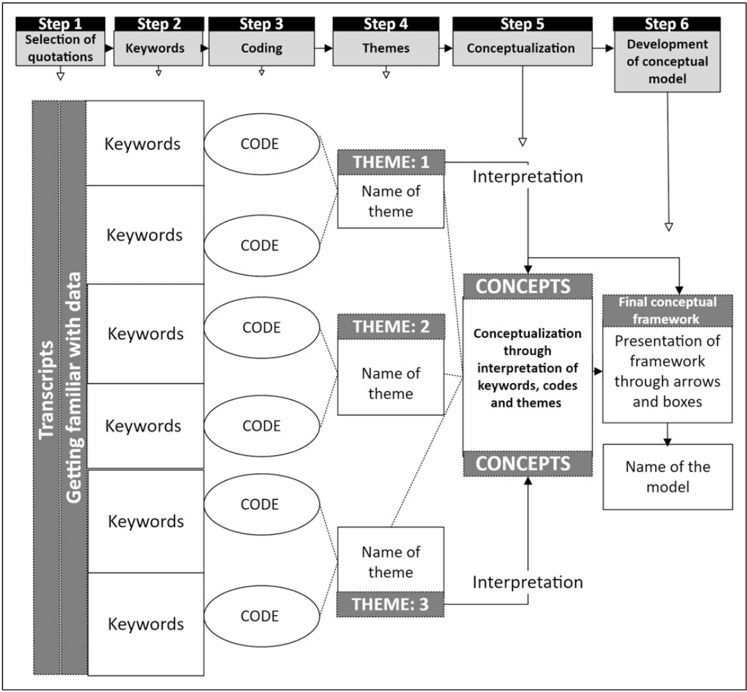
- The paper proposes six steps: transcription/familiarization and quotation selection; keyword selection; coding; theme development; conceptualization through interpretation of keywords, codes, and themes; and development of a conceptual model.
- It introduces 6Rs for keyword selection (realness, richness, repetition, rationale, repartee, regal), 6Rs for coding (robust, reflective, resplendent, relevant, radical, righteous), and 4Rs for theming (reciprocal, recognizable, responsive, resourceful).
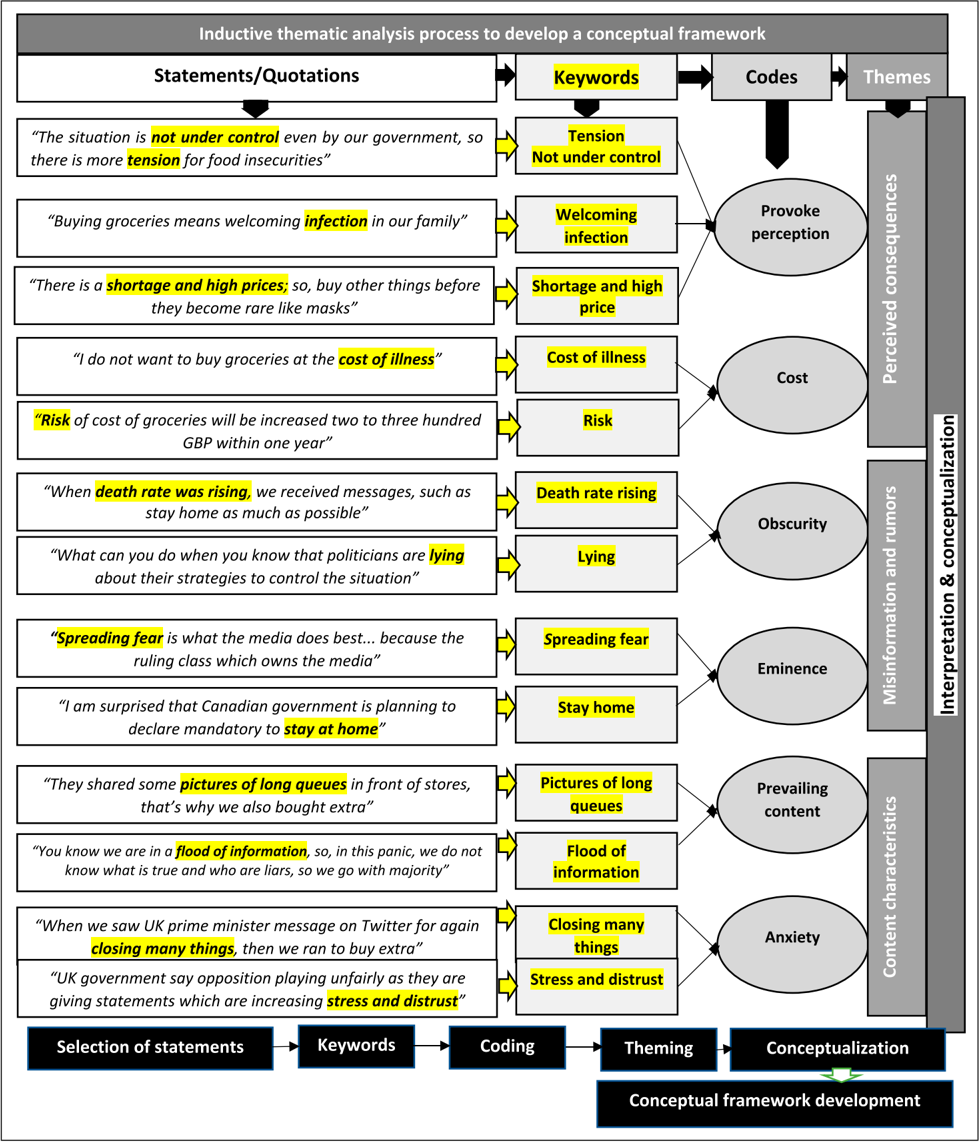
- In the exemplar study, three main themes emerged: “Perceived consequences” from codes “Provoke perception” and “Cost”; “Misinformation and rumors” from codes “Obscurity” and “Eminence”; and “Content Characteristics” from codes “Prevailing content” and “Anxiety.”
- The exemplar’s final model, “Panic buying as social practice,” was based on Protection Motivation Theory (PMT) and the Theory of Rumor Transmission (TORT).
Methods
- Design: a methodological/conceptual paper that presents a comprehensive systematic model for thematic analysis culminating in a conceptual model, using Naeem and Ozuem (2022a) as an exemplar.
- Exemplar data: qualitative data gathered from Twitter, YouTube, and interviews; the exemplar used a six-stage thematic analysis and a social constructionist perspective with PMT and TORT as theoretical foundations.
- Main analysis: the paper describes each of the six steps in detail, provides practical examples from the exemplar, and compares the proposed process with Braun and Clarke’s (2006) six steps of thematic analysis.
Limitations
- The paper states that the potential of the process to address other research contexts or quantitative methods may require further exploration, and that the efficiency of the method compared with other model-building approaches has not been empirically tested.
- Evident from the text: the proposed six-step process and the 6Rs/4Rs are illustrated through a single exemplar study and are not independently validated or empirically compared with alternative thematic analysis approaches.
Model-written summary. Check it against the paper before relying on it.
Integrity signals
Registry
Cites
Statistics
Figures

Verification
Claims the paper makes
0 Valid · 4 Not valid · 56 Not checked · 89 Own results and interpretations
The cited sources that could be checked couldn’t confirm or dispute this claim.
In the paper
“For narrative approaches, conceptual model development focuses on personal experiences, emotions, and life histories (Eldh et al., 2020).”
§ A Step-by-Step Process of Thematic Analysis to Develop a Conceptual Model in Qualitative Research > Step 6: Development of Conceptual Model.
What the sources say
- Could not verifycites Eldh et al., 2020 matched to “Quotations in Qualitative Studies: Reflections on Constituents, Custom, and Purpose” (2020) sourceExperimental — accuracy not yet measured
The Discussion and Conclusions (page numbers unavailable) address how quotations can illustrate qualitative analysis and findings. A search for narrative approaches, conceptual model development, emotions, and life histories found no passage addressing the attributed claim. (LLM, conf=0.72)
plainstates an association- Asserted: passes — The authors put it forward as true.
- Checkable: passes — It can be checked against evidence.
- Load-bearing: unclear — It is unclear whether the paper’s conclusions depend on it.
- Based: passes — The paper gives a reason why it holds.
- Could not verify
In the paper
“The analytical process balances between descriptive analysis, which outlines patterns or trends, and interpretive analysis, which offers subjective perspectives (Miles & Huberman, 1994, p. 56).”
§ A Step-by-Step Process of Thematic Analysis to Develop a Conceptual Model in Qualitative Research > Step 2: Selection of Keywords.
What the sources say
- Not matchedcites Miles & Huberman, 1994, p. 56
An author–year citation the paper’s reference list doesn’t settle. We don’t search these by name.
plain- Asserted: passes — The authors put it forward as true.
- Checkable: passes — It can be checked against evidence.
- Load-bearing: passes — The paper’s conclusions depend on it.
- Based: passes — The paper gives a reason why it holds.
- Not matched
In the paper
“However, the thematic analysis approach could also fit a post-positivist paradigm (Howell, 2012, p. 30).”
§ A Step-by-Step Process of Thematic Analysis to Develop a Conceptual Model in Qualitative Research > Step 2: Selection of Keywords.
What the sources say
- Not matchedcites Howell, 2012, p. 30
An author–year citation the paper’s reference list doesn’t settle. We don’t search these by name.
hedgedstates an association- Asserted: passes — The authors put it forward as true.
- Checkable: passes — It can be checked against evidence.
- Load-bearing: unclear — It is unclear whether the paper’s conclusions depend on it.
- Based: passes — The paper gives a reason why it holds.
- Not matched
In the paper
“Hence, quotation selection is not simply a mechanical task but is influenced by the researcher's philosophical and theoretical approach (Jackson & Mazzei, 2012).”
§ A Step-by-Step Process of Thematic Analysis to Develop a Conceptual Model in Qualitative Research > Step 1: Transcription, Familiarization With the Data, and Selection of Quotations.
What the sources say
- Not matchedcites Jackson & Mazzei, 2012
An author–year citation the paper’s reference list doesn’t settle. We don’t search these by name.
plainstates a cause- Asserted: passes — The authors put it forward as true.
- Checkable: passes — It can be checked against evidence.
- Load-bearing: passes — The paper’s conclusions depend on it.
- Based: passes — The paper gives a reason why it holds.
- Not matched
A conclusion the paper draws from its own results — it cites no other source for it, so there is none to check. The quote shows it is in the paper.
In the paper
“Thus, keywords serve as a critical bridge between data and themes in different methodologies.”
§ A Step-by-Step Process of Thematic Analysis to Develop a Conceptual Model in Qualitative Research > Step 4: Theme Development.
boostedstates an association- Asserted: passes — The authors put it forward as true.
- Checkable: passes — It can be checked against evidence.
- Load-bearing: unclear — It is unclear whether the paper’s conclusions depend on it.
- Based: passes — The paper gives a reason why it holds.
10 more claims
Create a free account to see all 149 claims and every source verdict.
- It may state two separate claims as one. 54
- Probably not a substantial claim. 128
Claims other papers make about this one
Each is checked against this paper’s own text: does it say what the citing paper says it does?
The source backs part of the claim, not all of it — or backs it for a different population, condition or comparison.
In the citing paper
“With the identified keywords, initial coding was further informed by and cross-referenced to the literature on AI ethics and governance, particularly addressing public concerns in government AI, alongside the author team's collective expertise in AI-driven digital transformation in public administration.”
From Accountability in Government Use of AI : Citizen Concerns and Preferences (2025) · cites this paper as Naeem et al. 2023
Experimental — accuracy not yet measuredThe source backs part of the claim, not all of it — or backs it for a different population, condition or comparison.
In the citing paper
“Thematic analysis is a highly popular technique among qualitative researchers for analyzing qualitative data, which usually comprises thick descriptive data (Naeem et al., 2023).”
From The Psycho-Emotive Effects of AI-Generated Fake News on Social Media Users (2026) · cites this paper as Naeem et al., 2023
Experimental — accuracy not yet measuredThe cited source says what the claim attributes to it.
In the citing paper
“The selection of keywords was guided by the 6Rs framework-Realness, Richness, Repetition, Rationale, Repartee, and Regal-to ensure they accurately represented the essence of the data (Naeem et al. 2023).”
From Accountability in Government Use of AI : Citizen Concerns and Preferences (2025) · cites this paper as Naeem et al. 2023
The cited source says what the claim attributes to it.
In the citing paper
“The data were analyzed through Naeem et al.'s (2023) six-step thematic analysis process to develop a conceptual framework (Naeem & Ozuem, 2022).”
From “It’s Not Just About Competition – It’s Ceremony”: Introducing the Embedded Indigeneity Framework for Understanding Identity, Mission, and Practice in TCU and NASNTI Athletics (2026) · cites this paper as Naeem et al. (2023)
The cited source says what the claim attributes to it.
In the citing paper
“The selected methodology was implemented due to the end results that 1) presented a novel conceptual framework and 2) serves as a contextually specific extension of existing theory/theories (Naeem et al., 2023).”
From “It’s Not Just About Competition – It’s Ceremony”: Introducing the Embedded Indigeneity Framework for Understanding Identity, Mission, and Practice in TCU and NASNTI Athletics (2026) · cites this paper as Naeem et al., 2023
Self-check
Percentages, sums and reported differences re-computed from the paper’s own numbers.
Each contradiction between two passages listed here was confirmed by an independent check.
Rated minor: it would not touch a result — a value no result rests on, a p-value that stays on the same side of the significance level, or a conflict that is clerical, resolved elsewhere in the paper, or outside its own findings.
In the paper
§ A Step-by-Step Process of Thematic Analysis to Develop a Conceptual Model in Qualitative Research > Step 6: Development of Conceptual Model.
“Positivism, which favours inductive methods, builds its model on top of previously established theories and conducts its experiments in an unbiased manner.”
§ A Step-by-Step Process of Thematic Analysis to Develop a Conceptual Model in Qualitative Research > Step 6: Development of Conceptual Model.
“An inductive approach is primarily data-driven, whereby themes are derived from the data itself without the influence of pre-existing theories (Braun & Clarke, 2006).”
Citations
Cites
Using thematic analysis in psychology
Braun, V., & Clarke, V. (2006) · Qualitative Research in Psychology · doi:10.1191/1478088706qp063oa · Cited by 194,414
Qualitative Data Analysis: An Expanded Sourcebook
(1994) · Journal of Environmental Psychology · doi:10.1016/s0272-4944(05)80231-2 · Cited by 48,420 · cited 2×
“In the coding process, consideration of keywords helps in multiple ways: The analytical process balances between descriptive analysis, which outlines patterns or trends, and interpretive analysis, which offers subjective perspectives (Miles & Huberman, 1994, p. 56).”
Lincoln, Y. S., Guba, E. G., & Pilotta, J. J. (1985) · International Journal of Intercultural Relations · doi:10.1016/0147-1767(85)90062-8 · Cited by 45,787 · cited 1×
“…degrees of subjectivity and objectivity has underscored the fl exibility intrinsic to research methodologies and highlighted that these tools of analysis are intimately intertwined with, and, indeed, emerge from the distinctive nature of speci fi c disciplines and perspectives (Lincoln & Guba, 1985).”
BackgroundThe Discovery of Grounded Theory: Strategies for Qualitative Research
Glaser, B. G., & Strauss, A. L. (2017) · Aldine (Routledge reprint) · doi:10.4324/9780203793206 · Cited by 25,789
The qualitative content analysis process
Elo, S., & Kyngäs, H. (2008) · Journal of Advanced Nursing · doi:10.1111/j.1365-2648.2007.04569.x · Cited by 22,617 · cited 1×
“Deductive coding, linked with descriptive analysis, is a top-down approach where pre-existing theories, models, or codes guide the data analysis (Elo & Kyng¨as, 2008).”
Method(2009) · Cited by 21,330
Reflecting on reflexive thematic analysis
Braun, V., & Clarke, V. (2019) · Qualitative Research in Sport, Exercise and Health · doi:10.1080/2159676x.2019.1628806 · Cited by 19,677
(1998) · Medical Entomology and Zoology · Cited by 18,397
(2014) · Cited by 15,747
S., N. L. (2017) · doi:10.1177/1609406917733847 · Cited by 14,051 · cited 3×
“· Robust: Coding should convey the true essence of data in a theoretical manner (Nowell et al., 2017).”
Background
Research works printed but not linked: 9
- 1. Arar, K. (2017). The what's and why's of the how to of qualitative research. Qualitative Report, 22(11), 2956-2958.
- 16. Creswell, J. W. (2012). Educational research. Pearson.
- 19. Denzin, N. K., & Salvo, J. (2020). New directions in theorizing qualitative research: Theory as resistance. Myers Education Press.
- 62. Oliver, P. (2021). Using qualitative methods to answer your research question (First). Open University Press.
- 63. Patton, M. Q. (2015). Qualitative research & evaluation methods: Integrating theory and practice (fourth). Sage Publications, Inc. Qualitative research (pp. 273-290). Sage.
- 67. Saldana, J. (2021). The coding manual for qualitative researchers (Fourth). Sage.
- 68. Saldana, J. M. (2016). The coding manual for qualitative researchers (4rd ed.). Sage Publications.
- 74. Seale, C. (2013). Qualitative research practice. In C. Seale, G. Gobo, J. Gubrium, & D. Silverman (Eds.), Concise paperback. Sage.
- 80. Tracy, S. J. (2019). Qualitative research methods: Collecting evi- dence, crafting analysis, communicating impact (2nd ed.). Wiley Blackwell.
Cited by
Items 301–400 of 2,204
Li, W., & Yu, Z. (2025) · Frontiers in Public Health · doi:10.3389/fpubh.2025.1628887 · Cited by 4
“For divergent opinions, we revisited the original transcripts and refined coding categories or their relationships where necessary, while retaining these differing perspectives to capture the diversity of experiences and deepen our understanding of mutual aid mechanisms (84).”
Thunström, A. O., Ali, L., Carlsen, H. K., Bohm, M., Wesén, L., Wrede, O., Vuković, I. S., Hellström, A., Larson, T., & Steingrímsson, S. (2025) · JMIR Formative Research · doi:10.2196/66163 · Cited by 6
“In addition, a semantic approach was used, focusing on the explicit content of the responses rather than underlying assumptions [10].”
Li, W. H. C., Chung, J. O. K., Chen, H., & Xiao, S. H. (2025) · Journal of Pediatric Nursing · doi:10.1016/j.pedn.2025.04.024 · Cited by 6
Improving Information Sharing in Offsite Construction (OSC): A Systematic Literature Review
Maheshwari, S., Ochoa, J. J., Gu, N., Rameezdeen, R., Mayer, W., & Doe, R. M. (2025) · Buildings · doi:10.3390/buildings15050698 · Cited by 8
Sar, H. R. S. K., Sabet, M. K., Zafarghandi, A. M., & Hassaskhah, J. (2024) · Language Testing in Asia · doi:10.1186/s40468-024-00335-8 · Cited by 12
“Thematic analysis is typically conducted through a six-step process (Naeem et al., 2023): – Data familiarization: the researcher reads and re-reads the data to become familiar with it and to identify any initial ideas or themes.”
Carlini, J., & Wu, L. L. (2024) · Services Marketing Quarterly · doi:10.1080/15332969.2024.2404743 · Cited by 5
Ye, Y. (2025) · Journal of Intercultural Communication Research · doi:10.1080/17475759.2025.2515475 · Cited by 6
“As noted by Naeem et al. (2023), this method offers cultural insights by exploring participants’ shared understanding of social events through an inductive approach.”
Marketing 5.0: Harnessing AI and Emerging Technologies to Shape the Future of Business
Ejjami, R. (2024) · International Journal For Multidisciplinary Research · doi:10.36948/ijfmr.2024.v06i04.26423 · Cited by 3
“The literature calls for increased scrutiny of AI algorithms to ensure that their design and deployment adhere to principles that minimize bias and promote fairness [52].”
BackgroundJafari, M., Delbosc, A., & Currie, G. (2025) · Transportation Research Part F Traffic Psychology and Behaviour · doi:10.1016/j.trf.2025.05.016 · Cited by 4
Challenges in the Peer-review process
Mishra, U. (2025) · Journal of Indonesian Management · doi:10.53697/jim.v5i1.2570 · Cited by 9
“Researchers systematically classified the data by analysing it, assigning codes and themes, and evaluating the outcomes (Thomas & Harden, 2008; Naeem et al., 2023).”
Azare, A. A., Ibrahim, M. H. W., Alshalif, A. F., Jaya, R. P., & Nindyawati, N. (2024) · Iranian Journal of Science and Technology Transactions of Civil Engineering · doi:10.1007/s40996-024-01690-5 · Cited by 5
“Keywords aim to identify and underline the significant issues in the area of interest of the research (Naeem et al. 2023).”
The eyes of the beholder: Perceived barriers to successful drug repurposing
Petykó, Z. I., Hosszú, D., Csanádi, M., Gyöngyösi, K., Obeng, G. D., Ameyaw, D., Dóczi, T. I., Kaló, Z., Lo, D. C., van der Meer, H. G., et al. (2025) · British Journal of Pharmacology · doi:10.1111/bph.70243 · Cited by 4
“The extracted data was analysed with a thematic analysis method to identify emerging patterns of barrier themes (Naeem et al., 2023).”
Zheng, X., Puad, M. H. M., & Jalil, H. A. (2025) · Education Sciences · doi:10.3390/educsci15070850 · Cited by 6
Cavaliere, F., Bellazzecca, E., & di Castiglionchio, E. E. Z. (2026) · Corporate Social Responsibility and Environmental Management · doi:10.1002/csr.70401 · Cited by 7
Lappeman, J., Bundwini, N., & Chikweche, T. (2024) · Journal of Consumer Behaviour · doi:10.1002/cb.2379 · Cited by 10
Generative artificial intelligence in venture creation learning: A new pedagogy of partnership
Meliá, M. R., & Blesa, A. (2026) · The International Journal of Management Education · doi:10.1016/j.ijme.2025.101355 · Cited by 17
Goldstein, E. C., Troubh, Z., Cooksey, K. E., Volkmar, M., Gallegos, V. C., Kaphingst, K. A., Lee, C. N., Housten, A. J., Mozersky, J. T., & Politi, M. C. (2025) · JMIR Formative Research · doi:10.2196/76740 · Cited by 4
A text mining study of competencies in modern supply chain management with skillset mapping
Kang, P. S., Enstroem, R., Bhawna, B., & Bennett, O. (2025) · Supply Chain Analytics · doi:10.1016/j.sca.2025.100117 · Cited by 19
Mitigating boredom in L2 Spanish reading class with the reading-writing continuation task
Liu, Z., Zhu, J., & Yuan, D. (2025) · Learning and Motivation · doi:10.1016/j.lmot.2025.102124 · Cited by 6
Ledro, C., Nosella, A., & Vinelli, A. (2025) · Journal of Cleaner Production · doi:10.1016/j.jclepro.2025.147142 · Cited by 11
Ameridyani, A., Tokito, M., & Saizen, I. (2025) · World Development Perspectives · doi:10.1016/j.wdp.2025.100700 · Cited by 30
Lai, A., Leoni, G., & Stacchezzini, R. (2025) · Accounting Auditing & Accountability Journal · doi:10.1108/aaaj-06-2024-7139 · Cited by 4
Khanal, K. (2024) · Interdisciplinary Journal of Innovation in Nepalese Academia · doi:10.3126/idjina.v3i2.73200 · Cited by 5
“Thematic analysis is a widely used method among qualitative researchers for examining qualitative data, typically involving detailed and descriptive information (Naeem et al., 2023).”
Design practices in visualization driven data exploration for non-expert audiences
Tylosky, N., Knutas, A., & Wolff, A. (2025) · Computer Science Review · doi:10.1016/j.cosrev.2025.100731 · Cited by 7
Aliaga-Rojas, J., & Pino, M. D. (2024) · Educational Assessment Evaluation and Accountability · doi:10.1007/s11092-024-09446-5 · Cited by 13
“Although this type of analysis emerges from constructionist lines (Braun & Clarke, 2006), various authors highlight its adaptability to different epistemological currents and relevance to the analysis of dense data, in a rigorous and systematic way (Braun & Clarke, 2019; Naeem et al., 2023).”
Basil, P. T., Ndibalema, P. M., & Lawrent, G. (2025) · Social and Emotional Learning Research Practice and Policy · doi:10.1016/j.sel.2025.100125 · Cited by 14
Hybrid times: War and peace in military innovation studies
Berthelsen, E. (2025) · Journal of Strategic Studies · doi:10.1080/01402390.2025.2512238 · Cited by 12
“30 I use the term ‘military organisational change’ to cover the processes and outcomes of innovation and adaptation.”
Baller, E. L., Zhao, W., Schissel, M. E., & Yoachim, S. D. (2024) · Journal of Dental Education · doi:10.1002/jdd.13755 · Cited by 7
Promoting Tourism Sustainability in Jordan: Policy Effectiveness and Stakeholders Perspectives
Harb, A. A., Alhammad, F. A., Almajali, T. A., Freewan, A., Shkokani, H., & Slehat, M. (2025) · Contemporary Review of the Middle East · doi:10.1177/23477989251319625 · Cited by 8
“Thereafter, the data were analyzed using a six-step thematic process, leading to conceptual generalizations based on key themes related to sustainable tourism (Naeem et al., 2023; Onwuegbuzie, 2009).”
Karimi, F., Marzban, E., & Dahlberg, U. (2025) · Journal of Integrative Environmental Sciences · doi:10.1080/1943815x.2025.2529796 · Cited by 4
“TA is a qualitative research method used to identify, analyse, and interpret patterns or themes within a data set, often leading to new insights and understanding (Naeem et al. 2023; Figgou and Pavlopoulos 2015; van der Leer et al. 2023).”
Marian, M., Pérez, R. L., Reed, E., Hurst, S., Lundgren, R., McClain, A. C., & Barker, K. M. (2025) · JMIR Infodemiology · doi:10.2196/67368 · Cited by 8
Naeem, M., Ozuem, W., Howell, K. E., & Ranfagni, S. (2024) · Psychology and Marketing · doi:10.1002/mar.21968 · Cited by 6
Self-citationSoto, I. L., Vidal, B., Verger, L., & Nagy, G. J. (2025) · Challenges · doi:10.3390/challe16040050 · Cited by 6
“We chose this software because it is free, easy to use, and supported by documentation and various tutorials on effective use [41].”
Rizza, C., & Ruggeri, D. (2025) · Journal of Management & Governance · doi:10.1007/s10997-025-09762-y · Cited by 5
“Accordingly, the empirical material was not codified, but instead analysed textually, with each author highlighting emergent themes pertaining to the research question (Berg & Madsen, 2020a, b ; Naeem et al., 2023 ).”
Jackson, E., Hill, E., Jones, K., Leitão, S., Tonta, K. E., MYERS, B. J., Sowerbutts, A., Townsend, J., Nayton, M., Baker, J., et al. (2025) · Mental Health & Prevention · doi:10.1016/j.mhp.2025.200424 · Cited by 4
Hong, S. ‐., Richardson, C., & Rahim, N. F. A. (2025) · Journal of Global Mobility The Home of Expatriate Management Research · doi:10.1108/jgm-07-2024-0072 · Cited by 4
Tiwari, A., Singh, S. K., Manar, M. K., Kanchan, K., & Kaur, M. (2024) · Discover Public Health · doi:10.1186/s12982-024-00127-8 · Cited by 8
Andrews, C. J., Pade, A., Boyle, F. M., Fernandez, D., Singline, L., Lancaster, A., Ellwood, D. A., Gordon, A., & Flenady, V. (2025) · BJOG An International Journal of Obstetrics & Gynaecology · doi:10.1111/1471-0528.18330 · Cited by 4
“We used thematic analysis that combined deductive and inductive approaches to align with the SBB evaluation questions, while allowing flexibility for new themes to be identified [13].”
The psychosocial background of dental care avoidance: A qualitative study
Lukács, M., Fábián, B., Bugán, A., & Varga, I. (2024) · Oral Diseases · doi:10.1111/odi.15136 · Cited by 4
“The thematic content analysis method was based on previous guidelines (Naeem et al., 2023).”
Muhammad, M., Stokes, J. E., Manning, L., & Huang, I. Y. (2024) · Veterinary Sciences · doi:10.3390/vetsci11100452 · Cited by 9
“This research adopted a systematic thematic analysis proposed by [41], to allow themes to emerge from the data.”
MethodInfluentialHow responsible are land acquisitions for megaprojects in global south cities?
Babalola, T. O. (2025) · Cities · doi:10.1016/j.cities.2025.106307 · Cited by 9
Zare, Z., Bahrami, M. A., Iranmanesh, F., & Kavosi, Z. (2025) · BMC Oral Health · doi:10.1186/s12903-025-06392-6 · Cited by 5
“Researchers applied thematic analysis to develop a conceptual model of their findings through a series of steps, including the selection of keywords and quotations, coding, theme identification, interpretation, and model development [21].”
Katta, S., & Davoody, N. (2025) · JMIR Medical Education · doi:10.2196/67993 · Cited by 6
Marshall, A., Donnelly, P., Elbeltagi, N. I., Gasson, S. J., Broadfield, A., Hopkins, A., Hartup, S. M., Turner, L., Young, A., Watson, E. K., et al. (2025) · Health and Quality of Life Outcomes · doi:10.1186/s12955-025-02396-6 · Cited by 3
“A thematic content analysis [16] of the completed free text fields for all participants was carried out by SG using NVIVO version 12 software.”
A Process Framework of Family AI Use in Early Education and Care
Zhang, Y., Zhang, Q.-L., Jiang, K., Li, Y., & Xie, Q.-Z. (2026) · Family Process · doi:10.1111/famp.70174 · Cited by 2
“We conducted thematic analysis (Braun et al. 2019; Naeem et al. 2023), involving iterative familiarization, coding, and category development through constant comparison.”
Zhang, L., & McCartney, G. J. (2026) · International Journal of Tourism Research · doi:10.1002/jtr.70301 · Cited by 3
McCluskey, M. S., & Saqib, W. (2026) · Teachers College Record The Voice of Scholarship in Education · doi:10.1177/01614681261438878 · Cited by 3
“Next, we engaged in theme development, which involved “organizing codes into meaningful groups to identify patterns and relationships, thereby offering insights into the research question[s]” (Naeem et al., 2023, p. 4).”
Liu, S., Lv, M., Huang, Q., & Zhang, X. (2025) · Asia Pacific Education Review · doi:10.1007/s12564-025-10055-0 · Cited by 6
“This step adhered to the 6Rs framework—realness, richness, repetition, rationale, repartee, and regal (Naeem et al., 2023).”
Information needs of South Sudanese refugees in North Western Uganda at Bidi Bidi refugee settlement
Mukungu, I., & Ngulube, P. (2025) · Information Processing & Management · doi:10.1016/j.ipm.2025.104359 · Cited by 3
What makes a man unmanly? The global concept of ‘unmanliness’
Żadkowska, M., Szlendak, T., Kossakowski, R., & Kosakowska‐Berezecka, N. (2025) · Humanities and Social Sciences Communications · doi:10.1057/s41599-025-04667-5 · Cited by 7
“This phase aimed to uncover abstract patterns, trends, and relationships that provide insight into our research questions (Naeem et al., 2023).”
Donois, K., Goodings, L., Finlay, W. M. L., & Gibson, N. (2025) · Public Understanding of Science · doi:10.1177/09636625251325453 · Cited by 6
“…analytic process (see also supplemental material), which included familiarization with the data, generations of keywords and initial codes, searching for themes, reviewing themes, and finally, defining and naming themes before producing the report (Braun and Clarke, 2006, 2022; Naeem et al., 2023).”
Awelewa, T., Murra, A. C., & Story, W. T. (2025) · Nutrients · doi:10.3390/nu17132094 · Cited by 3
“Data were analyzed using thematic analysis to examine views and opinions about breast-feeding [27,28].”
Chalmer, R., Ayers, E. I., Weiss, E. F., Fowler, N. R., Telzak, A., Summanwar, D., Zwerling, J. L., Wang, C., Xu, H., Holden, R. J., et al. (2025) · JMIR Research Protocols · doi:10.2196/60471 · Cited by 4
“We will also use applied thematic analysis [105] to identify patterns within and between codes.”
Sagoo, M. G., Lam, P. Y., Sharma, T., Arora, A., Siddiqui, M., Adeniyi, A., Brassett, C., Noël, G. P. J. C., Wingate, R. J. T., McWatt, S. C., et al. (2025) · Anatomical Sciences Education · doi:10.1002/ase.70026 · Cited by 4
Managerial influence on employee learning: contextual insights from industrial companies in Sweden
Jarl, F. H. (2025) · Journal of Workplace Learning · doi:10.1108/jwl-09-2024-0215 · Cited by 7
Chen, X., Wang, C., & Liu, Y. (2025) · Journal of Documentation · doi:10.1108/jd-06-2025-0154 · Cited by 2
Oladiran, O., Ogunbajo, R. A., Kemiki, O. A., et al. (2025) · Journal of Property Investment and Finance · doi:10.1108/jpif-11-2024-0147 · Cited by 3
Colling, A. M., Saunders, T., Creagh, N. S., Ashfaq, M., Brotherton, J. M. L., & Nightingale, C. E. (2025) · Health Expectations · doi:10.1111/hex.70397 · Cited by 5
“Transcripts were inductively thematically coded by authors (A.M.C., T.S. and M.A.) using NVivo 14 (QSR International Pty Ltd), to identify key themes, followed by deductive mapping of themes to the ODSF decisional needs, to understand participants' experiences and perspectives [23].”
Payne, C., Zieve, H., Lucas, C. T., et al. (2025) · MedEdPORTAL · doi:10.15766/mep_2374-8265.11522 · Cited by 3
“14 The coders then reached consensus on the labels assigned.”
The political economy of green industrial policy in liberal states
Arcand, B. (2025) · Energy Policy · doi:10.1016/j.enpol.2025.115006 · Cited by 3
Rasiya, A., & Raheem, U. A. (2026) · Nursing Open · doi:10.1002/nop2.70655 · Cited by 6
Perceptions on the Implementation of a School Nursing Pilot Programme in the Canary Islands
Fernández-Hernández, A., Figueroa-Martín, L., González-Betancor, S.-J., Ortega, B. R., la Torre, H. G., & Rodríguez-Suárez, C.-A. (2025) · Nursing Reports · doi:10.3390/nursrep15020048 · Cited by 4
“The analysis followed an intentional coding strategy [23,24], supported by Atlas Ti software (version 24.1.0) and based on Strauss’ methodology, which consists of two phases.”
InfluentialHow do older workers experience hybrid work? A thematic analysis
Bilau, I., Shagar, M., Baru, A., Tonetto, L. M., & Yang, E. (2025) · Journal of Corporate Real Estate · doi:10.1108/jcre-03-2025-0024 · Cited by 3
Chakraborty, S., & Thakur, N. (2024) · Cogent Education · doi:10.1080/2331186x.2024.2428895 · Cited by 4
“…that students have a significantly better understanding of the broader environmental impact of technology compared to their awareness of the specific issue of carbon emissions from extended screen time (Haleem et al., 2022; M. Naeem et al., 2023; P (cid:1) erez-Ju (cid:1) arez et al., 2023).”
InfluentialRamírez, J. P., García, J. R., & Pedregal, A. M. N. (2026) · Culture Medicine and Psychiatry · doi:10.1007/s11013-025-09964-x · Cited by 3
“This analysis aimed to identify recurring patterns of meaning across the data (Braun & Clarke, 2006), employing a step-by-step process from transcription to coding and conceptualisation (Naeem et al., 2023).”
Hua, W., & Soh, S. B. (2025) · International Journal of Intercultural Relations · doi:10.1016/j.ijintrel.2025.102352 · Cited by 7
Santiago, C. M. (2025) · Educational Action Research · doi:10.1080/09650792.2025.2568018 · Cited by 10
“However, regarding data analysis, teachers and students still verify ChatGPT’s results by checking actual scores and doing a thematic analysis (Naeem et al. 2023).”
Toward a Harmonized Health Technology Assessment Framework for Digital Health Technologies in Europe
Tsiasiotis, E., Mezei, F., Bidino, R. D., et al. (2025) · Value in Health · doi:10.1016/j.jval.2025.12.004 · Cited by 3
de la Cuadra-Grande, A., Rejas, J., Casado, M. Á., Monroy, M., & Ruiz, M. Á. (2025) · Journal of Neurology · doi:10.1007/s00415-025-13348-x · Cited by 7
Exploring the Urban Greening Community in Jakarta’s Urban Kampung: A Tactical Urbanism Perspective
Fitri, H., & Sari, A. A. (2025) · Sustainability · doi:10.3390/su17093904 · Cited by 5
Aschner, A., Donner, E. J., Diehl, B., Jetté, N., Blank, L. J., & Sharma, S. (2026) · Epilepsia · doi:10.1002/epi.70145 · Cited by 3
“16,17 Each step was conducted separately by two reviewers (S.S. and A.A.) and the results were compared prior to the subsequent step.”
Terrado, E. M. (2023) · REDU Revista de Docencia Universitaria · doi:10.4995/redu.2023.20311 · Cited by 6
Bowden, J. J., Mohanakrishnan, M., & Thompson, A. R. (2025) · Medical Science Educator · doi:10.1007/s40670-025-02587-2 · Cited by 10
Wambugu, J., Osinga, R., Murk, A. J., & Lamers, M. (2025) · Journal of Coastal Conservation · doi:10.1007/s11852-025-01142-w · Cited by 5
“Transcripts were read multiple times by the first author and coded deductively, focusing on stakeholders, motivations, and capacities, and inductively to capture challenges in the engagement process (Naeem et al. 2023; Punch 2013).”
Joshi, R., Mekoth, N., & Abhinaya, U. (2026) · International Journal of Consumer Studies · doi:10.1111/ijcs.70198 · Cited by 4
Stracke, C. M., Nahar, N., Punzo, V., Massaro, S., Pappa, D., Grassi, A. D., Bećirović, S., Hollins, P. A., Ziouvelou, X., Skënduli, M. P., et al. (2025) · MAP Education and Humanities · doi:10.53880/2744-2373.2025.6.61 · Cited by 8
The Thematic Analysis of Barriers to Immediate Post-Partum Long-Acting Reversible Contraception
Iqbal, M., Wasim, T., Al-Qahtani, S. A., Alghamdi, A. A., Ahmad, A., Abbas, A., Bushra, N., Thattarauthodiyil, U., Easwaran, V., Afzal, M., et al. (2024) · Healthcare · doi:10.3390/healthcare12222208 · Cited by 5
Song, T., Sun, B., Li, J., Li, H., Yang, C.-L., Xu, Y., & Lee, Y. (2026) · CHI Conference on Human Factors in Computing Systems · doi:10.1145/3772318.3791224 · Cited by 5
Ingram, C., Buggy, C., & Perrotta, C. (2025) · Journal of Substance Use and Addiction Treatment · doi:10.1016/j.josat.2025.209669 · Cited by 4
A six-phase AI-expert framework for evaluating policy coherence in sustainable tourism
Carić, H., Mandić, A., & Sever, I. (2025) · Information Technology & Tourism · doi:10.1007/s40558-025-00352-0 · Cited by 5
“The AI-generated insights are systematically compared with expert evaluations, using quantitative similarity measures (Jaccard similarity coefficient) and qualitative thematic analysis (Naeem et al. 2023).”
Dervić, M., Bećirović, S., & Polz, E. (2025) · Future education and learning spaces · doi:10.1007/978-981-96-7937-9_9 · Cited by 10
Giacomozzi, M., Brazelton, J., Jeswani, K., Ruumpol, D., Verdonk, P., & Nap, A. W. (2025) · Sexual and Reproductive Health Matters · doi:10.1080/26410397.2025.2562682 · Cited by 4
“Re fl exive thematic analysis was conducted throughout the research process, with codes generated and themes identi fi ed following the approaches of Braun and Clarke 38 and Naeem et al. 39 Recruitment was discontinued when no new information or themes emerged from the data, i.e. when information redundancy was observed…”
A Metamodel for Applying Green BPM Approaches with the EU Taxonomy
Bogatinovska, I., Klessascheck, F., Andree, K., & Pufahl, L. (2025) · Lecture notes in business information processing · doi:10.1007/978-3-031-95397-2_24 · Cited by 2
Kaman, K., & Deshmukh, A. K. (2025) · Spanish Journal of Marketing - ESIC · doi:10.1108/sjme-12-2024-0327 · Cited by 3
Edelman, A., Marten, R., Dhillon, I. S., et al. (2025) · BMJ Global Health · doi:10.1136/bmjgh-2024-018076 · Cited by 3
“…and stakeholders from all sectors; purchasing and payment systems; digital technologies for health and PHC-oriented research) 19 to draw out more detail on key aspects of PHC. Data analysis used a deductive thematic analysis approach 20 using the modified Astana PHC headings as themes (table 3).”
Mielly, M., Eyre, P. W., & Hubner, F. (2024) · Journal of Global Mobility The Home of Expatriate Management Research · doi:10.1108/jgm-11-2023-0090 · Cited by 4
Lee, C.-Y., Rajendra, D. S., Chong, H., Skulmoski, G. J., Skitmore, M., & Guo, L. (2026) · Journal of Construction Engineering and Management · doi:10.1061/jcemd4.coeng-17112 · Cited by 4
Understanding Social Motivation in Scan and Go Technology
Naeem, M., & Ozuem, W. (2025) · Journal of Computer Information Systems · doi:10.1080/08874417.2024.2445007 · Cited by 6
Self-citationWakgari, N., Bekele, D., Watson, S., Wondafrash, M., Bradfield, Z., & Tessema, G. A. (2025) · International Journal for Equity in Health · doi:10.1186/s12939-025-02722-w · Cited by 4
“Deductive and inductive thematic analysis was utilised to manage and interpret the collected data [44, 45].”
Husić, S., Miletić, B., Kolnik, T. Š., & Vejzović, V. (2025) · Nursing Reports · doi:10.3390/nursrep15090327 · Cited by 7
“Data were analyzed using reflexive thematic analysis [30], and the research protocol was developed following the Consolidated Criteria for Reporting Qualitative Research guidelines [31].”
Understanding People’s Motivation to Contribute to Wildlife Disease Surveillance
Waldo, Å., Neimanis, A. S., Ågren, E. O., Nöremark, M., & Johansson, M. V. (2025) · Society & Natural Resources · doi:10.1080/08941920.2024.2449034 · Cited by 6
“Motivation was a focus in a broad sense, but the analysis was mainly exploratory, and data driven (Braun and Clarke 2006; Muhammad Naeem et al. 2023; Byrne 2022).”
Peterson, H., & Tuncer, M. (2026) · Journal of Family Studies · doi:10.1080/13229400.2026.2615352 · Cited by 5
McCormick, S. A., Cukic, I., Alexanders, J., Yeowell, G., Fatoye, F., Kelly, B. M., Fitzgerald, V., Cable, N. T., Doherty, P., Deniszczyc, D., et al. (2025) · BMJ Public Health · doi:10.1136/bmjph-2024-002322 · Cited by 3
Zain, F. A. M., Muhamad, S. F., & Haron, H. I. C. (2026) · Journal of International Education in Business · doi:10.1108/jieb-08-2025-0111 · Cited by 3
Kottara, C., Asonitou, S., & Kavalieraki-Foka, D. (2025) · Trends in Higher Education · doi:10.3390/higheredu4030030 · Cited by 11
Leveraging an Arts-Based Approach to Foster Engagement, Nurture Kindness, and Prevent Violence
Paat, Y.-F., Garcia Tovar, D., Myers, N. W., Orezzoli, M. C. E., Giangiulio, A. M., Ruiz, S. L., Dorado, A. V., & Torres-Hostos, L. R. (2025) · Behavioral Sciences · doi:10.3390/bs15060799 · Cited by 3
“The data were analyzed using thematic data analysis, a qualitative research method to analyze and interpret patterns within textual data by systematically coding the data and grouping the codes into themes to derive deeper meanings and insights (Naeem et al., 2023).”
Informal land access for housing and associated settlement developments in Bahir Dar City, Ethiopia
Adigeh, D. T., Mekuria, E. B., & Abebe, B. G. (2025) · Frontiers in Human Dynamics · doi:10.3389/fhumd.2025.1477944 · Cited by 5
Engaging Secondary Students in Computing and Cybersecurity
Nite, S., Gray, T., Lee, S., et al. (2024) · doi:10.1145/3626203.3670624 · Cited by 3
Ntsanwisi, S. (2025) · Educational Considerations · doi:10.4148/0146-9282.2404 · Cited by 4
“This study is a theoretical argumentative paper that critically examines contemporary educational discourse through a literature-based analysis employing thematic analysis (Naeem et al., 2023).”
Metadata
- Authors
- Naeem, M., Ozuem, W., Howell, K., & Ranfagni, S.
- Affiliations
- University of Gloucestershire (GB)
- University of Cumbria (GB)
- Northumbria University (GB)
- University of Florence (IT)
- Corresponding author
- Naeem, Muhammad
- Venue
- International Journal of Qualitative Methods
- Publisher
- SAGE Publications
- Published
- 2023-10
- Volume
- 22
- ISSN
- 1609-4069 (ISSN-L)
- OpenAlex
- W4388503650
- Cited by
- 2,243
- References
- 71
- Citations by year
- 2026: 1000 · 2025: 981 · 2024: 258 · 2023: 4
- FWCI
- 1654.78
- Type
- journal article
- Language
- en
- Open access
- gold
- doi.org
- Licence
- Locations
- International Journal of Qualitative Methods (publishedVersion, cc-by-nc)
- Insight (University of Cumbria) (acceptedVersion)
- DOAJ (DOAJ: Directory of Open Access Journals) (submittedVersion, cc-by-sa)
- Florence Research (University of Florence) (submittedVersion)
- Topics
- Social Sciences › Education › Qualitative Research Methods and Applications
- Social Sciences › Sociology and Political Science › Qualitative Research Methods and Ethics
- Social Sciences › General Social Sciences › Computational and Text Analysis Methods
- Keywords
- thematic analysis, conceptual modeling, qualitative data analysis, inductive coding, deductive coding, grounded theory, interpretive phenomenology, constructivist research, positivist research, theoretical conceptualization, replicability
About these checks
Registry, retraction, Cites and statistics results are computed, not judged, with one exception: a printed reference that no index lists is read once by a model before it counts as a citation error. Claims are extracted by a model and kept only when their quote appears verbatim in the text; each cited source is then checked, with a model’s help, for whether it says what the claim relies on. Those verdicts can be wrong — read the claim’s quote and the cited source before relying on one.
The claim verdicts this report counts are experimental: their accuracy is not yet measured.
A language model drew the claims from the paper on 2026-10-10, under version 3 of the claim definition (model deepseek-v4.1-flash, prompt extract-v3).
A second model labelled each claim on 2026-10-10 (model jev-1.13-20260917, definition revision gold-guideline-v0.2).
Cited sources are checked with a language model’s help (gpt-6-sol).
Statistics and arithmetic are recomputed, not judged.
Confidence bands are shown only for fields calibrated on our annotated test set. None is calibrated yet, so no band is shown.
What counts as a claim ›How we measure confidence ›How we check this ›
Are you an author, or do you see a problem with this page? Request a review
Data sources
Bibliographic data: Semantic Scholar, OpenAlex, Crossref.
Contains information from the Semantic Scholar Academic Graph Datasets, made available under the ODC Attribution License (ODC-BY 1.0).
Semantic Scholar’s data is described in: Kinney, R., et al. (2023). The Semantic Scholar Open Data Platform. arXiv:2301.10140.
