

A Step-by-Step Process of Thematic Analysis to Develop a Conceptual Model in Qualitative Research
Open accessThe DOI matches its Crossref record; 77 of the 78 references it cites were found in a registry or an index, and 1 are not checked yet; 2 of the 57 sources its claims cite were checked for support.
Abstract
Thematic analysis is a highly popular technique among qualitative researchers for analyzing qualitative data, which usually comprises thick descriptive data. However, the application and use of thematic analysis has also involved complications due to confusion regarding the final outcome’s presentation as a conceptual model. This paper develops a systematic thematic analysis process for creating a conceptual model from qualitative research findings. It explores the adaptability of the proposed process across various research methodologies, including constructivist methodologies, positivist methodologies, grounded theory, and interpretive phenomenology, and justifies their application. The paper distinguishes between inductive and deductive coding approaches and emphasizes the merits of each. It suggests that the derived systematic thematic analysis model is valuable across multiple disciplines, particularly in grounded theory, ethnographic approaches, and narrative approaches, while also being adaptable to more descriptive, positivist-based methodologies. By providing a methodological roadmap, this study enhances the rigor and replicability of thematic analysis and offers a comprehensive strategy for theoretical conceptualization in qualitative research. The contribution of this paper is a systematic six-step thematic analysis process that leads to the development of a conceptual model; each step is described in detail and examples are given.
Verified 2026-11-22 · 1 reference not checked yet
Overview
CoChat Summary
TL;DR
This methodological paper presents a six-step systematic thematic analysis process for developing a conceptual model from qualitative data, illustrated with Naeem and Ozuem’s (2022a) panic-buying study. It introduces 6Rs for keyword selection, 6Rs for coding, and 4Rs for theming to enhance rigor and trustworthiness.
Key findings
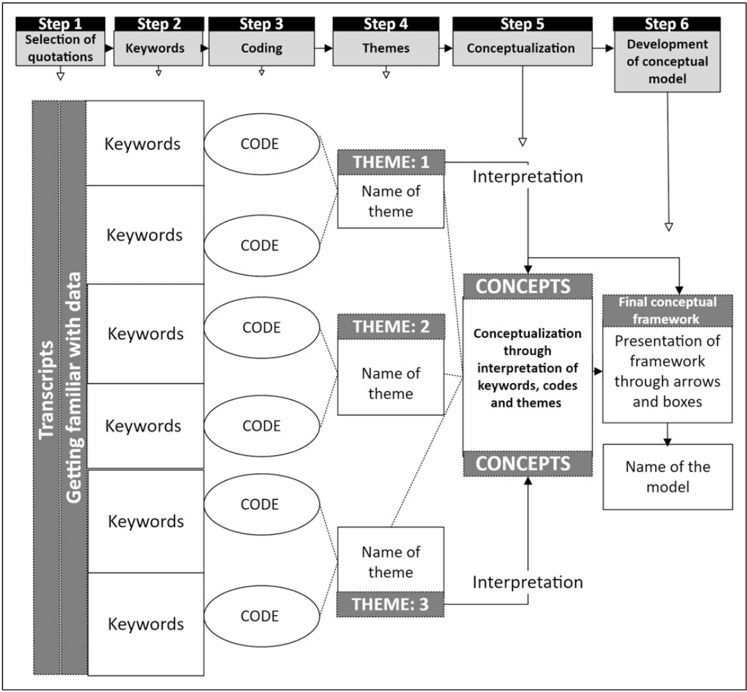
- The paper proposes six steps: transcription/familiarization and quotation selection; keyword selection; coding; theme development; conceptualization through interpretation of keywords, codes, and themes; and development of a conceptual model.
- It introduces 6Rs for keyword selection (realness, richness, repetition, rationale, repartee, regal), 6Rs for coding (robust, reflective, resplendent, relevant, radical, righteous), and 4Rs for theming (reciprocal, recognizable, responsive, resourceful).
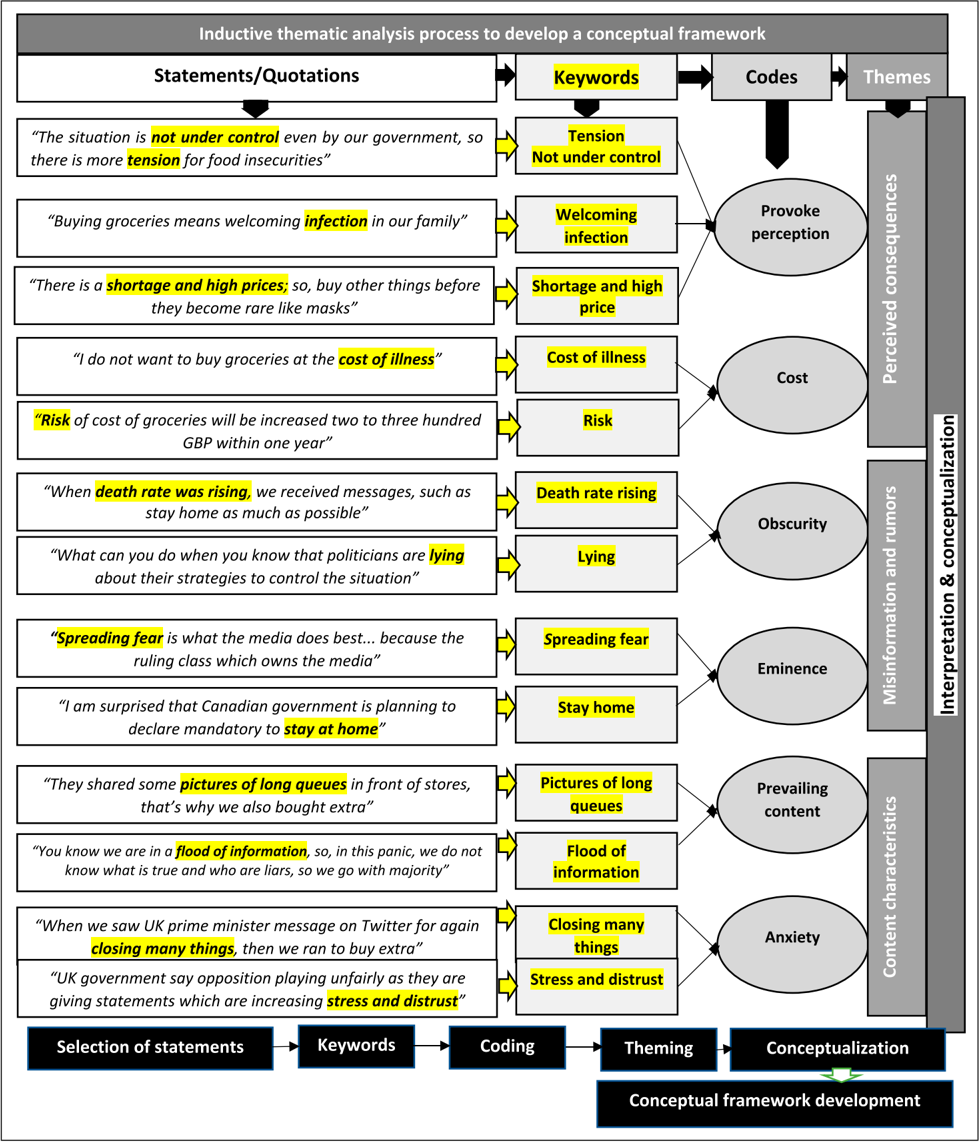
- In the exemplar study, three main themes emerged: “Perceived consequences” from codes “Provoke perception” and “Cost”; “Misinformation and rumors” from codes “Obscurity” and “Eminence”; and “Content Characteristics” from codes “Prevailing content” and “Anxiety.”
- The exemplar’s final model, “Panic buying as social practice,” was based on Protection Motivation Theory (PMT) and the Theory of Rumor Transmission (TORT).
Methods
- Design: a methodological/conceptual paper that presents a comprehensive systematic model for thematic analysis culminating in a conceptual model, using Naeem and Ozuem (2022a) as an exemplar.
- Exemplar data: qualitative data gathered from Twitter, YouTube, and interviews; the exemplar used a six-stage thematic analysis and a social constructionist perspective with PMT and TORT as theoretical foundations.
- Main analysis: the paper describes each of the six steps in detail, provides practical examples from the exemplar, and compares the proposed process with Braun and Clarke’s (2006) six steps of thematic analysis.
Limitations
- The paper states that the potential of the process to address other research contexts or quantitative methods may require further exploration, and that the efficiency of the method compared with other model-building approaches has not been empirically tested.
- Evident from the text: the proposed six-step process and the 6Rs/4Rs are illustrated through a single exemplar study and are not independently validated or empirically compared with alternative thematic analysis approaches.
Model-written summary. Check it against the paper before relying on it.
Integrity signals
Registry
Cites
Statistics
Figures

Verification
Claims the paper makes
0 Valid · 4 Not valid · 56 Not checked · 89 Own results and interpretations
The cited sources that could be checked couldn’t confirm or dispute this claim.
In the paper
“For narrative approaches, conceptual model development focuses on personal experiences, emotions, and life histories (Eldh et al., 2020).”
§ A Step-by-Step Process of Thematic Analysis to Develop a Conceptual Model in Qualitative Research > Step 6: Development of Conceptual Model.
What the sources say
- Could not verifycites Eldh et al., 2020 matched to “Quotations in Qualitative Studies: Reflections on Constituents, Custom, and Purpose” (2020) sourceExperimental — accuracy not yet measured
The Discussion and Conclusions (page numbers unavailable) address how quotations can illustrate qualitative analysis and findings. A search for narrative approaches, conceptual model development, emotions, and life histories found no passage addressing the attributed claim. (LLM, conf=0.72)
plainstates an association- Asserted: passes — The authors put it forward as true.
- Checkable: passes — It can be checked against evidence.
- Load-bearing: unclear — It is unclear whether the paper’s conclusions depend on it.
- Based: passes — The paper gives a reason why it holds.
- Could not verify
In the paper
“The analytical process balances between descriptive analysis, which outlines patterns or trends, and interpretive analysis, which offers subjective perspectives (Miles & Huberman, 1994, p. 56).”
§ A Step-by-Step Process of Thematic Analysis to Develop a Conceptual Model in Qualitative Research > Step 2: Selection of Keywords.
What the sources say
- Not matchedcites Miles & Huberman, 1994, p. 56
An author–year citation the paper’s reference list doesn’t settle. We don’t search these by name.
plain- Asserted: passes — The authors put it forward as true.
- Checkable: passes — It can be checked against evidence.
- Load-bearing: passes — The paper’s conclusions depend on it.
- Based: passes — The paper gives a reason why it holds.
- Not matched
In the paper
“However, the thematic analysis approach could also fit a post-positivist paradigm (Howell, 2012, p. 30).”
§ A Step-by-Step Process of Thematic Analysis to Develop a Conceptual Model in Qualitative Research > Step 2: Selection of Keywords.
What the sources say
- Not matchedcites Howell, 2012, p. 30
An author–year citation the paper’s reference list doesn’t settle. We don’t search these by name.
hedgedstates an association- Asserted: passes — The authors put it forward as true.
- Checkable: passes — It can be checked against evidence.
- Load-bearing: unclear — It is unclear whether the paper’s conclusions depend on it.
- Based: passes — The paper gives a reason why it holds.
- Not matched
In the paper
“Hence, quotation selection is not simply a mechanical task but is influenced by the researcher's philosophical and theoretical approach (Jackson & Mazzei, 2012).”
§ A Step-by-Step Process of Thematic Analysis to Develop a Conceptual Model in Qualitative Research > Step 1: Transcription, Familiarization With the Data, and Selection of Quotations.
What the sources say
- Not matchedcites Jackson & Mazzei, 2012
An author–year citation the paper’s reference list doesn’t settle. We don’t search these by name.
plainstates a cause- Asserted: passes — The authors put it forward as true.
- Checkable: passes — It can be checked against evidence.
- Load-bearing: passes — The paper’s conclusions depend on it.
- Based: passes — The paper gives a reason why it holds.
- Not matched
A conclusion the paper draws from its own results — it cites no other source for it, so there is none to check. The quote shows it is in the paper.
In the paper
“Thus, keywords serve as a critical bridge between data and themes in different methodologies.”
§ A Step-by-Step Process of Thematic Analysis to Develop a Conceptual Model in Qualitative Research > Step 4: Theme Development.
boostedstates an association- Asserted: passes — The authors put it forward as true.
- Checkable: passes — It can be checked against evidence.
- Load-bearing: unclear — It is unclear whether the paper’s conclusions depend on it.
- Based: passes — The paper gives a reason why it holds.
10 more claims
Create a free account to see all 149 claims and every source verdict.
- It may state two separate claims as one. 54
- Probably not a substantial claim. 128
Claims other papers make about this one
Each is checked against this paper’s own text: does it say what the citing paper says it does?
The source backs part of the claim, not all of it — or backs it for a different population, condition or comparison.
In the citing paper
“With the identified keywords, initial coding was further informed by and cross-referenced to the literature on AI ethics and governance, particularly addressing public concerns in government AI, alongside the author team's collective expertise in AI-driven digital transformation in public administration.”
From Accountability in Government Use of AI : Citizen Concerns and Preferences (2025) · cites this paper as Naeem et al. 2023
Experimental — accuracy not yet measuredThe source backs part of the claim, not all of it — or backs it for a different population, condition or comparison.
In the citing paper
“Thematic analysis is a highly popular technique among qualitative researchers for analyzing qualitative data, which usually comprises thick descriptive data (Naeem et al., 2023).”
From The Psycho-Emotive Effects of AI-Generated Fake News on Social Media Users (2026) · cites this paper as Naeem et al., 2023
Experimental — accuracy not yet measuredThe cited source says what the claim attributes to it.
In the citing paper
“The selection of keywords was guided by the 6Rs framework-Realness, Richness, Repetition, Rationale, Repartee, and Regal-to ensure they accurately represented the essence of the data (Naeem et al. 2023).”
From Accountability in Government Use of AI : Citizen Concerns and Preferences (2025) · cites this paper as Naeem et al. 2023
The cited source says what the claim attributes to it.
In the citing paper
“The data were analyzed through Naeem et al.'s (2023) six-step thematic analysis process to develop a conceptual framework (Naeem & Ozuem, 2022).”
From “It’s Not Just About Competition – It’s Ceremony”: Introducing the Embedded Indigeneity Framework for Understanding Identity, Mission, and Practice in TCU and NASNTI Athletics (2026) · cites this paper as Naeem et al. (2023)
The cited source says what the claim attributes to it.
In the citing paper
“The selected methodology was implemented due to the end results that 1) presented a novel conceptual framework and 2) serves as a contextually specific extension of existing theory/theories (Naeem et al., 2023).”
From “It’s Not Just About Competition – It’s Ceremony”: Introducing the Embedded Indigeneity Framework for Understanding Identity, Mission, and Practice in TCU and NASNTI Athletics (2026) · cites this paper as Naeem et al., 2023
Self-check
Percentages, sums and reported differences re-computed from the paper’s own numbers.
Each contradiction between two passages listed here was confirmed by an independent check.
Rated minor: it would not touch a result — a value no result rests on, a p-value that stays on the same side of the significance level, or a conflict that is clerical, resolved elsewhere in the paper, or outside its own findings.
In the paper
§ A Step-by-Step Process of Thematic Analysis to Develop a Conceptual Model in Qualitative Research > Step 6: Development of Conceptual Model.
“Positivism, which favours inductive methods, builds its model on top of previously established theories and conducts its experiments in an unbiased manner.”
§ A Step-by-Step Process of Thematic Analysis to Develop a Conceptual Model in Qualitative Research > Step 6: Development of Conceptual Model.
“An inductive approach is primarily data-driven, whereby themes are derived from the data itself without the influence of pre-existing theories (Braun & Clarke, 2006).”
Citations
Cites
Using thematic analysis in psychology
Braun, V., & Clarke, V. (2006) · Qualitative Research in Psychology · doi:10.1191/1478088706qp063oa · Cited by 194,414
Qualitative Data Analysis: An Expanded Sourcebook
(1994) · Journal of Environmental Psychology · doi:10.1016/s0272-4944(05)80231-2 · Cited by 48,420 · cited 2×
“In the coding process, consideration of keywords helps in multiple ways: The analytical process balances between descriptive analysis, which outlines patterns or trends, and interpretive analysis, which offers subjective perspectives (Miles & Huberman, 1994, p. 56).”
Lincoln, Y. S., Guba, E. G., & Pilotta, J. J. (1985) · International Journal of Intercultural Relations · doi:10.1016/0147-1767(85)90062-8 · Cited by 45,787 · cited 1×
“…degrees of subjectivity and objectivity has underscored the fl exibility intrinsic to research methodologies and highlighted that these tools of analysis are intimately intertwined with, and, indeed, emerge from the distinctive nature of speci fi c disciplines and perspectives (Lincoln & Guba, 1985).”
BackgroundThe Discovery of Grounded Theory: Strategies for Qualitative Research
Glaser, B. G., & Strauss, A. L. (2017) · Aldine (Routledge reprint) · doi:10.4324/9780203793206 · Cited by 25,789
The qualitative content analysis process
Elo, S., & Kyngäs, H. (2008) · Journal of Advanced Nursing · doi:10.1111/j.1365-2648.2007.04569.x · Cited by 22,617 · cited 1×
“Deductive coding, linked with descriptive analysis, is a top-down approach where pre-existing theories, models, or codes guide the data analysis (Elo & Kyng¨as, 2008).”
Method(2009) · Cited by 21,330
Reflecting on reflexive thematic analysis
Braun, V., & Clarke, V. (2019) · Qualitative Research in Sport, Exercise and Health · doi:10.1080/2159676x.2019.1628806 · Cited by 19,677
(1998) · Medical Entomology and Zoology · Cited by 18,397
(2014) · Cited by 15,747
S., N. L. (2017) · doi:10.1177/1609406917733847 · Cited by 14,051 · cited 3×
“· Robust: Coding should convey the true essence of data in a theoretical manner (Nowell et al., 2017).”
Background
Research works printed but not linked: 9
- 1. Arar, K. (2017). The what's and why's of the how to of qualitative research. Qualitative Report, 22(11), 2956-2958.
- 16. Creswell, J. W. (2012). Educational research. Pearson.
- 19. Denzin, N. K., & Salvo, J. (2020). New directions in theorizing qualitative research: Theory as resistance. Myers Education Press.
- 62. Oliver, P. (2021). Using qualitative methods to answer your research question (First). Open University Press.
- 63. Patton, M. Q. (2015). Qualitative research & evaluation methods: Integrating theory and practice (fourth). Sage Publications, Inc. Qualitative research (pp. 273-290). Sage.
- 67. Saldana, J. (2021). The coding manual for qualitative researchers (Fourth). Sage.
- 68. Saldana, J. M. (2016). The coding manual for qualitative researchers (4rd ed.). Sage Publications.
- 74. Seale, C. (2013). Qualitative research practice. In C. Seale, G. Gobo, J. Gubrium, & D. Silverman (Eds.), Concise paperback. Sage.
- 80. Tracy, S. J. (2019). Qualitative research methods: Collecting evi- dence, crafting analysis, communicating impact (2nd ed.). Wiley Blackwell.
Cited by
Items 901–1,000 of 2,204
Enhancing Clinical Competence of New Graduate Nurses to Improve The Quality of Patient Care
Matlhaba, K. L. (2025) · Jurnal Ners dan Kebidanan (Journal of Ners and Midwifery) · doi:10.26699/jnk.v12i1.art.p051-063 · Cited by 2
“Thematic analysis involves identifying, analyzing, and reporting patterns within datasets and its six-phased guide guided this study (Naeem et al., 2023).”
Widodo, A., Nurhaliza, W. O. S., & Akbar, M. R. (2025) · Social Sciences & Humanities Open · doi:10.1016/j.ssaho.2025.102272 · Cited by 12
Integrating HESQUAL, QFD and Kano framework for enhancing registrar services
Chávez, J., & Namoco, C. S. (2025) · Quality Assurance in Education · doi:10.1108/qae-04-2025-0106 · Cited by 1
A narrative review of healthcare workforce training in Bihar, India
Leggett, K., Maani, N., Narang, J., Ratcliff, C., Kanth, V., & Gibson, S. (2025) · Discover Public Health · doi:10.1186/s12982-025-01112-5 · Cited by 2
“Thematic analysis allows the patterns and themes of data to be identified, reported and interpreted, resulting in a heightened understanding of a topic and a detailed depiction of data [28, 29].”
Bourai, T., Nandigama, S., & Sharma, A. (2026) · Regional Environmental Change · doi:10.1007/s10113-026-02606-x · Cited by 1
“The articles on Uttarakhand were analysed using thematic analysis, a well-established technique for identifying patterns and themes in qualitative datasets (Naeem et al. 2023).”
Siddharth, A., Mastoridis, S., Silva, M., Aitken, D., & Higham, H. (2025) · Advances in Simulation · doi:10.1186/s41077-025-00359-x · Cited by 1
“We used the paper by Naeem et al. as a guide when performing the thematic analysis, including the development of abstract concepts using the qualitative data for the development of themes and subthemes [38].”
Between Principle and Practice: Value Patterns and Negotiation Strategies Among Journalists
Leonhardt, B. (2025) · Journalism & Mass Communication Quarterly · doi:10.1177/10776990251369022 · Cited by 1
Feminist fan engagement and collective agency: A case study of Barbie in China
Yuan, X., Yang, R., & Zhang, Z. (2025) · International Journal of Cultural Studies · doi:10.1177/13678779251358881 · Cited by 2
“…our in-depth interview data and identify interaction patterns between Chinese feminist fans and Barbie, we conducted thematic analysis, a method known for its accessibility, fl exibility, and ability to reveal shared meanings across qualitative data (Braun and Clarke, 2012; Naeem et al., 2023).”
Young Protesters Emotional Experiences and Mental Health in Post-July Revolution in Bangladesh
Shakira, A. M. (2026) · Journal of South Asian Issues (JSAI) · doi:10.65826/jsai.1.1.2026.81 · Cited by 1
“The context-sensitive approach involved careful consideration of the political sensibilities of the Bangladeshi revolutionary context, ensuring that interpretations remained grounded in participants expressed experiences rather than imposing external analytical frameworks (Naeem et al., 2023).”
Wong, T., & Shek, D. T. L. (2025) · International Journal of Environmental Research and Public Health · doi:10.3390/ijerph22040614 · Cited by 2
“The analytical process in thematic analysis balances descriptive analysis, which captures data patterns or trends, and interpretive analysis, which analyzes the data subjectively [57], while post-positivist paradigms have a stronger emphasis on describing the objective reality.”
The Inner Drive: Unpacking the Motivations for Consumer Participation as Sellers in Apparel Resale
Herman, J., Kim-Vick, J., & Hyun, J. (2025) · Businesses · doi:10.3390/businesses5040053 · Cited by 1
Advancing the WEFE nexus: Expert insights on implementation and challenges
Mellios, N. K., Vrachioli, M., Tseva, G., Renner, B., Papadopoulou, C.-A., Adamos, G., & Laspidou, C. (2026) · PLoS ONE · doi:10.1371/journal.pone.0350133 · Cited by 1
“In this context, inductive coding was implemented, in which codes were created based on the qualitative data itself [29].”
Korkmaz, H. (2025) · Kocaeli Üniversitesi Eğitim Dergisi · doi:10.33400/kuje.1601848 · Cited by 1
Systematic and critical literature review of low carbon lifestyle implementation in urban planning
Akbari, R., Derakhshesh, P., Imam, A., Alamoudi, M., & Pajani, M. (2025) · Discover Sustainability · doi:10.1007/s43621-025-02483-0 · Cited by 2
“Second, analyzing these documents can reveal pre-vailing trends, methodologies, and theoretical frameworks that have shaped current research practices [58, 59].”
Willand, N., Middha, B., Robertson, S., et al. (2026) · Energy Research & Social Science · doi:10.1016/j.erss.2026.104606 · Cited by 1
McGarry, J. (2025) · Violence Against Women · doi:10.1177/10778012241309367 · Cited by 1
“This research employs an inductive thematic analysis (Naeem et al., 2023) and other units of data to understand how stories concerning DFV and terrorism are framed, contextualized, and connected.”
InfluentialImpact of Lean Six Sigma Methodology on Healthcare Quality in Saudi Arabia: A Systematic Review
Sayed, S. H., Al-Harbi, Z. B. B. H., Almuari, M., & Aleisawi, N. (2025) · Journal of Education and Health Promotion · doi:10.37766/inplasy2025.5.0070 · Cited by 1
Khan, M. S., & Biao, Z. (2025) · Education as Change · doi:10.25159/1947-9417/19649 · Cited by 5
Bakeshlo, Z. A., Omidvar, M., & Palazzo, M. (2024) · Advances in marketing, customer relationship management, and e-services book series · doi:10.4018/979-8-3693-6685-1.ch004 · Cited by 4
Understanding an Australian sphere of influence beyond national identity
Lundström, M. H. (2025) · Australian Journal Of International Affairs · doi:10.1080/10357718.2025.2491700 · Cited by 2
Ko, I., Park, H. J., Ko, K. S., Kim, H., & Oh, J. (2025) · Foods · doi:10.3390/foods14213598 · Cited by 1
“Thematic analysis was employed to identify, interpret, and organize recurring patterns within the qualitative data [23].”
Burr, H., Durward, C. M., Hintze, K. J., & Mphwanthe, G. (2026) · Dietetics · doi:10.3390/dietetics5030047 · Cited by 1
“A thematic analysis was conducted on the qualitative responses to the open-ended questions using an inductive approach following a six-step framework to identify key themes [36,37].”
Critical success factors for rail infrastructure joint ventures
Basra, A., Wedawatta, G., & Tetteh, M. O. (2025) · Discover Cities · doi:10.1007/s44327-025-00045-7 · Cited by 1
“Inductive thematic analysis was the selected approach as this involves deriving and identifying themes from the data with no preconceptions [67], an aspect of this qualitative research for all three questions.”
Film festivals and social inclusion: the Ciputra Film Festival’s collaborative spirit
Haryono, C. G., Pamungkas, T. B., & Hartanto, L. C. (2025) · International Journal of Event and Festival Management · doi:10.1108/ijefm-07-2023-0059 · Cited by 2
Putra, S., Arief, M., Alamsjah, F., & Elidjen, E. (2024) · International Conference on ICT for Smart Society (ICISS) · doi:10.1109/iciss62896.2024.10751035 · Cited by 1
“The core research summary underpins these findings and insights: it encapsulates the essential discoveries and arguments drawn across the synthesis [56].”
Mainstream teachers, collegial learning and inclusive education in Sweden
Andersson, G. W., Thoutenhoofd, E. D., & Berhanu, G. (2026) · Journal of Research in Special Educational Needs · doi:10.1111/1471-3802.70135 · Cited by 2
Hafiz, N., Hyun, K., Tu, Q., Knight, A., Chow, C. K., Hespe, C., Briffa, T., Gallagher, R., Reid, C. M., Hare, D., et al. (2025) · Australian Journal of Primary Health · doi:10.1071/py24034 · Cited by 1
Bhuriveth, V., Lertsakulbunlue, S., Tangdumrongvong, V., Charoensakulchai, S., Piyaraj, P., Mahagita, C., & Kantiwong, A. (2025) · BMC Psychology · doi:10.1186/s40359-025-03282-y · Cited by 5
“Thematic analysis was conducted following Braun and Clarke’s six-step framework: (1) familiarization with the data, (2) generation of initial codes, (3) searching for themes, (4) reviewing themes, (5) defining and naming themes, and (6) producing the report [27].”
Xu, K., Zhang, Y., Yang, B., & Verbrugge, C. (2026) · CHI Conference on Human Factors in Computing Systems · doi:10.1145/3772318.3790625
Mabiletsa, V., & Ramdass, K. R. (2025) · Journal of Environmental Protection · doi:10.4236/jep.2025.1610052 · Cited by 2
de Lima, A. B. S., Becerra, C. E. T., FEITOSA, A. D., de Albuquerque, A. P. G., de Melo, F. J. C., & de Medeiros, D. D. (2025) · Standards · doi:10.3390/standards5010006 · Cited by 17
Makamu, M. C., Mudimeli, L. M., & Khosa-Nkatini, H. P. (2026) · E-Journal of Humanities Arts and Social Sciences · doi:10.38159/ehass.2026739 · Cited by 1
Nguyen, H. S., & Cao, J. (2026) · Journal of Science Education and Technology · doi:10.1007/s10956-026-10333-5 · Cited by 2
Hidden agency: ethnic economies and life courses of new immigrant Vietnamese women in Taiwan
Liu, H. T. (2025) · Asia Pacific Journal of Social Work and Development · doi:10.1080/29949769.2025.2583920 · Cited by 1
Mwiinde, A. M., Patrick, K., Fwemba, I., & Jospeh, Z. (2026) · BMC Public Health · doi:10.1186/s12889-025-25841-z · Cited by 2
“The structured focus group discussion guide was analysed using the inductive approach [46].”
Reframing Support: Institutional Perspectives on Female Entrepreneurship Development in Sri Lanka
Surangi, H. A. K. N. S., Wijetunge, W. A. D. S., & Samarakoon, S. M. A. K. (2025) · SAGE Open · doi:10.1177/21582440251396389 · Cited by 1
“Although there are various approaches to thematic analysis, this study adhered to the five-step procedure out-lined by Naeem et al. (2023).”
Castillo, F. A. D., Ching, G. S., del Castillo, C. D., & Huber, S. (2025) · Religions · doi:10.3390/rel16091158 · Cited by 3
Resilience in online education: navigating student challenges through community support
Weber, C. L. (2026) · Open Learning The Journal of Open Distance and e-Learning · doi:10.1080/02680513.2026.2655218 · Cited by 1
Mabweazara, G. M. (2025) · Global Public Health · doi:10.1080/17441692.2025.2585571 · Cited by 2
“Codes were developed through iterative comparison and abstraction, emphasizing recurring concerns and reflections (Morgan & Nica, 2020; Naeem et al., 2023).”
Digital Refuge or Digital Risk? Social Media and the Struggles of LGBTQ Youth Under U.S. PolicyPreprint
Al‐Rawi, A., Öz, M., Kafiliveyjuyeh, S., & Cetindere, E. O. (2025) · SSRN Electronic Journal · doi:10.2139/ssrn.5337733 · Cited by 1
The views and experiences of Grade 3 teachers in developing learners’ algebraic representations
Selepe, M. A., & Phala, T. (2025) · Pythagoras · doi:10.4102/pythagoras.v46i1.844 · Cited by 1
Khneyzer, C., Boustany, Z., & Dagher, J. (2026) · Administrative Sciences · doi:10.3390/admsci16030130 · Cited by 5
Experiences of People Living with a Kidney Transplant: A Phenomenological Study
Kusoom, W., Suwanboriboon, N., Siewthong, S., Krongyuth, S., & Hengyotmark, A. (2025) · Healthcare · doi:10.3390/healthcare13222986 · Cited by 3
“Since thematic analysis is one of the most widely utilized methods for analyzing qualitative data, it offers a structured yet flexible framework for identifying, analyzing, and interpreting patterns of meaning within datasets [20].”
Abourehab, Y. (2025) · International Journal of Play · doi:10.1080/21594937.2025.2535129 · Cited by 2
“Utilizing inductive and deductive coding in identifying the themes (Naeem et al., 2023), I paid special attention to the verbal utterances in English and Arabic as well as the non-verbal utterances such as the physical gestures and changes in tone of voice.”
Patty, J., Hattu, A., & Tanasale, I. O. (2025) · Buletin Poltanesa · doi:10.51967/tanesa.v26i1.3288 · Cited by 1
“This deductive approach involved systematic identification and categorization of data according to established theoretical constructs, followed by synthesis of coded segments to identify patterns and relationships (Naeem et al., 2023).”
Aharoni, M. (2026) · International Journal of Qualitative Methods · doi:10.1177/16094069261473131 · Cited by 5
Agbor, E. E., Böcher, M., Richard, S., et al. (2026) · Forest Policy and Economics · doi:10.1016/j.forpol.2026.103774 · Cited by 1
Measuring Digital Trade Development in ASEAN: A Mixed-Method Framework
Osma, A. N. (2025) · The Electronic Journal of Business Research Methods · doi:10.34190/ejbrm.23.1.3982 · Cited by 1
“This aligns with prior work by Naeem et al. (2023), which demonstrates its applicability in mixed-method studies on regional economic phenomena.”
InfluentialEbekozien, A., Ebekozien, E. O., Hafez, M., Aigbavboa, C., Nwaole, A. N. C., Samsurijan, M. S., Ogunsina, O., Adekunle, S. A., Ayo-Odifiri, S. O., Aliu, J., et al. (2025) · Engineering Construction & Architectural Management · doi:10.1108/ecam-01-2025-0157 · Cited by 1
Anas, M., Sugiono, S., Yuliani, T., & Riwayatiningsih, R. (2025) · Asian Journal of Human Services · doi:10.14391/ajhs.29.257 · Cited by 7
The Global Evolution and Expansion of Political Consultancy: A Systematic Literature Review
Ranjan, A., & Upadhyay, A. K. (2025) · Journal of Political Marketing · doi:10.1080/15377857.2025.2573455 · Cited by 1
Liao, E. N., Singh, A., Jaradeh, K., et al. (2025) · Journal of the American Academy of Audiology · doi:10.3766/jaaa.230031 · Cited by 1
Department of Education Management, P. A. C. E., Letuma, M. C., Dlamini, M. E., & Department of Curriculum Studies and Higher Education, U. O. F. S. (2025) · International Journal of Educational Management & Development Studies · doi:10.53378/ijemds.353284 · Cited by 1
ETHICAL USE OF ChatGPT IN RESEARCH WRITING
Namoco, S. O., & Ifedayo, A. E. (2026) · Veredas do Direito · doi:10.18623/rvd.v23.4903 · Cited by 1
Ibitoye, O. O., Asadi, A. R., Akinremi, T. P., Appiah, J. K., Jayathilake, H. M., & Said, H. (2025) · IEEE International Conference on Secure IoT, Assured and Trusted Computing (SATC) · doi:10.1109/satc65530.2025.11137352
“To analyze the data, a six-step systematic thematic analysis approach was followed [31].”
Brand Building Using Digital Marketing Tools: Insight into an Innovative Hybrid Model
Ranfagni, S., Rosati, M., & Frescucci, S. (2025) · Springer eBooks · doi:10.1007/978-3-031-82467-8_3 · Cited by 1
Self-citationPhilosophical Unerprinnings of Qualitative Research: Trranscending Modernity
Chakabwata, W. (2025) · IGI Global eBooks · doi:10.4018/979-8-3373-4432-4.ch001
Smokers' Behavior Following the Fatwa of the Indonesian Ulama Council
Sobri, S., Alfajri, A., Mustafa, N. N. B., Az-zahra, D. W., & Intan, N. (2024) · Nida Al-Qur an Jurnal Pengkajian Islam · doi:10.62990/nida.v5i2.91 · Cited by 2
“This model facilitates dynamic and iterative analysis, helping researchers identify relevant patterns and themes from the interview data (Naeem et al., 2023; Peticca-Harris et al., 2016).”
Tshilemba, D. N., Mickelsson, J., & Nyström, A. (2026) · The Journal of Marketing Theory and Practice · doi:10.1080/10696679.2026.2692436
Mapping Values in Life Sciences: Empowering Preservice Teachers through Experiential Learning
Ajayi, E. J. (2026) · International Journal of Learning Teaching and Educational Research · doi:10.26803/ijlter.25.8.24
Automated Decision Making in the Public Sector
Puka, K., & Mawela, T. (2026) · Communications in computer and information science · doi:10.1007/978-3-032-16761-3_8 · Cited by 1
Priambodo, A. P., Hidayati, N. O., & Nuraeni, A. (2025) · International Medical Case Reports Journal · doi:10.2147/imcrj.s478751
Santi, G., Romanato, E., Roklicer, R., & Carraro, A. (2025) · Sport Sciences for Health · doi:10.1007/s11332-025-01511-w
“The data analysis process involved several steps [27].”
Do Value Added Tax Class Rulings Matter in Universities?
Naidoo, P., Mvunabandi, J. D., & Phesa, M. (2026) · Economies · doi:10.3390/economies14050168 · Cited by 1
“Themes were subsequently developed by grouping related codes to identify recurring patterns (Naeem et al., 2023).”
Song, C., Zhang, S., Chi, D., & Xie, H. (2026) · Social Science & Medicine · doi:10.1016/j.socscimed.2026.119423
Why do Ukrainian refugee women remain in a politically ambivalent host country? The case of Hungary
Berde, É., Horváth, A. C., & Remsei, S. (2026) · Frontiers in Sociology · doi:10.3389/fsoc.2026.1922051
“The procedure followed an inductive thematic-analysis consistent with Naeem et al. (2023).”
LI, J., Azlan, A. A., Hassim, N. B., WANG, Y., & GUO, R. (2025) · doi:10.2196/preprints.77788
Patient narratives in an online hernia peer-support community: a qualitative netnographic analysis
Abbas, A., Xharavina, N., Bullock, J., & Chintapatla, S. (2026) · Hernia · doi:10.1007/s10029-026-03860-y
“Data were analysed using reflexive thematic analysis, guided by Braun and Clarke’s six-phase framework [27, 28 ].”
Vandrevala, T., Morrow, E. M., Coates, T., Boulton, R., Crawshaw, A. F., O'Dwyer, E. J., & Heitmeyer, C. (2024) · Research Square · doi:10.21203/rs.3.rs-4527358/v1
Nzita, M. K., & Wait, M. (2026) · Journal of Research in Interactive Marketing · doi:10.1108/jrim-02-2026-0130
Sapkota, R., Knight-Davidson, P., Roberts, J., & Pardhan, S. (2025) · BMJ Open · doi:10.1136/bmjopen-2025-099553 · Cited by 2
“Therefore, the focus groups were considered sufficient, 24 25 and the questions we were exploring were adequately answered.”
Elheneidy, S. S. A. M., & Mohamad, Z. S. (2026) · The Malaysian Journal of Qualitative Research · doi:10.61211/mjqr120103
Ngqoyiya, A. C. (2023) · ResearchSpace (University of KwaZulu-Natal) · doi:10.29086/10413/23092
An investigation of campuses’ sustainability practices in Nigerian higher education institutions
Jimoh, I. B., Clarke, A. C., ElAlfy, A., & Weber, O. (2025) · International Journal of Sustainability in Higher Education · doi:10.1108/ijshe-06-2024-0427
Representing the unrepresentable. An interpretative study of Ukraine war photojournalism
Benedetto, G. D., Bruno, M., & Peruzzi, G. (2026) · Visual Studies · doi:10.1080/1472586x.2026.2703136
Fenech, M. T. (2025) · International Journal of Pharmacy Practice · doi:10.1093/ijpp/riaf093.013
Faculty Resource Mobilization During the 2024 Liberate Palestine Student Protest Movement
Houlette, H. (2025) · The Journal of Higher Education · doi:10.1080/00221546.2025.2546766 · Cited by 2
“Concerned with identifying and qualifying the variable themes developed through data collection and analysis, thematic analysis focuses on data pattern recognition (Naeem et al., 2023).”
Strategic Interventions of Zakat Institution in Empowering MSEs: The Case of BAZNAS in Bone Regency
Ramli, A. F. A., Jaenudin, J., Yuniarti, V. S., et al. (2025) · Milkiyah Jurnal Hukum Ekonomi Syariah · doi:10.46870/milkiyah.v4i1.1527
Torres, R. Q. D., Pacquiao, D. F., Katz, J. R., Zha, P., Daub, K. F., & Sattler, V. P. (2025) · American Journal of Sexuality Education · doi:10.1080/15546128.2025.2535654
Ng, W., Toh, S. H., Blundell, B., & Slater, H. (2026) · Musculoskeletal Science and Practice · doi:10.1016/j.msksp.2026.103658
UK Public Sector Effectiveness and the Pursuit of NetZero 2050: An Exploratory StudyPreprint
Udoh, H. D. (2026) · SSRN Electronic Journal · doi:10.2139/ssrn.6437688
Skepticism and excitement when co-designing just-in-time mental health apps with minoritized youth
Figueroa, C. A., Guan, K., Gupta, D., Can, N., Green, K. H., Jung, J., Thalassinou, E., Kuiper, G., & Vegt, N. (2026) · Internet Interventions · doi:10.1016/j.invent.2026.100924 · Cited by 4
Khatwa, M., Bennett, V., Edwards, R. C., Richardson, L., Nguyen, P. T., Saleem, S., Chaires, S., O’Mara-Eves, A., & Kneale, D. (2026) · Cochrane Evidence Synthesis and Methods · doi:10.1002/cesm.70065 · Cited by 1
Kuzhabekova, A. (2025) · Central Asian Survey · doi:10.1080/02634937.2025.2566291 · Cited by 2
Despagne, C., & Buitrón, C. (2026) · Educational linguistics · doi:10.1007/978-3-032-16440-7_3
Marquiño, E. V. V., & Basas, A. A. (2026) · Scientia - The International Journal on the Liberal Arts · doi:10.57106/scientia.v15i2.227
Breaking Barriers: Navigational Strategies for Latina Entrepreneurs in Male-Dominated Sectors
Asrifan, A., Octaberlina, L. R., Herlina, H., Jakob, J. C., Nurdiansyah, E., Syafaruddin, A. R. A., & Sulaeman, S. (2025) · IGI Global eBooks · doi:10.4018/979-8-3693-5928-0.ch001
Sonego, K., & Stead, T. (2025) · AI & Society · doi:10.1007/s00146-025-02678-z · Cited by 1
Guadagnino, A., Kuchirko, Y. A., Eder, S., Arlia, M. C., Wang, X., & Niwa, E. Y. (2026) · Sociology Compass · doi:10.1111/soc4.70222
Bacani, R., & García, N. (2026) · Psychology and Education A Multidisciplinary Journal · doi:10.70838/pemj.570703
Xiao, L., & Larkins, R. J. (2026) · Innovations in Education and Teaching International · doi:10.1080/14703297.2026.2685603
Chen, T., Li, Q., Chen, Y., et al. (2026) · Disability and Rehabilitation · doi:10.1080/09638288.2026.2639944
Kesavan, V., Polisetty, A., Abilasha, N., & Hassan, V. I. (2026) · IGI Global eBooks · doi:10.4018/979-8-2600-2686-1.ch001
Tlale, L. B., Pillay, Y., & Basu, D. (2026) · Research Square · doi:10.21203/rs.3.rs-9220291/v1
Sherrington, M. (2025) · International studies in entrepreneurship · doi:10.1007/978-3-031-77513-0_4
Lawrence, L. (2024) · i-manager s Journal on Humanities & Social Sciences · doi:10.26634/jhss.4.3.20876
Blount, H., Ward, J., James, P. A. B., Worsley, P. R., Filingeri, D., & Esteves, N. K. (2026) · Health & Social Care in the Community · doi:10.1155/hsc/6254170
Hossain, S. M., Haider, S. A., Tehseen, S., Kocourek, M., Sathasivam, K., Yasmin, F., & Mahli, F. (2024) · Journal of Infrastructure Policy and Development · doi:10.24294/jipd9382 · Cited by 5
“The data analysis process employed an inductive approach to coding, allowing themes and patterns to organically emerge from the raw data (Naeem et al., 2023).”
Ahmed, M. A. A., Konta, M., Coulibaly, I., Diarra, D., Alami, H., Kielmann, K., & Ravinetto, R. (2026) · Global Health Action · doi:10.1080/16549716.2026.2676369
“The analysis followed a three-stage inductive approach (coding, thematization, and analysis) [40].”
Metadata
- Authors
- Naeem, M., Ozuem, W., Howell, K., & Ranfagni, S.
- Affiliations
- University of Gloucestershire (GB)
- University of Cumbria (GB)
- Northumbria University (GB)
- University of Florence (IT)
- Corresponding author
- Naeem, Muhammad
- Venue
- International Journal of Qualitative Methods
- Publisher
- SAGE Publications
- Published
- 2023-10
- Volume
- 22
- ISSN
- 1609-4069 (ISSN-L)
- OpenAlex
- W4388503650
- Cited by
- 2,243
- References
- 71
- Citations by year
- 2026: 1000 · 2025: 981 · 2024: 258 · 2023: 4
- FWCI
- 1654.78
- Type
- journal article
- Language
- en
- Open access
- gold
- doi.org
- Licence
- Locations
- International Journal of Qualitative Methods (publishedVersion, cc-by-nc)
- Insight (University of Cumbria) (acceptedVersion)
- DOAJ (DOAJ: Directory of Open Access Journals) (submittedVersion, cc-by-sa)
- Florence Research (University of Florence) (submittedVersion)
- Topics
- Social Sciences › Education › Qualitative Research Methods and Applications
- Social Sciences › Sociology and Political Science › Qualitative Research Methods and Ethics
- Social Sciences › General Social Sciences › Computational and Text Analysis Methods
- Keywords
- thematic analysis, conceptual modeling, qualitative data analysis, inductive coding, deductive coding, grounded theory, interpretive phenomenology, constructivist research, positivist research, theoretical conceptualization, replicability
About these checks
Registry, retraction, Cites and statistics results are computed, not judged, with one exception: a printed reference that no index lists is read once by a model before it counts as a citation error. Claims are extracted by a model and kept only when their quote appears verbatim in the text; each cited source is then checked, with a model’s help, for whether it says what the claim relies on. Those verdicts can be wrong — read the claim’s quote and the cited source before relying on one.
The claim verdicts this report counts are experimental: their accuracy is not yet measured.
A language model drew the claims from the paper on 2026-10-10, under version 3 of the claim definition (model deepseek-v4.1-flash, prompt extract-v3).
A second model labelled each claim on 2026-10-10 (model jev-1.13-20260917, definition revision gold-guideline-v0.2).
Cited sources are checked with a language model’s help (gpt-6-sol).
Statistics and arithmetic are recomputed, not judged.
Confidence bands are shown only for fields calibrated on our annotated test set. None is calibrated yet, so no band is shown.
What counts as a claim ›How we measure confidence ›How we check this ›
Are you an author, or do you see a problem with this page? Request a review
Data sources
Bibliographic data: Semantic Scholar, OpenAlex, Crossref.
Contains information from the Semantic Scholar Academic Graph Datasets, made available under the ODC Attribution License (ODC-BY 1.0).
Semantic Scholar’s data is described in: Kinney, R., et al. (2023). The Semantic Scholar Open Data Platform. arXiv:2301.10140.
