

A Step-by-Step Process of Thematic Analysis to Develop a Conceptual Model in Qualitative Research
Open accessThe DOI matches its Crossref record; 77 of the 78 references it cites were found in a registry or an index, and 1 are not checked yet; 2 of the 57 sources its claims cite were checked for support.
Abstract
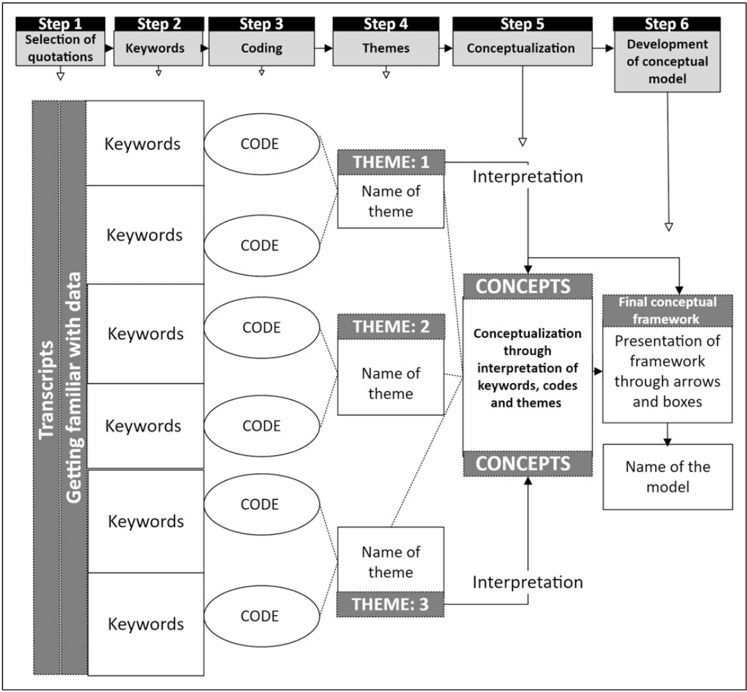
Thematic analysis is a highly popular technique among qualitative researchers for analyzing qualitative data, which usually comprises thick descriptive data. However, the application and use of thematic analysis has also involved complications due to confusion regarding the final outcome’s presentation as a conceptual model. This paper develops a systematic thematic analysis process for creating a conceptual model from qualitative research findings. It explores the adaptability of the proposed process across various research methodologies, including constructivist methodologies, positivist methodologies, grounded theory, and interpretive phenomenology, and justifies their application. The paper distinguishes between inductive and deductive coding approaches and emphasizes the merits of each. It suggests that the derived systematic thematic analysis model is valuable across multiple disciplines, particularly in grounded theory, ethnographic approaches, and narrative approaches, while also being adaptable to more descriptive, positivist-based methodologies. By providing a methodological roadmap, this study enhances the rigor and replicability of thematic analysis and offers a comprehensive strategy for theoretical conceptualization in qualitative research. The contribution of this paper is a systematic six-step thematic analysis process that leads to the development of a conceptual model; each step is described in detail and examples are given.
Verified 2026-11-22 · 1 reference not checked yet
Overview
CoChat Summary
TL;DR
This methodological paper presents a six-step systematic thematic analysis process for developing a conceptual model from qualitative data, illustrated with Naeem and Ozuem’s (2022a) panic-buying study. It introduces 6Rs for keyword selection, 6Rs for coding, and 4Rs for theming to enhance rigor and trustworthiness.
Key findings
- The paper proposes six steps: transcription/familiarization and quotation selection; keyword selection; coding; theme development; conceptualization through interpretation of keywords, codes, and themes; and development of a conceptual model.
- It introduces 6Rs for keyword selection (realness, richness, repetition, rationale, repartee, regal), 6Rs for coding (robust, reflective, resplendent, relevant, radical, righteous), and 4Rs for theming (reciprocal, recognizable, responsive, resourceful).
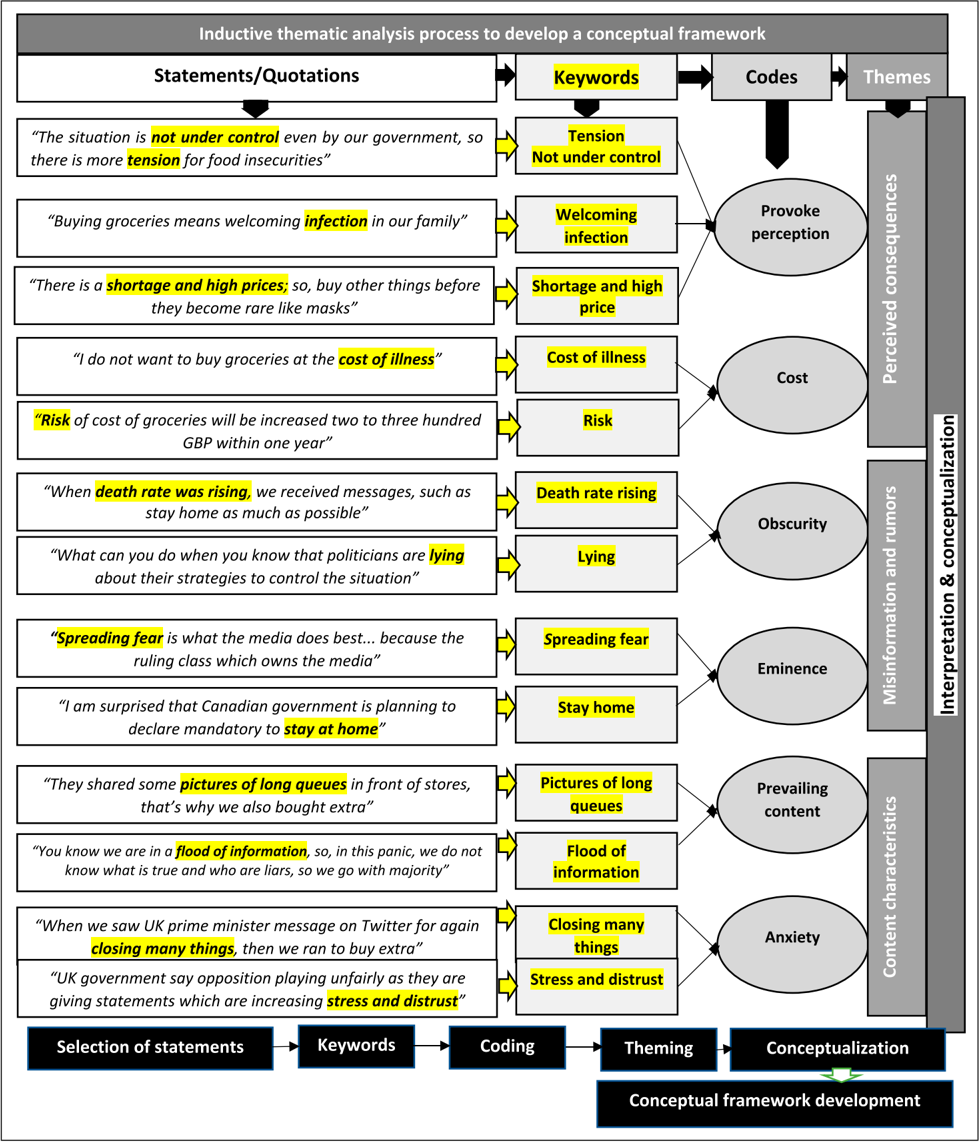
- In the exemplar study, three main themes emerged: “Perceived consequences” from codes “Provoke perception” and “Cost”; “Misinformation and rumors” from codes “Obscurity” and “Eminence”; and “Content Characteristics” from codes “Prevailing content” and “Anxiety.”
- The exemplar’s final model, “Panic buying as social practice,” was based on Protection Motivation Theory (PMT) and the Theory of Rumor Transmission (TORT).
Methods
- Design: a methodological/conceptual paper that presents a comprehensive systematic model for thematic analysis culminating in a conceptual model, using Naeem and Ozuem (2022a) as an exemplar.
- Exemplar data: qualitative data gathered from Twitter, YouTube, and interviews; the exemplar used a six-stage thematic analysis and a social constructionist perspective with PMT and TORT as theoretical foundations.
- Main analysis: the paper describes each of the six steps in detail, provides practical examples from the exemplar, and compares the proposed process with Braun and Clarke’s (2006) six steps of thematic analysis.
Limitations
- The paper states that the potential of the process to address other research contexts or quantitative methods may require further exploration, and that the efficiency of the method compared with other model-building approaches has not been empirically tested.
- Evident from the text: the proposed six-step process and the 6Rs/4Rs are illustrated through a single exemplar study and are not independently validated or empirically compared with alternative thematic analysis approaches.
Model-written summary. Check it against the paper before relying on it.
Integrity signals
Registry
Cites
Statistics
Figures

Verification
Claims the paper makes
0 Valid · 4 Not valid · 56 Not checked · 89 Own results and interpretations
The cited sources that could be checked couldn’t confirm or dispute this claim.
In the paper
“For narrative approaches, conceptual model development focuses on personal experiences, emotions, and life histories (Eldh et al., 2020).”
§ A Step-by-Step Process of Thematic Analysis to Develop a Conceptual Model in Qualitative Research > Step 6: Development of Conceptual Model.
What the sources say
- Could not verifycites Eldh et al., 2020 matched to “Quotations in Qualitative Studies: Reflections on Constituents, Custom, and Purpose” (2020) sourceExperimental — accuracy not yet measured
The Discussion and Conclusions (page numbers unavailable) address how quotations can illustrate qualitative analysis and findings. A search for narrative approaches, conceptual model development, emotions, and life histories found no passage addressing the attributed claim. (LLM, conf=0.72)
plainstates an association- Asserted: passes — The authors put it forward as true.
- Checkable: passes — It can be checked against evidence.
- Load-bearing: unclear — It is unclear whether the paper’s conclusions depend on it.
- Based: passes — The paper gives a reason why it holds.
- Could not verify
In the paper
“The analytical process balances between descriptive analysis, which outlines patterns or trends, and interpretive analysis, which offers subjective perspectives (Miles & Huberman, 1994, p. 56).”
§ A Step-by-Step Process of Thematic Analysis to Develop a Conceptual Model in Qualitative Research > Step 2: Selection of Keywords.
What the sources say
- Not matchedcites Miles & Huberman, 1994, p. 56
An author–year citation the paper’s reference list doesn’t settle. We don’t search these by name.
plain- Asserted: passes — The authors put it forward as true.
- Checkable: passes — It can be checked against evidence.
- Load-bearing: passes — The paper’s conclusions depend on it.
- Based: passes — The paper gives a reason why it holds.
- Not matched
In the paper
“However, the thematic analysis approach could also fit a post-positivist paradigm (Howell, 2012, p. 30).”
§ A Step-by-Step Process of Thematic Analysis to Develop a Conceptual Model in Qualitative Research > Step 2: Selection of Keywords.
What the sources say
- Not matchedcites Howell, 2012, p. 30
An author–year citation the paper’s reference list doesn’t settle. We don’t search these by name.
hedgedstates an association- Asserted: passes — The authors put it forward as true.
- Checkable: passes — It can be checked against evidence.
- Load-bearing: unclear — It is unclear whether the paper’s conclusions depend on it.
- Based: passes — The paper gives a reason why it holds.
- Not matched
In the paper
“Hence, quotation selection is not simply a mechanical task but is influenced by the researcher's philosophical and theoretical approach (Jackson & Mazzei, 2012).”
§ A Step-by-Step Process of Thematic Analysis to Develop a Conceptual Model in Qualitative Research > Step 1: Transcription, Familiarization With the Data, and Selection of Quotations.
What the sources say
- Not matchedcites Jackson & Mazzei, 2012
An author–year citation the paper’s reference list doesn’t settle. We don’t search these by name.
plainstates a cause- Asserted: passes — The authors put it forward as true.
- Checkable: passes — It can be checked against evidence.
- Load-bearing: passes — The paper’s conclusions depend on it.
- Based: passes — The paper gives a reason why it holds.
- Not matched
A conclusion the paper draws from its own results — it cites no other source for it, so there is none to check. The quote shows it is in the paper.
In the paper
“Thus, keywords serve as a critical bridge between data and themes in different methodologies.”
§ A Step-by-Step Process of Thematic Analysis to Develop a Conceptual Model in Qualitative Research > Step 4: Theme Development.
boostedstates an association- Asserted: passes — The authors put it forward as true.
- Checkable: passes — It can be checked against evidence.
- Load-bearing: unclear — It is unclear whether the paper’s conclusions depend on it.
- Based: passes — The paper gives a reason why it holds.
10 more claims
Create a free account to see all 149 claims and every source verdict.
- It may state two separate claims as one. 54
- Probably not a substantial claim. 128
Claims other papers make about this one
Each is checked against this paper’s own text: does it say what the citing paper says it does?
The source backs part of the claim, not all of it — or backs it for a different population, condition or comparison.
In the citing paper
“With the identified keywords, initial coding was further informed by and cross-referenced to the literature on AI ethics and governance, particularly addressing public concerns in government AI, alongside the author team's collective expertise in AI-driven digital transformation in public administration.”
From Accountability in Government Use of AI : Citizen Concerns and Preferences (2025) · cites this paper as Naeem et al. 2023
Experimental — accuracy not yet measuredThe source backs part of the claim, not all of it — or backs it for a different population, condition or comparison.
In the citing paper
“Thematic analysis is a highly popular technique among qualitative researchers for analyzing qualitative data, which usually comprises thick descriptive data (Naeem et al., 2023).”
From The Psycho-Emotive Effects of AI-Generated Fake News on Social Media Users (2026) · cites this paper as Naeem et al., 2023
Experimental — accuracy not yet measuredThe cited source says what the claim attributes to it.
In the citing paper
“The selection of keywords was guided by the 6Rs framework-Realness, Richness, Repetition, Rationale, Repartee, and Regal-to ensure they accurately represented the essence of the data (Naeem et al. 2023).”
From Accountability in Government Use of AI : Citizen Concerns and Preferences (2025) · cites this paper as Naeem et al. 2023
The cited source says what the claim attributes to it.
In the citing paper
“The data were analyzed through Naeem et al.'s (2023) six-step thematic analysis process to develop a conceptual framework (Naeem & Ozuem, 2022).”
From “It’s Not Just About Competition – It’s Ceremony”: Introducing the Embedded Indigeneity Framework for Understanding Identity, Mission, and Practice in TCU and NASNTI Athletics (2026) · cites this paper as Naeem et al. (2023)
The cited source says what the claim attributes to it.
In the citing paper
“The selected methodology was implemented due to the end results that 1) presented a novel conceptual framework and 2) serves as a contextually specific extension of existing theory/theories (Naeem et al., 2023).”
From “It’s Not Just About Competition – It’s Ceremony”: Introducing the Embedded Indigeneity Framework for Understanding Identity, Mission, and Practice in TCU and NASNTI Athletics (2026) · cites this paper as Naeem et al., 2023
Self-check
Percentages, sums and reported differences re-computed from the paper’s own numbers.
Each contradiction between two passages listed here was confirmed by an independent check.
Rated minor: it would not touch a result — a value no result rests on, a p-value that stays on the same side of the significance level, or a conflict that is clerical, resolved elsewhere in the paper, or outside its own findings.
In the paper
§ A Step-by-Step Process of Thematic Analysis to Develop a Conceptual Model in Qualitative Research > Step 6: Development of Conceptual Model.
“Positivism, which favours inductive methods, builds its model on top of previously established theories and conducts its experiments in an unbiased manner.”
§ A Step-by-Step Process of Thematic Analysis to Develop a Conceptual Model in Qualitative Research > Step 6: Development of Conceptual Model.
“An inductive approach is primarily data-driven, whereby themes are derived from the data itself without the influence of pre-existing theories (Braun & Clarke, 2006).”
Citations
Cites
Using thematic analysis in psychology
Braun, V., & Clarke, V. (2006) · Qualitative Research in Psychology · doi:10.1191/1478088706qp063oa · Cited by 194,414
Qualitative Data Analysis: An Expanded Sourcebook
(1994) · Journal of Environmental Psychology · doi:10.1016/s0272-4944(05)80231-2 · Cited by 48,420 · cited 2×
“In the coding process, consideration of keywords helps in multiple ways: The analytical process balances between descriptive analysis, which outlines patterns or trends, and interpretive analysis, which offers subjective perspectives (Miles & Huberman, 1994, p. 56).”
Lincoln, Y. S., Guba, E. G., & Pilotta, J. J. (1985) · International Journal of Intercultural Relations · doi:10.1016/0147-1767(85)90062-8 · Cited by 45,787 · cited 1×
“…degrees of subjectivity and objectivity has underscored the fl exibility intrinsic to research methodologies and highlighted that these tools of analysis are intimately intertwined with, and, indeed, emerge from the distinctive nature of speci fi c disciplines and perspectives (Lincoln & Guba, 1985).”
BackgroundThe Discovery of Grounded Theory: Strategies for Qualitative Research
Glaser, B. G., & Strauss, A. L. (2017) · Aldine (Routledge reprint) · doi:10.4324/9780203793206 · Cited by 25,789
The qualitative content analysis process
Elo, S., & Kyngäs, H. (2008) · Journal of Advanced Nursing · doi:10.1111/j.1365-2648.2007.04569.x · Cited by 22,617 · cited 1×
“Deductive coding, linked with descriptive analysis, is a top-down approach where pre-existing theories, models, or codes guide the data analysis (Elo & Kyng¨as, 2008).”
Method(2009) · Cited by 21,330
Reflecting on reflexive thematic analysis
Braun, V., & Clarke, V. (2019) · Qualitative Research in Sport, Exercise and Health · doi:10.1080/2159676x.2019.1628806 · Cited by 19,677
(1998) · Medical Entomology and Zoology · Cited by 18,397
(2014) · Cited by 15,747
S., N. L. (2017) · doi:10.1177/1609406917733847 · Cited by 14,051 · cited 3×
“· Robust: Coding should convey the true essence of data in a theoretical manner (Nowell et al., 2017).”
Background
Research works printed but not linked: 9
- 1. Arar, K. (2017). The what's and why's of the how to of qualitative research. Qualitative Report, 22(11), 2956-2958.
- 16. Creswell, J. W. (2012). Educational research. Pearson.
- 19. Denzin, N. K., & Salvo, J. (2020). New directions in theorizing qualitative research: Theory as resistance. Myers Education Press.
- 62. Oliver, P. (2021). Using qualitative methods to answer your research question (First). Open University Press.
- 63. Patton, M. Q. (2015). Qualitative research & evaluation methods: Integrating theory and practice (fourth). Sage Publications, Inc. Qualitative research (pp. 273-290). Sage.
- 67. Saldana, J. (2021). The coding manual for qualitative researchers (Fourth). Sage.
- 68. Saldana, J. M. (2016). The coding manual for qualitative researchers (4rd ed.). Sage Publications.
- 74. Seale, C. (2013). Qualitative research practice. In C. Seale, G. Gobo, J. Gubrium, & D. Silverman (Eds.), Concise paperback. Sage.
- 80. Tracy, S. J. (2019). Qualitative research methods: Collecting evi- dence, crafting analysis, communicating impact (2nd ed.). Wiley Blackwell.
Cited by
Items 801–900 of 2,204
Screens and Preschool Children: A Qualitative Exploration of Parental Experiences
Orfanidou, M., Theodosiadou, S., & Koliouli, F. (2025) · Children & Society · doi:10.1111/chso.12994 · Cited by 3
Aguilar, D. Y., Osman, F., Yeh, H.-H. E., & Ghahari, S. (2025) · Journal of Immigrant and Minority Health · doi:10.1007/s10903-025-01757-z · Cited by 1
Ngwenya, M. W., Muthelo, L., Rasweswe, M. M., & Mothiba, T. M. (2025) · Healthcare · doi:10.3390/healthcare13091047 · Cited by 2
“The authors followed the analytical process suggested by Naeem et al. [23].”
Cheng, T., Tseng, T.-H., Chen, C.-W., & Lin, C. (2025) · Urban Policy and Research · doi:10.1080/08111146.2025.2472056 · Cited by 1
Bordoh, A. (2025) · Frontiers in Education · doi:10.3389/feduc.2025.1560679 · Cited by 1
Szécsi, T., Rodriguez-Meehan, M., Essary, J. N., Hanhimäki, E., Ahtiainen, R., Dall’Asta, J. C., Fernandez, I., & Fonsén, E. (2025) · Journal of Childhood Education & Society · doi:10.37291/2717638x.202562620 · Cited by 3
C, A. M., & Alam, I. (2026) · Journal of Human Rights and Social Work · doi:10.1007/s41134-026-00468-1 · Cited by 1
Generative AI in Academia: How Engineering Students Perceive and Approach Ethical Challenges?
Hariyanto, D., Rafiq, A. A., Triyono, M. B., Murniati, D. E., Adinda, D., & Prihandini, T. F. (2026) · International Journal of Online and Biomedical Engineering (iJOE) · doi:10.3991/ijoe.v22i02.59281 · Cited by 2
The potential of place-based occupational therapy to support aging-in-place: A qualitative study
Cheong, F. W. F., & Yu, C. C. (2025) · Hong Kong Journal of Occupational Therapy · doi:10.1177/15691861251356633 · Cited by 1
“Thematic analysis (Naeem et al., 2023) was used to identify recurring themes and sub-themes.”
Combining Play and Pedagogy: A Market Study on an Interactive, Buildable Educational Kit
Melchor, B. T., Ceballos, G., Jaquias, A. A. P., Santiago, J. A., Untalan, E. T., & Tenerife, J. T. (2025) · International Conference on Engineering and Emerging Technologies (ICEET) · doi:10.1109/iceet67911.2025.11423926 · Cited by 1
Nevi, G., Bartoloni, S., Pascucci, F., & Dezi, L. (2026) · IEEE Transactions on Engineering Management · doi:10.1109/tem.2026.3677052 · Cited by 3
“The identified subthemes were subsequently aligned with specific main themes grounded in the DC perspective, leading to further discussions within the research team to achieve consensus [53].”
Kuralbayeva, А., Pilten, G., Tasova, A., et al. (2025) · Frontiers in Education · doi:10.3389/feduc.2025.1654562 · Cited by 1
Obstetric Violence From the Perspectives of Midwife Leaders in Hospitals in Nigeria
Olajide, A. O., Oyebamiji, R. T., & Oyedeji, O. Y. (2025) · Nursing for Women s Health · doi:10.1016/j.nwh.2024.09.001 · Cited by 2
Rais, H., Kersapati, M. I., Farid, M. R. A., et al. (2026) · Ethnobiology and Conservation · doi:10.15451/ec2026-02-15-04-1-27 · Cited by 1
“Once the recordings were transcribed, thematic analysis was performed following the systematic six-step process outlined by Naeem et al. (2023) to ensure rigor and conceptual clarity.”
Integrating co-management in black soil conservation: Stakeholders' perspectives in Baiquan, China
Cai, Z., Li, S., Du, G., & Li, Y. (2025) · Land Use Policy · doi:10.1016/j.landusepol.2025.107809 · Cited by 4
Knight, S., & Vitoroulis, I. (2025) · Journal of Black Studies · doi:10.1177/00219347251393530 · Cited by 1
“Thematic analysis is a versatile method that can be applied to both deductive and inductive coding, and can extract themes that provide deeper insights into participants’ lived experiences (Naeem et al., 2023).”
Oyshi, F. H., Czelusniak, E., Ahmed, R., Verweij, N. M., Arefeen, A., Abrams, A. L., Carden, K., & Carrasquillo, M. E. (2025) · Urban forestry & urban greening · doi:10.1016/j.ufug.2025.128721 · Cited by 4
Hurst, T. E., Brazeal, M., & Hogan, K. A. (2024) · Journal of Social Service Research · doi:10.1080/01488376.2024.2383266 · Cited by 1
“The researchers reviewed the participants’ responses using inductive thematic analysis (Naeem et al., 2023).”
Analisis Faktor-Faktor yang Mempengaruhi Intensitas Bermain Game Roblox pada Remaja
Fajarwati, A., Rahmania, G., Putri, K., Abdurrahman, N., Ardana, T. D., Adinda, Y. P., & Yasmin, M. (2026) · Jurnal Psikologi · doi:10.47134/pjp.v3i3.5701 · Cited by 1
Insights on wellbeing and society from a Taulasea/traditional healer perspective
Firestone, R. T., Hitti, P., Latu, L., et al. (2025) · Kōtuitui New Zealand Journal of Social Sciences Online · doi:10.1080/1177083x.2025.2514832 · Cited by 1
“The six-step strategy included a systematic approach to interpretation of keywords, codes, and themes to conceptualise the keywords, codes and themes (through re-interpretation) that leads to the final presentation of conceptual framework (Naeem et al. 2023).”
InfluentialSingle Mothers by Choice of Children With Disabilities
Greenbank, A. (2025) · Child Care Health and Development · doi:10.1111/cch.70177 · Cited by 1
Uncovering the Teamwork Competencies for Multi-Team Systems Operating in Extreme Environments
Berger, L., Khalid, M., & Salas, E. (2025) · Small Group Research · doi:10.1177/10464964251384643 · Cited by 2
“These quotes were used directly to inform the development of the conceptual framework (Naeem et al., 2023).”
Ajibade, B. O. (2026) · Human Resource Development International · doi:10.1080/13678868.2026.2678810 · Cited by 2
Knowledge of Remote Medication Abortion Among Patients Traveling From States That Restrict Abortion
Fiastro, A. E., Brown, E. M., Mena‐Meléndez, L., Kvitek, V. L., Fredman, S., Stoa, M., Norman, W. V., Munro, S. B., & Godfrey, E. M. (2026) · JAMA Network Open · doi:10.1001/jamanetworkopen.2026.26444 · Cited by 2
A bibliometric analysis of quality and food safety management in the food development industry
Zhu, B., Talib, H. H. A., & Hamamurad, Q. H. (2024) · Journal of Infrastructure Policy and Development · doi:10.24294/jipd.v8i8.5776 · Cited by 4
“Use qualitative content or grounded theory for comprehensive thematic analysis (Naeem et al., 2023).”
MethodMansor, S. G., Elgamal, R., Saleh, M. F. M., Othman, A. A. A., & Nawar, S. M. (2026) · Discover Oncology · doi:10.1007/s12672-026-05009-w · Cited by 2
“This method aligns with established frameworks for translational research, where integrating bench-to-bedside findings requires synthesis across biological and clinical domains [25].”
Indigenous Peoples’ knowledge systems and practices for climate survival
Sangat, S. S., Cerda, J., Pastor, C., Tabangay, J., Toirai, E., & Goldstein, A. (2026) · Humanities and Social Sciences Communications · doi:10.1057/s41599-026-07434-2 · Cited by 4
“The expert responses were analyzed using an inductive thematic approach (Fereday and Muir-Cochrane, 2006; Burnard et al., 2008; Naeem et al., 2023), which involves pattern recognition within the data to identify core themes.”
Liang, L., Chen, P., Zhang, M., & Guo, Z. (2025) · Scientific Reports · doi:10.1038/s41598-025-08292-9 · Cited by 1
“Grounded theory (GT), as a qualitative research method, primarily involves exploring and inductively analyzing a specific issue or phenomenon 32 .”
Delaye, M., Poloméni, A., Faiderbe, S., Berlioz, N., Benssekoum, C., Guillemin, A., Pudlarz, T., & de Montgolfier, S. (2024) · Health Expectations · doi:10.1111/hex.14146 · Cited by 2
Mohlaloka, S. M. B., & Ntlhare, L. A. (2024) · E-Journal of Religious and Theological Studies · doi:10.38159/erats.202410112 · Cited by 1
Qualitative Methodology Selection: Key Considerations for Dissertation Scholars
Asrifan, A., Pratiwi, W. R., Bahri, A., Jabu, B., Rossydi, A., & Mulyadi, M. (2024) · Advances in library and information science (ALIS) book series · doi:10.4018/979-8-3693-3069-2.ch002 · Cited by 2
Laranjeira, C., Marques, A., Fernandes, A. F. C., Domingos, M. A. F., & Moreira, I. (2025) · Nursing Reports · doi:10.3390/nursrep15100366 · Cited by 2
“Braun and Clarke’s [42,43] six phases were followed: Phase 1 (Familiarization with data), the complete transcribed data corpus was meticulously read and re-read with an inquisitive mindset and a writing instrument in hand to achieve a comprehensive grasp of the entire material; Phase 2 (Code…”
Effect of psychical environment on experience design and management
Chan, I. C. C., Chen, Z., Zhao, X., & Law, R. (2026) · International Journal of Contemporary Hospitality Management · doi:10.1108/ijchm-08-2025-1152 · Cited by 2
The big six model of AI trust: a unifying framework and 20-item scale for knowledge creation
Dickens, J. M., Uvet, H., Bauman, A., & Kwon, H. Y. (2026) · Journal of Knowledge Management · doi:10.1108/jkm-02-2025-0222 · Cited by 2
Leadership in elite football academy management teams
White, P., Wood, S., Parnell, D., & Batey, M. (2026) · Managing Sport and Leisure · doi:10.1080/23750472.2025.2576517 · Cited by 2
Hoy, K. I., Jones, S. J., Davis, R. E., Blake, C., & Burke, M. (2026) · Journal of School Health · doi:10.1111/josh.70151 · Cited by 1
“The research team used a general inductive approach to capture emergent themes that may have been otherwise overlooked with an a priori codebook [31].”
A qualitative study of male school leaders’ work–family conflict: Experiences and coping strategies
Kabesa, R., & Berkovich, I. (2025) · Educational Management Administration & Leadership · doi:10.1177/17411432251342543 · Cited by 1
“We used thematic analysis, a technique for fi nding, examining and summarising patterns and themes in data, to examine the transcripts (Naeem et al., 2023).”
Jahanbakhsh, E. (2026) · Social Sciences & Humanities Open · doi:10.1016/j.ssaho.2026.102795 · Cited by 6
Lin-Stephens, S., Tse, N. M. K., Manuguerra, M., Hernan, G., Alavi, A., Branford, A., Russell, L., Leon, L. C., Barkatsas, T., & O’Rourke, M. (2025) · Journal of Higher Education Policy and Management · doi:10.1080/1360080x.2025.2577494 · Cited by 3
“The discussions and reflections focusing on regenerative aspects of the experience were thematically analysed and coded by four co-authors (Braun & Clarke, 2006; Naeem et al., 2023).”
The Moderating Role of Corporate Governance in Financial Risk and Cost of Goods Sold
SAMUR, M. (2024) · Journal Of Organizational Behavior Research · doi:10.51847/fgjmx9oebd · Cited by 7
Kurnaz, A. (2025) · Conservation and Management of Archaeological Sites · doi:10.1080/13505033.2025.2592050 · Cited by 1
“This method allows for identifying recurring themes among participants’ views and relating these themes to broader theoretical frameworks (Naeem et al. 2023).”
Blasco, N. T., Torres-Marrero, S. D., Lahongrais-Lamboy, A. D., Rivera-Torres, N., Rosario-Ramos, L., & Argüelles-Berrios, C. (2025) · BMC Health Services Research · doi:10.1186/s12913-025-13794-3 · Cited by 1
“This approach ensured that the analysis aligned with the study’s objectives while allowing for systematic exploration of each domain [28].”
Corrêa, V. S., Capeli, C. M. D., & Nassif, V. M. J. (2026) · International Journal of Gender and Entrepreneurship · doi:10.1108/ijge-04-2025-0140 · Cited by 1
Sharman, N. (2025) · AMBIO · doi:10.1007/s13280-025-02293-8 · Cited by 5
“For the first round, the reporting template’s sub-questions functioned as a reference point, before sub-categories were developed (Schebesta 2018; Saldanˇa 2021; Naeem et al. 2023).”
Rajendran, V., Bursey, S., Liddard, C., Zeman, L., & Singh, R. (2026) · Journal of Patient Experience · doi:10.1177/23743735251408775 · Cited by 1
COVID for One: Identifying Obstacles to Self-Management of COVID-19 for Single Adults
Treiber, L. A., Emerson, C., & Shackleford, J. L. (2024) · Journal of Patient Experience · doi:10.1177/23743735241302742 · Cited by 2
Meera, S., & Vinodan, A. (2025) · International Journal of Event and Festival Management · doi:10.1108/ijefm-02-2025-0026 · Cited by 4
Determinants of success for women entrepreneurs: an exploratory study in the Tunisian context
Zamit, I., Hassine, A. L.-B., & Lakhal, L. (2026) · International journal of organizational analysis · doi:10.1108/ijoa-06-2025-5591 · Cited by 1
Hussain, M. (2025) · Journal of Islamic Finance and Economic Studies · doi:10.64268/jifes.v1i2.64 · Cited by 1
“For qualitative data, thematic analysis follows the six-phase framework of (Naeem et al., 2023; Rosen et al., 2023), beginning with familiarization and coding before developing, reviewing, and refining analytical themes.”
Dilber, C., & Yoşumaz, İ. (2026) · Journal of Academic Ethics · doi:10.1007/s10805-025-09681-5 · Cited by 1
de Lima, E. S., Potter, K., Preece, C., Rehill, N., Bulmer, S., Allen, K., March, A., Hobbs, T., & Fonagy, P. (2024) · Research Square · doi:10.21203/rs.3.rs-4901621/v1 · Cited by 2
Silva, J. C. K., Soliani, R. D., Ferreira-Júnior, G. C., Lovrić, N., & Lobão, M. S. P. (2025) · Gestão & Produção · doi:10.1590/1806-9649-2025v32e14724 · Cited by 8
Understanding the Behavior of Older Adults’ Social Media Platform-Swinging in the Philippines
Gallardo, M. O., Suarez, M. T., & Ebardo, R. A. (2024) · Lecture notes in computer science · doi:10.1007/978-3-031-61543-6_24 · Cited by 5
Elements of Effective Public Policy: Evidence From Odisha Millets Mission, India
Islam, M. S., & Nathan, H. S. K. (2025) · Review of Policy Research · doi:10.1111/ropr.70035 · Cited by 4
Gandhi, D. B. C., Mascarenhas, R., Vijayanand, P. J., Fernandez, C. J., Montanaro, V. V. A., Kamalakannan, S., Solomon, J. M., Urimubenshi, G., Ngeh, E. N., Sebastian, I. A., et al. (2025) · Scientific Reports · doi:10.1038/s41598-025-16738-3 · Cited by 2
Smith, K., Cruz, D., & Langford, A. (2025) · Agriculture and Human Values · doi:10.1007/s10460-025-10708-1 · Cited by 3
“…mindsets about financial risk in the context of scaling-up (open codes), grouping into patterns (themes), interpreting themes in light of existing theory (i.e. solidarity economy) and developing a new conceptual model (i.e. about ‘citizen-financiers’, solidarity and democracy) (Naeem et al. 2023).”
Veler-Poleg, N., Wiseman, H., Iwakabe, S., & Zilcha‐Mano, S. (2025) · Counselling Psychology Quarterly · doi:10.1080/09515070.2025.2580276 · Cited by 20
Navigating sports nutrition: athlete and coach experiences from a 16-week personalized intervention
Weerasinghe, K., Jayawardena, R., Palangasinghe, R., & Hills, A. P. (2025) · Nutrition & Metabolism · doi:10.1186/s12986-025-00941-0 · Cited by 4
“The analysis followed the structured approach outlined by Naeem et al. [22], beginning with data familiarization through repeated readings of interview transcripts by the research team (RJ, KW, and RP).”
White Participants’ Perceptions of Implicit Bias Interventions in U.S. Courts
Lawrence, M., Gittings, K. L., Thomas, S. N., Eerdmans, R. E., Hans, V. P., Campbell, J. E., & Salerno, J. M. (2025) · Behavioral Sciences · doi:10.3390/bs15091269 · Cited by 1
“We conducted a thematic content analysis following our data collection (Naeem et al., 2023) to explore patterns in participants’ responses to the two open-ended questions.”
Dhas, B. N., Brown, T., Devers, J., Murrill, R., Devecchi, C., & Sriram, V. (2026) · British Journal of Occupational Therapy · doi:10.1177/03080226261427207 · Cited by 1
HIV self-testing lived experiences of female sex workers in the Garden City, Southern Nigeria
Anyiam, F. E., Sibiya, M. N., & Oladimeji, O. (2025) · Women s Health · doi:10.1177/17455057251385803 · Cited by 1
Healing collective trauma through the arts: A predominantly online, multimodal trial in Ukraine
Teslenko, M., Шевчук, В., & Клевака, Л. (2026) · European Journal of Trauma & Dissociation · doi:10.1016/j.ejtd.2026.100635 · Cited by 1
Donner, M., Guimond, D., Lagendijk, E., Mamès, M., Baker, A., & de Vries, H. (2026) · Sustainable Development · doi:10.1002/sd.70930 · Cited by 1
Yati, P. P., & Walawalkar, A. M. (2024) · Advances in information security, privacy, and ethics book series · doi:10.4018/979-8-3693-5330-1.ch014 · Cited by 2
Faculty Perspectives on Web Learning Apps and Mobile Devices on Student Engagement
Coelhoso, P., & Kalogeras, S. (2024) · Journal of Information Technology Education Innovations in Practice · doi:10.28945/5272 · Cited by 8
“Thematic analysis is a popular technique for analyzing qualitative data that involves looking for patterns in the meaning of the data to find themes (Naeem et al., 2023).”
MethodLatino College Men’s Perceptions of Sexual Health Terms
Perez, J. S. C., Stephens, D. P., Spiker, R., Long, K. L., & Raja, K. (2025) · تاج. · doi:10.61186/shp.2025.2044626.1034 · Cited by 1
Porykali, B., Passi, G., Rangan, A., et al. (2025) · Nutrition & Dietetics · doi:10.1111/1747-0080.70026 · Cited by 1
Media coverage of climate change in Jordan: Reflections on politics, economics and climate science
Poberezhskaya, M., El‐Anis, I., & Mustafa, M. (2026) · Mediterranean Politics · doi:10.1080/13629395.2026.2646720 · Cited by 1
han, Y., & Ormond, K. E. (2025) · Orphanet Journal of Rare Diseases · doi:10.1186/s13023-025-04038-y · Cited by 1
“Coding and data analysis followed a thematic analysis approach in parallel to data collection [17].”
Rebhi, A. M. (2025) · Qualitative Research in Medicine & Healthcare · doi:10.4081/qrmh.2024.12641 · Cited by 1
“This study employs a method of inductive thematic analysis (Naeem et al., 2023).”
Spatial planning legacies and unauthorized land occupations in South Africa’s urban peripheries
Matamanda, A. R., Matooane, L. S., Bhanye, J. I., et al. (2026) · Planning Perspectives · doi:10.1080/02665433.2026.2615139 · Cited by 1
Diyoka, C. K., Chuy, K. D., Saidi, A. S., Mukanga, P. P., Omba, I. K., & Nkola, A. M. (2026) · Research Square · doi:10.21203/rs.3.rs-10651748/v1 · Cited by 1
Bartlett, R., Gresse, W., & Keyser, E. (2026) · African Journal of Employee Relations · doi:10.25159/2664-3731/19204 · Cited by 1
Circular economy as governmentality and postcolonial discourse in Indonesian telecom companies
Wirajaya, I. G. A., Sukadarmika, G., Widhiyani, N. L. S., Ardiana, P. A., Yanthi, K. D. L., Arsani, N. K. B., & Dewi, A. A. K. (2025) · Journal of Cleaner Production · doi:10.1016/j.jclepro.2025.147432 · Cited by 3
Matenga, T. F. L., Herce, M. E., Corbin, J. H., Zulu, J. M., Mwila, C., Mandyata, C., Frimpong, C., Siame, M., Shankalala, P., Nachalwe, N., et al. (2026) · PLOS Global Public Health · doi:10.1371/journal.pgph.0005879 · Cited by 1
“Workshop discussions were recorded and transcribed into Microsoft Word documents, we conducted a rapid four-step thematic analysis using summary tables, matrices, and affinity maps to systematically identify patterns and key themes across the data [23].”
Sinoy, B., Suay, J., Onsabia, M., & Tuba, J. (2025) · Psychology and Education A Multidisciplinary Journal · doi:10.70838/pemj.480409 · Cited by 1
A systematic mixed studies review of decent work literature: implications for research and policy
Andoh, R. P. K., Amankwaa, A., & Ayentimi, D. T. (2026) · Personnel Review · doi:10.1108/pr-07-2025-0812 · Cited by 3
Ababneh, A., Alrida, N. A., Ababneh, A., Eid, H. M., Tailakh, S. N., & Al-Zu'bi, B. M. (2025) · BMJ Open · doi:10.1136/bmjopen-2024-096756 · Cited by 1
Ryan, E., McDonnell, D., Healy, S., Lloyd, R. S., & Kinsella, S. (2026) · Autism · doi:10.1177/13623613261448516 · Cited by 1
“This approach allowed for themes and ideas to emerge naturally from the data and ensured that the content for subsequent rounds was grounded in the participants’ personal experiences and expertise (Fereday & Muir-Cochrane, 2006; Naeem et al., 2023).”
A typology of gender-based needs
Rothermel, A.-K., Nerino, V., Zhang, M., Bias, L., & Amacker, M. (2025) · Frontiers in Political Science · doi:10.3389/fpos.2025.1579061 · Cited by 2
Malinina, I. A. (2024) · Human Arenas · doi:10.1007/s42087-024-00448-9 · Cited by 3
“After the data were collected and transcribed, the “systematic thematic analysis” (Braun and Clark, 2006; Naeem et al., 2023) was applied with six steps: transcription, familiarization with the data, and selection of quotations; selection of keywords; coding; theme development; conceptualization…”
Lappeman, J., Mathebula, A., Brien, J., & Jay, S. (2024) · Journal of Cross-Cultural Psychology · doi:10.1177/00220221241286448 · Cited by 6
“The data from the interviews were analyzed thematically, drawing on a systematic six-step the-matic-analysis process (Braun & Clarke, 2019; Saldaña, 2021), with the purpose of developing a conceptual model that would be helpful practically and to build on for future research (Naeem et al., 2023).”
Witzel, B. S., Myers, J. A., & Mims, P. J. (2026) · Exceptional Children · doi:10.1177/00144029251413482 · Cited by 1
“Our approach followed a primarily deductive process, grounded in prior research and conceptual models (Naeem et al., 2023), and aimed to identify consistent themes across state policy documents.”
Chimukuche, R. S., Magongo, M., Shandu, Q., Bassett, I. V., Ndung’u, T., & Seeley, J. (2025) · AIDS Research and Therapy · doi:10.1186/s12981-025-00806-9 · Cited by 2
“The data analysis was conducted using a thematic approach [28].”
Utami, Y. P., Rinawan, F. R., Sari, P., Mutyara, K., & Herawati, D. M. (2026) · Journal of Multidisciplinary Healthcare · doi:10.2147/jmdh.s583785 · Cited by 5
“The interview transcripts and document notes were analyzed using the systematic thematic analysis approach proposed by Naeem et al. 27 This structured, six-step process involved transcription, keyword identification, coding, theme development, conceptualization, and model construction.”
Yunita, S., Susilawati, S., Darwis, R., & Ramadhan, A. (2025) · Jurnal Paedagogy · doi:10.33394/jp.v12i1.13363 · Cited by 4
Deriba, F. G., Saqr, M., & Tukiainen, M. (2026) · Interactive Learning Environments · doi:10.1080/10494820.2026.2647973 · Cited by 3
A phenomenological exploration of registered nurse degree apprentices' lived experiences
Clarke, F. (2025) · British Journal of Nursing · doi:10.12968/bjon.2024.0408 · Cited by 1
"I'll pay half the cost, for the loft" -- From Searching to Agreeing on Group Property Rentals
Garcia, J. E., Mannino, M., & Abouzied, A. (2024) · ACM Conference on Computer Supported Cooperative Work (CSCW) · doi:10.1145/3678884.3681908 · Cited by 1
Francis, N., Blundell-Birtill, P., Davies, M. W., Fall, L., Hartley, P., James, R., Rutherford, S., & Tree, D. (2026) · Assessment & Evaluation in Higher Education · doi:10.1080/02602938.2026.2724543 · Cited by 1
Viswanathan, H., Raghav, P. R., Sharma, P. P., Baskaran, P., Maheshwari, M., Aswathy, S. R., Gupta, M., & Mehrara, V. (2026) · Frontiers in Public Health · doi:10.3389/fpubh.2026.1744878 · Cited by 1
“This structured, sequential process enhances the rigor and trustworthiness of the themes developed from the collected qualitative data (13, 15).”
Yessenbekova, K., & Hajar, A. (2026) · Qualitative Research in Psychology · doi:10.1080/14780887.2026.2703494 · Cited by 1
Gemara, N. (2025) · Journal of Technology in Human Services · doi:10.1080/15228835.2025.2525779 · Cited by 1
“It provides a rigorous yet flexible approach to uncovering insights that would otherwise remain hidden (Naeem et al., 2023).”
Charting child agency in home language maintenance: Perspectives from Polish-Australian families
Romanowski, P. (2025) · Bilingual Research Journal · doi:10.1080/15235882.2025.2483538 · Cited by 1
“…track how participants adapt their language use based on the context and roles, shedding light on the intricate and complex mechanisms shaping social interactions, reflecting family members’ identities and highlighting the dynamic nature of the relationships among individuals (Naeem et al., 2023).”
Hassan, M., Cerruti, C., & Gusmerotti, N. M. (2026) · Management of Environmental Quality An International Journal · doi:10.1108/meq-07-2025-0516 · Cited by 3
Arzeman, A., Haines, J., Pritchard, C., Rutherford, S., & Francis, N. (2025) · FEBS Open Bio · doi:10.1002/2211-5463.70151 · Cited by 10
“The final prompt used for Claude.ai is provided in Appendix S3.”
Usability evaluation of a mobile mental health app for depression and anxiety self-care in Ethiopia
Guracho, Y. D., Thomas, S. J., & Win, K. T. (2025) · Discover Mental Health · doi:10.1007/s44192-025-00315-1 · Cited by 1
“Finally, Braun and Clarke’s six-step framework is producing a well-structured report highlighting the key findings from the transcription [42] (see Fig.”
InfluentialFrom Policy to Practice: A Delphi Protocol on Life Projects for Autistic Adults
Ferrazzi, G., Micai, M., Fulceri, F., Pingani, L., Ghirotto, L., Scattoni, M. L., & Galeazzi, G. M. (2025) · International Journal of Qualitative Methods · doi:10.1177/16094069251357766 · Cited by 1
“It involves carefully reading the material to extract meaning and understand different subjects and interpretations (Naeem et al., 2023).”
Mansour, M., Hammad, S. S., Al‐Anati, A., & Alkhowiter, L. K. (2025) · Journal of Nursing Management · doi:10.1155/jonm/6671562 · Cited by 3
“Such a systematic approach to data analysis consolidates consistency and replicability of the fndings and captures the connections between the data, interpretation, and conclusions [31].”
Mweemba, N., & Kalusa, L. (2026) · African Journal of Commercial Studies · doi:10.59413/ajocs/v7.i2.9 · Cited by 1
“Qualitative data analysis involved the application of thematic analysis, which is a six-step process according to Naeem et al. (2023).”
Metadata
- Authors
- Naeem, M., Ozuem, W., Howell, K., & Ranfagni, S.
- Affiliations
- University of Gloucestershire (GB)
- University of Cumbria (GB)
- Northumbria University (GB)
- University of Florence (IT)
- Corresponding author
- Naeem, Muhammad
- Venue
- International Journal of Qualitative Methods
- Publisher
- SAGE Publications
- Published
- 2023-10
- Volume
- 22
- ISSN
- 1609-4069 (ISSN-L)
- OpenAlex
- W4388503650
- Cited by
- 2,243
- References
- 71
- Citations by year
- 2026: 1000 · 2025: 981 · 2024: 258 · 2023: 4
- FWCI
- 1654.78
- Type
- journal article
- Language
- en
- Open access
- gold
- doi.org
- Licence
- Locations
- International Journal of Qualitative Methods (publishedVersion, cc-by-nc)
- Insight (University of Cumbria) (acceptedVersion)
- DOAJ (DOAJ: Directory of Open Access Journals) (submittedVersion, cc-by-sa)
- Florence Research (University of Florence) (submittedVersion)
- Topics
- Social Sciences › Education › Qualitative Research Methods and Applications
- Social Sciences › Sociology and Political Science › Qualitative Research Methods and Ethics
- Social Sciences › General Social Sciences › Computational and Text Analysis Methods
- Keywords
- thematic analysis, conceptual modeling, qualitative data analysis, inductive coding, deductive coding, grounded theory, interpretive phenomenology, constructivist research, positivist research, theoretical conceptualization, replicability
About these checks
Registry, retraction, Cites and statistics results are computed, not judged, with one exception: a printed reference that no index lists is read once by a model before it counts as a citation error. Claims are extracted by a model and kept only when their quote appears verbatim in the text; each cited source is then checked, with a model’s help, for whether it says what the claim relies on. Those verdicts can be wrong — read the claim’s quote and the cited source before relying on one.
The claim verdicts this report counts are experimental: their accuracy is not yet measured.
A language model drew the claims from the paper on 2026-10-10, under version 3 of the claim definition (model deepseek-v4.1-flash, prompt extract-v3).
A second model labelled each claim on 2026-10-10 (model jev-1.13-20260917, definition revision gold-guideline-v0.2).
Cited sources are checked with a language model’s help (gpt-6-sol).
Statistics and arithmetic are recomputed, not judged.
Confidence bands are shown only for fields calibrated on our annotated test set. None is calibrated yet, so no band is shown.
What counts as a claim ›How we measure confidence ›How we check this ›
Are you an author, or do you see a problem with this page? Request a review
Data sources
Bibliographic data: Semantic Scholar, OpenAlex, Crossref.
Contains information from the Semantic Scholar Academic Graph Datasets, made available under the ODC Attribution License (ODC-BY 1.0).
Semantic Scholar’s data is described in: Kinney, R., et al. (2023). The Semantic Scholar Open Data Platform. arXiv:2301.10140.
