

What is data justice? The case for connecting digital rights and freedoms globally
Open accessThe DOI matches its Crossref record; 38 of the 41 references it cites were found in a registry or an index, and 3 are not checked yet.
Abstract
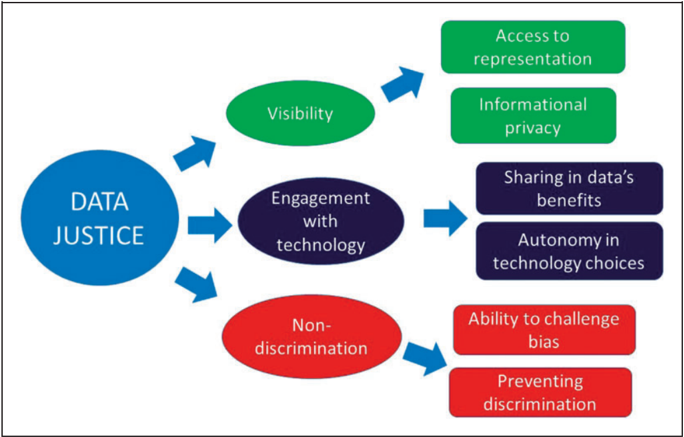
The increasing availability of digital data reflecting economic and human development, and in particular the availability of data emitted as a by-product of people’s use of technological devices and services, has both political and practical implications for the way people are seen and treated by the state and by the private sector. Yet the data revolution is so far primarily a technical one: the power of data to sort, categorise and intervene has not yet been explicitly connected to a social justice agenda by the agencies and authorities involved. Meanwhile, although data-driven discrimination is advancing at a similar pace to data processing technologies, awareness and mechanisms for combating it are not. This paper posits that just as an idea of justice is needed in order to establish the rule of law, an idea of data justice – fairness in the way people are made visible, represented and treated as a result of their production of digital data – is necessary to determine ethical paths through a datafying world. Bringing together the emerging scholarly perspectives on this topic, I propose three pillars as the basis of a notion of international data justice: (in)visibility, (dis)engagement with technology and antidiscrimination. These pillars integrate positive with negative rights and freedoms, and by doing so challenge both the basis of current data protection regulations and the growing assumption that being visible through the data we emit is part of the contemporary social contract.
Overview
The claims and statistics of this paper haven’t been checked yet.
Free: it reads the open-access text and checks the first 5 claims that cite a source we can check. Create a free account to check every claim.
Integrity signals
Registry
Cites
Statistics
Figures

Verification
Claims the paper makes
The claims and statistics of this paper haven’t been checked yet.
Free: it reads the open-access text and checks the first 5 claims that cite a source we can check. Create a free account to check every claim.
Claims other papers make about this one
Each is checked against this paper’s own text: does it say what the citing paper says it does?
The cited source says what the claim attributes to it.
In the citing paper
“It stresses the importance of developing individual freedoms in relation to how data are used and collected and advocates for enhanced autonomy and agency: people should be able to decide whether they want to participate in this system.”
From Staring Back at the Surveillance Gaze: The Resistance of LGBTQ+ Users on Social Media (2026) · cites this paper as Taylor 2017
The cited source says what the claim attributes to it.
In the citing paper
“Data justice frameworks are particularly invested in understanding the impacts, both negative and positive, of datafication and identifying ways to address them.”
From Staring Back at the Surveillance Gaze: The Resistance of LGBTQ+ Users on Social Media (2026) · cites this paper as Taylor 2017
The check wasn’t confident either way, so it gives no verdict — never disputed.
In the citing paper
“Because of this, the topic of data quality is beginning to transcend beyond the field of data management and into the realm of Human Computer Interaction (HCI), which accommodates holistic considerations such as how people search for relevant datasets [42], how developers perceive data work [64] and the best ways of using crowdsourcing to generate, evaluate or label data [71].”
From A Survey of Data Quality Requirements That Matter in ML Development Pipelines (2023) · cites this paper as [71]
Experimental — accuracy not yet measuredIn the citing paper
“Linnet Taylor (2017) advocates for a data justice framework acknowledging that, while there is a rapid development of data processing technologies, there is a lack of considerations of how datafication plays into broader social justice issues.”
From Staring Back at the Surveillance Gaze: The Resistance of LGBTQ+ Users on Social Media (2026) · cites this paper as Taylor 2017
In the citing paper
“For Taylor (2017), data justice revolves around three pillars: visibility, digital (dis)engagement, and countering data-driven discrimination.”
From Staring Back at the Surveillance Gaze: The Resistance of LGBTQ+ Users on Social Media (2026) · cites this paper as Taylor 2017
Self-check
Percentages, sums and reported differences re-computed from the paper’s own numbers.
The self-check needs the paper’s full text.
Citations
Cites
Clapp, J., & Sen, A. (1999) · International Journal Canada s Journal of Global Policy Analysis · doi:10.1177/002070200005500119 · Cited by 13,507
Clapp, J., & Sen, A. (1999) · International Journal · doi:10.2307/40203469 · Cited by 13,411
Sorting Things Out: Classification and Its Consequences
Bowker, G. C., & Star, S. L. (1999) · doi:10.7551/mitpress/6352.001.0001 · Cited by 6,188
(1993) · Oxford University Press eBooks · doi:10.1093/0198287976.001.0001 · Cited by 4,239
Toward a Field of Intersectionality Studies: Theory, Applications, and Praxis
Cho, S., Crenshaw, K. W., & McCall, L. (2013) · Signs: Journal of Women in Culture and Society · doi:10.1086/669608 · Cited by 4,126 · cited 2×
“This intersectionality (Cho et al., 2013) in the effects of datafication is an important component of the argument for a social justice perspective.”
BackgroundDoyle, T. (2017) · The Information Society · doi:10.1080/01972243.2017.1354593 · Cited by 3,071 · cited 3×
“O’Neil (2016) has warned that algorithmic models must be constantly recalibrated using feedback from the events they are supposed to predict.”
BackgroundNew York University Law Review
Rawls, J. (2017) · Justice · doi:10.4324/9781315193496-11 · Cited by 2,872
Lemke, T. (2001) · Economy and Society · doi:10.1080/03085140120042271 · Cited by 2,043 · cited 2×
“…designed to assure that people are not misusing state welfare funds and other publicly funded support are part of the apparatus of governmentality (Lemke, 2001); data-driven law enforcement focuses unequally on poor neighbourhoods which experience certain types of criminality (O’Neil, 2016); and…”
BackgroundSen, A. (2005) · Journal of Human Development · doi:10.1080/14649880500120491 · Cited by 1,966 · cited 5×
“Many states and regions, for example, take a perspective on rights that frames them as inseparable from corresponding duties, and also addresses the individual as part of the larger collective (Sen, 2005).”
BackgroundInfluentialLevin, K., Cashore, B., Bernstein, S., & Auld, G. (2012) · Policy Sciences · doi:10.1007/s11077-012-9151-0 · Cited by 1,839
Research works printed but not linked: 19
- Alkire S (2011) The capability approach and human development. University of Oxford. Available at: http://www.ophi. org.uk/wp-content/uploads/OPHI-HDCA-SS11-Intro-tothe-Capability-Approach-SA.pdf (accessed 23 June 2017).
- Arora P (2016) Bottom of the data pyramid: Big data and the global south. International Journal of Communication 10: 19.
- Eubanks V (2014) Want to predict the future of surveillance? Ask poor communities. The American Prospect , pp. 1-4. Available at: http://prospect.org/article/want-predict-futuresurveillance-ask-poor-communities#.VXbsO\_Oh2k8.twitter (accessed 9 October 2017).
- Foucault M (1977) Discipline & punish -Panopticism. Discipline and Punish: The Birth of the Prison. New York: Vintage, pp. 195-228.
- Holvast J (2013) De Volkstelling van 1971 . Amsterdam: Uitgeverij Paris.
- Jayaram M (2014) India's big brother project. Boston Review . Available at: http://www.bostonreview.net/world/malavika-jayaram-india-unique-identification-biometrics (accessed 1 January 2016).
- Kroll JA, et al. (2016) Accountable algorithms. University of Pennsylvania Law Review 165(633): 633-705.
- Makulilo AB (2016) ''A person is a person through other persons'' - A critical analysis of privacy and culture in Africa, Beijing Law Review 7: 192-204.
- Masiero S (2016) Digital governance and the reconstruction of the Indian anti-poverty system. Oxford Development Studies 818: 1-16.
- Nussbaum MC (2006) Frontiers of Justice: Disability, Nationality, and Species Membership . Cambridge, MA: Harvard University Press.
- O'Neil C (2016) Weapons of Math Destruction: How Big Data Increases Inequality and Threatens Democracy . New York: Crown Publishing Group.
- Raymond NA (2016) Beyond ''do no harm'' and individual consent: Reckoning with the emerging ethical challenges of civil society's use of data. In: Taylor L, Floridi L and van der Sloot B (eds) Group Privacy: New Challenges of Data Technologies . Springer International, pp. 67-82.
- Shearmur R (2015) Dazzled by data: Big Data, the census and urban geography. Urban Geography 36(7): 965-968.
- Spivak GC (1988) Can the subaltern speak? In: Nelson C and Grossberg L (eds) Marxism and the Interpretation of Culture . University of Illinois Press, pp. 271-313.
- Taylor L (2016a) From zero to hero: How zero-rating became a debate about human rights. IEEE Internet Computing 20(4): 79-83.
- Taylor L (2016b) No place to hide? The ethics and analytics of tracking mobility using mobile phone data. Environment and Planning D: Society and Space 34(2): 319-336.
- Taylor L (2016c) Safety in numbers? Group privacy and big data analytics in the developing world. Group Privacy: New Challenges of Data Technologies . Dordrecht: Springer.
- Taylor L (2016d) The ethics of big data as a public good: Which public? Whose good? Philosophical Transactions of the Royal Society A 374: 1-13.
- Taylor L and Broeders D (2015) In the name of development: Power, profit and the datafication of the global South. Geoforum 64(4): 229-237.
Cited by
Items 101–200 of 862
Delivery workers and the interplay of digital and mobility (in)justice
Vecchio, G., Tiznado-Aitken, I., Albornoz, C., & Tironi, M. (2022) · Digital Geography and Society · doi:10.1016/j.diggeo.2022.100036 · Cited by 56
Lyon, D. (2022) · Internet Policy Review · doi:10.14763/2022.4.1673 · Cited by 55
Surveillance in the Workplace: Past, Present, and Future
Ball, K. S. (2022) · Surveillance & Society · doi:10.24908/ss.v20i4.15805 · Cited by 68
Digital identity as platform-mediated surveillance
Masiero, S. (2023) · Big Data & Society · doi:10.1177/20539517221135176 · Cited by 41
“…same perspective illuminates how injustice is produced through digital identity, from the persistence of exclusion errors to undue profiling and enablement of policies that affect anti-poverty programme and aid recipients negatively (Martin and Taylor, 2021; Taylor, 2017; Weitzberg et al., 2021).”
BackgroundSharon, T., & Lucivero, F. (2019) · Big Data & Society · doi:10.1177/2053951719852969 · Cited by 48
“…by state 1 Interdisciplinary Hub for Security, Privacy and Data Governance, Radboud University, Nijmegen, Netherlands 2 Ethox and Wellcome Centre for Ethics and Humanities, University of Oxford, Oxford, UK and corporate actors (Andrejevic, 2014; boyd and Crawford, 2012; Taylor, 2017; Zuboff, 2015).”
BackgroundDigital rights and responsibility in education: A scoping review
Arrufat, M. J. G., García‐Martínez, I., López, M. A. R., & Torres-Hernández, N. (2024) · Education Policy Analysis Archives · doi:10.14507/epaa.32.7899 · Cited by 58
The dark side of data ecosystems: A longitudinal study of the DAMD project
Aaen, J., Nielsen, J. A., & Carugati, A. (2021) · European Journal of Information Systems · doi:10.1080/0960085x.2021.1947753 · Cited by 54
“…the same assets that make data so appreciated – that is, their volume, their value for a plurality of stakeholders and their indefinite reuse capacity – can also undermine privacy, commodify human behaviour, and result in comprehensive control and surveillance (Taylor, 2017; Zuboff, 2015).”
BackgroundApps, T., Beckman, K., & Howard, S. K. (2022) · Learning Media and Technology · doi:10.1080/17439884.2022.2160458 · Cited by 47
“The notion of data justice describes a focus on fairness in the way people are made visible, represented, and treated as a result of their production of digital data (Taylor 2017).”
BackgroundBots and Computational Propaganda: Automation for Communication and Control
Woolley, S. (2020) · Cambridge University Press eBooks · doi:10.1017/9781108890960.006 · Cited by 60
Data breaches in the age of surveillance capitalism: Do disclosures have a new role to play?
Andrew, J., Baker, M., & Huang, C. (2021) · Critical Perspectives on Accounting · doi:10.1016/j.cpa.2021.102396 · Cited by 48
The risks of invisibilization of populations and places in environment-migration research
Borderon, M., Best, K. B., Bailey, K., Hopping, D. L., Dove, M., & Cervantes de Blois, C. L. (2021) · Humanities and Social Sciences Communications · doi:10.1057/s41599-021-00999-0 · Cited by 38
Young, J. C., Lynch, R., Boakye-Achampong, S., Jowaisas, C., Sam, J., & Norlander, B. (2020) · GeoJournal · doi:10.1007/s10708-020-10184-6 · Cited by 44
“…issue of control is perhaps more problematic than the current lack of data, given that data are increasingly emerging from the Global South with attendant interest in leveraging them for economic change, development, and governance (Kshetri 2014; Mann 2017; Taylor 2017; Taylor and Schroeder 2014).”
BackgroundInequalities in privacy cynicism: An intersectional analysis of agency constraints
Hoffmann, C. P., Lutz, C., & Ranzini, G. (2024) · Big Data & Society · doi:10.1177/20539517241232629 · Cited by 52
“It is also an in fl uential perspective in interdisciplinary research on technology and data, such as science and technology studies (Gaughan et al., 2018), surveillance studies (Crooks, 2022) and critical data studies (Taylor, 2017).”
Facts and Where to Find Them: Empirical Research on Internet Platforms and Content Moderation
Keller, D., & Leerssen, P. (2020) · Cambridge University Press eBooks · doi:10.1017/9781108890960.011 · Cited by 63
User Perception of Smart Home Surveillance Among Adults Aged 50 Years and Older: Scoping Review
Campbell, J. P., Buchan, J., Chu, C. H., Bianchi, A., Hoey, J., & Khan, S. S. (2023) · JMIR mhealth and uhealth · doi:10.2196/48526 · Cited by 46
Bates, J., Cameron, D. S., Checco, A., Clough, P. D., Hopfgartner, F., Mazumdar, S., Sbaffi, L., Stordy, P., & de León, A. D. L. V. (2020) · ACM Conference on Fairness, Accountability, and Transparency (FAccT) · doi:10.1145/3351095.3372832 · Cited by 58
“…concerns begin to touch upon wider trends within Critical Data Studies and cognate fields, which have tended to emphasise the power dynamics of emergent data practices through concepts such as ‘Data Justice’ [7, 28], ‘Data Power’ [13], ‘Algo-rithms of Oppression’ [20], and ‘Data Feminism’ [8].”
BackgroundThe (in)credibility of algorithmic models to non-experts
Kolkman, D. (2020) · Information Communication & Society · doi:10.1080/1369118x.2020.1761860 · Cited by 52
“At the same time, the increasing in fl uence of algorithms has been cause for concern (Dourish, 2016) pertaining loss of privacy (Taylor, 2017), bias (Barocas & Selbst, 2016; Boyd & Crawford, 2012), and racism (van Doorn, 2017).”
BackgroundThe role of data in transformations to sustainability: a critical research agenda
de Albuquerque, J. P., Anderson, L. O., Calvillo, N., Coaffee, J., Cunha, M. A., Degrossi, L. C., Dolif, G., Horita, F., Klonner, C., Lima‐Silva, F., et al. (2021) · Current Opinion in Environmental Sustainability · doi:10.1016/j.cosust.2021.06.009 · Cited by 47
“Inparallel,wider implications of datafication processes have been explored in the fields of critical data studies [15,16] and data justice [17], such as data privacy, surveillance, ownership, accessibility and inclusivity.”
Artificial intelligence and consent: a feminist anti-colonial critique
Varon, J., & Peña, P. (2021) · Internet Policy Review · doi:10.14763/2021.4.1602 · Cited by 51
“According to Linnet Taylor, in her article “What is data justice?” (Taylor, 2017), low-income portions of the population will be subjected to an even more challenging situation, since the ability of authorities to collect accurate statistical data about them has been previously limited, but now they are targeted by re…”
BackgroundAtenas, J., Havemann, L., & Nerantzi, C. (2025) · Research in Learning Technology · doi:10.25304/rlt.v32.3296 · Cited by 45
Liu, H., Zhou, Q., & Liang, S. (2025) · Government Information Quarterly · doi:10.1016/j.giq.2025.102019 · Cited by 60
Lynskey, O. (2019) · International Journal of Law in Context · doi:10.1017/s1744552319000090 · Cited by 67
“This has led the Article 29 Working Party to recommend that Article 22 GDPR nevertheless be applied as a prohibition (Article 29 Working Party, 2018).”
BackgroundMethodInfluentialAttack the Data: Agency, Power, and Technopolitics in South African Data Activism
Cinnamon, J. (2019) · Annals of the American Association of Geographers · doi:10.1080/24694452.2019.1644991 · Cited by 47
“…(Social Justice Coalition 2013a); however, the extent to which data can be enrolled as agents of grassroots political power, in South Africa and elsewhere, is largely unresolved despite its centrality to data activism and wider data justice (Dencik, Hintz, and Cable 2016; Taylor 2017) initiatives.”
BackgroundDemocratic Creative Destruction? The Effect of a Changing Media Landscape on Democracy
Nielsen, R. K., & Fletcher, R. (2020) · Cambridge University Press eBooks · doi:10.1017/9781108890960.008 · Cited by 65
Cieslik, K., & Margócsy, D. (2022) · Progress in Development Studies · doi:10.1177/14649934221076580 · Cited by 53
“Data as an Inalienable Right The third critical policy alternative, associated with a larger set of emerging proposals on data justice, suggests that the ownership, use and processing of data should be limited through a variety of legal interventions, framing datafication as an issue of rights and not of intellectual…”
BackgroundMethodInfluentialFeminism Confronts AI: The Gender Relations of Digitalisation
Wajcman, J., & Young, E. S. (2023) · Oxford University Press eBooks · doi:10.1093/oso/9780192889898.003.0004 · Cited by 58
Agricultural data governance from the ground up: Exploring data justice with agri-food movements
Ruder, S.-L., & Wittman, H. K. (2025) · Big Data & Society · doi:10.1177/20539517251330182 · Cited by 45
“For example, legal analysis by Lilian Edwards and Michael Veale (2017: 18) concludes that the GDPR is ‘ restrictive, unclear, or even paradoxical ’ in its treatment of the ‘ right to explanation ’ , and that transparency and consent in the GDPR are not successfully articulated in a realistic and enforceable way.”
InfluentialDiscerning Between the “Easy” and “Hard” Problems of AI Governance
Minkkinen, M., & Mäntymäki, M. (2023) · IEEE Transactions on Technology and Society · doi:10.1109/tts.2023.3267382 · Cited by 43
“Links can also be drawn to the data justice [61], human rights [53], and technology for good [55] discourses.”
BackgroundAI ethics and data governance in the geospatial domain of Digital Earth
Micheli, M., Gevaert, C. M., Carman, M., Craglia, M., Daemen, E., Ibrahim, R. E., Kotsev, A., Mohamed-Ghouse, Z. S., Schade, S., Schneider, I., et al. (2022) · Big Data & Society · doi:10.1177/20539517221138767 · Cited by 43
“…ability to exert authority (sovereignty) over data by individuals and organizations; and the inclusion of less powerful actors, such as marginalized communities, in data governance so they can have claims on the bene fi ts derived from data (Micheli et al., 2020; Mulder et al., 2016; Taylor, 2017).”
BackgroundKemal, A. A., & Shah, M. H. (2023) · Information Technology and People · doi:10.1108/itp-02-2023-0176 · Cited by 40
“…challenges in striking a balance between digitalization initiatives in public sector projects which intricately intercept with the current data justice debates (Martin and Whitley, 2013; Marjanovic and Cecez-Kecmanovic, 2017; Taylor, 2017; Masiero and Das, 2019; Hosein and Whitley, 2019).”
BackgroundLyu, Z., Jing, Z., & Yang, X. (2025) · Frontiers in Sustainable Food Systems · doi:10.3389/fsufs.2025.1628588 · Cited by 49
Algorithms, ontology, and social progress
Iliadis, A. (2018) · Global Media and Communication · doi:10.1177/1742766518776688 · Cited by 39
“…Dencik et al., 2016; Hoffmann, 2017; Iliadis and Russo, 2016; Johnson, 2014; Kitchin, 2014a; 2014b; Kitchin and Lauriault, 2014; Markham, 2013; Mayernik and Acker, 2018; Milan and van der Velden, 2016; Neff et al., 2017; Posner and Klein, 2017; Schrock, 2017; Steinmann et al., 2016; Taylor, 2017).”
Smith, A. K. J., Davis, M. D. M., MacGibbon, J., Broady, T. R., Ellard, J., Rule, J., Cook, T., Duck-Chong, E., Holt, M., & Newman, C. E. (2023) · Sexuality Research and Social Policy · doi:10.1007/s13178-023-00791-6 · Cited by 38
“Beyond technoutopian portrayals which constitute new ways of generating and using data as opportunities for improved economic and human development (Lupton, 2018), data justice is concerned with how data and digital systems relate to basic freedoms and human rights (Taylor, 2017).”
BackgroundInfluentialThe datafication of primary and early years education: playing with numbers
Bolea, P. (2019) · International Studies in Sociology of Education · doi:10.1080/09620214.2019.1691038 · Cited by 31
Tensions in digital welfare states: Three perspectives on care and control
Zakharova, I., Jarke, J., & Kaun, A. (2024) · Journal of Sociology · doi:10.1177/14407833241238312 · Cited by 42
“We also add to the literature concerned with social justice (Dencik et al., 2022; Knezevic, 2020; Taylor, 2017) by shifting attention from big-scale ethics of digital technologies to the everyday lived experiences in-between state control and care.”
Ahmead, M., Sharif, N. E., & Abuiram, I. (2024) · Crime Science · doi:10.1186/s40163-024-00230-w · Cited by 48
“Cyberspaces provide a variety of digital platforms for academic institutions to manage teaching, learning, research, community development, and administration (Taylor, 2017).”
BackgroundPracticing environmental data justice: From DataRescue to Data Together
Walker, D., Nost, E., Lemelin, A., Lave, R., & Dillon, L. (2018) · Geo Geography and Environment · doi:10.1002/geo2.61 · Cited by 37
“Taylor (2017) calls for establishing a common direction in future data justice research to account for how data can lead to discrimination, discipline and control; acknowledge both the positive and negative possibilities of data; and apply across social contexts.”
BackgroundWearables for something good: aid, dataveillance and the production of children’s digital bodies
Sandvik, K. B. (2020) · Information Communication & Society · doi:10.1080/1369118x.2020.1753797 · Cited by 39
“…goods (Red fi eld, 2012; Scott-Smith, 2016) and socio-technical devices in STS (Tapia & Maitland, 2009) as well as critical humanitarian and data studies (Burns, 2015; Read et al., 2016; Taylor, 2017), ethics and technology (Sandvik et al., 2014) and critical security studies (Salter et al., 2019).”
BackgroundYouth Critical Data Practices in the COVID-19 Multipandemic
Barton, A. C., Greenberg, D., Turner, C., Riter, D., Perez, M., Tasker, T., Jones, D. L., Herrenkohl, L. R., & Davis, E. A. (2021) · AERA Open · doi:10.1177/23328584211041631 · Cited by 41
“Data justice refers to how people are made (in)visible, (mis)represented, and (mis)treated in the production of data (Taylor, 2017).”
BackgroundSetting data free: The politics of open data for food and agriculture
Fairbairn, M., & Kish, Z. (2023) · New Media & Society · doi:10.1177/14614448231174520 · Cited by 38
“If open data is to play a role in envisioning more egalitarian, democratic, and liberatory agri-food futures, it will have to be embedded in a development praxis that prioritizes data justice (Heeks and Renken, 2018; Johnson, 2014; Taylor, 2017) and data sovereignty (Snipp, 2016; Walter and Suina, 2019).”
BackgroundInfluentialDemocratizing AI from a Sociotechnical Perspective
Noorman, M. E., & Swierstra, T. (2023) · Minds and Machines · doi:10.1007/s11023-023-09651-z · Cited by 40
“Moreover, as discussions on bias and fairness in AI developments have shown, AI technologies, such as machine learning, have a hard time being sufficiently responsive to different and changing cultural, ethnic, and minority groups (Taylor, 2017).”
‘Digital First’: homelessness and data use in an online service environment
Humphry, J. (2019) · Communication Research and Practice · doi:10.1080/22041451.2019.1601418 · Cited by 31
“As a result, across a wide range of disciplines, there is an emerging programme of research examining the societal implications and politics of this paradigm with privacy, profiling, discrimination and surveillance all priority concerns of algorithmic and data-driven processes (Beer, 2017; Dencik, Hintz, & Cable, 2016…”
BackgroundThe Relationships between Data, Power, and Justice in CSCW Research
Chancellor, S., Guha, S., Kaye, J., King, J., Salehi, N., Schoenebeck, S., & Stowell, E. (2019) · Companion Publication of the 2019 Conference on Computer Supported Cooperative Work and Social Computing · doi:10.1145/3311957.3358609 · Cited by 29
“This panel’s focus on power and data complements a CSCW 2017 panel focused on power and design practices, as well as emerging scholarship arguing for principled data justice [1,6] and against data violence [4].”
BackgroundPolitik in der digitalen Gesellschaft: Zentrale Problemfelder und Forschungsperspektiven
Hofmann, J., Kersting, N., Ritzi, C., & Schünemann, W. J. (2019) · transcript Verlag eBooks · doi:10.14361/9783839448649 · Cited by 44
Heemsbergen, L. J., Treré, E., & Pereira, G. (2022) · Media International Australia · doi:10.1177/1329878x221086042 · Cited by 38
“That’s what techquity is”: youth perceptions of technological and algorithmic bias
Coenraad, M. (2022) · Information and Learning Sciences · doi:10.1108/ils-03-2022-0024 · Cited by 36
How data governance principles influence participation in biodiversity science
Sterner, B., & Elliott, S. (2023) · Science as Culture · doi:10.1080/09505431.2023.2214155 · Cited by 35
“As noted in Section 3.1, the FAIR Principles ’ promoters explicitly decline to comprehensively address all data governance issues important to researchers and stakeholders, including data justice and anti-colonialism (Taylor, 2017; Chan et al., 2019; Leonelli et al., 2021).”
InfluentialUstek‐Spilda, F., Powell, A. B., & Nemorin, S. (2019) · Big Data & Society · doi:10.1177/2053951719879468 · Cited by 35
“Connected and autonomous system design can also make it difficult to identify responsibilities and liabilities (Jasanoff, 2017; Taylor, 2017; Van der Ploeg, 2003).”
BackgroundPapaioannou, T. (2021) · Sustainability · doi:10.3390/su13052655 · Cited by 28
“Her work along with the work of other scholars, including Masiero [39] and O’Neill [40], show that “dataveillance” [41] disadvantages the poor.”
BackgroundResultKlumbytė, G., Draude, C., & Taylor, A. S. (2022) · ACM Conference on Fairness, Accountability, and Transparency (FAccT) · doi:10.1145/3531146.3533207 · Cited by 46
“As has been noted in various literature on fairness and justice in ML and algorithms [37, 58, 70, 87], fairness can be a rather limiting concept, particularly as it can legitimize inequalities and has a limited scope of application [58].”
BackgroundBiometric Infrastructures and the Indian Public Distribution System
Masiero, S. (2020) · South Asia Multidisciplinary Academic Journal · doi:10.4000/samaj.6459 · Cited by 31
“The object of a recent debate (Dencik et al. 2019), the notion of data justice indicates “fairness in the way people are made visible, represented and treated as a result of their production of digital data” (Taylor 2017:1).”
Cugurullo, F., Caprotti, F., Day, J., Geoghegan, S., Lynch, C. R., Menga, F., Robinson, C., & Williams, J. (2025) · Urban Political Ecology · doi:10.1177/30497515251344495 · Cited by 31
“When corporations control urban data, they possess the power to exploit citizen information for monetary gain which facilitates the reinforcement of pro fi t-driven models that marginalise predominantly lower-income communities (Taylor, 2017).”
Environmental chemicals and public sociology: engaged scholarship on highly fluorinated compounds
Cordner, A., Richter, L., & Brown, P. (2019) · Environmental Sociology · doi:10.1080/23251042.2019.1629271 · Cited by 31
“Link with data justice movement Producing new, usable, publicly available data for social change aligns with the growing data justice and environmental data justice approach (Dencik, Hintz, and Cable 2016; Dillon et al. 2019; Taylor 2017).”
MethodClegg, T., Cleveland, K., Weight, E. A., Greene, D., & Elmqvist, N. (2022) · Journal of Research in Science Teaching · doi:10.1002/tea.21842 · Cited by 30
Four Discourses of Digital Rights: Promises and Problems of Rights-Based Politics
Karppinen, K., & Puukko, O. (2020) · Journal of Information Policy · doi:10.5325/jinfopoli.10.1.0304 · Cited by 31
Bonacchi, C., Jones, S. B., Broccoli, E., Hiscock, A., & Robson, E. (2023) · International Journal of Heritage Studies · doi:10.1080/13527258.2023.2231919 · Cited by 34
“Data justice is central to this debate and can be defined as a ‘broad paradigm’ that ‘account[s] for complex power imbalances and injustices that are brought about by big data collection and use’ (Draude, Hornung, and Klumbytė 2022, 187, after Taylor 2017).”
Background‘The interface of the future’: Mixed reality, intimate data and imagined temporalities
Egliston, B., & Carter, M. (2022) · Big Data & Society · doi:10.1177/20539517211063689 · Cited by 34
de Albuquerque, J. P., Anderson, L. O., Calvillo, N., Cattino, M., Clarke, A., Cunha, M. A., Degrossi, L. C., Garde‐Hansen, J., Klonner, C., Lima‐Silva, F., et al. (2023) · Global Environmental Change · doi:10.1016/j.gloenvcha.2023.102730 · Cited by 33
Comparative Media Regulation in the United States and Europe
Fukuyama, F., & Grotto, A. (2020) · Cambridge University Press eBooks · doi:10.1017/9781108890960.010 · Cited by 43
COVID-19: What does it mean for digital social protection?
Masiero, S. (2020) · Big Data & Society · doi:10.1177/2053951720978995 · Cited by 32
Vera, L. A., Dillon, L., Wylie, S., Ohayon, J. L., Lemelin, A., Brown, P., Sellers, C. C., Walker, D., & _, _. (2018) · Mobilization An International Quarterly · doi:10.17813/1086-671x-24-4-511 · Cited by 32
A marathon, not a sprint – neuroimaging, Open Science and ethics
Beauvais, M. J. S., Knoppers, B. M., & Illes, J. (2021) · NeuroImage · doi:10.1016/j.neuroimage.2021.118041 · Cited by 31
“At its core, data jusice emphasizes accountability such that individuals and communities hould not bear the burdens of potential misuses ( Taylor, 2017 ).”
BackgroundNarrativity, Audience, Legitimacy: Data Practices of Community Organizers
Pei, L., Olgado, B. S., & Crooks, R. N. (2022) · CHI Conference Extended Abstracts on Human Factors in Computing Systems (CHI EA) · doi:10.1145/3491101.3519673 · Cited by 31
“negative aspects of data technologies" as datafcation unfolds across various domains of sociality [37].”
BackgroundOnline Political Advertising in the United States
Fowler, E. F., Franz, M. M., & Ridout, T. N. (2020) · Cambridge University Press eBooks · doi:10.1017/9781108890960.007 · Cited by 42
Global Digital Data Governance: Polycentric Perspectives
Aguerre, C., Campbell‐Verduyn, M., & Scholte, J. A. (2024) · Routledge eBooks · doi:10.4324/9781003388418 · Cited by 55
Normative Paradoxes of Privacy: Literacy and Choice in Platform Societies
Helm, P., & Seubert, S. (2020) · Surveillance & Society · doi:10.24908/ss.v18i2.13356 · Cited by 37
Witteborn, S. (2022) · Communication Culture and Critique · doi:10.1093/ccc/tcac007 · Cited by 41
User Data as Public Resource: Implications for Social Media Regulation
Napoli, P. M. (2019) · Policy & Internet · doi:10.1002/poi3.216 · Cited by 33
Policy mixes for more sustainable smart home technologies
Sovacool, B. K., Rio, D. D. F. D., & Griffiths, S. (2021) · Environmental Research Letters · doi:10.1088/1748-9326/abe90a · Cited by 29
“Punitive measures, however, often end up hurting the most vulnerable in a society and so issues of ‘flexibility justice’ (Powells and Fell 2019) or ‘data justice’ (Taylor 2017) need considered to ensure that sustainability goals are balanced with consumer protection for vulnerable groups.”
BackgroundICT in social protection schemes: deinstitutionalising subsidy-based welfare programmes
Masiero, S., & Prakash, A. (2019) · Information Technology and People · doi:10.1108/itp-02-2018-0086 · Cited by 32
“While advocates see this as a means to ensure services to recipients, research in the fields of surveillance and data justice (Taylor, 2017) observe the implications of this phenomenon, which turns the poor into subjects of a form of biometric profiling (Eubanks, 2018) that ends up reinforcing existing inequalities an…”
BackgroundMulder, F. (2020) · Journal of Contingencies and Crisis Management · doi:10.1111/1468-5973.12335 · Cited by 30
Critical companionship: Some sensibilities for studying the lived experience of data subjects
Ziewitz, M., & Singh, R. (2021) · Big Data & Society · doi:10.1177/20539517211061122 · Cited by 51
“A better understanding of the latter, it is argued, promises to increase the agency and voice of people at the margins of these systems and also helps us move beyond a dominant but narrow focus on technology as the starting point for our inquiries (Kennedy, 2018; Pink et al., 2017; Taylor, 2017).”
BackgroundReturning the data gaze in higher education
Thompson, T. L., & Prinsloo, P. (2022) · Learning Media and Technology · doi:10.1080/17439884.2022.2092130 · Cited by 31
“…to opening these blackboxes is a need to challenge the assumptions that the ‘ commodi fi cation … of our digital activity ’ (Sampedro 2018, ix) or ‘ being visible through the data we emit ’ (Taylor 2017, 1) are inevitable consequences of technology or part of the contemporary social contract.”
BackgroundPlace-based data justice practices for collaborative conservation research: A critical review
Robinson, C., Urzedo, D., Macdonald, J. M., Ligtermoet, E., Penton, C. E., Lourie, H. J., & Hoskins, A. J. (2023) · Biological Conservation · doi:10.1016/j.biocon.2023.110346 · Cited by 25
Conclusion: The Challenges and Opportunities for Social Media Research
Persily, N., & Tucker, J. A. (2020) · Cambridge University Press eBooks · doi:10.1017/9781108890960.014 · Cited by 24
Lin, H. Y., Wang, Y., & Kim, Y. (2023) · New Media & Society · doi:10.1177/14614448231168572 · Cited by 26
“Some scholars have also argued that innovations in data technology should reflect the “data justice” perspective of social equity and justice (Taylor, 2017).”
Justice and ethics in conservation remote sensing: Current discourses and research needs
York, N. D. L., Pritchard, R., Sauls, L. A., Enns, C., & Foster, T. (2023) · Biological Conservation · doi:10.1016/j.biocon.2023.110319 · Cited by 30
Choroszewicz, M., & Mäihäniemi, B. (2020) · Global Perspectives · doi:10.1525/gp.2020.12910 · Cited by 35
“Specifically, secondary data use is focused on and treated as the “new oil” because it enables various forms of value creation (Tempini 2017).”
BackgroundAutomating Empathy: Decoding Technologies that Gauge Intimate Life
McStay, A. (2023) · doi:10.1093/oso/9780197615546.001.0001 · Cited by 43
Datafication and urban (in)justice: Towards a digital spatial justice
Tedeschi, M. (2024) · Geography Compass · doi:10.1111/gec3.12763 · Cited by 26
Picasso, F., Atenas, J., Havemann, L., & Serbati, A. (2024) · Open Praxis · doi:10.55982/openpraxis.16.3.667 · Cited by 30
Masso, A., Gerassimenko, J., Kasapoğlu, T., & Beilmann, M. (2025) · Journal of Responsible Technology · doi:10.1016/j.jrt.2025.100112 · Cited by 28
Why do people resist algorithms? From the perspective of short video usage motivations
Xie, X., Du, Y., & Bai, Q. (2022) · Frontiers in Psychology · doi:10.3389/fpsyg.2022.941640 · Cited by 32
“As Taylor’s view, to ensure data fairness, users should have the freedom to access data technology and the freedom to refuse (Taylor, 2017).”
BackgroundStepping back from Data and AI for Good – current trends and ways forward
Aula, V., & Bowles, J. (2023) · Big Data & Society · doi:10.1177/20539517231173901 · Cited by 29
“…discursive perspective therefore offer strong theoretical foundations for future studies of Data and AI for Good and the broader work in Critical Data Studies (Dalton et al., 2016) Data Justice (Taylor, 2017) offers a range of critical research strategies that go beyond structuralist arguments.”
BackgroundPechenkina, E. (2023) · Open Book Publishers · doi:10.11647/obp.0363.09 · Cited by 31
Understanding citizen data practices from a feminist perspective
Fotopoulou, A. (2019) · Routledge eBooks · doi:10.4324/9781351247375-17 · Cited by 21
“Linnet Taylor (2017) provides an interesting example of how data technologies of control coevolve with empowering uses.”
BackgroundClarke, A., Parsell, C., & Lata, L. N. (2020) · The Sociological Review · doi:10.1177/0038026120954785 · Cited by 27
“These changes affect us all, but their effects are most profound for marginalised social groups (Taylor, 2017).”
BackgroundDigital citizenship for faculty of Iraqi universities
Wahib, M. S. K., Alamiry, Z. A. A., Majeed, B. H., & ALRikabi, H. T. S. (2023) · Periodicals of Engineering and Natural Sciences (PEN) · doi:10.21533/pen.v11.i2.117 · Cited by 20
Basic values in artificial intelligence: comparative factor analysis in Estonia, Germany, and Sweden
Masso, A., Kaun, A., & van Noordt, C. (2023) · AI & Society · doi:10.1007/s00146-023-01750-w · Cited by 30
“Regarding values of solidarity and diversity, the differences when comparing the three countries are also the smallest, which could be interpreted as their embeddedness in the general understanding of human rights (Taylor 2017).”
Data-driven regulation and governance in smart cities
Ranchordás, S., & Klop, A. (2018) · Edward Elgar Publishing eBooks · doi:10.4337/9781788111300.00018 · Cited by 26
Genovesi, S., Mönig, J. M., Schmitz, A., Poretschkin, M., Akila, M., Kahdan, M., Kleiner, R., Krieger, L., & Zimmermann, A. (2024) · AI and Ethics · doi:10.1007/s43681-023-00291-8 · Cited by 19
“…related with the use of many digital services raises fairness issues since users are often kept unaware of the exact use of their data, and they are not always in the position to defend their right to privacy [74, 91, 95]—being so a disadvantaged stakeholder compared with the service providers.”
Digital Technologies and the Advancement of Social Justice: A Framework and Agenda
Pang, M., Kankanhalli, A., Aanestad, M., Ram, S., & Maruping, L. M. (2024) · MIS Quarterly · doi:10.25300/misq/2024/484e3 · Cited by 33
Responsible innovation for digital identity systems
Anand, N., & Brass, I. (2021) · Data & Policy · doi:10.1017/dap.2021.35 · Cited by 22
“balance divergent societal and economic interests and brought to the fore novel ideas of data justice and human rights recognition in digital systems (Mansell, 2004; Mihr, 2017; Taylor, 2017; Masiero and Bailur, 2021; Niklas and Dencik, 2021).”
BackgroundA Hippocratic Oath for Mathematicians? Mapping the Landscape of Ethics in Mathematics
Müller, D., Chiodo, M., & Franklin, J. (2022) · Science and Engineering Ethics · doi:10.1007/s11948-022-00389-y · Cited by 30
“It also requires developers to understand more complex issues in data justice (for an overview, see Taylor 2017 and Dencik et al. 2019).”
BackgroundWhy Does Open Data Get Underused? A Focus on the Role of (Open) Data Literacy
Santos-Hermosa, G., Quarati, A., Loría-Solano, E., & Raffaghelli, J. E. (2023) · Higher education dynamics · doi:10.1007/978-3-031-24193-2_6 · Cited by 26
A Review of Ethical Considerations in Using Artificial Intelligence in E-Learning
Homayouni, L., Hejazi, Y., & Zarifsanaiey, N. (2024) · International and National Conference on E-Learning and E-Teaching (ICeLeT) · doi:10.1109/icelet62507.2024.10493100 · Cited by 20
“From a general point of view, ethical concerns related to AI have been taken into account in terms of the possible social, legal and economic implications of the deployment of AI systems with human agents from a variety of fields [32],[33] and related to specialized AI technique [34].”
BackgroundPrivacy in computer ethics: Navigating the digital age
Zostant, M., & Chataut, R. (2023) · Computer Science and Information Technologies · doi:10.11591/csit.v4i2.p183-190 · Cited by 22
“Consent is particularly important when dealing with sensitive personal data [13].”
Privacy Risks of Sharing Data from Environmental Health Studies
Boronow, K. E., Perovich, L. J., Sweeney, L., Yoo, J. S., Rudel, R. A., Brown, P., & Brody, J. G. (2020) · Environmental Health Perspectives · doi:10.1289/ehp4817 · Cited by 22
“The new and growing “ data justice ” movement has pointed to many abuses of data for surveillance and discrimination and has called for combatting such abuses and using data for rights, justice, and fairness (Taylor 2017).”
Advancing a Data Justice Framework for Public Health Surveillance
Buchbinder, M. H., Juengst, E. T., Rennie, S., Blue, C. M., & Rosen, D. L. (2022) · AJOB Empirical Bioethics · doi:10.1080/23294515.2022.2063997 · Cited by 22
“…those who are already socially marginalized is not novel, repurposing data for secondary uses and linking previously disparate data sources make it impossible to differentiate between voluntary and involuntary forms of data collection, which generates new fairness concerns (Taylor 2017).”
BackgroundMethodMasiero, S. (2018) · The Electronic Journal of Information Systems in Developing Countries · doi:10.1002/isd2.12053 · Cited by 25
“As discussed by Heeks and Wall (2017), in a discipline whose attention to paradigms is generally limited, such interest is functional to strengthening processes of theory‐building, and the critical component of the paradigm mirrors the field's recent turn towards issues of ethics, power and justice (e.g. Dearden, 2013…”
Background
Metadata
- Authors
- Taylor, L.
- Affiliations
- Tilburg University (NL)
- Corresponding author
- Taylor, Linnet
- ORCID
- Taylor, Linnet
- Venue
- Big Data & Society
- Publisher
- SAGE Publications
- Published
- 2017-11
- Volume
- 4
- Issue
- 2
- Pages
- 205395171773633
- ISSN
- 2053-9517 (ISSN-L)
- OpenAlex
- W2590124083
- Cited by
- 802
- References
- 38
- Citations by year
- 2026: 127 · 2025: 168 · 2024: 99 · 2023: 126 · 2022: 89 · 2021: 55 · 2020: 74 · 2019: 47 · 2018: 17
- FWCI
- 86.62
- Type
- journal article
- Language
- en
- Open access
- gold
- doi.org
- Licence
- cc-by-nc-nd
- journals.sagepub.com/page/policies/text-and-data-mining-license (tdm)
- Locations
- Big Data & Society (publishedVersion, cc-by-nc-nd)
- Tilburg University Research Portal (publishedVersion, other-oa)
- Research portal (Tilburg University) (submittedVersion, other-oa)
- Data Archiving and Networked Services (DANS) (submittedVersion, other-oa)
- DOAJ (DOAJ: Directory of Open Access Journals) (submittedVersion, cc-by-sa)
- EUR Research Repository (Erasmus University Rotterdam) (submittedVersion)
- Funders
- European Commission (624583)
- Universiteit van Amsterdam
- Topics
- Physical Sciences › Computer Science › Artificial Intelligence › Ethics and Social Impacts of AI
- Social Sciences › Law › Digitalization, Law, and Regulation
- Social Sciences › Business, Management and Accounting › Industrial relations › Legal and Labor Studies
- Keywords
- data justice, digital rights, internet freedom, datafication, visibility, anti-discrimination, data protection regulation, social justice, digital data, social contract
About these checks
Registry, retraction, Cites and statistics results are computed, not judged, with one exception: a printed reference that no index lists is read once by a model before it counts as a citation error. Claims are extracted by a model and kept only when their quote appears verbatim in the text; each cited source is then checked, with a model’s help, for whether it says what the claim relies on. Those verdicts can be wrong — read the claim’s quote and the cited source before relying on one.
Statistics and arithmetic are recomputed, not judged.
Confidence bands are shown only for fields calibrated on our annotated test set. None is calibrated yet, so no band is shown.
What counts as a claim ›How we measure confidence ›How we check this ›
Are you an author, or do you see a problem with this page? Request a review
Data sources
Bibliographic data: Semantic Scholar, OpenAlex, Crossref.
Contains information from the Semantic Scholar Academic Graph Datasets, made available under the ODC Attribution License (ODC-BY 1.0).
Semantic Scholar’s data is described in: Kinney, R., et al. (2023). The Semantic Scholar Open Data Platform. arXiv:2301.10140.
