

What is data justice? The case for connecting digital rights and freedoms globally
Open accessThe DOI matches its Crossref record; 38 of the 41 references it cites were found in a registry or an index, and 3 are not checked yet.
Abstract
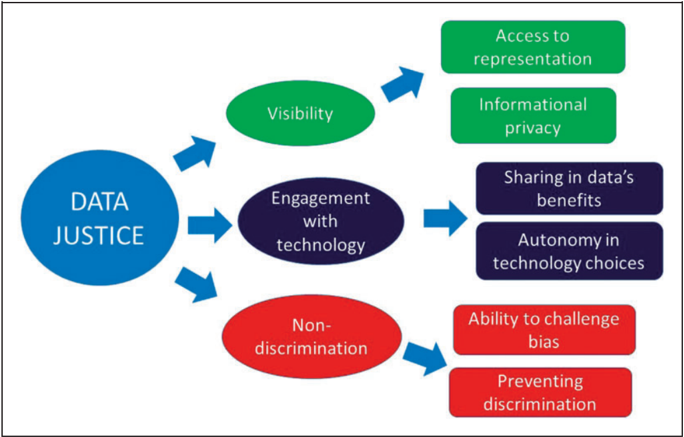
The increasing availability of digital data reflecting economic and human development, and in particular the availability of data emitted as a by-product of people’s use of technological devices and services, has both political and practical implications for the way people are seen and treated by the state and by the private sector. Yet the data revolution is so far primarily a technical one: the power of data to sort, categorise and intervene has not yet been explicitly connected to a social justice agenda by the agencies and authorities involved. Meanwhile, although data-driven discrimination is advancing at a similar pace to data processing technologies, awareness and mechanisms for combating it are not. This paper posits that just as an idea of justice is needed in order to establish the rule of law, an idea of data justice – fairness in the way people are made visible, represented and treated as a result of their production of digital data – is necessary to determine ethical paths through a datafying world. Bringing together the emerging scholarly perspectives on this topic, I propose three pillars as the basis of a notion of international data justice: (in)visibility, (dis)engagement with technology and antidiscrimination. These pillars integrate positive with negative rights and freedoms, and by doing so challenge both the basis of current data protection regulations and the growing assumption that being visible through the data we emit is part of the contemporary social contract.
Overview
The claims and statistics of this paper haven’t been checked yet.
Free: it reads the open-access text and checks the first 5 claims that cite a source we can check. Create a free account to check every claim.
Integrity signals
Registry
Cites
Statistics
Figures

Verification
Claims the paper makes
The claims and statistics of this paper haven’t been checked yet.
Free: it reads the open-access text and checks the first 5 claims that cite a source we can check. Create a free account to check every claim.
Claims other papers make about this one
Each is checked against this paper’s own text: does it say what the citing paper says it does?
The cited source says what the claim attributes to it.
In the citing paper
“It stresses the importance of developing individual freedoms in relation to how data are used and collected and advocates for enhanced autonomy and agency: people should be able to decide whether they want to participate in this system.”
From Staring Back at the Surveillance Gaze: The Resistance of LGBTQ+ Users on Social Media (2026) · cites this paper as Taylor 2017
The cited source says what the claim attributes to it.
In the citing paper
“Data justice frameworks are particularly invested in understanding the impacts, both negative and positive, of datafication and identifying ways to address them.”
From Staring Back at the Surveillance Gaze: The Resistance of LGBTQ+ Users on Social Media (2026) · cites this paper as Taylor 2017
The check wasn’t confident either way, so it gives no verdict — never disputed.
In the citing paper
“Because of this, the topic of data quality is beginning to transcend beyond the field of data management and into the realm of Human Computer Interaction (HCI), which accommodates holistic considerations such as how people search for relevant datasets [42], how developers perceive data work [64] and the best ways of using crowdsourcing to generate, evaluate or label data [71].”
From A Survey of Data Quality Requirements That Matter in ML Development Pipelines (2023) · cites this paper as [71]
Experimental — accuracy not yet measuredIn the citing paper
“Linnet Taylor (2017) advocates for a data justice framework acknowledging that, while there is a rapid development of data processing technologies, there is a lack of considerations of how datafication plays into broader social justice issues.”
From Staring Back at the Surveillance Gaze: The Resistance of LGBTQ+ Users on Social Media (2026) · cites this paper as Taylor 2017
In the citing paper
“For Taylor (2017), data justice revolves around three pillars: visibility, digital (dis)engagement, and countering data-driven discrimination.”
From Staring Back at the Surveillance Gaze: The Resistance of LGBTQ+ Users on Social Media (2026) · cites this paper as Taylor 2017
Self-check
Percentages, sums and reported differences re-computed from the paper’s own numbers.
The self-check needs the paper’s full text.
Citations
Cites
Clapp, J., & Sen, A. (1999) · International Journal Canada s Journal of Global Policy Analysis · doi:10.1177/002070200005500119 · Cited by 13,507
Clapp, J., & Sen, A. (1999) · International Journal · doi:10.2307/40203469 · Cited by 13,411
Sorting Things Out: Classification and Its Consequences
Bowker, G. C., & Star, S. L. (1999) · doi:10.7551/mitpress/6352.001.0001 · Cited by 6,188
(1993) · Oxford University Press eBooks · doi:10.1093/0198287976.001.0001 · Cited by 4,239
Toward a Field of Intersectionality Studies: Theory, Applications, and Praxis
Cho, S., Crenshaw, K. W., & McCall, L. (2013) · Signs: Journal of Women in Culture and Society · doi:10.1086/669608 · Cited by 4,126 · cited 2×
“This intersectionality (Cho et al., 2013) in the effects of datafication is an important component of the argument for a social justice perspective.”
BackgroundDoyle, T. (2017) · The Information Society · doi:10.1080/01972243.2017.1354593 · Cited by 3,071 · cited 3×
“O’Neil (2016) has warned that algorithmic models must be constantly recalibrated using feedback from the events they are supposed to predict.”
BackgroundNew York University Law Review
Rawls, J. (2017) · Justice · doi:10.4324/9781315193496-11 · Cited by 2,872
Lemke, T. (2001) · Economy and Society · doi:10.1080/03085140120042271 · Cited by 2,043 · cited 2×
“…designed to assure that people are not misusing state welfare funds and other publicly funded support are part of the apparatus of governmentality (Lemke, 2001); data-driven law enforcement focuses unequally on poor neighbourhoods which experience certain types of criminality (O’Neil, 2016); and…”
BackgroundSen, A. (2005) · Journal of Human Development · doi:10.1080/14649880500120491 · Cited by 1,966 · cited 5×
“Many states and regions, for example, take a perspective on rights that frames them as inseparable from corresponding duties, and also addresses the individual as part of the larger collective (Sen, 2005).”
BackgroundInfluentialLevin, K., Cashore, B., Bernstein, S., & Auld, G. (2012) · Policy Sciences · doi:10.1007/s11077-012-9151-0 · Cited by 1,839
Research works printed but not linked: 19
- Alkire S (2011) The capability approach and human development. University of Oxford. Available at: http://www.ophi. org.uk/wp-content/uploads/OPHI-HDCA-SS11-Intro-tothe-Capability-Approach-SA.pdf (accessed 23 June 2017).
- Arora P (2016) Bottom of the data pyramid: Big data and the global south. International Journal of Communication 10: 19.
- Eubanks V (2014) Want to predict the future of surveillance? Ask poor communities. The American Prospect , pp. 1-4. Available at: http://prospect.org/article/want-predict-futuresurveillance-ask-poor-communities#.VXbsO\_Oh2k8.twitter (accessed 9 October 2017).
- Foucault M (1977) Discipline & punish -Panopticism. Discipline and Punish: The Birth of the Prison. New York: Vintage, pp. 195-228.
- Holvast J (2013) De Volkstelling van 1971 . Amsterdam: Uitgeverij Paris.
- Jayaram M (2014) India's big brother project. Boston Review . Available at: http://www.bostonreview.net/world/malavika-jayaram-india-unique-identification-biometrics (accessed 1 January 2016).
- Kroll JA, et al. (2016) Accountable algorithms. University of Pennsylvania Law Review 165(633): 633-705.
- Makulilo AB (2016) ''A person is a person through other persons'' - A critical analysis of privacy and culture in Africa, Beijing Law Review 7: 192-204.
- Masiero S (2016) Digital governance and the reconstruction of the Indian anti-poverty system. Oxford Development Studies 818: 1-16.
- Nussbaum MC (2006) Frontiers of Justice: Disability, Nationality, and Species Membership . Cambridge, MA: Harvard University Press.
- O'Neil C (2016) Weapons of Math Destruction: How Big Data Increases Inequality and Threatens Democracy . New York: Crown Publishing Group.
- Raymond NA (2016) Beyond ''do no harm'' and individual consent: Reckoning with the emerging ethical challenges of civil society's use of data. In: Taylor L, Floridi L and van der Sloot B (eds) Group Privacy: New Challenges of Data Technologies . Springer International, pp. 67-82.
- Shearmur R (2015) Dazzled by data: Big Data, the census and urban geography. Urban Geography 36(7): 965-968.
- Spivak GC (1988) Can the subaltern speak? In: Nelson C and Grossberg L (eds) Marxism and the Interpretation of Culture . University of Illinois Press, pp. 271-313.
- Taylor L (2016a) From zero to hero: How zero-rating became a debate about human rights. IEEE Internet Computing 20(4): 79-83.
- Taylor L (2016b) No place to hide? The ethics and analytics of tracking mobility using mobile phone data. Environment and Planning D: Society and Space 34(2): 319-336.
- Taylor L (2016c) Safety in numbers? Group privacy and big data analytics in the developing world. Group Privacy: New Challenges of Data Technologies . Dordrecht: Springer.
- Taylor L (2016d) The ethics of big data as a public good: Which public? Whose good? Philosophical Transactions of the Royal Society A 374: 1-13.
- Taylor L and Broeders D (2015) In the name of development: Power, profit and the datafication of the global South. Geoforum 64(4): 229-237.
Cited by
Items 201–300 of 862
Yu, D., Tao, Q., Liu, Q., Jin, Y., Sun, Y., & Fu, P. (2025) · Results in Engineering · doi:10.1016/j.rineng.2025.105706 · Cited by 25
Making Waves: A justice-centred framework for wastewater-based public health surveillance
Arefin, M. R., Prouse, C., Wittmer, J., Amin, N., Assunção, M., Benezra, A., Chaudhuri, A., Diamond, M. B., Harshe, S., Hill-Tout, K., et al. (2024) · Water Research · doi:10.1016/j.watres.2024.122747 · Cited by 21
Governing artificial intelligence means governing data: (Re)setting the agenda for data justice
Taylor, L., de Souza, S. P., Martin, A. K., & López-Solano, J. (2025) · Dialogues on Digital Society · doi:10.1177/29768640241306800 · Cited by 26
“This is not an update to the framework for thinking about data justice in the context of data governance proposed by Taylor (2017).”
Self-citationFoundations of Communication/Media/Digital (In)justice
Fuchs, C. (2021) · Journal of Media Ethics · doi:10.1080/23736992.2021.1964968 · Cited by 22
“…the theoretical debate on media and justice (see also, among others, Christians, Glasser, McQuail, Nordenstreng, & White, 2009; Couldry, 2012; Habermas, 1990; Jansen, Pooley, & Taub-Pervizpour, 2011; Jensen, 2021; Padovani & Calabrese, 2014; Rao & Wasserman, 2015; Silverstone, 2007; Taylor, 2017).”
DataSHIELD: mitigating disclosure risk in a multi-site federated analysis platform
Avraam, D., Wilson, R. C., Aguirre Chan, N., Banerjee, S., Bishop, T. R. P., Butters, O., Cadman, T., Cederkvist, L., Duijts, L., Escribà Montagut, X., et al. (2024) · Bioinformatics Advances · doi:10.1093/bioadv/vbaf046 · Cited by 18
“However, accessibility must have limits, enabling society, its citizens, and competent professionals to have appropriate oversight and control over the use of data in which individuals or groups have a significant stake (Taylor 2017).”
Zygmuntowski, J. J. (2023) · Digital Society · doi:10.1007/s44206-023-00058-y · Cited by 23
“Openness lies on a spectrum of possible decisions on data governance, together with varied forms of permissioned access which are more suitable when data rights come into play (Taylor, 2017).”
BackgroundData protection beyond data rights: governing data production through collective intermediaries
Duncan, J. (2023) · Internet Policy Review · doi:10.14763/2023.3.1722 · Cited by 28
Governing Smart City IoT Interventions: A Complex Adaptive Systems Perspective
Venumuddala, V. R., Prakash, A., & Chaudhuri, B. (2024) · Digital Government Research and Practice · doi:10.1145/3660644 · Cited by 20
Informational Justice: Equity of Access, Implementation, and Interaction
Atkins, L. C., & Mahmud, A. (2020) · Encyclopedia of the UN sustainable development goals · doi:10.1007/978-3-319-71066-2_80-1 · Cited by 17
INTRODUCTION: DATA JUSTICE AND THE RIGHT TO THE CITY
Currie, M. E., Knox, J., & McGregor, C. (2022) · Edinburgh University Press eBooks · doi:10.1515/9781474492973-006 · Cited by 17
Bakir, V., & McStay, A. (2022) · Springer eBooks · doi:10.1007/978-3-031-13551-4 · Cited by 38
Flawn, L., & Soden, R. (2024) · Designing Interactive Systems Conference · doi:10.1145/3643834.3661585 · Cited by 17
“With acknowledgement of this issue, data justice argues for “fairness in the way people are made visible, represented and treated as a result of their production of digital data” [ 60].”
BackgroundADJOVI, I. S. M. (2025) · Frontiers in Research Metrics and Analytics · doi:10.3389/frma.2025.1504937 · Cited by 28
“Debates on bias and fairness are also taking place in computer sciences, machine learning, and artificial intelligence (Booth et al., 2021; Taylor, 2017), and their use in healthcare (Saheb et al., 2021).”
A literature review on artificial intelligence and ethics in online learning
Casas-Roma, J., & Conesa, J. (2021) · Elsevier eBooks · doi:10.1016/b978-0-12-823410-5.00006-1 · Cited by 20
Data Justice, Computational Social Science and Policy
Taylor, L. (2023) · Springer eBooks · doi:10.1007/978-3-031-16624-2_3 · Cited by 22
Self-citationMura, L., & Stehlíková, B. (2025) · Equilibrium Quarterly Journal of Economics and Economic Policy · doi:10.24136/eq.3743 · Cited by 22
Amar, S., Bori, N., & Cörvers, R. (2026) · Outlook on Agriculture · doi:10.1177/00307270251410944 · Cited by 20
“Following Taylor (2017), we view data governance as a political process, not merely about managing information, but about structuring relationships of power.”
From access and transparency to refusal: Three responses to algorithmic governance
James, A., Hynes, D., Whelan, A., Dreher, T., & Humphry, J. (2023) · Internet Policy Review · doi:10.14763/2023.2.1691 · Cited by 23
Beyond high-tech versus low-tech: A tentative framework for sustainable urban data governance
Kostakis, V., Pazaitis, A., & Liarokapis, M. V. (2023) · Big Data & Society · doi:10.1177/20539517231180583 · Cited by 18
“DLT-based smart cities are meant to be “ seamless, ” meaning that people have things taken care of without them getting in the way, knowing, or being asked (Taylor, 2017).”
BackgroundWagman, K. B., Blinder, E. B., Song, K., Vignon, A., Dworkin, S., Clegg, T., Vitak, J., & Chetty, M. (2023) · Proceedings of the ACM on Human-Computer Interaction · doi:10.1145/3610036 · Cited by 17
“This tension has been pointed out by data justice researchers in societal contexts outside of education [10, 17, 75].”
BackgroundJardel, H. V., & Delamater, P. L. (2024) · Geographical Analysis · doi:10.1111/gean.12399 · Cited by 20
Kalema, N. L. (2024) · Policy & Internet · doi:10.1002/poi3.436 · Cited by 22
Sandvik, K. B. (2019) · Journal of Humanitarian Affairs · doi:10.7227/jha.023 · Cited by 20
Advancing data justice in education: some suggestions towards a deontological framework
Perrotta, C. (2022) · Learning Media and Technology · doi:10.1080/17439884.2022.2156536 · Cited by 21
“This ‘ critical data studies ’ strand has inspired a lively interdisciplinary debate about the need to think more sociologically about the interdependencies between people and digital infrastructures (Taylor 2017).”
BackgroundFacilitating system-level behavioural climate action using computational social science
Debnath, R., van der Linden, S., Alvarez, R. M., & Sovacool, B. K. (2023) · Nature Human Behaviour · doi:10.1038/s41562-023-01527-7 · Cited by 15
Aaltonen, A., Alaimo, C., Parmiggiani, E., Stelmaszak, M., Järvenpää, S. L., Kallinikos, J., & Monteiro, E. (2023) · Communications of the Association for Information Systems · doi:10.17705/1cais.05320 · Cited by 36
Meissner, F., & Taylor, L. (2024) · Journal of Ethnic and Migration Studies · doi:10.1080/1369183x.2024.2307772 · Cited by 21
“The literature on data justice (Leese, Noori, and Scheel 2021; Sánchez-Monedero and Dencik 2020; Taylor 2017; Taylor and Meissner 2020) is relevant because it centres technological and data fi ed power as an object of ethical scrutiny, and places the fi rm alongside the state and the individual as…”
BackgroundSelf-citationCramer, B. W. (2018) · Journal of Information Policy · doi:10.5325/jinfopoli.8.1.0005 · Cited by 16
Charitsis, V., & Laamanen, M. (2022) · Social movement studies · doi:10.1080/14742837.2022.2123314 · Cited by 17
“Taylor (2017, p. 1) explicates that data justice refers to ‘fairness in the way people are made visible, represented and treated as a result of their production of digital data’ and maintains that data justice needs to be based on three pillars: (in)visibility, (dis)engagement with technology, and…”
BackgroundColoniality and frictions: Data-driven humanitarianism in North-Eastern Nigeria and South Sudan
Squire, V., & Alozie, M. T. (2023) · Big Data & Society · doi:10.1177/20539517231163171 · Cited by 19
“…have explored the intersections of social justice and processes of technological development from a range of angles over recent years (e.g. Dencik et al., 2016; Dencik and Sanchez-Monedero, 2021; Heeks and Renken, 2016; Heeks and Shekhar, 2019; Newman, 2015; Ruberg and Ruelos, 2020; Taylor, 2017).”
BackgroundPaudel, S., & Soden, R. (2023) · Proceedings of the ACM on Human-Computer Interaction · doi:10.1145/3579519 · Cited by 15
“The incorporation of justice into the practices surround the collection, sharing, and the use of data is a growing area of research in HCI and CSCW; scholars and activists have called for information justice [41], data justice [77], and design justice [15].”
BackgroundModeling Ethics: Approaches to Data Creep in Higher Education
Whitman, M. (2021) · Science and Engineering Ethics · doi:10.1007/s11948-021-00346-1 · Cited by 17
Hoefsloot, F. I., Jiménez, A., Martínez, J. A., Sara, L. M., & Pfeffer, K. (2022) · Information Technology for Development · doi:10.1080/02681102.2022.2091505 · Cited by 21
“Taylor (2017, p. 8) de fi nes data justice as balancing and grappling with the need to be represented but also the possibility of the need to opt-out of data collection or processing, the need to preserve one ’ s autonomy with regard to data-producing technologies and the need to be protected from…”
BackgroundMethodInfluentialCOVID‐19 and the Meaning of Crisis
Abdelrahman, M. (2022) · Development and Change · doi:10.1111/dech.12744 · Cited by 20
Smart Cities: Reviewing the Debate About Their Ethical Implications
Ziosi, M., Hewitt, B., Juneja, P., Taddeo, M., & Floridi, L. (2023) · Digital ethics lab yearbook · doi:10.1007/978-3-031-28678-0_3 · Cited by 21
Salifu, F. W., Abubakari, Z., & Richter, C. (2019) · Land · doi:10.3390/land8120189 · Cited by 15
“While innovation generally carries a positive connotation, e.g. increasing performance and effectiveness of organizations [34,35], Taylor [36], for instance, points out that not all innovation is good for everyone and that researchers would do well “to take into account different currents of public resistance to innov…”
BackgroundSatriawan, H. A., Julianti, L., Sugiantari, A. A. P. W., & Udytama, I. W. W. W. (2022) · Journal of Digital Law and Policy · doi:10.58982/jdlp.v1i3.301 · Cited by 13
What Can Data Justice Mean for Asylum Governance? The Case of Smartphone Data Extraction in Germany
Josipovic, I. (2023) · Journal of Refugee Studies · doi:10.1093/jrs/fead049 · Cited by 18
Koenig, P. D. (2024) · Information Technology for Development · doi:10.1080/02681102.2024.2375735 · Cited by 13
“Consequently, the benefits from transformative changes resulting from ICT use may largely accrue to actors outside of a digital ecosystem (Mann, 2018; Taylor, 2017).”
Beckman, K., Apps, T., & Bennett, S. (2024) · Computers and Education Open · doi:10.1016/j.caeo.2024.100213 · Cited by 15
Fry, M., & Hilburn, A. M. (2020) · The Extractive Industries and Society · doi:10.1016/j.exis.2020.03.017 · Cited by 17
Kennedy, L., Sood, A., Chakraborty, D., & Chitta, R. M. (2020) · Information Communication & Society · doi:10.1080/1369118x.2020.1851388 · Cited by 13
“More broadly, it questions whether the increasing prevalence of digital technologies helps realise data justice or rather produces new forms of injustice (Heeks & Renken, 2018; Taylor, 2017).”
BackgroundRestoration of mobility through mobile health: the digital health code as a technology of governance
Meng, J., Liu, Y., & Keane, M. (2021) · Asian Journal of Communication · doi:10.1080/01292986.2021.1941151 · Cited by 13
“…by mobile apps and cloud platforms, they also create a new digital divide or information asymmetry between those (citizens, patients and consumers) who generate data and those (state, platforms and corporations) that control and manage data (Andrejevic, 2014; Boyd & Crawford, 2012; Taylor, 2017).”
BackgroundCritical data literacy in praxis: An open education approach for academic development
Atenas, J., Havemann, L., Rodés, V., & Podetti, M. (2023) · Edutec Revista Electrónica de Tecnología Educativa · doi:10.21556/edutec.2023.85.2851 · Cited by 16
“…are being produced and reproduced in a datafied society, allowing us to and rethink our pedagogies using a critical, feminist and data justice approach (Braidotti, 2016; Dencik et al., 2016; Dencik & Sanchez-Monedero, 2022; D’Ignazio & Klein, 2020 ; Heeks & Swain, 2018; hooks, 1994; Taylor, 2017).”
BackgroundMethodKasapoğlu, T., Masso, A., & Calzati, S. (2021) · Digital Geography and Society · doi:10.1016/j.diggeo.2021.100016 · Cited by 20
Who are you? Examining the multifaceted innovation roles of municipal governments in AI governance
Elbehairy, F., Mora, L., & Soe, R.-M. (2025) · Technovation · doi:10.1016/j.technovation.2025.103303 · Cited by 15
Missing in action: queer(y)ing the educational implications of data justice in an age of automation
Arantes, J. A., & Vicars, M. (2023) · Learning Media and Technology · doi:10.1080/17439884.2023.2207141 · Cited by 15
“Exploited, in terms of the level of ‘ fairness in the way people are made visible, represented and treated as a result of their production of digital data ’ (Taylor 2017, 1).”
BackgroundUrban Data Power: Capitalism, Governance, Ethics, and Justice
Kitchin, R. (2023) · Bristol University Press eBooks · doi:10.56687/9781529233551-005 · Cited by 31
Principles of just urban land use planning
Dadashpoor, H., & Sajadi, A. (2024) · Land Use Policy · doi:10.1016/j.landusepol.2024.107132 · Cited by 14
Crypto-anarchy: a paradigm shift for society and the legal system
Zhuk, A. (2024) · Journal of Computer Virology and Hacking Techniques · doi:10.1007/s11416-024-00525-1 · Cited by 20
“Instances of hate speech [143], discrimination [193], and actions perpetuating social injustice [1] highlight the need to balance individual freedom with ethical considerations and responsibilities towards fellow members of society.”
The struggle against sexual violence in conflict: Investigating the digital turn
Sandvik, K. B., & Lohne, K. (2020) · International Review of the Red Cross · doi:10.1017/s1816383121000060 · Cited by 12
Li, L., Lee, K. Y., Chang, Y., Yang, S., & Park, P. (2021) · Information Technology for Development · doi:10.1080/02681102.2021.1882366 · Cited by 14
“Qureshi (2020) further stated that data for development (D4D) calls for data justice, which refers to the fairness in how people are represented and treated for the digital data they produce (Taylor, 2017).”
BackgroundData Agency Theory: A Precise Theory of Justice for AI Applications
Ajmani, L., Stapleton, L., Houtti, M., & Chancellor, S. (2024) · The 2024 ACM Conference on Fairness Accountability and Transparency · doi:10.1145/3630106.3658930 · Cited by 11
“Prior work supports the position that data rights are individual rights [82].”
BackgroundDigital platforms and the transformation of crime governance
Shan, Y. (2026) · The Journal of Chinese Sociology · doi:10.1186/s40711-025-00252-0 · Cited by 12
“Taylor (2017) proposes three core elements of data justice—visibility of data use, prior agreement, and protection from unjust outcomes—which provide a normative framework for embedding the rule of law within platform-based governance.”
Critical Data Literacy in Higher Education: Teaching and Research for Data Ethics and Justice
Atenas, J., Havemann, L., Kühn, C., & Timmermann, C. (2023) · Higher education dynamics · doi:10.1007/978-3-031-24193-2_12 · Cited by 18
An Educational Framework in Digital Rights and Responsibilities for Young Entrepreneurs
Arrufat, M. J. G., Torres-Hernández, N., García‐Martínez, I., & Martos, S. D. (2023) · SAGE Open · doi:10.1177/21582440231208614 · Cited by 11
“An analogous study by Taylor (2017) studies data-based discrimination in technology use.”
BackgroundCarmody, P. (2024) · Information Technology for Development · doi:10.1080/02681102.2024.2368539 · Cited by 13
“Furthermore, data and content exploitation is classed, as the greatest burden of surveillance using digital methods has always been borne by the poor; such as through attempts to avoid welfare fraud for example (Eubanks, 2014 and Masiero, 2016 cited in Taylor, 2017).”
A powerful potion for a potent problem: transformative justice for generative AI in healthcare
Gross, N. (2024) · AI and Ethics · doi:10.1007/s43681-024-00519-1 · Cited by 13
“Big Tech compa - nies have now become part and parcel of public and private healthcare [10], even when their technologies, systems, and infrastructures are explicitly connected with data justice issues [11].”
InfluentialOpola, F. O., Langan, S., Arulingam, I., Schumann, C., Singaraju, N., Joshi, D., & Ghosh, S. (2025) · Agriculture and Human Values · doi:10.1007/s10460-025-10731-2 · Cited by 14
“Establishing clear guidelines for ethical and responsible collection, processing, and use of data is therefore imperative from an inclusivity perspective (Taylor 2017; Fraser 2019).”
Persily, N., & Tucker, J. A. (2020) · Cambridge University Press eBooks · doi:10.1017/9781108890960.002 · Cited by 11
Big Data and Artificial Intelligence in Policy Making: A Mini-Review Approach
Supriyanto, E., & Saputra, J. (2022) · International Journal of Advances in Social Sciences and Humanities · doi:10.56225/ijassh.v1i2.40 · Cited by 23
“Big Data's advantages in government can be applied to government initiatives, empowering citizens and increasing openness and involvement among all stakeholders (Taylor, 2017).”
BackgroundData Justice and the Right to the City
Currie, M. (2022) · Edinburgh University Press eBooks · doi:10.1515/9781474492973 · Cited by 14
Framework for Managing Cybercrime Risks in Nigerian UniversitiesPreprint
Badamasi, B., & Utulu, S. C. A. (2021) · arXiv (Cornell University) · doi:10.48550/arxiv.2108.09754 · Cited by 22
“Cyberspaces have evolved tremendously over the years, providing a variety of digital platforms universities need to manage teaching, learning, research, community development and administration (Taylor, 2017).”
BackgroundCollaborative Speculations on Future Themes for Participatory Design in Germany
Mucha, H., de Barros, A. C., Benjamin, J. J., Benzmüller, C., Bischof, A., Buchmüller, S., de Carvalho, A., Dhungel, A.-K., Draude, C., Fleck, M.-J., et al. (2022) · i-com · doi:10.1515/icom-2021-0030 · Cited by 16
Wernick, A., & Artyushina, A. (2023) · Internet Policy Review · doi:10.14763/2023.1.1695 · Cited by 22
Rautenberg, N., & Murray, D. (2024) · Human Rights Review · doi:10.1007/s12142-024-00727-6 · Cited by 20
“Significantly, chilling effects are most strongly felt by those at the margins of society, or at a remove from the status quo, and are therefore most likely to affect activities that are perceived as unusual, unpopular, controversial, radical, or extreme (see Cohen 2000; Penney 2022; Taylor 2017).”
The politics of data justice: exit, voice, or rehumanisation?
Akbari, A. (2024) · Information Communication & Society · doi:10.1080/1369118x.2024.2437015 · Cited by 16
“According to Linnet Taylor, data justice connects ‘the power of data to sort, categorise and intervene […] to a social justice agenda’ and includes ‘fairness in the way people are made visible, represented and treated as a result of their production of digital data’ (Taylor, 2017, p. 1).”
InfluentialAI-Powered Digital Identity Systems and the New Digital Divide: The Case of World
Siad, R., & Sagar, A. (2025) · Emerging Media · doi:10.1177/27523543251340713 · Cited by 12
“One way is to adopt a data justice framework (Taylor, 2017), which in response to concerns about data fi cation, offers a guide to assess how individuals are represented by data, their ability to decide how much engagement or disengagement with data systems and the freedom from discrimination and…”
Alméstar, M., Romero-Muñoz, S., & Martínez, N. M. (2025) · Sustainability · doi:10.3390/su17115145 · Cited by 13
“This insight opens a pathway for reflexive governance, reinforcing inclusion and just transition [81,96,97].”
Our data, ourselves: Participation, justice, and alternative futures of data sovereignty in India
Dutta, S., & Mazumdar, S. (2025) · Big Data & Society · doi:10.1177/20539517251365235 · Cited by 14
“While some groups and societies may identify the bene fi ts, others may challenge data fi cation and surveillance as oppressive structures (Taylor, 2017).”
InfluentialDonia, J., & Marelli, L. (2025) · Health Policy · doi:10.1016/j.healthpol.2025.105443 · Cited by 11
Smith, C. H. (2020) · Philosophical studies series · doi:10.1007/978-3-030-50585-1_3 · Cited by 16
Haggart, B., & Spicer, Z. (2022) · Canadian Public Administration · doi:10.1111/capa.12460 · Cited by 14
Mapping Data Justice as a Multidimensional Concept Through Feminist and Legal Perspectives
Draude, C., Hornung, G., & Klumbytė, G. (2022) · Transforming communications · doi:10.1007/978-3-030-96180-0_9 · Cited by 16
Exploring Chinese cyber discourse: integrating political and legal perspectives
Cheng, L., & Liu, X. (2022) · International Journal of Legal Discourse · doi:10.1515/ijld-2022-2063 · Cited by 10
The unbearable lightness of consent: mapping MOOC providers' response to consent
Khalil, M., Prinsloo, P., & Slade, S. (2018) · ACM Conference on Learning @ Scale (L@S) · doi:10.1145/3231644.3231659 · Cited by 13
“” They also point out that what may constitute non-sensitive data in one context or at a particular time, may be considered sensitive in another context and/or time [25].”
BackgroundHwang, T. (2017) · Cambridge University Press eBooks · doi:10.1017/9781108890960.012 · Cited by 13
Masiero, S. (2024) · Information Technology for Development · doi:10.1080/02681102.2024.2313395 · Cited by 17
“…de fi ning data justice as ‘ fairness in the way people are made visible, represented and treated as a result of their production of digital data, ’ Taylor (2017) notes that, just as an idea of justice is needed to establish the rule of law, an idea of data justice serves to ‘ determine ethical…”
BackgroundGroen, E. L. M., Sharon, T., & Becker, M. (2026) · AI and Ethics · doi:10.1007/s43681-025-00955-7 · Cited by 12
“The case for connecting digital rights and freedoms globally”, Taylor [109, p. 2] argues, “just as an idea of justice is needed in order to establish the rule of law, an idea of data justice is necessary to determine ethical paths through a datafying world”.”
Exploring digital sovereignty: open questions for design in digital healthcare
Pierri, P., & Herlo, B. (2021) · Design for Health · doi:10.1080/24735132.2021.1928381 · Cited by 16
“Issues with the datafication of mental health service through digital health are varied, and also linked to the broader discourses on data justice (Taylor 2017), which highlight how citizens using public digital services are made visible, represented and treated differently as a result of their…”
BackgroundGroup-Privacy Threats for Geodata in the Humanitarian Context
Masinde, B. K., Gevaert, C. M., Nagenborg, M., & Zevenbergen, J. A. (2023) · ISPRS International Journal of Geo-Information · doi:10.3390/ijgi12100393 · Cited by 15
“Often, the impacts/outcomes of data technologies on algorithmically determined groups are felt disproportionately by existing social groups (e.g., biases) [11].”
BackgroundArefin, M. R., & Prouse, C. (2024) · Transactions of the Institute of British Geographers · doi:10.1111/tran.12732 · Cited by 11
Digital Dead Body Management (DDBM): Time to Think it Through
Sandvik, K. B. (2020) · Journal of Human Rights Practice · doi:10.1093/jhuman/huaa002 · Cited by 13
Covid-19: When Species and Data Meet
Price, C. (2020) · Postdigital Science and Education · doi:10.1007/s42438-020-00180-x · Cited by 13
“A range of characteristics including gender, ethnicity, race, religion, socio-economic status, location, and nationality determine how individuals become data subjects (Taylor 2017).”
BackgroundNevická, D., & Mesarčík, M. (2022) · International Journal of Discrimination and the Law · doi:10.1177/13582291221096615 · Cited by 12
“Taylor´s position stands on emphasizing “ethical paths through a datafying world “consisting of three pillars: visibility, engagement with technology, and non-discrimination (Taylor, 2017).”
BackgroundInfluentialRecognition in Personal Data: Data Warping, Recognition Concessions, and Social Justice
Stelmaszak, M., Wagner, E. L., & DuPont, N. N. (2024) · MIS Quarterly · doi:10.25300/misq/2023/18088 · Cited by 12
Optimizing air pollution sensing for social and environmental justice
Lin, Y., Robinson, C., Yeap, Q. F., & Michael, H. (2025) · Applied Geography · doi:10.1016/j.apgeog.2025.103606 · Cited by 10
Magaña, M. I., & Shilton, K. (2025) · ACM Conference on Fairness, Accountability, and Transparency (FAccT) · doi:10.1145/3715275.3732148 · Cited by 15
“…in tech [16, 21]); data justice (a framework that examines data issues in the context of existing power dynamics, ideology, and social practices [60]); techno-solutionism (approach that prioritizes solving problems through technological innovation [41]); and decolonization (an approach that…”
Hardia, S. (2025) · International Symposium on Autonomous Decentralized Systems · doi:10.1109/isads66912.2025.00017 · Cited by 9
Open Government Data Portals and SDG 11: Lessons from 19 U.S. Cities
Nabiyeva, G. N., & Wheeler, S. M. (2025) · Sustainability · doi:10.3390/su172210405 · Cited by 8
Charting exposomethics: a roadmap for the ethical foundations of the human exposome project
Sillé, F. C. M., Belkadi, M., Koehler, K., Ali, J., Vasiliou, V., Sarigiannis, D., & Härtung, T. (2026) · Human Genomics · doi:10.1186/s40246-025-00906-7 · Cited by 11
“This raises concerns about power asymmetries between data generators (e.g., participants or communities being monitored) and data analysts/owners 12 [57, 58].”
Identifying the Directions of Technology-Driven Government Innovation
Nam, H., Kim, S., & Nam, T. (2022) · Information · doi:10.3390/info13050208 · Cited by 8
The Critical Roles of Global South Stakeholders in AI Governance
Png, M.-T. (2022) · Oxford University Press eBooks · doi:10.1093/oxfordhb/9780197579329.013.57 · Cited by 12
Data and/as activism: Community-based racial justice data repertoires
Bui, M. (2023) · New Media & Society · doi:10.1177/14614448231206118 · Cited by 12
“As a result of such work, data activists often document how big and open data maintain power for white, wealthy groups; whereas the minoritized communities they support typically must gather “additional” or “valid” data to substantiate lived experiences and secure rights (Taylor, 2017).”
Buttow, C. V., & Weerts, S. (2023) · Information Polity · doi:10.3233/ip-230003 · Cited by 16
“It also provides more transparency and public awareness of the trade-offs of innovation, making more explicit how, for example, gains in efficiency could also lead to an increase in surveillance or aggravate discrimination against certain vulnerable groups (Taylor, 2017).”
Arias, C. G., & García, X. L. (2024) · Journalism and Media · doi:10.3390/journalmedia5030065 · Cited by 9
“…and the debate about the risks associated with its implementation is linked to other complementary research areas, such as critical data literacy and data justice, which share the goal of increasing citizens’ sensitivity to data risks and building resilience against data malpractice (Taylor 2017).”
BackgroundGEORGE, B. P. (2025) · Land Management and Utilization · doi:10.54963/lmu.v1i2.1527 · Cited by 12
Digital Economy and Trends of Political Development in Modern Societies
Nechaev, V. D., & Belokonev, S. Y. (2020) · Outlines of global transformations politics economics law · doi:10.23932/2542-0240-2020-13-2-6 · Cited by 8
“…цифровой трансформации российской экономики� Указанные документы фиксируют отставание России в области развития цифровой экономики (41–43-е место в международных рейтингах со значительным отставанием от лидеров – Швейцарии, Сингапура, Соединенных Штатов Америки, Нидерландов, Германии,…”
A Participatory Approach to Eliciting Local Values of Civic Data Justice
Peer, F. A. (2022) · Participatory Design Conference · doi:10.1145/3536169.3537788 · Cited by 10
“In doing so, Taylor proposes an approach to data justice that “begins not from a consideration of the average person, but asks instead what kind of organising principles for justice can address the marginalised and vulnerable to the same extent as everyone else” [61].”
BackgroundInfluentialGuidelines for genetic ancestry inference created through roundtable discussions
Wagner, J. K., Yu, J., Fullwiley, D., Moore, C., Wilson, J. F., Bamshad, M. J., & Royal, C. D. M. (2023) · Human Genetics and Genomics Advances · doi:10.1016/j.xhgg.2023.100178 · Cited by 8
Metadata
- Authors
- Taylor, L.
- Affiliations
- Tilburg University (NL)
- Corresponding author
- Taylor, Linnet
- ORCID
- Taylor, Linnet
- Venue
- Big Data & Society
- Publisher
- SAGE Publications
- Published
- 2017-11
- Volume
- 4
- Issue
- 2
- Pages
- 205395171773633
- ISSN
- 2053-9517 (ISSN-L)
- OpenAlex
- W2590124083
- Cited by
- 802
- References
- 38
- Citations by year
- 2026: 127 · 2025: 168 · 2024: 99 · 2023: 126 · 2022: 89 · 2021: 55 · 2020: 74 · 2019: 47 · 2018: 17
- FWCI
- 86.62
- Type
- journal article
- Language
- en
- Open access
- gold
- doi.org
- Licence
- cc-by-nc-nd
- journals.sagepub.com/page/policies/text-and-data-mining-license (tdm)
- Locations
- Big Data & Society (publishedVersion, cc-by-nc-nd)
- Tilburg University Research Portal (publishedVersion, other-oa)
- Research portal (Tilburg University) (submittedVersion, other-oa)
- Data Archiving and Networked Services (DANS) (submittedVersion, other-oa)
- DOAJ (DOAJ: Directory of Open Access Journals) (submittedVersion, cc-by-sa)
- EUR Research Repository (Erasmus University Rotterdam) (submittedVersion)
- Funders
- European Commission (624583)
- Universiteit van Amsterdam
- Topics
- Physical Sciences › Computer Science › Artificial Intelligence › Ethics and Social Impacts of AI
- Social Sciences › Law › Digitalization, Law, and Regulation
- Social Sciences › Business, Management and Accounting › Industrial relations › Legal and Labor Studies
- Keywords
- data justice, digital rights, internet freedom, datafication, visibility, anti-discrimination, data protection regulation, social justice, digital data, social contract
About these checks
Registry, retraction, Cites and statistics results are computed, not judged, with one exception: a printed reference that no index lists is read once by a model before it counts as a citation error. Claims are extracted by a model and kept only when their quote appears verbatim in the text; each cited source is then checked, with a model’s help, for whether it says what the claim relies on. Those verdicts can be wrong — read the claim’s quote and the cited source before relying on one.
Statistics and arithmetic are recomputed, not judged.
Confidence bands are shown only for fields calibrated on our annotated test set. None is calibrated yet, so no band is shown.
What counts as a claim ›How we measure confidence ›How we check this ›
Are you an author, or do you see a problem with this page? Request a review
Data sources
Bibliographic data: Semantic Scholar, OpenAlex, Crossref.
Contains information from the Semantic Scholar Academic Graph Datasets, made available under the ODC Attribution License (ODC-BY 1.0).
Semantic Scholar’s data is described in: Kinney, R., et al. (2023). The Semantic Scholar Open Data Platform. arXiv:2301.10140.
