

What is data justice? The case for connecting digital rights and freedoms globally
Open accessThe DOI matches its Crossref record; 38 of the 41 references it cites were found in a registry or an index, and 3 are not checked yet.
Abstract
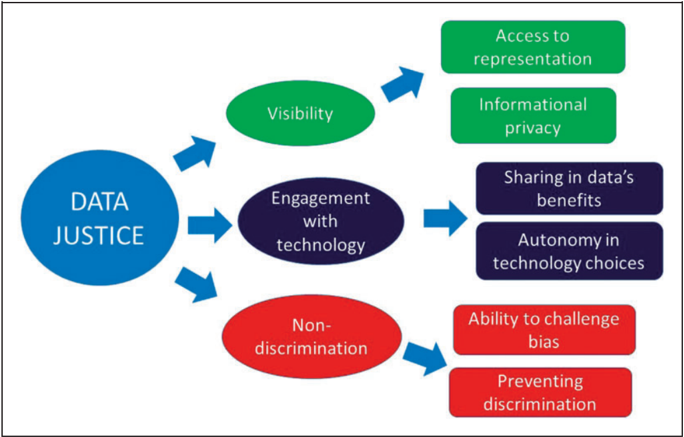
The increasing availability of digital data reflecting economic and human development, and in particular the availability of data emitted as a by-product of people’s use of technological devices and services, has both political and practical implications for the way people are seen and treated by the state and by the private sector. Yet the data revolution is so far primarily a technical one: the power of data to sort, categorise and intervene has not yet been explicitly connected to a social justice agenda by the agencies and authorities involved. Meanwhile, although data-driven discrimination is advancing at a similar pace to data processing technologies, awareness and mechanisms for combating it are not. This paper posits that just as an idea of justice is needed in order to establish the rule of law, an idea of data justice – fairness in the way people are made visible, represented and treated as a result of their production of digital data – is necessary to determine ethical paths through a datafying world. Bringing together the emerging scholarly perspectives on this topic, I propose three pillars as the basis of a notion of international data justice: (in)visibility, (dis)engagement with technology and antidiscrimination. These pillars integrate positive with negative rights and freedoms, and by doing so challenge both the basis of current data protection regulations and the growing assumption that being visible through the data we emit is part of the contemporary social contract.
Overview
The claims and statistics of this paper haven’t been checked yet.
Free: it reads the open-access text and checks the first 5 claims that cite a source we can check. Create a free account to check every claim.
Integrity signals
Registry
Cites
Statistics
Figures

Verification
Claims the paper makes
The claims and statistics of this paper haven’t been checked yet.
Free: it reads the open-access text and checks the first 5 claims that cite a source we can check. Create a free account to check every claim.
Claims other papers make about this one
Each is checked against this paper’s own text: does it say what the citing paper says it does?
The cited source says what the claim attributes to it.
In the citing paper
“It stresses the importance of developing individual freedoms in relation to how data are used and collected and advocates for enhanced autonomy and agency: people should be able to decide whether they want to participate in this system.”
From Staring Back at the Surveillance Gaze: The Resistance of LGBTQ+ Users on Social Media (2026) · cites this paper as Taylor 2017
The cited source says what the claim attributes to it.
In the citing paper
“Data justice frameworks are particularly invested in understanding the impacts, both negative and positive, of datafication and identifying ways to address them.”
From Staring Back at the Surveillance Gaze: The Resistance of LGBTQ+ Users on Social Media (2026) · cites this paper as Taylor 2017
The check wasn’t confident either way, so it gives no verdict — never disputed.
In the citing paper
“Because of this, the topic of data quality is beginning to transcend beyond the field of data management and into the realm of Human Computer Interaction (HCI), which accommodates holistic considerations such as how people search for relevant datasets [42], how developers perceive data work [64] and the best ways of using crowdsourcing to generate, evaluate or label data [71].”
From A Survey of Data Quality Requirements That Matter in ML Development Pipelines (2023) · cites this paper as [71]
Experimental — accuracy not yet measuredIn the citing paper
“Linnet Taylor (2017) advocates for a data justice framework acknowledging that, while there is a rapid development of data processing technologies, there is a lack of considerations of how datafication plays into broader social justice issues.”
From Staring Back at the Surveillance Gaze: The Resistance of LGBTQ+ Users on Social Media (2026) · cites this paper as Taylor 2017
In the citing paper
“For Taylor (2017), data justice revolves around three pillars: visibility, digital (dis)engagement, and countering data-driven discrimination.”
From Staring Back at the Surveillance Gaze: The Resistance of LGBTQ+ Users on Social Media (2026) · cites this paper as Taylor 2017
Self-check
Percentages, sums and reported differences re-computed from the paper’s own numbers.
The self-check needs the paper’s full text.
Citations
Cites
Clapp, J., & Sen, A. (1999) · International Journal Canada s Journal of Global Policy Analysis · doi:10.1177/002070200005500119 · Cited by 13,507
Clapp, J., & Sen, A. (1999) · International Journal · doi:10.2307/40203469 · Cited by 13,411
Sorting Things Out: Classification and Its Consequences
Bowker, G. C., & Star, S. L. (1999) · doi:10.7551/mitpress/6352.001.0001 · Cited by 6,188
(1993) · Oxford University Press eBooks · doi:10.1093/0198287976.001.0001 · Cited by 4,239
Toward a Field of Intersectionality Studies: Theory, Applications, and Praxis
Cho, S., Crenshaw, K. W., & McCall, L. (2013) · Signs: Journal of Women in Culture and Society · doi:10.1086/669608 · Cited by 4,126 · cited 2×
“This intersectionality (Cho et al., 2013) in the effects of datafication is an important component of the argument for a social justice perspective.”
BackgroundDoyle, T. (2017) · The Information Society · doi:10.1080/01972243.2017.1354593 · Cited by 3,071 · cited 3×
“O’Neil (2016) has warned that algorithmic models must be constantly recalibrated using feedback from the events they are supposed to predict.”
BackgroundNew York University Law Review
Rawls, J. (2017) · Justice · doi:10.4324/9781315193496-11 · Cited by 2,872
Lemke, T. (2001) · Economy and Society · doi:10.1080/03085140120042271 · Cited by 2,043 · cited 2×
“…designed to assure that people are not misusing state welfare funds and other publicly funded support are part of the apparatus of governmentality (Lemke, 2001); data-driven law enforcement focuses unequally on poor neighbourhoods which experience certain types of criminality (O’Neil, 2016); and…”
BackgroundSen, A. (2005) · Journal of Human Development · doi:10.1080/14649880500120491 · Cited by 1,966 · cited 5×
“Many states and regions, for example, take a perspective on rights that frames them as inseparable from corresponding duties, and also addresses the individual as part of the larger collective (Sen, 2005).”
BackgroundInfluentialLevin, K., Cashore, B., Bernstein, S., & Auld, G. (2012) · Policy Sciences · doi:10.1007/s11077-012-9151-0 · Cited by 1,839
Research works printed but not linked: 19
- Alkire S (2011) The capability approach and human development. University of Oxford. Available at: http://www.ophi. org.uk/wp-content/uploads/OPHI-HDCA-SS11-Intro-tothe-Capability-Approach-SA.pdf (accessed 23 June 2017).
- Arora P (2016) Bottom of the data pyramid: Big data and the global south. International Journal of Communication 10: 19.
- Eubanks V (2014) Want to predict the future of surveillance? Ask poor communities. The American Prospect , pp. 1-4. Available at: http://prospect.org/article/want-predict-futuresurveillance-ask-poor-communities#.VXbsO\_Oh2k8.twitter (accessed 9 October 2017).
- Foucault M (1977) Discipline & punish -Panopticism. Discipline and Punish: The Birth of the Prison. New York: Vintage, pp. 195-228.
- Holvast J (2013) De Volkstelling van 1971 . Amsterdam: Uitgeverij Paris.
- Jayaram M (2014) India's big brother project. Boston Review . Available at: http://www.bostonreview.net/world/malavika-jayaram-india-unique-identification-biometrics (accessed 1 January 2016).
- Kroll JA, et al. (2016) Accountable algorithms. University of Pennsylvania Law Review 165(633): 633-705.
- Makulilo AB (2016) ''A person is a person through other persons'' - A critical analysis of privacy and culture in Africa, Beijing Law Review 7: 192-204.
- Masiero S (2016) Digital governance and the reconstruction of the Indian anti-poverty system. Oxford Development Studies 818: 1-16.
- Nussbaum MC (2006) Frontiers of Justice: Disability, Nationality, and Species Membership . Cambridge, MA: Harvard University Press.
- O'Neil C (2016) Weapons of Math Destruction: How Big Data Increases Inequality and Threatens Democracy . New York: Crown Publishing Group.
- Raymond NA (2016) Beyond ''do no harm'' and individual consent: Reckoning with the emerging ethical challenges of civil society's use of data. In: Taylor L, Floridi L and van der Sloot B (eds) Group Privacy: New Challenges of Data Technologies . Springer International, pp. 67-82.
- Shearmur R (2015) Dazzled by data: Big Data, the census and urban geography. Urban Geography 36(7): 965-968.
- Spivak GC (1988) Can the subaltern speak? In: Nelson C and Grossberg L (eds) Marxism and the Interpretation of Culture . University of Illinois Press, pp. 271-313.
- Taylor L (2016a) From zero to hero: How zero-rating became a debate about human rights. IEEE Internet Computing 20(4): 79-83.
- Taylor L (2016b) No place to hide? The ethics and analytics of tracking mobility using mobile phone data. Environment and Planning D: Society and Space 34(2): 319-336.
- Taylor L (2016c) Safety in numbers? Group privacy and big data analytics in the developing world. Group Privacy: New Challenges of Data Technologies . Dordrecht: Springer.
- Taylor L (2016d) The ethics of big data as a public good: Which public? Whose good? Philosophical Transactions of the Royal Society A 374: 1-13.
- Taylor L and Broeders D (2015) In the name of development: Power, profit and the datafication of the global South. Geoforum 64(4): 229-237.
Cited by
Items 301–400 of 862
Interoperability and data standards in the K-12 education sector: intersections with data justice
Stewart, M. S., Pier, E. L., Ralyea, D., & Rice, A. (2023) · Learning Media and Technology · doi:10.1080/17439884.2023.2190121 · Cited by 10
“As noted above, surveillance or ‘ dataveillance ’ (Clarke 1988) is one of the foundational and consistent themes in the data justice and related literatures (e.g., Dencik, Hintz, and Cable 2016; Landwehr, Borning, and Wulf 2021; Taylor 2017).”
BackgroundRivera-Vargas, P., Jacovkis, J., Passerón, E., & Cobo, C. (2023) · Profesorado Revista de Currículum y Formación del Profesorado · doi:10.30827/profesorado.v27i1.24643 · Cited by 10
Georgiadou, Y., Kounadi, O., & de By, R. A. (2019) · Springer eBooks · doi:10.1007/978-981-32-9915-3_25 · Cited by 8
“This leads us to recent debates on data justice—fairness in the way people and their resources are made visible, represented and treated as a result of their digital data production (Taylor 2017).”
BackgroundSurveillance Capitalism in Mental Health: When Good Apps Go Rogue (and What Can Be Done about It)
Gross, N. R., & Mothersill, D. (2023) · Social Sciences · doi:10.3390/socsci12120679 · Cited by 9
“Data solidarity acknowledges that fairness and equality cannot easily be achieved, as there are many entrenched “social structures of recognition and concrete experiences of discrimination and injustice” (Braun and Hummel 2022, n.p.).”
BackgroundInfluentialGoverning Cross-Border Data Flows: Reconciling EU Data Protection and International Trade Law
Yakovleva, S. (2024) · doi:10.1093/oso/9780192899248.001.0001 · Cited by 17
Hauntings of Absence and Erasure: Black Archival Practices of Property Data
Percel, J. (2024) · Antipode · doi:10.1111/anti.13067 · Cited by 9
Data of/by/for the People: Designing Participatory Approaches to Data Governance
Simms, H., Surana, A., Millan, C. G., Avlona, N.-R., Bennett, S., Luger, E. A., & Nissen, B. (2024) · Designing Interactive Systems Conference · doi:10.1145/3656156.3658402 · Cited by 8
“In response to the inadequacies of popularised approaches to data ethics, and informed by concepts such as ‘data justice’ [45], a number of alternative data governance structures have emerged with the aim of restructuring how data is managed through more participatory, community-led and inclusive…”
BackgroundQiao, H., Wu, S., & Becker, C. (2025) · Proceedings of the ACM on Human-Computer Interaction · doi:10.1145/3710901 · Cited by 9
“Here, we use Taylor’s framework [91] to illustrate data intermediaries roles, as it clearly recognizes both the potential and limitations of data technology.”
de Souza, S. P. (2025) · Information Communication & Society · doi:10.1080/1369118x.2025.2471889 · Cited by 8
“At the same time, data justice has the potential for emancipatory and liberatory politics by focusing on people’s capabilities and free-doms in datafied societies (Akbari, 2024; Taylor, 2017).”
Prouse, C., & Arefin, M. R. (2025) · Progress in Human Geography · doi:10.1177/03091325251358410 · Cited by 8
“These include movements for data sovereignty and data justice (Taylor, 2017), anticolonial and Indigenous science (Lambert and Mark-Shadbolt, 2021a; Liboiron, 2021; Mubareka et al., 2022), anti-racist technology (Benjamin, 2019), and broader conceptualizations of political justice advanced by…”
Balest, J., Pezzutto, S., Giacovelli, G., & Wilczynski, E. (2022) · Sustainability · doi:10.3390/su141811392 · Cited by 10
Okunoye, B. (2022) · Data & Policy · doi:10.1017/dap.2022.29 · Cited by 13
“…as national ID projects serve the interests of “ data e37-6 Babatunde Okunoye justice ”— respecting human rights and improving the human condition, or instead “ data injustice ”— empowering exploitation and human rights violations (Dalton et al., 2016; lliadis and Federica, 2016; Taylor, 2017)?”
BackgroundWu, J., Liang, Y., & Liu, W. (2024) · Finance research letters · doi:10.1016/j.frl.2024.105033 · Cited by 9
Hussain, F., & Brown, S. (2024) · Information Technology for Development · doi:10.1080/02681102.2024.2327864 · Cited by 7
“Data justice refers to the equitable treatment of individuals concerning their visibility, representation, and treatment resulting from their digital data (Taylor, 2017).”
Kim, M. D. (2024) · Information Technology for Development · doi:10.1080/02681102.2024.2352382 · Cited by 7
“More recent scholarship in CDS, thus, calls for a collective effort toward achieving ‘data justice’; to bring ‘fairness in the way people are made visible, represented and treated as a result of their production of digital data’ (Taylor, 2017, p. 1; Heeks & Renken, 2018; Qureshi, 2020).”
Sustainable Geoinformatic Approaches to Insurance for Small-Scale Farmers in Colombia
Rabuh, A. A., Teeuw, R. M., Oakey, D. R., Argyriou, A. V., Foxley-Marrable, M., & Wilkins, A. (2024) · Sustainability · doi:10.3390/su16125104 · Cited by 8
“Finally, the use of mobile phone photos (time-stamped and GPS-located) can identify the crop, reveal its condition, and save verification costs for the insurers.”
BackgroundDavies, A. R., Cho, H., Vedoa, M., Varderi, R. M., & Gatejel, A.-M. (2025) · Geoforum · doi:10.1016/j.geoforum.2025.104318 · Cited by 12
Presa na rede de proteção social: privacidade, gênero e justiça de dados no Programa Bolsa Família
Valente, M. G., Neris, N., & Fragoso, N. (2021) · Novos Estudos - CEBRAP · doi:10.25091/s01013300202100010001 · Cited by 7
Smart Parenting? The Internet of Things, Children’s Privacy, and Data Justice
Mann, M., Wilson, M., & Warren, I. (2022) · The International Journal of Children s Rights · doi:10.1163/15718182-30010008 · Cited by 8
Data Cultures in Higher Education: Acknowledging Complexity
Raffaghelli, J. E., & Sangrà, A. (2023) · Higher education dynamics · doi:10.1007/978-3-031-24193-2_1 · Cited by 7
The Role of Cybersecurity on the Performance of Malaysian Higher Education Institutions
(2023) · Jurnal Pengurusan · doi:10.17576/pengurusan-2023-67-03 · Cited by 7
Introduction: Inequalities and Divides in Digital Cultures
Richterich, A., & Abend, P. (2019) · Digital Culture & Society · doi:10.14361/dcs-2019-0102 · Cited by 29
Towards the Design of Ethically-Aware Pedagogical Conversational Agents
Casas-Roma, J., & Conesa, J. (2020) · Lecture notes in networks and systems · doi:10.1007/978-3-030-61105-7_19 · Cited by 11
The tracked society: Interdisciplinary approaches on online tracking
König, R., Uphues, S., Vogt, V., & Kolany-Raiser, B. (2020) · New Media & Society · doi:10.1177/1461444820924629 · Cited by 8
“Many call for more fairness through a form of “data justice” (Dencik et al., 2016; Taylor, 2017) or “design justice,” for example, by making decision-making processes more open and participatory (Costanza-Chock, 2018).”
BackgroundKennedy, J., & Holcombe-James, I. (2021) · Telematics and Informatics · doi:10.1016/j.tele.2021.101767 · Cited by 9
Mutung’u, G. (2022) · Business and Human Rights Journal · doi:10.1017/bhj.2021.60 · Cited by 7
Access Denied: How Barriers to Participate on Zoom Impact on Research Opportunity
Kennedy, J., Holcombe-James, I., & Mannell, K. (2021) · M/C Journal · doi:10.5204/mcj.2785 · Cited by 9
Feminist and queer approaches to ICT4D: imagining and enacting liberation
Vannini, S., Tandon, A., & Masiero, S. (2024) · Information Technology for Development · doi:10.1080/02681102.2024.2360808 · Cited by 12
“While presenting multiple forms of data injustice as de fi ned in Taylor (2017), the paper also explores ways to overcome these forms of injustice, ways that the voices of study participants directly corroborate.”
Rights Out of Sight: Data Practices and Transparency Gaps in Smart Consumer IoT Ecosystems
Hudig, A. I., Mandalari, A. M., Norval, C., Haddadi, H., Binns, R., & Singh, J. (2025) · ACM Conference on Fairness, Accountability, and Transparency (FAccT) · doi:10.1145/3715275.3732154 · Cited by 10
Peak Pharma: Toward a New Political Economy of Health
Geiger, S., & Bourgeron, T. (2025) · doi:10.1093/9780191993626.001.0001 · Cited by 9
Match Made by Humans: A Critical Enquiry into Human-Machine Configurations in Data Labelling
Chandhiramowuli, S., & Chaudhuri, B. (2023) · Proceedings of the Annual Hawaii International Conference on System Sciences · doi:10.24251/hicss.2023.251 · Cited by 6
India’s Conception of Community Data and Addressing Concerns for Access to Justice
de Souza, S. P., & Bhardwaj, K. (2024) · Digital Society · doi:10.1007/s44206-024-00102-5 · Cited by 7
“This approach places an emphasis on how communities engage with technology and if they have the autonomy to use technology in a manner that is beneficial, or opt out when it is harmful (Peña Gangadharan & Niklas, 2019; Taylor, 2017).”
BackgroundWhat Hath Dobbs Wrought? Abortion activism in precarious and punitive times
Shade, L. R., & Werbin, K. C. (2024) · Journal of Gender Studies · doi:10.1080/09589236.2024.2357799 · Cited by 6
Anticipatory Social Work: Foresight Approaches and Tools for Social Imagining and Collective Praxis
Nissen, L. B. (2025) · doi:10.1093/9780197665220.001.0001 · Cited by 12
Harmful Algae Forecasting through an Ocean Data Justice Lens
Record, N. R., Tupper, B., Douyon, K., Drakopulos, L., Vera, L. A., & Evanilla, J. (2025) · Environmental Science & Technology · doi:10.1021/acs.est.4c10838 · Cited by 7
Assembling an infrastructure for historic climate data recovery: data friction in practice
Bates, J., Goodale, P., Lin, Y., & Andrews, P. (2019) · Journal of Documentation · doi:10.1108/jd-08-2018-0130 · Cited by 10
“…thus risks becoming an assemblage of actors whose practices become co-opted into the dominant neoliberal response to climate change, rather than contributing to the broader project of social justice, as advocated in the context of critical data studies by e.g. Dencik et al (2016) and Taylor (2017).”
BackgroundPolitical machines: a framework for studying politics in social machines
Papakyriakopoulos, O. (2021) · AI & Society · doi:10.1007/s00146-021-01180-6 · Cited by 9
“2017) that concern themselves with how algorithms function (Seaver 2019), what biases they introduce (Lazer 2015; Bozdag 2013), and how they influence the individuals and social groups (Taylor 2017; Beer 2017).”
BackgroundSurveillance, transparency, and trust
Lyon, D. R. (2021) · Routledge eBooks · doi:10.4324/9781003120827-18 · Cited by 8
Häußler, H. (2021) · Libri · doi:10.1515/libri-2021-0095 · Cited by 10
“Since this may lead to shifting responsibility between actors (Taylor 2017), Leonelli (2016) suggests shared accountability by all involved persons.”
BackgroundBoyd, C. (2022) · Journal of Documentation · doi:10.1108/jd-08-2021-0159 · Cited by 7
Leaving No-One Behind? A Research Agenda for Queer Issues in ICT4D
Wyers, K. (2022) · IFIP advances in information and communication technology · doi:10.1007/978-3-031-19429-0_32 · Cited by 8
Specifying a principle of cryptographic justice as a response to the problem of going dark
Wilson, M. (2023) · Ethics and Information Technology · doi:10.1007/s10676-023-09707-9 · Cited by 7
“Broadly, data justice is thus about “fairness in the way people are made visible, represented and treated as a result of their production of digital data” (Taylor, 2017, p. 10).”
BackgroundKühn, C., & Raffaghelli, J. E. (2023) · Postdigital science and education · doi:10.1007/978-3-031-31875-7_4 · Cited by 20
Conceptualizing fairness in the secondary use of health data for research: A scoping review
de la Cruz, P. C., & Shabani, M. (2023) · Accountability in Research · doi:10.1080/08989621.2023.2271394 · Cited by 7
“…this, many point to the importance of engaging individuals in research by providing clear and transparent communication about health data use (L. Taylor 2017; Vayena et al. 2018), ensuring individuals are adequately informed about their rights (Williams and Fahy 2019) or by giving individuals…”
What does data literacy means for you (as an educator)nowadays?
Raffaghelli, J. E., Ferrarelli, M., & Kühn, C. (2023) · Edutec Revista Electrónica de Tecnología Educativa · doi:10.21556/edutec.2023.86.2907 · Cited by 10
Thuermer, G., Walker, J., Simperl, E. P. B., & Carr, L. A. (2024) · Data & Policy · doi:10.1017/dap.2023.43 · Cited by 10
“” Therefore, they have no natural agency in howthey engagewith this data and its use for innovation(Taylor, 2017).”
BackgroundGallagher, M. S. (2019) · Perspectives on rethinking and reforming education · doi:10.1007/978-981-13-8161-4_11 · Cited by 6
Clark, M., & Driller, M. W. (2020) · Journal for the Measurement of Physical Behaviour · doi:10.1123/jmpb.2019-0034 · Cited by 7
Tzanou, M., & Karyda, S. (2021) · European Public Law · doi:10.54648/euro2022007 · Cited by 6
Vermanen, M., Rantanen, M. M., & Koskinen, J. S. S. (2022) · IFIP advances in information and communication technology · doi:10.1007/978-3-031-15688-5_2 · Cited by 9
From Data Ethics to Data Justice in/as Pedagogy (Dispatch)
Zeffiro, A. (2021) · Studies in Social Justice · doi:10.26522/ssj.v15i3.2546 · Cited by 9
“However, rather than locate injustices in data systems as errors or biases that can be fixed with more data, data justice seeks to understand the interests driving the processes of datafication by decentering data in the examination of these processes (Dencik, 2019; Metcalfe & Dencik, 2019; Taylor, 2017).”
BackgroundAdvancing Data Justice in Public Health and Beyond
Dencik, L. (2020) · The American Journal of Bioethics · doi:10.1080/15265161.2020.1806945 · Cited by 6
“This has, in some interpretations, led to new articulations of principles to underpin data governance that can better account for such inequalities (Heeks 2017; Taylor 2017), or practices in the handling of data that make asymmetries in the representation and power of data explicit (Johnson 2018).”
BackgroundSocial data governance: From reflective practices to comparative synthesis
Liu, J., & Wang, J. (2022) · Big Data & Society · doi:10.1177/20539517221139786 · Cited by 6
“For instance, who are the stakeholders when defining what kind of behavior-associated data should be governed and how? Who holds the decision rights and accountability, and in what sense, regarding behavior-related data assets, and who has influence in the decision-making process of data-related policy and practices?…”
BackgroundThe Feminist Principles of the Internet
Moolman, J., & Nascimento, C. (2023) · Wiley eBooks · doi:10.1002/9781119800729.ch18 · Cited by 6
Chala, E. H., & Workneh, T. W. (2026) · New Media & Society · doi:10.1177/14614448251378981 · Cited by 5
“…may involve organizations – governmental, civic, and corporate – investing on localized Internet infrastructure where “security by design” (Radanliev, 2024), responsible platform governance, data localization (Taylor, 2020), and user data accountability (Taylor, 2017) can be implemented.”
Mapping the discursive landscape of data activism: Articulations and actors in an emerging movement
Liminga, A., & Lindgren, S. (2024) · Big Data & Society · doi:10.1177/20539517241266416 · Cited by 8
“…several studies, particularly in the fi eld of critical data studies (Dalton et al., 2016), have considered how bias and discrimination can be inscribed in these processes in ways that can perpetuate social, economic and racial injustices (Eubanks, 2017; Noble, 2018; O ’ Neil, 2016; Taylor, 2017).”
Data governance must consider the interests of the global community
Rueda, J., Mann, S. P., Delgado, J., Earp, B. D., Jongsma, K. R., Mertes, H., Battisti, D., Beriaín, Í. D. M., Lenarczyk, G., Raposo, V. L., et al. (2025) · Nature Medicine · doi:10.1038/s41591-025-03837-x · Cited by 9
Data in crisis: Mobility and fitness-for-Use in decentralized ecosystems
Tonnarelli, F., & Mora, L. (2025) · Environmental Science & Policy · doi:10.1016/j.envsci.2025.104267 · Cited by 7
Dealing with the cost of EUDR compliance data and potential monetisation: Opportunities and risks
Afriyie-Kraft, L., Zabel, A., & Breu, T. (2026) · Forest Policy and Economics · doi:10.1016/j.forpol.2026.103709 · Cited by 10
Tiahrt, T., Hanus, B., & Porter, J. C. (2022) · Decision Sciences Journal of Innovative Education · doi:10.1111/dsji.12275 · Cited by 8
Oguguo, B. C. E., & Ocheni, C. A. (2023) · Information Security Journal A Global Perspective · doi:10.1080/19393555.2023.2284761 · Cited by 5
“Examination bodies now have access to a wide range of digital platforms thanks to the enormous evolution of cyberspaces over time (Taylor, 2017).”
Algorithmic Reproductive Justice
Fledderjohann, J., Knowles, B., & Miller, E. (2024) · ACM Conference on Fairness, Accountability, and Transparency (FAccT) · doi:10.1145/3630106.3658903 · Cited by 12
“Approaches rooted in social justice [14, 15, 34, 37, 57, 66, 111, 131, 137] have been proposed to sensitise algorithmic fairness to structural inequity.”
BackgroundPersonal data as pseudo-property: Between commodification and assetisation
Bilić, P., & Žitko, M. (2024) · European Journal of Communication · doi:10.1177/02673231241267128 · Cited by 6
“These are not mere theoretical musings but urgent issues with tangible implications for social justice, demanding immediate attention and action (Dencik et al., 2019; Heeks and Renken, 2018; Ruppert et al., 2017; Taylor, 2017).”
Jiménez, A., Hoefsloot, F. I., & Sara, L. M. (2024) · Information Systems Journal · doi:10.1111/isj.12565 · Cited by 10
“Residents' interest in utilising the MWO to demand changes from government institutions revealed to us the risks of data collection without consent (Taylor, 2017) and/or mapping areas that needed to be protected.”
InfluentialRe-thinking vulnerability: Research fraud and bureaucratic harm in community-engaged online research
Majic, S. A., & Ditmore, M. H. (2024) · Qualitative Research · doi:10.1177/14687941241297417 · Cited by 9
“…when conducting their work in most of the United States, and these vulnerabilities may be enhanced through ‘ de-platforming ’ – a type of ‘ data-driven discrimination ’ (Taylor, 2017), whereby sex workers (and others) are removed from online platforms because of the content they produce and share.”
Spatiotemporal dynamics and drivers of agricultural droughts in the agroecological zones of Cameroon
Ssembajwe, R., Nguefack, J. A., Mezafack, K. L., Kagezi, G. H., Gidudu, A., Arinaitwe, G., & Voda, M. (2025) · International Journal of Applied Earth Observation and Geoinformation · doi:10.1016/j.jag.2025.104581 · Cited by 5
The Data-Informed City: A Conceptual Framework for Advancing Research and Practice
de Jong, J., Fernández-Monge, F., Mayne, Q., & Vachon, N. (2025) · Information Polity · doi:10.1177/15701255251335459 · Cited by 7
“Some scholars have identified three main consequences of power asymmetries with regards to data: increasing discrimination of the less powerful, increasing inequalities in the access to the benefits produced by the data, and increasing surveillance and vulnerabilities to privacy (Taylor, 2017).”
Forane, S. G., Ezugwu, A. E.-S., & Igwe, K. (2025) · Procedia Computer Science · doi:10.1016/j.procs.2025.02.086 · Cited by 5
Citizens in Search for a Place in the Digital Health Data Space: A Case Study
Felt, U., Öchsner, S., & Rae, R. (2022) · Studies in health technology and informatics · doi:10.3233/shti220359 · Cited by 6
Amard, A., Hoess, A., Roth, T., Fridgen, G., & Rieger, A. (2022) · Lecture notes in computer science · doi:10.1007/978-3-031-06516-3_13 · Cited by 6
COVID-19 and the Data Governance Gap
Austin, L. M. (2023) · Annual Review of Law and Social Science · doi:10.1146/annurev-lawsocsci-050520-101947 · Cited by 5
Reeve, J., Zaugg, I. A., & Tian, Z. (2022) · Journal of Information Communication and Ethics in Society · doi:10.1108/jices-12-2021-0124 · Cited by 5
Hokka, J. (2022) · Transforming communications · doi:10.1007/978-3-030-96180-0_12 · Cited by 5
Why Users Hack: Conflicting Interests and the Political Economy of Software
Brown, B. A. T., Saariketo, M., Rostami, A., & Glöss, M. (2022) · Proceedings of the ACM on Human-Computer Interaction · doi:10.1145/3555774 · Cited by 7
“Previous research has also discussed jailbreaking [68], and opening data [109] as forms of hacking in relation to consumer resistance against restrictions established by the software manufacturer on different functionalities of the software [21].”
BackgroundDas, S., & Masiero, S. (2019) · International Conference on Information and Communication Technologies and Development (ICTD) · doi:10.1145/3287098.3287135 · Cited by 5
“Theorizations of data justice, meaning ‘fairness in the way people are made visible, represented and treated as a result of their production of digital data’ [25], are relevant to illuminate the implications of datafication for anti-poverty programme recipients.”
BackgroundTirrell, C., Senier, L., Wylie, S., Alder, C., Poudrier, G., DiValli, J., Beck, M., Nost, E., Brackett, R., & Gehrke, G. E. (2020) · Engaging Science Technology and Society · doi:10.17351/ests2020.313 · Cited by 5
Humanitarian Wearables: Digital Bodies, Experimentation and Ethics
Sandvik, K. B. (2020) · Military and humanitarian health ethics · doi:10.1007/978-3-030-36319-2_6 · Cited by 8
Building Toward More Just Data Practices
Gouge, C., & Carlson, E. B. (2022) · IEEE Transactions on Professional Communication · doi:10.1109/tpc.2021.3137675 · Cited by 6
Dasgupta, A. (2023) · Research Square · doi:10.21203/rs.3.rs-3449618/v1 · Cited by 7
From Algorithmic Bias to Inclusive Design: Rethinking AI for Equitable Transport SystemsPreprint
Tiwari, A. (2025) · SSRN Electronic Journal · doi:10.2139/ssrn.5250914 · Cited by 4
Mangkhalasiri, P., & Poothakool, K. (2025) · Journal of Contemporary Social Sciences and Humanities · doi:10.59796/jcsh.v12i2.18-34 · Cited by 5
Poyiadjis, K. (2026) · IGI Global eBooks · doi:10.4018/979-8-3373-4606-9.ch006 · Cited by 4
Situating Data: Inquiries in Algorithmic Culture
van Es, K., & Verhoeff, N. (2023) · Amsterdam University Press eBooks · doi:10.2307/jj.362382 · Cited by 4
Making the invisible visible: Youth designs for teaching about technological and algorithmic bias
Coenraad, M. (2024) · International Journal of Child-Computer Interaction · doi:10.1016/j.ijcci.2024.100634 · Cited by 4
Coenraad, M., & Weintrop, D. (2024) · ACM Technical Symposium on Computer Science Education (SIGCSE) · doi:10.1145/3626252.3630935 · Cited by 6
“Threats to Techquity include, but are not limited to: algorithmic bias [11,26,35]; threats related to privacy and the protection of user data [19,20,40]; data collection, surveillance, and data justice [12,13,36]; and bias within artificial intelligence systems [5,10,37].”
BackgroundData extraction in dockless bikeshare: An analysis from users’ perspective
Zhou, Z. (2024) · Big Data & Society · doi:10.1177/20539517241299724 · Cited by 6
“Whether the business logic of data extraction will simultaneously induce mobility injustice (Sheller, 2018) and data injustice (Taylor, 2017) by producing the closely interweaving of virtual and physical mobility (Sheller and Urry, 2006) through spatially differentiated dockless bike service…”
Building data citizenship and learning to resist in the datafied society
Carmi, E., & Nakou, P. (2025) · Learning Media and Technology · doi:10.1080/17439884.2025.2505553 · Cited by 6
The Trio of Computational Jurisprudence: History, Present, and Future
Zhu, S., & Chen, Y. (2025) · Springer eBooks · doi:10.1007/978-3-031-97389-5_3 · Cited by 4
Hanbal, R. D., Prakash, A., & Srinivasan, J. (2020) · International Conference on Theory and Practice of Electronic Governance · doi:10.1145/3428502.3428576 · Cited by 6
“The excitement with data-centric governance has also been accompanied by critiques, especially from the critical data studies and data justice movement[4,7,12,27].”
BackgroundPrivacy and Data Protection Practices of Digital Lending Apps in Kenya
Centre for Intellectual Property and Information Technology (2021) · Journal of intellectual property and information technology law · doi:10.52907/jipit.v1i1.68 · Cited by 4
Towards Transnational Fairness in Machine Learning: A Case Study in Disaster Response Systems
Kozcuer, C., Mollen, A., & Bießmann, F. (2024) · Minds and Machines · doi:10.1007/s11023-024-09663-3 · Cited by 5
“Here, investigations into transnational algorithmic fairness can benefit from discussions on data justice, critical data studies or data colonial-ism (Taylor, 2017; Dencik et al., 2022; Couldry & Mejias, 2019; Iliadis & Russo, 2016).”
Unlocking public infrastructures? State aid and the common European data space
Prug, T., & Bilić, P. (2024) · European Journal of Communication · doi:10.1177/02673231241290675 · Cited by 4
“…strategy, especially in the context of universal access, equal opportunity and non-discrimination, but also expanding to potentially new de fi nitions of public value concerning data justice in areas such as (in)visibility, (dis)engagement with technology, and anti-discrimination (Taylor, 2017).”
Reia, J. (2025) · Data & Policy · doi:10.1017/dap.2024.90 · Cited by 5
“This process requires a robust digital rights (Taylor, 2017) framework and a responsible, just and ethical approach to big data (Davis et al., 2021), to avoid over-policing (Maynard, Maynard, 2017) and controlling marginalized communities whose visibility as data points and subjection to…”
The governmentalisation of personal digital archives in asylum procedures
Josipović, I. (2025) · Journal of Ethnic and Migration Studies · doi:10.1080/1369183x.2025.2492350 · Cited by 4
“This condition is reflective of an age of Big Data, where individuals and public authorities increasingly govern through ‘public-private interfaces’ (Taylor 2017, 2), namely socio-technical infrastructures that allow for a transmission of commercially produced data collections into the public…”
Looking Back to the Future: A Glimpse at Twenty Years of Data Science
Zhang, L. (2023) · Data Science Journal · doi:10.5334/dsj-2023-007 · Cited by 4
Decolonising the internet: an introduction to the #AoIR2022 special issue
Iliadis, A., Σιαπέρα, Ε., & Lokot, T. (2023) · Information Communication & Society · doi:10.1080/1369118x.2023.2262554 · Cited by 27
“…approaches to digital governance (Mhlambi, 2020; Walter et al., 2021; Couture & Toupin, 2019), issues of data justice in decolonial perspective (Taylor, 2017; Dencik et al., 2019; Siapera, 2022), developing constructive frameworks for data sovereignty (Duarte, 2017; Leone, 2021; Alcantara &…”
BackgroundKitambaa: A Convivial Future-Oriented Framework for Kinangop’s Learning Hub
Kühn, C., Warui, M., & Kimani, D. K. (2024) · Education Sciences · doi:10.3390/educsci14050465 · Cited by 4
“(For the interested reader, this point can be expanded by reading [55] listed in the reference list).”
BackgroundData Justice in Digital Social Welfare: A Study of the Rythu Bharosa SchemePreprint
Masiero, S., & Buddha, C. (2021) · arXiv (Cornell University) · doi:10.48550/arxiv.2108.09732 · Cited by 5
“A focus on visualisation, representation and treatment of people through data defines data justice (Taylor, 2017).”
BackgroundDATA PROTECTION CHALLENGES IN SMART CITIES: AN EXAMINATION OF THE MALAYSIAN LEGAL FRAMEWORK
Pour, H. N. (2025) · UUM Journal of Legal Studies · doi:10.32890/uumjls2025.16.1.7 · Cited by 4
Grob, R., Warren, B. E., Cottrell, E., Grevious, N., Knight, S. J., Schlesinger, M. J., Smith, K. C., & Pandhi, N. (2025) · Patient Experience Journal · doi:10.35680/2372-0247.2022 · Cited by 4
Metadata
- Authors
- Taylor, L.
- Affiliations
- Tilburg University (NL)
- Corresponding author
- Taylor, Linnet
- ORCID
- Taylor, Linnet
- Venue
- Big Data & Society
- Publisher
- SAGE Publications
- Published
- 2017-11
- Volume
- 4
- Issue
- 2
- Pages
- 205395171773633
- ISSN
- 2053-9517 (ISSN-L)
- OpenAlex
- W2590124083
- Cited by
- 802
- References
- 38
- Citations by year
- 2026: 127 · 2025: 168 · 2024: 99 · 2023: 126 · 2022: 89 · 2021: 55 · 2020: 74 · 2019: 47 · 2018: 17
- FWCI
- 86.62
- Type
- journal article
- Language
- en
- Open access
- gold
- doi.org
- Licence
- cc-by-nc-nd
- journals.sagepub.com/page/policies/text-and-data-mining-license (tdm)
- Locations
- Big Data & Society (publishedVersion, cc-by-nc-nd)
- Tilburg University Research Portal (publishedVersion, other-oa)
- Research portal (Tilburg University) (submittedVersion, other-oa)
- Data Archiving and Networked Services (DANS) (submittedVersion, other-oa)
- DOAJ (DOAJ: Directory of Open Access Journals) (submittedVersion, cc-by-sa)
- EUR Research Repository (Erasmus University Rotterdam) (submittedVersion)
- Funders
- European Commission (624583)
- Universiteit van Amsterdam
- Topics
- Physical Sciences › Computer Science › Artificial Intelligence › Ethics and Social Impacts of AI
- Social Sciences › Law › Digitalization, Law, and Regulation
- Social Sciences › Business, Management and Accounting › Industrial relations › Legal and Labor Studies
- Keywords
- data justice, digital rights, internet freedom, datafication, visibility, anti-discrimination, data protection regulation, social justice, digital data, social contract
About these checks
Registry, retraction, Cites and statistics results are computed, not judged, with one exception: a printed reference that no index lists is read once by a model before it counts as a citation error. Claims are extracted by a model and kept only when their quote appears verbatim in the text; each cited source is then checked, with a model’s help, for whether it says what the claim relies on. Those verdicts can be wrong — read the claim’s quote and the cited source before relying on one.
Statistics and arithmetic are recomputed, not judged.
Confidence bands are shown only for fields calibrated on our annotated test set. None is calibrated yet, so no band is shown.
What counts as a claim ›How we measure confidence ›How we check this ›
Are you an author, or do you see a problem with this page? Request a review
Data sources
Bibliographic data: Semantic Scholar, OpenAlex, Crossref.
Contains information from the Semantic Scholar Academic Graph Datasets, made available under the ODC Attribution License (ODC-BY 1.0).
Semantic Scholar’s data is described in: Kinney, R., et al. (2023). The Semantic Scholar Open Data Platform. arXiv:2301.10140.
