

What is data justice? The case for connecting digital rights and freedoms globally
Open accessThe DOI matches its Crossref record; 38 of the 41 references it cites were found in a registry or an index, and 3 are not checked yet.
Abstract
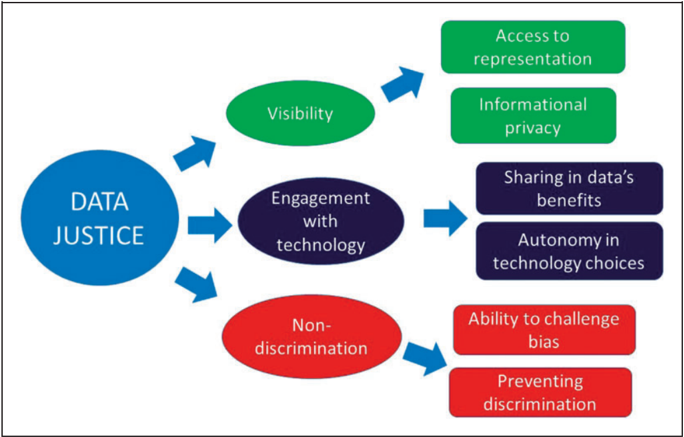
The increasing availability of digital data reflecting economic and human development, and in particular the availability of data emitted as a by-product of people’s use of technological devices and services, has both political and practical implications for the way people are seen and treated by the state and by the private sector. Yet the data revolution is so far primarily a technical one: the power of data to sort, categorise and intervene has not yet been explicitly connected to a social justice agenda by the agencies and authorities involved. Meanwhile, although data-driven discrimination is advancing at a similar pace to data processing technologies, awareness and mechanisms for combating it are not. This paper posits that just as an idea of justice is needed in order to establish the rule of law, an idea of data justice – fairness in the way people are made visible, represented and treated as a result of their production of digital data – is necessary to determine ethical paths through a datafying world. Bringing together the emerging scholarly perspectives on this topic, I propose three pillars as the basis of a notion of international data justice: (in)visibility, (dis)engagement with technology and antidiscrimination. These pillars integrate positive with negative rights and freedoms, and by doing so challenge both the basis of current data protection regulations and the growing assumption that being visible through the data we emit is part of the contemporary social contract.
Overview
The claims and statistics of this paper haven’t been checked yet.
Free: it reads the open-access text and checks the first 5 claims that cite a source we can check. Create a free account to check every claim.
Integrity signals
Registry
Cites
Statistics
Figures

Verification
Claims the paper makes
The claims and statistics of this paper haven’t been checked yet.
Free: it reads the open-access text and checks the first 5 claims that cite a source we can check. Create a free account to check every claim.
Claims other papers make about this one
Each is checked against this paper’s own text: does it say what the citing paper says it does?
The cited source says what the claim attributes to it.
In the citing paper
“It stresses the importance of developing individual freedoms in relation to how data are used and collected and advocates for enhanced autonomy and agency: people should be able to decide whether they want to participate in this system.”
From Staring Back at the Surveillance Gaze: The Resistance of LGBTQ+ Users on Social Media (2026) · cites this paper as Taylor 2017
The cited source says what the claim attributes to it.
In the citing paper
“Data justice frameworks are particularly invested in understanding the impacts, both negative and positive, of datafication and identifying ways to address them.”
From Staring Back at the Surveillance Gaze: The Resistance of LGBTQ+ Users on Social Media (2026) · cites this paper as Taylor 2017
The check wasn’t confident either way, so it gives no verdict — never disputed.
In the citing paper
“Because of this, the topic of data quality is beginning to transcend beyond the field of data management and into the realm of Human Computer Interaction (HCI), which accommodates holistic considerations such as how people search for relevant datasets [42], how developers perceive data work [64] and the best ways of using crowdsourcing to generate, evaluate or label data [71].”
From A Survey of Data Quality Requirements That Matter in ML Development Pipelines (2023) · cites this paper as [71]
Experimental — accuracy not yet measuredIn the citing paper
“Linnet Taylor (2017) advocates for a data justice framework acknowledging that, while there is a rapid development of data processing technologies, there is a lack of considerations of how datafication plays into broader social justice issues.”
From Staring Back at the Surveillance Gaze: The Resistance of LGBTQ+ Users on Social Media (2026) · cites this paper as Taylor 2017
In the citing paper
“For Taylor (2017), data justice revolves around three pillars: visibility, digital (dis)engagement, and countering data-driven discrimination.”
From Staring Back at the Surveillance Gaze: The Resistance of LGBTQ+ Users on Social Media (2026) · cites this paper as Taylor 2017
Self-check
Percentages, sums and reported differences re-computed from the paper’s own numbers.
The self-check needs the paper’s full text.
Citations
Cites
Clapp, J., & Sen, A. (1999) · International Journal Canada s Journal of Global Policy Analysis · doi:10.1177/002070200005500119 · Cited by 13,507
Clapp, J., & Sen, A. (1999) · International Journal · doi:10.2307/40203469 · Cited by 13,411
Sorting Things Out: Classification and Its Consequences
Bowker, G. C., & Star, S. L. (1999) · doi:10.7551/mitpress/6352.001.0001 · Cited by 6,188
(1993) · Oxford University Press eBooks · doi:10.1093/0198287976.001.0001 · Cited by 4,239
Toward a Field of Intersectionality Studies: Theory, Applications, and Praxis
Cho, S., Crenshaw, K. W., & McCall, L. (2013) · Signs: Journal of Women in Culture and Society · doi:10.1086/669608 · Cited by 4,126 · cited 2×
“This intersectionality (Cho et al., 2013) in the effects of datafication is an important component of the argument for a social justice perspective.”
BackgroundDoyle, T. (2017) · The Information Society · doi:10.1080/01972243.2017.1354593 · Cited by 3,071 · cited 3×
“O’Neil (2016) has warned that algorithmic models must be constantly recalibrated using feedback from the events they are supposed to predict.”
BackgroundNew York University Law Review
Rawls, J. (2017) · Justice · doi:10.4324/9781315193496-11 · Cited by 2,872
Lemke, T. (2001) · Economy and Society · doi:10.1080/03085140120042271 · Cited by 2,043 · cited 2×
“…designed to assure that people are not misusing state welfare funds and other publicly funded support are part of the apparatus of governmentality (Lemke, 2001); data-driven law enforcement focuses unequally on poor neighbourhoods which experience certain types of criminality (O’Neil, 2016); and…”
BackgroundSen, A. (2005) · Journal of Human Development · doi:10.1080/14649880500120491 · Cited by 1,966 · cited 5×
“Many states and regions, for example, take a perspective on rights that frames them as inseparable from corresponding duties, and also addresses the individual as part of the larger collective (Sen, 2005).”
BackgroundInfluentialLevin, K., Cashore, B., Bernstein, S., & Auld, G. (2012) · Policy Sciences · doi:10.1007/s11077-012-9151-0 · Cited by 1,839
Research works printed but not linked: 19
- Alkire S (2011) The capability approach and human development. University of Oxford. Available at: http://www.ophi. org.uk/wp-content/uploads/OPHI-HDCA-SS11-Intro-tothe-Capability-Approach-SA.pdf (accessed 23 June 2017).
- Arora P (2016) Bottom of the data pyramid: Big data and the global south. International Journal of Communication 10: 19.
- Eubanks V (2014) Want to predict the future of surveillance? Ask poor communities. The American Prospect , pp. 1-4. Available at: http://prospect.org/article/want-predict-futuresurveillance-ask-poor-communities#.VXbsO\_Oh2k8.twitter (accessed 9 October 2017).
- Foucault M (1977) Discipline & punish -Panopticism. Discipline and Punish: The Birth of the Prison. New York: Vintage, pp. 195-228.
- Holvast J (2013) De Volkstelling van 1971 . Amsterdam: Uitgeverij Paris.
- Jayaram M (2014) India's big brother project. Boston Review . Available at: http://www.bostonreview.net/world/malavika-jayaram-india-unique-identification-biometrics (accessed 1 January 2016).
- Kroll JA, et al. (2016) Accountable algorithms. University of Pennsylvania Law Review 165(633): 633-705.
- Makulilo AB (2016) ''A person is a person through other persons'' - A critical analysis of privacy and culture in Africa, Beijing Law Review 7: 192-204.
- Masiero S (2016) Digital governance and the reconstruction of the Indian anti-poverty system. Oxford Development Studies 818: 1-16.
- Nussbaum MC (2006) Frontiers of Justice: Disability, Nationality, and Species Membership . Cambridge, MA: Harvard University Press.
- O'Neil C (2016) Weapons of Math Destruction: How Big Data Increases Inequality and Threatens Democracy . New York: Crown Publishing Group.
- Raymond NA (2016) Beyond ''do no harm'' and individual consent: Reckoning with the emerging ethical challenges of civil society's use of data. In: Taylor L, Floridi L and van der Sloot B (eds) Group Privacy: New Challenges of Data Technologies . Springer International, pp. 67-82.
- Shearmur R (2015) Dazzled by data: Big Data, the census and urban geography. Urban Geography 36(7): 965-968.
- Spivak GC (1988) Can the subaltern speak? In: Nelson C and Grossberg L (eds) Marxism and the Interpretation of Culture . University of Illinois Press, pp. 271-313.
- Taylor L (2016a) From zero to hero: How zero-rating became a debate about human rights. IEEE Internet Computing 20(4): 79-83.
- Taylor L (2016b) No place to hide? The ethics and analytics of tracking mobility using mobile phone data. Environment and Planning D: Society and Space 34(2): 319-336.
- Taylor L (2016c) Safety in numbers? Group privacy and big data analytics in the developing world. Group Privacy: New Challenges of Data Technologies . Dordrecht: Springer.
- Taylor L (2016d) The ethics of big data as a public good: Which public? Whose good? Philosophical Transactions of the Royal Society A 374: 1-13.
- Taylor L and Broeders D (2015) In the name of development: Power, profit and the datafication of the global South. Geoforum 64(4): 229-237.
Cited by
Items 801–862 of 862
Future Directions of AI–IoT in Smart Urban Planning
Almulhim, A. I., Sharifi, A., Cheshmehzangi, A., He, B., & de Jong, M. (2026) · Urban sustainability · doi:10.1007/978-981-92-1011-4_16
Verma, V., Singh, H., & -, P. K. (2026) · IGI Global eBooks · doi:10.4018/979-8-3373-7107-8.ch012
Privacy and vulnerable populations: A 20-year bibliometric analysis
Ntlatywa, P., & van Greunen, D. (2026) · South African journal of information management · doi:10.4102/sajim.v28i1.2146
Vargas, L. C. M., & Macadar, M. A. (2026) · Revista de Administração Pública · doi:10.1590/0034-761220260079
Adnan, S. (2026) · Springer eBooks · doi:10.1007/978-981-10-7035-8_93-2
PhD, F. Y. A. (2026) · European Scientific Journal ESJ · doi:10.19044/esipreprint.8.2026.p528
PhD, F. Y. A. (2026) · European Scientific Journal ESJ · doi:10.19044/esipreprint.8.2026.p608
Artificial Intelligence and Social Welfare
Bahmani, N., Hamdaoui, A., & OULAICH, J. (2026) · International Journal of Research in Economics and Finance · doi:10.71420/ijref.v3i8-2.387
Building a Digital Smart City Index System for Urban Planning and Governance
Cai, Z., Wu, T., Li, Y., & Guan, C. (2026) · Applied Spatial Analysis and Policy · doi:10.1007/s12061-026-09988-9
“Research on data justice further argues that datafication tends to deliver fewer benefits to marginalized and informal populations unless visibility, representation, and participation are explicitly addressed (Taylor, 2017; Heeks & Shekhar, 2019).”
Masso, A., Pietarinen, A.-V., Ibrahimi, M., & Yahia, S. B. (2026) · AI & Society · doi:10.1007/s00146-026-03278-1
“…perceptions of security are not derived from technical performance alone but are shaped by how data-driven systems render people visible, categorize them, and differentially engage with social groups, raising questions of fairness and discrimination in socio-technical contexts (Taylor 2017).”
Refined Exclusion in Medical AI: Data Justice and Patient Safety Governance
Lee, J. H., Choi, B., Jeong, K., Suh, S. W., Kim, J. H., & Son, D. (2026) · Journal of Medical Internet Research · doi:10.2196/102359
“In its broader formulation, data justice examines how data systems determine whose experiences are made visible, how people are represented, and how they are treated [22].”
Women in Agriculture 4.0: Inequalities, Competencies, and Sociotechnical Innovation
Macário, C. G. D. N., Souza, M. I. F., de Abreu, L. S., de Carvalho, L. M., & Torres, T. Z. (2026) · Springer eBooks · doi:10.1007/978-3-032-24552-6_30
Moving in, Between and Through ANT: Translating and Being Translated
Thompson, T. L. (2026) · Springer eBooks · doi:10.1007/978-981-92-1483-9_2 · Cited by 1
刘, 艺. (2026) · Interdisciplinary Science Letters · doi:10.12677/isl.2026.105145
Mexhuani, B. (2026) · Policy Sciences · doi:10.1007/s11077-026-09630-y
AI Actors in the International Political Ecology: Power, Governance, and Environmental Futures
Sachan, S., & Shukla, D. (2026) · Advances in computational intelligence and robotics book series · doi:10.4018/979-8-2600-1413-4.ch009
Finding Life in Data: How Youth Engage Data in their Lives towards Data Education Justice
Barton, A. C., Clegg, T., & Tan, E. (2026) · Cognition and Instruction · doi:10.1080/07370008.2026.2727349
“…data literacy pursuits, especially those of youth from minoritized, resource-constrained communities as they navigate the everyday injustices and oppression disproportionately impacting them personally and their communities collectively (Philip et al., 2016; Taylor, 2017; Vakil et al., 2020, 2023).”
Anapey, G. M. (2026) · Springer eBooks · doi:10.1007/978-3-032-30647-0_11
Boutier, I. (2026) · Frontiers in Education · doi:10.3389/feduc.2026.1922260
Uzorka, A., & Odebiyi, O. A. (2026) · International Journal of Educational Research Open · doi:10.1016/j.ijedro.2026.100598
Introducing Accountable Design
Urquhart, L. D. (2026) · Cambridge University Press eBooks · doi:10.1017/9781108985734.002
Who Moves and Who Decides? Data-Driven Policy Models and Power in Climate Migration GovernancePreprint
Bibi, H., Tahir, M., & Alam, A. (2026) · SSRN Electronic Journal · doi:10.2139/ssrn.7488605
Attarassi, Y., & Karkouri, J. A. (2026) · Smart Cities · doi:10.3390/smartcities9090154
“Data-justice scholarship adds a warning we take as a design constraint: absence of published data is not the absence of knowledge, and measuring the former must not slide into a deficit story about Southern institutions [18–20].”
Jalbert, K., Hernández-Cortés, D., Kuznetsov, S., Florence, N., Guerrero, M. L., DeConcini, T., & Vega, A. R. (2026) · Sustainable Futures · doi:10.1016/j.sftr.2026.102169
A meta-synthesis of the big data in urban transportation planning processes
Setthasuravich, P., Sirikhan, K., Chalermpong, S., Thaithatkul, P., Uchiyama, Y., Irawan, M. Z., Alvarez, D. D. B., & Kato, H. (2026) · Cities · doi:10.1016/j.cities.2026.107632
Kirui, A. K. (2020) · Journal of Education and Learning Technology · doi:10.38159/jelt.2026781
Nichols, B. L., Groth, C., & Quinn, T. D. (2026) · Preventing Chronic Disease · doi:10.5888/pcd23.260255
The future of emergency management: Building a professionalized discipline for the 21st century
Doss, T. C. (2026) · Journal of Emergency Management · doi:10.5055/jem.1056
Spoof, decouple, evade: The infrapolitics of data illegibility in Hong Kong
Ting, T.-Y. (2026) · Big Data & Society · doi:10.1177/20539517261494677
Bapa, M. M. D. M., Liliweri, A., Djaha, A. S. A., Nursalam, N., & SAYRANI, L. P. (2026) · Jurnal Public Policy · doi:10.35308/jpp.v12i3.15028
“These findings reinforce the argument that justice in implementation depends not only on administrative delivery, but also on whether policy institutions can recognize differentiated forms of vulnerability and respond accordingly (Andrews & Kacmar, 2001; Dragoman, 2018; Taylor, 2017).”
Recognising the Benefits and Challenges of AI in Policing
Rowley, C., & Akhgar, B. (2026) · Security informatics and law enforcement · doi:10.1007/978-3-032-41284-3_1
Zur Berechenbarkeit von Umwelten: Wissenspolitiken und Klimagovernance
Eitel, K. (2026) · Kulturanthropologie Notizen · doi:10.21248/ka-notizen.88.78
Grobiša, A., Švigelj, B. V., Šprah, L., Grasselli, M. S., Rožič, T., Letina, D., Lah, T. K., Tojnko, N. K., Hočevar, D. K., Hafner, N. D., et al. (2026) · ZRC SAZU, Založba ZRC eBooks · doi:10.3986/9789610511793
Contradictions of agricultural digitalisation:
Manzoni, D. (2026) · ZRC SAZU, Založba ZRC eBooks · doi:10.3986/9789610511793_04
Digital Arrest Scams: The Inversion of Inclusion-Oriented Digital Infrastructure in India
Sharma, H., & Shethia, S. (2026) · IFIP advances in information and communication technology · doi:10.1007/978-3-032-30942-6_8
Qaffas, Y. (2026) · SSRN Electronic Journal · doi:10.2139/ssrn.7569219
Mohd, S. A. B., & Islam, M. A. (2026) · SSRN Electronic Journal · doi:10.2139/ssrn.7564478
Mijatović, M. D., & Ivanišević, A. (2026) · International Scientific Conference Law Days – Prof. Slavko Carić, PhD · doi:10.5937/pdsc26048d
Digital Financial Inclusion as Anticipatory Governance: Public Value, Resilience, and Equity
Negi, S., & Tyagi, N. (2026) · IGI Global eBooks · doi:10.4018/979-8-3373-9765-8.ch007
The constitutionalization of the right to water: Comparative perspectives and digital challenges
Oláh, E. E. (2026) · International Scientific Conference Law Days – Prof. Slavko Carić, PhD · doi:10.5937/pdsc26051o
Humanitarian Femtech: Reproductive Governance and Digital Infrastructures of Care
Jeziorek, M., & Tusikov, N. (2026) · Social Politics International Studies in Gender State & Society · doi:10.1093/sp/jxag063
Beyond Principlism: A Cosmopolitan and Care Ethics Approach to One Digital Health
Moyano-Fernández, C., Rueda, J., Delgado, J., Gómez-Franco, I., Martínez‐López, M. V., Toledo‐Chávarri, A., Rangel-Teixeira, A., & Puyol, A. (2026) · Journal of Bioethical Inquiry · doi:10.1007/s11673-026-10633-w
Munisekhar, K., & Morarji, B. (2026) · Frontiers in Sustainable Cities · doi:10.3389/frsc.2026.1959012
“Finally, data justice directs attention to how datafication distributes visibility, voice, and vulnerability across urban populations (Taylor, 2017; Heeks and Shekhar, 2019).”
InfluentialThe Universal Woman of SDG 5: Intersectional Silences in Global Gender Policy Discourse
Gunjial, T. R., & Manj, Y. N. (2026) · Journal of Language Literature & Social Affairs · doi:10.63056/jllsa.2.10.2026.397
(2026) · International Journal of Drug Delivery Technology · doi:10.25258/ijddt.16.77s.20
“The framework of data justice by Taylor (2017) can be applied to this situation, since it is not focused on privacy but on visibility, representation, and the ability to contribute to data decision-making.”
Atenas, J., Farrow, R., Caldwell, N. H. M., Costello, É., & Havemann, L. (2026) · International Review of Education · doi:10.1007/s11159-026-10229-x
Governing Smallholder Data in Digital Agriculture: A Multi-Stakeholder AssessmentPreprint
Amar, S., & Cörvers, R. (2026) · SSRN Electronic Journal · doi:10.2139/ssrn.7657651
Beyond smart cities: rethinking urban AI for inclusive development in the Global South
Almulhim, A. I. (2026) · Development in Practice · doi:10.1080/09614524.2026.2747116
Othman, K., Ismail, M., & Sawal, M. Z. H. M. (2026) · Advanced International Journal of Business Entrepreneurship and SMEs · doi:10.35631/aijbes.829108
Beyond harmony: critiquing and politicising Ubuntu in AI ethics
Nyamnjoh, A.-N., & de Vries, J. (2026) · AI and Ethics · doi:10.1007/s43681-026-01458-9
“Data implicate wider networks of relationship, generate knowledge through aggregation and collective patterns, and can reproduce structural inequalities that exceed the choices or interests of any single data subject [7, 21, 64, 76].”
Sanzharovskyi, I. M. (2026) · Culturological Almanac · doi:10.31392/cult.alm.2026.3.22
“…reference points of public deliberation (Haber-mas, 1989, p. 27–31), participatory parity (Fraser, 1998, p. 5–6), and visibility and non-discrimina-tion in the data sphere (Taylor, 2017, p. 7–9); and (4) identifying the possible significance of repeated interaction for political self-understanding.”
InfluentialData Sovereignty in the Digital Age
Osaulenko, O. H., & Horobets, O. (2026) · Statistics of Ukraine · doi:10.31767/su.3(114)2026.03.01
Wu, Y., & Rodriguez, L. (2026) · Educational Policy · doi:10.1177/08959048261500084
Condolo-Pardo, D. E., & Castillo, T. R. T. (2026) · Acta Innovations · doi:10.62441/actainnovations.vi.2640
Harper, C., Jawara, J., Hernandez, T., Whitaker, N., Sawwan, M., Wood, D., Erete, S. L., Weight, E. A., Blue, M. N. M., Kerr, Z. Y., et al. (2026) · doi:10.1145/3838843.3838857
Data Sovereignty and Algorithmic Governance in Developing Economies: Reclaiming Digital Agency
Varsha, M. S., & Subramani, A. K. (2026) · IGI Global eBooks · doi:10.4018/979-8-2600-0393-0.ch010
Understanding Exclusion Errors and Unequal Access to Social Protection in Indonesia
Tuwu, D. (2026) · International Journal of Contemporary Sciences · doi:10.55927/6546bc39
Sam-Ibrahim, F. E., Sodangi, D., & Abubakar, F. (2026) · Adolescencia e Saude · doi:10.67440/ahj.vi.2913
Vahia, I. V. (2026) · American Journal of Geriatric Psychiatry · doi:10.1016/j.jagp.2026.09.015
RetractedThe shift from browsing to AI prompting challenges web-tracking data
Martinez‐Serra, A., & Fuente-Cuesta, A. D. L. (2026) · Discover Data · doi:10.1007/s44248-026-00122-1
Metadata
- Authors
- Taylor, L.
- Affiliations
- Tilburg University (NL)
- Corresponding author
- Taylor, Linnet
- ORCID
- Taylor, Linnet
- Venue
- Big Data & Society
- Publisher
- SAGE Publications
- Published
- 2017-11
- Volume
- 4
- Issue
- 2
- Pages
- 205395171773633
- ISSN
- 2053-9517 (ISSN-L)
- OpenAlex
- W2590124083
- Cited by
- 802
- References
- 38
- Citations by year
- 2026: 127 · 2025: 168 · 2024: 99 · 2023: 126 · 2022: 89 · 2021: 55 · 2020: 74 · 2019: 47 · 2018: 17
- FWCI
- 86.62
- Type
- journal article
- Language
- en
- Open access
- gold
- doi.org
- Licence
- cc-by-nc-nd
- journals.sagepub.com/page/policies/text-and-data-mining-license (tdm)
- Locations
- Big Data & Society (publishedVersion, cc-by-nc-nd)
- Tilburg University Research Portal (publishedVersion, other-oa)
- Research portal (Tilburg University) (submittedVersion, other-oa)
- Data Archiving and Networked Services (DANS) (submittedVersion, other-oa)
- DOAJ (DOAJ: Directory of Open Access Journals) (submittedVersion, cc-by-sa)
- EUR Research Repository (Erasmus University Rotterdam) (submittedVersion)
- Funders
- European Commission (624583)
- Universiteit van Amsterdam
- Topics
- Physical Sciences › Computer Science › Artificial Intelligence › Ethics and Social Impacts of AI
- Social Sciences › Law › Digitalization, Law, and Regulation
- Social Sciences › Business, Management and Accounting › Industrial relations › Legal and Labor Studies
- Keywords
- data justice, digital rights, internet freedom, datafication, visibility, anti-discrimination, data protection regulation, social justice, digital data, social contract
About these checks
Registry, retraction, Cites and statistics results are computed, not judged, with one exception: a printed reference that no index lists is read once by a model before it counts as a citation error. Claims are extracted by a model and kept only when their quote appears verbatim in the text; each cited source is then checked, with a model’s help, for whether it says what the claim relies on. Those verdicts can be wrong — read the claim’s quote and the cited source before relying on one.
Statistics and arithmetic are recomputed, not judged.
Confidence bands are shown only for fields calibrated on our annotated test set. None is calibrated yet, so no band is shown.
What counts as a claim ›How we measure confidence ›How we check this ›
Are you an author, or do you see a problem with this page? Request a review
Data sources
Bibliographic data: Semantic Scholar, OpenAlex, Crossref.
Contains information from the Semantic Scholar Academic Graph Datasets, made available under the ODC Attribution License (ODC-BY 1.0).
Semantic Scholar’s data is described in: Kinney, R., et al. (2023). The Semantic Scholar Open Data Platform. arXiv:2301.10140.
