

What is data justice? The case for connecting digital rights and freedoms globally
Open accessThe DOI matches its Crossref record; 38 of the 41 references it cites were found in a registry or an index, and 3 are not checked yet.
Abstract
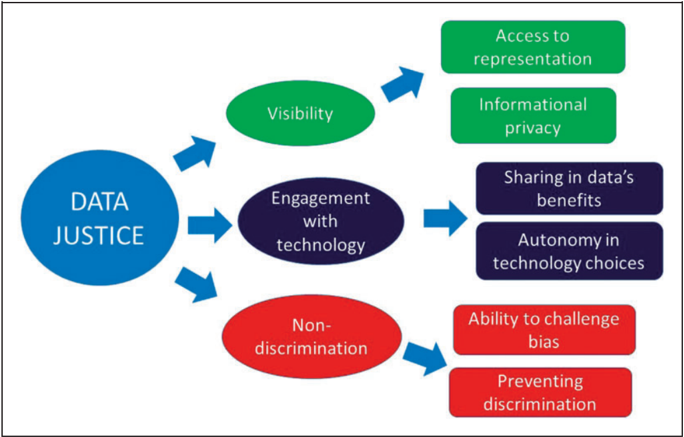
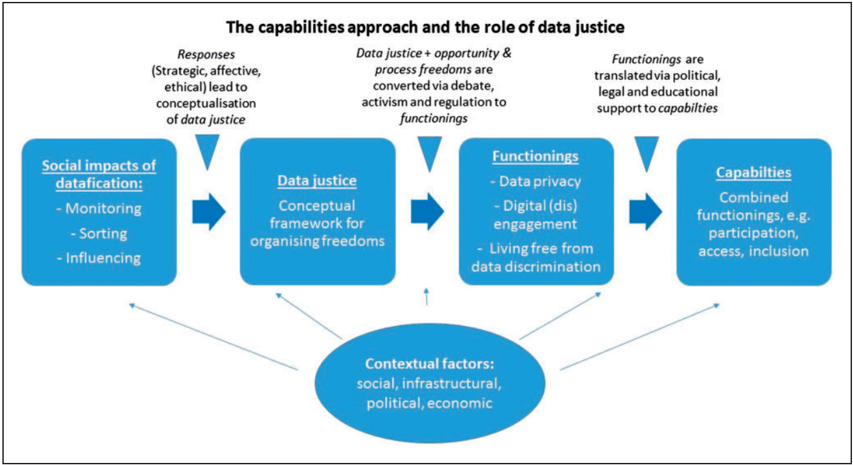
The increasing availability of digital data reflecting economic and human development, and in particular the availability of data emitted as a by-product of people’s use of technological devices and services, has both political and practical implications for the way people are seen and treated by the state and by the private sector. Yet the data revolution is so far primarily a technical one: the power of data to sort, categorise and intervene has not yet been explicitly connected to a social justice agenda by the agencies and authorities involved. Meanwhile, although data-driven discrimination is advancing at a similar pace to data processing technologies, awareness and mechanisms for combating it are not. This paper posits that just as an idea of justice is needed in order to establish the rule of law, an idea of data justice – fairness in the way people are made visible, represented and treated as a result of their production of digital data – is necessary to determine ethical paths through a datafying world. Bringing together the emerging scholarly perspectives on this topic, I propose three pillars as the basis of a notion of international data justice: (in)visibility, (dis)engagement with technology and antidiscrimination. These pillars integrate positive with negative rights and freedoms, and by doing so challenge both the basis of current data protection regulations and the growing assumption that being visible through the data we emit is part of the contemporary social contract.
Overview
The claims and statistics of this paper haven’t been checked yet.
Free: it reads the open-access text and checks the first 5 claims that cite a source we can check. Create a free account to check every claim.
Integrity signals
Registry
Cites
Statistics
Figures

Verification
Claims the paper makes
The claims and statistics of this paper haven’t been checked yet.
Free: it reads the open-access text and checks the first 5 claims that cite a source we can check. Create a free account to check every claim.
Claims other papers make about this one
Each is checked against this paper’s own text: does it say what the citing paper says it does?
The cited source says what the claim attributes to it.
In the citing paper
“It stresses the importance of developing individual freedoms in relation to how data are used and collected and advocates for enhanced autonomy and agency: people should be able to decide whether they want to participate in this system.”
From Staring Back at the Surveillance Gaze: The Resistance of LGBTQ+ Users on Social Media (2026) · cites this paper as Taylor 2017
The cited source says what the claim attributes to it.
In the citing paper
“Data justice frameworks are particularly invested in understanding the impacts, both negative and positive, of datafication and identifying ways to address them.”
From Staring Back at the Surveillance Gaze: The Resistance of LGBTQ+ Users on Social Media (2026) · cites this paper as Taylor 2017
The check wasn’t confident either way, so it gives no verdict — never disputed.
In the citing paper
“Because of this, the topic of data quality is beginning to transcend beyond the field of data management and into the realm of Human Computer Interaction (HCI), which accommodates holistic considerations such as how people search for relevant datasets [42], how developers perceive data work [64] and the best ways of using crowdsourcing to generate, evaluate or label data [71].”
From A Survey of Data Quality Requirements That Matter in ML Development Pipelines (2023) · cites this paper as [71]
Experimental — accuracy not yet measuredIn the citing paper
“Linnet Taylor (2017) advocates for a data justice framework acknowledging that, while there is a rapid development of data processing technologies, there is a lack of considerations of how datafication plays into broader social justice issues.”
From Staring Back at the Surveillance Gaze: The Resistance of LGBTQ+ Users on Social Media (2026) · cites this paper as Taylor 2017
In the citing paper
“For Taylor (2017), data justice revolves around three pillars: visibility, digital (dis)engagement, and countering data-driven discrimination.”
From Staring Back at the Surveillance Gaze: The Resistance of LGBTQ+ Users on Social Media (2026) · cites this paper as Taylor 2017
Self-check
Percentages, sums and reported differences re-computed from the paper’s own numbers.
The self-check needs the paper’s full text.
Citations
Cites
Clapp, J., & Sen, A. (1999) · International Journal Canada s Journal of Global Policy Analysis · doi:10.1177/002070200005500119 · Cited by 13,507
Clapp, J., & Sen, A. (1999) · International Journal · doi:10.2307/40203469 · Cited by 13,411
Sorting Things Out: Classification and Its Consequences
Bowker, G. C., & Star, S. L. (1999) · doi:10.7551/mitpress/6352.001.0001 · Cited by 6,188
(1993) · Oxford University Press eBooks · doi:10.1093/0198287976.001.0001 · Cited by 4,239
Toward a Field of Intersectionality Studies: Theory, Applications, and Praxis
Cho, S., Crenshaw, K. W., & McCall, L. (2013) · Signs: Journal of Women in Culture and Society · doi:10.1086/669608 · Cited by 4,126 · cited 2×
“This intersectionality (Cho et al., 2013) in the effects of datafication is an important component of the argument for a social justice perspective.”
BackgroundDoyle, T. (2017) · The Information Society · doi:10.1080/01972243.2017.1354593 · Cited by 3,071 · cited 3×
“O’Neil (2016) has warned that algorithmic models must be constantly recalibrated using feedback from the events they are supposed to predict.”
BackgroundNew York University Law Review
Rawls, J. (2017) · Justice · doi:10.4324/9781315193496-11 · Cited by 2,872
Lemke, T. (2001) · Economy and Society · doi:10.1080/03085140120042271 · Cited by 2,043 · cited 2×
“…designed to assure that people are not misusing state welfare funds and other publicly funded support are part of the apparatus of governmentality (Lemke, 2001); data-driven law enforcement focuses unequally on poor neighbourhoods which experience certain types of criminality (O’Neil, 2016); and…”
BackgroundSen, A. (2005) · Journal of Human Development · doi:10.1080/14649880500120491 · Cited by 1,966 · cited 5×
“Many states and regions, for example, take a perspective on rights that frames them as inseparable from corresponding duties, and also addresses the individual as part of the larger collective (Sen, 2005).”
BackgroundInfluentialLevin, K., Cashore, B., Bernstein, S., & Auld, G. (2012) · Policy Sciences · doi:10.1007/s11077-012-9151-0 · Cited by 1,839
Research works printed but not linked: 19
- Alkire S (2011) The capability approach and human development. University of Oxford. Available at: http://www.ophi. org.uk/wp-content/uploads/OPHI-HDCA-SS11-Intro-tothe-Capability-Approach-SA.pdf (accessed 23 June 2017).
- Arora P (2016) Bottom of the data pyramid: Big data and the global south. International Journal of Communication 10: 19.
- Eubanks V (2014) Want to predict the future of surveillance? Ask poor communities. The American Prospect , pp. 1-4. Available at: http://prospect.org/article/want-predict-futuresurveillance-ask-poor-communities#.VXbsO\_Oh2k8.twitter (accessed 9 October 2017).
- Foucault M (1977) Discipline & punish -Panopticism. Discipline and Punish: The Birth of the Prison. New York: Vintage, pp. 195-228.
- Holvast J (2013) De Volkstelling van 1971 . Amsterdam: Uitgeverij Paris.
- Jayaram M (2014) India's big brother project. Boston Review . Available at: http://www.bostonreview.net/world/malavika-jayaram-india-unique-identification-biometrics (accessed 1 January 2016).
- Kroll JA, et al. (2016) Accountable algorithms. University of Pennsylvania Law Review 165(633): 633-705.
- Makulilo AB (2016) ''A person is a person through other persons'' - A critical analysis of privacy and culture in Africa, Beijing Law Review 7: 192-204.
- Masiero S (2016) Digital governance and the reconstruction of the Indian anti-poverty system. Oxford Development Studies 818: 1-16.
- Nussbaum MC (2006) Frontiers of Justice: Disability, Nationality, and Species Membership . Cambridge, MA: Harvard University Press.
- O'Neil C (2016) Weapons of Math Destruction: How Big Data Increases Inequality and Threatens Democracy . New York: Crown Publishing Group.
- Raymond NA (2016) Beyond ''do no harm'' and individual consent: Reckoning with the emerging ethical challenges of civil society's use of data. In: Taylor L, Floridi L and van der Sloot B (eds) Group Privacy: New Challenges of Data Technologies . Springer International, pp. 67-82.
- Shearmur R (2015) Dazzled by data: Big Data, the census and urban geography. Urban Geography 36(7): 965-968.
- Spivak GC (1988) Can the subaltern speak? In: Nelson C and Grossberg L (eds) Marxism and the Interpretation of Culture . University of Illinois Press, pp. 271-313.
- Taylor L (2016a) From zero to hero: How zero-rating became a debate about human rights. IEEE Internet Computing 20(4): 79-83.
- Taylor L (2016b) No place to hide? The ethics and analytics of tracking mobility using mobile phone data. Environment and Planning D: Society and Space 34(2): 319-336.
- Taylor L (2016c) Safety in numbers? Group privacy and big data analytics in the developing world. Group Privacy: New Challenges of Data Technologies . Dordrecht: Springer.
- Taylor L (2016d) The ethics of big data as a public good: Which public? Whose good? Philosophical Transactions of the Royal Society A 374: 1-13.
- Taylor L and Broeders D (2015) In the name of development: Power, profit and the datafication of the global South. Geoforum 64(4): 229-237.
Cited by
Items 401–500 of 862
Valuing curation infrastructures
Wofford, M. F., Thomer, A. K., Hemphill, L., Polásek, K., & Yakel, E. (2025) · Journal of the Association for Information Science and Technology · doi:10.1002/asi.70015 · Cited by 6
“Taylor (2017) proposes a data justice research agenda examining both the beneficial and negative aspects of data.”
Santoro, C., Flores, C. A. C., Zuiderwijk, A., & Crompvoets, J. (2025) · Information Polity · doi:10.1177/15701255251367168 · Cited by 3
“Regarding the first category (naming), we see that inequities in open data go beyond participation and inclusion, encompassing also more structural issues of data justice (Taylor, 2017).”
Unsafe workplaces, marketed students: The deepfake policy gap in education
Arantes, J. A. (2025) · Policy Futures in Education · doi:10.1177/14782103251381953 · Cited by 6
“Digital technologies have only intensi fi ed this dynamic, enabling new forms of discrimination, intimidation, and profound psychological harm, which has been evidenced in a broad body of research (Burdon and Harpur, 2014; Datta et al., 2018; K¨ochling and Wehner, 2020; Taylor, 2017).”
Ravn, L. (2025) · Big Data & Society · doi:10.1177/20539517251381670 · Cited by 5
“Finally, the non-discrimination dimension relates to the ability to challenge biases and the prevention of discrimination (Taylor, 2017).”
InfluentialAhmmad, M., Yaqoub, M., & Al-Kassimi, K. (2025) · IGI Global eBooks · doi:10.4018/979-8-3373-1722-9.ch006 · Cited by 3
Disability Data Futures: Achievable Imaginaries for AI and Disability Data Justice
Newman-Griffis, D. R., Swenor, B. K., Valdez, R. S., & Mason, G. (2025) · Springer eBooks · doi:10.1007/978-3-031-93022-5_16 · Cited by 5
Rawson, B. (2025) · International Journal of Law in Context · doi:10.1017/s1744552325100347 · Cited by 5
Suraj Begum, R., Saravana Mahesan, S., Min, J., Divya, D., & Sakkan, T. (2025) · Asian Journal of Interdisciplinary Research · doi:10.54392/ajir25417 · Cited by 6
“The aforementioned behaviour is referred to by Couldry and Mejias as "data colonialism," a process in which digital systems use quantification to reshape social interactions while extracting value from human life activities (Taylor, 2017).”
Environmental data justice is key for developing more effective area-based conservation approaches
Goldstein, J. E., Brockington, D., Sandbrook, C. G., Meyfroidt, P., Geldmann, J., Kuemmerle, T., Pfeifer, M., Sauls, L. A., Vera, L. A., Dutta, A., et al. (2026) · Nature Reviews Biodiversity · doi:10.1038/s44358-025-00126-w · Cited by 4
“…FAIR criteria (findable, accessible, interoperable and reusable) principles for open data as well as good data practices such as the Indigenous data sovereignty principles of CARE (community benefit, authority to con-trol, responsibility and ethics) in data management and research 64–66 .”
Morales, S., Natansohn, G., & Molina, S. (2025) · Signo y Pensamiento · doi:10.11144/javeriana.syp44.tfrd · Cited by 4
Global Competition and Internationalization: The Influence of Rankings on Higher Education
Chheang, S., Huot, S., Loch, S., & Rous, M. (2026) · IGI Global eBooks · doi:10.4018/979-8-3373-6856-6.ch004 · Cited by 4
Butorac, I., McNaney, R., Thomas, J., Flores-Herrera, A., Seguin, J. P., Northam, J. C., & Carter, A. (2026) · ACM Transactions on Computing for Healthcare · doi:10.1145/3805040 · Cited by 3
“As digital data become increasingly available, researchers have suggested applying a data justice perspective that considers intersectionality and explores how data systems may discriminate against or control populations based on their socio-cultural positioning [74, 161].”
van Daalen, K. R., Dada, S., Abímbọ́lá, Ṣ., Bhaumik, S., Chilisa, B., Deerasinghe, G., Kyobutungi, C. K., Peters, S. A. E., Phelan, A., Rajeev, A., et al. (2026) · The Lancet Global Health · doi:10.1016/s2214-109x(26)00054-9 · Cited by 3
Justice in the governance of personal health data spaces: stakeholder perspectives in Belgium
Laes, E., Denier, Y., Goesaert, E., van Schyndel, C., & Lambrechts, N. (2026) · BMC Medical Ethics · doi:10.1186/s12910-026-01531-2 · Cited by 3
Muligheder og barrierer for kunstig intelligens i den offentlige sektor: En socioteknisk analyse
Christensen, S. N., Nielsen, J. A., Noesgaard, M. S., Elmholdt, K. T., & Ratner, H. (2024) · Samfundslederskab i Skandinavien · doi:10.22439/sis.v39i4.7325 · Cited by 3
Tempered enthusiasm by interviewed experts for synthetic data and ELSI checklists for AI in medicine
Cabrera, L. Y., Wagner, J. K., Gerke, S., & Susser, D. (2025) · AI and Ethics · doi:10.1007/s43681-024-00652-x · Cited by 6
“…accurately the data reflect the complex population, and whether the data were voluntarily shared or are the byproduct of our datafication society [ 39 ]; the regulatory framework in different jurisdictions and universities or medical centers using synthetic data; and who is involved in…”
Legal Prospects for Achieving Epistemic Data Justice for Rural Women in Tanzania and Kenya
Okeyo, N. (2024) · Journal of intellectual property and information technology law · doi:10.52907/jipit.v4i1.507 · Cited by 6
“Taylor's (2017) work already appreciates this position.”
InfluentialYamaguchi, S., Russell, M. J., Kheibari, S. Z., Daley, M., Mustafa, F., Nichols, N. E., Victor, J. M., Urichuk, L., & Belanger, Y. D. (2025) · Journal of Social Distress and the Homeless · doi:10.1080/10530789.2025.2485686 · Cited by 3
“Data justice discusses ethical principles, such as rights to privacy and autonomy, trust, and accountability (Taylor, 2017).”
InfluentialPersonal data protection in the age of mass surveillance
Hakkala, A., & Koskinen, J. S. S. (2022) · Journal of Computer Security · doi:10.3233/jcs-200033 · Cited by 10
“From the perspective of targets of surveillance, that data is derived from their persons, activities and contains significant amounts of personally identifiable information [95].”
Cryptic Commonalities: Working Athwart Cryptography, Mathematics and Anthropology
Mannov, A., Andersen, A. O., & Bruun, M. H. (2020) · STS Encounters · doi:10.7146/stse.v11i1.135274 · Cited by 5
Data, Society and the University: Facets of a Complex Problem
Raffaghelli, J. E., & Sangrà, A. (2023) · Higher education dynamics · doi:10.1007/978-3-031-24193-2_2 · Cited by 5
Day, S., & Rennie, S. (2023) · South African Journal of Science · doi:10.17159/sajs.2023/14911 · Cited by 4
“5 From a data justice perspective 6 , there are three conditions to consider in order for data-driven approaches to be ethically sound: non-discrimination (i.e. the ability to challenge biased data and avoid discrimination), engagement in the technology (i.e. the ability to make autonomous…”
BackgroundMelis, B., Paolini, C., Fioravanti, M., & Metilli, D. (2024) · Communication Culture and Critique · doi:10.1093/ccc/tcae029 · Cited by 6
Hartigan-Go, K. Y., Prieto, M. L., Castillo, A. F., & Eleazar, E. M. (2024) · Acta Medica Philippina · doi:10.47895/amp.vi0.10474 · Cited by 4
“60 The asymmetry, however, does not simply end here.”
Tadi, V. (2021) · International Journal of Science and Research (IJSR) · doi:10.21275/sr24709202600 · Cited by 3
“He argues that global disparities in data protection laws can lead to inequalities in how data is accessed and used, impacting the effectiveness of public - private collaborations [11].”
BackgroundInfluentialBeyond mitigation: building a case for collective rights and remedies for digital ID-enabled harms
Cioffi, K. (2024) · Information Communication & Society · doi:10.1080/1369118x.2024.2420023 · Cited by 3
Gezgin, U. B. (2019) · Connectist Istanbul University Journal of Communication Sciences · doi:10.26650/connectist2018-0042 · Cited by 4
“…people are datafied for fair welfare entitlements for the poorest, but because of the way the data are collected, the target group to serve is in fact excluded.2 “(In)visibility, (dis)engagement with technology and antidiscrimination” are listed as the pillars of data justice (Taylor, 2017, p.1).”
Standardizing Social Justice in Digital Health: An HDI-Informed Health Informatics Architecture
Thinyane, M. (2020) · International Journal of Standardization Research · doi:10.4018/ijsr.20200101.oa2 · Cited by 3
“…& Popma, 2019), informed consent, context transgressions (Nissenbaum, 2010), health data commoditization, new power asymmetries and discriminations (Taylor, 2017), data valorization and benefit-sharing, and the importation of digital capitalism practices into the health realm (Sharon, 2018).”
BackgroundInfluentialBioni, B. R., Garrote, M., Meira, M., & Batista, N. P. R. (2022) · Data & Policy · doi:10.1017/dap.2022.14 · Cited by 4
“…ICN to access public services reveals the need to look upon the Brazilian National Identity System beyond data protection, through a data justice (Taylor, 2017) perspective, since this approach will take into account other complexities and characteristics which, if not properly considered and…”
BackgroundBrown, M. (2019) · American Educational Research Association Annual Meeting (AERA) · doi:10.3102/1434004 · Cited by 3
ICT4D and Critical Data Studies: A Joint Research Agenda
Masiero, S. (2022) · International Conference on Information and Communication Technologies and Development (ICTD) · doi:10.1145/3572334.3572388 · Cited by 5
“A recent taxonomy [34] identifies three main issues, all based on the notion of data justice as “fairness in the way people are made visible, represented and treated as a result of their production of digital data” [47].”
BackgroundThe Digital Era Effect on Brand Image and Brand Communication: The Coca-Cola Case Studies
Armutlu, İ. İ. (2023) · Özgür Yayınları eBooks · doi:10.58830/ozgur.pub135.c535 · Cited by 8
Prinsip Etika Keilmuan Bidang Teknologi Informasi dan Penerapannya dalam Karya Tulis Ilmiah
Utama, A. B. P., Wibawa, A. P., Masruroh, B., & Ningrum, V. S. (2021) · Jurnal Inovasi Teknologi dan Edukasi Teknik · doi:10.17977/um068v1i82021p630-640 · Cited by 4
Dark side of IT : A misleading expression?
Masiero, S. (2023) · The Electronic Journal of Information Systems in Developing Countries · doi:10.1002/isd2.12293 · Cited by 7
Relationality and Data Justice for Trustworthy AI Practices in Africa
Ruttkamp, E. (2025) · Springer eBooks · doi:10.1007/978-3-031-75674-0_11 · Cited by 3
Low-cost sensor desert and equity across US cities
Zhai, W., Bai, X., Shi, Y., Tang, J., & Shi, Y. (2025) · Environment and Planning B Urban Analytics and City Science · doi:10.1177/23998083251325593 · Cited by 5
“Data justice seeks to address these concerns by ensuring fairness and equity in how people are represented and made visible through the production of digital data (Taylor, 2017).”
Gökçearslan, E., Çelik, S. T., Akdeniz, E. T., & Öztürk, E. (2025) · Journal of Evidence-Based Social Work · doi:10.1080/26408066.2025.2480396 · Cited by 1
Governing the Digital Society: Platforms, Artificial Intelligence, and Public Values
Dijck, J., Es, K., Helmond, A., & Vlist, F. (2025) · Amsterdam University Press eBooks · doi:10.1515/9789048562725 · Cited by 3
A Postcolonial Card Cartel: How European Companies Sold Biometric Voting in Africa
Debos, M. (2025) · Development and Change · doi:10.1111/dech.70000 · Cited by 4
Okonkwo, O. A. (2019) · World Journal of Advanced Research and Reviews · doi:10.30574/wjarr.2019.4.2.0151 · Cited by 2
“Independent oversight bodies equipped with enforcement powers can safeguard against corporate overreach and ensure the equitable distribution of digital dividends [45].”
InfluentialDigital Transformation and the Legal Protection of Personal Data in Indonesia
Sa’diyah, N. K., & Enggarsasi, U. (2025) · INTERNATIONAL JOURNAL OF MULTIDISCIPLINARY RESEARCH AND ANALYSIS · doi:10.47191/ijmra/v8-i11-52 · Cited by 2
Wang, X., Heng, C. K., & Wang, Y. (2025) · Habitat International · doi:10.1016/j.habitatint.2025.103652 · Cited by 3
Rereading the New International Economic Order in the digital age: Indonesia’s data sovereignty
Sampean (2026) · Development in Practice · doi:10.1080/09614524.2026.2613914 · Cited by 2
Bhanye, J. I. (2026) · Springer eBooks · doi:10.1007/978-3-030-68127-2_881-1 · Cited by 7
Amuha, M. G., & Masiero, S. (2026) · The Electronic Journal of Information Systems in Developing Countries · doi:10.1002/isd2.70066 · Cited by 3
“This problematizes a data- for-development philosophy, seen as harboring a risk of data exposure for subjects with limited abilities to grasp or challenge its consequences, becoming therefore exposed to data injustice as a structural condition (Taylor 2017).”
Chaiyasuk, S., Rugchatjaroen, K., Sirisunhirun, S., Dhirathiti, N. S., Amornsiriphong, S., & Ploywan, P. (2026) · PLoS ONE · doi:10.1371/journal.pone.0350135 · Cited by 2
“Conversely, “exclusionary auditability” emerges when inaccessible or burdensome service processes produce biased traces (S), governance limits contestability or obscures provenance (A), and culture privileges easily measured outputs over equity-sensitive interpretation (C) [7,39,40].”
مقارنة بعض نماذج الضوضاء الصوتية وتأثيرها على التشخيص الصوتي لبصمات برامج التواصل الاجتماعي
Ali, S. T., Araheemah, W. A., & Taiye, M. A. (2023) · Journal of Techniques · doi:10.51173/jt.v5i2.1058 · Cited by 2
Data Justice Now: Why We Need Technologies Built for Care and How You Can Advocate for Change
Brown, M., & Klein, C. (2023) · About Campus Enriching the Student Learning Experience · doi:10.1177/10864822231195579 · Cited by 2
Subbanarasimha, R. P., Venumuddala, V. R., Prakash, A., & Chaudhuri, B. (2023) · IFIP advances in information and communication technology · doi:10.1007/978-3-031-50188-3_30 · Cited by 3
Digital Identity Platforms: A Data Justice Perspective
Masiero, S. (2023) · Hawaii International Conference on System Sciences (HICSS) · doi:10.24251/hicss.2023.540 · Cited by 3
“Against this backdrop, future iterations of this research may work with different classifications of the outcomes produced by digital identity: to be taxonomised, as Taylor (2017) notes, are also the causes producing unfair outcomes on digital identity users.”
InfluentialHow people connect fairness and equity when they talk about data uses
Kennedy, H., Ditchfield, H., Oman, S., Bates, J., Medina-Perea, I., Frątczak, M., & Taylor, M. (2024) · Big Data & Society · doi:10.1177/20539517241303162 · Cited by 8
“We understand data in/equity as an element of the broader and more widely discussed umbrella term data justice (Dencik et al., 2019; Taylor, 2017) which is in need of empirical scholarly attention.”
Thinking Through the Materiality of Big Data: An Outward‐Looking Approach to Data Infrastructure
Zhang, M., Xu, J., Zhao, P., & Chung, C. K. L. (2025) · Tijdschrift voor Economische en Sociale Geografie · doi:10.1111/tesg.70005 · Cited by 3
Raghavendra, R. C. (2022) · Social and cultural studies of robots and AI · doi:10.1007/978-3-030-88615-8_9 · Cited by 2
Toward Data Justice: Understanding Police Shooting Data Systems and Narratives
Atherton, R. (2022) · IEEE Transactions on Professional Communication · doi:10.1109/tpc.2021.3138008 · Cited by 3
Sörries, P., Franzen, D., Sperl, M., & Müller-Birn, C. (2023) · Mensch und Computer (MuC) · doi:10.1145/3603555.3608531 · Cited by 2
“This assumption is reflected by Taylor [48], highlighting that data justice should align with a local community’s experiences.”
BackgroundAz adatműveltség és a kritikai szellem
Koltay, T. (2023) · Információs Társadalom · doi:10.22503/inftars.xxiii.2023.3.4 · Cited by 3
Disparate Measures: The Intersectional Economics of Women in STEM Work
Armstrong, M. A., & Averett, S. L. (2024) · The MIT Press eBooks · doi:10.7551/mitpress/12681.001.0001 · Cited by 2
Dushatova, S., Mirzayeva, G., qizi, G. M. S., Akhmedova, M., Qodirberganovna, A. N., & Xusanboyevna, A. S. (2024) · International Conference on Advance Computing and Innovative Technologies in Engineering (ICACITE) · doi:10.1109/icacite60783.2024.10616476 · Cited by 2
Algorithms and Administrative Justice in Africa: A Case Study from Nigeria
Adeleke, F., & Razzano, G. (2024) · Development · doi:10.1057/s41301-024-00407-5 · Cited by 3
“These pillars integrate positive with negative rights and freedoms, and by doing so challenge both the basis of current data protection regulations and the growing assumption that being visible through the data we emit is part of the contemporary social contract’ (Taylor 2017).”
Algorithmic models through a representational lens
Kolkman, D., & van Maanen, G. (2024) · The Information Society · doi:10.1080/01972243.2024.2398046 · Cited by 4
Como a IA Enxerga Seus Trabalhadores? Um Retrato Enviesado da Precarização dos Anotadores de Dados
Winques, K., & Magnolo, T. S. (2024) · Revista Latinoamericana de Ciencias de la Comunicación · doi:10.55738/alaic.v23i46.1143 · Cited by 3
11. Doing Inclusion : Negotiation and Co-creation for People-centric Smart Cities
de Lange, M., Ruijer, E. H. J. M., & Varró, K. (2025) · Amsterdam University Press eBooks · doi:10.1515/9789048562725-015 · Cited by 3
Cases and Traces, Platforms and Publics: Big Data and Health Surveillance
Robinson, S. (2021) · Springer eBooks · doi:10.1007/978-981-16-4290-6_14 · Cited by 2
Testing Data Feminism in India
Kashyap, S., & Singh, A. (2021) · Scholars Journal of Arts Humanities and Social Sciences · doi:10.36347/sjahss.2021.v09i10.006 · Cited by 2
“On the contrary, some scholars argue that a rational approach to data justice that is framed according to the needs of the people rather than their rights is achievable and necessary (Taylor, 2017).”
BackgroundInfluentialGezgin, U. B. (2023) · Özgür Yayınları eBooks · doi:10.58830/ozgur.pub135.c627 · Cited by 2
Intergenerational Justice as Driver for Responsible AI
Ruttkamp, E. (2023) · Communications in computer and information science · doi:10.1007/978-3-031-49002-6_2 · Cited by 6
Operationalizing Data Justice in Health Informatics
Thinyane, M. (2019) · ITU Kaleidoscope Academic Conference (ITU K) · doi:10.23919/ituk48006.2019.8996149 · Cited by 2
“As noted by Taylor [27], the ends of various data justice formulations is to achieve both specific outcomes and also specific configurations of the associated data assemblages towards the achievement of those outcomes: in the case of Johnson’s [29] framework, the end goal is embedding anti-discrimination principles an…”
BackgroundInfluentialde Andrade, M. C., Gonçalez, P. R. V. A., Junior, D. W. B., Baptista, A. A., & Coneglian, C. S. (2020) · Informação & Informação · doi:10.5433/1981-8920.2020v25n2p26 · Cited by 6
Conclusion: Building Fair Data Cultures in Higher Education
Raffaghelli, J. E., & Sangrà, A. (2023) · Higher education dynamics · doi:10.1007/978-3-031-24193-2_15 · Cited by 5
Rethinking digital rights through systemic problems of communication
Puukko, O. (2023) · Revista Latina de Comunicación Social · doi:10.4185/rlcs-2024-2044 · Cited by 4
Appraisal Practices in Web ArchivesPreprint
Summers, E. (2019) · SocArXiv (OSF Preprints) · doi:10.31235/osf.io/75mjp · Cited by 3
Atkins, L. C., & Mahmud, A. (2021) · Encyclopedia of the UN sustainable development goals · doi:10.1007/978-3-319-95960-3_80 · Cited by 4
Davies, T., & Calderon, A. (2022) · Springer eBooks · doi:10.1007/978-3-030-44556-0_102 · Cited by 2
Governing Decentralized Electricity: Taking a Participatory Turn
Brisbois, M. C. (2022) · Wiley eBooks · doi:10.1002/9783527831425.ch15 · Cited by 2
The Urgent Need for Health Data Justice in Precision Medicine
Shaw, J., Sekalala, S. R., & Fiske, A. (2024) · The American Journal of Bioethics · doi:10.1080/15265161.2024.2303141 · Cited by 2
“Data justice refers to a group of frameworks informing the study and use of data in ways that prioritize the needs and experiences of structurally marginalized communities (Dencik et al. 2019), and contribute to efforts to redress structural, institutional, and political injustices (Taylor 2017).”
BackgroundTowards A Global AI Auditing Framework: Assessment and Recommendations
(IPIE), I. P. O. T. I. E., Faveri, B., Johnson-León, M., Sylvester, P., Chun, W. H. K., Hannák, A., Mendoza, M., Broussard, M., Сергеевич, Е. Р., Nelson, A., et al. (2025) · doi:10.61452/zwed1485 · Cited by 6
Where is the ‘struggle’ in communications for social progress?
Gurumurthy, A. (2018) · Global Media and Communication · doi:10.1177/1742766518776686 · Cited by 1
“Calls for ‘data driven’ decision-making and global collaborations using Big Data seem to further simplistic formulations of win–win partnerships in development that obscure grievous violations of privacy (Taylor, 2017).”
BackgroundPeer-to-Peer Journalism Under Cognitive Capitalism
Ruotsalainen, J., & Minkkinen, M. (2022) · Springer eBooks · doi:10.1007/978-3-030-95073-6_12 · Cited by 1
Cameron, H., & Spors, V. (2023) · International Academic Mindtrek Conference (Mindtrek) · doi:10.1145/3616961.3616984 · Cited by 2
“These unfair practises become increasingly problematic when they are absorbed into the moral orders that dictate accountability and appropriateness [97], encouraging data subjects to accept opaque practises and data-violence [58, 93].”
BackgroundA Bibliometric Analysis of Digital Ethics and Human Rights
Idris, R., Idris, R. Z., Zakaria, N. S., Ridzuan, M. I. M., Morshidi, A. B., Azizan, A. A. D. A., & Jamaludin, R. (2024) · Advances in human and social aspects of technology book series · doi:10.4018/979-8-3693-3334-1.ch001 · Cited by 3
Exploring Data Altruism as Data Donation: A Review of Concepts, Actors and Objectives
Ansah, D., & Susha, I. (2024) · Lecture notes in computer science · doi:10.1007/978-3-031-70804-6_12 · Cited by 3
Data Trauma: A Concept Analysis
Smith, E., & Somayaji, D. (2024) · CIN Computers Informatics Nursing · doi:10.1097/cin.0000000000001218 · Cited by 2
Data solidarity in feminist technology activism and innovation
Richterich, A. (2024) · International Journal of Cultural Studies · doi:10.1177/13678779241299438 · Cited by 1
“This in turn has contributed to works emphasising communal and civic interests in data fi ed societies, with Taylor (2017) re fl ecting on the notion of ‘ data justice ’ , among other concepts.”
Artificial Intelligence and Sustainability: Navigating the Dual-Edged Sword of Innovation and Impact
Nida, B. R. (2025) · International Journal of Future Engineering Innovations · doi:10.54660/ijfei.2025.2.3.171-176 · Cited by 1
ZHAO, H., CAO, Z., & Li, X. (2025) · Journal of Law Psychology and Communication Studies · doi:10.63802/jlpcs.v1.i1.31 · Cited by 2
From field force to feed: A scoping review of digital marketing in India’s prescription drug sector
Anthuvan, T., Maheshwari, K., & Dattu, R. (2025) · International Journal of Health & Allied Sciences · doi:10.4103/ijhas.ijhas_69_25 · Cited by 3
Advancing Data Justice: Lessons From a Collective Efficacy Violence Prevention Intervention
Ohmer, M. L., Neumann, A., Jacobs, L. A., Beery, J., DeMars, K., & Miller, E. A. (2025) · Journal of the Society for Social Work and Research · doi:10.1086/738001 · Cited by 2
Yeni medyada mahremiyetin dönüşen sınırları: Gözetim, haklar ve kırılgan gruplar
Karaağaç, H. (2025) · Kayseri Üniversitesi Sosyal Bilimler Dergisi · doi:10.51177/kayusosder.1753013 · Cited by 1
Ebrahim, H. (2026) · Arab Media Renewal Journal · doi:10.66444/amrj.2026.8 · Cited by 1
Malachi, I. G., Akinola, O. O., Mordi, I. C., Umoru, N. B., & Palmer, S. A. (2025) · SAP Social AI · doi:10.62486/sai202515 · Cited by 5
Muallidin, I. (2026) · Telecommunications Policy · doi:10.1016/j.telpol.2026.103225 · Cited by 2
Griffin, C., Varughese, C., Provost, S., & Bice, S. (2026) · Earth System Governance · doi:10.1016/j.esg.2026.100361 · Cited by 1
Selling Emotions: Moral Limits of Intimate Data Markets
McStay, A. (2023) · Oxford University Press eBooks · doi:10.1093/oso/9780197615546.003.0010 · Cited by 1
Biju, A. V. N., Aparna, A. S., Treesa, J., & Nikhil, N. K. (2024) · Digital Finance · doi:10.1007/s42521-024-00109-0 · Cited by 4
“The negative societal implications, such as biases in algorithmic decision-making, nudging and manipulation, and privacy violations, are increasingly highlighted by past researchers (Hendrickson & Galston, 2019; Kitchin, 2017; Taylor, 2017).”
Cha, S., Seo, B.-G., Kim, T., & Kim, J. (2024) · Journal of Infrastructure Policy and Development · doi:10.24294/jipd.v8i8.6605 · Cited by 1
“Additionally, theories of information justice and data ethics underscore the importance of fairness, inclusivity, and human rights in the development and use of AI technologies (Floridi, 2019; Taylor, 2017).”
BackgroundSurveillance, privacy and the policy challenges: Decolonizing personal data protection in India
Muhammed, F., & Kachari, S. (2025) · Journal of Digital Media & Policy · doi:10.1386/jdmp_00177_1 · Cited by 2
Bernal, C. A. A., & Castañeda, Ó. J. M. (2025) · Globalizations · doi:10.1080/14747731.2025.2484894 · Cited by 2
“…of AI development, including tagged data, content moderation, and other similar work express practices that mask, devalue, and dispossess the human being, which is why workers deserve scrutiny and inclusion in the ethical framework (Floridi, 2016; Jasanoff, 2017; Taylor, 2017; Ustek-Spilda, 2019).”
Yalman, A. (2025) · Akademik İncelemeler Dergisi · doi:10.17550/akademikincelemeler.1589747 · Cited by 1
Situierte Daten: Wie Datenspaziergänge unser Verständnis von Daten in der Praxis verändern können
Mayer, K., & Jarke, J. (2025) · Digitality and education · doi:10.14361/9783839475164-020 · Cited by 3
Between Promise and Practice: How the UK VCSE Sector Adopts Generative AI
Colborn-Clark, D., Cecchinato, M. E., & Dow, A. (2025) · Annual Symposium on Human-Computer Interaction for Work (CHIWORK) · doi:10.1145/3707640.3731924 · Cited by 3
Metadata
- Authors
- Taylor, L.
- Affiliations
- Tilburg University (NL)
- Corresponding author
- Taylor, Linnet
- ORCID
- Taylor, Linnet
- Venue
- Big Data & Society
- Publisher
- SAGE Publications
- Published
- 2017-11
- Volume
- 4
- Issue
- 2
- Pages
- 205395171773633
- ISSN
- 2053-9517 (ISSN-L)
- OpenAlex
- W2590124083
- Cited by
- 802
- References
- 38
- Citations by year
- 2026: 127 · 2025: 168 · 2024: 99 · 2023: 126 · 2022: 89 · 2021: 55 · 2020: 74 · 2019: 47 · 2018: 17
- FWCI
- 86.62
- Type
- journal article
- Language
- en
- Open access
- gold
- doi.org
- Licence
- cc-by-nc-nd
- journals.sagepub.com/page/policies/text-and-data-mining-license (tdm)
- Locations
- Big Data & Society (publishedVersion, cc-by-nc-nd)
- Tilburg University Research Portal (publishedVersion, other-oa)
- Research portal (Tilburg University) (submittedVersion, other-oa)
- Data Archiving and Networked Services (DANS) (submittedVersion, other-oa)
- DOAJ (DOAJ: Directory of Open Access Journals) (submittedVersion, cc-by-sa)
- EUR Research Repository (Erasmus University Rotterdam) (submittedVersion)
- Funders
- European Commission (624583)
- Universiteit van Amsterdam
- Topics
- Physical Sciences › Computer Science › Artificial Intelligence › Ethics and Social Impacts of AI
- Social Sciences › Law › Digitalization, Law, and Regulation
- Social Sciences › Business, Management and Accounting › Industrial relations › Legal and Labor Studies
- Keywords
- data justice, digital rights, internet freedom, datafication, visibility, anti-discrimination, data protection regulation, social justice, digital data, social contract
About these checks
Registry, retraction, Cites and statistics results are computed, not judged, with one exception: a printed reference that no index lists is read once by a model before it counts as a citation error. Claims are extracted by a model and kept only when their quote appears verbatim in the text; each cited source is then checked, with a model’s help, for whether it says what the claim relies on. Those verdicts can be wrong — read the claim’s quote and the cited source before relying on one.
Statistics and arithmetic are recomputed, not judged.
Confidence bands are shown only for fields calibrated on our annotated test set. None is calibrated yet, so no band is shown.
What counts as a claim ›How we measure confidence ›How we check this ›
Are you an author, or do you see a problem with this page? Request a review
Data sources
Bibliographic data: Semantic Scholar, OpenAlex, Crossref.
Contains information from the Semantic Scholar Academic Graph Datasets, made available under the ODC Attribution License (ODC-BY 1.0).
Semantic Scholar’s data is described in: Kinney, R., et al. (2023). The Semantic Scholar Open Data Platform. arXiv:2301.10140.
