

What is data justice? The case for connecting digital rights and freedoms globally
Open accessThe DOI matches its Crossref record; 38 of the 41 references it cites were found in a registry or an index, and 3 are not checked yet.
Abstract
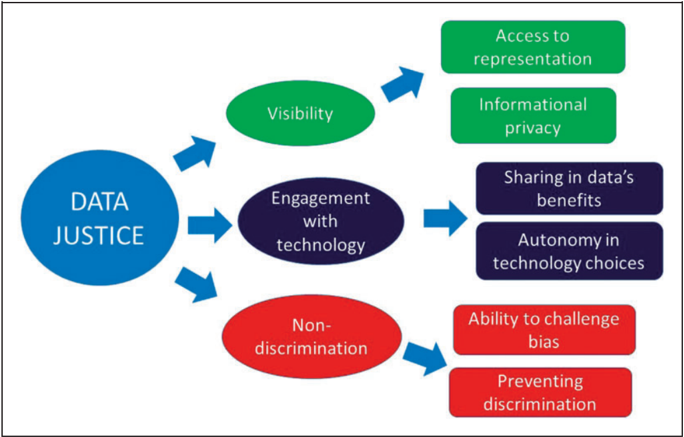
The increasing availability of digital data reflecting economic and human development, and in particular the availability of data emitted as a by-product of people’s use of technological devices and services, has both political and practical implications for the way people are seen and treated by the state and by the private sector. Yet the data revolution is so far primarily a technical one: the power of data to sort, categorise and intervene has not yet been explicitly connected to a social justice agenda by the agencies and authorities involved. Meanwhile, although data-driven discrimination is advancing at a similar pace to data processing technologies, awareness and mechanisms for combating it are not. This paper posits that just as an idea of justice is needed in order to establish the rule of law, an idea of data justice – fairness in the way people are made visible, represented and treated as a result of their production of digital data – is necessary to determine ethical paths through a datafying world. Bringing together the emerging scholarly perspectives on this topic, I propose three pillars as the basis of a notion of international data justice: (in)visibility, (dis)engagement with technology and antidiscrimination. These pillars integrate positive with negative rights and freedoms, and by doing so challenge both the basis of current data protection regulations and the growing assumption that being visible through the data we emit is part of the contemporary social contract.
Overview
The claims and statistics of this paper haven’t been checked yet.
Free: it reads the open-access text and checks the first 5 claims that cite a source we can check. Create a free account to check every claim.
Integrity signals
Registry
Cites
Statistics
Figures

Verification
Claims the paper makes
The claims and statistics of this paper haven’t been checked yet.
Free: it reads the open-access text and checks the first 5 claims that cite a source we can check. Create a free account to check every claim.
Claims other papers make about this one
Each is checked against this paper’s own text: does it say what the citing paper says it does?
The cited source says what the claim attributes to it.
In the citing paper
“It stresses the importance of developing individual freedoms in relation to how data are used and collected and advocates for enhanced autonomy and agency: people should be able to decide whether they want to participate in this system.”
From Staring Back at the Surveillance Gaze: The Resistance of LGBTQ+ Users on Social Media (2026) · cites this paper as Taylor 2017
The cited source says what the claim attributes to it.
In the citing paper
“Data justice frameworks are particularly invested in understanding the impacts, both negative and positive, of datafication and identifying ways to address them.”
From Staring Back at the Surveillance Gaze: The Resistance of LGBTQ+ Users on Social Media (2026) · cites this paper as Taylor 2017
The check wasn’t confident either way, so it gives no verdict — never disputed.
In the citing paper
“Because of this, the topic of data quality is beginning to transcend beyond the field of data management and into the realm of Human Computer Interaction (HCI), which accommodates holistic considerations such as how people search for relevant datasets [42], how developers perceive data work [64] and the best ways of using crowdsourcing to generate, evaluate or label data [71].”
From A Survey of Data Quality Requirements That Matter in ML Development Pipelines (2023) · cites this paper as [71]
Experimental — accuracy not yet measuredIn the citing paper
“Linnet Taylor (2017) advocates for a data justice framework acknowledging that, while there is a rapid development of data processing technologies, there is a lack of considerations of how datafication plays into broader social justice issues.”
From Staring Back at the Surveillance Gaze: The Resistance of LGBTQ+ Users on Social Media (2026) · cites this paper as Taylor 2017
In the citing paper
“For Taylor (2017), data justice revolves around three pillars: visibility, digital (dis)engagement, and countering data-driven discrimination.”
From Staring Back at the Surveillance Gaze: The Resistance of LGBTQ+ Users on Social Media (2026) · cites this paper as Taylor 2017
Self-check
Percentages, sums and reported differences re-computed from the paper’s own numbers.
The self-check needs the paper’s full text.
Citations
Cites
Clapp, J., & Sen, A. (1999) · International Journal Canada s Journal of Global Policy Analysis · doi:10.1177/002070200005500119 · Cited by 13,507
Clapp, J., & Sen, A. (1999) · International Journal · doi:10.2307/40203469 · Cited by 13,411
Sorting Things Out: Classification and Its Consequences
Bowker, G. C., & Star, S. L. (1999) · doi:10.7551/mitpress/6352.001.0001 · Cited by 6,188
(1993) · Oxford University Press eBooks · doi:10.1093/0198287976.001.0001 · Cited by 4,239
Toward a Field of Intersectionality Studies: Theory, Applications, and Praxis
Cho, S., Crenshaw, K. W., & McCall, L. (2013) · Signs: Journal of Women in Culture and Society · doi:10.1086/669608 · Cited by 4,126 · cited 2×
“This intersectionality (Cho et al., 2013) in the effects of datafication is an important component of the argument for a social justice perspective.”
BackgroundDoyle, T. (2017) · The Information Society · doi:10.1080/01972243.2017.1354593 · Cited by 3,071 · cited 3×
“O’Neil (2016) has warned that algorithmic models must be constantly recalibrated using feedback from the events they are supposed to predict.”
BackgroundNew York University Law Review
Rawls, J. (2017) · Justice · doi:10.4324/9781315193496-11 · Cited by 2,872
Lemke, T. (2001) · Economy and Society · doi:10.1080/03085140120042271 · Cited by 2,043 · cited 2×
“…designed to assure that people are not misusing state welfare funds and other publicly funded support are part of the apparatus of governmentality (Lemke, 2001); data-driven law enforcement focuses unequally on poor neighbourhoods which experience certain types of criminality (O’Neil, 2016); and…”
BackgroundSen, A. (2005) · Journal of Human Development · doi:10.1080/14649880500120491 · Cited by 1,966 · cited 5×
“Many states and regions, for example, take a perspective on rights that frames them as inseparable from corresponding duties, and also addresses the individual as part of the larger collective (Sen, 2005).”
BackgroundInfluentialLevin, K., Cashore, B., Bernstein, S., & Auld, G. (2012) · Policy Sciences · doi:10.1007/s11077-012-9151-0 · Cited by 1,839
Research works printed but not linked: 19
- Alkire S (2011) The capability approach and human development. University of Oxford. Available at: http://www.ophi. org.uk/wp-content/uploads/OPHI-HDCA-SS11-Intro-tothe-Capability-Approach-SA.pdf (accessed 23 June 2017).
- Arora P (2016) Bottom of the data pyramid: Big data and the global south. International Journal of Communication 10: 19.
- Eubanks V (2014) Want to predict the future of surveillance? Ask poor communities. The American Prospect , pp. 1-4. Available at: http://prospect.org/article/want-predict-futuresurveillance-ask-poor-communities#.VXbsO\_Oh2k8.twitter (accessed 9 October 2017).
- Foucault M (1977) Discipline & punish -Panopticism. Discipline and Punish: The Birth of the Prison. New York: Vintage, pp. 195-228.
- Holvast J (2013) De Volkstelling van 1971 . Amsterdam: Uitgeverij Paris.
- Jayaram M (2014) India's big brother project. Boston Review . Available at: http://www.bostonreview.net/world/malavika-jayaram-india-unique-identification-biometrics (accessed 1 January 2016).
- Kroll JA, et al. (2016) Accountable algorithms. University of Pennsylvania Law Review 165(633): 633-705.
- Makulilo AB (2016) ''A person is a person through other persons'' - A critical analysis of privacy and culture in Africa, Beijing Law Review 7: 192-204.
- Masiero S (2016) Digital governance and the reconstruction of the Indian anti-poverty system. Oxford Development Studies 818: 1-16.
- Nussbaum MC (2006) Frontiers of Justice: Disability, Nationality, and Species Membership . Cambridge, MA: Harvard University Press.
- O'Neil C (2016) Weapons of Math Destruction: How Big Data Increases Inequality and Threatens Democracy . New York: Crown Publishing Group.
- Raymond NA (2016) Beyond ''do no harm'' and individual consent: Reckoning with the emerging ethical challenges of civil society's use of data. In: Taylor L, Floridi L and van der Sloot B (eds) Group Privacy: New Challenges of Data Technologies . Springer International, pp. 67-82.
- Shearmur R (2015) Dazzled by data: Big Data, the census and urban geography. Urban Geography 36(7): 965-968.
- Spivak GC (1988) Can the subaltern speak? In: Nelson C and Grossberg L (eds) Marxism and the Interpretation of Culture . University of Illinois Press, pp. 271-313.
- Taylor L (2016a) From zero to hero: How zero-rating became a debate about human rights. IEEE Internet Computing 20(4): 79-83.
- Taylor L (2016b) No place to hide? The ethics and analytics of tracking mobility using mobile phone data. Environment and Planning D: Society and Space 34(2): 319-336.
- Taylor L (2016c) Safety in numbers? Group privacy and big data analytics in the developing world. Group Privacy: New Challenges of Data Technologies . Dordrecht: Springer.
- Taylor L (2016d) The ethics of big data as a public good: Which public? Whose good? Philosophical Transactions of the Royal Society A 374: 1-13.
- Taylor L and Broeders D (2015) In the name of development: Power, profit and the datafication of the global South. Geoforum 64(4): 229-237.
Cited by
Items 701–800 of 862
A Health Dystopia: The Rise of Pharmafeudalism
Geiger, S., & Bourgeron, T. (2025) · Oxford University Press eBooks · doi:10.1093/9780191993626.003.0011
A Health Utopia: A New Political Economy of Health
Geiger, S., & Bourgeron, T. (2025) · Oxford University Press eBooks · doi:10.1093/9780191993626.003.0012
Caring Capitalists or Ruthless Predators? The Janus Face of the Pharmaceutical Industry in the 2000s
Geiger, S., & Bourgeron, T. (2025) · Oxford University Press eBooks · doi:10.1093/9780191993626.003.0005
Geiger, S., & Bourgeron, T. (2025) · Oxford University Press eBooks · doi:10.1093/9780191993626.002.0004
Conceptualizing the Digital Human
Rössler, B., & Steeves, V. (2025) · Cambridge University Press eBooks · doi:10.1017/9781009383851.002
Invisibility and Exposure: Challenges of Using AI in Healthcare
Ott, T. (2025) · Zeitschrift für medizinische Ethik · doi:10.30965/29498570-20250143 · Cited by 1
The power of the norm: how schools interpret, use and disclose education data
Pangrazio, L., Duffy, G., & Zomer, C. (2025) · Cambridge Journal of Education · doi:10.1080/0305764x.2025.2590450 · Cited by 2
“Rather than rejecting datafication altogether, a data justice standpoint recognises the immediate and material need to generate other, better operationalisations of data, in order that data subjects currently deemed ‘non-normative’ in society can be granted equity (Hillman, 2022; Taylor, 2017).”
Tedeschi, M., Gkouskos, D., & Resmini, A. (2025) · Human Geography · doi:10.1177/19427786251396639
“…it frames humans into prede fi ned categories and classi fi cations – ‘ race, ethnicity, religion, gender, location, nationality, socio-economic status ’ (Taylor, 2017: 3), to name a few – which may lead to informational harms (Viljoen, 2021), algorithmic power imbalances reproducing…”
Doing Inclusion: Negotiation and Co-creation for People-centric Smart Cities
de Lange, M., Ruijer, E. H. J. M., & Varró, K. (2025) · Routledge eBooks · doi:10.5117/9789048562718-11 · Cited by 2
Police use of force data collection issues in Florida: A minor critique
Rose, A., McCreary, T., Craig, M. O., & Jackson, A. (2025) · Political Geography · doi:10.1016/j.polgeo.2025.103468
Poibeau, T. (2025) · Ubiquity Press eBooks · doi:10.5334/bde.j
Understanding Conversational AI: Philosophy, Ethics, and Social Impact of Large Language Models
Poibeau, T. (2025) · Ubiquity Press eBooks · doi:10.5334/bde · Cited by 6
Reflexão sobre a privacidade e o reúso de dados em cidades inteligentes: uma revisão de literatura
Moreira, A. L. D., Junior, R. M., & Coelho, T. R. (2025) · Informação & Informação · doi:10.5433/1981-8920.2025v30n2p382
A Framework for Social Justice-Oriented Practices for Accessible and Inclusive AI
Fernandes, S., Rahman, H., & Gorman, R. D. S. (2025) · Springer eBooks · doi:10.1007/978-3-031-93022-5_2
Artificial Intelligence and Diversity, Equity, and Inclusion
Garard, J., Ezirigwe, J., & Ayoub, M. (2025) · Springer eBooks · doi:10.1007/978-3-031-32257-0_72-1
Just Access: Public Library Marginalization of Unhoused Patrons
Abbott, J. K. (2025) · Proceedings of the Association for Information Science and Technology · doi:10.1002/pra2.1394
“…LIS literature: literacy and social justice (Saunders, 2017); worker justice (Roberts, 2019; Wildenhaus, 2019); data justice (Milan & Treré, 2019; Taylor, 2017); racial justice and archival silences (Caswell, 2021; Caswell et al., 2016; Ramirez, 2015; Sutherland, 2017); disability justice…”
Data Science in Service of Community Anomaly Detection
Klepac, G. (2025) · Advances in computational intelligence and robotics book series · doi:10.4018/979-8-3373-8510-5.ch009
Beyond Universal Metrics: A Global South-Centered Framework for Ethical AI DevelopmentPreprint
Abdullah, X., & Siddiqui, F. (2025) · SSRN Electronic Journal · doi:10.2139/ssrn.5792282
Communicating AI Ethics: A Thematic Analysis of Expert Discourse (2020-2025)
Mukhopadhyay, S. (2024) · Journal of Communication and Management · doi:10.58966/jcm2025446
Iman Santoso, T. S. (2025) · Hong Kong Journal of Social Sciences · doi:10.55463/hkjss.issn.1021-3619.66.8
Big Data Strategy for Regulatory Reform
Nkuna, R. (2025) · Springer eBooks · doi:10.1007/978-3-032-10713-8_14
Singh, A. K., & Wagisha (2025) · Springer eBooks · doi:10.1007/978-981-95-2282-8_13
Kalulu, J. C., & Wang, M. (2026) · International Journal for Equity in Health · doi:10.1186/s12939-025-02750-6
“By centering such transparency in data-driven technologies such as DHPs, users gain meaningful agency over their data, reframing their role from passive subjects to active participants in ethical data governance [42, 53].”
Josipović, I. (2025) · Oxford University Press eBooks · doi:10.1093/9780198945222.003.0082
Enhancing the effectiveness of digitalised maritime law enforcement
Zou, K., & Tan, Y. (2026) · Marine Policy · doi:10.1016/j.marpol.2026.107058 · Cited by 1
Private social media accounts as a productive resistance tactic: a qualitative study from China
Bao, H., & Shang, A. (2026) · Behaviour and Information Technology · doi:10.1080/0144929x.2026.2621782
“It is within this context that algorithmic resistance has emerged as an issue of global significance (Taylor 2017; Zuboff 2019).”
Safety in the Techno-Mediated City: Insights from Bengaluru's AI-Powered CCTV Network
Boro, U., Meissner, F., & Pfeffer, K. (2026) · Journal of Urban Technology · doi:10.1080/10630732.2025.2583882
“From a data justice point of view (Taylor, 2017), urban safety links to the agency of different urban residents to determine how data about them is used (Dubbeld, 2004; Kitchin, 2016).”
Trabalho na mídia, capitalismo de vigilância e a ascensão da ideologia de extrema-direita no BrasilPreprint
Evangelista, R., & de Mesquita, J. M. S. (2026) · doi:10.1590/scielopreprints.14386
Gwatidzo, K. T. (2026) · Research Square · doi:10.21203/rs.3.rs-8554032/v1
Shabu, K., & Prabhash, N. (2026) · World sustainability series · doi:10.1007/978-3-032-13412-7_17
Anderson, S. G., Chen, X. S., & Feng, Y. (2026) · Oxford University Press eBooks · doi:10.1093/obo/9780195389678-0351
Technosolutionist Urbanism*: Smart City
Reia, J., & da Cruz, L. F. O. (2026) · Springer eBooks · doi:10.1007/978-3-032-05155-4_6
Data as a State Form: Toward a Political Theory of Computational Governance
Yong, D. I. N. G. (2025) · Digital Society & Virtual Governance · doi:10.6914/dsvg.010202
“This paradigm generates productive research on data governance (Gil-Garcia, Dawes, & Pardo, 2018), data protection (van Zoonen, 2016), and data ethics (Taylor, 2017; Milan & van der Velden, 2016) — but it cannot capture the ontological transformation we identify.”
Law in the Loop: Reimagining Justice and Regulation in the Age of Artificial Intelligence
Saxena, N. (2026) · Advances in computational intelligence and robotics book series · doi:10.4018/979-8-2600-0000-7.ch006 · Cited by 2
Papa, V. (2025) · Emerald Group Publishing Limited eBooks · doi:10.1108/978-1-83549-238-320251010
BEING SEEN AND LOOKING BACK: MANDATORY ACKNOWLEDGMENT OF SURVEILLANCE FOR LGBTQ+ USERS
Chartrand, A. (2026) · AoIR Selected Papers of Internet Research · doi:10.5210/spir.v2024i0.15088 · Cited by 1
Zeffiro, A., Brodeur, J., & Montague, A. (2022) · doi:10.15173/mi.v1i1.5065
Vulnerable human rights in cyberspace: a multi-case study of Ugandan refugees’ digital risks
Lu, H., & Jin, S. (2026) · Online Media and Global Communication · doi:10.1515/omgc-2025-0051
“Taylor (2017) proposes a data-justice model centered on visibility, engagement, and anti-discrimination, warning that expanding digital footprints can also expand discriminatory exposure.”
“All of us data points”: Experiences of data welfare state from the margins
Nikunen, K., Talvitie–Lamberg, K., & Valtonen, S. (2026) · The Information Society · doi:10.1080/01972243.2026.2640575
“The results enhance our understanding of the contextual nature of datafication and data justice in everyday life, following Taylor’s call for “a vision of data justice that takes power and politics into account must necessarily also be rooted in local experience” (Taylor 2017, 7).”
Falcao, V. L. (2026) · Information Technology for Development · doi:10.17705/1itd.032112 · Cited by 5
“…idea of data justice, i.e., ‘fairness in the way people are made visible, represented and treated as a result of their production of digital data’ ( Taylor, 2017, p. 2), has been emphasised in conversations that critically engage with the ‘inclusion’ of populations in the digital realm via…”
Who Controls the Algorithm? Data Sovereignty, Digital Extractivism, and AI Governance Gaps in AfricaPreprint
Okediji, S., & Oyinkansola, G. (2026) · Research Square · doi:10.21203/rs.3.rs-9997871/v1
Governing Foreign Generative AI Through Deployment Routes in the Global SouthPreprint
Abdullah, X. (2026) · SSRN Electronic Journal · doi:10.2139/ssrn.6508277
Freier, A., Bowler, L., Owczar, H., Gogovor, A., Pandey, M., Riley, J., Stirling, M., Duris, J., McGrail, K. M., & Nickel, N. C. (2026) · International Journal for Population Data Science · doi:10.23889/ijpds.v11i1.2964 · Cited by 1
“To mitigate the risks of bias and systemic racism in research, data centres must consider adopting strategies that adequately respond, embedding equity in processes within their control and moving towards data justice [28].”
Rusdi, R., & Miharja, H. A. (2026) · JAMBURA GEO EDUCATION JOURNAL · doi:10.37905/jgej.v7i1.35890
Seeing Like a Community: Public Perceptions of Data Use in Government
Jeong, E., Jackson, C. B., Pandey, S., & Chen, K. (2026) · CHI Conference on Human Factors in Computing Systems · doi:10.1145/3772318.3790756
“Addressing issues of transparency and trust is necessary as AI and data-driven decision-making become central to public administration [29, 65].”
InfluentialBlinder, E. B., Bonsignore, E., & Clegg, T. (2026) · CHI Conference on Human Factors in Computing Systems · doi:10.1145/3772318.3791604 · Cited by 1
“…directly engaging with and seeking a better understanding of the perspectives of such communities, whose voices have been historically marginalized in the conceptualization and design of new technology [29, 57, 59, 63, 141] and who are among the most-likely to experience its adverse effects [132].”
Nanda, A., & Kaur, R. (2026) · Law Technology and Humans · doi:10.5204/lthj.4009
Humanitarian data infrastructures for missing migrants: A multimodal and ethics-integrated framework
Esen, M. F., & Aydemir, E. (2026) · Open Research Europe · doi:10.12688/openreseurope.23124.1 · Cited by 1
Which Way Forward? Reflections and Suggestions
Long, L. A. N., & Lee, D. (2026) · Lecture notes in energy · doi:10.1007/978-3-032-19171-7_8
Energy Data Production: Opportunities and Challenges
Long, L. A. N., & Lee, D. (2026) · Lecture notes in energy · doi:10.1007/978-3-032-19171-7_4
David, T. (2026) · Research Square · doi:10.21203/rs.3.rs-8986304/v1
Digital Twins in Translational Research and Health Care: An Anthropological Perspective
Wagner, J. K. (2026) · Ethics & Human Research · doi:10.1002/eahr.70022
Unpacking social scoring systems and their impact on fairness and digital dignity
Reveilhac, M., Druta, V., Tamò‐Larrieux, A., & Sapin, M. (2026) · Big Data & Society · doi:10.1177/20539517261434338
“…European Convention on Human Rights (de Bonth, n.d.); a design-oriented translation of HRs into context-speci fi c requirements (Aizenberg and Van Den Hoven, 2020); and studies of data injustices using illustrative cases such as bio-metric databases and migrant-visualization systems (Taylor, 2017).”
InfluentialSANGWA, S. (2026) · Open Journal of Stigmatized Knowledge & Suppressed Discourses · doi:10.65655/openchristianpress.2026.111
Balancing Privacy and Security: The Role of AI in Interagency Intelligence Databases
Vincenzo, L. D., Conversano, S., & Tirozzi, G. (2026) · Springer eBooks · doi:10.1007/978-3-032-15112-4_10
Jarial, S., & D., C. P. N. (2026) · Springer eBooks · doi:10.1007/978-3-032-08434-7_9
Normalizing Artificial Intelligence Research in Urban Planning: Pathways Toward Sustainable Cities
Santiago, E. (2026) · International Journal of Advanced Engineering and Management Research · doi:10.51505/ijaemr.2026.11224
“Therefore, the normalization of AI Research in urban planning must go along with large investment in participatory data gathering and community-based data — what some scholars have referred to as data justice (Taylor, 2017).”
Bittar, E. C. B. (2026) · Springer eBooks · doi:10.1007/978-3-032-22517-7_2
Wang, M., & Guo, B. (2026) · Sustainability · doi:10.3390/su18104862
Wisdom in the Loop - Human-Centered AI and African Knowledge Systems in HCI
Badawy, W. (2025) · African Human Computer Interaction Conference (AfriCHI) · doi:10.1145/3757232.3815398
“Ensuring accountability and benefit-sharing remains a critical concern, particularly where data sovereignty laws are weak or nonex-istent [49, 64, 74, 75, 77].”
Gomaa, M., & Salman, G. (2026) · Information Development · doi:10.1177/02666669261450589
Towards an intelligent Geospatial Digital Twin
Ochoa, K. S., Chen, C., Gao, S., Carney, J. A., & Peters, J. (2026) · International Journal of Architectural Computing · doi:10.1177/14780771261454101
“78 In GDTs, responsible handling of data is achieved through several strategies.”
Applications of Behavioural Data Science
Pogrebna, G. (2026) · Cambridge University Press eBooks · doi:10.1017/9781108939010.036
Pogrebna, G., & Hills, T. T. (2026) · Cambridge University Press eBooks · doi:10.1017/9781108939010.035
Making Personal Data Personal: The Emergence of Enactive Data in Organizations
Stelmaszak, M., Masiero, S., Wyers, K., Aaltonen, A., & Wagner, E. K. (2026) · Springer eBooks · doi:10.1007/978-3-032-20821-7_5 · Cited by 1
Technology, Management, and Social Justice: A Mapping of the Terrain and the Road Ahead
Joy, S., & Poonamallee, L. (2026) · Springer eBooks · doi:10.1007/978-3-032-20821-7_18
Designing for 1.5 °C Lifestyles: A Business-Driven Framework for Systemic Change
Godelnik, R., & Jaramillo, L. (2026) · Springer eBooks · doi:10.1007/978-3-032-20821-7_8
Revealing Power Imbalances in Data Privacy: A Privacy Privilege Model
Alhajri, M., Rudolph, C., & Oliver, G. (2026) · IFIP advances in information and communication technology · doi:10.1007/978-3-032-27993-4_35
Kpessa-Whyte, M. (2026) · International Journal of Sociology and Social Policy · doi:10.1108/ijssp-02-2026-0198 · Cited by 1
Ahn, Y. (2026) · Current Issues in Comparative Education · doi:10.52214/cice.v28i2.14618
“Value, once grounded in physical presence or empathy, comes to depend on visibility within data infrastructures (Taylor, 2017), with authority shifting from ethical judgment to automated behavioral prediction and control (Zuboff, 2015).”
A review of internet censorship: Modern measurement and circumvention techniques
Grübl, T., Enguix, F., & Stiller, B. (2026) · Computer Science Review · doi:10.1016/j.cosrev.2026.101002 · Cited by 1
“The growing deployment of censorship techniques [1–3] as well as increasing global attention to digital rights and freedoms [4–6] have fundamentally shaped the field over the past decade.”
Europe’s Datafied Borders: Technology, Control, and (In)Justice
Metcalfe, P. (2026) · Routledge eBooks · doi:10.4324/9781003669555
Anwar, M. A., Thylstrup, N. B., Grohmann, R., & Posada, J. (2026) · Big Data & Society · doi:10.1177/20539517261459214
“…societies (e.g. Sustainable Development Solutions Network and Open Data Watch, 2015; also see Kleine and Unwin, 2009), there are real dangers of en-trenchment of existing unequal patterns of power (e.g. Arora, 2016; Couldry and Mejias, 2019; Lehdonvirta, 2022; Madianou, 2019; Taylor, 2017).”
Gentelet, K., Mathieu, L.-C., & Bahary-Dionne, A. (2026) · Canadian Journal of Communication · doi:10.3138/cjc-2024-0101
Ollier‐Malaterre, A., Parent‐Rocheleau, X., Benkrid, K., & Savard, Y. P. (2026) · Surveillance & Society · doi:10.24908/ss.v24i3.19100 · Cited by 1
Policy Frameworks and Governance for Data-Driven Agriculture
Nhachi, M. N. D., Sutawi, M. P., Ibrahim, J. T., Relawati, R., & Priya, N. (2026) · Advances in geospatial technologies book series · doi:10.4018/979-8-3373-8037-7.ch008
Modern technology application in ethnoscience: machine learning, digital tools, and sustainability
Kabeer, D. A., Vinu, W., Ali, N. K. A., Fuad, V. C., Ajmal, P. M., & Zouhal, H. (2026) · Elsevier eBooks · doi:10.1016/b978-0-443-45513-1.00008-5
From records to actions: mediating civic data and environmental activism in Taiwan
Meng, J., Tsai, H.-J., & Lin, 林. Y.-P. (2026) · Information Communication & Society · doi:10.1080/1369118x.2026.2686318
Abdramanova, M. (2026) · Access to Justice in Eastern Europe · doi:10.33327/ajee-18-9.3-a0001986 · Cited by 1
Tajuar, J. T., Sultana, R. R., Rehan, T. T., Akter, J. T., Mahenaz, A., & Mannan, K. A. (2026) · Migration Diaspora and Remittance Review · doi:10.64907/xkmf.v6.i2.mdrr.2
Jabin, R. M., & Mannan, K. A. (2026) · Sustainable Environment and Business · doi:10.64907/xkmf.v6i2.seb.2
Continuous Well-Being Monitoring Through Interpretable Machine Learning
Alomair, M., Tubadji, A., & Boy, F. (2026) · Oxford University Press eBooks · doi:10.1093/9780198945215.003.0190
Mauceri, S., Faggiano, M. P., & Censi, L. D. (2026) · IGI Global eBooks · doi:10.4018/979-8-3373-8423-8.ch010
Tiemo, T. H. (2026) · Routledge eBooks · doi:10.4324/9781003686767
Age, T. J., & Machaba, M. F. (2026) · International Journal of Studies in Psychology · doi:10.66434/ijspsy.v1i1si.467
Shedid, M. Y. (2026) · Research Square · doi:10.21203/rs.3.rs-10060769/v1
CLEIG: An Institutional Diagnostic Framework for Digital Health Data Governance in AfricaPreprint
Chingarande, G. R. (2026) · SSRN Electronic Journal · doi:10.2139/ssrn.7110098
Governing Artificial Womb Technology: AI, Ethics, and Policy at the Boundaries of Human Development
Abadla, R., Alahmed, Y., & Alabadla, S. (2026) · Artificial intelligence · doi:10.5772/intechopen.1015650
From Digital to Postdigital: Rethinking Citizenship in the Age of Immaterial Labour
Walidaini, R. N., & Tamrin, S. (2026) · Springer eBooks · doi:10.1007/60490_2026_25
Gillibrand, S., Howells, K., Bleksley, D., Brown, J., & Sanders, C. (2026) · Social Science & Medicine · doi:10.1016/j.socscimed.2026.119616
When Data Protection Fails to Protect: Law, Power, and Postcolonial Governance in Bangladesh
Saha, P., Chan, A., & Sultana, S. (2026) · ACM SIGCAS/SIGCHI Conference on Computing and Sustainable Societies (COMPASS) · doi:10.1145/3811242.3819089 · Cited by 2
Ergashev, I. A. (2026) · AI and Ethics · doi:10.1007/s43681-026-01262-5
“Transparency, accountability, contestability and the rule of law apply to algorithmic decisions in the educational mobility context as they apply elsewhere; what differs is the technical difficulty of operationalising them when the decision-making process is opaque even to its designers [24, 25].”
Ugwu, J. N., Nyamboga, T. O., Oywa, A. I., Mbabazi, A., Muhammad, T., & Ugwu, O. P.-C. (2026) · Frontiers in Sustainable Cities · doi:10.3389/frsc.2026.1881417
“Taylor (2017) further cautions that participation systems amplify already-heard voices while marginalising those with the greatest service needs, a data justice concern that demands explicit design attention in any mobile governance strategy.”
Galasso, B. (2026) · Springer eBooks · doi:10.1007/60490_2026_32
Participatory Design Process of a Supportive Digital Platform to Enhance Local Urban Food Systems
Trude, A. C. B., White, A.-L., Rehman, Z., Mei, R., Thomson, W., Giampieri, M., & Sidell, C. (2026) · Foods · doi:10.3390/foods15152700
Bihl, J., Hocine, J., Fitzbay, S., Dupuis, M.-J., Landry, N., & Fastrez, P. (2026) · Approches Théoriques en Information-Communication (ATIC) · doi:10.3917/atic.012.0189
Brik, A. B. (2026) · Quality & Quantity · doi:10.1007/s11135-026-03044-x · Cited by 1
Generative AI and the Reconfiguration of Symbolic Authority: Implications of a Psychoanalytic View
Hamamra, B. T., & Uebel, M. (2026) · Human Arenas · doi:10.1007/s42087-026-00687-y · Cited by 1
Metadata
- Authors
- Taylor, L.
- Affiliations
- Tilburg University (NL)
- Corresponding author
- Taylor, Linnet
- ORCID
- Taylor, Linnet
- Venue
- Big Data & Society
- Publisher
- SAGE Publications
- Published
- 2017-11
- Volume
- 4
- Issue
- 2
- Pages
- 205395171773633
- ISSN
- 2053-9517 (ISSN-L)
- OpenAlex
- W2590124083
- Cited by
- 802
- References
- 38
- Citations by year
- 2026: 127 · 2025: 168 · 2024: 99 · 2023: 126 · 2022: 89 · 2021: 55 · 2020: 74 · 2019: 47 · 2018: 17
- FWCI
- 86.62
- Type
- journal article
- Language
- en
- Open access
- gold
- doi.org
- Licence
- cc-by-nc-nd
- journals.sagepub.com/page/policies/text-and-data-mining-license (tdm)
- Locations
- Big Data & Society (publishedVersion, cc-by-nc-nd)
- Tilburg University Research Portal (publishedVersion, other-oa)
- Research portal (Tilburg University) (submittedVersion, other-oa)
- Data Archiving and Networked Services (DANS) (submittedVersion, other-oa)
- DOAJ (DOAJ: Directory of Open Access Journals) (submittedVersion, cc-by-sa)
- EUR Research Repository (Erasmus University Rotterdam) (submittedVersion)
- Funders
- European Commission (624583)
- Universiteit van Amsterdam
- Topics
- Physical Sciences › Computer Science › Artificial Intelligence › Ethics and Social Impacts of AI
- Social Sciences › Law › Digitalization, Law, and Regulation
- Social Sciences › Business, Management and Accounting › Industrial relations › Legal and Labor Studies
- Keywords
- data justice, digital rights, internet freedom, datafication, visibility, anti-discrimination, data protection regulation, social justice, digital data, social contract
About these checks
Registry, retraction, Cites and statistics results are computed, not judged, with one exception: a printed reference that no index lists is read once by a model before it counts as a citation error. Claims are extracted by a model and kept only when their quote appears verbatim in the text; each cited source is then checked, with a model’s help, for whether it says what the claim relies on. Those verdicts can be wrong — read the claim’s quote and the cited source before relying on one.
Statistics and arithmetic are recomputed, not judged.
Confidence bands are shown only for fields calibrated on our annotated test set. None is calibrated yet, so no band is shown.
What counts as a claim ›How we measure confidence ›How we check this ›
Are you an author, or do you see a problem with this page? Request a review
Data sources
Bibliographic data: Semantic Scholar, OpenAlex, Crossref.
Contains information from the Semantic Scholar Academic Graph Datasets, made available under the ODC Attribution License (ODC-BY 1.0).
Semantic Scholar’s data is described in: Kinney, R., et al. (2023). The Semantic Scholar Open Data Platform. arXiv:2301.10140.
