

What is data justice? The case for connecting digital rights and freedoms globally
Open accessThe DOI matches its Crossref record; 38 of the 41 references it cites were found in a registry or an index, and 3 are not checked yet.
Abstract
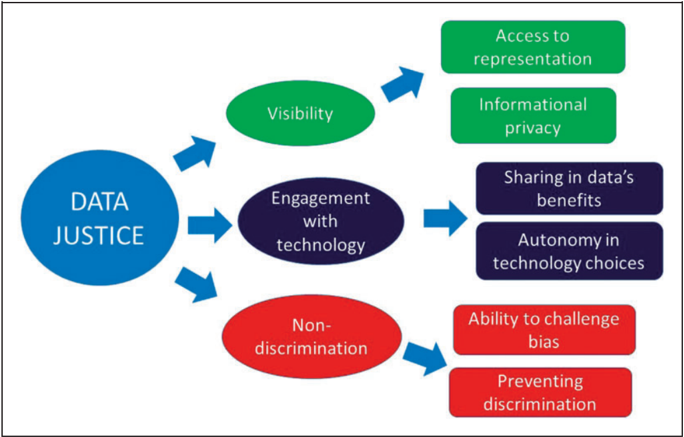
The increasing availability of digital data reflecting economic and human development, and in particular the availability of data emitted as a by-product of people’s use of technological devices and services, has both political and practical implications for the way people are seen and treated by the state and by the private sector. Yet the data revolution is so far primarily a technical one: the power of data to sort, categorise and intervene has not yet been explicitly connected to a social justice agenda by the agencies and authorities involved. Meanwhile, although data-driven discrimination is advancing at a similar pace to data processing technologies, awareness and mechanisms for combating it are not. This paper posits that just as an idea of justice is needed in order to establish the rule of law, an idea of data justice – fairness in the way people are made visible, represented and treated as a result of their production of digital data – is necessary to determine ethical paths through a datafying world. Bringing together the emerging scholarly perspectives on this topic, I propose three pillars as the basis of a notion of international data justice: (in)visibility, (dis)engagement with technology and antidiscrimination. These pillars integrate positive with negative rights and freedoms, and by doing so challenge both the basis of current data protection regulations and the growing assumption that being visible through the data we emit is part of the contemporary social contract.
Overview
The claims and statistics of this paper haven’t been checked yet.
Free: it reads the open-access text and checks the first 5 claims that cite a source we can check. Create a free account to check every claim.
Integrity signals
Registry
Cites
Statistics
Figures

Verification
Claims the paper makes
The claims and statistics of this paper haven’t been checked yet.
Free: it reads the open-access text and checks the first 5 claims that cite a source we can check. Create a free account to check every claim.
Claims other papers make about this one
Each is checked against this paper’s own text: does it say what the citing paper says it does?
The cited source says what the claim attributes to it.
In the citing paper
“It stresses the importance of developing individual freedoms in relation to how data are used and collected and advocates for enhanced autonomy and agency: people should be able to decide whether they want to participate in this system.”
From Staring Back at the Surveillance Gaze: The Resistance of LGBTQ+ Users on Social Media (2026) · cites this paper as Taylor 2017
The cited source says what the claim attributes to it.
In the citing paper
“Data justice frameworks are particularly invested in understanding the impacts, both negative and positive, of datafication and identifying ways to address them.”
From Staring Back at the Surveillance Gaze: The Resistance of LGBTQ+ Users on Social Media (2026) · cites this paper as Taylor 2017
The check wasn’t confident either way, so it gives no verdict — never disputed.
In the citing paper
“Because of this, the topic of data quality is beginning to transcend beyond the field of data management and into the realm of Human Computer Interaction (HCI), which accommodates holistic considerations such as how people search for relevant datasets [42], how developers perceive data work [64] and the best ways of using crowdsourcing to generate, evaluate or label data [71].”
From A Survey of Data Quality Requirements That Matter in ML Development Pipelines (2023) · cites this paper as [71]
Experimental — accuracy not yet measuredIn the citing paper
“Linnet Taylor (2017) advocates for a data justice framework acknowledging that, while there is a rapid development of data processing technologies, there is a lack of considerations of how datafication plays into broader social justice issues.”
From Staring Back at the Surveillance Gaze: The Resistance of LGBTQ+ Users on Social Media (2026) · cites this paper as Taylor 2017
In the citing paper
“For Taylor (2017), data justice revolves around three pillars: visibility, digital (dis)engagement, and countering data-driven discrimination.”
From Staring Back at the Surveillance Gaze: The Resistance of LGBTQ+ Users on Social Media (2026) · cites this paper as Taylor 2017
Self-check
Percentages, sums and reported differences re-computed from the paper’s own numbers.
The self-check needs the paper’s full text.
Citations
Cites
Clapp, J., & Sen, A. (1999) · International Journal Canada s Journal of Global Policy Analysis · doi:10.1177/002070200005500119 · Cited by 13,507
Clapp, J., & Sen, A. (1999) · International Journal · doi:10.2307/40203469 · Cited by 13,411
Sorting Things Out: Classification and Its Consequences
Bowker, G. C., & Star, S. L. (1999) · doi:10.7551/mitpress/6352.001.0001 · Cited by 6,188
(1993) · Oxford University Press eBooks · doi:10.1093/0198287976.001.0001 · Cited by 4,239
Toward a Field of Intersectionality Studies: Theory, Applications, and Praxis
Cho, S., Crenshaw, K. W., & McCall, L. (2013) · Signs: Journal of Women in Culture and Society · doi:10.1086/669608 · Cited by 4,126 · cited 2×
“This intersectionality (Cho et al., 2013) in the effects of datafication is an important component of the argument for a social justice perspective.”
BackgroundDoyle, T. (2017) · The Information Society · doi:10.1080/01972243.2017.1354593 · Cited by 3,071 · cited 3×
“O’Neil (2016) has warned that algorithmic models must be constantly recalibrated using feedback from the events they are supposed to predict.”
BackgroundNew York University Law Review
Rawls, J. (2017) · Justice · doi:10.4324/9781315193496-11 · Cited by 2,872
Lemke, T. (2001) · Economy and Society · doi:10.1080/03085140120042271 · Cited by 2,043 · cited 2×
“…designed to assure that people are not misusing state welfare funds and other publicly funded support are part of the apparatus of governmentality (Lemke, 2001); data-driven law enforcement focuses unequally on poor neighbourhoods which experience certain types of criminality (O’Neil, 2016); and…”
BackgroundSen, A. (2005) · Journal of Human Development · doi:10.1080/14649880500120491 · Cited by 1,966 · cited 5×
“Many states and regions, for example, take a perspective on rights that frames them as inseparable from corresponding duties, and also addresses the individual as part of the larger collective (Sen, 2005).”
BackgroundInfluentialLevin, K., Cashore, B., Bernstein, S., & Auld, G. (2012) · Policy Sciences · doi:10.1007/s11077-012-9151-0 · Cited by 1,839
Research works printed but not linked: 19
- Alkire S (2011) The capability approach and human development. University of Oxford. Available at: http://www.ophi. org.uk/wp-content/uploads/OPHI-HDCA-SS11-Intro-tothe-Capability-Approach-SA.pdf (accessed 23 June 2017).
- Arora P (2016) Bottom of the data pyramid: Big data and the global south. International Journal of Communication 10: 19.
- Eubanks V (2014) Want to predict the future of surveillance? Ask poor communities. The American Prospect , pp. 1-4. Available at: http://prospect.org/article/want-predict-futuresurveillance-ask-poor-communities#.VXbsO\_Oh2k8.twitter (accessed 9 October 2017).
- Foucault M (1977) Discipline & punish -Panopticism. Discipline and Punish: The Birth of the Prison. New York: Vintage, pp. 195-228.
- Holvast J (2013) De Volkstelling van 1971 . Amsterdam: Uitgeverij Paris.
- Jayaram M (2014) India's big brother project. Boston Review . Available at: http://www.bostonreview.net/world/malavika-jayaram-india-unique-identification-biometrics (accessed 1 January 2016).
- Kroll JA, et al. (2016) Accountable algorithms. University of Pennsylvania Law Review 165(633): 633-705.
- Makulilo AB (2016) ''A person is a person through other persons'' - A critical analysis of privacy and culture in Africa, Beijing Law Review 7: 192-204.
- Masiero S (2016) Digital governance and the reconstruction of the Indian anti-poverty system. Oxford Development Studies 818: 1-16.
- Nussbaum MC (2006) Frontiers of Justice: Disability, Nationality, and Species Membership . Cambridge, MA: Harvard University Press.
- O'Neil C (2016) Weapons of Math Destruction: How Big Data Increases Inequality and Threatens Democracy . New York: Crown Publishing Group.
- Raymond NA (2016) Beyond ''do no harm'' and individual consent: Reckoning with the emerging ethical challenges of civil society's use of data. In: Taylor L, Floridi L and van der Sloot B (eds) Group Privacy: New Challenges of Data Technologies . Springer International, pp. 67-82.
- Shearmur R (2015) Dazzled by data: Big Data, the census and urban geography. Urban Geography 36(7): 965-968.
- Spivak GC (1988) Can the subaltern speak? In: Nelson C and Grossberg L (eds) Marxism and the Interpretation of Culture . University of Illinois Press, pp. 271-313.
- Taylor L (2016a) From zero to hero: How zero-rating became a debate about human rights. IEEE Internet Computing 20(4): 79-83.
- Taylor L (2016b) No place to hide? The ethics and analytics of tracking mobility using mobile phone data. Environment and Planning D: Society and Space 34(2): 319-336.
- Taylor L (2016c) Safety in numbers? Group privacy and big data analytics in the developing world. Group Privacy: New Challenges of Data Technologies . Dordrecht: Springer.
- Taylor L (2016d) The ethics of big data as a public good: Which public? Whose good? Philosophical Transactions of the Royal Society A 374: 1-13.
- Taylor L and Broeders D (2015) In the name of development: Power, profit and the datafication of the global South. Geoforum 64(4): 229-237.
Cited by
Items 501–600 of 862
Zhang, Y. (2025) · International Conference on Innovation Management and Information Systems (ICIMIS) · doi:10.1145/3745676.3745722 · Cited by 1
“…reports on controversial decisions, referring to the practice of the EU Digital Services Act requiring the disclosure of algorithm logic [4]; For sudden events, the emergency system builds an “algorithm fuse mechanism” (suspending high-risk functions and automatically launching a…”
Surveillance and Human Flourishing: Pandemic Challenges
Lyon, D. (2025) · Cambridge University Press eBooks · doi:10.1017/9781009383851.006 · Cited by 1
When bits enter just transitions: data and energy justice in digitalised energy futures
Shakeel, S. R., Lacey‐Barnacle, M., Juntunen, J. K., & Smith, A. (2025) · Applied Energy · doi:10.1016/j.apenergy.2025.127075 · Cited by 1
Human Rights and Cybersecurity: Contentious Communities in Cyber Diplomacy Practice
Calderaro, A. (2025) · Springer eBooks · doi:10.1007/978-3-031-93385-1_10 · Cited by 2
Evidence-based medicine and the promises and limits of digital health and wearable technology
Canali, S., Schiaffonati, V., & Aliverti, A. (2026) · Studies in History and Philosophy of Science Part A · doi:10.1016/j.shpsa.2025.102097 · Cited by 1
Mobile Media Decision-Making: Toward a New Theory
Glover-Rijkse, R. (2026) · Mobile Media & Communication · doi:10.1177/20501579251411207 · Cited by 2
“Likewise, a data justice perspective suggests that people and populations should have a say in how technologies represent and impact them (Taylor, 2017, p. 1).”
Longdon, J., Acheampong, E., Gabrys, J., Blackwell, A. F., Ossom, B., & Ashton‐Butt, A. (2026) · Conservation Biology · doi:10.1111/cobi.70222 · Cited by 1
“Building on the established DJ (Taylor, 2017) and environmental data justice (EDJ) (Vera et al., 2019) literature, the concept of conservation data justice (CDJ) was introduced by Pritchard et al. (2022), who acknowledge that neither conservation nor technology is neutral; both are power laden…”
Whose Data Builds the City? Critical Data Practices for Socio-Environmentally Just Urbanization
Sharma, V., Mohan, A. K., & Kumar, N. (2026) · CHI Conference on Human Factors in Computing Systems · doi:10.1145/3772318.3791818 · Cited by 2
Dilinika, J. M. S. (2026) · doi:10.5860/crln.87.5.201 · Cited by 1
Abanto, M. J. M. P., -Navarro, J. I. C., Carlos-Abanto, E. I., Bazán-Pajuelo, V. Y., Bazán-Pajuelo, M. E., Colina-Cueva, L. A., & Mondragón, C. D. P. V. (2026) · Revista Latinoamericana de Estudios Educativos · doi:10.48102/rlee.2026.56.2.859 · Cited by 2
Taufikin, T. (2026) · TRANSFORMATIF · doi:10.23971/tf.v10i1.11327 · Cited by 1
Theatre of the Tech-Oppressed: Exploring Algorithmic Injustice Through Participatory Performances
Babai, N., Durall, E., Iivari, N., Kinnula, M., & Iversen, O. S. (2026) · Participatory Design Conference · doi:10.1145/3796624.3796649 · Cited by 1
“This dual dynamic underscores the importance of data justice ensuring not only fairness in data use, but also meaningful inclusion and recognition [140].”
Methodology for Studying the Digital City as a Space of Political Identity
Sanzharovskyi, I. M. (2026) · Актуальні проблеми філософії та соціології · doi:10.32782/apfs.v059.2026.19 · Cited by 1
Anjum, G., & Aziz, M. (2026) · Wiley Interdisciplinary Reviews Climate Change · doi:10.1002/wcc.70078 · Cited by 1
“Taylor (2017) contributed the sub-theme of data justice and representation , connecting digital rights and freedoms to climate governance by asking who is legible in climate datasets and models and whose data sovereignty is respected.”
Using EdTech to Reach the Unreached: Innovative Approaches to Non-Formal Education in Zimbabwe
Masveta, D. (2026) · Educational Point · doi:10.71176/edup/18866 · Cited by 1
“…"Ministry of IT" underscores the need for regulatory control in the standardization of data protection mechanisms, which is in line with the emerging literature on data justice, which posits the need to protect the data of marginalized groups from exploitation (Dencik & Cable, 2017; Taylor, 2017).”
Oguguo, B. C. E., Ocheni, C. A., Okebanama, C. I., Ezugwu, I. J., & Oguguo, E. C. (2026) · Computers & Security · doi:10.1016/j.cose.2026.105053 · Cited by 1
Kpum, M. M., & Gasa, V. (2026) · International Journal of Studies in Psychology · doi:10.66434/ijspsy.v1i1si.445 · Cited by 1
Citizen Science, Cognitive Justice and Data Sovereignty: a View from the South
Albagli, S. (2026) · Journal of Science Communication · doi:10.22323/355120260309065841 · Cited by 1
Connectivity justice: A new concept for the post-digital society
Jansson, A., Brantner, C., Fast, K., & Bengtsson, L. R. (2026) · Media Culture & Society · doi:10.1177/01634437261470730 · Cited by 1
“…concerns the fair distribution of rights and opportunities to move or remain in place (Sheller, 2018), and data justice focuses on how datafication shapes fairness and autonomy (Dencik et al., 2019; Taylor, 2017), connectivity justice links these through the capabilities to connect and disconnect.”
Stephan, J., & Elmazi, G. (2026) · Smart Cities · doi:10.3390/smartcities9090159 · Cited by 1
“From a data-justice perspective, Taylor (2017) emphasizes fairness in how individuals and communities are made visible, represented, and treated through digital data systems [46].”
Sa’diyah, N. K., Kartoningrat, R. B., & Enggarsasi, U. (2026) · Jurnal Hukum · doi:10.26532/jh.v42i2.48829 · Cited by 1
Youth and Social Media: From Vulnerability to Empowerment & Equality (Guest Editors' Introduction)
Smith, K. L., & Shade, L. R. (2021) · Studies in Social Justice · doi:10.26522/ssj.v15i3.2671 · Cited by 2
Digital Technologies, Data Commons and Rights in Africa: The Case of DigitalTransport4Africa
Klopp, J. M., Beshir, A. A., & Dusabe, E. (2023) · Springer eBooks · doi:10.1007/978-3-031-18704-9_4 · Cited by 1
Usman, H., khaliq, F., & Shaheen, K. H. (2023) · Journal of Social Research Development · doi:10.53664/jsrd/04-03-2023-04-570-588 · Cited by 3
Identity Platforms and Anti-LGBTQ+ Legislation: Implications for Safeguarding Personal Data
Wyers, K., Nicholson, B., Russpatrick, S., & Masiero, S. (2023) · IFIP advances in information and communication technology · doi:10.1007/978-3-031-50154-8_16 · Cited by 1
Internet Interoperability and Polycentric Attributes in Global Digital Data Ordering
Aguerre, C. (2024) · Routledge eBooks · doi:10.4324/9781003388418-4 · Cited by 1
EU Framework for Transfers of Personal Data: Critique and Directions for Reform
Yakovleva, S. (2024) · Oxford University Press eBooks · doi:10.1093/oso/9780192899248.003.0005 · Cited by 1
Chen, L. (2024) · Applied Mathematics and Nonlinear Sciences · doi:10.2478/amns-2024-3370 · Cited by 1
Rethinking individual and community engagement with genomics in a digital world
Felt, U. (2024) · Elsevier eBooks · doi:10.1016/b978-0-323-91799-5.00009-7 · Cited by 1
Bühler, M. M., Hollenbach, P., Köhler, L., Horvath, S., Jelinek, T., Nübel, K., & Riechert, D. (2025) · Elsevier eBooks · doi:10.1016/b978-0-443-29861-5.00002-0 · Cited by 2
Hänska (2019) · Journal of Information Policy · doi:10.5325/jinfopoli.9.2019.0014 · Cited by 1
Sapignoli, M., & Niezen, R. (2020) · Oxford University Press eBooks · doi:10.1093/oxfordhb/9780198840534.013.49 · Cited by 1
Cartographier les résistances à l’ère du capital algorithmique
Folco, J. D., & Martineau, J. (2021) · Revue Possibles · doi:10.62212/revuepossibles.v45i1.376 · Cited by 2
Hänska, M. (2019) · Journal of Information Policy · doi:10.5325/jinfopoli.9.1.0056 · Cited by 1
Hoefsloot, F. I., Jiménez, A., Sara, L. M., Flores, L. E. E., Martínez, J. A., & Pfeffer, K. (2022) · IFIP advances in information and communication technology · doi:10.1007/978-3-031-19429-0_36 · Cited by 1
Uncertainty for Good, Inverting Automated Empathy
McStay, A. (2023) · Oxford University Press eBooks · doi:10.1093/oso/9780197615546.003.0011 · Cited by 1
Analysis Of The 2nd Principle Of Pancasila On The Instagram Privacy Disclaimer
Dwipasari, B., Saputra, N. A., & Thalib, E. F. (2024) · Journal of Digital Law and Policy · doi:10.58982/jdlp.v3i2.533 · Cited by 1
Examining mobility data justice during 2017 Hurricane HarveyPreprint
Deng, H., & Wang, Q. (2021) · arXiv (Cornell University) · doi:10.48550/arxiv.2103.13879 · Cited by 2
“However, there is a growing concern about the justice of crowedsourced data sets (17), which can be caused by technology inequalities deeply rooted in the socio-economic system.”
BackgroundDavies, T., & Calderon, A. (2020) · Springer eBooks · doi:10.1007/978-3-030-13895-0_102-1 · Cited by 1
Knowledge infrastructures for just urban futures : a case of water governance in Lima, Peru
Hoefsloot, F. I. (2022) · doi:10.3990/1.9789036554848 · Cited by 3
Feminist Futures of Work: Reimagining Labour in the Digital EconomyPreprint
Arora, P., Raman, U., & König, R. (2023) · doi:10.5117/aup.22147289 · Cited by 2
From Media Reform to Data Justice
Shade, L. R. (2023) · Wiley eBooks · doi:10.1002/9781119800729.ch5 · Cited by 4
Ethik in der datenintensiven medizinischen Forschung
Ranisch, R., & Haltaufderheide, J. (2024) · Ethik in der Medizin · doi:10.1007/s00481-024-00844-3 · Cited by 1
“Galt die Aufmerksamkeit in der konventionellen Forschung vor allem Fragen der fairen Auswahl von Probanden und der Verteilung von Nutzen und Lasten (Emanuel et al. 2000), eröffnet die datenintensive Forschung den Raum für Anforderungen einer Datengerechtigkeit (Taylor 2017).”
What role can governance play in data justice? Reflections on the current AI moment
Dencik, L. (2025) · Dialogues on Digital Society · doi:10.1177/29768640251335677 · Cited by 1
“building on the original three pillars of data justice governance set out by Taylor (2017) for an AI era.”
Purtova, N. (2025) · Dialogues on Digital Society · doi:10.1177/29768640251339077 · Cited by 1
“In 2017, Linnet Taylor proposed a framework of global data justice to connect data governance to the ideas of social justice (Taylor, 2017).”
Technology Governance: A Dynamic Prescriptive Economics FrameworkPreprint
Khan, T. (2025) · SSRN Electronic Journal · doi:10.2139/ssrn.5340255 · Cited by 1
Saunders, R. (2025) · Sexualities · doi:10.1177/13634607241307173 · Cited by 1
“Data colonialism and related questions of data agency and data justice (Taylor, 2017; Taylor and Broeders, 2015) are important for understanding how sexual cultures are framed in international contexts and constructed through power inequalities between the Global North and South.”
Advancing Agency: Digital Self-Determination as a Framework for AI GovernancePreprint
Marcucci, S., & Verhulst, S. (2025) · SSRN Electronic Journal · doi:10.2139/ssrn.5343658 · Cited by 1
Academic-Industry Collaborations and Genomic Databases: a “Tyranny of the Minority”?
de Groot, N. F., Samuel, G. N., & Lucassen, A. (2025) · The American Journal of Bioethics · doi:10.1080/15265161.2025.2570680 · Cited by 1
“Instead, we should build upon frameworks like data justice, focusing on benefit sharing, fairness, and preventing discrimination (Taylor 2017), and data solidarity, which addresses reciprocity and power asymmetries and requires that commercial profits “need to come back to the people and…”
Perceiving justice in the AI city: Global evidence from an eye-tracking study of autonomous mobilityPreprint
Masso, A., Ibrahimi, M., Pietarinen, A., Behrendt, F., & Bhattarcherjee, S. (2025) · Research Square · doi:10.21203/rs.3.rs-8195075/v1 · Cited by 1
Artificial Intelligence and Diversity, Equity, and Inclusion
Garard, J., Ezirigwe, J., & Ayoub, M. (2026) · Springer eBooks · doi:10.1007/978-3-031-76750-0_72 · Cited by 1
Staring Back at the Surveillance Gaze: The Resistance of LGBTQ+ Users on Social Media
Chartrand, A. (2026) · Surveillance & Society · doi:10.24908/ss.v24i3.19225 · Cited by 1
Smith, C. H. (2020) · Philosophical studies series · doi:10.1007/978-3-030-50585-1_13
“11 International markets, not concern for “data justice” or ethics, therefore drives this process (Taylor 2017, p. 3). of digital identity are therefore discarded or computationally unobservable, leaving companies with limited, but commercially useful, shadows of a potential consumer’s identities.”
BackgroundO direito à privacidade no tempo do big data: narrativas profissionais na União Europeia
Neiva, L. (2020) · Revista Tecnologia e Sociedade · doi:10.3895/rts.v16n45.11439 · Cited by 2
Canadian Privacy Advocacy Groups and Bill C-51
Chan, S. (2019) · TSpace (University of Toronto)
Kohti dataoikeudenmukaisuutta – ehdotuksia tutkijoilta ja liikkeiltä
Puukko, O. (2021) · Media & viestintä · doi:10.23983/mv.109865 · Cited by 1
Earth Observation and the New African Rural Datascapes: Defining an Agenda for Critical ResearchPreprint
Pritchard, R., Kiwango, W. A., & Challinor, A. J. (2021) · arXiv (Cornell University) · doi:10.48550/arxiv.2108.09958 · Cited by 1
“Few studies question the politics of EO data themselves or pose critical questions over who can access, create, share, use or benefit from EO-derived information in different socio-political contexts (Taylor, 2017; Bakker & Ritts, 2018; Gabrys, 2020).”
BackgroundStandards Developments for Improving Care for Transgender People
Davison, K. S. (2022) · IntechOpen eBooks · doi:10.5772/intechopen.101907
Persily, N., & Tucker, J. A. (2020) · Cambridge University Press eBooks · doi:10.1017/9781108890960.001
Persily, N., & Tucker, J. A. (2020) · Cambridge University Press eBooks · doi:10.1017/9781108890960.015
Dencik, L., & Sánchez‐Monedero, J. (2022) · Revista Latinoamericana de Economía y Sociedad Digital · doi:10.53857/kynu7699 · Cited by 2
“En este sentido, el marco de Taylor para la justicia de datos da cuenta tanto del potencial positivo como del negativo de las nuevas tecnologías basadas en datos para facilitar la prosperidad humana (Taylor, 2017).”
BackgroundFoundations of Communication/Media/Digital (In)Justice
Fuchs, C. (2022) · Routledge eBooks · doi:10.4324/9781003279488-3
Vera, L. A. (2022) · Digital Repository Service (Northeastern University) · doi:10.17760/d20439238 · Cited by 14
Digital Health: Data Traps at Our Fingertips
Kuntsman, A., & Miyake, E. (2022) · University of Westminster Press eBooks · doi:10.16997/book61.b
The Developmental effects of big data in the Gulf Cooperation Council: Kuwait as a model
Hassanein, H. H. M. (2022) · International Journal of Multidisciplinary Studies on Management, Business, and Economy/International Journal of Multidisciplinary Studies on Management, Business, and Economy · doi:10.21608/ijmsbe.2022.269026
Conclusion: Is There Anyone Home?
Humphry, J. (2022) · Springer eBooks · doi:10.1007/978-981-19-3838-2_7
Introduction: Twists and Turns? From Analogue to Digital Surveillance
Munoriyarwa, A., & Mare, A. (2022) · Springer eBooks · doi:10.1007/978-3-031-16636-5_1 · Cited by 1
Optimising Emotion: Introducing the Civic Body
Bakir, V., & McStay, A. (2022) · Springer eBooks · doi:10.1007/978-3-031-13551-4_1
Situating Data: Inquiries in Algorithmic Culture
van Es, K. F., Verhoeff, N., Communicatie, L. M. E., Studies, I. M. A. P., Cultuurwetenschappen, D. M. E., LS Screen Cultures & Society, Cultures, A. D. M., & Transition, A. M. C. I. (2023) · Amsterdam University Press eBooks · doi:10.1515/9789048555444 · Cited by 8
Introduction: Situating Data as Cultural Inquiry
Verhoeff, N., & van Es, K. F. (2023) · Amsterdam University Press eBooks · doi:10.1515/9789048555444-003
Fry, M., & Hilburn, A. M. (2023) · The Latin American studies book series · doi:10.1007/978-3-031-22680-9_10
Data Surrogates as Hosts: Politics of Environmental Governance
Sivakumar, A. (2023) · Catalyst Feminism Theory Technoscience · doi:10.28968/cftt.v9i1.38144 · Cited by 1
Borges, N. N., & Lopes, F. S. (2023) · Scientific Journal of Applied Social and Clinical Science · doi:10.22533/at.ed.216392328041
TECNOLOGIA SUPERCRÍTICA APLICADA A EXTRAÇÃO DE PRODUTOS NATURAIS
Pantoja, K. R. P., Henriques, D. D. G. D. O., Bezerra, V. M. S., Moraes, R. M., da Silva, N. J. N., Menezes, E. G. O., & de Carvalho, R. N. (2023) · doi:10.22533/at.ed.63623310516
Engenharias: Desenvolvimento de processos e produtos 2
Amancio, E. C. (2023) · doi:10.22533/at.ed.636233105
Borges, N. N., & Lopes, F. S. (2023) · doi:10.22533/at.ed.63623310517
FORMALISMO DE CIDADES INTELIGENTES COM UMA INSTANCIAÇÃO EMPREGANDO ROBÓTICA COMO AVANÇO TECNOLÓGICO
Mendonça, M., Garcia, E. I., Milanez, F. R., Bovolenta, M. G., Sumar, R. R., Shiguemoto, A. L., Gongora, V. D. L., Montezuma, M. A. F., Gonçalves, J. F. D. S., Scannavino, F. D. A., et al. (2023) · doi:10.22533/at.ed.63623310514
de Aquino, A. C., Hisano, C., Barbosa, G. V., & Cavalheiro, A. A. (2023) · doi:10.22533/at.ed.63623310515
O MÉTODO PROMÉTHÉE NO APOIO MULTICRITÉRIO À DECISÃO: UM ESTUDO BIBLIOMÉTRICO
de Almeida, M. V. P., & Rangel, L. A. D. (2023) · doi:10.22533/at.ed.63623310512
BAŞBUĞ, B. (2023) · Özgür Yayınları eBooks · doi:10.58830/ozgur.pub135.c704 · Cited by 1
Biçer, A., & Koçer, M. (2023) · Özgür Yayınları eBooks · doi:10.58830/ozgur.pub135.c577
Gezgin, U. B. (2023) · Özgür Yayınları eBooks · doi:10.58830/ozgur.pub135.c628
Beyond Ritual: Exploring Organic Markets in Turkey
Kaptan, M., & Yön, B. (2023) · Özgür Yayınları eBooks · doi:10.58830/ozgur.pub135.c555
Sosyolojik Bir İnceleme: Sanatta Yaratıcılığın Yok Olması, ‘Yapay Zekâ ile Duygusuz Sanat’
Öze, N., & Yurdbekler, H. (2023) · Özgür Yayınları eBooks · doi:10.58830/ozgur.pub135.c518
İletişim Araştırmalarının Sosyolojik Kökenleri
Koç, Ç. T. (2023) · Özgür Yayınları eBooks · doi:10.58830/ozgur.pub135.c650
Türkiye’nin Podcast Haritası: En Çok Dinlenen Podcast Yayınları Üzerinden Bir Değerlendirme
Kurt, E. V. (2023) · Özgür Yayınları eBooks · doi:10.58830/ozgur.pub135.c600 · Cited by 1
Sandvik, K. B. (2023) · Manchester University Press eBooks · doi:10.7765/9781526165831.00013
McStay, A. (2023) · Oxford University Press eBooks · doi:10.1093/oso/9780197615546.002.0006
McStay, A. (2023) · Oxford University Press eBooks · doi:10.1093/oso/9780197615546.003.0001 · Cited by 3
McStay, A. (2023) · Oxford University Press eBooks · doi:10.1093/oso/9780197615546.002.0003
Waveforms of Human Intention: Towards Everyday Neurophenomenology
McStay, A. (2023) · Oxford University Press eBooks · doi:10.1093/oso/9780197615546.003.0009
The Context Imperative: Extractivism, Japan, Holism
McStay, A. (2023) · Oxford University Press eBooks · doi:10.1093/oso/9780197615546.003.0005
Hybrid Work: Automated for the People?
McStay, A. (2023) · Oxford University Press eBooks · doi:10.1093/oso/9780197615546.003.0008
McStay, A. (2023) · Oxford University Press eBooks · doi:10.1093/oso/9780197615546.003.0002
Assessing the Physiognomic Critique
McStay, A. (2023) · Oxford University Press eBooks · doi:10.1093/oso/9780197615546.003.0003
McStay, A. (2023) · Oxford University Press eBooks · doi:10.1093/oso/9780197615546.003.0006
Metadata
- Authors
- Taylor, L.
- Affiliations
- Tilburg University (NL)
- Corresponding author
- Taylor, Linnet
- ORCID
- Taylor, Linnet
- Venue
- Big Data & Society
- Publisher
- SAGE Publications
- Published
- 2017-11
- Volume
- 4
- Issue
- 2
- Pages
- 205395171773633
- ISSN
- 2053-9517 (ISSN-L)
- OpenAlex
- W2590124083
- Cited by
- 802
- References
- 38
- Citations by year
- 2026: 127 · 2025: 168 · 2024: 99 · 2023: 126 · 2022: 89 · 2021: 55 · 2020: 74 · 2019: 47 · 2018: 17
- FWCI
- 86.62
- Type
- journal article
- Language
- en
- Open access
- gold
- doi.org
- Licence
- cc-by-nc-nd
- journals.sagepub.com/page/policies/text-and-data-mining-license (tdm)
- Locations
- Big Data & Society (publishedVersion, cc-by-nc-nd)
- Tilburg University Research Portal (publishedVersion, other-oa)
- Research portal (Tilburg University) (submittedVersion, other-oa)
- Data Archiving and Networked Services (DANS) (submittedVersion, other-oa)
- DOAJ (DOAJ: Directory of Open Access Journals) (submittedVersion, cc-by-sa)
- EUR Research Repository (Erasmus University Rotterdam) (submittedVersion)
- Funders
- European Commission (624583)
- Universiteit van Amsterdam
- Topics
- Physical Sciences › Computer Science › Artificial Intelligence › Ethics and Social Impacts of AI
- Social Sciences › Law › Digitalization, Law, and Regulation
- Social Sciences › Business, Management and Accounting › Industrial relations › Legal and Labor Studies
- Keywords
- data justice, digital rights, internet freedom, datafication, visibility, anti-discrimination, data protection regulation, social justice, digital data, social contract
About these checks
Registry, retraction, Cites and statistics results are computed, not judged, with one exception: a printed reference that no index lists is read once by a model before it counts as a citation error. Claims are extracted by a model and kept only when their quote appears verbatim in the text; each cited source is then checked, with a model’s help, for whether it says what the claim relies on. Those verdicts can be wrong — read the claim’s quote and the cited source before relying on one.
Statistics and arithmetic are recomputed, not judged.
Confidence bands are shown only for fields calibrated on our annotated test set. None is calibrated yet, so no band is shown.
What counts as a claim ›How we measure confidence ›How we check this ›
Are you an author, or do you see a problem with this page? Request a review
Data sources
Bibliographic data: Semantic Scholar, OpenAlex, Crossref.
Contains information from the Semantic Scholar Academic Graph Datasets, made available under the ODC Attribution License (ODC-BY 1.0).
Semantic Scholar’s data is described in: Kinney, R., et al. (2023). The Semantic Scholar Open Data Platform. arXiv:2301.10140.
