

What is data justice? The case for connecting digital rights and freedoms globally
Open accessThe DOI matches its Crossref record; 38 of the 41 references it cites were found in a registry or an index, and 3 are not checked yet.
Abstract
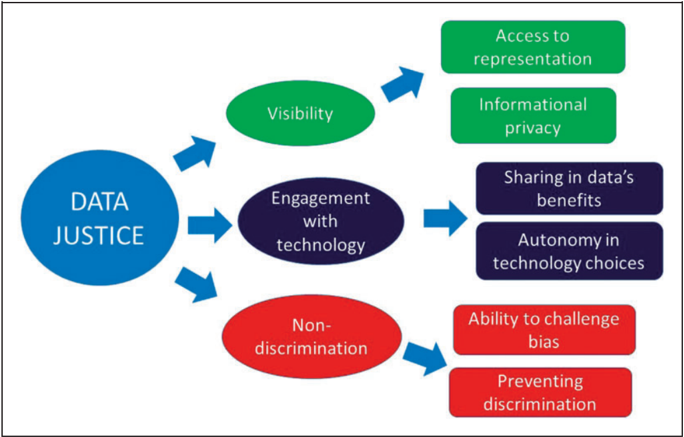
The increasing availability of digital data reflecting economic and human development, and in particular the availability of data emitted as a by-product of people’s use of technological devices and services, has both political and practical implications for the way people are seen and treated by the state and by the private sector. Yet the data revolution is so far primarily a technical one: the power of data to sort, categorise and intervene has not yet been explicitly connected to a social justice agenda by the agencies and authorities involved. Meanwhile, although data-driven discrimination is advancing at a similar pace to data processing technologies, awareness and mechanisms for combating it are not. This paper posits that just as an idea of justice is needed in order to establish the rule of law, an idea of data justice – fairness in the way people are made visible, represented and treated as a result of their production of digital data – is necessary to determine ethical paths through a datafying world. Bringing together the emerging scholarly perspectives on this topic, I propose three pillars as the basis of a notion of international data justice: (in)visibility, (dis)engagement with technology and antidiscrimination. These pillars integrate positive with negative rights and freedoms, and by doing so challenge both the basis of current data protection regulations and the growing assumption that being visible through the data we emit is part of the contemporary social contract.
Overview
The claims and statistics of this paper haven’t been checked yet.
Free: it reads the open-access text and checks the first 5 claims that cite a source we can check. Create a free account to check every claim.
Integrity signals
Registry
Cites
Statistics
Figures

Verification
Claims the paper makes
The claims and statistics of this paper haven’t been checked yet.
Free: it reads the open-access text and checks the first 5 claims that cite a source we can check. Create a free account to check every claim.
Claims other papers make about this one
Each is checked against this paper’s own text: does it say what the citing paper says it does?
The cited source says what the claim attributes to it.
In the citing paper
“It stresses the importance of developing individual freedoms in relation to how data are used and collected and advocates for enhanced autonomy and agency: people should be able to decide whether they want to participate in this system.”
From Staring Back at the Surveillance Gaze: The Resistance of LGBTQ+ Users on Social Media (2026) · cites this paper as Taylor 2017
The cited source says what the claim attributes to it.
In the citing paper
“Data justice frameworks are particularly invested in understanding the impacts, both negative and positive, of datafication and identifying ways to address them.”
From Staring Back at the Surveillance Gaze: The Resistance of LGBTQ+ Users on Social Media (2026) · cites this paper as Taylor 2017
The check wasn’t confident either way, so it gives no verdict — never disputed.
In the citing paper
“Because of this, the topic of data quality is beginning to transcend beyond the field of data management and into the realm of Human Computer Interaction (HCI), which accommodates holistic considerations such as how people search for relevant datasets [42], how developers perceive data work [64] and the best ways of using crowdsourcing to generate, evaluate or label data [71].”
From A Survey of Data Quality Requirements That Matter in ML Development Pipelines (2023) · cites this paper as [71]
Experimental — accuracy not yet measuredIn the citing paper
“Linnet Taylor (2017) advocates for a data justice framework acknowledging that, while there is a rapid development of data processing technologies, there is a lack of considerations of how datafication plays into broader social justice issues.”
From Staring Back at the Surveillance Gaze: The Resistance of LGBTQ+ Users on Social Media (2026) · cites this paper as Taylor 2017
In the citing paper
“For Taylor (2017), data justice revolves around three pillars: visibility, digital (dis)engagement, and countering data-driven discrimination.”
From Staring Back at the Surveillance Gaze: The Resistance of LGBTQ+ Users on Social Media (2026) · cites this paper as Taylor 2017
Self-check
Percentages, sums and reported differences re-computed from the paper’s own numbers.
The self-check needs the paper’s full text.
Citations
Cites
Clapp, J., & Sen, A. (1999) · International Journal Canada s Journal of Global Policy Analysis · doi:10.1177/002070200005500119 · Cited by 13,507
Clapp, J., & Sen, A. (1999) · International Journal · doi:10.2307/40203469 · Cited by 13,411
Sorting Things Out: Classification and Its Consequences
Bowker, G. C., & Star, S. L. (1999) · doi:10.7551/mitpress/6352.001.0001 · Cited by 6,188
(1993) · Oxford University Press eBooks · doi:10.1093/0198287976.001.0001 · Cited by 4,239
Toward a Field of Intersectionality Studies: Theory, Applications, and Praxis
Cho, S., Crenshaw, K. W., & McCall, L. (2013) · Signs: Journal of Women in Culture and Society · doi:10.1086/669608 · Cited by 4,126 · cited 2×
“This intersectionality (Cho et al., 2013) in the effects of datafication is an important component of the argument for a social justice perspective.”
BackgroundDoyle, T. (2017) · The Information Society · doi:10.1080/01972243.2017.1354593 · Cited by 3,071 · cited 3×
“O’Neil (2016) has warned that algorithmic models must be constantly recalibrated using feedback from the events they are supposed to predict.”
BackgroundNew York University Law Review
Rawls, J. (2017) · Justice · doi:10.4324/9781315193496-11 · Cited by 2,872
Lemke, T. (2001) · Economy and Society · doi:10.1080/03085140120042271 · Cited by 2,043 · cited 2×
“…designed to assure that people are not misusing state welfare funds and other publicly funded support are part of the apparatus of governmentality (Lemke, 2001); data-driven law enforcement focuses unequally on poor neighbourhoods which experience certain types of criminality (O’Neil, 2016); and…”
BackgroundSen, A. (2005) · Journal of Human Development · doi:10.1080/14649880500120491 · Cited by 1,966 · cited 5×
“Many states and regions, for example, take a perspective on rights that frames them as inseparable from corresponding duties, and also addresses the individual as part of the larger collective (Sen, 2005).”
BackgroundInfluentialLevin, K., Cashore, B., Bernstein, S., & Auld, G. (2012) · Policy Sciences · doi:10.1007/s11077-012-9151-0 · Cited by 1,839
Research works printed but not linked: 19
- Alkire S (2011) The capability approach and human development. University of Oxford. Available at: http://www.ophi. org.uk/wp-content/uploads/OPHI-HDCA-SS11-Intro-tothe-Capability-Approach-SA.pdf (accessed 23 June 2017).
- Arora P (2016) Bottom of the data pyramid: Big data and the global south. International Journal of Communication 10: 19.
- Eubanks V (2014) Want to predict the future of surveillance? Ask poor communities. The American Prospect , pp. 1-4. Available at: http://prospect.org/article/want-predict-futuresurveillance-ask-poor-communities#.VXbsO\_Oh2k8.twitter (accessed 9 October 2017).
- Foucault M (1977) Discipline & punish -Panopticism. Discipline and Punish: The Birth of the Prison. New York: Vintage, pp. 195-228.
- Holvast J (2013) De Volkstelling van 1971 . Amsterdam: Uitgeverij Paris.
- Jayaram M (2014) India's big brother project. Boston Review . Available at: http://www.bostonreview.net/world/malavika-jayaram-india-unique-identification-biometrics (accessed 1 January 2016).
- Kroll JA, et al. (2016) Accountable algorithms. University of Pennsylvania Law Review 165(633): 633-705.
- Makulilo AB (2016) ''A person is a person through other persons'' - A critical analysis of privacy and culture in Africa, Beijing Law Review 7: 192-204.
- Masiero S (2016) Digital governance and the reconstruction of the Indian anti-poverty system. Oxford Development Studies 818: 1-16.
- Nussbaum MC (2006) Frontiers of Justice: Disability, Nationality, and Species Membership . Cambridge, MA: Harvard University Press.
- O'Neil C (2016) Weapons of Math Destruction: How Big Data Increases Inequality and Threatens Democracy . New York: Crown Publishing Group.
- Raymond NA (2016) Beyond ''do no harm'' and individual consent: Reckoning with the emerging ethical challenges of civil society's use of data. In: Taylor L, Floridi L and van der Sloot B (eds) Group Privacy: New Challenges of Data Technologies . Springer International, pp. 67-82.
- Shearmur R (2015) Dazzled by data: Big Data, the census and urban geography. Urban Geography 36(7): 965-968.
- Spivak GC (1988) Can the subaltern speak? In: Nelson C and Grossberg L (eds) Marxism and the Interpretation of Culture . University of Illinois Press, pp. 271-313.
- Taylor L (2016a) From zero to hero: How zero-rating became a debate about human rights. IEEE Internet Computing 20(4): 79-83.
- Taylor L (2016b) No place to hide? The ethics and analytics of tracking mobility using mobile phone data. Environment and Planning D: Society and Space 34(2): 319-336.
- Taylor L (2016c) Safety in numbers? Group privacy and big data analytics in the developing world. Group Privacy: New Challenges of Data Technologies . Dordrecht: Springer.
- Taylor L (2016d) The ethics of big data as a public good: Which public? Whose good? Philosophical Transactions of the Royal Society A 374: 1-13.
- Taylor L and Broeders D (2015) In the name of development: Power, profit and the datafication of the global South. Geoforum 64(4): 229-237.
Cited by
Items 601–700 of 862
McStay, A. (2023) · Oxford University Press eBooks · doi:10.1093/oso/9780197615546.003.0004
Automating Vulnerability: Sensing Interiors
McStay, A. (2023) · Oxford University Press eBooks · doi:10.1093/oso/9780197615546.003.0007
Neema, I., Chenai, C., & Garnett, A. (2023) · Oxford University Press eBooks · doi:10.1093/oso/9780192889898.003.0020 · Cited by 2
Aguerre, C., Campbell‐Verduyn, M., & Scholte, J. A. (2024) · Routledge eBooks · doi:10.4324/9781003388418-1 · Cited by 3
Ideal-Real-Actual: Models for Collaboration between Anthropology and Computational Sciences
Jessen, J. F., Mannov, A., & Andersen, A. O. (2023) · Anthropology in Action · doi:10.3167/aia.2023.300302 · Cited by 2
TOWARD A REVOLUTION IN AUSTRALIAN CHILDREN’S DATA AND PRIVACY
Leaver, T. B., Mannell, K., Bunn, A., Duffy, G., Ng, R., & Zhao, A. (2023) · AoIR Selected Papers of Internet Research · doi:10.5210/spir.v2023i0.13529
Finding Life in Data: Datafication and Enlivening Data Towards Justice-Oriented Ends
Barton, A. C., Tan, E., & Clegg, T. (2023) · Proceedings. · doi:10.22318/icls2023.546176 · Cited by 1
Mhajne, A., & Henshaw, A. L. (2024) · Oxford University Press eBooks · doi:10.1093/oso/9780197695883.003.0009
Historical Perspective of Industrial Relationship in Nigeria
Victor-Akinyemi, H. B., & Olashupo, O. Z. (2024) · British Journal of Education Learning and Development Psychology · doi:10.52589/bjeldp-wr1ox3zu
Yakovleva, S. (2024) · Oxford University Press eBooks · doi:10.1093/oso/9780192899248.002.0009
Yakovleva, S. (2024) · Oxford University Press eBooks · doi:10.1093/oso/9780192899248.002.0008
Yakovleva, S. (2024) · Oxford University Press eBooks · doi:10.1093/oso/9780192899248.002.0007
Personal Data Transfers in International Trade and EU Law: A Tale of Two ‘Necessities’
Yakovleva, S. (2024) · Oxford University Press eBooks · doi:10.1093/oso/9780192899248.003.0002 · Cited by 1
Yakovleva, S. (2024) · Oxford University Press eBooks · doi:10.1093/oso/9780192899248.002.0004
Privacy Protection(ism): The Latest Wave of Trade Challenges on Regulatory Autonomy
Yakovleva, S. (2024) · Oxford University Press eBooks · doi:10.1093/oso/9780192899248.003.0003
Yakovleva, S. (2024) · Oxford University Press eBooks · doi:10.1093/oso/9780192899248.003.0006
Reconciling Data Privacy and Global Data Flows the EU Way
Yakovleva, S. (2024) · Oxford University Press eBooks · doi:10.1093/oso/9780192899248.003.0004
Cross-Border Data Flows: Between Trade and Data Privacy
Yakovleva, S. (2024) · Oxford University Press eBooks · doi:10.1093/oso/9780192899248.003.0001
“DATAİZM”E KARŞI VERİ GÜVENLİĞİ VE ADALETİ
Ümütlü, A. Y., & Afşar, Ö. A. (2024) · Adalet Dergisi · doi:10.57083/adaletdergisi.1483346
Medrado, A. M. L., & Verdegem, P. (2024) · Revista Mídia e Cotidiano · doi:10.22409/rmc.v18i2.63054
Iššūkiai politinės reprezentacijos raiškai didžiųjų duomenų laikais
Eidikytė, K. (2024) · Politologija · doi:10.15388/polit.2024.114.3
Takács, I., Bársony, R., Fenyvesi, A., & Mazák, V. E. (2024) · AIMS Agriculture and Food · doi:10.3934/agrfood.2024038
“Farmers had the opportunity to answer the questions on a 5-point rating scale (a measurement scale between two extreme values) by giving a multiple-choice numerical value [23].”
BackgroundGovernment of Canada Social Media Monitoring and Its Role in Public Environment Analysis
Dybka, C. (2024) · Carleton University's Institutional Repository (MacOdrum Library, Carleton University) · doi:10.22215/etd/2024-15988
The (Dis)integrative Potential of RightsPreprint
Plan, A. M., & Schiek, D. G. (2024) · SSRN Electronic Journal · doi:10.2139/ssrn.4934612
Ramasubramanian, S., Burth, S., & McMillian, M. S. (2024) · Oxford University Press eBooks · doi:10.1093/oxfordhb/9780197744345.013.13
Introduction to Volume II: Interrogating Cultures of Policing and Intelligence in the Big Data Era
Gundhus, H. O. I., Wathne, C. T., & Kuldova, T. Ø. (2024) · Palgrave's critical policing studies · doi:10.1007/978-3-031-68298-8_1
Ethics of Health Research Data Ownership and Global Regulations
Daniel, N. (2024) · Advances in data mining and database management book series · doi:10.4018/979-8-3693-3848-3.ch014
Boro, S., & Dixit, S. K. (2024) · ShodhKosh Journal of Visual and Performing Arts · doi:10.29121/shodhkosh.v5.i4.2024.2938
How have you modelled my gender? Reconstructing the history of gender representation in Wikidata
Melis, B., Fioravanti, M., Paolini, C., & Metilli, D. (2024) · Internet Histories · doi:10.1080/24701475.2024.2431798 · Cited by 2
“In our work, we apply the concept of data justice, defined by Taylor (2017) as “fairness in the way people are made visible, represented and treated as a result of their production of digital data”, and also Puig de la Bellacasa (2017)’s notion of “matters of care”, which in this context can be…”
AI Against 'I' Hiraeth Poiesis or Mimesis: A Critical Re/Account/Ability
Vicars, M., & Arantes, J. A. (2024) · Advances in human and social aspects of technology book series · doi:10.4018/979-8-3693-7235-7.ch017
Talvitie–Lamberg, K., Ehrlén, V., Uskali, T., Salonen, M., Villi, M., Munnukka, J., Koivula, M., & Kinnunen, W. (2025) · JYU Reports · doi:10.17011//jyureports/59
Re-Conceptualizing Governance Policies on Data Access for ResearchPreprint
Aguerre, C. (2025) · SSRN Electronic Journal · doi:10.2139/ssrn.5062144
An Anticipatory Social Work Manifesto
Nissen, L. B. (2025) · Oxford University Press eBooks · doi:10.1093/9780197665220.005.0002
Nissen, L. B. (2025) · Oxford University Press eBooks · doi:10.1093/9780197665220.002.0005
Nissen, L. B. (2025) · Oxford University Press eBooks · doi:10.1093/9780197665220.003.0008
Nissen, L. B. (2025) · Oxford University Press eBooks · doi:10.1093/9780197665220.003.0014
Nissen, L. B. (2025) · Oxford University Press eBooks · doi:10.1093/9780197665220.003.0007
Nissen, L. B. (2025) · Oxford University Press eBooks · doi:10.1093/9780197665220.005.0003
Nissen, L. B. (2025) · Oxford University Press eBooks · doi:10.1093/9780197665220.003.0016
Nissen, L. B. (2025) · Oxford University Press eBooks · doi:10.1093/9780197665220.003.0010
Building an Anticipatory Social Work Definition
Nissen, L. B. (2025) · Oxford University Press eBooks · doi:10.1093/9780197665220.003.0006
Nissen, L. B. (2025) · Oxford University Press eBooks · doi:10.1093/9780197665220.003.0015
Futures Thinking and Foresight Practice
Nissen, L. B. (2025) · Oxford University Press eBooks · doi:10.1093/9780197665220.003.0005
Nissen, L. B. (2025) · Oxford University Press eBooks · doi:10.1093/9780197665220.002.0002
Nissen, L. B. (2025) · Oxford University Press eBooks · doi:10.1093/9780197665220.003.0011
Nissen, L. B. (2025) · Oxford University Press eBooks · doi:10.1093/9780197665220.003.0018
Conclusion: Making Space for New Ways to Practice in the Road Ahead and 12 Ways to Get Started
Nissen, L. B. (2025) · Oxford University Press eBooks · doi:10.1093/9780197665220.003.0017
Nissen, L. B. (2025) · Oxford University Press eBooks · doi:10.1093/9780197665220.003.0012
Nissen, L. B. (2025) · Oxford University Press eBooks · doi:10.1093/9780197665220.002.0007
(2025) · Oxford University Press eBooks · doi:10.1093/9780197665220.005.0001
Nissen, L. B. (2025) · Oxford University Press eBooks · doi:10.1093/9780197665220.002.0008
History, Futurity, and the Evolution of Foresight
Nissen, L. B. (2025) · Oxford University Press eBooks · doi:10.1093/9780197665220.003.0004
Nissen, L. B. (2025) · Oxford University Press eBooks · doi:10.1093/9780197665220.002.0006
Social Welfare and Social Care
Nissen, L. B. (2025) · Oxford University Press eBooks · doi:10.1093/9780197665220.003.0009
Futures Thinking: Building Blocks for Critical and Participatory Foresight
Nissen, L. B. (2025) · Oxford University Press eBooks · doi:10.1093/9780197665220.003.0003
Nissen, L. B. (2025) · Oxford University Press eBooks · doi:10.1093/9780197665220.002.0009
Anticipatory Social Work Canvas Resources
Nissen, L. B. (2025) · Oxford University Press eBooks · doi:10.1093/9780197665220.005.0004
Anticipatory Social Work: Foresight Tools in Action
Nissen, L. B. (2025) · Oxford University Press eBooks · doi:10.1093/9780197665220.003.0013
Anticipatory Social Work: An Introduction
Nissen, L. B. (2025) · Oxford University Press eBooks · doi:10.1093/9780197665220.003.0001
Welcome—Why Foresight for Social Work?
Nissen, L. B. (2025) · Oxford University Press eBooks · doi:10.1093/9780197665220.003.0002
Idiosyncrasies, Forms of Work, and Capital: The Operational Context of Civic Data
Peer, F. A. (2025) · Computer Supported Cooperative Work (CSCW) · doi:10.1007/s10606-025-09517-1
“Such data infrastructures would also be better aligned with the needs and values of the communities in which they are embedded and would take us closer towards our goal of more equitable and just forms of data production and consumption (Heeks and Renken 2018; L. Taylor 2017; Johnson 2014, 2018).”
Adeleke, F. (2025) · Oxford University Press eBooks · doi:10.1093/9780198945215.003.0047
Vargas, L. C. M., & Macadar, M. A. (2025) · Annual International Conference on Digital Government Research · doi:10.59490/dgo.2025.1002
“Desta forma, data justice representa equidade na forma como as pessoas são tornadas visíveis, representadas e tratadas como resultado de sua produção de dados digitais (Taylor, 2017).”
InfluentialData Justice for International Development: A Structural Model and Manifesto
Heeks, R. (2025) · Oxford University Press eBooks · doi:10.1093/oso/9780198879145.003.0014
Citizenship Education and the Formation of Citizenship in the Digital Age
Mamlok, D. (2025) · Globalisation, comparative education and policy research · doi:10.1007/978-3-031-86145-1_3
Supporting Justice-Oriented Data Science in a Secondary Science Classroom: Pathways and Tensions
Leung, V., Chen, B., Bartucz, J., DeLiema, D., & Scharber, C. (2025) · Proceedings. · doi:10.22318/icls2025.879545
Precision justice: An imaginary of data and justice
Boenig-Liptsin, M. (2025) · Social Studies of Science · doi:10.1177/03063127251342275
“The co-productionist perspective supports inquiry into how a certain kind of justice is enacted through the data projects themselves, even if they appear to not be ‘explicitly connected’ (L. Taylor, 2017) to a predefined idea of justice as held by the agencies and authorities that enact them.”
Kempkens, A., & Müller, R. (2025) · Springer eBooks · doi:10.1007/978-3-662-70086-0_31-1
Парадигма мережевого суспільства Яна ван Дейка: потенціал теоретичної концептуалізації
Aharkov, M. (2025) · Sociological studios · doi:10.29038/2306-3971-2025-01-31-31
Garajamirli, N. (2025) · SCIENTIFIC WORK · doi:10.36719/2663-4619/118/189-202
Is Digital Government Strengthening or Weakening Society? Exploratory Study
Dueñas-Cid, D., Estévez, E., Janowski, T., & Musiatowicz-Podbiał, G. (2025) · Annual International Conference on Digital Government Research · doi:10.59490/dgo.2025.1059 · Cited by 1
Three Ideas for Data Law from Environmental Law: Harm, Responsibility, and Rights
de Souza, S. P., & Sharma, G. (2025) · MPI studies on intellectual property and competition law · doi:10.1007/978-3-031-91401-0_4
Data Violence in Networked Environments: A Study on User Experience
Kayış, H. H. (2025) · Yeni Medya Dergisi · doi:10.55609/yenimedya.1626763 · Cited by 1
Mulder, F. (2025) · Springer eBooks · doi:10.1007/978-3-031-89331-5_10
From Big Data to Local Data: An Exploration of Alternative Approaches to Data in Design
Pierri, P. (2024) · Cumulus Conference · doi:10.63442/okmz5619
Sesay, M. G., & Valentina, G. O. (2025) · Innovative Research Journal of Sociology and Humanities · doi:10.58806/irijsh.2025.v2i7n03
Towards Digital Self-Determination: Autonomy, Privacy, and Governance RightsPreprint
Petersons, E. (2025) · SSRN Electronic Journal · doi:10.2139/ssrn.5386248
Diversity and Inclusion in Data Activism: Frame Resonance and the Barrier of Problem Recognition
Wright, J. M. (2025) · Sociological Forum · doi:10.1111/socf.70004 · Cited by 1
Beyond Headcounts: Towards an Inclusive and Intersectional Framework for the 2027 Caste Census
Joshi, V. D., & Pushpam, A. (2025) · Contemporary Voice of Dalit · doi:10.1177/2455328x251362629
Artificial intelligence carries a huge upside. But potential harms need to be managed
Gillwald, A. N., & Adams, R. (2021) · doi:10.64628/aaj.atv33w9a3
From Tech Lash to Tech Fash: Strategic Reflections on a Decade of Collective Organizing in Computing
Huber, L., Reynolds-Cuéllar, P., DeVrio, A., Raihan, J., Sum, C. M., Dombrowski, L. S., Zhang, J., Becker, C., Irani, L. C., Krafft, P. M., et al. (2025) · Decennial Aarhus Conference · doi:10.1145/3737609.3747097 · Cited by 2
“Scholars have worked to develop a praxis not only of ethics, but of design or data justice —practices which do not just mitigate immediate harm but challenge the fundamental inequities and power imbalances perpetuated by platforms [13, 14, 16, 48].”
Three Pillars of a Smart Justice System
Tang, Z. S. (2025) · Cambridge University Press eBooks · doi:10.1017/9781009319232.010
Big Data and Rural Consumption Dynamics: An Empirical Analysis Based on Old-Age Insurance Policies
Deng, J., & Jia, T. (2025) · Information Resources Management Journal · doi:10.4018/irmj.389731
Rethinking AI Superintelligence Preparedness Through a Justice Lens
Iseko, A. (2025) · International Journal of Science Technology and Society · doi:10.11648/j.ijsts.20251305.12 · Cited by 1
Chowdhury, R. H. (2025) · International Journal of Research Publication and Reviews · doi:10.55248/gengpi.6.1025.3544
Universalidad o par conditio creditorum ante la tecnología disruptiva y la justicia preventiva
Velandia, J. E. V. (2025) · Díkaion · doi:10.5294/dika.2025.34.1.12 · Cited by 1
Okuboye, A. (2025) · International Journal of Management & Entrepreneurship Research · doi:10.51594/ijmer.v7i10.2100
Towards a New Political Economy of Health: A Roadmap for Policymakers and Activists
Geiger, S., & Bourgeron, T. (2025) · Oxford University Press eBooks · doi:10.1093/9780191993626.003.0013
TRIPS against Activists: The Advent of a Transnational and Legal Access to Medicines Activism
Geiger, S., & Bourgeron, T. (2025) · Oxford University Press eBooks · doi:10.1093/9780191993626.003.0004
The HIV/AIDS Crisis: Testing the Neoliberal Pharma Regime and a Bifurcating Activist Movement
Geiger, S., & Bourgeron, T. (2025) · Oxford University Press eBooks · doi:10.1093/9780191993626.003.0003
Market Repair and the Gentrification of the Activist Mind
Geiger, S., & Bourgeron, T. (2025) · Oxford University Press eBooks · doi:10.1093/9780191993626.003.0006
The COVID-19 Crisis: Rising Profits, Endangered Coalitions
Geiger, S., & Bourgeron, T. (2025) · Oxford University Press eBooks · doi:10.1093/9780191993626.003.0009
Market Misfires, Market Failures, and Market Innovation—the Project at the Base of This Volume
Geiger, S., & Bourgeron, T. (2025) · Oxford University Press eBooks · doi:10.1093/9780191993626.005.0001
At the Crossroads of Crises: How the Pharma Industry Is Not Returning to Normal
Geiger, S., & Bourgeron, T. (2025) · Oxford University Press eBooks · doi:10.1093/9780191993626.003.0010
Geiger, S., & Bourgeron, T. (2025) · Oxford University Press eBooks · doi:10.1093/9780191993626.003.0001
The Return of the Jedi? How Regulators Grapple with High-tech and High-priced Pharmaceuticals
Geiger, S., & Bourgeron, T. (2025) · Oxford University Press eBooks · doi:10.1093/9780191993626.003.0008
Geiger, S., & Bourgeron, T. (2025) · Oxford University Press eBooks · doi:10.1093/9780191993626.002.0005
Pharma Goes Neoliberal: Systemic Shifts in the 1980s
Geiger, S., & Bourgeron, T. (2025) · Oxford University Press eBooks · doi:10.1093/9780191993626.003.0002
Fortifying Pharma’s Coalition through the Art of Double-Capture
Geiger, S., & Bourgeron, T. (2025) · Oxford University Press eBooks · doi:10.1093/9780191993626.003.0007
Metadata
- Authors
- Taylor, L.
- Affiliations
- Tilburg University (NL)
- Corresponding author
- Taylor, Linnet
- ORCID
- Taylor, Linnet
- Venue
- Big Data & Society
- Publisher
- SAGE Publications
- Published
- 2017-11
- Volume
- 4
- Issue
- 2
- Pages
- 205395171773633
- ISSN
- 2053-9517 (ISSN-L)
- OpenAlex
- W2590124083
- Cited by
- 802
- References
- 38
- Citations by year
- 2026: 127 · 2025: 168 · 2024: 99 · 2023: 126 · 2022: 89 · 2021: 55 · 2020: 74 · 2019: 47 · 2018: 17
- FWCI
- 86.62
- Type
- journal article
- Language
- en
- Open access
- gold
- doi.org
- Licence
- cc-by-nc-nd
- journals.sagepub.com/page/policies/text-and-data-mining-license (tdm)
- Locations
- Big Data & Society (publishedVersion, cc-by-nc-nd)
- Tilburg University Research Portal (publishedVersion, other-oa)
- Research portal (Tilburg University) (submittedVersion, other-oa)
- Data Archiving and Networked Services (DANS) (submittedVersion, other-oa)
- DOAJ (DOAJ: Directory of Open Access Journals) (submittedVersion, cc-by-sa)
- EUR Research Repository (Erasmus University Rotterdam) (submittedVersion)
- Funders
- European Commission (624583)
- Universiteit van Amsterdam
- Topics
- Physical Sciences › Computer Science › Artificial Intelligence › Ethics and Social Impacts of AI
- Social Sciences › Law › Digitalization, Law, and Regulation
- Social Sciences › Business, Management and Accounting › Industrial relations › Legal and Labor Studies
- Keywords
- data justice, digital rights, internet freedom, datafication, visibility, anti-discrimination, data protection regulation, social justice, digital data, social contract
About these checks
Registry, retraction, Cites and statistics results are computed, not judged, with one exception: a printed reference that no index lists is read once by a model before it counts as a citation error. Claims are extracted by a model and kept only when their quote appears verbatim in the text; each cited source is then checked, with a model’s help, for whether it says what the claim relies on. Those verdicts can be wrong — read the claim’s quote and the cited source before relying on one.
Statistics and arithmetic are recomputed, not judged.
Confidence bands are shown only for fields calibrated on our annotated test set. None is calibrated yet, so no band is shown.
What counts as a claim ›How we measure confidence ›How we check this ›
Are you an author, or do you see a problem with this page? Request a review
Data sources
Bibliographic data: Semantic Scholar, OpenAlex, Crossref.
Contains information from the Semantic Scholar Academic Graph Datasets, made available under the ODC Attribution License (ODC-BY 1.0).
Semantic Scholar’s data is described in: Kinney, R., et al. (2023). The Semantic Scholar Open Data Platform. arXiv:2301.10140.
