

Effectiveness of COVID-19 vaccines against SARS-CoV-2 infection and severe outcomes in adults: a systematic review and meta-analysis of European studies published up to 22 January 2024
Open accessThe DOI matches its Crossref record; 71 of the 76 references it cites were found in a registry or an index; 37 of the 48 sources its claims cite were checked for support.
Abstract
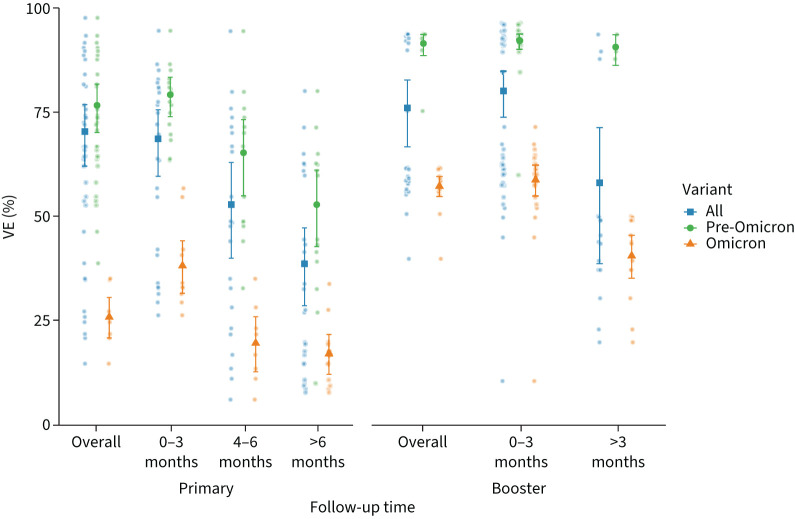
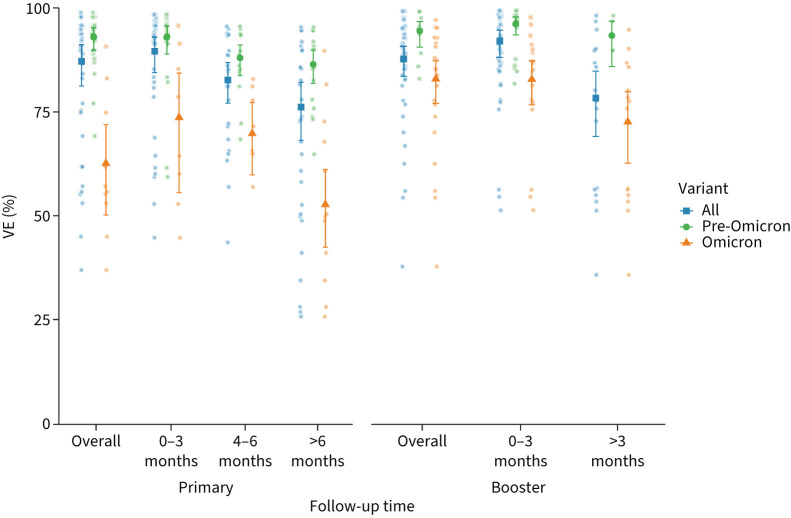
BACKGROUND: Up-to-date evidence from European studies on long-term vaccine effectiveness (VE) of COVID-19 vaccines is lacking. This review aimed to evaluate effectiveness and durability of primary vaccine series and boosters in preventing infection and severe outcomes in the European population. METHODS: We conducted systematic searches of PubMed and Embase up to 22 January 2024. We included observational studies that evaluated VE against severe acute respiratory syndrome coronavirus 2 (SARS-CoV-2) infection or severe disease (hospitalisation, intensive care unit admission or death) for primary series and boosters in Europe. We applied a random-effects meta-analysis model. RESULTS: We included 33 studies and over 56 million participants. The overall VE of the complete primary series against infection with any SARS-CoV-2 variant was 70.7%. VE was lower for Omicron, at 26.1%, than for pre-Omicron strains, at 77.0%. Over time, VE against infection by any variant decreased from 68.9% to 38.9% after 6 months. Boosters restored VE to 76.4% and maintained at 58.4% after 3 months. The overall VE of a complete primary series for severe outcomes due to any variant was 87.4%, with 93.3% for pre-Omicron and 62.8% for Omicron strains. Protection against severe outcomes declined less than for infection. 6 months after the primary series, the vaccine still provided over 50% protection against severe outcomes caused by Omicron. Boosters restored VE to 87.9% and maintained at 78.5% after 3 months. CONCLUSION: VE against SARS-CoV-2 infection declines markedly with time and Omicron variants. Protection against severe outcomes was more durable and resistant to viral mutation. Boosters restored protection, emphasising the need for timely booster vaccination for vulnerable populations.
Overview
CoChat Summary
TL;DR
This systematic review and meta-analysis of 33 European observational studies (>56 million participants) found that COVID-19 vaccines protect against SARS-CoV-2 infection and severe outcomes, but protection against infection wanes over time and is substantially lower for Omicron. Boosters restore protection, while protection against severe outcomes is more durable and less affected by viral mutation.
Key findings
- Primary-series VE against infection with any variant was 70.7% (95% CI 62.4–77.1), falling from 68.9% (95% CI 59.9–75.9) at 0–3 months to 38.9% (95% CI 28.8–47.5) after >6 months. VE was 77.0% (95% CI 70.4–82.1) for pre-Omicron versus 26.1% (95% CI 21.1–30.8) for Omicron.
- Primary-series VE against severe outcomes with any variant was 87.4% (95% CI 81.4–91.4): 93.3% (95% CI 90.0–95.4) for pre-Omicron and 62.8% (95% CI 50.4–72.1) for Omicron. More than 6 months after primary series, Omicron severe-outcome VE remained above 50% at 52.9% (95% CI 42.6–61.3).
- Boosters restored VE against infection to 76.4% (95% CI 67.0–83.1) overall and maintained it at 58.4% (95% CI 38.9–71.6) after >3 months. For severe outcomes, booster VE was 87.9% (95% CI 83.8–91.0) overall and 78.5% (95% CI 69.3–85.0) after >3 months.
- Among 33 included studies, 15 were low risk, 8 moderate risk and 10 high risk of bias; no study was critical risk or excluded from meta-analysis on quality grounds.
Methods
- Systematic review and random-effects meta-analysis following PRISMA, registered as PROSPERO CRD42024529854; PubMed and Embase were searched from 1 January 2020 to 22 January 2024, restricted to English-language observational studies conducted in Europe in adults aged ≥16 years.
- Included 33 studies (17 case–control, 12 cohort, 4 both) with >56 million participants; eligible VE estimates compared complete primary series or boosters with unvaccinated participants for RT-PCR-confirmed infection, hospitalisation, ICU admission or all-cause death.
- Analyses pooled adjusted VE estimates after log-odds conversion using inverse-variance weighting and restricted maximum-likelihood between-study variance; stratified by variant, time since last dose, vaccine type, study design, prior infection adjustment and risk of bias.
Limitations
- The paper states that hospitalisation, ICU admission and death were combined into a composite severe-outcome category because of limited power for individual outcomes, and that studies varied in whether they measured hospitalisation with versus due to COVID-19. It also notes limited generalisability outside Europe, inclusion of only four European-licensed vaccines, RT-PCR-only diagnosis, high I² heterogeneity, English-language restriction, lack of Omicron subvariant analyses, difficulty evaluating long-term second/third boosters, and no consideration of concomitant preventive measures, vaccine hesitancy or racial disparities.
- The text makes evident that all included studies were observational, so residual confounding is possible despite extraction of adjusted estimates; many studies had moderate or high risk of bias, commonly from missing data and selection bias related to prior infection.
- The very high I² values reported for most pooled estimates indicate substantial unexplained between-study variation, which the authors state limits generalisability.
Model-written summary. Check it against the paper before relying on it.
Integrity signals
Registry
Cites
Statistics
Figures
Verification
Claims the paper makes
24 Valid · 6 Not valid · 3 Not checked · 99 Own results and interpretations
Every source the paper cites for this claim was checked and supports it.
In the paper
“For example, some studies classified people with missing vaccination information as unvaccinated [30, 31].”
§ Effectiveness of COVID-19 vaccines against SARS-CoV-2 infection and severe outcomes in adults: a systematic review and meta-analysis of European studies published up to 22 January 2024 > Discussion
What the sources say
- Supportedcites [30] Niessen FA, Knol MJ, Hahné SJM, et al. Vaccine effectiveness against COVID-19 related hospital admission in the Netherlands: a test-negative case–control study. Vaccine 2022; 40: 5044– 5049. doi: 10.1016/j.vaccine.2022.06.011 35863935 PMC9174354 source
The Methods (Statistical analysis) state that patients with unknown vaccination status were included and considered non-vaccinated in a sensitivity analysis. They were excluded from the main analysis, so the claim applies to the sensitivity analysis only. (LLM, conf=0.91)
- Supportedcites [31] Kislaya I, Casaca P, Borges V, et al. Comparative effectiveness of COVID-19 vaccines in preventing infections and disease progression from SARS-CoV-2 omicron BA.5 and BA.2, Portugal. Emerg Infect Dis 2023; 29: 569– 575. doi: 10.3201/eid2903.221367 36737101 PMC9973705 source
In Methods > Exposure Definition, the paper says it used the nationwide electronic vaccination registry and classified patients with no record of COVID-19 vaccine administration as unvaccinated. This supports the cited example of treating absent vaccination records as unvaccinated status. (LLM, conf=0.89)
plain- Asserted: passes — The authors put it forward as true.
- Checkable: passes — It can be checked against evidence.
- Load-bearing: passes — The paper’s conclusions depend on it.
- Based: passes — The paper gives a reason why it holds.
- Supported
Every source the paper cites for this claim was checked and supports it.
In the paper
“Moreover, newly emerging Omicron variants were characterised to have viral mutations that facilitate immune escape [4].”
§ Effectiveness of COVID-19 vaccines against SARS-CoV-2 infection and severe outcomes in adults: a systematic review and meta-analysis of European studies published up to 22 January 2024 > Introduction
What the sources say
- Supportedcites [4] Willett BJ, Grove J, MacLean OA, et al. SARS-CoV-2 Omicron is an immune escape variant with an altered cell entry pathway. Nat Microbiol 2022; 7: 1161– 1179. doi: 10.1038/s41564-022-01143-7 35798890 PMC9352574 source
The Results section identifies multiple Omicron BA.1 and BA.2 spike mutations predicted to reduce antibody binding, including mutations previously associated with decreased binding. The Abstract and Discussion report substantial immune escape by these variants. The claim is supported for the Omicron variants studied. (LLM, conf=0.92)
plainstates a cause- Asserted: passes — The authors put it forward as true.
- Checkable: passes — It can be checked against evidence.
- Load-bearing: passes — The paper’s conclusions depend on it.
- Based: passes — The paper gives a reason why it holds.
- Supported
The cited sources support only part of this claim — read each source’s verdict below.
In the paper
“Another reason to include only European studies is that seasonal trends in COVID-19 cases are more pronounced than in countries such as Israel and Qatar [13, 14], which may also affect the VE estimate.”
§ Effectiveness of COVID-19 vaccines against SARS-CoV-2 infection and severe outcomes in adults: a systematic review and meta-analysis of European studies published up to 22 January 2024 > Introduction
What the sources say
- Partly supportedcites [13] Wiemken TL, Khan F, Puzniak L, et al. Seasonal trends in COVID-19 cases, hospitalizations, and mortality in the United States and Europe. Sci Rep 2023; 13: 3886. doi: 10.1038/s41598-023-31057-1 36890264 PMC9994397 sourceExperimental — accuracy not yet measured
The Results and Discussion report seasonal spikes in COVID-19 cases in Europe from approximately November through April. The paper does not compare Europe with Israel or Qatar, and its Discussion says the findings are not generalizable beyond the United States and Europe. It discusses vaccine timing, but not whether these seasonal differences affect vaccine-effectiveness estimates. (LLM, conf=0.88)
- Partly supportedcites [14] Kyaw MH, Spinardi JR, Jagun O, et al. Descriptive analysis to assess seasonal patterns of COVID-19 and influenza in low-income and middle-income countries in Asia, the Middle East and Latin America. BMJ Open 2024; 14: e081019. doi: 10.1136/bmjopen-2023-081019 PMC10831443 38296298 sourceExperimental — accuracy not yet measured
The Introduction and Discussion report seasonal COVID-19 trends in Europe, while the Results report no clear seasonal pattern in Qatar. The paper does not examine Israel or directly compare European countries with Israel and Qatar. It also does not assess whether seasonality affects vaccine-effectiveness estimates. (LLM, conf=0.84)
plainstates a possible cause- Asserted: passes — The authors put it forward as true.
- Checkable: passes — It can be checked against evidence.
- Load-bearing: passes — The paper’s conclusions depend on it.
- Based: passes — The paper gives a reason why it holds.
- Partly supported
Every source the paper cites for this claim was checked and supports it.
In the paper
“However, neutralising antibody levels were found to decline substantially 6 months after vaccination [1].”
§ Effectiveness of COVID-19 vaccines against SARS-CoV-2 infection and severe outcomes in adults: a systematic review and meta-analysis of European studies published up to 22 January 2024 > Introduction
What the sources say
- Supportedcites [1] Levin EG, Lustig Y, Cohen C, et al. Waning immune humoral response to BNT162b2 COVID-19 vaccine over 6 months. N Engl J Med 2021; 385: e84. doi: 10.1056/NEJMoa2114583 34614326 PMC8522797 source
The Results section (SARS-CoV-2 Antibody Kinetics after Receipt of Second Vaccine Dose) reports that neutralizing antibody titers fell significantly from their peak to the sixth study period, about six months after the second BNT162b2 dose. (LLM, conf=0.94)
plainstates a cause- Asserted: passes — The authors put it forward as true.
- Checkable: passes — It can be checked against evidence.
- Load-bearing: passes — The paper’s conclusions depend on it.
- Based: passes — The paper gives a reason why it holds.
- Supported
The cited sources support only part of this claim — read each source’s verdict below.
In the paper
“Moreover, existing reviews predominantly include studies from North America, Israel and Qatar, with a small number of studies from European countries [7, 8, 12].”
§ Effectiveness of COVID-19 vaccines against SARS-CoV-2 infection and severe outcomes in adults: a systematic review and meta-analysis of European studies published up to 22 January 2024 > Introduction
What the sources say
- Partly supportedcites [7] Song S, Madewell ZJ, Liu M, et al. Effectiveness of SARS-CoV-2 vaccines against Omicron infection and severe events: a systematic review and meta-analysis of test-negative design studies. Front Public Heal 2023; 11: 1195908. doi: 10.3389/fpubh.2023.1195908 PMC10289159 37361171 sourceExperimental — accuracy not yet measured
The Results (Study selection and characteristics) show that most included studies were from the U.S. and Canada, with two from Qatar and fewer from European countries. Israel is not among the countries listed for this review, so the claim is not fully supported by this source. (LLM, conf=0.87)
- Not checked — no full text of the sourcecites [8] Wu N, Joyal-Desmarais K, Ribeiro PAB, et al. Long-term effectiveness of COVID-19 vaccines against infections, hospitalisations, and mortality in adults: findings from a rapid living systematic evidence synthesis and meta-analysis up to December, 2022. Lancet Respir Med 2023; 11: 439– 452. doi: 10.1016/S2213-2600(23)00015-2 36780914 PMC9917454 source
- Partly supportedcites [12] Mohammed H, Pham-Tran DD, Yeoh ZYM, et al. A systematic review and meta-analysis on the real-world effectiveness of COVID-19 vaccines against infection, symptomatic and severe COVID-19 disease caused by the omicron variant (B.1.1.529). Vaccines (Basel) 2023; 11: 224. doi: 10.3390/vaccines11020224 36851102 PMC9965204 sourceExperimental — accuracy not yet measured
Results §3.1 lists 12 studies from the USA, four from Canada and two from Qatar, compared with eight from European countries. This supports the broad geographic pattern for this review, but its included-study list contains no study from Israel, and it does not establish the pattern across existing reviews generally. No page number is available in our copy. (LLM, conf=0.86)
plain- Asserted: passes — The authors put it forward as true.
- Checkable: passes — It can be checked against evidence.
- Load-bearing: passes — The paper’s conclusions depend on it.
- Based: passes — The paper gives a reason why it holds.
- Partly supported
75 more claims · 8 with their cited sources checked
Create a free account to see all 132 claims and to verify the 4 references still open.
- It may state two separate claims as one. 37
- Probably not a substantial claim. 17
- The quote only partly states this claim. 3
Self-check
Percentages, sums and reported differences re-computed from the paper’s own numbers.
Each contradiction between two passages listed here was confirmed by an independent check.
Rated minor: it would not touch a result — a value no result rests on, a p-value that stays on the same side of the significance level, or a conflict that is clerical, resolved elsewhere in the paper, or outside its own findings.
In the paper
§ Effectiveness of COVID-19 vaccines against SARS-CoV-2 infection and severe outcomes in adults: a systematic review and meta-analysis of European studies published up to 22 January 2024 > Discussion
“we observed a higher overall VE against Omicron infection at 6 months in Wu et al. [8] (50% versus 39%), but a lower VE in Mohammed et al. [12] (4% versus 39%).”
§ Effectiveness of COVID-19 vaccines against SARS-CoV-2 infection and severe outcomes in adults: a systematic review and meta-analysis of European studies published up to 22 January 2024 > Results > VE against SARS-CoV-2 infection
“| >6 months | Omicron | 7 (12) | 17.3 (12.3–21.9) | 97.79 | 453.4 |”
Rated minor: it would not touch a result — a value no result rests on, a p-value that stays on the same side of the significance level, or a conflict that is clerical, resolved elsewhere in the paper, or outside its own findings.
In the paper
§ Effectiveness of COVID-19 vaccines against SARS-CoV-2 infection and severe outcomes in adults: a systematic review and meta-analysis of European studies published up to 22 January 2024 > Results > Study characteristics
“| Stoliaroff-Pepin [63] | 2022 | Germany | TNCC”
§ Effectiveness of COVID-19 vaccines against SARS-CoV-2 infection and severe outcomes in adults: a systematic review and meta-analysis of European studies published up to 22 January 2024 > References
“63. Stoliaroff-Pepin A, Peine C, Herath T, et al. Effectiveness of vaccines in preventing hospitalization due to COVID-19: a multicenter hospital-based case-control study, Germany, June 2021 to January 2022. Vaccine 2023; 41: 290– 293.”
Rated minor: it would not touch a result — a value no result rests on, a p-value that stays on the same side of the significance level, or a conflict that is clerical, resolved elsewhere in the paper, or outside its own findings.
In the paper
§ Effectiveness of COVID-19 vaccines against SARS-CoV-2 infection and severe outcomes in adults: a systematic review and meta-analysis of European studies published up to 22 January 2024 > Methods > Data extraction
“we only extracted VE estimates that were adjusted for confounders using multivariable regression or propensity-score matching.”
§ Effectiveness of COVID-19 vaccines against SARS-CoV-2 infection and severe outcomes in adults: a systematic review and meta-analysis of European studies published up to 22 January 2024 > Results > Study characteristics
“| Erazo [46] | 2022 | Belgium | Retrospective cohort | All | Unknown | BNT162b2, mRNA-1273, ChAdOx1, Ad26.COV2-S | Primary series, first booster | Hospitalisation | None |”
Citations
Cites
The PRISMA 2020 statement: An updated guideline for reporting systematic reviews
Page, M. J., McKenzie, J. E., Bossuyt, P. M., Boutron, I., Hoffmann, T. C., Mulrow, C. D., Shamseer, L., Tetzlaff, J. M., Akl, E. A., Brennan, S. E., et al. (2021) · BMJ · doi:10.1136/bmj.n71 · Cited by 108,283
ROBINS-I: a tool for assessing risk of bias in non-randomised studies of interventions
Sterne, J. A., Hernán, M. A., Reeves, B. C., Savović, J., Berkman, N. D., Viswanathan, M., Henry, D., Altman, D. G., Ansari, M. T., Boutron, I., et al. (2016) · BMJ · doi:10.1136/bmj.i4919 · Cited by 20,329 · cited 1×
“Two reviewers (G.Z. and N.D.) independently assessed the included studies for risk of bias using the Risk of Bias in Non-Randomized Studies of Interventions (ROBINS-I) tool [16].”
Khoury, D. S., Cromer, D., Reynaldi, A., Schlub, T. E., Wheatley, A. K., Juno, J. A., Subbarao, K., Kent, S. J., Triccas, J. A., & Davenport, M. P. (2021) · Nature Medicine · doi:10.1038/s41591-021-01377-8 · Cited by 3,742 · cited 1×
“[25] found that protection against SARS-CoV-2 infection required higher levels of neutralising antibodies than protection against severe outcomes.”
SARS-CoV-2 variants, spike mutations and immune escape
Harvey, W. T., Carabelli, A. M., Jackson, B., Gupta, R. K., Thomson, E. C., Harrison, E. M., Ludden, C., Reeve, R., Rambaut, A., COVID-19 Genomics UK (COG-UK) Consortium, et al. (2021) · Nature Reviews Microbiology · doi:10.1038/s41579-021-00573-0 · Cited by 3,528
Effectiveness of Covid-19 Vaccines against the B.1.617.2 (Delta) Variant
Lopez Bernal, J., Andrews, N., Gower, C., Gallagher, E., Simmons, R., Thelwall, S., Stowe, J., Tessier, E., Groves, N., Dabrera, G., et al. (2021) · New England Journal of Medicine · doi:10.1056/nejmoa2108891 · Cited by 2,889
Single-cell landscape of bronchoalveolar immune cells in patients with COVID-19
Liao, M., Liu, Y., Yuan, J., Wen, Y., Xu, G., Zhao, J., Cheng, L., Li, J., Wang, X., Wang, F., et al. (2020) · Nature Medicine · doi:10.1038/s41591-020-0901-9 · Cited by 2,614 · cited 1×
“Memory B-cells are responsible for producing neutralising antibodies to prevent virus entry, while memory T-cells play a role in controlling SARS-CoV-2 infection by removing infected cells and thereby preventing more severe outcomes of COVID-19 [23].”
Effectiveness of COVID-19 vaccines against the Omicron (B.1.1.529) variant of concern
Andrews, N., Stowe, J., Kirsebom, F., Toffa, S., Rickeard, T., Gallagher, E., Gower, C., Kall, M., Groves, N., O’Connell, A.-M., et al. (2021) · doi:10.1101/2021.12.14.21267615 · Cited by 2,420
Waning Immune Humoral Response to BNT162b2 Covid-19 Vaccine over 6 Months
Levin, E. G., Lustig, Y., Cohen, C., Fluss, R., Indenbaum, V., Amit, S., Doolman, R., Asraf, K., Mendelson, E., Ziv, A., et al. (2021) · New England Journal of Medicine · doi:10.1056/nejmoa2114583 · Cited by 1,703
Safety and Efficacy of the BNT162b2 mRNA Covid-19 Vaccine through 6 Months
Thomas, S. J., Moreira, E. D., Kitchin, N., Absalon, J., Gurtman, A., Lockhart, S., Perez, J. L., Pérez Marc, G., Polack, F. P., Zerbini, C., et al. (2021) · New England Journal of Medicine · doi:10.1056/nejmoa2110345 · Cited by 1,640
Six Month Safety and Efficacy of the BNT162b2 mRNA COVID-19 Vaccine
Thomas, S. J., Moreira, E. D., Kitchin, N., Absalon, J., Gurtman, A., Lockhart, S., Perez, J. L., Pérez Marc, G., Polack, F. P., Zerbini, C., et al. (2021) · doi:10.1101/2021.07.28.21261159 · Cited by 1,640
mRNA vaccines induce durable immune memory to SARS-CoV-2 and variants of concern
Goel, R. R., Painter, M. M., Apostolidis, S. A., Mathew, D., Meng, W., Rosenfeld, A. M., Lundgreen, K. A., Reynaldi, A., Khoury, D. S., Pattekar, A., et al. (2021) · Science · doi:10.1126/science.abm0829 · Cited by 873 · cited 1×
“This finding is consistent with the dynamics of antibody titres following SARS-CoV-2 vaccination, showing that the initial high antibody levels appear to decline over time [17 – 19].”
Duration of Protection against Mild and Severe Disease by Covid-19 Vaccines
Andrews, N., Tessier, E., Stowe, J., Gower, C., Kirsebom, F., Simmons, R., Gallagher, E., Thelwall, S., Groves, N., Dabrera, G., et al. (2022) · New England Journal of Medicine · doi:10.1056/nejmoa2115481 · Cited by 807
SARS-CoV-2 Omicron is an immune escape variant with an altered cell entry pathway
Willett, B. J., Grove, J., MacLean, O. A., Wilkie, C., De Lorenzo, G., Furnon, W., Cantoni, D., Scott, S., Logan, N., Ashraf, S., et al. (2022) · Nature Microbiology · doi:10.1038/s41564-022-01143-7 · Cited by 785 · cited 1×
“Moreover, newly emerging Omicron variants were characterised to have viral mutations that facilitate immune escape [4].”
Efficacy of the mRNA-1273 SARS-CoV-2 Vaccine at Completion of Blinded Phase
El Sahly, H. M., Baden, L. R., Essink, B., Doblecki-Lewis, S., Martin, J. M., Anderson, E. J., Campbell, T. B., Clark, J., Jackson, L. A., Fichtenbaum, C. J., et al. (2021) · New England Journal of Medicine · doi:10.1056/nejmoa2113017 · Cited by 641
SARS-CoV-2 Omicron variant: Antibody evasion and cryo-EM structure of spike protein–ACE2 complex
Mannar, D., Saville, J. W., Zhu, X., Srivastava, S. S., Berezuk, A. M., Tuttle, K. S., Marquez, A. C., Sekirov, I., & Subramaniam, S. (2022) · Science · doi:10.1126/science.abn7760 · Cited by 630 · cited 1×
“Compared to earlier strains, Omicron has more mutation sites in the spike protein, of which 15 mutation sites are located in the receptor binding domain (RBD) [21].”
Andrews, N., Stowe, J., Kirsebom, F., Toffa, S., Sachdeva, R., Gower, C., Ramsay, M., & Lopez Bernal, J. (2022) · Nature Medicine · doi:10.1038/s41591-022-01699-1 · Cited by 453
Estimates of SARS-CoV-2 Omicron Variant Severity in Ontario, Canada
Ulloa, A. C., Buchan, S. A., Daneman, N., & Brown, K. A. (2022) · JAMA · doi:10.1001/jama.2022.2274 · Cited by 316 · cited 1×
“With the significant reduction in mortality from Omicron infection [37], the focus of the VE study should shift to protection against more relevant outcomes such as re-infection or post-COVID symptoms.”
Nordström, P., Ballin, M., & Nordström, A. (2022) · The Lancet · doi:10.1016/s0140-6736(22)00089-7 · Cited by 302
Increased memory B cell potency and breadth after a SARS-CoV-2 mRNA boost
Muecksch, F., Wang, Z., Cho, A., Gaebler, C., Ben Tanfous, T., DaSilva, J., Bednarski, E., Ramos, V., Zong, S., Johnson, B., et al. (2022) · Nature · doi:10.1038/s41586-022-04778-y · Cited by 297 · cited 1×
“It has even been found that booster exposure also improves the ability of the memory B-cells to recognise unknown variants such as the Omicron strain [18, 20].”
Evaluation of Waning of SARS-CoV-2 Vaccine–Induced Immunity: A Systematic Review and Meta-analysis
Menegale, F., Manica, M., Zardini, A., Guzzetta, G., Marziano, V., d'Andrea, V., Trentini, F., Ajelli, M., Poletti, P., & Merler, S. (2023) · JAMA Network Open · doi:10.1001/jamanetworkopen.2023.10650 · Cited by 280
Bruxvoort, K. J., Sy, L. S., Qian, L., Ackerson, B. K., Luo, Y., Lee, G. S., Tian, Y., Florea, A., Aragones, M., Tubert, J. E., et al. (2021) · BMJ · doi:10.1136/bmj-2021-068848 · Cited by 230 · cited 1×
“This led to a decline in vaccine effectiveness (VE) over time, as shown in several observational studies [2, 3].”
Efficient recall of Omicron-reactive B cell memory after a third dose of SARS-CoV-2 mRNA vaccine
Goel, R. R., Painter, M. M., Lundgreen, K. A., Apostolidis, S. A., Baxter, A. E., Giles, J. R., Mathew, D., Pattekar, A., Reynaldi, A., Khoury, D. S., et al. (2022) · Cell · doi:10.1016/j.cell.2022.04.009 · Cited by 207
Ferdinands, J. M., Rao, S., Dixon, B. E., Mitchell, P. K., DeSilva, M. B., Irving, S. A., Lewis, N., Natarajan, K., Stenehjem, E., Grannis, S. J., et al. (2022) · BMJ · doi:10.1136/bmj-2022-072141 · Cited by 185
COVID-19 vaccine effectiveness against the omicron (BA.2) variant in England
Kirsebom, F. C. M., Andrews, N., Stowe, J., Toffa, S., Sachdeva, R., Gallagher, E., Groves, N., O'Connell, A.-M., Chand, M., Ramsay, M., et al. (2022) · The Lancet Infectious Diseases · doi:10.1016/s1473-3099(22)00309-7 · Cited by 182
Stowe, J., Andrews, N., Kirsebom, F., Ramsay, M., & Bernal, J. L. (2022) · Nature Communications · doi:10.1038/s41467-022-33378-7 · Cited by 166
Gram, M. A., Emborg, H.-D., Schelde, A. B., Friis, N. U., Nielsen, K. F., Moustsen-Helms, I. R., Legarth, R., Lam, J. U. H., Chaine, M., Malik, A. Z., et al. (2022) · PLOS Medicine · doi:10.1371/journal.pmed.1003992 · Cited by 146
Arbel, R., Peretz, A., Sergienko, R., Friger, M., Beckenstein, T., Duskin-Bitan, H., Yaron, S., Hammerman, A., Bilenko, N., & Netzer, D. (2023) · The Lancet Infectious Diseases · doi:10.1016/s1473-3099(23)00122-6 · Cited by 145
Seasonal trends in COVID-19 cases, hospitalizations, and mortality in the United States and Europe
Wiemken, T. L., Khan, F., Puzniak, L., Yang, W., Simmering, J., Polgreen, P., Nguyen, J. L., Jodar, L., & McLaughlin, J. M. (2023) · Scientific Reports · doi:10.1038/s41598-023-31057-1 · Cited by 138 · cited 1×
“Another reason to include only European studies is that seasonal trends in COVID-19 cases are more pronounced than in countries such as Israel and Qatar [13, 14], which may also affect the VE estimate.”
Yang, Z.-R., Jiang, Y.-W., Li, F.-X., Liu, D., Lin, T.-F., Zhao, Z.-Y., Wei, C., Jin, Q.-Y., Li, X.-M., Jia, Y.-X., et al. (2023) · The Lancet Microbe · doi:10.1016/s2666-5247(22)00390-1 · Cited by 138 · cited 1×
“In our review, we found a pooled VE of 71% against SARS-CoV-2 infection, whereas systematic reviews of randomised clinical trials reported higher pooled vaccine efficacy of 83% [26] and 77% [27].”
Duration of effectiveness of vaccination against COVID-19 caused by the omicron variant
Higdon, M. M., Baidya, A., Walter, K. K., Patel, M. K., Issa, H., Espié, E., Feikin, D. R., & Knoll, M. D. (2022) · The Lancet Infectious Diseases · doi:10.1016/s1473-3099(22)00409-1 · Cited by 136 · cited 1×
“There have been several systematic reviews examining the real-world VE and durability of coronavirus disease 2019 (COVID-19) vaccine protection [5, 7 – 12], with some focusing solely on the Omicron variants [7, 10 – 12].”
(2022) · doi:10.1038/s41467-022-31838-8 · Cited by 135
Katikireddi, S. V., Cerqueira-Silva, T., Vasileiou, E., Robertson, C., Amele, S., Pan, J., Taylor, B., Boaventura, V., Werneck, G. L., Flores-Ortiz, R., et al. (2022) · The Lancet · doi:10.1016/s0140-6736(21)02754-9 · Cited by 124
Serological responses and vaccine effectiveness for extended COVID-19 vaccine schedules in England
(2021) · doi:10.1038/s41467-021-27410-5 · Cited by 117
Beladiya, J., Kumar, A., Vasava, Y., Parmar, K., Patel, D., Patel, S., Dholakia, S., Sheth, D., Boddu, S. H. S., & Patel, C. (2024) · Reviews in Medical Virology · doi:10.1002/rmv.2507 · Cited by 96 · cited 1×
“In our review, we found a pooled VE of 71% against SARS-CoV-2 infection, whereas systematic reviews of randomised clinical trials reported higher pooled vaccine efficacy of 83% [26] and 77% [27].”
Lim, J. M. E., Hang, S. K., Hariharaputran, S., Chia, A., Tan, N., Lee, E. S., Chng, E., Lim, P. L., Young, B. E., Lye, D. C., et al. (2022) · Cell Reports Medicine · doi:10.1016/j.xcrm.2022.100793 · Cited by 73 · cited 1×
“Based on previous reports, the Omicron variant has a strong ability to evade B-cell-mediated humoral immunity, while T-cell epitopes are relatively unchanged [24].”
Kirsebom, F. C. M., Andrews, N. J., Stowe, J., Ramsay, M. E., & Bernal, J. L. (2023) · The Lancet Infectious Diseases · doi:10.1016/s1473-3099(23)00365-1 · Cited by 67
Seppälä, E., Veneti, L., Starrfelt, J., Danielsen, A. S., Bragstad, K., Hungnes, O., Taxt, A. M., Watle, S. V., & Meijerink, H. (2021) · Eurosurveillance · doi:10.2807/1560-7917.es.2021.26.35.2100793 · Cited by 65
Flacco, M. E., Soldato, G., Martellucci, C. A., Carota, R., Luzio, R. D., Caponetti, A., & Manzoli, L. (2021) · Vaccines · doi:10.3390/vaccines9060628 · Cited by 53
Mohammed, H., Pham-Tran, D. D., Yeoh, Z. Y. M., Wang, B., McMillan, M., Andraweera, P. H., & Marshall, H. S. (2023) · Vaccines · doi:10.3390/vaccines11020224 · Cited by 47 · cited 3×
“Moreover, existing reviews predominantly include studies from North America, Israel and Qatar, with a small number of studies from European countries [7, 8, 12].”
(2022) · doi:10.1186/s12916-022-02480-4 · Cited by 43
Suarez Castillo, M., Khaoua, H., & Courtejoie, N. (2022) · Eurosurveillance · doi:10.2807/1560-7917.es.2022.27.16.2200250 · Cited by 41
Schuit, E., Venekamp, R. P., Hooft, L., Veldhuijzen, I. K., van den Bijllaardt, W., Pas, S. D., Zwart, V. F., Lodder, E. B., Hellwich, M., Koppelman, M., et al. (2022) · BMJ · doi:10.1136/bmj-2022-071215 · Cited by 41
(2022) · doi:10.1038/s41467-022-35168-7 · Cited by 37
Martellucci, C. A., Flacco, M. E., Soldato, G., Martino, G. D., Carota, R., Caponetti, A., & Manzoli, L. (2022) · Vaccines · doi:10.3390/vaccines10050662 · Cited by 34
Song, S., Madewell, Z. J., Liu, M., Longini, I. M., & Yang, Y. (2023) · Frontiers in Public Health · doi:10.3389/fpubh.2023.1195908 · Cited by 34 · cited 3×
“Moreover, existing reviews predominantly include studies from North America, Israel and Qatar, with a small number of studies from European countries [7, 8, 12].”
Pratama, N. R., Wafa, I. A., Budi, D. S., Sutanto, H., Asmarawati, T. P., Barlian Effendi, G., & Wungu, C. D. K. (2022) · Vaccines · doi:10.3390/vaccines10122180 · Cited by 30
Tamandjou Tchuem, C. R., Auvigne, V., Vaux, S., Montagnat, C., Paireau, J., Monnier Besnard, S., Gabet, A., Benhajkassen, N., Le Strat, Y., Parent Du Chatelet, I., et al. (2023) · Vaccine · doi:10.1016/j.vaccine.2023.02.062 · Cited by 27
Silva, T. C., Shah, S. A., Robertson, C., Sanchez, M. N., Katikireddi, S. V., Oliveira, V. D. A., Paixão, E. S., Rudan, I., Bertoldo, J., Penna, G. O., et al. (2022) · PLoS Medicine · doi:10.1371/journal.pmed.1004156 · Cited by 21
Uwamino, Y., Kurafuji, T., Takato, K., Sakai, A., Tanabe, A., Noguchi, M., Yatabe, Y., Arai, T., Ohno, A., Tomita, Y., et al. (2022) · Vaccine · doi:10.1016/j.vaccine.2022.06.016 · Cited by 21 · cited 1×
“This finding is consistent with the dynamics of antibody titres following SARS-CoV-2 vaccination, showing that the initial high antibody levels appear to decline over time [17 – 19].”
Braeye, T., van Loenhout, J. A. F., Brondeel, R., Stouten, V., Hubin, P., Billuart, M., Chung, P. Y. J., Vandromme, M., Wyndham-Thomas, C., Blot, K. Y., et al. (2023) · Eurosurveillance · doi:10.2807/1560-7917.es.2023.28.26.2200768 · Cited by 18
Niessen, F. A., Knol, M. J., Hahné, S. J. M., Bonten, M. J. M., & Bruijning-Verhagen, P. C. J. L. (2022) · Vaccine · doi:10.1016/j.vaccine.2022.06.011 · Cited by 15 · cited 1×
“For example, some studies classified people with missing vaccination information as unvaccinated [30, 31].”
van Ewijk, C. E., Kooijman, M. N., Fanoy, E. B., Raven, S. F. H., Middeldorp, M., Shah, A. A., de Gier, B., de Melker, H. E., Hahné, S. J. M., & Knol, M. J. (2022) · Eurosurveillance · doi:10.2807/1560-7917.es.2022.27.45.2200217 · Cited by 15
Perry, M., Gravenor, M. B., Cottrell, S. L., Bedston, S., Roberts, R. J., Williams, C. J., Salmon, J. E., Lyons, J., Akbari, A., Lyons, R. A., et al. (2022) · Human Vaccines & Immunotherapeutics · doi:10.1080/21645515.2022.2031774 · Cited by 14
Amodio, E., Vella, G., Restivo, V., Casuccio, A., Vitale, F. M., & On Behalf Of The Covid-Surveillance Working Group Of The University Of Palermo (2022) · Vaccines · doi:10.3390/vaccines10030426 · Cited by 14
Kerr, S., Vasileiou, E., Robertson, C., & Sheikh, A. (2022) · Journal of Global Health · doi:10.7189/jogh.12.05025 · Cited by 13
(2023) · doi:10.1007/s15010-023-02012-z · Cited by 13
Kislaya, I., Casaca, P., Borges, V., Sousa, C., Ferreira, B. I., Fonte, A., Fernandes, E., Dias, C. M., Duarte, S., Almeida, J. P., et al. (2023) · Emerging Infectious Diseases · doi:10.3201/eid2903.221367 · Cited by 13 · cited 1×
“For example, some studies classified people with missing vaccination information as unvaccinated [30, 31].”
Langlete, P., Tesli, M., Veneti, L., Starrfelt, J., Elstrøm, P., & Meijerink, H. (2023) · Vaccine · doi:10.1016/j.vaccine.2023.05.022 · Cited by 12
Petráš, M., Janovská, D., Lomozová, D., Franklová, M., Dlouhý, P., Rosina, J., & Lesná, I. K. (2024) · International Journal of Infectious Diseases · doi:10.1016/j.ijid.2024.106986 · Cited by 11
Zhou, G., Verweij, S., Bijlsma, M. J., de Vos, S., Oude Rengerink, K., Pasmooij, A. M. G., van Baarle, D., Niesters, H. G. M., Mol, P., Vonk, J. M., et al. (2023) · BMJ Open Respiratory Research · doi:10.1136/bmjresp-2023-001674 · Cited by 11 · cited 1×
“However, we believe that these preventive measures play an important role in estimating VE [34].”
Self-citation(2022) · doi:10.1016/j.vaccine.2022.11.065 · Cited by 10
Artificial intelligence in occupational health practice
Chirico, F., & Magnavita, N. (2024) · HAL · doi:10.5281/zenodo.10594908 · Cited by 8
Chirico, F., Khabbache, H., Rizzo, A., Nucera, G., Yildirim, M., Batra, K., Mahmood, B., & Szarpak, L. (2024) · International Network for the Advancement of Medicine, Psychology, and Public Health · doi:10.5281/zenodo.11068941 · Cited by 7
Evaluation of BNT162b2 Vaccine Effectiveness in Galicia, Northwest Spain
Pardo‐Seco, J., Mallah, N., López‐Pérez, L., González-Pérez, J. M., Rosón, B., Otero‐Barrós, M., Durán‐Parrondo, C., Rodríguez-Tenreiro, C., Calle, I. R., Gómez‐Carballa, A., et al. (2022) · International Journal of Environmental Research and Public Health · doi:10.3390/ijerph19074039 · Cited by 6
Kyaw, M. H., Spinardi, J. R., Jagun, O., Franco Villalobos, C., Kapetanakis, V., Sharf-Williams, R., & Yarnoff, B. (2024) · BMJ Open · doi:10.1136/bmjopen-2023-081019 · Cited by 6 · cited 1×
“Another reason to include only European studies is that seasonal trends in COVID-19 cases are more pronounced than in countries such as Israel and Qatar [13, 14], which may also affect the VE estimate.”
Russo, A. G., Murtas, R., Tùnesi, S., et al. (2022) · PubMed · doi:10.19191/ep22.1.a001.001 · Cited by 4
Erazo, D., Vincenti-Gonzalez, M. F., van Loenhout, J. A. F., Hubin, P., Vandromme, M., Maes, P., Taquet, M., Weyenbergh, J. V., Catteau, L., & Dellicour, S. (2022) · Viruses · doi:10.3390/v14061315 · Cited by 1
Nkouaga, F. (2024) · DOAJ (DOAJ: Directory of Open Access Journals) · doi:10.5281/zenodo.13539229 · Cited by 1
Waning of SARS-CoV-2 vaccine-induced immunity: A systematic review and secondary data analysis
Menegale, F., Manica, M., Zardini, A., Guzzetta, G., Marziano, V., d’Andrea, V., Trentini, F., Ajelli, M., Poletti, P., & Merler, S. (2022) · doi:10.1101/2022.07.04.22277225 · Cited by 1
Feikin, D. R., Higdon, M. M., Abu-Raddad, L. J., Andrews, N., & Araos, R. (2023) · The Lancet Respiratory Medicine · doi:10.1016/s2213-2600(23)00015-6 · cited 5×
“[8] also found that the decline in VE over time was more pronounced for SARS-CoV-2 infection than for severe outcomes.”
Influential
Research works printed but not linked: 1
- 10.1056/NEJMOA2113017/SUPPL_FILE/NEJMOA2113017_DATA-SHARING.PDF · doi:10.1056/nejmoa2113017/suppl_file/nejmoa2113017_data-sharing.pdf
Cited by
Estimated Effectiveness of 2024-2025 COVID-19 Vaccination Against Severe COVID-19
Ma, K. C., Webber, A. E., Lauring, A. S., Bendall, E. E., Papalambros, L., Safdar, B., Ginde, A. A., Peltan, I. D., Brown, S. M., Gaglani, M., et al. (2026) · JAMA Network Open · doi:10.1001/jamanetworkopen.2025.57415 · Cited by 25
The Gut Microbiome in Enteric Viral Infections: Underlying Mechanisms and Therapeutic Approaches
Borrego-Ruiz, A., & Borrego, J. J. (2025) · Microorganisms · doi:10.3390/microorganisms13102247 · Cited by 14
Azelastine Nasal Spray for Prevention of SARS-CoV-2 Infections: A Phase 2 Randomized Clinical Trial
Lehr, T., Meiser, P., Selzer, D., Rixecker, T. M., Holzer, F., Mösges, R., Smola, S., Bals, R., CONTAIN Study Group, Alberg, V., et al. (2025) · JAMA Internal Medicine · doi:10.1001/jamainternmed.2025.4283 · Cited by 16
Rationalizing recommendations for influenza and COVID-19 vaccines
Breznik, J. A., Miller, M. S., & Bowdish, D. M. E. (2025) · Vaccine · doi:10.1016/j.vaccine.2025.127775 · Cited by 9
Metadata
- Authors
- Zhou, G., Dael, N., Verweij, S., Balafas, S., Mubarik, S., Oude Rengerink, K., Pasmooij, A. M. G., van Baarle, D., Mol, P. G. M., de Bock, G. H., & Hak, E.
- Affiliations
- University of Groningen (NL)
- Utrecht University (NL)
- University Medical Center Groningen (NL)
- Corresponding author
- Zhou, Guiling
- ORCID
- Venue
- European Respiratory Review
- Publisher
- European Respiratory Society (ERS)
- Published
- 2025-01
- Volume
- 34
- Issue
- 175
- Pages
- 240222
- ISSN
- 0905-9180 (ISSN-L)
- 1600-0617
- PMC
- PMC11836669
- OpenAlex
- W4407751397
- Cited by
- 34
- References
- 76
- Citations by year
- 2026: 19 · 2025: 15
- FWCI
- 5.92
- Type
- journal article
- Language
- en
- Open access
- diamond
- doi.org
- Licence
- Locations
- European Respiratory Review (publishedVersion, cc-by-nc)
- PubMed Central (publishedVersion, cc-by-nc)
- PubMed (publishedVersion)
- DOAJ (DOAJ: Directory of Open Access Journals) (submittedVersion, cc-by-sa)
- Utrecht University Repository (Utrecht University) (submittedVersion, other-oa)
- University of Groningen research database (University of Groningen / Centre for Information Technology) (submittedVersion, cc-by-nc)
- Topics
- Health Sciences › Medicine › Infectious Diseases › SARS-CoV-2 and COVID-19 Research
- Social Sciences › Health › Vaccine Coverage and Hesitancy
- Health Sciences › Medicine › Infectious Diseases › COVID-19 Clinical Research Studies
- Keywords
- COVID-19 vaccines, SARS-CoV-2, vaccine effectiveness, Omicron variant, booster vaccination, waning immunity, severe outcomes, hospitalization, intensive care unit admission, vaccine durability, European adults
- MeSH terms
- COVID-19, SARS-CoV-2, COVID-19 Vaccines, Vaccine Efficacy, Adult, Europe, Humans, Severity of Illness Index, Treatment Outcome
About these checks
Registry, retraction, Cites and statistics results are computed, not judged, with one exception: a printed reference that no index lists is read once by a model before it counts as a citation error. Claims are extracted by a model and kept only when their quote appears verbatim in the text; each cited source is then checked, with a model’s help, for whether it says what the claim relies on. Those verdicts can be wrong — read the claim’s quote and the cited source before relying on one.
The claim verdicts this report counts are experimental: their accuracy is not yet measured.
A language model drew the claims from the paper on 2026-10-10, under version 3 of the claim definition (model deepseek-v4.1-flash, prompt extract-v3).
A second model labelled each claim on 2026-10-10 (model jev-1.13-20260917, definition revision gold-guideline-v0.2).
Cited sources are checked with a language model’s help (gpt-6-sol).
Statistics and arithmetic are recomputed, not judged.
Confidence bands are shown only for fields calibrated on our annotated test set. None is calibrated yet, so no band is shown.
What counts as a claim ›How we measure confidence ›How we check this ›
Are you an author, or do you see a problem with this page? Request a review
Data sources
Bibliographic data: Semantic Scholar, OpenAlex, Crossref.
Contains information from the Semantic Scholar Academic Graph Datasets, made available under the ODC Attribution License (ODC-BY 1.0).
Semantic Scholar’s data is described in: Kinney, R., et al. (2023). The Semantic Scholar Open Data Platform. arXiv:2301.10140.
