

A tale of three next generation sequencing platforms: comparison of Ion torrent, pacific biosciences and illumina MiSeq sequencers
Open accessThe DOI matches its Crossref record; 32 of the 32 references it cites were found in a registry or an index.
Abstract
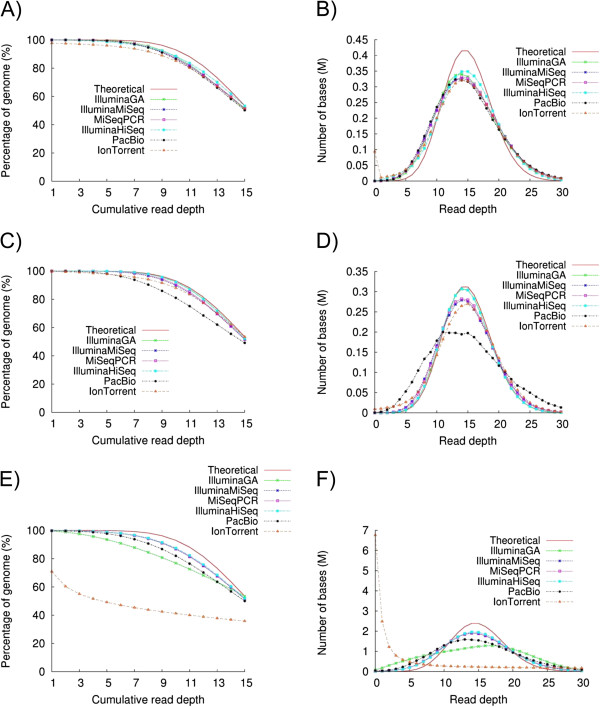
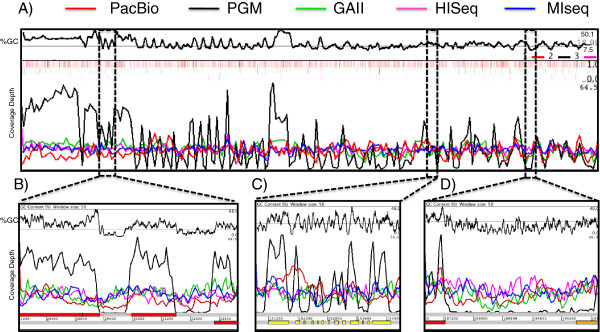
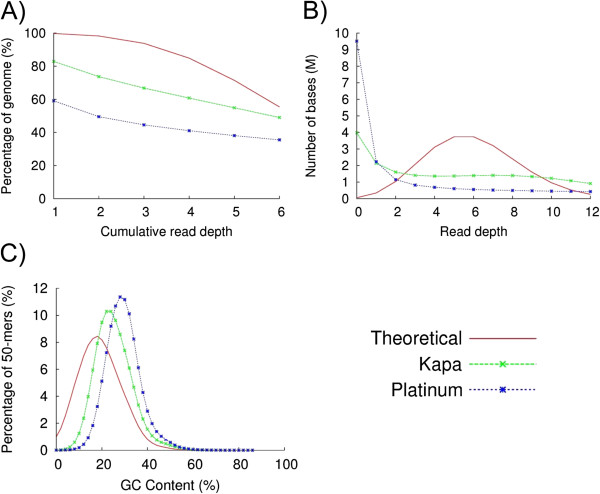
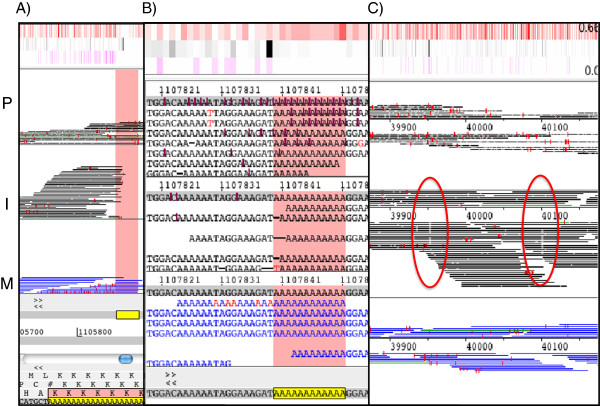
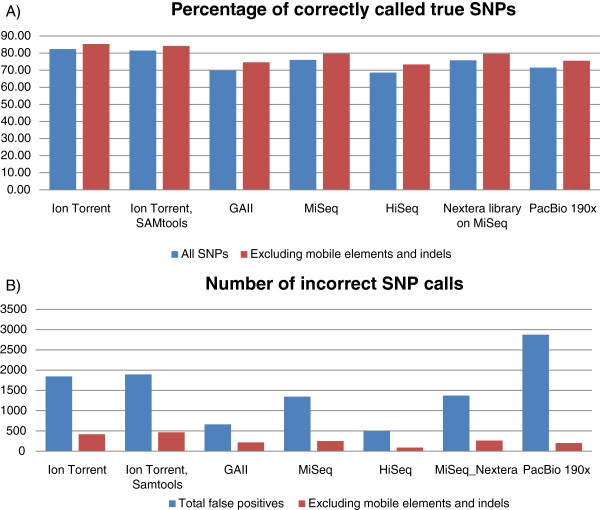
BACKGROUND: Next generation sequencing (NGS) technology has revolutionized genomic and genetic research. The pace of change in this area is rapid with three major new sequencing platforms having been released in 2011: Ion Torrent's PGM, Pacific Biosciences' RS and the Illumina MiSeq. Here we compare the results obtained with those platforms to the performance of the Illumina HiSeq, the current market leader. In order to compare these platforms, and get sufficient coverage depth to allow meaningful analysis, we have sequenced a set of 4 microbial genomes with mean GC content ranging from 19.3 to 67.7%. Together, these represent a comprehensive range of genome content. Here we report our analysis of that sequence data in terms of coverage distribution, bias, GC distribution, variant detection and accuracy. RESULTS: Sequence generated by Ion Torrent, MiSeq and Pacific Biosciences technologies displays near perfect coverage behaviour on GC-rich, neutral and moderately AT-rich genomes, but a profound bias was observed upon sequencing the extremely AT-rich genome of Plasmodium falciparum on the PGM, resulting in no coverage for approximately 30% of the genome. We analysed the ability to call variants from each platform and found that we could call slightly more variants from Ion Torrent data compared to MiSeq data, but at the expense of a higher false positive rate. Variant calling from Pacific Biosciences data was possible but higher coverage depth was required. Context specific errors were observed in both PGM and MiSeq data, but not in that from the Pacific Biosciences platform. CONCLUSIONS: All three fast turnaround sequencers evaluated here were able to generate usable sequence. However there are key differences between the quality of that data and the applications it will support.
Overview
The claims and statistics of this paper haven’t been checked yet.
Free: it reads the open-access text and checks the first 5 claims that cite a source we can check. Create a free account to check every claim.
Integrity signals
Registry
Cites
Statistics
Figures
Verification
Claims the paper makes
The claims and statistics of this paper haven’t been checked yet.
Free: it reads the open-access text and checks the first 5 claims that cite a source we can check. Create a free account to check every claim.
Claims other papers make about this one
Each is checked against this paper’s own text: does it say what the citing paper says it does?
The source backs part of the claim, not all of it — or backs it for a different population, condition or comparison.
In the citing paper
“The limit of detection in these experiments is based on the inherent error rate of the Illumina platform (up to 0.4%), which has previously been described for genome editing experiment analyzed by NGS71–73.”
From A high-fidelity Cas9 mutant delivered as a ribonucleoprotein complex enables efficient gene editing in human hematopoietic stem and progenitor cells (2018) · cites this paper as [72]
Experimental — accuracy not yet measuredThe check wasn’t confident either way, so it gives no verdict — never disputed.
In the citing paper
“RNA-seq is expected to produce some reads from highly expressed transcripts that begin at the same nucleotide and are thus designated “duplicate.””
From Multi-platform assessment of transcriptome profiling using RNA-seq in the ABRF next-generation sequencing study (2014) · cites this paper as [8]
Experimental — accuracy not yet measured
Self-check
Percentages, sums and reported differences re-computed from the paper’s own numbers.
The self-check needs the paper’s full text.
Citations
Cites
The Sequence Alignment/Map format and SAMtools
Li, H., Handsaker, B., Wysoker, A., Fennell, T., Ruan, J., Homer, N., Marth, G., Abecasis, G., Durbin, R., & 1000 Genome Project Data Processing Subgroup (2009) · Bioinformatics · doi:10.1093/bioinformatics/btp352 · Cited by 62,041
Fast and accurate short read alignment with Burrows-Wheeler transform
Li, H., & Durbin, R. (2009) · Bioinformatics · doi:10.1093/bioinformatics/btp324 · Cited by 58,607
RNA-Seq: a revolutionary tool for transcriptomics
Wang, Z., Gerstein, M., & Snyder, M. (2009) · Nature Reviews Genetics · doi:10.1038/nrg2484 · Cited by 13,174 · cited 1×
“Illumina sequencing has matured to the point where a great many applications [15-24] have been developed on the platform.”
BackgroundGenome sequence of the human malaria parasite Plasmodium falciparum
Gardner, M. J., Hall, N., Fung, E., White, O., Berriman, M., Hyman, R. W., Carlton, J. M., Pain, A., Nelson, K. E., Bowman, S., et al. (2002) · Nature · doi:10.1038/nature01097 · Cited by 4,407 · cited 1×
“4% [14], we use it as one of our test genomes, representing a significant challenge to most sequencing technologies.”
Method(1997) · Obesity Surgery · doi:10.1381/096089297765555359 · Cited by 3,916
Real-Time DNA Sequencing from Single Polymerase Molecules
Eid, J., Fehr, A., Gray, J., Luong, K., Lyle, J., Otto, G., Peluso, P., Rank, D., Baybayan, P., Bettman, B., et al. (2009) · Science · doi:10.1126/science.1162986 · Cited by 3,732
Accurate whole human genome sequencing using reversible terminator chemistry
Bentley, D. R., Balasubramanian, S., Swerdlow, H. P., Smith, G. P., Milton, J., Brown, C. G., Hall, K. P., Evers, D. J., Barnes, C. L., Bignell, H. R., et al. (2008) · Nature · doi:10.1038/nature07517 · Cited by 3,684
Self-citationGenome-Wide Mapping of in Vivo Protein-DNA Interactions
Johnson, D. S., Mortazavi, A., Myers, R. M., & Wold, B. (2007) · Science · doi:10.1126/science.1141319 · Cited by 2,927
An integrated semiconductor device enabling non-optical genome sequencing
Rothberg, J. M., Hinz, W., Rearick, T. M., Schultz, J., Mileski, W., Davey, M., Leamon, J. H., Johnson, K., Milgrew, M. J., Edwards, M., et al. (2011) · Nature · doi:10.1038/nature10242 · Cited by 2,172
Diep, B. A., Gill, S. R., Chang, R. F., Phan, T. H., Chen, J. H., Davidson, M. G., Lin, F., Lin, J., Carleton, H. A., Mongodin, E. F., et al. (2006) · The Lancet · doi:10.1016/s0140-6736(06)68231-7 · Cited by 1,633 · cited 9×
“MGEs were manually identified from the S. aureus USA300_FPR3757 genome annotation SNPs called from the resulting alignment provided a high-quality reference set for comparison with the SNPs identified by each sequencing platform.”
MethodInfluential
Cited by
Items 201–300 of 1,000
A SNaPshot of next generation sequencing for forensic SNP analysis
Daniel, R., Santos, C., Phillips, C., Fondevila, M., van Oorschot, R. A. H., Carracedo, Á., Lareu, M. V., & McNevin, D. B. (2014) · Forensic Science International Genetics · doi:10.1016/j.fsigen.2014.08.013 · Cited by 125
“[37] who were able to accurately call heterozygous SNPs with 15 coverage.”
BackgroundSchwach, F., Bushell, E., Gomes, A. R., Anar, B., Girling, G., Herd, C., Rayner, J. C., & Billker, O. (2015) · Nucleic Acids Research · doi:10.1093/nar/gku1143 · Cited by 112
“The homology arms and barcodes of vectors are therefore verified at the end of the production pipeline by sequencing four clones per design on an Illumina MiSeq instrument (150 bp paired ends are sequenced of 400–600 bp fragments (11)).”
MethodBöhme, U., Otto, T. D., Cotton, J. A., Steinbiss, S., Sanders, M. J., Oyola, S. O., Nicot, A., Gandon, S., Patra, K. P., Herd, C., et al. (2018) · Genome Research · doi:10.1101/gr.218123.116 · Cited by 133
“…P. gallinaceum genomic DNA from a batch prepared in 2003 was used to produce an amplification-free Illumina library of 400 – 600 base pairs (bp) (Quail et al. 2012), and 100-bp paired-end reads were generated on an Illumina HiSeq 2000 according to the manufacturer ’ s standard sequencing…”
Self-citationAccelerating Discovery and Functional Analysis of Small RNAs with New Technologies
Barquist, L., & Vogel, J. (2015) · Annual Review of Genetics · doi:10.1146/annurev-genet-112414-054804 · Cited by 130
L1 Mosaicism in Mammals: Extent, Effects, and Evolution
Faulkner, G. J., & Garcia-Perez, J. L. (2017) · Trends in Genetics · doi:10.1016/j.tig.2017.07.004 · Cited by 111
Gaby, J. C., Rishishwar, L., Valderrama-Aguirre, L. C., Green, S. J., Valderrama-Aguirre, A., Jordan, I. K., & Kostka, J. E. (2017) · Applied and Environmental Microbiology · doi:10.1128/aem.01512-17 · Cited by 124
Wu, Z., Gui, S., Quan, Z., Pan, L., Wang, S., Ke, W., Liang, D., & Ding, Y. (2014) · BMC Plant Biology · doi:10.1186/s12870-014-0289-0 · Cited by 119
VIP: an integrated pipeline for metagenomics of virus identification and discovery
Yang, L., Wang, H., Nie, K., Zhang, C., Zhang, Y., Wang, J., Niu, P., & Ma, X. (2016) · Scientific Reports · doi:10.1038/srep23774 · Cited by 131
Arahal, D. R. (2014) · Methods in microbiology · doi:10.1016/bs.mim.2014.07.002 · Cited by 117
Next-generation sequencing: recent applications to the analysis of colorectal cancer
Vecchio, F. D., Mastroiaco, V., Marco, A. D., Compagnoni, C., Capece, D., Zazzeroni, F., Capalbo, C., Alesse, E., & Tessitore, A. (2017) · Journal of Translational Medicine · doi:10.1186/s12967-017-1353-y · Cited by 121
“[42] evaluated the performance of Ion Torrent, PaciBio and Illumina to sequence 4 microbial genomes with CG content ranging from 19.”
MethodThe Genome Sequences of 90 Mushrooms
Li, H., Wu, S., Ma, X., Chen, W., Zhang, J., Duan, S., Gao, Y., Kui, L., Huang, W., Wu, P., et al. (2018) · Scientific Reports · doi:10.1038/s41598-018-28303-2 · Cited by 111
Ramirez-Busby, S. M., & Valafar, F. (2015) · Antimicrobial Agents and Chemotherapy · doi:10.1128/aac.00204-15 · Cited by 108
Utturkar, S. M., Klingeman, D. M., Land, M., Schadt, C. W., Doktycz, M. J., Pelletier, D. A., & Brown, S. D. (2014) · Bioinformatics · doi:10.1093/bioinformatics/btu391 · Cited by 135
“The so-called ‘third generation’ single-molecule sequencing technology developed by Pacific Biosciences (PacBio) has been compared with several NGS platforms (Quail et al ., 2012).”
Refined Pichia pastoris reference genome sequence
Sturmberger, L., Chappell, T. G., Geier, M., Krainer, F., Day, K. J., Vide, U., Trstenjak, S., Schiefer, A., Richardson, T. H., Soriaga, L. B., et al. (2016) · Journal of Biotechnology · doi:10.1016/j.jbiotec.2016.04.023 · Cited by 126
“Typically, repetitive genome features, skewed GC distributions and other genomic complexities limit the methods used for genome sequencing and assembly, giving rise to such errors (Quail et al., 2012a; Roberts et al., 2013).”
BackgroundSelection of biological indicators appropriate for European soil monitoring
Stone, D., Ritz, K., Griffiths, B. S., Orgiazzi, A., & Creamer, R. (2015) · Applied Soil Ecology · doi:10.1016/j.apsoil.2015.08.005 · Cited by 128
“For example, with regard to next generation sequencing (NGS) three new 100 platforms were released in 2011 alone: Ion Torrent’s PGM Pacific Biosciences’ RS 101 and the Illumina MiSeq (Quail et al., 2012).”
MethodInferring Clonal Composition from Multiple Sections of a Breast Cancer
Zare, H., Wang, J., Hu, A. K., Weber, K., Smith, J., Nickerson, D. A., Song, C.-Z., Witten, D., Blau, C. A., & Noble, W. S. (2014) · PLoS Computational Biology · doi:10.1371/journal.pcbi.1003703 · Cited by 120
“In future applications, it may be beneficial to model noise in data produced by sequencing technologies that exhibit high error rates (w0:02%) such as PacBio RS [54].”
BackgroundNext-Generation Sequencing in High-Sensitive Detection of Mutations in Tumors
Singh, R. R. (2020) · Journal of Molecular Diagnostics · doi:10.1016/j.jmoldx.2020.04.213 · Cited by 120
Bell, C. C., Magor, G. W., Gillinder, K. R., & Perkins, A. C. (2014) · BMC Genomics · doi:10.1186/1471-2164-15-1002 · Cited by 105
“The preparation of barcoded DNA libraries is generally achieved either through the ligation of unique barcode and adaptor sequences to fragmented DNA [15], or by incorporating barcode and adaptor sequences into PCR primers, so that the barcodes and the appropriate adaptors are added to the PCR product during the ampli…”
MethodLearning Ecological Networks from Next-Generation Sequencing Data
Vacher, C., Tamaddoni‐Nezhad, A., Kamenova, S., Peyrard, N., Moalic, Y., Sabbadin, R., Schwaller, L., Chiquet, J., Smith, M. A., Vallance, J., et al. (2016) · Advances in ecological research/Advances in Ecological Research · doi:10.1016/bs.aecr.2015.10.004 · Cited by 131
Self-citationMatsa, E., Ahrens, J. H., & Wu, J. C. (2016) · Physiological Reviews · doi:10.1152/physrev.00036.2015 · Cited by 105
Improved Protocols for Illumina Sequencing
Bronner, I. F., Quail, M. A., Turner, D., & Swerdlow, H. (2014) · Current Protocols in Human Genetics · doi:10.1002/0471142905.hg1802s80 · Cited by 126
Self-citationDinis, J. M., Florek, K. R., Fatola, O. O., Moncla, L. H., Mutschler, J. P., Charlier, O. K., Meece, J. K., Belongia, E. A., & Friedrich, T. C. (2016) · Journal of Virology · doi:10.1128/jvi.03248-15 · Cited by 120
“Amplified HA genes were prepared for deep sequencing using the Illumina MiSeq because of its high throughput and low error rate (32, 33).”
MethodASBL, O. B. O. I. P., Deans, Z. C., Costa, J. L., Cree, I. A., Dequeker, E., Edsjö, A., Henderson, S. J., Hummel, M., Ligtenberg, M. J. L., Loddo, M., et al. (2016) · Archiv für Pathologische Anatomie und Physiologie und für Klinische Medicin · doi:10.1007/s00428-016-2025-7 · Cited by 118
Chen, Z., Yuan, Y., Chen, X., Chen, J., Lin, S., Li, X., & Du, H. (2020) · Scientific Reports · doi:10.1038/s41598-020-60559-5 · Cited by 120
Bacterial diversity and flavor profile of Zha-Chili, a traditional fermented food in China
Cai, W., Tang, F., Wang, Y., Zhang, Z., Xue, Y., Zhao, X., Guo, Z., & Shan, C. (2021) · Food Research International · doi:10.1016/j.foodres.2021.110112 · Cited by 103
Depledge, D. P., Kundu, S., Jensen, N. J., Gray, E. R., Jones, M., Steinberg, S., Gershon, A. A., Kinchington, P. R., Schmid, D. S., Balloux, F., et al. (2013) · Molecular Biology and Evolution · doi:10.1093/molbev/mst210 · Cited by 106
“…excess of polymorphic sites in data sets from the GAIIx did not alter the consensus sequences for these samples but do confirm that a higher sequencing error rate is associated with the GAIIx, a finding that has been previously reported (Minoche et al. 2011; Loman et al. 2012; Quail et al. 2012).”
A roadmap for gene system development in Clostridium
Minton, N. P., Ehsaan, M., Humphreys, C. M., Little, G. T., Baker, J., Henstra, A. M., Liew, F. E., Kelly, M. L., Sheng, L., Schwarz, K. M., et al. (2016) · Anaerobe · doi:10.1016/j.anaerobe.2016.05.011 · Cited by 146
Miyamoto, M., Motooka, D., Gotoh, K., Imai, T., Yoshitake, K., Goto, N., Iida, T., Yasunaga, T., Horii, T., Arakawa, K., et al. (2014) · BMC Genomics · doi:10.1186/1471-2164-15-699 · Cited by 117
“Homopolymer error has often been reported for Ion PGM [18,22], and we could confirm this effect in the assembled contigs, as exemplified in Additional file 4: Figure S3(A).”
Peng, X., Yu, K.-Q., Deng, G., Jiang, Y., Wang, Y., Zhang, G., & Zhou, H. (2013) · Journal of Microbiological Methods · doi:10.1016/j.mimet.2013.07.015 · Cited by 115
Leonard, A. S., McClain, M. T., Smith, G. J. D., Wentworth, D. E., Halpin, R., Lin, X., Ransier, A., Stockwell, T. B., Das, S. R., Gilbert, A. S., et al. (2016) · Journal of Virology · doi:10.1128/jvi.01657-16 · Cited by 117
“Based on the known error rate of the Illumina sequencing platform (36, 37) and the stringency of these variant call criteria, we used a minimum allele frequency cutoff of 1% to identify variants.”
MethodSpecies classifier choice is a key consideration when analysing low-complexity food microbiome data
Walsh, A. M., Crispie, F., O’Sullivan, O., Finnegan, L., Claesson, M. J., & Cotter, P. D. (2018) · Microbiome · doi:10.1186/s40168-018-0437-0 · Cited by 98
“Long homopolymer tracts are especially problematic for Ion sequencing [32].”
BackgroundCastaño, C., Berlin, A., Durling, M. B., Ihrmark, K., Lindahl, B. D., Stenlid, J., Clemmensen, K. E., & Olson, Å. (2020) · New Phytologist · doi:10.1111/nph.16731 · Cited by 118
Copy number variation in the speciation of pigs: a possible prominent role for olfactory receptors
Paudel, Y., Madsen, O., Megens, H., Frantz, L., Bosse, M., Crooijmans, R. P. M. A., & Groenen, M. A. M. (2015) · BMC Genomics · doi:10.1186/s12864-015-1449-9 · Cited by 108
“Next generation sequencing methods have been shown biased in coverage in regions of high or low GC [53-58].”
V-Phaser 2: variant inference for viral populations
Yang, X. Q., Charlebois, P., Macalalad, A., Henn, M. R., & Zody, M. C. (2013) · BMC Genomics · doi:10.1186/1471-2164-14-674 · Cited by 104
Comparison of mapping algorithms used in high-throughput sequencing: application to Ion Torrent data
Caboche, S., Audebert, C., Lemoine, Y., & Hot, D. (2014) · BMC Genomics · doi:10.1186/1471-2164-15-264 · Cited by 97
Genome sequence of the corn leaf aphid ( Rhopalosiphum maidis Fitch)
Chen, W., Shakir, S., Bigham, M., Richter, A., Fei, Z., & Jander, G. (2019) · GigaScience · doi:10.1093/gigascience/giz033 · Cited by 113
“Contigs were assembled using PacBio, which provides > 10,000 base pair (bp) read lengths but has a 10% error rate [24].”
Botanical origin authentication of dietary supplements by DNA‐based approaches
Grazina, L., Amaral, J. S., & Mafra, I. (2020) · Comprehensive Reviews in Food Science and Food Safety · doi:10.1111/1541-4337.12551 · Cited by 105
Metabarcoding of lake benthic diatoms: from structure assemblages to ecological assessment
Rivera, S. F., Vasselon, V., Jacquet, S., Bouchez, A., Arizteguí, D., & Rimet, F. (2017) · Hydrobiologia · doi:10.1007/s10750-017-3381-2 · Cited by 114
“…(Elbrecht & Leese 2015), the choice of the PCR amplification protocol (Kebschull & Zador, 2015), the choice of the sequencing technology (Quail et al., 2012), the choice of the bioinformatics data processing (Schmidt et al., 2015), and the importance of the variation of cell biomass…”
BackgroundAccurate typing of short tandem repeats from genome-wide sequencing data and its applications
Fungtammasan, A., Ananda, G., Hile, S. E., Su, M. S.-W., Sun, C., Harris, R., Medvedev, P., Eckert, K., & Makova, K. D. (2015) · Genome Research · doi:10.1101/gr.185892.114 · Cited by 97
Hybrid de novo genome assembly of the Chinese herbal plant danshen (Salvia miltiorrhiza Bunge)
Zhang, G., Tian, Y., Zhang, J., Shu, L., Yang, S., Wang, W., Sheng, J., Dong, Y., & Chen, W. (2015) · GigaScience · doi:10.1186/s13742-015-0104-3 · Cited by 105
“Of all the constructed libraries, two with insertion sizes of 400 and 550 bp were sequenced on a MiSeq platform (Illumina, USA) using the PE-300 module [1], while the rest were sequenced on a HiSeq 2500 platform (Illumina, USA) using either a PE-100 or PE-90 module.”
MethodPinto, M., Borges, V., Antelo, M., Pinheiro, M., Nunes, A., Azevedo, J., Borrego, M. J., Mendonça, J., Carpinteiro, D., Vieira, L., et al. (2016) · Nature Microbiology · doi:10.1038/nmicrobiol.2016.190 · Cited by 96
Lahens, N. F., Ricciotti, E., Smirnova, O., Toorens, E., Kim, E. J., Baruzzo, G., Hayer, K. E., Ganguly, T., Schug, J., & Grant, G. R. (2017) · BMC Genomics · doi:10.1186/s12864-017-4011-0 · Cited by 115
“Both platforms have known GC biases [1, 29, 30] which could be contributing to these platform-specific differences.”
BackgroundLiquid Biopsy in Lung Cancer: Clinical Applications of Circulating Biomarkers (CTCs and ctDNA)
Lim, M., Kim, C., Sunkara, V., Kim, M., & Cho, Y. (2018) · Micromachines · doi:10.3390/mi9030100 · Cited by 107
“Ion-torrent, from ThermoFisher Scientific, was developed using a microfluidic chip and ion sensors to detect the proton that is released when a nucleotide is incorporated into the polymerase in DNA molecules [47].”
BackgroundMultiomics Research: Principles and Challenges in Integrated Analysis
Luo, Y., Zhao, C., & Chen, F. (2024) · BioDesign Research · doi:10.34133/bdr.0059 · Cited by 123
Liu, B., Morrison, C. D., Johnson, C. S., Trump, D. L., Qin, M., Conroy, J., Wang, J., & Liu, S. (2013) · Oncotarget · doi:10.18632/oncotarget.1537 · Cited by 110
“Currently, several platforms with different achievable throughputs, coverage, and resolutions are available, including Fluorescence In Situ Hybridization (FISH) [19, 20], NanoString’s digital detection technology [21-23], array comparative genomic hybridization (array CGH) [24], Single Nucleotide Polymorphism (SNP) ar…”
BackgroundMethodDietz, J., Schelhorn, S.-E., Fitting, D., Mihm, U., Süsser, S., Welker, M., Füller, C., Däumer, M., Teuber, G., Wedemeyer, H. H., et al. (2013) · Journal of Virology · doi:10.1128/jvi.02778-12 · Cited by 103
“By sequencing a clonal fragment, we determined for the 454 platform and the Illumina platform error rates in good accordance with data from previous studies (39, 41, 43, 45, 55).”
MethodResultA review of methods for nematode identification
Seesao, Y., Gay, M., Merlin, S., Viscogliosi, É., Aliouat‐Denis, C., & Audebert, C. (2016) · Journal of Microbiological Methods · doi:10.1016/j.mimet.2016.05.030 · Cited by 119
Current state‐of‐art of STR sequencing in forensic genetics
Alonso, A., Barrio, P. A., Muller, P. H., Köcher, S., Berger, B., Martín, P., Bodner, M., Willuweit, S., Parson, W., Roewer, L., et al. (2018) · Electrophoresis · doi:10.1002/elps.201800030 · Cited by 104
Ávila‐Ríos, S., Parkin, N. T., Swanstrom, R. I., Paredes, R., Shafer, R. W., Ji, H., & Kantor, R. (2020) · Viruses · doi:10.3390/v12060617 · Cited by 95
“Sequencing errors can also contribute to artefactual sequence diversity and are inherent to specific sequencing chemistries and platforms [36] (Table 3).”
BackgroundKnudsen, J. K., Michaelsen, T. Y., Bundgaard‐Nielsen, C., Nielsen, R. E., Hjerrild, S., Leutscher, P. D. C., Wegener, G., & Sørensen, S. (2021) · Scientific Reports · doi:10.1038/s41598-021-01248-9 · Cited by 111
Analysis of the genetic diversity of influenza A viruses using next-generation DNA sequencing
den Hoecke, S. V., Verhelst, J., Vuylsteke, M., & Saelens, X. (2015) · BMC Genomics · doi:10.1186/s12864-015-1284-z · Cited by 106
“A study by Quail and colleagues concluded that the overall SNP calling rate is slightly higher for the data generated by Ion Torrent PGM than for Illumina MiSeq data [21], whereas Loman and colleagues reported a lower substitution error rate for the Illumina MiSeq [20].”
BackgroundResultCirculating Cell Free Tumor DNA Detection as a Routine Tool forLung Cancer Patient Management
Vendrell, J. A., Mau‐Them, F. T., Béganton, B., Godreuil, S., Coopman, P. J., & Solassol, J. (2017) · International Journal of Molecular Sciences · doi:10.3390/ijms18020264 · Cited by 110
“1% and 1% depending on the platform used [69], making impossible the detection of rare mutations.”
BackgroundNext-Generation Sequencing and Its Application: Empowering in Public Health Beyond Reality
Gupta, N., & Verma, V. K. (2019) · Microorganisms for sustainability · doi:10.1007/978-981-13-8844-6_15 · Cited by 132
de Leng, W. W. J., Hooijdonk, C. G. G., Barendregt-Smouter, F. A. S., Koudijs, M. J., Nijman, I., Hinrichs, J. W. J., Cuppen, E. P. J. G., van Lieshout, S., Loberg, R. D., de Jonge, M. J. A., et al. (2016) · PLoS ONE · doi:10.1371/journal.pone.0149405 · Cited by 103
Kemler, M., Garnas, J. R., Wingfield, M. J., Gryzenhout, M., Pillay, K.-A., & Slippers, B. (2013) · PLoS ONE · doi:10.1371/journal.pone.0081718 · Cited by 102
“Other Ion Torrent studies have shown a connection between GC content and sequence coverage [35,36], although GC content alone appears not to be the solely responsible sequencing coverage issue [35].”
BackgroundThe application of genomics to tracing bacterial pathogen transmission
Croucher, N. J., & Didelot, X. (2014) · Current Opinion in Microbiology · doi:10.1016/j.mib.2014.11.004 · Cited by 112
Ogunade, I. M., Jiang, Y., Kim, D. H., Cervantes, A. A. P., Arriola, K. G., Vyas, D., Weinberg, Z. G., Jeong, K. C., & Adesogan, A. T. (2017) · Journal of Dairy Science · doi:10.3168/jds.2016-11745 · Cited by 92
“…study applied a newer sequencing technology, called single molecule real-time sequencing technology, to examine the bacterial profile of alfalfa silage because of its power to generate long sequence reads (Bao et al., 2016); however, this platform suffers from high error rate (Quail et al., 2012).”
BackgroundIndel-correcting DNA barcodes for high-throughput sequencing
Hawkins, J. A., Jones, S. K., Finkelstein, I. J., & Press, W. H. (2018) · Proceedings of the National Academy of Sciences · doi:10.1073/pnas.1802640115 · Cited by 103
“, TTT), (iii) no triplet self-complementarity, and (iv) no GGC [Illumina error motif (25)].”
Current challenges and solutions of de novo assembly
Liao, X., Li, M., Zou, Y. F., Wu, F., Yi‐Pan, & Wang, J. (2019) · Quantitative Biology · doi:10.1007/s40484-019-0166-9 · Cited by 123
“PCR process may introduce bias and mismatch [37].”
BackgroundLincoln, S. E., Hambuch, T., Zook, J. M., Bristow, S. L., Hatchell, K., Truty, R., Kennemer, M., Shirts, B. H., Fellowes, A., Chowdhury, S., et al. (2021) · Genetics in Medicine · doi:10.1038/s41436-021-01187-w · Cited by 91
Targeted DNA Methylation Analysis by Next-generation Sequencing
Masser, D. R., Stanford, D. R., & Freeman, W. M. (2015) · Journal of Visualized Experiments · doi:10.3791/52488 · Cited by 108
Genotype Calling from Population-Genomic Sequencing Data
Maruki, T., & Lynch, M. (2017) · G3 Genes Genomes Genetics · doi:10.1534/g3.117.039008 · Cited by 107
Evolutionary analysis of the most polymorphic gene family in falciparum malaria
Otto, T. D., Assefa, S. A., Böhme, U., Sanders, M. J., Kwiatkowski, D. P., Pf3k consortium, Berriman, M., & Newbold, C. (2019) · Wellcome Open Research · doi:10.12688/wellcomeopenres.15590.1 · Cited by 90
Self-citationMetagenomic Sequencing for Surveillance of Food- and Waterborne Viral Diseases
Nieuwenhuijse, D. F., & Koopmans, M. P. G. (2017) · Frontiers in Microbiology · doi:10.3389/fmicb.2017.00230 · Cited by 90
“Two studies compared the Illumina MiSeq, Roche-454 titanium, Ion Torrent PGM, and PacBio RS platforms (Quail et al., 2012; Frey et al., 2014).”
Yeh, Y., Tang, Y., Sebastian, A., Dasgupta, A., Perea‐López, N., Albert, I. U., Lu, H., Terrones, M., & Zheng, S.-Y. (2016) · Science Advances · doi:10.1126/sciadv.1601026 · Cited by 93
Salk, J. J., & Kennedy, S. R. (2019) · Environmental and Molecular Mutagenesis · doi:10.1002/em.22342 · Cited by 94
“Although these technologies enhance the ability to detect structural variants, they exhibit much higher error rates in the detection of single nucleotide variants, often as high as 15%–20% (Quail et al. 2012; Ross et al. 2013; Jain et al. 2017).”
BackgroundMurray, D. C., Haile, J., Dortch, J., White, N. E., Haouchar, D., Bellgard, M., Allcock, R. J. N., Prideaux, G. J., & Bunce, M. (2013) · Scientific Reports · doi:10.1038/srep03371 · Cited by 100
DNA methylation markers for early detection of women’s cancer: promise and challenges
Wittenberger, T., Sleigh, S. H., Reisel, D., Zikán, M., Wahl, B., Alunni‐Fabbroni, M., Jones, A., Evans, I., Koch, J., Paprotka, T., et al. (2014) · Epigenomics · doi:10.2217/epi.14.20 · Cited by 95
DNA Sequencing Sensors: An Overview
Garrido-Cárdenas, J. A., García‐Maroto, F., Bermejo, J. A. Á., & Manzano-Agugliaro, F. R. (2017) · Sensors · doi:10.3390/s17030588 · Cited by 116
“Their main advantage is that library preparation is not necessary and sequencing reagents are not needed [43,44].”
BackgroundMargos, G., Hepner, S., Mang, C., Marosevic, D., Reynolds, S. E., Krebs, S., Sing, A., Derdáková, M., Reiter, M., & Fingerle, V. (2017) · BMC Genomics · doi:10.1186/s12864-017-3804-5 · Cited by 89
“TS libraries have been described to give a more even coverage of genomes due to the mechanical fragmentation of DNA by ultrasound [9].”
BackgroundKnyazev, S., Tsyvina, V., Shankar, A., Melnyk, A., Artyomenko, A., Malygina, T., Porozov, Y. B., Campbell, E. M., Switzer, W. M., Skums, P., et al. (2021) · Nucleic Acids Research · doi:10.1093/nar/gkab576 · Cited by 89
“Nonetheless, the error rate of single-molecule sequencing is exceptionally high reaching 13 − 14% (65), which hampers PacBio sequencing to detect and assemble rare viral variants.”
Wilker, P. R., Dinis, J. M., Starrett, G. J., Imai, M., Hatta, M., Nelson, C. W., O’Connor, D. H., Hughes, A. L., Neumann, G., Kawaoka, Y., et al. (2013) · Nature Communications · doi:10.1038/ncomms3636 · Cited by 102
Advances in clinical next-generation sequencing: target enrichment and sequencing technologies
Ballester, L. Y., Luthra, R., Kanagal‐Shamanna, R., & Singh, R. R. (2016) · Expert Review of Molecular Diagnostics · doi:10.1586/14737159.2016.1133298 · Cited by 97
Spettel, K., Barousch, W., Makristathis, A., Zeller, I., Nehr, M., Selitsch, B., Lackner, M., Rath, P.-M., Steinmann, J., & Willinger, B. (2019) · PLoS ONE · doi:10.1371/journal.pone.0210397 · Cited by 86
Dietary overlap and seasonality in three species of mormoopid bats from a tropical dry forest
Salinas‐Ramos, V. B., M., L. G. H., León‐Régàgnon, V., Arrizabalaga‐Escudero, A., & Clare, E. L. (2015) · Molecular Ecology · doi:10.1111/mec.13386 · Cited by 96
“Second, NGS technologies impose greater sequencing error (Quail et al. 2012) that artificially inflates sequence diversity, and OTU estimators are thought to often overestimate diversity.”
BackgroundFeng, S., Zheng, K., Jiao, K., Cai, Y., Chen, C., Mao, Y., Wang, L., Zhan, X., Ying, Q., & Wang, H. (2020) · BMC Plant Biology · doi:10.1186/s12870-020-02429-w · Cited by 87
Rebollo, I. R., Sabisz, M., Baeriswyl, V., & Heinis, C. (2014) · Nucleic Acids Research · doi:10.1093/nar/gku940 · Cited by 98
“The main error source in Ion Torrent PGM sequencing is inaccurate flow-calls, which result in insertion/deletion (indel) errors, most frequently in homopolymeric regions (28,29).”
Detection Methods of Human and Animal Influenza Virus—Current Trends
Dziąbowska, K., Czaczyk, E., & Nidzworski, D. (2018) · Biosensors · doi:10.3390/bios8040094 · Cited by 85
“Some other technique, Illumina Platform, offers one million bases sequencing for the cost from $0.05 to $0.15 [67, 68] .”
MethodInfluentialMacchia, E., Manoli, K., Franco, C. D., Picca, R. A., Österbacka, R., Palazzo, G., Torricelli, F., Scamarcio, G., & Torsi, L. (2020) · ACS Sensors · doi:10.1021/acssensors.0c00694 · Cited by 85
Pinna, M., Zangaro, F., Saccomanno, B., Scalone, C., Bozzeda, F., Fanini, L., & Specchia, V. (2023) · Water · doi:10.3390/w15050949 · Cited by 124
Next-Generation Sequencing: Advantages, Disadvantages, and Future
Ari, Ş., & Arikan, M. (2016) · Plant Omics: Trends and Applications · doi:10.1007/978-3-319-31703-8_5 · Cited by 84
Advances in Persian Walnut (Juglans regia L.) Breeding Strategies
Vahdati, K., Arab, M. M., Sarikhani, S., Sadat‐Hosseini, M., Leslie, C. A., & Brown, P. J. (2019) · Springer eBooks · doi:10.1007/978-3-030-23112-5_11 · Cited by 108
Kodera, H., Kato, M., Nord, A. S., Walsh, T., Lee, M., Yamanaka, G., Tohyama, J., Nakamura, K., Nakagawa, E., Ikeda, T., et al. (2013) · Epilepsia · doi:10.1111/epi.12203 · Cited by 83
“Several bench-top high-throughput sequencing platforms are now available (Glenn, 2011; Loman et al., 2012; Quail et al., 2012).”
BackgroundThe mitochondrial genome map of Nelumbo nucifera reveals ancient evolutionary features
Gui, S., Wu, Z., Zhang, H., Zheng, Y., Zhu, Z., Liang, D., & Ding, Y. (2016) · Scientific Reports · doi:10.1038/srep30158 · Cited by 87
“Subsequently, the SMRT-bell library was sequenced using three SMRT cells (Pacific Biosciences) with C2 chemistry on a PacBio RS II sequencing platform 14 .”
Cell-free DNA and next-generation sequencing in the service of personalized medicine for lung cancer
Bennett, C. W., Berchem, G., Kim, Y. J., & El‐Khoury, V. (2016) · Oncotarget · doi:10.18632/oncotarget.11717 · Cited by 92
“1 with the Ion TorrentTM PGM) [77] and per specimen ($64 per specimen for the Illumina MiSeq versus $137 per specimen for the Ion TorrentTM PGM) [76, 79].”
BackgroundMethodResultInfluentialGóngora‐Castillo, E., & Buell, C. R. (2013) · Natural Product Reports · doi:10.1039/c3np20099j · Cited by 100
Catalano, S. R., Whittington, I. D., Donnellan, S. C., & Gillanders, B. M. (2014) · International Journal for Parasitology: Parasites and Wildlife · doi:10.1016/j.ijppaw.2013.11.001 · Cited by 82
“In recent years there have been major technological advances in the field of molecular genetics, providing the ability to sequence multiple markers or whole genomes in a short time span with low costs, e.g. next generation sequencing (Schuster, 2007; Mardis, 2008; Quail et al., 2012).”
BackgroundWan, Q., & Su, J. (2015) · Scientific Reports · doi:10.1038/srep12946 · Cited by 81
Gaps in DNA-Based Biomonitoring Across the Globe
McGee, K. M., Robinson, C. V., & Hajibabaei, M. (2019) · Frontiers in Ecology and Evolution · doi:10.3389/fevo.2019.00337 · Cited by 88
“As many companies, such as illumina R , which produce sequencing equipment, often refer to this sequencing technology as “next-generation sequencing,” therefore it would be logical to maintain consistency with this term (von Bubnoff, 2008; Quail et al., 2012).”
BackgroundPreimplantation Genetic Screening and Preimplantation Genetic Diagnosis
Sullivan-Pyke, C. S., & Dokras, A. (2018) · Obstetrics and Gynecology Clinics of North America · doi:10.1016/j.ogc.2017.10.009 · Cited by 81
High sensitivity multiplex short tandem repeat loci analyses with massively parallel sequencing
Zeng, X., King, J. L., Stoljarova, M., Warshauer, D. H., LaRue, B., Sajantila, A., Patel, J., Storts, D. R., & Budowle, B. (2014) · Forensic Science International Genetics · doi:10.1016/j.fsigen.2014.11.022 · Cited by 89
“Massively parallel sequencing (MPS) technology has the capability to sequence many targeted regions of multiple nucleic acid samples simultaneously with high coverage [10,11].”
BackgroundKukita, Y., Matoba, R., Uchida, J., Hamakawa, T., Doki, Y., Imamura, F., & Kato, K. (2015) · DNA Research · doi:10.1093/dnares/dsv010 · Cited by 88
“26,27 Consequently, the tags generated by read errors can be monitored using the tag size.”
Hiemenz, M., Ostrow, D. G., Busse, T., Buckley, J. D., Maglinte, D. T., Bootwalla, M., Done, J., Ji, J., Raca, G., Ryutov, A., et al. (2018) · Journal of Molecular Diagnostics · doi:10.1016/j.jmoldx.2018.06.009 · Cited by 82
Fu, D., He, C., Wei, J., Zhang, Z., Luo, Y., Tan, H., & Ren, C. (2018) · Cellular Physiology and Biochemistry · doi:10.1159/000495900 · Cited by 86
Boland, J., Chung, C. C., Roberson, D., Mitchell, J., Zhang, X.-J., Im, K., He, J., Chanock, S., Yeager, M., & Dean, M. (2013) · Human Genetics · doi:10.1007/s00439-013-1321-4 · Cited by 82
“However, there is a critical need for evaluation of each new method generating sequencing data against competing sequencing methods as well as non-sequence-based techniques (Quail et al. 2012; Lam et al. 2012; Loman et al. 2012).”
Pant, S., WEINER, R. S., & Marton, M. J. (2014) · Frontiers in Oncology · doi:10.3389/fonc.2014.00078 · Cited by 88
“The PGM Dx instrument will be an open platform for NGS tests but without specific assays submitted to the FDA.”
BackgroundMethodInfluentialGenomic perspectives on the evolution and spread of bacterial pathogens
Bentley, S. D., & Parkhill, J. (2015) · Proceedings of the Royal Society B Biological Sciences · doi:10.1098/rspb.2015.0488 · Cited by 92
“The second generation of sequencing technologies, which emerged around 2008, delivers much more data at lower costs [7].”
Next-generation sequencing in clinical virology: Discovery of new viruses
Datta, S., Budhauliya, R., Das, B., Chatterjee, S., Vanlalhmuaka, & Veer, V. (2015) · World Journal of Virology · doi:10.5501/wjv.v4.i3.265 · Cited by 99
Genomic Sequencing: Assessing The Health Care System, Policy, And Big-Data Implications
Phillips, K. A., Trosman, J. R., Kelley, R. K., Pletcher, M. J., Douglas, M. P., & Weldon, C. B. (2014) · Health Affairs · doi:10.1377/hlthaff.2014.0020 · Cited by 91
Next-Generation Sequencing for MicroRNA Expression Profile
Hu, Y., Lan, W., & Miller, D. (2017) · Methods in molecular biology · doi:10.1007/978-1-4939-7046-9_12 · Cited by 85
Metadata
- Authors
- Quail, M., Smith, M. E., Coupland, P., Otto, T. D., Harris, S. R., Connor, T. R., Bertoni, A., Swerdlow, H. P., & Gu, Y.
- Affiliations
- Wellcome Sanger Institute (GB)
- Corresponding author
- Quail, Michael
- ORCID
- Venue
- BMC Genomics
- Published
- 2012
- Volume
- 13
- Issue
- 1
- Pages
- 341
- ISSN
- 1471-2164 (ISSN-L)
- PMC
- PMC3431227
- OpenAlex
- W2124715997
- Semantic Scholar
- 11bc28c49fc164952f587bba71e55d25db0d1757
- Cited by
- 2,031
- References
- 32
- Citations by year
- 2026: 33 · 2025: 50 · 2024: 105 · 2023: 78 · 2022: 91 · 2021: 130 · 2020: 150 · 2019: 144 · 2018: 188 · 2017: 207 · 2016: 254 · 2015: 226 · 2014: 218 · 2013: 144 · 2012: 9
- FWCI
- 76.69
- Type
- journal article
- Language
- en
- Open access
- gold
- doi.org
- Licence
- cc-by
- Locations
- BMC Genomics (publishedVersion, cc-by)
- Europe PMC (PubMed Central) (publishedVersion, cc-by)
- PubMed Central (publishedVersion, cc-by)
- PubMed (publishedVersion)
- ORCA Online Research @Cardiff (Cardiff University) (acceptedVersion)
- ENLIGHTEN (Jurnal Bimbingan dan Konseling Islam) (acceptedVersion)
- DOAJ (DOAJ: Directory of Open Access Journals) (submittedVersion, cc-by-sa)
- Funders
- Wellcome Trust (grant number 098051, 098051)
- European Commission
- Topics
- Life Sciences › Biochemistry, Genetics and Molecular Biology › Molecular Biology › Genomics and Phylogenetic Studies
- Life Sciences › Biochemistry, Genetics and Molecular Biology › Genetics › Genomics and Rare Diseases
- Life Sciences › Biochemistry, Genetics and Molecular Biology › Molecular Biology › Genetics, Bioinformatics, and Biomedical Research
- Keywords
- Ion Torrent PGM, Illumina MiSeq, Illumina HiSeq, microbial genomes, AT-rich genome, Plasmodium falciparum, GC content, variant calling, false positive rate, sequencing error rate
- MeSH terms
- Base Composition, Base Sequence, Bordetella pertussis, Plasmodium falciparum, Staphylococcus aureus, Gene Library, Genome, Bacterial, Sequence Analysis, DNA, Genome, Protozoan, Polymorphism, Single Nucleotide, Databases, Genetic, Nucleotide Motifs
About these checks
Registry, retraction, Cites and statistics results are computed, not judged, with one exception: a printed reference that no index lists is read once by a model before it counts as a citation error. Claims are extracted by a model and kept only when their quote appears verbatim in the text; each cited source is then checked, with a model’s help, for whether it says what the claim relies on. Those verdicts can be wrong — read the claim’s quote and the cited source before relying on one.
Statistics and arithmetic are recomputed, not judged.
Confidence bands are shown only for fields calibrated on our annotated test set. None is calibrated yet, so no band is shown.
What counts as a claim ›How we measure confidence ›How we check this ›
Are you an author, or do you see a problem with this page? Request a review
Data sources
Bibliographic data: Semantic Scholar, OpenAlex, Crossref.
Contains information from the Semantic Scholar Academic Graph Datasets, made available under the ODC Attribution License (ODC-BY 1.0).
Semantic Scholar’s data is described in: Kinney, R., et al. (2023). The Semantic Scholar Open Data Platform. arXiv:2301.10140.
