

A tale of three next generation sequencing platforms: comparison of Ion torrent, pacific biosciences and illumina MiSeq sequencers
Open accessThe DOI matches its Crossref record; 32 of the 32 references it cites were found in a registry or an index.
Abstract
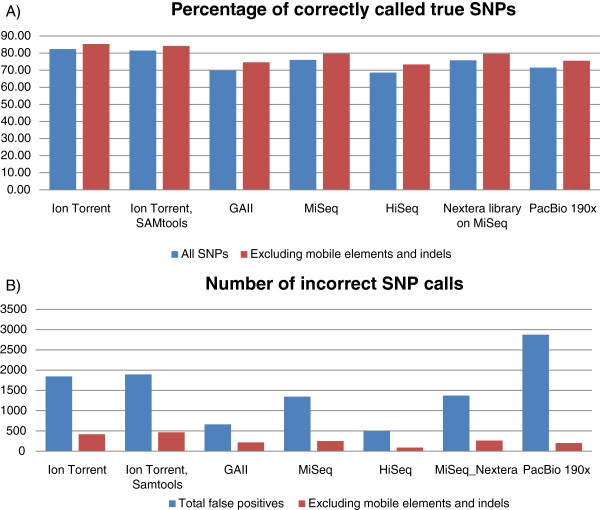
BACKGROUND: Next generation sequencing (NGS) technology has revolutionized genomic and genetic research. The pace of change in this area is rapid with three major new sequencing platforms having been released in 2011: Ion Torrent's PGM, Pacific Biosciences' RS and the Illumina MiSeq. Here we compare the results obtained with those platforms to the performance of the Illumina HiSeq, the current market leader. In order to compare these platforms, and get sufficient coverage depth to allow meaningful analysis, we have sequenced a set of 4 microbial genomes with mean GC content ranging from 19.3 to 67.7%. Together, these represent a comprehensive range of genome content. Here we report our analysis of that sequence data in terms of coverage distribution, bias, GC distribution, variant detection and accuracy. RESULTS: Sequence generated by Ion Torrent, MiSeq and Pacific Biosciences technologies displays near perfect coverage behaviour on GC-rich, neutral and moderately AT-rich genomes, but a profound bias was observed upon sequencing the extremely AT-rich genome of Plasmodium falciparum on the PGM, resulting in no coverage for approximately 30% of the genome. We analysed the ability to call variants from each platform and found that we could call slightly more variants from Ion Torrent data compared to MiSeq data, but at the expense of a higher false positive rate. Variant calling from Pacific Biosciences data was possible but higher coverage depth was required. Context specific errors were observed in both PGM and MiSeq data, but not in that from the Pacific Biosciences platform. CONCLUSIONS: All three fast turnaround sequencers evaluated here were able to generate usable sequence. However there are key differences between the quality of that data and the applications it will support.
Overview
The claims and statistics of this paper haven’t been checked yet.
Free: it reads the open-access text and checks the first 5 claims that cite a source we can check. Create a free account to check every claim.
Integrity signals
Registry
Cites
Statistics
Figures
Verification
Claims the paper makes
The claims and statistics of this paper haven’t been checked yet.
Free: it reads the open-access text and checks the first 5 claims that cite a source we can check. Create a free account to check every claim.
Claims other papers make about this one
Each is checked against this paper’s own text: does it say what the citing paper says it does?
The source backs part of the claim, not all of it — or backs it for a different population, condition or comparison.
In the citing paper
“The limit of detection in these experiments is based on the inherent error rate of the Illumina platform (up to 0.4%), which has previously been described for genome editing experiment analyzed by NGS71–73.”
From A high-fidelity Cas9 mutant delivered as a ribonucleoprotein complex enables efficient gene editing in human hematopoietic stem and progenitor cells (2018) · cites this paper as [72]
Experimental — accuracy not yet measuredThe check wasn’t confident either way, so it gives no verdict — never disputed.
In the citing paper
“RNA-seq is expected to produce some reads from highly expressed transcripts that begin at the same nucleotide and are thus designated “duplicate.””
From Multi-platform assessment of transcriptome profiling using RNA-seq in the ABRF next-generation sequencing study (2014) · cites this paper as [8]
Experimental — accuracy not yet measured
Self-check
Percentages, sums and reported differences re-computed from the paper’s own numbers.
The self-check needs the paper’s full text.
Citations
Cites
The Sequence Alignment/Map format and SAMtools
Li, H., Handsaker, B., Wysoker, A., Fennell, T., Ruan, J., Homer, N., Marth, G., Abecasis, G., Durbin, R., & 1000 Genome Project Data Processing Subgroup (2009) · Bioinformatics · doi:10.1093/bioinformatics/btp352 · Cited by 62,041
Fast and accurate short read alignment with Burrows-Wheeler transform
Li, H., & Durbin, R. (2009) · Bioinformatics · doi:10.1093/bioinformatics/btp324 · Cited by 58,607
RNA-Seq: a revolutionary tool for transcriptomics
Wang, Z., Gerstein, M., & Snyder, M. (2009) · Nature Reviews Genetics · doi:10.1038/nrg2484 · Cited by 13,174 · cited 1×
“Illumina sequencing has matured to the point where a great many applications [15-24] have been developed on the platform.”
BackgroundGenome sequence of the human malaria parasite Plasmodium falciparum
Gardner, M. J., Hall, N., Fung, E., White, O., Berriman, M., Hyman, R. W., Carlton, J. M., Pain, A., Nelson, K. E., Bowman, S., et al. (2002) · Nature · doi:10.1038/nature01097 · Cited by 4,407 · cited 1×
“4% [14], we use it as one of our test genomes, representing a significant challenge to most sequencing technologies.”
Method(1997) · Obesity Surgery · doi:10.1381/096089297765555359 · Cited by 3,916
Real-Time DNA Sequencing from Single Polymerase Molecules
Eid, J., Fehr, A., Gray, J., Luong, K., Lyle, J., Otto, G., Peluso, P., Rank, D., Baybayan, P., Bettman, B., et al. (2009) · Science · doi:10.1126/science.1162986 · Cited by 3,732
Accurate whole human genome sequencing using reversible terminator chemistry
Bentley, D. R., Balasubramanian, S., Swerdlow, H. P., Smith, G. P., Milton, J., Brown, C. G., Hall, K. P., Evers, D. J., Barnes, C. L., Bignell, H. R., et al. (2008) · Nature · doi:10.1038/nature07517 · Cited by 3,684
Self-citationGenome-Wide Mapping of in Vivo Protein-DNA Interactions
Johnson, D. S., Mortazavi, A., Myers, R. M., & Wold, B. (2007) · Science · doi:10.1126/science.1141319 · Cited by 2,927
An integrated semiconductor device enabling non-optical genome sequencing
Rothberg, J. M., Hinz, W., Rearick, T. M., Schultz, J., Mileski, W., Davey, M., Leamon, J. H., Johnson, K., Milgrew, M. J., Edwards, M., et al. (2011) · Nature · doi:10.1038/nature10242 · Cited by 2,172
Diep, B. A., Gill, S. R., Chang, R. F., Phan, T. H., Chen, J. H., Davidson, M. G., Lin, F., Lin, J., Carleton, H. A., Mongodin, E. F., et al. (2006) · The Lancet · doi:10.1016/s0140-6736(06)68231-7 · Cited by 1,633 · cited 9×
“MGEs were manually identified from the S. aureus USA300_FPR3757 genome annotation SNPs called from the resulting alignment provided a high-quality reference set for comparison with the SNPs identified by each sequencing platform.”
MethodInfluential
Cited by
Coming of age: ten years of next-generation sequencing technologies
Goodwin, S., McPherson, J. D., & McCombie, W. R. (2016) · Nature Reviews Genetics · doi:10.1038/nrg.2016.49 · Cited by 4,352
Role of the normal gut microbiota
Jandhyala, S. M. (2015) · World Journal of Gastroenterology · doi:10.3748/wjg.v21.i29.8787 · Cited by 3,001
Opportunities and challenges in long-read sequencing data analysis
Amarasinghe, S. L., Su, S., Dong, X., Zappia, L., Ritchie, M. E., & Gouil, Q. (2020) · Genome Biology · doi:10.1186/s13059-020-1935-5 · Cited by 2,530
PacBio Sequencing and its Applications
Rhoads, A., & Au, K. F. (2015) · Genomics, Proteomics & Bioinformatics · doi:10.1016/j.gpb.2015.08.002 · Cited by 2,135
RNA sequencing: the teenage years
Stark, R., Grzelak, M., & Hadfield, J. (2019) · Nature Reviews Genetics · doi:10.1038/s41576-019-0150-2 · Cited by 1,915
Saam, J., Arnell, C., Theisen, A., Moyes, K., Marino, I., Roundy, K. M., & Wenstrup, R. J. (2015) · Oncology · doi:10.1159/000437307 · Cited by 1,526
Takahashi, S., Tomita, J., Nishioka, K., Hisada, T., & Nishijima, M. (2014) · PLoS ONE · doi:10.1371/journal.pone.0105592 · Cited by 1,506
“In particular, Illumina-based strategies, which provide paired reads of the same DNA fragment, offer multiplexing capability and generate large amounts of sequence data [16,17].”
BackgroundThe Technology and Biology of Single-Cell RNA Sequencing
Kolodziejczyk, A. A., Kim, J. K., Svensson, V., Marioni, J. C., & Teichmann, S. A. (2015) · Molecular Cell · doi:10.1016/j.molcel.2015.04.005 · Cited by 1,487
“The advantages and disadvantages of sequencing platforms are the same for single-cell experiments as for ensembles of cells (for a review of sequencing platforms, see Lam et al., 2012; Quail et al., 2012).”
BackgroundThe sequence of sequencers: The history of sequencing DNA
Heather, J. M., & Chain, B. (2016) · Genomics · doi:10.1016/j.ygeno.2015.11.003 · Cited by 1,397
“The standard Genome Analyzer version (GAIIx) was later followed by the HiSeq, a machine capable of even greater read length and depth, and then the MiSeq, which was a lower-throughput (but lower cost) machine with faster turnaround and longer read lengths [61,62].”
MethodJoensen, K. G., Scheutz, F., Lund, O., Hasman, H., Kaas, R. S., Nielsen, E. M., & Aarestrup, F. M. (2014) · Journal of Clinical Microbiology · doi:10.1128/jcm.03617-13 · Cited by 1,409
“Since the WGS part of this study was performed using the IonTorrent PGM, the price of routine typing and surveillance could be further decreased by performing sequencing on the Illumina MiSeq benchtop sequencer (35), as our current in-house material cost price on this sequencing platform is around 160 euros per isolat…”
MethodThe Third Revolution in Sequencing Technology
van Dijk, E. L., Jaszczyszyn, Y., Naquin, D., & Thermes, C. (2018) · Trends in Genetics · doi:10.1016/j.tig.2018.05.008 · Cited by 1,057
“5 kb) and average error rates were high ( 13%) [19], the technology has strongly improved over recent years.”
BackgroundLowe, R., Shirley, N., Bleackley, M., Dolan, S., & Shafee, T. (2017) · PLOS Computational Biology · doi:10.1371/journal.pcbi.1005457 · Cited by 1,176
“Sequencing technology platforms commonly used for RNA-Seq [72][73].”
MethodOverview of Next‐Generation Sequencing Technologies
Slatko, B. E., Gardner, A. F., & Ausubel, F. M. (2018) · Current Protocols in Molecular Biology · doi:10.1002/cpmb.59 · Cited by 970
“SBS methods have taken several distinct approaches (Fuller et al., 2009; Mardis, 2008; Metzker, 2010; Quail et al., 2012; Shendure & Ji, 2008).”
MethodIntegrating photonics with silicon nanoelectronics for the next generation of systems on a chip
Atabaki, A. H., Moazeni, S., Pavanello, F., Gevorgyan, H., Notaros, J., Alloatti, L., Wade, M. T., Sun, C., Kruger, S. A., Meng, H., et al. (2018) · Nature · doi:10.1038/s41586-018-0028-z · Cited by 927
Characterizing and measuring bias in sequence data
Ross, M. G., Russ, C., Costello, M., Hollinger, A., Lennon, N. J., Hegarty, R., Nusbaum, C., & Jaffe, D. B. (2013) · Genome Biology · doi:10.1186/gb-2013-14-5-r51 · Cited by 909
“Illumina sequencing [18] has been shown to lose coverage in regions of high or low GC [19-22], a phenomenon also seen in other ‘ next-generation ’ technologies [3,6].”
BackgroundResultInfluentialVakulskas, C. A., Dever, D. P., Rettig, G. R., Turk, R., Jacobi, A. M., Collingwood, M. A., Bode, N. M., McNeill, M. S., Yan, S., Camarena, J., et al. (2018) · Nature Medicine · doi:10.1038/s41591-018-0137-0 · Cited by 782
Li, A., Zhang, J., & Zhou, Z. (2014) · BMC Bioinformatics · doi:10.1186/1471-2105-15-311 · Cited by 792
“Such errors are common in the current Roche (454) and Pacific Biosciences (PacBio) sequencing platforms [18-21].”
DNA-Free Genetically Edited Grapevine and Apple Protoplast Using CRISPR/Cas9 Ribonucleoproteins
Malnoy, M., Viola, R., Jung, M.-H., Koo, O.-J., Kim, S., Kim, J.-S., Velasco, R., & Nagamangala Kanchiswamy, C. (2016) · Frontiers in Plant Science · doi:10.3389/fpls.2016.01904 · Cited by 756
“Protoplast volume 200 µl (2 × 10⁵ cells) and RNPs for example 3:1 is Cas9 90 µg (stock 10 µg/µl) sgRNA 30 µg (stock 10 µg/µl) is used for transformation.”
MethodGuidelines for Validation of Next-Generation Sequencing–Based Oncology Panels
Jennings, L. J., Arcila, M. E., Corless, C., Kamel-Reid, S., Lubin, I. M., Pfeifer, J., Temple-Smolkin, R. L., Voelkerding, K. V., & Nikiforova, M. N. (2017) · The Journal of Molecular Diagnostics · doi:10.1016/j.jmoldx.2017.01.011 · Cited by 743
Chromosome-scale shotgun assembly using an in vitro method for long-range linkage
Putnam, N. H., O'Connell, B. L., Stites, J. C., Rice, B. J., Blanchette, M., Calef, R., Troll, C. J., Fields, A., Hartley, P. D., Sugnet, C. W., et al. (2016) · Genome Research · doi:10.1101/gr.193474.115 · Cited by 732
Insights from 20 years of bacterial genome sequencing
Land, M., Hauser, L., Jun, S.-R., Nookaew, I., Leuze, M. R., Ahn, T.-H., Karpinets, T., Lund, O., Kora, G., Wassenaar, T., et al. (2015) · Functional & Integrative Genomics · doi:10.1007/s10142-015-0433-4 · Cited by 727
A single-molecule long-read survey of the human transcriptome
Sharon, D., Tilgner, H., Grubert, F., & Snyder, M. (2013) · Nature Biotechnology · doi:10.1038/nbt.2705 · Cited by 701
He, J., Zhao, X., Laroche, A., Lu, Z.-X., Liu, H., & Li, Z. (2014) · Frontiers in Plant Science · doi:10.3389/fpls.2014.00484 · Cited by 659
“However, there are key differences between the quality of that data and the applications it will support (Quail et al., 2012).”
BackgroundMethodGenes and mutations causing retinitis pigmentosa
Daiger, S. P., Sullivan, L. S., & Bowne, S. J. (2013) · Clinical Genetics · doi:10.1111/cge.12203 · Cited by 619
“There are several NGS methods and numerous distinct applications (36, 37).”
Graphene nanodevices for DNA sequencing
Heerema, S. J., & Dekker, C. (2016) · Nature Nanotechnology · doi:10.1038/nnano.2015.307 · Cited by 611
Advancements in Next-Generation Sequencing
Levy, S. E., & Myers, R. M. (2016) · Annual Review of Genomics and Human Genetics · doi:10.1146/annurev-genom-083115-022413 · Cited by 599
RNA sequencing: new technologies and applications in cancer research
Hong, M., Tao, S., Zhang, L., Diao, L.-T., Huang, X., Huang, S., Xie, S.-J., Xiao, Z.-D., & Zhang, H. (2020) · Journal of Hematology & Oncology · doi:10.1186/s13045-020-01005-x · Cited by 596
Advances and Trends in Omics Technology Development
Dai, X., & Shen, L. (2022) · Frontiers in Medicine · doi:10.3389/fmed.2022.911861 · Cited by 535
“TGS, the third revolution in sequencing technology as enabled by Pacific Biosciences (PacBio, 2011) (76) and Oxford Nanopore Technologies (ONT, 2014) (77), is a single molecular and real-time sequencing technique that allows for the long-read sequencing with low alignment and mapping errors during…”
BackgroundUpdating benchtop sequencing performance comparison
Jünemann, S., Sedlazeck, F. J., Prior, K., Albersmeier, A., John, U., Kalinowski, J., Mellmann, A., Goesmann, A., von Haeseler, A., Stoye, J., et al. (2013) · Nature Biotechnology · doi:10.1038/nbt.2522 · Cited by 505
A first look at the Oxford Nanopore MinION sequencer
Mikheyev, A. S., & Tin, M. M. Y. (2014) · Molecular Ecology Resources · doi:10.1111/1755-0998.12324 · Cited by 483
“Together with other kinds of data, such as more accurate Illumina reads, it may assist genome assembly through scaffolding, similar to the way Pacific Biosciences reads are used now (Quail et al. 2012).”
BackgroundMethodBesser, J., Carleton, H. A., Gerner-Smidt, P., Lindsey, R. L., & Trees, E. (2018) · Clinical Microbiology and Infection · doi:10.1016/j.cmi.2017.10.013 · Cited by 466
Whole-Genome Sequencing of Bacterial Pathogens: the Future of Nosocomial Outbreak Analysis
Quainoo, S., Coolen, J. P. M., van Hijum, S. A. F. T., Huynen, M. A., Melchers, W. J. G., van Schaik, W., & Wertheim, H. F. L. (2017) · Clinical Microbiology Reviews · doi:10.1128/cmr.00016-17 · Cited by 458
Naccache, S. N., Federman, S., Veeraraghavan, N., Zaharia, M., Lee, D., Samayoa, E., Bouquet, J., Greninger, A. L., Luk, K.-C., Enge, B., et al. (2014) · Genome Research · doi:10.1101/gr.171934.113 · Cited by 460
“However, the latest NGS laboratory workflows incur minimum turnaround times exceeding 8 h from clinical sample to sequence (Quail et al. 2012).”
BackgroundLong-Read Sequencing Emerging in Medical Genetics
Mantere, T., Kersten, S., & Hoischen, A. (2019) · Frontiers in Genetics · doi:10.3389/fgene.2019.00426 · Cited by 440
A cascade of DNA-binding proteins for sexual commitment and development in Plasmodium
Sinha, A., Hughes, K. R., Modrzynska, K. K., Otto, T. D., Pfander, C., Dickens, N. J., Religa, A. A., Bushell, E., Graham, A. L., Cameron, R., et al. (2014) · Nature · doi:10.1038/nature12970 · Cited by 438
Self-citation‘Big data’, Hadoop and cloud computing in genomics
O’Driscoll, A., Daugelaite, J., & Sleator, R. D. (2013) · Journal of Biomedical Informatics · doi:10.1016/j.jbi.2013.07.001 · Cited by 431
“Advances in next generation sequencing technologies [1] has resulted in the generation of unprecedented levels of sequence data.”
BackgroundVerde, I., Jenkins, J., Dondini, L., Micali, S., Pagliarani, G., Vendramin, E., Paris, R., Aramini, V., Gazza, L., Rossini, L., et al. (2017) · BMC Genomics · doi:10.1186/s12864-017-3606-9 · Cited by 432
“These methodologies, are capable of obtaining much longer reads, up to 50 kb [36], with the trade-off of an increase in error rates of 13-15% [37, 38] in comparison to 0.”
MethodMolecular genetic testing and the future of clinical genomics
Katsanis, S. H., & Katsanis, N. (2013) · Nature Reviews Genetics · doi:10.1038/nrg3493 · Cited by 425
Piñol, J., Mir, G., Gomez‐Polo, P., & Agustí, N. (2015) · Molecular Ecology Resources · doi:10.1111/1755-0998.12355 · Cited by 423
“These studies are based on the use of the PCR to amplify DNA of a certain genomic region, followed by high-throughput sequencing (Quail et al. 2012).”
MethodArtificial intelligence (AI) and big data in cancer and precision oncology
Dlamini, Z., Francies, F. Z., Hull, R., & Marima, R. (2020) · Computational and Structural Biotechnology Journal · doi:10.1016/j.csbj.2020.08.019 · Cited by 398
PCR inhibition in qPCR, dPCR and MPS—mechanisms and solutions
Sidstedt, M., Rådström, P., & Hedman, J. (2020) · Analytical and Bioanalytical Chemistry · doi:10.1007/s00216-020-02490-2 · Cited by 397
Zhu, H., Zhang, H., Xu, Y., Laššáková, S., Korabečná, M., & Neužil, P. (2020) · BioTechniques · doi:10.2144/btn-2020-0057 · Cited by 380
Review of Clinical Next-Generation Sequencing
Yohe, S., & Thyagarajan, B. (2017) · Archives of Pathology & Laboratory Medicine · doi:10.5858/arpa.2016-0501-ra · Cited by 370
AfterQC: automatic filtering, trimming, error removing and quality control for fastq data
Chen, S., Huang, T., Zhou, Y., Han, Y., Xu, M., & Gu, J. (2017) · BMC Bioinformatics · doi:10.1186/s12859-017-1469-3 · Cited by 366
Ryabov, E. V., Wood, G. R., Fannon, J. M., Moore, J. D., Bull, J. C., Chandler, D., Mead, A., Burroughs, N., & Evans, D. J. (2014) · PLoS Pathogens · doi:10.1371/journal.ppat.1004230 · Cited by 365
“5%, similar to that previously reported [43].”
Next-Generation Sequencing: Methodology and Application
Grada, A., & Weinbrecht, K. (2013) · Journal of Investigative Dermatology · doi:10.1038/jid.2013.248 · Cited by 361
“The PGM performs semiconductor sequencing that relies on the detection of pH changes induced by the release of a hydrogen ion upon the incorporation of a nucleotide into a growing strand of DNA (Quail et al., 2012).”
BackgroundMethodInfluentialNayfach, S., & Pollard, K. S. (2015) · Genome Biology · doi:10.1186/s13059-015-0611-7 · Cited by 359
“07%) [30,31].”
Church, D. L., Cerutti, L., Gürtler, A., Griener, T., Zelazny, A., & Emler, S. (2020) · Clinical Microbiology Reviews · doi:10.1128/cmr.00053-19 · Cited by 349
“Overall, these shorter read systems function well when there is a reference sequence available for comparison and mapping against the test isolate’s sequence (568, 575, 578).”
BackgroundMethodMalla, M. A., Dubey, A., Kumar, A., Yadav, S., Hashem, A., & Abd_Allah, E. F. (2019) · Frontiers in Immunology · doi:10.3389/fimmu.2018.02868 · Cited by 345
“This led to a major shift by the scientific community from using the Roche 454 platform to Illumina technology (109).”
MethodA Survey of Validation Strategies for CRISPR-Cas9 Editing
Sentmanat, M. F., Peters, S. T., Florian, C. P., Connelly, J. P., & Pruett-Miller, S. M. (2018) · Scientific Reports · doi:10.1038/s41598-018-19441-8 · Cited by 341
Genomics-Driven Oncology: Framework for an Emerging Paradigm
Garraway, L. A. (2013) · Journal of Clinical Oncology · doi:10.1200/jco.2012.46.8934 · Cited by 340
Breast cancer intra-tumor heterogeneity
Martelotto, L. G., Ng, C. K., Piscuoglio, S., Weigelt, B., & Reis-Filho, J. S. (2014) · Breast Cancer Research · doi:10.1186/bcr3658 · Cited by 332
“71% for the most frequently employed MPS platforms [45,48], is particularly detrimental in the context of heterogeneity, as sequencing error may be mistaken for genuine subclonal mutations.”
BackgroundWhole genome sequencing in clinical and public health microbiology
Kwong, J. C., Mccallum, N., Sintchenko, V., & Howden, B. P. (2015) · Pathology · doi:10.1097/pat.0000000000000235 · Cited by 328
PBSIM: PacBio reads simulator—toward accurate genome assembly
Ono, Y., Asai, K., & Hamada, M. (2013) · Bioinformatics · doi:10.1093/bioinformatics/bts649 · Cited by 329
Song, P., Wu, L. R., Yan, Y. H., Zhang, J. X., Chu, T., Kwong, L. N., Patel, A. A., & Zhang, D. Y. (2022) · Nature Biomedical Engineering · doi:10.1038/s41551-021-00837-3 · Cited by 319
A reference human genome dataset of the BGISEQ-500 sequencer
Huang, J., Liang, X., Xuan, Y., Geng, C., Li, Y., Lu, H., Qu, S., Mei, X., Chen, H., Yu, T., et al. (2017) · GigaScience · doi:10.1093/gigascience/gix024 · Cited by 316
“Currently there are several commercially available second-generation sequencing platforms with differing performance and data features [4,5].”
Current Approaches for Diagnosis of Influenza Virus Infections in Humans
Vemula, S., Zhao, J., Liu, J., Wang, X., Biswas, S., & Hewlett, I. (2016) · Viruses · doi:10.3390/v8040096 · Cited by 314
“may provide some insightful NGS platform selection criteria [72].”
BackgroundJäger, A. C., Alvarez, M. L., Davis, C. P., Guzmán, E., Han, Y., Way, L., Walichiewicz, P., Silva, D., Pham, N., Caves, G., et al. (2017) · Forensic Science International: Genetics · doi:10.1016/j.fsigen.2017.01.011 · Cited by 314
PacBio metabarcoding of Fungi and other eukaryotes: errors, biases and perspectives
Tedersoo, L., Tooming‐Klunderud, A., & Anslan, S. (2018) · New Phytologist · doi:10.1111/nph.14776 · Cited by 312
Singh, R. R., Patel, K. P., Routbort, M. J., Reddy, N. G., Barkoh, B. A., Handal, B., Kanagal-Shamanna, R., Greaves, W. O., Medeiros, L. J., Aldape, K. D., et al. (2013) · The Journal of Molecular Diagnostics · doi:10.1016/j.jmoldx.2013.05.003 · Cited by 311
High-resolution phylogenetic microbial community profiling
Singer, E., Bushnell, B., Coleman-Derr, D., Bowman, B., Bowers, R. M., Levy, A., Gies, E. A., Cheng, J.-F., Copeland, A., Klenk, H.-P., et al. (2016) · The ISME Journal · doi:10.1038/ismej.2015.249 · Cited by 306
“PhyloTag sequencing also offers the highest contig accuracy without discrimination against GC-rich or -poor regions, which further reduces bias in amplicon-based profiling (Quail et al., 2012).”
BackgroundAssessing the Fecal Microbiota: An Optimized Ion Torrent 16S rRNA Gene-Based Analysis Protocol
Milani, C., Hevia, A., Foroni, E., Duranti, S., Turroni, F., Lugli, G. A., Sanchez, B., Martín, R., Gueimonde, M., van Sinderen, D., et al. (2013) · PLoS ONE · doi:10.1371/journal.pone.0068739 · Cited by 307
“The Ion Torrent PGM instrument represents a recently commercialized bench-top NGS platform and is marketed as being less costly and with a faster turnaround as compared to other NGS techniques such as the 454 and Illumina platforms [10,11].”
Cornejo-Granados, F., Lopez-Zavala, A. A., Gallardo-Becerra, L., Mendoza-Vargas, A., Sánchez, F., Vichido, R., Brieba, L. G., Viana, M. T., Sotelo-Mundo, R. R., & Ochoa-Leyva, A. (2017) · Scientific Reports · doi:10.1038/s41598-017-11805-w · Cited by 302
Salipante, S. J., Kawashima, T., Rosenthal, C., Hoogestraat, D. R., Cummings, L. A., Sengupta, D. J., Harkins, T. T., Cookson, B. T., & Hoffman, N. G. (2014) · Applied and Environmental Microbiology · doi:10.1128/aem.02206-14 · Cited by 301
Allali, I., Arnold, J. W., Roach, J., Cadenas, M. B., Butz, N., Hassan, H. M., Koci, M., Ballou, A., Mendoza, M., Ali, R., et al. (2017) · BMC Microbiology · doi:10.1186/s12866-017-1101-8 · Cited by 298
“Later, studies have compared data output from different sequencing platforms applied to genome [17 – 19] and 16S rRNA amplicon sequencing [20, 21].”
BackgroundMethodDenoising DNA deep sequencing data—high-throughput sequencing errors and their correction
Laehnemann, D., Borkhardt, A., & McHardy, A. C. (2016) · Briefings in Bioinformatics · doi:10.1093/bib/bbv029 · Cited by 296
“The drawback of extremely high error rates—and lower overall throughput, which makes it unaffordable for the amount of DNA in larger genomes such as the human genome [13] or in metagenome studies—is partly offset by two factors: Firstly, very long reads ( 10 kb) make the platform useful for scaffolding of de novo sequ…”
BackgroundMethodResultInfluentialShining a Light on Dark Sequencing: Characterising Errors in Ion Torrent PGM Data
Bragg, L. M., Stone, G., Butler, M. K., Hugenholtz, P., & Tyson, G. W. (2013) · PLoS Computational Biology · doi:10.1371/journal.pcbi.1003031 · Cited by 261
“Two studies comparing benchtop sequencers, including the PGM, were recently published [2,3], both focusing on the assembly prospects of benchtop platforms on single isolate genomes.”
BackgroundMethodInfluentialWoo, Y. H., Ansari, H., Otto, T. D., Klinger, C. M., Kolisko, M., Michálek, J., Saxena, A., Shanmugam, D., Tayyrov, A., Veluchamy, A., et al. (2015) · eLife · doi:10.7554/elife.06974 · Cited by 295
“The libraries were sequenced on an Illumina HiSeq2000 platform following the manufacturers standard cluster generation and sequencing protocols (Bentley et al., 2008; Quail et al., 2012).”
MethodSelf-citationZhou, X., Li, Y., Liu, S., Yang, Q., Su, X., Zhou, L., Tang, M., Fu, R., Li, J., & Huang, Q. (2013) · GigaScience · doi:10.1186/2047-217x-2-4 · Cited by 291
“Provided that the current sequencing cost for Hiseq 2000 (based on the list price from the manufacturer) is approximately $40 per gigabase, the sequence yield per run is 600 Gb [49], and the sequencing volume needed to reveal insect richness from bulk samples (based on empirical data of this paper), we calculate the a…”
BackgroundToward Accurate and Quantitative Comparative Metagenomics
Nayfach, S., & Pollard, K. S. (2016) · Cell · doi:10.1016/j.cell.2016.08.007 · Cited by 292
“Commonly used sequencers have different error rates and patterns (Quail et al., 2012), but their effects on taxonomic (Sinha et al.”
BackgroundWhole-Genome Sequencing in Outbreak Analysis
Gilchrist, C. A., Turner, S. D., Riley, M. F., Petri, W. A., & Hewlett, E. L. (2015) · Clinical Microbiology Reviews · doi:10.1128/cmr.00075-13 · Cited by 288
“Algorithm/software implementation (2) is the necessary link between the sample sequence data (1) and a comprehensive reference database (3) consisting of all available draft and complete genomes, metagenomes, 16S rRNA gene sequences, or other proteinencoding gene sequences.”
BackgroundA Sequel to Sanger: amplicon sequencing that scales
Hebert, P. D. N., Braukmann, T. W. A., Prosser, S. W. J., Ratnasingham, S., deWaard, J. R., Ivanova, N. V., Janzen, D. H., Hallwachs, W., Naik, S., Sones, J. E., et al. (2018) · BMC Genomics · doi:10.1186/s12864-018-4611-3 · Cited by 280
“Despite its high error (13%) in single base calls [3], its long reads permit the generation of circular consensus sequences (CCSs) [15].”
Bioinformatics and Computational Tools for Next-Generation Sequencing Analysis in Clinical Genetics
Pereira, R., Oliveira, J., & Sousa, M. (2020) · Journal of Clinical Medicine · doi:10.3390/jcm9010132 · Cited by 279
“However, for longer homopolymers the system is not effective, making their quantification inaccurate [29,30].”
BackgroundTang, M., Tan, M., Meng, G., Yang, S., Su, X., Liu, S., Song, W., Li, Y., Wu, Q., Zhang, A., et al. (2014) · Nucleic Acids Research · doi:10.1093/nar/gku917 · Cited by 278
“We calculated the average cost for each mitogenome based on published chemistry cost of the Hiseq 2000 (41), current sequencing capacity, average cost for Hiseq library construction, average MT DNA proportion from the present study and minimum sequencing coverage required for good-quality assembly (10–20X, from this s…”
MethodDetection of Genomic Structural Variants from Next-Generation Sequencing Data
Tattini, L., D’Aurizio, R., & Magi, A. (2015) · Frontiers in Bioengineering and Biotechnology · doi:10.3389/fbioe.2015.00092 · Cited by 273
“, 2014) and Oxford Nanopore MinION (Bayley, 2015), show similar read length and base-calling accuracy (~85%) (Quail et al., 2012; Quick et al., 2014; Ashton et al., 2015; Chaisson et al., 2015).”
BackgroundMetagenomics for pathogen detection in public health
Miller, R. R., Montoya, V., Gardy, J. L., Patrick, D. M., & Tang, P. (2013) · Genome Medicine · doi:10.1186/gm485 · Cited by 272
“Life Technologies Ion Torrent with Personal Genome Machine (PGM) 318 Chip 400 1-2 Gb 7 hours 3-5 × 10(6) Desktop machine Errors in homopolymeric regions Fastest output is helpful for urgent public health issues Fastest run time of desktop sequencers Biased coverage in AT rich regions [67] Can be deployed locally”
BackgroundSequencing, Assembling, and Finishing Complete Bacteriophage Genomes
Russell, D. A. (2018) · Methods in Molecular Biology · doi:10.1007/978-1-4939-7343-9_9 · Cited by 273
Ogunade, I. M., Jiang, Y., Pech Cervantes, A. A., Kim, D. H., Oliveira, A. S., Vyas, D., Weinberg, Z. G., Jeong, K. C., & Adesogan, A. T. (2018) · Journal of Dairy Science · doi:10.3168/jds.2017-12876 · Cited by 272
“…technologies to examine the microbial communities of corn, alfalfa, and sorghum silages (Bao et al., 2016; Kraut-Cohen et al., 2016); however, these platforms have lower throughput (Loman et al., 2012) and higher error rate (Quail et al., 2012), respectively, than Illumina MiSeq sequencing.”
BackgroundComparing Apples and Oranges?: Next Generation Sequencing and Its Impact on Microbiome Analysis
Clooney, A. G., Fouhy, F., Sleator, R. D., O’ Driscoll, A., Stanton, C., Cotter, P. D., & Claesson, M. J. (2016) · PLOS ONE · doi:10.1371/journal.pone.0148028 · Cited by 270
“Some non-metagenomic studies have evaluated these platforms and demonstrated comparable results when used to detect blood pathogens [17], diagnose dementia [18], and detect gene variants across four microbial genomes [19].”
High-throughput annotation of full-length long noncoding RNAs with capture long-read sequencing
Lagarde, J., Uszczynska-Ratajczak, B., Carbonell, S., Pérez-Lluch, S., Abad, A., Davis, C., Gingeras, T. R., Frankish, A., Harrow, J., Guigo, R., et al. (2017) · Nature Genetics · doi:10.1038/ng.3988 · Cited by 267
“5kb) (Supplementary Figure 1B-C), and used to construct sequencing libraries for 6 PacBio SMRT (single-molecular real-time) technology (35).”
MethodDefining a personal, allele-specific, and single-molecule long-read transcriptome
Tilgner, H., Grubert, F., Sharon, D., & Snyder, M. P. (2014) · Proceedings of the National Academy of Sciences · doi:10.1073/pnas.1400447111 · Cited by 266
“PacBio reads exhibit a higher error rate than Illumina sequencing (18).”
BackgroundSequence Capture versus Restriction Site Associated DNA Sequencing for Shallow Systematics
Harvey, M. G., Smith, B. T., Glenn, T. C., Faircloth, B. C., & Brumfield, R. T. (2016) · Systematic Biology · doi:10.1093/sysbio/syw036 · Cited by 255
“In both methods, the minimum of required PCR cycles should be used and DNA polymerases with reduced GC bias should be used to reduce amplification bias (Quail et al. 2012).”
MethodLack, J. B., Cardeno, C. M., Crepeau, M. W., Taylor, W., Corbett-Detig, R. B., Stevens, K. A., Langley, C. H., & Pool, J. E. (2015) · Genetics · doi:10.1534/genetics.115.174664 · Cited by 255
“Although not addressed here, differences in data generation, including (but not limited to) methods of obtaining genomic DNA and sequencing platform/chemistry, may in fl uence the resulting genomic data (Quail et al. 2012; Ratan et al. 2013; Solonenko et al. 2013).”
BackgroundAnalysis of plant microbe interactions in the era of next generation sequencing technologies
Knief, C. (2014) · Frontiers in Plant Science · doi:10.3389/fpls.2014.00216 · Cited by 253
High Throughput Sequencing: An Overview of Sequencing Chemistry
Ambardar, S., Gupta, R., Trakroo, D., Lal, R., & Vakhlu, J. (2016) · Indian Journal of Microbiology · doi:10.1007/s12088-016-0606-4 · Cited by 251
“‘First- Generation Sequencing’ (FGS), where the terminator ddNTP is tagged with specific fluorescent dyes [3].”
BackgroundGenomic insights into tuberculosis
Galagan, J. E. (2014) · Nature Reviews Genetics · doi:10.1038/nrg3664 · Cited by 247
Tessler, M., Neumann, J. S., Afshinnekoo, E., Pineda, M., Hersch, R., Velho, L. F. M., Segovia, B. T., Lansac-Toha, F. A., Lemke, M., DeSalle, R., et al. (2017) · Scientific Reports · doi:10.1038/s41598-017-06665-3 · Cited by 245
Criscuolo, A., & Brisse, S. (2013) · Genomics · doi:10.1016/j.ygeno.2013.07.011 · Cited by 241
“Ion reads were supported by low Phred quality scores on average (for more details, see [19]), we selected a quality cut-off of 13 for this dataset, in order to not discard too many reads.”
MethodAdvances in DNA metabarcoding for food and wildlife forensic species identification
Staats, M., Arulandhu, A. J., Gravendeel, B., Holst-Jensen, A., Scholtens, I., Peelen, T., Prins, T. W., & Kok, E. (2016) · Analytical and Bioanalytical Chemistry · doi:10.1007/s00216-016-9595-8 · Cited by 241
“There are many excellent reviews on NGS platforms, and also their fundamentals and broad characteristics are described elsewhere [13, 14, 115, 116].”
BackgroundLi, S., Tighe, S. W., Nicolet, C. M., Grove, D., Levy, S., Farmerie, W., Viale, A., Wright, C., Schweitzer, P. A., Gao, Y., et al. (2014) · Nature Biotechnology · doi:10.1038/nbt.2972 · Cited by 240
Chiu, C. Y. (2013) · Current Opinion in Microbiology · doi:10.1016/j.mib.2013.05.001 · Cited by 234
“Other NGS technologies, such as platforms by Ion Torrent (very fast run times of under three hours) and Pacific Biosciences (very long reads of up to 7 kb; average read lengths 3–4 kb) [88], have yet to be used widely for pathogen discovery, although one application may be rapid genome sequencing of emerging pathogens…”
Third-Generation Sequencing: The Spearhead towards the Radical Transformation of Modern Genomics
Athanasopoulou, K., Boti, M. A., Adamopoulos, P. G., Skourou, P. C., & Scorilas, A. (2021) · Life · doi:10.3390/life12010030 · Cited by 227
“5 kb) that were characterized by high error rates (~13%) [12], the technology was improved over the years, leading to the release of a new sequencer, the Sequel System, which was quickly established as the basic sequencing machine of PacBio for genome analysis.”
MethodDNA storage: research landscape and future prospects
Dong, Y., Sun, F., Ping, Z., Ouyang, Q., & Qian, L. (2020) · National Science Review · doi:10.1093/nsr/nwaa007 · Cited by 225
“The Helicos/HeliScope single-molecule sequencer [55], PacificBiosciences SMRT technology [56,57], Oxford Nanopore Technologies nanopore single-molecule technology [58,59] and single-cell genomic sequencing technology [60] are considered third-generation single-molecule sequencing technologies.”
MethodFrom Benchtop to Desktop: Important Considerations when Designing Amplicon Sequencing Workflows
Murray, D. C., Coghlan, M. L., & Bunce, M. (2015) · PLOS ONE · doi:10.1371/journal.pone.0124671 · Cited by 224
Airborne bacterial communities of outdoor environments and their associated influencing factors
Ruiz-Gil, T., Acuña, J. J., Fujiyoshi, S., Tanaka, D., Noda, J., Maruyama, F., & Jorquera, M. A. (2020) · Environment International · doi:10.1016/j.envint.2020.106156 · Cited by 222
Gao, X., Lin, H., Revanna, K., & Dong, Q. (2017) · BMC Bioinformatics · doi:10.1186/s12859-017-1670-4 · Cited by 220
“The 1% mutation rate is based on the reported upper range of the Illumina MiSeq sequencing platform [14].”
BackgroundSalipante, S. J., Sengupta, D. J., Rosenthal, C., Costa, G., Spangler, J., Sims, E. H., Jacobs, M. A., Miller, S. I., Hoogestraat, D. R., Cookson, B. T., et al. (2013) · PLoS ONE · doi:10.1371/journal.pone.0065226 · Cited by 220
Deagle, B. E., Thomas, A. C., Shaffer, A. K., Trites, A. W., & Jarman, S. N. (2013) · Molecular Ecology Resources · doi:10.1111/1755-0998.12103 · Cited by 221
“Biases in sequences recovered based on GC content have also been documented from the Ion Torrent sequencer (Quail et al. 2012).”
BackgroundInfluentialNext-Generation Sequencing — An Overview of the History, Tools, and “Omic” Applications
Kulski, J. K. (2016) · Next Generation Sequencing - Advances, Applications and Challenges · doi:10.5772/61964 · Cited by 208
Corcoran, M. M., Phad, G. E., Bernat, N. V., Stahl-Hennig, C., Sumida, N., Persson, M. A. A., Martin, M., & Hedestam, G. B. K. (2016) · Nature Communications · doi:10.1038/ncomms13642 · Cited by 220
Metadata
- Authors
- Quail, M., Smith, M. E., Coupland, P., Otto, T. D., Harris, S. R., Connor, T. R., Bertoni, A., Swerdlow, H. P., & Gu, Y.
- Affiliations
- Wellcome Sanger Institute (GB)
- Corresponding author
- Quail, Michael
- ORCID
- Venue
- BMC Genomics
- Published
- 2012
- Volume
- 13
- Issue
- 1
- Pages
- 341
- ISSN
- 1471-2164 (ISSN-L)
- PMC
- PMC3431227
- OpenAlex
- W2124715997
- Semantic Scholar
- 11bc28c49fc164952f587bba71e55d25db0d1757
- Cited by
- 2,031
- References
- 32
- Citations by year
- 2026: 33 · 2025: 50 · 2024: 105 · 2023: 78 · 2022: 91 · 2021: 130 · 2020: 150 · 2019: 144 · 2018: 188 · 2017: 207 · 2016: 254 · 2015: 226 · 2014: 218 · 2013: 144 · 2012: 9
- FWCI
- 76.69
- Type
- journal article
- Language
- en
- Open access
- gold
- doi.org
- Licence
- cc-by
- Locations
- BMC Genomics (publishedVersion, cc-by)
- Europe PMC (PubMed Central) (publishedVersion, cc-by)
- PubMed Central (publishedVersion, cc-by)
- PubMed (publishedVersion)
- ORCA Online Research @Cardiff (Cardiff University) (acceptedVersion)
- ENLIGHTEN (Jurnal Bimbingan dan Konseling Islam) (acceptedVersion)
- DOAJ (DOAJ: Directory of Open Access Journals) (submittedVersion, cc-by-sa)
- Funders
- Wellcome Trust (grant number 098051, 098051)
- European Commission
- Topics
- Life Sciences › Biochemistry, Genetics and Molecular Biology › Molecular Biology › Genomics and Phylogenetic Studies
- Life Sciences › Biochemistry, Genetics and Molecular Biology › Genetics › Genomics and Rare Diseases
- Life Sciences › Biochemistry, Genetics and Molecular Biology › Molecular Biology › Genetics, Bioinformatics, and Biomedical Research
- Keywords
- Ion Torrent PGM, Illumina MiSeq, Illumina HiSeq, microbial genomes, AT-rich genome, Plasmodium falciparum, GC content, variant calling, false positive rate, sequencing error rate
- MeSH terms
- Base Composition, Base Sequence, Bordetella pertussis, Plasmodium falciparum, Staphylococcus aureus, Gene Library, Genome, Bacterial, Sequence Analysis, DNA, Genome, Protozoan, Polymorphism, Single Nucleotide, Databases, Genetic, Nucleotide Motifs
About these checks
Registry, retraction, Cites and statistics results are computed, not judged, with one exception: a printed reference that no index lists is read once by a model before it counts as a citation error. Claims are extracted by a model and kept only when their quote appears verbatim in the text; each cited source is then checked, with a model’s help, for whether it says what the claim relies on. Those verdicts can be wrong — read the claim’s quote and the cited source before relying on one.
Statistics and arithmetic are recomputed, not judged.
Confidence bands are shown only for fields calibrated on our annotated test set. None is calibrated yet, so no band is shown.
What counts as a claim ›How we measure confidence ›How we check this ›
Are you an author, or do you see a problem with this page? Request a review
Data sources
Bibliographic data: Semantic Scholar, OpenAlex, Crossref.
Contains information from the Semantic Scholar Academic Graph Datasets, made available under the ODC Attribution License (ODC-BY 1.0).
Semantic Scholar’s data is described in: Kinney, R., et al. (2023). The Semantic Scholar Open Data Platform. arXiv:2301.10140.
