

The Hartung-Knapp-Sidik-Jonkman method for random effects meta-analysis is straightforward and considerably outperforms the standard DerSimonian-Laird method
Open accessThe DOI matches its Crossref record; 34 of the 34 references it cites were found in a registry or an index.
Abstract
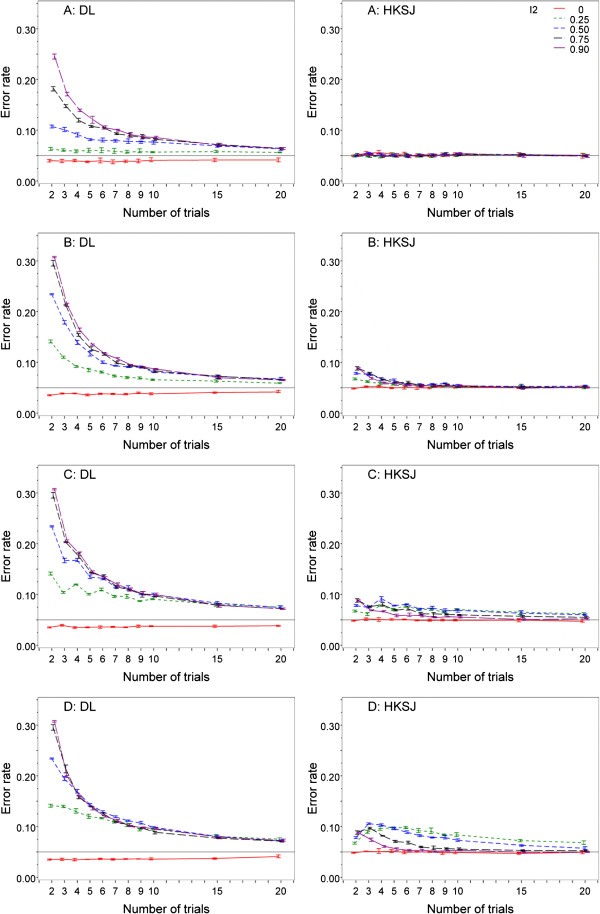
BACKGROUND: The DerSimonian and Laird approach (DL) is widely used for random effects meta-analysis, but this often results in inappropriate type I error rates. The method described by Hartung, Knapp, Sidik and Jonkman (HKSJ) is known to perform better when trials of similar size are combined. However evidence in realistic situations, where one trial might be much larger than the other trials, is lacking. We aimed to evaluate the relative performance of the DL and HKSJ methods when studies of different sizes are combined and to develop a simple method to convert DL results to HKSJ results. METHODS: We evaluated the performance of the HKSJ versus DL approach in simulated meta-analyses of 2-20 trials with varying sample sizes and between-study heterogeneity, and allowing trials to have various sizes, e.g. 25% of the trials being 10-times larger than the smaller trials. We also compared the number of "positive" (statistically significant at p < 0.05) findings using empirical data of recent meta-analyses with > = 3 studies of interventions from the Cochrane Database of Systematic Reviews. RESULTS: The simulations showed that the HKSJ method consistently resulted in more adequate error rates than the DL method. When the significance level was 5%, the HKSJ error rates at most doubled, whereas for DL they could be over 30%. DL, and, far less so, HKSJ had more inflated error rates when the combined studies had unequal sizes and between-study heterogeneity. The empirical data from 689 meta-analyses showed that 25.1% of the significant findings for the DL method were non-significant with the HKSJ method. DL results can be easily converted into HKSJ results. CONCLUSIONS: Our simulations showed that the HKSJ method consistently results in more adequate error rates than the DL method, especially when the number of studies is small, and can easily be applied routinely in meta-analyses. Even with the HKSJ method, extra caution is needed when there are = <5 studies of very unequal sizes.
Overview
The claims and statistics of this paper haven’t been checked yet.
Free: it reads the open-access text and checks the first 5 claims that cite a source we can check. Create a free account to check every claim.
Integrity signals
Registry
Cites
Statistics
Figures
Verification
Claims the paper makes
The claims and statistics of this paper haven’t been checked yet.
Free: it reads the open-access text and checks the first 5 claims that cite a source we can check. Create a free account to check every claim.
Claims other papers make about this one
Each is checked against this paper’s own text: does it say what the citing paper says it does?
The source backs part of the claim, not all of it — or backs it for a different population, condition or comparison.
In the citing paper
“Random-effects meta-regression with Knapp–Hartung adjustment was applied to account for between-study heterogeneity and to calculate 95% prediction intervals, estimating the likely range of effect sizes in future studies (30).”
From The association of screen time and the risk of sleep outcomes: a systematic review and meta-analysis. (2025) · cites this paper as [30]
Experimental — accuracy not yet measuredThe cited source says what the claim attributes to it.
In the citing paper
“To evaluate robustness of pooled estimates, prespecified sensitivity analyses included fixed-effect models, Hartung–Knapp adjustment for random-effects inference, alternative τ² estimators, leave-one-out analyses, and Bayesian random-effects meta-analysis (45–49).”
In the citing paper
“An inverse-variance method with a random-effects model and Hartung-Knapp-Sidik-Jonkman adjustment (33) was used to adjust for study variability in sample sizes.”
From Digital Media Use and Adolescents' Mental Health During the Covid-19 Pandemic: A Systematic Review and Meta-Analysis (2022) · cites this paper as [33]
Self-check
Percentages, sums and reported differences re-computed from the paper’s own numbers.
The self-check needs the paper’s full text.
Citations
Cites
2 retracted
Singh, M., & Das, R. R. (2013) · Cochrane Database of Systematic Reviews · doi:10.1002/14651858.cd001364.pub4 · Cited by 237
RetractedSingh, M., & Das, R. R. (2011) · Cochrane Database of Systematic Reviews · doi:10.1002/14651858.cd001364.pub3 · Cited by 86
RetractedMeasuring inconsistency in meta-analyses
Higgins, J. P. T., Thompson, S. G., Deeks, J. J., & Altman, D. G. (2003) · BMJ · doi:10.1136/bmj.327.7414.557 · Cited by 63,139 · cited 8×
“The levels correspond to no, low, moderate, high and very high heterogeneity, respectively [16].”
BackgroundMethodResultInfluentialMeta-analysis in clinical trials
DerSimonian, R., & Laird, N. (1986) · Controlled Clinical Trials · doi:10.1016/0197-2456(86)90046-2 · Cited by 39,552 · cited 2×
“Background The commonly used method for a random effects metaanalysis is the DerSimonian and Laird approach (DL method) [1].”
MethodQuantifying heterogeneity in a meta‐analysis
Higgins, J. P. T., & Thompson, S. G. (2002) · Statistics in Medicine · doi:10.1002/sim.1186 · Cited by 36,763 · cited 1×
“the degree of inconsistency in the studies’ results, in comparison to the total amount of variation [16,22].”
ResultConducting Meta-Analyses in R with the metafor Package
Viechtbauer, W. (2010) · Journal of Statistical Software · doi:10.18637/jss.v036.i03 · Cited by 20,464 · cited 2×
“The R package metafor [20] can also be used to perform an HKSJ analysis.”
MethodBorenstein, M., Hedges, L. V., Higgins, J. P. T., & Rothstein, H. R. (2009) · doi:10.1002/9780470743386 · Cited by 14,225
Borenstein, M., Hedges, L. V., Higgins, J. P. T., & Rothstein, H. R. (2021) · doi:10.1002/9781119558378 · Cited by 9,799
Improved tests for a random effects meta‐regression with a single covariate
Knapp, G., & Hartung, J. (2003) · Statistics in Medicine · doi:10.1002/sim.1482 · Cited by 2,075 · cited 1×
“The implementation is based on the meta-regression paper by Knapp and Hartung [34]: when no covariates or moderator variables are used, the meta-regression reduces to a random effects metaanalysis as proposed by Hartung/Knapp and Sidik/ Jonkman.”
MethodUncertainty in heterogeneity estimates in meta-analyses
Ioannidis, J. P. A., Patsopoulos, N. A., & Evangelou, E. (2007) · BMJ · doi:10.1136/bmj.39343.408449.80 · Cited by 1,254 · cited 1×
“Some detectable heterogeneity is present in about half of meta-analyses of clinical studies [15-18].”
BackgroundSelf-citation
Research works printed but not linked: 3
- The Cochrane Collaboration Review Manager (RevMan) 5.1.4 2011 Copenhagen: The Nordic Cochrane Centre
- Borenstein M Hedges L Higgins J Rothstein H Comprehensive Meta-analysis Version 2 2005 Englewood NJ: Biostat
- Hartung J An alternative method for meta-analysis Biom J 1999 901 916
Cited by
Items 401–500 of 1,007
Pfledderer, C. D., Burns, R. D., Byun, W., Carson, R. L., Welk, G. J., & Brusseau, T. A. (2021) · Obesity Reviews · doi:10.1111/obr.13265 · Cited by 61
“studies, results from the DerSimonian and Laird random effects model were converted to results using the Hartung–Knapp–Sidak–Jonkman method as this method yields more adequate error rates for random effects meta-analyses using a smaller number of studies.(25) Effect estimates were considered small if g < 0.”
BackgroundMethodKatsimpris, A., Karamaounas, A., Sideri, A. M., Katsimpris, J., Georgalas, I., & Petrou, P. (2021) · Eye · doi:10.1038/s41433-021-01648-1 · Cited by 55
García‐Hermoso, A., Ezzatvar, Y., Huerta‐Uribe, N., Alonso-Martínez, A. M., Chueca-Guindulain, M. J., Berrade‐Zubiri, S., Izquierdo, M., & Ramírez‐Vélez, R. (2022) · European Journal of Sport Science · doi:10.1080/17461391.2022.2086489 · Cited by 57
Mikhail, P., Howden, N., Monjur, M., Jeyaprakash, P., Said, C. F., Bland, A., Collison, D. G., McCartney, P. J., Adamson, C., Morrow, A., et al. (2022) · Open Heart · doi:10.1136/openhrt-2022-002076 · Cited by 45
Machine Learning Models for Predicting Disability and Pain Following Lumbar Disc Herniation Surgery
Berg, B., Gorosito, M. A., Fjeld, O., Haugerud, H., Storheim, K., Solberg, T. K., & Grotle, M. (2024) · JAMA Network Open · doi:10.1001/jamanetworkopen.2023.55024 · Cited by 58
Sharma, A., Alexander, G., Chu, J. H., Markopoulos, A., Maloul, G., Ayub, M. T., Fidler, M. J., & Okwuosa, T. M. (2024) · Journal of the American Heart Association · doi:10.1161/jaha.123.032620 · Cited by 52
Richter, D., & Hoffmann, H. (2018) · Social Psychiatry and Psychiatric Epidemiology · doi:10.1007/s00127-018-1577-z · Cited by 48
Ogbuewu, I. P., Okoro, V. M. O., & Mbajiorgu, C. A. (2019) · Tropical Animal Health and Production · doi:10.1007/s11250-019-02118-3 · Cited by 50
“The outcome of the effect of pepper treatment on broiler performance was depicted in forest plots (DerSimonian and Laird 1986; IntHout et al. 2014).”
BackgroundKang, J. H., Choi, S. H., Lee, J. S., Park, S. H., Kim, K. W., Kim, S. Y., Lee, S. S., & Byun, J. H. (2020) · Journal of Magnetic Resonance Imaging · doi:10.1002/jmri.27065 · Cited by 51
Chen, G., Xu, K., Sun, F., Sun, Y., Kong, Z., & Fang, B. (2020) · Canadian Journal of Infectious Diseases and Medical Microbiology · doi:10.1155/2020/7268519 · Cited by 57
“*e DL method might generate too many statistically significant results when the number of studies is small and there is moderate or substantial heterogeneity [60].”
MethodGordon, M., Viganola, D., Dreber, A., Johannesson, M., & Pfeiffer, T. (2021) · PLOS ONE · doi:10.1371/journal.pone.0248780 · Cited by 44
“When combining the final market price correlations in a random effects metaanalysis (using the conservative Hartung-Knapp-Sidik-Jonkman method to account for the small number of studies [27, 28]), we find a pooled correlation of 0.”
MethodActive video games for rehabilitation in respiratory conditions: Systematic review and meta-analysis
Simmich, J., Deacon, A. J., & Russell, T. G. (2019) · JMIR Serious Games · doi:10.2196/10116 · Cited by 43
“This method is recommended over the more common DerSimonian and Laird (DSL) method [46,47] for meta-analyses where only few studies are available (the DSL method was also calculated for comparison).”
MethodRubio‐Aparicio, M., López-López, J. A., Sánchez‐Meca, J., Marín‐Martínez, F., Viechtbauer, W., & Noortgate, W. V. D. (2018) · Research Synthesis Methods · doi:10.1002/jrsm.1312 · Cited by 44
“This was also reported in previous simulation studies restricted to normal scenarios.(17,22,36) Compared with HM, the PL method produced slightly narrower CIs.”
ResultAimo, A., Georgiopoulos, G. A., Panichella, G., Vergaro, G., Passino, C., Emdin, M., & Clerico, A. (2022) · European Journal of Internal Medicine · doi:10.1016/j.ejim.2022.01.012 · Cited by 50
Carter, J., Bick, D., Gallacher, D., & Chang, Y. (2022) · Birth · doi:10.1111/birt.12649 · Cited by 54
Does corporate governance improve integrated reporting quality? A meta-analytical investigation
Dragomir, V. D., & Dumitru, M. (2023) · Meditari Accountancy Research · doi:10.1108/medar-03-2022-1618 · Cited by 69
Szczerba, E., Barbaresko, J., Schiemann, T., Stahl‐Pehe, A., Schwingshackl, L., & Schlesinger, S. (2023) · BMJ Medicine · doi:10.1136/bmjmed-2023-000664 · Cited by 67
Long-Term Neuropsychiatric, Neurocognitive, and Functional Outcomes of Patients Receiving ECMO
Kalra, A., Kang, J. K., Khanduja, S., Menta, A. K., Ahmad, S. A., Liu, O., Rodriguez, E., Spann, M., Hernández, A. V., Brodie, D., et al. (2024) · Neurology · doi:10.1212/wnl.0000000000208081 · Cited by 43
Tan, Y. L., Chang, V. Y. X., Ang, W. H. D., Ang, W. W., & Lau, Y. (2024) · Anxiety Stress & Coping · doi:10.1080/10615806.2024.2392195 · Cited by 61
“The restricted maximum likelihood approach was used as the estimator for random-effect meta-analysis (Jamshidian, 2004), guided by the Hartung-Knapp-Sidik-Jonkman (HKSJ) method (IntHout et al., 2014).”
Crowther, M. E., Ferguson, S. A., Vincent, G. E., & Reynolds, A. C. (2021) · Clocks & Sleep · doi:10.3390/clockssleep3010009 · Cited by 46
“These methods were chosen to limit error rates due to expected heterogeneity in studies [64].”
MethodFornaro, M., Dragioti, E., Prisco, M. D., Billeci, M., Mondin, A. M., Calati, R., Smith, L., Hatcher, S., Kaluzienski, M., Fiedorowicz, J. G., et al. (2022) · BMC Medicine · doi:10.1186/s12916-022-02423-z · Cited by 65
“Data analysis and assessment of the credibility of evidence We re-analyzed each eligible MA using the extracted individual study estimates to compute the summary effect estimates and the exact p-value under the randomeffects model with DerSimonian and Laird method if included studies were equal or more than 10, and Ha…”
MethodBrini, S., Brudasca, N. I., Hodkinson, A., Kaluzinska, K., Wach, A., Storman, D., Prokop-Dorner, A., Jemioło, P., & Bala, M. M. (2023) · Clinical Psychology Review · doi:10.1016/j.cpr.2022.102236 · Cited by 44
Ezzatvar, Y., Ramírez-Vélez, R., Izquierdo, M., & García-Hermoso, A. (2021) · Diabetologia · doi:10.1007/s00125-021-05554-9 · Cited by 42
Brunner, M., Keller, L., Stallasch, S. E., Kretschmann, J., Hasl, A., Preckel, F., Lüdtke, O., & Hedges, L. V. (2022) · Research Synthesis Methods · doi:10.1002/jrsm.1584 · Cited by 58
Antivirals for post-exposure prophylaxis of influenza: a systematic review and network meta-analysis
Zhao, Y., Gao, Y., Guyatt, G. H., Uyeki, T. M., Liu, P., Liu, M., Shen, Y., Chen, X., Luo, S., Li, X., et al. (2024) · The Lancet · doi:10.1016/s0140-6736(24)01357-6 · Cited by 51
Aziz, H. A., Yahya, H. D. B., Ang, W. W., & Lau, Y. (2024) · Journal of Psychiatric Research · doi:10.1016/j.jpsychires.2024.11.070 · Cited by 65
Moreno, J. D., Martínez‐Huertas, J. Á., Olmos, R., Jorge‐Botana, G., & Botella, J. (2021) · Personality and Individual Differences · doi:10.1016/j.paid.2021.110818 · Cited by 55
Saueressig, T., Pedder, H., Bowe, S. J., Owen, P. J., & Belavy, D. L. (2021) · Journal of Orthopaedic & Sports Physical Therapy · doi:10.2519/jospt.2021.0107 · Cited by 41
Escandón, J. M., Escandón, L., Ahmed, A., Weiss, A. C., Nazerali, R. S., Ciudad, P., Langstein, H. N., & Manrique, O. J. (2022) · Journal of Plastic Reconstructive & Aesthetic Surgery · doi:10.1016/j.bjps.2022.08.025 · Cited by 44
A population‐based meta‐analysis of circulating GFAP for cognition and dementia risk
Gonzales, M. M., Wiedner, C. D., Wang, C., Liu, Q., Bis, J. C., Li, Z., Himali, J. J., Ghosh, S., Thomas, E. A., Parent, D. M., et al. (2022) · Annals of Clinical and Translational Neurology · doi:10.1002/acn3.51652 · Cited by 53
Chin, Y. H., Ng, C. H., Chew, N., Kong, G., Lim, W. H., Tan, D. J. H., Chan, K. E., Tang, A. S. P., Huang, D. Q., Chan, M. Y., et al. (2022) · EClinicalMedicine · doi:10.1016/j.eclinm.2022.101685 · Cited by 46
Bring, A., Thorslund, J., Rosén, L., Tonderski, K. S., Åberg, C., Envall, I., & Laudon, H. (2022) · Environmental Evidence · doi:10.1186/s13750-022-00289-5 · Cited by 57
“67 [52, 82] 28 [−3, 59] 48 [12, 85] 88 [63, 114] 40 [38, 42] 45 [44, 46] 38 [14, 62] 48 [41, 55]”
Gates, M., Pillay, J., Nuspl, M., Wingert, A., Vandermeer, B., & Hartling, L. (2023) · Systematic Reviews · doi:10.1186/s13643-023-02181-w · Cited by 52
“In all cases, we used the restricted maximum likelihood estimation approach and the Hartun-Knapp-Sidnick-Jonkman correction to derive 95% CIs [73, 74].”
MethodBoredom and digital media use: A systematic review and meta-analysis
Camerini, A.-L., Morlino, S., & Marciano, L. (2023) · Computers in Human Behavior Reports · doi:10.1016/j.chbr.2023.100313 · Cited by 63
Yoon, S., Choi, G., Lee, O. H., Yoon, I. J., Kang, H., Baek, C., Jung, Y., & Woo, Y. (2018) · Digestive Endoscopy · doi:10.1111/den.13050 · Cited by 35
Bell, E., Fryar, A. H., & Hillman, N. (2018) · Edward Elgar Publishing eBooks · doi:10.4337/9781785369759.00017 · Cited by 41
Niu, Q., Hong, Y., Lee, C., Men, C., Zhao, H., & Zuo, L. (2018) · PLoS ONE · doi:10.1371/journal.pone.0204526 · Cited by 41
Hu, Y., Matsui, Y., & Riley, L. W. (2020) · Antimicrobial Resistance and Infection Control · doi:10.1186/s13756-020-0691-3 · Cited by 46
“Hartung-Knapp adjustment provides a more conservative and robust pooled OR estimates and 95% CI, allowing for any heterogeneity between studies even when the study number is small and study size is unequal [33].”
BackgroundKoo, C., Hwang, J., Shin, H., & Ryu, J. (2020) · Journal of Clinical Medicine · doi:10.3390/jcm9092928 · Cited by 41
“In case the number of combined studies was lower than 10, the Hartung–Knapp–Sidik–Jonkman method was used in the random-effects analysis to minimize the error rate [15].”
MethodChew, H. S. J., Rajasegaran, N. N., Chin, Y. H., Chew, W. S. N., & Kim, K. M. (2023) · Journal of Medical Internet Research · doi:10.2196/42432 · Cited by 40
“…method rather than the commonly used DerSimonian-Laird method as they account for sampling error and small sample size [16,17]. τ 2 was used to estimate the between-study heterogeneity, and I 2 statistic was used to quantify the heterogeneity where 25%, 50%, and 75%…”
Doyle, E., Doyle, T. L. A., Bonacci, J., & FULLER, J. T. (2022) · Journal of Orthopaedic and Sports Physical Therapy · doi:10.2519/jospt.2022.10585 · Cited by 57
Yeung, M. K.-C., Chau, A. K.-Y., Chiu, J. Y.-C., Shek, J. T.-L., Leung, J. P.-Y., & Wong, T. C.-H. (2022) · Ageing Research Reviews · doi:10.1016/j.arr.2022.101675 · Cited by 42
Oerlemans, L. N. T., Peeters, C. M. M., Munnik-Hagewoud, R., Nijholt, I. M., Witlox, A. M. A., & Verheyen, C. C. P. M. (2023) · BMC Musculoskeletal Disorders · doi:10.1186/s12891-022-06044-8 · Cited by 47
Cuijpers, P. J., Harrer, M., Miguel, C., Čihařová, M., & Karyotaki, E. (2023) · American Psychologist · doi:10.1037/amp0001250 · Cited by 50
Nedjat, S., Wang, Y., Eshtiaghi, K., & Fleming, M. L. (2023) · Research in Social and Administrative Pharmacy · doi:10.1016/j.sapharm.2023.12.001 · Cited by 40
Ayenew, A. A., Mol, B. W., Bradford, B. F., & Abeje, G. (2024) · Systematic Reviews · doi:10.1186/s13643-023-02428-6 · Cited by 67
“The overall and sub-group pooled effect sizes were calculated using the random effect model with DerSimonian and Laired pooled effect method [38].”
MethodSaboor, S., Medina, A., & Marciano, L. (2024) · JMIR Mental Health · doi:10.2196/56045 · Cited by 68
Park, S.-K., Han, D. W., Chang, C. H., Jung, H., Kang, H., & Song, Y. R. (2024) · Anesthesiology · doi:10.1097/aln.0000000000005255 · Cited by 49
“15 The Hartung–Knapp–Sidik–Jonkman model was chosen as a secondary analysis to reduce potential type I error rates compared to the DerSimonian and Laird random effects model, particularly in situations where the number of studies is small and substantial heterogeneity exists.”
Equal‐tailed confidence intervals for comparison of rates
Laud, P. J. (2017) · Pharmaceutical Statistics · doi:10.1002/pst.1813 · Cited by 40
Impact of Whole, Fresh Fruit Consumption on Energy Intake and Adiposity: A Systematic Review
Guyenet, S. J. (2019) · Frontiers in Nutrition · doi:10.3389/fnut.2019.00066 · Cited by 39
“Although meta-analyses are commonly performed on fewer than ten studies, typical methods for accomplishing this do not adequately control the false positive rate, particularly in the context of high heterogeneity (23).”
MethodLee, H., Jeong, S., Yu, Y., Kang, J., Sun, H., Rhee, J., & Kim, Y. H. (2019) · Journal of Medical Genetics · doi:10.1136/jmedgenet-2019-106324 · Cited by 48
Schneider, S., Junghaenel, D. U., Broderick, J. E., Ono, M., May, M., & Stone, A. A. (2020) · Journal of Pain · doi:10.1016/j.jpain.2020.10.002 · Cited by 43
“This method has been shown to yield more accurate confidence intervals compared to unadjusted methods especially when a small number of studies with unbalanced sample sizes is combined in random-effects meta-analysis [29,51]; rather than assuming a standard normal distribution, individual coefficients and confidence i…”
MethodSchouten, M. J. E., Christ, C., Dekker, J., Riper, H. M., Goudriaan, A. E., & Blankers, M. (2021) · Alcohol and Alcoholism · doi:10.1093/alcalc/agaa147 · Cited by 53
“Simulation studies have shown that the HKSJ estimator often performs better than the frequently used DerSimonianLaird (DL) estimator, especially when there is heterogeneity and the number of pooled studies is small (IntHout et al., 2014).”
MethodNchanji, E. B., & Odhiambo, C. (2021) · Nutrients · doi:10.3390/nu13113701 · Cited by 51
“Following [46], we used the Sidik–Jonkman method and applied the Knapp–Hartung error adjustment to present robust coefficients.”
MethodOrhan, A., Khesrawi, F., Madsen, M. T., Vogelsang, R. P., Dohrn, N., Fiehn, A. K., & Gögenür, I. (2022) · Cancers · doi:10.3390/cancers14030636 · Cited by 44
“Sidik-Jonkman was applied for tau2 estimation and Hartung-Knapp adjustment of 95% CI for the random-effect model [23].”
MethodResilience Interventions Conducted in Western and Eastern Countries—A Systematic Review
Blessin, M., Lehmann, S., Kunzler, A. M., van Dick, R., & Lieb, K. (2022) · International Journal of Environmental Research and Public Health · doi:10.3390/ijerph19116913 · Cited by 40
“The test statistics and CIs were adjusted with the Hartung-KnappSidik-Jonkman method [38].”
MethodDelagneau, G., Twilhaar, E. S., Testa, R., van Veen, S., & Anderson, P. J. (2023) · Child Development · doi:10.1111/cdev.13885 · Cited by 46
“The variance ( τ 2 ) was estimated using the Hartung– Knapp– Sidik– Jonkman method, which provides more robust estimates when the number of studies is small (IntHout et al., 2014).”
MethodMostaid, M. S., Mancuso, S. G., Liu, C., Sundram, S., Pantelis, C., Everall, I., & Bousman, C. (2017) · Translational Psychiatry · doi:10.1038/tp.2016.279 · Cited by 45
Barić, H., Đorđević, V., Cerovečki, I., & Trkulja, V. (2018) · Advances in Therapy · doi:10.1007/s12325-018-0680-6 · Cited by 42
“Hartung–Knapp–Sidik–Jonkman correction for the standard error of the estimate [24].”
BackgroundZeng, Y., Tang, Y., Tang, J., Shi, J. C., Zhang, L., Zhu, T., Xiao, D., Qu, Y., & Mu, D. (2018) · Nutritional Neuroscience · doi:10.1080/1028415x.2018.1560905 · Cited by 48
Jury, M., Aelenei, C., Chen, C., Darnon, C., & Elliot, A. J. (2019) · Group Processes & Intergroup Relations · doi:10.1177/1368430219827361 · Cited by 52
García‐Albéniz, X., del Amo, J., Polo, R., Morales‐Asencio, J. M., & Hernán, M. Á. (2022) · European Journal of Epidemiology · doi:10.1007/s10654-022-00891-4 · Cited by 38
“Because the standard random effects method may yield an anticonservative (that is, too narrow) 95% CI (8), we also used the Hartung-Knapp random effects method (9), which has been shown to generally outperform the standard random effects method (10).”
MethodE-cigarettes and myocardial infarction: A systematic review and meta-analysis
Sharma, A., Gupta, I., Venkatesh, U., Singh, A. K., Golamari, R. R., & Arya, P. (2022) · International Journal of Cardiology · doi:10.1016/j.ijcard.2022.09.007 · Cited by 40
Cheng, W. H., Teo, R. H., Cheng, L. J., Lau, Y., & Lau, S. T. (2023) · Sleep Health · doi:10.1016/j.sleh.2023.04.004 · Cited by 51
Kang, J., Lee, H., Yu, S., Lee, M., Kim, H. J., Kwon, R., Kim, S. Y., Fond, G. B., Boyer, L., Rahmati, M., et al. (2024) · Molecular Psychiatry · doi:10.1038/s41380-024-02624-3 · Cited by 54
Pateras, K., Nikolakopoulos, S., & Roes, K. C. B. (2017) · Statistics in Medicine · doi:10.1002/sim.7569 · Cited by 39
“The second is based on the assumption of a fixed average trial risk ( p i 0 = ( p iT + p iC )∕ 2), with which we calculate the event probability in each arm, based on a simulated overall treatment effect 4 , 10 ; we refer to this as “ pAverage .””
Andò, G., & Costa, F. (2019) · International Journal of Cardiology · doi:10.1016/j.ijcard.2019.12.054 · Cited by 44
Choi, S. J., Yoon, H. M., Hwang, J. S., Suh, C. H., Jung, A. Y., Cho, Y. A., & Lee, J. S. (2020) · JAMA Network Open · doi:10.1001/jamanetworkopen.2020.7221 · Cited by 38
Dalia, T., Lahan, S., Ranka, S., Acharya, P., Gautam, A. S., Goyal, A., Mastoris, I., Sauer, A. J., & Shah, Z. I. (2020) · Indian Heart Journal · doi:10.1016/j.ihj.2020.12.002 · Cited by 45
Efficacy and Safety of Tranexamic Acid in Emergency Trauma: A Systematic Review and Meta-Analysis
Al-Jeabory, M., Szarpak, Ł., Attila, K., Simpson, M., Smereka, A., Gąsecka, A., Wieczorek, W., Pruc, M., Koselak, M., Gaweł, W., et al. (2021) · Journal of Clinical Medicine · doi:10.3390/jcm10051030 · Cited by 38
“We performed sensitivity analysis using the Hartung–Knapp–Sidik–Jonkman method, when the number of studies was small (<10) [20].”
MethodPark, J. E., Cheong, E., Jung, D. E., Shim, W. H., & Lee, J. S. (2021) · Frontiers in Neurology · doi:10.3389/fneur.2021.621936 · Cited by 44
“The pooled detection rate for focal lesions in patients with epilepsy was obtained by the Hartung-Knapp adjustment for random-effects models (16).”
MethodTsai, H., Lu, J.-W., Chen, L.-Y., & Chen, T. (2021) · Journal of Personalized Medicine · doi:10.3390/jpm11040279 · Cited by 42
“Concerning the possibility of producing false-positive results when using the DerSimonian–Laird method, we applied the Hartung–Knapp–Sidik–Jonkman (HKSJ) method for sensitivity analyses [29].”
MethodHuang, M., Shoskes, A., Migdady, I., Amin, M., Hasan, L. Z., Price, C. L., Uchino, K., Choi, C. W., Hernández, A. V., & Cho, S. (2021) · Journal of Intensive Care Medicine · doi:10.1177/08850666211018982 · Cited by 38
“The Sidik-Jonkman estimator was used for tau(19) and HartungKnapp adjustment was used in order to calculate confidence intervals (CI).(20) The Freeman-Tukey double arcsine transformation was used to calculate prevalence for all outcomes.”
MethodTuricchi, J., O'Driscoll, R., Finlayson, G., Beaulieu, K., Deighton, K., & Stubbs, R. J. (2019) · Obesity Reviews · doi:10.1111/obr.12849 · Cited by 37
“Both of these approaches are recommended as conservative methods, and therefore the risk of type 1 errors was reduced.(45) Two unstandardized outcome variables were used: (1) weight regain (the absolute difference between weight following loss and at follow‐up) and (2) FFM loss (the absolute difference between FFM at…”
MethodMeta-analysis of antenatal infection and risk of asthma and eczema
Zhu, T., Zhang, L., Qu, Y., & Mu, D. (2016) · Medicine · doi:10.1097/md.0000000000004671 · Cited by 38
“A random effects model was performed for all analyses in this study, as there was significant heterogeneity across studies in the pooled analysis and a small number of studies (<5 studies) in the subgroup meta-analyses for types of maternal infections.([11]) In regards to study design, an”
BackgroundMethodExact Inference on the Random-Effects Model for Meta-Analyses With Few Studies
Michael, H., Thornton, S., Xie, M., & Tian, L. (2018) · Biometrics · doi:10.1111/biom.12998 · Cited by 42
“Indeed, extensive simulation studies have found that the coverage probability of the DL-based confidence interval (CI) can be substantially lower than the nominal level in various settings (Kontopantelis et al., 2010; IntHout et al., 2014), leading to false positives.”
BackgroundNeale, E. P., Guan, V. X., Tapsell, L. C., & Probst, Y. (2020) · British Journal Of Nutrition · doi:10.1017/s0007114520001415 · Cited by 40
“Sensitivity analyses were also conducted using the random effects model with Hartung – Knapp – Sidik – Jonkman adjustment (26) .”
Yoneda, T. B., Lewis, N. A., Knight, J. E., Rush, J., Vendittelli, R., Kleineidam, L., Hyun, J., Piccinin, A. M., Hofer, S. M., Hoogendijk, E. O., et al. (2020) · The Journals of Gerontology Series A · doi:10.1093/gerona/glaa268 · Cited by 48
Combat and Operational Stress Control Interventions and PTSD: A Systematic Review and Meta-Analysis
Maglione, M., Chen, C., Bialas, A., Motala, A., Chang, J., Akinniranye, O., & Hempel, S. (2021) · Military Medicine · doi:10.1093/milmed/usab310 · Cited by 58
Mindfulness and Parenting: A Meta-analysis and an Exploratory Meta-mediation
Kil, H., Antonacci, R., Shukla, S., & Luca, A. D. (2021) · Mindfulness · doi:10.1007/s12671-021-01720-7 · Cited by 45
Berezowski, L., Ludwig, L., Martin, A., Löwe, B., & Mora, M. C. S. (2021) · Psychosomatic Medicine · doi:10.1097/psy.0000000000001011 · Cited by 48
“The 95% CIs were calculated via the Knapp-Hartung method (40,41).”
MethodMcEwen, C. C., Amir, T., Qiu, Y., Young, J., Kennedy, K., Grocott, H. P., Kashani, H. H., Mazer, C. D., Brudney, C. S., Kavosh, M., et al. (2022) · Canadian Journal of Anesthesia/Journal canadien d anesthésie · doi:10.1007/s12630-021-02171-3 · Cited by 39
Lorenzo-Luaces, L., Johns, E., & Keefe, J. R. (2018) · Journal of Medical Internet Research · doi:10.2196/10113 · Cited by 36
Gillespie, C. S., Veremu, M., Cook, W. H., Ashraf, M., Lee, K. S., Chedid, Y., Alam, A. M., Karepov, Y., Davies, B. M., Edlmann, E., et al. (2025) · Acta Neurochirurgica · doi:10.1007/s00701-025-06587-4 · Cited by 47
Acupuncture for substance use disorders: A systematic review and meta-analysis
Grant, S., Kandrack, R., Motala, A., Shanman, R., Booth, M. S., Miles, J. N. V., Sorbero, M. E. S., & Hempel, S. (2016) · Drug and Alcohol Dependence · doi:10.1016/j.drugalcdep.2016.02.034 · Cited by 40
He, Y., Ong, A. Y., Li, X., Din, F. V., Brown, E. R., Timofeeva, M. N., Wang, Z., Farrington, S. M., Campbell, H., Dunlop, M. G., et al. (2019) · Surgical Oncology · doi:10.1016/j.suronc.2019.05.014 · Cited by 40
“Given the relatively small number of validation studies for each model and the inherent heterogeneity across external datasets with diverse populations and clinical settings, we adopted the restricted maximum likelihood (REML) estimation along with the Hartung-Knapp-Sidik-Jonkman (HKSJ) method under a random-effects m…”
MethodVeronese, N., Demurtas, J., Thompson, T., Solmi, M., Pesolillo, G., Celotto, S., Barnini, T., Stubbs, B., Maggi, S., Pilotto, A., et al. (2020) · British Journal of Clinical Pharmacology · doi:10.1111/bcp.14310 · Cited by 39
“This estimator consistently results in more adequate error rates than the DerSirmonian-Leird method, especially when the number of studies is small.(19) We also estimated the prediction interval (PIs) and its 95% CI, which further accounts for between-study effects and estimates the certainty of the association if a n…”
MethodResultSelf-citationClifford, B. K., Koizumi, S., Wewege, M. A., Leake, H. B., Ha, L., Macdonald, E. R., Fairman, C. M., & Hagstrom, A. D. (2021) · Sports Medicine · doi:10.1007/s40279-021-01542-6 · Cited by 42
Παπαδόπουλος, Α., Palaiopanos, K., Protogerou, A. D., Paraskevas, G. P., Tsivgoulis, G. K., & Georgakis, M. K. (2020) · Journal of Stroke · doi:10.5853/jos.2019.03335 · Cited by 39
Buck, N., Fountain, M. T., Potts, S. G., Bishop, J., & Garratt, M. P. D. (2022) · Agricultural and Forest Entomology · doi:10.1111/afe.12531 · Cited by 48
“The Hartung-Knapp-SidikJonkman (HKSJ) estimator was used as it produces a more robust estimate of variance in the random-effects model (Inthout et al., 2014).”
MethodČihařová, M., Karyotaki, E., Miguel, C., Walsh, E., de Ponti, N., Amarnath, A., van Ballegooijen, W., Riper, H. M., Arroll, B., & Cuijpers, P. J. (2024) · Journal of Affective Disorders · doi:10.1016/j.jad.2024.05.070 · Cited by 42
Implicit and explicit influences of religious cognition on Dictator Game transfers
Billingsley, J., Gomes, C., & McCullough, M. E. (2018) · Royal Society Open Science · doi:10.1098/rsos.170238 · Cited by 37
Orange, S. T., Jordan, A., & Saxton, J. (2020) · Physiological Reports · doi:10.14814/phy2.14635 · Cited by 42
“Confidence intervals (CIs) were adjusted using the Knapp–Hartung adjustment due to the low number of studies (IntHout et al., 2014).”
MethodZhou, S., Xu, J., Xue, C., Yang, B., Mao, Z., & Ong, A. C. M. (2020) · Renal Failure · doi:10.1080/0886022x.2020.1847724 · Cited by 42
Alkadri, J., Hage, D., Nickerson, L. H., Scott, L. R., Shaw, J. F., Aucoin, S. D., & McIsaac, D. I. (2021) · Anesthesia & Analgesia · doi:10.1213/ane.0000000000005595 · Cited by 38
Chojak, R., Koźba‐Gosztyła, M., Słychan, K., Gajos, D., Kotas, M., Tyliszczak, M., & Czapiga, B. (2021) · Scientific Reports · doi:10.1038/s41598-021-93441-z · Cited by 35
Khan, S. A., Campbell, A., Lu, Y., An, L., Alpert, J. S., & Chen, Q. M. (2021) · Frontiers in Cardiovascular Medicine · doi:10.3389/fcvm.2021.752939 · Cited by 38
“The false positive rate increases when a small number of studies are enrolled and the outcome measures vary largely between the trials (19, 20).”
BackgroundMethodMacle, L., Frame, D., Gache, L. M., Monir, G., Pollak, S. J., & Boo, L. M. (2019) · BMJ Open · doi:10.1136/bmjopen-2018-023775 · Cited by 35
“We also employed an alternate meta-analytic method, Hartung-Knapp-Sidik-Jonkman (HKSJ), which is increasingly recommended for small and heterogeneous data sets, to assess impact on results.(10) After fitting the analyses, key patient and study design characteristics, for example, type of AF, comparator and study desig…”
MethodNg, C.-A., Gandham, A., Mesinovic, J., Owen, P. J., Ebeling, P. R., & Scott, D. (2023) · Journal of Bone and Mineral Research · doi:10.1002/jbmr.4899 · Cited by 36
Haslam, A., Gill, J., Taniguchi, T. E., Love, C. V., & Jernigan, V. B. B. (2022) · Nutrition and Health · doi:10.1177/02601060211070718 · Cited by 39
“Because of unknown variability in our studies, we calculated pooled mean differences for the main outcomes using a random-effects model with the Hartung-Knapp-Sidik-Jonkman method (IntHout et al., 2014).”
Method
Metadata
- Authors
- IntHout, J., Ioannidis, J. P., & Borm, G. F.
- Affiliations
- Radboud University Medical Center (NL)
- Stanford Medicine (US)
- Corresponding author
- IntHout, Joanna
- Venue
- BMC Medical Research Methodology
- Published
- 2014-02-18
- Volume
- 14
- Issue
- 1
- Pages
- 25-25
- ISSN
- 1471-2288 (ISSN-L)
- PMC
- PMC4015721
- OpenAlex
- W2032506622
- Cited by
- 2,419
- References
- 32
- Citations by year
- 2026: 599 · 2025: 299 · 2024: 319 · 2023: 279 · 2022: 263 · 2021: 243 · 2020: 144 · 2019: 81 · 2018: 62 · 2017: 50 · 2016: 37 · 2015: 37 · 2014: 3
- FWCI
- 41.47
- Type
- journal article
- Language
- en
- Open access
- gold
- doi.org
- Licence
- Locations
- BMC Medical Research Methodology (publishedVersion, cc-by)
- Europe PMC (PubMed Central) (publishedVersion, cc-by)
- PubMed Central (publishedVersion, cc-by)
- PubMed (publishedVersion)
- Radboud Repository (Radboud University) (submittedVersion)
- Radboud Repository (Radboud University) (submittedVersion, other-oa)
- Topics
- Social Sciences › Decision Sciences › Statistics, Probability and Uncertainty › Meta-analysis and systematic reviews
- Physical Sciences › Mathematics › Statistics and Probability › Statistical Methods in Clinical Trials
- Physical Sciences › Mathematics › Statistics and Probability › Statistical Methods in Epidemiology
- Keywords
- random-effects meta-analysis, DerSimonian-Laird method, type I error rate, study heterogeneity, significance testing
- MeSH terms
- Clinical Trials as Topic, Common Cold, Data Interpretation, Statistical, Humans, Zinc, Proportional Hazards Models, Odds Ratio, Sample Size, Precursor Cell Lymphoblastic Leukemia-Lymphoma
About these checks
Registry, retraction, Cites and statistics results are computed, not judged, with one exception: a printed reference that no index lists is read once by a model before it counts as a citation error. Claims are extracted by a model and kept only when their quote appears verbatim in the text; each cited source is then checked, with a model’s help, for whether it says what the claim relies on. Those verdicts can be wrong — read the claim’s quote and the cited source before relying on one.
Statistics and arithmetic are recomputed, not judged.
Confidence bands are shown only for fields calibrated on our annotated test set. None is calibrated yet, so no band is shown.
What counts as a claim ›How we measure confidence ›How we check this ›
Are you an author, or do you see a problem with this page? Request a review
Data sources
Bibliographic data: Semantic Scholar, OpenAlex, Crossref.
Contains information from the Semantic Scholar Academic Graph Datasets, made available under the ODC Attribution License (ODC-BY 1.0).
Semantic Scholar’s data is described in: Kinney, R., et al. (2023). The Semantic Scholar Open Data Platform. arXiv:2301.10140.
